anaheim-gazette 1906-06-14
Scanned page
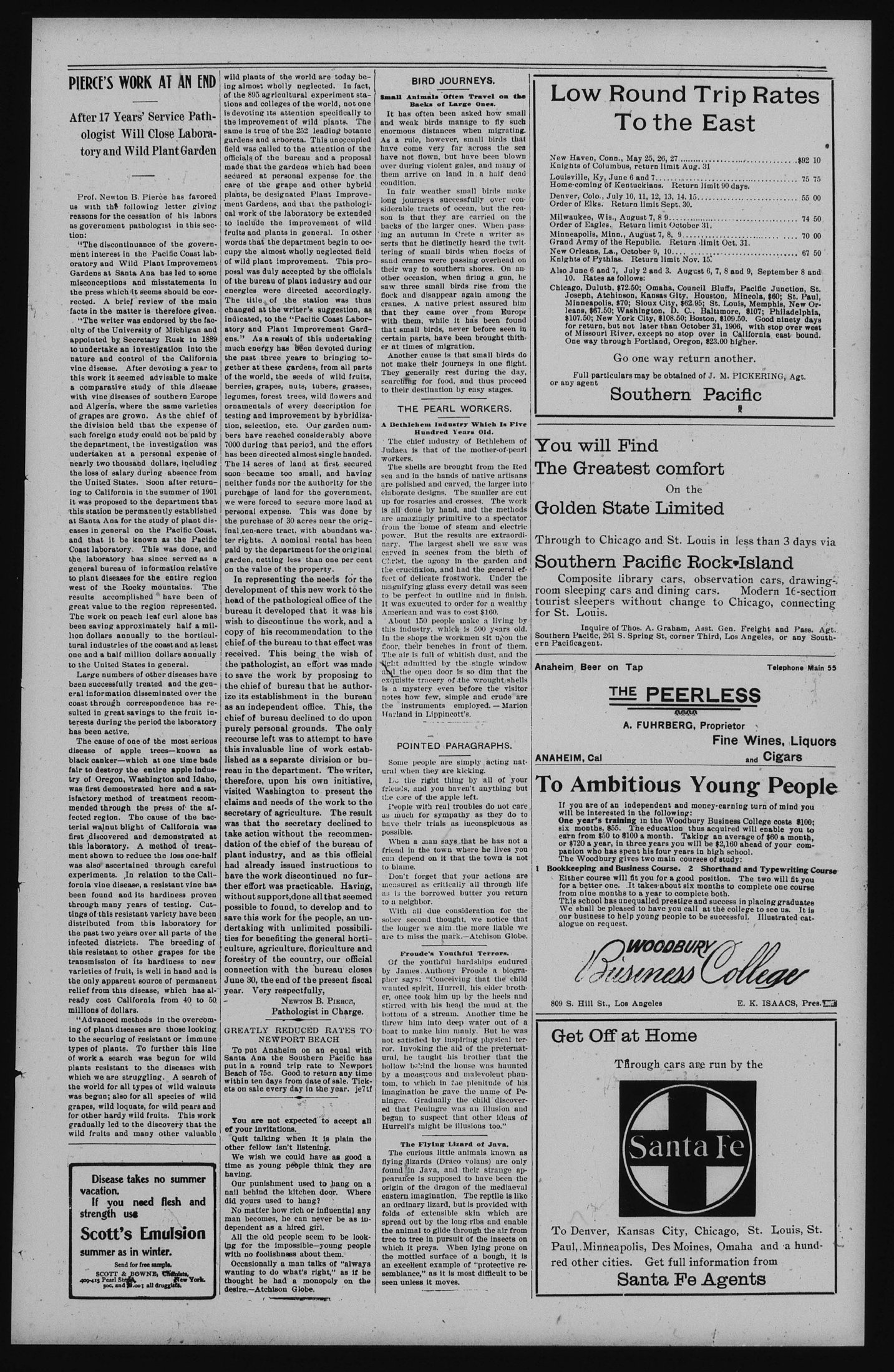
Searchable text
PIERCE'S WORK AT AN END
After 17 Years' Service Pathologist Will Close Laboratory and Wild Plant Garden
Prof. Newton B. Pierce has favored us with the following letter giving reasons for the cessation of his labors as government pathologist in this section:
"The discontinuance of the government interest in the Pacific Coast laboratory and Wild Plant Improvement Gardens at Santa Ana has led to some misconceptions and misstatements in the press which it seems should be corrected. A brief review of the main facts in the matter is therefore given.
"The writer was endorsed by the faculty of the University of Michigan and appointed by Secretary Rusk in 1889 to undertake an investigation into the nature and control of the California vine disease. After devoting a year to this work it seemed advisable to make a comparative study of this disease with vine diseases of southern Europe and Algeria, where the same varieties of grapes are grown. As the chief of the division held that the expense of such foreign study could not be paid by the department, the investigation was undertaken at a personal expense of nearly two thousand dollars, including the loss of salary during absence from the United States. Soon after returning to California in the summer of 1901 it was proposed to the department that this station be permanently established wild plants of the world are being almost wholly neglected of the 895 agricultural experiments and colleges of the world is devoting its attention specifically to the improvement of wild plants; same is true of the 252 leading gardens and arboreta. This field was called to the attention officials of the bureau and made that the gardens which secured at personal expense care of the grape and other plants, be designated Plantment Gardens, and that the local work of the laboratory be included in the improvement of fruits and plants in general. Words that the department be copy the almost wholly neglect of wild plant improvement.posal was duly accepted by the of the bureau of plant industry energies were directed accoThe title of the station changed at the writer's suggestion, to the "Pacific Coast laboratory and Plant Improvements."
As a result of this much energy has been devoted to the past three years to bring together at these gardens, from of the world, the seeds of w berries, grapes, nuts, tubers legumes, forest trees, wild fl ornamentals of every description testing and improvement by tion, selection, etc. Our gardeners have reached considerable 7000 during that period, and has been directed almost single The 14 acres of land at first soon became too small, and neither funds nor the author purchase of land for the go we were forced to secure more personal expense. This was
and Algeria, where the same varieties of grapes are grown. As the chief of the division held that the expense of such foreign study could not be paid by the department, the investigation was undertaken at a personal expense of nearly two thousand dollars, including the loss of salary during absence from the United States. Soon after returning to California in the summer of 1901 it was proposed to the department that this station be permanently established at Santa Ana for the study of plant diseases in general on the Pacific Coast, and that it be known as the Pacific Coast laboratory. This was done, and the laboratory has since served as a general bureau of information relative to plant diseases for the entire region west of the Rocky mountains. The results accomplished have been of great value to the region represented. The work on peach leaf curl alone has been saving approximately half a million dollars annually to the horticultural industries of the coast and at least one and a half million dollars annually to the United States in general.
Large numbers of other diseases have been successfully treated and the general information disseminated over the coast through correspondence has resulted in great savings to the fruit interests during the period the laboratory has been active.
The cause of one of the most serious disease of apple trees—known as black canker—which at one time bade fair to destroy the entire apple industry of Oregon, Washington and Idaho, was first demonstrated here and a satisfactory method of treatment recommended through the press of the affected region. The cause of the bacterial walnut blight of California was first discovered and demonstrated at this laboratory. A method of treatment shown to reduce the loss one-half was also ascertained through careful experiments. In relation to the California vine disease, a resistant vine has been found and its hardiness proven through many years of testing. Cuttings of this resistant variety have been distributed from this laboratory for the past two years over all parts of the infected districts. The breeding of this resistant to other grapes for the transmission of its hardiness to new ornamentals of every description testing and improvement by selection, etc. Our gardens have reached considerable 7000 during that period, and we have directed almost single The 14 acres of land at first soon became too small, and neither funds nor the authority purchase of land for the good we were forced to secure more personal expense. This was the purchase of 30 acres near final ten-acre tract, with abuser rights. A nominal rental paid by the department for the garden, netting less than one on the value of the property.
In representing the need development of this new work head of the pathological office it developed that it wish to discontinue the work copy of his recommendation chief of the bureau to that received. This being there the pathologist, an effort to save the work by propelling the chief of bureau that heize its establishment in that as an independent office. Chief of bureau declined to purely personal grounds. Recourse left was to attempt this invaluable line of work listed as a separate division reau in the department. Therefore, upon his own visited Washington to proclaims and needs of the world secretary of agriculture. That was that the secretary de take action without the reation of the chief of the plant industry, and as tha had already issued instructions have the work discontinued their effort was practicable without support, done all that possible to found, to develop save this work for the people dertaking with unlimited ties for benefiting the genetic culture, agriculture, floriculture forestry of the country, our connection with the burge
was also ascertained through careful experiments. In relation to the California vine disease, a resistant vine has been found and its hardiness proven through many years of testing. Cuttings of this resistant variety have been distributed from this laboratory for the past two years over all parts of the infected districts. The breeding of this resistant to other grapes for the transmission of its hardiness to new varieties of fruit, is well in hand and is the only apparent source of permanent relief from this disease, which has already cost California from 40 to 50 millions of dollars.
"Advanced methods in the overcoming of plant diseases are those looking to the securing of resistant or immune types of plants. To further this line of work a search was begun for wild plants resistant to the diseases with which we are struggling. A search of the world for all types of wild walnuts was begun; also for all species of wild grapes, wild loquats, for wild pears and for other hardy wild fruits. This work gradually led to the discovery that the wild fruits and many other valuable
Disease takes no summer vacation.
If you need flesh and strength use
Scott's Emulsion
summer as in winter.
Send for free sample.
SCOTT & BOWNE, Chemists,
409-415 Pearl Street,
New York.
50c. and $2.00; all druggists.
BIRD JOURNEYS.
Small Animals Often Travel on the Backs of Large Ones.
It has often been asked how small and weak birds manage to fly such enormous distances when migrating. As a rule, however, small birds that have come very far across the sea have not flown, but have been blown over during violent gales, and many of them arrive on land in a half dead condition.
In fair weather small birds make long journeys successfully over considerable tracts of ocean, but the reason is that they are carried on the backs of the larger ones. When passing an autumn in Crete a writer asserts that he distinctly heard the twittering of small birds when flocks of sand cranes were passing overhead on their way to southern shores. On another occasion, when firing a gun, he saw three small birds rise from the flock and disappear again among the cranes. A native priest assured him that they came over from Europe with them, while it has been found that small birds, never before seen in certain parts, have been brought thither at times of migration.
Another cause is that small birds do not make their journeys in one flight. They generally rest during the day, searching for food, and thus proceed to their destination by easy stages.
THE PEARL WORKERS.
A Bethlehem Industry Which Is Five Hundred Years Old.
The chief industry of Bethlehem of Judaea is that of the mother-of-pearl workers.
The shells are brought from the Red sea and in the hands of native artisans are polished and carved, the larger into elaborate designs. The smaller are cut up for rosaries and crosses. The work is all done by hand, and the methods
THE PEARL WORKERS.
A Bethlehem Industry Which Is Five Hundred Years Old.
The chief industry of Bethlehem of Judaea is that of the mother-of-pearl workers.
The shells are brought from the Red sea and in the hands of native artisans are polished and carved, the larger into elaborate designs. The smaller are cut up for roseries and crosses. The work is all done by hand, and the methods are amazingly primitive to a spectator from the home of steam and electric power. But the results are extraordinary. The largest shell we saw was carved in scenes from the birth of Christ, the agony in the garden and the crucifixion, and had the general effect of delicate frostwork. Under the magnifying glass every detail was seen to be perfect in outline and in finish. It was executed to order for a wealthy American and was to cost $160.
About 150 people make a living by this industry, which is 500 years old. In the shops the workmen sit upon the floor, their benches in front of them. The air is full of whitish dust, and the light admitted by the single window and the open door is so dim that the exquisite tracery of the wrought shells is a mystery even before the visitor notes how few, simple and crude are the instruments employed. — Marion Harland in Lippincott's.
POINTED PARAGRAPHS.
Some people are simply acting natural when they are kicking.
Do the right thing by all of your friends, and you haven't anything but the core of the apple left.
People with real troubles do not care as much for sympathy as they do to have their trials as inconspicuous as possible.
When a man says that he has not a friend in the town where he lives you can depend on it that the town is not to blame.
Don't forget that your actions are measured as critically all through life as is the borrowed butter you return to a neighbor.
With all due consideration for the sober second thought, we notice that the longer we aim the more liable we are to miss the mark.—Atchison Globe.
Froude's Youthful Terrors.
Of the youthful hardships endured
Froude's Youthful Terrors.
Of the youthful hardships endured by James Anthony Froude a biographer says: "Conceiving that the child wanted spirit, Hurrell, his elder brother, once took him up by the heels and stirred with his head the mud at the bottom of a stream. Another time he threw him into deep water out of a boat to make him manly. But he was not satisfied by inspiring physical terror. Invoking the aid of the preternatural, he taught his brother that the hollow behind the house was haunted by a monstrous and malevolent phantom, to which in the plenitude of his imagination he gave the name of Peningre. Gradually the child discovered that Peningre was an illusion and began to suspect that other ideas of Hurrell's might be illusions too."
The Flying Lizard of Java.
The curious little animals known as flying lizards (Draco volans) are only found in Java, and their strange appearance is supposed to have been the origin of the dragon of the mediaeval eastern imagination. The reptile is like an ordinary lizard, but is provided with folds of extensible skin which are spread out by the long ribs and enable the animal to glide through the air from tree to tree in pursuit of the insects on which it preys. When lying prone on the mottled surface of a bough, it is an excellent example of "protective resemblance," as it is most difficult to be seen unless it moves.
Low Round Trip Rates
To the East
New Haven, Conn., May 25, 26, 27 ... $92 10
Rights of Columbus, return limit Aug. 31
Louisville, Ky, June 6 and 7 ... 75 75
Home-coming of Kentuckians. Return limit 90 days.
Denver, Colo., July 10, 11, 12, 13, 14, 15 ... 55 00
Order of Elks. Return limit Sept. 30.
Milwaukee, Wis., August 7, 8 9 ... 74 50
Order of Eagles. Return limit October 31.
Minneapolis, Minn., August 7, 8, 9 ... 70 00
And Army of the Republic. Return limit Oct. 31.
New Orleans, La., October 9, 10 ... 67 50
Rights of Pythias. Return limit Nov. 15.
So June 6 and 7, July 2 and 3. August 6, 7, 8 and 9, September 8 and
10. Rates as follows:
Chicago, Duluth, $72.50; Omaha, Council Bluffs, Pacific Junction, St.
Joseph, Atchinson, Kansas City, Houston, Mineola, $60; St. Paul,
Minneapolis, $70; Sioux City, $62.95; St. Louis, Memphis, New Orleans, $67.50; Washington, D. C., Baltimore, $107; Philadelphia,
$107.50; New York City, $108.50; Boston, $109.50. Good ninety days
for return, but not later than October 31, 1906, with stop over west
of Missouri River, except no stop over in California east bound.
One way through Portland, Oregon, $23.00 higher.
Go one way return another.
Full particulars may be obtained of J. M. PICKERING, Agt.
any agent
Southern Pacific
You will Find
the Greatest comfort
On the
Golden State Limited
Bough to Chicago and St. Louis in less than 3 days via
Southern Pacific Rock-Island
Composite library cars, observation cars, drawinging, sleeping cars and dining cars. Modern 16-section
st sleepers without change to Chicago, connecting
St. Louis.
Inquire of Thos. A. Graham, Asst. Gen. Freight and Pass. Agt.
Pacific, 261 S. Spring St, corner Third, Los Angeles, or any Southpacificagent.
Heim Beer on Tap Telephone Main 55
THE PEERLESS
A. FUHRBERG, Proprietor
Fine Wines, Liquors
HEIM, Cal and Cigars
To Ambitious Young People
If you are of an independent and money-earning turn of mind you
will be interested in the following:
One year's training in the Woodbury Business College costs $100;
six months, $55. The education thus acquired will enable you to
learn from $50 to $100 a month. Taking an average of $60 a month,
or $720 a year, in three years you will be $2,160 ahead of your companion who has spent his four years in high school.
The Woodbury gives two main courses of study:
1. Skoolkeeping and Business Course. 2. Shorthand and Typewriting Course
Either course will fit you for a good position. The two will fit you
for a better one. It takes about six months to complete one course
from nine months to a year to complete both.
This school has unequalled prestige and success in placing graduates.
We shall be pleased to have you call at the college to see us. It is
our business to help young people to be successful. Illustrated catalogue on request.
Either course will fit you for a good position. The two will fit you for a better one. It takes about six months to complete one course from nine months to a year to complete both.
This school has unequalled prestige and success in placing graduates. We shall be pleased to have you call at the college to see us. It is our business to help young people to be successful. Illustrated catalogue on request.
WOODBURY Business College
9 S. Hill St., Los Angeles
E. K. ISAACS, Pres.
Get Off at Home
Through cars are run by the
o Denver, Kansas City, Chicago, St. Louis, St.
aul, Minneapolis, Des Moines, Omaha and a hundd other cities. Get full information from
Santa Fe Agents