anaheim-gazette 1906-03-08
Scanned page
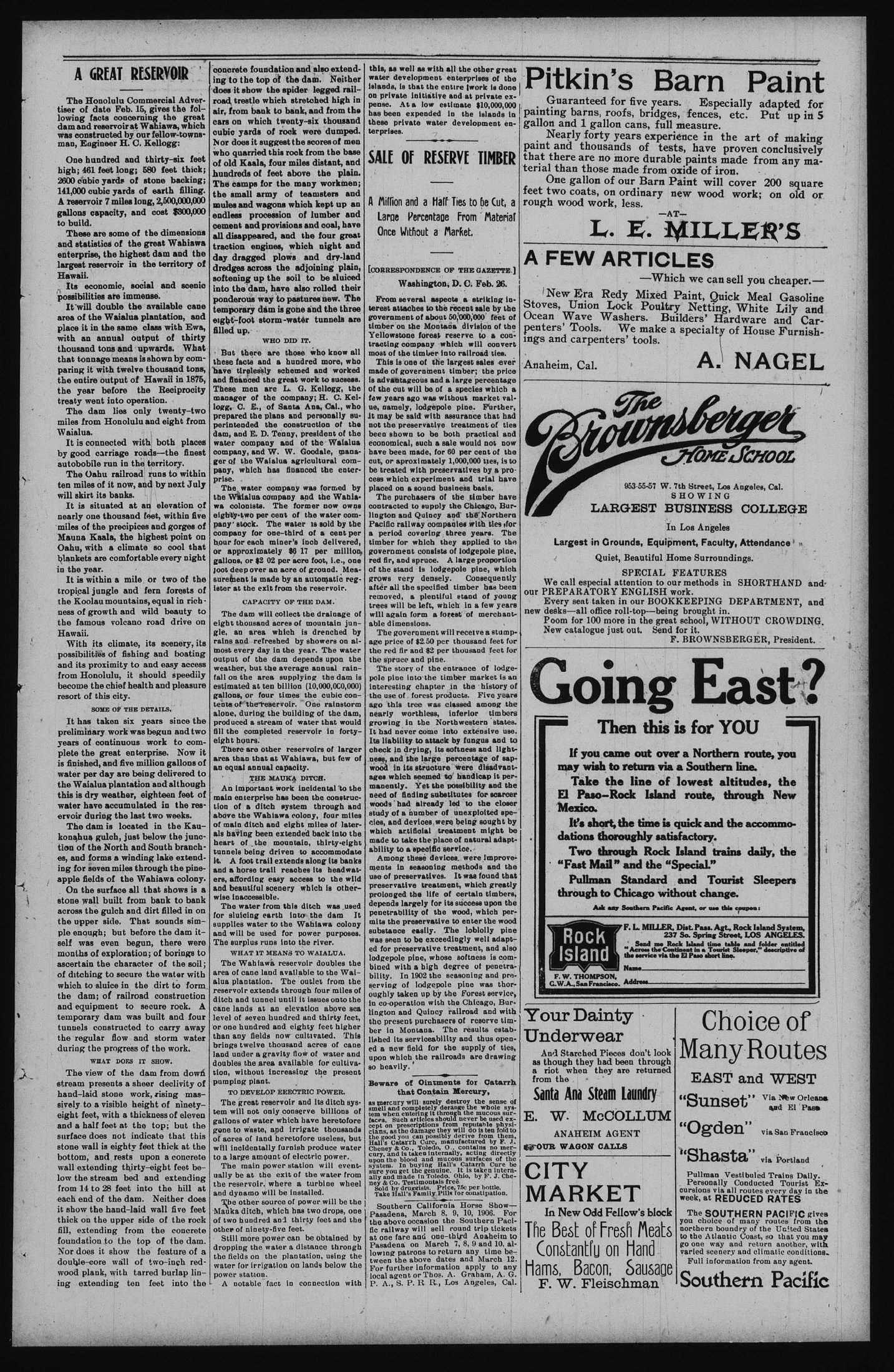
Searchable text
A GREAT RESERVOIR
The Honolulu Commercial Advertiser of date Feb. 15, gives the following facts concerning the great dam and reservoir at Wahiawa, which was constructed by our fellow-townsman, Engineer H. C. Kellogg:
One hundred and thirty-six feet high; 461 feet long; 580 feet thick; 2600 cubic yards of stone backing; 141,000 cubic yards of earth filling. A reservoir 7 miles long, 2,500,000,000 gallons capacity, and cost $300,000 to build.
These are some of the dimensions and statistics of the great Wahiawa enterprise, the highest dam and the largest reservoir in the territory of Hawaii.
Its economic, social and scenic possibilities are immense.
It will double the available cane area of the Waialua plantation, and place it in the same class with Ewa, with an annual output of thirty thousand tons and upwards. What that tonnage means is shown by comparing it with twelve thousand tons, the entire output of Hawaii in 1875, the year before the Reciprocity treaty went into operation.
The dam lies only twenty-two miles from Honolulu and eight from Waialua.
It is connected with both places by good carriage roads—the finest automobile run in the territory.
The Oahu railroad runs to within ten miles of it now, and by next July will skirt its banks.
It is situated at an elevation of concrete foundation and also extending to the top of the dam. It does it show the spider legged road trestle which stretched across air, from bank to bank, and from cars on which twenty-six cubic yards of rock were dumped. Nor does it suggest the scores who quarried this rock from the old Kaala, four miles distant hundreds of feet above the camps for the many workers the small army of teamsters mules and wagons which kept endless procession of lumber cement and provisions and coats all disappeared, and the four traction engines, which night dragged plows and dredges across the adjoining softening up the soil to be sent into the dam, have also rolled ponderous way to pastures new temporary dam is gone and the eight-foot storm-water tunnel filled up.
WHO DID IT.
But there are those who know these facts and a hundred more have tirelessly schemed and financed the great work to set these men are L. G. Kellogg manager of the company; H. logg, C. E., of Santa Ana, Cali prepared the plans and persons perintended the construction dam, and E. D. Tenny, president water company and of the W company, and W. W. Goodale,ger of the Waialua agricultural pany, which has financed the prise.
The water company was formed the Waialua company and the wa colonists. The former now
The dam lies only twenty-two miles from Honolulu and eight from Waialua.
It is connected with both places by good carriage roads—the finest autobobile run in the territory.
The Oahu railroad runs to within ten miles of it now, and by next July will skirt its banks.
It is situated at an elevation of nearly one thousand feet, within five miles of the precipices and gorges of Mauna Kaala, the highest point on Oahu, with a climate so cool that blankets are comfortable every night in the year.
It is within a mile or two of the tropical jungle and fern forests of the Koolau mountains, equal in richness of growth and wild beauty to the famous volcano road drive on Hawaii.
With its climate, its scenery, its possibilities of fishing and boating and its proximity to and easy access from Honolulu, it should speedily become the chief health and pleasure resort of this city.
SOME OF THE DETAILS.
It has taken six years since the preliminary work was begun and two years of continuous work to complete the great enterprise. Now it is finished, and five million gallons of water per day are being delivered to the Waialua plantation and although this is dry weather, eighteen feet of water have accumulated in the reservoir during the last two weeks.
The dam is located in the Kaukonahua gulch, just below the junction of the North and South branches, and forms a winding lake extending for seven miles through the pineapple fields of the Wahiawa colony.
On the surface all that shows is a stone wall built from bank to bank across the gulch and dirt filled in on the upper side. That sounds simple enough; but before the dam itself was even begun, there were months of exploration; of borings to ascertain the character of the soil;
logg, C. E., of Santa Ana, California prepared the plans and personal perintended the construction of dam, and E. D. Tenny, president water company and of the Waiola company, and W. W. Goodale, manager of the Waialua agricultural pany, which has financed the prise.
The water company was formed the Waialua company and the Waia colonists. The former now eighty-two per cent of the water pany's stock. The water is sold company for one-third of a hour for each miner's inch delivery or approximately $6 17 per gallon, or $2 02 per acre foot, if joot deep over an acre of ground surement is made by an automatic lister at the exit from the reservoir.
CAPACITY OF THE DAM.
The dam will collect the drain eight thousand acres of mountain gle, an area which is drenched rains and refreshed by shower most every day in the year. The output of the dam depends upon weather, but the average annual fall on the area supplying the estimated at ten billion (10,000,000 gallons, or four times the cubic tents of the reservoir. One rail alone, during the building of the produced a stream of water that fill the completed reservoir in eight hours.
There are other reservoirs of area than that at Wahiawa, but an equal annual capacity.
THE MAUKA DITCH.
An important work incidental main enterprise has been the construction of a ditch system through above the Wahiawa colony, four of main ditch and eight miles oals having been extended back in heart of the mountain, third tunnels being driven to accommodate it. A foot trail extends along it and a horse trail reaches its heirs, affording easy access to this and beautiful scenery which is wise inaccessible.
The water from this ditch was for sluicing earth into the daily supplies water to the Wahiawa and will be used for power pu. The surplus runs into the river.
WHAT IT MEANS TO WAIAUA
The Waiahawa reservoir doubles
ing for seven miles through the pineapple fields of the Wahiawa colony.
On the surface all that shows is a stone wall built from bank to bank across the gulch and dirt filled in on the upper side. That sounds simple enough; but before the dam itself was even begun, there were months of exploration; of borings to ascertain the character of the soil; of ditching to secure the water with which to sluice in the dirt to form the dam; of railroad construction and equipment to secure rock. A temporary dam was built and four tunnels constructed to carry away the regular flow and storm water during the progress of the work.
WHAT DOES IT SHOW.
The view of the dam from downstream presents a sheer declivity of hand-laid stone work, rising massively to a visible height of ninety-eight feet, with a thickness of eleven and a half feet at the top; but the surface does not indicate that this stone wall is eighty feet thick at the bottom, and rests upon a concrete wall extending thirty-eight feet below the stream bed and extending from 14 to 28 feet into the hill at each end of the dam. Neither does it show the hand-laid wall five feet thick on the upper side of the rock fill, extending from the concrete foundation to the top of the dam. Nor does it show the feature of a double-core wall of two-inch redwood plank, with tarred burlap lining extending ten feet into the
WHAT IT MEANS TO WAIALY
The Wahiawa reservoir doubles area of cane land available to alua plantation. The outlet from reservoir extends through four ditch and tunnel until it issues off cane lands at an elevation above level of seven hundred and thirty or one hundred and eighty feet than any fields now cultivated brings twelve thousand acres of land under a gravity flow of water doubles the area available for pumping plant.
TO DEVELOP EEECTRIC POWER
The great reservoir and its dittern will not only conserve billions gallons of water which have here gone to waste, and irrigate them of acres of land heretofore useless will incidentally furnish produce to a large amount of electric power.
The main power station will usually be at the exit of the water reservoir, where a turbine and dynamo will be installed.
The other source of power will Mauka ditch, which has two drops of two hundred and thirty feet other of ninety-five feet.
Still more power can be obtained dropping the water a distance to the fields on the plantation, using water for irrigation on lands below power station.
A notable fact in connection
Foundation and also extend-op of the dam. Neither the spider legged rail-which stretched high in bank to bank, and from the much twenty-six thousand of rock were dumped. suggest the scores of men and this rock from the base, four miles distant, and feet above the plain. For the many workmen; army of teamsters and loggers which kept up an excision of lumber and provisions and coal, have reed, and the four great engines, which night and plows and dry-land cross the adjoining plain, to the soil to be sluiced, have also rolled their way to pastures new. The dam is gone and the three storm-water tunnels are who did it.
are those who know all and a hundred more, who wisly schemed and worked the great work to success. are L. G. Kellogg, the company; H. C. Kel- of Santa Ana, Cal., who plans and personally su- the construction of the D. Tenny, president of the any and of the Waialua W. W. Goodale, mana- Waialua agricultural com- has financed the enter- company was formed by company and the Wahia- The former now owns this, as well as with all the other great water development enterprises of the islands, is that the entire work is done on private initiative and at private expense. At a low estimate $10,000,000 has been expended in the islands in these private water development enterprises.
SALE OF RESERVE TIMBER
A Million and a Half Ties to be Cut, a Large Percentage From Material Once Without a Market.
[CORRESPONDENCE OF THE GAZETTE.]
Washington, D. C. Feb. 26.
From several aspects a striking interest attaches to the recent sale by the government of about 50,000,000 feet of timber on the Montana division of the Yellowstone forest reserve to a contracting company which will convert most of the timber into railroad ties.
This is one of the largest sales ever made of government timber; the price is advantageous and a large percentage of the cut will be of a species which a few years ago was without market value, namely, lodgepole pine. Further, it may be said with assurance that had not the preservative treatment of ties been shown to be both practical and economical, such a sale would not now have been made, for 60 per cent of the cut, or approximately 1,000,000 ties, is to be treated with preservatives by a process which experiment and trial have placed on a sound business basis.
The purchasers of the timber have contracted to supply the Chicago, Bur-
of Santa Ana, Cal., who plans and personally supersedes the construction of the D. Tenny, president of the company and of the Waialua and W. W. Goodale, mana-Waiuala agricultural company has financed the enterprise.
The company was formed by company and the Waiahia. The former now owns one cent of the water com-
The water is sold by the one-third of a cent per miner's inch delivered, usually $6 17 per million, or an acre of ground. Mea-
made by an automatic regu-lit from the reservoir.
Will collect the drainage of and acres of mountain jun-
which is drenched by freshed by showers on alley in the year. The water the dam depends upon the average annual rain-
area supplying the dam is ten billion (10,000,000,000) four times the cubic con-
preservoir. One rainstorm in the building of the dam, stream of water that would be deleted reservoir in forty-
other reservoirs of larger size at Wahiawa, but few of usual capacity.
Mauka Ditch.
A work incidental to the rise has been the construc-tch system through and Wahiawa colony, four miles and eight miles of later-seen extended back into the mountain, thirty-eight driving to accommodate trail extends along its banks. Trail reaches its headwat-
easy access to the wild scenery which is other-
ible.
From this ditch was used earth into the dam. It turner to the Wahiawa colony used for power purposes. Drums into the river.
Means To Waialua.
Waira reservoir doubles the ue, namely, lodgepole pine. Further, it may be said with assurance that had not the preservative treatment of ties been shown to be both practical and economical, such a sale would not now have been made, for 60 per cent of the cut, or approximately 1,000,000 ties, is to be treated with preservatives by a process which experiment and trial have placed on a sound business basis.
The purchasers of the timber have contracted to supply the Chicago, Burlington and Quincy and the Northern Pacific railway companies with ties for a period covering three years. The timber for which they applied to the government consists of lodgepole pine, red fir, and spruce. A large proportion of the stand is lodgepole pine, which grows very densely. Consequently after all the specified timber has been removed, a plentiful stand of young trees will be left, which in a few years will again form a forest of merchantable dimensions.
The government will receive a stumpage price of $2.50 per thousand feet for the red fir and $2 per thousand feet for the spruce and pine.
The story of the entrance of lodgepole pine into the timber market is an interesting chapter in the history of the use of forest products. Five years ago this tree was classed among the nearly worthless, inferior timbers growing in the Northwestern states. It had never come into extensive use. Its liability to attack by fungus and to check in drying, its softness and lightness, and the large percentage of sapwood in its structure were disadvantages which seemed to handicap it permanently. Yet the possibility and the need of finding substitutes for scarcer woods had already led to the closer study of a number of unexplored species, and devices were being sought by which artificial treatment might be made to take the place of natural adaptability to a specific service.
Among these devices, were improvements in seasoning methods and the use of preservatives. It was found that preservative treatment, which greatly prolonged the life of certain timbers, depends largely for its success upon the penetrability of the wood, which permits the preservative to enter the wood substance easily. The loblolly pine was seen to be exceedingly well adapted for preservative treatment, and also lodgepole pine, whose softness is combined with a high degree of penetra-
Beware of Ointments for Catarrh that Contain Mercury,
as mercury will surely destroy the sense of smell and completely derange the whole system when entering it through the mucous surfaces. Such articles should never be used except on prescriptions from reputable physicians, as the damage they will do is ten fold to the good you can possibly derive from them. Hall's Catarrh Cure, manufactured by F. J. Cheney & Co., Toledo, O., contains no mercury, and is taken internally, acting directly upon the blood and mucous surfaces of the system. In buying Hall's Catarrh Cure be sure you get the genuine. It is taken internally and made in Toledo, Ohio, by F. J. Cheney & Co. Testimontals free.
Sold by druggists. Price, 75c per bottle.
Take Hall's Family Pills for constipation.
Southern California Horse Show—Pasadena, March 8, 9, 10, 1906. For the above occasion the Southern Pacific railway will sell round trip tickets at one fare and one-third Anaheim to Pasadena on March 7, 8, 9 and 10, allowing patrons to return any time between the above dates and March 12. For further information apply to any local agent or Thos. A. Graham, A. G. P. A., S. P. R. R., Los Angeles, Cal.
ckin's Barn Paint
guaranteed for five years. Especially adapted for
big barns, roofs, bridges, fences, etc. Put up in 5
and 1 gallon cans, full measure.
early forty years experience in the art of making
and thousands of tests, have proven conclusively
there are no more durable paints made from any mahan those made from oxide of iron.
The gallon of our Barn Paint will cover 200 square
to coats, on ordinary new wood work; on old or
wood work, less.
AT—
L. E. MILLER'S
NEW ARTICLES
—Which we can sell you cheaper.—
New Era Redy Mixed Paint, Quick Meal Gasoline
Union Lock Poultry Netting, White Lily and
Wave Washers. Builders' Hardware and Cars' Tools. We make a specialty of House Furnishd carpenters' tools.
A. NAGEL
The Brownsberger
HOME SCHOOL
953-55-57 W. 7th Street, Los Angeles, Cal.
SHOWING
LARGEST BUSINESS COLLEGE
Brownsberger Home School
953-55-57 W. 7th Street, Los Angeles, Cal.
SHOWING
LARGEST BUSINESS COLLEGE
In Los Angeles
largest in Grounds, Equipment, Faculty, Attendance
Quiet, Beautiful Home Surroundings.
SPECIAL FEATURES
call especial attention to our methods in SHORTHAND and
DEPARTORY ENGLISH work.
Every seat taken in our BOOKKEEPING DEPARTMENT, and
works—all office roll-top—being brought in.
m for 100 more in the great school, WITHOUT CROWDING.
catalogue just out. Send for it.
F. BROWNSBERGER, President.
Going East?
Then this is for YOU
If you came out over a Northern route, you may wish to return via a Southern line.
Take the line of lowest altitudes, the El Paso–Rock Island route, through New Mexico.
It's short, the time is quick and the accommodations thoroughly satisfactory.
Two through Rock Island trains daily, the "Fast Mail" and the "Special."
Pullman Standard and Tourist Sleepers through to Chicago without change.
Ask any Southern Pacific Agent, or use this coupon:
F. L. MILLER, Dist. Pass. Agt., Rock Island System,
237 So. Spring Street, LOS ANGELES.
Send me Rock Island time table and folder entitled "Across the Continent in a Tourist Sleeper," descriptive of the service via the El Paso short line.
"Fast Mail" and the "Special."
Pullman Standard and Tourist Sleepers through to Chicago without change.
Ask any Southern Pacific Agent, or use this coupon:
F. L. MILLER, Dist. Pass. Agt., Rock Island System,
237 So. Spring Street, LOS ANGELES.
Send me Rock Island time table and folder entitled "Across the Continent in a Tourist Sleeper," descriptive of the service via the El Paso short line.
Name
W. THOMPSON,
W.A., San Francisco.
Our Dainty
Lerwear
Starched Pieces don't look through they had been through when they are returned
Ana Steam Laundry
V. McCOLLUM
NAHEIM AGENT
WAGON CALLS
ITY
MARKET
New Odd Fellow's block
Rest of Fresh Meats
Instantly on Hand
Bacon, Sausage
W. Fleischman
Choice of Many Routes
EAST and WEST
"Sunset"
Via New Orleans and El Paso
"Ogden"
via San Francisco
"Shasta"
via Portland
Pullman Vestibuled Trains Daily.
Personally Conducted Tourist Excursions via all routes every day in the week, at REDUCED RATES
The SOUTHERN PACIFIC gives you choice of many routes from the northern boundry of the United States to the Atlantic Coast, so that you may go one way and return another, with varied scenery and climatic conditions.
Full information from any agent.
Southern Pacific