anaheim-gazette 1905-09-14
Scanned page
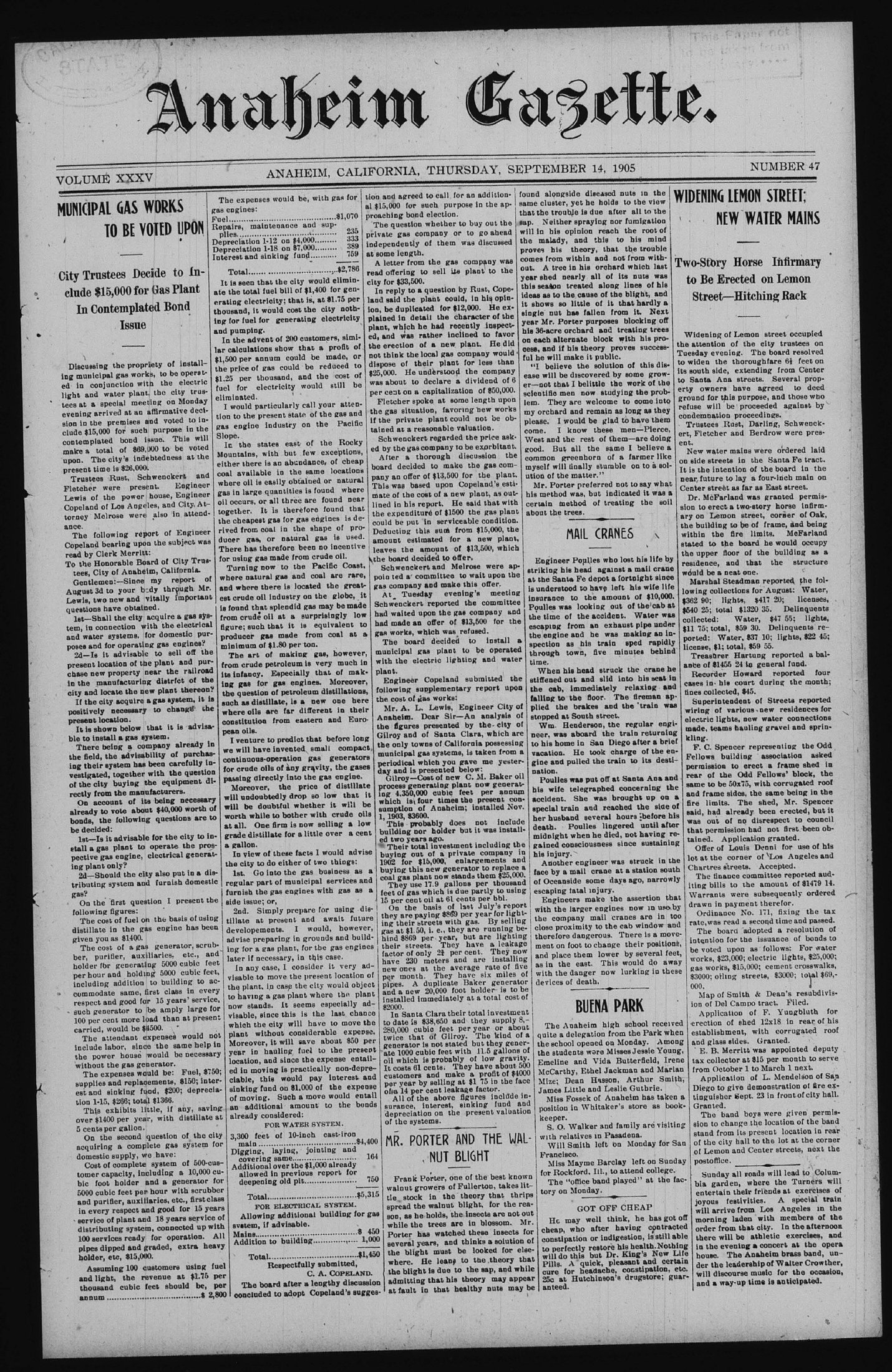
Searchable text
MUNICIPAL GAS WORKS
TO BE VOTED UPON
City Trustees Decide to include $15,000 for Gas Plant In Contemplated Bond Issue
Discussing the propriety of installing municipal gas works, to be operated in conjunction with the electric light and water plant, the city trustees at a special meeting on Monday evening arrived at an affirmative decision in the premises and voted to include $15,000 for such purpose in the contemplated bond issue. This will make a total of $69,000 to be voted upon. The city's indebtedness at the present time is $26,000.
Trustees Rust, Schwenckert and Fletcher were present. Engineer Lewis of the power house, Engineer Copeland of Los Angeles, and City At-
Trustees Rust, Schwenckert and Fletcher were present. Engineer Lewis of the power house, Engineer Copeland of Los Angeles, and City Attorney Melrose were also in attendance.
The following report of Engineer Copeland bearing upon the subject was read by Clerk Merritt:
To the Honorable Board of City Trustees, City of Anaheim, California.
Gentlemen:—Since my report of August 3d to your body through Mr. Lewis, two new and vitally important questions have obtained.
1st—Shall the city acquire a gas system, in connection with the electrical and water systems, for domestic purposes and for operating gas engines?
2d—Is it advisable to sell off the present location of the plant and purchase new property near the railroad in the manufacturing district of the city and locate the new plant thereon?
If the city acquire a gas system, it is positively necessary to change the present location.
It is shown below that it is advisable to install a gas system.
There being a company already in the field, the advisability of purchasing their system has been carefully investigated, together with the question of the city buying the equipment directly from the manufacturers.
On account of its being necessary already to vote about $40,000 worth of bonds, the following questions are to be decided:
1st—Is it advisable for the city to install a gas plant to operate the prospective gas engine, electrical generating plant only?
2d—Should the city also put in a distributing system and furnish domestic gas?
On the first question I present the following figures:
The cost of fuel on the basis of using distillate in the gas engine has been given you as $1400.
The cost of a gas generator, scrubber, purifier, auxiliaries, etc., and holder for generating 5000 cubic feet
I would particularly call your attention to the present state of the gas engine industry on the Slope.
In the states east of the Mountains, with but few exceptions there is an abundance of coal available in the same place where oil is easily obtained or gas in large quantities is found; oil occurs, or all three are found together. It is therefore found that cheapest gas for gas engine rived from coal in the shape of ducer gas, or natural gas. There has therefore been no interest for using gas made from crude oil.
Turning now to the Pacific where natural gas and coal are and where there is located the best crude oil industry on the grid is found that splendid gas may from crude oil at a surprising figure; such that it is equivalent producer gas made from minimum of $1.80 per ton.
The art of making gas from crude petroleum is very its infancy. Especially that ing gas for gas engines. My question of petroleum distribution such as distillate, is a new where oils are far different constitution from eastern and pean oils.
I venture to predict that because we will have invented small continuous-operation gas gas for crude oils of any gravity, passing directly into the gas moreover, the price of will undoubtedly drop so low will be doubtful whether it worth while to bother with it at all. One firm is now selling grade distillate for a little over a gallon.
In view of these facts I wonder the city to do either of two things:
1st. Go into the gas business regular part of municipal service furnish the gas engines with side issue; or,
2nd. Simply prepare for tillage at present and awake developments. I would advise preparing in grounds for a gas plant, for the later if necessary, in this case. In any case, I consider it
2d—Should the city also put in a distributing system and furnish domestic gas?
On the first question I present the following figures:
The cost of fuel on the basis of using distillate in the gas engine has been given you as $1400.
The cost of a gas generator, scrubber, purifier, auxiliaries, etc., and holder for generating 5000 cubic feet per hour and holding 5000 cubic feet, including addition to building to accommodate same, first class in every respect and good for 15 years’ service, such generator to be amply large for 100 per cent more load than at present carried, would be $4500.
The attendant expenses would not include labor, since the same help in the power house would be necessary without the gas generator.
The expenses would be: Fuel, $750; supplies and replacements, $150; interest and sinking fund, $200; depreciation 1-15, $266; total $1366.
This exhibits little, if any, saving over $1400 per year, with distillate at 5 cents per gallon.
On the second question of the city acquiring a complete gas system for domestic supply, we have:
Cost of complete system of 500-customer capacity, including a 10,000 cubic foot holder and a generator for 5000 cubic feet per hour with scrubber and purifier, auxiliaries, etc., first class in every respect and good for 15 years’ service of plant and 18 years’ service of distributing system, connected up with 100 services ready for operation. All pipes dipped and graded, extra heavy holder, etc., $15,000.
Assuming 100 customers using fuel and light, the revenue at $1.75 per thousand cubic feet should be, per annum ... $2,800
1st. Go into the gas business regular part of municipal service furnish the gas engines with side issue; or,
2nd. Simply prepare for tillage at present and awake developments. I would advise preparing in grounds for a gas plant, for the gas later if necessary, in this case.
In any case, I consider it visable to move the present plant, in case the city wants having a gas plant where now stands. It seems visable, since this is the place which the city will have the plant without considerableMoreover, it will save about one year in hauling fuel to the location, and since the expected in moving is practically available, this would pay in sinking fund on $1,000 of the moving. Such a move will an additional amount to already considered:
FOR WATER SYSTEM
3,300 feet of 10-inch cas main.....
Digging, laying, jointing covering same.....
Additional over the $1,000 allowed in previous report deepening old pit.....
Total.....
FOR ELECTRICAL SYSTEM
Allowing additional build system, if advisable.
Mains.....
Addition to building.....
Total.....
Respectfully subr
C. A. C.
The board after a length concluded to adopt Copela...
ANAHEIM, CALIFORNIA, THURSDAY, SEPTEMBER 14, 1902
tes would be, with gas for
$1,070
maintenance and sup235
1-12 on $4,000... 333
1-18 on $7,000... 389
sinking fund... 759
..... $2,786
what the city would elimifuel bill of $1,400 for genericity; that is, at $1.75 per
would cost the city nothor generating electricity.
ment of 200 customers, simions show that a profit of
annum could be made, or
gas could be reduced to
thousand, and the cost of
electricity would still be
particularly call your attenresent state of the gas and
industry on the Pacific
states east of the Rocky
with but few exceptions,
is an abundance, of cheap
able in the same locations
easily obtained or natural
quantities is found where
for all three are found near
it is therefore found that
tion and agreed to call for an additial $15,000 for such purpose in the approaching bond election.
The question whether to buy out the private gas company or to go ahead independently of them was discussed at some length.
A letter from the gas company was read offering to sell its plant to the city for $33,500.
In reply to a question by Rust, Copeland said the plant could, in his opinion, be duplicated for $12,000. He explained in detail the character of the plant, which he had recently inspected, and was rather inclined to favor the erection of a new plant. He did not think the local gas company would dispose of their plant for less than $25,000. He understood the company was about to declare a dividend of 6 per cent on a capitalization of $50,000.
Fletcher spoke at some length upon the gas situation, favoring new works if the private plant could not be obtained at a reasonable valuation.
Schwenckert regarded the price asked by the gas company to be exorbitant.
After a thorough discussion the board decided to make the gas company an offer of $13,500 for the plant. This was based upon Copeland’s estimate of the cost of a new plant, as outlined in his report. He said that with the expenditure of $1500 the gas plant
found alongside diseased nutsame cluster, yet he holds to
that the trouble is due after
sap. Neither spraying nor fuswill in his opinion reach ther
the malady, and this to leproves his theory, that ther
comes from within and not fouout. A tree in his orchard w
year shed nearly all of its
this season treated along liideas as to the cause of the bluit shows so little of it that
single nut has fallen from a
year Mr. Porter purposes bluhis 36-acre orchard and treaton each alternate block witcess, and if his theory proves
ful he will make it public.
"I believe the solution o
ease will be discovered by so
er—not that I belittle the w
scientific men now studying
lem. They are welcome to
my orchard and remain as lo
please. I would be glad to
come. I know these me
West and the rest of them—
good. But all the same I
common greenhorn of a f
myself will finally stumble u
tion of the matter."
Mr. Porter preferred not h
his method was, but indicat
certain method of treating
about the trees.
particularly call your attention present state of the gas and industry on the Pacific States east of the Rocky Mountains with but few exceptions, it is an abundance of cheapable in the same locations easily obtained or natural quantities is found where for all three are found near it is therefore found that gas for gas engines is decoal in the shape of pro- or natural gas is used. Therefore been no incentive gas made from crude oil.
Now to the Pacific Coast, central gas and coal are rare, there is located the great oil industry on the globe, it that splendid gas may be made in oil at a surprisingly low cost that it is equivalent to gas made from coal at a cost of $1.80 per ton.
Of making gas, however, petroleum is very much in Especially that of make-or gas engines. Moreover, one of petroleum distillations, distillate, is a new one here we are far different in their origin from eastern and Euro-
to predict that before long have invented small compact gas-operation gas generators oils of any gravity, the gases directly into the gas engine. Over, the price of distillate suddenly drop so low that it doubtful whether it will be able to bother with crude oils the firm is now selling a low distillate for a little over a cent
of these facts I would advise do either of two things: go into the gas business as a part of municipal services and the gas engines with gas as a; or,
simply prepare for using district present and await future incidents. I would, however, preparing in grounds and build-gas plant, for the gas engines necessary, in this case.
Case. I consider it very ad-
Preacher opened the gas situation, favoring new works if the private plant could not be obtained at a reasonable valuation.
Schwenckert regarded the price asked by the gas company to be exorbitant.
After a thorough discussion the board decided to make the gas company an offer of $13,500 for the plant. This was based upon Copeland's estimate of the cost of a new plant, as outlined in his report. He said that with the expenditure of $1500 the gas plant could be put in serviceable condition. Deducting this sum from $15,000, the amount estimated for a new plant, leaves the amount of $13,500, which the board decided to offer.
Schwenckert and Melrose were appointed a committee to wait upon the gas company and make this offer.
At Tuesday evening's meeting Schwenckert reported the committee had waited upon the gas company and had made an offer of $13,500 for the gas works, which was refused.
The board decided to install a municipal gas plant to be operated with the electric lighting and water plant.
Engineer Copeland submitted the following supplementary report upon the cost of gas works:
Mr. A. L. Lewis, Engineer City of Anaheim. Dear Sir—An analysis of the figures presented by the city of Gilroy and of Santa Clara, which are the only towns of California possessing municipal gas systems, is taken from a periodical which you gave me yesterday and is presented below:
Gilroy—Cost of new C. M. Baker oil process generating plant now generating 4,350,000 cubic feet per annum which is four times the present consumption of Anaheim; installed Nov. 1, 1903, $3600.
This probably does not include building nor holder but it was installed two years ago.
Their total investment including the buying out of a private company in 1902 for $15,000, enlargements and buying this new generator to replace a coal gas plant now stands them $25,000.
They use 17.9 gallons per thousand feet of gas which is due partly to using 15 per cent oil at 61 cents per bbl.
On the basis of last July's report they are paying $869 per year for lighting their streets with gas. By selling gas at $1.50, i.e., they are running behind $869 per year, but are lighting their streets. They have a leakage factor of only 2½ per cent. They now have 230 meters and are installing new ones at the average rate of five
Engineer Poplles who lost striking his head against at the Santa Fe depot a fort is understood to have left insurance to the amount Poulles was looking out on the time of the accident. escaping from an exhaustion the engine and he was mis-spection as his train sped through town, five minute time.
When his head struck the stiffened out and slid into the cab, immediately re-falling to the floor. The plied the brakes and then stopped at South street.
Wm. Henderson, the reeer, was aboard the tractor to his home in San Diego vacation. He took charge gine and pulled the train nation.
Poulles was put off at San his wife telegraphed con- accident. She was brought special train and reached her husband several hours death. Poulles lingered midnight when he died, not gained consciousness since his injury.
Another engineer was face by a mail crane at a of Oceanside some days after escaping fatal injury.
Engineers make the air with the larger engines to the company mail crane close proximity to the cab therefore dangerous. The ment on foot to change tha- and place them lower by as in the east. This wo-
simply prepare for using distinct present and await future
elements. I would, however,
preparing in grounds and building gas plant, for the gas engines
necessary, in this case.
case, I consider it very advocable to move the present location of
a city in case the city would object
to a gas plant where the plant
bids. It seems especially advocable this is the last chance
the city will have to move the
without considerable expense.
It will save about $50 per
hauling fuel to the present
and since the expense entailving is practically non-deprethis would pay interest and
fund on $1,000 of the expense
ag. Such a move would entail
total amount to the bonds
considered:
FOR WATER SYSTEM.
Set of 10-inch cast-iron
$4,400
laying, jointing and
fitting same..... 164
total over the $1,000 already
paid in previous report for
being old pit..... 750
FOR ELECTRICAL SYSTEM.
Building additional building for gas
if advisable.
$ 450
in to building..... 1,000
Respectfully submitted,
C. A. COPELAND.
Board after a lengthy discussion
need to adopt Copeland's sugges-
MR. PORTER AND THE WALNUT BLIGHT
Frank Porter, one of the best known
walnut growers of Fullerton, takes little stock in the theory that thrips spread the walnut blight, for the reason, as he holds, the insects are not out while the trees are in blossom. Mr. Porter has watched these insects for several years, and thinks a solution of the blight must be looked for elsewhere. He leans to the theory that the blight is due to the sap, and while admitting that his theory may appear at fault in that healthy nuts may be
Another engineer was face by a mail crane at a
of Oceanside some days ago,
escaping fatal injury.
Engineers make the acwith the larger engines to
the company mail crane,
close proximity to the cab,
therefore dangerous. The
ment on foot to change th
and place them lower by
as in the east. This woe
with the danger now lurdevices of death.
BUENA PALE
The Anaheim high school quite a delegation from t
the school opened on Monthe students were Misses
Emeline and Vida Butte
McCarthy, Ethel JackmaMize; Dean Hasson, A.
James Little and Leslie G.
Miss Fossek of Anahei
position in Whitaker's s
keeper.
S. O. Walker and famwith relatives in Pasadee.
Will Smith left on M.
Francisco.
Miss Mayme Barclay
for Rockford, Ill., to attn.
The "office band player
tory on Monday.
GOT OFF CEIL
He may well think,
cheap, who after having constipation or indigestion to perfectly restore his life will do this but Dr. K.
Pills. A quick, pleasae cure for headache, co25c at Hutchinson's draneed.
WIDENING LEMON STREET;
NEW WATER MAINS
Two-Story Horse Infirmary
to Be Erected on Lemon Street—Hitching Rack
Widening of Lemon street occupied the attention of the city trustees on Tuesday evening. The board resolved to widen the thoroughfare 6¼ feet on its south side, extending from Center to Santa Ana streets. Several property owners have agreed to deed ground for this purpose, and those who refuse will be proceeded against by condemnation proceedings.
Trustees Rust, Darling, Schwenckert, Fletcher and Berdrow were present.
New water mains were ordered laid on side streets in the Santa Fe tract. It is the intention of the board in the near future to lay a four-inch main on Center street as far as East street.
Dr. McFarland was granted permission to erect a two-story horse infirm-
MAIL CRANES
Peer Poplles who lost his life by his head against a mail crane Santa Fe depot a fortnight since stood to have left his wife life due to the amount of $10,000. Was looking out of the cab at the accident. Water was far from an exhaust pipe under the bridge and he was making an inward as his train sped rapidly down town, five minutes behind his head struck the crane he had out and slid into his seat in bed, immediately relaxing and onto the floor. The fireman apologized the brakes and the train was at South street.
Henderson, the regular engineer aboard the train returning home in San Diego after a brief run. He took charge of the end pulled the train to its destiny was put off at Santa Ana and telegraphed concerning the accident. She was brought up on a train and reached the side of the road several hours before his Poulles lingered until after night when he died, not having re-consciousness since sustaining injury.
Other engineer was struck in the back of a mail crane at a station south of San Diego some days ago, narrowly losing fatal injury.
Engineers make the assertion that the larger engines now in use by company mail cranes are in too proximity to the cab window and more dangerous. There is a move-on foot to change their positions, face them lower by several feet, the east. This would do away with the hard and remain as long as they would be glad to have them know these men—Pierce, but the rest of them—are doing all the same I believe a greenhorn of a farmer like will finally stumble on to a solitary matter."
Trustees Rust, Darling, Schwenckert, Fletcher and Berdrow were present.
New water mains were ordered laid on side streets in the Santa Fe tract. It is the intention of the board in the near future to lay a four-inch main on Center street as far as East street.
Dr. McFarland was granted permission to erect a two-story horse infirmary on Lemon street, corner of Oak, the building to be of frame, and being within the fire limits. McFarland stated to the board he would occupy the upper floor of the building as a residence, and that the structure would be a neat one.
Marshal Steadman reported the following collections for August: Water, $362 90; lights, $417 20; licenses, $540 25; total $1320 35. Delinquents collected: Water, $47 55; lights, $11 75; total, $59 30. Delinquents reported: Water, $37 10; lights, $22 45; license, $1; total, $59 55.
Treasurer Hartung reported a balance of $1455 24 in general fund.
Recorder Howard reported four cases in his court during the month; fines collected, $45.
Superintendent of Streets reported wiring of various new residences for electric lights, new water connections made, teams hauling gravel and sprinkling.
F. C. Spencer representing the Odd Fellows building association asked permission to erect a frame shed in rear of the Odd Fellows' block, the same to be 50x75, with corrugated roof and frame sides, the same being in the fire limits. The shed, Mr. Spencer said, had already been erected, but it was out of no disrespect to council that permission had not first been obtained. Application granted.
Offer of Louis Denni for use of his lot at the corner of Los Angeles and Chartres streets. Accepted.
The finance committee reported auditing bills to the amount of $1479 14. Warrants were subsequently ordered drawn in payment therefor.
Ordinance No. 171, fixing the tax rate, was read a second time and passed.
The board adopted a resolution of intention for the issuance of bonds to be voted upon as follows: For water works, $23,000; electric lights, $25,000; gas works, $15,000; cement crosswalks,
BUENA PARK
Anaheim high school received a delegation from the Park when school opened on Monday. Among students were Misses Jessie Young, Jane and Vida Butterfield, Irene Murphy, Ethel Jackman and Marian Dean Hasson, Arthur Smith, Mrs Little and Leslie Gutbrie.
Fossek of Anaheim has taken a loan in Whitaker’s store as bookkeeper.
D. Walker and family are visiting relatives in Pasadena.
All Smith left on Monday for San Francisco.
Mayme Barclay left on Sunday Rockford. Ill., to attend college.
The "office band played" at the facade Monday.
GOT OFF CHEAP
He may well think, he has got off his job, who after having contracted perturbation or indigestion, is still able perfectly restore his health. Nothing do this but Dr. King's New Life.
A quick, pleasant and certain song for headache, constipation, etc. that Hutchinson's drugstore; guaranteed.
Chartres streets. Accepted.
The finance committee reported auditing bills to the amount of $1479 14. Warrants were subsequently ordered drawn in payment therefor.
Ordinance No. 171, fixing the tax rate, was read a second time and passed.
The board adopted a resolution of intention for the issuance of bonds to be voted upon as follows: For water works, $23,000; electric lights, $25,000; gas works, $15,000; cement crosswalks, $3000; oiling streets, $3000; total $69,-000.
Map of Smith & Dean’s resubdivision of Del Campo tract. Filed.
Application of F. Yungbluth for erection of shed 12x18 in rear of his establishment, with corrugated roof and glass sides. Granted.
E. B. Merritt was appointed deputy tax collector at $15 per month to serve from October 1 to March 1 next.
Application of L. Mendelson of San Diego to give demonstration of fire extinguisher Sept. 23 in front of city hall. Granted.
The band boys were given permission to change the location of the band stand from its present location in rear of the city hall to the lot at the corner of Lemon and Center streets, next the postoffice.
Sunday all roads will lead to Columbia garden, where the Turners will entertain their friends at exercises of joyous festivities. A special train will arrive from Los Angeles in the morning laden with members of the order from that city. In the afternoon there will be athletic exercises, and in the evening a concert at the opera house. The Anaheim brass band, under the leadership of Walter Crowther, will discourse music for the occasion, and a way-up time is anticipated.