anaheim-gazette 1905-05-11
Scanned page
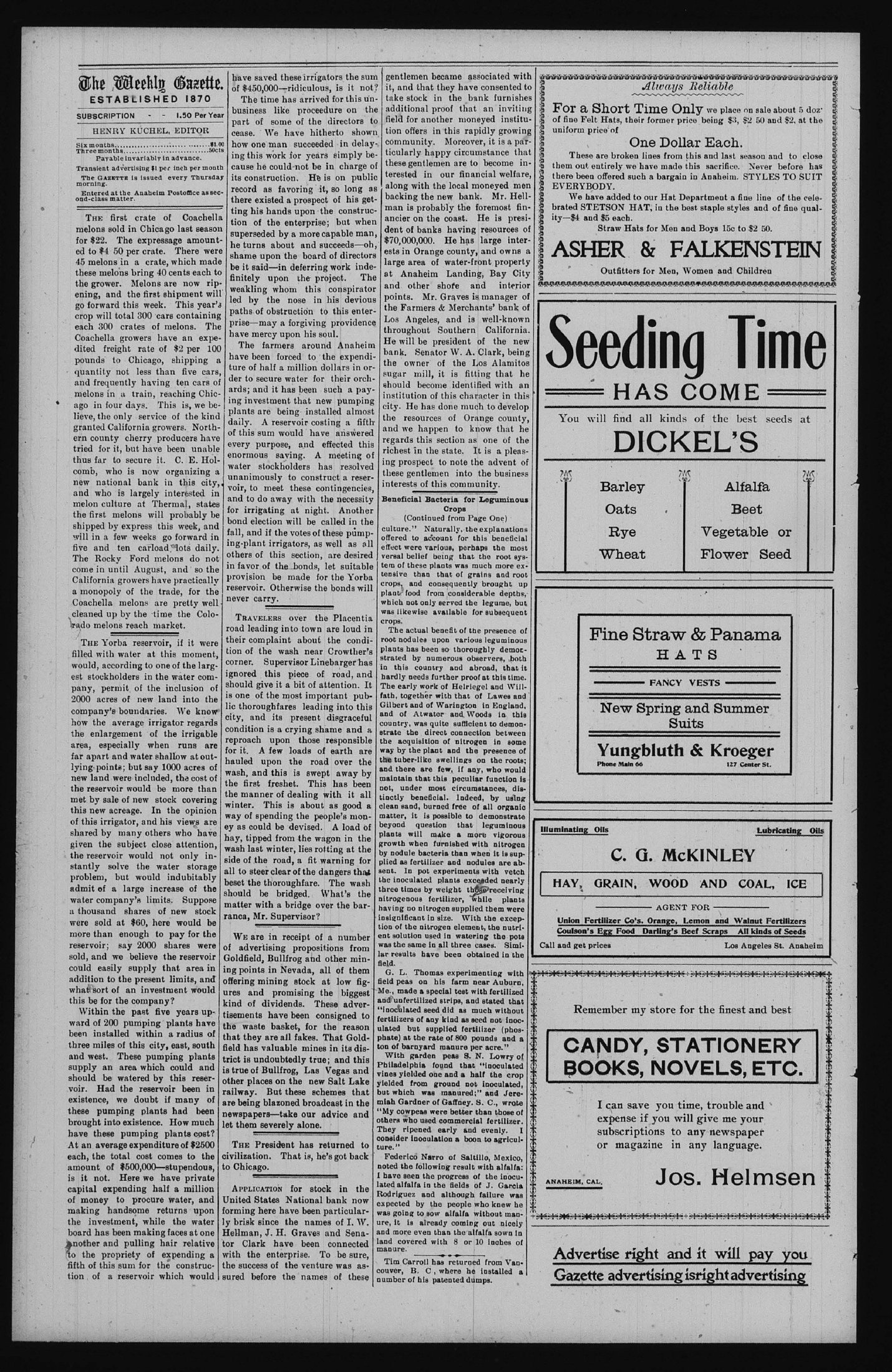
Searchable text
The first crate of Coachella melons sold in Chicago last season for $22. The expressage amounted to $4 50 per crate. There were 45 melons in a crate, which made these melons bring 40 cents each to the grower. Melons are now ripening, and the first shipment will go forward this week. This year's crop will total 300 cars containing each 300 crates of melons. The Coachella growers have an expedited freight rate of $2 per 100 pounds to Chicago, shipping a quantity not less than five cars, and frequently having ten cars of melons in a train, reaching Chicago in four days. This is, we believe, the only service of the kind granted California growers. Northern county cherry producers have tried for it, but have been unable thus far to secure it. C. E. Holcomb, who is now organizing a new national bank in this city, and who is largely interested in melon culture at Thermal, states have saved these irrigators of $450,000—ridiculous.
The time has arrived for business like proceeding part of some of the dead cease. We have hitherto how one man succeeded in this work for years because he could not be in its construction. He is record as favoring it, there existed a prospect ting his hands upon the tion of the enterprise; superseded by a more cap he turns about and suc shame upon the board or be it said—in deferring w finitely upon the project weakling whom this co led by the nose in his paths of obstruction to prise—a may a forgiving p have mercy upon his sou
The farmers around have been forced to the ture of half a million dol der to secure water for th ards; and it has been su ing investment that new plants are being installed daily. A reservoir costing of this sum would have every purpose, and effe enormous saving. A m water stockholders has unanimously to construc voir, to meet these cont and to do away with the for irrigating at night.
ago in four days. This is, we believe, the only service of the kind granted California growers. Northern county cherry producers have tried for it, but have been unable thus far to secure it. C. E. Holcomb, who is now organizing a new national bank in this city, and who is largely interested in melon culture at Thermal, states the first melons will probably be shipped by express this week, and will in a few weeks go forward in five and ten carload lots daily. The Rocky Ford melons do not come in until August, and so the California growers have practically a monopoly of the trade, for the Coachella melons are pretty well cleaned up by the time the Colorado melons reach market.
The Yorba reservoir, if it were filled with water at this moment, would, according to one of the largest stockholders in the water company, permit of the inclusion of 2000 acres of new land into the company's boundaries. We know how the average irrigator regards the enlargement of the irrigable area, especially when runs are far apart and water shallow at outlying points; but say 1000 acres of new land were included, the cost of the reservoir would be more than met by sale of new stock covering this new acreage. In the opinion of this irrigator, and his views are shared by many others who have given the subject close attention, the reservoir would not only instantly solve the water storage problem, but would indubitably admit of a large increase of the water company's limits. Suppose a thousand shares of new stock were sold at $60, here would be more than enough to pay for the reservoir; say 2000 shares were sold, and we believe the reservoir could easily supply that area in daily. A reservoir costing of this sum would have every purpose, and effect enormous saving. A water stockholders has unanimously to construct voir, to meet these conditions and to do away with them for irrigating at night. A bond election will be called fall, and if the votes of the ing-plant irrigators, as we others of this section, are in favor of the bonds, let provision be made for the reservoir. Otherwise the bond never carry.
TRAVELERS over the road leading into town and their complaint about the tion of the wash near Corner. Supervisor Linebark ignored this piece of should give it a bit of attention is one of the most important lic thoroughfares leading city, and its present condition is a crying shame reproach upon those refor it. A few loads of e hauled upon the road wash, and this is swept the first freshet. This is the manner of dealing with winter. This is about a way of spending the people as could be devised. Hay, tipped from the wagon wash last winter, lies rotting side of the road, a fit war all to steer clear of the dam beset the thoroughfare. T should be bridged. What matter with a bridge over ranca, Mr. Supervisor?
We are in receipt of a of advertising proposition Goldfield, Bullfrog and other points in Nevada all
stantly solve the water storage problem, but would indubitably admit of a large increase of the water company's limits. Suppose a thousand shares of new stock were sold at $60, here would be more than enough to pay for the reservoir; say 2000 shares were sold, and we believe the reservoir could easily supply that area in addition to the present limits, and what sort of an investment would this be for the company?
Within the past five years upward of 200 pumping plants have been installed within a radius of three miles of this city, east, south and west. These pumping plants supply an area which could and should be watered by this reservoir. Had the reservoir been in existence, we doubt if many of these pumping plants had been brought into existence. How much have these pumping plants cost? At an average expenditure of $2500 each, the total cost comes to the amount of $500,000—stupendous, is it not. Here we have private capital expending half a million of money to procure water, and making handsome returns upon the investment, while the water board has been making faces at one another and pulling hair relative to the propriety of expending a fifth of this sum for the construction of a reservoir which would
served these irrigators the sum of 10,000—ridiculous, is it not? Time has arrived for this unanticipated work like procedure on the behalf of some of the directors to do. We have hitherto shown the man succeeded in delaying his work for years simply because could not be in charge of construction. He is on public account favoring it, so long as existed a prospect of his getting hands upon the construction of the enterprise; but when added by a more capable man, he about and succeeds—oh, upon the board of directors said—in deferring work indebted upon the project. The king whom this conspirator had the nose in his devious obstruction to this enterprise may a forgiving providence mercy upon his soul.
Farmers around Anaheim have forced to the expenditure of a million dollars in orchid water for their orchard it has been such a payment that new pumping are being installed almost a reservoir costing a fifth rum would have answered purpose, and effected this was saving. A meeting of stockholders has resolved rigously to construct a reser- meet these contingencies, so away with the necessity rating at night. Another gentlemen became associated with it, and that they have consented to take stock in the bank furnishes additional proof that an inviting field for another moneyed institution offers in this rapidly growing community. Moreover, it is a particularly happy circumstance that these gentlemen are to become interested in our financial welfare, along with the local moneyed men backing the new bank. Mr. Hellman is probably the foremost financier on the coast. He is president of banks having resources of $70,000,000. He has large interests in Orange county, and owns a large area of water-front property at Anaheim Landing, Bay City and other shore and interior points. Mr. Graves is manager of the Farmers & Merchants' bank of Los Angeles, and is well-known throughout Southern California. He will be president of the new bank. Senator W. A. Clark, being the owner of the Los Alamitos sugar mill, it is fitting that he should become identified with an institution of this character in this city. He has done much to develop the resources of Orange county, and we happen to know that he regards this section as one of the richest in the state. It is a pleasing prospect to note the advent of these gentlemen into the business interests of this community.
Beneficial Bacteria for Leguminous Crops
Beneficial Bacteria for Leguminous Crops
(Continued from Page One)
culture." Naturally, the explanations offered to account for this beneficial effect were various, perhaps the most versal belief being that the root system of these plants was much more extensive than that of grains and root crops, and consequently brought up plant food from considerable depths, which not only served the legume, but was likewise available for subsequent crops.
The actual benefit of the presence of root nodules upon various leguminous plants has been so thoroughly demonstrated by numerous observers, both in this country and abroad, that it hardly needs further proof at this time. The early work of Helriegel and Willfath, together with that of Lawes and Gilbert and of Warington in England, and of Atwater and Woods in this country, was quite sufficient to demonstrate the direct connection between the acquisition of nitrogen in some way by the plant and the presence of the tuber-like swellings on the roots; and there are few, if any, who would maintain that this peculiar function is not, under most circumstances, distinctly beneficial. Indeed, by using clean sand, burned free of all organic matter, it is possible to demonstrate beyond question that leguminous plants will make a more vigorous growth when furnished with nitrogen by nodule bacteria than when it is supplied as fertilizer and nodules are absent. In pot experiments with vetch the inoculated plants exceeded nearly three times by weight those receiving nitrogenous fertilizer, while plants having no nitrogen supplied them were insignificant in size. With the exception of the nitrogen element, the nutrient solution used in watering the pots was the same in all three cases. Similar results have been obtained in the field.
In receipt of a number of interesting propositions from Bullfrog and other mines in Nevada, all of them mining stock at low figs promising the biggest dividends. These adverbs have been consigned to the basket, for the reason are all fakes. That Gold-valuable mines in its disdoubtedly true; and this Bullfrog, Las Vegas and places on the new Salt Lake But these schemes that blazoned broadcast in the ears—take our advice and severely alone.
President has returned to nation. That is, he's got back to it.
AATION for stock in the states National bank now there have been particular since the names of I. W. J. H. Graves and Senak have been connected enterprise. To be sure, loss of the venture was as fore the names of these applied as fertilizer and nodules are absent. In pot experiments with vetch the inoculated plants exceeded nearly three times by weight those receiving nitrogenous fertilizer, while plants having no nitrogen supplied them were insignificant in size. With the exception of the nitrogen element, the nutrient solution used in watering the pots was the same in all three cases. Similar results have been obtained in the field.
G. L. Thomas experimenting with field peas on his farm near Auburn, Me., made a special test with fertilized and unfertilized strips, and stated that "inoculated seed did as much without fertilizers of any kind as seed not inoculated but supplied fertilizer (phosphate) at the rate of 800 pounds and a ton of barnyard manure per acre."
With garden peas S. N. Lowry of Philadelphia found that "inoculated vines yielded one and a half the crop yielded from ground not inoculated, but which was manured;" and Jeremiah Gardner of Gaffney. S. C., wrote "My cowpeas were better than those of others who used commercial fertilizer. They ripened early and evenly. I consider inoculation a boon to agriculture."
Federico Narro of Saltillo, Mexico, noted the following result with alfalfa: I have seen the progress of the inoculated alfalfa in the fields of J. Garcia Rodriguez and although failure was expected by the people who knew he was going to sow alfalfa without manure, it is already coming out nicely and more even than the alfalfa sown in land covered with 8 or 10 inches of manure.
Tim Carroll has returned from Vancouver, B. C., where he installed a number of his patented dumps.
Always Reliable
For a Short Time Only we place on sale about 5 doz fine Felt Hats, their former price being $3, $2 50 and $2, at the uniform price of
One Dollar Each.
These are broken lines from this and last season and to close them out entirely we have made this sacrifice. Never before has there been offered such a bargain in Anaheim. STYLES TO SUIT EVERYBODY.
We have added to our Hat Department a fine line of the celebrated STETSON HAT, in the best staple styles and of fine quality—$4 and $5 each.
Straw Hats for Men and Boys 15c to $2 50.
FASHER & FALKENSTEIN
Outfitters for Men, Women and Children
Seeding Time
HAS COME
You will find all kinds of the best seeds at DICKEL'S
Barley
Oats
Alfalfa
Beet
You will find all kinds of the best seeds at
DICKEL'S
Barley
Oats
Rye
Wheat
Alfalfa
Beet
Vegetable or
Flower Seed
Fine Straw & Panama
HATS
FANCY VESTS
New Spring and Summer
Suits
Yungbluth & Kroeger
Phone Main 66 127 Center St.
Lubricating Oils
C. G. McKINLEY
MAY, GRAIN, WOOD AND COAL, ICE
AGENT FOR
Union Fertilizer Co's. Orange, Lemon and Walnut Fertilizers
Coulson's Egg Food Darling's Beef Scraps All kinds of Seeds
and get prices Los Angeles St. Anaheim
MAY, GRAIN, WOOD AND COAL, ICE
AGENT FOR
Union Fertilizer Co's. Orange, Lemon and Walnut Fertilizers
Coulson's Egg Food Darling's Beef Scraps All kinds of Seeds
and get prices Los Angeles St. Anaheim
Remember my store for the finest and best
CANDY, STATIONERY
BOOKS, NOVELS, ETC.
I can save you time, trouble and expense if you will give me your subscriptions to any newspaper or magazine in any language.
Jos. Helmsen
Advertise right and it will pay you
Gazette advertising is right advertising