anaheim-gazette 1904-06-16
Scanned page
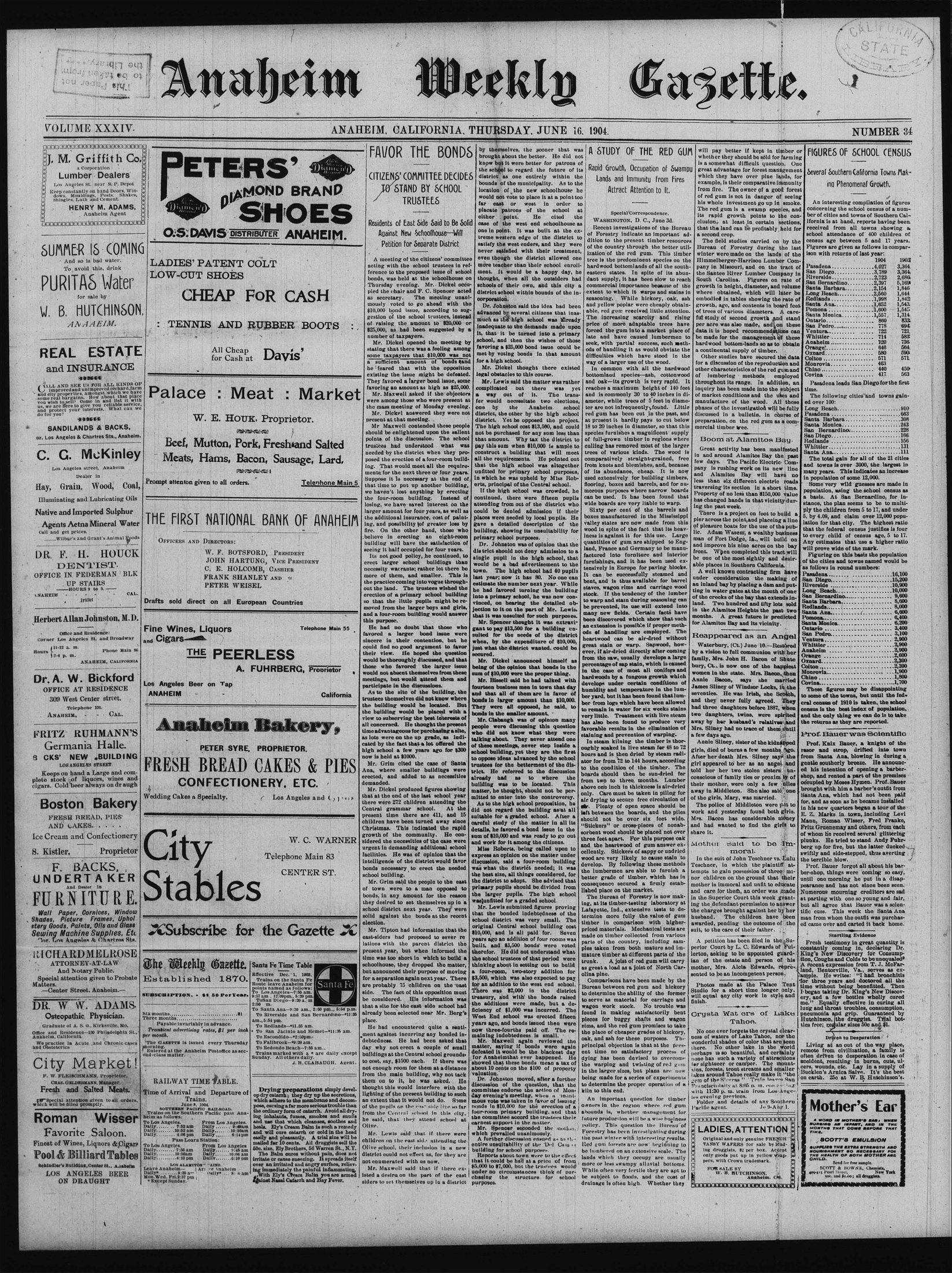
Searchable text
Anaheim
VOLUME XXXIV.
J. M. Griffith Co,
A Corporation
Lumber Dealers
Los Angeles St., near S. P. Depot
Keep constantly on hand doors, Windows, Mouldings, Posts, Shakes, Shingles, Lath and Cement.
HENRY M. ADAMS,
Anaheim Agent
SUMMER IS COMING
And so is bad water.
To avoid this, drink
PURITAS Water
for sale by
W. B. HUTCHINSON,
ANAHEIM.
REAL ESTATE
and INSURANCE
ALL AND SEE US FOR ALL KINDS OF improved and unimproved orchard, farm and city properties, amongst which we have some real bargains. How about that place you wish to sell? Come in and list it with us, we are here to give you reliable service, and protect your interests. What can we do for you?
SANDILANDS & BACKS,
or. Los Angeles & Chartres Sts., Anaheim.
C. G. McKinley
Los Angeles street, Anaheim
PETERS'
DIAMOND BRAND
SHOES
O.S.DAVIS DISTRIBUTOR ANAHEIM.
LADIES' PATENT COLT
LOW-CUT SHOES
CHEAP FOR CASH
: TENNIS AND RUBBER BOOTS:
All Cheap for Cash at Davis'
Palace : Meat : Market
W. E. HOUK, Proprietor.
Beef, Mutton, Pork, Fresh and Salted Meats, Hams, Bacon, Sausage, Lard,
CALL AND SEE US FOR ALL KINDS OF improved and unimproved orchard, farm and city properties, amongst which we have some real bargains. How about that place you wish to sell? Come in and list it with us, we are here to give you reliable service, and protect your interests. What can we do for you?
SANDILANDS & BACKS,
or. Los Angeles & Chartres Sts., Anaheim.
C. G. McKinley
Los Angeles street, Anaheim
Dealer in
Hay, Grain, Wood, Coal,
Illuminating and Lubricating Oils
Native and Imported Sulphur Agents Aetna Mineral Water
Call and get prices.
...Wilbur's and Grant's Animal Foods
DR. F. H. HOUCK
DENTIST.
OFFICE IN FEDERMAN BLK UP STAIRS
HOURS 9 to 5
ANAHEIM CAL.
jy1stf
Herbert Allan Johnston, M.D.
Office and Residence:
Corner Los Angeles St. and Broadway
Hours 11-12 a.m.
2-4 p.m.
ANAHEIM, CALIFORNIA
Dr. A. W. Bickford
OFFICE AT RESIDENCE
309 West Center street.
Telephone 101.
ANAHEIM, CAL.
FRITZ RUHMANN'S Germania Halle.
8 CKS' NEW BUILDING
LOS ANGELES STREET
Keeps on hand a Large and complete stock of liquors, wines and cigars. Cold beer always on draught
Boston Bakery
FRESH BREAD, PIES AND CAKES.
Ice Cream and Confectionery
S. Kistler, Proprietor
F. BACKS,
UNDERTAKER And Deser In FURNITURE
Palace : Meat : Market
W. E. HOUK, Proprietor.
Beef, Mutton, Pork, Fresh and Salted Meats, Hams, Bacon, Sausage, Lard,
Prompt attention given to all orders.
THE FIRST NATIONAL BANK OF ANAHEIM
OFFICERS AND DIRECTORS:
W. F. BOTSFORD, PRESIDENT
JOHN HARTUNG, VICE PRESIDENT
C. E. HOLCOMB, CASHIER
FRANK SHANLEY AND PETER WEISEL
Drafts sold direct on all European Countries
Fine Wines, Liquors and Cigars
Telephone Main 55
THE PEERLESS
A. FUHRBERG, Proprietor
Los Angeles Beer on Tap
ANAHEIM California
Anaheim Bakery,
PETER SYRE, PROPRIETOR.
FRESH BREAD CAKES & PIES CONFECTIONERY, ETC.
Wedding Cakes a Specialty.
Los Angeles and Cyprus
City Stables
W. C. WARNER
Telephone Main 83
CENTER ST.
Boston Bakery
FRESH BREAD, PIES AND CAKES.
Ice Cream and Confectionery
S. Kistler, Proprietor
F. BACKS,
UNDERTAKER
And Desier in
FURNITURE.
Wall Paper, Cornices, Window Shades, Picture Frames, Upholstery Goods, Paints, Oils and Glass Sewing Machine Supplies, Etc.
Cor. Los Angeles & Chartres Sts.
RICHARDMELROSE
ATTORNEY-AT-LAW
And Notary Public.
Special attention given to Probate Matters.
—Center Street, Anaheim.
DR. W. W. ADAMS,
Osteopathic Physician.
Graduate of A. S. O., Kirksville, Mo.
Office and Residence—130 Philadelphia St., Anaheim, California.
We practice in Acute and Chronic cases and Obstetrics
City Market!
F. W. FLEISCHMANN, Proprietor.
CHAS. GELDERMANN, Manager.
Fresh and Salted Meats.
Special attention given to all orders, which will be filled promptly.
Roman Wisser
Favorite Saloon.
Finest of Wines, Liquors & Cigars
Pool & Billiard Tables
Schindler's Building, Center St., Anaheim
LOS ANGELES BEER ON DRAUGHT
City Stables
W. C. WARNER
Telephone Main 83
CENTER ST.
Subscribe for the Gazette
The Weekly Gazette.
Established 1870.
SUBSCRIPTION. - $1.50 Per Year.
Six months...$1
Three months.....
Payable invariably in advance.
Transient advertising rates,$1 per inch per month.
The GAZETTE is issued every Thursday morning.
Entered at the Anaheim Postoffice as second-class matter.
RAILWAY TIME TABLE.
Time of Arrival and Departure of Trains.
June 8, 1904.
SOUTHERN PACIFIC RAILROAD.
Trains on the Southern Pacific pass Anaheim as follows:
To Los Angeles.
Daily...7:52 am Dally...9:49 am
Daily...10:52 am Dally...10:10 am
Daily...4:06 pm Dally...6:14 pm
Pass Loara Station:
To Los Angeles.
Daily...7:56 am Dally...9:45 am
Daily...10:56 am Dally...10:06 am
Daily...4:10 pm Dally...6:10 pm
LOS ALAMITOS TRAINS.
Leave Anaheim—Arrive Anaheim
Mon.Wed.Fri.2:37 pm
* Except Sunday.
Santa Fe Time Table
Effective Dec. 1, 1903.
Trains on the Santa Fe Route leave Anaheim for points named as follows:
To Los Angeles—7:55 am
9:57 am 12:09pm 5:20 pm
To San Diego—9:20 a.m 2:50 m.
To Santa Ana—9:20 am, 2:50 pm, 5:54 p.m.
To Riverside and San Bernardino—11:38 am, 5:54 p.m.
To Redlands—11:35 am.
To San Jacinto and Hemet—11:36 am.
To Escondido—2:00pm.
To Fallbrook—9:20 am.
To Redondo Beach—7:55 am.
Trains marked with a * are daily except Sunday. All others daily.
Drying preparations simply develop op dry catarrh; they dry up the secretions which adhere to the membrane and decompose, causing a far more serious trouble than the ordinary form of catarrh. Avoid all drying inhalants, fumes, smokes and snuffs and use that which cleanses, soothes and heals. Ely's Cream Balm is such a remedy and will cure catarrh or cold in the head easily and pleasantly. A trial size will be mailed for 10 cents. All druggists sell the 50o.c. size. Ely Brothers, 56 Warren St., N.Y.
The Balm cures without pain, does not irritate or cause sneezing. It spreads itself over an irritated and angry surface, relieving immediately the painful inflammation. With Ely's Cream Balm you are armed against Nasal Catarrh and Hay Fever.
FAVOR THE BONDS
CITIZENS' COMMITTEE DECIDES TO STAND BY SCHOOL TRUSTEES
Residents of East Side Said to Be Solid Against New Schoolhouse—Wiff Petition for Separate District
A meeting of the citizens' committee acting with the school trustees in reference to the proposed issue of school bonds, was held at the schoolhouse on Thursday evening. Mr. Dickel occupied the chair and F. C. Spencer acted as secretary. The meeting unanimously voted to go ahead with the $10,000 bond issue, according to suggestion of the school trustees, instead of raising the amount to $20,000 or $25,000, as had been suggested by a number of taxpayers.
Mr. Dickel opened the meeting by stating that there was a feeling among some taxpayers that $10,000 was not a sufficient amount of bonds and he feared that with the opposition existing the issue might be defeated. They favored a larger bond issue, some favoring an amount as high as $25,000.
Mr. Maxwell asked if the objectors were among those who were present at the mass meeting of Monday evening.
Mr. Dickel answered they were not present at that meeting.
Mr. Maxwell contended these people should be enlightened upon the salient points of the discussion. The school trustees had understood what was needed by the district when they proposed the erection of a four-room building. That would meet all the requirements for the next three or four years.
by themselves, the sooner that was brought about the better. He did not know but it were better for patrons of the school to regard the future of its district as one entirely within the bounds of the municipality. As to the location of the new schoolhouse he would not vote to place it at a point too far east or west in order to placate patrons of the school at either point. He cited the case of the west end schoolhouse as one in point. It was built at the extreme western edge of the district to satisfy the west enders, and they were never satisfied with their treatment, even though the district allowed one more teacher than their school enrollment. It would be a happy day, he thought, when all the outsiders had schools of their own, and this city a district school within bounds of the incorporation.
Dr. Johnston said the idea had been advanced by several citizens that inasmuch as the high school was already inadequate to the demands made upon it, that it be turned into a primary school, and then the wishes of those favoring a $25,000 bond issue could be met by voting bonds in that amount for a high school.
Mr. Dickel thought there existed legal obstacles to this course.
Mr. Lewis said the matter was rather complicated but there was yet a way out of it. The transfer would necessitate two elections, one by the Anaheim school district, the other by the high school district. Yet he opposed the project. The high school cost $13,560, and could not be purchased for any sum less than that amount. Why tax the district to pay this sum when $10,000 is ample to construct a building that will meet all the requirements. He pointed out that the high school was altogether unfitted for primary school purposes,
A STUDY OF THE RED
Rapid Growth, Occupation of Lands and Immunity from Attract Attention to It.
Special Correspondence.
WASHINGTON, D. C., June 3d.
Recent investigations of the land of Forestry indicate an important dition to the present timber reed of the country through the betterization of the red gum. This tree is the predominant species hardwood bottomlands of all the eastern states. In spite of its dant supply, it has been slow to commercial importance because it extent to which it warps and stains seasoning. While hickory, oak and yellow poplar were cheaply able, red gum received little attention. The increasing scarcity and price of more adaptable trees forced the gum into a market plete and have caused lumber seek, with partial success, suchods of handling it as would obviify difficulties which have stood way of a larger use of the wood.
In common with all the hard bottomland species—ash, cotton and oak—its growth is very rapid reaches a maximum height of 18 and is commonly 30 to 40 inches ameter, while trees of 5 feet in ter are not infrequently found. red gum has been cut in the past at present it hardly pays to cut 18 to 20 inches in diameter, so that species furnishes a magnificent set of full-grown timber in regions culling has removed most of the trees of various kinds. The we comparatively straight-grained, from knots and blemishes, and, beof its abundance, cheap. It is
existing the issue might be defeated.
They favored a larger bond issue, some favoring an amount as high as $25,000.
Mr. Maxwell asked if the objectors were among those who were present at the mass meeting of Monday evening.
Mr. Dickel answered they were not present at that meeting.
Mr. Maxwell contended these people should be enlightened upon the salient points of the discussion. The school trustees had understood what was needed by the district when they proposed the erection of a four-room building. That would meet all the requirements for the next three or four years. Suppose it is necessary at the end of that time to put up another building, we haven't lost anything by erecting the four-room building. Instead of losing, we have saved interest on the larger amount for four years, as well as the additional insurance, cost of painting, and possibility of greater loss by fire. On the other hand, those who believe in erecting an eight-room building will have the satisfaction of seeing it half occupied for four years.
Its not good polio, he continued, to erect larger school buildings than necessity warrants; rather let there be more of them, and smaller. This is the practice coming into vogue throughout the land. The trustees wished the erection of a primary school building so that the little pupils might be removed from the larger boys and girls, and a four-room building would answer this purpose.
He had no doubt that those who favored a larger bond issue were sincere in their contention, but he could find no good argument to favor their view. He hoped the question would be thoroughly discussed, and that those who favored the larger issue would not absent themselves from these meetings, but would attend them and participate in the discussions.
As to the site of the building, the trustees themselves did not know where the building would be located. But the building would be placed with a view to subserving the best interests of all concerned. He thought the present time advantageous for purchasing a site, as lots were on the up grade, as indicated by the fact that a lot offered the high school a few years ago for $300 now is held at $1000.
Mr. Grim cited the case of Santa Ana, where smaller buildings were erected, and added to as necessities demanded.
Mr. Dickel produced figures showing that at the end of the last school year there were 272 children attending the Central grammar school. At the present time there are 411, and 15 children have been turned away since Christmas. This indicated the rapid growth of the community. He considered the necessities of the case were urgent in demanding additional school facilities. He was of opinion that the intelligence of the district would favor bonds necessary to erect the needed school building.
Mr. Grim said the people to the east of town were to a man opposed to bonds, in any amount for the reason Mr. Lewis said the matter was rather complicated but there was yet a way out of it. The transfer would necessitate two elections, one by the Anaheim school district, the other by the high school district. Yet he opposed the project.
The high school cost $13,500, and could not be purchased for any sum less than that amount. Why tax the district to pay this sum when $10,000 is ample to construct a building that will meet all the requirements. He pointed out that the high school was altogether unfitted for primary school purposes, in which he was upheld by Miss Roberts, principal of the Central school.
If the high school was crowded, he continued, there were fifteen pupils attending from out of the district who could be denied admission if their places were needed by local pupils. He gave a detailed description of the building, showing its unsuitability for primary school purposes.
Dr. Johnston was of opinion that the district should not deny admission to a single pupil in the high school, that would be a bad advertisement to the town. The high school had 40 pupils last year; now it has 80. No one can estimate the number next year. While he had favored turning the building into a primary school, he was now convinced, on hearing the detailed objection to it on the part of Mr. Lewis, that it was usuited for such purposes.
Mr. Spencer thought it was extravagant to pay $13,500 for a building unsuited for the needs of the district when, by the expenditure of $10,000, just what the district wanted could be secured.
Mr. Dickel announced himself as being of the opinion that bonds in the sum of $10,000 were the proper thing.
Mr. Bissell said he had talked with fourteen business men in town that day and that all of them are in favor of bonds in larger amount than $10,000. They were all opposed, he said, to bonds in the smaller amount.
Mr. Clabaugh was of opinion many people were discussing this question who did not know what they were talking about. They never attend one of these meetings, never step inside a school building, yet they are the first to oppose ideas advanced by the school trustees for the betterment of the district. He referred to the discussion already had as to where the building was to be located.
This matter, he thought, should not be permitted to enter into the controversy.
As to the high school proposition, he did not regard the building as at all suitable for a graded school. After a careful study of the matter in all its details, he favored a bond issue in the sum of $10,000 and was ready to go out and work for it among the citizens.
Miss Roberts, being called upon to express an opinion on the matter under discussion, said a four-room building was what the district needed; it was the best size, all things considered, for the district to adopt. She advised that primary pupils should be divided from the larger pupils. The high school legal obstacles to this course.
Mr. Lewis said the matter was rather complicated but there was yet a way out of it. The transfer would necessitate two elections, one by the Anaheim school district, the other by the high school district. Yet he opposed the project.
The high school cost $13,500, and could not be purchased for any sum less than that amount. Why tax the district to pay this sum when $10,000 is ample to construct a building that will meet all the requirements. He pointed out that the high school was altogether unfitted for primary school purposes, in which he was upheld by Miss Roberts, principal of the Central school.
If the high school was crowded, he continued, there were fifteen pupils attending from out of the district who could be denied admission if their places were needed by local pupils. He gave a detailed description of the building, showing its unsuitability for primary school purposes.
Dr. Johnston was of opinion that the district should not deny admission to a single pupil in the high school, that would be a bad advertisement to the town. The high school had 40 pupils last year; now it has 80. No one can estimate the number next year. While he had favored turning the building into a primary school, he was now convinced, on hearing the detailed objection to it on the part of Mr. Lewis, that it was usuited for such purposes.
Mr. Spencer thought it was extravagant to pay $13,500 for a building unsuited for the needs of the district when, by the expenditure of $10,000, just what the district wanted could be secured.
Mr. Dickel announced himself as being of the opinion that bonds in the sum of $10,000 were the proper thing.
Mr. Bissell said he had talked with fourteen business men in town that day and that all of them are in favor of bonds in larger amount than $10,000. They were all opposed, he said, to bonds in the smaller amount.
Mr. Clabaugh was of opinion many people were discussing this question who did not know what they were talking about. They never attend one of these meetings, never step inside a school building, yet they are the first to oppose ideas advanced by the school trustees for the betterment of the district. He referred to the discussion already had as to where the building was to be located.
This matter, he thought, should not be permitted to enter into the controversy.
As to the high school proposition, he did not regard the building as at all suitable for a graded school. After a careful study of the matter in all its details, he favored a bond issue in the sum of $10,000 and was ready to go out and work for it amongthe citizens.
Miss Roberts, being called upon to express an opinion on the matter under discussion, said a four-room building was what the district needed; it was best size, all things considered, for the district to adopt. She advised that primary pupils should be divided from the larger pupils. The high school legal obstacles to this course.
Mr. Lewis said she matter was rather complicated but there was yet a way out of it. The transfer would necessitate two elections, one by the Anaheim school district, the other by the high school district. Yet he opposed the project.
The high school cost $13,500, and could not be purchased for any sum less than that amount. Why tax the district to pay this sum when $10,000 is ample to construct a building that will meet all the requirements. He pointed out that the high school was altogether unfitted for primary school purposes, in which he was upheld by Miss Roberts, principal ofthe Central学校.
If it was usuited for such purposes,
Mr. Spencer thought it was extravagant to pay $13,500 for a building unsuited forthe needsofthedistrictwhen,beyouthenbeusedtensivelyinEuropeforpavingbent.itcanbesuccessfullysteamed bent,andisthusavailableforbstaves.wagonrimsandcarriage stock. Ifthe tendencyofthelaundryandstainduringseasoningbe prevented,它usewillextendmanynewfields.Certain facts been discoveredwhichshowthatanextensionispossibleifpropergoodsofhandlingareemployedheartwoodcanbeair-driedwithgreatstainorwarp.Sapwood,everifair-drieddirectlyaftercoatingfromthesaw.usuallydevelopapercentageof sap stainwhichiscalledinthecaseofmostallconiferhardwoodsbyafungousgrowthdevelopunder certainconditionhumidityandtemperatureintherberyardbutithasbeenfoundthatberfromlogswhichhavebeenallowedtoremaininwaterfor sixweeksverylittle.Treatmentwithliveseahasalso been foundtoproducefavorableresultsintheeliminationstainingandpreventionwaringIn steam kilmingthe timberisoughtoughsoakedinlive steamfor48hoursandisthen driedbysteamatorforfrom72to144hours,accordingtotheconditionofthetimber.boardshouldthenbeundriedfromtwotothreemonths.Lumaboveone inchin thicknessisaironly.Caremustbe takeninpillingairdryingtosecurefreecirculation.plentyofopenspaceshouldleftbetweentheboards,andtheshouldnotbeover sixfeetwith"Stickers"orcross-piecesofno sorbent woodshouldbe placednotthreefeet apart.Forthispurposeandtheheartwoodofgumanswercellenly.S stickersof sappy or unwoodareverylikelyto cause stainsdevelop.Byfollowingthemethelumbermenareableto furnishbettergradeoftimberwhichhisenew consequencesecureda firmlylistedplaceonthemarket.TheBureauofForestryisnow
there were 272 children attending the Central grammar school. At the present time there are 411, and 15 children have been turned away since Christmas. This indicated the rapid growth of the community. He considered the necessities of the case were urgent in demanding additional school facilities. He was of opinion that the intelligence of the district would favor bonds necessary to erect the needed school building.
Mr. Grim said the people to the east of town were to a man opposed to bonds, in any amount for the reason they desired to set themselves up in a school district next year. They were solid against the bonds at the recent election.
Mr. Tipton had information that the east-siders had proposed to sever relations with the parent district the present year, but when informed the time was too short in which to build a schoolhouse, they dropped the matter, but announced their purpose of moving for a separation again next year. There are probably 75 children on the east side. The fact of this opposition must be considered. His information was that a site for the east side school had already been selected near Mr. Berg's place.
He had encountered quite a sentiment against incurring any bonded indebtedness. He had been asked that day why not erect a couple of small buildings at the Central school grounds to cost, say, $1500 each. If there was not enough room for them at a distance from the main building, why not tack them on to it, he was asked. He thought this would interfere with the lighting of the present building to such an extent that it would not do. Some of the pupils on the east side live so far from the Central school in this city, he said, that they attend school at Olive.
Mr. Lewis said that if there were children on the east side attending the Olive school, their inclusion in a new district could not effect us, for they are not enumerated with us now.
Mr. Maxwell said that if there existed a desire on the part of the east sides to set themselves up in a district
As to the high school proposition, he did not regard the building as at all suitable for a graded school. After a careful study of the matter in all its details, he favored a bond issue in the sum of $10,000 and was ready to go out and work for it among the citizens.
Miss Roberts, being called upon to express an opinion on the matter under discussion, said a four-room building was what the district needed; it was the best size, all things considered, for the district to adopt. She advised that primary pupils should be divided from the larger pupils. The high school was unfitted for a graded school.
Mr. Lewis submitted figures proving that the bonded indebtedness of the school district was very small. The original Central school building cost $10,000, and is all paid for. Seven years ago an addition of four rooms was built, and $3,500 bonds were voted therefor. He did not understand what the school trustees of that period were thinking about in setting out to build a four-room, two-story addition for $3,500, which was also expected to pay for an addition to the west end school. There was $2,000 in the district treasury, and with the bonds raised the additions were made, but a deficiency of $1,000 was incurred. The West End school was erected fifteen years ago, and bonds issued then were now three-fourths paid off. The remaining indebtedness is small.
Mr. Maxwell again reviewed the matter, saying if bonds were again defeated it would be the blackest day for Anaheimthat ever happened. He showed that these bonds mean a tax of about 10 cents on the $100 of property valuation.
Dr. Johnston moved, after a further discussion of the question, that the committee endorse the action of Monday evening's meeting, when a unanimous vote was taken in favor of issuing bonds in $10,000 for the erection of a four-room primary building, and that the committee accord the trustees their earnest support in the matter.
Mr. Spencer seconded the motion, which prevailed unanimously.
A further discussion ensued as to the entire unsuitability of the 'Del Cam' building for school purposes.
Reports about town were to the effect that it could be had at a price of from $5,000 to $7,000, but the trustees would under no circumstances think of purchasing the structure for school purposes.
As to the high school proposition, he did not regard the building as at all suitable for a graded school. After a careful study of the matter in all its details, he favored a bond issue in the sum of $10,000 and was ready to go out and work for it among the citizens.
Miss Roberts, being called upon to express an opinion on the matter under discussion, said a four-room building was what the district needed; it was the best size, all things considered, for the district to adopt. She advised that primary pupils should be divided from the larger pupils. The high school was unfitted for a graded school.
Mr. Lewis submitted figures proving that the bonded indebtedness of the school district was very small. The original Central school building cost $10,000, and is all paid for. Seven years ago an addition of four rooms was built, and $3,500 bonds were voted therefor. He did not understand what the school trustees of that period were thinking about in setting out to build a four-room, two-story addition for $3,500, which was also expected to pay for an addition to the west end school. There was $2,000 in the district treasury, and with the bonds raised the additions were made, but a deficiency of $1,000 was incurred. The West End school was erected fifteen years ago, and bonds issued then were now three-fourths paid off. The remaining indebtedness is small.
Mr. Maxwell again reviewed the matter, saying if bonds were again defeated it would be the blackest day for Anaheimthat ever happened. He showed that these bonds mean a tax of about 10 cents on the $100 of property valuation.
Dr. Johnston moved, after a further discussion of the question, that the committee endorse the action of Monday evening's meeting, when a unanimous vote was taken in favor of issuing bonds in $10,000 for the erection of a four-room primary building, and that the committee accord the trustees their earnest support in the matter.
Mr. Spencer seconded the motion, which prevailed unanimously.
A further discussion ensued as to the entire unsuitability of the 'Del Cam' building for school purposes.
Reports about town were to the effect that it could be had at a price of from $5,000 to $7,000, but the trustees would under no circumstances think of purchasing the structure for school purposes.
As to the high school proposition, he did not regard the building as at all suitable for a graded school. After a careful study of the matter in all its details, he favored a bond issue in the sum of $10,000 and was ready to go out and work for it among the citizens.
Miss Roberts, being called upon to express an opinion on the matter under discussion, said a four-room building was what the district needed; it was the best size, all things considered, for the district to adopt. She advised that primary pupils should be divided from the larger pupils. The high school was unfitted for a graded school.
Mr. Lewis submitted figures proving that the bonded indebtedness of the school district was very small. The original Central school building cost $10,000, and is all paid for. Seven years ago an addition of four rooms was built, and $3,500 bonds were voted therefor. He did not understand what the school trustees of that period were thinking about in setting out to build a four-room, two-story addition for $3,500, which was also expected to pay for an addition to the west end school. There was $2,000 in the district treasury, and with the bonds raised the additions were made, but a deficiency of $1,000 was incurred. The West End school was erected fifteen years ago, and bonds issued then were now three-fourths paid off. The remaining indebtedness is small.
Mr. Maxwell again reviewed the matter, saying if bonds were again defeated it would be the blackest day for Anaheimthat ever happened. He showed that these bonds mean a tax of about 10 cents on the $100 of property valuation.
Dr. Johnston moved, after a further discussion of the question, that the committee endorsethe action of Monday evening's meeting when a unanimous vote was taken in favor of issuing bonds in $10,000 for the erection of a four-room primary building,and thatthe committee accordthe trustees their earnest supportinthe matter.
Mr. Spencer secondedthe motionwhichprevailedunanimously.
A further discussion ensued as tothe entire unsuitabilityofthe'DelCam'buildingforschoolpurposes.
Reportsabouttownweretotheeffectthatitcouldbehadatpriceoffrom$5,000to$7,000butthetrusteeswouldunderno circumstancesthinkpurchasingthestructurefordchoolpurposes.
Plentyofopenspaceshouldleftbetweentheboards,andshouldnotbeoversixfeet"Stickers"orcross-piecesofnor sorientwoodshouldbelthethreefeetapart.Forthispurposeandtheheartwoodgowarmanswercellently.S stickersofsappyorundoodareverylikelytocausestairdevelop.Byfollowingthemethelumbermenareableto furnishbettergradeoftimberwhichhich consequencesecuredafirmlyellishedplaceonthemarket.
TheBureauofForestryisnowwingatitstimber-testinglaborator,LafayetteInd.,extensiveteststoterminemorefullythevalueoftimberincomparisonwithhighpricedmaterials.Mechanicaltestmadeontimbercollectedfromvariouspartsofthecountryincludingplestakenfrombothmatureandmaturetimberatdifferentpartsotrunk.AjoistofredgumwillcostasgreataloadasajostofNortholinapine.
ComparisonshavebeenmadebyBureaubetweenredgumandhighertodeterminetheabilityoftheforestworkserveasmaterialforcarriagewagonworkstock.No troubledoundinmakingsatisfactorypiecesforbuggyshaftswrims,andtheredgumpromisestotheplacementcheapergradesofhighoak,andashforthesepurposes.principalobjectionisthatattheentimeno satisfactoryprocessdyinghasbeendevisedtooverthewarpingandtwistingofredinthelarger sizes,butplansarebeingmadeforaseriesofexperimenteterminatetheproperoperationkilntothisend.
Animportantquestionfortimelownersintheregionwhereredaboundsis,thewhethermanagementfutureproductionwillbewastebumberedonanextivescaleLandswhichtheyoccupyareusmoreorlessswampyallavialbothWhileoftenveryfertiletheyareabe subjecttofloods,andtheco drainageisoftenhigh.Whether
STUDY OF THE RED GUM
Poids Growth, Occupation of Swampy Lands and Immunity from Fires Attract Attention to It.
Special Correspondence.
WASHINGTON, D. C., June 3d.
Recent investigations of the Bureau Forestry indicate an important addition to the present timber resources the country through the better utilization of the red gum. This timber is the predominant species on the hardwood bottomlands of all the southern states. In spite of its abundance supply, it has been slow to reach commercial importance because of the extent to which it warps and stains in owing. While hickory, oak, ash, yellow poplar were cheaply obtainable, red gum received little attention. An increasing scarcity and rising rate of more adaptable trees have led the gum into a market place of interest and have caused lumbermen to work with partial success, such method of handling it as would obviate the conflicts which have stood in the face of a larger use of the wood.
A common with all the hardwood homeland species—ash, cottonwood oak—its growth is very rapid. It reaches a maximum height of 140 feet is commonly 30 to 40 inches in diameter, while trees of 5 feet in diameter are not infrequently found. Little gum has been cut in the past, and present it hardly pays to cut below 20 inches in diameter, so that this species furnishes a magnificent supply of tall-grown timber in regions where logging has removed most of the larger sizes of various kinds. The wood is paratively straight-grained, free knots and blemishes, and because its abundance, cheap. It is now will pay better if kept in timber or whether they should be sold for farming is a somewhat difficult question. One great advantage for forest management which they have over pine lands, for example, is their comparative immunity from fire. The owner of a good forest of red gum is not in danger of seeing his whole investment go up in smoke. The red gum is a swamp species, and its rapid growth points to the conclusion, at least in certain sections, that the land can be profitably held for a second crop.
The field studies carried on by the Bureau of Forestry during the last winter were made on the lands of the Himmelberger-Harrison Lumber Company in Missouri, and on the tract of the Santee River Lumber Company in South Carolina. Figures on rate of growth in height, diameter, and volume where obtained, which will later be embodied in tables showing the rate of growth, age, and contents in board feet of trees of various diameters. A careful study of second growth and stand per acre was also made, and on these data it is hoped recommendations can be made for the management of these hardwood bottom-lands so as to obtain a continental supply of timber.
Other studies have secured the data for a discussion of the reproduction and other characteristics of the red gum and lumbering methods employed throughout its range. In addition, an inquiry has been made into the subject of market conditions and the uses and manufacture of the wood. All these phases of the investigation will be fully discussed in a bulletin, in course of preparation, on the red gum as a commercial timber tree.
Boom at Alamitos Bay.
Great activity has been manifested in and around Alamitos Bay the past few days. The Pacific Electric Company is rushing work on its new line and Alamitos Bay will have no
Boom at Alamitos Bay.
Great activity has been manifested in and around Alamitos Bay the past few days. The Pacific Electric Company is rushing work on its new line and Alamitos Bay will have no less than six different electric roads traversing its section in a short time. Property of no less than $150,000 value has changed hands in that vicinity during the past week.
There is a project on foot to build a pier across the point, and placing a line of pleasure boats for the use of the public. Adam Wasem, a wealthy business man of Fort Dodge, Ia., will build on and improve his nine acres on the bay front. When completed this tract will be one of the most sightly and desirable places in Southern California.
A well known contracting firm have under consideration the making of an inland bay by placing a dam and putting in water gates at the mouth of one of the creeks of the bay that extends inland. Two hundred and fifty lots sold in the Alamitos Heights the past two months. A great future is predicted for Alamitos Bay and its vicinity.
Reappeared as an Angel
Waterbury, (Ct.) June 10.—Restored by a vision to full communion with her family, Mrs. John H. Bacon of Shatebury, Ct., is now one of the happiest women in the state. Mrs. Bacon, then Annie Bacon, says she married James Sliney of Windsor Locks, in the seventies. He was Irish, she Scotch, and they never fully agreed. They had three daughters before 1887, when two daughters, twins, were spirited away by her husband's relatives and Mrs. Sliney had no trace of them until a few days ago.
Annie Sliney, sister of the kidnapped girls, died of burns a few months ago. After her death Mrs. Sliney says the girl appeared to her as an angel and told her her two stolen sisters unconscious of family ties or proximity of their mother, were only a few miles away in Middleton. She also said one of the girls, Mary, was married.
The police of Middleton were put to work and yesterday found both girls. Mrs. Bacon has considerable money and had wanted to find the girls to share it.
Mother Said to be Immoral.
In the suit of John Teschner vs. Lulu Teschner, in which the plaintiff attempts to gain possession of three minor children on the ground that their mother is immoral and unfit to educate and care for them, an order was made in the Superior Court this week grant-
Pasadena leads San Diego for the first time.
The following cities and towns gained over 100:
Long Beach...910
Pasadena...663
Santa Barbara...308
Santa Monica...243
San Bernardino...228
San Diego...166
Redlands...156
Whittier...131
Santa Ana...111
The total gain for all of the 21 cities and towns is over 3000, the largest in many years. This indicates an increase in population of some 12,000.
Some very wild guesses are made in population, using the school census as a basis. At San Bernardino, for instance, the plan seems to be to multiply the children from 5 to 17, and under 5, by 4.09, and claim over 12,000 population for that city. The highest ratio that the federal census justifies is four to every child of census age, 5 to 17. Any estimates that use a higher ratio will prove wide of the mark.
Figuring on this basis the population of the cities and towns named would be as follows in round numbers:
Passadena...16,100
San Diego...15,200
Riverside...10,900
Long Beach...10,000
San Bernardino...9,600
Santa Barbara...8,600
Redlands...8,000
Santa Ana...6,600
Pomona...6,400
Santa Monica...6,200
Ontario...3,400
San Pedro...3,100
Ventura...2,900
Whittler...2,900
Anaheim...2,900
Orange...2,600
Oxnard...2,300
Colton...2,300
Monrovia...1,900
Chino...1,800
Covina...1,700
These figures may be disappointing to some of the towns, but until the federal census of 1910 is taken, the school census is the best index of population, and the only thing we can do is to take the returns as they are reported.
Prof. Bauer was Scientific
Prof. Knix Bauer, a knight of the rasor and strop, drifted into town from Santa Ana, blowing in during a gentle southerly breeze. He announced his intention of opening a barbershop, and rented a part of the premises occupied by Moses Hymen. Prof. Bauer brought with him a barber's outfit from Santa Ana, which had not been paid for, and as soon as he became installed in his new quarters began a tour of the E. Z. Marks in town, including Levi Mann, Roman Wisser, Fred Franke, Fritz Gruenemay and others, from each of whom he received several glittering plunks. He tried to stand Andy Fuhrberg up for five, but the latter ducked swiftly and side-stepped, thus averting the terrible blow.
Prof. Bauer forgot all about his barber-shop, things were coming so easy, until one morning he put in a disappearance and has not since been seen. Numerous mourning creditors are sad at parting with one so young and fair.
Plenty of open space should be between the boards, and the piles not be over six feet wide. Markers or cross-pieces of nonabut wood should be placed not over feet apart. For this purpose oak the heartwood of gum answer easily. Stickers of sappy or undried are very likely to cause stain to pop. By following these methodsumbermen are able to furnish a grade of timber, which has in sequence secured a firmly established place on the market.
Bureau of Forestry is now making its timber-testing laboratory at Bette, Ind., extensive tests to determine more fully the value of gum in comparison with higher-quality materials. Mechanical tests are then timber collected from various parts of the country, including sam-maken from both mature and im-meral timber at different parts of the state. A joist of red gum will carry a load as a joist of North Carpine.
Comparisons have been made by the Bureau between red gum and hickory determine the ability of the former as material for carriage and work stock. No trouble was found in making satisfactorily bent for buggy shafts and wagon and the red gum promises to take place of cheaper grades of hickory, and ash for these purposes.
The principal objection is that at the pres-sive time no satisfactory process of mining has been devised to overcome warping and twisting of red gum larger sizes, but plans are now made for a series of experiments determine the proper operation of it so this end.
Important question for timber mines in the region where red gum is, whether management for production will be a wise business. This question the Bureau of Forestry has been investigating during last winter with interesting results. Timber forests are now beginning to numbered on an extensive scale. The which they occupy are usually for less swampy alluvial bottoms. The often very fertile they are apt to object to floods, and the cost of age is often high. Whether they