anaheim-gazette 1903-01-22
Scanned page
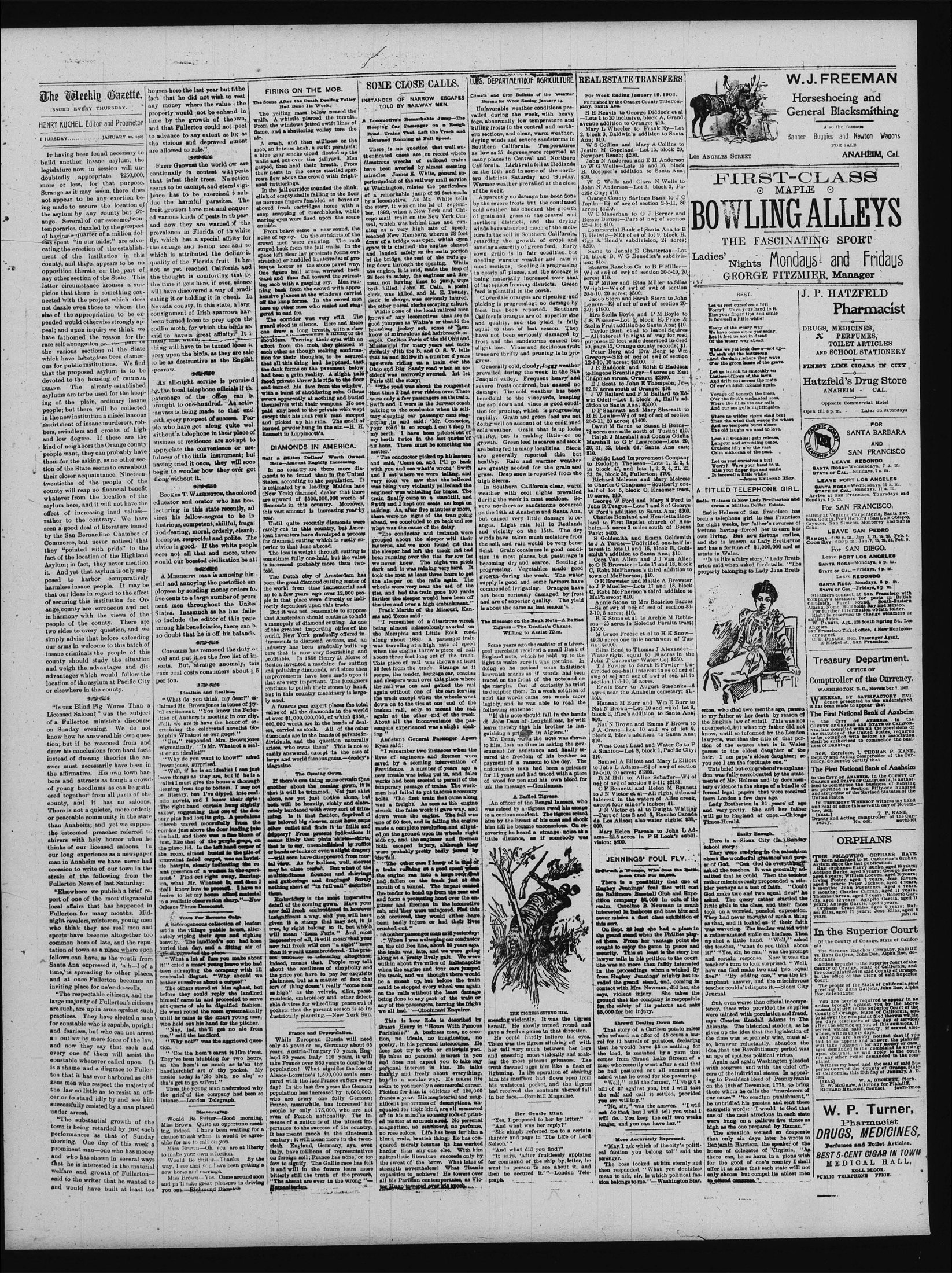
Searchable text
It having been found necessary to build another insane asylum, the legislature now in session will undoubtedly appropriate $250,000 more or less, for that purpose. Strange as it may seem, there does not appear to be any exertion being made to secure the location of the asylum by any county but Orange. Several of our esteemed contemporaries, dazzled by the prospect of having a quarter of a million dollars spent "in our midst" are advocating the erection of the establishment of the institution in this county, and there appears to be no opposition thereto on the part of any other section of the State. This latter circumstance arouses a suspicion that there is something connected with the project which does not dazzle even those to whom the size of the appropriation to be expended would otherwise strongly appeal; and upon inquiry we think we have fathomed the reason for the rare self-abnegation on the part of the various sections of the State which have heretofore been clamorous for public institutions. We find that the proposed asylum is to be devoted to the housing of criminal insane. The already-established asylums are to be used for the keeping of the plain, ordinary insane people; but there will be collected in the new institution a miscellaneous assortment of insane murderers, robbers, swindlers and crooks of high and low degree. If these are the kind of neighbors the Orange county people want, they can probably have them for the asking, as no other section of the State seems to care about their demeanour.
The Weekly Gazette.
ISSUED EVERY THURSDAY.
HENRY KUCHEL. Editor and Proprietor
F I U R S D A Y.... JANUARY 22, 1903
It has been found necessary to build another insane asylum, the legislature now in session will undoubtedly appropriate $250,000 more or less, for that purpose. Strange as it may seem, there does not appear to be any exertion being made to secure the location of the asylum by any county but Orange. Several of our esteemed contemporaries, dazzled by the prospect of having a quarter of a million dollars spent "in our midst" are advocating the erection of the establishment of the institution in this county, and there appears to be no opposition thereto on the part of any other section of the State. This latter circumstance arouses a suspicion that there is something connected with the project which does not dazzle even those to whom the size of the appropriation to be expended would otherwise strongly appeal; and upon inquiry we think we have fathomed the reason for the rare self-abnegation on the part of the various sections of the State which have heretofore been clamorous for public institutions. We find that the proposed asylum is to be devoted to the housing of criminal insane. The already-established asylums are to be used for the keeping of the plain, ordinary insane people; but there will be collected in the new institution a miscellaneous assortment of insane murderers, robbers, swindlers and crooks of high and low degree. If these are the kind of neighbors the Orange county people want, they can probably have them for the asking, as no other section of the State seems to care about their demeanour.
Fruit Growers: the world our are continually in contest with pests that infest their trees. No action seems to be exempt, and eternal vigilance has to be exercised to subdue the harmful parasites. The fruit growers have met and coquered various kinds of pests in their past and now they are warned of the prevalence in Florida of tb white fly, which has a special affinity for the orange and lemon tree and to which is attributed the delineation quality of the Florida fruit. It has not as yet reached California, and the thought is comforting that by the time it gets here, if ever, science will have discovered a way of eradicating it or holding it in check. In Nevada county, in this state, a large consignment of Irish sparrows have been turned loose to prey upon the codlin moth, for which the birds are said to have a great affinity. It is likely that within three things will have to be turned loose to prey upon the birds, as they are said to be as destructive as the English sparrow.
An all-night service is promised by the local telephone officials if their patronage of the office can be brought to one-hundred. As active canvass is being made to that end with every prospect of success. People who have got along quite well without a telephone in their place of business or residence are not apt to appreciate the convenience or usefulness of the little instrument; but having tried it once, they will soon begin to wonder how they ever got houses here the last year but for the fact that he did not wish to vest any money where the value of the property would not be enhanced in time by the growth of the own, and that Fullerton could not spect to advance to any extent as big as the vicious and depraved element are allowed to rule."
FIRING ON THE MOB.
The Scene After the Death Dealing Volleyball Had Done Its Work.
The yelling mass below neared the walls. A whistle pierced the tumult. From the windows jetted swift lines of flame, and a shattering volley tore their air.
A crash, and then stillness on the mob, an intense bush, a swift paralysis; a blue gray smoke cloud floated up the walls and out over the jailyard. Men gasped, then held their breath. From their nests in the caves startled sparrows flow above the crowd with frightened twitterings.
In the jail corridor sounded the clink clink of empty shells falling to the floor as nervous fingers fumbled at boxes above fresh cartridges home with a snap snapping of breechblocks, while staring eyes were fixed upon the scene outside.
From below came a new sound, the noise of agony. On the outskirts of the crowd men were running. The men surged back from the jail walls. In this space left clear lay prostrate forms on stretched or huddled in attitudes of grateque horror on the stone paved wall. One figure half arose, wavered back ward and then fall toward the retreating mob with a gasping cry. Men running back from the crowd with apprehensive glances at the windows carried off the limp forms. In the crowd men base up other men who sealed and secured to fro.
The corridor was very still. The guard stood in silence. Here and there one drew a long breath, with a slight shoulders. Turning their eyes with effort from the mob, they glanced each other as though seeking confirmation for their thoughts, to be assured that all this thing had happened, that the dark forms on the pavement had been a grim reality. A slight, pale faced private throw his rifle to the fire and turned his face from the window with a burst of shuddering seba. Other swore apparently at nothing and bushed themselves with their weapons. No paid any heed to the private who wove except that his next runk man stooped and picked up his rifle. The smelld burned powder hung in the air.—H.Bennett in Lippincott's.
DIAMONDS IN AMERICA.
Half a Billion Dollars Worth Own Here—Amount Rapidly Increasing.
In no country are there more o
"Is the Blind Pig Worse Than a Licensed Saloon?" was the subject of a Fullerton minister's discourse on Sunday evening. We do not know how he answered his own question; but if he reasoned from and drew his conclusions from hard facts instead of dreamy theories the answer must necessarily have been in the affirmative. His own town harbors and attracts as tough a crowd of young hoodlums as can be gathered together from all parts of the county, and it has no saloons. There is not a quieter, more orderly or peaceable community in the state than Anaheim; and yet we suppose the esteemed preacher referred to shivers with holy horror when he thinks of our licensed saloons. In our long experience as a newspaper man in Anaheim we have never had occasion to write of our town in the strain of the following from the Fullerton News of last Saturday:
"Elsewhere we publish a brief report of one of the most disgraceful devoted to the housing of criminal insane. The already-established asylums are to be used for the keeping of the plain, ordinary insane people; but there will be collected in the new institution a miscellaneous assortment of insane murderers, robbers, swindlers and crooks of high and low degree. If these are the kind of neighbors the Orange county people want, they can probably have them for the asking, as no other section of the State seems to care about their closer acquaintance. Nineteen-twentieths of the people of the county will reap no financial benefit whatever from the location of the asylum here, and it will not have the effect of increasing land values—rather to the contrary. We have seen a good deal of literature issued by the San Bernardino Chamber of Commerce, but never noticed that they "pointed with pride" to the fact of the location of the Highland Asylum; in fact, they never mention it. And yet that asylum is only supposed to harbor comparatively harmless insane people. It may be that our ideas in regard to the effect of securing this institution for Orange county are erroneous and not in harmony with the views of the people of the county. There are two sides to every question, and we simply advise that before extending our arms in welcome to this batch of insane criminals the people of this county should study the situation and weigh the advantages and disadvantages which would follow the location of the asylum at Pacific City or elsewhere in the county.
"What do you think, my dear?" explained Mr. Brownjones in tones of joyl excitement. "You know the Federation of Authors is meeting in our city. Well, we are to have the honor of entertaining the celebrated novelist Golphin Whatnot as our guest."
"Um," responded Mrs. Brownjones magnatically. "Is Mr. Whatnot a realist or an idealist?"
"Why do you want to know?" asked Brownjones, surprised.
"Well, if he is an idealist I can just save things as they are, but if he is a realist I must give the house a thorough cleaning from top to bottom. I may not be literary, but I've dipped into realistic novels, and I knew their style: The right hand contain hung slightly askew, suggesting that one of the dauery pins had lost its grip. A pendulous web waved mournfully from the cornice just above the door leading into the hall, and there was a fine bloom of dust, like that of the purple grape, on the piano lid. In the left-hand corner of the room, almost busiest in the pile of somewhat faded carpet, was an invisible hairpin, clearly indicating the recent presence of a woman in the apartment." Find out right away, Barrington, what Mr. Whatnot is, and then I shall know how to proceed. I have no desire to let my house afford material all-night service is promised by the local telephone officials if patronage of the office can be brought to one-hundred. An active vanass is being made to that end with every prospect of success. People who have got along quite well without a telephone in their place of business or residence are not apt to appreciate the convenience or usefulness of the little instrument; but having tried it once, they will soon begin to wonder how they ever got along without it.
Booker T. Washington, the colored educator and orator who has been lecturing in this state recently, advises his fellow-negros to be industrious, competent, skillful, frugal, good-fearing, moral, orderly, cleanly decorpus, respectful and polite. The advice is good. If the white people were not all that and more, where would our boasted civilization be at?
A Mississippi man is amusing himself and annoying the postoffice employees by sending money orders five cents to a large number of prominent men throughout the United States. Inasmuch as he has failed to include the editor of this paper among his beneficiaries, there can be no doubt that he is off his balance.
Congress has removed the duty on coal and put it on the free list of imports. But, strange anomaly, this free coal costs consumers about $5 per ton.
Idealism and Reality.
"What do you think, my dear?" explained Mr. Brownjones in tones of joyl excitement. "You know the Federation of Authors is meeting in our city. Well, we are to have the honor of entertaining the celebrated novelist Golphin Whatnot as our guest."
"Um," responded Mrs. Brownjones magnatically. "Is Mr. Whatnot a realist or an idealist?"
"Why do you want to know?" asked Brownjones, surprised.
"Well, if he is an idealist I can just save things as they are, but if he is a realist I must give the house a thorough cleaning from top to bottom. I may not be literary, but I've dipped into realistic novels, and I knew their style: The right hand contain hung slightly askew, suggesting that one of the dauery pins had lost its grip. A pendulous web waved mournfully from the cornice just above the door leading into the hall, and there was a fine bloom of dust, like that of the purple grape, on the piano lid. In the left-hand corner of the room, almost busiest in the pile of somewhat faded carpet, was an invisible hairpin, clearly indicating the recent presence of a woman in the apartment." Find out right away, Barrington, what Mr. Whatnot is, and then I shall know how to proceed. I have no desire to let my house afford material all-night service is promised by the local telephone officials if tha patronage of the office can be brought to one-hundred. An active vanass is being made to that end with every prospect of success. People who have got along quite well without a telephone in their place of business or residence are not apt to appreciate the convenience or usefulness of the little instrument; but having tried it once, they will soon begin to wonder how they ever got along without it.
Booker T. Washington, the colored educator and orator who has been lecturing in this state recently, advises his fellow-negros to be industrious, competent, skillful, frugal, good-fearing, moral, orderly, cleanly decorpus, respectful and polite. The advice is good. If the white people were not all that and more, where would our boasted civilization be at?
A Mississippi man is amusing himself and annoying the postoffice employees by sending money orders five cents to a large number of prominent men throughout the United States. Inasmuch as he has failed to include the editor of this paper among his beneficiaries, there can be no doubt that he is off his balance.
Congress has removed the duty on coal and put it on the free list of imports. But, strange anomaly, this free coal costs consumers about $5 per ton.
Idealism and Reality.
"What do you think, my dear?" explained Mr. Brownjones in tones of joyl excitement. "You know the Federation of Authors is meeting in our city. Well, we are to have the honor of entertaining the celebrated novelist Golphin Whatnot as our guest."
"Um," responded Mrs. Brownjones magnically. "Is Mr. Whatnot a realist or an idealist?"
"Why do you want to know?" asked Brownjones, surprised.
"Well, if he is an idealist I can just save things as they are, but if he is a realist I must give the house a thorough cleaning from top to bottom. I may not be literary, but I've dipped into realistic novels, and I knew their style: The right hand contain hung slightly askew, suggesting that one of the dauery pins had lost its grip. A pendulous web waved mournfully from the cornice just above the door leading into the hall, and there was a fine bloom of dust, like that of the purple grape, on the piano lid. In the left-hand corner of the room, almost busiest in the pile of somewhat faded carpet, was an invisible hairpin, clearly indicating the recent presence of a woman in the apartment." Find out right away, Barrington, what Mr. Whatnot is, and then I shall know how to proceed. I have no desire to let my house afford material all-night service is promised by the local telephone officials if tha patronage of the office can be brought to one-hundred. An active vanass is being made to that end with every prospect of success. People who have got along quite well without a telephone in their place of business or residence are not apt to appreciate the convenience or usefulness of the little instrument; but having tried it once, they will soon begin to wonder how they ever got along without it.
A Missouri dam should continue to bear a monopoly of diamond cutting. As of the greatest importing cities of world New York gradually offered documents to diamond cutters,and industry has been gradually built here that is now very flourishing profitable.In 1858 Henry D.Moston invented a machine for cut and polishing diamonds,and since improvements have been made up that are very important.The foreign continue to polish their stones by him in this country machinery is highly used.A famous gem expert places tha value of allthe diamonds in tha wa over $1,000,000,000of which $000,000worth are in tha hands ofters carried as stock.All of tha diamonds are in tha hands of private dividuals,and tha question nature ariseswho owns them?This is nearly answered.except in thc cagelargeand world famous gems.-Go Magazine.
The Coming Gown.
If there's one thing more certain another about tha coming gown that it will be trimmed.Not just alone,nor yet just bodice alone both will be heavily,richly and rastely burdened with every sort offming.Is it that fashion,hobeloved big sleeves,must have other outlet and finds it in frilly slippier?From present indication seems likely that plain skirts—that is to say.unembellished by or bands or tucks or even a slight dress-will soon have disappeared from tal view.As for bodies.well,she may be close reef.But what multidimensional florence and shih and gatherings and drappings nothing short of "in full sail" does them.Embroidery is thc most impure
There is not a quieter, more orderly or peaceable community in the state than Anaheim; and yet we suppose the esteemed preacher referred to shivers with holy horror when he thinks of our licensed saloons. In our long experience as a newspaper man in Anaheim we have never had occasion to write of our town in the strain of the following from the Fullerton News of last Saturday:
"Elsewhere we publish a brief report of one of the most disgraceful local affairs that has happened in Fullerton for many months. Midnight revelers, roisterers, young men who think they are real men and sports have become altogether too common here of late, and the reputation of town as a place where such fellows can have, as the youth from Santa Ana expressed it, 'a h—l of a time,' is spreading to other places, and at once Fullerton becomes an inviting place for ne'er-do-wells.
"The respectable citizens, and the large majority of Fullerton's citizens are such, are up in arms against such practices. They have elected a man for constable who is capable, upright and fearless, but who can not arrest an outlaw by mere force of the law, and now they say that each and every one of them will assist the constable whenever called upon. It is a shame and a disgrace to Fullerton that it has ever harbored as citizens men who respect the majesty of the law so little as to resist an officer or to stand idly by and see him successfully resisted by a man placed under arrest.
"The substantial growth of the town is being retarded by just such performances as that of Sunday morning. One day of this week a prominent man—one who has money and who has shown in several ways that he is interested in the material welfare and growth of Fullerton—said to the writer that he wanted to and would have built at least ten
Teams For Business Only.
A heterogeneous collection of loafers sat in the village public house, alternately wiping their eyes and righing heavily. The landlord's son had been buried that day, and a fitting air of shame pervaded the place.
"What a lot of fuss you make about it!" cried a smart young man who had been surveying the company with ill concealed disgust. "Why should we bother ourselves about a corpse?"
The others stared at him agast, but before they could reply the landlord himself came in and proceeded to serve out quarts of ale in dignified fashion. He went round the room systematically until he came to the smart young man, who held out his hand for the pitcher.
"Nay, lad, tha'll get no ale from me," said the landlord.
"Why not?" was the aggrieved question.
"'Cos tha heen't carnt it like t'rest. They've been blubbling for two hours, an tha heen't as much as ta'en thy handkerchief art o' thy pocket. My motto today is 'No blub, no ale;' so tha's got to go wi'out."
Then the young man understood why the grief of the company had been so intense. —London Telegraph.
Discouraging.
Would Re Suitor—Good morning, Miss Brown Quite an opportune meeting, indeed. I have been waiting for a chance to ask when it would be agreeable for me to call on you.
Miss Brown—Oh, you are at liberty to make your own selection.
Would Be Suitor—Thanks By the way. I see that you have been getting a new horse and carriage.
Miss Brown—Yes. Come around soon and pall take great pleasure in driving you out—Richmond District.
BING ON THE MOB.
After the Death Dealing Volleyball Had Done Its Work.
Rolling mass below neared the whistle pierced the tumult. Windows jetted swift lines of a shattering volley tore the hatch, and then stillness on the entrance bush, a swift paralysis; may smoke cloud floated up the out over the jallyard. Men held their breath. From them in the eaves startled sparrows above the crowd with frightterings.
A rail corridor sounded the clink, empty shells falling to the floor as fingers fumbled at boxes or cartridges home with a trapping of breechblocks, while eyes were fixed upon the scene below came a new sound, the cagony. On the outskiirts of the men were running. The mob took from the jail walls. In the shift clear lay prostrate forms out of or huddled in attitudes of groanor on the stone paved way. Half arose, wavered back and then fell toward the retreat with a gasping cry. Men run from the crowd with apprehensions at the windows carried bump forms. In the crowd men other men who sealed and staged and fro.
Corridor was very still. The stood in silence. Here and there saw a long breath, with a slow turn. Turning their eyes with an arm from the moth, they glanced at their thoughts, to be assured this thing had happened, that forms on the pavement below ran a grim reality. A slight, paid private threw his rifle to the floor owned his face from the window, burst of shuddering sobs. Others apparently at nothing and busied themselves with their weapons. No one may heed to the private who wept that his next rank man stooped up his rifle. The smell of powder hung in the air.—H. H. Hart in Lippinoots's.
AMONDS IN AMERICA.
A Billion Dollars Worth Owned. No country are there more diagonal than found then in the United States.
SOME CLOSE CALLS.
INSTANCES OF NARROW ESCAPES TOLD BY RAILWAY MEN.
A Locomotive's Remarkable Jump—The Sleeping Car Passenger on a Reugh Road—Trains That Left the Track and Returned Running at Full Speed.
There is no question that well authenticated cases are on record where disastrous wrecks of railroad trains have been averted by almost seeming miracles. James E. White, general superintendent of the railway mail service at Washington, relates the partiolaris of a remarkable jump of 28 feet made by a locomotive. As Mr. White tells the story, it was on the 1st of September, 1892, when a New York and Chicago mail train on the New York Central, which was behind time and running at a very high rate of speed, reached New Hamburg, where 28 foot draw of a bridge was open, which opened space it is claimed—the engine cleared and landed safely on the main portion of the bridge, the rest of the train going down through the opening. While the engine, it is said, made the leap of 28 feet in safety, the engineer and firemen, not having time to jump, were both killed. John H. Cain, a postal clerk, was killed, and M. E. Townney, clerk in charge, was seriously injured, the other postal clerks escaping unhurt.
While none of the local railroal men knows of any locomotives that are as good jumpers as White's or that do the bounding jockey not, some of them know of miraculous and hairbreathless Carl Paris of the old Ohio and Mississippi for many years and more recently with the B. and O. B. V. tells that he and Ed Swift a number of years ago were riding on a train over Ohio and Big Sandy road when an olddent was narrowly averted. But let Paris tell the story:
"The road was about the roughest at that time I had ever ridden over. There were only a few passengers on the train. Swift and I were in the forward coach talking to the conductor when his solitary sleeping car passenger can staggering in and said: 'Mr. Conductor, your road' is so rough I can't sleep in my berth. I have been pitched out of my berth twice in the last quarter of an hour. There must be something the matter.'"
The condnotor picked up his eastern and said, 'Come on, and I'll go back with you and see what's wrong'. Swift and I sat where we were talking, and unfavorable weather conditions prevailed during the week, with heavy fogs, abnormally low temperature and killing frosts in the central and northern sections, and clear, warm weather, drying winds and severe sandstorms in Southern California. Temperatures as low as 25 degrees were reported at many places in Central and Northern California. Light rain fell at Redlands on the 15th and in some of the northern districts Saturday and Sunday. Warmer weather prevailed at the close of the week.
Apparently no damage has been done by the severe frosts but the continued cold weather has checked the growth of grain and grass in the central and northern districts, and the drying winds have absorbed much of the moisture in the soil in Southern California, retarding the growth of crops and causing a scarcity of green feed. Early sown grain is in fair condition, but needing warmer weather and rain in most sections. Seeding is progressing in nearly all places, and the acreage is being materially increased over that of last season in many districts. Green feed is plentiful in the north.
Cloverdale oranges are ripening and picking is progressing; no damage by frost has been reported. Southern California oranges are of superior size and quality, and the yield is fully equal to that of last season. They have not been seriously damaged by frost and the sandstorms caused but slight loss. Vines and deciduous fruit trees are thrifty and pruning is in progress.
Generally cold, cloudy, foggy weather prevailed during the week in the San Joaquin valley. Frequent heavy and severe frosts occurred, but caused no damage. The cold weather has been beneficial to the vineyards, keeping the sap down and vines in good condition for pruning, which is progressing rapidly. Grain and green feed are not doing well on account of the continued cold weather. Grain that is up looks thrifty, but is making little- or no growth. Green feed is scarce and stock are being fed in many localities. Stock are generally reported thin but healthy. Rain and warmer weather are greatly needed for the grain and grass. Deep snow is reported from the climate and Crop Bulletin of the Weather Bureau for Week Ending January 19.
Unfavorable weather conditions prevailed during the week, with heavy fogs, abnormally low temperature and killing frosts in the central and northern sections, and clear, warm weather, drying winds and severe sandstorms in Southern California. Temperatures as low as 25 degrees were reported at many places in Central and Northern California. Light rain fell at Redlands on the 15th and in some of the northern districts Saturday and Sunday. Warmer weather prevailed at the close of the week.
Apparently no damage has been done by the severe frosts but the continued cold weather has checked the growth of grain and grass in the central and northern districts, and the drying winds have absorbed much of the moisture in the soil in Southern California, retarding the growth of crops and causing a scarcity of green feed. Early sown grain is in fair condition, but needing warmer weather and rain in most sections. Seeding is progressing in nearly all places, and the acreage is being materially increased over that of last season in many districts.
Same to Jennie E Chatterton-14, block B, W G Benedict's subion; $150.
Stearns Ranchos Co to B P Milk W of swf of swf of section 20-5-10; 20 acres; $500.
B P Miller and Etna Milller to Wright-Wf of swf of swf of section 20-5-10; 20 acres; $500.
Jacob Stern and Sarah Stern to Lemke-Ef of set nwf of section 3-9; $1900.
Mrs Stella Boyle and P M Boyl J S Wasser-Lot I, block E, Pr Stella Fruit addition to Santa Ana Taylor Buell et al Isabel Suil Taylor Buell et al Isabel Suil Taylor Buell et al Isabel Suil Taylor Buell et al Isabel Suil Taylor Buell et al Isabel Suil Taylor Buell et al Isabel Suil Taylor Buell et al Isabel Suil Taylor Buell et al Isabel Suil Taylor Buell et al Isabel Suil Taylor Buell et al Isabel Suil Taylor Buell et al Isabel Suil Taylor Buell et al Isabel Suil Taylor Buell et al Isabel Suil Taylor Buell et al Isabel Suil Taylor Buell et al Isabel Suil Taylor Buell et al Isabel Suil Taylor Buell et al Isabel Suil Taylor Buell et al Isabel Suil Taylor Buell et al Isabel Suil Taylor Buell et al Isabel Suil Taylor Buell et al Isabel Suil Taylor Buell et al Isabel Suil Taylor Buell et al Isabel Suil Taylor Buell et al Isabel Suil Taylor Buell et al Isabel Suil Taylor Buell et al Isabel Suil Taylor Bull
J R Haddock and Edith G Ha to Eugene Brentlinger-8 acres on Chapman street, Orange; $2400.
E J Scott to John E Thompson 12.27 acres south of Orange; $100.
J W Ballard and F M Ballard win Odell-Lot I, block A, Hallition to Santa Ana; $3000.
D F Sharratt and Mary Sharratt H L Lewis-Wf of net of set of sea 26-5-11; 20 acres; $1400.
David M Burns to Susan H B 7 acres one mile north of Tustin Ralph J Marshall and Connie Marshall to G P Lawrence-Lo 30; 31; 32; block 64; Santa Ana; $10.
Pacific Land Improvement Co to Rudolph Theissen-Lots 1., in block 47; and lots 1, 2, 3, 4; 23; block 48; fullerton-100%.
A grim reality. A slight, pale private throw his rifle to the floor, armed with his face from the window, burst of shuddering sobs. Others apparently at nothing and busied with their weapons. No one may heed to the private who wept that his next rank man stooped up his rifle. The smell of powder hung in the air.—H. H. Lippincott's.
All quite recently diamonds were cut in this country, but American inventors have developed a process diamond cutting which is vastly superior to that done abroad.
Loss in weight through cutting is times fully one-half, but the value probably more than two-times.
Dutch city of Amsterdam has the great diamond cutting center of world from time immemorial and a few years ago over 120,000 pearls that place were directly or independently upon this trade.
It was not reasonable to suppose Amsterdam should continue to hold monopoly of diamond cutting. As one greatest importing cities of the New York gradually offered incentives to diamond outliers, and an industry has been gradually built up that is now very flourishing and stable. In 1889 Henry D. Morse invented a machine for cutting polishing diamonds, and since then movements have been made upon it are very important. The foreigners use to polish their stones by hand, in this country machinery is large.
Famous gem expert places the total cost of all the diamonds in the world over $1,000,000,000, of which $580,000 are in the hands of deal-makers as stock. All of the other bonds are in the hands of private individuals, and the question naturally arises who owns them? This is not so easily answered, except in the case of world famous gems—Godey's mine.
The coming town there’s one thing more certain than ever about the coming gown; it is still be trimmed. Not just skirt nor yet just bodice alone, but will be heavily, richly and elaborately burdened with every sort of trimming. In it that fashion, deprived of beloved big sleeves, must have some outer outlet and finds it in frills and embellished or ruffled and or tucks or even a slight drapery soon have disappeared from morrow.
As for bodies, well, sleeves be close reaked. But what of the undistinct flounces and shirring gatherings and drapings? Surely short of “in full sail” describes howdy is the most imperative
"The road was about the rougeest at that time I had ever ridden over. There were only a few passengers on the train. Swift and I were in the forward coach talking to the conductor when the solitary sleeping car passenger came staggering in and said: 'Mr. Conductor, your road is so rough I can't sleep in my berth twice in the last quarter of an hour. There must be something the matter."
"The conductor picked up his eastern and said, 'Come on, and I'll go back with you and see what's wrong.' Swift and I sat where we were talking, and very soon we saw that the bellcoord was being very violently pulled and the engineer was whistling for brakes. The train finally came to a standkill, and Swift and I kept our seats an kept on talking. An after five minutes or more, there were no signs of the tran going ahead. We concluded to go back and see what was the cause of the delay.
"The conductor and trainman were grouped about the sleeper with their lunettes, and we soon found out that the sleeper had left the track ind had been running over the ties for low far we never knew. The night was pitch dark and it was raining very hard. It took the men at least three hours to get the sleeper on the rails again. The wheels were very near the end of the ties, and had the train gone 100 yards farther the sleeper would have been off the ties and over a high embankment."
Frank Martin of the Missouri, Kansas and Texas said:
"I remember of a disastrous wreck being almost miraculously avorted on the Memphis and Little Rock road along about 1888. A passenger train was traveling at a high rate of speed when the engine threw a piece of rail about three feet long out of the track. This piece of rail was thrown at least 25 feet from the track. Strange as it seems, the tender, baggage car, conches and sleepers went over this place where the rail was out and gained the rail again without one of the cars leaving the track except when the wheels went down on to the ties at one end of the broken rail, only to mount the rail again at the other end of the track. About all the inconvenience the passengers experienced was a slight shaking."
Assistant General Passenger Agent Ryan said:
"I remember two instances when the lives of engineers and firemen were saved by a seeming intervention of Providence. A number of years ago a new trestle was being put in, and false works had been erected to permit of the temporary passage of trains. The workmen had failed to put insane necessary bolts. The first train that came along was a freight. As soon as the engine struck the false work it gave way, and down went the engine. The fall was one of 50 feet, and in falling the engine made a complete revolution and slightly on the ground upon its wheels right side up, and the engineer and fireman both escaped injury, although they were probably pretty badly jarred by the fall.
"The other case I know of is that of a train running at a good speed when the engine ran into a large rock that had fallen on the track just as the month of a tunnel. The impact caused the tender to bend up from the rear end and form a protecting hood over the Joaquin valley. Frequent heavy and severe frosts occurred, but caused no damage. The cold weather has been beneficial to the vineyards, keeping the sap down and vines in good condition for pruning, which is progressing rapidly. Grain and green feed are not doing well on account of the continued cold weather. Grain that is up looks thrifty, but is making little- or no growth. Green feed is scarce and stock are being fed in many localities. Stock are generally reported thin but healthy. Rain and warmer weather are greatly needed for the grain and grass. Deep snow is reported from the high Sierra.
In Southern California clear, warm weather with cool nights prevailed during the week in most sections. Severe northers or sandstorms occurred on the 14th at Anaheim and Santa Ana, but caused very little damage to oranges. Light rain fell in Redlands and vicinity on the 15th. The dry winds have taken much moisture from the soil, and rain would be very beneficial. Grain continues in good condition in most places, but pasture is becoming dry and scarce. Seeding is progressing. Vegetables made good growth during the week. The water supply is good and some farmers have commended irrigating. Oranges have not been seriously damaged by frost and are of superior quality. The yield is about the same as last season's.
The Message on the Bank Note—A Baffled Tigress—The Dentist's Chance.
Willing to Assist Him.
Some years ago the cashier of a Liverpool merchant received a small Bank of England note, which he held up to the light to make sure it was genuine. In doing so he noticed some indistinct brownish marks as if words had been traced on the front of the note and on the margin. Out of curiosity he tried to decipher them. In a weak solution of acid the words came out much more legibly, and he was able to read the following sentence:
"If this note should fall in the hands of John Dean of Longhillmar, he will learn thereby that his brother is languishing a prisoner in Algiers."
Mr Dean, when he noted was shown to him, lost no time in asking government for assistance and finally secured the freedom of his brother on payment of a ransom to the dey. The unfortunate man had a prisoner for 11 years and had traced with a piece of wood for pen and his own blood for ink the message."—Gentleman.
A Baffled Tigress.
An officer of the Bengal lancers, who was seized by a tigress owed his escape to a curious accident. The tigress seized him by the breast of his cone and shock him till he became unconscious. On recovering he heard a strange noise at a little distance, as if somebody was Joaquin valley. Frequent heavy and severe frosts occurred, but caused no damage. The cold weather has been beneficial to the vineyards, keeping the sap down and vines in good condition for pruning, which is progressing rapidly. Grain and green feed are not doing well on account of the continued cold weather. Grain that is up looks thrifty, but is making little- or no growth. Green feed is scarce and stock are being fed in many localities. Stock are generally reported thin but healthy. Rain and warmer weather are greatly needed for the grain and grass. Deep snow is reported from the high Sierra.
In Southern California clear, warm weather with cool nights prevailed during the week in most sections. Severe northers or sandstorms occurred on the 14th at Anaheim and Santa Ana, but caused very little damage to oranges. Light rain fell in Redlands and vicinity on the 15th. The dry winds have taken much moisture from the soil, and rain would be very beneficial. Grain continues in good condition in most places, but pasture is becoming dry and scarce. Seeding is progressing. Vegetables made good growth during the week. The water supply is good and some farmers have commended irrigation. Oranges have not been seriously damaged by frost and are of superior quality. The yield is about the same as last season's.
The Message on the Bank Note—A Baffled Tigress—The Dentist's Chance.
Willing to Assist Him.
Some years ago the cashier of a Liverpool merchant received a small Bank of England note, which he held up to the light to make sure it was genuine. In doing so he noticed some indistinct brownish marks as if words had been traced on the front of the note and on the margin. Out of curiosity he tried to decipher them. In a weak solution of acid the words came out much more legibly, and he was able to read the following sentence:
"If this note should fall in the hands of John Dean of Longhillmar, he will learn thereby that his brother is languishing a prisoner in Algiers."
Mr Dean, when he noted was shown to him, lost no time in asking government for assistance and finally secured the freedom of his brother on payment of a ransom to the dey. The unfortunate man had a prisoner for 11 years and had traced with a piece of wood for pen and his own blood for inkthe message."—Gentleman.
A Baffled Tigress.
An officer of the Bengal lancers, who was seized by a tigress owed his escape to a curious accident. The tigress seized him by the breast of his cone and shock him till he became unconscious. On recovering he heard a strange noise at a little distance, as if somebody was Joaquin valley. Frequent heavy and severe frosts occurred, but caused no damage. The cold weather has been beneficial to the vineyards, keeping the sap down and vines in good condition for pruning, which is progressing rapidly. Grain and green feed are not doing well on account of the continued cold weather. Grain that is up looks thrifty, but is making little- or no growth. Green feed is scarce and stock are being fed in many localities. Stock are generally reported thin but healthy. Rain and warmer weather are greatly needed for the grain and grass. Deep snow is reported from the high Sierra.
In Southern California clear, warm weather with cool nights prevailed during the week in most sections. Severe northers or sandstorms occurred on the 14th at Anaheim and Santa Ana, but caused very little damage to oranges. Light rain fell in Redlands and vicinity on the 15th. The dry winds have taken much moisture from the soil, and rain would be very beneficial. Grain continues in good condition in most places, but pasture is becoming dry and scarce. Seeding is progressing. Vegetables made good growth during the week. The water supply is good and some farmers have commended irrigation. Oranges have not been seriously damaged by frost and are of superior quality. The yield is about the same as last season's.
JENNINGS' FOUL STREET
E J Scott to John E Thompson
E J Ballard to F M Ballard
Win Odell to L 1, 2 3 4 23 24 38 40
D F Sharratt to Mary Sharratt
H H Lewis-William to N P Lawrence-Lewis
Marshall to G P Lawrence-Lewis
30 31 32 64 Santa Ana
$10.
Pacific Land Improvement Co.
Rudolph Thelsson-Lots 1,
in block 47,and lots 1 2 ,3 ,4
23 ,24 ,38 ,Fullerton;
Richard Melroseand Mary M
to Charles C Chapman-Southern half of lot 5,block 64,Santa Ana
$10.
Pacific Land Improvement Co.
Rudolph Thelsson-Lots 1,
in block 47,and lots 1 2 ,3 ,4
23 ,24 ,38 ,Fullerton;
Richard Melroseand Mary M
to Charles C Chapman-Southern half of lot 5,block 64,Santa Ana
$10.
Pacific Land Improvement Co.
Rudolph Thelsson-Lots 1,
in block 47,and lots 1 2 ,3 ,4
23 ,24 ,38 ,Fullerton;
Richard Melroseand Mary M
to Charles C Chapman-Southern half of lot 5,block 64,Santa Ana
$10.
Pacific Land Improvement Co.
Rudolph Thelsson-Lots 1,
in block 47,and lots 1 2 ,3 ,4
23 ,24 ,38 ,Fullerton;
Richard Melroseand Mary M
to Charles C Chapman-Southern half of lot 5,block 64,Santa Ana
$10.
Pacific Land Improvement Co.
Rudolph Thelsson-Lots 1,
in block 47,and lots 1 2 ,3 ,4
23 ,24 ,38 ,Fullerton;
Richard Melroseand Mary M
to Charles C Chapman-Southern half of lot 5,block 64,Santa Ana
$10.
Pacific Land Improvement Co.
Rudolph Thelsson-Lots 1,
in block 47,and lots 1 2 ,3 ,4
23 ,24 ,38 ,Fullerton;
Richard Melroseand Mary M
to Charles C Chapman-Southern half of lot 5,block 64,Santa Ana
$10.
Pacific Land Improvement Co.
Rudolph Thelsson-Lots 1,
in block 47,and lots 1 2 ,3 ,4
23 ,24 ,38 ,Fullerton;
Richard Melroseand Mary M
to Charles C Chapman-Southern half of lot 5,block 64,Santa Ana
$10.
Pacific Land Improvement Co.
Rudolph Thelsson-Lots 1,
in block 47,and lots 1 2 ,3 ,4
23 ,24 ,38 ,Fullerton;
Richard Melroseand Mary M
to Charles C Chapman-Southern half of lot 5,block 64,Santa Ana
$10.
Pacific Land Improvement Co.
Rudolph Thelsson-Lots 1,
in block 47,and lots 1 2 ,3 ,4
23 ,24 ,38 ,Fullerton;
Richard Melroseand Mary M
to Charles C Chapman-Southern half of lot 5,block 64,Santa Ana
$10.
Pacific Land Improvement Co.
Rudolph Thelsson-Lots 1,
in block 47,and lots 1 2 ,3 ,4
23 ,24 ,38 ,Fullerton;
Richard Melroseand Mary M
to Charles C Chapman-Southern half of lot 5,block 64,Santa Ana
$10.
Pacific Land Improvement Co.
Rudolph Thelsson-Lots 1,
in block 47,and lots 1 2 ,3 ,
4.
23 ,24 ,38 ,Fullerton;
Richard Melroseand Mary M
to Charles C Chapman-Southern half of lot 5,block 64,Santa Ana
$10.
Pacific Land Improvement Co.
Rudolph Thelsson-Lots 1,
in block 47,and lots 1 2 ,
3.
24 ,38 ,
Fullerton;
Richard Melroseand Mary M
to Charles C Chapman-Southern half of lot 5,bblock64,Santa Ana
$10.
Pacific Land Improvement Co.
Rudolph Thelsson-Lots 1,
in block 47,and lots 1
2 .
3 .
4.
23 ,24 ,
38 ,
Fullerton;
Richard Melroseand Mary M
to Charles C Chapman-Southern half of lot
5,bblock64,Santa Ana
$10.
Pacific Land Improvement Co.
Rudolph Thelsson-Lots
1,
in block
5,bblock64,Santa Ana
$10.
Pacific Land Improvement Co.
Rudolph Thelsson-Lots
1,
in block
5,bblock64,Santa Ana
$10.
Pacific Land Improvement Co.
Rudolph Thelsson-Lots
1,
in block
5,bblock64,Santa Ana
$10.
Pacific Land Improvement Co.
Rudolph Thelsson-Lots
1,
in block
5,bblock64,Santa Ana
$10.
Pacific Land Improvement Co.
Rudolph Thelsson-Lots
1,
in block
5,bblock64,Santa Ana
$10.
Pacific Land Improvement Co.
Rudolph Thelsson-Lots
1,
in block
5,bblock64,Santa Ana
$10.
Pacific Land Improvement Co.
Rudolph Thelsson-Lots
1,
in block
5,bblock64,Santa Ana
$10.
Pacific Land Improvement Co.
Rudolph Thelsson-Lots
1,
in block
5,bblock64,Santa Ana
$10.
Pacific Land Improvement Co.
Rudolph Thelsson-Lots
1,
in block
5,bblock64,Santa Ana
$10.
Pacific Land Improvement Co.
Rudolph Thelsson-Lots
1,
in block
5,bblock64,Santa Ana
$10.
Pacific Land Improvement Co.
Rudolph Thelsson-Lots
1,
in block
5,bblock64,Santa Ana
$10.
Pacific Land Improvement Co.
Rudolph Thelsson-Lots
1,
in block
5,bblock64,Santa Ana
$10.
Pacific Land Improvement Co.
Rudolph Thelsson-Lots
1,
in block
5,bblock64,Santa Ana
$10.
Pacific Land Improvement Co.
Rudolph Thelsson-Lots
1,
in block
5,bblock64,Santa Ana
$10.
Pacific Land Improvement Co。
Rudolph Thelsson-Lots
1,
in block
5,bblock64,Santa Ana
$10.
Pacific Land Improvement Co。
Rudolph Thelsson-Lots
1,
in block
5,bblock64,Santa Ana
$10.
Pacific Land Improvement Co。
Rudolph Thelsson-Lots
1,
in block
5,bblock64,Santa Ana
$10.
Pacific Land Improvement Co。
Rudolph Thelsson-Lots
1,
in block
5,bblock64,Santa Ana
$10.
Pacific Land Improvement Co。
Rudolph Thelsson-Lots
1,
in block
5,bblock64,Santa Ana
$10.
Pacific Land Improvement Co。
Rudolph Thelsson-Lots
1,
in block
5,bblock64,Santa Ana
$10.
Pacific Land Improvement Co。
Rudolph Thelsson-Lots
I,
in block
5,bblock64,Santa Ana
$10.
Pacific Land Improvement Co。
Rudolph Thelsson-Lots
I,
in block
5,bblock64,Santa Ana
$10.
Pacific Land Improvement Co。
Rudolph Thelsson-Lots
I,
in block
5,bblock64,Santa Ana
$10.
Pacific Land Improvement Co。
Rudolph Thelsson-Lots
I,
in block
5,bblock64,Santa Ana
$10.
Pacific Land Improvement Co。
Rudolph Thelsson-Lots
I,
in block
5,bblock64,Santa Ana
$10.
Pacific Land Improvement Co。
Rudolph Thelsson-Lots
I,
in block
5,bblock64,Santa Ana
$10.
Pacific Land Improvement Co。
Rudolph Thelsson-Lots
I,
in block
5,bblock64,Santa Ana
$10.
Pacific Land Improvement Co。
Rudolph Thelsson-Lots
I,
in block
5.bblock64,Santa Ana
$10.
Pacific Land Improvement Co。
Rudolph Thelsson-Lots
I,
in block
5.bblock64,Santa Ana
$10.
Pacific Land Improvement Co。
Rudolph Thelsson-Lots
I,
in block
5.bblock64,Santa Ana
$10.
Pacific Land Improvement Co。
Rudolph Thelsson-Lots
I,
in block
5.bblock64,Santa Ana
$10.
Pacific Land Improvement Co。
Rudolph Thelsson-Lots
I,
in block
5.bblock64,Santa Ana
$
France and Depopulation.
While European Russia will need 45 years or so, Germany about 65 years, Austria-Hungary 70 years, England 80 years, Italy 110 years, it will France over 860 years to double its population! What signifies the loss of place-Lorraine's 1,500,000 souls combined with the loss France suffers every year? In the last five years the German population has increased by 8,000,000; are every one fully German; once meanwhile, has increased her role by only 175,000, who are not of French nationality. The increase of a nation is of the utmost importance to the success of its country. Has meant much in the nineteenth century; it will mean more in the twentieth. England, Germany, Aye, even now, have millions of representatives foreign soil; France has none, or too soon to signify. The Gallic race has felt hard and will in the future learn more early still the truth of the proverb, one absent are ever in the wrong."
An officer of the Bengal lancera, who was seized by a tigress owed his escape to a curious accident. The tigress seized him by the breast of his cost and shook him till he became unconscious. On recovering he heard a strange noise at a little distance, as if somebody was crushed out."
Another passenger man said yesterday: "When I was a sleeping car conductor on the old Bee line, about 80 years ago, the train was late, and we were going along at a pretty lively gait. We were within about five miles of Indianapolis when the engine and four cars jumped the track, and we thought there would be a smash up, but before the train could be stopped every wheel was again on the rails without the least damage being done to any part of the train or any of the passengers, barring the fright we all had."—Cincinnati Enquirer.
This is how Zola is described by Stuart Henry in "Hours With Famous Parisians:" A business man, no emotion, no ideals, no imagination, no poetry, in his personal intercourse. He does not try to win or entertain you. He takes no personal interest in you and does not expect you to take any personal interest in him. He talks frankly and freely about everything, but in a secular way. He makes life seem to you merely a commercial career. Fiction for him is editions of 100,000 francs a year. His magisterial and magnificent panoramaas descriptions, unequaled for their kind, are all measured off in his mind as so many rods of printed matter at so much a red. No personal magnetism, no sentiment, no perfume, no rose colors. Life has been for him a blunt, rode, brutish thing. He has conquered merely because he has worked harder than any one else. With him naturalistic literature succeeds only by the sweat of the brow. What loins of strength nevertheless! What Titanio capacities to achieve! He towers over all his Parisian contemporaries, as Victor Hugo towered over his spoon.
The TIGRESS SEIZED HIM.
mceezing violently. It was the tigress herself. He slowly turned round and gave a furtive gaze in that direction.
He could hardly believe his eyes. There was the tigress slinking off with her tall very much between her legs and sneezing most violently and making the most piteous grimaces. The truth dawned upon him like a flash of lightning. In the operation of shaking him his snuffbox had flown open from his waistcoat pocket, and the tigress had received the contents thereof full in her face.—Cornhill Magazine.
Her Gentle Hint.
"Yes, I proposed to her by letter."
"And what was her reply?"
"She simply referred me to a certain chapter and page in 'The Life of Lord Nelson.'"
"And what did you find?"
"It says, 'After fruitlessly applying for command of the ship by letter, he went in person to see about it, and then he secured it.'"—London Telegraph.
JENNINGS' FOUL
Struck a Woman Who Sues More Club For $2,000
There is a possibility that Hughey Jennings' foul files the Baltimore Baseball Club edition company $5,000 in our realm. Caroline B. Newman interested in insbouts and bases never misses a first class exit this sort.
On Sept. 29 she had the grand stand when the Phi-ed there. From her vantage sought to enjoy the game in security. This at least is the lawyer tells in his petition to She was no more than fairly in the proceedings when a woman from Hughay Jennings' might raided the grand stand, and contact with Mrs. Newman, does say violent injury. She ground that the company is not for the safety of its patrons $5,000 for her injury.
Shrewd Dealing Down
That story of a Caribou pooh refused an offer of 48 or rel for 11 barrels of potatoes that he would have $5 or more the load, is matched by a comes from Grand Lake Sawyer who recently went after he had pastured out all his asked what he owed for the pay.
"Well," said the farmer, bill of $7 against you, but she calf and call it settled you are willing."
"No sir," was the answer not do that but I will tell you will do. You keep the calf longer, and you can have her.
More Accurately Express
"May I ask which of the calfation you belong to stranger.
The boss looked at him then responded, "What you mean to ask, sir, is which position belongs to me."—Washi-
W.ESTATE TRANSFERS
Week Ending January 19, 1903.
Reavis to George Diddock et al
1 to 20 Inclusive, block A, Grand addition to Orange; $10.
L Wheeler to Frank Ey—Lot 3, Baldwin's addition to Santa $10.
Collins and Mary A Collins to M Copeland—Lot 15, block 20, Port Beach; $200.
N Anderson and E H Anderson
G Wells—Lots 15 and 16, block pepper's addition to Santa Ana;
G Wells and Clara N Wells to N Anderson—Lot 3, block 3, Pacity; $10.
County Savings Bank to J C—E of net of section 2-5-11, 80; $4250.
Mauerhan to O J Berner and Berner—Part of nwf of section 10; $10.
Commercial Bank of Santa Ana to B Wwig—NE of ef of lot 9, block B,
& Bond's subdivision, 2 acres;
Jennie E Chatterton—Lot 2ock B, W G Benedict's subdivis-
$150.
Ranchos Co to B P Miller—of swf of section 20-5-10, 20; $10.
P Miller and Etna Miller to Sline
night—Wt of swf of swf of section 10, 20 acres; $500.
Job Stern and Sarah Stern to John
ke—Ef of set of nwf of section 20-$1900.
Stella Boyle and P M Boyle to Wasser—Lot 1, block E, Price &
Fruit addition to Santa Ana; $10.
Ylbor Bush et al to Isabel Squires interest in right of way for roadoses 20 feet wide described in used page 12, Orange county records; $1.
Berg and Eva Berg to Wmory—SE of net of swf of section 10, 10 acres; $2000.
Haddock and Edith G Haddock
gene Brentlinger—8 acres on East pman street, Orange; $2400.
J Scott to John E Thompson, Jr. acres south of Orange; $10.
W Ballard and F M Ballard to Ed-Odell—Lot 1, block A, Hall's adton to Santa Ana; $3000.
F Sharratt and Mary Sharratt to Lewis—Wt of net of set of section 11, 20 acres; $1400.
M Burns to Susan H Burns—cres one mile north of Tustin; $10.
Ralph J Marshall and Connie Odella
shall to G P Lawrence—Lots 29, 31, 32, block 64, Santa Ana east;
Pacific Land Improvement Company
Rudolph Thelsson—Lots 1, 2, 3, 4,
block 47, and lots 1, 2, 3, 4, 21, 22,
block 38. Fullerton; $700.
W.J. FREEMAN
Horseshoeing and General Blacksmithing
Also the famous
Banner Buggies and Newton Wagons
FOR SALE
ANAHEIM, Cal.
FIRST-CLASS
MAPLE
BOWLING ALLEYS
THE FASCINATING SPORT
Ladies' Nights Mondays and Fridays
GEORGE FITZMIER, Manager
REST.
Let us rest ourselves a bit!
Worry? Wave your hand to it.
Kiss your finger tips and smile
It farewell a little while!
Weary of the weary way
We have come since yesterday.
Let it fret us not in dread
Of the weary way ahead.
While we yet look down—not up--
To seek out the buttercup
And the delay where they wave
Over the green home of the grave.
Let us launch us smoothly on Listless-billows of the lawn
And drift out across the main
Of our childish dreams again.
Voyage off beneath the trees,
O'er the field's enchanted seas,
Where the lilies are our sails
And our sea gulls nightingales.
Where no wilder storm shall best
Than the wind that waves the wheat
And no tempests burst above
The old laughs we used to love.
Lose all troubles; gain release,
Langour and exceeding peace,
Cruiding idly o'er the vast calm midocean of the past.
J. P. HATZFELD
Pharmacist
DRUGS, MEDICINES,
PERFUMES,
TOILET ARTICLES
AND SCHOOL STATIONERY
FINEST LINE CIGARS IN CITY
Hatzfeld's Drug Store
ANAHEIM - CAL.
Opposite Commercial Hotel
Open till 8 p.m. - Later on Saturdays
FOR
SANTA BARBA
AND
SAN FRANCISCO
LEAVE REDONDO
SANTA ROSA—Wednesdays, 7 a.m.
STATE OFCAL.-Sundays,7 a.m.
JENNINGS' FOUL FLY.
There is a possibility that one of Hayley Jennings' foul files will cost the Baltimore Baseball Club and Expo.
A FITLED TELEPHONE GIRL
Sadie Holmes Is Now Lady Bretherton and Owns a Million Dollar Estate.
Sadie Holmes of San Francisco has been a telephone girl in San Francisco for eight weeks, her father's reverence of fortune having forced her to earn her own living. But now fortune smiles, and she is known as Lady Bretherton and has a fortune of $1,000,000 and an estate in Wales.
"It is like a fairy story," Lady Bretherton said when asked for details. "The property belonging to Lady Jane Bretherton, who died two months ago, passed to my father at her death by reason of the English law of entail. This was not unexpected, but what my father did not know, until so informed by the London lawyers, was that the title of that portion of the estates that is in Wales passes to the eldest daughter of the heir. I am papa's eldest daughter; so you see I am the fortunate one."
This brief but comprehensive explanation was fully corroborated by the statements of Mr. Holmes and by documentary evidence in the shape of a bundle of formal legal papers that were received from London a few days ago.
Lady Bretherton is 21 years of age and very pretty. She and her father will go to England at once—Chicago Times Herald.
Easily Enough.
Here is a Sioux City (Ia.) Sunday school story:
They were studying in the eisenstein about the wonderful greatness and power of God. "Can God do everything?" asked the teacher. It was generally admitted that he could. Then the teacher rather mischievously propounded a stinker perhaps as a test of faith. "Could God make two and two equal five?" he asked. The teacher rather started the
JENNINGS' FOUL FLY.
There is a possibility that one of Hughay Jennings' foul flies will cost the Baltimore Baseball Club and Exposition company $5,000 in coin of the realm. Caroline B. Newman is much interested in inhouses and base hits and never misses a first class exhibition of this sort.
On Sept. 29 last she had a place in the grand stand when the Phillies played there. From her vantage point she ought to enjoy the game in peace and security. This at least is the story her lawyer tells in his petition to the court. She was no more than fairly interested in the proceedings when a wicked fly from Hughay Jennings' mighty bat invaded the grand stand, and, coming in contact with Mrs. Newman, did her, she says, violent injury. She takes the ground that the company is responsible for the safety of its patrons and asks $5,000 for her injury.
Shrewd Dealing Down Ench.
That story of a Caribou potato raiser who refused an offer of 48 cents a barrel for 11 barrels of potatoes, declaring that he would have $5 on nothing for the load, is matched by a yarn that comes from Grand Lake Stream of a man who recently went after a calf that he bad pastured out all summer and asked what he owed for the pasturing.
"Well," said the farmer, "I've got a bill of $7 against you, but I will take the calf and call it settled, provided you are willing."
"No, sir," was the answer. "I will not do that but I will tell you what I will do. You keep the calf two weeks longer, and you can have her."
More Accurately Expressed.
"May I ask which of the city's political faction you belong to?" said the stranger.
The boss looked at him sternly and then responded, "What you doubtless mean to ask, sir, is which political faction belongs to me."—Washington Star.
Easily Enough.
Here is a Sionx City (In.) Sunday school story:
They were studying in the ecoleism about the wonderful greatness and power of God. "Can God de everythin' asked the teacher. It was generally admitted that he could. Then the teacher rather mischievously propounded a stickler perhaps as a test of faith. "Could God make two and two equal five?" he asked. The query rather startled the little girls in the class, and their faces took on a worried, puzzled expression. They had never thought of such a thing as that, and it looked as if their faith was wavering. The teacher waited with a rather amused smile on his face. Then up shot a little hand. "Well," asked the teacher, "what do you think about it?" "Yes, sir, he can," was the prompt and certain response. Now it was the teacher's turn to look surprised. "Well, how can God make two and two equal five?" "By adding one," was the triumphant answer, and the mischievous teacher couldn't dispute it.—Sionx City Journal.
But, even worse than official incompetence, those who provided the supplies were tainted with population and fraud, says Charles Kendall Adams in The Atlantic. The historical student, as he gives up the idea that the legislation of the time was supremely wise, must also, however reluctantly, abandon the idea that the Revolutionary period was an age of spotless political virtue.
Again and again Washington pleaded with congress and with the chief officers of the individual states. In appealing to President Reed of Pennsylvania on the 12th of December, 1778, to bring those whom he calls the "murderers of our cause" "to condign punishment," he unbridled his passion and sent these energetic words: "I would to God that one of the most atrocious in each state were hung on a gallows five times as high as the one prepared by Haman."
The situation seemed so desperate that only six days later he wrote to Benjamin Harrison, the speaker of the house of delegates of Virginia, "As there can be no harm in a pious wish for the good of one's country I shall offer it as mine that each state will not only choose but compel its ablest men to attend conference."