anaheim-gazette 1900-07-26
Scanned page
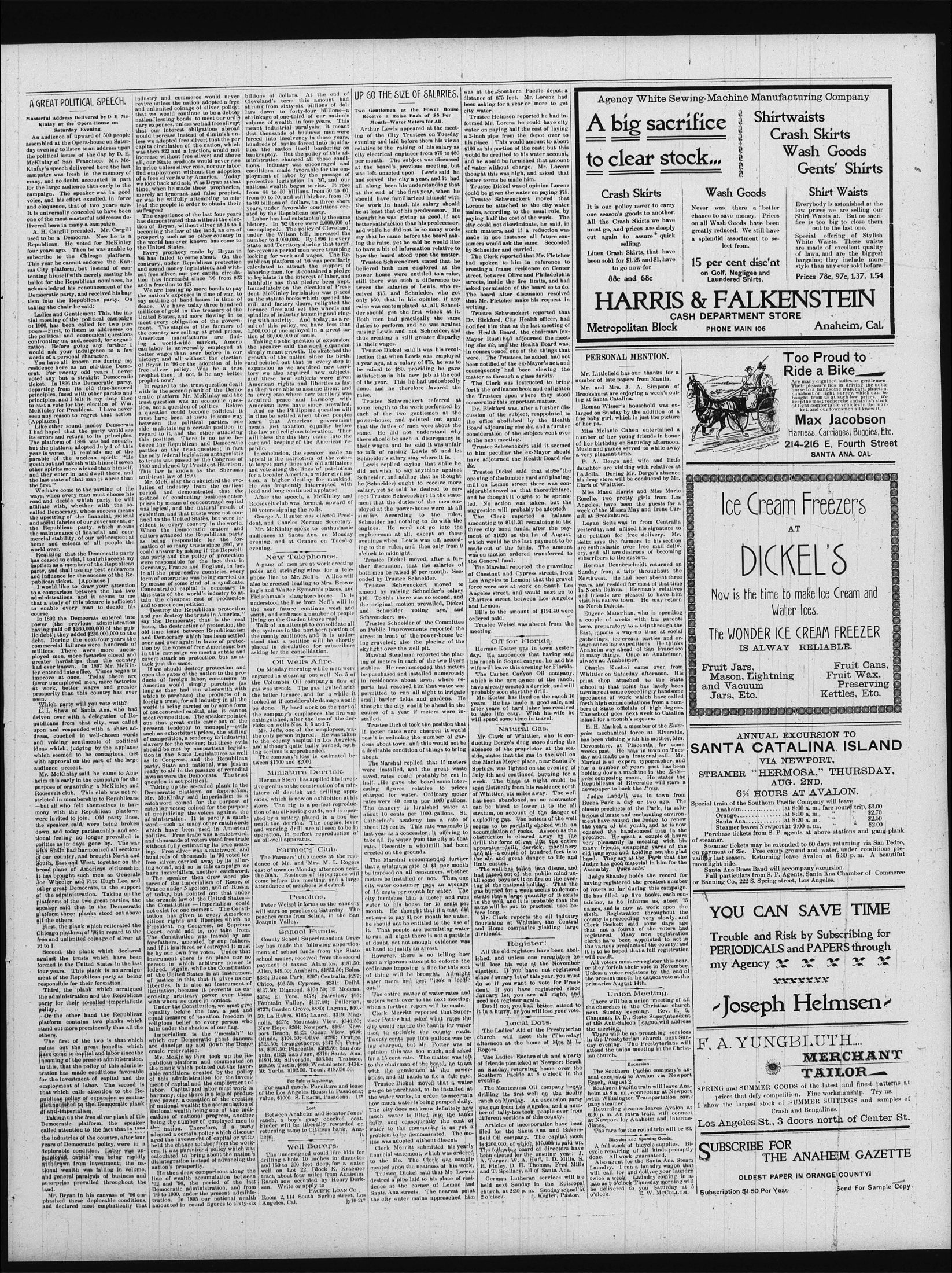
Searchable text
A GREAT POLITICAL SPEECH.
Masterful Address Delivered by D. E. McKinlay at the Opera-House on Saturday Evening.
An audience of upward of 500 people assembled at the Opera-house on Saturday evening to listen to an address upon the political issues of the day by D. E. McKinlay of San Francisco. Mr. McKinlay's speech delivered here the last campaign was fresh in the memory of many, and no doubt accounted in part for the large audience thus early in the campaign. The speaker was in good voice, and his effort excelled, in force and eloquence, that of two years ago. It is universally conceded to have been one of the most masterful addresses delivered here in many a campaign.
A. H. Cargill presided. Mr. Cargill used to be a Democrat. Now he is a Republican. He voted for McKinley four years ago. Then he was unable to subscribe to the Chicago platform. This year he cannot endorse the Kansas City platform, but instead of contenting himself with merely casting his ballot for the Republican nominees, he acknowledged his renouncement of the Democratic party, and received his baptism into the Republican party. On taking the chair he said:
Ladies and Gentlemen: This, the initial meeting of the political campaign of 1900, has been called for two purposes—First, to listen to addresses on the political and economical questions confronting us, and, second, for organization. Before going any further I would ask your indulgence to a few words of a personal character.
You have all known me during my residence here as an old-time Democrat. For twenty odd years I never voted any but a straight Democratic ticket. In 1896 the Democratic party, departing from its old time-honored principles, fused with other parties and principles, and I felt it my duty then to cast a vote for the election of Wm. McKinley for President. I have never seen any reason to regret that action.
Applauze.]
Like other sound money Democrats I had hoped that the party would see its errors and return to its principles. The platform of 1896 was bad enough, but the platform adopted July 4 of this year is worse. It reminds me of the parable of the unclean spirit: "He goeth out and taketh with himself seven other spirits more wicked than himself, and they enter in and dwell there, and industry and commerce would never revive unless the nation adopted a free and unlimited coinage of silver policy; that we would continue to be a debtor nation, issuing bonds to meet our ordinary expenses, unless we had free silver; that our interest obligations abroad would increase instead of diminish unless we adopted free silver; that the per capita circulation of the nation, which was then $23 and a fraction, would not increase without free silver; and above all, our State products would never rise in price unless silver rose, nor our labor find employment without the adoption of a free silver law by America. Today we look back and ask, Was Bryan at that time, when he made those prophecies, merely an ignorant and false prophet, or was he wilfully attempting to mislead the people in order to obtain their suffrages?
The experience of the last four years has demonstrated that without the election of Bryan, without silver at 16 to 1 becoming the law of the land, an era of prosperity such as no other country in the world has ever known has come to the United States.
Every prophecy made by Bryan in '96 has failed to come about. On the contrary, under Republican protection and sound money legislation, and without free silver, our per capita circulation has increased since '96 from $23 and a fraction to $27.
We are issuing no more bonds to pay the nation's expenses in time of war, to say nothing of bond issues in time of decease. We have today three hundred millions of gold in the treasury of the United States, and more flowing in to meet every obligation of the government. The staples of the farmers of the country are selling at good prices, American manufactures are finding a world-wide market, American labor is universally employed at better wages than ever before in our history; and all without the election of Bryan in '96 or the adoption of his free silver policy. Was he a true prophet then; if not, is he any better prophet now?
In regard to the trust question dealt with in the second plank of the Democratic platform Mr. McKinlay said the trust question was an economic question, not a question of politics. Before a question could become political it must have been at issue in some way between the political parties, one side maintaining a certain position in regard to it, and the other attacking this position. There is no issue between the Republican and Democratic parties on the trust question; in fact only federal legislation antagonistic to trusts was passed by the Congress of 1890 and signed by President Harrison. This law is known as the Sherman bill.
At the end of Cleveland's term this amount had shrunk from sixty-six billions of dollars down to forty-four billions—a shrinkage of one-third of our nation's volume of wealth in four years. This meant industrial paralysis; it meant that thousands of business men were forced into insolvency in those years, hundreds of banks forced into liquidation, the nation itself bordering on bankruptcy. But the policy of this administration changed all those conditions. Industry was encouraged and conditions made favorable for the employment of labor by the passage of protective legislation in '97, and our national wealth began to rise. It rose from 44 to 50 billionnes, from 50 to 60, from 60 to 70, and still higher, from 70 to 80 billionnes of dollars, in three short years, under favorable conditions created by the Republican party.
Labor has had substantially the same history. In '92 there were 2,000,000 unemployed. The policy of Cleveland, under the Wilson bill, increased the number to 4,000,000. By 1896 in every State and Territory during that tariff-for-revenue period men were tramping looking for work and wages. The Republican platform of '96 was peculiarly calculated to attract the support of laboring men, for it contained a pledge to legislate in the interest of labor, and faithfully has that pledge been kept. Immediately on the election of President McKinley legislation was placed on the statute books which opened the mill and factory doors, relighted the furnace fires and set the wheels and spindles of industry humming and ringing with activity. And today, as a result of this policy, we have less than 1,500,000 unemployed in a great nation of 80,000,000 of souls.
Taking up the question of expansion, the speaker said the word expansion simply meant growth. He sketched the growth of the nation since its birth, and pointed out that in every step in expansion as we acquired new territory we also acquired new subjects, and these new subjects were given American rights and liberties as fast as they were able to assume them; and in every case where new territory was acquired peace and harmony with American laws have since prevailed.
And so the Philippine question will in time be settled when those peoples learn that American government means just taxation, equality before the law and religious toleration. They will bless the day they came into the care and keeping of the American republic.
In conclusion, the speaker made an appeal to the patriotism of the voters to forget party lines and old affiliations and vote along the lines of patriotism for a broader America—a wider civiliza-
Like other sound money Democrats I had hoped that the party would see its errors and return to its principles. The platform of 1896 was bad enough, but the platform adopted July 4 of this year is worse. It reminds me of the parable of the unclean spirit: "He goeth out and taketh with himself seven other spirits more wicked than himself, and they enter in and dwell there, and the last state of that man is worse than the first."
We have come to the parting of the ways, when every man must choose his road and decide which party he will affiliate with, whether with the so-called Democracy, whose success means the upsetting of the financial, judicial and social fabrics of our government, or the Republican party, which means the maintenance of financial and commercial stability, of our self-respect at home and esteem of all people the world over.
Realizing that the Democratic party has ceased to exist, I tonight accept my baptism as a member of the Republican party, and shall use my best endeavors and influence for the success of the Republican ticket. [Applause.]
I would like to draw your attention to a comparison between the last two administrations, and it seems to me that a study of this picture is sufficient to enable every man to decide his course.
In 1892 the Democrats entered into power (the previous administration having paid off $260,000,000 of the public debt); they added $230,000,000 to the debt. During the next four years the commercial failures were hundreds of millions. There were more unemployed men, more factories closed and greater hardships than the country had ever known. In 1897 Mr. McKinley entered into office. Times began to improve at once. Today there are fewer unemployed men, more factories at work, better wages and greater prosperity than this country has ever seen.
Which party will you vote with?
L. L. Shaw of Santa Ana, who had driven over with a delegation of Republicans from that city, was called upon and responded with a short address, couched in well-chosen words and voicing sentiments of political ideas which, judging by the applause which seemed to be contagious, met with approval on the part of the large audience present.
Mr. McKinlay said he came to Anaheim this early in the campaign for the purpose of organizing a McKinley and Roosevelt club. This club was not restricted in membership to Republicans—but all who felt themselves in harmony with the Republican platform were invited to join. Old party lines, the speaker said, were being broken down, and today partisanship and sectional feeling no longer prevailed in politics as in days gone by. The war with Spain had harmonized all sections of our country, and brought North and South, East and West, together on the broad plane of American citizenship. It has brought such men as Generals Joe Wheeler and Fitz Hugh Lee, and other great Democrats, to the support of the administration. Taking up the parties the
In regard to the trust question dealt with in the second plank of the Democratic platform Mr. McKinlay said the trust question was an economic question, not a question of politics. Before a question could become political it must have been at issue in some way between the political parties, one side maintaining a certain position in regard to it, and the other attacking this position. There is no issue between the Republican and Democratic parties on the trust question; in fact the only federal legislation antagonistic to trusts was passed by the Congress of 1890 and signed by President Harrison. This law is known as the Sherman anti-trust law of 1890.
Mr. McKinlay then sketched the evolution of industry from the earliest period, and demonstrated that the method of conducting business enterprises by means of concentrated capital was logical, and the natural result of evolution, and that trusts were not confined to the United States, but were incident to every country in the world. When the Democratic orators and editors attacked the Republican party as being responsible for the formation of so many trusts since 1897, we could answer by asking if the Republican party and the policy of protection were responsible for the fact that in Germany, France and England, in fact in all the progressive countries, every form of enterprise was being carried on by means of some kind of a syndicate. Concentrated capital is necessary in this state of the world's industry to attain the cheapest cost of production and to meet competition.
"Destroy the Republican protection and you destroy the trusts in America," say the Democrats; that is the real issue, the destruction of protection, the old time issue between Republicanism and Democracy which has been settled over and over again in favor of protection by the votes of free Americans; but in this campaign we meet a subtle and covert attack on protection, but an attack just the same.
If we should destroy protection and open the gates of the nation to the products of foreign labor, consumers in America would simply purchase (as long as they had wherewith with which to purchase) the products of a foreign trust, for all industry in all the world is being carried on by some form of concentrated capital, else it cannot meet competition. The speaker pointed out that great evils came out of the present tendency to monopoly—evils such as exhortant prices, the stifling competition, a tendency to industrial slavery for the worker; but these evils should be met by nonpartisan legislation in the State Legislatures as well as in Congress, and the Republican party, State and national, was just as ready to aid in the passage of remedial laws as were the Democrats. The trust question is not political.
Taking up the so-called plank in the Democratic platform on imperialism, Mr. McKinlay said imperialism is a catchword coined for the purpose of catching votes; coined for the purpose of prejudicing the voters against the administration. It is purely a catchword—such as many other catchwords which have been used in American politics. Free trade was a catchword, and thousands of voters voted free trade without fully estimating its true meaning. Free silver was a catchword, and hundreds of thousands in '96 voted for free silver, carried away by its alluring sound, and so in this campaign we have imperialism, another catchword.
The speaker then drew word pictures of the imperialism of Rome, of France under Napoleon, and of Russia today, but pointed out that under the organic law of the United States—
In conclusion, the speaker made an appeal to the patriotism of the voters to forget party lines and old affiliations and vote along the lines of patriotism for a broader America, a wider civilization, a higher destiny for mankind. He was frequently interrupted with loud and long continued applause.
After the speech, a McKinley and Roosevelt club was formed, upward of 100 voters signing the rolls.
George A. Hunter was elected President, and Charles Norman Secretary.
Mr. McKinlay spoke to enthusiastic audiences at Santa Ana on Monday evening, and at Orange on Tuesday evening.
New Telephones.
A gang of men are at work erecting poles and stringing wires for a telephone line to Mr. Neff's. A line will also be erected leading to Mrs. Browning's and Walter Eymann's places, and Fleischman's slaughter-house. It is understood the line from Neff's will in near future continue west and south, and embrace a number of people living on the Garden Grove road.
Talk of an attempt to consolidate all the systems in the northern portion of the county continues, and it is understood that a petition will be shortly placed in circulation for subscribers asking for the consolidation.
Oil Wells Afire.
On Monday morning while men were engaged in cleaning out well No.5 of the Columbia Oil company a flow of gas was struck. The gas ignited with the boiler furnace, and for a while looked as if considerable damage would be done. By hard work on part of the company's employees the fire was extinguished, after the loss of the derricks on well Nos. 1, 5 and 7.
Mr. Jeffs, one of the employees, was the only person injured. He was taken to the county hospital in Los Angeles and although quite badly burned, nothing serious is apprehended.
The company's loss is estimated between $1500 and $2000.
Miniature Derrick.
Herman Stern has applied his inventive genius to the construction of a miniature oil derrick and drilling apparatus, which is now on exhibition at his store. The rig is a perfect reproduction of an oil-boring outfit, and is operated by a battery placed in a box neatly depleted. The engine lever working drill are all seen to be in operation, in perfect reproduction of an oil-well apparatus.
Farmers' Club.
The Farmers' club meets at the residence of Mr. and Mrs. M. L. Roger east of town on Monday afternoon next 30th. Business of importance will come before the meeting, and a large attendance of members is desired.
Peaches.
stricted in membership to Republicans—but all who felt themselves in harmony with the Republican platform were invited to join. Old party lines, the speaker said, were being broken down, and today partisanship and sectional feeling no longer prevailed in politics as in days gone by. The war with Spain had harmonized all sections of our country, and brought North and South, East and West, together on the broad plane of American citizenship. It has brought such men as Generals Joe Wheeler and Fitz Hugh Lee, and other great Democrats, to the support of the administration. Taking up the platforms of the two great parties, the speaker said that in the Democratic platform three planks stood out above all the others:
First, the plank which reiterated the Chicago platform of '96 in regard to the free and unlimited coinage of silver at 16 to 1.
Second, the plank which declared against the trusts which have been formed in the United States in the last four years. This plank is an arraignment of the Republican party as being responsible for their formation.
Third, the plank which arraigned the administration and the Republican party for their so-called imperialistic policy.
On the other hand the Republican platform contains two planks which stand out more prominently than all the others.
The first of the two is that which points out the great benefits which have come to capital and labor since the incoming of the present administration, in this, that the policy of this administration has made conditions favorable for the investment of capital and the employment of labor. The second is that which calls attention to the Republican policy of expansion as contradistinguished to the Democratic plank of anti-imperialism.
Taking up the free silver plank of the Democratic platform, the speaker called attention to the fact that in 1898 the industries of the country, after four years of Democratic policy, were in a deplorable condition. Labor was unemployed, capital was being rapidly withdrawn from investment; the national wealth was falling in volume, and general paralysis of business and enterprise prevailed throughout the land.
Mr. Bryan in his canvass of '96 emphasized these deplorable conditions, and declared most emphatically that Mr. McKinlay said important catchword coined for the purpose of catching votes; coined for the purpose of prejudicing the voters against the administration. It is purely a catchword—such as many other catchwords which have been used in American politics. Free trade was a catchword, and thousands of voters voted free trade without fully estimating its true meaning. Free silver was a catchword, and hundreds of thousands in '96 voted for free silver, carried away by its alluring sound, and so in this campaign we have imperialism, another catchword.
The speaker then drew word pictures of the imperialism of Rome, of France under Napoleon, and of Russia of today, but pointed out that under the organic law of the United States—the Constitution—imperialism could not exist for one moment. The Constitution has given to every American citizen rights and liberties which no President, no Congress, no Supreme Court, could add to, nor take from. The Constitution was framed by our forefathers, amended by our fathers, and if it is altered or destroyed it must be by our own free votes. Under that instrument there is no place nor no person in which arbitrary power is lodged. Again, while the Constitution of the United States is an instrument of justice in this, that it gives us our liberties, it is also an instrument of limitation, because it prevents us exercising arbitrary power over those with whom we come in contact.
Under the Constitution, we must give equality before the law, a just and equal measure of taxation, freedom in religious belief to every person who falls under the shadow of our flag.
Imperialism is the "messiah" to which our Democratic ghost dancers are dancing up and down the Democratic reservation.
Mr. McKinlay then took up the Republican platform and commented on the plank which pointed out the favorable conditions created by the policy of this administration for the investment of capital and the employment of labor. Capital and labor must work in harmony, else there is a loss of productive power, a cessation of the creation of national wealth; the accumulation of national wealth being one of the indications of national progress, another being the number of employed men in the nation. Therefore, if a party adopted a certain policy which discouraged the investment of capital or withheld the chance to labor from the workers, it was pursuing a policy which was calculated to bring about the nation's disintegration instead of advancing the nation's prosperity.
He then drew comparisons along the line of wealth accumulation between '92 and '96, the period of the last Democratic administration, and from '96 to 1900, under the present administration. In 1895 our national wealth amounted in round figures to sixty-six...
UP GO THE SIZE OF SALARIES.
Two Gentlemen at the Power House
Receive a Raise Each of $5 Per Month—Water Meters for All.
Arthur Lewis appeared at the meeting of the City Trustees on Tuesday evening and laid before them his views relative to the raising of his salary as city electrical engineer from $75 to $80 per month. The subject was discussed at the board's previous meeting, but was left unacted upon. Lewis said he had served the city a year, and it had all along been his understanding that at the end of the first year, when he should have familiarized himself with the work in hand, his salary should be at least that of his predecessor. He thought he was giving as good, if not better satisfaction than his predecessor, and while he did not in so many words say that he came before the board asking the raise, yet he said he would like to have a bit of information relative to how the board stood upon the matter.
Trustee Schwenckert stated that he believed both men employed at the power house were entitled to a raise, still there was such a difference between the salaries of Lewis, who received $75, and Schnieder, who got only $60, that, in his opinion, if any raise was contemplated at all, Schneder should get the first whack at it. Both men had practically the same duties to perform, and he was against raising Lewis and not Schneider, and thus creating a still greater disparity in their wages.
Trustee Dickel said it was his recollection that when Lewis was employed a year ago, at a salary of $75, he was to be raised to $80, providing he gave satisfaction in his new job at the end of the year. This he had undoubtedly done, and he therefore favored the raise.
Trustee Schwenckert referred at some length to the work performed by each of the two gentlemen at the power-house, and pointed out again that the duties of each were about the same. He did not understand why there should be such a discrepancy in their wages, and he said it was unfair to talk of raising Lewis $5 and let Schneider's salary stay where it is.
Lewis replied saying that while he did not wish to say anything against was at the Southern Pacific depot, a distance of 675 feet. Mr. Lorenz had been asking for a year or more to get city water.
Trustee Helmsen reported he had informed Mr. Lorenz he could have city water on paying half the cost of laying a 2-inch pipe from the depot over to his place. This would amount to about $100 as his portion of the cost; but this would be credited to his water account, and he would be furnished that amount of water without charge. Mr. Lorenz thought this was high, and asked that better terms be made him.
Trustee Dickel was of opinion Lorenz could be given the water on paying $75.
Trustee Schwenckert moved that Lorenz be attached to the city water mains, according to the usual rule, by paying half the cost of the work. The city could not discriminate, he said, in such matters, and if a reduction was made in one instance all future consumers would ask the same. Seconded by Schneider and carried.
The Clerk reported that Mr. Fletcher had spoken to him in reference to erecting a frame residence on Center street, between Olive and Philadelphia streets, inside the fire limits, and had asked permission of the board so to do. The board after discussion resolved that Mr. Fletcher make his request in writing.
Trustee Schwenckert reported that Dr. Bickford, City Health officer, had notified him that at the last meeting of the Health Board, the chairman (ex-Mayor Rust) had adjourned the meeting sine die, and the Health Board was, in consequence, one of the things that were. The Trustees, he added, had not been notified of the ex-Mayor's act, and consequently had been viewing the matter as through a glass darkly.
The Clerk was instructed to bring forth the ordinance book and enlighten the Trustees upon where they stood concerning this important matter.
Dr. Bickford was, after a further discussion of the subject, reappointed to the office abolished by the Health Board adjourning sine die, and a further consideration of the subject went over to the next meeting.
Trustee Schwenckert said it seemed to him peculiar the ex-Mayor should have adjourned the Health Board sine die.
Trustee Dickel said that since
Telephones.
Of men are at work erecting stringing wires for a tele- to Mr. Neff's. A line will lead to Mrs. Brown-Walter Eymann's places, and its slaughter-house. It is the line from Neff's will in future continue west and embrace a number of people the Garden Grove road.
An attempt to consolidate all was in the northern portion of continues, and it is under a petition will be shortly circulation for subscribers the consolidation.
Wells Afire.
Day morning while men were cleaning out well No. 5 of Arabia Oil company a flow ofruck. The gas ignited with furnace, and for a while it still considerable damage would By hard work on the part of any's employees the fire was used, after the loss of the der-ells Nos. 1, 5 and 7,
one of the employees, was person injured. He was taken county hospital in Los Angeles, high quite badly burned, noth- is apprehended.
Company's loss is estimated be-2000 and $2000.
Mature Derrick.
Stern has applied his inven- to the construction of a min- derlick and drilling app- which is now on exhibition at his rig is a perfect reproduc- oil-boring outfit, and is oper- battery placed in a box be- derrick. The engine, lever ing drill are all seen to be in in perfect reproduction of oil apparatus.
Farmers' Club.
Farmers' club meets at the resi- Mr. and Mrs. M. L. Rogers own on Monday afternoon next. Business of importance will come the meeting, and a large force of members is desired.
Peaches.
Trustee Schwenckert referred at some length to the work performed by each of the two gentlemen at the power-house, and pointed out again that the duties of each were about the same. He did not understand why there should be such a discrepancy in their wages, and he said it was unfair to talk of raising Lewis $5 and let Schneider's salary stay where it is.
Lewis replied saying that while he did not wish to say anything against Schneider, and adding that he thought he (Schneider) ought to receive more salary, yet he said he desired to correct Trustee Schwenckert in the statement that the duties of the men employed at the power-house were at all similar. According to the rules, Schneider had nothing to do with the engines. He need not go into the engine-room at all, except on those evenings when Lewis was off, according to the rules, and then only from 9 o'clock to midnight.
Trustee Dickel moved, after a further discussion, that the salaries of both men be raised $5 per month. Seconded by Trustee Schneider.
Trustee Schwenckert moved to amend by raising Schneider's salary $10. To this there was no second, and the original motion prevailed, Dickel and Schneider voting aye, and Schwenckert no.
Trustee Schneider of the Committee on Public Improvements reported the street in front of the power-house being graveled; also the placing of the skylight over the well pit.
Marshal Steadman reported the placing of meters in each of the two livery stables. He recommended that meters be purchased and installed numerously in residences about town, where reports had reached him that water was permitted to run all night to irrigate small barley fields and gardens. He thought the city would be ahead in the course of a year if meters were installed.
Trustee Dickel took the position that if meter rates were charged it would result in reducing the number of gardens about town, and this would not be a desirable condition of things to bring about.
The Marshal replied that if meters were installed, and the great waste saved, rates could probably be cut in half. He gave the board some interesting figures relative to prices charged for water. Ordinary meter rates were 40 cents per 1000 gallons. The cannery is furnished water at about 10 cents per 1000 gallons. St. Catherine's academy has a rate of about 124 cents. This rate was made last year as a concession, it offering to take all its water from the city at that rate. Recently a windmill had been erected on the grounds.
The Marshal recommended further that a minimum rate of $1 per month be imposed on all consumers, whether meters be installed or not. Thus, one city water consumer pays an average of 15 cents per month for water. The city furnishes him a meter and runs matter as through a glass darkly.
The Clerk was instructed to bring forth the ordinance book and enlighten the Trustees upon where they stood concerning this important matter.
Dr. Bickford was, after a further discussion of the subject, reappointed to the office abolished by the Health Board adjourning sine die, and a further consideration of the subject went over to the next meeting.
Trustee Schwenckert said it seemed to him peculiar the ex-Mayor should have adjourned the Health Board sine die.
Trustee Dickel said that since the opening of the lumber yard and planing-mill on Lemon street there was considerable travel on that thoroughfare, and he thought it ought to be sprinkled. No action was taken, but the suggestion will probably be adopted.
The Clerk reported a balance amounting to $141.31 remaining in the three city bond funds, after the payment of $1020 on the 1st of August, which would be the last payment to be made out of the funds. The amount was on motion ordered transferred to the General fund.
The Marshal reported the graveling of Chestnut and Cypress streets, from Los Angeles to Lemon; that the gravel force were now at work on South Los Angeles street, and would next go to Chartres street, between Los Angeles and Lemon.
Bills to the amount of $194.40 were ordered paid.
Trustee Weisel was absent from the meeting.
Off for Florida.
Herman Koster was in town yesterday. He announces that having sold his ranch in Soquel canyon, he and his wife will leave this evening for Florida.
The Carbon Canyon Oil company, which is the new owner of the ranch, have already erected a derrick, and will probably soon start the drill.
Mr. Koster has lived on the ranch 16 years. He has made a good sale, and after years of hard labor has resolved to take life easy. With his wife he will spend some time in travel.
Natural Gas.
Mr. Clark of Whittier, who is conducting Derge's drug store during the absence of the proprietor at the seaside, states that the gas in the well on the Marius Meyer place, near Santa Fe Springs, was lighted on the evening of July 4th and continued burning for a week. The blaze at night could be seen distinctly from his residence north of Whittier, six miles away. The well has been abandoned, as no contractor can be hired to lower it to the oil stratum, on account of the danger of exploding gas. The bottom of the well seems to be partially choked with an accumulation of rocks. As soon as the obstruction is cleared away by the drill, the force of gas lifts the entire apparatus—drill, derrick, machinery and all—a couple of hundred feet into the air, and great danger to life and limb ensues.
The well has fallen into disuse, and had passed out of the public mind until some boys set it on fire on the evening of the national holiday. That the gas burned for a week seems to demonstrate that a large quantity of It exists
E. H. Markel, a member of the E-prise mechanical force at Riverville has been visiting with his mother, Devonshire, at Placentia for six weeks past. He was in town on Tuesday and made us a fraternal call. Markel is an expert typographer for a number of years past having forth high commendations from many bursars of State officials of high degree. The school goes next week to Cata island for a month's sojourn.
E. H. Markel, a member of the E-prise mechanical force at Riverville has been visiting with his mother, Devonshire, at Placentia for six weeks past. He was in town on Tuesday and made us a fraternal call. Markel is an expert typographer for a number of years past having forth high commendations from many bursars of State officials of high degree. The school goes next week to Cata island for a month's sojourn.
Judge Shanley holds the record having registered the greatest num- ber of voters so far during this camp. He has filled up five books, each
Farmers' Club.
Farmers' club meets at the resitors on Monday afternoon next.
Business of importance will
more the meeting, and a large
pace of members is desired.
Peaches,
Weisel informs us the cannery
on peaches on Saturday. The
come from Selma, in the San
Valley.
School Funds.
School Superintendent Greenmade the following apportionment school funds from the State
money, received from the second
of taxes: Alamitos, $181.50;
Anaheim, $1853.50; Bolsa,
Bena Park, $297; Centralia, $297;
$93.50; Cypress, $231; Delhi,
Diamond, $101.40; El Modena,
Toro, $178; Fairview, $88;
An Valley, $137.50; Fullerton,
Garden Grove, $880; Laguna, $60.
Mabra, $105; Laurel, $319; Mag275; Mountain View, $346.50;
Pepe, $264; Newport, $165; Newach, $132; Ocean View, $616;
$104.50; Olive, $288; Orange,
Orangehorpe, $247.50; Peral50; Placentia, $302.50; San Joa32; San Juan, $118; Santa Ana,
Silverado, $93.50; Trabuco,
Tustin, $900; Westminster, $434.
Opa, $192.50. Total, $18,036.50.
For Sale or Exchange.
Small ranch. Furniture and lease
Los Angeles House in Pasadena;
1000. S. LEACH, Pasadena. It
Lost.
Queen Anaheim and Senator Jones'
a boy's gray checked coat.
will be liberally rewarded on
being same to Citizens bank. AnaIt
Well Borers.
Undersigned would like bids for
a hole 10 inches in diameter
to 200 feet deep, for a water
Lot 22, Block K, Kraemer
about four miles from Anaheim.
Now occupied by Henry DerkWrite or apply to
PACIFIC LOAN CO.
2, 114 South Spring street, Los
ies, Cal.
jy19-2t*
The Marshal recommended further
that a minimum rate of $1 per month
be imposed on all consumers, whether
meters be installed or not. Thus one
city water consumer pays an average
of 15 cents per month for water.
The city furnishes him a meter and runs
water to his house for 15 cents per
month. He thought that if a man did
not care to pay $1 per month for water,
he should not be entitled to the use of it.
That people are permitting water to run all night there is not a particle of doubt, yet not enough evidence was at hand to justify an arrest.
However, there is no telling how soon a vigorous attempt to enforce the ordinance imposing a fine for this sort of thing will be brought. All-night water users had best "look a ledle out."
The entire matter of water rates and meters went over to the next meeting,
when a further report will be made.
Clerk Merritt reported that Supervisor Potter had asked what rates the city would charge the county for water used to sprinkle the county roads. Twenty cents per 1000 gallons was being charged, but Mr. Potter was of opinion this was too much, and asked for a 15-cent rate. The matter was left to the chairman of the board, he to act with the gentlemen at the powerhouse, and all hands to fix a fair rate.
Trustee Dickel moved that a water gauge be purchased, to be installed at the water works, in order to ascertain how much water is being pumped daily. The city does not know definitely how much water is lifted into the tanks daily, and consequently the cost of water to the community is as yet a problem to be demonstrated. The motion was adopted without dissent.
Clerk Merritt submitted his yearly financial statement, which was ordered to the file. The Clerk was complimented upon the neatness of his work.
Trustee Dickel said that Mr. Lorenz desired a pipe laid to his place of residence at the corner of Lemon and Santa Ana streets. The nearest point the city water mains approached him.
The cannery is furnished water at about 10 cents per 1000 gallons. St. Catherine's academy has a rate of about 12 cents. This rate was made it last year as a concession, it offering to take all its water from the city at that rate. Recently a windmill had been erected on the grounds.
The Marshal recommended further that a minimum rate of $1 per month be imposed on all consumers, whether meters be installed or not. Thus one city water consumer pays an average of 15 cents per month for water. The city furnishes him a meter and runs water to his house for 15 cents per month. He thought that if a man did not care to pay $1 per month for water, he should not be entitled to the use of it. That people are permitting water to run all night there is not a particle of doubt, yet not enough evidence was at hand to justify an arrest.
However, there is no telling how soon a vigorous attempt to enforce the ordinance imposing a fine for this sort of thing will be brought. All-night water users had best "look a ledle out."
The entire matter of water rates and meters went over to the next meeting,
when a further report will be made.
Clerk Merritt reported that Supervisor Potter had asked what rates the city would charge the county for water used to sprinkle the county roads. Twenty cents per 1000 gallons was being charged, but Mr. Potter was of opinion this was too much, and asked for a 15-cent rate. The matter was left to the chairman of the board, he to act with the gentlemen at the powerhouse, and all hands to fix a fair rate.
Trustee Dickel moved that a water gauge be purchased, to be installed at the water works, in order to ascertain how much water is being pumped daily. The city does not know definitely how much water is lifted into the tanks daily, and consequently the cost of water to the community is as yet a problem to be demonstrated. The motion was adopted without dissent.
Clerk Merritt submitted his yearly financial statement, which was ordered to the file. The Clerk was complimented upon the neatness of his work.
Trustee Dickel said that Mr. Lorenz desired a pipe laid to his place of residence at the corner of Lemon and Santa Ana streets. The nearest point the city water mains approached him.
The cannery is furnished water at about 10 cents per 1000 gallons. St. Catherine's academy has a rate of about 12 cents. This rate was made it last year as a concession, it offering to take all its water from the city at that rate. Recently a windmill had been erected on the grounds.
The Marshal recommended further that a minimum rate of $1 per month be imposed on all consumers, whether meters be installed or not. Thus one city water consumer pays an average of 15 cents per month for water. The city furnishes him a meter and runs water to his house for 15 cents per month. He thought that if a man did not care to pay $1 per month for water, he should not be entitled to the use of it. That people are permitting water to run all night there is not a particle of doubt, yet not enough evidence was at hand to justify an arrest.
However, there is no telling how soon a vigorous attempt to enforce the ordinance imposing a fine for this sort of thing will be brought. All-night water users had best "look a ledle out."
The entire matter of water rates and meters went over to the next meeting,
when a further report will be made.
Clerk Merritt reported that Supervisor Potter had asked what rates the city would charge the county for water used to sprinkle the county roads. Twenty cents per 1000 gallons was being charged, but Mr. Potter was of opinion this was too much, and asked for a 15-cent rate. The matter was left to the chairman of the board, he to act with the gentlemen at the powerhouse, and all hands to fix a fair rate.
Trustee Dickel moved that a water gauge be purchased, to be installed at the water works, in order to ascertain how much water is being pumped daily. The city does not know definitely how much water is lifted into the tanks daily, and consequently the cost of water to the community is as yet a problem to be demonstrated. The motion was adopted without dissent.
Clerk Merritt submitted his yearly financial statement, which was ordered to the file. The Clerk was complimented upon the neatness of his work.
Trustee Dickel said that Mr. Lorenz desired a pipe laid to his place of residence at the corner of Lemon and Santa Ana streets. The nearest point the city water mains approached him.
The cannery is furnished water at about 10 cents per 1000 gallons. St. Catherine's academy has a rate of about 12 cents. This rate was made it last year as a concession, it offering to take all its water from the city at that rate. Recently a windmill had been erected on the grounds.
The Marshal recommended further that a minimum rate of $1 per month be imposed on all consumers, whether meters be installed or not. Thus one city water consumer pays an average of 15 cents per month for water. The city furnishes him a meter and runs water to his house for 15 cents per month. He thought that if a man did not care to pay $1 per month for water, he should not be entitled to the use of it. That people are permitting水 run all night there is not a particle of doubt, yet not enough evidence was at hand to justify an arrest.
However, there is no telling how soon a vigorous attempt to enforce the ordinance imposing a fine for this sort of thing will be brought. All-night water users had best "look a ledle out."
The entire matter of water rates and meters went over to the next meeting,
when a further report will be made.
Clerk Merritt reported that Supervisor Potter had asked what rates the city would charge the county for water used to sprinkle the county roads. Twenty cents per 1000 gallons was being charged, but Mr. Potter was of opinion this was too much, and asked for a 15-cent rate. The matter was left to the chairman of the board, he to act with the gentlemen at the powerhouse, and all hands to fix a fair rate.
Trustee Dickel moved that a water gauge be purchased, to be installed at the water works, in order to ascertain how much water is being pumped daily. The city does not know definitely how much water is lifted into the tanks daily, and consequently the cost of water to the community is as yet a problem to be demonstrated. The motion was adopted without dissent.
Clerk Merritt submitted his yearly financial statement, which was ordered to the file. The Clerk was complimented upon the neatness of his work.
Trustee Dickel said that Mr. Lorenz desired a pipe laid to his place of residence at the corner of Lemon and Santa Ana streets. The nearest point the city water mains approached him.
The cannery is furnished water at about 10 cents per 1000 gallons. St. Catherine's academy has a rate of about 12 cents. This rate was made it last year as a concession, it offering to take all its water from the city at that rate. Recently a windmill had been erected on the grounds.
The Marshal recommended further that a minimum rate of $1 per month be imposed on all consumers, whether meters be installed or not. Thus one city water consumer pays an average of 15 cents per month for water. The city furnishes him a meter and runs water to his house for 15 cents per month. He thought that if a man did not care to pay $1 per month for water, he should not be entitled to the use of it. That people are permitting水 run all night there is not a particle of doubt, yet not enough evidence was at hand to justify an arrest.
However, there is no telling how soon a vigorous attempt to enforce the ordinance imposing a fine for this sort of thing will be brought. All-night water users had best "look a ledle out."
The entire matter of water rates and meters went over to the next meeting,
when a further report will be made.
Clerk Merritt reported that Supervisor Potter had asked what rates the city would charge the county for water used to sprinkle the county roads. Twenty cents per 1000 gallons was being charged, but Mr. Potter was of opinion this was too much, and asked for a 15-cent rate. The matter was left to the chairman of the board, he to act with the gentlemen at the powerhouse, and all hands to fix a fair rate.
Trustee Dickel moved that a water gauge be purchased, to be installed at the water works, in order to ascertain how much water is being pumped daily. The city does not know definitely how much water is lifted into the tanks daily, and consequently the cost of water to the community is as yet a problem to be demonstrated. The motion was adopted without dissent.
Clerk Merritt submitted his yearly financial statement, which was ordered to the file. The Clerk was complimented upon the neatness of his work.
Trustee Dickel said that Mr. Lorenz desired a pipe laid to his place of residence at the corner of Lemon and Santa Ana streets. The nearest point the city water mains approached him.
The cannery is furnished水 at about 10 cents per 1000 gallons. St. Catherine's academy has a rate of about 12 cents. This rate was made it last year as a concession, it offering to take all its水 fromthe city at that rate.Recently a windmill had been erected onthe grounds.
The Marshal recommended further that a minimum rate of $1 per month be imposed on all consumers, whether meters be installed or not.As noted above many climate conditions have caused the Judge to re-train many friends swapping yarn on old lang syne and holding out their hand.The judge has good material in him for assembly.Quién sabe!
Judge Shanley holds the record having registered the greatest number of voters so far during this camp.Hes filled up five books each taining as he informs us about names,and is now at work upon sixth.Registration throughout county is proceeding very slowly.Clerk Beckett said some days that not a fourth of the voter registered.Many new registr clerks have been appointed to various precincts ofthe country it is hoped that a full register will result.All voters must re-register this or they forfeit their vote in November.Unless a voter registers bythe present month he cannot vote primaries August thirteenth.
Union Meeting.
There will be a union meeting inthe Christian o ne next Sunday evening.Rev.D Chapman,D.D.,State Superior.ofthe Anti-Saloon League,s will attendthe union meeting inthe eanI church.
Excursion.
The Southern Pacific company nual excursion to Avalon via N eugene Beach.October 2.
Southern Pacific train will leave heim at 8.a.m.,connecting at N ewilwith Wilmington Transportation.pany steamer.Returning steamer leaves Availo p6:30 p.m.An extra train will w ill at Newport for Anaheim and in diates.The fare forthe round trip will
Buena Park day or two ago.classic preclinets ofthe Park.it s brious climate have causedthe Judgeto re-train many friends swapping yarn on old lang syne and holding out their hand.The judge has good material in him for assembly.Quién sabe!
Judge Shanley holds the record having registeredthe greatest numberof voters so far duringthis camp.Hes filled up five books each taining as he informs us about names,and is now at work upon sixth.Registration throughout county is proceeding very slowly.Clerk Beckett said some days that not a fourth ofthe voter registered.Many new registr clerks have been appointedto various precincts ofthe country it is hoped that a full register will result.All voters must re-register this or they forfeit their vote in November.Unless a voter registers bythe present month he cannot vote primaries August thirteenth.
Well Borers.
Undersigned would like bids fora hole 10 inches in diameterto 200 feet deep,forka lot 22,Block K,kraemerabout four miles from Anaheim.now occupied by Henry Derk-Write or applyto:
PACIFIC LOAN CO..
2,14 South Spring street,Los jes,Cal.
jy19-2t*
Agency White Sewing Machine Manufacturing Company
A big sacrifice to clear stock...
Shirtwaists
Crash Skirts
Wash Goods
Gents' Shirts
Crash Skirts
is our policy never to carry season's goods to another. In the Crash Skirts we have just go, and prices are deeply again to assure quick selling.
When Crash Skirts, that have been sold for $1.25 and $1, have to go now for 88c and 68c
Wash Goods
Never was there a better chance to save money. Prices on all Wash Goods have been greatly reduced. We still have a splendid assortment to select from.
15 per cent disc'nt on Golf, Negligee and Laundered Shirts.
Shirt Waists
Everybody is astonished at the low prices we are selling our Shirt Waists at. But no sacrifice is too big to close them out to the last one.
Special offering of Stylish White Waists. These waists are made of excellent quality of lawn, and are the biggest bargains; they include more style than any ever sold before.
Prices 78c, 97c, 1.37, 1.54
HARRIS & FALKENSTEIN
CASH DEPARTMENT STORE
Metropolitan Block
PHONE MAIN 106
Anaheim, Cal.
PERSONAL MENTION.
Sittlefield has our thanks for a lot of late papers from Manila.
and Mrs. J. A. Simpson of Burst are enjoying a week's out-town Catalina.
In Wisser's household was enron Sunday by the addition of a boy girl, which is just the picture here.
Melanie Cahen entertained a lot of her young friends in honor of her birthday on Saturday afternoon.
and games served to while away pleasant time.
Derge and wife and little sister are visiting with relatives at During Mr. Derge's absence
Too Proud to Ride a Bike
Are many dignified ladies or gentlemen. Their pleasure lies in driving the noble horse to a handsome trap, cart, phaeton, runabout or light surrey, which can be bought from us at such low prices. We keep the most recherche and stylish stock of light comfortable vehicles in the market, and our townsmen all know it.
Max Jacobson
Harness, Carriages, Buggies, Etc.
214-216 E. Fourth Street
SANTA ANA, CAL.
Ice Cream Freezers
AT
DICKEL'S
Now is the time to make Ice Cream and Water Ices.
The WONDER ICE CREAM FREEZER IS ALWAY RELIABLE.
Fruit Jars,
Mason, Lightning
and Vacuum
Jars, Etc.
Fruit Cans,
Fruit Wax,
Preserving
Kettles, Etc.
ANNUAL EXCURSION TO
SANTA CATALINA ISLAND
VIA NEWPORT,
STEAMER "HERMOSA," THURSDAY,
AUG. 2ND.
6½ HOURS AT AVALON.
Special train of the Southern Pacific Company will leave
Anaheim...at 8:00 a.m., fare round trip, $3.00
Orange...at 8:10 a.m., ““ $2.70
Santa Ana...at 8:20 a.m., ““ $2.50
Steamer leaves Newport at 9:00 a.m., ““ $2.00
Purchase tickets from S. P. agents at above stations and gang plank of steamer.
Steamer tickets may be extended to 60 days, returning via San Pedro, on payment of 25c. Free camp ground and water, under conditions prevailing last season. Returning leave Avalon at 6:30 p.m. A beautiful moonlight ride.
Santa Ana Brass Band will accompany excursion.
Full particulars from S. P. Agents, Santa Ana Chamber of Commerce or Banning Co., 222 S. Spring street, Los Angeles.
Special train of the Southern Pacific Company will leave Anaheim at 8:00 a.m., fare round trip, $3.00
Orange at 8:10 a.m., "$2.70
Santa Ana at 8:20 a.m., "$2.50
Steamer leaves Newport at 9:00 a.m., "$2.00
Purchase tickets from S. P. agents at above stations and gang plank of steamer.
Steamer tickets may be extended to 60 days, returning via San Pedro, on payment of 25c. Free camp ground and water, under conditions prevailing last season. Returning leave Avalon at 6:30 p.m. A beautiful moonlight ride.
Santa Ana Brass Band will accompany excursion.
Full particulars from S. P. Agents, Santa Ana Chamber of Commerce or Banning Co., 222 S. Spring street, Los Angeles.
YOU CAN SAVE TIME
Trouble and Risk by Subscribing for PERIODICALS and PAPERS through my Agency
Joseph Helmsen
F. A. YUNGBLUTH....
MERCHANT TAILOR
SPRING and SUMMER GOODS of the latest and finest patterns at prices that defy competition. Fine workmanship. Try us.
I show the largest stock of SUMMER SUITINGS and samples of Crash and Bengalines.
Los Angeles St., 3 doors north of Center St.
SUBSCRIBE FOR THE ANAHEIM GAZETTE
OLDEST PAPER IN ORANGE COUNTYI
Subscription $1.50 Per Year.
Send For Sample Copy.