anaheim-gazette 1899-04-06
Scanned page
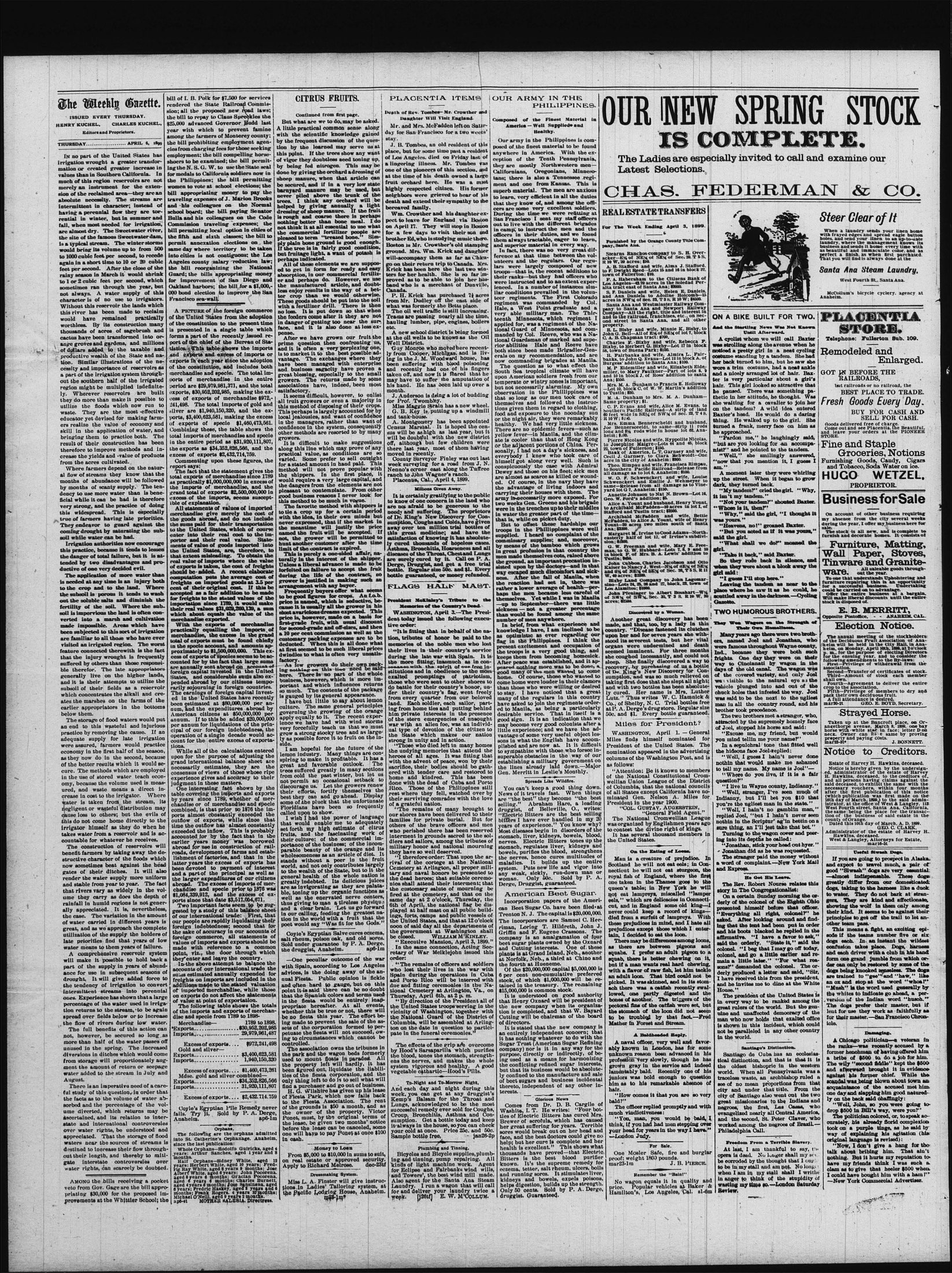
Searchable text
The Weekly Gazette.
ISSUED EVERY THURSDAY.
HENRY KUCHEL, CHARLES KUCHEL,
Editors and Proprietors.
THURSDAY... APRIL 6, 1899
In no part of the United States has irrigation wrought a greater transformation or created greater increase in values than in Southern California. In much of this region reservoirs are not merely an instrument for the extension of the reclaimed area—they are an absolute necessity. The streams are intermittent in character; instead of having a perennial flow they are torrential in winter, but in summer and fall, when most needed for irrigation, are almost dry. The Sweetwater river, the site of the famous Sweetwater dam, is a typical stream. The winter storms would bring its volume up to from 500 to 1000 cubic feet per second, to recede again in a short time to 10 or 20 cubic feet per second. After the close of the rainy season in March it would shrink to 1 or 2 cubic feet per second, which sometimes ran through the year, but not always. A water supply of this character is of no use to irrigators. Without this reservoir the lands which this river has been made to reclaim would have remained practically worthless. By its construction many thousands of acres of sagebrush and cactus have been transformed into orange groves and gardens, and millions of dollars added to the taxable and productive wealth of the State and nation. Similar illustrations of the necessity and importance of reservoirs as a part of the irrigation system throughout the southern half of the irrigated region might be multiplied indefinitely. Wherever reservoirs are built they do more than make it possible to utilize the floods which now run to waste. They are the most effective educator yet devised for making farmers realize the value of economy and skill in the application of water, and bringing them to practice both. The result of their construction has been therefore to improve methods and increase the yields and value of products from the acres cultivated.
Where farmers depend on the natural flow of streams they know that the bill of I. B. Polk for $7,500 for services rendered the State Railroad Commission; all the proposed new road laws; the bill to repay to Claus Spreckles the $25,000 advanced Governor Budd last year with which to prevent famine among the farmers of Monterey county; the bill prohibiting employment agencies from charging fees for those seeking employment; the bill compelling horse-shoers to be examined; the bill permitting the N. S. G. W. to use the State seal for medals to California soldiers now in the Philippines; the bill permitting women to vote at school elections; the bill appropriating money to pay the traveling expenses of J. Marion Brooks and his colleagues on the Normal school board; the bill paying Senator Bulla and his colleagues on the Code Commission traveling expenses; the bill permitting local option in cities of the fifth and sixth classes; the bill to permit annexation elections on the same day where territory to be taken into cities is not contiguous; the Los Angeles county salary reduction law; the bill reorganizing the National Guard; the bills appropriating money for improvement of San Diego and Oakland harbors; the bill for a $1,000,-000 bond election to improve the San Francisco sea-wall.
A PICTURE of the foreign commerce of the United States from the adoption of the constitution to the present time is presented in a single table which forms a part of the recently issued report of the chief of the Bureau of Statistics. This table shows the imports and exports and excess of imports or exports in each year since the adoption of the constitution, and includes both merchandise and specie. The total imports of merchandise in the entire period are $29,979,981,371, and the total exports, $30,952,202,985, making the excess of exports of merchandise $972,-241,498. The total imports of gold and silver are $1,940,150,320, and the exports, $3,400,623,581, making the excess of exports of specie $1,460,473,581. Combining these, the table shows the total imports of merchandise and specie in the entire period as $31,920,111,807, the exports as $34,352,828,586, and the excess of exports $2,432,714,759.
Commenting upon these figures, the report says:
The fact that the statement gives the CITRUS FRUITS
Continued from first page
But what are we to do, may we little practical common sense with the scientific knowledge by the frequent discussion of this point. If the trees show vigor they doubtless seed them by being nitrogen. This done by giving orchard ad sheep manure, when that are be secured, and if in a very barnyard manure may be never piled above the trunk trees. I think any orchard helped by giving annually dressing of sheep manure. If is rough and coarse there is nothing better than bone manure not think it at all essential to the commercial fertilizer please to term "treated bone plain bone ground is good If the tree is in fairly good condition but fruitage light, a want of perhaps indicated.
All of these elements we are led to get in form for ready absorption, in our commercialer and perhaps do. However,the manufactured article,and less enjoy results in the way ter crop than we would do These goods should be put into with a fertilizer drill. There no loss. It is put down so that the feeders come after it they in danger of getting too near face,and it is also done n pense.
After we have grown our prime question then confronted it and it often a very perplex is to market it to the best价 advantage. The exchanges who have been managed with e and business sagacity have great blessing,specially to growers. The returns made associations have indeed,b satisfactory.
It seems difficult,however,a all truit growers or even a m this method of disposing of tha This perhaps is largely account local jealousies,and want of e in the managers,rather than confidence in the system,corr other methods are resorted to growers.
It is difficult to make sure along this line which may prevaile practical value,as condition varied.Some prefer to sell for a stated amount in hand p method will not prove poor shipners.In the first
Where farmers depend on the natural flow of streams they know that the months of abundance will be followed by months of scanty supply. The tendency to use more water than is beneficial while it can be had is therefore very strong, and the practice of doing this widespread. This is especially true of farmers having late priorities. They endeavor to guard against the coming drought by saturating the subsoil while water can be had.
Irrigation authorities now encourage this practice, because it tends to lessen the danger of total failure, but it is attended by two disadvantages and productive of one very decided evil.
The application of more water than is needed at any time is an injury both to the crop and to the land. Where the subsoil is porous it tends to wash out the soluble salts and diminish the fertility of the soil. Where the subsoil is impervious the land is often converted into a marsh and cultivation made impossible. Areas which have been subjected to this sort of irrigation are familiar to all those who have ever visited an irrigated region. The worst feature connected therewith is the fact that the injury wrought is frequently suffered by others than those responsible therefor. The late appropriators generally live on the higher lands, and it is their attempts to utilize the subsol of their fields as a reservoir which concentrates the alkali and creates the marshes on the farms of the earlier appropriators in the bottoms below them.
The storage of flood waters would put an end to this wasteful and injurious practice by removing the cause. If an adequate supply for late irrigation were assured, farmers would practice economy in the first half of the season, as they now do in the second, because of the better results which it would secure. The methods which are employed in the use of stored water teach economy, because the volume used is measured, and waste means a direct increase in cost to the irrigator. Where water is taken from the stream, its negligent or wasteful distribution may cause loss to others; but the evils of this do not come home directly to the irrigator himself as they do when he takes water from a reservoir and is accountable for whatever he receives.
The construction of reservoirs will benefit farmers by taking away the destructive character of the floods which now sometimes beat against the head gates of their ditches. It will also render the water supply more uniform and stable from year to year. The fact that rivers vary as widely in the volume they carry as does the depth of
The total exports of merchandise since 1789 was practically $1,000,000,000 in excess of the imports of merchandise, and the grand total of exports $2,500,000,000 in excess of the imports, seems susceptible of explanation.
All statements of values of imported merchandise give merely the cost of the goods abroad, and do not include the sums paid for their transportation to the United States, which of course enter into their real cost to the importer and their real value. Statements of value of goods imported into the United States, are, therefore, to that extent misleading. To obtain the real value of imports where the value of exports is taken, the cost of freights should be added. A recent elaborate computation puts the average cost of freights on imported goods at 3.5 percent of their original cost. If this be accepted as a fair addition to be made for freights to the stated values of the importation since 1789, it would make their real values $31,029,260,139, a sum which about equals the value of the merchandise exported.
With the exports of merchandise practically equalling the imports of merchandise, the excess in the grand total of exports must be found chiefly in the specie account, and amounts approximately to $1,500,000,000. This excess of exports of species seems to be accounted for by the fact that large sums are annually sent abroad on account of foreign capital invested in the United States, and considerable sums also expended abroad by our citizens temporarily sojourning in foreign countries.
The earnings of foreign capital invested in the United States have recently been estimated at $80,000,000 per annum, and the expenditures abroad by American citizens at $50,000,000 per annum. If to this be added $20,000,000 per annum for liquidations of the principal of our foreign indebtedness, the operation of a single decade would account for the entire excess of exportations.
While all of the calculations entered upon for the purpose of adjusting the grand international balance sheet are necessarily estimates, they are the consensus views of those whose ripe experience gives and accuracy to their judgment in these matters.
One interesting fact shown by the table covering the imports and exports by years since 1789, whether of merchandise or of merchandise and specie combined, is that prior to 1876 the imports almost constantly exceeded the outflow of exports, while since that time the outflow has almost constantly exceeded the inflow. This is probably accounted for by the fact that in the earlier years money was borrowed abroad for use in construction of railroads, development of farms and establishment of factories, and that in latter years the excess of exports has been devoted to payment of interest and a part of the principal as well as larger expenditures of our citizens abroad. The excess of imports of merchandise and specie prior to 1876 was $1,084,339,912, and the excess of expenses upon these figures, the report says:
The fact that the statement gives the total exports of merchandise since 1789 is practically $1,000,000,000 in excess of the imports of merchandise, and the grand total of exports $2,500,000,000 in excess of the imports, seems susceptible of explanation.
All statements of values of imported merchandise give merely the cost of the goods abroad, and do not include the sums paid for their transportation to the United States, which of course enter into their real cost to the importer and their real value. Statements of value of goods imported into the United States are, therefore, to that extent misleading. To obtain the real value of imports where the value of exports is taken, the cost of freights should be added. A recent elaborate computation puts the average cost of freights on imported goods at 3.5 percent of their original cost. If this be accepted as a fair addition to be made for freights to the stated values of the importation since 1789, it would make their real values $31,029,260,139, a sum which about equals the value of the merchandise exported.
With the exports of merchandise practically equalling the imports of merchandise, the excess in the grand total of exports must be found chiefly in the specie account, and amounts approximately to $1,500,000,000. This excess of exports of species seems to be accounted for by the fact that large sums are annually sent abroad on account of foreign capital invested in the United States, and considerable sums also expended abroad by our citizens temporarily sojourning in foreign countries.
The earnings of foreign capital invested in the United States have recently been estimated at $80,000,000 per annum, and the expenditures abroad by American citizens at $50,000,000 per annum. If to this be added $20,000,000 per annum for liquidations of the principal of our foreign indebtedness, the operation of a single decade would account for the entire excess of exportations.
While all of these calculations entered upon for the purpose of adjusting the grand international balance sheet are necessarily estimates they arethe consensus viewsof those whose ripe experience gives and accuracyto their judgmentin these matters.
One interesting fact shown bythe table coveringtheimportsbysexportsbyyearssince1789whetherofmerchandiseorofmerchandiseandspeciecombinedisthatpriorto1876theimportsmostoblasticallyexceededtheoutflowofexportswhilesincethattimetheoutflowhasalmostconstantlyexceededtheinflowThisisprobablyaccountedforbythefactthatintheearlieryearsmoneywasborrowedabroadforuseinconstructionrailroadsdevelopmentfarmsandestablishmentfactories,andthatinlattheysexcessoftorexportshasbedevotedtontypaymentofinterestandapartofprincipalaswellaslargerexpendituresofourcitizensabroad.Theexcessofimportsofmerchandiseandspeciepriorto1876was$1,084,339,912,andtheexcessofexpensesuponthesefigures,thereportsays:
The fact thatthestatementgivesthetotalexportsofmerchandisesince1789isparticularly$1,000,000,000inexcessoftheimportsofmerchandiseandthegrandtotalofexports$2,5ooo,oooowinexcessoftheimportsofmerchandiseandthegrandtotalofexports$2,5ooo,oooowinexcessoftheimportsofmerchandiseandthegrandtotalofexports$2,5ooo,oooowinexcessoftheimportsofmerchandiseandthegrandtotalofexports$2,5ooo,oooowinexcessoftheimportsofmerchandiseandthegrandtotalofexports$2,5ooo,oooowinexcessoftheimportsofmerchandiseandthegrandtotalofexports$2,5ooo,oooowinexcessoftheimportsofmerchandiseandthegrandtotalofexports$2,5ooo,oooowinexcessoftheimportsofmerchandiseandthegrandtotalofexports$2,5ooo,oooowinexcessoftheimportsofmerchandiseandthegrandtotalofexports$2,5ooo,oooowinexcessoftheimportsofmerchandiseandthegrandtotalofexports$2,5ooo,oooowinexcessoftheimportsofmerchandiseandthegrandtotalofexports$2,5ooo,oooowinexcessoftheimportsofmerchandiseandthegrandtotalofexports$2,5ooo,oooowinexcessoftheimportsofmerchandiseandthegrandtotalofexports$2,5ooo,oooowinexcessoftheimportsofmerchandiseandthegrandtotalofexports$2,5ooo,oooowinexcessoftheimportsofmerchandise和thegrandtotalofexports$2,5ooo,oooowinexcessoftheimportsofmerchandise和thegrandtotalofexports$2,5ooo,oooowinexcessoftheimportsofmerchandise和thegrandtotalofexports$2,5ooo,oooowinexcessOftheimportsOfmerchandise和thegrandtotalOfexports$2,5ooo,oooowinexcessOftheimportsOfmerchandise和thegrandtotalOfexports$2,5ooo,oooowinexcessOftheimportsOfmerchandise和thegrandtotalOfexports$2,5OOO,OOOOWINEXPRESSOFTHEIMPORTS OFMERCHANDISE AND THEGRANDTOTAL OFMERCHANDISE AND THEGRANDTOTAL OFMERCHANDISE AND THEGRANDTOTAL OFMERCHANDISE AND THEGRANDTOTAL OFMERCHANDISE AND THEGRANDTOTAL OFMERCHANDISE AND THEGRANDTOTAL OFMERCHANDISE AND THEGRANDTOTAL OFMERCHANDISE AND THEGRANDTOTAL OFMERCHANDISE AND THEGRANDTOTAL OFMERCHANDISE AND THEGRANDTOTAL OFMERCHANDISE AND THEGRANDTOTAL OFMERCHANDISE AND THEGRANDTOTAL OFMERCHANDISE AND THEGRANDTOTAL OFMERCHANDISE AND THEGRANDTOTAL OFMERCHANDISE AND THEGRANDTOTAL OFMERCHANDISE AND THEGRANDTOTAL OFMERCHANDISE AND THEGRANDTOTAL OFMERCHANDISE AND THEGRANDTOTAL OFMERCHANDISE AND THEGRANDTOTAL OFMERCHANDISE AND THEGRANDTOTAL OFMERCHANDISE AND THEGRANDTOTAL OFMERCHANDISE AND THEGRANDTOTAL OFMERCHANDISE AND THEGRANDTOTAL OFMERCHANDISE AND THEGRANDTOTAL OFMERCHANDISE AND THEGRANDTOTAL OFMERCHANDISE AND THEGRANDTOTAL OFMERCHANDISE AND THEGRANDTOTAL OFMERCHANDISE AND THEGRANDTOTAL OFMERCHANDISE AND THEGRADTTotal Of MERCHANDISE AND THEGRADTTotal Of MERCHANDISE AND THEGRADTTotal Of MERCHANDISE AND THEGRADTTotal Of MERCHANDISE AND THEGRADTTotal Of MERCHANDISE AND THEGRADTTotal Of MERCHANDISE AND THEGRADTTotal Of MERCHANDISE AND THEGRADTTotal Of MERCHANDISE AND THEGRADTTotal Of MERCHANDISE AND THEGRADTTotal Of MERCHANDISE AND THEGRADTTotal Of MERCHANDISE AND THEGRADTTotal Of MERCHANDISE AND The GRADTTotal Of MERCHARDISCE AND THE GRADTTotal Of MERCHARDISCE AND The GRADTTotal Of MERCHARDISCE AND The GRADTTotal Of MERCHARDISCE And The GRADTTotal Of MERCHARDISCE And The GRADTTotal Of MERCHARDISCE And The GRADTTotal Of MERCHARDISCE And The GRADTTotal Of MERCHARDISCE And The GRADTTotal Of MERCHARDISCE And The GRADTTotal Of MERCHARDISCE And The GRADTTotal Of MERCHARDISCE And The GRADTTotal Of MERRDDITAL OF MERCHANTS AND THE GRADDITAL OF MERCHANTS AND THE GRADDITAL OF MERCHANTS And The GRADDITAL OF MERCHANTS And The GRADDITAL OF MERCHANTS And The GRADDITAL OF MERCHANTS And The GRADDITAL OF MERCHANTS And The GRADDITAL OF MERCHANTS And The GRADDITAL OF MERCHANTS And The GRADDITAL OF MERCHANTS And The GRADDITAL OF MERCHANTS And The GRADDITAL OF MERCHANTS And The GRADDITAL OF MERCHANTS And The GRADDITAL OF MERCHANTS And The GRADDITAL OF MERCHANTS And The GRADDITAL Of MERCHANTS And The GRADDITAL Of MERCHANTS And The GRADDITAL Of MERCHANTS And The GRADDITAL Of MERCHANTS And The GRADDITAL Of MERCHANTS And The GRADDITAL Of MERCHANTS And The GRADDITAL Of MERCHANTS And The GRADDITAL Of MERCHANTS And The GRADDITAL Of MERCHANTS And The GRADDITAL Of MERCHANTS And The GRADDITAL Of MERCHANTS And The GRADDITAL Of MERCHANTS And The GRADDITAL Of MERCHANTS And The GRADDITAL Of MERCHANTS And The GRADDITAL Of MERCHANTS And The GRADDITAL Of MERCHANTS And The GRADDITAL Of MERCHANTS And The GRADDITAL Of MERCHANTS And The GRADDITAL Of MERCHANTS And The GRADDITAL Of MERCHANTS And The GRADDITAL Of MERCHANTS And The GRADDITAL Of MERCHANTS And The GRADDITAL Of MERCHANTS And The GRADDITAL Of MERCHANTS And The GRADDITAL Of MERCHANTS And The GRADDITAL Of MERCHANTS And The GRADDITAL Of MERCHANTS And The GRADDITAL Of MERCHANTS And The GRADDITAL Of MERCHANTS And The GRADDITAL Of MERCHANTS And The GRADDITAL Of MERCHANTS And The GRADDITAL Of MERCHANTS And The GRADDITAL Of MERCHANTS And The GRADDITAL Of MERCHANTS And The GRADDITAL Of MERCHANTS And The GRADDITAL Of MERCHANTS And The GRADDITAL Of MERCHANTS And The GRADDITAL Of MERCHANTS And The GRADDITAL Of MERCHANTS And The GRadDITAL Of MERCHANTS And The GRadDITAL Of MERCHANTS And The GRadDITAlOf MERCHANTABILITYAndTheGradDITAlOf MERCHANTABILITYAndTheGradDITAlOf LIABILITYAndTheGradDITAlOf LIABILITYAndTheGradDITAlOf LIABILITYAndTheGradDITAlOf LIABILITYAndTheGradDITAlOf LIABILITYAndTheGradDITAlOf LIABILITYAndTheGradDITAlOf LIABILITYAndTheGradDITAlOf LIABILITYAndTheGradDITAlOf LIABILITYAndTheGradDITAlOf LIABILITYAndTheGradDITAlOf LIABILITYAndTheGradDITAlOf LIABILITYAndTheGradDITAlOf LIABILITYAndTheGradDITAlOf LIABILITYAndTheGradDITAlOf LIABILITYAndTheGradDITAlOf LIABILITYAndTheGradDITAlOf LIABILITYAndTheGradDITAlOf LIABILITYAndTheGradDITAlOf LIABILITYAndTheGradDITAlOf LIABILITYAndTheGradDITAlOf LIABILITYAndTheGradDITAlOf LIABILITYAndTheGradDITAlOf LIABILITYAndTheGradDTIALOF MERCHANTABILITYAndTheGradDTIALOF LIABILITYAndTheGradDTIALOF LIABILITYAndTheGradDTIALOF LIABILITYAndTheGradDTIALOF LIABILITYAndTheGradDTIALOF LIABILITYAndTheGradDTIALOF LIABILITYAndTheGradDTIALOF LIABILITYAndTheGradDTIALOF LIABILITYAndTheGradDTIALOF LIABILITYAndTheGradDTIALOF LIABILITYAndTheGradDTIALOF LIABILITYAndTheGradDTIALOF LIABILITYAndTheGradDTIALOF LIABILITYAndTheGradDTIALOF LIABILITYAndTheGradDTIALOF LIABILITYAndTheGradDTIALOF LIABILITYAndTheGradDTIALOF LIABILITYAndTheGradDTIALOF LIABILITYAndTHE GradeDTIALOF MERCHANTABILITYAndTHE GradeDTIALOF LIABILITYAndTHE GradeDTIALOF LIABILITYAndTHE GradeDTIALOF LIABILITYAndTHE GradeDTIALOF LIABILITYAndTHE GradeDTIALOF LIABILITYAndTHE GradeDTIALOF LIABILITYAndTHE GradeDTIALOF LIABILITYAndTHE GradeDTIALOF LIABILITYAndTHE GradeDTIALOF LIABILITYAndTHE GradeDTIALOF LIABILITYAndTHE GradeDTIALOF LIABILITYAndTHE GradeDTIALOF LIABILITYAndTHE GradeDTIALOF LIABILITYAndTHE GradeDTIALOF LIABILITYAndTHE GradeDTIALOF LIABILITYAndTHE GradeDTIALOF LIABILITYAndTHE GradeDTIALOF LIABILITYAndTHE GradeDTIALOF LIABILITYAndTHE GradeDTIALOF LIABILITYAndTHE GradeDTIALOF LIABILITYAndTHE GradeDTIALOF LIABILITYAndTHE GradeDTIALOF LIABILITYAndTHE GradeDTIALOF LIABILITYAndTHE GradeDTIALOFILITY&&THE GradeDTIALOFILITY&&THE GradeDTIALOFILITY&&THE GradeDTIALOFILITY&&THE GradeDTIALOFILITY&&THE GradeDTIALOFILITY&&THE GradeDTIALOFILITY&&THE GradeDTIALOFILITY&&THE GradeDTIALOFILITY&&THE Grage DTIONALIFILITY&&THE Grage DTIONALIFILITY&&THE Grage DTIONALIFILITY&&THE Grage DTIONALIFILITY&&THE Grage DTIONALIFILITY&&THE Grage DTIONALIFILITY&&THE Grage DTIONALIFILITY&&THE Grage DTIONALIFILITY&&THE Grage DTIONALIFILITY&&THE Grage DTIONALIFILITY&&THE Grage DTIONALIFILITY&&THE Grage DTIONALIFILITY&&THE Grage DTIONALIFILITY&&THE Grage DTIONALIFILITY&&THE Grage DTIONALIFLY&&THE Grage DTIONALIFLY&&THE Grage DTIONALIFLY&&THE Grage DTIONALIFLY&&THE Grage DTIONALIFLY&&THE Grage DTIONALIFLY&&THE Grage DTIONALIFLY&&THE Grage DTIONALIFLY&&THE Grage DTIONALIFLY&&THE Grage DTIONALIFLY&&THE Grage DTIONALIFLY&&THE Grage DTIONALIFLY&&THE Grage DTIONALIFLY&&THE Grage DTIONALIFLY&&THEN Grage DTIONALIFLY&&THEN Grage DTIONALIFLY&&THEN Grage DTIONALIFLY&&THEN Grage DTIONALIFLY&&THEN Grage DTIONALIFLY&&THEN Grage DTIONALIFLY&&THEN Grage DTIONALIFLY&&THEN Grage DTIONALIFLY&&THEN Grage DTIONALIFLY&&THEN Grage DTIONALIFLY&&THEN Grage DTIONALIFLY&&THEN Grage DTIONALIFLY&&THEN Grage DTIONALIFLY&&THEN Grage DTIONALIFLY&&THEN Grage DTIONALIFLY&&THEN Grage DTIONALIFLY&&THEN Grage DTIONALIFLY&&THEN Grage DTIONALIFLY&&THEN Grage DTionaliFLIY&&THEN Grage dtionaliFLIY&&THEN Grage dtionaliFLIY&&THEN Grage dtionaliFLIY&&THEN Grage dtionaliFLIY&&THEN Grage dtionaliFLIY&&THEN Grage dtionaliFLIY&&THEN Grage dtionaliFLIY&&THEN Grage dtionaliFLIY&&THEN Grage dtionaliFLIY&&THEN Grage dtionaliFLIY& THEN Grage dtionaliFLIY& THEN Grage dtionaliFLIY& THEN Grage dtionaliFLIY& THEN Grage dtionaliFLIY& THEN Grage dtionaliFLIY& THEN Grage dtionaliFLIY& THEN Grage dtionaliFLIY& THEN Grage dtionaliFLIY& THEN Grage dtionaliFLIY& THEN Grage dtionaliFLIY& THEN Grage dtionaliFLIY& THEN Grage dtionaliFLIY& THEN Grage dtionaliFLIY& THEN Grage dtionaliFLIY& THEN Grage dt Italian Fliy& THEN Grage dt Italian Fliy& THEN Grage dt Italian Fliy& THEN Grage dt Italian Fliy& THEN Grage dt Italian Fliy& THEN Grage dt Italian Fliy& THEN Grage dt Italian Fliy& THEN Grage dt Italian Fliy& THEN Grage dt Italian Fliy& THEN Grage dt Italian Fliy& THEN Grage dt Italian Fliy& Than Grage dt Italian Fliy& Than Grage dt Italian Fliy& Than Gragedt Italian Fliy& Than Gragedt Italian Fliy& Than Gragedt Italian Fliy& Than Gragedt Italian Fliy& Than Gragedt Italian Fliy& Than Gragedt Italian Fliy& Than Gragedt Italian Fliy& Than Gragedt Italian Fliy& Than Grageredt Italian Fliy& Than Grageredt Italian Fliy& Than Grageredt Italian Fliy& Than Grageredt Italian Fliy& Than Grageredt Italian Fliy& Than Grageredt Italian Fliy& Than Grageredt Italian Ffliy& Than Grageredt Italian Ffliy& Than Grageredt Italian Ffliy& Than Grageredt Italian Ffliy& Than Grageredt Italian Ffliy& Than Grageredt Italian Ffliy& Than Grageredt Italian Ffliy& Than Grageredt Italian Ffliy& Than Grageredt Italian Fflily& Than Grageredt Italian Fflily& Than Grageredt Italian Fflily& Than Grageredt Italian Fflily& Than Grageredt Italian Fflily& Than Grageredt Italian Fflily& Than Grageredt Italian Fflily& ThanGrageredt Italian Fflily& ThanGrageredt Italian Fflily& ThanGrageredt Italian Fflily& ThanGrageredt Italian Fflily& ThanGrageredt Italian Fflily& ThanGrageredt Italian Fflily& ThanGrageredt Italian Fflily& ThanGrageredt Italian Fflily& ThanGrageredt Italian Fflily &ThanGrageredt Italian Fflily& ThanGrageredt Italian Fflily& ThanGrageredt Italian Fflily& ThanGrageredt Italian Fflily& ThanGrageredt Italian Fflily& ThanGrageredt Italian Fflily& ThanGrageredt Italian Fflily& ThanGrageredt Italian Fflily &ThanGrageredt意大利Fflily &ThanGrageredit意大利Fflily &ThanGrageredit意大利Fflily &ThanGrageredit意大利Fflily &ThanGrageredit意大利Fflily &ThanGrageredit意大利Fflily &ThanGrageredit意大利Fflily &ThanGrageredit意大利Fflily &ThanGrageredit意大利Fflily &ThanasGrageredit意大利Fflily &ThanasGrageredit意大利Fflily &ThanasGrageredit意大利Fflily &ThanasGrageredit意大利Fflily &ThanasGragereedit意大利Fflily &ThanasGragereedit意大利Fflily &ThanasGragereedit意大利Fflily &ThanasGragereedit意大利Fflily &ThanasGragereedit意大利Fflliy &ThanasGragereedit意大利Fflliy &ThanasGragereedit意大利Fflliy &ThanasGragereedit意大利Fflliy &ThanasGragereedit意大利Fflliy &ThanasGragereedit意大利Fflliy &ThanasGragereedit意大利Fflliy &ThanasGragereeditItalianFflliy &ThanasGragereeditItalianFflliy &ThanasGragereeditItalianFflliy &ThanasGragereeditItalianFflliy &ThanasGragereeditItalianFflliy &ThanasGragereeditItalianFflliy &ThanasGragereeditItalianFflliy &ThanasGragereeditItalianFflliy &ThanasGrogereieditItalianFflliy &ThanosGrogereieditItalianFflliy &ThanosGrogereieditItalianFflliy &ThanosGrogereiedit
water is taken from the stream, its negligent or wasteful distribution may cause loss to others; but the evils of this do not come home directly to the irrigator himself as they do when he takes water from a reservoir and is accountable for whatever he receives.
The construction of reservoirs will benefit farmers by taking away the destructive character of the floods which now sometimes beat against the head gates of their ditches. It will also render the water supply more uniform and stable from year to year. The fact that rivers vary as widely in the volume they carry as does the depth of rainfall in humid regions is not generally appreciated. It is, nevertheless, the case. The variation in the amount of water carried in different years is great, and as we approach the complete utilization of the supply the holders of late priorities find that years of low water means to them years of failure.
A comprehensive reservoir system will make it possible to hold back a part of the supply in years of abundance for use in subsequent seasons of drought. It will give added force to the tendency of irrigation to convert intermittent streams into perennial ones. Experience has shown that a large percentage of the water used in irrigation returns to the stream, to be again spread over fields below or to increase the flow of rivers during low water.
The full benefits of this action can not, however, be secured so long as more than half of the water passes off unused in the spring. The increased diversions in ditches which would come from storage will proportionately augment the amount of return or seepage water added to the stream in July and August.
There is an imperative need of a careful study of this question, in order that the facts as to the volume of water absorbed and the percentage of the volume diverted, which returns may be ascertained, and its relation to state and international controversies over water rights, be understood and appreciated. That the storage of flood waters near the sources of streams is destined to increase their flow throughout their length, and thereby to mitigate interstate controversies over water rights, can scarcely be doubted.
AMONG the bills receiving a pocket veto from Gov. Gage are the bill appropriating $30,000 for the proposed improvements at the Whittler School; the
CITRUS FRUITS.
Continued from first page.
But what are we to do, may be asked. A little practical common sense along with the scientific knowledge gained by the frequent discussion of the question by the learned may serve us at this point. If the trees show any want of vigor they doubtless seed toning up, they being nitrogen. This may be done by giving the orchard dressing of sheep manure, when that article can be secured, and if in a very low state barnyard manure may be used, but never piled above the trunk of the trees. I think any orchard will be helped by giving annually a light dressing of sheep manure. If the fruit is rough and coarse there is perhaps nothing better than bone meal. I do not think it at all essential to use what the commercial fertilizer people are pleased to term "treated bone." Simply plain bone ground is good enough. If the tree is in fairly good condition, but fruiting light, a want of potash is perhaps indicated.
All of these elements we are supposed to get in form for ready and easy absorption, in our commercial fertilizer and perhaps do. However, we use the manufactured article, and doubtless results in the way of a better crop than we would otherwise. These goods should be put into the soil with a fertilizer drill. There is no loss. It is put down so that when the feeders come after it they are not in danger of getting too near the surface, and it is also done at less expense.
After we have grown our fruit the prime question then confronting us, and it is often a very perplexing one, is to market it to the best possible advantage. The exchanges where they have been managed with enterprise and business sagacity have proven a great blessing, especially to the small growers. The returns made by some associations have, indeed, been most satisfactory.
It seems difficult, however, to enlist all fruit growers or even a majority in this method of disposing of their crops. This perhaps is largely accounted for by local jealousies, and want of confidence in the system, consequently other methods are resorted to by many growers.
It is difficult to make suggestions along this line which may prove of any practical value, as conditions are so varied. Some prefer to sell outright for a stated amount in hand paid. This method will not prove popular with the shippers. In the first place, it
PLACENTIA ITEMS
Death of Rev. Tombes—Mr. Crowther and Daughter Will Visit England.
Mr. and Mrs. McFadden left on Saturday for San Francisco for a two weeks' stay.
J. B. Tombes, an old resident of this place, but for some time past a resident of Los Angeles, died on Friday last of a lingering illness. Mr. Tombes was one of the pioneers of this section, and at the time of his death owned a large fruit orchard here. He was a most highly respected citizen. His former neighbors were grieved to hear of his death and extend their sympathy to the bereaved family.
Wm. Crowther and his daughter expect to leave for England via Boston on April 17. They will stop in Bosson for a few days to visit their son and brother Ed, who is studying music there. Boston is Mr. Crowther's old stamping ground. Mrs. Wm. Krick and daughter will accompany them as far as Chikago on their return trip to Canada. Mrs. Krick has been here the last two winters for her health. She is so far improved as to be able to join her husband who is a merchant of Dunville, Canada.
P. H. Krick has purchased 74 acres from Mr. Dudley off the east side of what was formerly the Betts place.
The oil well traffic is still increasing. Teams are passing nearly all the time, hauling lumber, pipe, engines, boilers etc.
A new school district is being formed at the oil wells to be known as the Oil Well District.
Guy Monroe who moved here recently from Cooper, Michigan, and is living in the J. M. Woodward house, has been suffering with blood poisoning and recently had one of his fingers taken off, and now it is feared that he may have to suffer the amputation of his hand. He has been laid up over a month.
J. Anderson is doing a lot of budding for Prof. Twombey.
Miss Maggie Sraina has a new wheel.
G. B. Key is putting up a windmill and tank-house.
A Montgomery has been appointed Census Marshal. It is hoped the census will be as high as last year, but it will be doubtful with the new district off, although but few children were there last year, most of them having moved in recently.
County Surveyor Finley was out last week surveying for a road from J. N. Nenno's corner east along the Tuffree ranch to John Wagner's ranch.
OUR ARMY IN THE PHILIPPINES.
Composed of the Finest Material in America—Well Supplied and Healthy.
Our army in the Philippines is composed of the finest material to be found anywhere in America. With the exception of the Tenth Pennsylvania, they are mostly Northwestern men—Californians, Oregonians, Minnesota; there is also a Tennessee regiment and one from Kansas. This is superb material. The men are anxious to learn, very efficient in all the duties that they know of, and among the officers are some very excellent soldiers.
During the time we were refitting at San Francisco I sent my staff officers out to live with the different brigades in camp, to instruct the men and the officers in their duties, and we found them always tractable, eager to learn, and superior material in every way.
In fact, there was no very great difference at that time between the volunteers and the regulars. Our regulars were largely composed of new troops—that is, the recent additions to their ranks—but they had officers who were instructed and to an extent experienced.
In a number of instances similar conditions prevailed in the volunteer regiments. The First Colorado regiment was commanded by Col. Hale, a West Point graduate and a very able military man. The Thirteenth Minnesota, which regiment I applied for, was a regiment of the National Guard of Minnesota, and commanded by Col. Reeve, who was a National Guardsman of marked and superior abilities Hale and Reeve have both since been made Brigadier-Generals on my recommendation, and are now commanding brigades at Manila.
The question as to what effect the South Sea tropical climate will have upon American soldiers fresh from our temperate or wintry zones is important, but not necessarily alarming. My own observation in the Phillipines was that so long as our men took care of themselves and followed the instructions given them in regard to clothing, food and exposure to the noonday sun or the night air, they were remarkably healthy. We had very little sickness. There are no epidemic fevers—such as yellow fever—in Manila, and the climate is cooler than that of Hong Kong or the adjacent portions of China. Personally, I had not a day's sickness, and everybody I knew who took care of himself got along very well. Such is conspicuously the case with Admiral Dewey and those on his fleet; sick men
OUR NEWS
The Ladies Latest Selection CHASSE
REALESTATE TRANSFER
For The Week Ending April Furnished by the Orange Company; Santa Ana.
Stearns Ranchos company tractor—E% of NE% of SE% of R 10 W; 29 acres; $10.
A. B. Stafford and wife; Alum to F. Dwight Reed—Lots 15 and town of Fallerton; $10.
F. A. Habersham to the City Los Angeles—43 70 acres in the alta tract east of Santa Ana; $8.
S. F. Daniels and wife; Helm and Ann Daniela to Adoline acres in NW% of Sec. 23, T 8 N.; Santa Ana and Westminster company to Santa Ana and New Company—All the right title 10 and to the railroad; Franchise end street in Santa Ana; property.
R. L. Bisby and wife; Minneapolis John G. Bell—All of E% of SE% of C. A. B. Chapman tract; $700.
Charles F. Bixby and wife; Bixby, to Herbert G. Bixby—58 town of Buena Park; $100.
H. Fairbanks and wife; Al banks, to John Q. Evans—Lot 10 Burgess' addition to Santa Ania.
M.P.Edimiller and wife; E miller, to Mary Faulkner-Paul and 10 in block J.of Ross' adjoining Ana; $500.
Mrs.M.A.Dunham to France—Lot 10 block C.of W.W.Martin to Tustin; $800.
M.A.Dunham to Mrs.M.Mame property; $11.
C.P.Evans and wife; Alice Southern Pacific Railroad—A 60 feet wide in SE% of SW% of R 10 W; $200.
Mrs.Emmya Bennerscheldt Joe Bennersceeldt to same long and 85rd wide in housem; $400.
Pierre Nicolas and wife; Hyphoe Josephine Malgre—Lots 42 town of Fullerton; $100.
Bank of America, L.T.Garci Cecil J.Farnsworth; Clara Acre in the city of Anaheim: Theo.Rainbow and wife; Fraxto Southern Pacific Railroad all damage as to loc 6, Anahelm:
great blessing, especially to the small growers. The returns made by some associations have, indeed, been most satisfactory.
It seems difficult, however, to enlist all fruit growers or even a majority in this method of disposing of their crops. This perhaps is largely accounted for by local jealousies, and want of confidence in the managers, rather than want of confidence in the system, consequently other methods are resorted to by many growers.
It is difficult to make suggestions along this line which may prove of any practical value, as conditions are so varied. Some prefer to sell outright for a stated amount in hand paid. This method will not prove popular with the shippers. In the first place, it would require a very large capital, and the dangers from the elements are not pleasant to contemplate. From other good business reasons I never look for this method to be much in vogue.
The favorite method with shippers is to tie a crop up for a certain period with the idea, in their own minds but never expressed, that if the market in the meantime will justify the price named the fruit will be accepted. If not, the grower will be permitted to hunt another customer after the time limit of the contract is expired.
This is purely a one-sided affair, naturally in the interest of the shipper. Unless a liberal advance is made to be forfeited on failure to accept the fruit during the life of the contract, no grower is justified in making such an arrangement with any buyer.
Frequently buyers offer what seems to be good figures for crops. An f.o.b. price is named, which is seductive, because it is usually all the grower in his most avidious dreams expected. This price is, however, made on a basis for first-grade fruit, with usual discount for second-grade and off-sized, and then a 10 per cent commission as well as the customary packing expenses are to be deducted. When this is all done what at first seemed to be such liberal prices dwindles to what is often very unsatisfactory.
As few growers do their own nacking nothing on this time need be said there. There is no part of the whole business, however, which is more important and which influences returns so much. The contents of the package is gauged by its general appearance.
I have but little to say about lemon culture. The same general principles governing the growing of the orange apply equally to it. The recent experience we have had with wind storms very forcefully teach us that we must grow a strong stocky tree and as largely as possible force it to fruit on the inside.
I am hopeful for the future of the lemon industry. Many things are conspiring to make it profitable. It has a great and favorable outlook. The trees suffered greatly in many sections from cold the past winter, but let us not permit an occasional setback to discourage us. Let the growers renew their efforts, fortify themselves the best they can, and go ahead. Display some of the pluck that the unfortunate Floridians have so frequently called upon to show.
I wish I had the power of language that would enable me to adequately set forth my high estimate of citrus fruits, and the fascinating work of their culture; of the commercial importance of the business; of the incompatible beauty of the orange and its wholesomeness as an article of diet. It stands without a peer in the fruit world, and not only contributes largely to the wealth of the State, but to it the general health of the whole nation is greatly indebted. Its delicious juices are as invigorating as they are palatable, toning up the organic functions as well as the enervated nerve centers,
J. Anderson is doing a lot of budding for Prof. Twombey.
Miss Maggie Srain has a new wheel. G.B. Key is putting up a windmill and tank-house.
A Montgomery has been appointed Census Marshal. It is hoped the census will be as high as last year, but it will be doubtful with the new district off, although but few children were there last year, most of them having moved in recently.
County Surveyor Finley was out last surveying for a road from J. N. Nenno's corner east along the Tuffree ranch to John Wagner's ranch.
Placenus Cal., April 4, 1899.
Millions Given Away.
It is certainly gratifying to the public who are not afraid to be generous to the needy and suffering. The proprietors of Dr. King's New Discovery for Consumption, Coughs and Colds, have given away over ten million trial bottles of this great medicine; and have the satisfaction of knowing it has absolutely cured thousands of hopeless cases. Asthma, Bronchitis, Hoarseness and all diseases of the Throat, Chest and Lungs are surely cured by it. Call on P.A. Derge, Druggist, and get a free trial bottle. Regular size 50c. and $1. Every bottle guaranteed, or money refunded.
FLAGS HALF MAST
President McKinley's Tribute to the Memories of the Country's Dead.
WASHINGTON, April 3—The President today issued the following executive order:
"It is fitting that in behalf of the nation, tributes of honor be paid to the memories of the noble men who lost their lives in their country's service during the late war with Spain. It is more fitting, inasmuch as in conscience with the spirit of our free institutions and in obedience to the most exalted promptings of patriotism, those who were sent to other shores to do battle for their country's honor, under their country's flag, went freely from every quarter from our beloved land. Each soldier, each sailor, parting from home ties and putting behind him private interests in the presence of the stern emergencies of unsought war with an alien foe, was an individual type of devotion of the citizen to the State which makes our nation strong in unity and in action.
"Those who died left in many homes the undying memories that attend the heroes of all ages. It was fitting that with the advent of peace, won by their sacrifice, their bodies should be gathered with tender care and restored to home and kindred. This has been done with the dead of Cuba and Porto Rico. Those of the Philippines still rest where they fell, watched over by their surviving comrades with love of a grateful nation.
"The remains of many brought to our shores have been delivered to their families for private burial. But for others of the brave officers and men who perished there has been reserved interment in grounds sacred to the soldiers and sailors, among the tributes of military honor and national mourning they have so well deserved.
"I therefore order: That upon the arrival of the cortex at the National Cemetery at Arlington, all proper military and naval honors be presented to the dead heroes; that suitable ceremonies shall attend their interment; that the customary salute of mourning be fired at the cemetery, and that on the same day at 2 o'clock Thursday,the"
American Beet Sugar.
Upon American soldiers fresh from our temperate or wintry zones is important, but not necessarily alarming. My own observation in the Phillipsines was that so long as our men took care of themselves and followed the instructions given them in regard to clothing, food and exposure to the noonday sun or the night air, they were remarkably healthy. We had very little sickness.
There are no epidemic fevers—such as yellow fever—in Manila, and the climate is cooler than that of Hong Kong or the adjacent portions of China. Personally, I had not a day's sickness, and everybody I knew who took care of himself got along very well. Such is conspicuously the case with Admiral Dewsey and those on his fleet; sick men are almost as scarce as killed or wounded.
Of course, in the navy they have the advantage of living indoors and carrying their houses with them. The army is necessarily more exposed. For two weeks Gen. Greene and his bridegift were in the trenches up to their middles in water greater part of the time—that is, while on picket duty.
But to offset these hardships our troops in the Phillipsines were well supplied. I heard no complaint of the commissary supplies; and moreover, by means of the bamboo which grows in great profusion in that country the men made themselves cots, raised above the ground, an important precaution insisted upon by doctors—and in that way escaped much discomfort and sickness. After the fall of Manila when they reaction had set in, there was rather a lower average of health—perhaps men became less careful of themselves. Yet while I was in Manila—up to September—there was little sickness—not a greater percentage than would be found among the same number of men anywhere.
In brief, from what experience and knowledge I have, I am inclined to be as optimistic as ever regarding our flag in the Philippines. I think present excitement and occupation of troops is a very good thing; keeps them from becoming homesick. After peace was established, and it appeared nothing more was to be done,a good many of the men wanted to come home. Of course, those who wanted to come home were louder in their clamors than those who were willing or desired to stay. I have noticed that a great many of the regulars in this country have asked to join the regiments ordered to Manila, as being a particularly desirable service. That in itself is a good sign. It is an indication that we may become very good colonists after a little experience; and we have the advantage of some very useful object lessons in what the English have accomplished and are now at. It difficult to sympathize with those who foresee superb obstacles in the way of our establishing a military government on the lines already laid down." Major Gen. Merritt in Leslie's Monthly.
Spreads Like Wildfire.
You can't keep a good thing down. News of it travels fast. When things are "the best" they become "the best selling." Abraham Hare, a leading druggist, of Belleville, O., writes: "Electric Bitters are the best selling bitters I have ever handled in my 20 years of experience." You know why? Most diseases begin in disorders of the stomach, liver, kidneys, bowels, blood nerves. Electric Bitters tones up the stomach, regulates liver, kidneys and bowels, purifies blood, strengthens the nerves; hence cures multitudes of maladies. It builds up the entire system. Puts new life and vigor into any weak, slickly run-down man or woman. Only 50c. Sold by P.A. Derge, Druggist, guaranteed.
Discovered by a Woman
Another great discover made,and that too,based country." Disease fastened upon her and for seven years stood its severest tests,the organs were undermined seemed imminent.Fore she coughed incestively,she finally discovered,burying by pheromone.De King's New Discount,and was so much taking first dose that she sank with two bottles she had cured.Her name is Lutz." Thus writes W.C.O.,of Shelby,N.C.T.r.t at P.A.Derge's drug store 50c.and $1.Every bottle.
Miles for Pres
WASHINGTON, April Miles finds himself new President of the United States nomination appeared in this column of the Washington as follows:
"Attention: Be it known ofthe National Constitution wellington Union Leagueof Columbia that,the natiofallof allStates exceptCaliforniaminatedGen.NelsonPresidentintheyear1906COL.GUSTAV.AUD."
General Fiction
The National Cromwell was organized by Englishto contestthe divine rightIt has several thousandthe United States.
On the Eating Of
Man is a creatureof Scotland he will not eatnecktie he will not eatroyal fishof Englandwould one takeninTheThamesqueen'stable;inNewnot eatlamprey,miscellaneouswithanemergencyasanarticleofdiet.Istandwithoutapeerinthefruitworld,andnotonlycontributeslargelytothewealthofStatebutitthegeneralhealthofthewholenationisgreatlyindebted.Itsdeliciousjuiceareasinvigoratingastheyarepalatable,toninguptheorganifunctionsaswellastheenervatednervecenters,
I wish I had the power of language that would enable me to adequately set forth my high estimate of citrus fruits, and the fascinating work of their culture; of the commercial importance of the business; of the incomparable beauty of the orange and its wholesomeness as an article of diet. It stands without a peer in the fruit world, and not only contributes largely to the wealth of the State, but to it the general health of the whole nation is greatly indebted. Its delicious juices are invigorating as they are palatable, toning up the organic functions as well as the enervated nerve centers, thus giving to man a tireless physique and a clear brain. Let us go forward in our calling, feeding the greatest nation in the world with a fruit that the poet would say "Was fit for the Gods."
Coyle's Egyptian Salve cures eczema, salt rheum, poison oak, and old sores. Sold under guarantee by P. A. Derge, the druggist, Anaheim.
One peculiar outcome of the war with Spain, according to Los Angeles advises, is the doing away of the annual Fiesta. Public opinion is fickle and often hard to gauge, but on this point it is said there can be no doubt that the Spanish colors and terms used in the Fiesta would be entirely inappropriate hereafter. At all events, whether this be true or not, there will be no Fiesta this year. The effort being made to prevent the sale of the assets of the corporation formed to perpetuate the Fiesta will not succeed, owing to circumstances which cannot be controlled.
The association owns the tribunes in the park and the wagon beds formerly used to mount floats in parades. All the property left will hardly, it has been figured out, liquidate the liabilities of the Fiesta corporation, and the only thing left to do is to sell what will find a purchaser and go out of business.
H. G. Wilshire has given up his lease of Fiesta Park, which now falls back to the Fiesta Association. The rent of the grounds is $50 a month, and as the owner of the property, Victor Ponet, must, by the original terms of the lease, be given two months' notice before the lease can be canceled, some one will have to pay Ponet at once $100 in cash.
Money to Loan
From $5,000 to $10,000 in sums to suit, on real estate or approved security. Apply to Richard Melrose.
Dressmaking System.
Miss L. A. Finster will give instructions in Ladies' Tailoring system, at the Pacific Lodging House, Anaheim.
Plumbing System.
Miss L. A. Finster will give instructions in Ladies' Tailoring system, at the Pacific Lodging House, Anaheim.
Plumbing and Tinning.
Bicycles and Bicycle supplies, plumbing and tinning, pump repairing. All kinds of light machine work. Agent for Eclipse and Fairbanks wind wills, and Towers', the best wind mill made. Also agent for the Santa Ana Steam Laundry. I run a wagon that will call for and deliver your laundry twice a week.
Plumbing and Tinning.
Bicycles and Bicycle supplies, plumbing and tinning, pump repairing. All kinds of light machine work. Agent for Eclipse and Fairbanks wind wills, and Towers', the best wind mill made. Also agent for the Santa Ana Steam Laundry. I run a wagon that will call for and deliver your laundry twice a week.
Abraham Hare, a leading druggist, of Belleville, O., writes: "Electric Bitters are the best selling bitters I have ever handled in my 20 years of experience." You know why? Most diseases begin in disorders of the stomach, liver, kidneys, bowels, blood, nerves. Electric Bitters tones up the stomach, regulates liver, kidneys and bowels, purifies the blood, strengthens the nerves, hence cures multitudes of maladies. It builds up the entire system. Puts new life and vigor into any weak, sickly, run-down man or woman. Only 50c. Sold by P. A. Derge, Druggist, guaranteed.
American Beet Sugar.
Incorporation papers of the American Beet Sugar Co. have been filed at Trenton N. J. The capital is $20,000,000. The incorporators are Samuel C. Herriman, Loring T. Hildreth, John J. Griffin and F. Eugene Crassons. The company is an amalgamation of four beet sugar plants owned by the Oxnard and Cutting interests. One of these plants is at Grand Island, Neb., another at Norfolk, Neb., a third at Chino and the fourth at Hueneme.
Of the $20,000,000 capital $5,000,000 is 6 per cent non-cumulative preferred stock, of which $1,000,000 will be retained in the treasury. The remaining $15,000,000 is common stock.
It is understood on good authority that Henry Oxnard will be president of the new company when its organization is completed, and that W. Bayard Cutting will be chairman of the board of directors.
It is stated that the new company is an entirely independent concern; that it has nothing whatever to do with the Sugar Trust (American Sugar Refining company) nor is it in any way for the purpose, directly or indirectly, of being used as a means for harmonizing the conflicting refined sugar interests, but that its business would be absolutely confined to the manufacture and sale of beet sugars and business incidental thereto, independent of any other interests.
Glorious News
Comes from Dr. D. B. Cargile of Washita, I.T. He writes: "Four bottles of Electric Bitters has cured Mrs. Brewer of scrofula, which has caused her great suffering for years. Terrible sores would break out on her head and face, and the best doctors could give no help; but her cure is complete and her health is excellent." This shows what thousands have proved—that Electric Bitters is the best blood purifier known. It's the supreme remedy for eczema, tetter, salt rheum, ulcers, boils and running sores. It stimulates liver, kidneys and bowels, expels poisons helps digestion builds up the strength. Only 50 cents. Sold by P. A. Derge, druggist. Guaranteed.
On the Eating of Food
Man is a creature of Scotland he will not eat nectaric he will not eat royal fish of England, who one taken in the Thames queen's table; in New York not eat lampreys, miscells," which are deliciacial cut, and in England never could keep a record from a surfeit of lard these prejudices except those vaintain I decided to eat them.
There may be differences as there are between squabs. I prefer an adult squabh there is better choice but if a man wants real flesh with a flavor of raw fish an adult loon. That bird picked. It was skinned and ach there was a catfish lowed one partly digged bones of another. The pectoral fins of the catfish the stomach of the loom to be troubled by this Mather in Forest and Strut.
A baldheaded Man
A naval officer very widely known in London unknown reason been asked profession very slowly; grown gray in the service lamentably bald. Recent juniors was bold enough him as to his remarkable hair.
"How comes it that you bald?"
The officer replied promptly much vindictiveness:
"You man, you want think if you had had me your head for years in this London Judy."
For Sale.
One Mosler Safe fine proof: weight 1800 pounds mar23-1m
Remember the "No wagon equals it has price: Popular vehicle Hamilton's, Los Angeles
OUR NEW SPRING STOCK IS COMPLETE.
The Ladies are especially invited to call and examine our Latest Selections.
CHAS. FEDERMAN & CO.
REAL ESTATE TRANSFERS
For The Week Ending April 3, 1899.
Furnished by the Orange County Title Company, Santa Ana.
Stearns Ranchos company to S. H. Overacker—E% of NE% of SE% of Sec. 20, T 5 S, R 10 W, 20 acres; $10.
A. B. Stafford and wife, Alma J. Stafford, to F. Dwight Reed—Lots 15 and 16 in block 22, town of Fullerton; $10.
F. A. Habersham to the Citizens Bank of Los Angeles—43.70 acres in the Soledad Peralta tract east of Santa Ana; $300.
S. F. Daniels and wife, Helen E. Daniels, and Ann Daniels to Adoline Holcomb—15 acres in NW% of Sec. 23, T 3 S, R 10 W; $400.
Santa Ana and Westminster Railway Company to Santa Ana and Newport Railway Company—All the right, title and interest in and to the railroad, franchises, etc., on Second street in Santa Ana, and all other property.
R. L. Bisby and wife, Minnie K. Bisby, to John G. Bell—All of E% of SE% of lot 7, block C, A. B. Chapman tract; $100.
Charles F. Bixby and wife, Rebecca F. Bixby, to Herbert G. Bixby—Lot 17 in block 58, town of Buena Park; $100.
H. Fairbanks and wife, Almira L. Fairbanks, to John Q. Evans—Lot 12 in block A, of Burgess' addition to Santa Ana; $100.
M. P. Eidemiller and wife, Elizabeth Eldemiller, to Mary Faulkner—Part of lots 8, 9 and 10 in block J, of Ross' addition to Santa Ana; $550.
Mrs. M. A. Dunham to Francis E. Holloway—Lot 10, block C, of W. W. Martin's addition to Tustin; $30.
M. A. Dunham to Mrs. M. A. Dunham—Same property; $1.
C. P. Evans and wife, Alice M. Evans, to Southern Pacific Railroad—a strip of land 60 feet wide in SE% of SW% of Sec. 23, T 4 S, R 10 W; $20.
Mrs. Emma Bennerscheldt and husband, Joe Bennersceeldt, to same—Strip 11 rods long and 8½ rods wide in house lot 62, Anaheim; $20.
Pierre Nicolas and wife, Hyppolite Nicolas, to Josephine Maigre—Lots 44 and 45, block 22, town of Fullerton; $150.
Bank of America, L. T. Garnsey and wife, Cecil J. Garnsey, to Clara Rehwoldt—One acre in the city of Anaheim; $300.
Theo. Rimpau and wife, Francisca Rimpau, to Southern Pacific Railroad—Release from all damage as to lot 6, Anaheim; $100.
ON A BIKE BUILT FOR TWO.
And the Startling News Was Not Known Until Afterward.
A cyclist whom we will call Baxter was strolling along the avenue when he noticed a pretty girl in a neat cycling costume standing by a tandem. She had her back turned to him, but he saw she wore a trim costume, had a neat ankle and a nicely arranged lot of hair. Baxter is very particular about a girl's hair. This girl looked so attractive that he paused. There was something pathetic in her attitude, he thought. Was she waiting for a cavalier to join her on the tandem? A wild idea entered Baxter's head. He would do a daring thing. He walked up to the girl. She turned a frank, merry face on him as he approached.
"Pardon me," he laughingly said, "but are you looking for an accompanist?" and he pointed to the tandem.
"Well," she smilingly answered, "now that you mention it, I guess I am."
A moment later they were whirling.
PLACENTIA STORE.
Telephone: Fullerton Sub. 109.
Remodeled and Enlarged.
GOT IN BEFORE THE RAILROADS,
but railroads or no railroad, the BEST PLACE TO TRADE.
Fresh Goods Every Day.
BUY FOR CASH AND SELL FOR CASH.
Goods delivered free of charge.
Come out and see Placentia, the Beautiful,
and leave your orders at the PIONEER STORE.
Fine and Staple Groceries, Notions
Furnishing Goods, Candy, Cigars and Tobacco, Soda Water on ice.
HUGO WETZEL
Discovered by a Woman.
Another great discovery has been made, and that, too, by a lady in this country. "Disease fastened its clutches upon her and for seven years she withstood its severest tests, but her vital organs were undermined and death seemed imminent. For three months she coughed incessantly, and could not sleep. She finally discovered a way to recovery, by purchasing us a bottle of De King's New Discovery for Consumption, and was so much relieved on taking first dose that she slept all night; and with two bottles has been absolutely cured. Her name is Mrs. Luther Lutz." Thus writes W. C. Hamnick & Co., of Shelby, N. C. Trial bottles free at P. A. Derge's drug store. Regular size 50c. and $1. Every bottle guaranteed.
Miles for President?
WASHINGTON, April 1. — General Miles finds himself nominated for President of the United States. The nomination appeared in the advertising columns of the Washington Post, and is as follows:
"Attention: Be it known to members of the National Constitutional Cromwellian Union League of the District of Columbia, that the national councils of all States except California have nominated Gen. Nelson A. Miles for President in the year 1900.
'COL. GUSTAY, AUGERSTEIN,
'General FIELD Agent.'
The National Cromwellian League was organized by Englishmen years ago to contest the divine right of kings.
It has several thousand members in the United States."
On the Eating of Looms.
Man is a creature of prejudice. In Scotland he will not eat eels; in Connecticut he will not eat sturgeon, the royal fish of England, where the first one taken in the Thames goes to the queen's table; in New York he will not eat lampreys, miscalled "lamper"
Pierre Nicolas and wife, Hypollite Nicolas, to Josephine Maigre—Lots 44 and 45, block 22, town of Fullerton; $100.
Bark of America L.P. Garnsey and wife, Colleil Garney, to Clara Behwold—One acre in the city of Anaheim; $800.
Theo Rimpau and wife, Francisca Rimpau, to Southern Pacific Railroad—Release from all damage as to lot 6, Anaheim; $100.
W. O. F. Schwenkert and wife, Louise Schwenkert and Emile J. Wehmeyer to same—Release from all damage as to Vineyard lot G 7, Anaheim; $150.
Annette Johnson to Nat N. Brown—Lot 16, Geo. W. Ford's addition; $8.
Alice A. Yount and husband, Henry Yount, to Archibald McGraw—10 acres in lot I, of Stafford Martin tract; $550.
Auballab McFadden and wife, Bettie McFadden, to Alice A. Yount, wife of Henry Yount—20 acres two miles south of Santa Ana; $3200.
Margaret M. Irvine to Cood Adams—North-easterly half of lot 17, of Irvine's subdivision; $2300.
G. W. Freeman and wife, Mary E. Freeman, to G. W. Hubbard—Lots 7, 8, 9 and 10 in block F. of Mrs. B. A. Lewis' addition to Tustin; $600.
John Cabbon, Charles Jacobson and Otto Kebben-Jay, West—N% of SE% of SE% of Sec. 38, T S.S. R 11 W, 49 acres; $2200.
Birby Land Company to John Lagomarino—Lots 24, 25, and 27, block 22 of Los Alamitos; $1000.
John Pfeninger to Albert Boschart—W% of SW% of SW%, Sec. 35, T 3 S.R 19 W, 20 acres; $2500.
TWO HUMOROUS BROTHERS.
They Won Wagers on the Strength of Their Own Homelessness.
Many years ago there were two brothers, named Joel and Jonathan, who were famous throughout Wayne county, Ind., because they were both such frights. One day they were on their way to Lincolnnati by wagon in the days of the old canal. The wagon was of the covered variety, and only Joel was visible to the natural eye as the vehicle plunged into and out of the chuck holes that infested the way. Joel was said to be the next to the ugliest man in all the country round, and his brother took precedence.
The two brothers met a stranger, who attracted by the supremely homely face of Joel, stopped his horse and said:
"Excuse me, my friend, but would you mind tell me your name?"
In a sepulchral tone that fitted well the hideous face Joel replied:
"Well, I guess I hain't never done nothing that would make me ashamed to tell my name. My name is Joel."
"Where do you live, if it is a fair question?"
"I live in Wayne county, Indiana."
"Well, stranger I've seen much of Indianny, but I'll bet you $10 that you're the ugliest man in the state."
"Well, I hain't no gamblin man," replied Joel, "but I hainn't never nothin in the Scriptur' ag'in bettin on a sure thing, an I'l jest take that bot."
Turning to the wagon cover and peering into its depths he called:
"Jonathan, stick your head out byer."
Jonathan did as he was requested.
The stranger paid the money without a word of complaint—New York Mail and Express.
He Got His Leave.
The Rev. Robert Nourse relates this story in The Congregationalist: On a certain Sunday morning the orally arranged lot of hair. Butter is very particular about a girl's hair. This girl looked so attractive that he paused. There was something pathetic in her attitude, he thought. Was she waiting for a cavalier to join her on the tandem? A wild idea entered Baxter's head. He would do a daring thing. He walked up to the girl. She turned up a frank, merry face on him as he approached.
"Pardon me," he laughingly said,
"but are you looking for an accompanist?" and he pointed to the tandem.
"Well," she smiling answered,
"now that you mention it, I guess I am."
A moment later they were whirling up the street. When it began to grow dark, they turned back.
"My tandem?" cried the girl. "Why it isn't my tandem."
"Not your tandem?" shouted Baxter.
"Whose is it, then?"
"Why," said the girl, "I thought it was yours."
"Heavena, no!" grinned Baxter.
"But you noted as if it was yours," said the girl.
"What shall we do?" moaned the girl.
"Take it back," said Baxter.
So they rode back in silence, and when they were about a block away the girl said:
"I guess I'll stop here."
Leaving the tandem as near to the place where he saw it as he could, he scatted away in the darkness—Cycling Gazette.
TWO HUMOROUS BROTHERS.
They Won Wagers on the Strength of Their Own Homelessness.
Many years ago there were two brothers, named Joel and Jonathan, who were famous throughout Wayne county, Ind., because they were both such frights. One day they were on their way to Lincolnnati by wagon in the days of the old canal. The wagon was of the covered variety, and only Joel was visible to the natural eye as the vehicle plunged into and out of the chuck holes that infested the way. Joel was said to be the next to the ugliest man in all the country round, and his brother took precedence.
The two brothers met a stranger who attracted by the supremely homely face of Joel, stopped his horse and said:
"Excuse me, my friend, but would you mind tell me your name?"
In a sepulchral tone that fitted well the hideous face Joel replied:
"Well, I guess I hain't never done nothing that would make me ashamed to tell my name. My name is Joel."
"Where do you live, if it is a fair question?"
"I live in Wayne county, Indiana."
"Well stranger I've seen much of Indianny, but I'll bet you $10 that you're the ugliest man in the state."
"Well I hain't no gamblin man," replied Joel, "but I hain't never nothin in the Scriptur' ag'in bettin on a sure thing, an I'l jest take that bot."
Turning to the wagon cover and peering into its depths he called:
"Jonathan, stick your head out byer."
Jonathan did as he was requested.
The stranger paid the money without a word of complaint—New York Mail and Express.
He Got His Leave.
The Rev. Robert Nourse relates this story in The Congregationalist: On a certain Sunday morning the orally arranged lot of hair. Butter is very particular about a girl's hair. This girl looked so attractive that he paused. There was something pathetic in her attitude, he thought. Was she waiting for a cavalier to join her on the tandem? A wild idea entered Baxter's head. He would do a daring thing. He walked up to the girl. She turned up a frank, merry face on him as he approached.
"Pardon me," he laughingly said,
"but are you looking for an accompanist?" and he pointed to the tandem.
"Well," she smiling answered,
"now that you mention it, I guess I am."
A moment later they were whirling up the street. When it began to grow dark, they turned back.
"My tandem?" cried the girl. "Why it isn't my tandem."
"Not your tandem?" shouted Baxter.
"Whose is it, then?"
"Why," said the girl, "I thought it was yours."
"Heavena, no!" grinned Baxter.
"But you noted as if it was yours," said the girl.
"What shall we do?" moaned the girl.
"Take it back," said Baxter.
So they rode back in silence, and when they were about a block away the girl said:
"I guess I'll stop here."
Leaving the tandem as near to the place where he saw it as he could, he scatted away in the darkness—Cycling Gazette.
TWO HUMOROUS BROTHERS.
They Won Wagers on the Strength of Their Own Homelessness.
Many years ago there were two brothers, named Joel and Jonathan, who were famous throughout Wayne county, Ind., because they were both such frights. One day they were on their way to Lincolnnati by wagon in the days of the old canal. The wagon was of the covered variety, and only Joel was visible to the natural eye as the vehicle plunged into and out of the chuck holes that infested the way. Joel was said to be the next to the ugliest man in all the country round, and his brother took precedence.
The two brothers met a stranger who attracted by the supremely homely face of Joel, stopped his horse and said:
"Excuse me, my friend, but would you mind tell me your name?"
In a sepulchral tone that fitted well the hideous face Joel replied:
"Well, I guess I hain't never done nothing that would make me ashamed to tell my name. My name is Joel."
"Where do you live, if it is a fair question?"
"I live in Wayne county, Indiana."
"Well stranger I've seen much of Indianny, but I'll bet you $10 that you're the ugliest man in the state."
"Well I hain't no gamblin man," replied Joel, "but I hain't never nothin in the Scriptur' ag'in bettin on a sure thing, an I'l jest take that bot."
Turning to the wagon cover and peering into its depths he called:
"Jonathan, stick your head out byer."
Jonathan did as he was requested.
The stranger paid the money without a word of complaint—New York Mail and Express.
He Got His Leave.
The Rev. Robert Nourse relates this story in The Congregationalist: On a certain Sunday morning the orally arranged lot of hair. Butter is very particular about a girl's hair. This girl looked so attractive that he paused. There was something pathetic in her attitude, he thought. Was she waiting for a cavalier to join her on the tandem? A wild idea entered Baxter's head. He would do a daring thing. He walked up to the girl. She turned up a frank, merry face on him as he approached.
"Pardon me," he laughingly said,
"but are you looking for an accompanist?" and he pointed to the tandem.
"Well," she smiling answered,
"now that you mention it, I guess I am."
A moment later they were whirling up the street. When it began to grow dark, they turned back.
"My tandem?" cried the girl. "Why it isn't my tandem."
"Not your tandem?" shouted Baxter.
"Whose is it, then?"
"Why," said the girl, "I thought it was yours."
"Heavena,no!" grinned Baxter.
"But you noted as if it was yours," said the girl.
"What shall we do?" moaned the girl.
"Take it back," said Baxter.
So they rode back in silence, and when they were about a block away the girl said:
"I guess I'll stop here."
Leaving the tandem as near to the place where he saw it as he could,he scatted away in the darkness—Cycling Gazette.
TWO HUMOROUS BROTHERS.
They Won Wagers on the Strength of Their Own Homelessness.
Many years ago there were two brothers,named Joel and Jonathan,who were famous throughout Wayne county,Ind., because they were both such frights. One day they were on their way to Lincolnnati by wagon in the days of the old canal. The wagon was of the covered variety,and only Joel was visible to the natural eye as the vehicle plunged into and out of the chuck holes that infested the way。Joel was said to be the next to the ugliest man in all the country round,and his brother took precedence.
The two brothers met a stranger who attracted by the supremely homely face of Joel,stopped his horse and said:
"Excuse me,my friend,but would you mind tell me your name?"
In a sepulchral tone that fitted well the hideous face Joel replied:
"Well,I guess I hain't never done nothing that would make me ashamed to tell my name.My name is Joel."
"A beautiful Siesta."
GEO.E.BYRD,DESIGNER
E.B.BYRDITT,
OPOSITE POSTOFFICE,
ANAHEIM CALIF.
ELECTION NOTICE.
The annual meeting of the stockholders of Anahiem will be held in City Hall in Anaheim on Monday,April 10th,at 2 o'clock p.m.
forthe purposeof electing Directors forthe ensuingyear,andto considerthefollowingamendmentstotheBy-laws:
Privilegeofwithdrawalcouldbe carriedontoadvantage.
Offerthe entire businessatbusinessforEstate.
MarionettT.
NoticetoCreditors.
EstateofHarveyH.Hawkins.deceased.
Noticeisherebygivenbytheundersigned administratorofthe estateofHarveyH.Hawkins.deceased.tothecreditorsofandallpersonshavingsharesagainsttheseecessionofthecompany undertakingtheensuingyearandtoprovidepropertyandpayingcosts.
marionettT.
NoticetoCreditors.
EstateofHarveyH.Hawkins.deceased.
Noticeisherebygivenbytheundersigned administratorofthe estateofHarveyH.Hawkins.deceased.tothecreditorsofandallpersonshavingsharesagainsttheseecessionofthecompany undertakingtheensuingyearandtoprovidepropertyandpayingcosts.
marionettT.
NoticetoCreditors.
EstateofHarveyH.Hawkins.deceased.
Noticeisherebygivenbytheundersigned administratorofthe estateofHarveyH.Hawkins.deceased.tothecreditorsofandallpersonshavingsharesagainsttheseecessionofthecompany undertakingtheensuingyearandtoprovidepropertyandpayingcosts.
marionettT.
NoticetoCreditors.
EstateofHarveyH.Hawkins.deceased.
Noticeisherebygivenbytheundersigned administratorofthe estateofHarveyH.Hawkins.deceased.tothecreditorsofandallpersonshavingsharesagainsttheseecessionofthecompany undertakingtheensuingyearandtoprovidepropertyandpayingcosts.
marionettT.
NoticetoCreditors.
EstateofHarveyH.Hawkins.deceased.
Noticeisherebygivenbytheundersigned administratorofthe estateofHarveyH.Hawkins.deceased.tothecreditorsofandallpersonshavingsharesagainsttheseecessionofthecompany undertakingtheensuingyearandtoprovidepropertyandpayingcosts.
marionettT.
NoticetoCreditors.
EstateofHarveyH.Hawkins.deceased.
Noticeisherebygivenbytheundersigned administratorofthe estateofHarveyH.Hawkins.deceased.tothecreditorsofandallpersonshavingsharesagainsttheseecessionofthecompany undertakingtheensuingyearandtoprovidepropertyandpayingcosts.
marionettT.
NoticetoCreditors.
EstateofHarveyH.Hawkins.deceased.
Noticeisherebygivenbytheundersigned administratorofthe estateofHarveyH.Hawkins.deceased.tothecreditorsofandallpersonshavingsharesagainsttheseecessionofthecompany undertakingtheensuingyearandtoprovidepropertyandpayingcosts.
marionettT.
NoticetoCreditors.
EstateofHarveyH.Hawkins.deceased.
Noticeisherebygivenbytheundersigned administratorofthe estateofHarveyH.Hawkins.deceased.tothecreditorsofandallpersonshavingsharesagainsttheseecessionofthecompany undertakingtheensuingyearandtoprovidepropertyandpayingcosts.
marionettT.
NoticetoCreditors.
EstateofHarveyH.Hawkins.deceased.
Noticeisherebygivenbytheundersigned administratorofthe estateofHarveyH.Hawkins.deceased.tothecreditorsofandallpersonshavingsharesagainsttheseecessionofthecompany undertakingtheensuingyearandtoprovidepropertyandpayingcosts.
marionettT.
NoticetoCreditors.
EstateofHarveyH.Hawkins.deceased.
Noticeisherebygivenbytheundersigned administratorofthe estateofHarveyH.Hawkins.deceased.tothecreditorsOfandallpersonshavingsharesagainsttheseecessionofthecompany undertakingtheensuingyearandtoprovidepropertyandpayingcosts.
marionettT.
NoticetoCreditors.
EstateofHarveyH.Hawkins.deceased.
Noticeisherebygivenbytheundersigned administratorofthe estateofHarveyH.Hawkins.deceased.tothecreditorsOfandallpersonshavingsharesagainsttheseecessionofthecompany undertakingtheensuingyearandtoprovidepropertyandpayingcosts.
marionettT.
NoticetoCreditors.
EstateofHarveyH.Hawkins.deceased.
Noticeisherebygivenbytheundersigned administratorofthe estateofHarveyH.Hawkins.deceased.to.thecreditorsOfandallpersonshavingsharesagainst-theseecessionofthecompany undertakingtheensuingyearandtoprovidepropertyandpayingcosts.
marionettT.
NoticetoCreditors.
EstateofHarveyH.Hawkins.deceased.
Noticeisherebygivenbytheundersigned administratorofthe estateofHarveyH.Hawkins.deceased.to.thecreditorsOfandallpersonshavingsharesagainst-theseecessionofthecompany undertakingtheensuingyearandtoprovidepropertyandpayingcosts.
marionettT.
NoticetoCreditors.
EstateofHarveyH.Hawkins.deceased.
Noticeisherebygivenbytheundersigned administratorofthe estateofHarveyH.Hawkins.deceased.to.thecreditorsOfandallpersonshavingsharesagainst-theseecessionofthecompany undertakingtheensuingyearandtoprovidepropertyandpayingcosts.
marionettT.
NoticetoCreditors。
EstateofHarveyH.Hawkins.deceased。
Noticeisherebygivenbytheundersigned administratorofthe estateofHarveyH.Hawkins.deceased.to.thecreditorsOfandallpersonshavingsharesagainst-theseecessionofthecompany undertakingtheensuingyear和toprovidepropertyandpayingcosts。
marionettT。
NoticetoCreditors。
EstateofHarveyH.Hawkins.deceased。
Noticeisherebygivenbytheundersigned administratorofthe estateofHarveyH.Hawkins.deceased.to.thecreditorsOfandallpersonshavingsharesagainst-theseecessionofthecompany undertakingtheensuingyear和toprovidepropertyandpayingcosts。
marionettT。
NoticetoCreditors。
EstateofHarveyH.Hawkins.deceased。
Noticeisherebygivenbytheundersigned administratorofthe estateofHarveyH.Hawkins.deceased.to.thecreditorsOfandallpersonshavingsharesagainst-theseecessionofthecompany undertakingtheensuingyear和toprovidepropertyandpayingcosts。
marionettT。
NoticetoCreditors。
EstateofHarveyH.Hawkins.deceased。
Noticeisherebygivenbytheundersigned administratorofthe estateofHarveyH.Hawkins.deceased.to.thecreditorsOfandallpersonshavingsharesagainst-theseecessionofthecompany undertakingtheensuingyear和toprovidepropertyandpayingcosts。
marionettT。
NoticetoCreditors。
Estate.of Harvey H.Washington,
March 8,1899,一年二月,星期六,
星期八,星期九,
星期十,星期一,
星期十二,星期三,
星期四,星期五,
星期六,星期七,
星期八,星期九,
星期十,星期一,
星期十二,星期三,
星期四,星期五,
星期六,星期七,
星期八,星期九,
星期十,星期一,
星期十二,星期三,
星期四,星期五,
星期六,星期七,
星期八,星期九,
星期十,星期一,
星期十二,星期三,
星期四,星期五,
星期六,星期七,
星期八,星期九,
星期十,星期一,
星期十二,星期三,
星期四,星期五,
星期六,星期七,
星期八,星期九,
星期十,星期一,
星期十二,星期三,
星期四,星期五,
星期六,季度,
季度,
季度,
季度,
季度,
季度,
季度,
季度,
季度,
季度,
季度,
季度,
季度,
季度,
季度,
季度,
季度,
季度,
季度,
季度,
季度,
季度,
季度,
季度,
季度,
季度,
季度,
季度、
季度、
季度、
季度、
季度、
季度、
季度、
季度、
季度、
季度、
季度、
季度、
季度、
季度、
季度、
季度、
季度、
季度、
季度、
季度、
季度、
季度、
季度、
季度、
季度、
季度、
季度、
季度、
季度、
季度、
季度、
季度、
季度、
季度、
年度
年度
年度
年度
年度
年度
年度
年度
年度
年度
年度
年度
年度
年度
年度
年度
年度
年度
年度
年度
年度
年度
年度
年度
年度
年度
年度
年度
年度
年度
年度
年度
年度
年度
年度
年度
年度
年度
年度
年度
年度
年度
年度
年度
年度
年度
年度
年度
年度
年度
全年
全年
全年
全年
全年
全年
全年
全年
全年
全年
全年
全年
全年
全年
全年
全年
全年
全年
全年
全年
全年
全年
全年
全年
全年
全年
全年
全年
全年
全年
全年
全年
全年
全年
全年
全年
全年
全年
全年
全年
全年
全年
全年
全年
全年
全年
全年
全年
The annual meeting of the stockholders ofAnahiem will be held in City Hall on May 15th,at 2 o'clock p.m.forThe annual meeting of stockholders ofAnahiem will be held in City Hall on May 15th,at 2 o'clock p.m.forThe annual meeting of stockholders ofAnahiem will be held in City Hall on May 15th,at 2 o'clock p.m.forThe annual meeting of stockholders ofAnahiem will be held in City Hall on May 15th,at 2 o'clock p.m.forThe annual meeting of stockholders ofAnahiem will be held in City Hall on May 15th,at 2 o'clock p.m.forThe annual meeting of stockholders ofAnahiem will be held in City Hall on May 15th,at 2 o'clock p.m.forThe annual meeting of stockholders ofAnahiem will be held in City Hall on May 15th,at 2 o'clock p.m.forThe annual meeting of stockholders ofAnahiem will be held in City Hall on May 15th,at 2 o'clock p.m.forThe annual meeting of stockholders ofAnahiem will be held in City Hall on May 15th,at 2 o'clock p.m.forThe annual meeting of stockholders ofAnahiem will be held in City Hall on May 15th,at 2 o'clock p.m.forThe annual meeting of stockholders ofAnahiem will be held in City Hall on May 15th,at 2 o'clock p.m.forThe annual meeting of stockholders ofAnahiem will be held in City Hall on May 15th,at 2 o'clock p.m.forThe annual meeting of stockholders ofAnahiem will be held in City Hall on May 15th,at 2 o'clock p.m.forThe annual meeting of stockholders ofAnahiem will be held in City Hall on May
On the Eating of Looms.
Man is a creature of prejudice. In Scotland he will not eat eels; in Connecticut he will not eat sturgeon, the royal fish of England, where the first one taken in the Thames goes to the queen's table; in New York he will not eat lampreys, miscalled "lamper eels," which are delicacies in Connecticut, and in England some old king—I never could keep a record of kings—died from a surfeit of lampreys. With these prejudices except those which I entertain, I decided to eat the loom.
There may be differences among loons, as there are between pigeons and squabs. I prefer an adult pigeon to a squab, there is better chewing on it, but if a man wants real hard chewing, with a flavor of raw fish, let him tackle an adult loon. That bird could not be picked. It was skinned, and in its stomach there was a catfish recently swallowed, one partly digested and the bones of another. The triggers of the pectoral fins of the catfish were set, but the stomach of the loon did not seem to be troubled by that fact.—Fred Mather in Forest and Stream.
A Baldheaded Reply.
A naval officer, very well and favorably known in London, has for some unknown reason been advanced in his profession very slowly, though he has grown gray in the service and indeed lamentably bald. Recently one of his juniors was bold enough to question him as to his remarkable absence of hair.
"How comes it that you are so very bald?"
The officer replied promptly and with much vindictiveness:
"You, man, you would be bald, I think, if you had had men stepping over your head for years in the way I have."—London Judy.
For Sale.
One Mosler Safe, fire and burglar proof: weight 1800 pounds.
mar23-1m
J. B. PIERCE.
Remember the "Bain!"
No wagon equals it in quality and price. Popular vehicles at Baker & Hamilton's, Los Angeles, Cal. sl-6m
Indianity, but I bet you $10 that you're the ugliest man in the state."
Well, I haint no gamblin man," replied Joel, "but I haint never seen nothin in the Scriptur' ag'in bettin on a sure thing, an I'll jest take that bet."
Turning to the wagon cover and peering into its depths he called:
"Jonathan, stick your head out byer."
Jonathan did as he was requested.
The stranger paid the money without a word of complaint.—New York Mail and Express.
He Get His Leave.
The Rev. Robert Nourse relates this story in The Congregationalist:
On a certain Sunday morning the orderly of the colonel of the Eighth Ohio presented himself before that officer. "Everything all right, colonel?" he asked. After looking around and finding that the tent had been put in order and his boots blackened he replied in the affirmative: "I have a favor to ask," said the orderly. "State it," said the colonel. "I beg that I may go off today, colonel, and go a little earlier and remain a little later." "For what reasons?" demanded the colonel. The orderly produced a letter and said, "Sir, I have received this from the president, and he invites me to dine at the White House."
The president of the United States is in every way to be ranked among the great rulers of the world. But the genuine and unaffected democracy of the man who now holds that exalted office is shown in this incident, which could not be paralleled in any other country in the world.
Santiago's Distinction.
Santiago de Cuba has an ecclesiastical distinction, and that is that it is the oldest bishopric in the western world. When all Pennsylvania was a traceless waste, an archbishop ruled a see of no mean proportions from that city and under that title. From the city of Santiago also went out the two great missionaries to the Indians and negroes, the first, Las Casas, who evangelized nearly all Central America, and the second, St. Peter Claver, who worked among the negroes of Brazil.—Philadelphia Call.
Freedom From a Terrible Slavery.
At last, I am thankful to say, the opera is dead. No longer shall my soul be corroded by the thought that I ought to be in my stall and am not. No longer when I am in my stall shall I write in anger to think of the stupidity of wasting my time so.—London Saturday Review.
Useful Siwash Dogs.
If you are going to prospect in Alaska and expect to travel much, a pair of good "Siwash" dogs are very essential—almost indispensable. These dogs greatly differ from our domesticated dogs, taking to the harness like a duck to water. They do not bark at strangers. They are kind and affectionate, showing the wolf in them only among their kind. It seems to be against their principles to get off the trail to let another team pass.
This means a fight, an exciting episode if the teams number five or six dogs each. In an instant the wildest confusion takes place. Dogs, hararness and each driver with a club in his hand form one grand jumble from which order can only be restored by some of the dogs being knocked unseasonal. The dogs are trained to "gee" and "haw," like an ox and stop at the word "whoa!" "Mush" is the word used generally by the whites to indicate go ahead, a perversion of the Indian word "husch." The dogs prefer their master, but if lent for use they work as faithfully as for their master.—San Francisco Chronicle.
Damaging.
A Chicago politician—a veteran in the ranks—was recently accused by a former henchman of having offered him a bribe of $500 to do a job for him. The wily "second saddle" kept the $500 and afterward brought it in evidence against his former chief. While the scandal was being blown about town an acquaintance of the accused met him one day and slapping him good naturedly on the back said chaffingly:
"Well, John, so you were going to drop $500 in Bill's way, were you?"
The politician colored, or, to speak accurately, his already florid complexion took on a purple tinge, as he said by way of explaining his agitation (his original language is revised):
"Now, I don't give a hang for the talk about bribing him. That ain't nothing. But it hurts my reputation to have my friends think I was such a olam as to give that heeler $500 when I could have bought him with a ham!"—New York Commercial Advertiser.