anaheim-gazette 1899-04-06
Scanned page
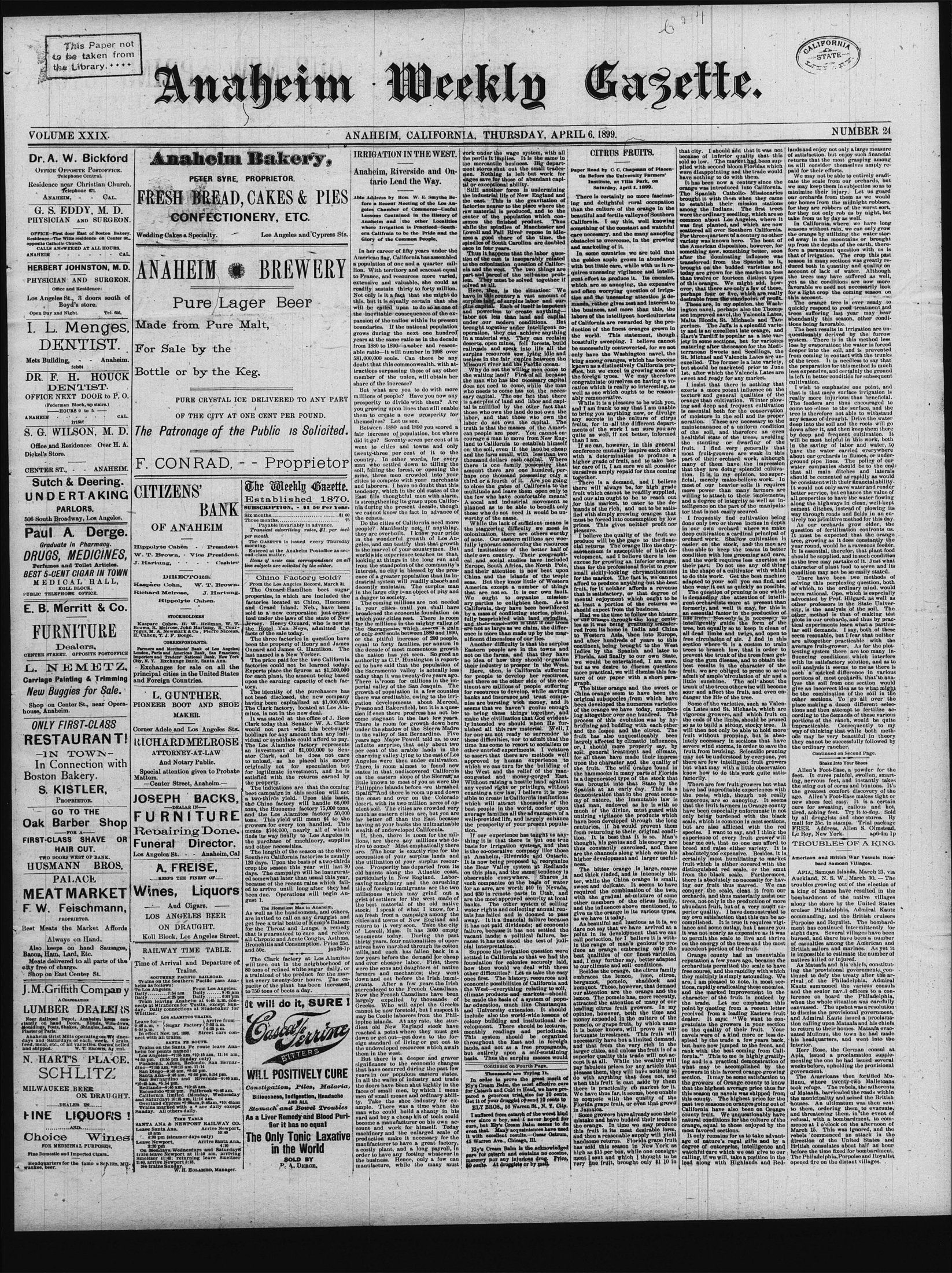
Searchable text
This Paper not to be taken from the Library.
VOLUME XXIX.
Dr. A. W. Bickford
OFFICE OPPOSITE POSTOFFICE.
Telephone Central.
Residence near Christian Church.
Telephone 671.
ANAHEIM, CAL.
G. S. EDDY, M. D.
PHYSICIAN AND SURGEON.
OFFICE—First door East of Boston Bakery.
Residence—The Wilte residence on Center St., opposite Catholic Church.
CALLS ANSWERED AT ALL HOURS.
ANAHEIM CAL.
HERBERT JOHNSTON, M. D.
PHYSICIAN AND SURGEON.
Office and Residence:
Los Angeles St., 3 doors south of Boyd's store.
Open Day and Night.
Tel. 656.
I. L. Menges,
DENTIST.
Metz Building, Anaheim.
feb24
DR. F. H. HOUCK
DENTIST.
OFFICE NEXT DOOR to P. O.
(Federman Block, up stairs.)
HOURS 9 to 5
ANAHEIM CAL.
S. G. WILSON, M. D.
Office and Residence: Over H. A. Dickel's Store.
CENTER ST., ANAHEIM.
Anaheim Bakery,
PETER SYRE, PROPRIETOR.
FRESH BREAD, CAKES & PIES CONFECTIONERY, ETC.
Wedding Cakes a Specialty. Los Angeles and Cypress Sts.
ANAHEIM BREWERY
Pure Lager Beer
Made from Pure Malt,
For Sale by the
Bottle or by the Keg.
PURE CRYSTAL ICE DELIVERED TO ANY PART OF THE CITY AT ONE CENT PER POUND.
The Patronage of the Public is Solicited.
F. CONRAD, - Proprietor
DR. F. H. HOUCK
DENTIST.
OFFICE NEXT DOOR to P. O.
(Federman Block, up stairs.)
HOURS 9 to 5.
ANAHEIM
CAL.
jy15tt
S. G. WILSON, M. D.
Office and Residence: Over H. A. Dickel's Store.
CENTER ST., - - ANAHEIM.
Sutch & Deering.
UNDERTAKING
PARLORS.
506 South Broadway, Los Angeles.
Paul A. Derge.
Graduate in Pharmaoy.
DRUGS, MEDICINES,
Perfumes and Toilet Articles.
BEST 5-CENT CIGAR IN TOWN
MEDICAL HALL,
KOLL BLOCK.
PUBLIC TELEPHONE OFFICE.
E. B. Merritt & Co.
FURNITURE
Dealers.
CENTER STREET. OPPOSITE POSTOFFICE
L. NEMETZ,
Carriage Painting & Trimming
New Buggies for Sale.
Shop on Center St., near Opera-house, Anaheim.
ONLY FIRST-CLASS
RESTAURANT!
—IN TOWN—
In Connection with Boston Bakery.
S. KISTLER,
PROPRIETOR.
GO TO THE Oak Barber Shop
FOR A
FIRST-CLASS SHAVE OR HAIR CUT.
TWO DOORS WEST OF BANK.
HUSMANN BROS.
PALACE MEAT MARKET
CITIZENS' BANK
OF ANAHEIM
Hippolyte Cahen - President
W. T. Brown, Vice President.
J. Hartung, Cashier
DIRECTORS:
Kaspare Cohn, W. T. Brown,
Richard Melrose, J. Hartung.
Hippolyte Cahen.
STOCKHOLDERS
Kaspare Cohen, H. W. Hellman, W. T. Brown, R. Melrose, John Hartung, R. Courreges H. A. Newmark & Co., Pierre Nicolas, H. Cahen, T. J. F. Boege.
CORRESPONDENTS:
Farmers and Merchante' Bank of Los Angeles; London, Paris and American Bank, San Francisco; Importers and Traders' National Bank, New York City, N.Y. Exchange Bank, Santa Ana.
Exchanges for sale on all the principal cities in the United States and Foreign Countries.
L. GUNTHER.
PIONEER BOOT AND SHOE
MAKER.
Corner Adele and Los Angeles Sts.
RICHARDMELROSE
ATTORNEY-AT-LAW
And Notary Public.
Special attention given to Probate Matters.
Center Street, Anaheim.
JOSEPH BACKS,
DEALER IN
FURNITURE
Repairing Done.
Funeral Director.
Los Angeles St. - Anaheim, Cal
A. FREISE,
KEEPES THE FINEST OF...
Wines, Liquors
The Weekly Gazette.
Established 1870.
SUBSCRIPTION, - $1 50 Per Year.
Six months... $1 00
Three months... 75
Payable invariably in advance.
Transient advertising rates, $1 per inch per month.
The GAZETTE is issued every Thursday morning.
Entered at the Anaheim Postoffice as second-class matter.
Items of news and correspondence on all live subjects are solicited by the editor.
Chino Factory Sold?
From the Los Angeles Record, March 31.
The Oxnard-Hamilton beet sugar properties, in which are included the factories located at Chino, Hueneeme and Grand Island. Neb., have been sold to a new corporation just organized under the laws of the state of New Jersey. Henry Oxnard, who is now at the Hotel Van Neys, admitted the facts of the sale today.
The three factories in question have been the property of Henry and James Oxnard and James G. Hamilton. The last named is a New Yorker.
The price paid for the two California factories could not be learned today. Experts place the figures at $1,500,000 for each plant, the amount being based upon the earning capacity of each factory.
The identity of the purchasers has not been disclosed, the new company having been capitalized at $1,000,000. The Clark factory, located at Los Alamitos, is not in the new deal.
It was stated at the office of J. Ross Clark today that Senator W. A. Clark would not part with his beet-sugar holdings for any amount that any individual or syndicate could afford to pay. The Los Alamitos factory represents an investment of $1,000,000 to Senator Clark, and he does not care to unload, as he placed his money originally not for speculation but for legitimate investment, and he is satisfied with the returns earned by the property.
The indications are that the coming beet campaign in this section will not a two-thirds yield. Upon this basis, the Chino factory will handle 66,000 tons, the Hueneeme factory 75,000 tons, and the Los Alamitos factory 50,000 tons. This yield will mean $4 to the growers for every ton handled. This means $764,000, nearly all of which finds its way finally to Los Angeles in the purchase of machinery, supplies and other necessities.
The length of the season at the three Southern California factories is usually 120 days. Upon the basis of a two-thirds crop this year will last 80 days. The campaign will be inaugurated somewhat later than usual this year, because of the recent rains which failed to arrive until long after they had been due. Operations will begin Au-
GO TO THE Oak Barber Shop FOR A FIRST-CLASS SHAVE OR HAIR CUT. TWO DOORS WEST OF BANK. HUSMANN BROS.
PALACE MEAT MARKET F. W. Feischmann, PROPRIETOR. Beat Meats the Market Affords Always on Hand. Also keeps on hand Sausages, Bacon, Ham, Lard, Etc. Meats delivered to all parts of the city free of charge. Shop on East Center St.
J.M. Griffith Company A CORPORATION LUMBER DEALERS Neer Railroad Depot, Anaheim, keeps constantly on hand Doors, Blinds, Windows, Monilings, Posts, Shakes, Shingles, Lath, Hair Plaster of Parts. Anaheim Grist Mills operating on Wednesdays and Saturdays of each week. Train feed, meal, etc., of all varieties Corn shelled and shipped. W.T. BROWN, Agent.
N. HART'S PLACE. SCHLITZ MILWAUKEE BEER ON DRAUGHT. DEALER IN FINE LIQUORS! AND Choice Wines FOR MEDICINAL PURPOSES, Fine Domestic and Imported Cigars Headquarters for the famo s Schlitz, Milwaukee, beer.
JOSEPH BACKS,
DEALER IN FURNITURE Repairing Done. Funeral Director. Los Angeles St. Anaheim, Cal
A. FREISE,
KEEPS THE FINEST OF... Wines, Liquors And Cigars. LOS ANGELES BEER ON DRAUGHT. Koll Block, Los Angeles Street.
RAILWAY TIME TABLE. Time of Arrival and Departure of Trains.
SOUTHERN PACIFIC RAILROAD. Trains on the Southern Pacific pass Anaheim as follows: To Los Angeles From Los Angeles Daily 7:54 am Daily 9:45 am Daily 4:25 pm Daily 6:01 pm Train leaving Anaheim at 9:45 a.m. connects at Miranfores for Tustin, except Sunday. Daily connections at Studebaker for Whittler.
LOS ALAMITOS TRAINS. Leave for Sugar Factory Arrive from 9:48 a.m. 7:52 a.m. 6:02 p.m. In effect Nov. 1st, 1898. Street cars connect with all trains.
SANTA FE ROUTE. Trains on the Santa Fe route leave Anaheim for points named: Los Angeles—7:55 am.*10:15 am, 11:14 am.*4:55 pm.(3:55 pm Sunday only) Pasadena, Azusa, Redondo, San Bernardino—7:55 am.*10:15 am, 11:14 am San Diego—9:46 am.*2:50 pm Santa Ana—9:46 am.*2:50 pm San Bernardino and Riverside—9:46 am.*10:45 am.*5:54 pm Redlands—9:46 am.*10:45 am Escondido*2:50 pm Fallbrook*9:46 am California limited (Monday, Wednesday and Saturday) 10:15 am, 11:14 am Overland express 7:58am, 9:46am.*10:45 am Trains marked with a * are daily except Sunday. All others daily.
TIME TABLE SANTA ANA & NEWPORT RAILWAY CO. Leave Santa Ana Arrive Newport, 10 am 10:40 4:30 pm (steamer days only) Leave Newport Arrive Santa Ana, 2:30 pm On Mondays, Wednesdays and Saturdays train leave Newport at 11:10 am, arriving Smeltzer 11:48; returning leave Smeltzer 2:40; arrive Newport 3:18. No trains Sunday. W.H. HOLABIRD, Manager.
It will do it, SURE!
Cascaferrine BITTERS WILL POSITIVELY CURE Constipation, Piles, Malaria, Biliousness, Indigestion, Headache AND ALL Stomach and Bowel Troubles As a Liver Remedy and Blood Purifier it has no equal The Only Tonic Laxative in the World
SOLD BY P.A.DERGE,
IRRIGATION IN THE WEST.
Anaheim, Riverside and Ontario Lead the Way.
In her career of fifty years under the American flag, California has assembled a population of one and a quarter million. With territory and seacoast equal to France, and resources more varied, extensive and valuable, she could as readily sustain thirty to forty million. Not only is it a fact that she might do this, but it is equally certain that she will be called upon to do so as one of the inevitable consequences of the expansion of the nation within its present boundaries. If the national population grows during the next one hundred years at the same ratio as in the decade from 1880 to 1890—a sober and reasonable ratio—it will number in 1998 over 581,000,000 souls. Can there be any doubt that this commonwealth, with attractions surpassing those of any other member of the union, will obtain her share of the increase?
But what are you to do with more millions of people? Have you now any prosperity to divide with them? Are you growing upon lines that will enable them to create a new prosperity for themselves? Let us see.
Between 1880 and 1890 you scored a fair increase of population, but where did it go? Seventy-seven per cent of it went to cities and towns and only twenty-three per cent of it to the country. In other words, for every man who settled down to tilling the soil, felling the forest, or opening the mine, three men crowded into your work under the wage system, with all the perils it implies. It is the same in the mercantile business. Big department stores shut out the small tradesmen. Nothing is left but work for wages save for those of abundant capital or exceptional ability.
Still another force is undermining the industrial life of New England and the east. This is the gravitation of factories nearer to the place where the raw material is produced, and to the center of the population which consumes the finished product. Thus while the spindles of Manchester and Lowell and Fall River repose in idleness a good share of the time, the spindles of South Carolina are doubled once in four years.
Thus it happens that the labor question of the east is inseparably related to the colonization question of California and the west. The two things are part and parcel of the self-same problem. They must be solved together if solved at all.
Here, then, is the situation: We have in this country a vast amount of surplus land, of surplus labor and surplus capital. Each of itself is impudent and powerless to create anything—labor not less than land and capital under our modern conditions. But brought together under intelligent cooperation, they can achieve anything in a material way. They can reclaim deserts, open mines, fell forests, build railroads and speak into life all the surplus resources now lying idle and useless in the fair empire between the Missouri river and the Pacific ocean.
Why do not the willing men come to the waiting land? First of all because the man who has the necessary capital does not need to come, while the man who needs to come has not the necessary capital. The one fact that there is a surplus of land and labor and capital is nullified by the other fact that those who own the land do not own the labor, and that those who own the labor do not own the capital. The truth is that the masses of the American people are poor. You cannot encourage a man to move from New England to California to establish himself on the soil, even if the land be cheap and the farm small, with less than two thousand dollars cash capital. Where there is one family possessing that amount there are one hundred, perhaps one thousand possessing only a few.
CITRUS FRUITS.
Paper Read by C.C. Chapman of Placement Before the University Farmers' Institute, at Villa Park, on Saturday, April 1, 1899.
There is certainly no more fascinating and delightful rural occupation than the culture of the orange in beautiful and fertile valleys of Southern California. I say this, well knowing something of the constant and watchful care necessary, and the many annoying obstacles to overcome, in the growing and marketing of it.
In some countries we are told that the golden apple grows in abundance with but little care, while with us it requires unceasing vigilance and intelligent effort to produce it. Its enemies which are so annoying, the expensive and often worrying question of irrigation and the unecessary attention it demands, rather gives zest and interest to the business, and more than this, the labors of the intelligent horticulturist of California are rewarded by the production of the finest oranges grown in the world. This statement, though boastfully sweeping. I believe cannot be successfully controverted, for we not only have the Washington navel, that king among oranges, which has become known as a distinctively California product, but we excel in growing some of the foreign types. We may therefore congratulate ourselves on having a vocation which is really so interesting, as well as one which ought to be reasonably remunerative.
While it is a pleasure to be with you and I am frank to say that I am unable to bring you anything new, or divulge any secrets in the culture of citrus fruits, for in all the different departments of the work I am sure you are quite as well, if not better, informed than I am.
If we can, however, in this general conference mutually inspire each other with a determination to produce higher grade of fruit, and to take better care of it, I am sure we all consider ourselves amply repaid for thus coming.
Weekly Gazette
published 1870
is Solicited.
Proprietor
Between 1880 and 1890 you scored a fair increase of population, but where did it go? Seventy-seven per cent of it went to cities and towns and only twenty-three per cent of it to the country. In other words, for every man who settled down to tilling the soil, felling the forest, or opening the mine, three men crowded into your cities to compete with your merchants and laborers. I have no doubt that this tendency, which in the old states of the East fills thoughtful men with alarm, is strengthening its grasp upon California during the present decade, though we cannot know the fact in advance of the census.
Do the cities of California need more people? Manifestly not, if anything, they are overbuilt. I know your pride in the wonderful growth of Los Angeles, and can testify that that growth is the marvel of your countrymen. But worldwide experience teaches us that, looking at things in the long run and from the standpoint of the community’s interest, no city is blessed by the presence of a greater population than its industrial system will readily absorb and decently maintain. The surplus man in the large city is an object of pity and a danger to society.
The coming millions are not needed in your cities until you shall have broadened the economic foundation on which your cities rest. There is room for the millions in the mighty valley of the Sacramento, which scores a gain of only 2000 souls between 1880 and 1890, or the pitiful increase of 200 people, equal to forty families, per annum in the decade of most momentous growth the nation has yet seen. So good an authority as C.P. Huntington is reported to have said that the population of the Sacramento valley is actually less today than it was twenty-five years ago. There is room for millions in the imperial valley of the San Joaquin. The growth of population in a few counties there was creditable, owing to the irrigation developments about Merced, Fresno and Bakersfield, but it is a question if even there progress has not become stagnant in the last few years. There is room for growth down here under the shadow of the Sierra Madre in the valley of San Bernardino. Five years ago Major Powell told us to our infinite surprise, that only about two per cent of the arable lands in the charming valley lying to the east of Los Angeles were then under cultivation. There is room almost to found new states in that undiscovered California on the eastern slope of the Sierras, as little known to most of you as were the Philippine islands before we thrashed Spain. And there is room up and down the coast and over on the Colorado desert, with its two million acres of opulent soil. The cities are crowded very much as eastern cities are, but you are far better off than the East because having at your backs the unimaginable wealth of undeveloped California.
If, then, there is room for the millions, are there any millions who desire to come? Most emphatically there are. The hour is exactly ripe for the occupation of your surplus lands and the utilization of your surplus resources. Prosperity has departed from its old haunts along the Atlantic coast, particularly in New England. Labor-saving machinery and the onrushing tide of foreign immigrants are the two millstones which may grind out a sort of settlers for the west made of member of the union, will obtain her share of the increase?
But what are you to do with more millions of people? Have you now any prosperity to divide with them? Are you growing upon lines that will enable them to create a new prosperity for themselves? Let us see.
Between 1880 and 1890 you scored a fair increase of population, but where did it go? Seventy-seven per cent of it went to cities and towns and only twenty-three per cent of it to the country. In other words, for every man who settled down to tilling the soil, felling the forest, or opening the mine, three men crowded into your cities to compete with your merchants and laborers. I have no doubt that this tendency, which in the old states of the East fills thoughtful men with alarm, is strengthening its grasp upon California during the present decade, though we cannot know the fact in advance of the census.
Do the cities of California need more people? Manifestly not, if anything, they are overbuilt. I know your pride in the wonderful growth of Los Angeles, and can testify that that growth is the marvel of your countrymen. But worldwide experience teaches us that, looking at things in the long run and from the standpoint of the community’s interest, no city is blessed by the presence of a greater population than its industrial system will readily absorb and decently maintain. The surplus man in the large city is an object of pity and a danger to society.
The coming millions are not needed in your cities until you shall have broadened the economic foundation on which your cities rest. There is room for the millions in the mighty valley of the Sacramento, which scores a gain of only 2000 souls between 1880 and 1890, or the pitiful increase of 200 people, equal to forty families, per annum in the decade of most momentous growth the nation has yet seen. So good an authority as C.P. Huntington is reported to have said that the population of the Sacramento valley is actually less today than it was twenty-five years ago. There is room for millions in the imperial valley of the San Joaquin. The growth of population in a few counties there was creditable, owing to the irrigation developments about Merced, Fresno and Bakersfield, but it is a question if even there progress has not become stagnant in the last few years. There is room for growth down here under the shadow of the Sierra Madre in the valley of San Bernardino. Five years ago Major Powell told us to our infinite surprise, that only about two per cent of the arable lands in the charming valley lying to the east of Los Angeles were then under cultivation. There is room almost to found new states in that undiscovered California on the eastern slope of the Sierras, as little known to most of you as were the Philippine islands before we thrashed Spain. And there is room up and down the coast and over on the Colorado desert, with its two million acres of opulent soil. The cities are crowded very much as eastern cities are, but you are far better off than the East because having at your backs the unimaginable wealth of undeveloped California.
If, then, there is room for the millions, are there any millions who desire to come? Most emphatically there are. The hour is exactly ripe for the occupation of your surplus lands and the utilization of your surplus resources. Prosperity has departed from its old haunts along the Atlantic coast, particularly in New England. Labor-saving machinery and the onrushing tide of foreign immigrants are the two millstones which may grind out a sort of settlers for the west made of member of the union, will obtain her share of the increase?
But what are you to do with more millions of people? Have you now any prosperity to divide with them? Are you growing upon lines that will enable them to create a new prosperity for themselves? Let us see.
Between 1880 and 1890 you scored a fair increase of population, but where did it go? Seventy-seven per cent of it went to cities and towns and only twenty-three per cent of it to the country. In other words, for every man who settled down to tilling the soil, felling the forest, or opening the mine, three men crowded into your cities to compete with your merchants and laborers. I have no doubt that this tendency, which in the old states of the East fills thoughtful men with alarm, is strengthening its grasp upon California during the present decade, though we cannot know the fact in advance of the census.
Do the cities of California need more people? Manifestly not, if anything, they are overbuilt. I know your pride in the wonderful growth of Los Angeles, and can testify that that growth is the marvel of your countrymen. But worldwide experience teaches us that, looking at things in the long run and from the standpoint of the community’s interest, no city is blessed by the presence of a greater population than its industrial system will readily absorb and decently maintain. The surplus man in the large city is an object of pity and a danger to society.
The coming millions are not needed in your cities until you shall have broadened the economic foundation on which your cities rest. There is room forthe millions inthe mighty valleyoftheSacramentowhich scoresa gainofonly2000soulsbetween1880and1890orthepitifulincreaseof200people,equaltofortryfamiliesperannuuminthedecadeofmostmomentousgrowththenationhasyetseen.SogoodanauthorityasC.P.HuntingtonisreportedtohavesaidthatthepopulationoftheSacramentovalleyisactuallylesstodayitwastwenty-fiveyearsagro.Thelackofsufficientmeansisthesaggeringdifficultywemeatincolonization,theareathorsworthyofnote.Oureasternmillionsarewofullyignorantconcerningtheresourcesandinstitutionsofthebet halfofhalfourcountry,andgeographicalandsocialstudieshaveincludedEurope,SouthAfrica,NorthPole,andtheattentionisnowbentupChinaandthe Islandsofthetropleseas.ButtheyknowlittleOfWesternAmericaexceptanumberofthingsthatarenotso.itIsourownfault.Wew oughttoorganizemissionpartiestoc睁亮theAsiCalifornia,theyhavebeenbewilderedbya massofconflictingstories.plientlybesprinkledwithlandswindles,andtheconclusionisthatifourtreesarenotaslargeasweclaim,thedifferenceismorethanmadeupbythemagnificentdimensionsofourslies.
Another difficulty is thatthesurplusEasternpeopleareinthetownsandnotonthefarms,andthattheyhavenoideaofhowtheyshouldorganize theirindustryprosperintheWest.
Herethen,isCalifornia sufferingforpeopletodevelopherresources,andthereonothersideofthecontinentaremillionsoftople sufferingforrecoursestodevelop,而save banks和insuranceand trustcompaniesareburstingwithmoney,andItseemsthatwehaventhomeasgenius enoughtobringthethesethingstogether,andmakethecivilizationthatGodevidentlyintendedweshouldwhenHefurnishedallthisrawmaterial.Well,Iforoneamnotreadytosurrendertothese difficulties,nortoadmitthatthetimehascometocertosocialismorotheruntriedexperiments.IventuretoassertthattherearemethodswellapprovedbyhumanexperiencetowhichwecanturnfordothebuildingoftheWestandthe reliefofthemancongestedandmoney-gorgedEast.Withoutraisingahostilehandagainvestedrightorprivilegewithoutenactinganewlaw.IbelieveitispossibletocreateinCaliforniainstitutionswhichwillattractthousandsofthebestpeopleintheworld,c conferuponaveragefamilyalltheadvantagesofwell-providedlife,andlargelyenhancetheprosperityofyourpresentpopulation.
If our experience has taughtusanythingitisthatthereisbutonetruebasisforirrigationsystems,andthatisco-operativecompanylike thoseatAnaheim,RiversideandOntario。它nowbeingproposedtocorreganizetheBearValleysystematRedlandsonthisplan,andthesametendencyobservableeverywhere。Sharesinsuchcompaniesonthebasisoftowaterforanacre,aareworth$40inNevada,and$30inremotepartsinUtah,andarethemostapprovedsecurityatlocalmemberoftheunionWillobtainhershareofthememberoftheunionWillobtainhershareofthememberoftheunionWillobtainhershareofthememberoftheunionWillobtainhershareofthememberoftheunionWillobtainhershareofthememberoftheunionWillobtainhershareofthememberoftheunionWillobtainhershareofthememberoftheunionWillobtainhershareofthememberoftheunionWillobtainhershareofthememberoftheunionWillobtainhershareofthememberoftheunionWillobtainhershareofthememberoftheunionWillobtainhershareofthememberoftheunionWillobtainhershareofthememberoftheunionWillobtainhershareofthememberoftheunionWillobtainhershareofthememberoftheunionWillobtainhershareofthememberoftheunionWillobtainhershareofthememberoftheunionWillobtainhershareofthememberoftheunionWillobtainhershareofthememberoftheunionWillobtainhershareofthememberoftheunionWillobtainhershareofthememberoftheunionWillobtainhershareofthememberoftheunionWillobtainhershareofthememberoftheunionWillobtainhershareofthememberoftheunionWillobtainhershareofthememberoftheunionWillobtainhershareofthememberoftheunionWillobtainhershareofthememberoftheunionWillobtainhershareofthememberoftheunionWillobtainhershareofthememberoftheunionWillobtainhershareofthememberoftheunionWillobtainhershareofthememberoftheunionWillobtainhershareofthememberoftheunionWillobtainhershareofthememberoftheunionWillobtainhershareofthemember-of-theunionWillobtainhershare-of-theunionWillobtainher分享-of-theunionWillobtainher分享-of-theUnionWillobtainher分享-of-theUnionWillobtainher分享-of-theUnionWillobtainher分享-of-theUnionWillobtainher分享-of-theUnionWillobtainher分享-of-theUnionWillobtainment分享-of-theUnionWillobtainment分享-of-theUnionWillobtainment分享-of-theUnionWillobtainment分享-of-theUnionWillobtainment分享-of-theUnionWillobtainment分享-of-theUnionWillobtainment分享-of-theUnionWillobtainment分享-of-theUnionWillobtainment分享-of-theUnion WillObtainment分享-of-theUnion WillObtainment分享-of-theUnion WillObtainment分享-of-theUnion WillObtainment分享-of-theUnion WillObtainment分享-of-theUnion WillObtainment分享-of-theUnion WillObtainment分享-of-theUnion WillObtainment分享-of-theUnion WillObtainment分享-of-theUnion WillObtainment分享-of-theUnion WillObtainment分享-of-theUnion WillObtainment分享-of-theUnion WillObtainment分享-of-theUnion WillObtainment分享-of-theUnion WillObtainment分享-of-theUnion WillObtainment分享-of-theUnion WillObtainment分享-of-theUnion WillObtainment分享-of-theUnion WillObtainment分享-of-theUnion WillObtainment分享-of-theUnion WillObtainment分享-of-theUnion WillObtainment分享-offehence分享-offehence分享-offehence分享-offehence分享-offehence分享-offehence分享-offehence分享-offehence分享-offehence分享-offehence分享-offehence分享-offehence分享-offehence分享-offehence分享-offehence分享-offehence分享-offehence分享-offehence分享-offehence分享-offehence分享-offehence分享-offehence分享-offehence分享-offehence分享-offehence分享-offehence分享-offehence分享-offehence分享-offehence分享-offehence sharing-offehence sharing-offehence sharing-offehence sharing-offehence sharing-offehence sharing-offehence sharing-offehence sharing-offehence sharing-offehence sharing-offehence sharing-offehence sharing-offehence sharing-offehence sharing-offehence sharing-offehence sharing-offehence sharing-offehence sharing-offehence sharingOFFehence sharingOFFehence sharingOFFehence sharingOFFehence sharingOFFehence sharingOFFehence sharingOFFehence sharingOFFehence sharingOFFehence sharingOFFehence sharingOFFehence sharingOFFehence sharingOFFehence sharingOFFehence sharingOFFehence sharingOFFehence sharingOFFehene共享OFFehene共享OFFehene共享OFFehene共享OFFehene共享OFFehene共享OFFehene共享OFFehene共享OFFehene共享OFF ehene共享OFF ehene共享OFF ehene共享OFF ehene共享OFF ehene共享OFF ehene共享OFF ehene共享OF ehene共享OF ehene共享OF ehene共享OF ehene共享OF ehene共享OF ehene共享OF ehene共享OF ehene共享OF ehene共享OF ehene共享OF ehene共享OF ehene共享OF ehene共享OF ehene共享OF ehene共享OF ehene共享OF ehene共享OF ehene共享OF ehene共享OF ehene共享OF ehene共享OF ehene共享OF ehene共享OF ehene共享OF ehene共享OF ehene共享OF ehene共享OF ehene共享OF ehene共享OF ehene共享OF ehene共享OF ehene共享OF ehene共享OF ehene共享OF ehene共享OF ehene共享OF ehene共享OF ehene共享OF ehene共享OF ehene共享OF ehene共享OF ehene共享OF ehene共享OF ehene共享OF ehene共享OF ehene共享OF ehene共享OF ahena shared OF ahena shared OF ahena shared OF ahena shared OF ahena shared OF ahena shared OF ahena shared OF ahena shared OF ahena shared OF ahena shared OF ahena shared OF ahena shared OF ahena shared OF ahena shared OF ahena shared OF ahena shared OF ahena shared OF ahena shared OF ahena shared OF ahena shared OF ahena shared OF ahena shared OF ahena shared OF ahena shared OF ahena shared OF ahena shared OF ahena shared OF ahena shared OF ahena shared OF ahena shared OF ahena shared OF ahena shared OF ahena shared OF ahena shared OF ahena shared OfAhena shared OfAhena shared OfAhena shared OfAhena shared OfAhena shared OfAhena shared OfAhena shared OfAhena shared OfAhena Shared OfAhena Shared OfAhena Shared OfAhena Shared OfAhena Shared OfAhena Shared OfAhena Shared OfAhena Shared OfAhena Shared OfAhena Shared OfAhena Shared OfAhena Shared OfAhena Shared OfAhena Shared OfAhena Shared OfAhena Shared OfAhena Shared OfAhena Shared OfAhena Shared OfAhena Shared OfAhena Shared OfAhena Shared OfAhena Shared OfAhena Shared OfAhennShared OfAhennShared OfAhennShared OfAhennShared OfAhennShared OfAhennShared OfAhennShared OfAhennShared OfAhennShared OfAhennShared OfAhennShared OfAhennShared OfAhennShared OfAhennShared OfAhennShared OfAHennShared OfAHennShared OfAHennShared OfAHennShared OfAHennShared OfAHennShared OfAHennShared OfAHennShared OfAHennShared OfAHennShared OfAHennShared OfAHennShared OfAHennShared OfAHennShared OfAHennShared OfAHennShared OfAHennShared OfAHennShared OfAHennShared OfAHennShared OfAHnnShared OfAHnnShared OfAHnnSharedOfAHnnsharedOfAHnnsharedOfAHnnsharedOfAHnnsharedOfAHnnsharedOfAHnnsharedOfAHnnsharedOfAHnnsharedOfAHnnsharedOfAHnnsharedOfAHnnsharedOfAHnnsharedOfAHnnsharedOfAHnnsharedOfAHnnsharedOfAHnnsharedOfAHnnsharedOfAHnnsharedOfAHnnsharedOfAHnnsharedOfAHnnsharedOfAHnnsharedOfAHnnsharedOfAHnnsharedOfAHnnsharedOfAHnnsharedOfAHnnsharedOfAHnnsharedOfAHnnsharedOfAHnnsharedOfAHnnsharedOfAHnnsharedOfAHnnsharedOfAHnnsharedOfAHnnsharedOfAHnnsharedOfAHnnsharedOfAHnnsharedOfAHnnsharedOfAHnnsharedOfAHnnsharedOfAHnnsharedOfAHnnsharedOfAHnnsharedOfAHnnsharedOfAHnnsharedOfAHnnsharedOfOHNN_sharedOfOHNN_sharedOfOHNN_sharedOfOHNN_sharedOfOHNN_sharedOfOHNN_sharedOfOHNN_sharedOfOHNN_sharedOfOHNN_sharedOfOHNN_sharedOfOHNN_sharedOfOHNN_sharedOfOHNN_sharedOfOHNN_sharedOfOHNN_sharedOfOHNN_sharedOfOHNN_sharedOfOHNN_sharedOfOHNN_sharedOfOHNN_sharedOfOHNN_sharedOfOHNN_sharedOfOHNN_sharedOfOHNN_sharedOfOHNN_sharedOfOHNN_sharedOfOHNN_sharedOfOHNN_sharedOfOHNN_sharedOffOHNN_sharedOffOHNN_sharedOffOHNN_sharedOffOHNN_sharedOffOHNN_sharedOffOHNN_sharedOffOHNN_sharedOffOHNN_sharedOffOHNN_sharedOffOHNN_sharedOffOHNNsharpOffOHNNsharpOffOHNNsharpOffOHNNsharpOffOHNNsharpOffOHNNsharpOffOHNNsharpOffOHNNsharpOffOHNNsharpOffOHNNsharpOffOHNNsharpOffOHNNsharpOffOHNNsharpOffOHNNsharpOffOHNNsharpOffOHNNsharpOffOHNNsharpOffOHNNsharpOffOHNNsharpOffOHNNsharpOffOHNNsharpOffOhNNsharpOffOhNNsharpOffOhNNsharpOffOhNNsharpOffOhNNsharpOffOhNNsharpOffOhNNsharpOffOhNNsharpOffOhNNsharpOffOhNNsharpOffOhNNsharpOffOhNNsharpOffOhNNsharpOffOhNNsharpOffOhNNsharpOffOhNNsharpOffOhNNsharpOffOhNNsharpOffOhNNsharp OffOhANN sharp OffOhANN sharp OffOhANNSharp OffOhANNSharp OffOhANNSharp OffOhANNSharp OffOhANNSharp OffOhANNSharp OffOhANNSharp OffOhANNSharp OffOhANNSharp OffOhANNSharp OffOhANNSharp OffOhANNSharp OffOhANNSharp OffOhANNSharp OffOhANNSharp OffOhANNSharp OffOhANNSharp OffOhANNSharp OffOhANNSharp OffOhANNSharp OffOhANNSharp OffOhANNSharp OffOhANNSharp OffOhANNSharp OffOhANNSharp OffOhANNSharp OffOhANNSharp OffOhANNSharp OffOhANNSharp OffOhANNSharp OffOhANNSharp OffOhANNSharp OffOhANNSharp OffOhANNSharp OffOhANNSharp OFFhn sharp OFFhn sharp OFFhn sharp OFFhn sharp OFFhn sharp OFFhn sharp OFFhn sharp OFFhn sharp OFFhn sharp OFFhn sharp OFFhn sharp OFFhn sharp OFFhn sharp OFFhn sharp OFFhn sharp OFFhn sharp OFFhn sharp OFFhn sharp OFFhn sharp OFFhn sharp OFFhn sharp OFFhn sharp OFFhn sharp OFFhn sharp OFFhn sharp OFFhn sharp OFFhn sharp OFFhn sharp OFFhn sharp OFFhn sharp OFFhn sharp OFFhn sharp OFFhn sharp OFFhn sharps OFFhn sharps OFFhn sharps OFFhn sharps OFFhn sharps OFFhn sharps OFFhn sharps OFFhn sharps OFFhn sharps OFFhn sharps OFFhn sharps OFFhn sharps OFFhn sharps OFFhn sharps OFFhn sharps OFFhn sharps OFFhn sharps OFFhn sharps OFFhn sharps OFFhn sharps OFFhn sharps OFFhn sharps OFFhn sharps OFFhn sharps OFFhn sharpsOFFhn sharpsOFFhn sharpsOFFhn sharpsOFFhn sharpsOFFhn sharpsOFFhn sharpsOFFhn sharpsOFFhn sharpsOFFhn sharpsOFFhn sharpsOFFhn sharpsOFFhn sharpsOFFhn sharpsOFFhn sharpsOFFhn sharpsOFFhn sharpsOFFhn sharpsOFFhn sharpsOFFhn sharpsOFFhn sharpsOFFhntharpsOFFhntharpsOFFhntharpsOFFhntharpsOFFhntharpsOFFhntharpsOFFhntharpsOFFhntharpsOFFhntharpsOFFhntharpsOFFhntharpsOFFhntharpsOFFhntharpsOFFhntharpsOFFhntharpsOFFhntharpsOFFhntharpsOFFhntharpsOFFhntharpsOFFhntharpsOFFhntharpsOFFhntharpsOFFhntharpsOffsethttarptsOffsethttarptsOffsethttarptsOffsethttarptsOffsethttarptsOffsethttarptsOffsethttarptsOffsethttarptsOffsethttarptsOffsethttarptsOffsethttarptsOffsethttarptsOffsethttarptsOffsethttarptsOffsethttarptsOffsethttarptsOffsethttarptsOffsethttarptsOffsethttarptsOffsethttarptsOffsethttarptsOffsethttarptsOffsethttarptsOffsethttarptsOffsethttarptsOffsetttHarptsOffsetttHarptsOffsetttHarptsOffsetttHarptsOffsetttHarptsOffsetttHarptsOffsetttHarptsOffsetttHarptsOffsetttHarptsOffsetttHarptsOffsetttHarptsOffsetttHarptsOffsetttHarptsOffsetttHarptsOffsetttHarpts OffsetttHarpts OffsetttHarpts OffsetttHarpts OffsetttHarpts OffsetttHarpts OffsetttHarpts OffsetttHarpts OffsetttHarpts OffsetttHarpts OffsetttHarpts OffsetttHarpts OffsetttHarpts OffsetttHarpts OffsetttHarpts OffsetttHarpts OffsetttHarpts OffsetttHarpts OffsetttHarpts OffsetttHarpts OffsetttHarpts OffsetttHarpts OffsetttHarpts OffsetttHarpts Offsettt Harpts Offsettt Harpts Offsettt Harpts Offsettti Harpts Offsettti Harpts Offsettti Harpts Offsettti Harpts Offsettti Harpts Offsettti Harpts Offsettti Harpts Offsettti Harpts Offsettti Harpts Offsettti Harpts Offsettti Harpts Offsettti Harpts Offsettti Harpts Offsettti Harpts Offsettti Harpts Offsettti Harptsi Horsts Handling With A Number From Its Own State To A Number From Its Own State To A Number From Its Own State To A Number From Its Own State To A Number From Its Own State To A Number From Its Own State To A Number From Its Own State To A Number From Its Own State To A Number From Its Own State To A Number From Its Own State To A Number From Its Own State To A Number From Its Own State To A Number From Its Own State To A Number From Its Own State To A Number From Its Own StateToANumberFromitsOwnStateToANumberFromitsOwnStateToANumberFromitsOwnStateToANumberFromitsOwnStateToANumberFromitsOwnStateToANumberFromitsOwnStateToANumberFromitsOwnStateToANumberFromitsOwnStateToANumberFromitsOwnStateToANumberFromitsOwnStateToANumberFromitsOwnStateToANumberFromitsOwnStateToANumberFromitsOwnStateToANumberFromitsOwnStateToANumberFromitsOwnStateToANumberFromitsOwnStateToANumberFromitsOwnStateToANumberFromitsOwnStateToANumberFromitsOwnStateToANumberFromitsOwnStateToANumberFromitsOwnStateToANumberFromitsownStateToANumberFromitsownStateToANumberFromitsownStateToANumberFromitsownStateToANumberFromitsownStateToANumberFromitsownStateToANumberFromitsownStateToANumberFromitsownStateToANumberFromitsownStateToANumberFromitsownStateToANumberFromitsownStateToANumberFromitsownStateToANumberFromitsownStateToANumberFromitsownStateToANumberFromitsownStateToAnumberFromitsownStateToAnumberFromitsownStateToAnumberFromitsownStateToAnumberFromitsownStateToAnumberFromitsownStateToAnumberFromitsownStateToAnumberFromitsownStateToAnumberFromitsownStateToAnumberFromitsownStateToAnumberFromitsownStateToAnumberFromitsownStateToAnumberFromitsownStateToAnumberFromitsownStateToAnumberFromitsownStateToAnumberFor its own state To AnumberFor its own state To AnumberFor its own state To AnumberFor its own state To AnumberFor its own state To AnumberFor its own state To AnumberFor its own state To AnumberFor
of the season at the three California factories is usually on the basis of a two-thirds season this year will last 80 campaign will be inaugurated later than usual this year, the recent rains which fall until long after they had operations will begin Aufactory at Los Alamitos in the neighborhood of mined white sugar daily, or of the product for the marenty-four hours. The caplant has been increased beets a day.
But there is a deeper and graver significance to the economic changes that have occurred during the past few years in our populous eastern states. In all the walks of industry and trade the doors have been shut tightly in the faces of small men, by which I mean men of small means and ordinary ability. Take the shoe-industry for example. There was a time when the man who could build a shanty in his yard and buy a cheap kit of tools could become a manufacturer on his own account and work for himself. Today machinery and the enlarged scale of production make it necessary for the manufacturer to have a great factory, a costly plant, and a long payroll, in order to have any footing whatever in the business. Hence, only a few can manufacture, while the many must
Continued on Fourth Page.
Thousands are Trying It.
In order to prove the great merit of Ely's Cream Balm, the most effective cure for Catarrh and Cold in Head, we have prepared a generous trial size for 10 cents. Get it of your druggist or send 10 cents to ELY BROS., 56 Warren St., N. Y. City.
I suffered from catarrh of the worst kind ever since a boy, and I never hoped for cure, but Ely's Cream Balm seems to do even that. Many acquaintances have used it with excellent results.—Oscar Ostrum, 45 Warren Ave., Chicago, Ill.
Ely's Cream Balm is the acknowledged cure for catarrh and contains no cocaine, mercury nor any injurious drug. Price, 50 cents. At druggists or by mail.
If our experience has taught us anything it is that there is but one true basis for irrigation systems, and that is the co-operative company like those at Anahelm, Riverside and Ontario. It is now being proposed to reorganize the Bear Valley system at Redlands on this plan, and the same tendency is observable everywhere. Shares in such companies on the basis of water for an acre, are worth $40 in Nevada, and $30 in remote parts in Utah, and are the most approved security at local banks. The other system of selling water rights and collecting annual rentals has failed and is doomed to pass away. It it a financial failure because it has not paid dividends; an economic failure, because it has not settled the vacant lands; a political failure, because it has not stood the test of judicial interpretation.
Suppose the irrigation question were settled in California so that we had the foundation for colonies securely laid, how then would we deal with these other difficulties? Let us take the easy ones first. The history, resources and economic possibilities of California and the West—everything relating to soil, climate products and markets—should be made the basis of a system of popular education, much like Chautauqua and University extension. It should include also the world-wide lessons of colony building and institutional development. There should be lectures, monthly readings and periodicals. This system should be organized throughout the East and in foreign lands, and not as a free propaganda, but entirely upon a self-sustaining basis. Thus the surplus masses would
Besides the orange, the citrus family embraces the lemon, lime, citron bergamot, pomelo, shaddock and komquot. Those, however, that demand our attention are the orange and the lemon. The pomelo has, more recently attracted the attention of many of our leading citrus fruit growers. In my opinion, however, both the time and money expended in the culture of the pomelo, or grape fruit, by which name it is better known, will prove an unfortunate investment. This fruit will necessarily have but a limited demand and that from the very rich in the larger cities, and unless the fruit is of superior quality this trade will not accept it at all. While the wealthy will pay fabulous prices for any article that pleases them, they will have nothing to do with anything that does not, and when this fruit is cast aside by them there is practically no market for it. We have thus far, it seems, been unable to compete with the quality of Florida grape fruit, or even that grown in Jamaica.
Some growers have already seen their mistake and have budded their trees to the orange. In time we may produce this fruit in its most desirable form and then a reasonable supply will yield handsome returns. Florida grape fruit has sold this season in New York high as $15 per box, while one consignment I sent and which I thought to be very fine fruit, brought only $10
CALIFORNIA STATE
Gazette.
1899. NUMBER 24
NITRUS FRUITS.
led by C. C. Chapman of Placentore the University Farmers' Institute, at Villa Park, on Saturday, April 1, 1899.
It is certainly no more fascinat- der delightful rural occupation than culture of the orange in the land and fertile valleys of Southern California. I say this, well knowing of the constant and watchful necessity, and the many annoying to overcome, in the growing settling of it.
The countries we are told that can apple grows in abundance little care, while with us it reeasing vigilance and intelligence to produce it. Its enemies, be so annoying, the expensive worrying question of irriga- the unceasing attention it de-ther gives zest and interest to success, and more than this, the intelligent horticulturists are rewarded by the pro- fect of the finest oranges grown in this statement, though my sweeping. I believe cannot sufficiently controverted, for we not use the Washington navel, the long oranges, which has become a distinctively California pro- we excel in growing some of these types. We may therefore make ourselves on having a vow which is really so interesting, as one which ought to be reason-enerative.
It is a pleasure to be with you, frank to say that I am unable to anything new, or divulge seeds in the culture of citrus in all the different depart- the work I am sure you are well, if not better, informed.
I mean, however, in this general case mutually inspire each other determination to produce a trade of fruit, and to take bet- it, I am sure we all consider amply repaid for thus coming that city. I should add that it was not because of inferior quality that this sold so low. The market had been supplied with second bloom Floridas which were disappointing and the trade would have nothing to do with them.
It has been now a century since the orange was introduced into California. The Spanish Catholic Missionaries brought it with them when they came to establish their mission stations among the Indians. The first trees were the ordinary seedling, which are so common about Los Angeles, where it was first planted, and which are now scattered all over Southern California. For three-quarters of a century no other variety was known here. The bent of the American disposition, however, for something new, something better, soon after the dominating influence was transferred from the Spanish to it, brought on the budded varieties and today are grown for the market no less than twelve or fourteen distinct types of this orange. We might add, however, that there are only a few of these, perhaps four or five, which are really desirable from the standpoint of profit.
These are, in my opinion, the Washington navel, perhaps also the Thompson improved navel, the Valencia Lates, Malta Bloods, St. Michaels and Tangerines. The Jaffa is a splendid variety and is an excellent late orange, and Hart's Tardiff is popular as a late variety in some sections, but for varieties maturing after the season for the Mediterranean Sweets and Seedlings, the St. Michael and Valencia Lates are unexcelled. The former is a late variety, but should be marketed prior to June 1st, after which the Valencia Lates are sweet and ready for any market.
I insist that there is nothing that exerts a more potent influence on the texture and general qualities of the orange than cultivation. Winter plowing and deep and frequent cultivation is essential both for the conservation of moisture in the soil and its proper aeration. These are necessary to the maintenance of a uniform condition of the soil, and therefore an even healthful state of the trees, avoiding the stunting or dwarfing of the fruit.
I find very generally that most fruit-growers are weak in this part of their orchard work, although many of them have the impression that they are doing splendid cultivation. It is in my opinion too super lands and enjoy not only a large measure of satisfaction, but enjoy such financial returns that the most grasping among us will consider themselves amply repaid for their efforts.
We may not be able to entirely eradicate the scale from our orchards, but we may keep them in subjection so as to minimize their injury. Let us guard our orchards from them as we would our homes from the midnight robbers, for they are robbers of the worst sort, for they not only rob us by night, but take from us by day as well.
In California, where we have long seasons without rain, we can only grow the orange by utilizing the water stored away in the mountains or brought up from the depths of the earth; therefore a paramount question with us is that of irrigation. The crop this past season in many sections was greatly reduced both in quantity and quality on account of lack of water. Although the trees may have suffered as well, yet as the conditions are now more favorable we need not necessarily look for a light crop the coming season on this account.
The orange tree is ever ready to quickly respond to good treatment and trees suffering last year may bear abundantly this season, other conditions being favorable.
The best results in irrigation are unquestionably derived by the furrow system. There is in this method less loss by evaporation; the water is forced deeper into the soil, and is prevented from coming in contact with the trunks of the trees. It is needless to say that the preparation for this method is much less expensive, and certainly the ground is left in better condition for subsequent cultivation.
I wish to emphasize one point, and that is that mere surface irrigation is really more injurious than beneficial. The feeders are thus encouraged to come too close to the surface, and the tree is therefore not able to withstand any season of drought. Drive the water deep into the soil and the roots will go down after it, and then keep them there by deep and frequent cultivation. It will be most helpful in this work, both in the saving of labor and water, to have the water carried everywhere about our orchards in flumes, or underground pipe lines. The policy of our water companies should be to the end that all main ditches and laterals
We may therefore make ourselves on having a vouch which is really so interesting, as one which ought to be reasonerative.
It is a pleasure to be with you, frank to say that I am unable to anything new, or divulge in the culture of citrus in all the different departments of the work I am sure you are well, if not better, informed.
However, in this general case mutually inspire each other determination to produce a grade of fruit, and to take bet of it. I am sure we all consider simply repaid for thus coming is a demand, and I believe will always be, for high grade which cannot be readily supplied, him ought to be to reach out market, to cater to the desire rich, and not to be satisfiesimply growing oranges that forced into consumption by low This gives neither profit nor have the quality of the fruit we will be the gage to the financials. The orange like the chrysum is susceptible of high deformity, and I believe there is less for growing an inferior orange, the professional florist to grow skilfully-looking chrysanthemums market. The fact is, we cannot produce anything but the best it neither affords a revenue satisfactory, or that degree of enjoyment which ought to be a portion of the returns we expect from the business.
We time to follow the history change through the long centuries being gradually transferred its home in India and China from Asia, then into Europe, over hundreds of years to this day, being brought to the West by the Spanish and later to England and finally to our own State. It did be entertained, I am sure. We desire to discuss questions practical, we will dismiss this feature paper with a short paragraph about orange and the sweet or orange seem to have been the sub-species from which have developed the numerous varieties we have today, number together over one hundred. The evolution was by hybrids and budding with each other lemon and the citron. The also unquestionably been affected by climatic influences, would more properly say, by general treatment and climate, these have made their impression character and the quality of it. The wild orange found in mocks in many parts of Florida generated type of the stock that brought into that State by the at an early day. This is a situation that in the great econature, the immutable law is ennolded as he is with so much divine, must guard with vigilance the products which can developed through the long days, if he would prevent them turning to their original condition is best that it is so. Man's genius and his energy are constantly exercised, and these channels along which come his development and larger useful bitter orange is large, coarse kinked, and is intensely bitten by the China orange is small, and delicate. It seems to have the combination of the two, a gradual ad-mixture of some
I insist that there is nothing that exerts a more potent influence on the texture and general qualities of the orange than cultivation. Winter plowing and deep and frequent cultivation is essential both for the conservation of moisture in the soil and its proper aeration. These are necessary to the maintenance of a uniform condition of the soil, and therefore an even healthful state of the trees, avoiding the stunting or dwarfing of the fruit. I find very generally that most fruit-growers are weak in this part of their orchard work, although many of them have the impression that they are doing splendid cultivation. It is, in my opinion, too superficial, merely make-believe work. In most of our heavier soils it requires more power than many farmers are willing to attach to their implements, and a degree of integrity as well as intelligence on the part of the manipulator that is not easily secured.
I frequently find cultivation being done only two or three inches in depth in our own orchard where we make deep cultivation a cardinal principal of orchard work. Shallow cultivation is easier on the stock, and the men are thus able to keep the teams in better condition with less grooming and care, and the work requires less exertion on their part. Do not use any old thing in the shape of a cultivator with which do this work. Get the best machine adapted to your soil you can find, and then wear it out as quickly as possible.
The question of pruning is one which is demanding the attention of intelligent orchardists more at present than formerly, and well it may, for this is an essential factor in the production of fine fruits. Not only is it necessary to intelligently guide the form of the tree, but equally so to keep it clean of all dead limbs and twigs, and open to free circulation of air. I find in this section where it is a custom to train trees to branch low, that in order to prevent the trunk of the trees from getting the gum disease, and to obtain the best results in the character of the fruit, we are obliged to prune so as to admit of ample circulation of air and a little sunshine. The soil about the trunk of the trees otherwise will become sour and affect the fruit, and even endanger the life of the tree.
Some of the varieties, such as Valencia Lates and St Michaels, which are vigorous growers, and which fruit on the ends of the limbs should be pruned so as to build a strong, stocky tree. It will then not only be able to hold more fruit without propping, but is absolutely necessary in sections that have severe wind storms, in order to save the fruit from bruising. Scientific pruning may not be understood by everyone, yet there are few intelligent fruit growers but what may with a little observation know how to do this work quite satisfactorily.
There are few fruit growers but what have had unprofitable experiences with the pests, though not really numerous are so annoying. It seems that the fruit farmers in Orange county have been especially unfortunate in not only being burdened with the black scale, which is common in most sections, but are also afflicted with the red species. I want to say, and I think the experience of every fruit grower will bear me out, that no one can afford to breed and raise either variety. It is absolutely too expensive. Besides, it is certainly most humiliating to market fruit which is either covered with the distinguished red scale, or the smut from the black scale. Furthermore, there is absolutely no necessity for having our fruit thus marred. We can conquer the scale, clean it from our orchards, and thus materially assist our sweet and ready for any market.
I insist that there is nothing that exerts a more potent influence on the texture and general qualities of the orange than cultivation. Winter plowing and deep and frequent cultivation is essential both for the conservation of moisture in the soil and therefore an even healthful state of the trees, avoiding the stunting or dwarfing of the fruit. I find very generally that most fruit-growers are weak in this part of their orchard work, although many of them have the impression that they are doing splendid cultivation. It is, in my opinion, too superficial, merely make-believe work. In most of our heavier soils it requires more power than many farmers are willing to attach to their implements, and a degree of integrity as well as intelligence on the part of the manipulator that is not easily secured.
I frequently find cultivation being done only two or three inches in depth in our own orchard where we make deep cultivation a cardinal principal of orchard work. Shallow cultivation is easier on the stock, and the men are thus able to keep the teams in better condition with less grooming and care, and the work requires less exertion on their part. Do not use any old thing in the shape of a cultivator with which do this work. Get the best machine adapted to your soil you can find, and then wear it out as quickly as possible.
The question of pruning is one which is demanding the attention of intelligent orchardists more at present than formerly, and well it may, for this is an essential factor in the production of fine fruits. Not only is it necessary to intelligently guide the form of the tree, but equally so to keep it clean of all dead limbs and twigs, and open to free circulation of air. I find in this section where it is a custom to train trees to branch low, that in order to prevent the trunk of the trees from getting the gum disease, and to obtain the best results in the character of the fruit, we are obliged to prune so as to admit of ample circulation of air and a little sunshine. The soil about the trunk of the trees otherwise will become sour and affect the fruit, and even endanger the life of the tree.
Some have been two methods of solving this perplexing question, both of which, to the ordinary mind, would seem rational. Ope, which is especially advocated by Prof. Hilgard, as well as other professors in the State University, is the analysis of the soil. The other method is that of making test plots in our orchards, and thus by practical experiments learn what a particular soil demands. I say, both of these seem reasonable, but I fear that neither are altogether practicable with the average fruit-grower. As for the plotting system there are too many influencing conditions which interfere with its satisfactory solution, and as to soil analysis it seems to me as there is such a marked difference in various portions of most orchards, that to analyse the soil from one section would give an incorrect idea as to what might be the combination of the soil in the other sections. To go all over place making a dozen different selections and then attempt to fertilize according to the demands of these various portions of the ranch would be quite impracticable. Consequently to my way of thinking that while both methods may be very beautiful in theory they cannot be successfully followed by the ordinary rancher.
Continued on Second Page.
Shake Into Your Shoes
Allen's Foot-Ease, a powder for the feet. It cures painful, swollen, smarting, nervous feet, and instantly takes the sting out of corns and bunions. It's greatest comfort discovery of the age. Allen's Foot-Ease makes tight or new shoes feel easy. It is a certain cure for sweating, callous and hot tired, aching feet. Try it to-day. Sold by all druggists and shoe stores. By mail for 25c. in stamps. Trial package FREE. Address Allen S. Olmstead,
Le Roy New York.
ap6-4m 1p
TROUBLES OF A KING.
American and British War Vessels Bombard Samoan Villages.
APIA, Samoan Islands, March 23, via Auckland, N.S.W., March 30.- The troubles growing out ofthe election of a king of Samoa have resulted inthe bombardmentofthe native villages
future, the immutable law is
enforced as he is with so
the divine, must guard with
vigilance the products which
man developed through the long
ages, if he would prevent them
turning to their original condition,
it is best that it is so. Man's
genius and his energy are
instantly exercised, and these
channels along which come his
development and larger usefulness.
Bitter orange is large, coarse
and rinded, and is intensely bitter in the China orange is small,
and delicate. It seems to have
the combination of the two,
its gradual ad-mixture of some
members of the citrus family,
confluences above mentioned, to
the orange in its various types,
have it today.
Fruitful and luscious as it is, we say that we have arrived at a
its development that we can
section, for I believe it is withrange of man's genious to produce orange embracing only the
qualities of our finest varieties,
may further say, better adapted
to climate and soil conditions.
As the orange, the citrus family
is the lemon, lime, citron,
tart, pomelo, shaddock and
Those, however, that demand
are the orange and the
the pomelo has, more recently,
in the attention of many of our
citrus fruit growers. In my
however, both the time and
expended in the culture of the
or grape fruit, by which name
heer known, will prove an unnecessary investment. This fruit will
only have but a limited demand,
from the very rich in the
ties, and unless the fruit is of a quality this trade will not ac-
While the wealthy will
prizes for any article that
them, they will have nothing to
anything that does not, and
this fruit is cast aside by them
practically no market for it.
Thus far, it seems, been unable
with the quality of the
grape fruit, or even that grown
caa.
Growers have already seen their
land have budded their trees to
grow. In time we may produce
it in its most desirable form,
a reasonable supply will yield
the returns. Florida grape fruit
this season in New York as 15 per box, while one consign-
and which I thought to be the fruit, brought only $1 10 in numerous, are so annoying. It seems that the fruit farmers in Orange county have been especially unfortunate in not only being bardened with the black scale, which is common in most sections,
but are also afflicted with the red species. I want to say, and I think the experience of every fruit grower will bear me out, that no one can afford to breed and raise either variety. It is absolutely too expensive. Besides, it is certainly most humiliating to market fruit which is either covered with the distinguished red scale, or the smut from the black scale. Furthermore,
there is absolutely no necessity for having our fruit thus marred. We can conquer the scale, clean it from our orchards, and thus materially assist our trees, not only in the production of more abundant fruit, but of a very much superior quality. I have demonstrated to my own satisfaction that this can be accomplished.
It is true it requires vigilance and some outlay, but I assure you it was not nearly as expensive as it was to permit the scale to live and thrive on the energy of the trees and the most succulent portion of the fruit.
Orange county had an unenviable reputation a few years ago, because the orchardists permitted the scale to have free course, and the rapidity with which they multiply is simply astounding. We are, I am pleased to note, in most sections, rapidly eradicating these enemies, and the marked improvement in the character of the fruit is noticed by the trade. Let me emphasize this point by quoting from a recent letter received from a leading Eastern fruit dealer. It says: "We want to congratulate the growers in your section on the quality of their fruit. Your navels were of a kind more or less despised by the trade a few years back, but have now jumped to the front, and rank with the best coming from California."
This to me is highly gratifying and is a practical demonstration of what may be accomplished by the growers in this favored orange-growing section. It may be some satisfaction to the growers of Orange county to know that the highest average price thus far this season on navels was shipped from this county. The highest price for the past two seasons on oranges going out of California have also been on Orange county fruit. We unquestionably have natural conditions for the culture of the orange, equal to those enjoyed by the most favored sections.
It only remains for us to take advantage of nature's regal gifts and by a degree of enterprise, intelligence and watchful care which we can give to our calling, if we will, take a position in the lead along with Highlands and Red-
American and British War Vessels Bombard Samoan Villages.
APIA, Samoan Islands, March 23, via Auckland, N.S.W., March 30. — The troubles growing out of the election of a king of Samoa have resulted in the bombardment of the native villages along the shore by the United States cruiser Philadelphia, Admiral Kautz commanding, and the British cruisers Porpoise and Royalist. The bombardment has continued intermittently for eight days. Several villages have been burned, and there have been a number of casualties among the American and British sailors and marines. As yet it is impossible to estimate the number of natives killed or injured.
As Mataafa and his chiefs, constituting the provisional government, continued to defy the treaty after the arrival of the Philadelphia, Admiral Kautz summoned the various consuls and the senior naval officers to a conference on board the Philadelphia, when the whole situation was carefully canvassed. The upshot was a resolution to dismiss the provisional government, and Admiral Kautz issued a proclamation calling upon Mataafa and his chiefs to return to their homes. Mataafa evacuated Mulinuuu, the town he had made his headquarters, and went into the Interior.
Herr Rose, the German consul at Apia, issued a proclamation supplementing the one he had issued several weeks before, upholding the provisional government.
The Americans then fortified Mulinuuu, where twenty-two Malietoans took refuge. The rebels, the adherents of Mataafa, barricaded the roads within the municipality and seized the British houses. An ultimatum was then sent to them, ordering them to evacuate, and threatening them. In the event of refusal, with a bombardment, to commence at 1 o'clock on the afternoon of March 15. This was ignored, and the rebels commenced an attack in the direction of the United States and British consulates about half an hour before the time fixed for bombardment. The Philadelphia, Porpoise and Royalist opened fire on the distant villages.