anaheim-gazette 1899-03-02
Scanned page
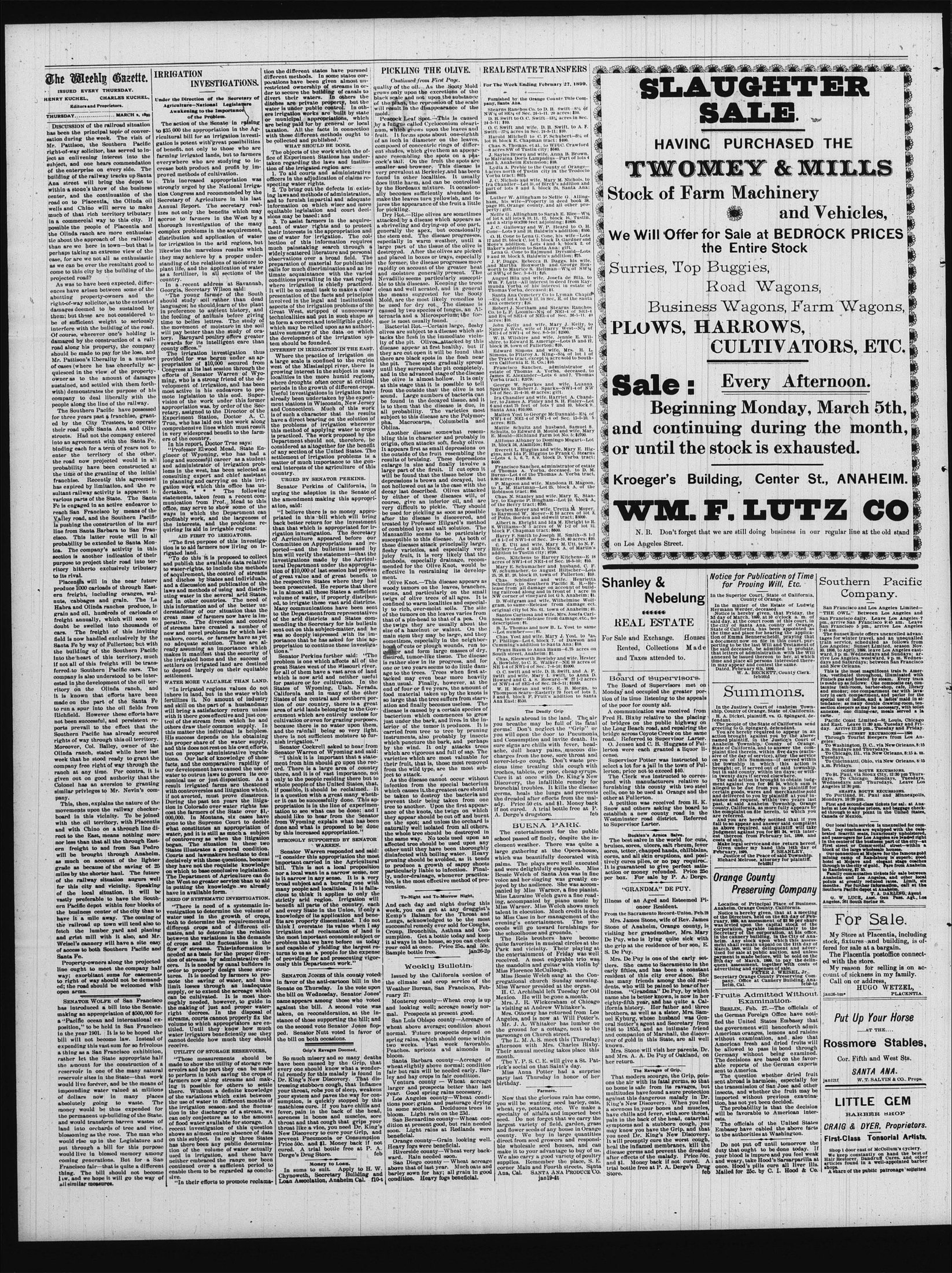
Searchable text
DISCUSSION of the railroad situation has been the principal topic of conversation during the week. The visit of Mr. Pattison, the Southern Pacific right-of-way solicitor, has served to inject an enlivening interest into the subject, and one hears commendation of the enterprise on every side. The building of the railway tracks up Santa Ana street will bring the depot to within a stone's throw of the business center, and the continuation of the road on to Placentia, the Olinda oil wells and Chino will serve to make much of that rich territory tributary in a commercial way to this city. If possible the people of Placentia and the Olinda ranch are more enthusiastic about the approach of the railroad than are we here in town—but that is perhaps taking an extreme view of the case, for are we not all as enthusiastic as we can be over the resultant good to come to this city by the building of the projected road?
As was to have been expected, differences have arisen between some of the abutting property owners and the right-of-way solicitor, as to the extent of damages deemed to be sustained by them; but these are not considered to be of sufficient weight to seriously interfere with the building of the road. Of course, wherever one's holding is damaged by the construction of a railroad along his property, the company should be made to pay for the loss, and Mr. Pattison's liberality in a number of cases (where he has cheerfully acquiesced in the view of the property owner as to the amount of damages sustained, and settled with them forthwith) demonstrates the purpose of his company to deal liberally with the people along the line of the railway.
The Southern Pacific have possessed for three years past a franchise, granted by the City Trustees, to operate their road upon Santa Ana and Olive streets. Had not the company entered into an agreement with the Santa Fe, binding each for a term of years not to enter the territory of the other, the road now projected would in all probability have been constructed at the time of the granting of the initial IRRIGATION INVESTIGATIONS.
Under the Direction of the Secretary of Agriculture—National Legislature Awakening to the Importance of the Problem.
The action of the Senate in raising to $35,000 the appropriation in the Agricultural bill for an irrigation investigation is potent with great possibilities of benefit, not only to those who are farming irrigated lands, but to farmers everywhere who are studying to increase both product and profit by improved methods of cultivation.
This increased appropriation was strongly urged by the National Irrigation Congress and recommended by the Secretary of Agriculture in his last Annual Report. The secretary realizes not only the benefits which may accrue to farmers in the West by a thorough investigation of the many complex problems in the acquirement, distribution and application of water for irrigation in the arid regions, but likewise the marvelous results which they may achieve by a proper understanding of the relations of moisture to plant life, and the application of water as a fertilizer, in all sections of the country.
In a recent address at Savannah, Georgia, Secretary Wilson said:
"The young farmer of the South should study soil rather than dead languages; he should learn of the plant in preference to ancient history, and the feeding of animals before giving time to belles lettres. The study of the movement of moisture in the soil will pay better than the study of oratory. Barnyard poultry offers greater rewards for its intelligent care than county offices."
The irrigation investigation thus provided for was begun under an appropriation of $10,000 secured from Congress at its last session through the efforts of Senator Warren of Wyoming, who is a strong friend of the development of irrigation, and has been most active in his endeavors to promote legislation to this end. Supervision of the work under this former appropriation was, by order of the Secretary, assigned to the Director of the Experiment Station, Doctor A. C. True, who has laid out the work along comprehensive lines which must result in very widespread benefit to the farmers of the country.
In his report, Doctor True says:
"Professor Elwood Mead, State Engineer of Wyoming, who has had a long and successful career as a student and administrator of irrigation problems in the west, has been selected as assistant to different states have pursued different methods. In some states porations have been given almost restricted ownership of streams in order to secure the building of canals divert their waters. In others ditches are private property, but water is under public control. In others irrigation works are built by municipal appropriations, where being paid for by general or taxation. All the facts in connection with these different methods ought be collected and published."
WHAT SHOULD BE DONE.
The objects of the work which this piece of Experiment Stations has undertaken regarding the laws and invention of the irrigated region are:
1. To aid courts and administrative officers in the adjudication of claims affecting water rights.
2. To bring out the defects in laws and methods of administration and to furnish impartial and adequate information on which wiser and equitable legislation and court decisions may be based; and
3. To assist farmers in the acquisition of water rights and to provide their interests in the appropriate use of water for irrigation. The section of this information requires much painstaking search through widely scattered literature and per observations over a broad field, preparation of material for public calls for much discrimination and ultimate acquaintance with the conditions prevailing in the vast area irrigation is chiefly praised. It will be no small task to make presentation of the facts and principles aspects of the irrigation problem Great West, stripped off unnecessary technicalities and put in such shape to form a correct and intelligible summary of the data on the development of the irrigation system should be founded.
INTEREST IN IRRIGATION IN THE WEST OF THE MISSISSIPPI RIVER,
Where the practice of irrigation is large scale is confined to the west of the Mississippi river, growing interest in this subject in localities in the more humid areas droughts often occur at periods in the growth difference Useful investigations in irrigation already been undertaken bythe ment stations in Wisconsin, New York and Connecticut. Much of this is of such a character that there have a direct bearing on the solvency problems of irrigation with this method of applying water is practiced. The work proposed Department should not, therefore considered as altogether for these or any section ofthe United States settlement of irrigation problem matter of much importance to rural interestsofthe agriculture country.
The Southern Pacific have possessed for three years past a franchise, granted by the City Trustees, to operate their road upon Santa Ana and Olive streets. Had not the company entered into an agreement with the Santa Fe, binding each for a term of years not to enter the territory of the other, the road now projected would in all probability have been constructed at the time of the granting of the initial franchise. Recently this agreement has expired by limitation, and the resultant railway activity is apparent in various parts of the State. The Santa Fe is engaged in an active endeavor to reach San Francisco by means of the Valley road, and the Southern Pacific is pushing the construction of its surf line from Santa Barbara to San Francisco. This latter route will in all probability be extended to Santa Monica. The company's activity in this section is another indication of their purpose to project their road into territory hitherto exclusively tributary to its rival.
Placencia will in the near future produce 1000 carloads of through Eastern freight, including oranges, walnuts, cabbages and grain. The La Habra and Olinda ranches produce, in grain and oil, hundreds of carloads of freight annually, which will soon no doubt be swelled into thousands of cars. The freight of this inviting field is now handled exclusively by the Santa Fe by way of Fullerton; but with the building of the Southern Pacific into the heart of this territory, much if not all of this freight will be transferred to Southern Pacific cars. The company is also understood to be interested in the development of the oil territory on the Olinda ranch, and it is known that efforts have been made on the part of the Santa Fe to run a spur into the oil fields from Richfield. However these efforts have not been successful, and persistent reports prevail to the effect that the Southern Pacific has already secured rights of way through this oil territory. Moreover, Col. Bailey, owner of the Olinda ranch, stated while here last week that he stood ready to grant the company free right of way through the ranch at any time. Per contra, it is given out on good authority that the Colonel has an aversion to granting similar privileges to Mr. Nevin's company.
This, then, explains the nature of the movements upon the railway checkerboard in this vicinity. To be joined with the oil territory, with Placentia and with Chino on a through line direct to the East, means nothing more nor less than that all through Eastern freight to and from San Pedro will be brought through Anaheim, as much on account of the lighter grade as because of the saving of 25 miles by the shorter haul. The future of the railway situation augurs well for this city and vicinity. Speaking of the local situation, it will be vastly preferable to have the South efforts of Senator Warren of Wyoming, who is a strong friend of the development of irrigation, and has been most active in his endeavors to promote legislation to this end. Supervision of the work under this former appropriation was, by order of the Secretary, assigned to the Director of the Experiment Station, Doctor A. C. True, who has laid out the work along comprehensive lines which must result in very widespread benefit to the farmers of the country.
In his report, Doctor True says:
"Professor Elwood Mead, State Engineer of Wyoming, who has had a long and successful career as a student and administrator of irrigation problems in the west, has been selected as consulting expert and chief assistant in planning and carrying on this irrigation work which this office has undertaken.* * * The following statements, taken from a recent communication from Prof. Mead to this office, may serve to show some of the ways in which the Department can profitably work, and the largeness of the interests, and the problems requiring its aid in irrigable regions:
AID FIRST TO IRRIGATORS.
"The first purpose of this investigation is to aid farmers now living on irrigated land.
"To do this it is proposed to collect and publish the available data relative to water-rights, to include the methods of acquirement, the control of streams and ditches by States and individuals, and a discussion and publication of the laws and methods of using and distributing water in the several arid States, and in other countries. The need of this information and of the better understanding of our situation than the great mass of farmers now have is imperative. The diversion and control of streams have created a number of new and novel problems for which lawmakers, courts, or farmers have as yet no adequate solution. These are already assuming an importance which makes it manifest that the security of the irrigated home and the success of settlers on irrigated land are destined to depend largely on their equitable settlement.
WATER MORE VALUABLE THAN LAND.
"In irrigated regions values do not inhere in land, but in the water which fertilizes it. No amount of industry and skill on the part of a husbandman will bring a satisfactory return unless with it there goes effective and just control of the stream from which he and others draw their common supply. In this matter the individual is helpless. His success depends on his obtaining his proper share of the water supply, and this does not rest on his own efforts, but on proper administrative regulations. Our lack of knowledge of these facts, and the comparative rapidity of our development have caused the use of water to outrun laws to govern its economical use or just disposition. As a result irrigated farms are threatened with controversies and litigation which, if not averted, must prove disastrous. During the past ten years the litigation in Colorado over water rights has cost the farmers of the State over $1,000,000. In Montana, six cases have gone to the Supreme Court to decide what constitutes an appropriation of water, and it is still as much a subject of controversy as when the litigation began. The situation in these two States illustrates a general condition. Courts and lawmakers hesitate to deal decisively with these questions, because they have not the requisite knowledge on which to base conclusive legislation. The Department of Agriculture can do the West no greater service than to aid in putting the knowledge we already have in available form."
NEED OF SYSTEMATIC INVESTIGATION.
Senator Warren of Wyoming, who is a strong friend of the development of irrigation, and has been most active in his endeavors to promote legislation was by order of the Secretary, assigned to the Director of the Experiment Station, Doctor A. C. True, who has laid out the work along comprehensive lines which must result in very widespread benefit to the farmers of the country.
In his report, Doctor True says:
"Professor Elwood Mead, State Engineer of Wyoming, who has had a long and successful career as a student and administrator of irrigation problems in the west, has been selected as consulting expert and chief assistant in planning and carrying on this irrigation work which this office has undertaken.* * * The following statements, taken from a recent communication from Prof. Mead to this office, may serve to show some of the ways in which the Department can profitably work, and the largeness of the interests, and the problems requiring its aid in irrigable regions:
AID FIRST TO IRRIGATORS.
"The first purpose of this investigation is to aid farmers now living on irrigated land.
"To do this it is proposed to collect and publish the available data relative to water-rights, to include the methods of acquirement, the control of streams and ditches by States and individuals, and a discussion and publication of the laws and methods of using and distributing water in the several arid States, and in other countries. The need of this information and of the better understanding of our situation than the great mass of farmers now have is imperative. The diversion and control of streams have created a number of new and novel problems for which lawmakers, courts, or farmers have as yet no adequate solution. These are already assuming an importance which makes it manifest that the security of the irrigated home and the success of settlers on irrigated land are destined to depend largely on their equitable settlement."
WATER MORE VALUABLE THAN LAND.
"In irrigated regions values do not inhere in land, but in the water which fertilizes it. No amount of industry and skill on the part of a husbandman will bring a satisfactory return unless with it there goes effective and just control of the stream from which he and others draw their common supply. In this matter the individual is helpless. His success depends on his obtaining his proper share of the water supply, and this does not rest on his own efforts, but on proper administrative regulations." Our lack of knowledge of these facts, and the comparative rapidity of our development have caused the use of water to outrun laws to govern its economical use or just disposition. As a result irrigated farms are threatened with controversies and litigation which, if not averted, must prove disastrous. During the past ten years the litigation in Colorado over water rights has cost the farmers of the State over $1,000,000. In Montana, six cases have gone to the Supreme Court to decide what constitutes an appropriation of water, and it is still as much a subject of controversy as when the litigation began. The situation in these two States illustrates a general condition. Courts and lawmakers hesitate to deal decisively with these questions, because they have not the requisite knowledge on which to base conclusive legislation. The Department of Agriculture can do the West no greater service than to aid in putting the knowledge we already have in available form."
NEED OF SYSTEMATIC INVESTIGATION.
Senator Warren of Wyoming,
I think it is important that ment from him should go upward.
There is a large area off there, and it is of vast importance only to the people residing there.
Area area arid lands belonging to certain institutions are entirely used for cultivation or even for grazing because there is no water upward.
And rainfall being so severe there is not sufficient moisture irrigation.
Senator Cockrell asked to hear Senator Warren of Wyoming about his involvement with Placentia and with Chino on a thorough line directing to East means nothing more nor less than that all through Eastern freight to and from San Pedro will be brought through Anaheim as much on account ofthe savingof 25 milesbythe shorter haul.The futureofthe railway situationaugurswellforthiscityandvicinity.Speakingofthelocalsituation.itwillbevastlypreferabletohavetheSouth effortsofSenatorWarrenofWyomingwhoisastrongfriendofthedevelopmentofirrigationandhasbeenmostactiveinhisendeavorthegrowthofirrigationproblemsthemethicallendertotheheartuponthistourismhalftermoftheearthuponthistourismhalftermoftheearthuponthistourismhalftermoftheearthuponthistourismhalftermoftheearthuponthistourismhalftermoftheearthuponthistourismhalftermoftheearthuponthistourismhalftermoftheearthuponthistourismhalftermoftheearthuponthistourismhalftermoftheearthuponthistourismhalftermoftheearthuponthistourismhalftermoftheearthuponthistourismhalftermoftheearthuponthistourismhalftermoftheearthuponthistourismhalftermoftheearthuponthistourismhalftermoftheearthuponthistourismhalftermoftheearthuponthistourismhalftermoftheearthuponthistourismhalftermoftheearthuponthistourismhalftermoftheearthuponthistourismhalftermoftheearthuponthistourismhalftermoftheearthuponthistourismhalftermoftheearthuponthistourismhalftermoftheearthuponthistourismhalftermoftheearthuponthistourismhalftermoftheearthuponthistourismhalftermoftheearthuponthistourismhalftermoftheearthuponthistourismhalftermoftheearthuponthistourismhalftermoftheearthuponthistourismhalftermoftheearthuponthistourismhalftermoftheearthuponthistourismhalftermoftheearthuponthistourismhalftermoftheearthuponthistourismhalftermoftheearthuponthistourismh半termoftheearthuponthistourismh半term ofthemethicallendertotheheartuponthistourismh半term ofthemethicallendertotheheartuponthistourismh半term ofthemethicallendertotheheartuponthistourismh半term ofthemethicallendertotheheartuponthistourismh半term ofthemethicallendertotheheartuponthistourismh半term ofthemethicallendertotheheartuponthistourismh半term ofthemethicallendertotheheartuponthistourismh半term ofthemethicallendertotheheartuponthistourismh半term ofthemethicallendertotheheartuponthistourismh半term ofthemethicallendertotheheartuponthistourismh半term ofthemethicallendertotheheartuponthistourismh半term ofthemethicallendertotheheartuponthistourismh半term ofthemethicallendertotheheartuponthistourismh半term ofthemethicallendertotheheartuponthistourismh半term ofthemethicallendertotheheartuponthistourismh半term ofthemethicallendertotheheartuponthistourismh半term ofthemethicallendertotheheartuponthistourismh半term ofthemethicallendertotheheartuponthistourismh半term ofthemethicallendertotheheartuponthistourismh半term ofthemethicallendertotheheartuponthistourismh半term ofthemethicallendertotheheartupon$thistourtieruptheruntieruptheruntieruptheruntieruptheruntieruptheruntieruptheruntierruptheruntierruptheruntierruptheruntierruptheruntierruptheruntierruptheruntierruptheruntierruptheruntierruptheruntierruptheruntierruptheruntierruptheruntierruptheruntierruptheruntierruptheruntierruptheruntierruptheruntierruptheruntierruptheruntierruptheruntierruptheruntierruptheruntierruptheruntierruptheruntierruptheruntierruptheruntierruptheruntierruptheruntierruptheruntierruptheruntierruptheruntiertriumruptterruptterruptterruptterruptterruptterruptterruptterruptterruptterruptterruptterruptterruptterruptterruptterruptterruptterruptterruptterruptterruptterruptterruptterruptterruptterruptterruptterruptterruptterruptedterruptedterruptedterruptedterruptedterruptedterruptedterruptedterruptedterruptedterruptedterruptedterruptedterruptedterruptedterruptedterruptedterruptedterruptedterruptedterruptedterruptedterruptedterruptedterputedterruptedterputedterputedterputedterputedterputedterputedterputedterputedterputedterputedterputedterputedterputedterputedterputed terputedTerputedTerputedTerputedTerputedTerputedTerputedTerputedTerputedTerputedTerputedTerputedTerputedTerputedTerputedTerputedTerputedTerputedTerputedTerputedTerputedTerputedTerputedTerputedTerputedTerputedTerputedTerputedTerputedTerputedTerputedTerputedTerputedTerputedTerputedTerputedTerputedTerputedTerputedTerputedTerputedTerputedTerputedTerputedTerpute TerputedTerpute Terpute Terpute Terpute Terpute Terpute Terpute Terpute Terpute Terpute Terpute Terpute Terpute Terpute Terpute Terpute Terpute Terpute Terpute Terpute Terpute Terpute Terpute Terpute Terpute Terpute Terpute Terpute Terpute Terpute Terpute Terpute Terpute Terpute Terpute Terpute Terpute Terpute Terpute Terpute Terpute Terpute Terpute Terpute Terpute Terpute Terpute Terpute Terpute Terpute Terpute Terpute Terpute Terpute Terpute Terpute Terpute Terpute Terpute Terpute Terpute Tier pute Tier pute Tier pute Tier pute Tier pute Tier pute Tier pute Tier pute Tier pute Tier pute Tier pute Tier pute Tier pute Tier pute Tier pute Tier pute Tier pute Tier pute Tier pute Tier pute Tier pute Tier pute Tier pute Tier pute Tier pute Tier pute Tier pute Tier pute Tier pute Tier pute Tier pute Tier pute Tier pute Tier putei Tier putei Tier putei Tier putei Tier putei Tier putei Tier putei Tier putei Tier putei Tier putei Tier putei Tier putei Tier putei Tier putei Tier putei Tier putei Tier putei Tier putei Tier putei Tier putei Tier putei Tier putei Tier putei Tier putei Tier putei Tier putei Tier putei Tier putei Tier putei Tier putei Tier putei Tier putei Tier.putei Tier.putei Tier.putei Tier.putei Tier.putei Tier.putei Tier.putei Tier.putei Tier.putei Tier.putei Tier.putei Tier.putei Tier.putei Tier.putei Tier.putei Tier.put ei Tier.put ei Tier.put ei Tier.put ei Tier.put ei Tier.put ei Tier.put ei Tier.put ei Tier.put ei Tier.put ei Tier.put ei Tier.put ei TI TI TI TI TI TI TI TI TI TI TI TI TI TI TI TI TI TI TI TI TI TI TI TI TI TI TI TI TI TI TI TI TI TI TI TI TI TI TI TI TI TI TI TI TI TI TI TI TI TI TI TI TI TI TI TI TI TI TI TI TI TI TI TI TI TI TI TI TI TI TI TI TI TI TI T ITI T ITI T ITI T ITI T ITI T ITI T ITI T ITI T ITI T ITI T ITI T ITI T ITI T ITI T ITI T ITI T ITI T ITI T ITI T ITI T ITI T ITI T ITI T ITI T ITI T ITI T ITI T ITI T ITI T ITI T ITI T ITI T ITI T IIIIIIIIIIIIIIIIIIIIIIIIIIIIIIIIIIIIIIIIIIIIIIIIIIIIIIIIIIIIIIIIIIIIIIIIIIIIIIIIIIIIIIIIIIIIIIIIIIIIIIIIIIIIIIIIIIIIIIIIIIIIIIIIIIIIIIIIIIIIIIIIIIⅡⅡⅡⅡⅡⅡⅡⅡⅡⅡⅡⅡⅡⅡⅡⅡⅡⅡⅡⅡⅡⅡⅡⅡⅡⅡⅡⅡⅡⅡⅡⅡⅡⅡⅡⅡⅡⅡⅡⅡⅡⅡⅡⅡⅡⅡⅡⅡⅡⅡⅡⅡⅣⅣⅣⅣⅣⅣⅣⅣⅣⅣⅣⅣⅣⅣⅣⅣⅣⅣⅣⅣⅣⅣⅣⅣⅣⅣⅣⅣⅣⅣⅣⅣⅣⅣⅣⅣⅣⅣⅣⅣⅣⅣⅣⅣⅣⅣⅣⅣⅴⅴⅴⅴⅴⅴⅴⅴⅴⅴⅴⅴⅴⅴⅴⅴⅴⅴⅴⅴⅴⅴⅴⅴⅴⅴⅴⅴⅴⅴⅴⅴⅴⅴⅴ∏∏∏∏∏∏∏∏∏∏∏∏∏∏∏∏∏i∏i∝i∝i∝i∝i∝i∝i∝i∝i∝i∝i∝i∝i∝i∝i∝i∝i∝i∝i∝i∝i∝i∝i∝i∝i∝i∝i∝i∝i∝i∝i∝i∝i∗i∝i∝i∝i∝i∝i∝i∝i∝i∝i∝i∛i∝i∝i ∏i ∏i ∏i ∏i ∏i ∏i ∏i ∏i ∏i ∏i ∏i ∏i ∏i ∏i ∏i ∏i ∏i ∏i ∏i ∏i ∏i ∏i ∏i ∏i ∏i ∣i ∣i ∣i ∣i ∣i ∣i ∣i ∣i ∣i ∣i ∣i ∣i ∣i ∣i ∣i ∣i ∣i ∣i ∣i ∣i ∣i ∣i ∣i ∣i ∵i ∵i ∵i ∵i ∵i ∵i ∵i ∵i ∵i ∵i ∵i ∵i ∵i ∵i ∵i ∵i ∵i ∵i ∵i ∵i ∵i ∵i ∵i ∵i ∵i ∵i ∵i ∵i ∵i ∵i ∵i ∵i ∵i ÷ i ÷ i ÷ i ÷ i ÷ i ÷ i ÷ i ÷ i ÷ i ÷ i ÷ i ÷ i ÷ i ÷ i ÷ i ÷ i ÷ i ÷ i ÷ i ÷ i ÷ i ÷ i ÷ i ÷ i ÷ i ÷ i ÷ i ÷ i ÷ i ÷ i ÷ i ÷ i ÷ i ÷ i ÷ i ÷ i ÷ i ÷ i ÷ i ÷ i ÷ i ÷ i ÷ i ÷ i ÷ i ÷ i ÷ i ÷ i ÷ i ÷ i ÷ i÷ i÷ i÷ i÷ i÷ i÷ i÷ i÷ i÷ i÷ i÷ i÷ i÷ i÷ i÷ i÷ i÷ i÷ i÷ i÷ i÷ i÷ i÷ i÷ i÷ i÷ i÷ i÷ i÷ i÷ i÷ i÷ i÷ iiÿìììììììììììììììììììììììììììììììììììììììììììììììììììììììììììììììììììììììììììîîîîîîîîîîîîîîîîîîîîîîîîîîîîîîîîîîîîîîîîîîîîîîîîîîîîîîîîîîîîîîîîîîîî îïïïïïïïïïïïïïïïïïïïïïïïïïïïïïïïïïïïïïïïïïïïïïïïïïïïïïϊϊϊϊϊϊϊϊϊϊϊϊϊϊϊϊϊϊϊϊϊϊϊϊϊϊϊϊϊϊϊϊϊϊϊϊϊϊϊϊϊϊϊϊϊϊϊϊϊϊїィїїїїїїїїїїїїїїїїїїїїїїїїїїїїїїїїїїїїїїїїїїїїй йй йй йй йй йй йй йй йй йй йй йй йй й阎 й阎 й阎 й阎 й阎 й阎 й阎 й阎 й阎 й阎 й阎 й阎 й阎 й阎 й阎 й阎 й阎 й阎 й阎 й阎 й阎 й阎 й阎 й阎 й阎 й阎 й阎 й阎 й阎 й阎 й阎 й阎 й阎 й阎 й阎 й阎 Й闾 Й闾 Й闾 Й闾 Й闾 Й闾 Й闾 Й闾 Й闾 Й闾 Й闾 Й闾 Й闉 Й闉 Й闉 Й闉 Й闉 Й闉 Й闉 Й闉 Й闉 Й闉 Й闉 Й闕 Й闉 Й闉 Й闉 Й闉 Й闉 Й闉 Й闉 Й闉 Й闉 Й闉 Й闉 Й闉 Й闕 Й闕 Й闕 Й闕 Й闕 Й闕 Й闕 Й闕 Й闕 Й闕 Й闕 Й闕 Й闕 Й闕 შე შე შე შე შე შე შე შე შე შე შე შე შე შე შე შე შე შე შე შე შე შე შე შე შე შე შე შე შე შე შე შე შე ჩზენსტრსტრსტრსტრსტრსტრსტრსტრსტრსტრსტრსტრსტრსტრსტრსტრსახილიააააააააააააააააააააააააansaasaansaansaansaansaansaansaansaansaansaansaansaansaansaansaansaansaansaansaansaansaansaansaansaansaansaansaansaansaansaansaansaansaansaansaansaansaansaansaansaansaansaansaansaansaansaansaansaansaansaansaansaansaansaansaansaansaansaansaansaansaansaansaansaansaansaansaansaansaansaansaassaasaasaasaasaasaasaasaasaasaasaasaasaasaasaasaasaasaasaasaasaasaasaasaasaasaasaasaasaasaasaasaasaasaasausaasausausausausausausausausausausausausausausausausausausausausausausausausausausausausausausausausausausaUSAUSAUSAUSAUSAUSAUSAUSAUSAUSAUSAUSAUSAUSAUSAUSAUSAUSAUSAUSAUSAUSAUSAUSAUSAUSAUSAUSAUSAUSAUSAUSAUSAUSAUSAUSA USA USA USA USA USA USA USA USA USA USA USA USA USA USA USA USA USA USA USA USA USA USA USA USA USA USA USA USA USA USA USA USA USA USA USA USA USA USA USA USA USA USA USA USA USA USA USA USA USA USA USA USA USA USA USA USA USA USA USA USA USA USA USA USA USA USA USA USA USA USA USA USA USA USA USA USA USA USA USA USA USA USA USA USA США США США США США США США США США США США США США США США США США США США США США США США США США США США США США США США США США США США СШАpliceplicepliceplicepliceplicepliceplicepliceplicepliceplicepliceplicepliceplicepliceplicepliceplicepliceplice
This, then, explains the nature of the movements upon the railway checkerboard in this vicinity. To be joined with the oil territory, with Placentia and with Chino on a through line direct to the East, means nothing more nor less than that all the through Eastern freight to and from San Pedro will be brought through Anaheim, as much on account of the lighter grade as because of the saving of 25 miles by the shorter haul. The future of the railway situation augurs well for this city and vicinity. Speaking of the local situation, it will be vastly preferable to have the Southern Pacific depot within four blocks of the business center of the city than to have it a mile away. The coming of the railroad up town will tend also to fetch the lumber yard and planing and grist mill with it also; and Mr. Weisel's cannery will have a site easy of access to both Southern Pacific and Santa Fe.
Property-owners along the projected line ought to meet the company half way; exorbitant sums for easements to right of way should not be demanded; the road should be welcomed with open arms.
SENATOR WOLFE of San Francisco has introduced a bill into the Senate making an appropriation of $500,000 for a "Pacific ocean and international exposition," to be held in San Francisco in the year 1901. It is to be hoped the bill will not become law. Instead of expending this vast sum for so frivolous a thing as a San Francisco exhibition, rather let the State appropriate half the amount for the construction of a reservoir in one of the many natural reservoir sites in the State—that work would live forever, and be the means of impounding water valued at millions of dollars now in many places absolutely going to waste. The money would be thus expended for the permanent up-building of the State, and would transform barren wastes of land into orchards of tree and vine, blossoming as the rose. The man who would rise up in the Legislature and put through a bill for this purpose would live in blessed memory among coming generations. But for a San Francisco fair—that is quite a different thing. The bill should not become law, and we hope it will go the way of all similar measures.
During the past ten years the litigation in Colorado over water rights has cost the farmers of the State over $1,000,000. In Montana, six cases have gone to the Supreme Court to decide what constitutes an appropriation of water, and it is still as much a subject of controversy as when the litigation began. The situation in these two States illustrates a general condition. Courts and lawmakers hesitate to deal decisively with these questions, because they have not the requisite knowledge on which to base conclusive legislation. The Department of Agriculture can do the West no greater service than to aid in putting the knowledge we already have in available form.
NEED OF SYSTEMATIC INVESTIGATION.
"There is need of a systematic investigation to determine the volume of water used in the growth of crops, both to determine the requirements of different crops and of different climates, and to determine the relation between the variations in the demands of crops and the fluctuations in the flow of streams. This information is needed as a basis for the proper diversion of streams by administrative officers. It is needed by canal builders in order to properly design these structures. It is needed by farmers to promote the saving of water, and thus limit losses through an inadequate supply, or to extend the acreage which can be cultivated. It is most thoroughly needed, however, to guide in the making of just and proper water-right decrees. In the disposal of streams, courts cannot properly fix the volume to which appropriators are entitled. Until they know how much water irrigators beneficially use they cannot decide how much they should receive.
UTILITY OF STORAGE RESERVOIRS.
"These measurements should be made to show the utility of storage reservoirs and the part they can be made to perform in both saving the crops of farmers now along streams and making it possible for others to settle there. Without a definite knowledge of the variations which exist between the use of water in different months of the irrigation season, and the fluctuation in the discharge of a stream, we can only conjecture as to the amount of flood water available for storage. A recent investigation of this question shows an almost entire absence of data on this subject. In only three States has there been any public determination of the volume of water actually used in irrigation, and these have neither embraced the range nor been continued over a sufficient period to enable them to be regarded as conclusive."
In their efforts to promote reclamation in succession by the line of expansion it is in line with existing conditions. It is not a local problem but a local want in a narrow sense is it narrow in any sense. It broad subject and a burning concern among people and localities. It cloosely thinks it applies strictly arid region. Irregular benefit all parts of the county and every State in the Union, knowledge of its application fits properly disseminated. Think I overstate its value with irrigation and reclamation on most important economic problems that we have before us and capable of yielding large returns to us as a people for those providing for and prosecuting this Department work."
The different states have pursued different methods. In some states corrosions have been given almost unsecured ownership of streams in order to secure the building of canals to meet their waters. In others the stresses are private property, but the state is under public control. In other irrigation works are built by state municipal appropriations, which being paid for by general or local taxation. All the facts in connection with these different methods ought to be collected and published."
WHAT SHOULD BE DONE.
The objects of the work which the office of Experiment Stations has undertaken regarding the laws and institute of the irrigated region are:
To aid courts and administrative efforts in the adjudication of claims resulting water rights.
To bring out the defects in existing laws and methods of administration, to furnish impartial and adequate information on which wiser and more suitable legislation and court decisions may be based; and
To assist farmers in the acquisition of water rights and to protect their interests in the appropriation of water for irrigation. The collection of this information requires a well scattered literature and personal observations over a broad field. The preparation of material for publication is for much discrimination and an intimate acquaintance with the varied conditions prevailing in the vast region where irrigation is chiefly practiced. It will be no small task to make a clear presentation of the facts and principles involved in the legal and institutional aspects of the irrigation problems of the West, stripped of unnecessary technicalities and put in such shape as form a correct and intelligible guide, which may be relied upon as an authoritative summary of the data on which development of the irrigation system should be founded.
INTEREST IN IRRIGATION IN THE EAST.
Where the practice of irrigation on large scale is confined to the region east of the Mississippi river, there is growing interest in the subject in many cities in the more humid regions where droughts often occur at critical periods in the growth of different crops. Fewful investigations in irrigation have already been undertaken by the expert stations in Wisconsin, New Jersey, Connecticut. Much of this work of such a character that the results give a direct bearing on the solution of the problems of irrigation wherever it is method of applying water to crops practiced. The work proposed by the department should not, therefore, be considered as altogether for the benefit any section of the United States. The settlement of irrigation problems is a matter of much importance to the general interests of the agriculture of this country.
PICKLING THE OLIVE.
Continued from First Page.
quality of the oil. As the Sooty Mold grows only upon the excretions of the black scale and not upon the substance of the plant, the repression of the scale will result in the disappearance of the mold.
Peacock Leaf Spot.—This is caused by a fungus called Cycloconium oleaginum, which grows upon the leaves and fruit. It forms spots about one-eighth of an inch in diameter on the leaves, composed of concentric rings of different shades, which give them an appearance resembling the spots on a peacock's tail. On the fruit the spots are smaller and browner. This disease is very prevalent at Berkeley, and has been found in other localities. It usually does little harm, and can be controlled by the Bordeaux mixture. It occasionally becomes sufficiently abundant to make the leaves turn yellowish, and injures the appearance of the fruit a little for pickling.
Dry Rot.—Ripe olives are sometimes attacked by a disease which appears as a shriveling and drying-up of one part, generally the apex, but occasionally the stem end. The disease progresses especially in warm weather, until a large part of the tissue of the olive is destroyed. After the olives are picked and placed in boxes or trays, especially the former, the disease progresses more rapidly on account of the greater heat and moisture generally present. The Nevadillo seems particularly susceptible to this disease. Keeping the trees clean and well aerated, and in general the means suggested for the Sooty Mold, are the most likely remedies to be used for dry rot. The disease is caused by two species of fungus, an Alternaria and a Microsporum; the former is most usually found.
Bacterial Rot.—Certain large, fleshy olives are subject to a disease which attacks the flesh in the immediate vicinity of the pit. Olives attacked by this disease appear at first healthy, but if they are cut open it will be found that there are black spots in the flesh near the pit. These spots gradually spread until they surround the pit completely, and in the advanced stage of the disease the olive is almost hollow. It is only at this stage that it is possible to tell from the outside that the olive is not sound. Large numbers of bacteria can be found in the decayed tissue, and it is to them that the disease is due, in all probability. The varieties most subject to this disease are the Polymorpha, Macrocarpa, Columbella and Obliza.
Another disease somewhat resembling this in character and probably in origin, often attacks soft, fleshy olives. It appears first as small depressions on the outside of the fruit resembling the results of bruising. These depressions enlarge in size and finally involve a large part of the fruit. If cut open it will be found that the tissue below
IN URGED BY SENATOR PERKINS.
Senator Perkins of California, in bringing the adoption in the Senate of amendment making this appropriation, said:
"I believe there is no money appreciated in this bill which will bring better return for the investment that which is appropriated for irrigation investigation. The Secretary Agriculture appeared before our committee on Appropriations and relied—and the bulletins issued by me will verify the statement—that the investigations made by the Agricultural Department under the appropriation of $10,000 of last session had proven great value and of great benefit to these respective States where they had been prosecuted. He reports that there is almost all these States a sufficient volume of water, if properly distributed, to irrigate these vast arid districts, many communications have been sent to the Department from representatives of the arid districts and States commending the Secretary for his bulletin out on this subject-matter, and he is so deeply impressed with its importance that he has asked for this appropriation to continue these investigations."
Senator Perkins further said: "The problem is one which affects all of the Great States west of the Missouri river, all of them have a vast area of land which is now arid and neither useful nor pasture or for cultivation. In the states of Wyoming, Utah, Nevada and in many of the other states of the central and southern portion of our country, there is a great area of arid lands belonging to the Government which are entirely useless for cultivation or even for grazing purposes, because there is no water upon them, and the rainfall being so very light, there is not sufficient moisture to furnish crops."
Senator Cookrell asked to hear from Senator Warren of Wyoming and said: "I think it is important that a statement from him should go upon the record. There is a large area of country here, and it is of vast importance, not only to the people residing there but to whole people of the United States, that possible, it should be reclaimed. It is a question with a great many whight it can be successfully done. This appropriation is in the line of experimentation to see what can be done; and I would like to hear from the Senator from Wyoming explain what has been done and what is proposed to be done by this increased appropriation."
STRONGLY SUPPORTED BY SENATOR WARREN.
Senator Warren responded and said: "I consider this appropriation the most important carried in the Agriculturalill. This is not a local proposition for a local want in a narrow sense, nor it narrow in any sense. It is a very broad subject and a burning one with many people and localities. It is fallacious to think it applies to only the more humid regions, there droughts often occur at critical periods in the growth of different crops. Failure investigations in irrigation have been undertaken by the experienced stations in Wisconsin, New Jersey Connecticut. Much of this work of such a character that the results are direct bearing on the solution of problems of irrigation wherever method of applying water to crops practiced. The work proposed by the department should not, therefore, be considered as altogether for the benefit any section of the United States. The element of irrigation problems is a matter of much importance to the general interests of the agriculture of this country.
URGED BY SENATOR PERKINS.
Senator Perkins of California, in bringing the adoption in the Senate of amendment making this appropriation, said:
"I believe there is no money appreciated in this bill which will bring better return for the investment that which is appropriated for irrigation investigation. The Secretary Agriculture appeared before our committee on Appropriations and relied—and the bulletins issued by me will verify the statement—that the investigations made by the Agricultural Department under the appropriation of $10,000 of last session had proven great value and of great benefit to these respective States where they had been prosecuted. He reports that there is almost all these States a sufficient volume of water, if properly distributied, to irrigate these vast arid districts, many communications have been sent to the Department from representatives of the arid districts and States commending the Secretary for his bulletin out on this subject-matter, and he is so deeply impressed with its importance that he has asked for this appropriation to continue these investigations."
Senator Perkins further said: "The problem is one which affects all of the Great States west of the Missouri river, all of them have a vast area of land which is now arid and neither useful nor pasture or for cultivation. In the states of Wyoming, Utah, Nevada and in many of the other states of the central and southern portion of our country, there is a great area of arid lands belonging to the Government which are entirely useless for cultivation or even for grazing purposes, because there is no water upon them, and the rainfall being so very light, there is not sufficient moisture to furnish crops."
Senator Cookrell asked to hear from Senator Warren of Wyoming and said: "I think it is important that a statement from him should go upon the record. There is a large area of country here, and it is of vast importance, not only to the people residing there but to whole people of the United States, that possible, it should be reclaimed. It is a question with a great many whight it can be successfully done. This appropriation is in the line of experimentation to see what can be done; and I would like to hear from the Senator from Wyoming explain what has been done and what is proposed to be done by this increased appropriation."
STRONGLY SUPPORTED BY SENATOR WARREN.
Senator Warren responded and said: "I consider this appropriation the most important carried in the Agriculturalill. This is not a local proposition for a local want in a narrow sense, nor it narrow in any sense. It is a very broad subject and a burning one with many people and localities. It is fallacious to think it applies to only the more humid regions, there droughts often occur at critical periods in the growth of different crops. Failure investigations in irrigation have been undertaken by the department should not, therefore, be considered as altogether for the benefit that which is appropriated for irrigation investigation. The Secretary Agriculture appeared before our committee on Appropriations and relied—and the bulletins issued by me will verify the statement—that the investigations made by the Agricultural Department under the appropriation of $10,000 of last session had proven great value and of great benefit to these respective States where they had been prosecuted. He reports that there is almost all these States a sufficient volume of water, if properly distributied, to irrigate these vast arid districts, many communications have been sent to the Department from representatives of the arid districts and States commending the Secretary for his bulletin out on this subject-matter, and he is so deeply impressed with its importance that he has asked for this appropriation to continue these investigations."
Senator Perkins further said: "The problem is one which affects all of the Great States west of the Missouri river, all of them have a vast area of land which is now arid and neither useful nor pasture or for cultivation. In the states of Wyoming, Utah, Nevada and in many of the other states of the central and southern portion of our country, there is a great area of arid lands belonging to the Government which are entirely useless for cultivation or even for grazing purposes, because there is no water upon them, and the rainfall being so very light, there is not sufficient moisture to furnish crops."
SENATOR JONES of this county voted in favor of the anti-cartoon bill in the Senate on Thursday. In the vote upon the bill on Wednesday, Senator Jones' name appears among those who voted against the bill. A second vote was taken, on reconsideration, at the instance of those supporting the bill; and on the second vote Senator Jones flopped. Senator Nutt voted in favor of the bill on both occasions.
Grip's Ravages Doomed.
So much misery and so many deaths have been caused by the Grip, that every one should know what a wonderful remedy for this malady is found in Dr. King's New Discovery. That disressing stubborn cough, that inflames your throat, robs you of sleep, weakens your system and paves the way for consumption, is quickly stopped by this matchless cure. If you have chills and fever, pain in the back of the head, soreness in bones and muscles, sore throat and that cough that grips your throat like a vice, you need Dr. King's New Discovery to cure your Grip, and prevent Pneumonia or Consumption. Price 50c. and $1. Money back if not sure. A trial bottle free at P. A. Derge's Drug Store.
Money to Loan.
In sums to suit. Apply to H.W. Chynoweth, Secretary Building and Loan Association, Anaheim Cal. f10-t
Weekly Bulletin.
Issued by the California section of the climate and crop service of the Weather Bureau, San Francisco, February 27:
Monterey county—Wheat crop is up and looking well; acreage nearly normal. Prospects at present good.
San Luis Obispo county—Acreage of wheat above average; condition about normal. Future prospects depend on spring rains, which should come within two weeks. Past week favorable. Peaches, apricots and almonds in bloom.
Santa Barbara county—Acreage of wheat slightly above normal; condition fair but rain will be needed early. Barley and hay crops in fair condition.
Ventura county — Wheat acreage larger and prospects better than last year. Good spring rains necessary.
Los Angeles county—Wheat conditions poor; grain and pasturage drying in some sections. Deciduous trees in bloom. Light rain on the 23d.
San Bernardino county—Wheat condition at present good, but rain needed soon. Light rains at Redlands were beneficial.
Orange county—Grain looking well. Heavy frogs were beneficial.
Riverside county—Wheat very backward. Rain needed soon.
San Diego county—Wheat acreage above that of last year. Much oats and barley sown for hay; all grain in good condition. Heavy frogs beneficial.
BUENA PARK.
The entertainment for the public school passed off finely, despite the inclement weather. There was quite a large gathering at the Opera-house, which was beautifully decorated with palms. The plays were well executed and were delightfully enjoyable. Miss Bessie Welch of Santa Ana was in fine voice and her singing was greatly enjoyed by the audience. She was accompanied by Miss Warner, a fine pianist. Miss Lauraine Welch gave a fine reading, accompanied by piano music by Miss Warner. Miss Welch shows much talent in elocation. Much credit is due to Miss Case in her management of the evening's entertainment. The proceeds will go toward furnishings for the schoolhouse and grounds.
The Reis brothers become quite favorites in musical circles at the Park and vicinity. Their playing at the entertainment of Friday was well received. A most enjoyable trio was the mandolin and guitar with violin by Miss Florence McCullough.
Miss Bessie Welch sang at the Congregational church Sunday morning. Miss Warner presided at the organ.
H.C. Archibald left Tuesday for Old Mexico. He will be gone a month.
Mrs.J.R.Wickersham of Chicago is visiting at Andrew Whitaker's.
Mrs.Ottoway has returned from Los Angeles, and is now at Will Potter's.
Mr.J.A.Witaker has lumber on the ground for a cottage, next to the parsonage on Church street.
The L.M.A.S.s meet this (Thursday) afternoon with Mrs.Charles Bixby. Their annual meeting takes place this month.
The Y.P.S.C.E.will give a St.Patrick's social on that Saint's day.
Miss Anna Potter had a surprise party last Thursday in honor of her birthday.
Farmers.
Now that the glorious rain has come, you will be wanting seed barley, oats, wheat, rye, potatoes, etc. We make a specialty of alfalfa and imported beet seed. Do not forget that we carry the largest variety of field, garden, grass and flower seeds of any house in Orange county. We buy in large quantities direct from seed growers and responsible wholesale seed houses, and can make it to your advantage to buy of us. We also carry a good variety of poultry supplies. Remember the place, S.E.corner Main and Fourth streets, Santa Ana, Cal.SANTA ANA PRODUCE CO.jan19-4t
SLAUGHTER SALE.
HAVING PURCHASED THE
TWOMEY & MILLS
Stock of Farm Machinery
and Vehicles,
We Will Offer for Sale at BEDROCK PRICES
the Entire Stock
Surries, Top Buggies,
Road Wagons,
Business Wagons, Farm Wagons,
PLOWS, HARROWS,
CULTIVATORS, ETC.
Sale: Every Afternoon.
Beginning Monday, March 5th,
and continuing during the month,
or until the stock is exhausted.
Sale: Every Afternoon.
Beginning Monday, March 5th, and continuing during the month, or until the stock is exhausted.
Kroeger’s Building, Center St., ANAHEIM.
WM. F. LUTZ CO
N. B. Don’t forget that we are still doing business in our regular line at the old stand on Los Angeles Street.
Shanley & Nebelung
REAL ESTATE
For Sale and Exchange. Houses Rented, Collections Made and Taxes attended to.
Board of Supervisors.
The Board of Supervisors met on Monday and occupied the greater portion of its time listening to the appeals of the poor for county aid.
A communication was received from Fred H. Bixby relative to the placing of bridges on the public highway on the Long Beach road, and repairing the bridge across Coyote Creek on the same road. Referred to Supervisor Larter. O. Jensen and C. B. Huggans of Fullerton were each granted a liquor license.
Supervisor Potter was instructed to select a lot for a jail in the town of Fullerton, price not to exceed $40.
The Clerk was instructed to correspond with manufacturers relative to furnishing this county with two steel cells, one to be used at Orange and the other at Fullerton.
A petition was received from H. K. Snow and others asking the board to establish a new county road in the Westminster road district. Referred to Supervisor Larter.
Bucklen’s Arnica Salve.
The best salve in the world for cuts, bruises, sores, ulcers, salt rheum, fever sores, tetter, chapped hands, chilblains, corns, and all skin eruptions, and positively cures piles, or no pay required.
It is guaranteed to give perfect satisfaction or money refunded. Price 25c per box. For sale by P. A. Derge.
“GRANDMA” DE PUY.
Notice for Publication of Time for Proving Will, Etc.
In the Superior Court, State of California, County of Orange.
In the matter of the Estate of Ludwig Hermann Werder deceased.
Notice hereby given that Friday, the 3d day of March, 1899, at 10 o’clock a.m. of said day, at the court room of this court, in the city of Santa Ana, county of Orange, State of California, has been appointed as the time and place for hearing the application of Emma Bennerscheldt; praying that action will be taken in this court, supporting to be the last Will and Testament of the said deceased, be admitted to probate.
That letters of administration with the Will annexed be issued thereon to her, at which time and place all persons interested therein may appear and contest the same.
Dated, February 6th, 1899.
W. A. BECKETT, County Clerk,
feb16td
Summons.
In the Justice’s Court of Anaheim Township, County of Orange, State of California, send greeting to G. Spingard, defendant.
You are hereby required to appear in an action brought against you by the above-named plaintiff, in the Justice’s Court of Anaheim Township, County of Orange, State of California, and to answer the complaint within five days (exclusive of the day of service), after the service on you of this Summons—if served within the township in which this action is brought; or if served out of said township, but in said county, within ten days; or within twenty days if served elsewhere.
The above-brought judicial judgment against you for $10.44, which sum is alleged to be due from you to plaintiff for certain goods, wares and merchandise sold and delivered to you by plaintiff at your instance and request, within two years last past, at said Anaheim Township, Orange county, California, as more fully appears by court service and due return hereof.
Given under my hand this 14th day of February, 1899.
F. SHANLEY
Justice of the Peace of said Township.
Richard Melrose, attorney for plaintiff,
feb22tf
Southern Pacific Company.
San Francisco and Los Angeles Limited—“THE OWL.” Between Los Angeles and San Francisco daily. Leave Los Angeles. 7 pm; arrive San Francisco 9:45 am; Leave San Francisco 5 pm.; arrive Los Angeles 7:45 am.
The Sunset Route offers unexcelled advantages for winter travel, and an unequalled train service; scheduled as follows from Los Angeles; Sunset Limited season Nov. 30, 1899; April 1899; leave Los Angeles eastward. 3 p.m. Wednesday and Sundays; arrive Los Angeles westward. 9 p.m. Wednesdays and Saturdays; between San Francisco and New Orleans.
This is the most magnificent train in America, vestibulated throughout, illuminated with Pintsch gas and heated by steam. Every train is made up as follows:
One composite car, container bathroom, barber-shop, cafe, library and smoker; one compartment car with lavatory in each compartment, and parlor for the special use of ladies, and a ladies’ maid in attendance; as many double drawing-room, ten-section sleepers as may be necessary, with toilet annexes; one dining-car, meals served a la carte.
Pacific Coast Limited—St. Louis, Chicago and East. Leave 11:30 am. Tuesday and Friday.
Arrive 12:15 pm. Tuesday and Friday.
1898—SUNSET EXCURSIONS—1898
Through Tourist Sleepers from Los Angeles:
To Washington, D.C., via New Orleans, 8:15 a.m. Sunday and Thursdays.
To Chicago, Ill., via New Orleans, 8:15 a.m. Tuesdays.
To Olmsteadtti Ohio, via New Orleans, 8:15 a.m. Fridays.
OODEN ROUTE EXCURSIONS.
To St. Paul, via Sioux City, 12:30 pm Thursday.
To Chicago Mondays, Tuesdays,
Wednesday and Thursdays, Leave Los Angeles 12:30 pm.
SHASTA ROUTE EXCURSIONS.
To Portland, St. Paul and Minneapolis,
Mondays. 10:20 pm.
First and second-class tickets for sal., at Anaheim at Los Angeles prices, and baggage checked through to any point in the United States, Canada or Mexico.
Our local train service is unexcelled for comfort. Day coaches are equipped with the celebrated Scarritt seats, luxuriously upholstered, and passengers for Los Angeles are lended right in the center of the business part of the city—at First street or Commercial street—with a block of the large wholesale houses.
On vacation not needed for the famous gold mining camp of Randburg is superb; good hotel at Mojave and elegant stage coaches through to the city of gold. Pare from Anaheim to Randsburg. $75.
Family commutation tickets for sale between Anaheim and Los Angeles, and other local points at greatly reduced rates in Miami for further information, call at the Southern Pacific depot at Anaheim.
T.A. DARLING Agent
G.W.LUGE,Astet.Gen.Pass.Art.,Los
A petition was received from H. K. Snow and others asking the board to establish a new county road in the Westminster road district. Referred to Supervisor Larter.
Bucklen's Arnica Salve.
The best salve in the world for cuts, bruises, sores, ulcers, salt rheum, fever sores, tetter, chapped hands, chillblains, corns, and all skin eruptions, and positively cures piles, or no pay required. It is guaranteed to give perfect satisfaction or money refunded. Price $250 per box. For sale by P. A. Derge.
"GRANDMA" DE PUY.
Illness of an Aged and Esteemed Pioneer Resident.
From the Sacramento Record-Union, Feb. 23
Mrs. James Stone, wife of Rev. James Stone of Anaheim, Orange county, is visiting her grandmother, Mrs. Mary De Puy, who is lying quite sick with the grip at the residence of her son, E. S. De Puy.
Mrs. De Puy is one of the early settlers. She came to Sacramento in the early fifties, and has been a constant resident of this city ever since. She has many friends among the old residents, who will be pained to hear of her illness. "Grandma" De Puy, by which name she is better known, is now in her eighty-fifth year, and has quite a California history. Her father and three brothers, as well as a sister, Mrs. Samuel Kyburg, whose husband was General Sutter's agent and Secretary from 1846 to 1853, and an intimate friend and companion of Marshall, the discoverer of gold in this State, are all well known.
Mrs. Stone will visit her parents, Dr. and Mrs. A. A. De Puy of Oakland, on her return.
The Ravages of Grip.
That modern scourge, the Grip, poisons the air with its fatal germs, so that no home is safe from its ravages, but multitudes have found a sure protection against this dangerous malady in Dr. King's New Discovery. When you feel a soreness in your bones and muscles, have chills and fever, with sore throat, pain in the back of the head, catarrhal symptoms and a stubborn cough, you may know you have the Grip, and that you need Dr. King's New Discovery. It will promptly cure the worst cough, heal the inflamed membranes, kill the disease germs and prevent the dreaded after effects of the malady. Price $50c. and $1. Money back if not cured. A trial bottle free at P. A. Derge's Drug Store.
Orange County Preserving Company
Location of Principal Place of Business, Anaheim, Orange County, California.
Notice is hereby given, that at a meeting of the Directors, held on the 6th day of February, 1899, an assessment of $50 per share was levied upon the capital stock of the corporation, payable immediately to the Secretary of the corporation, at his office. In the cannery building, in the City of Anaheim. Any stock upon which this assessment shall remain unpaid on the 11th day of March, 1899, will be delinquent and adverised for sale at public auction, and unless payment is made before will be sold on the 27th day of March, 1899, to pay the delinquent assessment, together with costs of advertising and expenses of sale.
PETER J. WEISEL, Jr.
Secretary Orange County Preserving Company. Office at Cannery Building, Anaheim, Cal.
Fruits Admitted Without Examination.
BERLIN., Feb. 27.-The officials of the German Foreign Office have notified the United States Embassy that the government will henceforth admit American oranges, lemons and raisins without examination, and also that American fresh and dried fruits will be allowed to pass in bond through Germany without being examined. The decisions are based on the favorable reports of the German experts sent to America.
The question whether dried fruit sent abroad is harmless, especially for the transmission of San Jose and other insects, and whether the fruit may be imported without previous examination, has not yet been decided.
The probability is that the decision will be favorable to American interests.
The officials of the United States Embassy have cabled the above facts to the authorities at Washington.
Do not put off until tomorrow the duty that ought to be done today. If your blood is impure and you feel weak and weary, take Hood's Sarsarparilla at once. Hood's pills cure all liver ills. Mailed for 25c. by C. I. Hood & Co.
For Sale.
My Store at Placentia, including stock, fixtures and building, is offered for sale at a bargain.
The Placentia postoffice connected with the store.
My reason for selling is on account of sickness in my family.
Call on or address,
HUGO WETZEL,
Jan26-1m*
Put Up Your Horse
Rossmore Stables,
Cor. Fifth and West Sts.
SANTA ANA.
W.T.SALVIN & CO.. Props.
LITTLE GEM
BARBER SHOP
CRAIG & DYER, Proprietors.
First-Class Tonsorial Artists.
Shop 1 door east of McCollum's cycleery.
We keep constantly on hand the best of Hair Restorer, Dandruff Cures, and other articles found in a well-appointed barber shop.
A share of the public patronage solicited