anaheim-gazette 1899-03-02
Scanned page
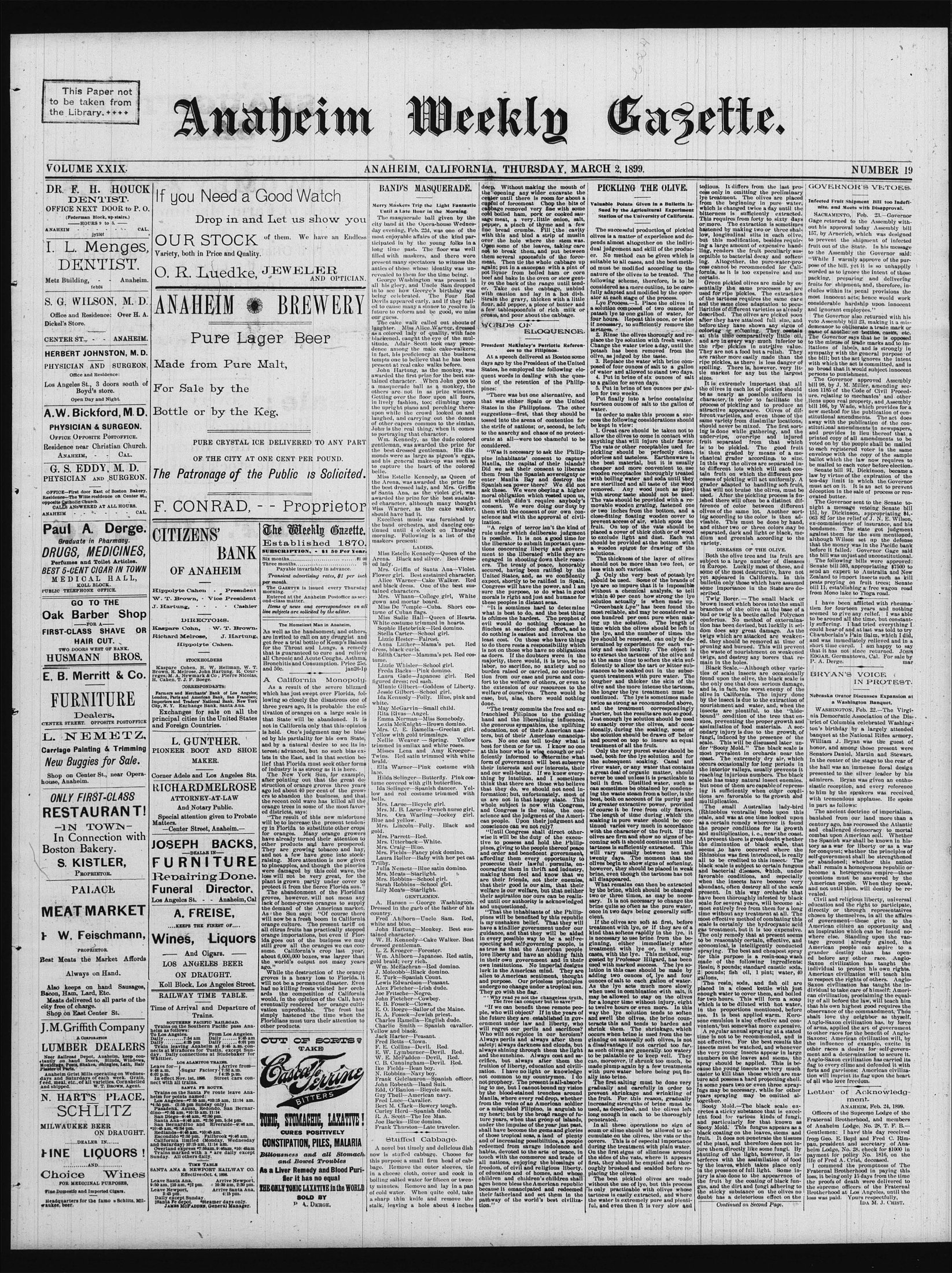
Searchable text
This Paper not to be taken from the Library.
VOLUME XXIX.
DR. F. H. HOUCK
DENTIST.
OFFICE NEXT DOOR to P. O.
(Federman Block, up stairs.)
HOURS 9 to 5.
ANAHEIM CAL.
jy154f
I. L. Menges,
DENTIST.
Metz Building, Anaheim.
feb24
S. G. WILSON, M. D.
Office and Residence: Over H. A. Dickel's Store.
CENTER ST., Anaheim.
HERBERT JOHNSTON, M. D.
PHYSICIAN AND SURGEON.
Office and Residence:
Los Angeles St., 3 doors south of Boyd's store.
Open Day and Night.
A.W. Bickford, M.D.
PHYSICIAN & SURGEON.
OFFICE OPPOSITE POSTOFFICE.
Residence near Christian Church.
ANAHEIM, CAL.
G. S. EDDY, M. D.
If you Need a Good Watch
Drop in and Let us show you
OUR STOCK of them. We have an End
Variety, both in Price and Quality.
O. R. Luedke, JEWELER
AND OPTICI
ANAHEIM BREWERY
Pure Lager Beer
Made from Pure Malt,
For Sale by the
Bottle or by the Keg.
PURE CRYSTAL ICE DELIVERED TO ANY PA
OF THE CITY AT ONE CENT PER POUND.
The Patronage of the Public is Solicite
Office and Residence:
Los Angeles St., 3 doors south of Boyd's store.
Open Day and Night.
A.W. Bickford, M.D.
PHYSICIAN & SURGEON.
OFFICE OPPOSITE POSTOFFICE.
Residence near Christian Church.
ANAHEIM, CAL.
G.S. EDDY, M.D.
PHYSICIAN AND SURGEON.
OFFICE—First door East of Boston Bakery.
Residence—The Witte residence on Center St., opposite Catholic Church.
CALLS ANSWERED AT ALL HOURS.
ANAHEIM, CAL.
Paul A. Derge.
Graduate in Pharmacy.
DRUGS, MEDICINES,
Perfumes and Toilet Articles.
BEST 5-GENT CIGAR IN TOWN
MEDICAL HALL,
KOLL BLOCK.
PUBLIC TELEPHONE OFFICE.
GO TO THE Oak Barber Shop
FOR A FIRST-CLASS SHAVE OR HAIR CUT.
TWO DOORS WEST OF BANK.
HUSMANN BROS.
E.B.Merritt & Co.
FURNITURE
Dealers.
CENTER STREET. OPPOSITE POSTOFFICE
L.NEMETZ,
Carriage Painting & Trimming
New Buggies for Sale.
Shop on Center St., near Opera-house, Anaheim.
ONLY FIRST-CLASS RESTAURANT!
—IN TOWN—
In Connection with Boston Bakery.
S.KISTLER,
PROPRIETOR.
PALACE
For Sale by the
Bottle or by the Keg.
PURE CRYSTAL ICE DELIVERED TO ANY PAYMENT OF THE CITY AT ONE CENT PER POUND.
The Patronage of the Public is Solicited
F.CONRAD, - - Proprietor
CITIZENS' BANK
OF ANAHEIM
Hippolyte Cahen President
W.T. Brown Vice President
J.Hartung Cashier
DIRECTORS:
Kaspare Cohn, W.T. Brown
Richard Melrose, J.Hartung
Hippolyte Cahen.
STOCKHOLDERS:
Kaspare Cohen, H.W. Hellman, W.T. Brown, R.Melrose, John Hartung, R.Courreges, M.A.Newmark&Co., Pierre Nicolas,H.Cahen,T.J.F.Boege.
CORRESPONDENTS:
Farmers and Merchants' Bank of Los Angeles; London, Paris and American Bank; San Francisco; Importers and Traders' National Bank; New York City, N.Y. Exchange Bank; Santa Ana.
Exchanges for sale on all the principal cities in the United States and Foreign Countries.
L.GUNTHER.
PIONEER BOOT AND SHOE MAKER.
Corner Adele and Los Angeles Sts.
RICHARDMELROSE
ATTORNEY-AT-LAW
And Notary Public.
Special attention given to Probate Matters.
Center Street, Anaheim.
JOSEPH BACKS,
DEALER IN FURNITURE
Repairing Done.
Funeral Director.
The Weekly Gazette
Established 1876
SUBSCRIPTION, $1.50 Per Yr.
Six months...Three months...Payable invariably in advance.
Transient advertising rates,$1 per month.
The GAZETTE is issued every Thursday.
Entered at the Anaheim Postoffice and on-class matter.
Items of news and correspondence live subjects are solicited by the editor.
The Homeliest Man in Anaheim,
As well as the handsomest, and other are invited to call on any drugstores get free a trial bottle of Kemp's Bake for the Throat and Lungs, a remnant that is guaranteed to cure and relieve all Chronic and Acute Coughs. Asthma Bronchitis and Consumption. Price and 50c.
A California Monopoly
As a result of the severe blizzard which has just swept over Florida, lowing so closely the disastrous one three years ago, it is probable thativation of oranges on a large scale that State will be abandoned. It not in California only that this opiates is held. One's judgment may be led by his partiality for his own Stature and by a natural desire to see its terrestrial advanced, but no such bias exists in the East, and in that section lief that Florida must seek other forms of industry as is strong as it is here.
The New York Sun, for exam after pointing out that the greatest destruction of orange groves three years ago led about 40 per cent of the growers to abandon the business, and the recent cold wave has killed all orange trees in some of the most faded districts, says:
"The result of this new misfortune will be to increase the present tendency in Florida to substitute other products and have prosper They are growing tobacco and lime and not a few have gone into stealing. More attention is now given to pineapples, and though the pinewere damaged by this cold wave, loss will not be very great, for plant is grown partly under cover protect it from the fierce Florida sun."
The abandonment of the Florida groves, however, will not mean
RESTAURANT!
IN TOWNIn Connection with Boston Bakery.
S. KISTLER,
PROPRIETOR.
PALACE
MEAT MARKET
W. Feischmann,
PROPRIETOR.
Best Meats the Market Affords
Always on Hand.
Also keeps on hand Sausages, Bacon, Ham, Lard, Etc.
Meats delivered to all parts of the city free of charge.
Shop on East Center St.
J.M. Griffith Company
A CORPORATION
LUMBER DEALERS
Neer Railroad Depot, Anaheim, keep constantly on hand Doors, Blinds, Windows, Mouldings, Posts, Shakes, Shingles, Lath, Hair Plaster of Paris.
Anaheim Grist Mills operating on Wednesdays and Saturdays of each week. Grain feed, meal, etc., of all varieties. Cornshellled and shipped.
W. T. Brown, Agent.
N. HART'S PLACE.
SCHLITZ
MILWAUKEE BEER ON DRAUGHT.
DEALER IN...
FINE LIQUORS!
AND...
Choice Wines FOR MEDICINAL PURPOSES,
Fine Domestic and Imported Cigars.
Headquarters for the famo s Schlitz, Milwaukee, beer.
ATTORNEY-AT-LAW
And Notary Public.
Special attention given to Probate Matters.
Center Street, Anaheim.
JOSEPH BACKS,
DEALER IN
FURNITURE
Repairing Done.
Funeral Director.
Los Angeles St. - Anaheim, Cal
A. FREISE,
...KEEPS THE FINEST OF....
Wines, Liquors
And Cigars.
LOS ANGELES BEER ON DRAUGHT.
Koll Block, Los Angeles Street.
RAILWAY TIME TABLE.
Time of Arrival and Departure of Trains.
SOUTHERN PACIFIC RAILROAD.
Trains on the Southern Pacific pass Anaheim as follows:
To Los Angeles.
Daily.....7:54 am Daily.....9:45 am
Daily.....4:25 pm Daily.....6:01 pm
Train leaving Anaheim at 9:45 a.m. connects at Miraflores for Tustin, except Sunday. Dally connections at Studebaker for Whittier.
LOS ALAMITOS TRAINS.
Leave for—
9:48 a.m. Sugar Factory 7:52 a.m.
6:02 p.m. 4:25 p.m.
In effect Nov. 1st, 1898. Street cars connect with all trains.
SANTA FE ROUTE.
Trains on the Santa Fe route leave Anaheim for points named:
Los Angeles—7:55 am.*10:15 am, 11:14 am,
4:55 pm.(3:55 pm Sunday only)
Pasadena, Azusa, Redondo, San Bernardino—7:55 am.*10:15 am, 11:14
San Diego—9:46 am.*2:50 pm.
Santa Ana—9:46 am.*2:50 pm, 5:54 pm.
San Bernardino and Riverside—9:46 am.*10:45 am.*5:54 pm.
Redlands—9:46 am.*10:45 am.
Escondido*2:50 pm. Fallbrook*9:46 am.
California limited (Monday, Wednesday and Saturday) 10:15 am, 11:14 am.
Overland express*7:55 am.*9:48am.*10:45 am.
Trains marked with a * are daily except Sunday. All others daily.
TIME TABLE
SANTA ANA & NEWPORT RAILWAY CO.
Effectives Oct. 4, 1898.
Leave Santa Ana,
9:50 am, 110 am.*12 pm.
10:30 am, 2:30 pm.
Leave Newport,
3:45 pm.
Daily except Sunday.
Santa Fe depot. Steamer days only.
JAMES MCFAADDEN, General Manager.
The result of this new misfortune will be to increase the present tendency in Florida to substitute other oranges for oranges. Many orange growers have already turned their attention to other products and have prospered. They are growing tobacco and lime and not a few have gone into storage. More attention is now given to pineapples, and though the pineapple were damaged by this cold wave, loss will not be very great, for the plant is grown partly under cover to protect it from the fierce Florida sun.
The abandonment of the Florida groves, however, will not mean a lack of home-grown oranges to support the demand of the American market. As the Sun says: "Of course they will now be a fresh boom in California orange culture. The present tariff all citrus fruits has practically stopped orange importations, but even if Florida goes out of the business we will still grow all the oranges we can do some. California's crop last year about 6,000,000 boxes, was larger than the world's output not many years ago."
While the destruction of the oranges is a heavy loss to Florida will not be a permanent disaster. Egg had no killing frosts visited her orards the competition of California would, in the opinion of the Call, eventually rendered her orange cultivation unprofitable. The frost simply hastened the time when Floridians must turn their attention to other products.
OUT OF SORTS
TAKE
CUSTER POSITIVELY
CONSTIPATION, PILES, MALARIES
Billiousness and all Stomach and Bowel Troubles
As a Liver Remedy and Blood Purifier it has no equal
THE ONLY TONIC LAXATIVE in the WORKSOLD BY
P.A.DERGE.
Heim Weekly Gazette
ANAHEIM, CALIFORNIA, THURSDAY, MARCH 2, 1899.
BAND'S MASQUERADE.
Merry Maskers Trip the Light Fantastic
Until a Late Hour in the Morning.
The masquerade ball given by the city band at the Opera-house Wednesday evening, Feb. 22d, was one of the most enjoyable affairs of the kind participated in by the young folks in a long time past. The floor was well filled with maskers, and there were present many spectators to witness the antics of those whose identity was unrevealed to them for the time being.
George Washington was present in all his glory, and Uncle Sam dropped in to see how George's birthday was being celebrated. The Four Red Devils appeared early, and if they failed to cause many a sinner to resolve in future to reform and be good, we miss our guess.
The cake walk called out shouts of laughter. Miss Alice Warner, dressed as a colored lady of quality, with face blackened, caught the eye of the multitude. Adair Scott took easy precedence among the male cake-walkers; in fact, his proficiency at the business tempts one to believe that he has been present at real cake walks before.
John Hartung, as the monkey, was awarded the first prize for the best sustained character. When John goes to a masquerade ball as a monkey, the others are not in as prize winners. Getting over the floor upon all fours, in lively fashion, too; climbing upon the upright piano and perching thereupon while the crowd looked on and laughed, and carrying out the dozens of other capers common to the simian, John is the real thing; when it comes to portraying that character.
Wm. Kennedy, as the dude colored gentleman, was awarded the prize for the best dressed gentleman. His diamonds were as large as pigeon's eggs, and his general make-up was such as to capture the heart of the colored belle.
deep. Without making the mouth of the opening any wider excavate the center until there is room for about a cupful of forcemeat. Chop the bits of cabbage removed very fine with some cold boiled ham, pork or cooked sausage meat, a very little onion, salt, pepper, a pinch of thyme and a few fine bread crumbs. Fill; the cavity with this and bind a strip of muslin over the hole where the stem was. Open some of the leaves, taking care not to break them, and put between them several spoonsfuls of the forcemeat. Then tie the whole cabbage up again; put in a saucepan with a pint of pot liquor from boiled ham or corn beef and bake in the oven or stew gently on the back of the range until tender. Take out the cabbage, unbind with caution and lay in a hot dish. Strain the gravy, thicken with a little flour, add pepper, a piece of butter and a few tablespoonfuls of rich milk or cream, and pour about the cabbage.
WORDS OF ELOQUENCE.
President McKinley's Patriotic References to the Filipinos.
At a speech delivered at Boston some days ago by the President of the United States, he employed the following eloquent words in dealing with the question of the retention of the Philippines:
"There was but one alternative, and that was either Spain or the United States in the Philippines. The other suggestions—first, that they should be tossed into the arena of contention for the strife of nations; or, second, be left to the anarchy and chaos of no protectorate at all—were too shameful to be considered."
"Was it necessary to ask the Philippine inhabitants' consent to capture Manila, the capital of their islands? Did we ask their consent to liberate them from the Spanish sovereignty or
PICKLING THE OLD
Valuable Points Given in a Bullet Sued by the Agricultural Expedition of the University of California
The successful production of olives is a matter of experience; pends almost altogether on the dual judgement and skill of the er. No method can be given suitable to all cases, and the bed must be modified according nature of the olives to be treated following scheme, therefore it considered as a mere outline, to fully adapted and modified by the actor at each stage of the process.
Lye Process.-1. Place the oil on a solution composed of two ounces patash lye to one gallon of water four hours. Repeat this once, if necessary, to sufficiently remorttness.
2. Rinse the olives thoroughly place the lye solution with fresh Change the water twice a day, u potash has been removed from olive, as judged by the taste.
3. Replace the water with brushed of four ounces of salt to aid water and allowed to stand till 4. Put in brine of six ounces to a gallon for seven days.
5. Put in brine of ten ounces for two weeks.
Put finally into a brine containing fourteen ounces of salt to the ginger water.
In order to make this processcess the following consideration be kept in view:
1. Great care should be taken allow the olives to come in contain anything that will injure their The vats or other receptables u pickling should be perfectly odorless and tasteless. Earthen best material, but it is cheaper and more convenient wooden receptacles thoroughly
DELIVERED TO ANY PART
PUBLIC IS SOLICITED.
PROPRIETOR
ESTABLISHED 1870.
SCRIPTION - $150 Per Year.
months. $100 months. 75 payable invariably in advance.
resident advertising rates, $1 per inch.
GAZETTE is issued every Thursday dag.
ed at the Anaheim Postoffice as sectress matter.
of news and correspondence on all
objects are solicited by the editor.
The Homelie Man in Anaheim,
ill as the handsomest, and others,
writed to call on any druggist and
see a trial bottle of Kemp's Balsam
Throat and Lungs, a remedy
guaranteed to cure and relieve
ronic and Acute Coughs. Asthma,
hitis and Consumption. Price 25c.
jan26-1p.
California Monopoly,
a result of the severe blizzard
has just swept over Florida, folso closely the disastrous one of
years ago, it is probable the culon of oranges on a large scale in
State will be abandoned. It is
California only that this opinion.
One's judgment may be biasis partiality for his own State,
a natural desire to see its inadvance, but no such bias exthe East, and in that section betreat Florida must seek other formistry as is strong as it is here.
New York Sun, for example,
pointing out that the great deton of orange groves three years
about 40 per cent of the growbland the business, and that
cent cold wave has killed all the
trees in some of the most favorriests, says:
The result of this new misfortune
to increase the present tendenlora to substitute other crops
anges. Many orange growers
already turned their attention to
products and have prospered,
are growing tobacco and hay,
but a few have gone into stockment. More attention is now given
apples, and though the pineries
damaged by this cold wave, the
will not be very great, for the
grown partly under cover to
it from the fierce Florida sun."
abandonment of the Floridian
however, will not mean any
awarded the first prize for the best sustained character. When John goes to
a masquerade ball as a monkey, the
others are not in as prize winners.
Getting over the floor upon all fours,
in lively fashion, too; climbing upon
the upright piano and perching thereupon while the crowd looked on and
laughed, and carrying out the dozens
of other capers common to the simian,
John is the real thing, when it comes
to portraying that character.
Wm. Kennedy, as the dude colored
gentleman, was awarded the prize for
the best dressed gentleman. His diamonds were as large as pigeon's eggs,
and his general make-up was such as to capture the heart of the colored belle.
Miss Estelle Kennedy, as Queen of the Arena, was awarded the prize for
the best dressed lady, and Mrs. Griffin of Santa Ana, as the violet girl, was awarded the prize for the best sustained character, although many thought Miss Warner, as the cake walker,
should have had it.
Excellent music was furnished by the band orchestra, and dancing continued until 4 o'clock on Thursday morning. Following is a list of the maskers present:
LADIES.
Miss Estelle Kennedy—Queen of the Arena. Black and silver. Best dressed lady.
Mrs. Griffin of Santa Ana—Violet Flower girl. Best sustained character.
Alice Warner—Cake Walker. Red and black dress. One of the best sustained characters.
Mrs. Whann—College girl, White gown and mortar board.
Miss De Temple—Cuba. Short costume of Cuban flags.
Miss Sadie Hall—Queen of Hearts. White costume trimmed in hearts.
Sophie Hetebrink—Red domino.
Stella Carter—School girl.
Lizzie Hester—Fairiest.
Anna Luther—Mama's pet. Red dress, black curls.
Edith Carter—Mamma's pet. Red costume.
Lizzie Whisper—School girl.
Freda Backs—Pink domino.
Laura Gade—Japanese girl. Red figured dress; red sash.
Minnie Gilbert—Goddess of Liberty.
Jessie Gilbert—School girl.
Ida Kennedy—Folly. Blue, pink and white.
May McGarvin—Small child.
Rita Rivas—Angel.
Emma Norman—Miss Somebody.
Lexia McKnight—Brown domino.
Mrs. C. E. Ramella—Greecian girl.
Yellow with gold trimmings.
Nellie Weaver—Spring. Yellow trimmed in smilax and white roses.
Misses Lena and Amy Koeger—Twins. Red satin trimmed with white braid.
Ella Warner—Pink costume with lace.
Hilda Selinger—Butterfly. Pink costume covered with gilt butterflies.
Ida Selinger—Spanish dancer. Yellow and red costume trimmed with bells.
Mrs. Larue—Bicycle girl.
Mrs. M. B. Larue—French nurse girl.
Mrs. Ora Warling—Jockey girl. Blue and yellow.
Mrs. Lincoln—Folly. Black and gold.
Mrs. Parrett—Red.
Mrs. Utterback—White.
Mrs. Craig—Blue.
Mrs. Fields—Fancy pink domino.
Laura Roller—Baby with her pet cat Trilby.
Julia Nemetz—Blue satin domino.
Mrs. Meats—Starlight.
Mrs. Robbins School girl.
Sarah Robbins School girl.
Lily Meats—Starlight.
GENTLEMEN.
"There was but one alternative, and that was either Spain or the United States in the Philippines. The other suggestions—first, that they should be tossed into the arena of contention for the strife of nations; or, second, be left to the anarchy and chaos of no protec-oration at all—these too shameful to be considered."
"Was it necessary to ask the Philippine inhabitants' consent to capture Manila, the capital of their islands? Did we ask their consent to liberate them from the Spanish sovereignty or enter Manila Bay and destroy the Spanish sea power there? We did not ask these. We were obeying a higher moral obligation which rested upon us, and which didn't require anybody's consent. We were doing our duty by them with the consent of our own conscience and with the approval of civilization."
"A reign of terror isn't the kind of rule under which deliberate judgment is possible. It is not a good time for the liberator to submit important questions concerning liberty and government to the liberated while they are engaged in shooting down their rescuers.
The treaty of peace, honorarily secured, having been ratified by the United States, and, as we confidently expect, shortly to be ratified in Spain, Congress will have the power, and I am sure the purpose, to do what in good morals is right and just humane for these peoples in distant seas.
"It is sometimes hard to determine what is best to do, and the best thing is oftimes the hardest. The prophet of evil would do nothing because he finches at sacrifice and effort, and to do nothing is easiest and involves the least cost. On those who have things to do there rests a responsibility which is not on those who have no obligations as doers. If the doubters were in the majority, there would, it is true, be no labor, no sacrifice, no anxiety and no burden raised or carried, no contribution from our ease and purse and comfort to the welfare of others, or even to the extension of our resources to the welfare of ourselves. There would be ease, but alas, there would nothing done."
"The treaty commits the free and en-franchised Filipinos to the guiding hand and the liberalizing influences, the generous sympathies, the uplifting education, not of their American masters, but of their American emancipators. No one can tell to-day what is best for them or for us. I know no one at this hour who is wise enough or sufficiently informed to determine what form of government will best subserve their interests and our interests, their and our well-being. If we knew everything by intuition, and I sometimes think that there are those who believe that they do, we should not need information; but unfortunately, most of us are not in that happy state. This whole subject is now with Congress, and Congress is the voice, the conscience and the judgment of the American people. Upon their judgment and conscience can we not rely?
"Until Congress shall direct otherwise it will be the duty of the executive to possess and hold the Philippines, giving to the people thereof peace and order and beneficent government, affording them every opportunity to prosecute their lawful pursuits, encouraging them in thrift and industry, making them feel and know that we are their friends, not their enemies, that their good is our aim, that their welfare is our welfare, but that neither their aspiration nor ours can be realiz-"
"timed varies very much in accordance with the character of the fruits olives are firm and show no sign coming soft it should continue until tertains sufficiently extracted will vary usually between two twenty days. The moment olives begin to show signs of soothe they should be placed on brine, even though the tertains all disappeared."
What remains can then be exe-
by the brine, which should be ofi two or three times, as may be
The destruction of the orange is a heavy loss to Florida, it be a permanent disaster. Even killing frosts visited her orchard the competition of California in the opinion of the Call, have hastened the time when theANS must turn their attention to products.
Stuffed Cabbage
A novel but timely and delicious dish now is stuffed cabbage. Choose for this purpose a small firm head of cabbage. Remove the outer sleeves, tie in a cheese cloth, cover and cook in boiling salted water for fifteen or twenty minutes. Remove and lay in a pan of cold water. When quite cold, take a sharp thin knife and remove the stalk, leaving a hole about 4 inches.
Mrs. Larue—Bicycle girl.
Mrs. M. B. Larue—French nurse girl.
Mrs. Ora Warling—Jockey girl.
Blue and yellow.
Mrs. Lincoln—Folly. Black and gold.
Mrs. Parrett—Red.
Mrs. Utterback—White.
Mrs. Craig—Blue.
Mrs. Fields—Fancy pink domino.
Laura Roller—Baby with her pet cat Trilby.
Julia Nemetz—Blue satin domino.
Mrs. Meats—Starlight.
Mrs. Robbins—School girl.
Sarah Robbins—School girl.
Lily Meats—Starlight.
GENTLEMEN.
A. Hansen — George Washington. Dressed in the garb of the father of his country.
Fred Ahlborn—Uncle Sam. Red, white and blue.
John Hartung—Monkey. Best sustained character.
W. H. Kennedy—Cake Walker. Best dressed gentleman.
L. Z. Kroeger—Forester.
Wm. Ahlborn—Japanese. Red satin, gold braid; very rich.
Wm. McEachran—Red domino.
J. Molebb—Black domino.
E. Turk—Spanish Count.
Lewis Edwardson—Peasant.
Alex Fletcher—Irish dude.
Joe Fritsche—Negro.
John Fletcher—Cowboy.
E. B. Fossek—Clown.
E. O. Boege—Sailor of the Maine.
R. A. Fossek—Jewish priest.
Charles Ramella—English dude.
Charlie Smith — Spanish cavalier.
Yellow and black.
Jack Harter—Peasant.
Fred Betts—Clown.
F. E. Collins—Devil. Red.
E. W. Lymburner—Devil. Red.
W. E. McFadden—Devil. Red.
C. B. Cunningham—Devil. Red.
Ike Fields—Bean boy.
N. Robbins—Navy boy.
Frank Gelclamon—Spanish officer.
John Robenth—Band Suit.
Edd. O'Banion—Bicycle suit.
Guy Theil—American navy.
Fred Luce—Cavalier.
Bert M. Clark—Bowyery tough.
Curley Herd—Spanish dude.
R. A. Scott—the Ice Man.
Joe Backs—Blue domino.
Frank Thurston-Late traveler.
Until Congress shall direct otherwise it will be the duty of the executive to possess and hold the Philippines, giving to the people thereof peace and order and beneficial government, affording them every opportunity to prosecute their lawful pursuits, encouraging them in thrift and industry, making them feel and know that we are their friends, not their enemies, that their good is our aim, that their welfare is our welfare, but that neither their aspiration nor ours can be realized until our authority is acknowledged and unquestioned.
That the inhabitants of the Philippines will be benefited by this republic is my unshaken belief. That they will have a kindlier government under our guidance, and that they will be aided in every possible way to be a self-respecting and self-governing people, is as true as that the American people love liberty and have an abiding faith in their own government and in their own institutions. No imperial designs lurk in the American mind. They are alien to American sentiment, thought and purpose. Our priceless principles undergo no change under a tropical sun. They go with the flag.
Why read ye not the changeless truth,
The free can conquer but to save?
If we can benefit these remote people, who will object? If in the years of the future they are established in government under law and liberty, who will regret our perils and sacrifices? Who will not rejoice in our heroism? Always perils and always after them safety; always darkness and clouds, but always shining through them the light and the sunshine. Always cost and sacrifice, but always after them the fruition of liberty, education and civilization. I have no light or knowledge not common to my countrymen. I do not prophecy. The present is all-absorbing to me, but I cannot bound my vision by the blood-stained trenches around Manila, where every red drop, whether from the veins of an American soldier or a misguided Filipino, is anguish to my heart; but by the broad range of future years, when that group of islands, under the impulse of the year just past, shall have become the gems and glories of those tropical seas, a land of plenty and of increasing possibilities, a people redeemed from savage indolence and habits, devoted to the arts of peace, in touch with the commerce and trade of all nations, enjoying the blessings of freedom, of civil and religious liberty, of education and of homes, and whose children and children's children shall ages hence bless the American republic because it emancipated and redeemed their fatherland and set them in the pathway of the world's best civilization.”
PICKLING THE OLIVE.
Ubliable Points Given in a Bulletin Issued by the Agricultural Experiment Station of the University of California.
The successful production of pickled olives is a matter of experience and depends almost altogether on the individual judgement and skill of the producer. No method can be given which is suitable to all cases, and the best method must be modified according to the nature of the olives to be treated. The following scheme, therefore, is to be considered as a mere outline, to be carefully adapted and modified by the operator at each stage of the process.
Lye Process.—1. Place the olives in solution composed of two ounces of tash lye to one gallon of water, for four hours. Repeat this once, or twice necessary, to sufficiently remove the netness.
2. Rinse the olives thoroughly and reduce the lye solution with fresh water. Change the water twice a day, until the lash has been removed from the lye, as judged by the taste.
3. Replace the water with brine composed of four ounces of salt to a gallon water and allowed to stand two days.
4. Put in brine of six ounces of salt a gallon for seven days.
5. Put in brine of ten ounces per gallon for two weeks.
Put finally into a brine containing upteen ounces of salt to the gallon of water.
In order to make this process a success following considerations should be kept in view:
1. Great care should be taken not to sow the olives to come in contact with anything that will injure their flavor. The vats or other receptacles used for skelling should be perfectly clean, torless and tasteless. Earthenware is the best material, but it is usually cheaper and more convenient to use wooden receptacles thoroughly treated tedious. It differs from the last process only in omitting the preliminary lye treatment. The olives are placed from the beginning in pure water, which is changed twice a day until the bitterness is sufficiently extracted. This requires from forty to sixty days or more. The extraction is sometimes hastened by making two or three shallow, longitudinal slits in each olive, but this modification, besides requiring a large amount of expensive handling, renders the fruit peculiarly susceptible to bacterial decay and softening. Altogether, the pure-water-process cannot be recommended for California, as it is too expensive and uncertain.
Green pickled olives are made by essentially the same processes as are used for ripe pickles. The extraction of the tartness requires the same care and the same close adaptation to peculiarities of different varieties as already described. The olives are picked soon after they have attained full size, and before they have shown any signs of coloring or softening. They contain at this time comparatively little oil, and are in every way much inferior to the ripe pickles in nutritive value. They are not a food but a relish. They are rather more easily made than the ripe pickles, as there is less danger of spoiling. There is, however, very little market for any but the largest sizes.
It is extremely important that all the olives in each lot of pickles should be as nearly as possible uniform in character; in order to facilitate the process of picking and to produce an attractive appearance. Olives of different varieties, and even those of the same variety from dissimilar locations, should never be mixed. The first sorting is done while gathering, and the under-ripe, over-ripe and injured fruit separated from that which is to be pickled. The good fruit is then graded by means of a mechanical grader according to size. In this way the olives are separated into different lots which will each contain fruit on which the different pro
GOVERNOR'S VETOES.
Infected Fruit Shipment Bill too Indefinite, and Meets with Disapproval.
SACRAMENTO, Feb. 23.—Governor Gage returned to the Assembly without his approval today Assembly bill 157, by Arnerich, which was designed to prevent the shipment of infected fruit out of the State. In his message to the Assembly the Governor said: "While I warmly approve of the purpose of the bill, yet it is so unhappily worded as to ignore the intent of those packing, preparing and delivering fruits for shipment; and, therefore, includes within its penal provisions the most innocent acts; hence would work considerable hardship upon innocent and ignorant employees."
The Governor also returned with his veto Assembly bill 23, making it a misdemeanor to obliterate a trade mark or name of another on bottles, casks, etc. The Governor says that he is opposed to the misuse of trade marks and to imitations of labels, and is strongly in sympathy with the general purpose of the bill; but the act ignores the intent with which the act is committed, and is so broad that it would subject innocent persons to punishment.
The Governor approved Assembly bill 98, by J. M. Miller, amending section 1185 of the Code of Civil Procedure, relating to mechanics' and other liens upon real property, and Assembly bill 166, by Wade, which provides for a new method for the publication of constitutional amendments. The act does away with the publication of the constitutional amendments in newspapers, and provides in lieu thereof that a printed copy of all amendments to be voted on by the people shall be mailed to each registered voter in the same envelope with the copy of the sample ballot which the law now requires to be mailed to each voter before election.
Senate bill 91, Dickinson, became a law by virtue of this newspaper.
Put in brine of six ounces of salt a gallon for seven days.
Put in brine of ten ounces per gallon for two weeks.
Put finally into a brine containing fourteen ounces of salt to the gallon of water.
In order to make this process a success the following considerations should be kept in view:
1. Great care should be taken not to allow the olives to come in contact with anything that will injure their flavor.
2. The vats or other receptacles used for pickling should be perfectly clean, porless and tasteless. Earthenware is the best material, but it is usually cheaper and more convenient to use wooden receptacles thoroughly treated with boiling water and soda until they are sterilized and all taste of the wood removed. Any wood (such as pine) with strong taste should not be used. The vats should be provided with a removable wooden grating, fastened one inch from the bottom, and a nose-fitting floating wooden cover to prevent access of air, which spots the汁. On top of the vats should be placed a cover of thick cloth or of wood exclude light and dust. Each vat should be provided at the bottom with wooden spigot for drawing off the solutions.
The thickness of the layer of olives should not be more than two feet, or as with soft varieties.
Only the very best of potash lye should be used. Some of the brands of ore so impure that it is impossible without a chemical analysis, to tell within 40 per cent how strong the lye solution actually is when made up. Greenbank Lye" has been found the most reliable, and may be considered as the hundred per cent pure when making up the solution. The length of time which the olives should be left in the lye, and the number of times the lye should be renewed, can only be determined by experiment for each variety and each locality. The object is to extract the tartness of the olive and the same time to soften the skin sufficiently to allow the tart or bitter substances to be soaked out in the subsequent treatment with pure water. The tougher and thicker the skin of the olive and the more intense the tartness, the longer the lye treatment must be continued. The lye is sometimes made twice as strong as recommended above, and the treatment correspondingly shorter, but the results are not so good. Most enough lye solution should be used exactly cover the olives, and occasionally, during the soaking, some of the solution should be drawn off below and poured on top to insure an equal treatment of all the fruit.
Only the very purest water should be used, both for the lye solution and for subsequent soaking. Canal and river water, or any water that contains great deal of organic matter, should never be used unless it is practicable to kill it first. Distilled water, such as sometimes obtained by condensing the waste steam from a boiler, is the last, both on account of its purity and greater extractive power, provided course it be free from oily flavors.
The length of time during which the lyeaking in pure water should be conducted varies very much in accordance with the character of the fruit. If the lives are firm and show no signs of beginning soft it should continue until the lyeing is sufficiently extracted. This will vary usually between ten and twenty days. The moment that the lives begin to show signs of softening, however, they should be placed in weak wine, even though the tartness has not disappeared.
What remains can then be extracted from the brine, which should be changed to three times, as may be necessitated by this process a success after considering should be kept in view:
1. Great care should be taken not to allow the olives to come in contact with anything that will injure their flavor.
2. The vats or other receptacles used for pickling should be perfectly clean, porless and tasteless. Earthenware is the best material, but it is usually cheaper and more convenient to use wooden receptacles thoroughly treated with boiling water and soda until they are sterilized and all taste of the wood removed. Any wood (such as pine) with strong taste should not be used. The vats should be provided with a removable wooden grating, fastened one inch from the bottom, and a nose-fitting floating wooden cover to prevent access of air, which spots the汁. On top of the vats should be placed a cover of thick cloth or of wood exclude light and dust. Each vat should be provided at the bottom with wooden spigot for drawing off the solutions.
The thickness of the layer of olives should not be more than two feet, or as with soft varieties.
Only the very best of potash lye should be used. Some of the brands of ore so impure that it is impossible without a chemical analysis, to tell within 40 per cent how strong the lye solution actually is when made up. Greenbank Lye" has been found the most reliable, and may be considered as the hundred per cent pure when making up the solution. The length of time which the olives should be left in the lye, and the number of times the lye should be renewed, can only be determined by experiment for each variety and each locality. The object is to extract the tartness of the olive and the same time to soften the skin sufficiently to allow the tart or bitter substances to be soaked out in the subsequent treatment with pure water. The tougher and thicker the skin of the olive and the more intense the tartness, the longer the lye treatment must be continued. The lye is sometimes made twice as strong as recommended above, and the treatment correspondingly shorter, but the results are not so good. Most enough lye solution should be used exactly cover the olives, and occasionally, during the soaking, some of the solution should be drawn off below and poured on top to insure an equal treatment of all the fruit.
Only the very purest water should be used, both for the lye solution and for subsequent soaking. Canal and river water, or any water that contains great deal of organic matter, should never be used unless it is practicable to kill it first. Distilled water, such as sometimes obtained by condensing the waste steam from a boiler, is the last, both on account of its purity and greater extractive power, provided course it be free from oily flavors.
The length of time during which the lyeaking in pure water should be conducted varies very much in accordance with the character of the fruit. If the lives are firm and show no signs of beginning soft it should continue until the lyeing is sufficiently extracted. This will vary usually between ten and twenty days. The moment that the lives begin to show signs of softening, however, they should be placed in weak wine, even though the tartness has not disappeared.
What remains can then be extracted from the brine, which should be changed to three times, as may be necesitated by this process a success after considering should be kept in view:
1. Great care should be taken not to allow the olives to come in contact with anything that will injure their flavor.
2. The vats or other receptacles used for pickling should be perfectly clean, porless and tasteless. Earthenware is the best material, but it is usually cheaper and more convenient to use wooden receptacles thoroughly treated with boiling water and soda until they are sterilized and all taste of the wood removed. Any wood (such as pine) with strong taste should not be used. The vats should be provided with a removable wooden grating, fastened one inch from the bottom, and a nose-fitting floating wooden cover to prevent access of air, which spots the汁. On top of the vats should be placed a cover of thick cloth or of wood exclude light and dust. Each vat should be provided at the bottom with wooden spigot for drawing off offthe solutions.
The thickness of the layer of olives should not be more than two feet, or as with soft varieties.
Only the very best of potash lye should be used. Some of the brands of ore so impure that it is impossible without a chemical analysis, to tell within 40 per cent how strong the lye solution actually is when made up. Greenbank Lye" has been found the most reliable, and may be considered as he hundred per cent pure when making up the solution. The length of time which the olives should be left in the lye, and the number of times the lye should be renewed, can only be determined by experiment for each variety and each locality. The object is to extract the tartness of the olive and the same time to soften the skin sufficiently to allow the tart or bitter substances to be soaked out in the subsequent treatment with pure water. The tougher and thicker the skin ofthe olive andthe more intensethe tartness,the longertheleye treatmentmustbecontinued.Thelyeis sometimesmade twiceasstrongasrecommendedabove,andthetreatmentcorrespondinglyborter,buttheresultsonhequalsnotsogood.Hastoughleysolutionshouldbeusedexactlycovertheolives,andoccasionallyduringthesoaking,someofthesolutionshouldbemadeoffbelowandpouredontoptoinsureanewtreatmentofallthefruit.
Onlytheverypurestwatershouldbedused,bothforthelyseolutionandfordesubsequentsoaking.Canalandriverwateroranywaterthatcontainsgreatdealoforganicmattershouldneverbeusedunlessitpracticabledollitfirst.Distilledwater,suchasometimesobtainedbycondensingsweaste steamfromaboiler,thelastbothonaccountofits purityandgreaterextractivepower.providedcourseitbefreefromoilyflavors.
The length of time during which the lyeaking in pure water should be conducted varies very much in accordance withthecharacterofthefruit.Ifthelivesarefirmandshownosignsofbenningsoftitshouldcontinueuntilthel甩tsillvariesusuallybetweentenandtwentydays.Themomentthatthel甩sbegintoshowsignsofsofteningweathersouldbeplacedinweaknine,eventhoughthetartnesshasnotdisappeared.
Whatremainscanthenbeextractedbrinewhichshouldbechangedorthreetimes,asmaybecessentialtothisprocessasuccessafterconsiderationshouldbefoundinanylandmorethanacademyago,hasscrowdedtheAtlanticandchallengeddemocracytomortalcombatupontAmericansoil.WhethertheSpanishwarshallbeknowninhistoryaswarforlibertyoraswarforconquest;whethertheprinciplesofself-governmentshallbestrengthenedorabandoned;whetherthis nation shallremainahomogenousepublicorbecomeaheterogenuosehenceatthequestionmustbewereansweredbytheAmericanpeople。Whentheyspeak,andnotuntilthen.willdestinyberevealed.
Civilandreligiouslibertyuniversal
The small Australian lady-bird (Rhizobius ventralis) feeds upon this scale, and was at one time looked upon as a certain remedy wherever it found the proper conditions for its growth and multiplication, i.e., near the coast. At present there is great doubt whether the diminution of black scale, that seems to have occurred where the Rhizobius was first introduced, is really all to be credited to this insect. The black scale is subject to certain fungous and bacterial diseases, which, under favorable conditions, and especially when the insects have become very abundant, often destroy all of the scale present. In this way orchards that have been thoroughly infested by black scale for several years, will become almost entirely free from them for a long time without any treatment at all. The most effective method of combating this scale is certainly the hydrocyanic acid gas treatment, but it is too expensive. The only remedy that at present seems to be reasonably certain, effective, and economical, is intelligently conducted spraying. The best and cheapest spray for this purpose is a resin-soap wash made of the following ingredients: Resin; 8 pounds; standard caustic soda; 2 pounds; fish oil; 1 pint; water; 40 gallons.
The resin, soda, and fish oil are placed in a closed kettle with just enough water to cover them, and boiled for two hours. This will form a soap which is to be diluted with hot water, in the proportions mentioned, before use. It is best applied warm. Kerosene emulsion is also effective and convenient, but somewhat more expensive.
A regular annual spraying at a stated time is not to be recommended, and is not effective. For the best results the insects must be watched, and whenever the very young insects appear in large numbers on the leaves and stems, the spray should be applied. This is because the young insects are very much easier to kill than those which are mature and possess a hard protecting shell. In some years two or even three sprayings may be necessary, while for other years spraying may be omitted altogether.
Sooty Mold.—The black scale excretes a sticky substance that is excellent food for various kinds of fungi, and particularly for that known as Sooty Mold. This fungus appears as a black coating on the leaves, stems and fruit. It does not penetrate the tissues of the plant, and therefore does not injure them directly like some fungi. By shutting off the light, however, it interferes with the assimilation of food by the leaves, which takes place only in the presence of full light. Some injury is also done to the appearance of the fruit by the coating of black fungus, and the dirt and fungi adhering to the sticky substance on the olives no doubt has a deleterious effect on the
Continued on Second Page.
Letter of Acknowledgment.
ANAHEIM, Feb. 24, 1899.
Officers of the Supreme Lodge of the Fraternal Brotherhood, and members of Anaheim Lodge, No. 28, T. F. B.—Gentlemen: I have this day received from Geo. E. Boyd and Fred C. Rimpau, president and secretary of Anaheim Lodge, No. 28, check for $1000 in payment for policy No. 1816, on the life of Fred A. Crist, deceased.
I commend the promptness of The Fraternal Brotherhood in paying this loss, it being only 15 days from the time the proofs of death were delivered to the supreme officers of the Fraternal Brotherhood at Los Angeles, until the loss was paid. Yours respectfully,
IDA M. J. CRIST.