anaheim-gazette 1899-01-26
Scanned page
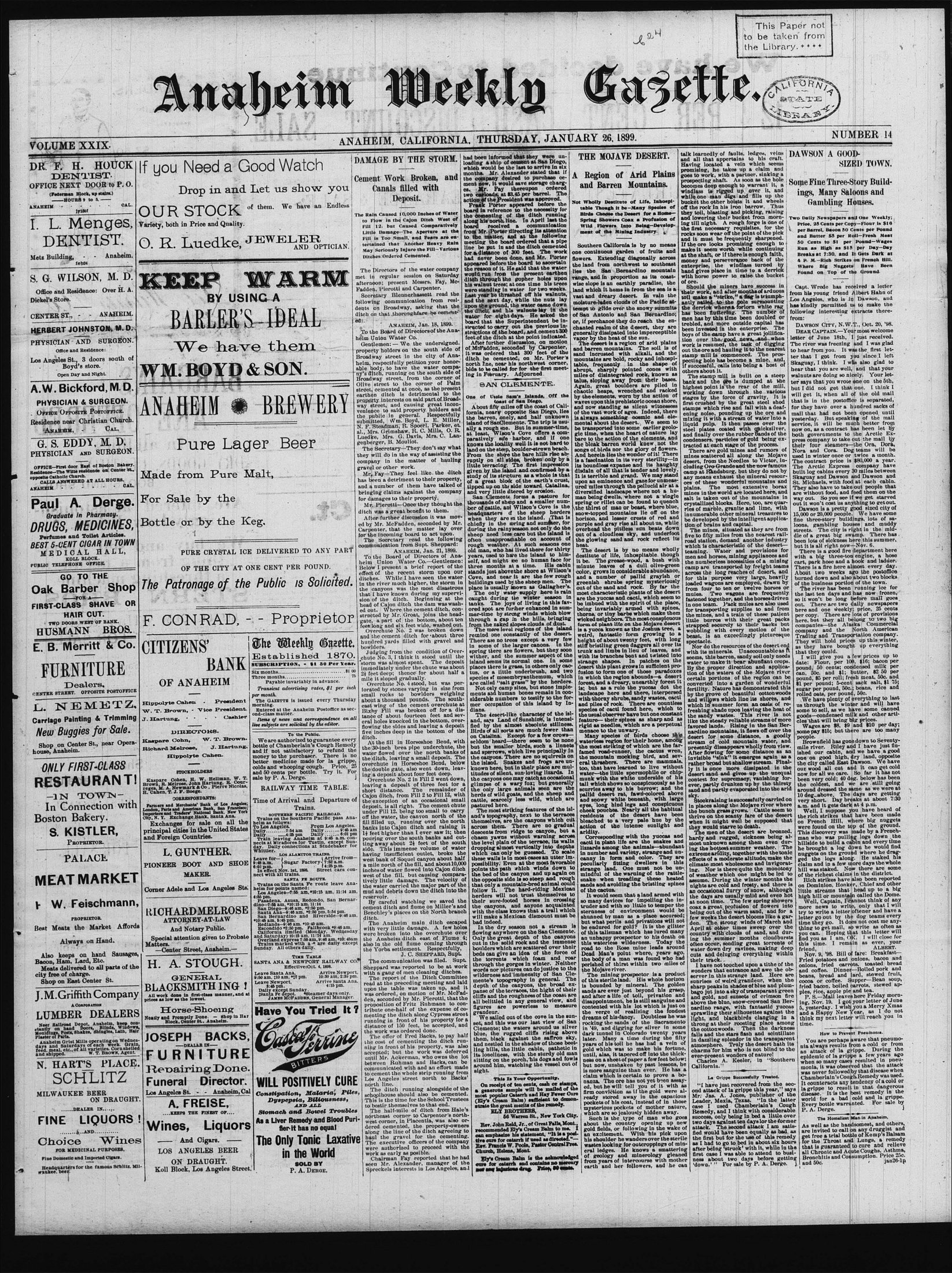
Searchable text
Anaheim
VOLUME XXIX.
DR. F. H. HOUCK
DENTIST.
OFFICE NEXT DOOR to P. O.
(Federman Block, up stairs.)
HOURS 9 to 5.
ANAHEIM CAL.
I. L. Menges,
DENTIST.
Metz Building, Anaheim.
feb24
S. G. WILSON, M. D.
Office and Residence: Over H. A. Dickel's Store.
CENTER ST., Anaheim.
HERBERT JOHNSTON, M. D.
PHYSICIAN AND SURGEON.
Office and Residence:
Los Angeles St., 3 doors south of Boyd's store.
Open Day and Night.
A.W. Bickford, M. D.
PHYSICIAN & SURGEON.
Office Opposite Postoffice.
Residence near Christian Church.
ANAHEIM, Cal.
G. S. EDDY, M. D.
PHYSICIAN AND SURGEON.
OFFICE—First door East of Boston Bakery.
Residence—The White residence on Center St.
If you Need a Good Watch
Drop in and Let us show you
OUR STOCK of them. We have an Endless Variety, both in Price and Quality.
O. R. Luedke, JEWELER
AND OPTICIAN.
KEEP WARM
BY USING A
BARLER'S IDEAL
We have them
WM. BOYD & SON.
ANAHEIM BREWERY
Pure Lager Beer
Made from Pure Malt
A.W. Bickford, M.D.
PHYSICIAN & SURGEON.
OFFICE OPPOSITE POSTOFFICE.
Residence near Christian Church.
ANAHEIM, CAL.
G. S. EDDY, M. D.
PHYSICIAN AND SURGEON.
OFFICE—First door East of Boston Bakery.
Residence—The Wilte residence on Center St.
opposite Catholic Church.
CALLS ANSWERED AT ALL HOURS.
ANAHEIM, CAL.
Paul A. Derge.
Graduate in Pharmacy.
DRUGS, MEDICINES,
Perfumes and Toilet Articles.
BEST 5-CENT CIGAR IN TOWN
MEDICAL HALL,
KOLL BLOCK.
PUBLIC TELEPHONE OFFICE.
GO TO THE
Oak Barber Shop
FOR A
FIRST-CLASS SHAVE OR
HAIR CUT.
TWO DOORS WEST OF BANK.
HUSMANN BROS.
E. B. Merritt & Co.
FURNITURE
Dealers.
CENTER STREET. OPPOSITE POSTOFFICE
L. NEMETZ,
Carriage Painting & Trimming
New Buggies for Sale.
Shop on Center St., near Operahouse, Anaheim.
ONLY FIRST-CLASS
RESTAURANT!
-IN TOWNIn Connection with
Boston Bakery.
S. KISTLER,
PROPRIETOR.
PALACE
MEAT MARKET
CITIZENS'
BANK
OF ANAHEIM
Hippolyte Cahen - President
W. T. Brown, Vice President.
J. Hartung, Cashier
DIRECTORS:
Kaspare Cohn, W. T. Brown.
Richard Melrose, J. Hartung.
Hippolyte Cahen.
STOCKHOLDERS:
Kaspare Cohen, H. W. Hellman, W. T.
Brown, R. Melrose, John Hartung, R. Courreges, M. A. Newmark & Co., Pierre Nicolas,
H. Cahen, T. J. F. Boege.
CORRESPONDANTS:
Farmers and Merchants' Bank of Los Angeles;
London, Paris and American Bank, San Francisco;
Importers and Traders' National Bank, New York City,
N.Y. Exchange Bank, Santa Ana.
Exchanges for sale on all the principal cities in the United States and Foreign Countries.
L. GUNTHER.
PIONEER BOOT AND SHOE
MAKER.
Corner Adele and Los Angeles Sts.
The Weekly Gazette.
Established 1870.
SUBSCRIPTION, - $1 50 Per Year.
Six months... $1 00
Three months... 75
Payable invariably in advance.
Transient advertising rates, $1 per inch per month.
The GAZETTE is issued every Thursday morning.
Entered at the Anaheim Postoffice as second-class matter.
Items of news and correspondence on all live subjects are solicited by the editor.
To the Public.
We are authorized to guarantee every bottle of Chamberlain's Cough Remedy and if not satisfactory to refund the money to the purchaser. There is no better medicine made for la grippе colds and whooping cough. Price, 25 and 50 cents per bottle. Try it. For sale by P. A. Derge.
RAILWAY TIME TABLE.
Time of Arrival and Departure of Trains.
SOUTHERN PACIFIC RAILROAD.
Trains on the Southern Pacific pass Anaheim as follows:
To Los Angeles...
Daily... 7:45 am Dally... 9:45 am
Daily... 4:25 pm Dally... 6:01 pm
Train leaving Anaheim at 9:45 a.m. connects with Mirandares for Tustin, except Sunday. Daily connections at Studebaker for Whittier.
LOS ALAMITOS TRAINS.
Leave for...
Arrive from...
Sugar Factory... 7:52 a.m.
4:25 p.m.
In effect Nov. 1st, 1898. Street cars connect with all trains.
SANTA FE ROUTE.
Trains on the Santa Fe route leave Anaheim for points named:
Los Angeles... 7:55 am, *10:15 am, 11:14 am
4:55 pm.
In Connection with Boston Bakery.
S. KISTLER,
PROPRIETOR.
PALACE
MEAT MARKET
H. W. Feischmann,
PROPRIETOR.
Best Meats the Market Affords
Always on Hand.
Also keeps on hand Sausages,
Bacon, Ham, Lard, Etc.
Meats delivered to all parts of the city free of charge.
Shop on East Center St.
J.M. Griffith Company
A CORPORATION
LUMBER DEALERS
Neer Railroad Depot, Anaheim, keep constantly on hand Doors, Blinds, Windows, Mouldings, Posts, Shakes, Shingles, Lath, Hair Plaster of Paris.
Anaheim Grist Mills operating on Wednesdays and Saturdays of each week. Grain feed, meal, etc., of all varieties. Cornshellled and shipped.
W. T. BROWN, Agent.
N. HART'S PLACE.
SCHLITZ
MILWAUKEE BEER ON DRAUGHT.
DEALER IN...
FINE LIQUORS!
AND...
Choice Wines FOR MEDICINAL PURPOSES,
Fine Domestic and Imported Cigars.
Headquarters for the famous Schlitz, Milwaukee, beer.
L. GUNTHER.
PIONEER BOOT AND SHOE MAKER.
Corner Adele and Los Angeles Sts.
RICHARDMELROSE
ATTORNEY-AT-LAW
And Notary Public.
Special attention given to Probate Matters.
—Center Street, Anaheim—
H. A. STOUGH.
GENERAL BLACKSMITHING!
All work done in first-class manner, and at prices as low as the lowest.
Horse-Shoeing
Neatly and Promptly Done. — Shop in Har Block, Center St., Anaheim.
JOSEPH BACKS,
DEALAR IN
FURNITURE
Repairing Done.
Funeral Director.
Los Angeles St. - Anaheim, Cal
A. FREISE,
KEeps THE FINEST OF...
Wines, Liquors
And Cigars.
LOS ANGELES BEER
ON DRAUGHT.
Koll Block, Los Angeles Street.
Time of Arrival and Departure of Trains.
SOUTHERN PACIFIC RAILROAD.
Trains on the Southern Pacific pass Anaheim as follows:
To Los Angeles.
Daily...7:54 am 9:45 am
Daily...4:25 pm Daily...6:01 pm
Train leaving Anaheim at 9:45 a.m. connects at Mirafores for Tustin, except Sunday. Daily connections at Studebaker for Whittier.
LOS ALAMITOS TRAINS.
Leave for—9:48 a.m. Sugar Factory Arrive from—6:02 p.m.
In effect Nov. 1st, 1898. Street cars connect with all trains.
SANTA FE ROUTE.
Trains on the Santa Fe route leave Anaheim for points named:
Los Angeles—7:55 am.*10:15 am, 11:14 am 4:55 pm.
Pasadena, Azusa, Redondo, San Bernardino—7:55 am.*10:15 am, 11:14 am
San Diego—9:46 am.*2:50 pm.
Santa Ana—9:46 am.*2:50 pm, 5:54 pm.
San Bernardino and Riverside—9:46 am.*10:45 am, 5:45 pm.
Redlands—9:46 am.*10:45 am.
Escondido*2:50 pm. Fallbrook*9:46 am.
California limited (Monday, Wednesday and Saturday) 10:15 am, 11:14 am; Overland express 9:46 am, 9:46 am.*10:45 am
Trains marked with a * are daily except Sunday. All others daily.
TIME TABLE
SANTA ANA & NEWPORT RAILWAY CO.
Effectives Oct. 4, 1898.
Leave Santa Ana. Arrive Newport 9:50 am; 11:00 am; 2:30 pm Leave Newport. Arrive Santa Ana 3:45 p.m. Dally except Sunday. Santa Fe depot.*Steamer days only.JAMES MCFADDEN, General Manager.
Have You Tried It?
Castle Gerrine
BITTERS
WILL POSITIVELY CURE Constipation, Malaria, Piles Dyspepsia, Billousness,
AND ALL Stomach and Bowel Troubles As a Liver Remedy and Blood Purifier it has no equal The Only Tonic Laxative in the World
SOLD BY P.A.DERGE.
Weim Weekly Gazette
ANAHEIM, CALIFORNIA, THURSDAY, JANUARY 26, 1899.
Watch us show you We have an Endless ELER AND OPTICIAN.
ARM DEAL them ON. BREWERY Beer
DAMAGE BY THE STORM.
Cement Work Broken, and Canals filled with Deposit.
The Rain Caused 10,000 Inches of Water to Flow in the Cajon Ditch West of Fill 12, but Caused Comparatively Little Damage—The Aperture at the Fill is Too Small, and Fears are entertained that Another Heavy Rain May Seriously Injure the Fill—Various Ditches Ordered Cemented.
The Directors of the water company met in regular session on Saturday afternoon; present Messrs. Fay, McFadden, Pierotti and Carpenter.
Secretary Blennnerhassett read the following communication from residents on Broadway, asking that the ditch on that thoroughfare be cemented:
ANAHEIM, Jan. 18, 1899.
To the Board of Directors of the Anaheim Union Water Co.
Gentlemen: — We the undersigned. property holders on the south side of Broadway street in the city of Anaheim, respectfully petition your honorable body, to have the water company's ditch, running on the south side of Broadway street, from the corner of Olive street to the corner of Palm street, cemented at once, as the present earthen ditch is detrimental to the property interests on said part of Broadway street, and causing great inconvenience to said property holders and the public in general. Respectfully submitted, Wm. Boyd, L. E. Miller, N. F. Steadman, R. Spoerl, Parker, et al., Mrs. Grimshaw, R. C. Mills, O. R. Luedke, Mrs. G. Davis, Mrs. C. Langenberger, B. Mouliot.
The Secretary—They don't say what they will do in the way of assisting the company in the matter of hauling gravel or other work.
Mr. Fay—They feel like the ditch had been informed that they were unloading a ship of cement at San Diego, which would be the last to arrive in six months. Mr. Alexander stated that if the company desired to purchase cement now, it would save storage charges. Mr. Fay thereupon ordered two carloads, at $3.45 per barrel. The action of the President was approved.
Frank Porter appeared before the board in reference to the necessity for the cementing of the ditch running along his north line. In April last the board received a communication from Mr. Porter directing its attention to the matter, and at the following meeting the board ordered that a pipe line be put in and the ditch cemented for a distance of 300 feet. The work had never been done, and Mr. Porter appeared before the board to ascertain the reason of it. He said that the water would run from the present earthen ditch through the gopher holes upon his walnut trees; at one time his trees were standing in water for two weeks. Last year he thrashed off his walnuts, and the next day, while the nuts lay upon the ground, the water came down the ditch, and his walnuts lay in the water for eight days. He asked the board that the Superintendent be instructed to carry out the previous instructions of the board, and cement 300 feet of the ditch at the point indicated.
After further discussion, on motion of McFadden, seconded by Carpenter, it was ordered that 300 feet of the ditch be cemented, on Mr. Porter's north line, near his northwest corner, bids to be called for for the first meeting in February. Adjourned.
SAN CLEMENTE.
One of Utole Sam's Islands, Off the Coast of San Diego.
About fifty miles off the coast of California, nearly opposite San Diego, lies the barren, onely, and half unknown island of SanClemente. The trip is usually a rough one. But in summer-time, at least, Wilson's Cove offers a comparatively safe harbor, and if one knows the locality well it is not hard to land on the step, boulder-strewn beach. From the shore the bare hills rise abruptly on all sides, broken only by a little terracing. The first impression given by the island and confirmed by a THE MOJAVE DESERT.
A Region of Arid Plains and Barren Mountains.
Not Wholly Destitute of Life. Inhospitable table Though it be—Many Species of Birds Choose the Desert for a Home-Spring Showers Coax a Profusion of Wild Flowers Into Being—Development of the Mining Industry.
Southern California is by no means one continuous garden of fruits and flowers. Extending diagonally across the land from northwest to southeast lies the San Bernardino mountain range, and in proportion as its coastwise slope is an earthly paradise, this land which it hems in from the sea is vast and dreary desert. In vain the moisture-laden clouds of the Pacific attempt to glide over the snowy summit of San Antonio and San Bernardino or, if perchance they do reach the enchanted realm of the desert, they are generally dissipated into imperceptible vapor by the heat of the sun.
The desert is a region of arid plains and barren mountains. The soil is sand incrusted with alkali, and these mountains are bold, rocky and inhospitable frequently in the shape of abrupt, sharply pointed cones with miles of disintegrated rock, known as talus, sloping away from their bases Again, great boulders are piled chaotic heaps, wrenched and racked by the elements, worn by the action of waves upon this prehistoric ocean shore and now standing as silent witnesses of the vast work of ages. Indeed, there is always something cosmic and elemental about the desert. We seem to be transported into some earlier geologic time, when the heart of nature lingered to the action of the elements, and the bleak barren world knew not that songs of birds nor the glory of flowers And herein lies the wonder of it! There is a fascination in its very sterility—its boundless expanse and its haughty disdain of all that is tender and lovelier.
REWERY
Beer
HERED TO ANY PART
T PER POUND.
ic is Solicited.
Proprietor
BEEKLY GAZETE.
Published 1870.
APPTION, - $1 50 Per Year.
advertising rates, $1 per inch
TTE is issued every Thursday
at the Anaheim Postoffice as sectatter.
neues ana correspondence on all
are solicited by the editor.
To The Public.
authorized to guarantee every
chamberlain's Cough Remedy
satisfactory to refund the
purchaser. There is no
medicine made for la gripe,
whooping cough. Price, 25
ats per bottle. Try it. For
A. Derge.
WAY TIME TABLE.
Arrival and Departure of Trains.
SHERN PACIFIC RAILROAD.
the Southern Pacific pass Anacles.
From Los Angeles.
:4:54 am Dally:9:45 am
:4:56 pm Dally:6:01 pm
viving Anahelm at 9:45 a.m. conraires for Tustin, except Sunconnections at Studebaker for
LOS ALAMITOS TRAINS.
Arrive from:
Sugar Farm at 7:82 a.m.
Nov. 1st, 1898.
Street cars contitrains.
SANTA FE ROUTE.
the Santa Fe route leave Anantes named:
les-7:56 am.*10:15 am, 11:14 am.
NY'S ditch, running on the south
Broadway street, from the corner of
Olive street to the corner of Palm
street, cemented at once, as the present
earthen ditch is detrimental to the
property interests on said part of Broadway street, and causing great inconvenience to said property holders and
the public in general. Respectfully
submitted, Wm. Boyd, L. E. Miller,
N. F. Steadman, R. Spoer, Parker, et.
al., Mrs. Grimshaw, R. C. Mills, O. R.
Luedke, Mrs. G. Davis, Mrs. C. Langenberger, B. Mouliot.
The Secretary—They don't say what they will do in the way of assisting the company in the matter of hauling gravel or other work.
Mr. Fay—They feel like the ditch has been a detriment to their property, and a number of them have talked of bringing claims against the company for damages to their property.
Mr. Pierotti—Once they thought the ditch was a great benefit to them.
After further discussion it was moved by Mr. McFadden, seconded by Mr. Carpenter, that the matter lay over for the incoming board to act upon.
The Secretary read the following communication from Supt. Sheppard:
ANAHEIM, Jan. 21, 1899.
To the Board of Directors of Anaheim Union Water Co.—Gentlemen: Below I present a brief report of the effect of the recent storm upon our ditches. While I have seen the water in the river much higher, the storm in the canyons was the most disastrous that I have known during my supervision of the ditch. Beginning at the head of Cajon ditch the dam was washed out. Where the cement ditch, constructed by Mr. Groat, joins the headgate, a part of the bottom, about ten feet long and six feet wide, washed out.
Overchute No. 2 was broken down and the cement ditch for about three hundred yards filled with gravel and bowlders.
Judging from the condition of Overchute No. 3, I think it stood until the storm was almost spent. The deposit immediately under the chute was about 2½ feet deep; thence for about half a mile it sloped gradually.
Overchute No. 4 stood, but was perforated by stones varying in size from small rocks to bowlders weighing about a thousand pounds. The southeast wing of the cement overchute at Bixby Fill was broken off for a distance of about fourteen feet and several holes knocked in the bottom, overflowing the sides and leaving a deposit five inches deep in the bottom of the ditch.
At the fill in Horseshoe Bend, with the 30-inch brea pipe underchute, the water flowed over the north banks of the ditch, leaving a small deposit. The overchute in Horseshoe Bend, below the double gate, also went down, leaving a deposit about four feet deep.
Overchute No. 2 in Fill 2 went down, leaving a deposit of three feet for a short distance. The remainder of Cajon ditch, from Fill 2 to Fill 12, with the exception of an occasional small deposit, is all right. The cement chute under Fill 12, being too small to carry off the water, the canyon north of the fill filled up, running over the north banks into Cajon ditch and raising it 1 feet higher than I ever saw it; then pouring over the south banks and cutting away about 2½ feet of the south side. This immense volume of water having insufficient outlet, broke the west bank of Soquel canyon about half a mile north of the fill, and about 10,000 inches of water flowed into Cajon ditch west of the fill, but causing comparatively little damage. The velocity of the water carried the major part of the mud and debris down the ditch into the reservoir.
San Clemente forms a pasture for thousands of sheep and a smaller number of cattle, and Wilson's Cove is the headquarters of the sheep herders when they are in the island. That is chiefly in the spring and summer, for during the rainy season not only do the sheep need less care but the island is often unapproachable on account of rough weather. At such seasons one old man, who has lived there for thirty years, used to have the island to himself, and might see no human face for three months at a time. His cabin stands just abovethe shore at Wilson's Cove, and near it are the few rough buildings used by the sheep men. The place is usually known as Gallagher's.
The only water supply here is rain caught during the winter season in tanks. The joys of living in this favored spot are further enhanced in summer-time by strong winds which blow through a gap in the hills, bringing from the naked slope clouds of dust.
The more level regions of the island remind one constantly of the desert. There are no trees except a very few in some of the larger canons. In the spring there are flowers, but they soon wither, and the summer aspect of the island seems its normal one. In some places there is grass, in others only cactus, or a little underbrush, and two species of mesembryanthemum, which are called "salt grass" by the herders.
Not only camp sites, but stone implements and human bones remain in considerable numbers to testify to the former occupation of this island by Indians.
The desert-like character of the island, says Land of Sunshine, is intensified by the almost absolute stillness. Birds of all sorts are much fewer than on Catalina. Except for a few crowds—seldom heard—there seem to be none but the smaller birds, such as linnetts and sparrows, which live principally in canyons. There are no squirrels on the island. Snakes and frogs are unknown here, but in their place are multitudes of silent, sun-loving lizards. In the canyons one may catch an occasional glimpse of a wary fox; but generally the only large animals seen are the herds of wild goats, and the sheep and cattle, scarceely less wild, which are pastured here.
The most striking features of the island's topography, next to the terraces themselves, are the canyons which cut across them. There are no gradual descents from ridge to canyon, but a cham yawns without warning across the level plain of the terrace, its walls dropping almost vertically into depths which can only be guessed. To scale these walls is in most cases an utter impossibility. Even at the most favorable points this path winds down to the bed of the canyon and up again on opposite side is so steep and rough that only a mountain-bred animal could follow it. The hard-riding Mexican herders will not trust themselves to crossing miles of disintegrated rock known as talus, sloping away from their bases.
Again, great boulders are piled in chaotic heaps, wrenched and racked by the elements, worn by the action of waves upon prehistoric ocean shores and now standing as silent witnesses of the vast work of ages. Indeed, there is always something cosmic and elegant about the desert. We seem to be transported into some earlier geologic time, when the heart of nature bore to the action of the elements, and the bleak barren world knew not that songs of birds nor the glory of flowers. And herein lies the wonder of it! There is a fascination in its very sterility—its boundless expanse and its haughtiness disdain of all that is tender and lovely It is terrible and grand. We may stand upon an eminence and gaze for unnies ured miles through the pellucid air at diversified landscape where not a human being dwells, where not a single spring or rillet can be found to quench the thirst of man or beast, where blue snow-topped mountains lie off on top horizon, and lesser crests of red purple and gray rise all about us; while overhead the pitiless sun beats down out of a cloudless sky, and undergoes the glowing sand and rock reflect heat.
The desert is by no means whose destitute of life, inhospirable, though it be. The grease-wood, a bush white minute leaves of a dull olive-green, grows in considerable abundance and a number of pallid grayish greenish shrubs spring mysterious out of the sand and rock. By far there most characteristic plants of this desert are the yuccas and cacti which seem be imbued with spirit of the plant being invariably armed with spin thorns or tiny barbs which make their wicked neighbors. Most conspicuous form of plant life on the Mojave deserts is yucca as the Joshua tree weird; fantastic form growing to height of about twenty feet, with low stiff bristling green daggers all over trunk and limbs in lieu of leaves; with its branches bent and twisted in strange shapes. In patches on this desert plant grows in sufficient fusion to form one of those paradox in which region abounds—a desert forest, and a dreary, unearthly forest; but as a rule the yuccas dot landscape here and there; interpenetring with thorny shrubs, sandy wastes; cape and plains of rock. There are countless species of cacti found here; which include usual observer have but one constant feature—their spines as sharp and rigid as needles; which are a perpetual menace to the unwary.
Many species of birds choose waterless region for their home; among them are fledglings among animals—abundant in number and variety; strange and canyin in form and color. They peculiarly fitting dwellers in strange land. One must not be mindful of the warning of the raindawn when treading these heathy sands and avoiding the bristling spit of the cactus.
It would seem that a land armed with many miles of disintegrated rock known as talus, sloping away from their bases again great boulders are piled in chaotic heaps wrenched and racked by the elements, worn by the action of waves upon prehistoric ocean shores and now standing as silent witnesses of the vast work of ages. Indeed there is always something cosmic and elegant about this desert area—they are prehistoric ocean shores—and now standing as silent witnesses of prehistoric ocean shores—and now standing as silent witnesses of prehistoric ocean shores—and now standing as silent witnesses of prehistoric ocean shores—and now standing as silent witnesses of prehistoric ocean shores—and now standing as silent witnesses of prehistoric ocean shores—and now standing as silent witnesses of prehistoric ocean shores—and now standing as silent witnesses of prehistoric ocean shores—and now standing as silent witnesses
the exception of an occasional small deposit, is all right. The cement chute under Fill 12, being too small to carry off the water, the canyon north of the fill filled up, running over the north banks into Cajon ditch and raising it 1/4 feet higher than I ever saw it; then pouring over the south banks and cutting away about 2¼ feet of the south side. This immense volume of water having insufficient outlet, broke the west bank of Soquel canyon about half a mile north of the fill, and about 10,000 inches of water flowed into Cajon ditch west of the fill, but causing comparatively little damage. The velocity of the water carried the major part of the mud and debris down the ditch into the reservoir.
By careful watching we saved the cement ditch and flume on Miller's and Benchley's places on the North branch ditch.
The Anaheim main ditch escaped with very little damage. A few holes were broken into the overchute over the Anaheim ditch east of Flume 4; also in the old flume coming through the Yorba settlement. Respectfully, J. C. SHEPPARD, Supt.
The communication was filed. Supt. Sheppard was reported to be at work with a gang of men cleaning ditches.
The report of the Ditch Committee read at the preceding meeting and laid upon the table was taken up, and it was ordered, on motion of Mr. McFadden, seconded by Mr. Plerotti, that the proposition of Fritz Ruhmann to contribute one-half of the expense of cementing the ditch along Cypress street running in front of his property for a distance of 150 feet, be accepted, and the work was ordered done.
The offer of Fred Backs, to pay half the cost of cementing the ditch running in front of his property, was also accepted; but the work was deferred until Mr. Ackerman, who owns the lot between Ruhman and Backs, can be communicated with and an effort made to cement the whole strip running from Los Angeles street north to Backs' north line.
The ditch running alongside of the schoolhouse should also be cemented. This is the time for the School Trustees to bestir themselves to that end.
The half-mile of ditch from Hale's northeast corner to Carpenter's north-west corner, in Placentia, was also ordered cemented, the property-owners along the line of the ditch agreeing to haul the gravel for the cementing. The executive officers of the company were authorized to proceed with the work as early as possible.
Chairman Fay reported that he had seen Mr. Alexander, manager of the Spreckels interests in Los Angeles; and
cattle, scarcely less wild, which are pastured here.
The most striking features of the island's topography, next to the terraces themselves, are the canyons which cut across them. There are no gradual descents from ridge to canyon, but a chasm yawns without warning across the level plain of the terrace, its walls dropping almost vertically into depths which can only be guessed. To scale these walls is in most cases an utter impossibility. Even at the most favorable points the path which winds down to the bed of the canyon and up again on the opposite side is so steep and rough that only a mountain-bred animal could follow it. The hard-riding Mexican herders will not trust themselves to their sure-footed horses in crossing the canyons, and anyone acquainted with the class knows that a trail which will make a Mexican dismount must be bad indeed.
In the dry season not a stream is flowing anywhere on the San Clemente. Only the great depth of the canyons cut in the solid rock and the immense boulders which are scattered over their beds can give an idea of the force of the torrents which foam and roar through the gorges in winter. Neither words nor pictures can do justice to the wilderness and immensity of San Clemente's topography in general. The depth of the canyons, the broad expanse of the terraces, the hight of their cliffs and the roughness of the coast are all belittled in any general view, and figures are powerless to measure grandeur.
We sailed out of the cove in the sunset, and this was our last view of San Clemente; the waters around us silver blue, the rugged cliffs rising above them, black against the saffron sky, and nestled in the shadow of those beetling hills, the little cabin, pathetic in its loneliness, with the sturdy old man sitting on the porch, his dogs and fowls around him, watching the vessel out of sight.
This Is Your Opportunity.
On receipt of ten cents, cash or stamps, a generous sample will be mailed of the popular Catarrh and Hay Fever Cure (Ely's Cream Balm) sufficient to demonstrate the great merits of the remedy.
ELY BROTHERS,
56 Warren St., New York City.
Rev. John Reid, Jr., of Great Falls, Mont., recommended Ely's Cream Balm to me. I can emphasize his statement, "It is a positive cure for catarrh if used as directed."—Rev. Francis W. Poole, Pastor Central Prairie Church, Helena, Mont.
Ely's Cream Balm is the acknowledged cure for catarrh and contains no mercury nor any injurious drug. Price: $0 cents.
Corresponding with the yuccas cacti in plant life are the snakes lizzards among the animals—abundant in number and variety, strange and canny in form and color. They peculiarly fitting dwellers in strange land. One must not be mindful of the warning of the raak snake when treading these heath sands and avoiding the bristling spines of the cactus.
It would seem that a land armed so many devices for impelling their truder and with so little to temper sternness of environment would shunned by man as a place accustomed to what perils and privations will be endured for gold? It is the glare of this talisman which has lured me unhappy prospectors to his death this waterless wilderness. Today road to the Rose mine leads are Dead Man's point where years ago he body of a man was found whose perished of thirst within two miles on Mojave river.
The mining prospector is a producer of this sterile land. His whole hour is bounded by mineral. The gold sands are ever just beyond his glove and after a life of toll, privation disappointment, he is still sanguine contented with his lot which is just verge of realizing the four dreams of his fancy. Doubtless he rocking the sands of the Sacramento in '49, and digging for silver in dark tunnel in Colorado twenty years of his toll he has had a very gold which was to make his fortune until alas, it tapered off into the treeless on a sheet of paper a few feet below but now, unshaken by past lessons is more sanguine than ever. He claim which is certain to prove ananza. The ore has not yet been added, but he will tell you of it while firm conviction as if the gold were ready stored away in the capa pockets of his coat, instead of in mysterious pockets of mother naissance which are so jealously hidden away.
Such is the type of man who about country opening up gold fields, or following in his an excitement. With his pick his shoulder he wander over the sand wastes looking for outcroppings of eral ledges. He knows a smattering of geology and mineralogy from years of intercourse with moss earth and her followers, and he
MOJAVE DESERT.
Region of Arid Plains Barren Mountains.
Destitute of Life, Inhospi-Though it be—Many Species of Choose the Desert for a Home—Showers Coax a Profusion of Flowers Into Being—Develop-of the Mining Industry.
San Bernardino mountain and in proportion as its coast-e is an earthly paradise, the which hems in from the sea is a dreary desert. In vain the shaded clouds of the Pacific at-glide over the snowy summits Antonio and San Bernardino; chance they do reach the en- realm of the desert, they are dissipated into imperceptible heat of the sun.
Desert is a region of arid plains on mountains. The soil is of crusted with alkali, and the soils are bold, rocky and inhospi- frequently in the shape of sharply pointed cones with disintegrated rock, known as spring away from their bases. Great boulders are piled in sheeps, wrenched and racked elements, worn by the action of this prehistoric ocean shore, standing as silent witnesses to work of ages. Indeed, there is something cosmic and ele- about the desert. We seem to reported into some earlier geolo- when the heart of nature lay the action of the elements, and barren world knew not the birds nor the glory of flowers. Well lies the wonder of it! Thereination in its very sterility—in endless expanse and its haughty all that is tender and lovely.
There are gold mines and rumors of mines scattered all along the Mojave desert, from the Needles to Victor, including Oro Grande and the now famous camp at Randsburg, but they do not by talk learnedly of faults, ledges, veins and all that appertains to his craft. Having located a vein which seems promising, he takes up a claim and goes to work, with a partner, sinking a prospecting shaft. As soon as the hole becomes deep enough to warrant it, a windlass is rigged up over it, and while one man digs and fills up the bucket the other holds it and wheels off the rock in his iron barrow. Thus they toll, blasting and picking, raising and lowering their bucket from morning till night. A rough forge is one of the first necessary requisites, for the rocks soon wear off the point of the pick and it must be frequently sharpened. If the ore looks promising enough to make it seem worth while continuing at the shaft, or if there is enough faith, money and perseverance back of the enterprise, the windlass turned by hand gives place in time to a derrick with horse power to raise the bucket of ore.
Should the miners have success in their work, and after months of arduous toll make a "strike," a flag is triumphantly nailed to the pole surmounting the derrick where a forlorn white rag has been fluttering. The number of men has by this time been doubled or trebled, and more outside capital has been invested in the enterprise. The boys of the camp have a great jollification over the good news, and when work is resumed, the task of digging out the ore and hauling it to the nearest stamp mill is commenced. The prospecting hole has become a mine, and, if successful, calls into being a host of others about it.
The stamp mill is built on a steep bank and the ore is dumped at the highest point in the rear of the mill, working down through the various stages by the force of gravity. It is first crushed by the great steel shod stamps which rise and fall with a deafening noise, pounding up the ore and mixing it with a stream of water into a liquid pulp. It then passes over the steel plates coated with quicksilver, and finally over the rubber bands of the condensers, particles of gold being extracted at each stage of the process.
There are gold mines and rumors of mines scattered all along the Mojave desert, from the Needles to Victor, including Oro Grande and the now famous camp at Randsburg, but they do not by DAWSON A GOOD-SIZED TOWN.
Some Fine Three-Story Buildings, Many Saloons and Gambling Houses.
Two Daily Newspapers and One Weekly; Price: 25 Cents per Copy—Flour is $10 per Barrel, Bacon 50 Cents per Pound and Butter $5 per Roll—Fresh Meat 50 Cents to $1 per Pound—Wages Run as High as $15 per Day—Day Breaks at 7:30, and It Gets Dark at 4 P.M.-Rich Strikes on French Hill. Where Big Nuggets Have Been Found on Top of the Ground.
Capt. Wrede has received a letter from his young friend Albert Hahn of Los Angeles, who is in Dawson, and has kindly permitted us to make the following interesting extracts there-from:
DAWSON CITY, N.W.T., Oct. 20, '98.
DEAR CAPTAIN.—Your most welcome letter of June 18th, I just received. The river was freezing and I was glad to hear from you. It was the first letter that I got from you since I left Skaguay, I think. I was also glad to hear that you are well, and that your walnuts are doing so nicely. Your letter says that you wrote one on the 5th, but I did not get that one. I think I will get it, when all of the old mail that is in the postoffice is separated, for they have over a hundred sacks of mail that had not been opened until yesterday. But speaking of the mail service, it will be much better from now on, as a contract has been let by both governments to take out the mail by their four steamers—the Ora, Dora, Nora and Cora. Dog teams will be used in winter once or twice a month. The contract price is $80,000 a year. The Arctic Express company have built log cabins every 30 miles between
The stamp mill is built on a steep bank and the ore is dumped at the highest point in the rear of the mill, working down through the various stages by the force of gravity. It is first crushed by the great steel shod stamps which rise and fall with a deafening noise, pounding up the ore and mixing it with a stream of water into a liquid pulp. It then passes over the steel plates coated with quicksilver, and finally over the rubber bands of the condensers, particles of gold being extracted at each stage of the process.
There are gold mines and rumors of mines scattered all along the Mojave desert, from the Needles to Victor, including Oro Grande and the now famous camp at Randsburg, but they do not by any means exhaust the mineral resources of these wonderful mountains and plains. The most extensive borax mines in the world are located here, and salt is taken out of the mountains in crystallized blocks. Here, too, are quarries of marble, granite and lime, with innumerable other mineral treasures to be developed by the intelligent application of brains and capital.
The mines, situated as they are from five to fifty miles from the nearest railroad station, demand another industry which is characteristic of the desert—teaming. Water and provisions for men and horses, mining appliances and the numberless necessities of a mining camp are transported by freight teams across the long reaches of desert, and for this purpose very large, heavily loaded wagons are employed, drawn by four to ten or twelve horses or mules. Two wagons are frequently fastened together, and the horses driven in one team. Pack mules are also used for transporting supplies to and from the mines, and a train of these patient little burros with their great packs strapped securely to their backs but wobbling with every motion of the beast, is an exceedingly picturesque spectacle.
Nor do the resources of the desert end with its minerals. Unaccountable as it seems, this barren, sandy soil only needs water to make it bear abundant crops. By the proper direction and application of the waters of the Mojave river certain portions of the region can be converted into a garden of wonderful fertility. Nature has demonstrated this by the grove of beautiful cottonwoods and willows which line its shores, and which in summer form an oasis of refreshing shade upon leaving the heat of the sandy wastes. This river is not like the steady reliable streams of more favored lands. Rising in the San Bernardino mountains, it flows off the desert for some distance, a goodly stream of cold mountain water, and presently disappears wholly from view. After flowing for some distance as an invisible "sink" it emerges again as a rather broad but shallow stream. Finally it is once more dissipated in the desert sand and gives up the unequal contest for supremacy, vanishing forever, partly drunken up by the thirsty sand and partly evaporated into the arid sky.
Stockraising is successfully carried on in places along the Mojave river where the bunch grass grows. Cattle seem to thrive on the scanty fare of the desert when it might well be supposed that they would starve to death.
The men of the desert are bronzed, hardy and rugged, sickness being almost unknown among them even during the hottest summer weather. The extreme aridity, together with the tonic effects of a moderate altitude, make the climate most wholesome and invigorating. Nor is there quite the monotony of weather which one might be led to assume. During the winter months the nights are cold and frosty, and there is an occasional flurry of snow, although the days are usually mild and even hot walnuts are doing so nicely. Your letter says that you wrote one on the 5th, but I did not get that one. I think I will get it, when all of the old mail that is in the postoffice is separated, for they have over a hundred sacks of mail that had not been opened until yesterday. But speaking of the mail service, it will be much better from now on, as a contract has been let by both governments to the Arctic Express company to take out the mail by their four steamers—the Ora, Dora, Nora and Cora. Dog teams will be used in winter once or twice a month. The contract price is $80,000 a year. The Arctic Express company have built log cabins every 30 miles between Skaguay and Dawson and Dawson and St. Michaels, with food at each cabin. They also have to take out people that are without food, and feed them on the way out. So you see if we get starved out it won't cost us anything to get out.
Dawson is a pretty good sized city of 15,000 or 20,000 people. We have some fine three-story buildings, lots of saloons, gambling houses and muddy streets. The city is right in the middle of a great big swamp. There has been lots of sickness here this summer, but it is all right now—Nov. 6.
There is a good fire department here with a big three-ton engine, a hose cart, park hose and a hook and ladder. There is a fire here almost every day. About two weeks ago the postoffice burned down and also about two blocks of the business portion of the town.
The river has been running ice for the last ten days and has now frozen, so it won't be long before mail goes out. There are two daily newspapers here and one weekly: price, 25 cents per copy. There are lots of provisions here, but they all belong to two big companies—the Alaska Commercial company and the North American Trading and Transportation company. They will hold prices up this winter, as they have bought up everything that they could.
I will give you a few prices up to date: Flour, per 100; $16; bacon per pound, 50 cents; condensed milk per can, 50c. and $1; butter, $2 50 per pound, $5 per roll; fresh meat, 50c. and $1 per pound; 5-cent sack salt, $1 75; sugar per pound, 50c.; beans, rice and rolled oats, per pound, 50c.
We have plenty of everything to last us through the winter and will have some to sell, as we have some canned goods—condensed milk and other articles that will bring big prices.
Wages are $8; $9 and $10 per day; some pay $15; but there are too many people.
Brownfield has gone down to Seventy-mile river. Riley and I have just finished our cabin, and we have a good one on good high, dry land, opposite the city called East Dawson. We have our wood all cut and it can get cold now for all we care. So far it has not been very cold; 40 deg. below has been the coldest, and we are still going around dressed the same as we were at 10 deg. above. The days are getting very short. Day breaks at about 7:30 a.m. and it gets dark at 4 p.m.
Well, I suppose you have heard of the rich strikes that have been made on French Hill, where big nuggets were found on the top of the ground. This discovery was made by a Frenchman who was pulling logs down the hillside to build a cabin and every time he brought a log down he would find nuggets on the ground where he dragged the logs along. He staked his claim and in a few more days whole hill was staked. Now there are some of the richest claims in the district.
Rich strikes have also been reported on Dominion Honker, Chief and other little streams that head up to a big high hill or mounts in called the Dome.
Responding with the yuccas and plant life are the snakes and animals among the animals—abundant in form and color. They are early fitting dwellers in this rare land. One must not be unful of the warning of the rattle when treading these heated and avoiding the bristling spines of cactus.
Would seem that a land armed with any devices for impelling the interior and with so little to temper the stress of environment would be used by man as a place accursed; what perils and privations will not lured for gold? It is the glitter talisman which has lured many happy prospectors to his death on waterless wilderness. Today the Rose mine leads around Man's point where, years ago, body of a man was found who had died of thirst within two miles of Jojave river.
The mining prospector is a product of sterile land. His whole horizon surrounded by mineral. The golden ore ever just beyond his grasp, after a life of toil, privation and appointment, he is still sanguine and contented with his lot which is just on edge of realizing the fondest mas of his fancy. Doubtless he was going the sands of the Sacramento valley, and digging for silver in some tunnel in Colorado twenty years.
Many a time during the fifty-third of his toil he has had a vein of which was to make his fortune, alas, it tapered off into the thickness of a sheet of paper a few feet below; now, unshaken by past lessons, he are sanguine than ever. He has a bone which is certain to prove a boon. The ore has not yet been assayed but he will tell you of it with as conviction as if the gold were already stored away in the capacious sets of his coat, instead of in those serious pockets of mother nature, which are so jealously hidden away.
Which is the type of man who goes out the country opening up new fields, or following in the wake of excitement. With his pick upon shoulder he wanders over the sterile hills looking for outcroppings of mined deposits. He knows a smattering geology and minerology gleaned by years of intercourse with mother earth and her followers, and he can stockraising is successfully carried on in places along the Mojave river where the bunch grass grows. Cattle seem to thrive on the scanty fare of the desert when it might well be supposed that they would starve to death.
The men of the desert are bronzed, hardy and rugged, sickness being almost unknown among them even during the hottest summer weather. The extreme aridity, together with the tonic effects of a moderate altitude, make the climate most wholesome and invigorating. Nor is there quite the monotony of weather which one might be led to assume. During the winter months the nights are cold and frosty, and there is an occasional flurry of snow, although the days are usually mild and even hot at noon time. The few spring showers coax a great profusion of flowers into being out of the warm sand, and for a few weeks the desert blooms like a garden. The strong winds of March and April at other times sweep over the country with clouds of sand, and during the summer months cloudbursts often occur, sending great torrents of water down dry ravines, making deep cuts and deluging everything within their track.
I have not touched upon a title of the wonders that entrance and awe the observer in this strange land. Here are sunrises of weird grandeur, when the sharp peaks in shades of blue and plumago jut into a sky of transparent green and gold, and sunsets of crimson fire above the blue, snow-crowned San Bernardino range, with fantastic yuccas sprawling their silhouettes against the light, and blackbirds clanging in a throng at their roosting place among the cottonwoods. Then the darkness falls and the stars flash and scintillate in dazzling splendor in the transparent atmosphere. Truly the desert hath its charms for him who is not blind to the ever-present wonders of nature!
Charles A. Keeler, in "Southern California."
La Grippe Successfully Treated.
"I have just recovered from the second attack of la grippe this year," says Mr. Jas. A. Jones, publisher of the Leader, Mexia, Texas. "In the latter case I used Chamberlain's Cough Remedy, and I think with considerable success, only being in bed a little over two days against ten days for the former attack. The second attack I am satisfied would have been equally as bad as the first but for the use of this remedy as I had to go to bed in about six hours after being 'struck' with it, while in the first case I was able to attend to business about two days before getting 'down.'" For sale by P. A. Derge.
The Homeliest Man in Anaheim,
As well as the handsomest, and others, are invited to call on any druggist and get free a trial bottle of Kemp's Balsam for the Throat and Lungs, a remedy that is guaranteed to cure and relieve all Chronic and Acute Coughs. Asthma, Bronchitis and Consumption. Price 25c. and 50c.