anaheim-gazette 1897-10-14
Scanned page
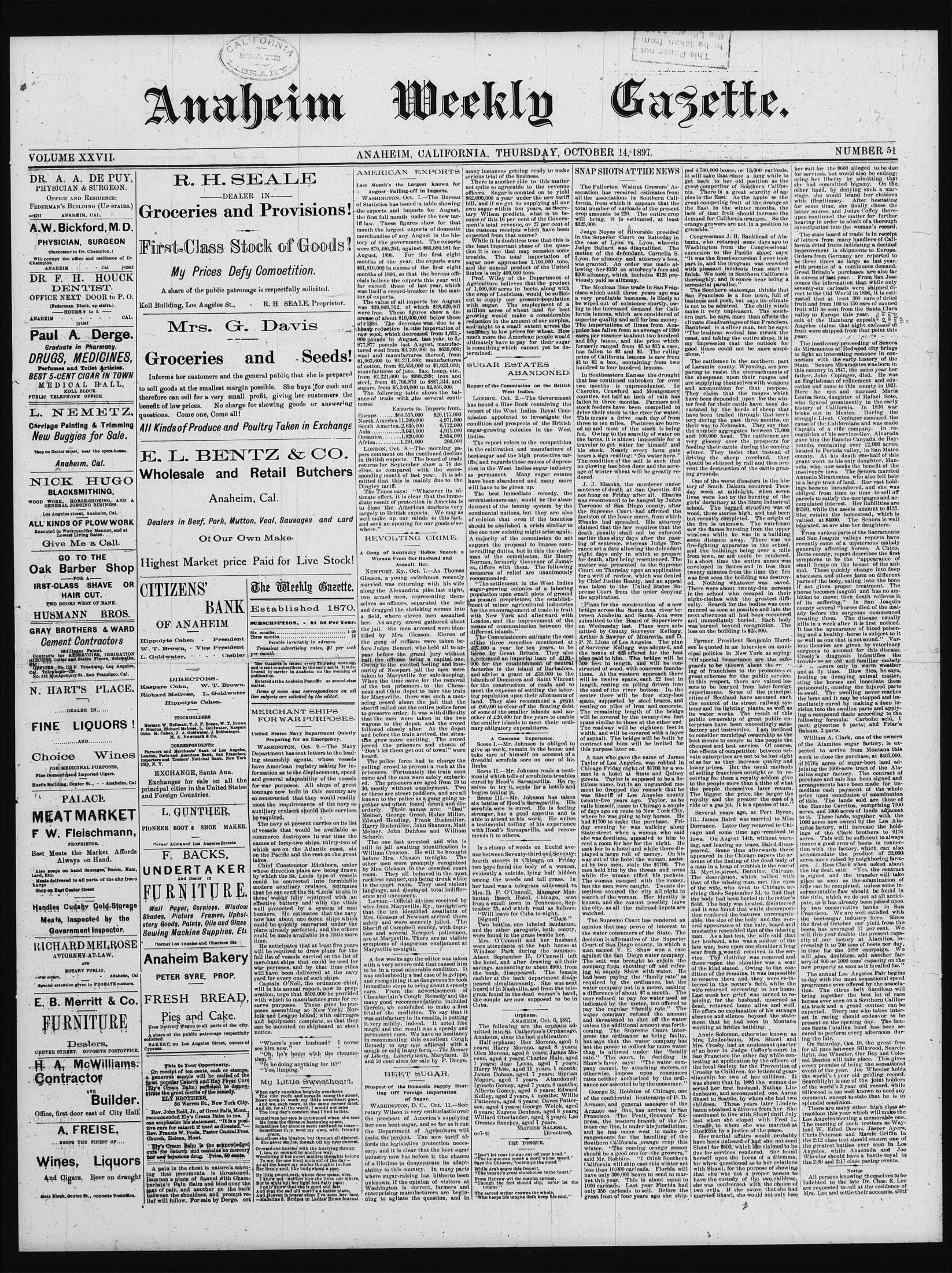
Searchable text
Anaheim
VOLUME XXVII.
DR. A. A. DE PUY,
PHYSICIAN & SURGEON.
OFFICE AND RESIDENCE;
FEDERMAN'S BUILDING (UP-STAIRS.)
oct21f ANAHEIM, CAL.
A.W. Bickford, M.D.
PHYSICIAN, SURGEON
(Successor to Dr. Champion.)
Will occupy the office and residence of Dr.
Champion.
ANAHEIM - Cal. j=24tf
DR. F. H. HOUCK
DENTIST.
OFFICE NEXT DOOR to P. O.
(Federman Block, up stairs.)
HOURS 9 to 5
ANAHEIM - Cal. jy15tf
Paul A. Derge.
Graduate in Pharmaey.
DRUGS, MEDICINES,
Perfumes and Toilet Articles.
BEST 5-CENT CIGAR IN TOWN
MEDICAL HALL,
KOLL BLOCK.
PUBLIC TELEPHONE OFFICE.
L. NEMETZ.
Carriage Painting & Trimming
New Buggies for Sale.
Shop on Center street, near the opera-house.
Anaheim, Cal.
R. H. SEALE
DEALER IN
Groceries and Provisions!
First-Class Stock of Goods!
My Prices Defy Competition.
A share of the public patronage is respectfully solicited.
Koll Building, Los Angeles St., R. H. SEALE, Proprietor.
Mrs. G. Davis
Groceries and Seeds!
Informs her customers and the general public that she is prepared to sell goods at the smallest margin possible. She buys 'for cash and therefore can sell for a very small profit, giving her customers the benefit of low prices. No charge for showing goods or answering questions. Come one, Come all!
All Kinds of Produce and Poultry Taken in Exchange
E. L. BENTZ & CO.
Wholesale and Retail Butchers
BEST 5-CENT CIGAR IN TOWN
MEDICAL HALL,
KOLL BLOCK.
PUBLIC TELEPHONE OFFICE.
L. NEMETZ.
Carriage Painting & Trimming
New Buggies for Sale.
Shop on Center street, near the opera-house.
Anaheim, Cal.
NICK HUGO
BLACKSMITHING,
WOOD WORK, HORSE-SHOOKING, AND A GENERAL JOBBING BUSINESS.
Los Angeles street, Anaheim, Cal.
ALL KINDS OF PLOWWORK
Executed in Workmanlike Manner, and at Lowest Living Rates.
Give Me a Call.
GO TO THE
Oak Barber Shop
FOR A
IRST-CLASS SHAVE OR
HAIR CUT.
TWO DOORS WEST OF BANK.
HUSMANN BROS.
GRAY BROTHERS & WARD
Cement Contractors
Shillinger Patent.
Contracts for RESERVOIRS, IRRIGATION
MITCHER, Caller and Stable Floors, Sidewalks,
Elevators.
No. 124 N. Broadway, Log Angeles,
Cal. Telephone—286.
No. 316 Montgomery St., San Francisco, Cal.
N. HART'S PLACE.
DEALER IN...
FINE LIQUORS!
AND...
Choice Wines
FOR MEDICINAL PURPOSES,
Fine Domestic and Imported Cigars.
Hart's Building, Center St., - Anaheim, Cal
PALACE
MEAT MARKET
F. W. Fleischmann,
PROPRIETOR.
Best Meats the Market Affords
Always on Hand.
Also keeps on hand Sausages, Bacon, Ham,
Lard, Etc.
Meats delivered to all parts of the city free o
harge
Shop on East Center Street.
Informs her customers and the general public that she is prepared to sell goods at the smallest margin possible. She buys for cash and therefore can sell for a very small profit, giving her customers the benefit of low prices. No charge for showing goods or answering questions. Come one, Come all!
All Kinds of Produce and Poultry Taken in Exchange
E. L. BENTZ & CO.
Wholesale and Retail Butchers
Anaheim, Cal.
Dealers in Beef, Pork, Mutton, Veal, Sausages and Lard
Of Our Own Make.
Highest Market price Paid for Live Stock!
CITIZENS'
BANK
OF ANAHEIM
Hippolyte Cahen - President
W. T. Brown - Vice President
L. Goldwater - Cashier
DIRECTORS..
Kaspare Cohn, W. T. Brown.
Richard Melrose, L. Goldwater
Hippolyte Cahen.
STOCKHOLDERS
Herman W. Hellman, T. J. F. Boege, W. T. Brown
P. Nicolus, Richard Melrose, L. Goldwater, Kasparre Cohn H. Cahen, J. A. Goldwater, J. Schlesinger.
M. A. Newmark & Co.
CORRESPONDENTS:
Farmers and Merchants' Bank of Los Angeles,
London, Paris and American Bank, San Francisco;
Importers and Traders' National Bank, New York City, N.Y.
EXCHANGE, Santa Ana.
Exchanges for sale on all the principal cities in the United States and Foreign Countries.
L. GUNTHER.
PIONEER BOOT & SHOE MAKER.
Corner Adele and Los Angeles Streets
F. BACKS,
UNDERTAKER
And Dealer in FURNITURE.
The Weekly Gazette.
Established 1870.
SUBSCRIPTION, - $1 50 Per Year.
Six months... 1 000
Three months... 750
Payable invariably in advance.
Transient advertising rates, $1 per inch per month.
The Gazette is issued every Thursday morning and is sent to subscribers by the early mails. It is delivered by carrier in Anaheim on the morning of publication.
Entered at the Anaheim Postoffice as second-class matter.
Items of news and correspondence on all live subjects are solicited by the editor.
MERCHANT SHIPS FOR WAR PURPOSES.
United States Navy Department Quietly Preparing for an Emergency.
WASHINGTON, Oct. 9.-The Navy Department has sent letters to the leading steamship agents, whose vessels have American registry asking for information as to the displacement, speed and general adaptability of the vessels for war purposes. All ships of great tonnage now built in this country are so constructed that they would readily meet the requirements of the navy as auxiliary cruisers should their services be required.
The navy at present carries on its list of vessels that would be available as commerce destroyers in war time the names of forty-two ships, thirty-two of which are on the Atlantic coast, six on the Pacific and the rest on the great lakes.
Chief Constructor Hichborn, under whose direction plans are being drawn by which the St. Louis type of vessels could be converted into formidable modern auxiliary cruisers, estimates that he can send the St. Louis to sea in three weeks fully equipped with an
MEAT MARKET
F W. Fleischmann,
PROPRIETOR.
Best Meats the Market Affords
Always on Hand.
Also keeps on hand Sausages, Bacon, Ham,
Lard, Etc.
Meats delivered to all parts of the city free o
charge
Shop on East Center Street.
Handles Cudahy Cold-Storage
Meats, Inspected by the
Government Inspector.
RICHARD MELROSE
ATTORNEY AT LAW.
AND
NOTARY PUBLIC.
Anaheim, Cal.
Special attention given to PROBATE matters.
E. B. Merritt & Co.
FURNITURE
Dealers.
CENTER STREET. OPPOSITE POSTOFFICE.
H. A. McWilliams.
Contractor
AND
Builder.
Office, first door east of City Hall.
A. FREISE,
...KEEPS THE FINEST OF...
Wines, Liquors
And Cigars. Beer on draught
Mets Block, Center St., opposite Postoffice.
L. GUNTHER.
PIONEER BOOT & SHOE MAKER.
Corner Adela and Los Angeles Streets
F. BACKS,
UNDERTAKER
And Dealer in
FURNITURE.
Wall Paper, Cornices, Window
Shades, Picture Frames, Upholstery Goods, Painte, Oils and Glass
Sewing Machine Supplies, Etc.
Corner Los Angeles and Chartres Sts
Anaheim Bakery
PETER SYRE, PROP.
FRESH BREAD,
Pies and Cake.
Free Delivery Wagon to all parts of the city.
A share of the public patronage respectfully
solicited.
BAKERY; on Los Angeles Street, corner of
Cypress.
This Is Your Opportunity.
On receipt of ten cents, cash or stamps,
a generous sample will be mailed of the
most popular Catarrh and Hay Fever Cure
(Ely's Dream Balm) sufficient to demonstrate the great merits of the remedy.
ELY BROTHERS,
56 Warren St., New York City.
Rev. John Reid, Jr., of Great Falls, Mont.,
recommended Ely's Cream Balm to me. I
can emphasize his statement, "It is a positive cure for catarrh if used as directed."—
Rev. Francis W. Poole, Pastor Central Pres.
Church, Helena, Mont.
Ely's Cream Balm is the acknowledged
cure for catarrh and contains no mercury
toxin and injurious drug. Price, 50 cents.
A pain in the chest is nature's warning that pneumonia is threatened.
Bampen a piece of flannel with Champperlain's Pain Balm and bind over the
seat of pain, and another on the back
between the shoulders, and prompt relief will follow. For sale by Derge. oct
When early sunshine brightly overflows
The city roofs and spreads along the street.
Down town to work my little sweetheart goes.
And we, each morn, at the same corner meet.
And oh, for all the world, I would not miss
The long day's comfort that I find in this.
Sometimes her step is quickened when she see
Me from the distance hastening apace.
Sometimes her glances seem inclined to tease.
Sometimes they meet my own, with friend
grace.
Sometimes she blushes, but through all discreet
She never smiles, though oft my eyes entree
Onward she hurries with the hurrying throng;
I, too, go onward by another way.
Wondering if her sweet maiden thoughts belonTo me, for one blest moment of the day—
As all the hours my tender thoughts inclose
Her lovely soul, like buds about a rose.
My little sweetheart, whose dear name, alas,
I know not—neither how she lives nor when
Nor to what toll her light feet daily pass;
I only know that she is good and fair.
And that the sad old world's a better place,
And Heaven is nearer since I've seen her face—Madeline S. Bridges in Ladies' Home Journa
ANAHEIM, CALIFORNIA, THURSDAY, OCTOBER 14, 1897.
AMERICAN EXPORTS
Last Month's the Largest Known for August - Falling-off in Imports.
WASHINGTON, Oct. 7.—The Bureau of Statistics has issued a table showing the exports and imports for August, the first full month under the new tariff law. These figures show for that month the largest exports of domestic merchandise of any August in the history of the government. The exports were $79,490,264, against $66,680,981 for August, 1896. For the first eight months of the year, the exports were $61,810,000 in excess of the first eight months of 1896, so that the bureau officials believe the exports this year will far exceed those of last year, which was itself a record-breaker in the matter of exports.
The value of all imports for August was $39,848,312, of which $18,629,607 were free. These figures show a decrease of about $10,000,000 below those of 1896. The decrease was due to a heavy reduction in the importation of raw wool, which decreased from 4,651,000 pounds in August, last year, to 2,877,877 pounds last August, manufactured wool from $3,709,000 to $639,000; wool and manufactures thereof, from $1,963,600 to $1,271,000; manufactures of cotton, from $2,553,000 to $1,623,000; manufactures of jute, flax, hemp, etc., from $2,221,000 to $999,289; iron and steel, from $1,766,870 to $887,344; and sugars, from $5,340,000 to $2,956,000.
The following table shows the balance of trade with the several continents:
Exports to. Imports from.
Europe.....$60,515,000 $20,175,000
North America 11,599,000 4,971,000
South America.2,635,000 6,712,000
Asia.....3,043,000 4,911,000
Oceanica.....1,820,000 2,854,000
Africa.....1,291,000 260,000
LONDON, Oct. 8.—The morning papers comment on the continued decline in British exports. The board of trade returns for September show a 7% decline, as compared with the corrections many instances getting ready to make serious trial of the business.
There is another side to this matter not quite so agreeable to the revenue officers. Sugar is counted on to yield $62,000,000 a year under the new tariff bill, and if we get to supplying all our own sugar within ten years, as Secretary Wilson predicts, what is to become of this 16 per cent of the Government's total revenue, or 27 per cent of the customs receipts which have been expected from that source?
While it is doubtless true that this is the least important phase of the question it is one that may occasion some trouble. The total importation of sugar now approaches 1,700,000 tons. and the annual product of the United States is only 409,000 tons.
Prof. Wiley of the Department of Agriculture believes that the product of 1,000,000 acres in beets, along with the crop of Louisiana would be sufficient to supply our present population with sugar. The employment of a million acres of wheat land for beet growing would make a considerable reduction in the amount of our surplus, and might to a small extent arrest the tendency to low prices for wheat. How much more the American people would ultimately have to pay for their sugar is something which cannot yet be determined.
SUGAR ESTATES ABANDONED.
Report of the Commission on the British West Indies.
LONDON, Oct. 2.—The Government has issued a Blue Book containing the report of the West Indies Royal Commission appointed to investigate the condition and prospects of the British sugar-growing colonies in the West Indies.
The report refers to the competition in the cultivation and manufacture of beet sugar and the high protective tariffs; and regards those causes of depression in the West Indies sugar industry as permanent. Many sugar estates
SNAP SHOTS AT THE NEW WEEK
The Fullerton Walnut Growers' Association has received estimates from all the associations in Southern California from which it appears that the total number of carloads of the present crop amounts to 220. The entire crew will bring it is estimated at less than $325,000.
Judge Noyes of Riverside presides in the Superior Court on Saturday over the case of Lyon vs. Lyon where Judge Ballard was disqualified. The motion of the defendant, Cornelia Lyon for alimony and attorney's fee was granted. An order was made allowing her $150 as attorney's fees and $200 alimony which includes $125 privately paid as alimony.
The Mexican lime trade in San Francisco which until three years ago was a very profitable business is likely to be wiped out of existence shortly owing to the increased demand for California lemons, which are considered superior quality and sell for less money. The importations of limes from Acapulco has fallen from an average of 12 cases per steamer to about two hundred and fifty boxes; and the price which formerly ranged from $5 to $15 a case has fallen to $3 and $4. The ruling price of California lemons is now from $1 to $2 a box containing from thirteen to four hundred lemons.
In Southeastern Kansas the drought that has continued unbroken for over two months is unprecedented. Cherokee, Crawford and Montgomery counties, not half an inch of rain fell in three months. Farmers are stock feeders have been compelled drive their stock to the river for water. This means a drive each day of frost three to ten miles. Pastures are buildup up and most of the stock is being fed. Owing to the scarcity of water these farms it almost impossible for traveler to get water himself at his stock. Nearly every farm bears a sign reading: "No water here." The condition of the soil is such that no plowing has been done and the age of winter wheat will be greatly reduced.
She buys for cash and saving her customers the goods or answering Taken in Exchange
& CO.
Il Butchers
Sausages and Lard
for Live Stock!
Weekly Gazette.
published 1870.
PITION, - $1 50 Per Year.
is issued every Thursday morning, subcribers by the early mails. It is delivered in Anaheim on the morning of the Anaheim Postoffice as second-class notice and correspondence on all are solicited by the editor.
HANT SHIPS WAR PURPOSES.
States Navy Department Quietly during an Emergency.
BOTTON, Oct. 9.—The Navy that has sent letters to the leadership agents, whose vessels are registering asking for assistance to the displacement, speed adaptability of the vessels purposes. All ships of great size built in this country are cited that they would readily requirements of the navy as guards should their services be paid at present carries on its list that would be available as destroyers in war time the forty-two ships, thirty-two of one on the Atlantic coast, six fifteen and the rest on the great Constructor Hichborn, under construction plans are being drawn the St. Louis type of vessels converted into formidable auxiliary cruisers, estimates in send the St. Louis to sea in tanks fully equipped with an export to. Imports from Europe. $60,515,000 $20,175,000 North America 11,599,000 4,971,000 South America 2,635,000 6,712,000 Asia. 3,043,000 4,911,000 Oceanica. 1,820,000 2,854,000 Africa. 1,291,000 260,000
LONDON, Oct. 8.—The morning papers comment on the continued decline in British exports. The board of trade returns for September show a 7% decline, as compared with the corresponding month of last year. It is admitted that this is mainly due to the Dingley tariff.
The Times says: "Whatever its ultimate effect, it is clear that the immediate result of protection in America is to close the American markets very largely to British exports. We may as well make up our minds to this fact, and seek an opening for our goods elsewhere."
REVOLTING CRIME.
A Gang of Kentucky Hobos Snatch a Woman From Her Husband and Assault Her.
NEWPORT, Ky., Oct. 7.—As Thomas Gleason, a young switchman recently married, was returning with his wife along the Alexandria pike last night, two armed men, representing themselves as officers, separated the pair and dragged the shrieking woman into a field, where eleven men assaulted her. An angry crowd gathered about the jail. Six men arrested were identified by Mrs. Gleason. Eleven of the gang of ruffians were taken before Judge Bennet, who held all to appear before the grand jury without bail the offense being a capital one. Owing to the excited feeling and insecurity of Newport jail the men were taken to Marysville for safe-keeping. When the time came for the removal of the ten prisoners to the Chesapeak and Ohio depot to take the train for Marysville, there was such a menacing crowd about the jail that the sheriff called out the entire police force to preserve order. It was with difficulty that the men were taken in the two wagons to the depot, and the crowd followed closely after. At the depot and before the train arrived, the situation grew more exciting. The crowd jeered the prisoners and shouts of "Don't let them get out of town!" were heard.
The police force had to charge the yelling crowd to prevent a rush at the prisoners. Fortunately the train soon came and the men were safely embarked. The prisoners are aged from 19 to 30, mostly without employment. Two or three are street peddlers, and are all known to the police as a gang going together and often found drunk and disorderly. Their names are; "Dad" Meiner, George Greer, Huber Miller, Edward Hending, Frank Bushmiller, Harry Bushmiller, John Shannon, Matt Meiner, John Duhfoss and William Schorle.
The one last arrested and who is still in jail awaiting identification is William Croxon. He will be brought before Mrs. Cleason to-night. The other men were promptly recognized by Mrs. Gleason in the crowded court room. They all behaved in the most reckless manner, one being drunk while in the court room. They used violent language, and displayed total indifference and unconcern.
Report of the Commission on the British West Indies.
LONDON, Oct. 2.—The Government has issued a Blue Book containing the report of the West Indies Royal Commission appointed to investigate the condition and prospects of the British sugar-growing colonies in the West Indies.
The report refers to the competition in the cultivation and manufacture of beet sugar and the high protective tariffs, and regards those causes of depression in the West Indies sugar industry as permanent. Many sugar estates have been abandoned and many more will have to be given up.
The best immediate remedy, the commissioners say, would be the abandonment of the bounty system by the continental nations, but they are also of opinion that even if the bounties should be abolished a crisis similar to the one now existing might arise again.
A majority of the commission do not support the proposal to impose countervailing duties, but in this chairman of the commission, Sir Henry Norman, formerly Governor of Jamaica, differs with them. The following measures of relief are unanimously recommended:
"The settlement in the West Indies sugar-growing colonies of a laboring population upon small plots of ground as peasant proprietors; the establishment of minor agricultural industries for the encouragement of trade in fruit with New York and afterward with London, and the improvement of the means of communication between the different islands."
The Commissioners estimate the cost of the three remedies mentioned at £7,000 a year for ten years, to be borne by Great Britain. They also recommend an imperial loan of £120,000 for the establishment of central factories in the island of Barbadoes, and advise a grant of £30,000 to the islands of Dominica and Saint Vincent for the construction of roads and to meet the expense of settling the laboring population upon their allotments of land. They also recommend a grant of £60,000 to clear off the floating debt of some of the smaller islands and another of £20,000 for five years to enable the smaller islands to meet their ordinary obligatory expenditures.
A Common Experience.
Scense I.-Mr. Johnson is obliged to give up work, remain in the house and take care of himself on account of a dreadful scrofa sore on one of his limbs.
Scense II.-Mr. Johnson reads a testimonial which tells of scroffous troubles cured by Hood's Sarsaparilla. He resolves to try it sends for a bottle and begins taking it.
Scene III.-Mr. Johnson has taken six battles of Hood's Sarsaparilla. His scrofa sore is cured. He is feeling stronger, has a good appetite and is able to attend to his work. He writes a testimonial telling of his experience with Hood's Sarsaparilla, and recommends it to others.
In a clump of woods on Euclid avenue between Seventy-third and Seventy-fourth streets in Chicago on Friday two boys found the body of a woman, evidently a suicide, lying half hidden among the weeds and tall grass. In her hand was a telegram addressed to Mrs. D. P. O'Connell, Manager Manhattan Beach Hotel, Chicago, sent by Southeastern Kansas the drought that has continued unbroken for over two months is unprecedented.
Cheroke, Crawford and Montgomery counties, not half an inch of rain fell in three months. Farmers are stock feeders have been compelled drive their stock to the river for water This means a drive each day for three to ten miles. Pastures are buildup and most of the stock is being fed. Owing to the scarcity of water in the farms, it is almost impossible for traveler to get water for himself at his stock. Nearly every farm gives bears a sign reading: "No water here." The condition of the soil is such that no plowing has been done and the age of winter wheat will be greatly reduced.
J. J. Ebanks, the murderer under sentence of death at San Quentin. Not hang on Friday after all. Ebanks was resentenced to be hanged by Jud Torrence of San Diego county, after the Supreme Court had affirmed decision of the lower court, from whom Ebanks had appealed. His attorney claimed that the law requires that death penalty shall not be enforced earlier than sixty days after the passing of sentence, whereas Judge Torrance set a date allowing the defense eight days only in which prepares for death, after being resentenced.
Matter was presented to the Supreme Court on Thursday upon an application for a writ of review, which was denied by Chief Justice Beatty, and an appeal was taken to the United States Supreme Court from the order denyinlthe application.
Plans for the construction of a bridge across the Santa Ana river between Anaheim and Santa Ana was submitted to the Board of Supervisory on Wednesday last. Plans were submitted by County Surveyor Kelvin Arthur & Sawyer of Monrovia,and P.N.Liute of Los Angeles.The plan of Surveyor Kelvinoggled was adopted,the bonus of $25 offered forthe plan paid to him.The bridge will be 500 feet in length,and will be constructedof wood.with concretefountains.Atthe western approach theremain twelve spans,each 22 feetlength,resting on piling floorandthe sandofthe river bottom.Incenter there will be four sixty-spans,supportedby steel braces,rresting on piles of iron and concenThe remaining length ofthe bridgewillbe coveredbythe twenty-two spanssimilarto thoseatotherThe roadwaywillbe eighteenfeetwidth,andwillbecoveredwithaleafasphalt.Thebridgewillbebuiltcontractandbidswillbeinvitedthispurposelateron.
A man who gavethe name of Jay TaylorofLosAngeleswas robbedChicagoFridaynightof$170bya manin a hotel atStateandQuartets.Taylorissupposedtobea titiousname,butinanunguardedmenthe droppedtheremarkthatwasSheriffofLosAngelesconttwenty-fiveyearsago.Taylor,a callshimself,cametoChicagoa courseofdaysagoenrouteToNewYorkwherehewasgoingtobuyhorses.had$170tomakethepurchase.dayeveninghewaswalkingaloneStatestreetwhenawomanwhohaswastidetherentallroomforherforthenight.tookhertoahotelandwhilethereplayedalargerollofmoney.Oryoutaworthofthehotlouwwoman.adbytwomen,stolethe$1700.menheldhimbythe throatandwhilethewomanriffledhispoison.Thewomanescapedwiththembutthemenwere caught.Twentytectivesscouredthecityallnightssearchofthewoman.Heridentified
Constructor Hichborn, under section plans are being drawn the St. Louis type of vessels converted into formidable auxiliary cruisers, estimates to send the St. Louis to sea in ships fully equipped with an battery and with the vitalsected by a system of coal. He estimates that the navy about one dozen ships which quickly converted under the lady perfected, and the others made available in a little more capacities that at least five years required to draw plans for the vessels carried on the list of ships that could be used foroses, and by that time rifles had been delivered at the navy every one of such ships.
O'Nell, the ordnance chief, is annual report, now in preparation that $500,000 be provided to manufacture guns for purposes. These guns he purmiling at New York, Nor-League Island, with carriages equipment complete, so that they counted on shipboard at short distances your husband? I never know.
Your home with the rheuma-doing anything for it?" Imping."
Little Sweetheart.
Sunshine brightly overflows roofs and spreads along the street; to work my little sweetheart goes each morn, at the same corner meet all the world, I would not miss day's comfort that I find in this. Her step is quickened when she sees the distance hastening apace; her glances seem inclined to tease—she meets my own, with friendly blushes, but through all discreet smiles, though oft my eyes entreat. Hurries with the hurrying thong; onward by another way.
If her sweet maiden thoughts belong to one blest moment of the day—hours my tender thoughts inclose soul, like buds about a rose.
Sweetheart, whose dear name, alas, not—neither how she lives nor where, at toll her light feet daily pass; now that she is good and fair.
She sad old world's a better place, then near since I've seen her face.
Bridges in Ladies Home Journal.
BEET SUGAR.
Prospect of the Domestic Supply Shutting Off Foreign Importation of Sugar.
WASHINGTON, D.C., Oct. 11. Secretary Wilson is very enthusiastic over the prospect of America's supplying her own beet sugar, and so far as it can the Department of Agriculture will assist the project. The new tariff affords the legislative protection necessary, and it is clear that the beet sugar industry now has before it the chance of a lifetime to demonstrate its adaptability to this country. In many parts where sugar-raising has hitherto been unknown, if the opinion of visitors at Washington is correct, farmers and enterprising manufacturers are beginning to agitate the question, and in
SECTE 11.-Mr. Johnson has six battles of Hood's Sarsaparilla. His sorofila sore is cured. He is feeling stronger, has a good appetite and is able to attend to his work. He writes a testimonial telling of his experience with Hood's Sarsaparilla, and recommends it to others.
In a clump of woods on Euclid avenue between Seventy-third and Seventy-fourth streets in Chicago on Friday two boys found the body of a woman, evidently a suicide, lying half hidden among the weeds and tall grass. In her hand was a telegram addressed to Mrs. D. P. O'Connell, Manager Manhattan Beach Hotel, Chicago, sent from a small town in Tennessee, September 25, and which read as follows: "Will leave for Cuba to night.
[Signed]
"DAN."
Two bottles, one labeled laudanum, and the other paregoric, both empty, were found in the grass beside her.
Mrs. O'Connell and her husband were attendants at the bath house at Windsor Park during the summer. About September 15, O'Connell left the hotel, and after drawing all their savings, amounting to about $900, from the bank, disappeared. The female cashier at the bath department disappeared simultaneously. She was next heard of in Nashville, and from the telegram found in the dead woman's hand, the couple are now supposed to be in Cuba.
Orphans.
ANAHEIM, Oct. 6, 1897.
The following are the orphans admitted into St. Catherine's Orphanage, Anaheim, since the last publication:
Half orphans: Rex Moreno, aged 9 years; Harry Moreno, aged 8 years; Olen Moreno, aged 5 years; James Moreno, aged 4 years; Charles Hale, aged 7 years; Jose Levas, aged 7 years; Harry White, aged 11 years; 1 month; James Dobson, aged 7 years; Siprian Mogort, aged 7 years; Abandoned: Ignacio Gomey, aged 7 years; 6 months; Alberto Gomey, aged 6 years; Edward Kelley, aged 2 years; 4 months; Willie Patterson, aged 6 years; Daves Patterson, aged 4 years; George Weick, aged 6 years; Eugene Denham, aged 8 years; Willard Oberlander, aged 8 years; Leo Orestes Sanchez, aged 7 years.
MOTHER SALESIA,
oc7-4t
THE TONGUE.
"Don't let your tongue out off your head."
"The tongue can speak a word whose speed." Says the Chinese,"outstrips the steed"
While Arab sages this impart,
The tongue's great storehouse is the heart."
From Hebrew wit the maxim sprung,
"Though the feet should alp,' never let the tongue."
The sacred writer crowns the whole,
"Who keeps his tongue doth keep his soul."
SHOTS AT THE NEWS
ullerton Walnut Growers' Association has received estimates from associations in Southern California from which it appears that the number of carloads of the present amounts to 220. The entire crop being, it is estimated, at least Noyes of Riverside presided superior Court on Saturday in lieu of Lyon vs. Lyon, wherein Ballard was disqualified. The defendant, Cornelia S. For alimony and attorney's fees, cited. An order was made alter $150 as attofney's fees andamy, which includes $125 prepaid as alimony.
Mexican lime trade in San Francisco until three years ago was profitable business, is likely to end out of existence shortly, owne increased demand for Califomns, which are considered of quality and sell for less money. Importations of limes from Acacia fallen from an average of 1200 per steamer to about two hundred boxes, and the price which vary ranged from $5 to $15 a case, given to $3 and $4. The ruling California lemons is now from a box, containing from two to four hundred lemons.
Southeastern Kansas the drought has continued unbroken for over months is unprecedented. In late Crawford and Montgomery, not half an inch of rain has been three months. Farmers and feeders have been compelled to their stock to the river for water. Means a drive each day of from ten miles. Pastures are burnt and most of the stock is being drawing to the scarcity of water on farms, it is almost impossible for a farmer to get water for himself and stock. Nearly every farm gate sign reading: "No water here." Condition of the soil is such that farming has been done and the acre-winter wheat will be greatly re-
ped 4,500,000 boxes, or 12,000 carloads. It will take that State a long while to get back to her old position as the great competitor of Southern California. There is a great scarcity of apples in the East. As the apple is the great competing fruit of the orange at the East in the winter months, the lack of that fruit should increase the demand for California oranges. So the orange growers are not in a position to grumble."
Congressman J. H. Bankhead of Alabama, who returned some days ago to Washington from the Congressional excursion to the Pacific slope, says: "It was the finest excursion I ever took part in, and the program was crowded with pleasant incidents from start to finish. We took in Southern California thoroughly, and it comes near being a terrestrial paradise."
The Southern statesman thinks that San Francisco is a fine town, full of business and push, but says its climate is not to be admired. The chilly winds make it very unpleasant. The southern part, he says, more than offsets the climate disadvantages of San Francisco. Bankhead is a silver man, but he says: "The business revival has struck the coast, and taking the entire slope, it is my impression that the outlook for good times could not be more auspicious."
The cattlemen in the northern part of Laramie county, Wyoming, are preparing to resist the encroachments of the sheepmen upon their ranges and are supplying themselves with weapons and ammunition for that purpose. They claim that the ranges which have been depended upon for the winter feed for their cattle have been devastated by the herds of sheep that have been trailed through that territory during the past three months, on their way to Nebraska. They say that the number aggregates between 75,000 and 100,000 head. The cattlemen are very gloomy over the prospects for feeding their cattle during the coming winter. They insist that instead of driving the sheep overland, they should be shipped by rail and thus prevent the destruction of the cattle grazing grounds.
her suit for the $600 alleged to be due for services, but would also be endangering her liberty by admitting that she had committed bigamy. On the other hand, by denying such a marriage, she would brand her children with illegitimacy. After hesitating for some time, she finally chose the latter course, and Judge Coffey thereupon continued the matter for further hearing in order to admit of a thorough investigation into the woman's record.
The state board of trade is in receipt of letters from many handlers of California dried fruits indicating a decided improvement in shipments to Europe. Orders from Germany are reported to be three times as large as last year, with promise of a continuous demand. Great Britain's purchases are also far in excess of last year. From San Jose comes the information that while only seventy-six carloads were shipped direct to the Old World in 1896, it is estimated that at least 300 cars of dried fruit and from 100 to 150 cars of canned fruit will be sent from the Santa Clara valley to Europe this year. Suit of the Hamburg exposure Angeles claims that eight carloads of fruit were shipped from that point this year.
The insolvency proceeding of Senora de Miramontes at Redwood city brings to light an interesting romance in connection with the early history of the State. Senora Miramontes was born in this country in 1847, the same year her father, John Copinger, died. He was an Englishman of refinement and education and came to this county in 1821. Here he met and married Maria Louisa Soto, daughter of Rafael Soto, who figured prominently in the early history of California. In 1836 war broke out in Mexico. During the struggle Lieut. Copinger espoused the cause of the Californians and was made Captain of a rifle company. In recognition of his services Gov. Alvarada gave him the Rancho Canyada de Raymundo, containing over 12,000 acres located in Portola valley, in San Mateo county. At his death one-half of this grant went to his only daughter, Manuela, who now seeks the benefit of the insolvency laws. The Senora married
Ebanks, the murderer under the death at San Quentin, did not log on Friday after all. Ebanks sentenced to be hanged by Judge Jose of San Diego county, after Supreme Court had affirmed the man of the lower court, from which he had appealed. His attorney said that the law requires that the penalty shall not be enforced unless sixty days after the passage sentence, whereas Judge Torre set a date allowing the defendant always only in which to prepare truth, after being resentenced. The man was presented to the Supreme Court upon an application for review, which was denied Justice Beatty, and an appeal taken to the United States Supreme Court from the order denying publication.
As for the construction of a new across the Santa Ana river between Anaheim and Santa Ana were added to the Board of Supervisors Wednesday last. Plans were submitted by County Surveyor Kellogg, Mar & Sawyer of Monrovia, and D. Elmute of Los Angeles. The planveyor Kellogg was adopted, and bonus of $25 offered for the best bid to him. The bridge will be built in length, and will be constructed of wood, with concrete foundations. At the western approach there are twelve spans, each 22 feet in height, resting on piling driven into bed of the river bottom. In the meantime there will be four sixty-foot supports by steel braces, and on piles of iron and concrete remaining length of the bridge covered by the twenty-two foot similar to those at the other end. Roadway will be eighteen feet in width and will be covered with a layerhalt. The bridge will be built by steel and bids will be invited for purpose later on.
Man who gave the name of James Carlo of Los Angeles, was robbed in Carlo Friday night of $1700 by a woman at State and Quincy. Taylor is supposed to be a fictional name, but in an unguarded manner she dropped the remark that he Sheriff of Los Angeles county five years ago. Taylor, as he himself, came to Chicago a couple ago en route to New York City. He was going to buy horses. He 1700 to make the purchase. Friending he was walking along street when a woman who said was destitute, appealed to him to room for her for the night. He entered a hotel and while there discharged a large roll of money. On his outfit of the hotel the woman assisted two men, stole the $1700. The sold him by the throat and arms of the woman riffled his pockets. The woman escaped with the money; the men were caught. Twenty deserts scoured the city night in all of the woman. Her identity is
One of the worst disasters in the history of South Dakota occurred Tuesday week at midnight, when seven lives were lost by the burning of the girls' dormitory at the State Industrial school. The burned structure was of wood, three stories high, and had been but recently completed. The origin of the fire is unknown. The watchman saw the flames bursting from the upper windows while he was in a building some distance away. There was no fire-fighting apparatus in the school, and the buildings being over a mile from town, no aid could be rendered. In a short time the entire annex was enveloped in flames and in less than twenty minutes from the time the fire was first seen the building was destroyed. Nothing whatever was saved. There were about twenty-five persons in the school who escaped in their night-clothes with the greatest difficulty. Search for the bodies was commenced as soon as possible and late the next afternoon all had been recovered and immediately buried. Each body was burned beyond recognition. The loss on the building is $25,000.
Former President Benjamin Harrison is quoted in an interview on municipal politics in New York as saying: "Of special importance are the safeguards to be thrown about the opening of franchises to the promoters of great schemes for the public service. In this respect, there are valued lessons to be learned from later foreign experiments. Some of the principal cities of Scotland have assumed each control of its street railway systems and its lighting plants, as well as its water works. The result of this public ownership of great public enterprises have been exceedingly satisfactory and instructive. I am inclined to consider municipal ownership as the best means to secure to the people the cheapest and best service. Of course, the effects of competition between private enterprises are not to be lost sight of as far as they increase quality and lower prices. But the usual methods of selling franchises outright or in receiving for them a royalty seldom give to the people more than a title what the people themselves later return. The bigger the price, the larger the royalty and the greater the cost of a ride or a gas jet. It is a species of tax."
Several years ago, at Port Byron, Ill., James Baird was married to Miss Dorrance. Later they removed to Chicago and some time ago removed to Iowa. On August 14th, without warning, and leaving no trace, Baird disappeared. Some time afterwards there appeared in the Chicago papers the account of the finding of the dead body of a man in a heap of rubbish in rear of 34 Myrtle street, Dunning, Chicago. The description, which tallied with that of the missing man, met the eyes of the wife, who went to Chicago, arriving there September 3rd. to find that the body had been buried in the potter's ground.
The sheepmen upon their ranges and are supplying themselves with weapons and ammunition for that purpose. They claim that the ranges which have been depended upon for the winter feed for their cattle have been devastated by the herds of sheep that have been trailed through that territory during the past three months, on their way to Nebraska. They say that the number aggregates between 75,000 and 100,000 head. The cattlemen are very gloomy over the prospects for feeding their cattle during the coming winter. They insist that instead of driving the sheep overland, they should be shipped by rail and thus prevent the destruction of the cattle grazing grounds.
From various parts of the Sacramento and San Joaquin valleys reports have recently come of a mysterious malady generally affecting horses. A Chico, Butte county, report describes the first symptoms to be the "appearance of small lumps on the breast of an animal. These quickly change into deep abscesses, and others form on different parts of the body, eating into the bone if not given proper treatment. The horse becomes languid and has no ambition to move; then death relieves it of its suffering." In San Joaquin county several "horses died of the malady before the surgeons commenced treating them. The disease usually kills in a week after it is first noticed. It has the appearance of blood poisoning and a healthy horse is subject to it as well as one that is not sound." Various theories are given by veterinary surgeons to account for this disease. Creely's diagnosis indentifies the trouble as an old and familiar malady occurs only in warm weather and at fly time. Blow flies, he says, feeding on decaying animal matter, sting the horses and inoculate them poisonously, causing the injured parts to swell. The swelling never reaches the bone and it may be stopped and immediately owed by making a deep incision into the swollen parts and applying a compound made according to the following formula: Carbolic acid, 1 part; glycerine 6 parts; and Friar's Balsam, 2 parts.
William A. Clark, one of the owners of the Alamitos sugar factory, is expected to arrive from Montana this week to close the purchase, at $405,000. Of 8176 acres of sugar-beet land adjoining 1000-acre tract of the Alamitos sugar factory. The contract of purchase and sale has been signed and arrangements have been made for immediate cash payment of the whole price upon conclusion of examination of title. The lands sold are those of the Rancho Corritos, comprising 700 acres, and 1000 acres of lands adjacent to it. These lands, together with the 1000 acres now owned by the Los Alamitos factory, will increase the holdings of the Clark brothers to 9176 acres. This will be sufficient to always insure a good crop of beets in connection with the factory, which can also accommodate the product of 20,000 acres more raised by neighboring farmers. J. Ross Clark when asked about the big deal, sait: "Yes, the contract is signed and the transfer will take place as soon as the examination of title can be completed, unless some insurmountable flaw should be found in the title, which we do not at all antici-
The Supreme Court has rendered an opinion that may prove of interest to water consumers of the State. The opinion is affirmative of the Superior of San Diego county, in which a named V. E. Shaw won a case against the San Diego water company. It was brought to enjoin the company from shutting off and refusing supply Shaw with water. He been paying the "family rate" as agreed by the ordinance, but the company put in a meter, making reference of about $7 a month. The refused to pay for water used as agreed by the meter, but offered to the regular "family rate." The company refused the amount threatened to shut off the water due to the additional amount was forthcoming. The Supreme Court interrupted the ordinance as being faulty, says that the water company has the power to collect for more water is allowed under the "family rate." The court, in deciding in favor, says: "The water company cannot, by attaching meters, orwise, impose upon consumers neither authorized by the ordinance nor assented to by the consumer."
George B. Robbins of Chicago, one of the confidential lieutenants of P. D. Journ., and general manager of the four car line, has arrived in San Francisco. The Fruit Growers' Exhibition, the western branch of the Arrow car line, is under his jurisdiction, he has come west to make arrangements for the handling of the eastern California orange crop this year. "The coming orange season will be a good one for the growers," Mr. Robbins. "I think Southern California will ship cast this winter not than 10,000 carloads. Florida will only 300,000 boxes to send to marris this year. This is about equal to carloads. Last year Florida had 350 carloads to sell. Before the last frost of four years ago she shipped several years ago, at Port Byron, Ill., James Baird was married to Miss Dorrance. Later they removed to Chicago and some time ago removed to Iowa. On August 14th, without warning, and leaving no trace, Baird disappeared. Some time afterwards there appeared in the Chicago papers the account of the finding of the dead body of a man in a heap of rubbish in the rear of 34 Myrtle street, Dunning, Chicago. The description, which tallied with that of the missing man, met the eyes of the wife, who went to Chicago, arriving there September 3rd, to find that the body had been buried in the potter's field. The body was located, disinterred and it was found that while decomposition rendered the features unrecognizable, the size of the body and the general appearance of the hair, beard and mustache resembled that of the missing man. As a last test, the wife said that her husband, who was a soldier of the late war, bore upon one shoulder a long scar from a wound received in the service. The clothing was removed and there upon the shoulder was a scar of the kind stated. Owing to the condition of the remains, it was impossible to remove them and they were re-interred in the potter's field, while the wife returned sorrowing to her home. Last week her grief was turned to rejoicing, for the husband, mourned as dead, returned home alive and well. He offers no explanation of his strange absence and silence beyond the statement that he had been in Montana working at bridge building.
Annie Solomon, otherwise known as Mrs. Lindenbaum, Mrs. Shawl and Mrs. Crosby, had an unpleasant quarter of an hour in Judge Coffey's court in San Francisco the other day while contesting an application by the officers of the local Society for the Prevention of Cruelty to Children, for letters of guardianship for two of her children. It was shown that in 1885 the woman deserted her first husband, Nathan Lindenbaum, and accompanied one Aaron Shawl to Seattle, by whom she had two children. Three years later Lindenbaum obtained a divorce from her. She continued to live with Shawl until July last when she eloped with Fred L. Crosby, to whom she was married at Stockton by a justice of the peace.
Her marital affairs would probably have been unheard of had she not sued Shawl for $600, which she claimed to be due for services rendered. She found herself upon the horns of a dilemma, for when questioned as to her relations with Shawl, for the purpose of showing that she was not a proper person to have the custody of the two children, she was confronted with the choice of two evils. If she swore that she had married Shawl, she would not only lose of title. The lands sold are those of the Rancho Cerritos, comprising 7000 acres, and 1000 acres of lands adjacent to it. These lands, together with the 1000 acres now owned by the Los Almitos factory, will increase the holdings of the Clark brothers to 9176 acres. This will be sufficient to always insure a good crown of beets in connection with the factory, which can also accommodate the product of 20,000 acres more raised by neighboring farmers. J. Ross Clark when asked about the big deal, said: "Yes, the contract is signed and the transfer will take place as soon as the examination of title can be completed, unless some insurmountable flaw should be found in the title, which we do not at all anticipate, as it has already been passed upon by two conservative banks in San Francisco. We are well satisfied with the beet-sugar industry here. Since first of October our yield from the beets, has averaged 17 per cent. We will this year double the present capacity of our factory at Alamitos, increasing it to 700 tons of beets per day, in time for the 1898 campaign. We will also doubtless add another factory of 800 or 1000 tons' capacity on the new property as soon as it is called for."
The annual Los Angeles Fair begins to-day with the most sensational speed programme ever offered by the association. The citrus belt handicap will bring together the best lot of race horses ever seen on a Southern California track and a grand contest can be expected. Every one who takes interest in racing should endeavor to be present on the opening day. The famous Santa Catalina band has been secured to perform every afternoon during the fair.
On Saturday, Oct. 16, the great free for all pace between Silkwood, Searchlight, Joe Wheeler, Our Boy and Colonel Benton will take place. This gives every promise of being the sensational event of the year. Joe Wheeler holds the world's 4 year old gelding record. Searchlight is one of the joint holders of the world's 3 year old record, while Silkwood is too well known to need any comment, except to state that he is in splendid condition.
There are many other high class attractions this year which will make the Los Angeles meeting a memorable one. The meeting of such trotters ever seen in Los Angeles, while Anaconda and Joe Wheeler should have a battle royal in the 2:30 and 2:17 class pacing events.
Notice
All persons knowing themselves to be indebted to the late Dr. Chas. E. Lee are requested to call at the residence of Mrs. Lee and settle their accounts s30tf