anaheim-gazette 1895-12-05
Scanned page
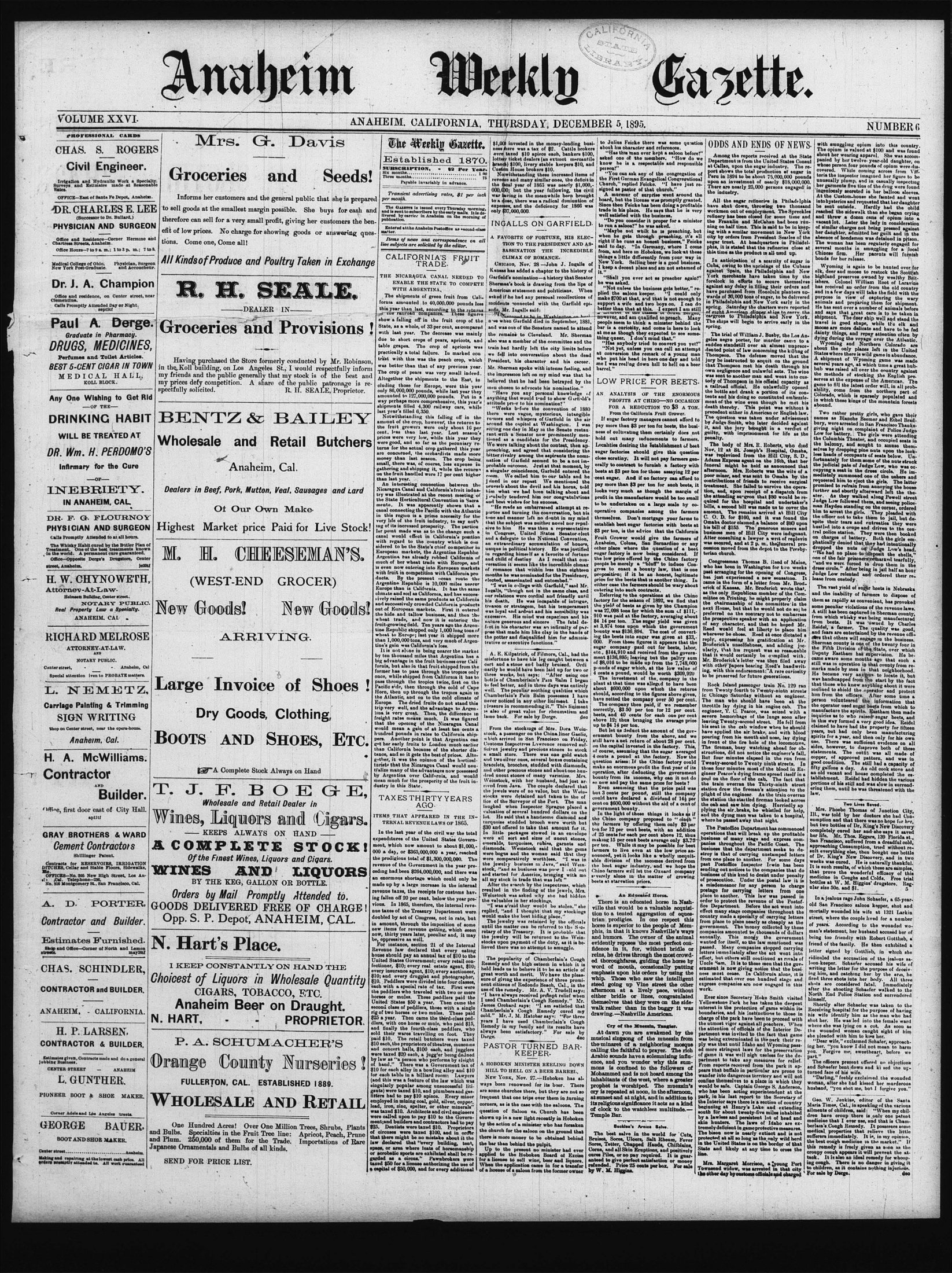
Searchable text
Anaheim
VOLUME XXVI.
PROFESSIONAL CARDS
CHAS. S. ROGERS
Civil Engineer.
Irrigation and Hydraulic Work a Specialty.
Surveys and Estimates made at Reasonable Rates.
OFFICE—East of Santa Fe Depot, Anaheim.
DR. CHARLES E. LEE
(Successor to Dr. Bullard.)
PHYSICIAN AND SURGEON
Office and Residence—Corner Hermine and Chartress Streets, Anaheim.
Office Hours—7 to 9 a.m.; 1 to 3 p.m.; 7 to 8.
Medical College of Ohio;
New York Post-Graduate.
Physician, Surgeon and Accoucheur.
Dr. J. A. Champion
Office and residence, on Center street, near Clementina.
Calls Promptly Attended Day or Night, sept5th
Paul A. Derge.
Graduate in Pharmacy.
DRUGS, MEDICINES,
Perfumes and Toilet Articles.
BEST 5-CENT CIGAR IN TOWN
MEDICAL HALL,
KOLL BLOCK.
Any One Wishing to Get Rid
OF THE
DRINKING HABIT
WILL BE TREATED AT
DR. Wm. H. PERDOMO'S
Infirmary for the Cure
Mrs. G. Davis
Groceries and Seed
Informs her customers and the general public that she is poto sell goods at the smallest margin possible. She buys for catherefore can sell for a very small profit, giving her customers therefit of low prices. No charge for showing goods or answerintions. Come one, Come all!
All Kinds of Produce and Poultry Taken in Exch
R. H. SEALE,
DEALER IN
Groceries and Provision
Having purchased the Store formerly conducted by Mr. Robin the Koll building, on Los Angeles St., I would respectfully i
my friends and the public generally that my stock is of the best
my prices defy competition. A share of the public patronage
spectfully solicited.
BENTZ & BAILEY
Wholesale and Retail Butcher
Anaheim, Cal.
MEDICAL HALL,
KOLL BLOCK.
Any One Wishing to Get Rid
OF THE DRINKING HABIT
WILL BE TREATED AT
DR. Wm. H. PERDOMO'S
Infirmary for the Cure
OF INEBRIETY.
IN ANAHEIM, CAL.
DR. F. G. FLOURNOY
PHYSICIAN AND SURGEON
Calls Promptly Attended to at all hours.
The Whisky Habit cured by the Butler Plan of Treatment. One of the best treatments known in the world. A permanent cure guaranteed.
Office—Opposite Derge's Drugstore, Center street, Anaheim.
H. W. CHYNOWETH,
Attorney-At-Law.
Helmsen Building, Center street.
NOTARY PUBLIC.
Real Property Law a Specialty.
ANAHEIM, CAL.
RICHARD MELROSE
ATTORNEY-AT-LAW.
AND
NOTARY PUBLIC.
Center street, Anaheim, Cal.
Special attention given to PROBATE matters.
L. NEMETZ,
Carriage Painting & Trimming
SIGN WRITING
Shop on Center street, near the opera-house.
Anaheim, Cal.
H. A. McWilliams.
Contractor
AND
Builder.
Office, first door east of City Hall.
ap11tf
GRAY BROTHERS & WARD
Cement Contractors
Shillinger Patent.
Contracts for RESERVOIRS, IRRIGATION DUTCHES, Cellar and Stable Floors, Sidewalks, Inc.
OFFICES—No. 205 New High Street, Los Angeles, Cal., Telephone—236,
No. 316 Montgomery St., San Francisco, Cal.
BENTZ & BAILEY
Wholesale and Retail Butcher
Anaheim, Cal.
Dealers in Beef, Pork, Mutton, Veal, Sausages and Lard.
Of Our Own Make.
Highest Market price Paid for Live Stock.
M. H. CHEESEMAN'S
(WEST-END GROCER)
New Goods! New Goods!
ARRIVING.
Large Invoice of Shoes
Dry Goods, Clothing,
BOOTS AND SHOES, ET
A Complete Stock Always on Hand
T. J. F. BOEGH
Wholesale and Retail Dealer in
Wines, Liquors and Cigars
KEEPS ALWAYS ON HAND
A COMPLETE STOCK
Of the Finest Wines, Liquors and Cigars.
WINES AND LIQUORS
BY THE KEG, GALLON OR BOTTLE.
Orders by Mail Promptly Attended to.
GRAY BROTHERS & WARD
Cement Contractors
Shillinger Patent.
Contracts for RESERVOIRS, IRRIGATION
DITCHES, Collar and Stable Floors, Sidewalks,
Me.
OFFICES—No. 205 New High Street, Los Analdo, Cal. Telephone—236.
No. 316 Montgomery St., San Francisco, Cal.
A. D. PORTER,
Contractor and Builder.
Estimates Furnished.
Shop and Office—Corner of North and Lemon
streets.
CHAS. SCHINDLER,
CONTRACTOR and BUILDER.
ANAHEIM, - CALIFORNIA.
H. P. LARSEN,
CONTRACTOR & BUILDER.
Estimates given, Contracts made and do a general
jobbing Business.
CENTER STREET — ANAHEIM
L. GUNTHER.
PIONEER BOOT & SHOE MAKER.
Corner Adele and Los Angeles trests.
GEORGE BAUER,
BOOT AND SHOE MAKER.
Center street...Anabeim.
Making and repairing at the lowest cash price. All
orders promptly attended to. All work guaranteed
Wholesale and Retail Dealer in
Wines, Liquors and Cigars
KEeps Always on Hand
A COMPLETE STOCK
Of the Finest Wines, Liquors and Cigars.
WINES AND LIQUORS
BY THE KEG, GALLON OR BOTTLE.
Orders by Mail Promptly Attended to.
GOODS DELIVERED FREE OF CHARGE.
Opp. S. P. Depot, ANAHEIM, CAL.
N. Hart's Place.
I KEEP CONSTANTLY ON HAND THE
Choicest of Liquors in Wholesale QuantiCIGARS, TOBACCO, ETC.
Anaheim Beer on Draught.
N. HART, PROPRIETO
P. A. SCHUMACHER'S
Orange County Nurseries
FULLERTON, CAL. ESTABLISHED 1889.
WHOLESALE AND RETAIL
One Hundred Acres! Over One Million Trees, Shrubs, Plants
and Bulbs. Specialties in the Fruit Tree line: Apricot, Peach, Prunus
and Plum. 250,000 of them for the Trade. Importations of R
Japanese Ornamentals and Bulbs of all kinds.
SEND FOR PRICE LIST.
Heim Weekly C
ANAHEIM, CALIFORNIA, THURSDAY, DECEMBER 5, 1895.
Davis
nd Seeds!
general public that she is prepared
sible. She buys for cash and
t, giving her customers the bening goods or answering questry Taken in Exchange
EALE.
IN
Provisions !
ly conducted by Mr. Robinson,
st., I would respectfully inform
my stock is of the best and
of the public patronage is reR. H. SEALE, Proprietor.
BAILEY
etail Butchers
Cal.
The Weekly Gazette.
Established 1870.
SUBSCRIPTION. - $2 Per Year.
Six months... 1,00
Three months... 75
Payable invariably in advance.
Transient advertising rates, $1 per inch per month.
The Gazette is issued every Thursday morning,
and is sent to subscribers by the early mails. It is delivered by carrier in Anaheim on the morning of publication.
Entered at the Anaheim Postoffice as second-class matter.
Items of news and correspondence on all live subjects are solicited by the editor.
CALIFORNIA'S FRUIT TRADE.
THE NICARAGUA CANAL NEEDED TO ENABLE THE STATE TO COMPETE WITH ARGENTINA.
The shipments of green fruit from California amounted to 40,000,000 pounds less this year than last, according to the returns due on railroad companies. These figures show a falling off in the fruit crop of the State, as a whole, of 33 per cent, as compared with last year. The decrease was mainly due to short crops of pears, apricots, and table grapes. The crop of apricots was practically a total failure. In marked contrast with this was the peach crop, which was better than that of any previous year. The crop of pears was very small indeed. Altogether the shipments to the East, including those for Europe, were this year only 86,000,000 pounds, while last year they amounted to 127,000,000 pounds. Put in a way perhaps more comprehensive, this year's shipments filled 4,300 railway cars, while last year's filled 6,350.
Notwithstanding this falling off in the amount of the crop, however, the returns to the fruit growers were only about 16 per cent, less than last year. Last season's prices were very low, while this year they were good, and so far as the pecuniary returns for the actual crop gathered this year are concerned, the orchardists made more money than last season. The crop being small, there was, of course, less expense in gathering and shipping it, while the return on the fruit handled were 17 per cent higher.
$1,000 invested in the money-lending business here was a tax of $2. Cattle brokers were taxed $10 apiece each, bankers $100, lottery ticket dealers (an extinct mercantile branch) $100, livery stable keepers $10, and Custom House brokers $10.
No withstanding these increased items of revenue and many similar ones, the deficit in the local year of 1865 was nearly $1,000,-000,000; but the year following, the civil war having in the meanwhile been brought to a dose, there was a radical diminution of expenses, and the deficiency for 1866 was only $37,000,000.
INGALLS ON GARFIELD.
A FAVORITE OF FORTUNE, HIS ELECTION TO THE PRESIDENCY AND ASSASSINATION THE INCREDIBLE CLIMAX OF ROMANCE.
Chicago, Nov. 28—John J. Ingalls of Kansas has added a chapter to the history of Garfield's nomination—a history that Senator Sherman's book is drawing from the lips of American statesmen and politicians. When asked if he had any personal recollections of incidents connected with the Garfield episode, Mr. Ingalls said:
"I am reminded to be in Washington on business when Garfield died in September, 1881, and was one of the Senators named to attend the remains to Cleveland. Mr. Sherman also was a member of the committee and the train had hardly left the city limits before we fell into conversation about the dead President, his character and his career. Mr. Sherman spoke with intense feeling, and the impression left on my mind was that he believed that he had been betrayed by the men chosen to advocate his nomination."
"Have you any personal knowledge of anything that would tend to show Garfield's attitude prior to his nomination?"
"Weeks before the convention of 1880 there were vague, mysterious, intangible rumors and whispers of Garfield in the air around the capitol at Washington. I was sitting one day in May in the Senate restaurant with a Senator now prominently mentioned as a candidate for the Presidency. We were talking about the contest, then approaching, and agreed that considering the bitter rivalry among the aspirants the nomination of Garfield seemed to be a not-improbable outcome. Just at that moment, by a singular coincidence, Garheld entered the Judius Feicke there was some about his character and reference."
"Has this man ever kept a secret one of the members." "Know he is a respectable and person?" "You can ask any of the conspiracy First German Evangelical Church," replied Feicke. "I have signed as pastor of that church."
A murmur of surprise went board, but the license was promised. Since then Feicke has been doing trade in his place. He says that well satisfied with the business.
"Do you consider it proper for you to run a saloon!" he was asked.
"Maybe not whilst he is present when he gets through pressure right if he runs an honest business said to day." "In Germany, we from, and here in Hoboken, we things a little differently from your New York. Selling beer is a good I keep a decent place and am not it."
"Shall you ever act as preacher he was asked."
"Not unless the business gets applied the saloon keeper." "I make $700 at that, and that is not support a wife and two boys on better than that at this. I expect a member of the classes of nohowever, and am qualified to preside people seem to think a minister bar is a curiosity, and come in at me as though they expected that thing queer. I don't mind that."
"Has anybody tried to convert." "Not yet, unless you can call at conversion the remark of a who put his head in here one day me I was reeling down hill to hear barrel."
LOW PRICE FOR PROFITS AT CHINO—NO FOR A REDUCTION TO FROM THE California Fruit Grocery If sugar factory managers cannot pay more than $3 per ton for beetsness of cultivating them certainly hold out many inducements Localities desiring the establishment sugar factories should give this close scrutiny. It will not pay ferrically to contract to furnish a few beats at $3 per ton for those assays."
BAILEY
etail Butchers
Cal.
real, Sausages and Lard
Make
aid for Live Stock!
ESEMAN'S.
New Goods!
ING.
of Shoes!
Clothing,
HOES, ETC.
always on Hand
DEGE.
Dealer in
and Cigars.
IN HAND —
STOCK!
oors and Cigars.
LIQUORS
OR BOTTLE.
by Attended to.
TAXES THIRTY YEARS AGO
ITEMS THAT APPEARED IN THE INTERNAL REVENUE LAWS OF 1865.
In the last year of the civil war the total expenditures of the United States Government, which now amount to about $1,000,000 a day, or $365,000,000 a year, reached the prodigious total of $1,300,000,060. The revenue of the Government in the year preceding had been $264,000,000, and there was an enormous shortage which could only be made up by a large increase in the internal revenue taxes, the receipts for customs having fallen off 20 per cent, below the year pre-
Altogether the shipments to the East, in including those for Europe, were this year only 86,000,000 pounds, while last year they amounted to 127,000,000 pounds. Put in a way perhaps more comprehensive, this year's shipments filled 4,300 railway cars, while last year's filled 6,350.
Notwithstanding this falling off in the amount of the crop, however, the returns to the fruit growers were only about 16 per cent, less than last year. Last season's prices were very low, while this year they were good, and so far as the pecuniary returns for the actual crop gathered this year are concerned, the orchardits made more money than last season. The crop being small, there was, of course, less expense in gathering and shipping it, while the return on the fruit handled were 17 per cent higher than last year.
An interesting connection between the Nicaragua Canal and California's fruit industry was illustrated at the recent meeting of the State Horticultural Convention in Sacramento. It was apparently shown that a canal connecting the Pacific with the Atlantic in this region is a prime necessity for the very life of the fruit industry, to say nothing of its increased prosperity. The particlar lar point made was as to the change such a canal would effect in California's position with regard to the country which is considered to be the State's chief competitor in European markets, the Argentine Republic Argentina has already robbed California of much of her wheat trade with Europe, and is even now entering into European markets with fruit in competition with California products. By the present ocean route the Argentine Republic is 10,000 miles nearer Europe than is California. It has the same climate and soil as California, and has successfully raised the same products as California and successively crowded California products out of European markets. First it entered the hide and tallow business, and then the wheat trade, and now it is entering the fruit-growing field. Ten years ago the Argentine Republic shipped only 1,000 long tons of wheat to Europe; last year it shipped more than 1,000,000 tons, and very much of Argentine's gain was California's loss.
It is not alone in being nearer the market by ten thousand miles that Argentina has a big advantage in the fruit business over California, but also in that fruit shipped from the former has to pass through the tropics only once, while shipped from California it has to pass through the tropics twice, first on the Pacific side, then through the cold of Cape Horn, then up through the tropics again in the Atlantic, and on to the cold climate of Europe. The dried fruits do not stand this trip very well, and the advantage to Argentina is very great. Then, the difference in freight rates means much. It was figured that the opening of the Nicaragua Canal would mean a gain of at least ten cents a hundred pounds in rates to California shipers. Another point is that Argentina can get her early fruits to London much earlier than California because of the shorter distance, and so it gets the best of prices. Altogether, it was the opinion of the horticulturists that the Nicaragua Canal would neutralize many of the advantages now possessed by Argentina over California, and would mean much for the prosperity of the fruit industry in this State.
TAXES THIRTY YEARS AGO
ITEMS THAT APPEARED IN THE INTERNAL REVENUE LAWS OF 1865.
In the last year of the civil war the total expenditures of the United States Government, which now amount to about $1,000,000 a day, or $365,000,000 a year, reached the prodigious total of $1,300,000,060. The revenue of the Government in the year preceding had been $264,000,000, and there was an enormous shortage which could only be made up by a large increase in the internal revenue taxes, the receipts for customs having fallen off 20 per cent, below the year pre-
Altogether the shipments to the East, including those for Europe, were this year only 86,000,000 pounds, while last year they amounted to 127,000,000 pounds. Put in a way perhaps more comprehensive, this year's shipments filled 4,300 railway cars, while last year's filled 6,350.
Notwithstanding this falling off in the amount of the crop, however, the returns to the fruit growers were only about 16 per cent, less than last year. Last season's prices were very low, while this year they were good, and so far as the pecuniary returns for the actual crop gathered this year are concerned, the orcharditis made more money than last season. The crop being small, there was, of course, less expense in gathering and shipping it, while the return on the fruit handled were 17 per cent higher than last year.
An interesting connection between the Nicaragua Canal and California's fruit industry was illustrated at the recent meeting of the State Horticultural Convention in Sacramento. It was apparently shown that a canal connecting the Pacific with the Atlantic in this region is a prime necessity for the very life of the fruit industry, to say nothing of its increased prosperity. The particlar lar point made was as to the change such a canal would effect in California's position with regard to the country which is considered to be the State's chief competitor in European markets, the Argentine Republic Argentina has already robbed California of much of her wheat trade with Europe, and is even now entering into European markets with fruit in competition with California products. By the present ocean route the Argentine Republic is 10,000 miles nearer Europe than is California. It has the same climate and soil as California,and has successively raised the same products as California and successively crowded California products out of European markets. First it entered the hide and tallow business,and thenthe wheat trade,and now it is enteringthe fruit-growing field. Ten years agothe Argentine Republic shipped only 1,000 long tons of wheat to Europe;last year it shipped more than 1,000,000 tons,and very much of Argentine's gain was California's loss.
It is not alone in being nearer the market by ten thousand miles that Argentina has a big advantage in the fruit business over California but also in that fruit shipped fromthe former has to pass throughthe tropics only once,while shipped fromCalifornia it has to pass throughthe tropics twice,first onthePacificside,thenthroughthecoldofCapeHorn,thenup通throughthe tropicsagainintheAtlantic,andontothecoldclimateofEurope.Thedriedfruitsdonotstandthistripverywell,andtheadvantagetoArgentinaiverygreat.Thedifferenceinfreightratesmeansmuch.IwerefiguredthattheopeningoftheNicaraguaCanalwouldmeana gainofatleasttencentsahundredpoundsinratestoCaliforniashipers.AnotherpointisthatArgentinacangetherearlyfruitstoLondonmuchearlierthanCaliforniabecauseoftheshorterdistance,andsoitgetethebestofprices.Alttogether,它wasoputinhastheproblemwiththeadvantagesnowpossessedbyArgentinaoverCalifornia,andwouldmeanmuchfortheprosperityofthefruitindustryinthisState.
TAXES THIRTY YEARS AGO
ITEMS THAT APPEARED IN THE INTERNAL REVENUE LAWS OF 1865.
In the last year of the civil war the total expenditures oftheUnitedStatesGovernmentwhichnowamounttoabout$1,000,a day,$365,000,ayearreachedtheprodigioustotalof$1,300,ooo,\text{O}60.TherevenueoftheGovernmentinthereyprecedinghadbeen$264,\text{O}ooo,\text{O}ooo,andtherewasanenormousshortagewhichcouldonlybemadeupbyalargeincreaseintheinternalrevenuetaxes,thereceiptsforscustomshavingfalloned29percent,belowtheyearpre-
AltogethertheshipmentstotheEast,intudingthoseforEuropewerethisyearonly865,ooo,poundswhilelastyeartheyamounttedto127,ooo,poundswhilelastyeartheyamounttedto127,ooo,poundswhilelastyeartheyamounttedto127,ooo,poundswhilelastyeartheyamounttedto127,ooo,poundswhilelastyeartheyamounttedto127,ooo,poundswhilelastyeartheyamounttedto127,ooo,poundswhilelastyeartheyamounttedto127,ooo,poundswhilelastyeartheyamounttedto127,ooo,poundswhilelastyeartheyamounttedto127,ooo,poundswhilelastyeartheyamounttedto127,ooo,poundswhilelastyeartheyamounttedto127,ooo,poundswhilelastyeartheyamounttedto127,ooo,poundswhilelastyeartheyamounttedto127,ooo,poundswhilelastyeartheyamounttedto127,ooo,poundswhilelastyeartheyamounttedto127,ooo,poundswhilelastyeartheyamounttedto127,ooo,poundswhilelastyeartheyamounttedto127,ooo,poundswhilelastyeartheyamounttedto127,ooo,poundswhilelastyeartheyamounttedto127,ooo,poundswhilelastyeartheyamounttedto127,ooo,poundswhilelastyeartheyamounttedto127,ooo,poundswhilelastyeartheyamounttedto127,ooo,poundswhilelastyeartheyamounttedto127,ooo,poundswhilelastyeartheyamounttedto127,ooo,poundswhenlastyeartheyamounttedto127,ooo,poundswhenlastyeartheyamounttedto127,ooo,poundswhenlastyeartheyamounttedto127,ooo,poundswhenlastyeartheyamounttedto127,ooo,poundswhenlastyeartheyamounttedto127,ooo,poundswhenlastyeartheyamounttedto127,ooo,poundswhenlastyeartheyamounttedto127,ooo,poundswhenlastyeartheyamounttedto127,ooo,poundswhenlastyeartheyamounttedto127,ooo,poundswhenlastyear theyamounttedto127,ooo,poundswhenlastyear theyamount Tedto127,ooo,poundswhenlastyear theyamount Tedto127,ooo,poundswhenlastyear theyamount Tedto127,ooo,poundswhenlastyear theyamount Tedto127,ooo,ponds whenlastyear theyamount Tedto127,ooo,ponds whenlastyear they_amount Tedto127,ooo,ponds whenlastyear they_amount Tedto127,ooo,ponds whenlastyear they_amount Tedto127,ooo,ponds whenlastyear they_amount Tedto127,OOO,Ponds when last year they_amount Tedto127,OOO,Ponds when last year they_amount Tedto127,OOO,Ponds when last year they_amount Tedto127,OOO,Ponds when last year they_amount Tedto127,OOO,Ponds when last year they_amount Tedto127,OOO,Ponds when last year they_amount Tedto127,OOO,Ponds when last year they_amount TedTO
In the last year of the civil war the total expenditures of the United States Government, which now amount to about $1,000,000 a day, or $365,000,000 a year, reached the prodigious total of $1,300,000,000. The revenue of the Government in the year preceding had been $244,000,000, and there was an enormous shortage which could only be made up by a large increase in the internal revenue taxes, the receipts for customs having fallen off 20 per cent, below the year previous. In 1865, therefore, the internal revenue taxes of the Treasury Department were doubled by act of Congress, not in rate, but in amount through the imposition of some new items for revenue getting, which seem now, thirty years later, peculiar and, it may be, oppressive as well.
For instance, section 21 of the Internal Revenue law declared that every eating house should pay an annual tax of $10 to the United States Government; every retail confectioner, $10; every real estate agent, $10; every insurance agent, $10; every druggist and photographer, $10. Peddlers were divided into four classes each with a special rate of tax. First were the peddlers who traveled with two or more horses or mules. These peddlers paid the United States $50 a year. Then came the second class of peddlers those with a single rig of two horses or two mules. These paid $25 a year. Then came the third-class peddlers with one horse or mule, who paid $15, and finally the fourth-class peddlers who sold their wares travelling on foot. They paid $10. The retail butchers were taxed $10 each, the proprietors of theatres, museums and concert halls, $100 each, and jugglers were taxed $20 each, a juggler being defined by law as "a person who performs by sleight of hand." There was a Government tax of $10 for each alley in a bowling alley and $10 for each table in a billiard room. Lawyers (and this was a feature of the law which was singularly popular among unsuccessful litigants) were taxed $10, and plumbers and gasitters had to pay $10 apiece. Every miner employed in mining coal, gold, silver, copper, lead, iron, zinc, spelter, or other minerals" was taxed $10. Architects and civil engineers were called upon to pay $10 to the Government; and builders and contractors had to pay $25. Dentists were taxed $10. Proprietors of circuses were taxed $100, and in order that there might be no mistake about it the law declared that "every building, tent, space, or area where feats of horsemanship or acrobatic sports are exhibited shall be regarded as a circus." Pawnbrokers were taxed $50 for a license authorizing the use of a capital of $50,000, and for every additional office of the Surveyor of the Port. The man laughed when Inspector Sprague placed a valuation of several hundred dollars on the lot. He said that a handsome diamond and turquoise studded brooch were worth but $30 and offered to take that amount for it. In little packages stowed in an envelope were all sort and sizes of uncut stones, emeralds, turquoises, rubies, garnets and diamonds. Weinstock said that the gems were bogus and the woman said that they were comparatively worthless. "I was in the jewelry business in Java," said Weinstock, "and as business was poor I cold out and started for America, bringing with me all my stock in trade that was left."
After the search by the inspectress, which resulted in the finding of the jewels Mrs. Weinstock was asked why she had hidden the valables in her stockings.
"I was afraid they would be stolen," she replied, "and I thought that my stockings would make the best hiding place."
The jewelry was retained by the officials until the matter can be referred to the Secretary of the Treasury. It is probable that the jewelry will be returned to the Weinstocks upon payment of the duty, as it is believed there was no attempt to smuggle.
The popularity of Chamberlain's Cough Remedy and the high esteem in which it is held leads us to believe it to be an article of great worth and merit. We have the pleasure of giving the experience of three prominent citizens of Redondo Beach, Cal., in the use of the remedy. Mr. A. V. Trudell says: "I have always received prompt relief when I used Chamberlain's Cough Remedy." Mr. James Orchard says: "I am satisfied that Chamberlain's Cough Remedy cured my cold." Mr. J. M. Hatcher says: "For three years I have used Chamberlain's Cough Remedy in my family and its results have always been satisfactory." For sale by Derge.
PASTOR TURNED BAR-KEEPER.
A HOBOKEN MINISTER REELING DOWN HILL TO HELL ON A BEER BARREL.
New York, Nov. 27.—Hoboken has always been renowned for its beer. There are some churches there, but they are not so frequent that one trips over them in turning corners, as is the case with the saloons. The question of Saloon vs. Church has been shown up in a new light recently in Hoboken by the action of a minister who has forsaken the church for the saloon on the ground that there is more money to be obtained behind the bar than behind the pulpit.
Up to the present no minister had ever applied to the Hoboken Board of Excise for a license to sell wine, beer and liquors. When the application came in for a transfer of a license of a saloon from the former owner
An Educated Horse.
There is an educated horse in ville that would be a valuable addition to a tented aggregation of trian prodigies. In one respect horse is superior to the people on phis, in that it knows Nashville and humors. The owner of the evidently reposes the most perfidence in it, for without being relinshs he drives through the most thoroughfares, guiding the word of month, occasionally by emphasis upon his orders by unwhip. Those who saw the instead going up Vine street th afternoon at a lively pace, either bridle or lines, congreg themselves that they were on th walk rather than in the buggy drawing.—Nashville American.
Cry of the Muenzin, Tangler.
At dawn you are awakened by musical sings of the minzizn;the minaret of a neighboring calling the faithful to prayer. The Arabic sounds have a solemnizingce,and you wonder why th monz is confined to the follow Mohammed and is not heard amid inhabitants of the west where prophet is worshiped. The minz哭 is repeated at noon, in the afternoon at sunset and at night, and in add its religious significance acts are of clock to the watchless mult Temple Bar.
Bucklen's Arnea Salve.
The best salve in the world for Bruises, Sores, Ulcers, Salt Rheum Sores,Tetter,Chapped Hands,Corns,and all Skin Eruptions,and pures Piles,或no pay required. It anteced to give perfect satisfaction or refunded. Price 25 cents per box.by W.M.Higgins.
Gazette.
BER 5, 1895.
NUMBER 6
to Julius Feicke there was some question about his character and references.
"Has this man ever kept a saloon before?" asked one of the members. "How do we know he is a respectable and responsible person?"
"You can ask any of the congregation of the First German Evangelical Congregational Church," replied Feicke. "I have just resigned as pastor of that church."
A murmur of surprise went around the board, but the license was promptly granted. Since then Feicke has been doing a profitable trade in his place. He says that he is very well satisfied with the business.
"Do you consider it proper for a minister to run a saloon?" he was asked.
"Maybe not while he is preaching, but when he gets through preaching, it's all right if he runs an honest business," Feicke said to day. "In Germany, where I come from, and here in Hoboken, we look at these things a little differently from your way in New York. Selling beer is a good business. I keep a decent place and am not ashamed of it."
"Shall you ever act as preacher again?" he was asked.
"Not unless the business gets better," replied the saloon keeper. "I could only make $700 at that, and that is not enough to support a wife and two boys on. I can do better than that at this. I expect I am still among the classes of South Bergen, however, and am qualified to preach. Many people seem to think a minister behind the bar is a curiosity, and come in here to look at me as though they expected to see something queer. I don't mind that."
"Has anybody tried to convert you yet?" Not yet, unless you can call an attempt at conversion the remark of a young man who put his head in here one day and told me I was reeling down hill to hell on a beer barrel."
LOW PRICE FOR BEETS.
AN ANALYSIS OF THE ENORMOUS PROFITS AT CHINO—NO OCCASION FOR A REDUCTION TO $3 A TON.
From the California Fruit Grower.
If sugar factory managers cannot afford to pay more than $3 per ton for beets, the business of cultivating them certainly does not hold out many inducements to farmers. Localities desiring the establishment of beet sugar factories should give this question close scrutiny. It will not pay farmers generally to contract to furnish a factory with beets at $3 per ton for those assaying 12 per斤ODDS AND ENDS OF NEWS.
Among the reports received at the State Department is from the United States Consul at Callao, upon the sugar industry. The report shows the total production of sugar in Peru in 1894 to be about 75,000,000 pounds upon an investment of nearly $18,000,000. There are nearly 25,000 persons engaged in the industry.
All the sugar refineries in Philadelphia have shut down, throwing two thousand workmen out of employment. The Spreckles refinery has been closed for some time and the Franklin and McCahan had been running on half time. This is said to be in keeping with a similar movement in New York city by orders from President Searles of the sugar trust. At headquarters in Philadelphia, it is stated that the refineries close at this time as the product is all used up.
In anticipation of a scarcity of sugar in Cuba, owing to the uprisings of the Cubans against Spain, the Philadelphia and New York merchants have taken time by the forelock in efforts to secure themselves against any delay in filling their orders and have purchased from Honolulu planters upwards of 30,000 tons of sugar, to be delivered in Philadelphia and New York early in the spring. Saturday the charters were reported of eight American clipper ships to carry the cargoes to Philadelphia and New York. The ships will begin to arrive early in the spring.
The trial of William J. Busby, the Los Angeles negeros porter, for murder came to a sudden standstill over an almost unprecedented point of law concerning the killing of Thompson. The defense moved that the jury be instructed to acquit on the ground that Thompson met his death through his own negligence and unlawful acts. The wine was sent to another man and went into custody of Thompson in his official capacity as a railroad official. He unlawfully opened the bottle and drank a portion of its contents and his doing so constituted embezzlement of the wine even though he met his death thereby. This point was without a precedent either in American or English law. The question was taken under advisement by Judge Smith, who later decided against it, and the jury brought in a verdict of guilty, with imprisonment for life as the penalty.
The body of Mrs. R. Roberts, who died Nov. 12 at St. Joseph's Hospital, Omaha, was replevin from the Hill City, S. D., Adams Express agent on the 16th, that her funeral might be held as announced that afternoon. Mrs. Roberts was the wife of a smuggling opium into this country. The opium is valued at $100 and was found about her wearing apparel. She was accompanied by her twelve-year-old daughter, on whose person four pounds of opium were discovered. While coming across from Victoria the inspector imagined her figure to be unusually plump, and in casually inspecting her garments five tins of the drug were found ingeniously secreted in her balloon sleeves. At the Custom-house she fainted and went into hysteria and requested that her daughter be sent outside. Hardly had the child reached the sidewalk than she began crying and threw a dozen cans of opium into a vacant lot. Later the lady in consideration of similar charges not being pressed against her daughter, admitted her guilt and in the absence of bondamen was detained in prison. The woman has been regularly engaged for several months in smuggling for a local Chinese firm. Her parents will furnish bonds for her release.
Wyoming is again to be hunted over for elk, deer and moose to restock the Scottish highland preserves owned by wealthy Britisher. Colonel William Root of Laravine has received an order from the old country and in a few days will take the field with the purpose in view of capturing the wary animals and preparing them for shipment. He has sent over a number of animals before and says that great care is to be taken in shipment. The deer ship well and stand the travel in good shape, while the elk and moose are more delicate and have to be fed dainty things, and repay attention often by dying during the voyage over the Atlantic.
Wyoming and Northern Colorado are about the only places left in the United States where there is wild game in abundance. A shipment of Wyoming game was made several years ago, at which time a great hubbub was raised all over the country against the methods of stocking the English preserves at the expense of the American. The game to fill the latest order will, in all probability, come from the northern part of Colorado, which is sparsely populated and in which these kings of the mountain forests abound.
Two rather pretty girls, who gave their names as Blanche Beemer and Ethel Bradbury, were arrested in San Francisco Thanksgiving night on complaint of Police Judge Low for battery. The girls were attending the Columbia Theater, and occupied seats in the balcony, and sought to amuse themselves by dropping pine nuts upon the luckless heads of occupants of seats below. Unfortunately for them some of the nute struck the judicial pate of Judge Low, who was occupying a seat in the dress circle. He immediately
IF sugar factory managers cannot afford to pay more than $3 per ton for beets, the business of cultivating them certainly does not hold out many inducements to farmers. Localities desiring the establishment of beet sugar factories should give this question close scrutiny. It will not pay farmers generally to contract to furnish a factory with beets at $3 per ton for those assaying 12 per cent sugar. And if no factory can afford to pay more than $3 per ton for such beets, it looks very much as though the margin of profit in the manufacture would be too small to be undertaken on a large scale by cooperative companies among the farmers themselves. Don't mortgage your farm to establish beet sugar factories with beets at $3 per ton, is the advice that the California Fruit Grower would give the farmers of Sanseim, Colosa, San Bernardino or any other place where the question of a beet sugar factory is now being considered. If the low price offered by the Chino factory people be merely a "bluff" to induce Congress to enact a bounty law, that is one proposition; if it be an honest, legitimate price for the beets that is another thing. In either case the farmers should be wary about entering into such contracts.
Referring to the operations at the Chino factory for the season of 1892, we find that the yield of beets as given by the Champion was 27,098 tons for which the sum of $111.00 was paid at the factory, averaging about 414 per ton. The sugar yield was given at 3,874 tons upon which the government county was $136,894. The cost of converting the beets into sugar was given at $33,000. From these figures it appears that the sugar company paid out for beets, labor, etc., $144,910 and received from the government $136,895; leaving but the paltry sum $8,016 to be made up from the 7,748,000 pounds of sugar which, at the low value of cents a pound, would be worth $309,920. The investment of the company in the plant at that time was alleged to have been about $600,000 upon which the returns would, according to the figures above given, have netted the company over 50 per cent.
The company then paid, if we remember correctly, $35.50 per ton for 12 per cent. beets, and 40 cents for each one per cent above 12; thus bringing the average price up to $414 per ton.
But let us deduct the amount of the government bounty from the above, and we will have a net return of about 28 per cent. in the capital invested in the factory. This course, assuming that the sugar averaged cents a pound at the factory. Now the question arises: If the Chino factory could take an enormous profit the first year of its operation, after deducting the government county from its income, why can it not do now and pay the same price for beets?
Even assuming that the price paid was 3 cents per pound, still the company would have declared a dividend of 14½ per cent on $600,000 without the aid of a cent of government bounty.
In the light of these things it looks as if the Chino company proposed to "cinch" the farmers by offering them only $3 per ton for 12 per cent beets, with an addition 25 cents for each per cent above 12, thus making 15 per cent beets average only $3.75 per ton. While it may be possible for best farmers to live even at the low price announced, yet it looks like a wholly inequitable division of the incomes derived from the best sugar industry, and we hope the Chino farmer will let the Oxoard company severely alone in the matter of growing beets at starvation prices.
AN EDUCATED HORSE.
CONGRESSMAN THOMAS B. REED OF MAINE, who has been in Washington for two weeks past arranging for the opening of Congress, has just experienced a new sensation. It came in the form of a letter from Mr. Broderick of Kansas. Mr. Broderick wrote that, as only Republican member of the Committee on Printing, he might properly claim the chairmanship of the committee in the next House, but that he would not do so; he preferred on the contrary not to embarrass the prospective speaker with an application of any character, and that he hoped Mr. Reed would feel at liberty to place him wherever he chose. Reed at once dictated a reply, expressing his gratification at Mr. Broderick's unselfishness, and adding jocularly, that his request was so reasonable that it would certainly be complied with. Mr. Broderick's letter was then filed away with other papers bearing Reed's handwriting, with this endorsement: A rare curiosity to be preserved for future generations.
Rock Island passenger train No. 129 ran from Twenty-fourth to Twenty-ninth streets in Chicago Saturday without an engineer. The man who should have been at the throttle lay dying in his engine cab. The engineer, T. C. Pearce, was seized with a severe hemorrhage of the lungs soon after leaving Twenty-second street. He fell from his seat in the cab window when he should have applied air brake, and with blood pouring from his mouth and nose, lay dying in front of the fire hole of locomotive. The fireman, busy watching ahead for obstructions, did not notice the engineer's fall. But four minutes elapsed in the run from Twenty-second to Twenty-ninth streets. In those four minutes most of the blood in Engineer Pearce's dying frame spread itself in a pool on the floor of the cab. The fact that the train overran the Thirty-ninth street station drew the fireman's attention to the plight of the engineer. As the train overran the station she stalled fireman looked across the cab and saw him dying. Hurriedly aplying air brake, he whistled for help, and the dying man was taken to a hospital, where he passed away that night.
The Postoffice Department has commenced operations that will break up the profitable business of many stage and express companies throughout the Pacific Coast. The business that the department seeks to destroy is that of carrying unstamped letters from one place to another. For some days past Postoffice Inspector Irwin has been sending out notices to the companies that do business of this kind to desist under penalty of prosecution. Under the postal law it is a misdemeanor for any person to charge postage for carrying letters from one place to another. This law was passed in
Two rather pretty girls, who gave their names as Blanche Beeer and Ethel Bradbury, were arrested in San Francisco Thanks giving night on complaint of Police Judge Low for battery. The girls were attending the Columbia Theater, and occupied seats in the balcony, and sought to amuse themselves by dropping pine nuts upon the nuckles heads of occupants of seats below.
Unfortunately for some of the nuts struck the judicial pate of Judge Low, who was occupying a seat in the dress circle. He immediately summoned one of the usheres and requested him to eject the girls. The latter promised to refrain from annoying the house further and abortively after left the theater.
As they walked along Powell street Judge Low followed them, and seeing police man Hayden standing on the corner, ordered him to arrest girls. They pleaded with the officer not to take them to jail, but despite their tears and entreaties they were hustled into a coupe and driven to the central police station. They were then booked on charges of battery. Both the girls emphatically denied that they had intentionally dropped nuts on Judge Low's head.
"We had no place to deposit the shells," one of the fair prisoners remarked tearfully, "and we were forced to drop them in the dress circle." After being in jail half an hour Judge Low relented and ordered their release from custody.
The vast yield of sugar beets in Nebraska and the inability of farmers to dispose of them as rapidly as convenient, has provoked some peculiar violations of the revenue laws. A still has been captured in Sherman county from which whisky was being manufactured from beets. It was owned by Charles Reidel, a farmer. The quality was good, and fears are entertained by the revenue officers that others will engage in the business. Sherman county is one of twenty four in the Fifth Division of State, over which Deputy Eastham has supervision. He became aware some months ago that such a still was in operation in that county from remarks made by men in that neighborhood.
He became very anxious to locate it, but was handicapped from the start by the fact that those who knew anything about it were inclined to shield the operator and protect him from the officers. After some time a person volunteered information that the operator used sugar beets from which to manufacture spirits. Eastham then made inquiries as to who raised sugar beats, and in this way formed a very good idea. Reidel claimed to have had the property for fifteen years, but had only been manufacturing spirits for a year, and then only for his own use. There was sufficient evidence on all sides, however, to disprove both of these statements. The outfit was all made of copper, of approved pattern, and was in good condition. The still had a capacity of fifty gallons a day. An old cook stove and an old vacant sod house completed the establishment. Reidel had hidden various portions of his still and was slow in surrendering them, until he was threatened with the law.
Two Lives Saved.
Mrs. Phoebe Thomas of Junction City, Ill., was told by her doctors she had Consumption and that there was no hope for her, but two bottles of Dr. King's New Discovery completely cured her and she says it saved her life. Mr Thomas Eggers, 139 Florida at San Francisco, suffered from a dreadful cold, approaching Consumption, tried without result everything else, then bought one bottle of Dr. King's New Discovery, and in two weeks wounded He is naturally thankful.
It is such results, of which these are samples, that prove the wonderful efficacy of this medicine in Coughes and Colda. Free trial bottles at W.M.Higgins' drugstore. Regular size 50c., and 1
An Educated Horse.
There is an educated horse in Nashville that would be a valuable acquisition to a tented aggregation of equestrian prodigies. In one respect this horse is superior to the people of Memphis, in that it knows Nashville's ways and humors. The owner of the animal confidently reposes the most perfect confidence in it, for, without bridle or pins, he drives through the most crowded thoroughfares, guiding the horse by word of mouth, occasionally putting emphasis upon his orders by using the ship. Those who saw the intelligent need going up Vine street the other afternoon at a lively pace, without other bridle or lines, congratulated themselves that they were on the sidewalk rather than in the buggy it was sawing.—Nashville American.
Cry of the Muezzin, Tangier.
At dawn you are awakened by the musical singong of the muezzin from the minaret of a neighboring mosque calling the faithful to prayer. The richrabio sounds have a solemnizing influence, and you wonder why this summons is confined to the followers of Mohammed and is not heard among the inhabitants of the west, where a greater prophet is worshiped. The muezzin's cry is repeated at noon, in the afternoon, sunset and at night, and in addition to religious significance it acts as a kind clock to the watchless multitude.—Sample Bar.
Bucklen's Arnaica Salve.
The best salve in the world for Cuts, Sores, Ulcers, Salt Rheum, Fever, Tetter, Chapped Hands, Chilblains, and all Skin Eruptions, and positively less Piles, or no pay required. It is guaranteed to give perfect satisfaction or money bounded. Price 25 cents per box. For sale W. M. Higgins.
Mrs. Margaret Morrison, a young Port Townsend widow, was arrested in that city the other day by customs officials and charged
Two Lives Saved.
Mrs. Phoebe Thomas of Junction City, Ill., was told by her doctors she had Consumption and that there was no hope for her, but two bottles of Dr. King's New Discovery completely cured her and she says it saved her life. Mr. Thos. Eggers, 139 Florida st., San Francisco, suffered from a dreadful cold, approaching Consumption, tried without result everything else, then bought one bottle of Dr. King's New Discovery, and in two weeks was cured. He is naturally thankful. It is such results, of which these are samples, that prove the wonderful efficacy of this medicine in Coughs and Colds. Free trial bottles at W. M. Higgins' drugstore. Regular size 50c. and $1.
In a jealous rage John Schaefer, a 65-year-old San Francisco saloon keeper, shot and mortally wounded his wife at 1321 Larkin street; where the couple lived for a number of years. According to the wounded woman's statement, her husband accused her of being too friendly with Robert Gottlieb, a friend of the family. He then exhibited a letter signed by Gottlieb, in which she ridiculed the accusation of the jealous saloon-keeper. Schaefer accused his wife of writing the letter for the purpose of deceiving him, and catching her by the arm, he fired three shots into her body. All three shots are considered fatal. Immediately after the shooting Schaefer walked to the North End Police Station and surrendered himself.
Shortly after Schaefer was taken to the Receiving hospital for the purpose of having his wife identify him as the man who had shot her. He was led into the female ward where she was lying on a cot. As soon as the wounded woman caught sight of him she pleaded with him to kiss her.
"Dear wife," exclaimed Schafer, approaching her, "you know I did not mean to harm you. Forgive me, sweetheart, before we part."
The officers present offered no objections and Schaefer bent down and kissed the upturned face of his wife.
"Darling," feebly exclaimed the wounded woman, after she had kissed her murderous husband, "you shot me, but I forgive you."
Geo. W. Jenkins, editor of the Santa Maria Times, Cal., in speaking of the variousailments of children, said: "When my children have croup there is only one patent medicine that I ever use, and that is Chamberlain's Cough Remedy. It possesses some medical properties that relieve the little sufferers immediately. It is in my opinion, the best cough medicine in the market." If this remedy is freely given as soon as the croupy cough appears it will prevent the attack. It is also an ideal remedy for whooping cough. There is no danger in giving it to children, as it contains nothing injurious. For sale by Dargo.