anaheim-gazette 1895-06-13
Scanned page
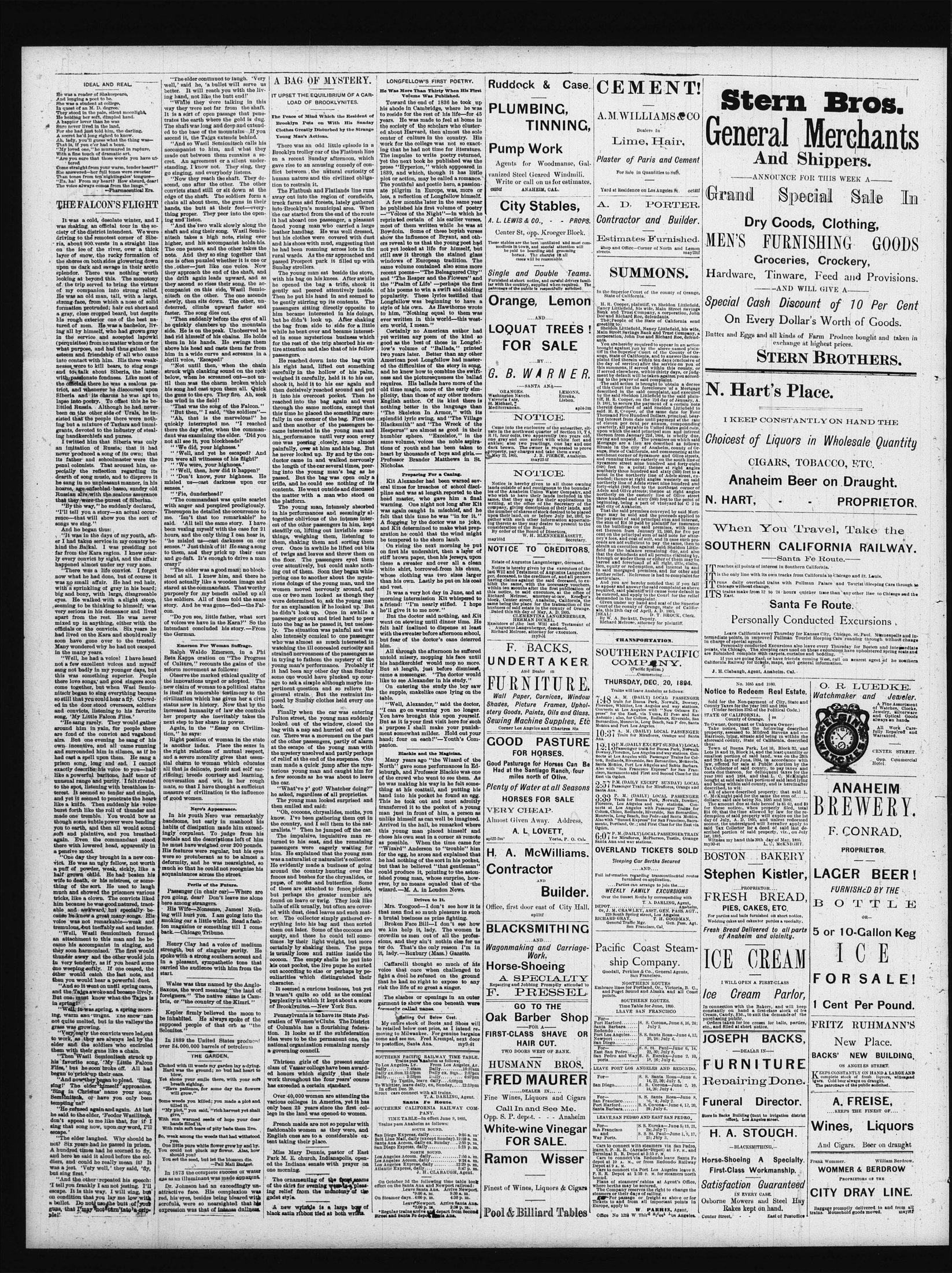
Searchable text
IDEAL AND REAL
He was a reader of Shakespeare,
And longing a poet to be.
She was a student at college,
In quest of an M. D. degree.
They stood in the pale, silent moonlight,
He holding her soft, dimpled hand.
A happier lover than he was
Sure never lived in the land,
For she had just told him, the darling,
A secret he'd long sighed to know.
Ah, lady, you'll guess what the thing was—
That is, if you e'er had a beau.
"My loved one," he murmured in rapture,
With a fine touch of dramatic art,
"Are you sure that those words you have uttered
Come straight from your warm, tender heart?"
She answered—her full tones were sweeter
Than tones from ten'nightingales' tongues—
"Es, ha! From my heart? How absurd, dear!
The voice always comes from the lungs."
—Pharmaceutical Era.
THE FALCON'S FLIGHT
It was a cold, desolate winter, and I was making an official tour in the society of the district intendent. We were driving to the remotest corner of Siberia, about 900 versts in a straight line on the ice of the river, over a thick layer of snow, the rocky formation of the shores on both sides glowering down upon us dark and savage in their arctic splendor. There was nothing worth looking at beyond this. The monotony of the trip served to bring the virtues of my companion into strong relief. He was an old man, tall, with a large, strong face, from which a nose of solid formation protruded; hair cut short and a gray, close cropped beard, but despite his rough exterior one of the best natured of men. He was a bachelor, living all by himself, who had grown gray in the service and accepted lapowki (perquisites) from no matter whom or for what purpose, and had thus gained the esteem and friendship of all who came into contact with him. His three weaknesses were to kill bears, to sing songs and to talk about Siberia, the latter with passionate fondness. Like most of the officials there he was a zealous patriot, and whenever he discoursed upon Siberia and its charms he was apt to lapse into poetry. To offset this he be-littled Russia. Although he had never been on the other side of Urals, he insisted that the people there were nothing but a mixture of Tartars and immigrants, devoted to the industry of stealing handkerchiefs and purses.
I twitted him that Siberia was only an imitation of Russia; that it had never produced a song of its own; that its father and schoolmaster were the penal colonists. That aroused him, especially the reflection regarding its
"The elder continued to laugh. 'Very well,' said he, 'a bullet will serve us better. It will reach you with the living hand, not like the butt end!'
"While they were talking in this way they were not far from the shaft. It is a sort of open passage that penetrates the earth where the gold is dug. The shaft was long and deep and extended to the base of the mountains. If you ascend it, the Tajga extends behind.
"And so Wasil Semionitsch calls his accompanist to him, and what they made out between them remains a secret. An agreement or a silent understanding, I know not. They sing, they go singing, and everybody listens.
"Now they reach the shaft. They descend, one after the other. The other convicts stand still or sit down at the edge of the shaft. The soldiers form a chain all about them, the guns in their hands, the butt at their feet—everything proper. They peer into the opening and listen.
"And the two walk slowly along the shaft and sing their song. Wasil Semionitsch takes a high note, rising ever higher, and his accompanist holds his. The one pauses, and the other takes the note. And they so sing together that one is often puzzled whether it is one or the other—just like one voice. Now they approach the end of the shaft, and the drift again leads upward, and as they ascend so rises their song, the accompanist on this side, Wasil Semionitsch on the other. The one ascends slowly, then sits down. The other, undeterred, climbs up faster and faster. The song dies out.
"Then suddenly before the eyes of all he quickly clambers up the mountain side. He is on the peak. Unobserved he had rid himself of his chains. He holds them in his hands. He swings them above his head and casts them far from him in a wide curve and screams in a shrill voice, 'Escaped!'
"Not until then, when the chain struck with clanking sound on the rock below, when he screamed out—not until then was the charm broken which his song had cast upon them all. Quick the guns to the eye. They fire. Ah, seek the wind in the field!
"That was the song of the Falcon."
"But then," I said, "the soldiers"—
"Ah, that is the marvelous!" he quickly interrupted me. "I reached there the day after, when the commandant was examining the elder. Did you not all see it, you blockheads?
"We did, your highness."
"Well, and yet he escaped? And you were all witnesses of his flight?"
"We were, your highness."
"Well, then, how did it happen?"
A BAG OF MYSTERY
IT UPSET THE EQUILIBRIUM OF THE LOAD OF BROOKLYN NITES
The Peace of Mind Which the Resistance Brooklyn trolley car of the Flatbus en a recent Sunday afternoon gave rise to an amusing comedy flict between the natural curriculature to restrain it.
The Flatbush and Flatlands lie away out into the region of cornfields farms and forests, lately gone into Brooklyn's municipal area. The car started from the end of the road it had aboard one passenger, a person young man who carried leather handbag. He was well dressed but his clothes were covered with his shoes with mud, suggesting he had been roaming across lots rural wards. As the car approached passed Prospect park it filled with Sunday strollers.
The young man sat beside him with his bag on his knees. After he opened the bag a trifle, gently and peered attentively. Then he put his hand in and seemed to gently stirring up its content passengers sitting directly opposite him became interested in his bag but he didn't look up. After he bag from side to side formed while he bent over and became indicted in some mysterious business for the rest of the trip absorbed tire attention and also that of his passengers.
He reached down into the bag his right hand, lifted out some carefully in the hollow of his weighed it carefully, held it to shook it, held it to his ear again then decisively reached around it into his overcoat pocket. Then reached into the bag again through the same motions, exerting this time he placed something fully in one corner of the bag. And then another of the passengers came interested in the young man's performance until very soon one was peering closely, some painfully over at him and his bag he never looked up. By and by by the doctor came in and walked near the length of the car several times into the young man's bag...
with passionate fondness. Like most of the officials there he was a zealous patriot, and whenever he disheard upon Siberia and its charms he was apt to lapse into poetry. To offset this he be-littled Russia. Although he had never been on the other side of Urals, he insisted that the people there were nothing but a mixture of Tartars and immigrants, devoted to the industry of stealing handkerchiefs and purses.
I twitted him that Siberia was only an imitation of Russia; that it had never produced a song of its own; that its father and schoolmaster were the penal colonists. That aroused him, especially the reflection regarding its dearth of song music, and to disprove it he sang in no unpleasant manner, in his hoarse, age enfeebled basso, sundry old Russian airs with the zealous assurance that they were the purest of Siberian.
"By the way," he suddenly declared, "I'll tell you a story—an actual occurrence—that will show you the sort of songs we sing."
And he began thus:
"It was in the days of my youth, after I had taken service in my country behind the Baikal. I was presiding not far from the Kara region. I knew nearly every convict by sight, and the affair happened almost under my very nose.
"There was a life convict. I forget now what he had done, but of course it was no small affair. He had red hair, with a sprinkling of gray in his beard; big and bony, with large, disagreeable eyes. He walked with a slight stoop, seeming to be thinking to himself; was very serious in his demeanor and lived apart from the rest. He was never mixed up in anything, either with the officials or the convicts. Six years he had lived on the Kara and should really soon have gone over to the trusted. Many wondered why he had not escaped in the many years.
"Well, he had a voice! I have heard not a few excellent voices and myself sang not badly in my younger days, but this is something superior. People there love songs, and good singers soon come together, but when Wasi Semionitsch began to sing everything became so still that you could hear a fly. Crowded in the door stood overseers, soldiers and convicts, listening to his favorite song, 'My Little Falcon Flies.'"
"He sang rarely. They would gather around him in vain, for people there are fond of the convict and vagabond airs. But one evening he sang of his own incentive, and all came running and surrounded him in silence, as if he had cast a spell upon them. He sang a prison song, long and sad. I cannot exactly describe his voice to you—half like a powerful baritone, half tenor of unusual range and purity. I felt riveted to the spot, listening with breathless interest. It seemed so tender and simple, and yet it seemed to penetrate the heart like a knife. Then suddenly his voice burst forth like the roll of thunder and made one tremble. You would bow as though some subtle power were bending you to earth, and then all would sound soft and plaintive, and you breathed again. Even the commandant stood there with lowered head, apparently in a pensive mood.
"One day they brought in a new convict. He was an ugly fellow, not worth a puff of powder, weak, sickly, like a half grown child. He had beaten his wife to death, or his mistress, or something of the sort. He used to laugh much and showed the prisoners various tricks, like a clown. The convicts liked below, when he screamed out—not until then she was the charm broken which his song had cast upon them all. Quick the guns to the eye. They fire. Ah, seek the wind in the field!
"That was the song of the Falcon."
"But then," I said, "the soldiers!"—"Ah, that is the marvelous!" he quickly interrupted me. "I reached there the day after, when the commandant was examining the elder. 'Did you not all see it, you blockheads?'
"We did, your highness.'
"Well, and yet he escaped? And you were all witnesses of his flight?"
"We were, your highness.'
"Well, then, how did it happen?"
"Don't know, your highness. He misled us—cast darkness upon our senses."
"Fie, dunderhead!"
"The commandant was quite scarlet with anger and perspired prodigiously. Thereupon he detailed the occurrence to me. 'Isn't that too remarkable?' he said. 'All tell the same story. I have been vexing myself with the case for 21 hours, and the only thing I can hear is, 'he misled us—cast darkness on our senses.' Just think of it! He sang a song to them, and they prick up their ears and go daft. It's enough to drive a man crazy!'
"The elder was a good man; no blockhead at all. I knew him, and there he stood actually like a wooden image and stared at the commandant. That worthy purposely for my benefit called up all the soldiers. All of them told the same story. And he was gone—fled—the Falcon.
"Do you see, little father, what sort of voices we have in the Kara?" So the intendant concluded his story.—From the German.
Emerson For Woman Suffrage.
Ralph Waldo Emerson, in a Phi Beta Kappa oration on "The Progress of Culture," recounts the gains of the reform movement as follows:
Observe the marked ethical quality of the innovations urged or adopted. The new claim of woman to a political status is itself an honorable testimony to the civilization which has given her a civil status new in history. Now that by the increased humanity of law she controls her property she inevitably takes the next step to her share in power.
Again, in the "Essay on Civilization," he says:
Right position of woman in the state is another index. Place the sexes in the right relations of mutual respect, and a severe morality gives that essential charm to woman which educates all that is delicate, poetic and self-sacrificing; breeds courtesy and learning, conversation and wit, in her rough mate, so that I have thought a sufficient measure of civilization is the influence of good women.
Nero's Appearance.
In his youth Nero was remarkably handsome, but early in manhood his habits of dissipation made him exceedingly corpulent. To judge from his medals and the descriptions left of him he must have weighed over 200 pounds. His features were regular, but his eyes were so protuberant as to be almost deformity, and he was nearsighted, so much so that he could not recognize his acquaintances across the street.
Perils of the Future.
Passenger (in chair car)—Where are you going, dear? Don't leave me alone
weighed it carefully, held it to shook it, held it to his ear again through the same motions, exceed this time he placed something fully in one corner of the bag. Faced then another of the passengers came interested in the young man's performance until very soon one was peering closely, some painfully over at him and his bag he never looked up. By and by he doctor came in and walked near length of the car several times into the young man's bag passed. But the bag was opened trifle, and he could see nothing contents. He went outside and dived the matter with a man who stole the platform.
The young man intensely asked in his performances and seemingly together oblivious of the intense est of the other passengers in his steadily on lifting out invisible things, weighing them, shaking them and sorting over. Once in awhile he lifted up of twigs and leaves and thrown to the floor. The passengers eye over attentively, but could make ing out of them. Soon they began perching one to another about these rious doings of the young man; women moved nervously around one or two men looked as though were determined to ask the young man for an explanation if he looked up he didn't look up. Once in awhile passenger got out and tried hard into the bag as he passed it but by fly. The situation was painful also intensely comical to one pair who was almost as much interested watching the ill concealed curious strained nervousness of the passenger in trying to fathom the mystery young man's performance. Proof it had been any other day than some one would have plucked up age to ask a simple although may pertinent question and so relieved general strain. But the restraints posed by Sunday clothes held even back.
Finally when the car was en Fulton street, the young man sucked out of the window, closing bag with a nap and hurried out car. There was a movement on top of the other passengers, partly off at the escape of the young man; the mystery unsolved and partly piled up relief at end of the suspense man made a quick jump after this torious young man and caught him a few seconds as he was about to take car.
"What've y' got? Whatcher did he ask, regardless of all propriety The young man looked surprised then smiled and said:
"Oh, cocoons, chrysalides, moth know I've been gathering them country, and I sell them to ruralists." Then he jumped off to The impulsive, inquisitive man turned to his seat, and the rem passenger were eagerly waited him. He explained that the young was a naturalist or naturalist's colony He evidently made a business out around the country hunting ove fences and bushes for the chrysalis pupae, of moths and butterflies...of these are attached to fence pups but perhaps greater number
and yet is seemed to penetrate the heart like a knife. Then suddenly his voice burst forth like the roll of thunder and made one tremble. You would bow as though some subtle power were bending you to earth, and then all would sound soft and plaintive, and you breathed again. Even the commandant stood there with lowered head, apparently in a pensive mood.
"One day they brought in a new convict. He was an ugly fellow, not worth a puff of powder, weak, sickly, like a half grown child. He had beaten his wife to death, or his mistress, or something of the sort. He used to laugh much and showed the prisoners various tricks, like a clown. The convicts liked him because he was good natured, tractable and awkward, but specially because he knew a great many songs. His voice was not remarkable—weak and tremulous, but ineffably sad and tender.
"Well, Wasil Semionitsch formed an attachment to this man and he became his accompanist in singing, and they soon harmonized. The first would thunder away and the other would join in very tenderly, as if you heard some one weeping softly. If one ceased, the other would catch the last note, and then you would hear a powerful duet.
"And so it went on until spring came, and the Tajga awoke and became lively. But one must know what the Tajga is in spring!
"Well, it was spring, a spring morning, warm and origin. The snow nai not quite melted, but in the valleys the grass was growing.
"Very early the convicts were led out to work, as they are always led by the elder and the soldiers who encroiled them with their guns like a chain.
"Then Wasil Semionitsch struck up his favorite song, 'My Little Falcon Flese,' but he soon broke off. All had begun to prick up their ears.
"And now they began to plead. 'Sing, sing!' The elder himself approaches. 'Sing in Christus' name your song, Semionitsch, or have you only been tempting us?
"He refused again and again. At last he said to the elder, 'Feodor Wasilitsch, don't appeal to me like that, for if I sing that song now, upon my word, I'll escape.'
"The elder laughed. Why should he not? Six years had he passed in prison. A hundred times had he scorned to fly, and here he said it aloud before the soldiers, and could he really mean it? It was a jest. 'Vety well,' they said, 'fly, but sing first.'"
"And the other repeated his speech: 'I tell you frankly I am not jesting. I'll escape. It is this way. I will sing, but on condition that you lay me low with a bullet. Do not use the butt of your guns, that I may not turn into a grippel!"
Nero's Appearance.
In his youth Nero was remarkably handsome, but early in manhood his habits of dissipation made him exceedingly corpulent. To judge from his medals and the descriptions left of him he must have weighed over 200 pounds. His features were regular, but his eyes were so protuberant as to be almost a deformity, and he was near sighted, so much so that he could not recognize his acquaintances across the street.
Perils of the Future.
Passenger (in chair car)—Where are you going, dear? Don't leave me alone here among strangers.
His Wife—Nonsense, James! Nothing will hurt you. I am going into the smoking car a little while. Read a fashion magazine or something till I come back.—Chicago Tribune.
Henry Clay had a voice of medium strength, but of singular purity. He spoke with a strong southern accent and in a pleasant, sympathetic tone that carried the audience with him from the start.
Wales was thus named by the Anglo-Saxons, the word meaning "the land of foreigners." The native name is Cambria, or "the country of the Kimri."
Kepler firmly believed the moon to be inhabited. He always spoke of the supposed people of that orbit as "the Selenites."
In 1889 the United States produced over 34,000,000 barrels of petroleum.
THE GARDEN.
Choked with ill weeds my garden lay a dying. Hard was the ground; no bud had heart to blow. Yet shone your smile there, with your soft breath sighing. "Have patience, for some day the flowers will grow."
Some weeds you killed; you made a plot and tilled it.
"My plot," you said, "rich harvest yet shall give."
With sun warmed seeds of hope your dear hands filled it.
With rain soft tears of pity bade them live.
So, weak among the weeds that had withstood you.
One little pure white flower grew by and by. You could not pluck my flower. Alas, how should you?
You set the seed, but let the blossom die.
—Pall Mall Budget.
In 1873 the complete success or water was an illuminant was made apparent.
Dr. Johnson had an exceedingly unattractive face. His complexion was red, his eyes, besides being bleared with scrofula, were so nearsighted that his expression was that of intense dullness.
The young man looked surprised then smiled and said:
"Oh, cooons, chrysalides, moth know. I've been gathering them in the country, and I sell them to the uralists." Then he jumped off the impulse, inquisitive mind turned to his seat, and the rem passengers were eagerly waiting him. He explained that the young was a naturalist or naturalist's color. He evidently made a business out around the country hunting over fences and bushes for the chrysalids pupae, of moths and butterflies. Of these are attached to fence posts but perhaps the greater number found on leave or twig. They look balls of silk usually, but often are ed with dust, dead leaves and sucker. The collector simply gathered erything into his bag and then them out later. Some of the cocoon empty, and these he could tell times by their light weight, but certainly by shaking them. The is usually loose and rattles insistent ooooon. The empty shells he put his coat pocket, the live pupae he cut according to size or perhaps enliarities which distinguished character.
It seemed a curious business, but it wasn't quite so odd as the coerplexity in which it kept about two of Brooklynites—New York Sun.
Pennsylvania is to have its State eration of Women's Clubs. The Dept of Columbia has a flourishing fiction. It looks as if the subfederation idea were to be the permanent one national organization remaining m.a governing council.
Thirteen girls of the present class of Vassar college have been awarded honors which signify that work throughout the four years' course has exceeded a certain standard.
Over 40,000 women are attending various colleges in America, yet only been 25 years since the first lege in the land was opened to women.
French maids are not so popular fashionable women as they were. English ones are to a considerable tent taking their place.
Miss Mary Dennis, pastor of Park M.E. church, Indianapolis, edited the Indiana senate with prayer one morning.
The ornamenting of the front door of the skirt for evening wear is aiding relief from the monotony of godet style.
A new wrinkle is a large black satin ribbon tied at both wrinkles.
A BAG OF MYSTERY.
UPSET THE EQUILIBRIUM OF A CAR-LOAD OF BROOKLYNITES.
The Peace of Mind Which the Resident of Brooklyn Puts on With His Sunday Clothes Greatly Disturbed by the Strange Young Man's Actions.
There was an odd little episode in a Brooklyn trolley car of the Flatbush line a recent Sunday afternoon, which we rise to an amusing comedy of conjecture between the natural curiosity of human nature and the civilized obligation to restrain it.
The Flatbush and Flatlands line runs away into the region of cornfields, brook farms and forests, lately gathered in Brooklyn's municipal area. When a car started from the end of the route had aboard one passenger, a pleasant young man who carried a large other handbag. He was well dressed, but his clothes were covered with dust and his shoes with mud, suggesting that he had been roaming across lots in the rural wards. As the car approached and passed Prospect park it filled up with Sunday strollers.
The young man sat beside the stove, with his bag on his knees. After awhile he opened the bag a trifle, shook it gently and peered attentively inside. Then he put his hand in and seemed to gently stirring up its contents. The passengers sitting directly opposite to him became interested in his doings, but he didn't look up. After shaking the bag from side to side for a little while he bent over and became interested in some mysterious business which the rest of the trip absorbed his attention and also that of his fellow passengers.
He reached down into the bag with his right hand, lifted out something carefully in the hollow of his palm,ighed it carefully, held it to his ear, took it, held it to his ear again and then decisively reached around and put into his overcoat pocket. Then he reached into the bag again and went through the same motions, except that is time he placed the something carefully in one corner of the bag. First one then another of the passengers became interested in the young man and performance until very soon every was peering closely, some almost finely, over at him and his bag. But never looked up. By and by the conductor came in and walked nervously into the young man's bag as he
LONGFELLOW'S FIRST POETRY.
He Was More Than Thirty When His First Volume Was Published.
Toward the end of 1836 he took up his abode in Cambridge, where he was to reside for the rest of his life—for 45 years. He was made to feel at home in the society of the scholars who clustered about Harvard, then almost the sole center of culture in the country. His work for the college was not so exacting that he had not time for literature. The impulse to write poetry returned, yet the next book he published was the prose "Hyperion," which appeared in 1839, and which, though it has little plot or action, may be called a romance. The youthful and poetic hero, a passionate pilgrim in Europe, was more or less, a reflection of Longfellow himself.
A few months later in the same year he published his first volume of poetry—"Voices of the Night"—in which he reprinted certain of his earlier verses, most of them written while he was at Bowdoin. Some of these boyish verses show the influence of Bryant, and others reveal to us that the young poet had not yet looked at life for himself, but still saw it through the stained glass windows of European tradition. The same volume contained also some more recent poems—"The Beleaguered City" and "The Reaper and the Flowers" and the "Psalm of Life"—perhaps the first of his poems to win a swift and abiding popularity. These lyrics testified that Longfellow was beginning to have a style of his own. As Hawthorne wrote to him, "Nothing equal to them was ever written in this world—this western world, I mean."
Certainly no American author had yet written any poem of the kind so good as the best of those in Longfellow's volume of "Ballads," printed two years later. Better than any other American poet Longfellow had mastered the difficulties of the story in song, and he knew how to combine the swiftness and the picturesqueness the ballad requires. His ballads have more of the old time magic, more of the early simplicity, than those of any other modern English author. Of its kind there is nothing better in the language than "The Skeleton In Armor," with its splendid lyric swing, and "The Village Blacksmith" and "The Wreck of the Hesperus" are almost as good in their humbler sphere. "Excelsior," in the same volume, voices the noble aspirations of youth and has been taken to heart by thousands of boys and girls. Professor Brander Matthews in St. Nicholas.
Ruddock & Case.
PLUMBING,
TINNING,
Pump Work
Agents for Woodmanse, Galvanized Steel Geared Windmili.
Write or call on us for estimates.
ANAHEIM, CAL.
City Stables,
A. L. LEWIS & CO., - PROPS.
Center St, opp. Kroeger Block.
These stables are the best ventilated and most commodious in town, and special attention will be paid to boarding and grooming horses. The charges in all cases will be reasonable.
Single and Double Teams.
Furnished at short notice, and careful drivers familiar with the country, supplied when required. The patronage of the public is respectfully solicited.
Orange, Lemon
...AND...
LOQUAT TREES!
FOR SALE
G. B. WARNER.
SANTA ANA.
ORANGES,
Washington Navels.
Valencia Iate,
St. Michael,
Mediterranean.
NOTICE.
Came into the enclosure of the subscriber, situate in the northwest quarter of Section 13, T4, RJ1, four colts, two apparently two years old, one gray and one sorrel with white feet and ankles; also two yearlings, one bay and one dark brown. The owner is requested to prove property, pay charges and take them away.
May 22, 1895.
J.B. PIERCE, Anaheim.
may 23-f
CEMEN
A.M.WILLIAMS
Dealers In
Lime, HarPlaster of Paris and
For Sale in Quantities to Sell
Yard at Residence on Los Angeles
A. D. PORT
Contractor and B
Estimates Furniture
Shop and Office—Corner of North streets.
SUMMON
In the Superior Court of the county,
State of California.
H. R. Cooper, plaintiff vs. Sheldon,
Sancy Littlefield, his wife, Main Street Bank and Trust Company, a corporate Doe and Richard Ree, defendants.
The People of the State of Caligreeting to:
Sheldon Littlefield, Nancy Littlefield,
Main Street Savings Bank and Trust Corporation, John Doe and Richard Doe.
You are hereby required to appear brought against you by the above tilt in the Superior Court of the County, State of California, and to answer plaintiffs after the service this summons; if served within this day if served elsewhere, within thirty days if therein described of said Shelden said: H. R. Cooper, of the same day Thousand Five Hundred Dollars; prening interest from date until payment of eleven per cent per annum; quarterly; all payable in United States upon which the said principal sum therefrom from January 22d, 1894; is owed and unpaid. The premises are a lien described Situate in the city of Anaheim, california; State of California, and commute southeast corner of Sycamore and And running thence easterly on Sycamore street nine hundred and sixty point; in this city at southern three hundred and sixty point.
Preparing For a Canine.
It carefully, held it to his ear, took it, held it to his ear again and decisively reached around and put into his overcoat pocket. Then he entered into the bag again and went through the same motions, except that time he placed the something carefully in one corner of the bag. First one then another of the passengers became interested in the young man and performance until very soon every time he placed the something carefully in one corner of the bag. First one then another of the passengers become interested in the young man and performance until very soon every time he placed the something carefully in one corner of the bag.
But the bag was open only a tie, and he could see nothing of its contents. He went outside and discussed matter with a man who stood on a platform.
The young man intensely absorbed his performances and seemingly all other passengers in him, kept radically on, lifting out invisible some-thing, weighing them, listening to them, shaking them and sorting them.
Once in awhile he lifted out bits twigs and leaves and threw them on the floor. The passengers eyed them or attentively, but could make nothing out of them. Soon they began whispering one to another about the mysteries doings of the young man, and the men moved nervously around, and or two men looked as though they were determined to ask the young man an explanation if he looked up. But didn’t look up. Once in awhile a passenger got out and tried hard to peer at the bag as he passed it, but useless.
The situation was painful and was so intensely comical to one passenger who was almost as much interested in watching the ill concealed curiosity and trained nervousness of the passengers as trying to fathom the mystery of the young man’s performance. Probably if had been any other day than Sunday one would have plucked up course to ask a simple although maybe im-iment question and so relieve the general strain. But the restraint im-ined by Sunday clothes held every one back.
Finally when the car was enteringoton street, the young man suddenly kicked out of the window, closed his wrist with a nap and hurried out of the room. There was a movement on the part of other passengers, partly of alarm the escape of the young man with mystery unsolved and partly perhaps relief at the end of the suspense. One man made a quick jump after the mysterious young man and caught him for few seconds as he was about to leave car.
“What’ve y’got? Whatother doing?” asked, regardless of all proprieties. The young man looked surprised and smiled and said:
“Oh, cocoons, chrysalides, moths, you’ve been gathering them out in country, and I sell them to the nat-lists.” Then he jumped off the car. The impulsive, inquisitive man re-ceded to his seat, and the remaining senders were eagerly waiting for him. He explained that the young man a naturalist or naturalist’s collector, evidently made a business of going round the country hunting over the trees and bushes for the chrysalides, or moths, and butterflies. Some these are attached to fence pickets, perhaps the greater number are
ness and the picturesqueness the ballad requires. His ballads have more of the old time magic, more of the early simplicity, than those of any other modern English author. Of its kind there is nothing better in the language than “The Skeleton In Armor,” with its splendid lyric swing, and“The Village Blacksmith”and“The Wreck of the Hesperus”are almost as good in their humbler sphere.“Excelsior,”in the same volume, voices the noble aspirations of youth and has been taken to heart by thousands of boys and girls.—Professor Brander Matthews in St. Nicholas.
Preparing For a Caning.
Kit Alexander had been warned several times for breaches of school discipline and was at length reported to the headmaster, who gave him a final warning. One night not long after Kit was again caught in mischief, and he felt that this time he was “in for it.” A flogging by the doctor was no joke, and Kit determined to make what preparation he could that the wind might be tempered to the shorn lamb.
On rising the next morning he put on first his undershrift, then a layer of stiff brown paper, then his jerseys, upon these a sweater and over all a clean white shirt, borrowed from his chum, whose clothing was two sizes larger than his own. Lastly he put on his coat and vest.
It was a very hot day in June, and at morning intermission Kit whispered to a friend:“I’m nearly stifled. I hope he’ll give it to me now.”
But the doctor said nothing, and Kit went on stewing until dinner time. He felt half inelined to dispense at least with the sweater before afternoon school, but fear of the doctor’s cane deterred him.
All through the afternoon he suffered untold misery, mopping his face until his handkerchief would mop no more. But at length, just before dismissal, came a messenger.“The doctor would like to see Alexander in his study.”
On entering the study boy saw the supple, snakelike cane lying on the table.
“Well, Alexander,” said the doctor,“I can go on warning you no longer. You have brought this upon yourself. But as it is your first visit here for such a purpose I shall make your punishment somewhat milder. Hold out your hand; four on each!”—Youth’s Companion.
Blackie and the Magician.
Many years ago“the Wizard of North” gave some performances in Edinburgh, and Professor Blackie was one of the crowd who went to see them. As he was making his way in he felt something at his coattail, and putting his hand into his pocket he found an egg. This he took out and most adroitily transferred it to the pocket of a young man just in front of him, a person as unlike himself as can well be imagined. Arrived in the hall, he remarked where this young man placed himself and chose his own seat in a corner as remote as possible. When the time came for“Wizard”Anderson to“trouble”him for the egg, he arose and explained that he had nothing of the sort in his pocket, but that he believed“that gentleman”could produce it, pointing to the astonished young man, whose surprise, however, by no means equaled that of the wizard.M.A. in London News.
F. BACKS,
UNDERTAKER.
AND Dealer in FURNITURE.
Wall Paper,Cornices Window Shades,Picture Frames,Upholstery Goods,Paints.Oils and Glass.Sewing Machine Supplies Etc
Corner Los Angeles and Chartres Sts
GOOD PASTURE FOR HORSES.
Good Pasturage for Horses Can Be Had at the Santiago Ranch,four miles north of Olive.
Plenty of Water at all Seasons HORSES FOR SALE VERY CHEAP.
Almost Given Away.Address,A.L.LOVETT,
Yorla,P.O.Cal.
H.A.McWilliams.
Contractor AND Builder.
Southern Pacific Company (Pacific System).
Thursday, Dec. 20,
Trains will leave Anaheim as follows:
A.DAILY) LOCAL train for Buena Park,Norwalk Florence,Whittier Lake with“Newpress”for at Los Angeles with“Newpress”for at East,yuma.ElAntonio;also for Colton,Redlands,Bernardino,Monroe,Long Beach,San Bernardo,Monroe,Long Beach,San Bernardo,Monroe,Long Beach,San Bernardo,Monroe,Long Beach,San Bernardo,Monroe,Long Beach,San Bernardo,Monroe,Long Beach,San Bernardo,Monroe,Long Beach,San Bernardo,Monroe,Long Beach,San Bernardo,Monroe,Long Beach,San Bernardo,Monroe,Long Beach,San Bernardo,Monroe,Long Beach,San Bernardo,Monroe,Long Beach,San Bernardo,Monroe,Long Beach,San Bernardo,Monroe,Long Beach,San Bernardo,Monroe,Long Beach,San Bernardo,Monroe,Long Beach,San Bernardo,Monroe,Long Beach,San Bernardo,Monroe,Long Beach,San Bernardo,Monroe,Long Beach,San Bernardo,Monroe,Long Beach,San Bernardo,Monroe,Long Beach,San Bernardo,Monroe,Long Beach,San Bernardo,Monroe,Long Beach,San Bernardo,Monroe,Long Beach,San Bernardo,Monroe,Long Beach,San Bernardo,Monroe,Long Beach,San Bernardo,Monroe,Long Beach,San Bernardo,Monroe,Long Beach,San Bernardo,Monroe,Long Beach,San Bernardo,Monroe,Long Beach,San Bernardo,Monroe,Long Beach,San Bernardo,Monroe,Long Beach,San Bernardo,Monroe,Long Beach,San Bernardo,Monroe,Long Beach,San Bernardo,Monroe,Long Beach,San Bernardo,Monroe,Long Beach,San Bernardo,Monroe,Long Beach,San Bernardo,Monroe,Long Beach,San Bernardo,Monroe,Long Beach,San Bernardo,Monroe,Long Beach,San Bernardo,Monroe,Long Beach,San Bernardo,Monroe,Long Beach,San Bernardo,Monroe,Long Beach,San Bernardo,Monroe,Long Beach,San Bernardo,Monroe,Long Beach,San Bernardo,Monroe,Long Beach,San Bernardo,Monroe,Long Beach,San Bernardo,Monroe,Long Beach,San Bernardo,Monroe,Long Beach,San Bernardo,Monroe,Long Beach,San Bernardo,Monroe,Long Beach,San Bernardo,Monroe,Long Beach,San Bernardo,Monroe,Long Beach,San Bernardo,Monero
The young man looked surprised and smiled said:
"Oh, cocoons, chrysalides, moths, you now. I've been gathering them out in the country, and I sell them to the natalists." Then he jumped off the car. The impulsive, inquisitive man re-raised to his seat, and the remaining passengers were eagerly waiting for him. He explained that the young man was a naturalist or naturalist's collector. Evidently made a business of going around the country hunting over the trees and bushes for the chrysalides, or insects, of moths and butterflies. Some of these are attached to fence pickets, perhaps the greater number are used on leave or twig. They look like husks of silk usually, but often are covered with dust, dead leaves and such materials. The collector simply gathered everything into his bag and then sorted it out later. Some of the cocoons are oily, and these he could tell sometimes by their light weight, but more mainly by shaking them. The pupa usually loose and rattles inside theoon. The empty shells he put into coat pocket, the live pupae he sorted according to size or perhaps by pararities which distinguished their tracer.
It seemed a curious business, but yet wasn't quite so odd as the comical eloquence in which it kept about a score Brooklynites.—New York Sun.
Pennsylvania is to have its State Federation of Women's Clubs. The District Columbia has a flourishing federation. It looks as if the subfederation were to be the permanent one, the usual organization remaining merely evening council.
Fourteen girls of the present senior of Vassar college have been award-monitors which signify that their efforts throughout the four years' course exceeded a certain standard.
Over 40,000 women are attending the most colleges in America, yet it has been 25 years since the first collin in the land was opened to women.
French maids are not so popular with nonable women as they were, and Irish ones are to a considerable extent taking their place.
Miss Mary Dennis, pastor of East M.E. church, Indianapolis, opens the Indiana senate with prayer on morning.
The ornamenting of the front seams the skirts for evening wear is pleasurable from the monotony of the style.
A new wrinkle is a large bow of satin ribbon tied at both wrists.
This he took out and most adroitly transferred it to the pocket of a young man just in front of him, a person as unlike himself as can well be imagined. Arrived in the hall, he remarked where this young man placed himself and chose his own seat in a corner as remote as possible. When the time came for "Wizard" Anderson to "trouble" him for the egg, he arose and explained that he had nothing of the sort in his pocket, but that he believed "that gentleman" could produce it, pointing to the astonished young man, whose surprise, however, by no means equaled that of the wizard.—M.A. in London News.
Driven to It.
Mrs. Toogood—I don't see how it is that men find so much pleasure in such a brutal business as prize fighting.
Broken Face Bill—I don't see how we kin help it, lady. The women is crowdd us men out of all the professions, and they ain't nothin else for us ter do. That's only reason I'm in it, lady.—Roxbury (Mass.) Gazette.
Caffarelli thought so much of his voice that once when challenged to fight a duel he refused on the ground that he had no right to expose to any risk the life of so great a singer.
The slashes or openings in an outer garment to show the one beneath were formerly called nanes.
Selling Out Below Cost.
My entire stock of Boots and Shoes will be retailed below cost price, as I intend removing to Milwaukee. For genuine bargains come and see me. Fred Krempel, next door to postoffice, Santa Ana.
my9:4t
SOUTHERN PACIFIC RAILWAY TIME TABLE.
Trains pass Anaheim as follows;
To Los Angeles, Lr. From Los Angeles, Ar.
Daily...7:48am Daily...10:37am
Daily ex.Sun.12:13pm Daily ex.Sun...2:57pm
Daily...3:33pm Daily...6:07pm
To Tustin, leave daily...6:08pm
To Whittier, leave daily ex,Sunday...12:13pm In effect Dec. 20.
Street cars connect with all trains.
T.A.DARLING,Agent.
Santa Fe Route.
SOUTHERN CALIFORNIA RAILWAY COMPANY.
TIME TABLE-In effect June 9, 1895.
Trains pass Anaheim as follows:
SOUTH BOUND.
San Diego Express,daily...9:05 a.m.
Belt Line Mail,daily(except Sunday)12:10 a.m.
Santa Ana Accom,daily ex.Sunday...2:55 p.m.
San Diego Express,daily...5:18 p.m.
NORTH BOUND.
Los Angeles Accom,daily...7:56 a.m.
Los Angeles Accom,daily...9:24 a.m.
Los Angeles Express,daily...12:29 p.m.
Atlantic Express,daily...5:47 p.m.
J.H.CLABAUGH,Agent.
On October 3d the following table took effect on the Santa Ana and Newport railroad:
Leave Santa Ana. Arrive Newport.
*9:00 a.m. 9:30 a.m.
On Steamer days..4:00 p.m. 4:30 p.m.
Leave Newport. Arrive Santa Ana..3:00 p.m. 3:30 p.m.*
HORSES FOR SALE
VERY CHEAP.
Almost Given Away. Address,
A.L.LOVETT,
Yorla,P.O.O.Cal.
H.A.McWilliams.
Contractor
And
Builder.
Office,first door east of City Hall.
ap11tf
BLACKSMITHING
AND
Wagonmaking and Carriage-Work,
Horse-Shoeing
A SPECIALTY
Repairing and Jobbing Promply attended to F.PRESSEL.
GO TO THE
Oak Barber Shop
FOR A
FIRST-CLASS SHAVE OR HAIR CUT.
TWO DOORS WEST OF BANK.
HUSMANN BROS.
FRED MAURER
DEALER IN...
Fine Wines,Liquors and Cigars
Call In and See Me.
Opp.S.P.p depot....Anaheim
White-wine Vinegar FOR SALE.
Ramon Wisser
Finest of Wines,Liquors & Cigars
Pool & Billiard Tables
CEMENT!
A.M.WILLIAMS & CO
Dealers In
Lime, Hair,
Plaster of Paris and Cement
For Sale in Quantities to Suit.
Yard at Residence on Los Angeles St. oct4tf
A.D.PORTER,
Contractor and Builder.
Estimates Furnished.
Shop and Office—Corner of North and Lemon streets.
SUMMONS.
In the Superior Court of the county of Orange, State of California.
H.R.Cooper, plaintiff, vs. Sheldon Littlefield, Nancy Littlefield, his wife, Main Street Savings Bank and Trust Company, a corporation, John Doe and Richard Roe, defendants.
The People of the State of California send greeting to:
Sheldon Littlefield, Nancy Littlefield, his wife, Main Street Savings Bank and Trust Company, a corporation, John Doe and Richard Roe, defendants.
You are hereby required to appear in an action brought against you by the above named plaintiff in the Superior Court of the County of Orange, State of California, and to answer the complaint filed therein within ten days (exclusive of the day of service) after the service on you of this summons, if served within this county, or if served elsewhere, within thirty days, or judgment by default will be taken against you according to the prayer of said complaint.
The said action is brought to obtain a decree of this Court for the foreclosure of a Mortgage described in the said complaint, and executed by the said Sheldon Littlefield to the said plaintiff, H.R.Cooper, on the 22d day of January, A.D.1891, to secure the payment of a certain note therein described of said Sheldon Littlefield to said H.R.Cooper, of the same date for Four Thousand Five Hundred Dollars, principal, bearing interest from date until payment at the rate of eleven per cent per annum, compounding quarterly, all payable in United States gold coin upon which the said principal sum and interest thereon from January 22d, 1894, is wholly due, owing and unpaid. The premises on which said Mortgage are a lien are described as follows: Situate in the city of Anaheim, county of Orange, State of California, and commencing at the southeast corner of Sycamore and Olive streets, and running thence easterly on the south line of Sycamore street nine hundred and forty-eight feet to a point; thence at right angles southerly three hundred and sixty (360) feet to a point.
Stern Bros.
General Merchants
And Shippers.
ANNOUNCE FOR THIS WEEK A
Grand Special Sale In
Dry Goods, Clothing,
MEN'S FURNISHING GOODS
Groceries, Crockery,
Hardware, Tinware, Feed and Provisions.
AND WILL GIVE A
Special Cash Discount of 10 Per Cent
On Every Dollar's Worth of Goods.
Butter and Eggs and all kinds of Farm Produce bought and taken in exchange at highest prices.
STERN BROTHERS.
N.Hart's Place.
I KEEP CONSTANTLY ON HAND THE
Choicest of Liquors in Wholesale Quantity
CIGARS, TOBACCO, ETC.
N. Hart's Place.
I KEEP CONSTANTLY ON HAND THE Choicest of Liquors in Wholesale Quantity
CIGARS, TOBACCO, ETC.
Anaheim Beer on Draught.
N. HART, PROPRIETOR.
When You Travel, Take the SOUTHERN CALIFORNIA RAILWAY.
Santa Fe Route.
It reaches all points of interest in Southern California.
It is the only line with its own tracks from California to Chicago and St. Louis.
It runs daily overland trains with Pullman Palace and Tourist Sleeping Cars through Chicago without change.
It makes from 12 to 24 hours quicker time than any other line to Chicago and the East.
Santa Fe Route.
Personally Conducted Excursions
Leave California every Thursday for Kansas City, Chicago, St. Paul, Minneapolis and intermediate points in improved Pullman Tourist Sleeping Cars running without change in charge of special agents.
The sleeping cars used on these excursions have upholstered spring seats and are furnished complete with carpets, curtains and bedding.
If you are going East or have friends coming West, call on nearest agent of he southern California Railway for tickets, maps, and general information.
J. H. Clabaugh, Agent, Anaheim, Cal.
TRANSPORTATION.
SOUTHERN PACIFIC COMPANY.
(Pacific System.)
Commencing...
THURSDAY, DEC. 20, 1894.
Trains will leave Anaheim as follows:
7:48 A. M. (DAILY) LOCAL PASSENGER train for Buena Park, Norwalk, Downey, Florence, Whitier, Los Angeles and way stations. Connects at Los Angeles with "New Orleans" press for the East, via Yuma, El Paso and San Antonio; also for Colton, Redlands, Riverside, San Bernardino, Monrovia, Monrovia, Port Los Angeles and Santa Barbara also with "San Francisco Express" for San Francisco, Sacramento and First and Second Class for the East via Ogden.
2:57 P.M. (DAILY EXCEPT SUNDAY) LOCAL Passenger Train for Mirafores, Orange and Santa Ana.
3:33 P. M. (DAILY) LOCAL PASSENGER train for Buena Park, Norwalk, Downey, Florence, Los Angeles and way stations. Connects at Los Angeles with Passenger Trains for Colton, Redlands, San Marinley, Monrovia, Monrovia, Long Beach, San Pedro and Santa Barbara also with "Sunset Express" for San Francisco, Sacramento, Portland, Or.; and First Class for the East via Ogden.
6:07 P.M. (DAILY) LOCAL PASSENGER TRAIN for Mirafores, Tustin, Orange Santa Ana and way stations.
OVERLAND TICKETS SOLD
Sleeping Car Berths Secured
AND...
Full information regarding transcontinental routes furnished on application.
Parties can arrange to join the...
WEEKLY FAMILY EXCURSIONS
Over the Sunset Route by corresponding with...
No. 1685 and 1980.
Notice to Redeem Real Estate.
Sold for the Non-payment of City, State and County Taxes for the year 1883 and 1884 (Under Section 3788 of the Political Code.) STATE OF CALIFORNIA, COUNTY OF ORANGE.
To Owner, Occupant or Unknown Owner:
Take notice that the following described property, assessed to Mildred Stevens and Harrison lying, situate and being within the aforesaid county, State of California, described thus:
Town of Buena Park, Lot 10, Block 32, and Lots 8 and 10 in Buck IA and the least quantity or smallest portion of said land was on the 29th days of June, 1894, in accordance with law, offered for sale at Public Auction by the Tax Collector of said county, to pay taxes and costs due thereon, for delinquent taxes for the year 1883 and 1884, and that L. C. McKnight bought at said sale that portion of said land lying within said county, and is hereinafter described, to wit:
All of above described property; that said L. C. McKnight paid for the same sum of... dollars; said sale being No. 1685 and 1980.
The amount due at date hereof is $52,220 and $9 for these noticees when properly filed, total $61400 that is due by law on the 29th days of June, 1894; demption of said property will expire on the last day of July, A.D. 1885, and unless redeemed sooner, the undersigned will hereafter apply to said Tax Collector for a deed of said last described portion of said property, viz., on July 1st, 1895.
Witness my hand this 30th day of May, 1885 my30-4t L. C. McKNIGHT.
BOSTON BAKERY
Stephen Kistler,
FRESH BREAD
O. R. LUEDKE.
Watchmaker and Jeweler.
A Fine Assortment of Watches, Clocks, Jewelry, Silverware and Optical Goods always en hands.
All Work Carefully Repaired and Warranted.
CENTER STREET.
Opp. Commercial Hotel.
OVERLAND TICKETS SOLD
Sleeping Car Berths Secured
... AND...
Full information regarding transcontinental routes furnished on application.
WEEKLY FAMILY EXCURSIONS
Over the Sunset Route by corresponding with T. A. DARLING, Agent,
Depot...
Anahiem,
Or, J. M. CRAWLEY, ASST. GEN. PASS. AGT., 229 South Spring street, Los Angeles.
RICHARD GRAY,
T. H. GOODMAN,
General Traffic Mgr.
Gen. Pass. Agt.
San Francisco, Cal.
Pacific Coast Steamship Company.
Goodall, Perkins & Co., General Agents,
San Francisco.
NORTHERN ROUTES
Embrace lines for Portland, Or., Victoria, B. C., and Puget Sound and Alaska and all Coast points.
SOUTHERN ROUTES.
Time Table for June, 1895.
LEAVE SAN FRANCISCO
For—
Port Harford...
S. S. Corona, June 8, 16, 24; July 2.
Santa Barbara...
Redondo...
Port Los Angeles...
S. S. Santa Rosa—June 4, 12, 20, 28; July 6.
Newport...
San Diego...
S. S. St. Paul—June 6, 14, 22, 30; July 8.
San Pedro and Wayports...
S. S. Eureka—June 2, 10, 18, 26; July 4.
LEAVE PORT LOS ANGELES AND REDONDO.
For—
San Diego...
S. S. Santa Rosa—June 6, 14, 22, 30; July 8.
S. S. Corona—June 2, 10, 18, 26; July 4.
For—
San Francisco...
S. S. Santa Rosa—June 8, 16, 24; July 2.
S. S. Corona—June 4, 12, 20, 28; July 6.
LEAVE SAN PEDRO AND EAST SAN PEDRO.
For—
San Francisco and Bay Ports.
S. S. Eureka—June 5, 13, 21, 29; July 7.
S. S. St. Paul—June 1, 9, 17, 25; July 3.
Cars to connect with steamers via San Pedro, save S. P., K. R. (Arcade-Bepot) at 5 P.M., and terminal R. R. Depot at 5:15 P.M.
Cars to connect via Redondo leave Santa Fe Depot at 10 A.M., or from Redondo Railway Depot at 9 A.M.
Cars to connect via Port Los Angeles leave S. R. R. Depot at 1:10 P.M., for steamers northward.
Plans of steamers' cabins at Agent's Office, where berths may be secured.
The Company reserves the right to change the steamers or their days of sailing.
For passage or freight as above or for tickets to and from all important points in Europe, apply to W. PARRIS, Agent,
Office No 1231 W Third Street Los Angeles.
BOSTON BAKERY
Stephen Kistler,
PROPRIETOR...
FRESH BREAD,
PIES, CAKES, ETC.
For parties and bails furnished on short notice.
Welding cakes and cakes for parties a specialty.
Fresh Bread Delivered to all parts of Anaheim and vicinity.
ICE CREAM
I WILL OPEN A FIRST-CLASS Ice Cream Parlor,
In connection with the Bakery, and will keep constantly on hand a first-class stock of ice Cream, Candy, Etc., to suit the demands of the purchasing public.
Orders taken for ice cream for balls, parties, etc., and filled at short notice.
JOSEPH BACKS,
DEALER IN
FURNITURE RepairingDone.
Funeral Director.
Store in Backs Building (next to irrigation district office), Los Angeles street.
H. A. STOUGH.
BLACKSMITHING,
Horse-Shoeing A Specialty.
First-Class Workmanship.
Satisfaction Guaranteed
IN EVERY CASE
Osborne Mowers and Steel Hay Rakes kept on hand.
Center Street,
BREWERY.
F. CONRAD,
PROPRIETOR.
LAGER BEER!
FURNISHED BY THE BOTTLE
OR—
5 or 10-Gallon Keg ICE FOR SALE!
1 Cent Per Pound.
FRITZ RUHMANN'S New Place.
BACKS' NEW BUILDING.
OS ANGELES STREET.
KEEPS CONSTANTLY ON HAND A LARGE AND complete stock of fresh liquors, wines and ligars. Cold beer always on draught.
The patronage of the public solicited.
A. FREISE,
KEEPS THE FINEST OF....
Wines, Liquors
And Cigars. Beer on draught
Frank Wommer.
William Berdrow.
WOMMER & BERDROW
PROPRIETORS OF THE
CITY DRAY LINE.
Baggage promptly delivered to and from all trains. Household goods moved.