anaheim-gazette 1894-07-05
Scanned page
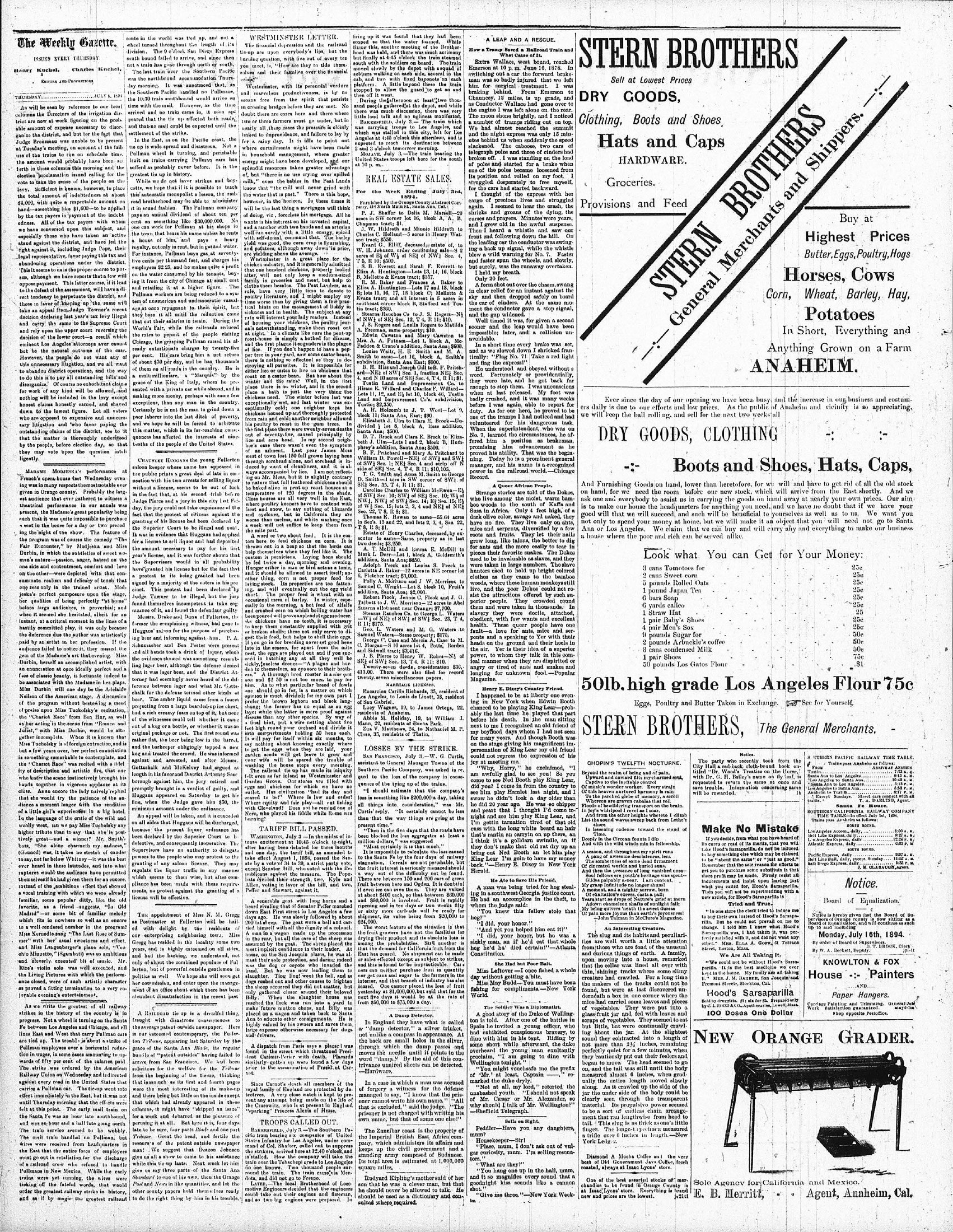
Searchable text
As will be seen by reference to our local columns the Directors of the irrigation district are now at work figuring on the probable amount of expense necessary to disorganize the district, and but for the fast that Judge Broussau was unable to be present at Tuesday's meeting, on account of the failure of the trains to run on schedule time, the amount would probably have been set forth in those columns this morning and the election proclamation issued calling for the vote to take the sense of the people on the lavy. Sufficient is known, however, to place the total amount of indebtedness at about $4,000, with quite a respectable amount on hand—something like $1,600—to be applied by the tax payers in payment of the indebtedness. All of the tax payers with whom we have conversed upon this subject, and especially those who have taken an active stand against the district, and have led the fight against it, including Judge Pope, their legal representative, favor paying this tax and abandoning operations under the district.
This it seems to us is the proper course to pursue, although we have reports that a few will oppose payment. This latter course, if it lead to the defeat of the assessment, will have a direct tendency to perpetuate the district, and those in favor of keeping up the same will take an appeal from Judge Towner's recent decision declaring last year's tax levy illegal and carry the same to the Supreme Court and rely upon the upper court reversing the decision of the lower court—a result which eminutes Los Angeles attorneys aver cannot but be the natural outcome of the case. However, the people do not want any of this unnecessary litigation, and we all want to abandon district operations, and the way to do this is to pay all outstanding bills and disorganize. Of course no exhorbitant claims for work of any kind will be allowed, and nothing will be included in the levy except honest claims honestly earned, and shaved down to the lowest figure. Let all voters who are opposed to expensive and unnecessary litigation and who favor paying the outstanding claims of the district, see to it that the matter is thoroughly understood by the people, before election day, so that they may vote upon the question intelligently.
route in the world was tied up, and not a wheel turned throughout the length of its division. The 9 o'clock San Diego Express south bound failed to arrive, and since then not a train has gone through north or south. The last train over the Southern Pacific was the northbound accommodation Thursday morning. It was announced that, as the Southern Pacific handled no Pullmans, the 10:30 train southbound would arrive on time with the mail. However, as the time arrived and no train came in, it soon appeared that the tie up affected both roads, and that no mail could be expected until the settlement of the strike.
In the East, as on the Pacific coast, the tie up is wide-spread and disastrous. Not a Pullman wheel is turning, and perishable fruit on trains carrying Pullman cars has suffered as probably never before. It is the greatest tie up in history.
While we do not favor strikes and boycotts, we hope that if it is possible to teach this autocratic monopolist a lesson, the railroad brotherhood may be able to administer it in sound fashion. The Pullman company pays an annual dividend of about ten percent on something like $30,000,000. No one can work for Pullman at his shops in the town that bears his name unless he rents a house of him, and pays a heavy royalty, notonly in rent, but in gas and water. For instance, Pullman buys gas at seventy-five cents per thousand foot, and charges his employees $2.25, and he makes quite a profit on the water consumed by his tenants, buying it from the city of Chicago at small cost and retailing it at a higher figure. The Pullman workers are being reduced to a system of unamerican and undemocratic vassalage at once repugnant to their spirit, but they bore it all until the reduction came that out their salaries in twain. During the World's Fair, while the railroads reduced the rates to permit of the people visiting Chicago, the grasping Pullman raised his already extortionate charges by twenty-five per cent. His cars bring him a net return of about $50 per day, and he has thousands of them on all roads in the country. He is a multimillionaire, a "Marquis," by the grace of the King of Italy, whom he presented with a private car while abroad, and is making more money, perhaps with some few exceptions, than any man in the country. Certainly he is not the man to grind down a poor laborer into the last ditch of poverty, and we hope he will be forced to arbitrate this matter, which in its far-reaching consequences has affected the interests of nineteen of the people of the United States.
WESTMINSTER LETTER.
The financial depression and the railroad tie-up are upon everybody's lips, but the burning question, with five out of every ten you meet, is, "How are they to tide themselves and their families over the financial crisis?"
Westminster, with its perennial verdure and marvelous productiveness, is by no means free from the spirit that persists in crossing bridges before they are met. No doubt there are cases here and there where two or three farmers must go under, but in nearly all these cases the pressure is closely linked to improvidence, and failure to lay by for a rainy day. It is idle to point out where curtailments might have been made in household management, where greater energy might have been developed, and our splendid resources taken greater advantage of, but "there is no use crying over spilled milk," even the babies in the Past Lands know that "the mill will never grind with the water that is past." There is this hope, however, in the horizon. In these times it will be the last thing a mortgagee will think of you; viz., foreclose his mortgage. All he wants is his interest on his invested capital, and a rancher with two hauds and an artesian well can surely with a little energy, spiced with self-denial, command that. The barley yield was good, the corn crop is flourishing, and potatoes; although away down in price, are yielding above the average.
Westminster is a great place for the chicken industry, and it is generally admitted that one hundred chickens, properly looked after, will not only keep a medium-sized family in groceries and meat, but help to clothe them beaches. The Peat Landers as a rule, have very little time to devote to poultry literature, and I might employ my time worse than by giving them a few practical hints on the management of blind in sickness and in health. The subject at any rate will interest your lady readers. Instead of housing your chickens, the poultry journals notwithstanding make them roost out at night. In a climate like ours the pent-up roost-house is simply a hotbed for disease, and the first plague it engenders is the plague of lice. If you don't happen to have a paper tree in your yard, sow some castor beans; there is nothing so effectual as they in destroying all parasites. It is impossible for either lice or mites to live on chickens that roost on a castor bean. But how about the winter and the rains? Well, in the first place there is no winter, and in the second place a bath is just the very thing the chickens need. The winter before last was exceptionally wet, and last winter was exceptionally cold; one neighbor kept his chickens housed up and thoroughly protected from rain and cold; another neighbor allowed his poultry to roost in the gum trees. In the first place there were twenty-seven deaths out of seventy-five caused principally by lice and sore head. In my second neighbor's case there wasn't even the symptom of an alment.
Last year James Moss west of town lost 150 full grown laying hens
MADAME MODESKA'S performance at French's opera-house last Wednesday evening was in many respects the most notable ever given in Orange county. Probably the largest audience that ever gathered to witness a theatrical performance in our annuals was present, the Madame's great popularity being such that it was quite impossible to purchase a seat in the house for a day or two preceding the night of the show. The feature of the program was of course the comedy "The Fair Encounter," by Modjeska and Miss Durbin, in which the subtleties of sweet woman's nature—passion, anger, hatred on the one side and contentment, comfort and love on the other—were depicted with that consummate realism and delicacy of touch that one sees only in the trained artist. Modjeska's perfect composure upon the stage, her qualities of being perfectly "at home" before large audiences, is proverbial; and when it seemed she hesitated, albeit for an instant, at a critical moment in the lines of a hasty committed play, it was only because the deference due the author was artistically paid by an artist in her profession. If the audience failed to notice it, they mussed the gem of the Madame's art that evening. Miss Durbin herself an accomplished artist, with an enunciation at once ideally perfect and a face of classic beauty, is fortunate indeed to be associated with the Madame in her plays. Miss Durbin will one day be the Adelaide Neilson of the American stage. A discussion of the program without beatowing a meed of praise upon Miss Tuckolsky's recitation, the "Chariot Race" from Ben Hur, as well as her acting in the scene from "Rousseau and Juliet," with Miss Durbin, would be altogether incomplete. When it is known that Miss Tucholsky is of foreign extraction, and is but a few years over, her perfect enunciation is something remarkable to contemplate, and the "Chariot Race" was recited with a fidelity of description and artistic fire, that one who knew the scene instinctively brought his hands together in vigorous applause at its close. As an encore the lady naively replied that she would try the patience of the audience a moment longer with the rendition of a little girl's experiences in a big hotel. In the language of the critique of the wild and woolly west, we can pay Miss Tucholsky any higher tribute than to say that she is positively great—and a winner? Mr. Smith's bass, "She alone charmeth my sadness," (Gounod) was, it takes no stretch of cander to say, not far below Whitney—it was the best heard in these latitudes, and into what this unnecessary litigation, and we all want to abandon district operations, and the way to do this is to pay all outstanding bills and disorganize. Of course no exorbitant claims for work of any kind will be allowed, and nothing will be included in the levy except honest claims honestly earned, and shaved down to the lowest figure. Let all voters who are opposed to expensive and unnecessary litigation and who favor paying the outstanding claims of the district, see to it that the matter is thoroughly understood by the people, before election day, so that they may vote upon the question intelligently.
CHAUNCEY HUGGANS the young Fullerton saloon keeper whose name has appeared in one public prints a great deal of late in connection with his two arrests for selling liquor without a license, seems to be out of luck in the fact that, at his second trial before Judge Pierce and a jury in this city last Friday, the jury could not take cognizance of the fact that the protest of citizens against it granting of his license had been declared by the Superior Court to be illegal and void. It was in evidence that Huggans had applied for a license to sell liquor and had deposited the amount necessary to pay for his first year's license, and it was further shown that the Supervisors would in all probability have granted his license but for the fact that a protest to its being granted had been signed by a majority of the voters in his prosecution. This protest had been declared by Judge Towner to be illegal, but the jury found themselves incompetent to take cognizance of it, and found the defendant guilty.
Messrs Drake and Dunn of Fullerton, former the complaining witness, had gone to Huggans' saloon for the purpose of purchasing beer and informing against him. P. A. Schumacher and Ben Porter were present and all hands took a drink of liquor, which the evidence showed was something resembling lager beer, although the defense denied that it was lager beer, and the District Attorney had seemingly never heard of the difference between lager and what Mr. Gottschalk for the defense termed other kinds of beer. The amber liquid came from a faucet projecting from a large boarded-up ice chest, had a rich creamy foam on top of it, but none of the witnesses could tell whether it came out of a keg or a bottle, or whether it was an original package or not. The first round was rather flat, the beer being low in the barrel, and the barkeeper obligingly tapped a new keg and treated the crowd. He was informed against and arrested, and after Messrs Gottschalk and McKelvey had argued at length in his favor and District Attorney Scar borough against him, the jury retired and promptly brought in a verdict of guilty, and Huggans appeared on Saturday to get his fine, when the Judge gave him $50, the minimum amount under the ordinance.
An appeal will be taken, and it is conceded on all sides that Huggans will be discharged, because the present liquor ordinance has been declared by the Superior Court to be defective, and consequently inoperative. The Supervisors have no authority to delegate powers to the people who may protest to the granting of any saloon license. They may regulate the liquor traffic in any manner.
A word or two about feed. It is the custom here to feed chickens on corn. It is thrown out in a heap so that the birds can help themselves when they feel like it. The custom is pernicious. Laying hens should be fed twice a day, morning and evening. Hunger either in man or bird actress a tonic, and it should be allowed to assert itself; another thing, corn is not proper food for laying stock. Its properties are too fattening, and will eventually cut the egg yield short. The proper feed is wheat with an occasional mess of barley. In winter, especially in the morning, a hot feed of alfalfa and crushed corn on which boiling water has been poured will provoke splendid egg producer. As chickens have no tooth, it is necessary to keep them constantly supplied with grit or broken shells; these not only serve to digest their food, but helps to shell their eggs. If you go in for breeding never set good hens late in the season, for apart from the mite pest, the eggs are played out and if you succeed in hatching any at all they will be sickly useless drones—"A plague and burden to themselves, an eye sore to their brothers." A thorough bred rooster is a nice quintion and $2 50 is not too much; to pay for him. As to what particular breed of fowl one should go in for, is a matter on which opinion is much divided; for my own part I prefer the brown leghorn and black langshang; the former has no equal as an egg layer while the latter is more proof against diseases than any other species. By way of a final hint, put a wire netting about five feet high round your orchard and divide it into compartments holding 50 hens each. It will pay for itself within six months, to say nothing about knowing exactly where to get the eggs when they are laid, your garden seeds will get leave to grow and your wife will be spared the trouble of washing the house steps every morning.
The railroad tie up has made its inquiry felt even as far inland as Westminster and Garden Grove. Our stores are filled with eggs and shickens for which we have no outlet. Has civilization "had its day and ceased to be?" Where is law and order? Where equity and fair play—all out fishing with Cleveland? Does not he remind one of Nero, who played his fiddle while Rome was burning?
TARIFF BILL PASSED.
WASHINGTON July 3 — In midst of intense excitement at 10:45 o'clock to night, after having been debated for three months and one day, the tariff bill, as amended to take effect August 1, 1894, passed the Senate by a vote of 34 to 39, a strict party vote, esteemed Senator Hill, who voted with the re-
who knew the scene instinctively brought his hands together in vigorous applause at its close. As an encore the lady naively replied that she would try the patience of the audience a moment longer with the rendition of a little girl's experiences in a big hotel. In the language of the critic of the wild and woolly west, Jan we pay Miss Tucholsky any higher tribute than to say that she is positively great—and a winner? Mr. Smith's bass, "She alone charmeth my sadness," (Gounod) was, it takes no stretch of cander to say, not far below Whitney—it was the best ever heard in these latitudes, and into what raptures would the audience have permitted themselves if he had given them for an encore, instead of the ambitious effort that showed a vocal training with which we were already familiar, some popular ditty, like the old favorite, as a friend suggest, "In Old Madrid"—or some bit of familiar melody which fits in nowhere so well as an oncore to a well-rendered number in the program? Miss Kernood sang "The Last Rose of Summer" with her usual sweetness and effect, and Miss Laugenberger's piano solo, "Vechio Minuetto," (Sgambati) was an ambitious and cleverly executed bit of music. Mr. Rice's violin solo was well executed, and the Living Pictures with which the performance closed, were of such artistic character as proved a fitting termination to a very enjoyable evening's entertainment.
As we write the greatest of all railway strikes in the history of the country is in progress. Not a wheel is turning on the Santa Fe between Los Angeles and Chicago, and all lines East and West that carry Pullman cars are tied up. The trouble is about a strike of Pullman employees over a horizontal reduction in wages, in some cases amounting to upwards of fifty per cent of the salaries paid. The strike was ordered by the American Railway Union on Wednesday and is directed against every road in the United States that carries a Pullman car. The tie-up went into effect immediately in the East, but it was not until Thursday morning that the effects were felt at this point. The early mail train on the Santa Fe was an hour late southbound, and was an hour and a half late going north. The train service seemed to be wobbly. The mail train handled no Pullman, but wires were received from headquarters in the East that the entire force of employees must go out in retaliation for the discharge of a railroad crew who refused to handle Pullmans in New Mexico. While the early trains were yet running, the wires were ticking off the fateful words, that would order the greatest railway strike in history, and as if by magic the greatest railroad length in his favor and District Attorney Scar borough against him, the jury retired and promptly brought in a verdict of guilty, and Huggans appeared on Saturday to get his fine, when the Judge gave him $50, the minimum amount under the ordinance.
An appeal will be taken, and it is conceded on all sides that Huggans will be discharged, because the present liquor ordinance has been declared by the Superior Court to be defective, and consequently inoperative. The Supervisors have no authority to delegate powers to the people who may protest to the granting of any saloon license. They may regulate the liquor traffic in any manner which seems to them wise, but after compliance has been made with these requirements, no protest against the granting of a license will be effective.
The appointment of Miss N. M. Gregg as Postmaster at Fullerton will be hailed with delight by the residents of our enterprise neighboring town. Miss Gregg has resided in the locality some two years, and is highly esteemed on all sides, and had the backing, we understand, not only of about the combined population of Fullerton, but of powerful outside gentlemen in politics as well. We hope she will soon get her commission, and enter upon the management of an office about which there has been abundant dissatisfaction in the recent past.
A Railroad tie up is a dreadful thing, fraught with disastrous consequences to the average patent outside newspaper. Here is our esteemed contemporary, the Fullerton Tribune, appearing last Saturday by the grace of the Santa Ana Blade, its regular bundle of "patent outsides" having failed to arrive from San Francisco. We had been solicitor for the welfare from the beginning of the tie-up, thinking that insamuch as its first and fourth pages were the most interesting of its make-up and there being but little on the inside except that which had already appeared in these columns, it might have "skipped an issue" for a week and debarred us the pleasure of perusing it at all. But here it is, four days late to be sure, four parts Blade and one part Tribune. Great the head, and fertile the resources of the patent outside newspaper man! We suggest that Deason Johnson give us all a show to come to his assistance while this tie-up lasts. Next week let him give us say three parts of the Santa Ana Standard to one of his own, then the Orange Post and News in like quantities, and let the other county papers hold themselves ready to do the right thing by him in his trouble.
A venerable goat with long horns and a board rivaling that of Senator Peffer marched down East First street in Los Angeles a few days ago. He was slowly followed by about 200 ft aloft. The goat wore a bell and carried himself with all the dignity of a colonel. A man in a wagon made up the procession in the rear, but all the care of the sheep was assumed by the goat. The sheep placed the most implicit confidence in their leader. At home, on the San Joaquin plane, he was almost their sole protection, and daring indeed was the dog or coyote who invaded the band. But he was now leading them to slaughter. Ting ling! went the bell, and as dogs rashed out and other causes to frighten the sheep occurred they did not scatter, but only gathered closer around their beloved Billy. When the slaughter house was reached the flock was run into a yard to make future mutton chops, and Billy was placed on a wagon and taken back to Santa Ana to educate other consignments. He is highly valued by his owners and saves them large expense otherwise necessary for dogs and drivers.
A dispatch from Paris says a placard was found in the street which threatened President Casimir-Pierce with death. Placards similarly gotten up were found a few days prior to the assassination of President Carnot.
Since Carnot's death all members of the royal family of England are protected by detectives. A very close watch is kept to prevent any attempt being made on the life of the Czarowitz, who is at present in England "parking" Priuscess Alexis of Hesse.
TROOPS CALLED OUT.
BAKERSFIELD, July 3.—The Southern Pacific train bearing six companies of United States Infantry for Los Angeles, under command of Col. Shafter, called out to suppress the strikers, arrived here at 12:40 o'clock, and stalled. How the company will take the train over the Tehachepi grade to Los Angeles no knows. Two thousand people surround the train. The train came via Mendota, and did not go to Freeso.
LATER—The local Brotherhood of Locomotive Engineers decided that the engineers could take out their engines and fireman, and so two big engines were prepared. In
INSTER LETTER. Depression and the railroad everybody's lips, but the with five out of every ten how are they to tide them families over the financial with its perennial verdure productiveness, is by no spirit that persists ages before they are met. No cases here and there where emmers must go under, in cases the pressure is closely evidence, and failure to lay by it. It is idle to point out events might have been made management, where greater have been developed, and our acres taken greater advantage is no use crying over spilled the babies in the Peat Lands the mill will never grind with past." There is this hope, horizon. In these times it thing a mortgagee will think foreclose his mortgage. All he greet on his invested capital, with two hands and an artesian with a little energy, spiced command that. The barley, the corn crop is flourishing, although away down in price, move the average.
It is a great place for the city, and it is generally admitted red chickens, properly looked at only keep a medium-sizederies and meat, but help to besides. The Peat Landers, as a very little time to devote to care, and I might employ my son by giving them a few prac the management of blady in health. The subject at any cost your lady readers. Instead our chickens, the poultry touring, make them out oust climate like ours the pent-up simply a hotbed for disease, plague it engenderis the plague don't happen to have a poper yard, sow some castor beans, dog so effectual as they in desertsites. It is impossible for minutes to live on chickens that torter bean. But how about the ice rains? Well, in the first no winter, and in the second just the very thing the winter before last was sweet, and last winter was exold; one neighbor kept his hed up and thoroughly protected cold; another neighbor allowed roost in the gum trees. In there were twenty-seven deaths day-live, caused principally by head. In my second neighoro wasn't even the symptom it. Last year James Moss lost 150 full grown laying honefiring up it was found that they had been scaped so that the water foshed. While fixing this, another meeting of the Brotherhood was held, and there was much acrimony but finally at 4:45 o'clock the train steamed south with the soldiers on board. The train moved slowly by the depot with a squad of soldiers walking on each side, several in the cab, and two with fixed bayonots on each platform. A little beyond these the train stopped to allow the guard to get on and then off it went.
During the afternoon at least two thousand people gathered at the depot, and while there was much discussion, there was very little loud talk and no uglyness manifested.
BAKERSFIELD. July 3 — The train which was carrying troops to Los Angeles, and which was stalled in this city, left for Los Angeles at 4:45 o'clock this afternoon, and is expected to reach its destination between 2 and 3 o'clock tomorrow morning.
MOJAVE. July 3 — The train bearing the United States troops left here for the south at 10 p.m.
REAL ESTATE SALES.
For the Week Ending July 3rd, 1894.
Furnished by the Orange County Abstract Company, 42 North Main St., Santa Ana, Cal.: P. J. Shaffar to Delia M. Marsell—20 acres in SW corner lot 16, block A, A. B. Chapman tract; $1.
J. W. Hildreth and Minnie Hildreth to Charles C. Holland—5 acres in Henry Watson tract; $550.
Evard G. Elliff, deceased, estate of, W. H. Johnson, order confirming sale—S 2 acres of E' of W' of SE' of NW' Sec. 4, T 5, R 10; $500.
S. B. Everett and Sarah F. Everett to Eliza A. Huntington—Lots 13, 14, 16, block B, Mellotte & Evans tract; $157.
R. M. Baker and Frances A Baker to Eliza A. Huntington—Lots 17 and 18, block B; lots 11, 16, 17, 18 block C; Mellotte & Evans tract; and all interest in 5 acres in southeast corner block B, Stafford and Tustin tract; $360.
Stearns Ranchos Co to J. S. Rogers—N' of NW' of SE' Sec. 12, T 4, R 11; $10.
J. S. Rogers and Luella Rogers to Matilda A. Freeman, same property; $10.
Edwin Cawaton and Mary Cawaton to Mrs. A. A. Putnam—Lot 1, block A, MoFadden & Crane's addition, Santa Ana; $600.
Louise Waitt, H. E. Smith and M. A. Smith to sane—Lot 16, block A, Smith's subdivision, Santa Ana East; $900.
B. H. Hilsa and Joseph Gill to B. F. Pritchard—NE' of SW' Sec. 1, fraction NE' Sec. 4, and N 10 acres of SE' Sec. 4, T 4, R 11; $1.
Tustin Land and Improvement Co. to Hiram E. Willard and Charles F. Willard—Lots 11, 12, and E' lot 10, block 46, Tustin Land and Improvement Co.'s subdivision, Tustin; $2,350.
A.H.Lombcob to J. T. Wool—Lot 9, block 11; Santa Ana; East; $90.
Elizabeth J. Ulm to Clara E. Brock—Undivided lot 8, block A, loss addition, Santa Ana; $500.
D.T. Brock and Clara E. Brock to Elizabeth J. Ulm—Lots 1 and 2, block B, Humphrey's addition, Santa Ana; $500.
B.F. Pritchard and Mary A. Pritchard to William D. Powell—NE' of SW' and SW'
A LEAP AND A RESCUE.
How a Tramp Saved a Railroad Train and What Came of It.
Extra Wallace, west bound, reached Emerson at 10 p.m. June 10, 1878. In switching out a car the forward brakeman was so badly injured that we left him for surgical treatment. I was braking behind. From Emerson to Chaucey, 12 miles is up grade, and as Conductor Wallace had gone over to the engine I was left alone on the rear. The moon shone brightly, and I noticed a number of tramps riding out on top. We had almost reached the summit and the night express was only 15 minutes behind us when suddenly the speed slackened. The caboose, two cars of telegraph poles and three of cinders had broken off. I was standing on the load of poles and started for a brake when one of the poles became loosened from its position and rolled on my foot. I struggled desperately to free myself, for the cars had started backward.
I thought of the express with her cargo of precolons lives and struggled again. I seemed to hear the crash,the shriks and groans of the dying,the curses and prayers.Minutes were years,and I grew old in the awful suspense.The I heard a whistle and saw our front end following down the hill.On the leading car the conductor was swinging a back up signal while the whistle blew a wild warning for No.7.Faster and faster span the wheels,and slowly,but surely,was the runaway overtaken.I hold my breath.
Only 20 feet.
A form shot out over the chasm,swung in clear relief for an instant against the sky and then dropped safely on board the car of cinders.At the same moment the conductor gave a stop signal,and the gap widened.
Well timed it was,for given a second sooner and the leap would have been impossible; later,and a collision unavoidable.
In a short time every brake was set,and as we slowed down I shrieked frantically: "Flag No.7! Take a red light and flag the express!"He understood and obeyed without a word.Fortunately or providentially,they were late,and he got back far enough to stop them.I was unconscious when at last released.My foot was badly crushed,and it was many weeks before I was again able to report for duty.As for our hero,他 proved to be one of the tramps I had noticed and had volunteered for his dangerous task.When the superintendent,who was on No.7,learned the circumstances,he offered him a position as brakeman,promising him advancement as he proved his ability That was the beginning.Today he is a prominent general
It is impossible for hunters to live on chickens that tatter bean. But how about the mice rains? Well, in the first no winter, and in the second is just the very thing the Winter before last was wet, and last winter was exotic; one neighbor kept him up and thoroughly protected cold; another neighbor allowed roost in the gum trees. In there were twenty-seven deaths by live, caused principally by head. In my second neighbor wasn't even the symptom it. Last year James Moss lost 150 full grown laying hens dead alone, and storehead is in front of cleanliners, and it is all lice. I am not reflective, but it is slightly contrary to pent up roost houses at a 120 degrees in the shade, are all very well in the East, keepers have to contend with worms, to say nothing of blizzards but in California they are constantly supplied with grit; these not only serve to dig but helps to shell their eggs; breeding never set good hens so far apart from the mite are played out and if you succeed any at all they will be drones—"A plague and burrowes, an eye sore to their brothough bred rooster is a sine qua non is not too much to pay for that particular breed of fowls that particular breed of fowls that particular breed of fowls that particular breed of fowls that particular breed of fowls that particular breed of fowls that particular breed of fowls that particular breed of fowls that particular breed of fowls that particular breed of fowls that particular breed of fowls that particular breed of fowls that particular breed of fowls that particular breed of fowls that particular breed of fowls that particular breed of fowls that particular breed of fowls that particular breed of fowls that particular breed of fowls that particular breed of fowls that particular breed of fowls that particular breed of fowls that particular breed of fowls that particular breed of fowls that particular breed of fowls that particular breed of fowls that particular breed of fowls that particular breed of fowls that particular breed of fowls that particular breed of fowls that particular breed of fowls that particular breed of fowls that particular breed of fowls that particular breed of fowls that particular breed of fowls that particular breed of fowls that particular breed of fowls that particular breed of fowls that particular breeding of fish in a stream or a river.
LOSSES BY THE STRIKE.
SAN FRANCISCO, July 3.—W. G. Curtis, assistant to General Manager Towe of the Southern Pacific Company, was asked in regard to the loss of the company in consequence of the tying up of the trains.
"I should estimate that the company's loss is something like $200,000 a day, taking all things into consideration," was Mr. Curtis's reply. "It certainly cannot be less than that the way things are going at the present time."
"Then in the five days that the roads have been blocked the loss aggregates at least a million dollars," was suggested.
"Most certainly it is that much."
It is impossible to calculate the loss caused by the Santa Fe by the four days of railway stagnation. Cercals are not perishable, but the fruit interest is seriously menaced should B. H. Hias and Joseph Gill to B. F. Pritchard—NE of SW Sec. 1, fraction NE Sec. 4, and N 10 acres of SE Sec. 4, T 4, R 11; $1. Tustin Land and Improvement Co. to Hiram E. Willard and Charles F. Willard—Lots 11, 12, and E lot 10, block 46, Tustin Land and Improvement Co.'s subdivision, Tustin; $2,350.
A. H. Holcomb to J. T. Wool—Lot 9, block 11; Santa Ana, East; $90.
Elizabeth J. Ulm to Clara E. Brock—Undivided lot 8, block A, kiss addition, Santa Ana; $500.
D. T. Brock and Clara E. Brock to Elizabeth J. Ulm—Lots 1 and 2, block B, Humphrey's addition, Santa Ana; $500.
B. F. Pritchard and Mary A. Pritchard to William D. Powell—NE of SW and SW of SE Sec. 1; NE Sec. 4 and strip off N side of SE Sec. 4, T 4, R 11; $10,105.
T. G. Smith and Anna M. Smith to George D. Smith—1 acre in SW corner of SW of SE Sec. 35, T 4, R 11; $1.
Carolina Charles to William McEwen—E of SW Sec. 10; SW of SE Sec. 10; W of NW; N 10 acres of SW Sec. 14; E Sec. 15; E of W Sec. 15; lots 2, 3, 4 and NE of NE Sec. 4, T 4, R 11; $10,105.
Thomas E. Rowan to same—55.64 acres in Sea's 15 and 22, and lots 2, 3, 4, Sec. 22, T 8, R 8; $1.
Fatate of Henry Charles deceased, by executor to same—Same property as in last two deeds; $3,250.
A. T. McDill and Emma E. McDill to Mark L. Dorr—Lot 1, block A, Goldsmith's addition, Santa Ana; $050.
Adolph Peek and Lovisa S. Peek to Carletta J. Baker—12 acres in NE corner lot 6, Fletcher tract; $3,000.
Polly A. Morrison and J.W. Morrison to Samuel C. Wright—Lot 8, block 10, Fruit's addition, Santa Ana; $2,000.
Robert Flock, Jennie C. Flock and J.G. Talbott to J.W. Morrison—12 acres in Abel Stearns allotment near Orange; $7,000.
Stearna Ranchos Co. to George L. Waters—W of NE of SW of SW Sec. 23, T 4, R 11; $175.
Geo.L.Waters and M.G.Waters to Samuel Waters—Same property; $175.
George C.Case and Mercia A.Case to M.C.Morgan—S 10 acres lot 4,Potts,Borden and Sidwell tract;$3,416.
J.B.Pierce to Henry W.Robres-Nof SW Sec.13,T4,R11;$10.
Twenty-seven deeds consideration $36.,413.00. There were also filed for record tweety.seven miscellaneous papers.
MARRIAGE LICENSES.
Recarolion Carillo Richards, 35, resident of Los Angeles, to Louis de Linott, 38, resident of San Gabriel.
Lucy Wagner, 19, to James Ortega, 22, residents of Anahoe.
Abbie M.Holday, 19, to William J.Mann, 22, residents of Buena Park.
Zua V.Matthews, 24, to Nathaniel M.P.Close, 35, residents of Tustin.
LOSSES BY THE STRIKE.
SAN FRANCISCO, July 3.—W. G. Curtis Assistant to General Manager Towe of the Southern Pacific Company was asked in regard to the loss of the company in consequence of the tying up of the trains.
"I should estimate that the company's loss is something like $200,000 a day,taking all things into consideration," was Mr. Curtis's reply." It certainly cannot be less than that the way things are going at the present time."
"Then in the five days that the roads have been blocked the loss aggregates at least a million dollars," was suggested.
"Most certainly it is that much."
It is impossible to calculate the loss caused by the Santa Fe by the four days of railway stagnation. Cercals are not perishable, but the fruit interest is seriously menaced should B. H. Hias and Joseph Gill to B.F.Pritchard—NE of SW Sec.1 fraction NE Sec.4,and N 10 acres of SE Sec.4,T4,R11;$1.
Strange stories are told of the Dokos who live among the moist, warm bamboo woods to the south of Kaffa and Susa in Africa Only four feet high.of a dark olive color,savage and naked,they have no fire They live only on ants,mice and serpents diversified by a few roots and fruits They let their nails grow long like talons,the botter to dig for ants and the more easily to tear in pieces their favorite snakes.The Dokos used to be invaluable as slaves,and they were taken in large numbers.The slave hunters used to hold up bright colored clothes as they came to the bamboo woods where these human monkeys still live,and the poor Dokos could not resist the attractions offered by such superior people They crowded round them and were taken in thousands.In slavery they were docile attached obedient with few wants and excellent health These queer people have one fault—a love for ants,mice and serpents and a speaking to Yer with their heads on the ground and their heels in the air.Yer is their idea of a superior power.to whom they talk in this comical manner when they are dispired or angry or tired of ants and snakes and longing for unknown food.-Popular Magazine.
Henry E.Dixey's Country Friend.
I happened to be at liberty one evening in New York when Edwin Booth chanced to be playing King Lear-probably the last time he played that part before his death.In the man sitting next to me I recognized an old friend of my boyhood days whom I had not seen for many years.And though Booth was on the stage giving his magnificent impression of King Lear my old friend could not repress the expression of his joy at meeting me.
"Why,Harry," he exclaimed,"I am awfully glad to see you! So you come to see Ned Booth play King Lear,did you? I come in from the country to see him play Hamlet last night,and I swore he didn't look a day older than he did 20 year ago He was so chipper and peart That I thought I'd come tonight and see him play King Lear,and I'm gettin tarnition tired of that old cuss with the long white beard an hair that's rantin an carryin up on there an I think it's a golddorn swindle,n if they don't make that old rat dry up an bring out Ned Booth an let him play King LearI'm goin to have my money back."-Henry E.Dixey in New York Harold
He understood and obeyed without a word.Fortunately or providentially,they were late,and he proved far enough to stop them.I was unconscious when at last released.My foot was badly crushed,and it was many weeks before I was again able to report for duty.As for our hero,他 proved to be one of the tramps I had noticed and had volunteered for his dangerous task When the superintendent,the who on No.7 learned the circumstance,the offered him a position as brakeman,promising him advancement as he proved his ability That was the beginning.Today he is a prominent general manager,and his name is a recognized power in the railroad world.-Chicago Record.
A Queuer African People.
Strange stories are told of the Dokos who live among the moist,warm bamboo woods where these human monkeys still live,and the poor Dokos could not resist the attractions offered by such superior people They crowded round them and were taken in thousands.In slavery they were docile attached obedient with few wants and excellent health These queer people have one fault—a love for ants,mice and serpents and a speaking to Yer with their heads on the ground and their heels in the air.Yer is their idea of a superior power.to whom they talk in this comical manner when they are dispired or angry or tired of ants and snakes and longing for unknown food.-Popular Magazine.
Henry E.Dixey's Country Friend.
I happened to be at liberty one evening in New York when Edwin Booth chanced to be playing King Lear-probably the last time he played that part before his death.In the man sitting next to me I recognized an old friend of my boyhood days whom I had not seen for many years.And though Booth was on the stage giving his magnificent impression of King Lear my old friend could not repress the expression of his joy at meeting me.
"Why,Harry," he exclaimed,"I am awfully glad to see you! So you come to see Ned Booth play King Lear,did you? I come in from the country to see him play Hamlet last night,and I swore he didn't look a day older than he did 20 year ago He was so chipper and peart That I thought I'd come tonight and see him play King Lear,and I'm gettin tarnition tired of that old cuss with the long white beard an hair that's rantin an carryin up on there an I think it's a golddorn swindle,n if they don't make that old rat dry up an bring out Ned Booth an let him play King LearI'm goin to have my money back."-Henry E.Dixey in New York Harold
Deeply in the Circcean founds I dip And with the wild winds mix in fellowship A season,and throughout my spirit runs A pang of awesome desolateness,Lent The somberness are graven cabalas that roll Floods of bewildering transport on the bay In joy's whirlpool I revel as I soar And from the other heights whereeto I List the sound waves sweep back from L shore
In lessening cadence toward the star Time.
Deeply in the Circcean founds I dip And with the wild winds mix in fellowship A season,and throughout my spirit runs A pang of awesome desolateness,Lent The somberness are graven cabalas that roll Floods of bewildering transport on the bay In joy's whirlpool I revel as I soar And from the other heights wheretoeto I List the sound waves sweep back from L shore
CHOPIN'S TWELFTH NOCTURNE
Beyond the realm of being and pain,
Upward and oneward films my charmed a captive to the ineffable control Of musica wonder worker.Every straight Of heaven nurtured harmony is rainy To the parched geeled memory,a scrare Whereon are graven cabalas that roll Floods of bewildering transport on the bay In joy's whirlpool I revel as I soar And from the other heights wheretoeto伊List the sound waves sweep back from L shore
And from the other heights wheretoeto伊List the sound waves sweep back from L shore
Inland to Westminster and
Our stores are filled with
kens for which we have no
privilization "had its day and
Where is law and order?
Fair play—all out fishing
Does not be reminded of
his fiddle while Rome was
gard to the loss of the company in consequence of the tying up of the trains.
"I should estimate that the company's loss is something like $200,000 a day, taking all things into consideration," was Mr. Curtis' reply. "It certainly cannot be less than that the way things are going at the present time."
"Then in the five days that the roads have been blocked the loss aggregates at least a million dollars," was suggested. "Most certainly it is that much."
It is impossible to calculate the loss caused to the Santa Fe by the four days of railway stagnation. Cereals are not perishable, but the fruit interest is seriously menaced should a way out of the difficulty not be found. There are between 150 and 200 cars of green fruit here and Ogden. It is doubtful if even ice can save them. They are valued at about $400 each, so that between $60,000 and $80,000 is involved. Fruit is rapidly ripening and in ten days or two weeks fifty or sixty more carloads will be ready for shipment, its value being from $20,000 to $24,000.
The worst feature of the situation is that the fruit growers have not the facilities for drying their product and its absolute loss is among the probabilities. Still another is that the demand for California fruit from the East has ceased. No shipment can be made or sales effected except as subject to strikes, and this is found to be impracticable. Carriers can neither purchase fruit in quantity nor get cause and sugar to the farmers in the interior, and that branch of industry has also ceased. One caner placed the loss of fruit yesterday at $1,000,000, but said that for the next five days it would be at the rate of from $50,000 to $75,000 a day.
A Damp Detector.
In England they have what is called a "damp detector," a silver trinket, not unlike a compass in appearance. At the back are small holes in the silver, through which the damp passes and moves the needle until it points to the word "damp." By the aid of this contrivance unaired sheets can be detected.
In a case in which a man was accused of forgery a witness for the defense managed to say, "I know that the prisoner cannot write his own name." "All is excluded," said the judge. "The prisoner is not charged with writing his own name, but that of some one else!"
The Zanzibar coast is the property of the Imperial British East Africa company, which administers its affairs and keeps up the civil government and a standing army composed of Sudanese. Its total area is estimated at 1,000,000 square miles.
Rudyard Kipling's mother said of her son that he was a clever man, but that he should never be allowed to talk. He should be used as a dictionary and consulted where required.
Amwrfully glad to see you! So you come in from the country to see him play Hamlet last night, and I swow he didn't look a day older than he did 20 year ago. He was so chipper and peart that I thought I'd come tonight and see him play King Lear, and I'm getting tarnation tired of that old cuss with the long white beard an hair that's rantin an carryin on up there, I think it's a golddarn swindle, an if they don't make that old rat dry up an bring out Ned Booth an let him play King Lear I'm goin to have my money back." — Henry E. Dixey in New York Herald.
He Ate to Save His Friend.
A man was being tried for hog stealing in a southwest Georgia justice court. He had an accomplice in the theft, to whom the judge said:
"You knew this fellow stole that hog?"
"I did, your honor."
And yet you helped him eat it!
"I did, your honor, but he was a sickly man, an if he'd eat that whole hog he'd ha' died certain!" — Atlanta Constitution.
She Had but Poor Bait.
Miss Leftover — I once fished a whole day without getting a bite.
Miss May Budd — You must have been fishing for compliments. — New York World.
The Soldier Was a Diplomatist.
A good story of the Duke of Wellington is told. After one of the battles in Spain he invited a young officer, who had exhibited conspicuous bravity, to dine with him in his tent. Riding by some short while afterward, the duke overheard the young man exultantly proclaim, "I am going to dine with Wellington tonight."
"You might vouchsafe me the prefix of 'Mr.' at least, Captain ——," remarked the duke dryly.
"Not at all, my lord," retorted the unabashed youth. "I should not speak of Mr. Cesar or Mr. Alexander, so why should I talk of Mr. Wellington?" — Sheffield Telegraph.
Sells on Sight.
Peddler — Have you any daughters, mum?
Housekeeper — Sir!
Place, mum, I don't ask out of vulgar curiosity, mum. I'm selling resonators.
What are they?
You hang one up in the hall, mum, and it so magnifies every sound that a goodnight kiss sounds like a cannon shot."
Give me three." — New York Weekly.
Deeply In The Circanean Fountains I dip
And with the wild winds mix in fellowships
A season, and throughout my spirit runs
A pang of awesome desolateness, lent
The somberness of some dead firaments of clericated worlds and buried suns.
And then the presence of long vanished Soul fellows are youth's heritage was Glides palpably—a near. I am content.
My Infants infiltrate no longer shout!
A moment, and a mighty sorrow, born Of exaltation's excess, casts a pallmy Tears start as drops of Nature's grief at Adown chameleon shafts of sunlight for My being quivers 'neath the sweet dureness Of palm more joyless than earth's joyousness
John Talman in McClure's Magazine
An Interesting Creature.
The slug and its habits and peculiaries are well worth a little attention from those who are fond of the unseen and curious things of earth. A fast upon moving into a house reminds that the cellar was lined all over thin, shining tracks where some creature had crawled. For a long time the makers of the tracks could not find, but were at last discovered dernetha a box in one corner where mice had carried some leaves and parts of vegetables. They were put in glass fruit jar and fed with leaf scrapes of vegetables. They seemed but little, but were continually eating about the jar. At the slight sound they contracted into a length not more than 2½ inches, remains perfectly quiet for a few minutes; they cautiously put out their feeder began to move. The head seemed on, and the tail was still until they measured almost 6 inches when ually the entire length moved along. As it crawled up the side ojar under side of the body clearly seen through the transpiration material. Its propulsive power seems to be a sort of endless chain arrangement that ran lengthwise from her tail. This slug is as thick as one's finger. The longest specimen means a trifle over 6 inches in length.
York Ledger.
Diamond A Mocha Coffee and the best of Old Government Java Coffee roasted; always at Isaac Lyons' store.
One of the best assorted stocks of chandise to be found in Orange County at Isaac Lyons' store. Everything is new and prices are the lowest.
STERN BROTHERS
Sell at Lowest Prices
DRY GOODS,
Thing, Boots and Shoes.
Hats and Caps
HARDWARE.
Groceries.
Visions and Feed
STERN BROTHERS
General Merchants and Shippers.
Buy at
Highest Prices
Butter, Eggs, Poultry, Hogs
Horses, Cows
Corn, Wheat, Barley, Hay,
Potatoes
In Short, Everything and
Anything Grown on a Farm
ANAHEIM.
Ever since the day of our opening we have been busy, and the increase in our business and costumility is due to our efforts and low prices. As the public of Anaheim and vicinity is so appreciating,
will keep the ball rolling, and sell for the next two weeks all
DRY GOODS, CLOTHING
Ever since the day of our opening we have been busy and the increase in our business and costumtality is due to our efforts and low prices. As the public of Anaheim and vicinity is so appreciating,
will keep the ball rolling, and sell for the next two weeks all.
DRY GOODS, CLOTHING
Boots and Shoes, Hats, Caps,
Furnishing Goods on hand, lower than heretofore, for we will and have to get rid of all the old stock
and, for we need the room before our new stock, which will arrive from the East shortly. And we
me and everybody to asaist us in carrying the goods on hand away at nearly your own prices. Our aim
make our house the headquarters for anything you need, and we have no doubt that if we have your
will that we will succeed, and such will be beneficial to yourselves as well as to us. We want you
only to spend your money at home, but we will make it an object that you will need not go to Santa
or Los Angeles. We claim that we can buy and will carry ally and everything to make our business
se where the poor and rich can be served alike.
Look what You can Get for Your Money:
3 cans Tomatoes for 25¢
2 cans Sweet corn 25¢
5 pounds Rolled Oats 25£
1 pound Japan Tea 25£
6 bars Soap 25£
6 yards calico 25£
1 Straw Hat 25£
1 pair Baby's Shoes 25£
4 pair Men's Sox 25£
9 pounds Sugar for 50£
2 pounds Arbuckle's coffee 50£
3 cans condensed Milk 50£
1 pair Shoes 75£
50 pounds Los Gatos Flour $1
Old high grade Los Angeles Flour 75¢
Eggs, Poultry and Butter Taken in Exchange. See for Yourself.
TERN BROTHERS, The General Merchants.
OPIN'S TWELFTH NOCTURNE.
In the realm of being and of pain,
and onward flits my charmed soul,
love to the ineffable control
of one's wonder worker. Every strain
heaven nurtured harmony is rain
the parched globe of memory, a scroll
reion are graven cablas that roll
of bewildering transport on the brain.
Whirlpool I revel as I soar,
from the ether heights whereto I climb
the sound waves sweep back from Lethe's
oreening cadence toward the stand of time.
In the Circcean founts I dip
with the wild winds mix in fellowship.
And throughout my spirit runs
of awesome desolateness, lent
omnibness of some dead firmament
rated worlds and buried suns.
Notice.
The party who recently took from the City Hall a red-back cloth-bound book entitled "Dr. Wood's Treatise on the Horse," with Dr. G. H. Bailey's name on fly leaf, is requested to return the same at once and save trouble. Information concerning same will be rewarded.
Make No Mistake
If you decide, from what you have heard of its curbs or read of its merits, that you will take Hood's Saraspartilla, do not be induced to buy something else which may be claimed to be "about the same" or "just as good." Remember that the sole reason for efforts to get you to purchase some substitute is that
SOUTHERN PACIFIC RAILWAY TIME TABLE.
Trains pass Anaheim as follows:
From ARRIVE AT ANAHEIM
Tustin.....7:23 A.M.
Santa Ana to Los Angeles.....8:13 A.M.
Los Angeles to Santa Ana.....10:40 A.M.
Santa Ana to Los Angeles.....3:13 P.M.
Los Angeles to Santa Ana.....5:58 P.M.
Anahiem to Tustin.....6:17 P.M.
Except Sundays. Street cars connect with all trains.
Santa Fe Route.
SOUTHERN CALIFORNIA RAILWAY COMPANY
TIME TABLE—In effect July 1st, 1894.
Trains pass Anaheim as follows:
NORTH BOUND.
Los Angeles Accom., daily.....8:00 A.M.
Belt Line Express, daily.....9:27 A.M.
Los Angeles Express, daily.....12:24 P.M.
Atlantic Express, daily.....6:03 P.M.
SOUTH BOUND.
Pacific Express, daily.....9:07 A.M.
Belt Line mail, daily, except Sunday.....11:55 A.M.
San Diego Express, daily.....5:35 P.M.
J. M. GLABAUCH, Agent.
Make No Mistake
If you decide, from what you have heard of its cures or read of its merits, that you will take Hood's Sarsaparilla, do not be induced to buy something else which may be claimed to be "about the same" or "just as good." Remember that the sole reason for efforts to get you to purchase some substitute is that more profit may be made. Firmly resist all inducements and insist upon having just what you called for, Hood's Sarsaparilla. Then you will not be experimenting with a new article, for Hood's Sarsaparilla is Tried and True.
In one store the clerk tried to induce me to buy their own instead of Hood's Sarsaparilla. But he could not prevail on me to change. I told him I knew what Hood's Sarsaparilla was, I had taken it, was perfectly satisfied with it, and did not want any other." Mrs. Ella A. Goff, CI Terrace Street, Boston, Mass.
We Are All Taking It.
"We could not be without Hood's Sarsaparilla. It is the best medicine we ever kept in the house. My family also all taking it." Mrs. J. M. BARBER, San Joaquin and Fremont Streets, Stockton, Cal.
Hood's Sarsaparilla Sold by drugstores; $1; six for $3. Prepared only by C.I. HOOD & CO., Apothecaries, Lowell, Mass.
100 Dosos One Dollar
New Orange Grader.
Sole Agency for California and Mexico.
E. B. Merritt, Agent, Annheim, Cal.