anaheim-gazette 1892-03-10
Scanned page
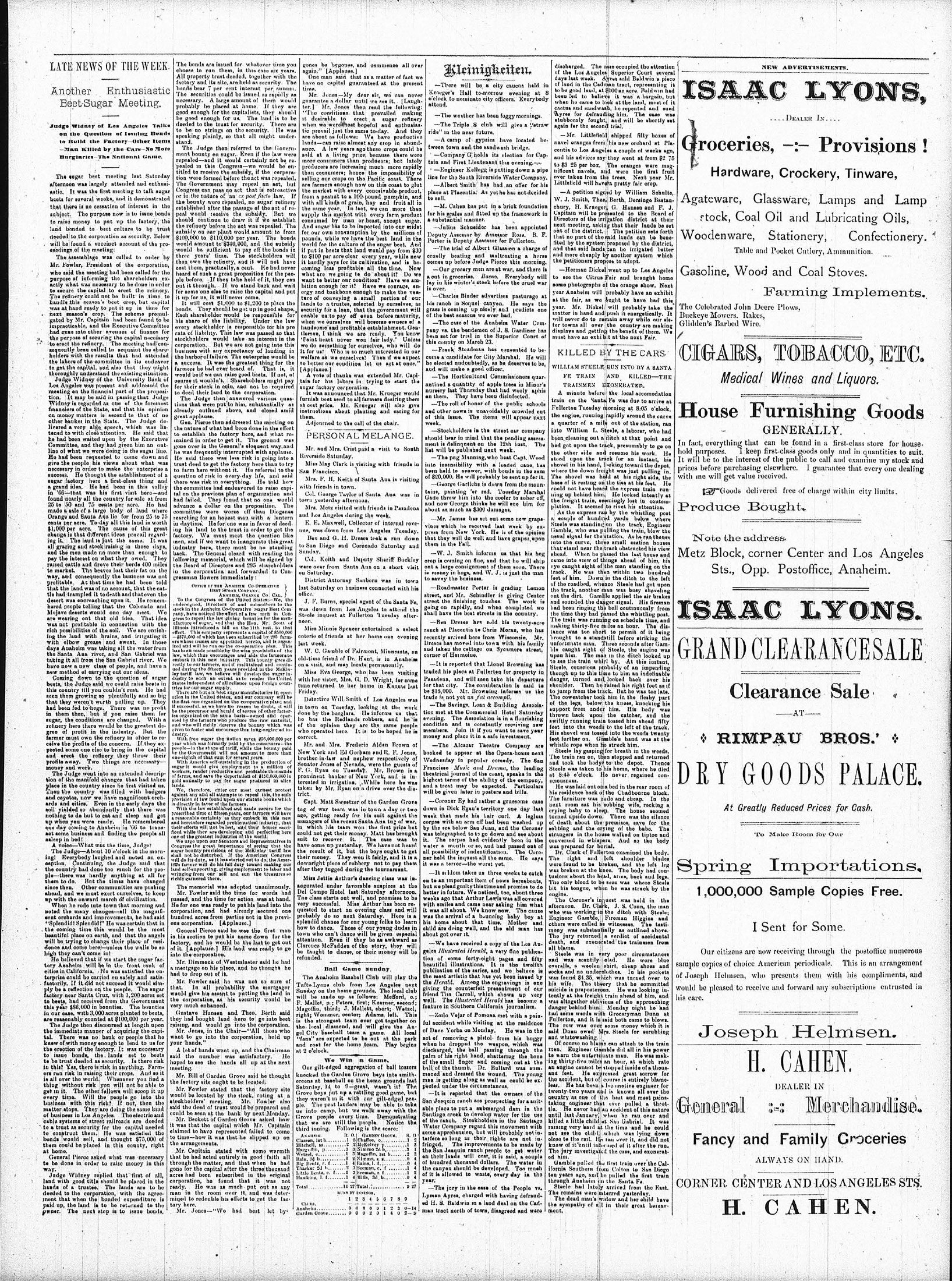
Searchable text
LATE NEWS OF THE WEEK.
Another Enthusiastic Beet-Sugar Meeting.
Judge Widney of Los Angeles Talks on the Question of Issuing Bonds to Build the Factory—Other Items—Man Killed by the Cars—No More Burglaries—The National Gauce.
The sugar beet meeting last Saturday afternoon was largely attended and enthusiastic. It was the first meeting to talk sugar beets for several weeks, and it demonstrated that there is no cessation of interest in the subject. The purpose now is to issue bonds to raise money to put up the factory, the land bonded to beet culture to be trust deeded to the corporation as security. Below will be found a succinct account of the proceedings of the meeting:
The assemblage was called to order by Mr. Fowler, President of the corporation, who said the meeting had been called for the purpose of informing the shareholders exactly what was necessary to be done in order to secure the capital to erect the refinery. The refinery could not be built in time to handle this season's beet crop, but capital was at hand ready to put it up in time for next season's crop. The scheme promulgated by Mr. Capitain had been found to be impracticable, and the Executive Committee had gone into other avenues of finance for the purpose of securing the capital necessary to erect the refinery. The meeting had consequently been called to acquaint the shareholders with the results that had attended the laborers in its endeavor to get the capital, and also that they might thoroughly understand the existing situation.
Judge Widney of the University Bank of Los Angeles was present and addressed the meeting on the financial part of the proposition. It may be said in passing that Judge Widney is regarded as one of the foremost financiers of the State, and that his opinion on money matters is second to that of no other banker in the State. The Judge delivered a very able speech, which was listened to with close attention. He said that he had been waited upon by the Executive Committee, and they had given him an outline of what we were doing in the sugar line. He had been requested to come down and give the people his views about what was necessary in order to make the enterprise a success. He thought the establishment of a
The bonds are issued for whatever time you choose to run them, in this case six years. All property trust decided, together with the factory and its site, are held as security. The bonds bear 7 per cent interest per annum. The securities could be issued as rapidly as necessary. A large amount of them would probably be placed at home. If they are good enough for the capitalists, they should be good enough for us. The land is to be deeded to the trust for security. There are to be no strings on the security. He was speaking plainly, so that all might understand.
The Judge then referred to the Government bounty on sugar. Even if the law were repealed—and it would certainly not be repealed in this Congress—we would be entitled to receive the subsidy, if the corporation were formed before the act was repealed. The Government may repeal an act, but Congress can pass no act that is retroactive or in the nature of an ex post facto law. If the bounty were repealed, no sugar rolinery established after the passage of the act of repeal would receive the subsidy. But we should continue to draw it if we establish the refinery before the act was repealed. The subsidy on our plant would amount to from $100,000 to $110,000 per year. The bonds would amount to $340,000, and the subsidy would be sufficient to pay off the bonds in three years' time. The stockholders will own their refinery, and it will not have cost them, practically a cent. He had never heard of such a great proposition for the people before. If they take hold of it, they can put it through. If we stand back and wait for some one else to raise the capital and put it up for us, it will never come.
It will cost $1,000 to $1,200 to place the bonds. They should be get up in good shape. Each shareholder would be responsible for his share of the liability. Under the law every stockholder is responsible for his proata rate of liability. This law was passed so that stockholders would take an interest in the corporation. But we are not going into this business with any expectancy of landing in the harbor of failure. The enterprise would be a success. It was the greatest thing for the farmers he had ever heard of. That is, it would be if we can raise good boots. If not, course wouldn't. Shareholders might pay for their stock in coin, and not be required to deed their land to the corporation.
The Judge then answered various questions that were put to him, subantially as already outlined above, and closed amid great applause.
Gen. Pierros then addressed the meeting on the nature of what had been done in the effort to establish the factory here, and what remained in order to get it. The ground was gone over in the General's eloquent way, and he was frequently interrupted with applause. He said there was less risk in going into a trust deed than to get the factory here than to try to farm here without it. He referred to the question of risk in every day life, and said gones be bygones again." [Applause.] One man said that he have no capital guine time.
Mr. Jones—My guarantee a dollar ter.] Mr. Jones tide it desirable to cease prevail just tha t are about as follows lands—can raise alance. A few years sold at a living price more consumers than producers are increase than consumers; he selling our crops on are farmers enough market with over from a peanut to a M with all kinds of grief the same year. In supply this market consumed by man And sugar has to buy for our own consumer pounds, while we have world for the culture if put in beets that ht $100 per acre cheap is hardly pays for it coming less profitat what are we going want to better our credit enough for it ergy and backbone turf of conveying lands to a trustee, a security for a loan, enable us to pay off when we ourselves have handsome and profitable treason. I think we wo faint heart never do something for it for us? Who is so welfare as we ourselves better our condition [Applause.] A vote of thanks wain tain for his labor's sugar factory corporate It was announced ture furnish seed to eat at coat prices. Mr. J instructions about them.
Adjourned to tha PERSONA
Mr. and Mrs. Cristi Riverside Saturday.
Miss May Clark is San Francisco.
Judge Widway of the University Bank of Los Angeles was present and addressed the meeting on the financial part of the proposition. It may be said in passing that Judge Widway is regarded as one of the foremost financiers of the State, and that his opinion on money matters is second to that of no other banker in the State. The Judge delivered a very able speech, which was listened to with close attention. He said that he had been waited upon by the Executive Committee, and they had given him an outline of what we were doing in the sugar line. He had been requested to come down and give the people his views about what was necessary in order to make the enterprise a success. He thought the establishment of a sugar factory here a first-class thing and a grand idea. He had been in this valley in '66—that was his first visit here—and found nearly all the country for sale at from 25 to 50 and 75 cents per acre. He had made a sale of a large body of land where Orange and Santa Ana lie for from 25 to 75 cents per acre. To-day all this land is worth $1,000 per acre. The cause of this great change is that different ideas prevail regarding it. The land is just the same. It was all grazing and stock raising in those days, and the men made no more than enough to pay the interest on what they owed. They raised cattle and drove their hordes 400 miles to market. The beavers lost their fat on the way, and consequently the business was not profitable. At that time he had been told that the land was of no account, that the cattle had trampled it to death and that even the desert was enroaching upon it. He remembered people telling that the Colorado and Mojave deserts would one day meet. We are wearing out that old idea. That idea was not profitable in connection with the rich possibilities of the soil. We are enriching the land with brains, and irrigating it with elbow grease and sweat. In those days Anahaim was taking all the water from the Santa Ana river, and San Gabriel was taking it all from the San Gabriel river. We have now a new class of people, and have a new method of carrying out our ideas.
Coming down to the question of sugar boats, the Judge said we could raise bests in this country till you couldn't rest. He had seen them growing so plentifully and so big that they weren't worth pulling up. They had been fed to hogs. There was no profit in them then, but if you raise them for sugar, the conditions are changed. With a rhinery here there would be the greatest degree of profit in the industry. But the farmer must own the refinery in order to receive the profits of the concern. If they expected some one else to bring in the capital and erect the refinery they throw their profits away. Two things are necessary—money and work.
The Judge went into an extended description of the manifold changes that had taken place in the country since he first visited us. Then the country was filled with badgers and coyotes, now we have magnificent orchards and cities. Even in the early days the soil yielded so abundantly that there was nothing to do but to eat and sleep and get up when you were ready. He remembered one day coming to Anahaim in '66 to transport some business and finding the people all asleep in bed!
A voice—What was the time, Judge?
The Judge—About 10 o'clock in the morning! Everybody laughed and noted an exception. Continuing, the Judge said that the country had done too much for the people—there was hardly anything at all for them to do. But the times have changed since then. Other communities are pushing ahead, and we must exert ourselves, to keep up with the onward march of civilization.
When he rode into town morning and course it wouldn't. Shareholders might pay for their stock in coin, and not be required to deed their land to the corporation.
The Judge then answered various questions that were put to him, substantially as already outlined above, and closed amid great applause.
Gen. Pierres then addressed the meeting on the nature of what had been done in the effort to establish the factory here, and what remained in order to get it. The ground was gone over in the General's eloquent way, and he was frequently interrupted with applause. He said there was less risk in going into a trust deed to get the factory here than to try to farm hero without it. He referred to the question of risk in every-day life, and said there was risk in everything. He told how the committee had endeavored to raise capital on the previous plan of organization and had failed. They found that no one would advance a dollar on the proposition. The committee were worse off than Diogenes searching for an honest man with a lantern in daytime. He for one was in favor of deeding his land to the trust in order to get the factory. We must meet the question like men, and if we want to inaugurate this great industry here, there must be no standing back. The General closed with reading the following memorial, which will be signed by the Board of Directors and 295 shareholders in the corporation and forwarded to Congressman Bowers immediately:
OFFICE OF THE ANAHIM CO-OPERATIVE BIRT SUGAR COMPANY.
ANAHIMI ORANGE CO., CAL.
To the Congress of the United States—We, the undersigned, Directors of our subscribers to the stock in the Association Co-op largest company noticed the effort of few members in Congress to repeal the law giving bounties for the manufacture of sugar, and that the Hon. Mr. Scott of Illinois introduced a bill on the 11th mast to that effect. This company represents a capital of $800,000-$755,000 of which has been subscribed by 250 farmers whose names are appended hereto, and is organized into two co-operatives: this has an end made possible by provisions of law, which thus encourages and aids the farmers to embark in this new industry. This county goes directly to our farmers, and if maintained and continued during the fifteen years provided in the McKinley tariff law, we believe will develop the sugar industry to such an extent as to render the United States independent of all reliance upon foreign countries for our sugar supply.
There are but six sugar manufacturers in operation in the United States, and our company will be the first one organized on the co-operative plan; and if successful, as we have no reason to doubt, it will be the precursor and herald of scores of other factories organized on the same basis—owned and operated by farmers who will richly deserve the bonanza which given to foster and encourage this long-neglected industry.
With free sugar the nation saves $565,000,000 per year which was formerly paid by the consumers—the people in the shape of tariff, while the buoyancy paid by the Government will not amount to more than one cent per year.
With America self-maintaining in production of sugar it would give employment to a million workers, render productive and profitable thousands of farms, and save the deportation of $156,000,000 in gold annually to pay for sugar produced in alien lands.
We therefore enter our most earnest protest against any attempt to replicate this, only because protection law found upon our institute books which is directly in favor of our farmers.
With the law established and made secure for the prescribed time of fifteen years, our farmers will have a reasonable certainty as they embark in this new and heretofore regarded problematic industry, that their efforts will not be lost, and their homes sacrificed while they are developing and perfecting here on their own land.
We urge upon our Senators and Representatives in Congress the great importance of seeing that the sugar bounty provisions of the McKinley tariff law shall not be disturbed. If the American Congress will do its duty, as it has started out to do, the American farmer will do his full duty toward making our land-supporting, giving employment to labor and wringing from our soil and sun the treasures so richly garnered there.
The memorial was adopted unanimously.
Mr. and Mrs. Cristi Riverside Saturday.
Miss May Clark is San Francisco.
Sexual manners at work
Col. George Taylor town yesterday after Mrs. Motz visited us and Los Angeles durin E. E. Maxwell, Co.nueuse, was down from Ben and G. H.D.to San Diego and C.Sunday.
Col. Keith and I were over from San Diego on Saturday.
District Attorney last Saturday on business office.
J.F. Burns special was down from Los Angeles Steele inquiry at Fukuon noon.
Miss Minnie Spencer coterie of friends at last week.
W.C. Gamble of Old-time friend of Drau on a visit, and may lose Miss Eva George, Mrs., time returned to her Friday.
Detective Will Smith in town on Tuesday; done by the burglar; he has the Redlanda of opinion they who operated here.
Mr. and Mrs. Frey New York and Ed Gore brother-in-law and my Senator Jones of New F.G.Ryan on Tuesday prominent banker of interested taken by Mr.Ryan or trict.
Capt.Matt Sweetz tug of war team wage getting ready for unmanager of the recourse in which his team woult not get their arm suit to recover it; have come up yostoried result of it but their money. They ww downright piece of rope after they tugged over.
Miss Jettie Arthur augurated under favor Del Campo Hotel last Class starts out very successful.
Mis
Soil yielded so abundantly that there was nothing to do but to eat and sleep and got up when you were ready. He remembered one day coming to Anaheim in '66 to transact some business and finding the people all asleep in bed!
A voice—What was the time, Judge?
The Judge—About 10 o'clock in the morning! Everybody laughed and noted an exception. Continuing, the Judge said that the country had done too much for the people—there was hardly anything at all for them to do. But the times have changed since then. Other communities are pushing ahead, and we must exort ourselves, to keep up with the onward march of civilization.
When he rode into town that morning and noted the many changes—all the magnificent orchards and improvements, he had said "Splendid! Splendid!" He was certain that in the coming time this would be the most beautiful place on earth, and that the angels will be trying to change their place of residence and come here—unless the walls be so high they can't come in!
He believed that if we start the sugar factory Anaheim will be in the front rank of cities in California. He was satisfied the enterprise could be carried on safely and satisfactorily. If it did not succeed it would simply be a reflection on the people. The sugar factory near Santa Cruz, with 1,200 acres set to beats, had received from the Government this year $88,000 in bounties. The bounties in our case, with 3,000 acres planted to beats, are reasonably counted at $100,000 per year.
The Judge then discouraged at length upon the immediate manner of acquiring the capital. There was no bank or people that he knew of with money enough to lend to us for the erection of the factory. It was necessary to issue bonds, the lands set to beats to be trust deeded as security. In there risk in this? Yes, there is risk in anything. Farmers ran risk in raising their crops. And so it is all over the world. Whenever you find a thing without risk you will not be able to get in it. The other fellows will scoop it up every time. Will the people go into the business with this risk? If not, then the matter stops. They are doing the same kind of business in Los Angeles. The electric and cable systems of street railroads are decided to a trust as security for the capital needed to construct them. He was satisfied the bonds would sell, and thought $75,000 of them could be placed in this county, right at home.
General Pierce asked what was necessary to be done in order to raise money in this way.
Judge Widney replied that first of all, land with good title should be placed in the hands of a trustee. The lands are to be deeded to the corporation, with the agreement that when the bonded expenditure is paid up, the land is to be returned to the owner. The next step is to issue bonds.
The memorial was adopted unanimously.
Mr. Fowler said the time for words had passed, and the time for action was at hand. He for one was ready to put his land into the corporation, and had already secured one hundred acres from parties not in the previous corporation. [Applause.]
General Pierce said he was the first man in his section to put his name down for the factory, and he would be the last to get out of it. [Applause.] His land was ready to go into the corporation.
Mr. Dimmock of Westminster said he had a mortgage on his place, and he thought he had to drop out of it.
Mr. Fowler said he was not so sure of that. In all probability the mortgager would give his assent to putting the land in the corporation, as his security would be very much enhanced.
Gustave Hansen and Theo. Borth said they had bought land here to go into beet raiding, and would go into the corporation.
Mr. Jones, in the Chair—"All those who want to go into the corporation, hold up your hands."
A lot of hands wont up, and the Chairman said the number was satisfactory. He hoped to see the hands all up at the next meeting.
Mr. Bill of Garden Grove said he thought the factory site ought to be located.
Mr. Fowler stated that the factory site would be located by the stock, voting at a stockholders' meeting. Mr. Fowler also said the dead of trust would be prepared and could be seen at the bank by next Monday.
Mr. Beckett of Garden Grove asked how it was that the capital which Mr. Capitain claimed to have represented failed to come to time—how it was that he slipped up on the arrangements.
Mr. Capitain stated with some warmth that he had acted entirely in good faith all through the matter, and that when he had gone for the capital after the three thousand acres had been subscribed in the original corporation, he found that it was not ready. He was as much put out as any man in the room over it, and was determined to redouble his efforts to get the factory here.
Mr. Jones—"We had best let by-
tug of war team久 ago, getting ready for managers of the account in which his team would not get their men suit to recover it; have come up yet迟后的 result of it, but their money. They woke downtime piece of rope after they tugged durir
Miss Jettie Arthur's augurated under faves Del Campo Hotel last The class starts out well very successful. Miss quested to start an probably do so next splendid chance for our how to dance. Those town who can't dance attention. Even if Clarence McFadden can be taught to dance, refounded.
Hall Gam
The Anaheim Basin Tufts-Lyons club from Sunday on the home ground will be made up as P.M., Mallot p.; Peters Magoffin, third; J.M right; Wommer, counter is the strongest team on local diamond, and gel City baseball team "Jana" are expected to and rost for the home at 2 o'clock.
Our gilt-edged aggrue knocked the Garden Groves at baseball on Saturday, 14 to 9-Grove boys put up an apple they weren't in it wit ple. The post launder us into camp, but we Grove people every that we are still their third innning. Follow
ANAHIM R.O.
Classen, 1st b.
Mitchell, ss.
Magoffin, third
Wret c.
Hail 24 h.
Big Benz r.f.
Thacker 21 b.
Little Benz c.
Hawkins l.f.
Total 14 27
RUNS BY
CLUES,
Anabeim,
Garden Grove
gones be bygones, and commence all over again." [Applause.]
One man said that as a matter of fact we have no capital guaranteed at the present time.
Mr. Jones—My dear sir, we can never guarantee a dollar until we see it. [Laughter.] Mr. Jones then read the following: "The conditions that prevailed making it desirable to erect a sugar refinery when we were most hopeful and enthusiastic prevail just the same to-day. And they are about as follows: We have productive lands—can raise almost any crop in abundance. A few years ago these crops could be sold at a living price, because there were more consumers than producers; but lately producers are increasing much more rapidly than consumers; hence the impossibility of selling our crops on the Pacific coast. There are farmers enough now on this coast to glut the market with every consignable product, from a peanut to a 100-pound pumpkin, and with all kinds of grain, hay and fruit all in the same year. In fact, we can more than supply this market with every farm product consumed by man or boat, except sugar. And sugar has to be imported into our midst for our own consumption by the millions of pounds, while we have the best land in the world for the culture of the sugar beet. And if in put beats that land would pay from $30 to $100 per acre clear every year, while now is hardy pays for its cultivation, and is becoming less profitable all the time. Now what are we going to do about it? Do we want to better our condition? Have we ambition enough for it? Have we courage, energy and backbone enough to make the venture of conveying a small portion of our lands to a trustee, selected by ourselves, as security for a loan, that the government will enable us to pay off even before maturity, when we ourselves will become owners of a handsome and profitable establishment. Geometron, I think we are ready. You know "Paint heart never won fair lady." Unless we do something for ourselves, who will do it for us? Who is so much interested in our welfare we are ourselves? Then if we expect to better our condition let us act at once." [Applause.]
A vote of thanks was extended Mr. Capitain for his labors in trying to start the sugar factory corporation.
It was announced that Mr. Krueger would furnish beet seed to all farmers desiring them at cost price. Mr. Krueger will also give instructions about planting and saring for them.
Adjourned to the call of the chair.
PERSONAL MELANGE.
Mr. and Mrs. Crist paid a visit to South Riverside Saturday.
Miss May Clark is visiting with friends in San Francisco.
Kleinigkriten.
There will be a city caucus held in Kroeger's Hall to-morrow evening at 8 o'clock to nominate city officers. Everybody attend.
The weather has been foggy mornings.
The Triple S club will give a "straw ride" in the near future.
A camp of gypsies have located between town and the sandwash bridge.
Company G holds its election for Captain and First Lieutenant this evening.
Engineer Kellogg is putting down a pipe line for the South Riveraide Water Company.
Albert Smith has had an offer for his place at Placentia. As yet he has not decided to sell.
M. Cahen has put in a brick foundation for his scales and fitted up the framework in a substantial manner.
Julius Schneider has been appointed Deputy Assessor by Assessment Ross. B. F. Porter is Assistant for Fullerton.
The trial of Albert Glasson a charge of cruelly beating and maltreating a horse comes up before Judge Pierce this morning.
Our grocery men are at war, and there is a out in groceries. Bueno. Everybody will lay in his winter's stock before the cruel war is over.
Charles Binder advertises pasturage at his ranch in Noquel canyon. He says the grass is coming up nicely and predicts one of the best seasons we ever had.
The case of the Anaheim Water Company vs. the bondmen of J. S. Gardiner has been set for trial in the Superior Court of this county on March 23.
Frank Steadman has consented to become a candidate for City Marshal. He will be elected undoubtedly, as he deserves to be, and will make a good officer.
The Horticultural Commissioners quarantined a quantity of apple trees in Minor's nursery last Thursday that had woolly aphis en them. They have been disinfected.
The roll of honor of the public schools and other news is unavoidably crowded out of this issue. The items will appear next week.
Stockholders in the street car company should bear in mind that the pending assessment is delinquent on the 12th inst. The list will be published next week.
The png Manning, who beat Capt. Wood into insensibility with a loaded cane, has been held to answer, with bonds in the sum of $20,000. He will probably be sent out far it.
Disobcharged. The case occupied the attention of the Los Angeles Superior Court several days last week. Ayres sold Baldwin a piece of land in the Cadman tract, representing it to be good land, at $100 an acre. Baldwin had been led to believe it was a bargain, but when he came to look at the land, most of it cautes and sandwash, he repented and sued Ayres for defrauding him. The case was stubbornly fought, and will be shortly seen again for the second trial.
Mr. Littlefield shipped fifty boxes of navel oranges from his new orchard at Plaza centia to Los Angeles a couple of weeks ago and his advice say they went at from $2 75 to $3 25 per box. The oranges were magnificent navels, and were the first fruit ever taken from the trees. Next year Mr. Littlefield will have a pretty fair crop.
A petition signed by William Schultze, W. J. Smith, Theo Berth, Domingo Basta chury, H. Krueger, G. Hansen and F. J. Capitain will be presented to the Board of Directors of the irrigation district at their next meeting, asking that their lands be set out of the district. The petition sets forth that no part of the said lands can be benefited by the system proposed by the district, and that said lands can be irrigated better and more cheaply by another system which the petitioners propose to adopt.
Herman Dickel went up to Los Angeles to see the Citrus Fair and brought home some photographs of the orange show. Next year Anaheim will probably have an exhibit at the fair, as we ought to have had this year. Mr. Dickel will probably take the matter in hand and push it energetically. It will never do to remain away while our sister towns all over the country are making displays and getting the benefit of them. We must have an exhbit at the next Fair.
KILLED BY THE CARS
WILLIAM STEELE RUN INTO BY A SANTA
FE TRAIN AND KILLED—THE TRAINMEN EXONERATED.
A minute before the local accommodation train on the Santa Fe was due to arrive at Fullerton Tuesday morning at 8:05 o'clock, the engine running rapidly around the curve a quarter of a mile out of the station, ran into William L. Steele, a laborer, who had been cleaning out a ditch at that point and had got upon the track, presumably to go on the other side and resume his work. He stood upon the trick for an instant, his shovet in his hand, looking toward the depot, where the down freight was just pulling in. The shovet was held at his right side in...
PERSONAL MELANGE.
Mr. and Mrs. Crist paid a visit to South Riverside Saturday.
Miss May Clark is visiting with friends in San Francisco.
Mrs. F. H. Keith of Santa Ana is visiting with friends in town.
Col. George Taylor of Santa Ana was in town yesterday afternoon.
Mrs. Metz visited with friends in Pasadena and Los Angeles during the week.
E. E. Maxwell, Collector of internal revenue, was down from Los Angeles Tuesday.
Ben and G. H. Dresca took a run down to San Diego and Coronado Saturday and Sunday.
Col. Koith and Deputy Sheriff Buckley were over from Santa Ana on a short visit on Saturday.
District Attorney Sanborn was in town last Saturday on business connected with his office.
J. F. Burns, special agent of the Santa Fe, was down from Los Angeles to attend the Steele inquest at Fullerton Tuesday afternoon.
Miss Minnie Spencer entertained a select coterie of friends at her home one evening last week.
W. C. Gamble of Fairmont, Minnesota, an old-time friend of Dr. Hunt, is in Anheim on a visit, and may locate permanently.
Miss Eva George, who has been visiting with her sister, Mrs. G. D. Wright, for some time returned to her home in Kansas last Friday.
Detective Will Smith of Los Angeles was in town on Tuesday, looking at the work done by the burglar. He informs us that he has the Redlands robbers, and he is of the opinion they are the same people who operated here. It is to be hoped he is correct.
Mr. and Mrs. Frederic Alden Brown of New York and Ed Gorbam and R. F. Jones, brother-in-law and nephew respectively of Senator Jones of Nevada, were the guests of F. G. Ryan on Tuesday. Mr. Brown is a prominent banker of New York, and is interested in irrigation. While here he was taken by Mr. Ryan on a drive over the district.
Capt. Matt Sweatzer of the Garden Grove tag of war team was in town a day or two ago, getting ready for his suit against the managers of the recent Santa Ana tag of war, in which his team won the first prize but could not get their money. Matt has brought suit to recover it. The case was to have come up yesterday. We have not heard the result of it, but the boys ought to get their money. They won it fairly, and it is a downright piece of robbery not to pay them after they tugged during the tournament.
Miss Jettie Arthur's dancing class was inaugurated under favorable auspices at the Del Campo Hotel last Saturday afternoon. The class starts out well, and promises to be very successful.
Miss Arthur has been re-
The Horticultural Commissioners quarried a quantity of apple trees in Minor's nursery last Thursday that had woolly aphis en them. They have been disinfected.
The roll of honor of the public schools and other news is unavoidably crowded out of this issue. The items will appear next week.
Stockholders in the street our company should bear in mind that the pending assessment is delinquent on the 12th inst. The list will be published next week.
The pag Manning, who beat Capt. Wood into insensibility with a loaded cane, has been held to answer, with bonds in the sum of $20,000. He will probably be sent up for it.
George Garlica is down from the mountains, painting 'er red. Tuesday Marshal Gade threw him into the cooler to sober off, and now George thinks he will sue him for about as much as $300 damages.
Mr. James has set out some new grape vines which he received last week by express from New York. He is of the opinion that they will do well and have grapes upon them in the Fall.
W. J. Smith informs us that his hog crop is coming on fine, and that he will ship out a large consignment of them soon. There is money in hogs, and W. J. is just the man to savvy the business.
Roadmaster Porter is grading Lomon street, and Mr. Schindler is giving Center street the finishing touches. The work is going on rapidly, and when completed we shall have the best streets in the country.
Ben Dresses has sold his twenty-acre ranch at Placentia to Chris Moran, who has recently arrived here from Wisconsin. Mr. Dresses has moved into town with his family and taken the cottage on Sycamore street, corner of Hermione.
It is reported that Lionel Browning has traded his place at Fullerton for property in Pasadena, and will soon take his departure for that city. The consideration is said to be $18,000. Mr. Browning informs us the trade is not yet unfit accompli.
The Savings Loan & Building Association met at the Commercial Hotel Saturday evening. The Association is in a flourishing condition and is constantly receiving new members. Join it if you want to save your money and place it in a safe investment.
The Alcazar Theatre Company are booked to appear at the Opera-house next Wednesday in popular comedy. The Dan Francisco Music and Drama, the leading theatre journal of the city, speaks in the highest terms of the ability of the company, and a treat may be expected. Particular will be given later in posters and bills.
Coroner Ey had rather a gruesome case down in Diok Egan's territory one day last week that made his hair curl. A legless corpse with an arm off had been washed up by the sea below San Juan, and the Coroner was telegraphed to go down and see about it. The corpse had evidently been in the water a month or so, and had passed out of all possibility of indentification. The Coroner held the inquiry all the same. He says it was a terror—the worst yet.
It also takes us three weeks to catch on to an important item of news heroabouts, but we plead guilty this time and promise to do batter in future. We noticed, too, about three weeks ago that Arthur Lewis was all covered with amides and came near asking what he
tug of war team was in town a day or two ago, getting ready for his suit against the managers of the recent Santa Ana tag of war, in which his team won the first prize but could not get their money. Matt has brought suit to recover it. The case was to have come up yesterday. We have not heard the result of it, but the boys ought to get their money. They won it fairly, and it is a downright piece of robbery not to pay them after they tugged during the tournament.
Miss Jettie Arthur's dancing class was inaugurated under favorable auspices at the Del Campo Hotel last Saturday afternoon. The class starts out well, and promises to be very successful. Miss Arthur has been requested to start an evening class and will probably do so next Saturday. Here is a splendid chance for our young folks to learn how to dance. Those of our young dudes in town who can't dance will be given especial attention. Even if they be as awkward as Clarence McPadden of the story, they will be taught to dance, or their money will be refunded.
Hall Game Sunday.
The Anahaim Baseball Club will play the Tufts-Lyons club from Los Angeles next Sunday on the home grounds. The local club will be made up as follows: Mefford, c.; F. Mallet, p.; Peters, first; Koorner, second; Magoffin, third; J. Mallott, short; Wetzel, right; Wommer, center; Adams, left. This is the strongest team ever got together on the local diamond, and will give the Angel City baseball队 a game. All local "Jana" are expected to be out at the park and root for the home team. Play begins at 2 o'clock.
We Win a Game.
Our gilt-edged aggregation of ball tossers knocked the Garden Grove boys into smithereens at baseball on the home grounds last Saturday, 14 to 9—great, wasn't it? The Grove boys put up a rattling good game, but they weren't in it with our gilt-edged people. The peat landers may be able to take us into camp, but we walk away with the Grove people every time. Demonstrating that we are still the people. Notice the third inning. Following is the score:
ANAHIM R.O GARDEN GROVE R.O CLUPS ANAHEIM
R.O GARDEN GROVE R.O CLUPS ANAHEIM
1 2 3 4 5 6 7 8 9
1 2 3 4 5 6 7 8 9
0 0 8 0 0 1 2 3 0-14
0 0 8 0 0 1 2 3 0-14
Garden Grove
down in Diok Egan's territory one day last week that made his hair curl. A legless corpse with an arm off had been washed up by the sea below San Juan, and the Coroner was telegraphed to go down and see about it. The corps had evidently been in the water a month or so, and had passed out of all possibility of indentification. The Coroner held the inquest all the same. He says it was a terror—the worst yet.
It seldom takes us three weeks to catch on to an important item of news hereabouts, but we plead guilty this time and promise to do better in future. We noticed, too, about three years ago that Arthur Lewis was all covered with smiles and came near asking him what it was all about. We know now. The cause was arrival of a bouncing baby boy at his home about that time. Mother and child are doing well, and the old man has about got over it.
We have received a copy of the Los Angeles Illustrated Herald, a very fine publication of some forty-eight pages and fifty beautiful illustrations. It is the twelfth publication of the series, and we believe is the most artistic that has yet been issued by the Herald. Among the engravings is one giving the counterfeit presentment of our friend Tim Carroll, which shows up very well. The Illustrated Herald has become a feature in Southern California journalism.
Zoilo Vejar of Pomona met with a painful accident while visiting at the residence of Dave Yorba on Monday. He was in the act of removing a pistol from his buggy when he dropped the weapon, which was discharged, the ball passing through the palm of his right hand, shattering the bone of the small finger and coming out at the ball of the thumb. Dr. Bullard was summoned and dressed the wound. The young man is getting along as well as could be expected under the circumstances.
It is reported that the owners of the San Joaquin pitch are prospecting for a suitable place to put a submerged dam in the Santiago creek to develop water for the use of the ranch. Stockholders in the Santiago Water Company regard this movement with some apprehension, but will probably not interfere so long as their rights are not infringed. The improvements to be made by the San Joaquin pitch people to get water en their lauds will cost, it is said, a couple of hundred thousand dollars. The water in the canyon should be developed. Too much of it allowed to waste, every day in the year.
The jury in the case of the People vs. Lyman Ayres, charged with having defrauded H. S. Baldwin in a land deal on the Cadman tract north of town, disagreed and were next room sat his sobbing wife, rocking a crying baby to sleep. The house seemed turned upside down. There was the silence of death about the premises, save for the sobbing and the crying of the babe. The strangers in the house walked on tiptoe and conversed in whispers. And so the body was prepared for burial.
Dr. Clark of Fullerton examined the body. The right and left shoulder blades were found to be broken, and the left leg was broken at the knee. The body had conclusions about the head, arms, back and legs. The only blood to be seen was where Stoole bit his tongue, when he was strack by the engine.
The Coroner's inquiry was held in the afternoon. The man who was working in the ditch with Stoele; Engineer Gamble; Fromm Higgins and others were called as witnesses. The testimony was substantially as outlined above. The jury returned a verdict of accidental death, and exonerated the trainmen from all blame.
Steele was in very poor circumstances and was scantily clad. He wore blue overalls, a woolen shirt, cheap shoes and socks and no underclothes. In his pockets was found $4.35, which was turned over to his wife. The theory that he committed suicide is preposterous. He was looking intently at the freight train ahead of him, and was altogether oblivious of the approaching danger behind him. Monday night he had had some words with Grooscyman Dunn at Fullerton, and it is said both came to blows.
The row was even some money which it is said Dunn owed Mrs. Steele for scrubbing and whitowashing.
Of course no blame can attach to the train men. Engineer Gamble did all in his power to warn the unfortunate man. He was making thirty-five miles an hour, at which rate an engine cannot be stopped inside a thousand feet. He expressed great sorrow for the accident, but of course is entirely blameless. He has been a locomotive engineer for twenty-two years and is known all over the country as one of the best and most painstaking engineers that ever pulled a throttle. He never had an accident of this nature until last January, when he ran over and killed a little child at San Gabriel. It was raining very hard at the time and he could not see the child, which was lying down close to the rail. He ran over it, and did not know of it until informed of it after the run. The jury investigated the case, and exonerated him.
Gamble pulled the first train over the California Southern from Colton to San Diego ten years ago, and he pulled the first train through Anahaim in the Santa Fe.
Steele had lately arrived from East. The remains were interred yesterday.
The dead man's widow and her child have the sympathy of all in their great bereavement.
NEW ADVERTISEMENTS.
ISAAC LYONS,
...DEALER IN...
Groceries, :- Provisions!
Hardware, Crockery, Tinware,
Agateware, Glassware, Lamps and Lamp stock, Coal Oil and Lubricating Oils,
Woodenware, Stationery, Confectionery.
Table and Pocket Cutlery, Ammunition.
Gasoline, Wood and Coal Stoves.
Farming Implements.
The Celebrated John Deere Plows,
Buckeye Mowers. Rakes,
Glidden's Barbed Wire.
CIGARS, TOBACCO, ETC.
Medical Wines and Liquors.
House Furnishing Goods
GENERALLY.
In fact, everything that can be found in a first-class store for house-hold purposes. I keep first-class goods only and in quantities to suit. It will be to the interest of the public to call and examine my stock and prices before purchasing elsewhere. I guarantee that every one dealing with me will get value received.
House Furnishing Goods
GENERALLY.
In fact, everything that can be found in a first-class store for household purposes. I keep first-class goods only and in quantities to suit.
It will be to the interest of the public to call and examine my stock and
prices before purchasing elsewhere. I guarantee that every one dealing
with me will get value received.
Goods delivered free of charge within city limits.
Produce Bought.
Note the address:
Metz Block, corner Center and Los Angeles
Sts., Opp. Postoffice, Anaheim.
ISAAC LYONS.
GRAND CLEARANCESALE
Clearance Sale
AT
RIMPAU BROS.'
DRY GOODS PALACE.
At Greatly Reduced Prices for Cash.
To Make Room for Our
Spring Importations.
1,000,000 Sample Copies Free.
At Greatly Reduced Prices for Cash.
To Make Room for Our
Spring Importations.
1,000,000 Sample Copies Free.
I Sent for Some.
Our citizens are now receiving through the postoffice numerous sample copies of choice American periodicals. This is an arrangement of Joseph Helmsen, who presents them with his compliments, and would be pleased to receive and forward any subscriptions entrusted in his care.
Joseph Helmsen.
H. CAHEN.
DEALER IN
General :: Merchandise.
Fancy and Family Groceries
ALWAYS ON HAND.
CORNER CENTER AND LOS ANGELES STS.
H. CAHEN.