anaheim-gazette 1892-01-14
Scanned page
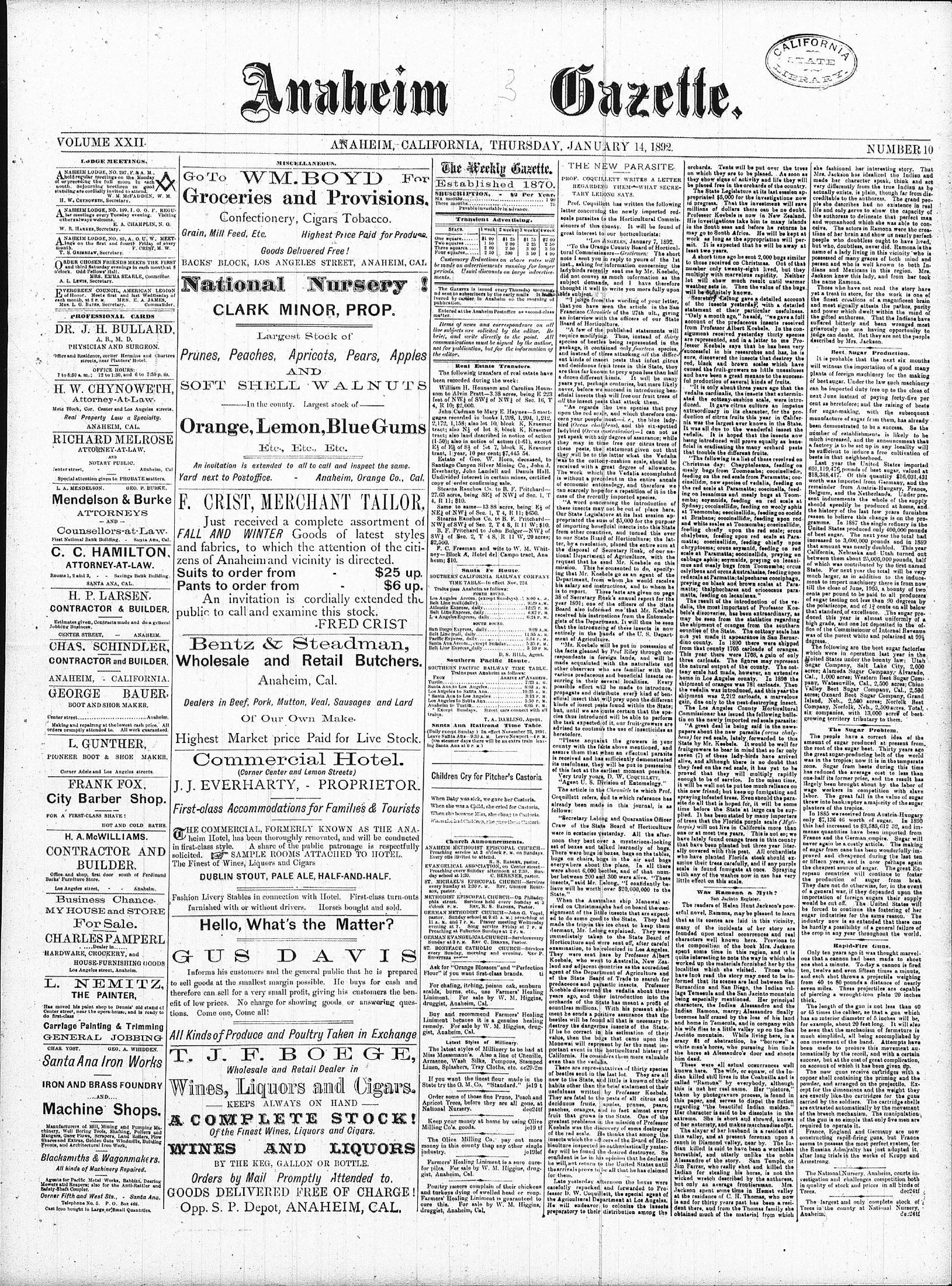
Searchable text
VOLUME XXII.
LODGE MEETINGS.
ANAHEIM LODGE, NO. 207, F. & A. M., hold regular meetings on the Monday of or preceding the full moon. In each month, sojourning brethren in good standing are cordially invited to attend.
W. W. CHYNOWETH, W. M.
H. W. CHYNOWETH, Secretary.
ANAHEIM LODGE, NO. 199, I. O. O. P. REGULAR meetings every Tuesday evening. Visiting others always welcome.
E. A. CHAMPLIN, N. O.
W. R. HARKER, Secretary.
ANAHEIM LODGE, NO. 35, A. O. U. W. MEETINGS on the first and fourth Friday of every month.
F. CRIST, M. W.
T. S. GRIMSHAW, Secretary.
ORDER CHOSEN FRIENDS MEETS THE FIRST and third Saturday evenings in each month at 8 o'clock. Odd Fellows Hall.
MRS. EMMA SEARLE, Councillor.
A. L. LEWIS, Secretary.
EVERGREEN COUNCIL, AMERICAN LEGION of Hoor. Meets first and last Wednesday of each month, at 8 p.m.
MRS. E. A. JAMES,
Mrs. L. G. BATES, Secretary.
PROFESSIONAL CARDS
DR. J. H. BULLARD,
A. B., M. D.
PHYSICIAN AND SURGEON.
Office and Residence, corner Hermine and Chartres streets, near Planters' Hotel.
OFFICE HOURS:
7 to 8:30 a.m.; 12 to 1:30, and 6 to 7:30 p.m.
H. W. CHYNOWETH,
Attorney-At-Law.
Metz Block, Cor. Center and Los Angeles streets.
Real Property Law a Specialty.
ANAHEIM, CAL.
RICHARD MELROSE
ATTORNEY-AT-LAW,
AND
NOTARY PUBLIC.
Center street,
Anaheim, Cal.
MISCELLANEOUS.
Go To WM.BOY
Groceries and ProConfectionery, Cigars To
Grain, Mill Feed, Etc.
Highest Price
Goods Delivered Free!
BACKS' BLOCK, LOS ANGELES STREET,
National Nursery
CLARK MINOR,
Largest Stock of Prunes, Peaches, Apricots, Potatoes
AND SOFT SHELL WATER
In the county. Largest stock of Orange, Lemon, Blueberries
Etc., Etc., Etc.
An invitation is extended to all to call and in Yard next to Postoffice.
Anaheim
H. W. CHYNOWETH,
Attorney-At-Law.
Meiz Block, Cor. Center and Los Angeles streets.
Real Property Law a Specialty.
ANAHEIM, CAL.
RICHARD MELROSE
ATTORNEY-AT-LAW,
AND
NOTARY PUBLIC.
Center street,
Anaheim, Cal.
Special attention given to PROBATE matters.
L. A. MENDELSON.
GEO. P. BURKE.
Mendelson & Burke
ATTORNEYS
AND
Counsellors-at-Law.
First National Bank Building.
Santa Ana, Cal.
C. C. HAMILTON,
ATTORNEY-AT-LAW.
Rooms 1, 2 and 3.
Savings Bank Building.
SANTA ANA, CAL.
H. P. LARSEN,
CONTRACTOR & BUILDER.
Estimates given, Contracts made and do a general Jobbing Business.
CENTER STREET,
ANAHEIM.
CHAS. SCHINDLER,
CONTRACTOR and BUILDER.
ANAHEIM, - CALIFORNIA.
GEORGE BAUER,
BOOT AND SHOE MAKER.
Center street...
Anaheim.
Making and repairing at the lowest cash price. All orders promptly attended to. All work guaranteed.
L. GUNTHER,
PIONEER BOOT & SHOE MAKER.
Corner Adele and Los Angeles streets.
FRANK FOX,
City Barber Shop.
FOR A FIRST-CLASS SHAVE!
HOT AND COLD BATHS.
H. A. McWILLIAMS.
CONTRACTOR AND BUILDER.
Office and shop, first door south of Ferdinand Backe's Furniture Store.
Los Angeles street,
Anaheim.
Business Chance.
SOFT SHELL WALK
In the county. Largest stock of Orange, Lemon, Blu
Etc., Etc., Etc.
An invitation is extended to all to call and in Yard next to Postoffice.
Anaheim,
F. CRIST, MERCHANT
Just received a complete a
FALL AND WINTER Goods of
and fabrics, to which the attentio
zens of Anaheim and vicinity is d
Suits to order from
Pants to order from
An invitation is cordially o
public to call and examine this st
-FRED
Bentz & Stead
Wholesale and Retail
Anaheim, Cal.
Dealers in Beef, Pork, Mutton, Veal, Sausa
Of Our Own MakeHighest Market price Paid for
Commercial H
(Corner Center and Lemon Streets)
J. J. EVERHARTY, - PROP
First-class Accommodations for Famil
THE COMMERCIAL, FORMERLY KNOWN
Theim Hotel, has been thoroughly renovated, and in first-class style. A share of the public patronage solicited. SAMPLE ROOMS ATTACHED The Finest of Wines, Liquors and Cigars
DUBLIN STOUT, PALE ALE, HALF-AN
Fashion Livery Stables in connection with Hotel. Furnished with or without drivers. Horses ho
FOR A FIRST-CLASS SHAVE!
HOT AND COLD BATHS.
H. A. McWILLIAMS.
CONTRACTOR AND BUILDER.
Office and shop, first door south of Ferdinand Backs' Furniture Store.
Los Angeles street, Anaheim.
Business Chance.
MY HOUSE and STORE
For Sale.
CHARLESPAMPERL
...Dealer in....
HARDWARE, CROCKERY, and
HOUSE-FURNISHING GOODS
Los Angeles street, Anaheim.
L. NEMITZ,
THE PAINTER,
Has moved his paint shop to Dennis' old stand of Center street, near the opera-house, and is ready to do first-class Carriage Painting & Trimming GENERAL JOBBING
CHAS. YOST.
GEO. A. WHIDDEN.
Santa Ana Iron Works
IRON AND BRASS FOUNDRY
...AND...
Machine Shops.
Manufacturers of Mill, Mining and Pumping Machinery, Well Boring Tools, Shafting, Pulleys and Hangers, Gang Plows, Scrapers, Land Rollers, Plow Shares and Extras, Golden Gate Windmills, Building Prants, and Architectural Iron Work.
Blacksmiths & Wagonmakers.
All kinds of Machinery Repaired.
Agents for Pacific Metal Works, Babbitt, Desering Mowers and Reapers; also for the Anti-Rattler and Safety-Shaft Coupler.
Oorner Fifth and West Sts., Santa Ana.
Telephone No. 5. P. O. Box 468.
Cast Iron bought in Large or Small Quantities.
First-class Accommodations for Families
THE COMMERCIAL, formerly known as The Commercial Hotel, has been thoroughly renovated, and is in first-class style. A share of the public patronage solicited. SAMPLE ROOMS ATTACHED TO The Finest of Wines, Liquors and Cigars
DUBLIN STOUT, PALE ALE, HALF-AVE
Fashion Livery Stables in connection with Hotel. Furnished with or without drivers. Horses bound.
Hello, What's the Maid?
Informs his customers and the general public that to sell goods at the smallest margin possible. He buys therefore can sell for a very small profit, giving his客户 efit of low prices. No charge for showing goods or tions. Come one, Come all!
All Kinds of Produce and Poultry Taken
T. J. F. BOE
Wholesale and Retail Dealer in Wines, Liquors and Cigars
KEEPS ALWAYS ON HAND
A COMPLETE STOCK OF the Finest Wines, Liquors and Cigars
WINES AND LIQUORS
BY THE KEG, GALLON OR BOTTLE
Orders by Mail Promptly Attended
GOODS DELIVERED FREE OF CHARGE
Opp. S. P. Depot, ANAHEIM
ANAHEIM, CALIFORNIA, THURSDAY, JANUARY 14, 1892.
M.BOYD For and Provisions.
ery, Cigars Tobacco.
Highest Price Paid for Produce!
Is Delivered Free!
ANGELES STREET, ANAHEIM, CAL
Nursery!
MINOR, PROP.
gest Stock of
Apricots, Pears, Apples AND
LL WALNUTS
county. Largest stock of
emon, Blue Gums
, Etc., Etc.
to all to call and inspect the same.
ANAheim, Orange Co., Cal.
The Weekly Gazette.
Established 1870.
SHUSCRIPTION, - $2 Per Year.
Six months... 1.90
Three months... 75
Payable invariably in advance.
Transient Advertising.
SPACE.
1 week
2 weeks
3 weeks
4 week
One square.... $1.00
Two squares.... 1.50
Three squares.... 2.00
Four squares.... 2.50
Customary Reductions on above rates will be made on advertisements running for longer periods. Usual discounts on large advertisements.
The Gazette is issued every Thursday morning and sent to subscribers by the early malls. It is delivered by carrier in Anaheim on the morning of publication.
Entered at the Anaheim Postoffice as second-class matter.
Items of news and correspondence on all live subjects are solicited by the editor. Be brief, and write directly to the point. All communications must be signed by the author, not for publication, but for the information of the editor.
Real Estate Transfers.
The following transfers of real estate have been recorded during the week:
William H. Hounsom and Carolina Hounsom to Alvin Pratt—3.38 acres, being E 223 feet of NW¹ of SW² of NW³ of Sec. 16, T 4, R 10; $2,000.
John Cadman to Mary E. Haynes—5 mortgages recorded in books I,208,I,204,I,212,2,172,I,158; also lot 10, block K, Kraemer tract; also N¹ of lot 8, block K, Kraemer tract; also land described in notice of action (1-50); also in notice of action (1-61), except E¹ of F₁ of S₁ of Lot 7, block K, Kraemer tract, 1 year, 10 per cent; $7,445 54.
Estate of Geo. W. Horn, deceased, to Santiago Canyon Silver Mining Co., John J. Everhardt, John Landell and Dennis Hall. Undivided interest in certain mines, certified
THE NEW PARASITE:
PROF. COQUILLETT WRITES A LETTER REGARDING THEM WHAT SECRETARY LEONG SAYS.
Prof. Coquillett has written the follow letter concerning the newly imported scale parasites to the Horticultural Commissioners of this county. It will be found great interest to our horticulturists:
"Los Angeles, January 7, 1892.
To the Oranga County Board of Horticultural Commissioners—Gentlemen: The above note I sent you in reply to yours of the inst., asking for information concerning ladybirds recently sent me by Mr. Kooseb did not convey as much information as the subject demands, and I have therefore thought it well to write you more fully upon this subject.
"I judge from the wording of your letter that you have seen the article in the San Francisco Chronicle of the 27th ult., giving an interview with the officers of our State Board of Horticulture.
"A few published statements we require modifying. Thus, instead of three species of beetles being represented in this package, it contained only fourteen species and instead of these attacking all the different kinds of insect pests that infest grits and deciduous fruit trees in this State, they are thus far known to prey upon less than half a dozen different kinds. It will be many years yet, perhaps centuries, but more likely never, before we succeeded in introducing beneficial insects that will free our fruit trees all the insect pests that attack them."
As regards the two species that prey upon the red scale, and which therefore concern your people most—i.e., the blue ladybird (Oreus chalebia), and the six-spotted ladybird (Oreus quaterlustris)—I cannot yet speak with any degree of assurance; while they may in time free our citrus trees these pests, the statement given out that they will be to the latter what the Vedalia was to the cottony-cushion scale, should be received with a great degree of allowance. The work which the Vedalia accomplishes is without a precedent in the entire area.
MERCHANT TAILOR.
A complete assortment of Goods of latest styles which the attention of the citi and vicinity is directed.
from - $25 up.
from - $6 up.
is cordially extended the examine this stock.
FRED CRIST
Steadman,
and Retail Butchers.
Aheim, Cal.
Mutton, Veal, Sausages and Lard
Your Own Make.
Price Paid for Live Stock.
Special Hotel.
(ater and Lemon Streets)
CITY, - PROPRIETOR.
ations for Families & Tourists
MERELLY KNOWN AS THE ANA-roughly renovated, and will be conducted of the public patronage is respectfully DOOMS ATTACHED TO HOTEL.
And Cigars
ALE ALE, HALF-AND-HALF.
rection with Hotel. First-class turn-outs drivers. Horses bought and sold.
been recorded during the week:
William H. Hounsom and Carolina Hounsom to Alvin Pratt—3.38 acres, being E 223 feet of NW¹ of SW¹ of Sec. 16, T 4, R 10; $2,000.
John Cadman to Mary E. Haynes—5 mortgages recorded in books 1,208,1,204,1,212,2,172,1,158; also lot 10, block K, Kraemer tract; also N² of lot 8, block K, Kraemer tract; also land described in notice of action (1.50); also in notice of action (1.61), except E² of E² of S² of lot 7, block K, Kraemer tract, 1 year, 10 per cent; $7,445 54.
Estatto of Geo. W. Horn, deceased, to Santiago Canyon Silver Mining Co., John J. Everharty, John Laudell and Daniel Hall. Undivided interest in certain mines, certified copy of order confirming sale.
Stearns Ranchos Co. to B.F. Pritchard—27.63 acres, being SE¹ of NW¹ of Sec. 1, T 4, R 11; $10.
Same to same—13.88 acres, being E² of NE¹ of NW¹ of Sec. 1, T 4, R 11; $650.
Stearns Ranchos Co. to B.F. Pritchard—NW¹ of SW¹ of Sec. 2, T 4 S¹ R 11 W; $10.
B.F. Pritchard to John Bulger—NW¹ of SW¹ of Sec. 2, T 4 S¹ R 11 W, 20 acres; $2,500.
F.C. Freeman and wife to W.M. Whitney—Block A, Hotel del Campo tract, Anaheim; $10.
Santa Fe Route.
SOUTHERN CALIFORNIA RAILWAY COMPANY
TIME TABLE-In effect Nov. 22.
Trains pass Anaheim as follows:
NORTH BOUND.
Los Angeles Accom.(except Sundays)·8:00 A.M.
Belt Line mall (daily)·9:20 A.M.
Atlantic Express,daily·12:27 A.M.
Belt Line Express,daily·4:42 P.M.
Los Angeles Express,daily·6:24 P.M.
SOUTH BOUND.
San Diego Express,daily·9:09 A.M.
Belt Line mall,daily·11:55 A.M.
Pacific Express,daily·3:54 P.M.
Santa Ana Accom.except Sunday·5:35 P.M.
Belt Line Express,daily·5:59 P.M.
D.S.HILL.Agent.
Southern Pacific Route.
SOUTHERN PACIFIC RAILWAY TIME TABLE.
Trains pass Anaheim as follows:
ARRIVE AT ANAHEIM
Tustin·7:23 A.M.
Santa Ana to Los Angeles·8:03 A.M.
Los Angeles to Santa Ana·10:25 A.M.
Santa Ana to Los Angeles·2:13 P.M.
Los Angeles to Santa Ana·5:00 P.M.
Anahiem to Tustin·6:06 P.M.
* Except Sundays. Street cars connect with all trains.
T.A.DARLING.Agent.
Santa Anna Railroad Time Table.
(Dally except Sunday.) In effect November 23, 1891.
Leave Santa Ana—9:30 A.M. Leave Newport—4 P.M.
(On steamer days there will be an extra train leaving Santa Ana at 6 P.m.).
Children Cry for Pitcher's Castoria.
When Baby was sick, we gave her Castoria.
When she was a Child, she cried for Castoria,
When she became Miss, she clung to Castoria.
When she had Children, she gave them Castoria.
Church Announcements.
ANAHEIM METHODIST EPISCOPAL CHURCH—Preaching service at 3 o'clock P.M. on Sundays.Every one invited to attend.
S.B. BADGER,pastor.
EVANGELICAL ASSOCIATION on Center street—Preaching every Sunday afternoon at 2:30 Sunday school at 1:30.
C.BERRNER,pastor.
ST.MIGHAELS EPISCOPAL CHURCH—Services every Sunday at 2:30 P.M. REV.GEORGE ROBINSON,pastor.
METHODIST EPISCOPAL CHURCH—On Philadelphia street. Services held every Sunday at 3 o'clock P.M. REV.R.BADGER,pastor.
It will be many years yet, perhaps centuries, but more likely never before we succeeded in introducing beneficial insects that will free our fruit trees all the insect pests that attack them.
"As regards the two species that prey upon the red scab,and which therefore concern your people most-i.e.,the blue ladybird(Oreus chalebiae),and the six-spotted ladybird(Oreus castratusius)-I can not yet speak with any degree of assurance; while they may in time free our citrus trees on these pests,the statement given out that they will be to the latter what the Vedalia was to the cottony-cushion scale,s should be received with a great degree of allowance.The work which the Vedalia accomplishes is without a precedent in the entire annual economic entomology,and therefore we can scarcely hope for a repetition of it in the case of the recently imported species."
"A word concerning the introduction of these insects may not be out of place here Our State Legislature at its last session appropriated the sum of $5,000 for the purpose of importing beneficial insects into this State from other countries,and turned this over to our State Board of Horticulture;the latter by a resolution,placed the entire sum at the disposal of Secretary Rusk.of our national Department of Agriculture.with the request that he send Mr.Koebele on this mission. This he consented to do,specifying that Mr.Koebele go as an agent of the Department,从 whom he would receive his salary and instructions,and to whom he is to report. These facts are given on page 38 of Secretary Rusk's annual report for the year 1891;one of the officers of the State Board also informed me that Mr.Koebele received his instructions from the Entomologists of the Department.I will thus be seen that the introducing of these insects is now entirely in the hands of the U.S.Department of Agriculture.
"Mr.Koebele will be put in possession of the facts gleaned by Prof Riley through correspondents in foreign lands,and will be made acquainted with the naturalists and other observers who are familiar with the various pradaceous and beneficial insects coourning in their several localities.Every possible effort will be made to introduce,propagate and distribute every kind of beneficial insect that will prey upon the different kinds of insect pests found within the State;but, until we are quite certain that the species thus introduced will be able to perform the task expected of it,our fruit-growers are advised to continue the use of insecticides as heretofore.
"Please acquaint the growers in your county with the facts above mentioned,and assure them that when an effectual parasite is received and has sufficiently demonstrated its usefulness,they will be put in possession of this fact at the earliest moment possible.Very truly yours,D.W.Coquillett,
"Agent U.S.Division of Entomology."
The article in the Chronicle to which Prof. Coquillett refers,and to which reference has already been made in this journal.is as follows:
"Secretary Lelong and Quarantine Officer Crawf of State Board of Horticulture were in ecotacies yesterday.All the afternoon they bent over a mysterious-looking set of boxes and talked learnedly of bugs There were bugs in boxes,bugs on the tables,bugs on chairs,bugs in the air and bugs everywhere about the place.In all there were about 6,000 beetles,and of that number between 200 and 300 were alive."These insects,"said Mr.Lelong,"I confidently believe will be worth over $20,000,000 to the State."
When the Australian ship Monowai arrived on Christmas she had on board the
CHURCH Announcements.
ANAHEIM METHODIST EPISCOPAL CHURCH—Prescribing services at 3 o'clock p.m. on Sundays. Every one invited to attend.
R. S. BADER, pastor.
EVANGELICAL ASSOCIATION, on Center street—Prescribing every Sunday afternoon at 2:30. Sunday school at 1:30.
C. BERRNER, pastor.
ST. MICHAEL'S EPISCOPAL CHURCH—Services every Sunday at 2:30 p.m. REV. GEORGE ROBINSON, pastor.
METHODIST EPISCOPAL CHURCH—On Philadelphia street. Services held every Sunday at 3 o'clock p.m. REV. R. S. BADER, pastor.
German Methodist Church—John G. Vogel, pastor. Sunday school at 9:45 a.m.; presaching at 11 a.m. and 7 p.m. Prayer meeting Wednesday evening at 7. Song service Friday at 7 p.m. Presaching at Fullerton Sundays at 2 p.m.
German Evangelical Church—Services every Sunday at 3 p.m. REV. C. BERRNER, pastor.
St. Boniface Catholic Church—Services every Sunday morning and evening. REV. P. STRETTEMBERN, pastor.
Ask for "Orange Blossom" and "Perfection Flour" if you want first-class brands.
For chafing, itching, poison oak, sunburn scalds, burns, etc., use Farmers' Healing Liniment. For sale by W. M. Higgins, druggist, Anaheim, Cal.
Buy and recommend Farmers' Healing Liniment because it is a genuine healing remedy. For sale by W. M. Higgins, druggist, Anaheim, Cal.
Latest Styles of Millinery.
The latest styles of Millinery to be had at Miss Moosmann's. Also a line of Chenille, Arrasone, Wash Silks, Pompons, Stamped Linen, Splashers, Tray Cloths, etc. cc29-2m
If you want the finest flour made in the State try the O. M. Co. "Standard." jol9 tf
Order some of those fine Prune, Peach and Apricot Trees, before they are all gone, at National Nursery.
Keep your money at home by using Olive Milling Co.'s goods.
The Olive Milling Co.'s pay out more money in this county than any other single industry.
Farmers' Healing Liniment is a sure cure for piles. For sale by W. M. Higgins, druggist, Anaheim, Cal.
Poultry raisers complain of their chickens and turkeys dying of swelled head or roup. Farmers' Healing Liniment is guaranteed to cure this. For sale by W. M. Higgins, druggist, Anaheim, Cal.
Secretary Lelong and Quarantine Officer Crawl of the State Board of Horticulture were in ecstacies yesterday. All the afternoon they bent over a mysterious-looking set of boxes and talked learnedly of bugs. There were bugs in boxes, bugs on the tables, bugs on chairs, bugs in the air and bugs everywhere about the place. In all there were about 6,000 beetles, and of that number between 200 and 300 were alive. "These insects," said Mr. Lelong, "I confidently believe will be worth over $20,000,000 to the State."
When the Australian ship Monowai arrived on Christmas she had on board the assignment of the little insects that are expected to do some good to the State. They had made the tripin the ice chest to keep them dormant, Mr. Lelong explained. They were immediately taken to the State Board of Horticulture and were sent off after careful examination, to be colonized in Los Angeles. They were sent here by Professor Albert Koebele, who went to Australia, New Zealand and adjacent countries as the accredited agent of the Department of Agriculture and of the State Board of Trade to search for predaceous and parasitic insects. Professor Koebele discovered the vedalia about three years ago, and their introduction into the orchards of the State has meant a profit of countless millions. With his present shipment he sends a positive assurance that the beetles will be found all that is necessary to destroy the dangerous insects of the State. If he be correct in his estimation of their value, then the bags that came upon the Monowai will represent by far the most important event in the horticultural history of California. He considers them more valuable even than the vedalia.
There are representatives of thirty species of beestles sent in the last lot. They are all new to the State, and little is known of their habits other than the brief statement of their usefulness written by Professor Koebele.
They are fatal to the pests of all citrus and deciduous fruits, apples, prunes, pears, peaches, oranges, and in fact almost every fruit that grows in the State. One of the greatest problems in the mission of Professor Koebele was the discovery of some destroyer of the red scale. He thinks that among the insects which the officers of the Board of Horticulture inspected so enthusiastically yesterday will be found the desired destroyer. So confident he will not return to the United States until the arrivals prove to be all that he has claimed for them.
Late yesterday afternoon the boxes were carefully repacked and forwarded to Professor D. W. Coquillett, the special agent of the Agricultural Department at Los Angeles. He will endeavor to colonize the insects preparatory to their distribution among the
JUARY 14, 1892.
NEW PARASITE.
WILLETT WRITES A LETTER
THEM—WHAT SECRELONG SAYS.
Willett has written the following being the newly imported red to the Horticultural Commission county. It will be found of our horticulturists:
SUS ANGELES, January 7, 1892.
San County Board of Horticultural Services—Gentlemen: The short you in reply to yours of the last information concerning theently sent me by Mr. Koebsole, as much information as the lands, and I have therefore all to write you more fully upon from the wording of your letter, even the article in the San counties of the 27th ult., giving with the officers of our State agriculture.
The published statements will bring. Thus, instead of thirty trees being represented in the contained only fourteen species, these attacking all the different insect pests that infect citrus fruit trees in this State, they remain prey upon less than half but kinds. It will be many years centuries, but more likely we succeeded in introducing ben-that will free our fruit trees of insects that attack them.
The two species that prey on, and which therefore con-clude most—i.e., the blue lady-california), and the six-spotted australasia)—I can not as any degree of assurance; while time free our citrus trees of the statement given out that the latter what the Vedalia cushion scale, should be a great degree of allowance, such the Vedalia accomplished excellent in the entire orchards. Tents will be put over the trees on which they are to be placed. As soon as they show signs of activity and life they will be placed free in the orchards of the country.
The State Legislature at its last session appropriated $5,000 for the investigations now in progress. That the investments will save millions of dollars there can be no doubt. Professor Koebsole is now in New Zealand. His investigations take him to many islands in the South seas and before he returns he may go to South Africa. He will be kept at work as long as the appropriation will permit. It is expected that he will be away at least two years.
A short time ago he sent 2,000 bugs similar to those received on Christmas. Out of that number only twenty-eight lived, but they multiply with marvelous rapidity. Neither lot will show much result until warmer weather sets in. Then the value of the bugs will be definitely known.
Secretary Talbog gave a detailed account of the insects yesterday, with a detailed statement of their particular usefulness. "Only a month ago," he said, "we gave a full account of the predaceous insects received from Professor Albert Koebsole. In the consignment received yesterday thirty species are represented, and in a letter to me Professor Koebsole says that he has been very successful in his researches and has, he is sure, discovered the insects that destroy the red, black and brown scales which have caused the fruit-growers no little unassuices and have been a great menace to the successful production of several kinds of fruits.
"It is only about three years ago that the vedalia cardinalis, the insects that exterminated the cottony-suckish scale, were introduced. It gave citrus culture an impetus extraordinary in its character, for the production of citrus fruits this year in California was the largest ever known in the State. It was all due to the wonderful insect the vedalia. It is hoped that the insects now being introduced will prove equally beneficial in eradicating the many orchard pests that trouble the different fruits.
"The following is a list of these resolved on Christmas day: Chaypteloema, feeding on mealy bugs from Toomomba; cocosinellede, feeding on the red scale from Paramatta; coocinellae fashioned her interesting story. That Mrs. Jackson has idealized the Indian and made her character speak, think and act actually exists, is plain, though far from discreditable to the authoress. The grand people she describes had no existence in real life and only serve to show the capacity of the authoress to delineate that perfect man and womanhood which she was able to conceive. The actors in Ramona were the creations of her brain and show us nearly perfect people who doubtless ought to have lived, but who, doubtless, never did. Ramona is the name of a lady living in this vicinity who is possessed of many graces of both mind and person and who is well known to both Indians and Mexicans in this region. Mrs. Jackson knew this lady, and from her took the name Ramona.
Those who have not read the story have yet a treat in store, for the work is one of the finest creations of a magnificent brain and most signally attests the pathos, purity and power which dwelt within the mind of the gifted authoress. That the Indiana have suffered bitterly and been wronged most grievously no one having opportunity to judge can doubt. But they are not the people described by Mrs. Jackson.
Beet Sugar Production.
It is probable that the next six months will witness the importation of a good many plants of foreign machinery for the making of beet sugar. Under law such machinery can be imported duty free up to the close of next June instead of paying forty-five per cent as heretofore; and the raising of beets for sugar-making, with the subsequent manufacture of sugar from them, has already been demonstrated to be a success. So the number of establishments is likely to be much increased, and the announcement that a factory is to be set up in any locality will be sufficient to induce a free cultivation of beets in that neighborhood.
Last year the United States imported 601,119,476 pounds of beet sugar, valued at $18,348,417. Of this quantity $16,031,431
It will be many centuries, but more likely we succeed in introducing benjamins that will free our fruit trees of seeds that attack them.
The two species that prey on crabs and which therefore constitute most—i.e., the blue ladybugs) and the six-spotted australiasize)—I can not as any degree of assurance; while time free our citrus trees of statement given out that the latter what the Vedalia tony-cushion scale, should be a great degree of allowance, such the Vedalia accomplished in the entire annals entomology, and therefore we repeat a repetition of it in the recently imported species.
Occurring the introduction of may not be out of place here. Relature at its last session appears of $5,000 for the purpose of beneficial insects into this State entities, and turned this over guard of Horticulture; the latitude placed the entire sum at Secretary Rusk, of our nation of Agriculture, with the send Mr. Koebels on this consent to do, specify-obele go as agent of the instructions, and to whom he These facts are given on page Ruak's annual report for the officers of the State机关 me that Mr. Koebels institutions from the Entomelement. It will thus be seen of these insects is now hands of the U.S. Department.
will be put in possession of Prof Riley through foreign lands, and will be used with the naturalists and who are familiar with the ous and beneficial insects co- several localities. Every will be made to introduce, distribute every kind of ben- it will prey upon the different species found within the State; the same certain that the speci- would be able to perform all of it, our fruit-growers are aware the use of insecticides as paint the growers in your fruits above mentioned, and when an effectual parasite has sufficiently demonstrated they will be put in possession of earliest moment possible. A.D. W. Coquillett, Division of Entomology."
The Chronicle to which Prof. D. W. Coquillett, and to which reference has made in this journal, is as long and Quarantine Officer State Board of Horticulture yesterday. All the after-ower a mysterious-looking talked learnedly of bugs, bugs in boxes, bugs on the tables, bugs in the air and bugs at the place. In all there beetles, and of that num- 300 were alive." These Delong, "I confidently behover $20,000,000 to the australian ship Monowai ar-
ful production of several kinds of fruits.
"It is only about three years ago that the vedalia cardinalis, the insects that exterminated the cottony-sushion scale, were introduced. It gave citrus culture an impulse extraordinary in its character, for the production of citrus fruits this year in California was the largest ever known in the State. It was all due to the wonderful insect the vedalia. It is hoped that the insects now being introduced will prove equally as beneficial in eradising the many orchard pests that trouble the different fruits.
"The following is a list of those received on Christmas day: Chaypteloema, feeding on mealy bugs from Toomcilla; cocinellade, feeding on the red scale from Paramatta; cocinellade, new species of vedalia, feeding on the red scale at Paramatta; cocinellade, feeding on lecanimus and mealy bugs at Toomcilla; cocinemids, feeding on red scale at Sydney; cocinellade, feeding on woody phila at Toomcilla; cocinellade, feeding on coocids at Braibane; cocinellade, feeding upon red and white scales at Toomcilla; cocinellade, feeding chiefly upon the red scale; orcus chalybeus, feeding upon red scale at Paramatta; cocinellade, feeding chiefly upon cryptoema; orcus soymid, feeding on red scale at Paramatta; cocinellades, preying on cabbage phila; soymids, preying on lecanimus and mealy bugs from Toomcilla; orcus calybeus and orcus Australasiae, feeding upon red scale at Parmatta; talphecharae coeciphaga, preying on black and brown scales at Paramatta; thalphocharae and erioococus paramatta, feeding on lecanimus.
The result of the introduction of the vedalia, the most important of Professor Koebels discoveries, has been extraordinary, as may be seen from the statistics regarding the shipment of oranges from the southern counties of the State. The cottony scale has not yet made it appearance in San Bernardino county. In 1890 there were shipped from that county 1705 carloads of oranges. This year there were 1768, a gain of only three carloads. The figures may represent the natural output of the county. The cottony scale had made, however, an extensive home in Los Angeles county. In 1890 the shipment of oranges was 781 carloads. Then the vedalia was introduced, and this year the shipment was 2,212 carloads, a marvelous gain, due only to the pest-destroying insect.
The Los Angeles County Horticultural Commissioner has issued the following bulletin on the newly imported red scale parasite:
"A great deal is being said in the newspapers about the new parasite (orcas chalybeus) for red scale, lately forwarded to this State by Mr. Koebels. It would be well for fruitgrowers to bear in mind that so far only seven (7) of these lady-birds have arrived alive, and although there is no doubt that they feed on the red scale, it has yet to be proved that they will multiply rapidly enough to be of service. In the mean time, it will be well not to put too much reliance on this new friend; but keep up fumigating and spraying infested trees. Even should the parasite do all that is hoped for, it will be some time before the State at large can be supplied. It has been stated by many importers of trees that the Florida purple scale (Mytilaspia) will not live in California more than one or at most two years. This is not so; we have lately found orange trees in this county that have been planted but three year literally covered with this pest. All orchardista who have planted Florida stock should examine their trees carefully, and if any purple scale is found fumigate at once. Spraying with any of the washens now in use has very little effect on this scale.
Was Ramona a Myth?
San Jacinto Register.
The readers of Helen Hunt Jackson's pow-
of beet sugar. Under the law such machinery can be imported duty free up to the close of next June instead of paying forty-five per cent as heretofore; and the raising of beets for sugar-making, with the subsequent manufacture of sugar from them, has already been demonstrated to be a success. So the number of establishments is likely to be much increased, and the announcement that a factory is to be set up in any locality will be sufficient to induce a free cultivation of beets in that neighborhood.
Last year the United States imported 601,119,476 pounds of beet sugar, valued at $18,348,417. Of this quantity $16,031,431 worth was imported from Germany, and the remainder from Austria-Hungary, France, Belgium, and the Netherlands. Under present inducements the whole of the supply should speedily be produced at home, and the history of the last few years furnishes reason to believe this change is on the programme. In 1887 the single refinery in the United States produced only 400,000 pounds of beet sugar. The next year total had increased to 3,600,000 pounds and in 1889 that amount was nearly doubled. This year California, Nebraska and Utah turned out between them about 25,000,000 pounds half of which was contributed by the first named State. For next year total will be very much larger, as in addition to the inducement to import machinery there is from now till the close of June, 1905 a bounty of two cents per pound to be paid to all producers of sugar testing not less than 90 degrees by the polariscoe, and of 12 cents on all below that standard of excellence. The sugar produced this year is almost uniformly of a high grade, and one lot deposited in the office of the Commissioner of Internal Revenue was of the purest whites and polarized at 90 degrees.
The following are the beet sugar factories which were in operation last year in the United States under the bounty law: Utah Sugar Company, Salt Lake City, 2,000 acres; Alameda Sugar Company; Alvarado Cal., 1,000 acres; Western Beet Sugar Company, Watsonville Cal., 2,500 acres; Oxnard Beet Sugar Company; Grand Island Neb., 2,500 acres; Norfolk Beet Company, Norfolk Neb., 2,500 acres; Total six companies with 13,000 acres of beet-growing territory tributary to them.
The Sugar Problem.
The people have a correct idea of the amount of sugar produced at present from the root of the sugar best. Thirty years ago the great sugar-producing belt of the world was in the tropics; now it is in the temperate zone. Sugar from beans during this time has reduced average cost to less than one-half its former price; and this result has largely been brought about by the labor of wage workers in competition with slave labor. The great fall in the value of sugar threw into bankruptcy a majority of the sugar planters of the tropics.
In 1885 we received from Austria-Hungary only $7,136 46 worth of sugar. In 1890 this had increased to $3,585,612 52,and immense quantities have been imported from France and the German empire. Sugar will never again be a costly article. The making of sugar from cane has been wonderfully improved and cheapened during the last ten or fifteen years,and is now perhaps againthe cheapest source of sugar.The greatest European countries will continue to fosterthe production of sugar from brew They dare not do otherwise,for inthe eventsof a general war,they depended uponthe importationof foreign sugars their supplywould be cut off.The United States will
long and Quarantine Officer
Board of Horticulture
yesterday. All the aftercover a mysterious-looking
talked learnedly of bugs,
in boxes, bags on the tables,
bugs in the air and bugs
at the place. In all thore
beetles, and of that number 300 were alive. "These
Lelong, 'I confidently behold over $20,000,000 to the
Australian ship Monowai arrangement had on board the constitute insects that are expextto the State. They had
the ice chest to keep them
long explained. They were
en to the State Board of
were sent off, after careful
colonized in Los Angeles.
here by Professor Albert
unt to Australia, New Zaecountries as the accredited
ment of Agriculture and
aid of Trade to search for
marvastic insects. Professor
and the vedaia about three
their introduction into the
State has meant a profit of.
With his present shippositive assurance that the
and all that is necessary to
cross insects of the State.
in his estimation of their
bugs that came upon the
present by far the most immebriable horticultural history of
readers then more valuable
alia.
presentatives of thirty species
the last lot. They are all
and little is known of their
brief statement of their
by Professor Koebele.
the pests of all citrus and
apples, prunes, pears,
and in fact almost every
in the State. One of the
in the mission of Professor
discovery of some destroyer
he thinks that among the
flicors of the Board of Horno enthusiastically yesterthe desired destroyer. So
his opinion that he declares
to the United States until
be all that he has claimed
afternoon the boxes were
and forwarded to Proillette, the special agent of
department at Los Angeles.
to colonize the insects in distribution among the
time before the State at large can be supplied. It has been stated by many importers of trees that the Florida purple scale (Mytilus lapis) will not live in California more than one or at most two years. This is not so; we have lately found orange trees in this county that have been planted but three year literally covered with this pest. All orchardista who have planted Florida stock should examinate their trees carefully, and if any purple scale is found fumigate at once. Spraying with any of the washes now in use has very little effect on this scale.
Was Ramona a Myth?
San Jacinto Register.
The readers of Helen Hunt Jackson's pow-ful novel, Ramona, may be pleased to learn that as its scenes are laid in this vicinity, many of the incidents of her story are founded upon actual occurrences and real characters well known here. Previous to the composition of the book Mrs. Jackson spent some time in this region, and it is quite interesting to note the way in which she worked up the materials furnished her by the localities which she visited. Those who have not read the story may need to be informed that its scenes are laid between San Bernardino and San Diego, the Indian village Temesula and the San Jacinto mountain being especially mentioned. Her principal characters, the Indian Alessandro and the Indian Ramona, marry; Alessandro finally becomes half crazed by the loss of his land and home in Temesula, and in company with his wife flies to a little valley up on the San Jacinto mountain. While living here, in a crazy fit of abstraction, he "borrows" a white man's horse, who pursuing him finds the horse at Alessandro's door and shoots him dead.
These were all actual occurrences well known here. The wife, or squaw, of the Indian killed still lives in the Coahuilla and is called "Ramona" by everybody, although this is not her real name. Her "picture," taken by photogravure process, is found in this paper, and serves to dispel the fiction regarding "the beautiful Indian maiden." Her character is said to be dissolute in the extreme. She is short and shrewd, knows of her notoriety, and makes matchwise off it.
The slayer of her husband is a resident of this valley, and at present foreman upon a ranch in Diamond valley, near by. The Indian killed is said to have been a worthless horsetail, and utterly unlike the noble Alessandro of the story. Sam Temple, or Jim Farrar, who really shot and killed the Indian for stealing his horse, is not the wicked wretch described by the authoress, but only an average frontierman. Mrs. Jackson spent some time in Hemet valley at the residence of C. H. Thomas, who now is and for thirty years past has been a resident there, and from the Thomas family she obtained much of the material from which planters of the tropics.
In 1885 we received from Austria-Hungary only $7,136 46 worth of sugar. In 1890 this had increased to $3,585,612 52, and immense quantities have been imported from France and the German empire. Sugar will never again be a costly article. The making of sugar from cane has been wonderfully improved and cheapened during the last ten or fifteen years; and is now perhaps again the cheapest source of sugar. The great European countries will continue to foster the production of sugar from break. They dare not do otherwise, for, in the event of a general war, if they depended upon the importation of foreign sugars their supply would be cut off. The United States will be forced to continue the fostering of her sugar industries for the same reason. The industry now is so extended that there can be hardly a possibility of a general failure of the crop in any year throughout the world.
Kapid-Fire Guns.
Only ten years ago it was thought marvelous that a cannon had been made to shoot one shot a minute. To-day a cannon is fired ten, twelve and even fifteen times a minute, and each shot throws a projectile weighing from 40 to 80 pounds a distance of nearly seven miles. These projectiles are capable of piercing a wrought-iron plate 20 inches thick.
The length of the gun is not less than 40 or 45 times the caliber, so that a gun which has an interior diameter of 5 inches will be, for example, about 20 feet long. It will also be seen that the mechanism of fermeture is much simplified, all being accomplished by one movement of the hand. Attempts have been made to procure this movement automatically by the recoil, and with a certain success, but at the cost of great complication, on account of which it has been given up.
The new guns receive cartridges with a copper shell containing the priming and the powder, and arranged on the projectile. Except for the dimensions and the weight they are exactly like-the-cartridges for the guns carried by the soldiers. The cartridge shells are extracted automatically by the movement of the breech mechanism. The manipulation of the gun is so simple that only five men are required to operate it.
France, England and Germany are now constructing rapid-firing guns, but France seems to possess the most perfect system, for the Russian Admiralty has just adopted it, after long trials in the works of Krupp and Armstrong.
The National Nursery, Anaheim, courts investigation and challenges competition both in quality of stock and prices in all kinds of Trees.
The largest and only complete stock of Trees in the county at National Nursery, Anaheim.