anaheim-gazette 1891-12-10
Scanned page
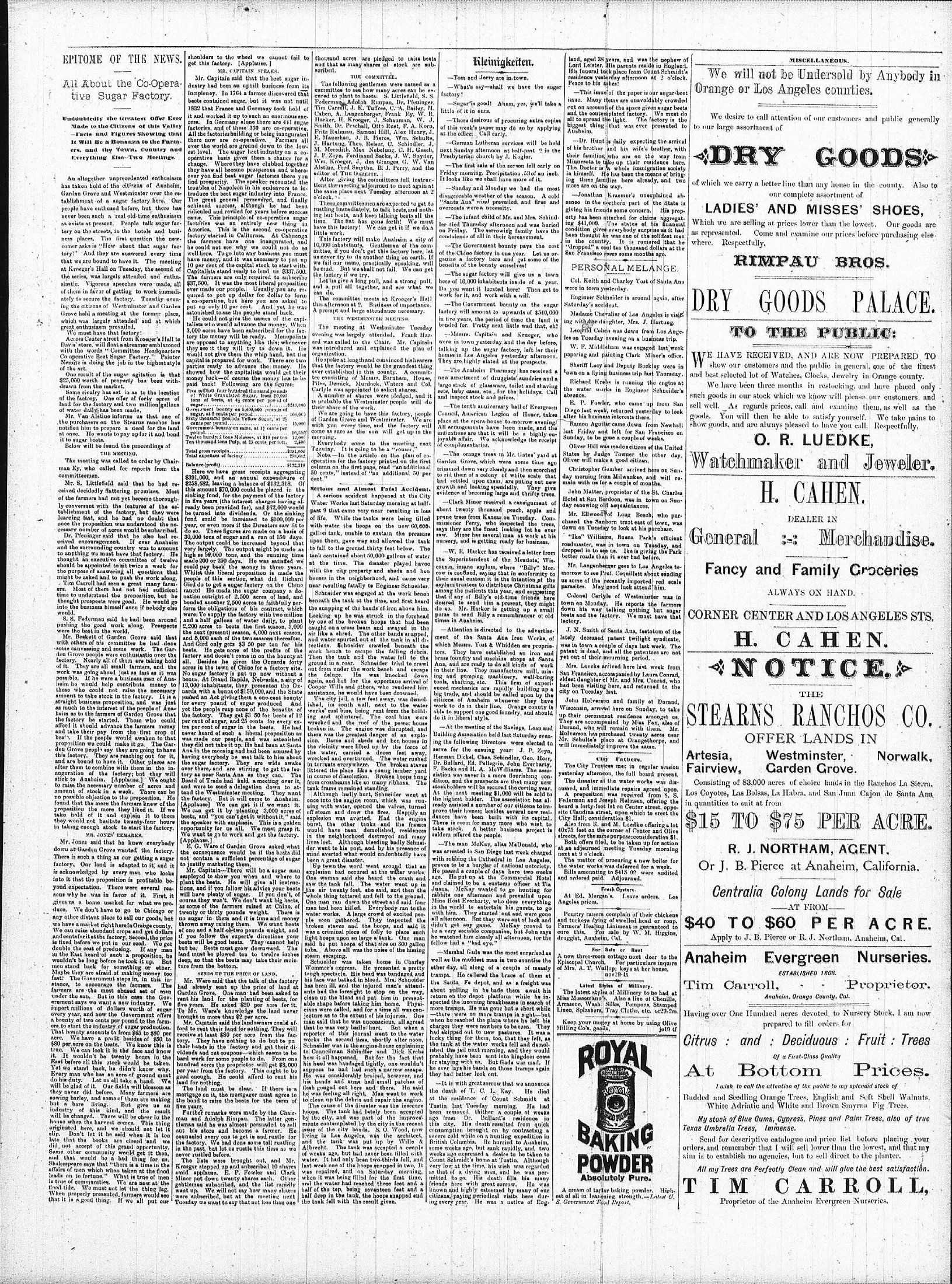
Searchable text
EPITOME OF THE NEWS.
All About the Co-Operative Sugar Factory.
Undoubtedly the Greatest Offer Ever Made to the Citizens of this Valley — Facts and Figures Showing that It Will Be a Bonanza to the Farmers, and the Town, Country and Everything Else—Two Meetings.
An altogether unprecedented enthusiasm has taken hold of the citizens of Anahim, Garden Grove and Westminster over the establishment of a sugar factory here. Our people have enthused before, but there has never been such a real old-time enthusiasm as exists at present. People talk sugar factory on the streets, in the hotels and business places. The first question the newcomer asks is "How about that sugar factory?" And they are answered every time that we are bound to have it. The meeting at Kroeger's Hall on Tuesday, the second of the series, was largely attended and enthusiastic. Vigorous speeches were made, all of them in favor of getting to work immediately to secure the factory. Tuesday evening the citizens of Westminster and Garden Grove held a meeting at the former place, which was largely attended and at which great enthusiasm prevailed.
We must have that factory!
Across Center street from Kroeger's Hall to Davis' store, will float a streamer emblazoned with the words "Committee Headquarters Co-operative Best Sugar Factory." Painter Nemitz is doing the job in the highest style of the art.
One result of the sugar agitation is that $25,000 worth of property has been withdrawn from the market.
Some rivalry has set in as to the location of the factory. One offer of forty acres of land for the factory and two million gallons of water daily has been made.
Mr. Van Alstine informs us that one of the purchasers on the Stearns ranchos has notified him to prepare a deed for the land at once. He wants to pay up for it and bond it to sugar beets.
Below will be found the proceedings of
THE MEETING.
The meeting was called to order by Chairman Ey, who called for reports from the committeemen.
MR. CAPITAIN SPEAKS.
Mr. Capitain said that the beet sugar industry had been an uphill business from its incipiency. In 1764 a farmer discovered that beets contained sugar, but it was not until 1832 that France and Germany took hold of it and worked it up to such an enormous success. In Germany alone there are 411 sugar factories, and of these 330 are co-operative. All the factories building or being inaugurated there now are co-operative. Farmers all over the world are ground down to the low-eat level. The sugar beet industry on a cooperative basis gives them a chance for a change. Where they have clubbed together they have all become prosperous and wherever you find best sugar factories there you find prosperity. The speaker recounted the troubles of Napoleon in his endeavors to introduce the beet sugar industry into France. The great general persevered, and finally achieved success, although he had been ridiculed and reviled for years before success came. This principle of co-operative sugar factories was an entirely new thing in America. This is the second co-operative factory started in California. At Cahnenga the farmers have one inaugurated, and he could not see why we could not do as well here. To go into any business you must have money, and it was necessary to put up 10 per cent of the capital stock to start with. Capitalists stand ready to lend us $337,500. The farmers are only required to subscribe $37,500. It was the most liberal proposition ever made our people. Usually you are required to put up dollar for dollar to form a co-operation, but here you are asked to put up only 10 per cent. And yet he was astonished to see the people stand back.
He could not give the names of the capitalists who would advance the money. When 3,000 acres have been subscribed for the factory the money will be ready. Monopolists are opposed to anything like this; whenever they see it they will try to down it. He would not give them the whip hand, but the capital is prepared for work. There are two parties ready to advance the money. He showed how the capitalists would get their money back—of course the money has to be paid back! Following are the figures:
Five million four hundred thousand pounds of White Granulated Sugar, from 10,000 tons of beets, at 4½ cents per pound of sugar.
$243,090 Government bounty on 5,400,000 pounds of sugar, at 2¢ cents per pound.
168,600 Sixty thousand pounds Yellow Sugar, at 2¢ cents per pound.
15,600 Government bounty on same, at 11¢ cents per pound.
10,500 Twelve hundred tons Molasses, at $19 per ton.
12,000 Ten thousand tons Pulp, at 25 cents per ton.
2,400 Total gross receipts.
$391,600 Total expenses of factory.
$258,682 Balance (profit).
$132,318
The following committee is cured to plant a Federman Ada Tim Carroll, J.C., Cohen, A., Lauen Harker, H., Krueg Smith, Dr. Presz Fritz Ruhmman, E.Mauerhan, M.Meredith, M.J.P.Zeyn,Fern Wm.Kroeger, Alstine,Fred S editor of THE GROUP.
After giving tions the meetings the same place no clock.
These committees rustling immediately but beats, at time. The flat have this factory little work.
This factory was 10,000 inhabitants mittte; if you do not use never try to do we fail our name but But we the factory if we Let us give a and a pull all can do.
The committee this afternoon at A prompt and laud THE WEEK.
The meeting evening was large and was introduced organization.
He spoke at length that the factory ever established tree consisting of Piles,Demick,Carlyle was appalled.
A number of us probable the their share of ours.
We are going to Garden Grove with you every come as sure as morning.
Everybody co Tuesday. It is Note—In the operation for the column on the first 50 cents," instantient."
$25,000 worth of property has been withdrawn from the market.
Some rivalry has set in as to the location of the factory. One offer of forty acres of land for the factory and two million gallons of water daily has been made.
Mr. Van Alstine informs us that one of the purchasers on the Stearns ranchos has notified him to prepare a deed for the land at once. He wants to pay up for it and bond it to sugar beets.
Below will be found the proceedings of THE MEETING.
The meeting was called to order by Chairman Ey, who called for reports from the committeemen.
Mr. S. Littlefield said that he had received decidedly flattering promises. Most of the farmers had not yet become thoroughly conversant with the features of the establishment of the factory, but they were learning fast, and he had no doubt that once the proposition was understood the necessary number of acres would be subscribed.
Dr. Pfeninger said that he also had received encouragement. If ever Anaheim and the surrounding country was to amount to anything we must have that factory. He thought an executive committee of twelve should be appointed to sit twice a week for the purpose of answering all questions that might be asked and to push the work along.
Tim Carroll had seen a great many farmers. Most of them had not had sufficient time to understand the proposition, but he thought prospects were good. He would go into the business himself even if nobody else would.
S. S. Federman said he had been around pushing the good work along. Prospects were the best in the world.
Mr. Beekett of Garden Grove said that with others of his committee he had done some canvassing and some work. The Garden Grove people were enthusiastic over the factory. Nearly all of them are taking hold of it. They are all small farmers, and the work was going ahead just as fast as it was possible. If he were a business man of Anaheim he would help contribute money to those who could not raise the necessary amount to take stock in the factory. It is a straight business proposition, and was just as much to the interest of the people of Anaheim as to the farmers of Garden Grove that the factory be started. Those who could afford it should advance the farmers money and take their pay from the first crop of beetles. If the people would awaken to that proposition we could make it go. The Garden Grove people say they are going to have this factory. They are reaching out for it, and are bound to have it. Other places are after them to combine with them in the inauguration of the factory; but they will stick to Anaheim. [Applause.] We ought to raise the necessary number of acres and amount of stock in a week. There can be no possible objection to the proposition. He found that the more the farmers knew of the proposition the more they liked it. If we take hold of it and explain it to them they would not hesitate twenty-four hours in taking enough stock to start the factory.
MR. JONES' REMARKS.
Mr. Jones said that he knew everybody down at Garden Grove wanted the factory. There is such a thing as our getting a sugar factory. Our land is adapted to it, and it is acknowledged by every man who looks into it that the proposition is profitable beyond expectation. There were several reasons why he was in favor of it. First, it gives us a home market for what we propose.
Five million four hundred thousand pounds of White Granulated Sugar, from 80,000 tons of beets, at 42 cents per pound of sugar.
Government bounty on 5,400,000 pounds of sugar, at 2 cents per pound.
Six thousand pounds Yellow Sugar, at 21 cents per pound.
Government bounty on same at 11 cents per pound.
Twelve hundred tons Molasses, at $10 per ton
Ten thousand tons Pulp, at 25 cents per ton.
Total gross receipts... $391,000
Total expenses of factory... $288,682
Balance (profit)... $152,318
Here we have gross receipts aggregating $391,000, and an annual expenditure of $258,682, leaving a balance of $132,318. Of this amount $70,000 could be placed in the sinking fund, for the payment of the factory in five years (the interest charges having already been provided for), and $62,000 would be turned into dividends. Or the sinking fund could be increased to $100,000 per year, or even more if the Directors saw fit to do so. These figures are made on a basis of 30,000 tons of sugar and a run of 150 days. The output could be increased beyond that very largely. The output might be made as high as 59,000 tons, and the running time made 200 or 250 days. He was satisfied we could pay back the money in three years. Whilst this liberal proposition is made the people of this section, what did Richard Girdo do to get a sugar factory on the Chino ranch? He made the sugar company a donation outright of 2,500 acres of land, and bonded another 2,500 acres to faithfully perform the obligations of his contract, which were: To supply the factory with two million and a half gallons of water daily, to plant 2,200 acres to beets the first season, 3,000 next (present) season, 4,000 next season, and 5,000 each of the two seasons thereafter. And Girdo only gets $3 50 per ton for his beets. He gets none of the profits of the factory and doesn't come in on the bounty at all. Besides he gives the Oxnardis forty acres in the town of Chino for a factory site. No sugar factory is put up without a bonus. At Grand Rapids, Nebraska, a city of 13,000 inhabitants, they presented the Oxnards with a bonus of $150,000, and the State passed an Act giving them a one-cent bounty for every pound of sugar produced. And yet the people reap none of the benefits of the factory. They get $3 50 for bales of 12 per cent of sugar, and 25 cents for every extra cent of sugar in the beets. He had never heard of such a liberal proposition as was made our people, and was astonished they did not take it up. He had been at Santa Ana in the morning and had been amused by having everybody he met talk to him about the sugar factory. They are wide awake over there, and are stirring to get the factory as near Santa Ana as they can. The Board of Trade held a meeting over it, and were to send a delegation down to attend the Westminster meeting. They want the factory. But it will come to Anaheim.[Applause.] We can get it if we want it. We can get it by planting 3,000 acres of beets, and "you can't get it without it," said the speaker with emphasis. This is a golden opportunity for us all. We must grasp it. We want to go to work and get the factory.[Applause.]]
E. G. Ware of Garden Grove asked what the consequence would be if the beets did not contain a sufficient percentage of sugar to justify marketing them.
Mr. Capitain—There will be a sugar man employed to show you when and where to plant the beets. He will give all instructions, and if you follow his advice your beets will have plenty of sugar. If you don't, of course they won't. We don't want big beets, as some of the farmers raised at Chino money back—of course the money has to be paid back! Following are the figures:
Five million four hundred thousand pounds of White Granulated Sugar, from 80,000 tons of beets, at 42 cents per pound of sugar, at 2 cents per pound.
Six thousand pounds Yellow Sugar, at 21 cents per pound.
Government bounty on same at 11 cents per pound.
Twelve hundred tons Molasses, at $10 per ton
Ten thousand tons Pulp, at 25 cents per ton.
Total gross receipts... $391,000
Total expenses of factory... $288,682
Balance (profit)... $152,318
A serious acacia Water Works last past 9 that came life. While there with water with gallon tank, unpaired upon them, gave up to fall on the growtank contained at at time.The with city prisons houses in the near resulting fat.
Schneider was beneath the tank snapping off the Looking up he by one of his braces on a cross air like a shred,and water spurted rections.Schneider work bench to Then the tank ground out under ther deluge.Be again,and but for Cooper Wille and assistance,hwe would.The city jail,a ibished its south works' coal bins,and splintered and broken in.The there was in grease.Barns and the vicinitywerethe water,carrie wrecked and overin torrentsevery litteredthe placein course of dissolvefrom crossbeams lihank tank frame remains.Although badly once into the engung with water,cow off steam and dredge explosion was avowed burst,the other would have been in the neighborhood lives lost.Although der want to his poin mind averted what been a great disaster.Up town these explosions had occured One woman said saw the tank fall.the air twenty few whole tittlettone One man ran low
Mr. Jones said that he knew everybody down at Garden Grove wanted the factory. There is such a thing as our getting a sugar factory. Our land is adapted to it, and it is acknowledged by every man who looks into it that the proposition is profitable beyond expectation. There were several reasons why he was in favor of it. First, it gives us a home market for what we produce. We don't have to go to Chicago or any other distant places to sell our goods, but we have a market right here in Orange county. We can raise abundant crops and get dollars and cents for it at the factory. Second, the price is fixed before we put in our seed. We get double the cost of producing. If any man in the East heard of such a proposition, he wouldn't be long before he took it up. But men stand back for something or ether. Maybe they are afraid of making money too fast! The Government stops in, in this instance, to encourage the farmers. The farmers are the most abused set of men under the sun. But in this case the Government says we want a new industry. We import millions of dollars worth of sugar every year, and now the Government offers a bounty of two cents per pound to the farmers to start the industry of sugar production. That bounty amounts to from $65 to $80 per acre. We have a profit besides of $50 to $80 per acre on the beets. We know this is true. We can look it in the face and know it. It wouldn't be twenty hours in the East before all this stock would be taken. Yet we stand back, he didn't know why. Every man who has an acre of ground must do his duty. Let us all take a hand. We will be glad of it. Our fields will blossom as they never did before. Many farmers are sowing barley, and some of them are making but a bare living. But give us an industry of this kind, and the result will be changed. There will be cheer in the house when the harvest comes. This thing originated here, and we should not let it slip. Don't let it be said when it is too late that the books are closed and we did not accept of this grand opportunity. Some other community would get it then, and that would be a bad thing for us. Shakespeare says that "there is a time in the affairs of men which when taken at the flood leads on to fortune." What is true of men is true of communities. We are now at the flood tide. We must not let the thing lag. When properly presented, farmers would see that it is a good thing. If we all put our
E.G.Ware of Garden Grove asked what the consequence would be if the beets did not contain a sufficient percentage of sugar to justify marketing them.
Mr.Capitain—There will be a sugar man employed to show you when and where to plant the beats. He will give all instructions, and if you follow his advice your beets will have plenty of sugar. If you don't, of course they won't. We don't want big beets, as some of the farmers raised at Chino, of twenty or thirty pounds weight. There is no sugar in them and it is time and money thrown away raising them. We want beets of one and a half or two pounds weight, and if you follow the expert's directions your beets will be good beets. They cannot help but be. Beets must grow downward. The land must be plowed ten to twelve inches deep, so that the beets may take their moisture from the bottom.
SENDS UP THE PRICE OF LAND.
Mr.Ware said that the talk of the factory had already sent up the price of land at Garden Grove. One man had been asked to rent his land for the planting of beets, for five years. He asked $20 per acre for it. To Mr.Ware's knowledge the land never brought in more than $2 per acre.
Mr.Capitain said the landowners could afford to rent their land for nothing. They will receive at least $80 per acre from the factory. They have nothing to do but put their hands in the factory and get their dividends and out coupons—which seems to be hard work for some people to do. From one hundred acres the proprietor will get $8,000 per year from the factory. This ought to be good enough. He could afford to rent his land for nothing.
The land must be clear. If there is a mortgage on it, the mortgagor must agree to the bond to raise the beets for the term of five years.
Further remarks were made by the Chairman and Adolph Rimpau. The latter gentleman said he was almost persuaded to sell out his store and become a farmer. He counseled everyone one to get in and rustle for the factory. We had done some tall rustling in the past, but let us rustle this time as we never rustled before.
The lists were brought out, and Mr.Kroeger stepped up and subscribed 10 shares amid applause. E.P.Fowler and Clark Minor put down twenty shares each. Other gentlemen subscribed, and the list rapidly went up. We will not say how many shares were subscribed, but at the meeting next Tuesday we want to say that not less than one
At town we saw explosion had occured. One woman said she saw the tank fall, the air twenty feet tall whole thing toppled. One man ran down man had been killed water works. A plea soon gathered broken staves and was a criminal piece light hoops upon saithe he put hoops tabs. Above all we steam escaping.
Schneider was Wommer's express tough spectacle. His face was bathed has been ill, and the ants had the foresight clean up the blood able shape before tracians were called, an jecture as to the man said that he was very busy reporter of this job works the second Schneder was in thie Councilman Schneider how it all happened his head was handed suppose he had hud He was considerable hands and arms flesh gonged out he he was feeling all rite to clean up the debt
The cause of these hoops. The tank by the city, and was mentions contemplated issue of the city being living in Los Angeles and the tank was Albrecht. The tank of weeks ago, but his water. It had only last week one of them was repaired, and when it was being fished and the water had half of the top, being half deep in the tank the tank fell with t
not fail to
sugar incess from its
covered that
is not until
look hold of
formous succension of 441 sugar
cooperative,
nanguarated
farmers all
to the lowly on a coance for a
and together
where and
there you
ounted the
rivors to intake to France.
and finally
had been more successive sugar thing in
cooperative Cahuenga rated, and not do as you must to put up start with.
subscribe proposition you are return to form asked to get he was back.
the capiley. When for the faccoponists whenever it he.
but, but the there are two money. He get their has to be resources.
he get their has to be resources.
thousand acres are pledged to raise beets and that as many shares of stock are subscribed.
THE COMMITTEE.
The following gentlemen were named as a committee to see how many acres can be secured to plant to beets: S. Littlefield, S. S. Federmann, Adolph Rumpau, Dr. Pfeninger, Tim Carroll, J. K. Tufree, C. A. Bailey, H. Cahen, A. Lungenberger, Frank Ey, W. R. Harker, H. Kroeger, J. Schauman, W. J. Smith, Dr. Pershall, Otto Rust, F. A. Korn, Fritz Ruhlman, Samuel Hill, Alex Henry, J. E. Mauerhan, J. B. Pierce, Wm. Schulte, J. Hartung, Theo Raiser, C. Schindler, J. M. Meredith, Max Nebelung, C. H. Gosch, J. P. Zeyn, Ferdinand Backs, J. W. Suyder, Wm. Kroeger, J. des Granges, G. W. Van Alatine, Fred Smythe, B. J. Perry, and the editor of THE GAZETE.
After giving the committees full instructions the meeting adjourned to meet again at the same place next Tuesday afternoon at 2 o'clock.
These committees are expected to get to rustling immediately, to talk beets, and nothing but beets, and keep talking beets all the time. The fiat has gone forth! We must have this factory! We can get it if we do a little work.
This factory will make Anaheim a city of 10,000 inhabitants. Gentlemen of the committee, if you don't get this factory here, let us never try to do another thing on earth. If we fail our name, practically speaking, will be mad. But we shall not fail. We can get the factory if we try.
Let us give a long pull, and a strong pull, and a pull all together, and see what we can do.
The committee meets at Kroeger's Hall this afternoon at 2. Business of importance.
A prompt and large attendance necessary.
THE WESTMINSTER MEETING.
The meeting at Westminster Tuesday evening was largely attended. Frank Hazard was called to the Chair, Mr. Capitain was introduced and explained the plan of organization.
He spoke at length and convinced his hearers that the factory would be the greatest thing ever established in this county. A committee consisting of Messrs. Barnham, House, Piles, Demick, Murdock, Waters and Col. Carlyle was appointed to solicit shares.
A number of shares were pledged, and it is probable the Westminster people will do their share of the work.
We are going to have this factory, people of Garden Grove and Westminster. We are with you every time, and the factory will come as sure as the sun will get up in the morning.
Everybody come to the meeting next Tuesday. It is going to be a "rouser."
Note. In the article on the plan of cooperation for the factory printed on the first column on the first page, read "an additional 50 cents," instead of "an additional 50 per cent."
Kleinigkeiten.
Tom and Jerry are in town.
What's say—shall we have the sugar factory?
Sugar is good! Ahem, yes, we'll take a little of it in ours.
Those desirous of procuring extra copies of this week's paper may do so by applying at the office. Call early.
German Lutheran services will be held next Sunday afternoon at half-past 2 in the Presbyterian church by J. Kogler.
The first rain of the season fell early on Friday morning. Precipitation .53 of an inch. It looks like we shall have more of it.
Sunday and Monday we had the most disgraceable weather of the season. A cold "Santa Ana" wind prevailed, and fires and overcoats a necessity.
The infant child of Mr. and Mrs. Schindler died Thursday afternoon and was buried on Friday. The sorrowing family have the condolence of all in their bereavement.
The Government bounty pays the cost of the Chino factory in one year. Let us organize a factory here and get some of the benefits of the bounty ourselves!
The sugar factory will give us a town here of 10,000 inhabitants inside of a year. Do you want it located here? Then go to work for it, and work with a will.
The Government bounty on the sugar factory will amount to upwards of $540,000 in five years, the period of time the land is bonded for. Pretty neat little wad that, eh?
Messrs. Capitain and Krueger, who were in town yesterday and the day before, talking up the sugar factory, left for their homes in Los Angeles yesterday afternoon. They are highly elated at the prospects.
The Anaheim Pharmacy has received a new assortment of druggists' sundries and a large stock of glassware, toilet and shaving sets, baby cases, etc., for the holidays. Call and inspect stock and prices.
The tenth anniversary ball of Evergreen Council, American Legion of Honor, takes place at the opera-house to-morrow evening! All arrangements have been made, and the indications are that it will be a highly enjoyable affair. We acknowledge the receipt of complimentaries.
The orange trees in Mr. Gates' yard at Garden Grove, which were some time ago trimmed down very closely and then scorched to rid them of a colony of white scale that land, aged 38 years, and was the nephew Lord Leister. His parents reside in England His funeral took place from Count Schreib residence yesterday afternoon at 2 o' Peace to his ashes!
This issue of the paper is our sugar issue. Many items are unavoidably crossed out on account of the space given sugar and the contemplated factory. We must all to spread the light. The factory is biggest thing that was ever presented Anaheim.
Dr. Hunt is daily expecting the arrival of his brother and his wife's brother; their families, who are on the way Minnesota to take up their residence The Doctor is a whole immigration so in himself. He has been the means of bringing three families here already, and more are on the way.
Jonathan Krauser's unexplained sense in the northern part of the State giving his friends some concern. His erry has been attached for claims aggreing $41,000. The status of his final condition gives everybody surprise as it been thought he was one of the solidest in the country. It is rumored that "dropped" a cool ten thousand dollars at San Francisco races some months ago.
PERSONAL MELANGE
Col. Keith and Charley Yost of Santa Barbara in town yesterday.
Engineer Schneider is around again on Saturday's accident.
Madame Chevalier of Los Angeles is waiting with her daughter, Mrs. J. Hartung Leophold Cohen was down from Los Angeles on Tuesday evening on a business trip W.F.Middleham was engaged last year papering and painting Clark Minor's office Sheriff Lacy and Deputy Buckley were town on a flying business trip last Thursday Richard Krebs is running the engine water works in Engineer Schneider absence.
E.P.Powler who came up from Diego last week returned yesterday to town after his business interests there.
Ramon Aguilar came down from New York last Friday and left for San Francisco Sunday; to be gone a couple of weeks.
Oliver Hill was made a citizen of the United States by Judge Towner the other or Oliver will make a good citizen.
Christopher Gomber arrived here on Sunday morning from Milwaukee; and will
In the factory having almost 1000 would be sinking at 50,000 per sawfit to a basis of 50 days. Everybody come to the meeting next Tuesday. It is going to be a "rouser." Note—In the article on the plan of cooperation for the factory printed on the first column on the first page, read "an additional 50 cents," instead of "an additional 50 per cent."
Serious and Almost Fatal Accident.
A serious accident happened at the City Water Works last Saturday morning at half-past 9 that came very near resulting in loss of life. While the tanks were being filled with water the hoops on the new 60,600-gallon tank, unable to sustain the pressure upon them, gave way and allowed the tank to fall to the ground thirty feet below. The tank contained about 50,000 gallons of water at the time. The disaster played havoc with the city property and sheds and hen houses in the neighborhood, and came very near resulting fatally to engineer Schneider.
Schneider was engaged at the work bench beneath the tank at the time, and first heard the snapping of the bands of iron above him. Looking up he was struck in the forehead by one of the broken hoops that had been caught on a cross beam and swayed in the air like a shred. The other bands snapped, and water spurted out of the tank in all directions. Schneider crawled beneath the work bench to escape the falling dobris. Then the tank and the water fell to the ground in a roar. Schneider tried to crawl out from under the work bench and escape the deluge. He was knocked down again, and but for the epportune arrival of Cooper Wille and others, who rendered him assistance, he would have been drowned.
The city jail, a few feet away, was demolished, its south wall, next to the water works' coal bins, being rent from the building and splintered. The coal bins were wrecked and the roof of the power house broken in. The engine was disrupted, and there was the greatest danger of an explosion. Baras and sheds and hen houses in the vicinity were lifted up by the force of the water, carried a dozen feet away, wrecked and overturned. The water rushed in torrents everywhere. The broken staves littered the place like a young lumber yard in course of dissolution. Broken hooks hang from crossbeams so many ribbons. The tank frame remained standing.
Although badly hurt, Schneider went at once into the engine room, which was running with water, opened the valves, turned off steam and drew the fires. Happily an explosion was averted. Had the engine burst, the other tanks and the frames would have been demolished, residences in the neighborhood destroyed and many lives lost. Although bleeding badly Schneider went to his post, and by his presence of mind averted what would undoubtedly have been a great disaster.
Up town we went around that an explosion had occurred at the water works. One woman said she heard the crash and saw the tank fall. The water went up in the air twenty feet, she said, and then the whole thing tottered and fell to the ground. One man ran down the street and said fourteeens consisting of Messrs. Barnham, House, Piles, Demick, Murdock, Waters and Col. Carlyle was appointed to solicit shares.
We are going to have this factory, people of Garden Grove and Westminster. We are with you every time, and the factory will come as sure as the sun will get up in the morning.
Everybody come to the meeting next Tuesday. It is going to be a "rouser."
Note—In the article on the plan of cooperation for the factory printed on the first column on the first page, read "an additional 50 cents," instead of "an additional 50 per cent."
The tenth anniversary ball of Evergreen Council, American Legion of Honor, takes place at the opera-house to-morrow evening. All arrangements have been made, and the indications are that it will be a highly enjoyable affair. We acknowledge the receipt of complimentaries.
The orange trees in Mr. Gates’ yard at Garden Grove, which were some time ago trimmed down very closely and then scorched to rid them of a colony of white scale that had settled upon them, are putting out new growth and looking spendly. They give evidence of becoming large and thrifty trees.
Clark Minor received a consignment of about twenty thousand peach, apple and prune trees from Kansas on Tuesday. Commissioner Perry, who inspected the trees, says they are the finest looking lot he ever saw. Minor has several men at work at his nursery, and is getting ready for business.
W. R. Harker has received a letter from the Superintendent of the Meadota, Wisconsin, insane asylum, where “Billy” Morrow is confined, saying that in conformity to their usual custom it is the intention of the ashley trustees to distribute Christmas gifts among the patients this year, and suggesting that if any of Billy’s old-time friends desire to send him a present, they might do so. Mr. Harker is getting up a small purse to send Billy a remembrancer of old times in Anaheim.
Attention is directed to the advertisement of the Santa Ana Iron Works, of which Messrs. Yost & Whidden are proprietors. They have established an iron and brass foundry and machine shops at Santa Ana, and are ready to do all kinds of work in their line. They manufacture mill, mining and pumping machinery, well-boring tools, shafting, etc. This firm of expert mechanics are rapidly building up a big trade, and should be called upon by the citizens of Anaheim whenever they have work to do in their line. Orange county is able to support one good foundation, and should do it in liberal style.
At the meeting of the Savings, Loan and Building Association held last Saturday evening—the following Directors were elected to serve for the ensuing year: J. P. Zeyn, Harman Dickel, Chas. Schindler, Geo. Horr, Dr. Bullard, Ed., Pellegrin, John Everharty, F. Backs and H. A. McWilliams. The association was never in a more flourishing condition, and the prospects are that many new stockholders will be secured the coming year.
At the next meeting $1,000 will be sold to the highest bidder. The association has already assisted a number of our citizens to improve their homes; besides new residences have been built with its capital. There is room for many more wish to take stock. A better business project is saldom offered to people.
The man McKay, alias McDonald, who was arrested in San Diego last week charged with robbing the Cathedral in Los Angeles, proves to be a burglary of national notoriety. He passed a couple of days here two weeks ago. He put up at the Commercial Hotel and claimed to be a customs officer at Tia Juana. McKay wanted to go hunting for rabbits one afternoon and prevailed upon Mine Host Everharty, who does everything in the world to entertain his guests.
Richard Krebs is running the engine water works in Engineer Schneidt absence.
E. P. Fowler, who came up from New York last week, returned yesterday to help after his business interests there.
Ramon Aguilar came down from New York last Friday and left for San Francisco Sunday; to be gone a couple of weeks.
Oliver Hill was made citizen of the United States by Judge Towner the other or Oliver will make a good citizen.
Christopher Gomber arrived here on Saturday morning from Milwaukee, and will main with us for a couple of months.
John Matter, proprietor of the St. Charles Hotel at San Berdoon, was in town on Saturday renewing old acquaintances.
Mr. Ellwood of Long Beach, who chased the Sanborn tractor east of town, down on Tuesday to look at his purchases.
“Iko” Williams, Buena Park’s official roadmaster, was in town on Tuesday; she dropped in to see us. Ike is giving the P.O.Box better roads than it ever before.
Mr Langenberger goes to Los Angeles morrow to see Prof. Coquillet about sending us some of the recently imported red parasites. May good luck attend him.
Colonel Carlyle of Westminster was town on Monday. He reports the farm down his way talking nothing but auctions andthe factory.Westminster must have thesefactory.
J.N.Smith of Santa Ana,fastotum of lateately deceased patent twilight syndicationwas in town a couple of days last week.Thepatentisdead,andimmediaterepairsagreedupon.Maindareldest daughterofMr.Mandres.Courand,hadbeenvisitinghere,andreturnedtothecityonTuesdaylast.
John HolersonandfamilyofDurangoWisconsinarrivedhereonSunday,totakeupyourpermanentresidenceamongetherTheyareaccompaniedbyMissFox.alsoDurandwhowillremainwiththem.MainholersonhaspurchasedtwentyacresnewMr.Schulte'splaceatOrangethorpe,andwillimmediatelyimprovethesame.
City Patrons.
The City Trustees met in regular session yesterdayafternoon,thefullboardpresenceThe disasteratthewaterworkswasdismissed,andimmediaterepairsagreedupon.AprepositionwasreceivedfromSt.FederaldemanandJosephHelmsenofferingboardaforty-footlotontCenterstreet.oppositeClaudiaNaudinstreet.upwhichtocrecttheCityHall;consideration$1.AlsofromR.mandL.Mueckeofferingal40x75footontheCornerofCenterandOlivestreets.forthesamepurpose;consideration$2Bothoffailed,tobebakenupforactionatanjeworedtingTuesdaymorningnextat9oclock.Thematterof procuringanewboilerforyethewaterworksdeferredforaweek.Billsmounting$41592wouldauditedandorderedpaid.Addjourned.
Fresh Oysters.
AtEd.Morgan'sLeaveorders.LosAngelesprices.
up town the word went around that an explosion had occurred at the water works. One woman said she heard the crash and saw the tank fall. The water went up in the air twenty feet, she said, and then the whole thing toothed and fell to the ground. One man ran down the street and said four men had been killed. Everybody ran to the water works. A large crowd of excited people soon gathered. They inspected the broken staves and the hoops, and said it was a criminal piece of folly to place such light hoops upon so large a tank. One man said he put hoops of that size on 300 gallon tubs. Above all was the noise of the hissing steam escaping.
Schneider was taken home in Charley Wommer's express. He presented a pretty tough spectacle. His head was bandaged and his face was batched in blood. Mrs. Schneider has been ill, and the injured man's attendants had the foresight to stop on the way, clean up the blood and put him in presentable shape before taking him home. Physicians were called, and for a time all was conjecture as to the extent of his injuries. One man said that he was unconscious, all agreed that he was very badly hurt. But when a reporter of this journal went to the water works the second time, shortly after noon, Schneider was in the engine-house explaining to Councilman Schindler and Dick Krebs how it all happened. But for the fact that his head was bandaged tightly, one wouldn't suppose he had had such a narrow escape. He was considerably bruised, however, and his hands and arms had small patches of flesh gonged out here and there. He said he was feeling all right. Men went to work to clean up the debris and repair the engine.
The cause of the disaster was the insecure hoops. The tank had lately been accepted by the city, and part of the improvements contemplated by the city in the recent issue of the city bonds. S. O. Wood, now living in Los Angeles, was the architect, and the tank was put up by Wille & Albrecht. The tank was accepted a couple of weeks ago, but had never been filled with water. It had only been two-thirds full, and last week one of the hoops snapped in two. It was repaired, and on Saturday morning, when it was being filled for the first time, and the water had reached three feet and a half deep in the tank, the hoops snapped and the tank fell with the result given.
—The man McKay, alias McDonald, who was arrested in San Diego last week charged with robbing the Cathedral in Los Angeles, proves to be a burglar of national notoriety. He passed a couple of days here two weeks ago. He put up at the Commercial Hotel and claimed to be a customs officer at Tia Juana. McKay wanted to go hunting for rabbits one afternoon and prevailed upon Mine Host Everharty, who does everything in the world to entertain his guests, to go with him. They started out and were gone all afternoon. But they were out of luck and didn't get any game. McKay proved to be a very sociable companion, but John says he watched him closely all afternoon, for the fellow had a "bad eye."
—Marshal Gade was the most surprised as well as the maddest man in two counties other day, all along of a couple of measly tramps. He collared the brace of them at the Santa Fe depot, and as a freight was about piling in he bade them await his return on the depot platform while he inspected the incoming breakaime in search of more tramps. He was gone but a short while —there were no more tramps in sight—but when he reached the place where he left his charges they were nowhere to be seen. They had skipped out to new pastures. It was a lucky thing for them, too, that they left, as the tank at the water works fell and demolished the jail next morning, and they would probably have been sent into kingdom come for staying with us. But Gade was mad. If he ever lays his bands on those tramps again they had better look out.
—It is with great sorrow that we announce the death of T. C. L. Kay. He died at the residence of Count Schmidt at Tuatin last Tuesday morning. He had been removed thither a couple of weeks ago from Dr. Bullard's residence in this city. His death resulted from quick consumption brought on by contracting a severe cold while on a hunting expedition in British Columbia. He hurried to Auhaheim, some weeks ago, but sank rapidly, and two weeks ago expressed a desire to be taken to Count Schmidt's home at Tuatin. Although very low at the time, his wish was regarded as that of a dying man, and he was permitted to go. His death fills his many friends here with great sorrow. He was known and highly esteemed by many of our citizens, paying periodical visits here during every year. He was a native of Eng-
ROYAL BAKING POWDER Absolutely Pure.
A cream of tartar baking powder. High estat of all in leavening strength. Latest O.S. Government Food Report.
MISCELLANEOUS.
We will not be Undersold by Anybody in Orange or Los Angeles counties.
We desire to call attention of our customers and public generally to our large assortment of
DRY GOODS
of which we carry a better line than any house in the county. Also to our complete assortment of
LADIES' AND MISSES' SHOES,
Which we are selling at prices lower than the lowest. Our goods are as represented. Come and examine our prices before purchasing else where. Respectfully,
RIMPAU BROS.
DRY GOODS PALACE.
TO THE PUBLIC:
WE HAVE RECEIVED, AND ARE NOW PREPARED TO show our customers and the public in general, one of the finest and best selected lot of Watches, Clocks, Jewelry in Orange county.
We have been three months in restocking, and have placed only such goods in our stock which we know will please our customers and sell well. As regards prices, call and examine them, as well as the goods. You will then be able to satisfy yourself. We take pains to show goods, and are always pleased to have you call. Respectfully,
O. R. LUEDKE,
Watchmaker and Jeweler.
We have been three months in restocking, and have placed only such goods in our stock which we know will please our customers and sell well. As regards prices, call and examine them, as well as the goods. You will then be able to satisfy yourself. We take pains to show goods, and are always pleased to have you call. Respectfully,
O. R. LUEDKE,
Watchmaker and Jeweler.
H. CAHEN.
DEALER IN
General Merchandise.
Fancy and Family Groceries
ALWAYS ON HAND.
CORNER CENTER AND LOS ANGELES STS.
H. CAHEN.
NOTICE.
THE
STEARNS RANCHOS CO.
OFFER LANDS IN
Artesia, Westminster, Norwalk,
Fairview, Garden Grove.
Consisting of 83,000 acres of choice lands in the Ranchos La Sierra, Los Coyotes, Las Bolsas, La Habra, and San Juan Cajon de Santa Ana in quantities to suit at from $15 TO $75 PER ACRE.
R. J. NORTHAM, AGENT.
Or J. B. Pierce at Anaheim, California.
Centralia Colony Lands for Sale
AT FROM
$15 TO $75 PER ACRE.
R. J. NORTHAM, AGENT.
Or J. B. Pierce at Anaheim, California.
Centralia Colony Lands for Sale
AT FROM
$40 TO $60 PER ACRE.
Apply to J. B. Pierce or R. J. Northam, Anaheim, Cal.
Anaheim Evergreen Nurseries.
ESTABLISHED 1868.
Tim Carroll, Proprietor.
Anaheim, Orange County, Cal.
Having over One Hundred acres devoted to Nursery Stock, I am now prepared to fill orders for
Citrus: and: Deciduous: Fruit: Trees
Of a First-Class Quality
At Bottom Prices.
I wish to call the attention of the public to my splendid stock of Budded and Seedling Orange Trees, English and Soft Shell Walnuts, White Adriatic and White and Brown Smyrna Fig Trees.
My stock of Blue Gums, Cypress, Pines and Palm Trees, also of true Texas Umbrella Trees, Immense.
Send for descriptive catalogue and price list before placing your orders, and remember that I will sell lower than the lowest, and that my aim is to establish no agencies, but to sell direct to the planter.
All my Trees are Perfectly Clean and will give the best satisfaction.
TIM CARROLL,
Proprietor of the Anaheim Evergreen Nurseries.