anaheim-gazette 1891-11-19
Scanned page
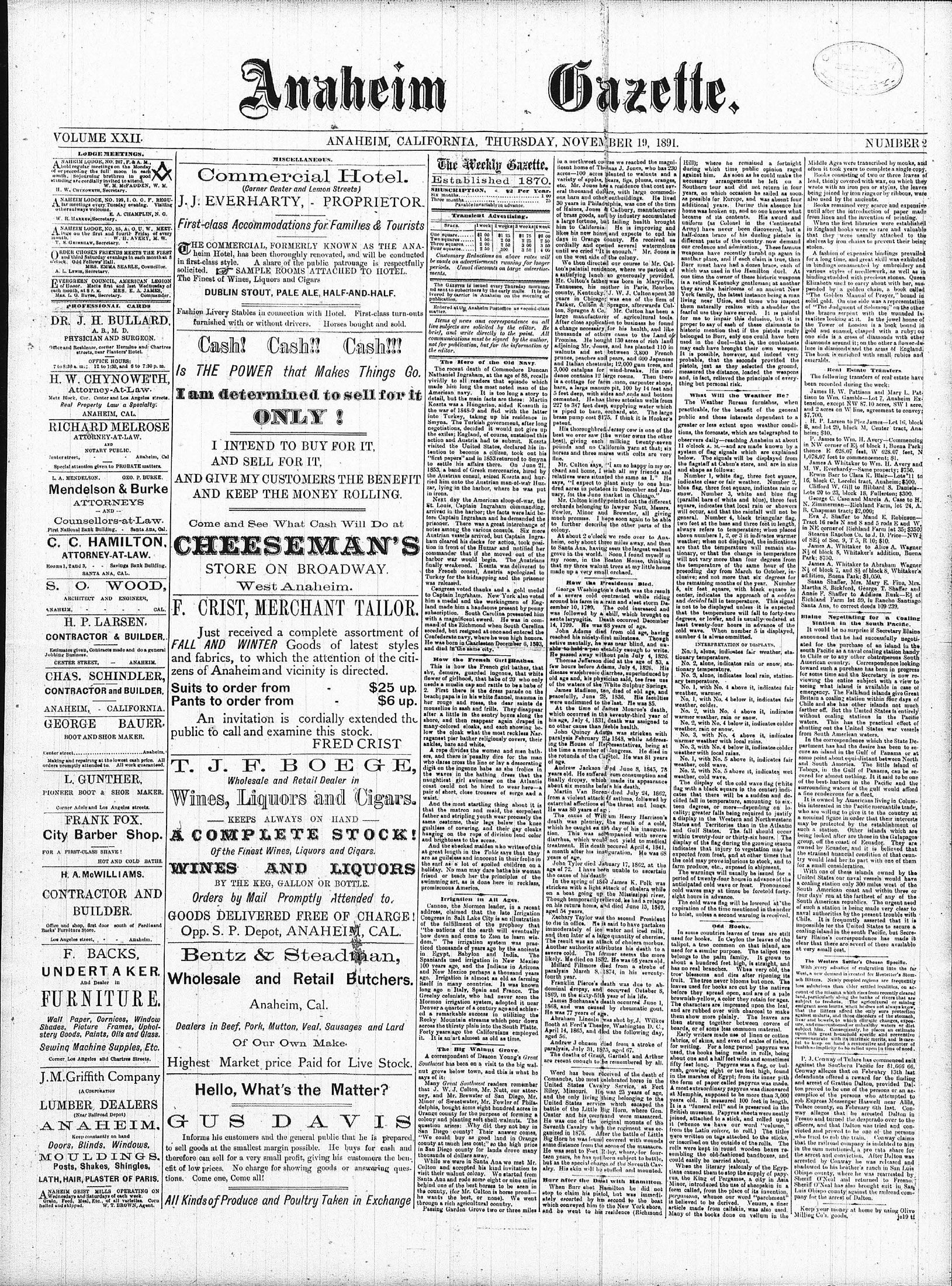
Searchable text
VOLUME XXII.
LODGE MEETINGS.
ANAHEIM LODGE, NO. 297, F. & A. M., hold regular meetings on the Monday of or preceding the full moon in each month. Joinouring brethren in good standing are cordially invited to attend.
W. M. McFADDEN, W. M.
H. W. CHYNOWETH, Secretary.
ANAHEIM LODGE, NO. 199, I. O. O. P. REGULAR meetings every Tuesday evening. Visiting others always welcome.
E. A. CHAMPLIN, N. O.
W. R. HARKER, Secretary.
ANAHEIM LODGE, NO. 85, A. O. U. W. MEETINGS on the first and fourth Friday of every month.
W. H. AVERY, M. W.
T. S. GRIESHAW, Secretary.
ORDER CHOSEN FRIENDS MEETS THE FIRST and third Saturday evenings in each month at 8 o'clock. Odd Follows Hall.
MRS. EMMA SEARLE, Councillor.
A. L. Lewis, Secretary.
EVERGREEN COUNCIL, AMERICAN LEGION OF Honor. Meets first and last Wednesday of each month at 5 p.m.
MRS. E. A. JAMES,
Mrs. L. O. Hayes, Secretary.
PROFESSIONAL CARDS
DR. J. H. BULLARD,
A. B., M. D.
PHYSICIAN AND SURGEON.
Office and Residence, corner Hermine and Chartres streets, near Planters' Hotel.
OFFICE HOURS:
7 to 8:30 a.m.; 12 to 1:30, and 6 to 7:30 p.m.
H. W. CHYNOWETH,
Attorney-At-Law.
Metz Block, Cor. Center and Los Angeles streets.
Real Property Law a Specialty:
ANAHEIM, CAL.
RICHARD MELROSE
ATTORNEY-AT-LAW.
AND
NOTARY PUBLIC.
Center street,
Anaheim, Cal
Special attention given to PROBATE matters.
L. A. MENDELSON.
OEO. P. BURKE.
MISCELLANEOUS.
Commercial House
(Corner Center and Lemon Streets)
J.J. EVERHARTY, - PRO
First-class Accommodations for Families
THE COMMERCIAL, FORMERLY KNOWN Theim Hotel, has been thoroughly renovated, and in first-class style. A share of the public patron solicited. SAMPLE ROOMS ATTACHED The Finest of Wines, Liquors and Cigars
DUBLIN STOUT, PALE ALE, HALF-A
Fashion Livery Stables in connection with Hotel furnished with or without drivers.
Cash! Cash!! C
Is THE POWER that Makes I am determined to sell ONLY!
I INTEND TO BUY FOR AND SELL FOR IT,
AND GIVE MY CUSTOMERS TH
H. W. CHYNOWETH,
Attorney-At-Law.
Metz Block, Cor. Center and Los Angeles streets.
Real Property Law a Specialty:
ANAHEIM, CAL.
RICHARD MELROSE
ATTORNEY-AT-LAW.
AND
NOTARY PUBLIC.
Center street,
Anaheim, Cal.
Special attention given to PROBATE matters.
L. A. MENDELSON.
GEO. P. BURKE.
Mendelson & Burke
ATTORNEYS
AND
Counsellors-at-Law.
First National Bank Building.
Santa Ana, Cal.
C. C. HAMILTON.
ATTORNEY-AT-LAW.
Rooms 1, 2 and 3.
Savings Bank Building.
SANTA ANA, CAL.
S. O. WOOD,
ARCHITECT AND ENGINEER,
ANAHEIM, CAL.
H. P. LARSEN,
CONTRACTOR & BUILDER.
Estimates given, Contracts made and do a general Jobbing Business.
CENTER STREET,
ANAHEIM.
CHAS. SCHINDLER,
CONTRACTOR and BUILDER.
ANAHEIM, CALIFORNIA.
GEORGE BAUER,
BOOT AND SHOE MAKER.
Center street...
Anaheim.
Making and repairing at the lowest cash price. All orders promptly attended to. All work guaranteed.
L. GUNTHER,
PIONEER BOOT & SHOE MAKER.
Corner Adele and Los Angeles streets.
FRANK FOX.
City Barber Shop.
FOR A FIRST-CLASS SHAVE!
HOT AND COLD BATHS.
H. A. McWILLIAMS.
CONTRACTOR AND BUILDER
I am determined to sell ONLY!
I INTEND TO BUY FOR AND SELL FOR IT,
AND GIVE MY CUSTOMERS THE AND KEEP THE MONEY ROOM
Come and See What Cash WILL BE
CHEESEMASTORE ON BROADWAY
West Anaheim.
F. CRIST, MERCHANT
Just received a complete assortment of fall and winter Goods of lace and fabrics, to which the attention zens of Anaheim and vicinity is directed.
Suits to order from
Pants to order from
An invitation is cordially extended public to call and examine this store.
T. J. F. BOEVER
Wholesale and Retail Dealer in Wines, Liquors and Cocktails
KEEPS ALWAYS ON HAND
A COMPLETE STOCK OF THE Finest Wines, Liquors and Cocktails
WINES AND LICHTIONS
BY THE KEG, GALLON OR BOTTLE
Orders by Mail Promptly Attended
FRANK FOX.
City Barber Shop.
FOR A FIRST-CLASS SHAVE!
HOT AND COLD BATHS.
H. A. McWILLIAMS.
CONTRACTOR AND BUILDER.
Office and shop, first door south of Perdinand Backs' Furniture Store.
Los Angeles street, Anaheim.
F. BACKS,
UNDERTAKER.
And Dealer in
FURNITURE.
Wall Paper, Cornices, Window Shades, Picture Frames, Upholstery Goods, Paints, Oils and Glass.
Sewing Machine Supplies, Etc.
Corner Los Angeles and Chartres Streets.
J.M. Griffith Company
(A Corporation)
LUMBER DEALERS
(Near Railroad Depot)
ANAHEIM.
Keep constantly on hand
Doors, Blinds, Windows,
MOULDINGS.
Posts, Shakes, Shingles,
LATH, HAIR, PLASTER OF PARIS.
ANAHEIM ORIST MILLS OPERATING ON Wednesdays and Saturdays of each week.
Grain, Feed, Meal, Etc., of all varieties. Corn shelled and shipped.
W. T. BROWN, Agent.
KEEPS ALWAYS ON HAND
A COMPLETE STORY
Of the Finest Wines, Liquors and Gins
WINES AND LICHT
BY THE KEG, GALLON OR BOTTLE
Orders by Mail Promptly Attend
GOODS DELIVERED FREE OF Opp. S. P. Depot, ANAHEIM
Bentz & Steadr
Wholesale and Retail B
Anaheim, Cal.
Dealers in Beef, Pork, Mutton, Veal, Sausage
Of Our Own Make.
Highest Market price Paid for L
Hello, What's the Mat?
GUS DAVENPORT
Informs his customers and the general public that to sell goods at the smallest margin possible. He buys therefore can sell for a very small profit, giving his cut efit of low prices. No charge for showing goods or tions. Come one, Come all!
All Kindsof Produce and Poultry Taken
ANAHEIM, CALIFORNIA, THURSDAY, NOVEMBER 19, 1890
MISCELLANEOUS.
Comcial Hotel.
(Enter and Lemon Streets)
TY, - PROPRIETOR.
Modations for Families & Tourists
ORMERLY KNOWN AS THE ANAroughly renovated, and will be conducted
of the public patronage is respectfully
ROOMS ATTACHED TO HOTEL.
and Cigars
PALE ALE, HALF-AND-HALF.
Connection with Hotel. First-class turn-outs
at drivers. Horses bought and sold.
Cash!!! Cash!!!
that Makes Things Go.
nined to sell for it
NLY!
TO BUY FOR IT,
FOR IT,
STOMERS THE BENEFIT
The Weekly Gazette.
Established 1870.
SHUSCRIPTION, - $2 Per Year.
Six months. 1.00
Three months. 75
Pavable invariably in advance.
Transient Advertising.
SPACE.
One square.....
Two squares.....
Three squares.....
Four squares.....
1 week
$1 00
1 50
2 00
2 50
2 50
2 weeks
$1 25
2 00
2 50
3 00
3 50
3 weeks
$1 75
2 25
3 00
3 50
4 00
4 weeks
$2 00
2 50
3 00
3 50
Customary Reductions on above rates will be made on advertisements running for longer periods. Usual discounts on large advertisements.
The Gazette is issued every Thursday morning, and sent to subscribers by the early mail. It is delivered by carrier in Anaheim on the morning of publication.
Entered at the Anaheim Postoffice as second-class matter.
Items of news and correspondence on all live subjects are solicited by the editor. Be brief, and write directly to the point. All communications must be signed by the author, not for publication, but for the information of the editor.
The Hero of the Old Navy.
The recent death of Commodore Duncan Nathaniel Ingraham, at the age of 88, recalls vividly to all readers that episode which made him long the most noted man of the American navy. It is too long a story to detail, but the main facts are these: Martin Koszta was a Hungarian, aided Kosauth in the war of 1848-9 and fled with the latter into Turkey, taking up his residence in Smyna. The Turkish government, after long negotiations, decided it would not give up the exiles; England, of course, sustained this action and Austria had to submit. Koszta visited the United States, declared his intention to become a citizen, took out his "first papar" and in 1853 returned to Smyna to settle his affairs there. On June 21, 1853, a band of Greek mercenaries, hired by the Austrian consul, seized Koszta and hurried in a northwest course we reached the magnificent home of Thomas J. Jones, who has 22 acres—100 acres planted to walnuts and a variety of apples, bears, figs, plums, orange etc. Mr. Jones has a residence that cost several thousand dollars, with large commodious barn and other outbuildings. He lives 30 years in Philadelphia, was one of the first of Haines, Jones & Caldbury, manufacturer of brass goods, and by industry accumulated a large fortune, but failing health brought him to California. He is improving and likes his new home and expects to end his days in Orange county. He received u cordially and opened several watermelons until we cried "It is enough." Mr. Jones is on the west side of the colony.
We then directed our course to Mr. Culton's palatial residence, where we partook of a satisfying lunch so generously provided Mr. Culton's father was born in Maryville, Tennessee, his mother in Paris, Bourbon county, Kentucky. J.W.J. Culton spent 30 years in Chicago; was one of the firm of Parker, Culton & Sprague, afterwards Culton, Sprague & Co. Mr. Culton has been a large manufacturer of agricultural tools. After close application to business he found a change necessary for his health, and like thousands of others came to the Land of Promise. He bought 130 acres of rich land adjoining Mr. Jones, and has planted 110 in walnuts and set between 3,800 French prunes, peaches and pears, and 600 Japanese and Italian chestnuts; 12,000 gum trees, and 3,000 catalpas for wind-breaks. His residence contains 12 large rooms. Then there is a cottage for farm men, carpenter shops, barn, a large manure pit, 100 by 14 feet and 5 feet deep, with sides and ends and bottom cemented. He has three artesian wells from 227 to 347 feet deep, supplying water which is piped to barn, orchard, etc. The large brass pump cost $175. I think it is Hooker's patent.
His thoroughbred Jersey cow is one of the best we ever saw (the writer owns the other best), giving each milking twenty-seven pounds and no California yarn at that; six horses and three mares with colts are very fine.
Mr. Culton says, "I am so happy in my orchard and home. I wish all my friends and relatives were situated the same as I." He
TO BUY FOR IT,
FOR IT,
STOMERS THE BENEFIT
THE MONEY ROLLING.
What Cash Will Do at
SEMAN'S
BROADWAY.
Anaheim.
MERCHANT TAILOR.
a complete assortment of
Goods of latest styles
with the attention of the citivicity is directed.
JAMES, LIQUORS and CIGARS.
AND LIQUORS
GALLON OR BOTTLE.
Promptly Attended to.
BROEGE,
and Retail Dealer in
Cigars and Cigars.
WAYS ON HAND —
ETE STOCK!
Cheses, Liquors and Cigars.
GALLON OR BOTTLE.
Promptly Attended to.
IRRIGATION IN ALL Ages.
Cannon, the Mormon leader, in a recent vividly to all readers that episode which made him long the most noted man of the American navy. It is too long a story to detail, but the main facts are these: Martin Koszta was a Hungarian, aided Kosuth in the war of 1848-9 and fled with the latter into Turkey, taking up his residence in Smyna. The Turkish government, after long negotiations, decided it would not give up the exiles; England, of course, sustained this action and Austria had to submit. Koszta visited the United States, declared his intention to become a citizen, took out his "first papara" and in 1853 returned to Smyna to settle his affairs there. On June 21, 1853, a band of Greek mercenaries, hired by the Austrian consul, seized Koszta and hurried him onto the Austrian man-of-war Huzzar, lying in the harbor, where he was put in irons.
Next day the American sloop-of-war, the St. Louis, Captain Ingraham commanding, arrived in the harbor; the facts were laid before Captain Ingraham and he demanded the prisoner. There was a great interchange of notes among the various consuls. Six more Austrian vessels arrived, but Captain Ingraham cleared his decks for action, took position in front of the Huzzar and notified her commander that if she moved out of the harbor war would begin. The Austrians finally weakened. Koszta was delivered to the French consul, Austria apologized to Turkey for the kidnapping and the prisoner was released.
Cengress voted thanks and a gold medal to Captain Ingraham. New York also voted him a medal and the workingmen of England made him a handsome present by penny subscription. South Carolina presented him with a magnificent sword. He was in command of the Richmond when South Carolina escaped, but resigned at once and entered the Confederate navy, where he won high honors. He was born in Charleston December 6, 1833, and died in the same city.
How the French Girl Hatches.
This is how the French girl bathes that aby, demure, guarded ingenuous, that white flower of girlhood, that babe of 20 who only needs a muslin cap and rattle to be a babe of 2. First there is the dress parade on the beach; papa is in his white flannel, mamma in her rouge and roses, the dear maiden de mousseline in saff and frills. They disappear after a little in the sentry boxes along the shore, and then reappear again draped in many-colored cloaks, and each showing below the cloak what the most reckless Narraganset pier bather religiously covers, their anklees, bare and white.
A rope divides the women and men bathers, and there is penalty dire for the man who dares cross the line or lay a desecrating digit on the ingenuine babe as she frolics in the waves in the bathing dress that the naughtiest girl swimmer on the Atlantic coast could not be hired to wear here—a pair of short, close trousers of serge and a waist.
And the most startling thing about it is that the matron and maid, the corpulent father and striplying youth wear proselytely the same costume, their legs below the knee guiltless of covering, and their gay cloaks hanging on the rope of division lend color and brightness to the scene.
And the shocked maiden who writes of this at great length in the Table says that they are as guileless and innocent in their frolie in the surf as a lot of spoiled children on a holiday. No man may dare bathe his woman friend or teach her the principles of the swimming art, as is done here in rockless, promiscuous America.
Irrigation In All Ages.
Cannon, the Mormon leader, in a recent vividly to all readers that episode which made him long the most noted man of the American navy. It is too long a story to detail, but the main facts are these: Martin Koszta was a Hungarian, aided Kosuth in the war of 1848-9 and fled with the latter into Turkey, taking up his residence in Smyna. The Turkish government, after long negotiations, decided it would not give up the exiles; England, of course, sustained this action and Austria had to submit. Koszta visited the United States, declared his intention to become a citizen, took out his "first papara" and in 1853 returned to Smyna to settle his affairs there. On June 21, 1853, a band of Greek mercenaries, hired by the Austrian consul, seized Koszta and hurried him onto the Austrian man-of-war Huzzar, lying in the harbor, where he was put in irons.
Next day the American sloop-of-war, the St. Louis, Captain Ingraham commanding, arrived in the harbor; the facts were laid before Captain Ingraham and he demanded the prisoner. There was a great interchange of notes among the various consuls. Six more Austrian vessels arrived, but Captain Ingraham cleared his decks for action, took position in front of the Huzzar and notified her commander that if she moved out of the harbor war would begin. The Austrians finally weakened. Koszta was delivered to the French consul, Austria apologized to Turkey for the kidnapping and the prisoner was released.
Cengress voted thanks and a gold medal to Captain Ingraham. New York also voted him a medal and the workingmen of England made him a handsome present by penny subscription. South Carolina presented him with a magnificent sword. He was in command of the Richmond when South Carolina escaped, but resigned at once and entered the Confederate navy, where he won high honors. He was born in Charleston December 6, 1833, and died in the same city.
How the Presidents Bled.
George Washington's death was the result of a severe cold contracted while riding around his farm in rain and sleet storm December 10, 1799. The cold increased and was followed by a chill, which brought on acute laryngitis. Death occurred December 14, 1799. He was 68 years of age.
John Adams died from old age, having reached his ninety-first milestone. Though active mentally, he was near blind, and unable to hold a pen steady enough to write. He passed away without pain July 4, 1826.
Thomas Jefferson died at the age of 83, a few hours before Adams, July 4, 1826. His disease was johrenic diarrhea, superinduced by old age and his physician said, too free use of of waters of the White Sulphur Springs. James Madison, too, died of old age,and peacefully, June 28, 1836. His faculties were undimmed to the last. He was 85.
At the time of James Monroe's death which occurred in seventh-third year of his age, July 4, 1831, death was assigned to no other cause than feeble health.
John Quinoy Adams was stricken with paralysis February 21, 1848, while addressing the House of Representatives, being at the time a member of Congress. He died in rotunda of the Capitol. He was 81 years of age.
Andrew Jackson died June 8, 1845, 78 years old. He suffered from consumption and finally dropy which made its appearance about six months before his death.
Martin Van Buren died July 24, 1862 from a violent attack of asthma, followed by catarhal affections of the throat and lungs. He was 80 years of age.
The cause of William Henry Harrison's death was pleurisy, the result of a cold which he caught on the day of his inauguration. This was accompanied with severe diarrhea which would not yield to medical treatment. His death occurred April 4, 1841,a month after his inauguration. He was 68 years of age.
John Tyler died January 17, 1862; at the age of 72.I have been unable to ascertain the cause of his death.
In the spring of 1840 James K. Polk was stricken with a light attack of chelera while on a boat going up the Mississippi river. Though temporarily relieved he had a relapse on his return home,and died June 15.1849.
WAYS ON HAND —
BETE STOCK!
Liquors and Cigars.
UND LIQUORS
GALLON OR BOTTLE.
Promptly Attended to.
ED FREE OF CHARGE!
ANAHEIM, CAL.
Steadman,
Retail Butchers.
heim, Cal.
卜ton, Veal, Sausages and Lard
Own Make.
ce Paid for Live Stock.
What's the Matter?
DAVIS
the general public that he is prepared
begin possible. He buys for cash and
profit, giving his customers the benshowing goods or answering ques-
Poultry Taken in Exchange
Irrigation in All Ages.
Cannon, the Mormon leader, in a recent
address, claimed that the late Irrigation
Congress in Salt Lake City is an illustration
of the fulfillment of the prophecy that
"the nations of the earth will eventually
bow down and come to Zion to learn wisdom." The irrigation system was practiced thousands of years ago by the ancients
in Egypt, Babylon and India. The
Spaniards used irrigation in New Mexico
100 years ago, and the Indians in Arizona
and Now Mexico perhaps a thousand years
ago. Irrigation is almost as old as farming
itself in many countries. It was known
long ago in Italy, Spain and France. The
Greeks colonists, who had never seen the
Mormon irrigation system, adopted it near
Denver a quarter of a century ago and achieved
a remarkable success in utilizing the
Rocky Mountain streams which pour down
across the thirsty plain into the South Platte.
Forty years ago the Californians employed
it. It is an art almost as old as time.
The Big Walnut Grove.
A correspondent of Deacon Young's Great
Southwest has been on a visit to the big walnut grove below town, and this is what he
says of it:
Many Great Southwest readers remember
that J. W. J. Colton, Mr. Nutt, our attorneny, and Mr. Brewater of San Diego, Mr.
Minor of Sweetwater, Mr. Fowler of Philadelphia, bought some eight hundred acres in
Orange county for the purpose of forming a colony and planting soft shell-walnuts. The
question arises: Why did they not buy in San Diego county? Their answer comes,
"We could buy as good land in Orange county at much less cost;" so the high price in San Diego county for lands drove many thousands of dollars away.
While we were in Santa Ana we met Mr.
Culton and accepted his kind invitation to visit their walnut colony. We started from Santa Ana and rode some eight or nine miles behind one of the best horses to be seen in the county, (for Mr. Culton is horse proud—he wants the best, or none). We went through a rich agricultural country.
Passing Garden Grove two or three miles
that the matron and maid, the corpulent father and stripling youth wear precisely the same costume, their legs below the knee guilless of covering, and their gay cloaks hanging on the rope of division lend color and brightness to the scene.
And the shocked maiden who writes of this at great length in the Table says that they are as guileless and innocent in their frolic in the surf as a lot of spoiled children on a holiday. No man may dare bathe his woman friend or teach her the principles of the swimming art, as is done here in reckless, promiscuous America.
Irrigation in All Ages.
Cannon, the Mormon leader, in a recent address, claimed that the late Irrigation Congress in Salt Lake City is an illustration of the fulfillment of the prophecy that "the nations of the earth will eventually bow down and come to Zion to learn wisdom." The irrigation system was practiced thousands of years ago by the ancients in Egypt, Babylon and India. The Spaniards used irrigation in New Mexico 100 years ago, and the Indians in Arizona and New Mexico perhaps a thousand years ago. Irrigation is almost as old as farming itself in many countries. It was known long ago in Italy, Spain and France. The Greeks colonists, who had never seen the Mormon irrigation system, adopted it near Denver a quarter of a century ago and achieved a remarkable success in utilizing the Rocky Mountain streams which pour down across the thirsty plain into the South Platte. Forty years ago the Californians employed it. It is an art almost as old as time.
The Big Walnut Grove.
A correspondent of Deacon Young's Great Southwest has been on a visit to the big walnut grove below town, and this is what he says of it:
Many Great Southwest readers remember that J. W. J. Colton, Mr. Nutt, our attorneny, and Mr. Brewater of San Diego, Mr.
Minor of Sweetwater, Mr. Fowler of Philadelphia, bought some eight hundred acres in Orange county for the purpose of forming a colony and planting soft shell-walnuts. The question arises: Why did they not buy in San Diego county? Their answer comes,
"We could buy as good land in Orange county at much less cost;" so the high price in San Diego county for lands drove many thousands of dollars away.
While we were in Santa Ana we met Mr.
Culton and accepted his kind invitation to visit their walnut colony. We started from Santa Ana and rode some eight or nine miles behind one of the best horses to be seen in the county, (for Mr. Culton is horse proud—he wants the best, or none). We went through a rich agricultural country.
Passing Garden Grove two or three miles that the matron and maid, the corpulent father and stripling youth wear precisely the same costume, their legs below the knee guilless of covering, and their gay cloaks hanging on the rope of division lend color and brightness to the scene.
And the shocked maiden who writes of this at great length in the Table says that they are as guileless and innocent in their frolic in the surf as a lot of spoiled children on a holiday. No man may dare bathe his woman friend or teach her the principles of the swimming art, as is done here in reckless, promiscuous America.
Irrigation in All Ages.
Cannon, the Mormon leader, in a recent address, claimed that the late Irrigation Congress in Salt Lake City is an illustration of the fulfillment of the prophecy that "the nations of the earth will eventually bow down and come to Zion to learn wisdom." The irrigation system was practiced thousands of years ago by the ancients in Egypt, Babylon and India. The Spaniards used irrigation in New Mexico 100 years ago, and the Indians in Arizona and New Mexico perhaps a thousand years ago. Irrigation is almost as old as farming itself in many countries. It was known long ago in Italy, Spain and France. The Greeks colonists, who had never seen the Mormon irrigation system, adopted it near Denver a quarter of a century ago and achieved a remarkable success in utilizing the Rocky Mountain streams which pour down across the thirsty plain into the South Platte. Forty years ago the Californians employed it. It is an art almost as old as time.
The Big Walnut Grove.
A correspondent of Deacon Young's Great Southwest has been on a visit to the big walnut grove below town, and this is what he says of it:
Many Great Southwest readers remember that J. W. J. Colton, Mr. Nutt, our attorneny, and Mr. Brewater of San Diego, Mr.
Minor of Sweetwater, Mr. Fowler of Philadelphia, bought some eight hundred acres in Orange county for the purpose of forming a colony and planting soft shell-walnuts. The question arises: Why did they not buy in San Diego county? Their answer comes,
"We could buy as good land in Orange county at much less cost;" so the high price in San Diego county for lands drove many thousands of dollars away.
While we were in Santa Ana we met Mr.
Culton and accepted his kind invitation to visit their walnut colony. We started from Santa Ana and rode some eight or nine miles behind one of the best horses to be seen in the county, (for Mr. Culton is horse proud—he wants the best, or none). We went through a rich agricultural country.
Passing Garden Grove two or three miles that the matron and maid, the corpulent father and stripling youth wear precisely the same costume, their legs below the knee guilless of covering, and their gay cloaks hanging on the rope of division lend color and brightness to the scene.
And the shocked maiden who writes of this at great length in the Table says that they are as guileless and innocent in their frolic in the surf as a lot of spoiled children on a holiday. No man may dare bathe his woman friend or teach her the principles of the swimming art, as is done here in reckless, promiscuous America.
Irrigation in All Ages.
Cannon, the Mormon leader, in a recent address, claimed that the late Irrigation Congress in Salt Lake City is an illustration of the fulfillment of the prophecy that "the nations of the earth will eventually bow down and come to Zion to learn wisdom." The irrigation system was practiced thousands of years ago by the ancients in Egypt, Babylon and India. The Spaniards used irrigation in New Mexico 100 years ago, and the Indians in Arizona and New Mexico perhaps a thousand years ago. Irrigation is almost as old as farming itself in many countries. It was known long ago in Italy, Spain and France. The Greeks colonists, who had never seen the Mormon irrigation system, adopted it near Denver a quarter of a century ago and achieved a remarkable success in utilizing the Rocky Mountain streams which pour down across the thirsty plain into the South Platte. Forty years ago the Californians employed it. It is an art almost as old as time.
The Big Walnut Grove.
A correspondent of Deacon Young's Great Southwest has been on a visit to the big walnut grove below town, and this is what he says of it:
Many Great Southwest readers remember that J.W.J.CultonMr.NuttournameattorneanyandMr.BrewaterofSanDiegoMr.MinorofSweetwaterMr.FowlerofPhiladelphiaboughtsomeeighthundredacresinOrangecountyforthepurposeofformingacolonyandplantingsoftshell-walnuts.Thequestionarises:WhydidtheynotbuyinSanDiegocounty?Theanswercomes,
"WecouldbuyasgoodlandinOrangecountyatmuchlesscost;"sothehighpriceinSanDiegocountyforlandsdrovemanythousandsofdollarsaway."
WhilewewereinSantaAnawetmetMr.Cultonandaccepthiskinditiontevisittheirwalnutcolony.WestartedfromSantaAnawetandrodesomeeightor九ne miliesbehindoneofthebesthorsestobeseeninthecounty,(forMr.Cultonishorseproud—hewantsthebest,或none).Wewentthrougharichagriculturalcountry.PassingGardenGrovetwoorthreemilesthatthematronandmaid,thecorpulentfatherandstriplingyouthwearpreciselythesamecostume,theirlegsbelowthekneeguillessofcovering,andtheirgaycloakinghangingontheropeofdivisionlendcolorandbrightnesstochests.thecauseofdiscomforttobewitnessablethecauseofdiscomforttobewitnessablethecauseofdiscomforttobewitnessablethecauseofdiscomforttobewitnessablethecauseofdiscomforttobewitnessablethecauseofdiscomforttobewitnessablethecauseofdiscomforttobewitnessablethecauseofdiscomforttobewitnessablethecauseofdiscomforttobewitnessablethecauseofdiscomforttobewitnessablethecauseofdiscomforttobewitnessablethecauseofdiscomforttobewitnessablethecauseofdiscomforttobewitnessablethecauseofdiscomforttobewitnessablethecauseofdiscomforttobewitnessablethecauseofdiscomforttobewitnessablethecauseofdiscomforttobewitnessablethecauseofdiscomforttobewitnessablethecauseofdiscomforttobewitnessablethecauseofdiscomforttobewitnessablethecauseofdiscomforttobewitnessablethecauseofdiscomforttobewitnessablethecauseofdiscomforttobewitnessablethecauseofdiscomforttobewitnessablethecauseofdiscomforttobewitnessablethecauseofdiscomforttobewitnessablethecauseofdiscomfortto bewitnessablethecauseofdiscomforttobewitnessablethecauseofdiscomforttobewitnessablethecauseofdis comforttobewitnessablethecauseofdis comforttobewitnessablethecauseOfdis comforttobewitnessablethecauseOfdis comforttobewitnessablethecauseOfdis comforttobewitnessablethecauseOfdis comforttobewitnessablethecauseOfdis comforttobewitnessablethecauseOf dis comforttobewitnessablethecauseOf dis comforttobewitnessablethecauseOf dis comforttobewitnessablethecauseOf dis comforttobewitnessablethecauseOf dis comforttobewitnessablethecauseOf dis comforttobewitnessablethecauseOf dis comforttobewitnessablethecauseOf dis comforttobewitnessablethecauseOf dis comforttobewitnessablethecauseOf dis comfortto bewitnessablethecauseOf dis comfortto bewitnessablethecauseOf dis comfortto bewitnessablethecauseOf dis comfortto bewitnessablethecauseOf dis comfortto bewitnessablethecauseOf dis comfortto bewitnessablethecauseOf dis comfortto bewitnessablethecauseOf dis comfortto bewitnessablethecauseOf dis comfortto bewitnessablethecauseOf dis comfortto bewitnessablethecauseOf dis comfortto bew witnessablethecauseOf dis comfortto bew witnessablethecauseOf dis comfortto bew witnessablethecauseOf dis comfortto bew witnessablethecauseOf dis comfortto bew witnessablethecauseOf dis comfortto bew witnessablethecauseOf dis comfortto bew witnessablethecauseOf dis comfortto bew witnessABLETHESEMENHAVEBEENATTENTEDTOBECOMINGBESTOFCHILDRENINTHESEMENHAVEBEENATTENTEDTOBECOMINGBESTOFCHILDRENINTHESEMENHAVEBEENATTENTEDTOBECOMINGBESTOFCHILDRENINTHESEMENHAVEBEENATTENTEDTOBECOMINGBESTOFCHILDRENINTHESEMENHAVEBEENATTENTEDTOBECOMINGBESTOFCHILDRENINTHESEMENHAVEBEENATTENTEDTOBECOMINGBESTOFCHILDRENINTHESEMENHAVEBEENATTENTEDTOBECOMINGBESTOFCHILDRENINTHESEMENHAVEBEENATTENTEDTOBECOMINGBESTOFCHILDRENINTHESEMENHAVEBEENATTENTEDTOBECOMINGBESTOFCHILDRENINTHESEMENHAVEBEENATTENTEDTOBECOMINGBESTOFCHILDRENINTHESEMENHAVEBEENATTENTEDTOBECOMINGBESTOFCHILDRENINTHESEMENHAVEBEENATTENTEDTOBECOMINGBESTOFCHILDRENINTHESEMENHAVEBEENATTENTEDTOBECOMINGBESTOFCHILDRENINTHESEMENHAVEBEENATTENTEDTOBECOMINGBESTOFCHILDRENINTHESEMENHAVEBEENATTENTEDTOBECOMINGBESTOFCHILDRENINTHESEMENHAVEBEENATTENTEDTOBECOMINGBESTOFCHILDRENINTHESEMENHAVEBEENATTENTEDTOBECOMINGBESTOFCHILDRENINTHESEMENHAVEBEENATTENTEDTOBECOMINGBESTOFCHILDRENINTHESEMENHAVEBEENATTENTEDTOBECOMINGBESTOFCHILDRENINTHESEMENHAVEBEENATTENTEDTOBECOMINGBESTOFCHILDRENINTHESEMENHAVEBEENATTENTEDTOBECOMINGBESTOFCHILDRENINTHESEMENHAVEBEENATTENTEDTOBECOMINGBESTOFCHILDRENINTHESEMENHAVEBEENATTENTEDTOBECOMINGBESTOFCHILDRENINTHESEMENHAVEBEENATTENTEDTOBECOMINGBESTOFCHILDRENINTHESEMENHAVEBEENATTENTEDTOBECOMINGBESTOFCHILDRENINTHESEMENHAVEBEENATTENTEDTOBECOMINGBESTOFCHILDRENINTHESEMENHAVEBEENATTENTEDTOBECOMINGBESTOFCHILDRENINTHESEMENHAVEBEENATTENTEDTOBECOMINGBESTOFCHILDRENINTHESEMENHAVEBEENATTENTEDTOBECOMINGBESTOFCHILDRENINTHESEMENHAVEBEENATTENTEDTOBECOMINGBESTOFCHILDRENINTHESEMENHAVEBEENATTENTEDTOBECOMINGBESTOFCHILDRENINTHESEMENHAVEBEENATTENTEDTOBECOMINGBESTOFCHILDRENINTHESEMENHAVEBEenATTENTEDTOBECOMINGBESTOFCHILDRENINTHESEMENHAVEBEenATTENTEDTOBECOMINGBESTOFCHLDRENIN THESEMENHAVE BEEN ATTENTED TO BECOME BEST OF CHILDREN IN THESEMENS HAVE BEEN ATTENTED TO BECOME BEST OF CHILDREN IN THESEMENS HAVE BEEN ATTENTED TO BECOME BEST OF CHILDREN IN THESEMENS HAVE BEEN ATTENTED TO BECOME BEST OF CHILDREN IN THESEMENS HAVE BEEN ATTENTED TO BECOME BEST OF CHILDREN IN THESEMENS HAVE BEEN ATTENTED TO BECOME BEST OF CHILDREN IN THESEMENS HAVE BEEN ATTENTED TO BECOME BEST OF CHILDREN IN THESEMENS HAVE BEEN ATTENTED TO BECOME BEST OF CHILDREN IN THESEMENS HAVE BEEN ATTENTED TO BECOME BEST OF CHILDREN IN THESEMENS HAVE BEEN ATTENTED TO BECOME BEST OF CHILDREN IN THESEMENS HAVE BEen ATTENTED TO BECOME BEST OF CHILDREN IN THESEMENS HAVE BEen ATTENTED TO BECOME BEST OF CHILDREN IN THESEMENS Have Been AtTented To Become Best Of Chldren In Thesems Have Been AtTented To Become Best Of Chldren In Thesems Have Been AtTented To Become Best Of Chldren In Thesems Have Been AtTented To Become Best Of Chldren In Thesems Have Been AtTented To Become Best Of Chldren In Thesems Have Been AtTented To Become Best Of Chldren In Thesems Have Been AtTented To Become Best Of Chldren In Thesems Have Been AtTented To Become Best Of Chldren In Thesems Have Been AtTented To Become Best Of Chldren In Thesems Have Been AtTented To Become Best Of Chldren In Thesems Have Been AtTented To Become Best Of Chldren In Thesems Have Been AtTented To Become Best Of Chldren In Thesems Have Been AtTented To Become Best Of Chldren In Thesems Have Been AtTented To Become Best Of Chldren In Thesems Have Been AtTentedTo Become Best Of Chldren In Thesems Have Been AtTented To Become Best Of Chldren In Thesems Have Been AtTented To Become Best Of Chldren In Thesems Have Been AtTented To Become Best Of Chldren In Thesems Have Been AtTented To Become Best Of Chldren In Thesems Have Been AtTented To Become Best Of Chldren In Thesems Have Been AtTented To Become Best Of Chldren In Thesems Have Been AtTented To Become Best Of Chldren In Thesems Have Been AtTentedTo Become Best Of Chldren In Thesems Have Been AtTented To Become Best Of Chldren In Thesems Have Been AtTented To Become Best Of Chldren In Thesems Have Been AtTented To Become Best Of Chldren In Thesems Have Been AtTented To Become Best Of Chldren In Thesems Have Been AtTented To Become Best Of Chldren In Thesems Have Been AtTentedTo Become Best Of Chldren In Thesems Have Been AtTented To Become Best Of Chldren In Thesems Have Been AtTented To Become Best Of Chldren In Thesemes Have Been AtTented To Become Best Of Chldren In Thesemes Have Been AtTented To Become Best Of Chldren In Thesemes Have Been AtTented To Become Best Of Chldren In Thesemes Have Been AtTented To Become Best Of Chldren In Thesemes Have Been AtTented To Become Best Of Chldren In Thesemes Have Been AtTentedTo Become Best Of Chldren In Thesemes Have Been AtTentedTo Become Best Of Chldren In Thesemes Have Been AtTentedTo Become Best Of Chldren In Thesemes Have Been AtTentedTo Become Best Of Chldren In Thesemes HavesBeenAtTentedToBecomeBestOfChldrenInTheSeemsHavesBeenAtTentedToBecomeBestOfChldrenInTheSeemsHavesBeenAtTentedToBecomeBestOfChldrenInTheSeemsHavesBeenAtTentedToBecomeBestOfChldreneShavesBeenAtTentedToBecomeBestOfChldreneShavesBeenAtTentedToBecomeBestOfChldreneShavesBeenAtTentedToBecomeBestOfChldreneShavesBeenAtTentedToBecomeBestOfChldreneShavesBeenAtTentedToBecomeBestOfChldreneShavesBeenaTenAtTenAtTenAtTenAtTenAtTenAtTenAtTenAtTenAtTenAtTenAtTenAtTenAtTenAtTenAtTenAtTenAtTenAtTenAtTenAtTenAtTenAtTenAtTenAtTenAtTenAtTenAtTenAtTenAtTenAtTenAt TenAtTenAt TenAt TenAt TenAt TenAt TenAt TenAt TenAt TenAt TenAt TenAt TenAt TenAt TenAt TenAt TenAt TenAt TenATTenATTenATTenATTenATTenATTenATTenATTenATTenATTenATTenATTenATTenATTenATTenATTenATTenATTenATTenATTenATTenATTenATTenATTenATTenATTenATTenATTenATTenATTenATTenATTenATTenATTenATTenATTenATTenATTenATTenATTenATTenATTenATTenATTenAT TenAT TenAT TenAT TenAT TenAT TenAT TenAT TenAT TenAT TenAT TenAT TenAT TenAT TenAT TenAT TenAT TenAT TenAT TenAT TenAT TenAT TenAT TenAT TenAT TenAT TenAT TenAT TenAT TenAT TenAT Ten AT Ten AT Ten AT Ten AT Ten AT Ten AT Ten AT Ten AT Ten AT Ten AT Ten AT Ten AT Ten AT Ten AT Ten AT Ten AT Ten AT Ten AT Ten AT Ten AT Ten AT Ten AT Ten AT Ten AT Ten AT Ten AT Ten AT Ten AT Ten AT Ten AT Ten AT Ten AT Ten AT ten AT ten AT ten AT ten AT ten AT ten AT ten AT ten AT ten AT ten AT ten AT ten AT ten AT ten AT ten AT ten AT ten AT ten AT ten AT ten AT ten AT ten AT ten_AT十_AT十_AT十_AT十_AT十_AT十_AT十_AT十_AT十_AT十_AT十_AT十_AT十_AT十_AT十_AT十_AT十_AT十_AT十_AT十_AT十_AT十_AT十_AT十_AT十_AT十_AT十_AT十_AT十_AT十_AT十_AT十_AT十_AT十_AT十_AT十_AT十_AT十_AT十_AT十_AT十_AT十_AT十_AT十_AT十_AT十_AT十_AT十_
NUMBER 19, 1891.
course we reached the magniThomas J. Jones, who has 230
as planted to walnuts and a
bears, figs, plums, oranges,
has a residence that cost sevdollars, with large commodithe outbuildings. He lived
Ladhia, was one of the firm
& Cadbury, manufacturers
and by industry accumulated
but failing health brought
nia. He is improving and
home and expects to end his
county. He received us
expended several watermelons
"It is enough." Mr. Jones is
one of the colony.
ected our course to Mr. Culidence, where we partook of
which so generously provided.
then was born in Maryville,
mother in Paris, Bourbon
ky. J. W. J. Culton spent 30
ago; was one of the firm of
& Sprague, afterwards CulCo. Mr. Culton has been a
meritor of agricultural tools.
ication to business he found
cary for his health, and like
others came to the Land of
ought 130 acres of rich land
mines, and has planted 110 in
bet between 3,800 French
pears, and 600 Japanese
stuins; 12,000 gum trees, and
for wind-breaks.
His resi2 large rooms. Then there
farm men, carpenter shops,
nure pit, 100 by 14 feet and
sides and ends and bottom
has three attesian wells from
supplying water which
in, orchard, etc. The large
$175. I think it is Hooker's
red Jersey cow is one of the
(writer owns the other
milking twenty-seven California yarn at that; six mares with colts are very
ys. "I am so happy in my orwish all my friends and
quoted the same as L."
Hill); where he remained a fortnight during which time public opinion raged against him. As soon as he could make the necessary arrangements he left on a Southern tour and did not return in four years, on which occasion he sailed as soon as possible for Europe, and was absent four additional years. During this absence his home was broken up, and no one knows what became of its contents. His sword and uniform (as Colonel in the Continental Army) have never been discovered, but a half-dozen brace of his dueling pistols in different parts of the country now demand our credence and admiration. These famous weapons have recently turned up again in another place, and if each claim is true, then Burr must have had a dozen brace, each of which was used in the Hamilton duel. At one time the owner of these historic weapons is a retired Kentucky gentleman; at another they are the heirlooms of an ancient New York family, the latest instance being a man living near Utios, and those who inspect them naturally realize with a shoulder the fearful use they have served. It is painful for me to impair this delusion, but it is proper to say of each of these claimants to historic mention that if the pistols really belonged to Burr, only one could have been used in the duel—that is, the combatants may each have brought their own weapon. It is possible, however, and indeed very probable, that the seconds provided the pistols, just as they selected the ground, measured the distance, loaded the weapons and, in fact, relieved the principals of everything but personal risk.
What Will the Weather Be?
The Weather Bureau furnishes, when practicable, for the benefit of the general public and those interests dependent to a greater or less extent upon weather conditions, the forecasts, which are telegraphed to observers daily—reaching Anaheim at about 11 o'clock A.M.,—and are made known by a system of flag signals which are explained below. The signals will be displayed from the flagstaff at Cahen's store, and are in size and shape as follows:
Number 1, white flag, three feet square,
Middle Ages were transcribed by monks, and often it took years to complete a single copy.
Books consisting of two or three leaves of lead, thinly covered with wax, on which they wrote with an iron pen or stylus, the leaves being joined by iron rings or by ribbons, were also used by the ancients.
Books remained very scarce and expensive until after the introduction of paper made from linen and the invention of printing.
When the first libraries were established in England books were so rare and valuable that they were usually attached to the shelves by iron chains to prevent their being stolen.
A fashion of expensive bindings prevailed for a long time, and great skill was exhibited in bindings ornamented by embroidery and various styles of needlework, as well as in binding studded with precious stones. Queen Elizabeth used to carry about with her, suspended by a golden chain, a book called "The Golden Manual of Prayer," bound in solid gold. On one side was a representation of "The Judgment of Solomon;" on the other the brazen serpent with the wounded Isaacites looking at it. In the jowel house of the Tower of London is a book bound in gold and enamel, clasped with a ruby; on one side is a cross of diamonds with other diamonds around it; on the other a flower-deuce in diamonds and the arms of England. The book is enriched with small rubies and emeralds.
Rent Estate Transfers.
The following transfers of real estate have been recorded during the week:
James H. W. Pattison and Mary L. Patison to Win Gambie—Lot 7, Anaheim Extension, except NW 87.50 acres, SW 1 acre, and 2 acres on W line, agreement to convey; $7.700.
H. P. Larsen to Plez James—Lot 16, block B, and lot 29, block M, Center tract, Anaheim; $10.
P. James to Wm. H. Avery—Commencing in NW corner of E of block B, Buena Park; thence E 628.07 feet, W 628.07 feet, N 1,078.07 feet to commencement; $1.
James A Whitaker to Wm. H. Avery and M. Weverhard—Same property; $750.
Erwin Barr to Clara K. Blair—Lots 11 to 16
The weather bureau furnishes when practicable for the benefit of the general public and those interests dependent on a greater or less extent upon weather conditions, the forecasts, which are telegraphed to observers daily—reaching Anaheim at about 11 o'clock A.M., and are made known by a system of flag signals which are explained below. The signals will be displayed from the flagstaff at Cahen's store, and are in size and shape as follows:
Number 1, white flag, three feet square, indicates clear or fair weather. Number 2, blue flag, three feet square, indicates rain or snow. Number 3, white and blue flag (parallel bars of white and blue), three feet square, indicates local rain or showers will occur, and that the rainfall will not be general. Number 4, black triangular flag, two feet at the base and three feet in length, always refers to temperature; when placed above numbers 1, 2, or 3 it indicates warmer weather; when not displayed, the indications are that the temperature will remain stationary, or that the change in temperature will not vary more than four degrees from the temperature of the same hour of the preceding day from March to October, inclusive; and not more than six degrees for the remaining months of the year.
Number 5, six feet square, with black square in center, indicates the approach of a sudden and decided fall in temperature. This signal is not to be displayed unless it is expected that the temperature will fall to forty-two degrees, or lower, and is usually ordered at least twenty-four hours in advance of the cold wave. When number 5 is displayed, number 4 is always omitted.
INTERPRETATION OF DISPLAYS.
No. 1, alone, indicates fair weather, stationary temperature.
No. 2, alone, indicates rain or snow, stationary temperature.
No. 3, alone, indicates local rain, stationary temperature.
No. 1, with No. 4 above it, indicates fair weather, warmer.
No. 1, with No. 4 below it, indicates fair weather, colder.
No. 2, with No. 4 above it, indicates warmer weather, rain or snow.
No. 2, with No. 4 below it, indicates colder weather, rain or snow.
No. 3, with No. 4 above it, indicates warmer weather with local rains.
No. 3, with No. 4 below it, indicates colder weather with local rains.
No. 1, with No. 5 above it, indicates fair weather, cold wave.
The display of the cold wave flag (white flag with a black square in the center) indicates that there will be a sudden and decided fall in temperature, amounting to sixteen degrees, or more—depending on locality; greater falls required to justify a display in the Western and Northwestern States and Territories than in the Atlantic and Gulf States. The fall should occur within twenty-four or thirty-six hours. The display of the flag during the growing season indicates that injury to vegetation may be expected from frost, and at other times that the cold may prove injurious to stock, and to farm produce, etc., exposed in shipment.
The warnings will usually be issued for a period of twenty-four hours in advance of the anticipated cold wave or frost. Pronounced cold waves may at times be foretold forty-eight hours in advance.
The cold wave flag will be lowered at the elevation of the time mentioned in the article.
What Will the Weather Be?
The Weather Bureau furnishes when practicable for the benefit of the general public and those interests dependent on a greater or less extent upon weather conditions, the forecasts, which are telegraphed to observers daily—reaching Anaheim at about 11 o'clock A.M., and are made known by a system of flag signals which are explained below. The signals will be displayed from the flagstaff at Cahen's store, and are in size and shape as follows:
Number 1, white flag, three feet square, indicates clear or fair weather. Number 2, blue flag, three feet square, indicates rain or snow. Number 3, white and blue flag (parallel bars of white and blue), three feet square, indicates local rain or showers will occur, and that the rainfall will not be general. Number 4, black triangular flag, two feet at the base and three feet in length, always refers to temperature; when placed above numbers 1, 2, or 3 it indicates warmer weather; when not displayed, the indications are that the temperature will remain stationary, or that the change in temperature will not vary more than four degrees from the temperature of the same hour of the preceding day from March to October, inclusive; and not more than six degrees for the remaining months of the year.
Number 5, six feet square, with black square in center, indicates the approach of a sudden and decided fall in temperature. This signal is not to be displayed unless it is expected that the temperature will fall to forty-two degrees, or lower, and is usually ordered at least twenty-four hours in advance of the cold wave. When number 5 is displayed, number 4 is always omitted.
Interpretation of Displays.
No. 1, alone, indicates fair weather, stationary temperature.
No. 2, alone, indicates rain or snow, stationary temperature.
No. 3, alone, indicates local rain, stationary temperature.
No. 1, with No. 4 above it, indicates fair weather, warmer.
No. 1, with No. 4 below it, indicates fair weather, colder.
No. 2, with No. 4 above it, indicates warmer weather, rain or snow.
No. 2, with No. 4 below it, indicates colder weather, rain or snow.
No. 3, with No. 4 above it, indicates warmer weather with local rains.
No. 3, with No. 4 below it,indicates colder weather with local rains.
No. 1,with No.5 above it,indicates fair weather,cold wave.
The display of the cold wave flag (white flag with a black square in the center) indicates that there will be a sudden and decided fall in temperature,amounting to sixteen degrees,or more—depending on locality;greater falls required to justify a display in the Western and Northwestern States and Territories than in the Atlantic and Gulf States。The fall should occur within twenty-four or thirty-six hours。The display of the flag during the growing season indicates that injury to vegetation may be expected from frost,and at other times that the cold may prove injurious to stock,and to farm produce,etc., exposed in shipment。
The warnings will usually be issued for a period of twenty-four hours in advance of the anticipated cold wave or frost。Pronounced cold waves may at times be foretold forty-eight hours in advance。
The cold wave flag will be lowered at the elevation of the time mentioned in the article.
What Will The Weather Be?
The Weather Bureau furnishes when practicable for the benefit of the general public and those interests dependent on a greater or less extent upon weather conditions,the forecasts,which are telegraphed to observers daily—reaching Anaheim at about 11 o'clock A.M., and are made known by a system of flag signals which are explained below.The signals will be displayed from the flagstaff at Cahen's store,and are in size and shape as follows:
Number 1,white flag,three feet square,indicates clear or fair weather.Number 2,blue flag,three feet square,indicates rain or snow.Number 3,white and blue flag (parallel bars of white and blue),three feet square,indicates local rain or showers will occur,and that the rainfall will not be general.Number 4,black triangular flag,two feet at the base and three feet in length,always refers to temperature;when placed above numbers 1,2,or 3 it indicates warmer weather; when not displayed,the indications are that the temperature will remain stationary,or that the change in temperature will not vary more than four degrees from the temperature of the same hour of the preceding day from March to October,inclusive;and not more than six degrees for the remaining months of the year.Number 5,六 feet square,with black square in center,indicates the approach of a sudden and decided fall in temperature。This signal is not to be displayed unless it is expected that the temperature will fall to forty-two degrees,or lower,and is usually ordered at least twenty-four hours in advance of the cold waveWhen number 5 is displayed,number 4 is always omitted.
Interpretation Of Displays.
No.1,alone,indicates fair weather,stationary temperature.
No.2,alone,indicates rain or snow,stationary temperature.
No.3,alone,indicates local rain,stationary temperature.
No.1,with No.4 above it,indicates fair weather,warmer.
No.1,with No.4 below it,indicates fair weather,colder.
No.2,with No.4 above it,indicates warmerweather,rain或雪.
No.2,with No.4 below它,indicates warmerweather,rain或雪.
No.2,with No.4 below它,indicates warmerweather,rain或雪.
No.2,with No.4 below它,indicates warmerweather,rain或雪.
No.2,with No.4 below它,indicates warmerweather,rain或雪.
No.2,with No.4 below它,indicates warmerweather,rain或雪.
James H.W.Pattison and Mary L.Pattison to Wm.H.Avery—Commencing in NW corner of E₁of block I.Buena Park; thence E628.07 feet,NW287.07 feet,NW1078.07 feet to commencement;$1.$
James A Whitaker to Wm.H.Avery and M.W.Everhardy—Same property;$750.$
Erwin Barr to Clara K.Blair—Lots $11to16$ block C,Lorelei tract,Anaheim;$500.$
Clifford W.Gill to Hibbard S.Daniels—Lots $20to23$ block 18,Fullerton;$300.$
George C.Case,and Marcia A.Case to H.N.Zimmerman—Richland Farm,Lot $24,A.B.chapman tract;$2,$000.$
Eva J.Shaffer to Maud E.Robinson—Tract I6 reds N和S和 rods E和W,在NE corner of Richland Farm fet $35;$350Steeura Ranchos Co.to J.D.Price—NW$1of Sec.9,T5,R10;$10.$
James A.Whitaker to Alice A.Wagner N₁of block S Whitaker's addition,Buena Park;$750.$
James A.Whitaker to Abraham Wagner N₁of block S,and S₁of block BWhitaker's addition,Buena Park;$1,$050.$
Susan Shaffer,Mrs.Mary E.Fine,Mrs.Martha S.Bickford,Gorges T.S.Shaffer and Annie P.Shaffer to Addison Rusk—E₁of Richland Farm lot $59,$in Rancho Santiago Santa Ana,tothe correct deeds $109-239.$
Hilaine Negotiating for a Coaling Station in the South Pacific.
It would be no surprise if Secretary Blaine announced that he had successfully negotiated for the purchase of an island in the south Pacific as a naval coaling station handy to Chile or any other obstructive South American country.Corrrespondence looking toward such a purchase has been progress for some time and the Secretary is now reviewing the entire subject with a view to seeing what island is available in case of emergency.The Falkland islands give Great Britain a coaling station within four days of Chile and she has other islands not much farther offBut The United States is entirely without coaling stations in the Pacific watersThis has the practical effect of shutting out the United States war vesselsfrom South American waters.In the correspondence which the State Department has had desire has been to secure an island in the Gulf of Panama or at some point about equi-distant between North and South America.The little island of Toboga,the Gulf of Panama,can be secured for almost nothing.it It said to be one ofthe best harbors in the Pacific andthe surrounding waters of the Gulf would afforda fine rendezvous for a fleet.
It is owned by Americans living in Columbia interested in the Pacific mercantile trade who are willing to give it to the country at a nominal figure in order that their interests may be protected bythe establishmentof such a station.Others which are being looked after are those in the Galápagos group offthe coast of Ecuador They are owned by Ecuador,and it is believed thatthe strained financial condition ofthat country would lead her to part with one of themfor a small consideration.With one of these islands owned bythe United States our naval vessels would havea coaling station only300 miles west ofthe South American coast and within threeor four days' run atthe farthestof anyoftheSouth American republics.The urgent needofsuch a station is being very clearto
William Henry Harrison's way, the result of a cold, in the day of his inauguration accompanied with severe would not yield to medical death occurred April 4, 1841, in inauguration. He was 68 January 17, 1862, at the been unable to ascertain it.
James K. Polk was sent attack of chelsea while up the Mississippi river, relieved, he had a relapse and died June 15, 1849.
He was 66 years old, died from a stroke of 1874, in his seventy-fourth year.
The second President is said to have partaken in water and ice milk, large quantity of cherries, attack of cholera morbus attributes his death to a former seems the more mature seems the more ancient.
He was 66 years old, died from a stroke of 1874, in his seventy-fourth year.
The death was due to abduction occurred October 8, fifth year of his life.
The death occurred June 1, by rheumatic gout.
The was shot by J. Wilko Saire, Washington D.C., killed the following day.
Died from a stroke of 1875, aged 67.
Garfield and Arthur be remembered by all.
Received of the death of the celebrated horse in the military service, at Fort Willem was 25 years of age, thing belonging to the time which escaped the Big Horn, where Gen. Armand were massacred.
Original mounts of the horse the regiment was or After the battle of Little covered with wounds the scene of the massacre. Relay, whore, for four-but been subject to battle, charge of the Seventh Cavalry and mounted.
With Hamilton. Hamilton he did not dislike, but was immediatly second to the boat to the New York shore, in residence (Richmond).
Literary jealousy of the Egyptians caused them to stop the supply of papyrus, the King of Pergamos, a city in Asia Minor, introduced the use of sheopsakin in a form called, from the place of its invention, pergamona, whence our word "parchment" is believed to be derived. Venuum, a tiner article made from caltakin, was also used. Many of the books done on vellum in the degrees, or more—depending on locality; greater falls being required to justify a display in the Western and Northwestern States and Territories than in the Atlantic and Gulf States. The fall should occur within twenty-four or thirty-six hours. The display of the flag during the growing season indicates that injury to vegetation may be expected from frost, and at other times that the cold may prove injurious to stock, and to farm produce, etc., exposed in shipment.
The warnings will usually be issued for a period of twenty-four hours in advance of the anticipated cold wave or frost. Pronounced cold waves may at times be foretold forty-eight hours in advance.
The cold wave flag will be lowered at the expiration of the time mentioned in the order to hoist, unless a second warning is received.
Odd Books.
In some countries leaves of trees are still for books. In Ceylon the leaves of the talipot, a tree common on that island, are used for a similar purpose. The talipot tree belongs to the palm family. It grows to about a hundred feet high, is straight, and has no real branches. When very old, the trees' blossoms and dies after ripening its fruit. The tree never blooms but once. Leaves used for books are cut by the natives before they spread open, and are of a pale brownish-yellow, a color they retain for ages. The characters are impressed upon the leaf, and are rubbed over with charcoal to make them show more plainly. The leaves are then strung together between covers of boards, or of some less common material.
Early writers made use of linen or cotton fabrics, of skins, and even of scales of fishes, for writing. For a long period papyrus was used, the books being made in rolls, being about one and a half feet wide and sometimes fifty feet long. Papyrus was a flag, or bullrush, growing eight or ten feet high, found in the marashes of Egypt; from its inner pith the form of paper called papyrus was made. A most extraordinary papyrus was discovered at Memphis, supposed to be more than 3,000 years old. It measured 100 feet in length. It is a "funeral roll" and is preserved in the British museum. Papyrus sheets were neatly joined, attached to a stick, and rolled upon it (whence we have our word "volume," from the Latin volvere, to roll.) The titles were written on tags attached to the sticks, or inscribed on the outside of the rolls. The rolls were kept in round wooden boxes resembling the old-fashioned bandboxes, and could easily be carried about.
When the literary jealousy of the Egyptians caused them to stop the supply of papyrus, the King of Pergamos, a city in Asia Minor, introduced the use of sheopsakin in a form called, from the place of its invention, pergamona, whence our word "parchment" is believed to be derived. Venuum, a tiner article made from caltakin, was also used. Many of the books done on vellum in the degrees or more—depending on locality; greater falls being required to justify a display in the Western and Northwestern States and Territories than in the Atlantic and Gulf States. The fall should occur within twenty-four or thirty-six hours. The display of the flag during the growing season indicates that injury to vegetation may be expected from frost, and at other times that the cold may prove injurious to stock, and to farm produce, etc., exposed in shipment.
The warnings will usually be issued for a period of twenty-four hours in advance of the anticipated cold wave or frost. Pronounced cold waves may at times be foretold forty-eight hours in advance.
The cold wave flag will be lowered at the expiration of the time mentioned in the order to hoist, unless a second warning is received.
Odd Books.
In some countries leaves of trees are still for books. In Ceylon the leaves of the talipot, a tree common on that island, are used for a similar purpose. The talipot tree belongs to the palm family. It grows to about a hundred feet high, is straight, and has no real branches. When very old, the trees' blossoms and dies after ripening its fruit. The tree never blooms but once. Leaves used for books are cut by the natives before they spread open, and are of a pale brownish-yellow, a color they retain for ages. The characters are impressed upon the leaf, and are rubbed over with charcoal to make them show more plainly. The leaves are then strung together between covers of boards, or of some less common material.
Early writers made use of linen or cotton fabrics, of skins, and even of scales of fishes, for writing. For a long period papyrus was used,the books being made in rolls,bearing about one and a half feet wide and sometimes fifty feet long.Papyrus was a flag,bullrush,growing eight or ten feet high,found in the marashes of Egypt;from its inner piththe form of paper called papyrus was made.A most extraordinary papyrus was discovered at Memphis,supposed to be more than 3,000 years old.it measured 100 feet in length.it is a "funeral roll"and is preservedintheBritish museum.Papyrus sheets were neatly joined,tattooed onthe outsideoftherolls.Therollswere keptinroundwoodenboxesresemblingtheold-fashionedbandboxes,andcouldeasilybecarriedabout.
When the literary jealousy of the Egyptians caused them to stop the supply of papyrus,the King of Pergamos,a city in Asia Minor,introducedtheuseofsheopsakininformalpergamona whenceourword"parchment"isbelievedtoberderived.venuim,a tinerarticlemadefromcaltakinwasalsoused.Manyofthebooksdoneonvelluminthedegreesormore—dependingonlocality;greaterfallsbeingrequiredtojustifyadisplayintheWesternandNorthwesternStatesandTerritoriesthaninAtlanticandGulfStates.Thefallshouldoccurwithtwentythreemonthswhicharebeinglookedafterare thoseintheGalápagosgroup,offthe coastofEcuador TheyareownedbyEcuador,anditisbelievedthatthestrainedfinancialconditionofthatcountrywouldleadherpartwithoneofthemforasmallconsideration.
With oneofthese islands ownedbytheUnitedStatesournavialvesselswouldhaveacoalingstationonly300mileswestoftheSouthAmericancoastandwiththreeorfourdaysrunatthefarthestofanyoftheSouthAmerican republics.Theurgentneedofsucha stationisbeingmadeverycleartonavalauthoritiesbythepresenttroublewithChile。它is frequentlyassertedthatitisimpossiblefortheUnitedStatestosecureacoalingislandinthe southPacificbutSecretaryBlaine'scorrespondencehasmadeitclearthatthereareseveralfotheavailableatverysmallcost.
P.J.Conwaytouhadcommencedsuit againsttheSouthernPacificfor$1,G6666.Conway alleges thatonFebruary13thlastdefendantsoffereda rewardforthefindingand arrestofGrattonDalton,providedDaltonprovedtobeoneofthepersonsoranacccompliceofthepersonswhoattemptedtorobExpressMessengerHaswellneAlila,Tularecounty.onFebruary6thlast.Conway alleges thathe arrestedDaltoninConwayhewasreleasedandshadowedtohisbrother'sranchinSanLuisObiscoountywherehewasrearrested.SherifO'NealandreturnedtoFresno.SherifO'NealhasalsobroughtsuitinSanLuisObiscoountyagaintherailroadcompanyforthearrestofDalton.
KeepyourmoneyathomebyusingOliveMillingCo'sgoods.jo19tf