anaheim-gazette 1891-06-25
Scanned page
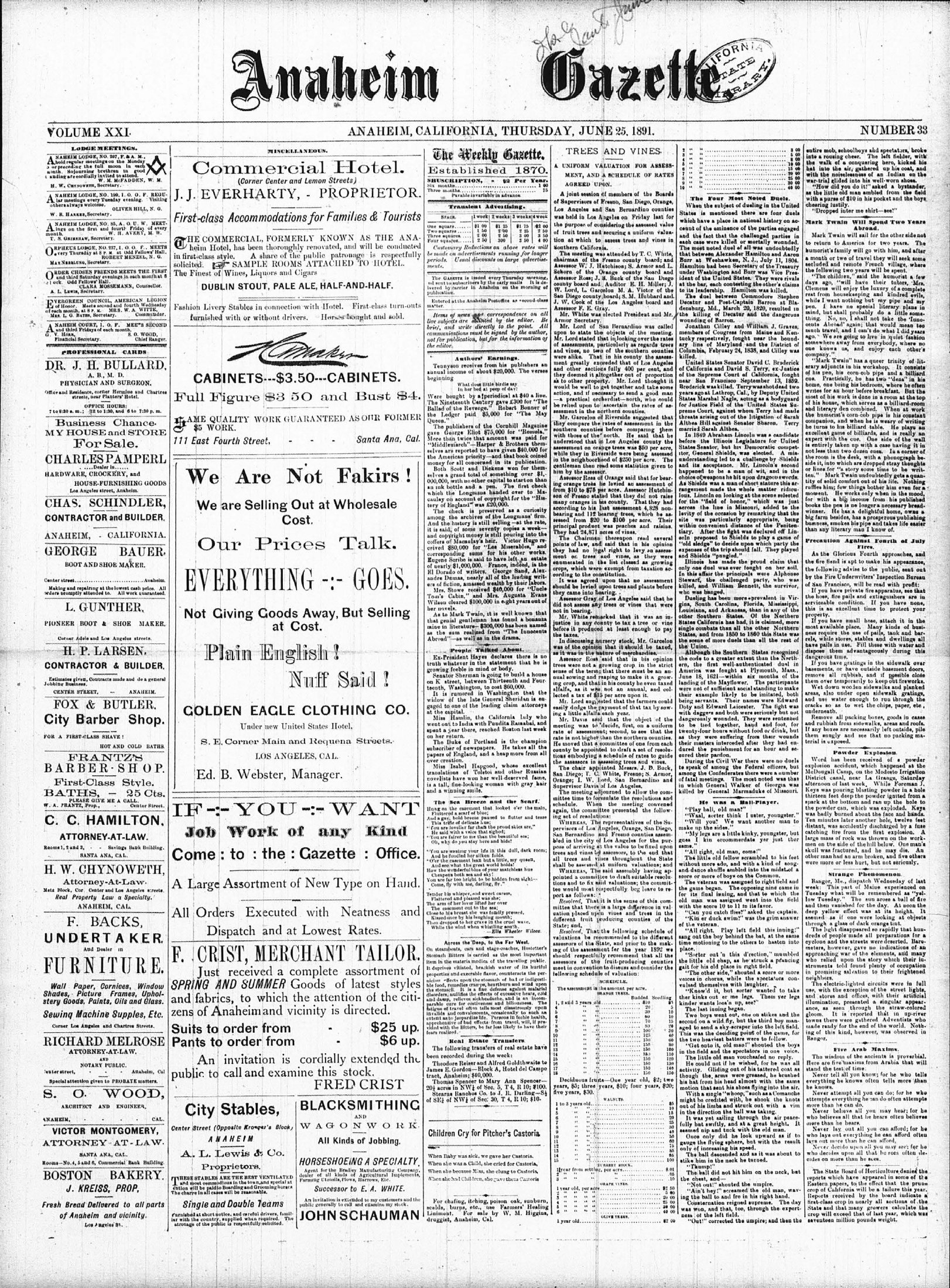
Searchable text
VOLUME XXI.
LODGE MEETINGS.
ANAHEIM LODGE, NO. 207, F. & A. M., hold regular meetings on the Monday or preceding the full moon in each month. Nojourning brethren in good standing are cordially invited to attend. W. M. McFADDEN, W. M. H. W. Chrysoweth, Secretary.
ANAHEIM LODGE, NO. 199, I. O. O. F. REGULAR meetings every Tuesday evening. Visiting others always welcome. OLIVER HILL, N. O. W. R. HARKER, Secretary.
ANAHEIM LODGE, NO. 85, A. O. U. W. MEETINGS on the first and fourth Friday of every month. W. H. AVERY, M. W. T. S. GRIESHAW, Secretary.
ORPHEUS LODGE, NO. 237, I. O. O. F. MEETS every Thursday at 8 P.M. at Odd Fellows Hall. ROBERT MENZEL, N. O. MAX NEBRULUNG, Secretary.
ORDER CHOSEN FRIENDS MEETS THE FIRST and third Saturday evenings in each month at 8 P.M. Odd Fellows Hall. CLARA MOSSEMANN, Counsellor. A. L. LEWIS, Secretary.
EVERGREEN COUNCIL, AMERICAN LEGION of Honor. Meetes second and fourth Wednesday of each month, at 8 P.M. MRS. W.A.WITTE, Mrs. L.G.BATES, Secretary. Commander.
ANAHEIM COURT, I. O. F. MEETS SECOND and third Fridays of each month.
G. V.HORN, S.O.WOOD, Financial Secretary. Chief Ranger.
PROFESSIONAL CARDS
DR. J. H. BULLARD,
A. B., M.D.
PHYSICIAN AND SURGEON.
Office and Residence, corner Hermine and Chartres streets, near Planters' Hotel.
OFFICE HOURS:
7 to 8:30 a.m.; 10 to 1:30, and 6 to 7:30 p.m.
Business Chance MY HOUSE and STORE For Sale.
CHARLES PAMPERL ... Dealer in... HARDWARE, CROCKERY, and
MISCELLANEOUS.
Commercial House
(Corner Center and Lemon Streets)
J.J.EVERHARTY, - PROFESSIONAL
First-class Accommodations for Families
THE COMMERCIAL, FORMERLY KNOWN Theim Hotel, has been thoroughly renovated, and in first-class style. A share of the public patron solicited.
SAMPLE ROOMS ATTACHED The Finest of Wines, Liquors and Cigars
DUBLIN STOUT, PALE ALE, HALF-AM
CABINETS---$3.50---CABBIES
Full Figure $3 50 and
AME QUALITY WORK GUARANTEED A $5 WORK.
111 East Fourth Street.
We Are Not Easily
PHYSICIAN AND SURGEON.
Office and Residence, corner Hermine and Chartres streets, near Planters' Hotel.
OFFICE HOURS:
7 to 8:30 a.m.; 12 to 1:30, and 6 to 7:30 p.m.
Business Chance.
MY HOUSE and STORE
For Sale.
CHARLES PAMPERL
...Dealer in...
HARDWARE, CROCKERY, and
HOUSE-FURNISHING GOODS
Los Angeles street, Anaheim.
CHAS. SCHINDLER,
CONTRACTOR and BUILDER.
ANAHEIM, - CALIFORNIA.
GEORGE BAUER,
BOOT AND SHOE MAKER.
Center street...Anaheim.
Making and repairing at the lowest cash price. All orders promptly attended to. All work guaranteed.
L. GUNTHER,
PIONEER BOOT & SHOE MAKER.
Corner Adele and Los Angeles streets.
H. P. LARSEN,
CONTRACTOR & BUILDER.
Estimates given, Contracts made and do a general Jobbing Business.
CENTER STREET, - ANAHEIM.
FOX & BUTLER.
City Barber Shop.
FOR A FIRST-CLASS SHAVE!
HOT AND COLD BATHS.
FRANTZ'S
BARBER SHOP.
First-Class Style.
BATHS, - 25 Cts.
PLEASE GIVE ME A CALL.
W. A. FRANTZ, Prop., Center Street.
C. C. HAMILTON,
ATTORNEY-AT-LAW.
Rooms 1, 2 and 3, Savings Bank Building.
SANTA ANA, CAL.
H. W. CHYNOWETH,
Attorney-At-Law.
Metz Block, Cor. Center and Los Angeles streets.
Real Property Law a Specialty.
ANAHEIM, CAL.
CABINETS---$3.50----CAB
Full Figure $3 50 and
AME QUALITY WORK GUARANTEED A $5 WORK.
111 East Fourth Street.
We Are Not Fa
We are Selling Out at Wh
Cost.
Our Prices T
EVERYTHING ---
Not Giving Goods Away, Bu
at Cost.
Plain English !
Nuff Sa
GOLDEN EAGLE CLOTHI
Under new United States Hotel,
S. E. Corner Main and Requena
LOS ANGELES, CAL.
Ed. B. Webster, Manager.
IF :- YOU :- W
Job Work of any
Come : to : the : Gazette
A Large Assortment of New Typ
C. C. HAMILTON,
ATTORNEY-AT-LAW.
Rooms 1, 2 and 3, Savings Bank Building.
SANTA ANA, CAL.
H. W. CHYNOWETH,
Attorney-At-Law.
Metz Block, Cor. Center and Los Angeles streets.
Real Property Law a Specialty.
ANAHEIM, CAL.
F. BACKS,
UNDERTAKER.
And Dealer in
FURNITURE.
Wall Paper, Cornices, Window Shades, Picture Frames, Upholstery Goods, Paints, Oils and Glass.
Sewing Machine Supplies, Etc.
Corner Los Angeles and Chartres Streets.
RICHARD MELROSE
ATTORNEY-AT-LAW.
AND
NOTARY PUBLIC.
Center street, Anaheim, Cal.
Special attention given to PROBATE matters.
S. O. WOOD,
ARCHITECT AND ENGINEER,
ANAHEIM, CAL.
VICTOR MONTGOMERY,
ATTORNEY-AT-LAW.
SANTA ANA, CAL.
Rooms—No.4, 5 and 6, Commercial Bank Building.
BOSTON BAKERY.
J. KREISS, PROP,
Fresh Bread Delivered to all parts of Anaheim and vicinity.
Los Angeles St.
City Stables,
Center Street (Opposite Kroger's Block),
ANAHEIM
A. L. Lewis & Co.
Proprietors.
THESE STABLES ARE THE BEST VENTILATED
and most commodious in the town, and special atention will be paid to Boarding and Grooming horace.
The charme in all cases will be reasonable.
Single and Double Teams
Furnished at short notice, and careful drivers, familiar with the country, supplied when required. The atronage of the public is respectfully solicited.
BLACKS
WAGO
All Kinds
HORSESHOEI
Agent for the Bradleys dealer of all kinds of Farming Utensils, Plows
Successor to
An invitation is extended public generally to call JOHN SCOTT
ANAHEIM, CALIFORNIA, THURSDAY, JUNE 25, 1891.
SCELLANEOUS.
Special Hotel.
(ater and Lemon Streets)
TY, - PROPRIETOR.
ations for Families & Tourists
MERLY KNOWN AS THE ANAroughly renovated, and will be conducted
of the public patronage is respectfully
BOOMS ATTACHED TO HOTEL.
and Cigars
ALE ALE, HALF-AND-HALF.
connection with Hotel. First-class turn-outs
drivers. Horses bought and sold.
$3.50---CABINETS.
3 50 and Bust $4.
GUARANTEED AS OUR FORMER
Santa Ana, Cal.
Not Fakirs!
The Weekly Gazette.
Established 1870.
SHUSCRIPTION, - $2 Per Year.
Six months. 1 00
Three months. 75
Pavable invariably in advance.
Transient Advertising.
SPACE.
1 week
2 weeks
3 weeks
4 week
One squares.... $1 00
Two squares... 1 50
Three squares... 2 00
Four squares... 2 50
Customary Redections on above rates will be made on advertisements running for longer periods. Usual discounts on large advertisements.
The Gazette is issued every Thursday morning,
and sent to subscribers by the early malls. It is deivered by carrier in Anaheim on the morning of publication.
Entered at the Anaheim Postoffice as second-class matter.
Items of news and correspondence on all line subjects are solicited by the editor. Be brief, and write directly to the point. All communications must be signed by the author, not for publication, but for the information of the editor.
Authors' Earnings.
Tennyson receives from his publishers an annual income of about $20,000. The verses beginning.
What does little birdie say?
In her bed at peep of day?
Were bought by a periodical at $40 a line.
The Nineteenth Century gave £300 for "The Ballad of the Revenge." Robert Bonner of the Ledger paid $5,000 for "The May Queen."
The publishers of the Cornhill Magazine gave George Eliot $75,000 for "Romola."
More than twice that amount was paid for "Middleniarch"—Harper & Brothers them-selves are reported to have given $40,000 for the American priority—and that book coined money for all concerned in its publication.
Both Scott and Dickens won for them-selves a grand total of something over $1.
TREES AND VINES.
A UNIFORM VALUATION FOR ASSESSMENT, AND A SCHEDULE OF RATES AGREED UPON.
A joint session of members of the Board of Supervisors of Presno, San Diego, Orange Los Angeles and San Bernardino counties was held in Los Angeles on Friday last for the purpose of considering the assessed value of fruit trees and securing a uniform valuation at which to assess trees and vines in Southern California.
The meeting was attended by T. C. White chairman of the Presno county board; and Assessor W. J. Hatchison; S. Armor and L. Schorn of the Orange county board and Assessor Ross; J. S. Buck of the San Diego county board and Auditor E. H. Miller; J. W. Lord, L. Garcelon M. A. Victor of the San Diego county board; S. M. Hubbard and J. W. Cook of the Los Angeles board and Assessor F. E. Gray.
Mr. White was elected President and Mr. Armor Secretary.
Mr. Lord of San Bernardino was called upon to state the objects of the meeting. Mr. Lord stated that in looking over the rates of assessments, particularly as regards trees and vines, no two of the southern counties were alike. That in his county the assessment greatly exceeded that of Los Angeles and other sections fully 400 per cent, and they deemed it altogether out of proportion as to other property. Mr. Lord thought it would be well to get together and take some action, and if necessary to send a good man—a practical orchardist—north, who could be relied upon to ascertain the rates of assessment in the northern counties.
Mr. Garcelon of Riverside suggested that they compare the rates of assessment in the southern counties before comparing them with those of the north. He said that he understood that in Los Angeles county the assessment on orange trees was $60 per acre while they in Riverside were being assessed in the neighborhood of $250 per acre. The gentleman then read some statistics given to him by the assessor.
Assessor Rosa of Orange said that for bear-
Not Fakirs!
G Out at Wholesale Cost.
Rices Talk.
ING :: GOES.
oods Away, But Selling at Cost.
English!
Nuff Said!
LE CLOTHING CO.
United States Hotel.
In and Requena Streets.
ANGELES, CAL.
r, Manager.
U :: WANT
of any Kind
e : Gazette : Office.
nt of New Type on Hand.
What does little birdie say?
In her bed at peep of day:
Were bought by a periodical at $40 a line.
The Nineteenth Century gave £300 for "The Ballad of the Revenge."
Robert Bonner of the Ledger paid $5,000 for "The May Queen."
The publishers of the Cornhill Magazine gave George Eliot $75,000 for "Romola." More than twice that amount was paid for "Middlemarch"—Harper & Brothers themselves are reported to have given $40,000 for the American priority—and that book coined money for all concerned in its publication.
Both Scott and Dickens won for themselves a grand total of something over $1,000,000, with no other capital to start on than an ink bottle and a pen. The first check which the Longmans handed over to Macaulay on account of copyright for the "History of England" was £20,000.
The check is preserved as a curiosity among the archives of the Longman's firm. And the history is still selling—at the rate, it is said, of some seventy copies a week—and copyright money is still pouring into the coffers of Macaulay's heir. Victor Hugo received $80,000 for "Les Miserables," and corresponding sums for his other works. Eugene Scribe is said to have left an estate of nearly $1,000,000. France, indeed, is the El Dorado of writers. George Sand, Alex andre Dumas, nearly all of the leading writers of fiction, amassed wealth by their labors.
Mrs. Stowe received $40,000 for "Uncle Tom's Cabin," and Mrs. Augusta Evans Wilson cleared $100,000 in eight years out of her novels.
As to Mark Twain, it is well known that genial gentleman has found a bonanza mine in literature—$300,000 has been named as the sum realized from "The Innocents Abroad"—as well as in the drama.
People Talked About.
Ex-President Hayes declares there is no truth whatever in the statement that he is growing feeble in mind or body.
Senator Sherman is going to build a house on K street, between Thirteenth and Fourteenth, Washington, to cost $60,000.
It is rumored in Washington that the widow of the late General Sheridan is engaged to one of the leading claim attorneys at the capital.
Miss Hamlin, the California lady who went out to India with Pundita Ramabai, and spent a year there, reached Boston last week on her return.
The Duke of Portland is the champion subscriber of newspapers. He takes all the papers of England, and a heap more from all over creation.
Miss Isabel Hapgood, whose excellent translations of Tolstoi and other Russian novelists have won her well-deserved fame, is a tall, fine-looking woman with gray hair and a winning smile.
The Sea Breeze and the Scarf:
Hang on the casement that looked o'er the main, fluttered a scarf of blue;
And a gay, bold breeze paused to flutter and tease This trifle of delicate hue:
"You are loveliar far than the proud skies are," He said with a voice that sighed:
"You are fairer to me than the beautiful sea; Oh, why do you stay here and hide!
"You are wasting your life in this dull, dark room; And she fondled her silken folds.
"Over the casement lean but a little, my queen, And see what the great world holds! How the wonderful blue of your matchless hue Cheapeus both sea and sky!
You are far too bright to be hidden from sight: Come, fly with me, darling, fly."
Tender his whisper, and sweet caress,
Flattered and pleased was she;
The arm of her lover lifted her over
The casement out to the sea;
Mr. Lord thought it would be well to get together and take some action, and if necessary to send a good man—a practical orchardist—north, who could be relied upon to ascertain the rates of assessment in the northern counties.
Mr. Garcelon of Riverside suggested that they compare the rates of assessment in the southern counties before comparing them with those of the north. He said that he understood that in Los Angeles county the assessment on orange trees was $60 per acre while they in Riverside were being assessed in the neighborhood of $250 per acre. The gentleman then read some statistics given to him by the assessor.
Assessor Ross of Orange said that for bearing orange trees he levied an assessment of from $10 to $75 per acre. Assessor Hutchinson son of Fresno stated that they did not raise many oranges in his county. That they had according to his last assessment 4,828 non-bearing and 112 bearing trees, which he as-sessed from $20 to $109 per acre. Their principal product was peaches and raisins. They had 24,871 acres of vines.
The Chairman thereupon read several pieces of law, and said that in his opinion they had no legal right to levy an assessment or trees and vines, as they were enumerated in the list classed as growing crops, which were exempt from taxation according to the constitution.
It was agreed upon that no assessment should be levied upon trees and plants before they came into bearing.
Assessor Gray of Los Angeles said that he did not assess any trees or vines that were not in bearing.
Mr. White remarked that it was an injustice in any county to tax a tree or vine before it produced at least enough to pay the taxes.
In discussing nursery stock, Mr. Garcelon was of the opinion that it should be taxed, as it was in the nature of merchandise.
Assessor Rosa said that in his opinion trees were not a growing crop in the strict sense of the term; that there must be an annual sowing and reaping to make it a growing crop, and that in his county he even taxed alfalfa, as it was not an annual, and collected a tax of $15 per acre upon it.
Mr. Lord suggested that the farmers could easily dodge the payment of that tax by sowing a little alfalfa each year.
Mr. Davis said that the object of the meeting was to decide, first, on a uniform rate of assessment; second, to see that the rate is not higher than the northern counties. He moved that a committee of one from each county be appointed to draft a set of resolutions embodying a schedule of rates to guide the assessors in assessing trees and vines.
The chair appointed Meeres J. D. Buck, San Diego; T. C. White, Fresno; S. Armor, Orange; I. W. Lord, San Bernardino and Supervisor Davis of Los Angeles.
The meeting adjourned to allow the committee time to formulate the resolutions and schedule. When the meeting convened again, the committee presented the following set of resolutions:
Whereas The representatives of the Supervisors of Los Angeles, Orange, San Diego San Bernardino and Fresno counties assembled in the city of Los Angeles for the purpose of arriving at a uniform valuation; and Whereas The said assembly having applied pointed a committee to draft suitable resolutions and to fix said valuations; the committee would most respectfully beg leave to report as follows:
Resolved That it is the sense of this committee that there is a large difference in value
WANT of any Kind
e : Gazette : Office.
MERCHANT TAILOR.
a complete assortment of
GOODS of latest styles
which the attention of the citivid vicinity is directed.
m - $25 up.
om - $6 up.
is cordially extended the
examine this stock.
FRED CRIST
BLACKSMITHING
AND
WAGON WORK.
All Kinds of Jobbing.
HORSESHOEING A SPECIALTY.
Agent for the Bradley Manufacturing Company,
dealer of all kinds of Agricultural Implements,
Farming Utensils, Plows, Harrows, Etc.
Successor to E. A. WHITE.
An invitation is extended to my customers and the public generally to call and examine my stock.
JOHN SCHAUMAN
Hung on the casement that looked over the main,
Fluttered a scarf of blue;
And a gay hold breast pressed to flutter and tease
This trifle of delicate hue;
"You are lovelier far than the proud skies are,"
He said with a voice that sighed;
"You are fairer to me than the beautiful sea,"
Oh, why do you stay here and hide!
"You are wasting your life in this dull, dark room;
And he fondled her silken folds.
"Over the casement lean but a little, my queen,
And see what the great world holds!
How the wonderful blue of your matchless hue
Cheapest both sea and sky!
You are far too bright to be hidden from sight:
Come, fly with me, darling, fly."
Tender his whisper, and sweet caress,
Flattered and pleased was she;
The arm of her lover lifted her over
The casement out to the sea;
Close to his breast she was fondly pressed,
Kissed once by his laughing mouth;
Then dropped to her grave in the cruel wake,
While the wind when whistling south.
— Ella Wheeler Wilcox.
Across the Deep, to the Far West.
On steamboats, cars and stage-coaches, Hostetter's Stomach Bitters is carried as the most important item in the materia medica of the travelling public.
It deprives viated, braiskish water of its hurtful properties and excreable flavor, counteracts the perilous effects upon the stomach of ba1 or indigestible food, remedies cramps, heartburn and wind upon the stomach. It is a fine defense against malarial disorders, nullifies the effects of excessive heats, cold and damp, relieves sickheadache, and is an incompatible cure for cottiness and billiousness. The fatigue of travel often tells most disastrously upon invalids and convalescents, occasionally to such an extent as jeopardize life. Persons in feeble health, apprehensive of bad effects from travel, will, if provided with the Bitters, be far less likely to have their fears realized.
Real Estate Transfers.
The following transfers of real estate have been recorded during the week:
Theodore Reiser and Alfred Goldthwaite to James E. Gordon—Block A, Hotel del Campo tract, Anaheim; $40,000.
Thomas Spencer to Mary Ann Spencer—20 acres in NW½ of Sec. 5, T 4, R 10; $100.
Steara Rancho Co. to J. R. Darling—S½ of SE½ of NW½ of Sec. 30, T 4, R 10; $10.
Children Cry for Pitcher’s Castoria
When Baby was sick, we gave her Castoria.
When she was a Child, she cried for Castoria.
When she became Miss, she clung to Castoria.
When she had Children, she gave them Castoria.
For chafing, itching, poison oak, sunburn,
scalds, burns, etc., use Farmers' Healing Liniment. For sale by W. M. Higgins,
druggist, Anaheim, Cal.
SCHEDULE.
The assessment is the amount per acre.
ORANGE TREES.
Budded. Seedling
1, 2 and 3 years old. $10
4 - 20
5 - 30
6 - 40
7 - 50
8 - 60
9 - 70
10 - 80
11 - 90
12 - 100
13 - 110
14 - 120
15 - 130
16 - 140
17 - 150
18 - 160
Deciduous fruits—One year old, $2; two years,$3; three years,$10; four years,$20 five years,$30.
WALNUTS
1 to 3 years old.
4 - 8
5 - 10
6 - 15
7 - 20
8 - 25
9 - 30
10 - 35
SURBERRY STOCK.
1 year from setting, per acre.
2 - 4
3 - 6
4 - 8
5 - 10
GRAPE VINES.
1 year old, per acre.
2 - 4
3 - 6
4 - 8
5 - 10
OLIVE TREES.
1 year old. $2
NE 25, 1891.
S AND VINES.
VALUATION FOR ASSESSD A SCHEDULE OF RATES
UPON.
of members of the Boards
of Fresno, San Diego, Orange,
and San Bernardino counties
Angeles on Friday last for
considering the assessed value
and securing a uniform valuto assess trees and vines in
Arizona.
was attended by T. C. White,
the Fresno county board; and
Hatchison; S. Armor and L.
Orange county board and
J. S. Buck of the San Diego
and Auditor E. H. Miller; J.
Arcelor M. A. Victor of the
city board; S. M. Hubbard and
the Los Angeles board and
Gray.
was elected President and Mr.
ry.
San Bernardino was called
the objects of the meeting,
that in looking over the rates
particularly as regards trees
two of the southern counties
in his county the assessexceeded that of Los Angeles
the objects fully 400 per cent, and
altogether out of proportion
property. Mr. Lord thought it
to get together and take some
necessary to send a good man
archchief—north, who could
ascertain the rates of asnorthern counties.
of Riverside suggested that
the rates of assessment in the
sites before comparing them
the north. He said that he
in Los Angeles county the
grass trees was $60 per acre,
riverside were being assessed
worth of $250 per acre. The
read some statistics given to
sensor.
of Orange said that for bear-
The Four Most Noted Duels.
When the subject of dueling in the United States is mentioned there are four duels which have a place in national history on account of the eminence of the parties engaged and the fact that the challenged parties in each case were killed or mortally wounded.
The most noted duel of all was undoubtedly that between Alexander Hamilton and Aaron Burr at Wewahken, N. J., July 11, 1804. Hamilton had been Secretary of the Treasury under Washington and Burr was Vice President of the United States. They were rivals at the bar, each contesting the other's claims to its leadership. Hamilton was killed.
The duel between Commodore Stephen Decatur and Post-Captain Barron at Bladensburg, Md., March 20, 1820, resulted in the killing of Decatur and the dangerous wounding of Barron.
Jonathan Cilley and William J. Graves, members of Congress from Maine and Kentucky respectively, fought near the boundary line of Maryland and the District of Columbia, February 24, 1838, and Cilley was killed.
United States Senator David C. Broderick of California and David S. Terry, ex-Justice of the Supreme Court of California, fought near San Francisco September 13, 1859. Broderick was killed. Terry was shot dead two years ago at Lathrop, Cal., by Deputy United States Marshal Nagle, acting as a bodyguard for Justice Field of the United States Supreme Court, against whom Terry had made threats arising out of the litigation of Sarah Althea Hill against Senator Sharon. Terry married Sarah Althea.
In 1849 Abraham Lincoln was a candidate before the Illinois Legislature for United States Senator, but his Democratic competitor, General Shields, was elected. A misunderstanding led to a challenge by Shields and its acceptance. Mr. Lincoln's second happened to be a man of wit, and in the choice of weapons he hit upon dragonous words.
entire mob, schoolboys and spectators, broke into a rousing cheer. The left fielder, with the walk of a conquering hero, kicked his hat into the air, gathered up his coat, and with the noiselessness of an Indian on the war-trial glided into his well-worn shoes.
"How did you do it?" asked a bystander, as the little old man ambled from the field with a purse of $10 in his pocket and the boys cheering lustily.
"Dropped inter me shirt—see."
Mark Twain Will Spend Two Years Abroad.
Mark Twain will sail for the other side not to return to America for two years. The humorist's family will go with him, and after a month or two of travel they will seek some secluded and remote French village, where the following two years will be spent.
"The children," said the humorist a few days ago, "will have their tutors, Mrs. Clemens will enjoy the luxury of a complete rest from housekeeping and kindred evils, while I want nothing but my pipe and my pen. I have no special literary plans in mind, but shall probably do a little something. No, no, I shall not take the 'Innocents Abroad' again; that would mean too much travel, and I can't do what I did years ago." We are going to live in quiet fashion somewhere away from everybody, where no one knows us, and enjoy each other's company."
Mark Twain has a queer trinity of literary adjuncts in his workshop. It consists of his pen, his corn-cob pipe and a billiard cue. Practically, he has two "denz" in his home, one being his bedroom, where he often writes for an hour before breakfast. But the most of his work is done in a room at the top of his house, which serves as a billiard-room and literary den combined. When at work the humorist's corn-cob pipe is his constant companion, and when he is weary of writing he turns to his billiard table. He plays an excellent game of billiards, and is really an expert with the cue. One side of the wall is entirely taken up with a case having it in not less than two dozen cues. In a corner of the room is the desk, with a phonograph beside it, into which are dropped stray thoughts or lines for "a story some time to be written." Mark Twain undoubtedly gets a quant-
Mr. Lord thought it to get together and take some necessary to send a good man or archbishop—north, who could not ascertain the rates of assessment in the cities before comparing them near San Francisco September 13, 1859. Brederick was killed. Terry was shot dead two years ago at Lathrop, Cal., by Deputy United States Marshal Nagle, acting as a bodyguard for Justice Field of the United States Supreme Court, against whom Terry had made threats arising out of the litigation of Sarah Althea Hill against Senator Sharon. Terry married Sarah Althea.
In 1849 Abraham Lincoln was a candidate before the Illinois Legislature for United States Senator, but his Democratic competitor, General Shields, was elected. A misunderstanding led to a challenge by Shields and its acceptance. Mr. Lincoln's second happened to be a man of wit, and in the choice of weapons he hit upon dragonous words. As Shields was a man of short stature this arrangement made the whole matter ridiculous. Lincoln on looking at the scene selected for the "field of honor," which was just across the line in Missouri, added to the levity of the occasion by remarking that the site was particularly appropriate, being within convenient distance of the Penitentiary. After the fight was declared off Lincoln proposed to Shields to play a game of "old sledge" to decide upon which party the expenses of the trip should fall. They played and Shields "pungled."
Illinois has made the proud claim that only one duel was ever fought on her soil. In this affair the principals were Alphonse Stewart, the challenged party, who was killed, and William Bennett, the survivor, who was hanged.
Dueling has been more prevalent in Virginia, South Carolina, Florida, Mississippi, Louisiana, and Arkansas, than in any of the other Southern States. Of the Northern States California has had, it is claimed, more single combats than all the other Northern States, and from 1850 to 1860 this State was the scene of more duels than all the rest of the Union.
Although the Southern States recognized the code to a greater extent than the Northen, the first well-authenticated dual in America was fought at Plymouth, Mass., June 18, 1621—within six months of the landing of the Mayflower. The participants were not of sufficient social standing to make their example likely to be imitated, both being servants. Their names were Edward Doty and Edward Leicester. The fight was with daggers and both were seriously but not dangerously wounded. They were sentenced to be tied together, hand and foot, for twenty-four hours without food or drink, but as they were suffering from their wounds their masters interceded after they had endured the punishment for an hour and secured their pardon.
During the Civil War there were no duels to speak of among the Federal officers, but among the Confederates there were a number of fatal meetings. The most noted was that in which General Walker of Georgia was killed by General Marmaduke of Missouri.
He was a Hall-Player.
"Play ball, old man!"
"Waal, sorter think I uset, youngster."
"Will you? We want another man to make up the sides."
"My legs are a little kinky, youngster, but gues I kin ercommerdate yer just thorns."
"All right, old man, come!"
The little old fellow scrambled to his feet without more ado, and with a kind of song-and dance shuffle ambled into the midst of a score or more of boys on the Common.
The veteran was assigned to right field and the game began. The opposing nine came in for its final inning, and that to which the old man was assigned went into the field with the score 10 to 11 in its favor.
Practically, he has two "denz" in his home, one being his bedroom, where he often writes for an hour before breakfast. But the most of his work is done in a room at the top of his house, which serves as a billiard-room and literary den combined. When at work the humorist's corn-cob pipe is his constant companion, and when he is weary of writing he turns to his billiard table. He plays an excellent game of billiards, and is really an expert with the cue. One side of the wall is entirely taken up with a case having it in not less than two dozen cues. In a corner of the room is the desk, with a phonograph beside it, into which are dropped stray thoughts or lines for "a story some time to be written." Mark Twain undoubtedly gets a quantity of solid comfort out of his life. Nothing ruffles him; few things bother him even for a moment. He works only when in the mood, for with a big income from his published books she is no longer a necessary breadwinner. He has a delightful home, owns a big farm besides, has a prosperous publishing business, smokes his pipe and takes life easier than any literary man I know of.
Precaution Against Fourth of July Firees.
As the Glorious Fourth approaches, and the fire fiend is apt to make his appearance, the following advise to the public, sent out by the Fire Underwriter's Inspection Bureau of San Francisco, will be read with profit:
If you have private fire apparatus, see that the hose, fire pails and extinguishers are in serviceable condition. If you have none, this is an excellent time to protect your property.
If you have small hose, attach it in the most available place. Many kinds of business require the use of pails, tank and barrels, while stores, stables and dwellings all have pails in use. Fill these with water and dispose them advantageously during this dangerous time.
If you have gratings in the sidewalk over basements, or have outside basement doors, remove all rubbish, and if possible close them over temporarily to keep out fireworks.
Wet down wooden sidewalks and planked areas, also open inside sidewalk gratings, and use water enough to run through the cracks so as to wet the chips, paper, etc., underneath.
Remove all packing boxes, goods in cases and rubbish from sidewalks, areas and roofs. If any boxes are necessarily left outside, pile them snugly and see that no packing material is exposed.
Powder Explosion.
Word has been received of a powder explosion accident, which happened at the McDougall Camp, on the Modesto Irrigation District canal, near La Grange, Saturday afternoon of last week. While Foreman J. Keys was pouring blasting powder in a hole thirteen feet deep the powder ignited from a spark at the bottom and ran up the hole to the powder can, which was exploded. Keys was badly burned about the face and hands. Ten minutes later another hole, twelve feet distant, was accidentally discharged by a fuse catching fire from the first explosion. A large mass of rock was thrown on the workmen on the side of the hill below. One man's skull was fractured, and he may die. An other man had an arm broken, and five others were more or less hurt, but not seriously.
Strange Phenomenon.
Bangor, Me., dispatch Wednesday of last week: This part of Maine experienced on Tuesday what will be remembered as "yellow Tuesday." The sun arose a ball of fire and then vanished for the day. At noon the
at the following schedule of recommended to the different State, and prior to the makement for the year 1892 we fully recommend that all the fruit-producing countries to discuss and consider the sale of valuation:
SCHEDULE:
- Budded Scedling $10
- WALNUTS $5
- SURBERRY STOCK. $10
- JOB ACTS. $10
- OLIVE TREES. $20
One year old, $2; two years, $10; four years, $20;
"Play ball, old man!"
"Waal, sorter think I uster, youngster."
"Will you? We want another man to make up the sides."
"My legs are a little kinky, youngster, but gues I kin ercommerdate yer just thor same."
"All right, old man, come!"
The little old fellow scrambled to his feet without more ado, with a kind of song-and dance shuffle ambled into the midst of a score or more of boys on the Common.
The veteran was assigned to right field and the game began. The opposing nine came in for its final issuing, and that to which the old man was assigned went into the field with the score 10 to 11 in its favor.
"Can you catch flies?" asked the captain.
"Kin er duck swim!" was the grim answer of the veteran.
"All right. Play left field this inning!' sang out the boy behind the bat, at the same time motioning to the others hasten into place.
"Sorter out 'n this d'rection," mumbled the little old chap, as he struck a prancing gait for his old place in right field.
"The other side," shouted a score or more voices in chorus, while the spectators convulsed themselves with laughter.
"Know'd it, but sorter wanted to take ther kinks out er me legs. Them yer legs kinder wants loos'n up, see?"
The last inning began.
Two boys went out, one on stikes and the second on a wild fly, but the third boy managed to send a sky-scraper into the left field. This was the deciding point of the game, for the two heaviest batters were to follow.
"Get onto it, old man!" shouted the boys in the field and the spectators in one voice.
The little old man vouchsafed no reply.
He could not if he wished, for he was all activity. Gliding out of his tattered coat as though the arms were greased, he brushed his hat from his head almost with the same motion that sent his shoes flying into the air.
With a single "whoop," such as a Comanche might be credited with, he shook the knots out of his limbs and struck out with a vim in the direction the ball was taking.
It was yet sailing through the air peacefully but swiftly, and at a great height. It seemed nip and tuck with the old man.
Once only did he look upward as if to gauge the flying sphere, but with the result only of increasing his speed.
The ball descended and as it was about to stike him in the neck he turned.
"Thump!"
The ball did not hit him on the neck, but the chest, and—
"Not out!" shouted the umpire.
"Ain't heey!" screamed the old man, waving the ball to and fro in his right hand.
Cousternation reigned supreme. The day was won, and that, too, through the expertness of the left field.
"Out!" corrected the umpire; and then the powder can, which was exploded. Keys was badly burned about the face and hands. Ten minutes later another hole, twelve feet distant, was accidentally discharged by a fuse catching fire from the first explosion. A large mass of rock was thrown on the workmen on the side of the hill below. One man's skull was fractured, and he may die. An other man had an arm broken, and five others were more or less hurt, but not seriously.
Strange Phenomenon.
Bangor, Me., dispatch Wednesday of last week: This part of Maine experienced on Tuesday what will be remembered as "yellow Tuesday." The sun arose a ball of fire and then vanished for the day. At noon the deep yellow effect was at its height. It seemed as if one were looking at objects through a glass of dark orange tint.
The light disappeared so rapidly that hundreds of people made all preparations for a cyclone and the streets were deserted. Bare-meters, however, gave no indications of an approaching war of the elements, and many who relied upon the story which their instruments told found plenty of occupation in promising salvation to their frightened neighbors.
The electric-lighted circuits were in full use, with the exception of the street lights, and stores and offices, with their artificial illumination, presented a singular appearance, as seen through the straw-colored gloom. It is reported that in up-river towns there were gathered Adventists who made ready for the end of the world. Nothing of this kind, however, was observed in Bangor.
Five Arab Maxims.
The wisdom of the ancients is proverbial. Here are five maxims from Arabia that will stand the test of time:
Never tell all you know; for he who tells everything he knows often tells more than he knows.
Never attempt all you can do; for he who attempts everything he can do often attempts more than he can do.
Never believe all you may hear; for he who believes all that he hears often believes more than he hears.
Never lay out all you can afford; for he who lays out everything he can afford often lays out more than he can afford.
Never decide upon all you may see; for he who decides upon all that he sees often decides on more than he sees.
The State Board of Horticulture denied the reports which have appeared in some of the Eastern papers, to the effect that the prune crop of California will be a failure this year. Reports received by the board indicate a first-class crop in nearly all sections of the State and that many growers calculate the crop will exceed that of last year, which was seventeen million pounds weight.