anaheim-gazette 1891-05-07
Scanned page
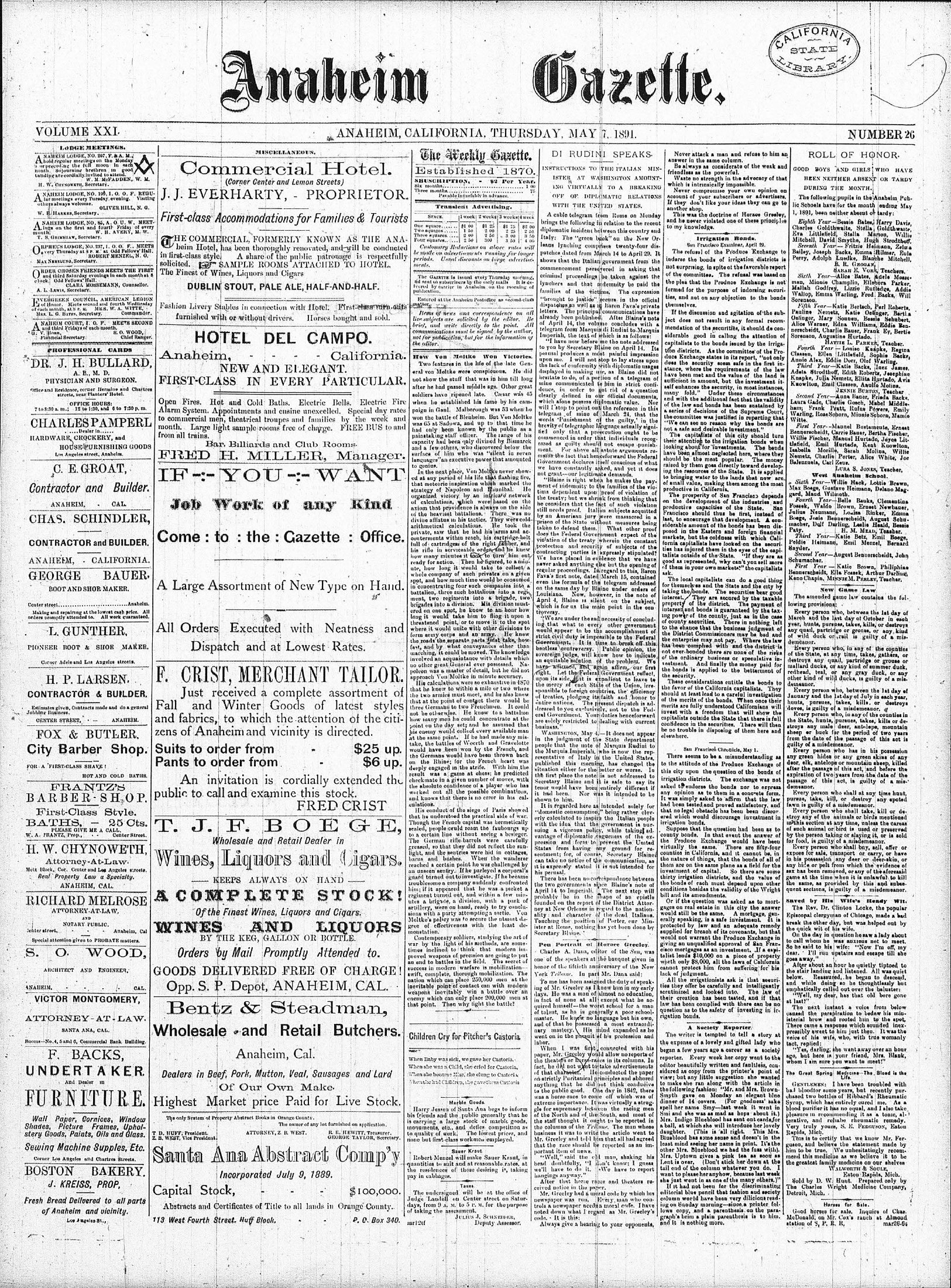
Searchable text
VOLUME XXI.
LODGE MEETINGS.
ANAHEIM LODGE, NO. 207, F. & A. M., hold regular meetings on the Monday or preceding the full moon in each month. Sojourning brethren in good standing are cordially invited to attend.
W. M. McFADDEN, W. M.
H. W. Chrysoworth, Secretary.
ANAHEIM LODGE, NO. 106, I. O. O. F. REGULAR meetings every Tuesday evening. Visiting others always welcome.
OLIVER HILL, N. G.
W. R. HARKER, Secretary.
ANAHEIM LODGE, NO. 85, A. O. U. W. MEETINGS on the first and fourth Friday of every month.
W. H. AVERY, M. W.
T. S. GRINSHAW, Secretary.
ORPHEUS LODGE, NO. 237, I. O. O. F., MEETS every Thursday at 9 P.M. at Old Followers' Hall.
HOBERT MENZEL, N. G.
MAX NEBRILUNG, Secretary.
ORDER CHOSEN FRIENDS MEETS THE FIRST and third Saturday evenings in each month at 5 clock.
Odd Followers' Hall.
CLAHA MOSSEMANN, Counsellor.
A. L. LEWIT, Secretary.
EVERGREEN COUNCIL, AMERICAN LEGION of Honor. Meets second and fourth Wednesday of each month, at 8 P.M.
MRR. W. A. WITTE,
Mrs. L. G. BAYES, Secretary.
ANAHEIM COURT, I. O. F., MEETS SECOND and third Fridays of each month.
G. V. HORN,
S. O. WOOD,
Financial Secretary
PROFESSIONAL CARDS
DR. J. H. BULLARD,
A. E., M. D.
PHYSICIAN AND SURGEON.
Office and Residence, corner Hermine and Chartres streets, near Plantera' Hotel.
OFFICE HOURS:
7 to 8:30 a.m.; 12 to 1:30, and 6 to 7:30 p.m.
CHARLES PAMPERL
...Dealer in...
HARDWARE, CROCKERY, and HOUSE FURNISHING GOODS
Los Angeles street, Anaheim.
C. E. GROAT,
MISCELLANEOUS.
Commercial Hotel
(Corner Center and Lemon Streets)
First-class Accommodations for Families
THE COMMERCIAL, FORMERLY KNOWN AS Theim Hotel, has been thoroughly renovated, and will in first-class style. A share of the public patronage solicited. SAMPLE ROOMS ATTACHED TO The Finest of Wines, Liquors and Cigars
DUBLIN STOUT, PALE ALE, HALF-AND-Fashion Livery Stables in connection with Hotel. First-furnished with or without drivers. Horses bough
HOTEL DEL CAMP
Anaheim,
NEW AND ELEGANT.
FIRST-CLASS IN EVERY PART
Open Fires. Hot and Cold Baths. Electric Bells.
Alarm System. Appointments and ensuine unexcelled. Spare to commercial men, theatrical troupes and families by month. Large light sample rooms free of charge. FREE from all trains.
Bar Billiards and Club Rooms
FRED H. MILLER, MA
IF :: YOU :: WA
PHYSICIAN AND SURGEON.
Office and Residence, corner Hermine and Chartres streets, near 'Planters' Hotel.
OFFICE HOURS:
7 to 8:30 a.m.; 12 to 1:30, and 6 to 7:30 p.m.
CHARLES PAMPERL
...Dealer in...
HARDWARE, CROCKERY, and HOUSE FURNISHING GOODS
Los Angeles street, Anaheim.
C. E. GROAT,
Contractor and Builder.
ANAHEIM, CAL.
CHAS. SCHINDLER,
CONTRACTOR and BUILDER.
ANAHEIM, CALIFORNIA.
GEORGE BAUER,
BOOT AND SHOE MAKER.
Center street...Anaheim.
Making and repairing at the lowest cash price. All orders promptly attended to. All work guaranteed.
L. GUNTHER,
PIONEER BOOT & SHOE MAKER.
Corner Adele and Los Angeles streets.
H. P. LARSEN.
CONTRACTOR & BUILDER.
Estimates given. Contracts made and do a general Jobbing Business.
CENTER STREET, - ANAHEIM.
FOX & BUTLER.
City Barber Shop.
FOR A FIRST-CLASS SHAVE!
HOT AND COLD BATHS.
FRANTZ'S
BARBER SHOP.
First-Class Style.
BATHS, - 25 Cts.
PLEASE GIVE ME A CALL.
W. A. PRANTZ, Prop., Center Street.
H. W. CHYNOWETH,
Attorney-At-Law.
Metz Block, Cor. Center and Los Angeles streets.
Real Property Law a Specialty.
ANAHEIM, CAL.
RICHARD MELROSE
ATTORNEY AT LAW.
FIRST-CLASS IN EVERY PART
Open Fires. Hot and Cold Baths. Electric Bells.
Alarm System. Appointments and cuisine unexcelled. Spare to commercial men, theatrical troupes and families by month. Large light sample rooms free of charge. FREE from all trains.
Bar Billiards and Club Rooms
FRED H. MILLER, MA
IF :: YOU :: WA
Job Work of any
Come : to : the : Gazette :
A Large Assortment of New Type
All Orders Executed with Neat Dispatch and at Lowest Rate
F. CRIST, MERCHANT TA
Just received a complete assortment of Fall and Winter Goods of latex and fabrics, to which the attention ozens of Anaheim and vicinity is direct.
Suits to order from
Pants to order from
An invitation is cordially extended public to call and examine this stock.
FRED CI
T. J. F. BOE
Wholesale and Retail Dealer in Wines, Liquors and (C)
KEEPS ALWAYS ON HAND
A COMPLETE STO
First-Class Style.
BATHS, - 25 Cts.
PLEASE GIVE ME A CALL.
W. A. PRANTZ, Prop., Center Street.
H. W. CHYNOWETH,
Attorney-At-Law.
Metz Block, Cor. Center and Los Angeles streets.
Real Property Law a Specialty.
ANAHEIM, CAL.
RICHARD MELROSE
ATTORNEY-AT-LAW.
AND
NOTARY PUBLIC.
Center street, Anaheim, Cal.
Special attention given to PROBATE matters.
S. O. WOOD,
ARCHITECT AND ENGINEER,
ANAHEIM, CAL.
VICTOR MONTGOMERY,
ATTORNEY-AT-LAW.
SANTA ANA, CAL.
Rooms—No.4, 5 and 6, Commercial Bank Building.
F. BACKS,
UNDERTAKER.
And Dealer in
FURNITURE.
Wall Paper, Cornices, Window Shades, Picture Frames, Upholstery Goods, Paints, Oils and Glass.
Sewing Machine Supplies, Etc.
Corner Los Angeles and Chartres Streets.
BOSTON BAKERY.
J. KREISS, PROP,
Fresh Bread Delivered to all parts of Anaheim and vicinity.
Los Angeles St.,
T. J. F. BOE
Wholesale and Retail Dealer in
Wines, Liquors and Cigars
KEEPS ALWAYS ON HAND
A COMPLETE STOCK
Of the Finest Wines, Liquors and Cigars
WINES AND LIQUORS
BY THE KEG, GALLON OR BOTTLE
Orders by Mail Promptly Attended
GOODS DELIVERED FREE OF CHARGE
Opp. S. P. Depot, ANAHEIM,
Bentz & Steadmire
Wholesale and Retail Butler
Anaheim, Cal.
Dealers in Beef, Pork, Mutton, Veal, Sausages
Of Our Own Make.
Highest Market price Paid for Livestock
The only System of Property Abstract Books in Orange County.
The owner of any lot furnished on T. D. HUFF, President.
ATTORNEY, Z. B. WEST.
R. E. HEW GEORGE T.
Santa Ana Abstract Co.
Incorporated July 9, 1889.
Capital Stock,
Abstracts and Certificates of Title to all lands in Orlando.
113 West Fourth Street. Huff Blok.
ANAHEIM, CALIFORNIA, THURSDAY, MAY 7, 1891.
Special Hotel.
(and Lemon Streets)
Y, - PROPRIETOR.
ons for Families & Tourists
ERLY KNOWN AS THE ANAhily renovated, and will be conducted
the public patronage is respectfully
MS ATTACHED TO HOTEL.
Cigars
EALE, HALF-AND-HALF.
on with Hotel. First class turn-outs
wers. Horses bought and sold.
EL CAMPO.
California.
ELEGANT.
VERY PARTICULAR.
ths. Electric Bells. Electric Fire
cusine unexcelled. Special day rates
pes and families by the week and
free of charge. FREE BUS to and
and Club Rooms.
LLER, Manager.
WANT
The Weekly Gazette.
Established 1870.
SHUSCRIPTION, - $2 Per Year.
Six months... 1 00
Three months... 75
Pavable in varifably in advance.
Transient Advertising.
SPACE:
One square..... $1 00
Two squares..... 1 50
Three squares..... 2 00
Four squares..... 2 50
1 week
2 weeks
3 weeks
4 week
$1 25
2 00
2 50
3 00
3 50
$1 75
2 25
2 50
3 50
4 00
Customary Reductions on above rates will be made on advertisements running for longer periods. Usual discounts on large advertisements.
The Gazette is issued every Thursday morning. It is delivered by carrier in Anaheim on the morning of publication.
Entered at the Anaheim Postoffice as second-class matter.
Items of news and correspondence on all live subjects are solicited by the editor. Be brief, and write directly to the point. All communications must be signed by the author, not for publication, but for the information of the editor.
How Von Moltko Won Victories.
Two features in the life of the late General von Moltko were conspicuous. He did not show the stuff that was in him till long after he had passed middle age. Other great soldiers have ripened late. Cesar was 45 when he established his fame by his campaign in Gaul. Malborough was 53 when he won the battle of Bleuheim. But Von Moltke was 65 at Sadowa, and up to that time he had only been known by the public as a painstaking staff officer. The range of his capacity had been only divined by Bismarck and a few others, who discovered below the surface of him who was "silent in seven languages" an executive power that amounted to genius.
In the next place, Von Moltko never showed at any period of his life that flashing fire,
DI RUDINI SPEAKS.
INSTRUCTIONS TO THE ITALIAN MINISTER AT WASHINGTON AMOUNTING VIRTUALLY TO A BREAKING OFF OF DIPLOMATIC RELATIONS WITH THE UNITED STATES.
A cable telegram from Rome on Monday brings the following in relation to the recent diplomatic incident between this country and Italy: The "green book" on the New Orleans lynching comprises twenty-four dispatches dated from March 14 to April 29. It shows that the Italian government from the commencement persevered in asking that criminal proceedings be taken against the lynchers and that indemnity be paid the families of the victims. The expression "brought to justice" recurs in the official dispatches as well as in Baron Fava's private letters. The principal communications have already been published. After Blaine's note of April 14, the volume concludes with a telegram from Marquis di Rudini to Marquis Imperial, the text of which is as follows:
"I have now before me the note addressed to you by Secretary Blaine on April 14. Its persuasive produces a most painful impression upon me. I will not stop to lay stress upon the lack of conformity with diplomatic usage displayed in making use, as Blaine did not hesitate to do, of a portion of a telegram of mine communicated to him in strict confidence, in order to not rid of a question clearly defined in our official documents, which alone possess diplomatic value. Nor will I stop to point out the reference in this telegram of mine of March 24, that the words 'Punishment of the guilty,' in the brevity of telegraphic language actually signified only that a prosecution ought to be commenced in order that individuals recognized as guilty should not escape punishment. For above all statute arguments remain the fact that henceforward the Federal Government declares itself conscious of what we have constantly asked, and yet it does not grant—our legitimate demands."
Blaine is right when he makes the
complete assortment of goods of latest styles the attention of the citicinity is directed.
$25 up.
$6 up.
cordially extended the fine this stock.
FRED CRIST
BOEGE,
Retail Dealer in
Cars and Ligars.
IS ON HAND —
TE STOCK!
Electric Bells. Electric Fire
cuisine unexcelled. Special day rates
tapes and families by the week and
free of charge. FREE BUS to and
and Club Rooms.
LLER, Manager.
of any Kind
Gazette: Office.
of New Type on Hand.
with Neatness and Lowest Rates.
CHANT TAILOR.
complete assortment of goods of latest styles the attention of the citicinity is directed.
Von Moltkoe never showed at any period of his life that flashing fire, that meteoric inspiration which marked the strategy of Napoleon and Hannibal. He organized victory by an intricate network of calculations, which were based on the axiom that providence is always on the side of the heaviest battalions. There was no divine afflatus in his tactics. They were cold-arithmetical calculations. He took the private, saw that he had his arms and accountments within reach, his cartridge-belt full of cartridges of the right caliber, and his rifle in serviceable order and he knew how many minutes it took to turn him out ready for action. Then he figured, to a minute, how long it would take to collect a whole company of such privates on a given spot, and how much time would be consumed in concentrating four such companies into a battalion, three such battalions into a regiment, two regiments into a brigade, two brigades into a division. His division mustered on one spot, he know to an hour how long it would take him to fling it upon a threatened point, or to move it to the spot where it would unite with other divisions to form army corps and an army. He knew the roads the separate parts must take, how fast, and by what conveyances other than marching, it could be moved. The knowledge involved an acquaintance with details which no other great General ever possessed. Napoleon was a master of detail, but he did not approach Von Moltkoe in minute accuracy.
His calculations were so exhaustive in 1870 that he knew to within a mile or two where the two armies must meet, and he also knew that at the point of contact there would be three Germans to two Frenchmen. It could not be otherwise. He know to a battalion how many men he could concentrate at the point on the day set; and he assumed that his enemy would collect every available man at the same point. If he had made any mistake, the battles of Woerth and Gravelotte would have been won by the French, and the Germans would have been thrown back on the Rhine; for the French heart was deeply engaged in the strife. With him, the result was a game at chess; he predicted checkmate in a given number of moves, with the absolute confidence of a player who has worked out all the possible combinations, and knows that there is no error in his calculations.
His conduct of the siege of Paris showed that he understood the practical side of war. Though the French capital was hermetically sealed, people could roam the faubourgs up to a certain line without seeing a besieger. The German rifle-barrels were carefully greased, so that they did not reflect the sunlight, and the sentries were hid in cottages, barns and bushes. When the wanderer reached a certain point he was challenged by an unseen sentry. If he parlayed a corporal's guard turned out to investigate. If he became troublesome a company suddenly confronted him; if it appeared that he was a pocket a regiment turned out, and within a few minutes a brigade, a division, with a park of artillery, were on hand, ready to try conclu-
not show the stunt that was in him till long after he had passed middle age. Other great soldiers have ripened late. Caesar was 45 when he established his fame by his campaign in Gaul. Malborough was 53 when he won the battle of Blenheim. But Von Moltkue was 65 at Sadowa, and up to that time he had only been known by the public as a painstaking staff officer. The range of his capacity had been only divined by Bismarck and a few others, who discovered below the surface of him who was "silent in seven languages" an executive power that amounted to genius.
In the next place, Von Moltkue never showed at any period of his life that flashing fire, that meteoric inspiration which marked the strategy of Napoleon and Hannibal. He organized victory by an intricate network of calculations, which were based on the axiom that providence is always on the side of the heaviest battalions. There was no divine afflatus in his tactics. They were cold-arithmetical calculations. He took the private, saw that he had his arms and accountments within reach, his cartridge-belt full of cartridges of the right caliber, and his rifle in serviceable order and he knew how many minutes it took to turn him out ready for action. Then he figured, to a minute, how long it would take to collect a whole company of such privates on a given spot, and how much time would be consumed in concentrating four such companies into a battalion, three such battalions into a regiment, two regiments into a brigade, two brigades into a division. His division mustered on one spot, he know to an hour how long it would take him to fling it upon a threatened point, or to move it to the spot where it would unite with other divisions to form army corps and an army. He knew the roads the separate parts must take, how fast, and by what conveyances other than marching, it could be moved. The knowledge involved an acquaintance with details which no other great General ever possessed. Napoleon was a master of detail, but he did not approach Von Moltkue in minute accuracy.
His calculations were so exhaustive in 1870 that he knew to within a mile or two where the two armies must meet, and he also knew that at the point of contact there would be three Germans to two Frenchmen. It could not be otherwise. He know to a battalion how many men he could concentrate at the point on the day set; and he assumed that his enemy would collect every available man at the same point. If he had made any mistake, the battles of Woerth and Gravelotte would have been won by the French, and the Germans would have been thrown back on the Rhine; for the French heart was deeply engaged in the strife. With him, the result was a game at chess; he predicted checkmate in a given number of moves, with the absolute confidence of a player who has worked out all the possible combinations, and knows that there is no error in his calculations.
His conduct of the siege of Paris showed that he understood the practical side of war. Though the French capital was hermetically sealed, people could roam the faubourgs up to a certain line without seeing a besieger. The German rifle-barrels were carefully greased, so that they did not reflect the sunlight, and the sentries were hid in cottages, barns and bushes. When the wanderer reached a certain point he was challenged by an unseen sentry. If he parlayed a corporal's guard turned out to investigate. If he became troublesome a company suddenly confronted him; if it appeared that he was a pocket a regiment turned out, and within a few minutes a brigade, a division, with a park of artillery, were on hand, ready to try conclu-
not show the stunt that was in him till long after he had passed middle age. Other great soldiers have ripened late. Caesar was 45 when he established his fame by his campaign in Gaul. Malborough was 53 when he won the battle of Blenheim. But Von Moltkue was 65 at Sadowa, and up to that time he had only been known by the public as a painstaking staff officer. The range of his capacity had been only divined by Bismarck and a few others, who discovered below the surface of him who was "silent in seven languages" an executive power that amounted to genius.
In the next place, Von Moltkoe never showed at any period of his life that flashing fire, that meteoric inspiration which marked the strategy of Napoleon and Hannibal. He organized victory by an intricate network of calculations, which were based on the axiom that providence is always on the side of the heaviest battalions. There was no divine afflatus in his tactics. They were cold-arithmetical calculations. He took the private, saw that he had his arms and accountments within reach, his cartridge-belt full of cartridges of the right caliber, and his rifle in serviceable order and he knew how many minutes it took to turn him out ready for action. Then he figured, to a minute, how long it would take to collect a whole company of such privates on a given spot, and how much time would be consumed in concentrating four such companies into a battalion, three such battalions into a regiment, two regiments into a brigade, two brigades into a division. His division mustered on one spot, he know to an hour how long it would take him to fling it upon a threatened point, or to move it to the spot where it would unite with other divisions to form army corps and an army. He knew the roads the separate parts must take, how fast, and by what conveyances other than marching, it could be moved. The knowledge involved an acquaintance with details which no other great General ever possessed. Napoleon was a master of detail, but he did not approach Von Moltkue in minute accuracy.
His calculations were so exhaustive in 1870 that he knew to within a mile or two where the two armies must meet, and he also knew that at the point of contact there would be three Germans to two Frenchmen. It could not be otherwise. He know to a battalion how many men he could concentrate at the point on the day set; and he assumed that his enemy would collect every available man at the same point. If he had made any mistake, the battles of Woerth and Gravelotte would have been won by the French, and the Germans would have been thrown back on the Rhine; for the French heart was deeply engaged in the strife. With him, the result was a game at chess; he predicted checkmate in a given number of moves, with the absolute confidence of a player who has worked out all the possible combinations, and knows that there is no error in his calculations.
His conduct of the siege of Paris showed that he understood the practical side of war. Though the French capital was hermetically sealed, people could roam the faubourgs up to a certain line without seeing a besieger. The German rifle-barrels were carefully greased, so that they did not reflect the sunlight, and the sentries were hid in cottages, barns and bushes. When the wanderer reached a certain point他 was challenged by an unseen sentry. If he parleyed a corporal's guard turned out to investigate. If he became troublesome a company suddenly confronted him; if it appeared that he was a pocket a regiment turned out,and within a few minutes a brigade,a division,with a park of artillery,were on hand,ready to try conclu-
It will appear here as intended solely for "domestic consumption" being rather cleverly calculated to inspire the Italian people with the idea that they government is pursuing a vigorous policy,while taking advantage of diplomatic exigencies of the expression and form to prevent the United States from having any ground for resentment; for,of course,Secretary Blaine can take no notice of its communication,as it is expressly stated it is not intended for his perusal.
There has been no correspondence between two governments since Blaine's note of April 14 to Imperiali. The next step will probably be in shape of an epipetal founded on the report of the District Attorney at New Orleans in regard to the nation.
His conduct of the siege of Paris showed that he understood the practical side of war. Though the French capital was hermetically sealed, people could roam the faubourgs up to a certain line without seeing a besieger. The German rifle-barrels were carefully greased, so that they did not reflect the sunlight, and the sentries were hid in cottages, barns and bushes. When the wanderer reached a certain point he was challenged by an unseen sentry. If he parleyed a corporal's guard turned out to investigate. If he became troublesome a company suddenly confronted him; if it appeared that he was a picket a regiment turned out, and within a few minutes a brigade, a division, with a park of artillery, were on hand, ready to try conclusions with a party attempting a sortie. Von Moltke's policy was to secure the utmost degree of effectiveness with the least demonstration.
Contemporary soldiers, studying the art of war by the light of his methods, are sometimes inclined to think that modern improved weapons of precision are going to put an end to battles in the field. The secret of success in modern warfare is mobilization—swift, complete, thorough mobilization. The nation which can place 250,000 men at the inevitable point of contact can with modern weapons inevitably win a battle over an enemy which can only place 200,000 men at that point. Then why tight the battle?
Children Cry for Pitcher's Castoria
When Baby was sick, we gave her Castoria. When she was a child, she cried for Castoria. When she became Miss, she clung to Castoria. When she had children, she gave them Castoria.
Marble Goods.
Harry Jessen of Santa Ana begs to inform his friends and the public generally that he is carrying a large stock of marble goods, monuments, etc., and defies competition as to quality of work. The lowest prices, and none but first-class workmen employed.
Sauer Kraut.
Robert Menzel will make Sauer Kraut, in quantities to suit and at reasonable rates, at the residences of those desiring it, taking pay in cabbages.
Taxes.
The undersigned will be at the office of Judge Landell on Center street on Saturday, from 9 A.M. to 5 P.M. for the purpose of taking the assessment.
Julius J. Schneider,
Deputy Assessor.
Mr12tf
"domestic consumption," being rather cleverly calculated to inspire the Italian people with the idea that the government is pursuing a vigorous policy, while taking advantage of diplomatic cogency of the expression and form to prevent the United States from having any ground for resentment; for, of course, Secretary Blaine can take no notice of the communication, as it is expressly stated it is not intended for his perusal.
There has been no correspondence between the two governments since Blaine's note of April 14 to Imperiali. The next step will probably be in the shape of an epilogue founded on the report of the District Attorney at New Orleans in regard to the nationality and character of the dead Italians. Tonching the position of Porter, our Minister at Rome, nothing has yet been done by Secretary Blaine.
Pen Portrait of Horace Greeley.
Charles A. Dana, editor of the Sun, was one of the speakers at the banquet given in honor of the fifteenth anniversary of the New York Tribune. In part Mr. Dana said:
To me has been assigned the duty of speaking of Mr. Greeley as I knew him in my early days. He was a man of almost no education, in fact of none at all except what he acquired himself—the worst school for a man of talent, as he is generally a poor schoolmaster. He knew no language but his own, and of that he possessed a most extraordinary mastery. His mind expanded as he went on in the pursuit of his profession and labor.
When I was first connected with his paper, Mr. Greeley would allow no reports of the theater or horse races in its columns. In fact, he did not want to take advertisements of that character. He conducted the paper on strictly Puritanical principles and abhored anything that he did not think conducive to the public good. One day in 1842, there was a horse-race to come off which was of extreme importance. It was virtually a struggle for supremacy between the racing men of the North and of the South, and most of the staff thought it ought to be reported in the columnes of the Tribune. The man whose business it was to write the article went to Mr. Greeley and told him that all had agreed that the race should be reported as an important item of news.
"Well," said the old man, shaking his head doubtfully, "I don't know; I guess we'll have to do it." We have to report hangings anyway."
After that horse races and theater received notice in the paper.
Mr. Greeley had a moral code by which his newspaper was run. Every man who controls a newspaper needs a moral code. I have noted down what I regard as Mr. Greeley's code. It is this:
Always give a hearing to your opponents,
7. 1891.
NUMBER 26
NI SPEAKS.
IN THE ITALIAN MINWASHINGTON AMOUNTTAY TO A BREAKING
ACOMATIC RELATIONS
LIMITED STATES.
from Rome on Monday
in relation to the recent
between this country and
Moscow" on the New Orprises twenty-four distinct March 14 to April 29. It
is government from the
powered in asking that
be taken against the
indemnity be paid the
time. The expression
occurs in the official
in Baron Fava's private
communications have
added. After Blaine's note
name concludes with a
noun di Rudini to Marquis
which is as follows:
June the note addressed
Blaine on April 14. Its
most painful impression
stop to lay stress upon
with diplomatic usage
uses, as Blaine did not
mention of a telegram of
the him in strict configot rid of a question
our official documents,
diplomatic value. Nor
are the reference in this
of March 24, that the
of the guilty," in the
language actually signication ought to be
that individuals recogid not escape punishing arguments reforeward the Federal
self conscious of what
asked, and yet it does
make demands.
Never attack a man and refuse to him an answer in the same column.
Be always as considerate of the weak and friendless as the powerful.
Waste no strength in the advocacy of that which is intrinsically impossible.
Never compromise your own opinion on account of your subscribers or advertisers.
If they don't like your ideas they can go to another shop.
This was the doctrine of Horace Greesley,
and he never violated one of these principles to my knowledge.
Irrigation Honds.
San Francisco Examiner, April 29.
The refusal of the Produce Exchange to indorse the bonds of irrigation districts is not surprising, in spite of the favorable report of the committee. The refusal was based on the plea that the Produce Exchange is not formed for the purpose of indorsing securities, and not on any objection to the bonds themselves.
If the discussion and agitation of the subject does not result in any formal recommendation of the securities, it should be considerable good in calling the attention of capitalists to the bonds issued by the irrigation districts. As the committee of the Produce Exchange states in its report, "not only does the security seem safe in the first instance, where the requirements of the law have been met and the value of the land is sufficient in amount, but the investment itself enhances the security, in most instances, many fold." Under these circumstances and with the additional fact that the validity of the law and bonds has been sustained by a series of decisions of the Supreme Court, the committee was justified in reporting that "We can see no reason why the bonds are not a safe and desirable investment."
The capitalists of this city should turn their attention to the irrigation bonds when looking about for investments. The bonds have been almost neglected here, where they should be the most popular. The money raised by them goes directly toward developing the resources of the State. It is applied to bringing water to the lands that now are.
ROLL OF HONOR.
GOOD BOYS AND GIRLS WHO HAVE BEEN NEITHER ABSENT OR TARDY DURING THE MONTH.
The following pupils in the Anaheim Public Schools have for the month ending May 1, 1891, been neither absent or tardy:
Eighth Year—Bessie Bates; Harry Davir,
Charles Goldthwaite, Stella, Goldthwaite,
Eva Littlefield, Stella Marson, Willie Mitchell, David Smythe, Hugh Strodtheff.
Seventh Year—Fritzie Heimann, Zelia Bailey, Joseph Backs, Emma Hillmer, Eula Perry, Adolph Luedke, Blanche Mitchell, B. R. Grogan,
Sarah E. Vork, Teachers.
Sixth Year—Alice Bates, Adele Mossman, Minnie Champlin, Elleborra Parker, Mallah Godfrey, Lizzie Rutledge, Addie Wallop, Emma Warling, Fred Backe, Will Sorenson.
Fifth Year—Katie Bertsch, Perl Roberts,
Pauline Neumett, Katie Oefinger, Bertha Oelinger, Mary Sonnen, Bessie Schubert, Alice Warner, Edna Williams, Eddie Bennerscheldt, Charlie Bauer, Frank Ey, Bertie Sorenson, Augustine Hurtado.
HATTIE L. PARKER, Teacher.
Fourth Year—Louise Knapke, Regina Classen, Ellen Littlefield, Sophie Backe, Annie Alex, Eddie Dorr, Olof Warling.
Third Year—Katie Backs, Inez James,
Adaela Strodtthoff, Edith Roberts, Josephine Knapke, Julia Nemetz, Ellita Hurtado, Avia Knowlton, Emil Classen, Amullo Molins.
JENNIE BURTON, Teacher.
Second Year—Anna Bauer, Frieda Backe,
Laura Gade, Charlie Gosch, Mabel Middleham, Frank Pratt, Rufus Powers, Emily Warling, Rose Schorn, Minnie Schorn, Mamie Witte.
First Year—Manuel Bustamente, Ernest Bennarscheldt, Carrie Bauer, Bertha Fischer, Willie Fischer, Manuel Hurtado, Joyce Littlefield, Emil Hurtado, Kent Knowlton, Isabella Morille, Sarah Molina, Willie Nemetz, Caroline Porter, Alice White, Joe Balenzuela, Carl Zeus.
LURA S. JONES, Teacher,
West Anaheim School.
It does not appear the State department of Marquis Rudini to who is now the reporter of the United States, has changed the better or worse. In this not addressed to it is safe to say its entirely different if was intended to be intended solely for being rather clever in the Italian people the government is purveyor, while taking advantage of the ex-operative of the United any ground for re- Secretary Blaine the communication, as it is not intended for
Respondence between Justice Blaine's note of The next step will shape of an epistle of the District Attorney toward the nation
sufficient in amount, but the investment it self enhances the security, in most instances, many fold." Under these circumstances and with the additional fact that the validity of the law and bonds has been sustained by a series of decisions of the Supreme Court, the committee was justified in reporting that "We can see no reason why the bonds are not a safe and desirable investment."
The capitalists of this city should turn their attention to the irrigation bonds when looking about for investments. The bonds have been almost neglected here, where they should be the most popular. The money raised by them goes directly toward developing the resources of the State. It is applied to bringing water to the lands that now are of small value, making them among the most productive in California.
The prosperity of San Francisco depends on the development of the industries and productive capacities of the State. San Francisco should thus be first, instead of last, to encourage that development. A considerable amount of the bonds has been disposed in the Eastern and foreign financial markets, but the coldness with which California capitalists have looked on the securities has injured them in the eyes of the capitalists outside of the State. "If they are as good as represented, why can't you sell more of them in your own market?" the capitalists ask.
The local capitalists can do a good thing for themselves and the State and the city by taking the bonds. The securities bear good interest. They are secured by the taxable property of the district. The payment of interest and bonds is guaranteed by the taxing power of the county, just as in the case of county securities. There in nothing left to the chance that the business judgment of the District Commissioners may be bad and the enterprise may not pay. Where the law has been complied with and the district is not over-bonded there are none of the risks of the ordinary business or speculative investment. And finally the money paid for the bonds is applied to the betterment of the security.
These considerations entitle the bonds to the favor of the California capitalists. They should at least lead to a careful investigation of the merits of the bonds. When once their merits are fully understood Californians will invest with a freedom that will show the capitalists outside the State that there is full confidence in the securities. There will then be no trouble in disposing of them here and elsewhere.
San Francisco Chronicle, May 1.
There seems to be a misunderstanding as to the attitude of the Produce Exchange of this city upon the question of the bonds of irrigation districts. The exchange was not asked to endorse the bonds nor to express any opinion as to them in a concrete form. It was simply asked to affirm that the law had been tested and proved satisfactory, and that no legal obstacle has been discovered which would discourage investment in irrigation bonds.
Suppose that the question had been as to county bonds. In that event the answer of the Produce Exchange would have been virtually the same. There are fifty-four counties in California, and it cannot be, in the nature of things, that the bonds of all of them are on the same plane as a field for the investment of capital. So there are some thirty irrigation districts, and the value of the bonds of each must depend upon other conditions besides the validity of the Wright bill and its amendments.
Or if the question was asked as to mortgages on real estate in this city to answer sufficient in amount, but the investment it self enhances the security, in most instances, many fold." Under these circumstances and with the additional fact that the validity of the law and bonds has been sustained by a series of decisions of the Supreme Court, the committee was justified in reporting that "We can see no reason why the bonds are not a safe and desirable investment."
The capitalists of this city should turn their attention to the irrigation bonds when looking about for investments. The bonds have been almost neglected here, where they should be the most popular. The money raised by them goes directly toward developing the resources of the State. It is applied to bringing water to the lands that now are of small value, making them among the most productive in California.
The prosperity of San Francisco depends on the development of the industries and productive capacities of the State. San Francisco should thus be first, instead of last, to encourage that development. A considerable amount of the bonds has been disposed in the Eastern and foreign financial markets, but the coldness with which California capitalists have looked on the securities has injured them in the eyes of the capitalists outside of the State. "If they are as good as represented, why can't you sell more of them in your own market?"the capitalists ask.
The local capitalists can do a good thing for themselves and the State and the city by taking the bonds. The securities bear good interest. They are secured by the taxable property of the district. The payment of interest and bonds is guaranteed by the taxing power of the county, just as in the case of county securities. There in nothing left to the chance that the business judgment of the District Commissioners may be bad and the enterprise may not pay. Where the law has been complied with and the district is not over-bonded there are none of the risks of the ordinary business or speculative investment. And finally the money paid for the bonds is applied to the betterment of the security.
These considerations entitle the bonds to the favor of the California capitalists. They should at least lead to a careful investigation of the merits of the bonds. When once their merits are fully understood Californians will invest with a freedom that will show the capitalists outside of the State that there is full confidence in the securities. There will then be no trouble in disposing of them here and elsewhere.
San Francisco Chronicle, May 1.
There seems to be a misunderstanding as to the attitude of the Produce Exchange of this city upon the question of the bonds of irrigation districts. The exchange was not asked to endorse the bonds nor to express any opinion as to them in a concrete form. It was simply asked to affirm that the law had been tested and proved satisfactory, and that no legal obstacle has been discovered which would discourage investment in irrigation bonds.
Suppose that the question had been as to county bonds. In that event the answer of the Produce Exchange would have been virtually the same. There are fifty-four counties in California, and it cannot be, in the nature of things, that the bonds of all of them are on the same plane as a field forthe investmentof capital.So there are some thirty irrigation districts,andthevalueofthebondsofeachmustdependuponotherconditionsbesidesthevalidityoftheWrightbillanditsamendment.
Or ifthequestionwasaskedastomortgagesonrealestateinthiscitytowhancounty
Second Year—Anna Huebert, Lokie Brown, Max Boege, Gustave Heimann, Delano Maggard, Maud Wilmoth.
Fourth Year—Belle Banks,Clementina Fossek, Waldo Brown, Ernest Newbauer, Julius Neumann,Loais Rinker, Emma Boege, Josie Beennerscheidt,August Schumacher,Dulf Darling,Leslie Heald,Bessie Paty.H.M.Ead,Taeder.
Third Year—Katie Bettz,Emil Boege,Poldie Heimann,Emil Menzel,Bernard Snyder.
Second Year—August BeennerscheidtJohn Schumacher.
First Year—Katie Brown,Philipine Beennerscheidt,Ella Fossek,Arthur Darluek,Keno Chapin,Minnie M.Perley,Teacher.
New Game Law
The amended game law contains following provisions:
Every person who, between 1st day of March andthe last dayof Octoberin each year,hunts,puruses,takes,kills,或destroysanyquail,partridge或grouse,或anykindofwildduckorrailisguiltyofa midemeanor.
Every person who,在anyofthecountiesintheState,hunts,puruses,takes,kills,或destroysanyquail,partridge或grouse,或anykindofwildduckorrailisguiltyofa midemeanor.
Every person who shall take,kill或destroyanyoftheanimalsorbirdsmentionedinthissectionatanytime.unlessthecarusofsuchanimalorbirdisusedorpreservedbythepersontakingorslayingit.oris soldforfood.isguiltyofa midemeanor.
Every person whoshallbuy,sell,efferorexposeorforsale.transportorcarry,或haveinhispossessionanydeer或deer-skin,或anyhideorpeltfromwhichtheevidenceofsexhasbeenremoved,或anyoftheaforesaidgameatthetimewhenitunlawfultokillthesame.asprovidedbythisandsubsequentsections.isguiltyofa midemeanor.
Saved by His Wife's Read Wit.
The Rev.Dr.Clinton Locke,the popular
being rather clever in the Italian people who govern is purer, while taking advantage of the ex-peace prevent the United States from communication, as it is not intended for correspondence between since Blaine's note of the next step will shape of an epistle of the District Attorney to the nation of the dead Italians, of Porter, the Minneapolis has yet been done by Murice Greeley.
The district attorney of the Sun, was the banquet given in anniversary of the New York City, Dana said: named the duty of speak- know him in my early childhood no education, except what he accost school for a man generally a poor school-language but his own, and a most extraordinarily expanded as he of his profession and connected with his hold allow no reports of cases in its columns. In take advertisements conducted the paper principles and abhorred not think conducive one day in 1842, there off which was of was virtually a strug- men the racing men South, and most of right to be reported in June. The man whose article went to him that all had agreed were reported as an im- man, shaking his don't know; I guess We have to report cases and theaters re- porter.
natural code by which his Every man who con- a moral code. I have heard as Mr. Greeley's going to your opponents,
Suppose that the question had been as to county bonds. In that event the answer of the Produce Exchange would have been virtually the same. There are fifty-four counties in California, and it cannot be, in the nature of things, that the bonds of all of them are on the same plane as a field for the investment of capital. So there are some thirty irrigation districts, and the value of the bonds of each must depend upon other conditions besides the validity of the Wright bill and its amendments.
Or if the question was asked as to mortgages on real estate in this city the answer would still be the same. A mortgage, generally speaking, is a safe investment. It is protected by law and an adequate remedy supplied for breach of its covenants, but that would not warrant the Produce Exchange in giving an unqualified approval of San Francisco mortgages as an investment. If a capitalist lends $10,000 on a piece of property worth only $8,000, all the laws of California cannot protect him from suffering for his lack of judgment.
All the irrigationists ask is that securities they offer be carefully and intelligently scrutinized and looked into. The law of their creation has been tested, and if that law has been complied with there can be no question as to the safety of investing in irrigation bonds.
A Society Reporter.
The writer is tempted to tell a story at the expense of a lovely and gifted lady who began a few years ago a career as a society reporter. Every week her copy went to the editor beautifully written and faultless, considered as copy from the printer's point of view; but any little suggestion she wanted to make she ran along with the article in the following fashion: "Mr. and Mrs. Brown-Smyth gave on Monday an elegant blue dinner of 14 covers. (For goodness' sake spell her name Smy—last week it went in Smi and she was as mad as hops about it.) Mrs. Indigo Blueblood has sent out cards for a ball, at which she will introduce her lovely daughter. (This is all right. This Mrs. Blueblood has some sense and doesn't in the least mind seeing her name in print. It's the other Mrs. Blueblood we had the fuss with). Mrs. Uptown gives a pink tea as soon as Lent is over. (Don't stick her down at the tail end of the column whatever you do. I want to please her anyhow, because last weak she just went in as one of the many others.)"
If it had not been for the discriminating editorial blue pencil that fashion and society column world have been very diligious reading on Sunday morning—since a printer follows copy, and a parenthesis is to him, and it is nothing more.
Every person who shall take, kill or destroy any of the animals or birds mentioned in this section at any time, unless the carcas of such animal or bird is used or preserved by the person taking or slaying it, or is sold for food, is guilty of a misdemeanor.
Every person who shall buy, sell, offer or expose for sale, transport or carry, or have in his possession any deer or deer-skin, or any hide or pelt from which the evidence of sex has been removed, or any of the aforesaid game at the time when it is unlawful to kill the same, as provided by this and subsequent sections, is guilty of a misdemeanor.
Saved by His Wife's Rendme Wit.
The Rev. Dr. Clinton Locke, the popular Episcopal clergyman of Chicago, made a bad break the other day, but was helped out by the quick wit of his wife.
On the day in question he saw a lady about to call whom he was anxious not to meet. So he said to his wife: "Now I'm off, my dear. I'll run upstairs and escape till she goes away."
After about an hour he quietly tiptoed to the stair landing and listened. All was quiet below. Reassured, he began to descend, and while doing so he thoughtlessly but emphatically called out over the baluster: "Well, my dear, has that old bore gone at last?"
The next instant a voice from below caused the perpiration to bedew his ministerial brow and rooted him to the spot. There came a response which sounded inexpressibly sweet to him just then. It was the voice of his wife, who, with true womanly tact, replied:
"Yes, darling; she went away over an hour ago, but here is your friend, Mrs. Blank, whom I am sure you want to meet!"
The Great Spring Medicine—The Blood is the Life.
GENTLEMEN: I have been troubled with bad bloodtor some years, but recently purchased two bottles of Hibbard's Rheumatic Syrup, which has entirely cured me. As a blood purifier it has no equal, and I also take pleasure in recommending it as a tonic, alterative, and reliable rheumatic remedy. Very truly yours, S.E.Ferguson, Eaton Rapids, Mich.
This is to certify that we know Mr. Ferguson, and believe the statement made by him to be true. We unhesitatingly recommend this medicine as we believe it to be the greatest family medicine on our shelves.
WALWORTH & SOULK.
Eaton Rapids, Mich.
Sold by D.W.Hunt. Prepared only by The Charles Wright Medicine Company, Detroit, Mich.
Horses for Sale.
Good horses for sale. Inquire of Chas. McDonald, on Mr.Cox's ranch at Almond station of S., P.R.R., mar26-6s