anaheim-gazette 1891-03-26
Scanned page
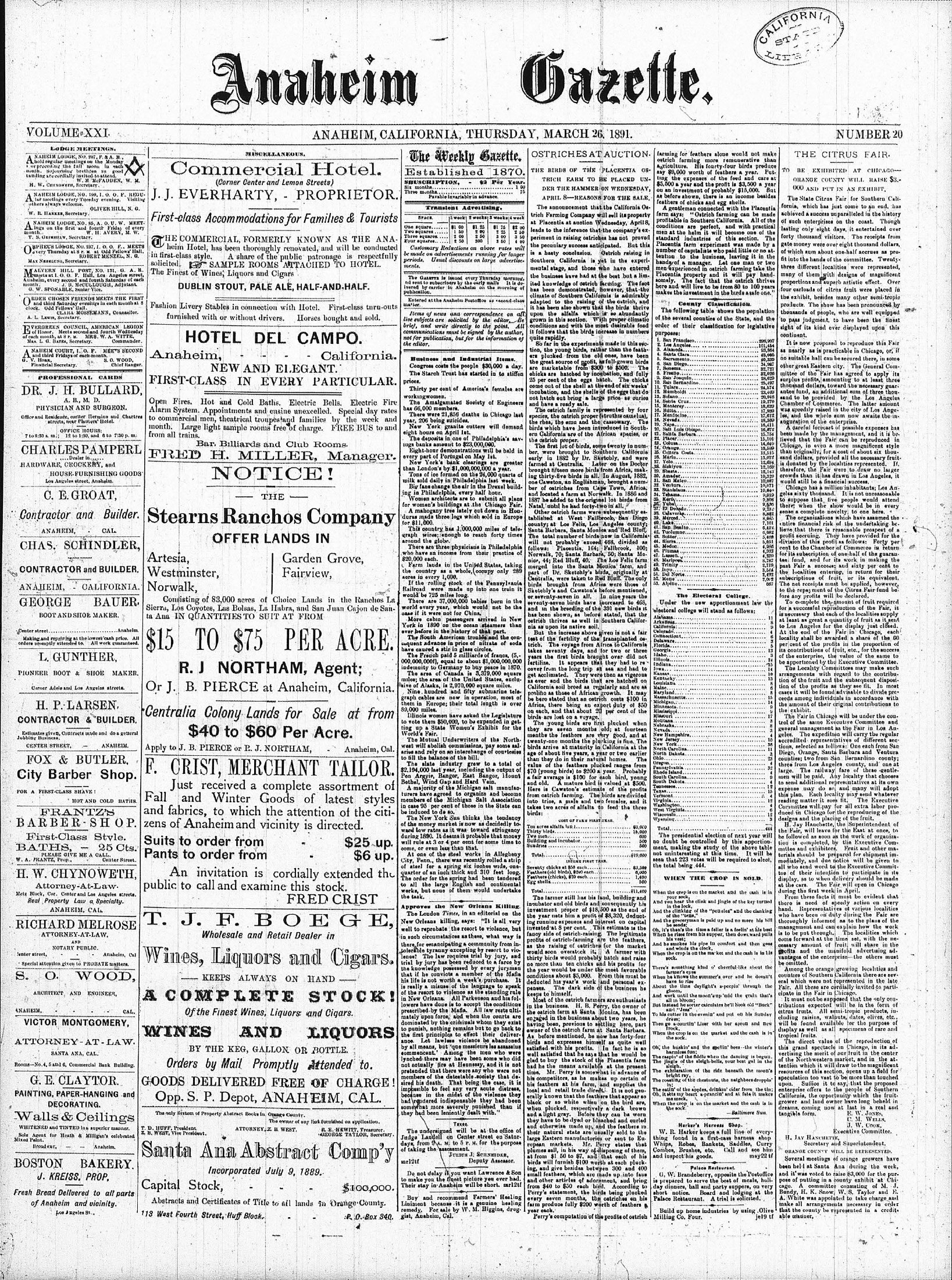
Searchable text
VOLUME XXI.
LODGE MEETINGS.
ANAHEIM LODGE, NO. 207, F. & A. M., hold regular meetings on the Monday or preceding the full moon in each month. Sojourning brethren in good tanding are cordially invited to attend.
W. M. McPADDEN, W. M.
H. W. CHRYNORTH, Secretary.
ANAHEIM LODGE, NO. 199, I. O. O. F. REGULAR meetings every Tuesday evening. Visiting others always welcome.
OLIVER HILL, N. G.
W. R. HARRER, Secretary.
ANAHEIM LODGE, NO. 85, A. O. U. W. MEETings on the first and fourth Friday of every month.
W. H. AVERY, M. W.
T. S. GRINSSIAN, Secretary.
ORPHEUS LODGE, NO. 237, I. O. O. F., MEETS every Thursday at 8 P.M. at Old Fellow's Hall.
ROBERT MENZEL, N. O.
MAX NESELUNG, Secretary.
MALVERN HILL POST, NO. 131, G. A. R., meets at I. O. O. F., Hall, Los Angeles street, Anaheim, every second and fourth Saturday of each month.
J. B. McCULLOUGH, Adjutant.
G. W. SPONABLE, Senior Vice.
ORDER CHOSEN FRIENDS MEETS THE FIRST and third Saturday evenings in each month at 8 clock.
Old Fellow's Hall,
CLAHA MOSSEMANN, Counsellor.
A. L. LEWIN, Secretary.
EVERGREEN COUNCIL, AMERICAN LEGION of Honor. Meets second and fourth Wednesday of each month, at 8 P.M.
MRS. W. A. WITTE,
Mrs. L. G. BATES, Secretary.
ANAHEIM COURT, I. O. F., MEETS SECOND and third Fridays of each month.
G. V. HONG,
Financial Secretary.
PROFESSIONAL CARDS
DR. J. H. BULLARD,
A. B., M. D.
PHYSICIAN AND SURGEON.
Office and Residence, corner Hermine and Chartres streets, near Flauters' Hotel.
OFFICE HOURS:
7 to 8:30 a.m.; 12 to 1:30, and 6 to 7:30 p.m.
CHARLES PAMPERL
...Dealer in...
HARDWARE, CROCKERY, and HOUSE-FURNISHING GOODS
MISCELLANEOUS.
Commercial Hotel
(Corner Center and Lemon Streets)
J. J. EVERHARTY, - PROPRINT
First-class Accommodations for Families &
THE COMMERCIAL, FORMERLY KNOWN AS Theim Hotel, has been thoroughly renovated, and will be in first-class style.
A share of the public patronage is solicited.
SAMPLE ROOMS ATTACHED TO The Finest of Wines, Liquors and Cigars.
DUBLIN STOUT, PALE ALE, HALF-AND-HAKE
Fashion Livery Stables in connection with Hotel. First-class furnished with or without drivers. Horses bought an
HOTEL DEL CAMPO
Anaheim,
Calif.
NEW AND ELEGANT.
FIRST-CLASS IN EVERY PARTICIPATION
Open Fires. Hot and Cold Baths. Electric Bells.
E Alarm System. Appointments and cuisine unexcelled.
Speeches to commercial men, theatrical troupes and families by the month.
Large light sample rooms free of charge.
FREE from all trains.
Bar Billiards and Club Rooms.
FRED H. MILLER, Manuscript NOTICE!
PROFESSIONAL CARDS
DR. J. H. BULLARD,
A. B., M. D.
PHYSICIAN AND SURGEON.
Office and Residence, corner Hermine and Chartres streets, near "Punters' Hotel."
OFFICE HOURS:
7 to 8:30 a.m.; 12 to 1:30, and 6 to 7:30 p.m.
CHARLES PAMPERL
...Dealer in...
HARDWARE, CROCKERY, and HOUSE-FURNISHING GOODS
Los Angeles street, Anaheim.
C. E. GROAT,
Contractor and Builder.
ANAHEIM, CAL.
CHAS. SCHINDLER,
CONTRACTOR and BUILDER.
ANAHEIM, CALIFORNIA.
GEORGE BAUER,
BOOT AND SHOE MAKER.
Center street...Anaheim.
Making and repairing at the lowest cash price. All orders promptly attended to. All work guaranteed.
L. GUNTHER,
PIONEER BOOT & SHOE MAKER.
Corner Adele and Los Angeles streets.
H. P. LARSEN,
CONTRACTOR & BUILDER.
Estimates given, Contracts made and do a general Jobbing Business.
CENTER STREET, ANAHEIM.
FOX & BUTLER,
City Barber Shop.
FOR A FIRST-CLASS SHAVE!
HOT AND COLD BATHS.
FRANTZ'S
BARBER SHOP.
First-Class Style.
BATHS, - 25 Cts.
PLEASE GIVE ME A CALL.
W. A. PRANTZ, Prop., Center Street.
H. W. CHYNOWETH,
Attorney-At-Law.
Metz Block, Cor. Center and Los Angeles streets.
Real Property Law a Specialty.
FIRST-CLASS IN EVERY PARTICLE
Open Fires. Hot and Cold Baths. Electric Bells. E Alarm System. Appointments and ensuine unexcelled. Speci to commercial men, theatrical troupes and families by the month. Large light sample rooms free of charge. FREE from all trains.
Bar. Billiards and Club Rooms.
FRED H. MILLER, Man
NOTICE!
THE
Stearns Ranchos Comp
OFFER LANDS IN
Artesia,
Westminster,
Norwalk,
Consisting of 83,000 acres of Choice Lands in the Sierra, Los Coyotes, Las Bolsas, La Habra, and San Juan Ca ta Ana IN QUANTITIES TO SUIT AT FROM
$15 TO $75 PER AC
R. J NORTHAM, Agent
Or J. B. PIERCE at Anaheim, Cal
Centralia Colony Lands for Sale at
$40 to $60 Per Acre.
Apply to J. B. PIERCE or P. J. NORTHAM, An
F. CRIST, MERCHANT TAIL
Just received a complete assortm Fall and Winter Goods of latest and fabrics, to which the attention of zens of Anaheim and vicinity is directed
Suits to order from
Pants to order from
An invitation is cordially extended public to call and examine this stock.
FRED CRI
FRANTZ'S BARBER SHOP.
First-Class Style.
BATHS, - 25 Cts.
PLEASE GIVE ME A CALL.
W. A. FRANTZ, Prop., Center Street.
H. W. CHYNOWETH,
Attorney-At-Law.
Metz Block, Cor. Center and Los Angeles streets.
Real Property Law a Specialty.
ANAHEIM, CAL.
RICHARD MELROSE
ATTORNEY-AT-LAW.
AND
NOTARY PUBLIC.
Center street,
Anaheim, Cal.
Special attention given to PROBATE matters.
S. O. WOOD,
ARCHITECT AND ENGINEER,
ANAHEIM, CAL.
VICTOR MONTGOMERY,
ATTORNEY-AT-LAW.
SANTA ANA, CAL.
Rooms—No.4, 5 and 6, Commercial Bank Building.
G. E. CLAYTOR.
PAINTING, PAPER-HANGING and DECORATING.
Walls & Ceilings
WHITENED and TINTED in a superior manner.
Sole Agent for Heath & Milligan's celebrated Mixed Paint.
Broadway,
Anaheim.
BOSTON BAKERY.
J. KREISS, PROP,
Fresh Bread Delivered to all parts of Anaheim and vicinity.
Los Angeles St..
ANAHEIM, CALIFORNIA, THURSDAY, MARCH 26, 1891.
Special Hotel.
(Lemon Streets)
PROPRIETOR.
for Families & Tourists
LY KNOWN AS THE ANArenovated, and will be conducted
public patronage is respectfully
ATTACHED TO HOTEL.
SALE, HALF-AND-HALF.
with Hotel. First-class turn-outs
s. Horses bought and sold.
CALAMPO.
California.
ELEGANT.
ERY PARTICULAR.
Electric Bells. Electric Fire
ine unexcelled. Special day rates
and families by the week and
free of charge. FREE BUS to and
Club Rooms.
LER, Manager.
CE!
The Weekly Gazette.
Established 1870.
SBUSCRIPTION, - $2 Per Year.
Six months. 1,00
Three months. 75
Pavable invariably in advance.
Transient Advertising.
SPACE.
One square... $1 00
Two squares... 1 50
Three squares... 2 00
Four squares... 2 50
Customary Reductions on above rates will
be made on advertisements running for longer
periods. Usual discounts on large advertisements.
The Gazette is issued every Thursday morning,
and sent to subscribers by the early mails. It is deivered by carrier in Anaheim on the morning of
publication.
Entered at the Anaheim Postoffice as second-class
master.
Items of news and correspondence on all
live subjects are solicited by the editor. Be
brief, and write directly to the point. All
communications must be signed by the author,
not for publication, but for the information of
the editor.
Business and Industrial Items.
Congress costs the people $30,000 a day.
The Starch Trust has started in to stiffen prices.
Thirty per cent of America's females are
workingwomen.
The Amalgamated Society of Engineers has 66,000 members.
There were 21,856 deaths in Chicago last
year, 206 being suicides.
New York granite cutters will demand eight hours on April 1st.
The deposits in one of Philadelphia's savings banks amount to $23,000,000.
Eight-hour demonstrations will be held in every part of Portugal on May 1st.
New York's bank clearings are greater than London's by $1,000,000,000 a year.
Tons of ice formed on the 24,000 quarts of ice!
OSTRICHES AT AUCTION.
THE BIRDS OF THE PLACENTIA OSTRICH FARM TO BE PLACED UNDER THE HAMMER ON WEDNESDAY,
APRIL 8—REASONS FOR THE SALE.
The announcement that the California Ostrich Farming Company will sell its property at Placentia at auction Wednesday, April 8,
leads to the inference that the company's experiment in raising ostriches has not proved the pecuniary success anticipated. But this is a hasty conclusion. Ostrich raising in Southern California is yet in the experimental stage, and those who have entered the business have had at the best but a limited knowledge of ostrich farming. The fact has been demonstrated, however, that the climate of Southern California is admirably adapted to the raising of the ostrich, and it has been also shown that the birds thrive upon the alfalfa which is so abundantly grown in this section. With proper climatic conditions and with the most desirable food it follows that the birds increase in numbers quite rapidly.
So far in the experiments made in this section, the young birds, rather than the feathers plucked from the old ones, have been the great source of profit, as full-grown birds are marketable from $300 to $500. The chicks are hatched by incubation, and fully 25 per cent of the eggs hatch. The chicks come out of the shell at the end of six weeks' incubation, and the shells of the egg that do not hatch out bring a large price as curiosity and have a ready sale.
The ostrich family is represented by four species, the ostrich proper (struthus camelus), the rhea, the emu and the cassowary. The birds which have been introduced in Southern California are of the African species, or the ostrich proper.
The first lot of birds, some twenty in number, were brought to Southern California early in 1882 by Dr. Sketchy, and were farmed at Centralia. Later on the Doctor brought fifteen more birds from Africa, making thirty-five birds in all. In August 1882,
1. San
2. Los
3. Alas
4. San
5. Sacr
6. San
7. Sone
8. Free
9. Tula
10. Huat
11. Sola
12. Sola
13. Sola
14. Sola
15. Mon
16. Mon
17. Men
18. Nape
19. Napa
20. San
21. Place
22. Colo
23. Orga
24. Com
25. Com
26. Yelo
27. Shoa
28. Shoa
Electric Bells. Electric Fire
engine unexcelled. Special day rates
and families by the week and
free of charge. FREE BUS to and
Club Rooms.
LER, Manager.
ICE!
Nos Company
BANDS IN
Garden Grove,
Fairview,
choice Lands in the Ranchos La
bra, and San Juan Cajon de San
AT FROM
PER ACRE.
AM, Agent;
Anaheim, California.
for Sale at from
Per Acre.
RTHAM, Anaheim, Cal.
HANT TAILOR.
complete assortment of
goods of latest styles
the attention of the citinity is directed.
$25 up.
$6 up.
cordially extended tha
e this stock.
FRED CRIST
prices.
Thirty per cent of America's females are
working women.
The Amalgamated Society of Engineers has 66,000 members.
There were 21,856 deaths in Chicago last year, 206 being suicides.
New York granite cutters will demand eight hours on April 1st.
The deposit in one of Philadelphia's savings banks amount to $23,000,090.
Eight-hour demonstrations will be held in every part of Portugal on May 1st.
New York's bank clearings are greater than London's by $1,000,000,000 a year.
Tons of ice formed on the 24,000 quarts of milk sold daily in Philadelphia last week.
Big fans change the air in the Drexel building in Philadelphia, every half hour.
Women architects are to submit all plans for women's buildings at the Chicago Fair.
A mahogany tree lately out down in Honduras made three logs which sold in Europe for $11,000.
This country has 1,000,000 miles of telegraph wires; enough to reach forty times around the globe.
There are three physicians in Philadelphia who have an income from their practice of $20,000 each.
Farm lands in the United States, taking the country as a whole, occupy only 289 acres in every 1,000.
If the rolling stock of the Pennsylvania Railroad were made up into one train it would be 725 miles long.
There are 37,000,000 babies born in the world every year, which would not be the case if it were not for China.
More cabin passengers arrived in New York in 1890 on the ocean steamers than ever before in the history of that part.
The South American tronkia and the consequent advance in price of nitrate of soda have caused a stir in glass circles.
The French paid 5 milliards of francs (5,000,000,000f), equal to about $1,000,000,000 indemnity to Germany to buy peace in 1870.
The area of Canada is 3,379,000 square miles; the area of the United States, exclusive of Alaska, is 2,970,000 square miles.
Nine hundred and fifty submarine telegraph cables are now in operation, most of them in Europe; their total length is over 89,000 miles.
Illinois women have asked the Legislature to vote them $50,600, to be expended in getting up a State Women's Exhibit for the World's Fair.
The Mutual Underwriters of the Northwest will abolish commissions, pay some salaries and rely on an interchange of courtesies to fill the balance of the bill.
The slate industry grew to a total of $2,194,000 last year, including the output of Pen Argyie, Bangor, East Bangor, Mount Bethel, Wind Gap and Hard Vein.
A majority of the Michigan salt manufacturers have agreed to organize and become members of the Michigan Salt Association in case 95 per cent of those in the State can be induced to do so.
The New York Sun thinks the tendency of the money market is now as decidedly toward low rates as it was toward stringency during 1890. It seems it probable that money will rule at 3 or 4 per cent for some time to come, or even less than that.
At one of the steel works in Allegheny City, Penn., there was recently rolled a strip of steel for a spring six inches wide, one-quarter of an inch thick and 310 feet long. The order for the spring had been tendered to all the large English and continental works, but none of them would undertake the task.
But the increase above given is not a fair test of the fertility of the transplanted ostrich. The voyage from Africa to California takes seventy days, and for two or three years the first birds brought over did not fertilize. It appears that they had to recover from the long trip at sea and had to get acclimated. They were then as vigorous as ever and the birds that are hatched on California soil breed as regularly and are as prolific as those of African growth. It may be here stated that an ostrich costs $100 in Africa; there being an export duty of $50 on each, and that about 20 per cent of the birds are lost on a voyage.
The young birds are first plucked when they are seven months old; at fourteen months the feathers are very good, and at twenty-one months the plucking is fine. The birds arrive at maturity in California at the age of about five years, a year or two earlier than they do in their natural homes. The value of the feathers plucked ranges from $70 (young birds) to $200 a year. Probably a fair average is $100 for each bird, young and old. A mature bird is valued at $500. Here is Cawaton's estimate of the profits from ostrich farming. The birds are divided into trios, a male and two females, and it takes two acres of alfalfa to feed the three birds:
COST OF FARM FIRST YEAR.
Ten acres alfalfa at I... $3,000
Terry birds... 18,900
Two nests... 999
Building and incubator... 599
Suadries... 599
Total... $19,900
INCOME FIRST YEAR.
Seventy chicks at $50 each... $3,500
Feathers (old birds)... $29 each... 6,999
Feathers (chicks)... $24 each... 1,499
Egg shells... 599
Total... $11,499
The farmer still has his land, building and incubator and old birds and consequently his 25 per cent of the eggs hatch. The chicks come out of the shell at the end of six weeks' incubation, and the shells of the egg that do not hatch out bring a large price as curios and have a ready sale.
The ostrich family is represented by four species, the ostrich proper (struthis camelus), the rhesus, the emu and the cassowary. The birds which have been introduced in Southern California are of the African species, or the ostrich proper.
The first lot of birds, some twenty in number, were brought to Southern California early in 1882 by Dr. Sketchly, and were farmed at Centralia. Later on the Doctor brought fifteen more birds from Africa, making thirty-five birds in all. In August, 1882, one Caweton, an Englishman, brought a number of ostrichs from Cape Town, Africa, and located a farm at Norwalk. In 1886 and 1897 he added to the original lot birds from Natal, until he had forty-two in all.
Other ostrich farms were subsequently established at West Fallbrook, San Diego county; at Los Feliz, Los Angeles county; Santa Barbara, Santa Monica and Red Bluff. The total number of birds now in California will not probably exceed 488 divided as follows: Placentis, 164; Fallbrook, 100; Norwalk, 70; Santa Barbara, 59; Santa Monica, 44; Red Bluff, 40. The Los Feliz farm merged into the Santa Monica farm and part of Dr. Sketchly's birds originally at Centralia were taken to Red Bluff. The only birds brought from Africa were those of Sketchly's and Cawaton's before mentioned or seventy-seven in all. In nine years the seventy-seven birds have increased to 468,and in the breeding of the 391 new birds it has been shown, as before stated, that ostrich thrives as well in Southern California as upon its native soil.
But the increase above given is not a fair test of the fertility of the transplanted ostrich. The voyage from Africa to California takes seventy days,and for two or three years the first birds brought over did not fertilize. It appears that they had to recover from the long trip at sea and had to get acclimated. They were then as vigorous as ever and the birds that are hatched on California soil breed as regularly and are as prolific as those of African growth. It may be here stated that an ostrich costs $100 in Africa; there being an export duty of $50 on each,and that about 20 per cent of the birds are lost on a voyage.
The young birds are first plucked when they are seven months old; at fourteen months the feathers are very good,and at twenty-one months the plucking is fine. The birds arrive at maturity in California at the age of about five years,a year or two earlier than they do in their natural homes. The value of the feathers plucked ranges from $70 (young birds) to $200 a year. Probably a fair average is $100 for each bird,young and old. A mature bird is valued at $500.Here is Cawaton's estimate of the profits from ostrich farming. The birds are divided into trios,a male and two females,and it takes two acres of alfalfa to feed the three birds:
COST OF FARM FIRST YEAR.
Ten acres alfalfa at I... $3,000
Terry birds... 18,999
Two nests... 999
Building and incubator... 599
Suadries... 599
Total... $19,999
INCOME FIRST YEAR.
Seventy chicks at $50 each... $3,599
Feathers (old birds)... $29 each... 6,999
Feathers (chicks)... $24 each... 1,499
Egg shells... 599
Total... $11,499
The farmer still has his land,building and incubator and old birds and consequently his
The New York Sun thinks the tendency of the money market is now as decidedly toward low rates as it was toward strigency during 1890. It deems it probable that money will rule at 3 or 4 per cent for some time to come, or even less than that.
At one of the steel works in Allegheny City, Penn., there was recently rolled a strip of steel for a spring six inches wide, one quarter of an inch thick and 310 feet long. The order for the spring had been tendered to all the large English and continental works, but none of them would undertake the task.
Approves the New Orleans Killing.
The London Times, in an editorial on the New Orleans killing, says: "It is all very well to reprobate the resort to violence, but in such circumstances as these, what way is there for emancipating a community from intolerable tyranny excepting by resort to violence? The law requires trial by jury, and trial by jury has been reduced to a farce by the knowledge possessed by every juryman that if he convicts a member of the Mafia his life is not worth a week's purchase. It is really a misuse of the language to speak of the resort to violence as the standing rule in New Orleans. All Parkinson and his followers have done is to accept the conditions prescribed by the Mafia. All law rests ultimately upon force, and when the courts are dominated by the criminals whom they exist to punish, nothing remains but to go back to the first principles to effect their deliverance. Let lawless violence be abandoned by all means, but 'que messieurs les assassins commencent.' Among the men who were lynched there may have been some who did not actually fire at Hennessy, and it is not pretended that there were any who were not members of the datestable society that desired his death. That being the case, it is impossible to feel any acute distress, because in the midst of the violence they had wondered indispensable they had been somewhat more severely punished than if they had been leniently dealt with."
Texas.
The undersigned will be at the office of Judge Landell on Center street on Saturday, from 9 A.M. to 5 P.M. for the purpose of taking the assessment.
Julius J. Schnider,
Deputy Assessor.
Do not delay if you want Lawrence & Son to make you the finest picture you ever had. Their stay in Anaheim will be short.
Buy and recommend Farmers' Healing Liniment because it is a genuine healing remedy. For sale by W. M. Higgins, druggist, Anaheim, Cal.
Perry's computation of the profits of ostrich takes two acres of alfalfa to feed the three birds:
COST OF FARM FIRST YEAR.
Ten acres alfalfa land $3,000
Thirty birds 18,000
Two men 600
Building and incubator 500
Sundries 500
Total $19,000
INCOME FIRST YEAR.
Seventy chicks at $50 each $3,500
Feathers (old birds) $20 each 6,000
Feathers (chicks) $20 each 1,400
Egg shells 500
Total $11,400
The farmer still has his land, building and incubator and old birds and consequently his investment proper of $18,500 as the end of the year nets him a profit of $8,320, deducting running expenses and interest on capital invested at 8 per cent. This estimate is the fancy side of ostrich-raising. The legitimate profits of ostrich-farming are the feathers, as the raising of ostrichs for the market would soon overstock it. A farmer with thirty birds would probably hatch and raise no more than ten chicks and his profits for the year would be under the most favorable conditions about $5,000. From this must be deducted his year's work and personal expenses. The dark side of the business he keeps to himself.
Most of the ostrich farmers are enthusiasts in the business. H. B. Perry, owner of the ostrich farm at Santa Monica, has been engaged in the business about two years, he having been previous to settling here, part owner of the ostrich farm at Santa Barbara. As before mentioned, he now has forty-four birds and expresses himself as quite well satisfied with his profits. In fact he is so well satisfied that he says that he would be glad to buy the stock of the Placentia farm had he the means available at the present time. Mr. Perry is somewhat in advance of his competitors, as he makes up certain of his feathers at his farm, and supplies the local and retail trade direct. It is not generally known that the feathers that appear so black or so white when on the bird are, when plucked, respectively a dark brown and a light gray. Before they can be worn they have to be dyed or bleached and curled and otherwise made up, and the feathers in their natural state are usually sold to the large Eastern manufacturers or sent to European markets. Mr. Perry states that plumes sell, in his way of disposing of them, at from $150 to $7, and that each of his birds will furnish $100 worth at each plucking, and give besides between 300 and 400 small feathers, which are made up into faux and other articles of adornment, and bring from $40 to $50 each bird. According to Perry's statement, the birds being plucked every seven months, the ostriches on his farm produce fully $200 worth of feathers a year each.
Perry's computation of the profits of ostrich
IN AUCTION.
PLACENTIA OSTHE PLACED UNRON WEDNESDAY,
IS FOR THE SALE.
At the California Oswill sell its property
Wednesday, April 8,
at the company's exhibes has not proved
participated. But this
Ostrich raising in
yet in the experiwho have entered
the best but a limfarming. The fact
however, that the
formis is admirably
of the ostrich, and
that the birds thrive
is so abundantly
With proper climatic
most desirable food
increase in numbers
County Classification.
The following table shows the population of the several counties of the State, and the order of their classification for legislative purposes:
1. San Francisco 206,907
2. Los Angeles 101,454
3. Alameda 93,564
4. Santa Clara 48,086
5. Sacramento 40,339
6. San Diego 34,967
7. Sonoma 32,721
8. Fresno 32,026
9. San Josequin 28,629
10. Bernardino 28,477
11. Tulare 24,574
12. Humboldt 23,409
13. Solano 20,046
14. Santa Cruz 19,270
15. Monterey 18,639
16. Butte 17,030
17. Mendocino 17,612
18. Nevada 18,611
19. Marina 18,611
20. San Luis Obispo 19,072
21. Santa Barbara 19,754
22. Placer 15,101
23. Colusa 14,646
24. Orange 13,589
25. Contra Costa 13,515
26. Marin 13,072
27. Yolo 12,604
28. Siskiyou 12,168
29. Shasta 12,143
30. Amader 10,320
THE CITRUS FAIR.
TO BE EXHIBITED AT CHICAGO—ORANGE COUNTY WILL RAISE $3,-000 AND PUT IN AN EXHIBIT.
The State Citrus Fair for Southern California, which has just come to an end, has achieved a success unparalleled in the history of such enterprises on the coast. Though lasting only eight days, it entertained over forty thousand visitors. The receipts from gate money were over eight thousand dollars, of which sum about one-half accrues as profit into the hands of the committee. Twenty-three different localities were represented, many of them with designs of magnificent proportions and superb artistic effect. Over four carloads of citrus fruit were placed in the exhibit, besides many other semi-tropic products. The show has been pronounced by thousands of people, who are well equipped to pass judgment, to have been the finest sight of its kind ever displayed upon this continent.
It is now proposed to reproduce this Fair as nearly as is practicable in Chicago, or, if no suitable hall can be secured there, in some other great Eastern city. The General Committee of the Fair has agreed to apply its surplus profits, amounting to at least three thousand dollars, toward the necessary guarantee fund, an additional sum of three thousand to be provided by the Los Angeles Chamber of Commerce. The latter amount was speedily raised in the city of Los Angeles, and the whole sum now awaits the inauguration of the enterprise.
A careful forecast of possible expenses has been made by the management, and it is believed that the Fair can be reproduced in Chicago, in even a more magnificent style than originally; for a cost of about six thousand dollars, provided all the necessary fruits is donated by the localities represented. If, therefore, the Fair were to draw no larger crowds than it has drawn in Los Angeles, it
The chicks end of six weeks of the egg that do not charge price as curios represented by four (struthis osmelus) the cassowary. The introduced in South African species, or some twenty in num- southern California ketobly, and were later on the Doctor from Africa, mak- In August, 1882, man brought a num- Cape Town, Africa walk. In 1886 and annual lot birds from two in all.
subsequently established in San Diego, Los Angeles county, and Red Bluff, is now in California divided as Fallbrook, 100; Lara, 50; Santa Mo- The Los Feliz farm Monica farm, originally at Red Bluff. The only varieties were those of before mentioned. In nine years the increased to 468, the 391 new birds it stated, that the Southern California for two or threeught over did not they had to reat sea and had to more then as vigorous are hatched on regularly and are as growth. It may rich costs $100 in export duty of $5020 per cent of the first plucked when old; at fourteen very good, and at bucking is fine. The California at the year or two earlier natural homes. The bucked ranges from a year. Probably each bird, young is valued at $500. Rate of the profits the birds are divided two females, and it feed the three
The Electoral College.
Under the new apportionment law the electoral college will stand as follows:
Alabama
Arkansas
California
Colorado
Connecticut
Delaware
Florida
Georgia
Idaho
Illinois
Indiana
Iowa
Kansas
Kentucky
Louisiana
Maine
Maryland
Massachusetts
Michigan
Minnesota
Mississippi
Montana
Nebraska
Nevada
New Hampshire
New Jersey
New York
North Carolina
North Dakota
Ohio
Oregon
Pennsylvania Rhode Island South Carolina South Dakota Tennessee Texas Vermont Virginia Washington West Virginia Wisconsin Wyemlur
Total 444
The presidential election of next year will no doubt be controlled by this apportionment, making the study of the above table not uninteresting at this time. It will be seen that 223 votes will be required to elect the total being 444.
WHEN THE CROP IS SOLD.
When the crop is on the market and the cash is in your sock, And you hear the clink and jingle of the key turned surplus profits, amounting to at least three thousand dollars, toward the necessary guarantee fund, an additional sum of three thousand to be provided by the Los Angeles Chamber of Commerce. The latter amount was speedily raised in the city of Los Angeles, and the whole sum now awaits the inauguration of the enterprise.
A careful forecast of possible expenses has been made by the management, and it is believed that the Fair can be reproduced in Chicago, in even a more magnificent style than originally, for a cost of about six thousand dollars, provided all the necessary fruit is donated by the localities represented. If, therefore, the Fair were to draw no larger crowds than it has drawn in Los Angeles, it would still be a financial success.
Chicago has a million inhabitants; Los Angeles sixty thousand. It is not unreasonable to suppose that five people would attend there; when the show would be in every sense a complete novelty to one here.
The organizations which have assumed the entire financial risk of the undertaking believe that there is reasonable prospect of a profit accruing. They have provided for the division of this profit as follows: Forty per cent to the Chamber of Commerce in return for its subscription of one half of the guarantee fund, and for its work in making the past Fair a success; and sixty per cent to the localities entering, in return for their subscriptions of fruit, or its equivalent. The net receipts must be applied, however, to the repayment of the Citrus Fair fund before any profits will be declared.
To complete the amount of fruit required for a successful reproduction of the Fair, it is necessary that each of the localities supply at least as great a quantity of fruit as it sent to Los Angeles for the display just closed. At the end of the Fair in Chicago, each locality shall be awarded a share of the 60 per cent of the profits in the proportion of its contributions of fruit, etc., for the success of the enterprise, the value of the same to be apportioned by the Executive Committee.
The Locality Committees may make such arrangements with regard to the contribution of the fruit and the subsequent disposition of the profits as they see fit. In most cases it will be found advisable to divide proceeds among individuals in accordance with the amount of their original contributions to the exhibit.
The Fair in Chicago will be under the control of the same Executive Committee and general management as the Fair in Los Angeles. The expedition will carry the regular accredited representatives of different sections, selected as follows: One each from San Diego, Orange, Santa Barbara and Ventura counties; two from San Bernardino county; three from Los Angeles county, and one at large. The railway fare of these gentlemen will be paid. Any locality that chooses to send additional representatives at its own expense may do so and many will adopt this plan. Each locality may send whatever reading matter it sees fit. The Executive Committee will pay for all extra labor produced in Chicago for the reproducing of the designs and the placing of the fruit.
H Jay Hauchette, the Superintendent of the Fair, will leave for the East at once, to be followed as soon as the work of organization is completed, by the Executive Committee and exhibitors. Fruit and other materials should be prepared for shipment immediately, and due notice will be given to all who send word to the Executive Committee of their intention to participate in its display, as to when delivery should be made at the cara. The Fair will open in Chicago during the first week in April.
From these facts it must be evident that there is need of speedy action on every
WHEN THE CROP IS SOLD.
When the crop is on the market and the cash is in your sock,
And you hear the clink and jingle of the key turned
And the clinking of the "penalties" and the clanking of the "leas."
And the groceryman is paid up and no more his bill he sends;
Oh, it's then's the time a feller is a feelin' at his best
When he rises from his supper, then downward pulls his vest;
And he smokes his pipe in comfort and then goes and winds the clock.
When the crop is on the market and the cash is in his sock.
There's something kind o' cheerful-like about the farmer's eyes
When he knows the summer's over and he doesn't have to rise
About the time daylight's a peepin' through the gloom,
And work until the moon's up 'mid the grain that's all in about;
But instead he correr calculates he'll hook old "Buck" and "Jess"
To his cutter in the evenin' and put on his Sunday dress;
Then go a courtn' Lizer with her apron and new frock,
When the crop is on the market and the cash is in the sock.
Oh, the hunkin' and the spellin' bees—the winter's harmless fun!
The raspin' of the fiddle when the dancing is begun.
The jingle of the sleigh-bells, your best gal in the sleigh.
The exhilaration of the ride beneath the moon's bright ray.
The roasting of the chestnuts, the neighbors droppin'in;
The eatin' of the apples, drinkin' cider from the tin;
Oh, it sets my heart a prancin' and at fate it makes me tremble.
When the crop is on the market and the cash is in the sock.
Baltimore Sun.
Marker's Harness Shop.
W. R. Harker keeps a full line of everything found in a first-cass harness shop Whips, Robes, Bankets, Saddles, Curry Combes, Brushes, etc. Call and see him and inspect his goods. may 22 tf
Palace Restaurant.
G. W. Brandeberry, opposite the Postoffice is prepared to serve the best of meals, holiday dinners, ball and party suppers, on very short notice. Board and lodging at the Palace Restaurant. A trial is solicited.
Build up home industries by using Olive Milling Co. Four.
Committee will pay for all extra labor produced in Chicago for the reproducing of the designs and the placing of the fruit.
H. Jay Hanchette, Superintendent of the Fair, will leave for the East at once, to be followed as soon as the work of organization is completed, by the Executive Committee and exhibitors. Fruit and other materials should be prepared for shipment immediately, and due notice will be given to all who send word to the Executive Committee of their intention to participate in its display, as to when delivery should be made at the cars. The Fair will open in Chicago during the first week in April.
From these facts it must be evident that there is need of speedy action on every hand. Representatives of various localities who have been on duty during the Fair are thoroughly informed as to the plans of the management and can explain how the work is to be put through. The localities which come forward at the time set, with the necessary amount of fruit will share in the profits and the manifold advertising advantages of the enterprise—the others must be omitted.
Among the orange growing localities and counties of Southern California there are several which were not represented in the late Fair. All are cordially invited to participate in the Fair in Chicago.
It must not be supposed that the only contributions expected will be in the form of citrus fruits. All semi-tropical products, including raisins, walnuts, dates, olives, etc., will be found available for the purpose of display as well as all specimens of rare and tropical fruits.
The direct value of the reproduction of this grand spectacle in Chicago, in its advertising merit of our fruit in the center of Northwestern market, and in the attention which it will draw to the magnificent resources of this section, opens up a field for speculation too vast to be more than touched upon. Suffice it to say, that the proposed enterprise offers to the people of Southern California, the opportunity which the fruit-grower and land owner have long beheld in dreams, coming now at last in a real and tangible form.
E. W. Jones
C. M. Wells
J. W. Cook
Executive Committee.
H. JAY HANCHETTE,
Secretary and Superintendent.
ORANGE COUNTY WILL BE REPRESENTED.
Several meetings of orange growers have been held at Santa Ana during the week, and it was voted to raise $3,000 for the purpose of putting in a county exhibit at Chicago. A committee consisting of M. J. Bundy, H. K. Snow, W. S. Taylor and E. A. White was appointed to take charge and make all arrangements necessary in order that the county be represented in a creditable manner.