anaheim-gazette 1891-02-19
Scanned page
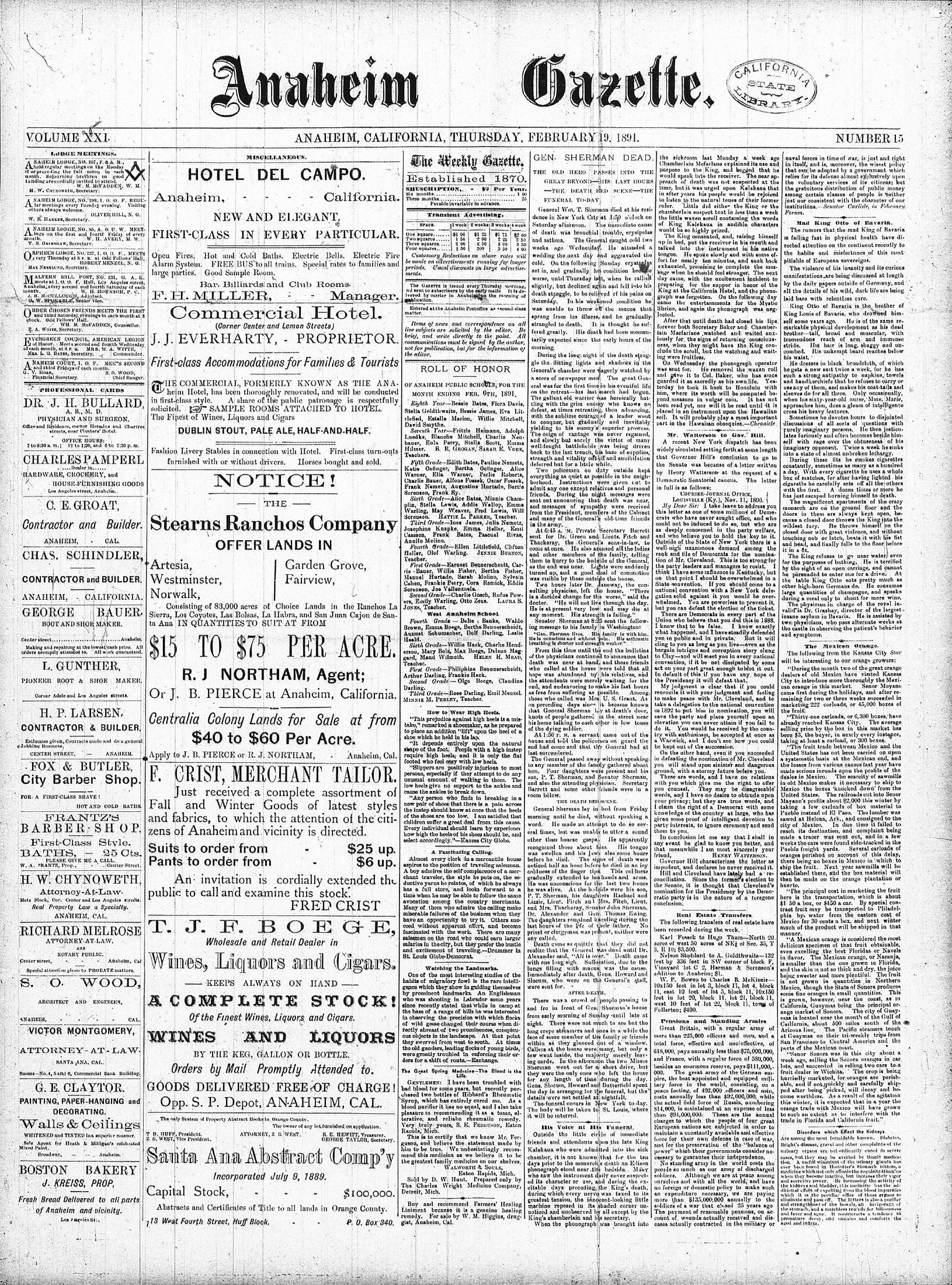
Searchable text
VOLUME XXI.
LODGE MEETINGS.
ANAHEIM LODGE, NO. 207, F. & A. M., hold regular meetings on the Monday after preceding the full moon in each month. Soljourning brethren in good standing are cordially invited to attend.
W. M. McFADDEN, W. M.
W. W. Chrysoweth, Secretary.
ANAHEIM LODGE, NO. 199, I. O. O. F. REGULAR meetings every Tuesday evening. Visiting others always welcome.
OLIVER HILL, N. O.
W. K. HARKER, Secretary.
ANAHEIM LODGE, NO. 85, A. O. U. W. MEETINGS on the first and fourth Friday of every month.
W. H. AVERY, M. W.
T. S. GRINSSHAW, Secretary.
ORPHEUS LODGE, NO. 237, I. O. O. F., MEETS every Thursday at S.P.M. at Old Fellow's Hall.
ROBERT MENZEL, N. O.
MAX NEBRUGO, Secretary.
ALVERN HILL POST, NO. 231, G. A. H. meets at I. O. O. F., Hall, Los Angeles street.
Anaheim, every second and fourth Saturday of each month.
W. H. HOUNSOM, P.C.
J. B. McCULLOUGH, Adjutant.
O. W. SPONSALLE, Senior Vice.
ORDER CHOSEN FRIENDS MEETS THE FIRST and third Saturday, evenings in each month at 8 clock.
Old Fellow's Hall.
WM. M. McFADDEN, Counsellor.
E.A. WHITE, Secretary.
EVERGREEN COUNCIL, AMERICAN LEGION of Honor. Meet's second and fourth Wednesday of each month at S.P.M.
MRS. W.A. WITTE,
MRS. L.G. BATES, Secretary.
Commander.
ANAHEIM COURT, I. O. F., MEET'S SECOND and third Fridays of each month.
G.V.Hoons,
S.O.WOOD,
Financial Secretary.
PROFESSIONAL CARDS
DR. J. H. BULLARD,
A.B., M.D.
PHYSICIAN AND SURGEON.
Office and Residence, corner Hermins and Chartres streets, near Plat尾店 Hotel.
OFFICE HOURS:
7 to 8:30 a.m.; 12 to 1:30, and 6 to 7:30 p.m.
CHARLES PAMPERL
... Dealer in...
HARDWARE, CROCKERY, and
MISCELLANEOUS.
HOTEL DEL CAMPO
Anaheim,
Calif.
NEW AND ELEGANT.
FIRST-CLASS IN EVERY PARTICIPANT
Open Fires, Hot and Cold Baths. Electric Bells.
Alarm System. FREE BUS to all trains. Special rates to large parties. Good Sample Room.
Bar, Billiards and Club Rooms.
F.H.MILLER,
Ma.
Commercial Hotel
(Corner Center and Lemon Streets)
J.J.EVERHARTY,- PROPRINT
First-class Accommodations for Families &
THE COMMERCIAL, FORMERLY KNOWN AS Theheim Hotel, has been thoroughly renovated, and will be in first-class style.
A share of the public patronage is solicited.
SAMPLE ROOMS ATTACHED TO The Finest of Wines, Liquors and Cigars
DUBLIN STOUT, PALE ALE, HALF-AND-HA
Fashion Livery Stables in connection with Hotel. First-class furnished with or without drivers. Horses bought a
PROFESSIONAL CARDS
DR. J. H. BULLARD,
A. B., M. D.
PHYSICIAN AND SURGEON.
Offer and Residence, corner Hermins and Chartres streets, near Planter's Hotel.
OFFICE HOURS:
7 to 8:30 a.m.; 12 to 1:30, and 6 to 7:30 p.m.
CHARLES PAMPERL
...Dealer in...
HARDWARE, CROCKERY, and HOUSE-FURNISHING GOODS
Los Angeles street, Anaheim.
C. E. GROAT,
Contractor and Builder.
ANAHEIM, CAL.
CHAS. SCHINDLER,
CONTRACTOR and BUILDER.
ANAHEIM, CALIFORNIA.
GEORGE BAUER,
BOOT AND SHOE MAKER.
Center street... Anaheim.
Making and repairing at the lowest cash price. All orders promptly attended to. All work guaranteed.
L. GUNTHER,
PIONEER BOOT & SHOE MAKER.
Corner Adele and Los Angeles streets.
H. P. LARSEN,
CONTRACTOR & BUILDER.
Estimates given, Contracts made and do a general Jobbing Business.
CENTER STREET, Anaheim.
FOX & BUTLER,
City Barber Shop.
FOR A FIRST-CLASS SHAVE!
HOT AND COLD BATHS.
FRANTZ'S
BARBER SHOP.
First-Class Style.
BATHS, - 25 Cts.
PLEASE GIVE ME A CALL,
W. A. FRANTZ, Prop., Center Street.
H. W. CHYNOWETH,
Attorney-At-Law.
Metz Block, Cor. Center and Los Angeles streets.
THE COMMERCIAL, FORMERLY KNOWN AS Them Hotel, has been thoroughly renovated, and will be in first-class style. A share of the public patronage is solicited. SAMPLE ROOMS ATTACHED TO The Finest of Wines, Liquors and Cigars
DUBLIN STOUT, PALE ALE, HALF-AND-HA
Fashion Livery Stables in connection with Hotel. First-class furnished with or without drivers. Horses bought a
NOTICE!
Stearns Ranchos Company
OFFER LANDS IN
Artesia,
Westminster,
Norwalk,
Consisting of 83,000 acres of Choice Lands in the Sierra, Los Coyotes, Las Bolsas, La Habra, and San Juan Cita Ana IN QUANTITIES TO SUIT AT FROM
$15 TO $75 PER AC
R. J NORTHAM, Agent
Or J. B. PIERCE at Anaheim, Ca
Centralia Colony Lands for Sale a
$40 to $60 Per Acre.
Apply to J. B. PIERCE or R. J NORTHAM,
F. CRIST, MERCHANT TAN
Just received a complete assortment of Fall and Winter Goods of latest and fabrics, to which the attention of zens of Anaheim and vicinity is directed.
Suits to order from
Pants to order from
An invitation is cordially extended public to call and examine this stock.
FRED CR
FRANTZ'S BARBER SHOP.
First-Class Style.
BATHS, - 25 Cts.
PLEASE GIVE ME A CALL.
W. A. FRANTZ, Prop., Center Street.
H. W. CHYNOWETH,
Attorney-At-Law.
Metz Block, Cor. Center and Los Angeles streets.
Real Property Law a Specialty.
ANAHEIM, CAL.
RICHARD MELROSE
ATTORNEY-AT-LAW.
AND
NOTARY PUBLIC.
Center street, Anaheim, Cal.
Special attention given to PROBATE matters.
S. O. WOOD,
ARCHITECT AND ENGINEER.
ANAHEIM, CAL.
VICTOR MONTGOMERY,
ATTORNEY-AT-LAW.
SANTA ANA, CAL.
Rooms—No.4, 5 and 6, Commercial Bank Building.
G. E. CLAYTOR.
PAINTING, PAPER-HANGING and DECORATING.
Walls & Ceilings
WHITENED and TINTED in a superior manner.
Sole Agent for Heath & Milligan's celebrated Mixed Paint.
Broadway, Anaheim.
BOSTON BAKERY
J. KREISS, PROP,
Fresh Bread Delivered to all parts of Anaheim and vicinity.
Los Angeles St...
Suits to order from
Pants to order from
An invitation is cordially extended public to call and examine this stock.
T. J. F. BOEIG
Wholesale and Retail Dealer in
Wines, Liquors and Cigars
KEeps always on hand
A COMPLETE STOCK
Of the Finest Wines, Liquors and Cigars.
WINES AND LIQUORS
BY THE KEG, GALLON OR BOTTLE.
Orders by Mail Promptly Attended
GOODS DELIVERED FREE OF CHARGE
Opp. S. P. Depot, ANAHEIM, CAL.
The only System of Property Abstract Books in Orange County.
The owner of any lot furnished on a
T. D. HUFF, President.
ATTORNEY, Z. D. WEST.
R. E. HEWITT,
GEORGE TAYLOR
Santa Ana Abstract Company
Incorporated July 9, 1889.
Capital Stock,
Abstracts and Certificates of Title to all lands in Orange
113 West Fourth Street, Huff Block.
ANAHEIM, CALIFORNIA, THURSDAY, FEBRUARY 19, 1891.
L CAMPO.
California.
ELEGANT,
VERY PARTICULAR.
S. Electric Bells. Electric Fire
brains. Special rates to families and
Club Rooms.
Manager.
Special Hotel.
(Lemon Streets)
PROPRIETOR.
s for Families & Tourists
LY KNOWN AS THE ANAly renovated, and will be conducted
public patronage is respectfully
ATTACHED TO HOTEL.
sigars
ALE, HALF-AND-HALF.
with Hotel. First-class turn-outs
s. Horses bought and sold.
The Weekly Gazette.
Established 1870.
SBUSCRIPTION, - $2 Per Year.
Six months.
Three months.
Payable invariably in advance.
Transient Advertising.
SpACE.
1 week
2 weeks
3 weeks
4 week
One square....$1.00
Two squares....1.50
Three squares....2.00
Four squares....2.50
Customary Reductions on above rates will
be made on advertisements running for longer
periods. Usual discounts on large advertisements.
The Gazette is issued every Thursday morning,
and sent to subscribers by the early mail. It is deivered by carrier in Anaheim on the morning of
publication.
Entered at the Anaheim Postoffice as second-class
matter.
Items of news and correspondence on all live subjects are solicited by the editor. Be brief, and write directly to the point. All communications must be signed by the author, not for publication, but for the information of the editor.
ROLL OF HONOR
OF ANAHEIM PUBLIC SCHOOLS, FOR THE MONTH ENDING FEB. 6TH, 1891.
Eighth Year—Bessie Bates, Flora Davis,
Stella Goldthwaite, Bessie James, Eva Littlefied, Estelle Marion, Willie Mitchell,
David Smythe.
Seventh Year—Fritzie Heimann, Adolph Luedke, Blanche Mitchell, Charlie Neubauer, Eula Perry, Stella Scott, Emma Hilmer. B. R. GHOOGAN, Sarah E. VORK,
Teachers.
Fifth Grade—Edith Bates, Pauline Nemetz,
Katie Oelinger, Bortha Oelinger, Alice Warner, Ella Warner, Perlie Roberts,
GEN. SHERMAN DEAD.
THE OLD HERO PASSES INTO THE GREAT BEYOND—HIS LAST HOURS —THE DEATH RED SCENE—THE FUNERAL TO-DAY.
General Wm. T. Sherman died at his residence in New York City at 1:50 o'clock on Saturday afternoon. The immediate cause of death was bronchial trouble, erysipelas and asthma. The General caught cold two weeks ago Wednesday. He attended a wedding the next day and aggravated the cold. On the following Sunday erysipelas set in, and gradually his condition became worse, until Thursday last, when he rallied slightly, but declined again and fell into his death struggle, to be relieved of his pains on Saturday. In his weakened condition he was unable to throw off the mucus that sprang from his illness, and he gradually strangled to death. It is thought he suffered greatly. His death had been momentarily expected since the early hours of the morning.
During the long night of the death struggle the fitting lights and shadows in the General's chamber were dagerly watched by a score of newspaper men. The great General was for the first time in his eventful life on the retreat—his last march had begun. The gallant old warrior was horically batting with the grim enemy who knows no defeat, at times retreating, then advancing, with the sublime courage of a leader wont to conquer, but gradually and inevitably yielding to his enemy's superior prowess. The coign of vantage was never regained, and slowly but surely the victor of many well-fought battlefields was being driven back to the last trench, his base of supplies, strength and vitality oft off and annihilation deferred but for a little while.
Two policemen on duty outside kept everything as quiet as possible in the neigh-
OF ANAHEIM PUBLIC SCHOOLS; FOR THE MONTH ENDING FEB. 6TH, 1891.
Eighth Year—Bessie Bates, Flora Davis, Stella Goldthwaite, Bessie James, Eva Littlefield, Estelle Marion, Willie Mitchell, David Smythe.
Seventh Year—Fritzie Heimann, Adolph Luedke, Blanche Mitchell, Charlie Neubauer, Eula Perry, Stella Scott, Emma Hilmer. B. R. GHOGAN, SARAH E. VORE, Teachers.
Fifth Grade—Edith Bates, Pauline Nemetz, Katie Oefinger, Bertha Oeilinger, Alice Warner, Ella Warner, Perle Roberts, Charlie Bauer, Allons Fossak, Oscar Fossek, Frank Nemetz, Augustine Hurtado, Bertie Sorenson, Frank Ey.
Sixth Grade—Alice Bates, Minnie Champlin, Stella Lewis, Addie Wallop, Emma Warling, May Weaver, Fred Lewis, Will Sorenson. HATTIE L. PARKER, Teacher.
Third Grade—Inez James, Julia Nemetz, Josephine Knapke, Emma Heller, Emil Cassan, Frank Bates, Pascual Rivas, Anulfo Molino.
Fourth Grade—Ellen Littlefield, Clifton Heller, Olof Warling. JENNIE BUURTON, Teacher.
First Grade—Earnest Bennerscheidt, Carrie Bauer, Willie Fisher, Bertha Fisher, Manuel Hurtado, Sarah Molino, Sylvain Cahen, Frankie Pery, Cora Remick, Eddie Sorenson, Joe Vallenzuela.
Second Grade—Charlie Gosch, Rufus Powers, Emily Warling, Otto Zeus. LAURA S. JONES, Teacher.
West Annheim School.
Fourth Grade—Belle Banks, Waldo Brown, Emma Boege, Bertha Bennerscheidt, Annust Schumacher, Dolf Darling, Leslie Heald.
Sixth Grade—Willie Hack, Charlie Henderson, Mary Bola, Max Boege, Delano Maggard, Maud Wilmoth. HELEN H. MEAD, Teacher.
First Grade—Philipine Bennnerscheidt, Arthur Darling, Frankie Hack.
Second Grade—Oligo Boege, Claudina Darling.
Third Grade—Rose Darling, Emil Menzel. MINNIE M. PERLEY, Teacher.
How to Wear High Heels.
“This prejudice against high heels is a mistake,” remarked a shoemaker, as he prepared to place an addition “lift” upon the heel of a shoe which he held in his lap.
“It depends entirely upon the natural shape of the foot. People with a high instep require high heels, and it is only the flat footed who feel easy with low heels.
“Slipppers are positively injurious to most persons, especially if they attempt to do any unusual amount of walking in them. The low heels give no support to the ankles and cause the ankles to break down.”
“Any person who finds in breaking in a now pair of shoes that there is a pain across the instep should know at once that the heels of the shoes are too low. I am satisfied that children suffer a great deal from this cause. Every individual should learn by experience how high the heels of his shoes should be, and select accordingly.”—Kansas City Globe.
A Fascinating Calling.
Almost every clerk in a mercantile house aspires to the position of traveling salesman. A boy admires the self complacence of a merchant traveler, the style he puts on, the seductive yarn he relates, of which he always has a full store, and looks forward to a time when he may be able to follow the same avocation among the country merchants. Many of them who admire the calling make a score of newspaper men.
The great General was for the first time in his eventual life on the retreat—his last march had begun. The gallant old warrior was horically battling with the grim enemy who knows no defeat, at times retreating then advancing with the subline courage of a leader wont to conquer but gradually and inevitably yielding to his enemy’s superior prowess. The coign of vantage was never regained and slowly but surely the victor of many well-fought battlefields was being driven back to the last trench; his base of supplies strength and vitality offset and annihilation deferred but for a little while.
Two policemen on duty outside kept everything as quiet as possible in the neighborhood. Instructions were given not to admit any one except relatives and personal friends. During the night messages were sent out announcing that death was near, and messages of sympathy were received from the President; members of the Cabinet and many of the General’s old-time friends in the army.
At 6:45 A.M. Private Secretary Barrett sent for Dr. Green and Lieuts. Pitch and Thackeray, the General’s sons-in-law to come at once. He also accused all the ladies and other members of the family telling them to burry to the bedside of the General., as the end was near. Lights were suddenly turned up and a good deal of commotion was visible by those outside the house.
Two hours later Dr. Janeway, the consulting physician, left the house. “There is a decided change for the worse,” said the doctor. “He will not live through the day. He is at present very low and may die at any moment. His strength is failing.”
Senator Sherman at 8:25 sent the following message to his family in Washington:
“Gen. Sherman lives. His family is with him. He is conscious and without pain. His asthmatic breathing is shorter and strength weaker.”
From this time until the end the bulletins of physicians continued to announce that death was near at hand; and those friends who called at the house were told that all hope was abandoned by his relatives; and the attendants were merely waiting for the end; and endeavoring to make his last hours as free from suffering as possible. Among those who called was Mrs. U.S. Grant. As on preceding days since it became known that General Sherman lay at death’s door, knots of people gathered in the street near his home talking to each other in low tones of the dying soldier.
At 1:50 P.M. a servant came out of the house and told the policemen on guard the end had come and that the General had at last surrendered.
The General passed away without speaking to any member of the family gathered about him. Four daughters were present and his son, P.T. Sherman, and Senator Sherman, and also the attending physician. Secretary Barrett and some other friends were in a room below.
THE DEATH RED SCENE.
General Sherman lay in bed from Friday morning until he died without speaking a word. He made an attempt to do so several times but was unable to utter a sound other than hoarse gasp. He apparently recognized those about him. His tongue was swollen and his jaws also some hours before he died. The signs of death were noticed half an hour before he died in an ice coldness of the finger tips. This coldness gradually extended to his hands and arms. He was unconscious for the last two hours he was alive. At the bedside were his son, P.T. Sherman, his daughters Rachel and Lizzie Lieut., Fritch and Mrs. Fitch, Lieut., and Mrs. Thackeray; Senator John Sherman.
My friend leapt into his cage as dead and well-night rank at tide of action of the parish thinker on this State national gation whirlwind but you see My friend recoonto make take a walk in 1892 save the elevation do it try with a War bear be kept On this in definite you will ground These with you you co-words your I claim knowleve given a party in them In definihe Pre My joy impulse Hill conciliate The Ser nominal cratio p conclu
A Fascinating Calling.
Almost every clerk in a mercantile house aspires to the position of traveling salesman. A boy admires the self-complacence of a merchant traveler, the style he puts on, theDUCTive yarns he relates, of which he always has a full store, and looks forward to a time when he may be able to follow the same avocation among the country merchants. Many of them who admire the calling make miserable failures of the business when they have an opportunity to try it. Others succeed without apparent effort, and become fascinated with the work. There are many salesmen on the road who could earn larger salaries in the city, but they prefer the bustle and excitement of traveling—Drummer in St. Louis Globe-Democrat.
Watching the Landmarks.
One of the most interesting studies of the habits of migratory fowl is the rare intelligence which they show in guiding themselves by prominent landmarks. An Englishman who was shooting in Labrador some years since recently stated that while in camp at the base of a range of hills he was interested in observing the precision with which flocks of wild geese changed their course when directly abreast of two prominences, conspicuous objects in the landscape. At that point they swerved from west to south. At times the old ganders, leading flocks of young birds, were greatly troubled in enforcing their orders for a shift of route—Exchange.
The Great Spring Medicine—The Blood is the Life.
GENTLEMEN: I have been troubled with bad blood for some years, but recently purchased two bottles of Hibbard's Rheumatic Syrup, which has entirely cured me. As a blood purifier it has no equal, and I also take pleasure in recommending it as a tonic, alterative, and reliable rheumatic remedy. Very truly yours, S.E. Ferguson, Eaton Rapids, Mich.
This is to certify that we know Mr. Ferguson, and believe the statement made by him to be true. We unhesitatingly recommend this medicine as we believe it to be the greatest family medicine on our shelves.
WALWORTH & SOULE,
Eaton Rapids, Mich.
Sold by D. W. Hunt. Prepared only by The Charles Wright Medicine Company, Detroit, Mich.
Buy and recommend Farmers' Healing Liniment because it is a genuine healing remedy. For sale by W.M. Higgins, druggist, Anaheim, Cal.
General Sherman lay in bed from Friday morning until he died, without speaking a word. He made an attempt to do so several times, but was unable to utter a sound other than hoarse gasps. He apparently recognized those about him. His tongue was swollen and his jaws also some hours before he died. The signs of death were noticed half an hour before he died in an ice coldness of the finger tips. This coldness gradually extended to his hands and arms. He was unconscious for the last two hours he was alive. At the bedside were his son, P.T. Sherman, his daughters Rachael and Lizzie, Lieut. Fitch and Mrs. Fitch, Lieut. Mrs. Thackery, Senator John Sherman, Dr. Alexander and Gen. Thomas Ewing. The daughters remained kneeling during the last hours of the life of their father. No priest or clergyman was present, neither were any called.
Death came so quietly that they did not realize that the General was dead until Dr. Alexander said, "All is over." Death came with one long sigh. Suspitation due to the lungs filling with mucus was the cause. Immediately after death, Gens. Howard and Slocum, who were on the General's staff, were sent for.
AFTER DEATH.
There was a crowd of people passing to and fro in front of Gen. Sherman's house from early morning of Sunday until late at night. There were not much to see but the long crepe streamers and ones in a while the face of some member of the family or friends within as they glanced out of a window. Callers at the house were many, but only a few went inside, the majority merely leaving cards. In the afternoon the two Misses Sherman went out for a short drive, but they were the only ones who left the house for any length of time during the day. Gens. Slocum, Howard and Butterfield spent the day in arranging for the funeral, but the details were not settled at nightfall.
The funeral occurs in New York to-day. The body will be taken to St. Louis, where it will be interred.
His Voice at His Funeral.
Outside the little circle of immediate friends and attendants upon the late King Kalakaua who were admitted into the sick chamber, it is not known that for the ten days prior to the monastery's death an Ellison phonograph stood near the bedside. Many who saw the instrument daily never suspected its character or use, and during the excitable days preceding the King's death, during which every nerve was taxed to its greatest tension, the innocent-looking little machine reposed in its shaded corner unnoticed and unobserved by all except by the King's chamberlain and his secretary.
When the phonograph was brought into
MAN DEAD.
PASSES INTO THE
HIS LAST HOURS
BED SCENE—THE
man died at his resition at 1:50 o'clock on
the immediate cause
trouble, crysipolas
oral caught cold two
He attended a
and aggravated the
Sunday crysipolas
condition became
ast, when he rallied
in and fell into his
devoid of his pains on
dened condition he
of the mucus that
and he gradually
is thought he suffth had been momentaearly hours of the
of the death strugshadows in the
daggerly watched by
The great Genin in eventful life
march had begun,
was heroically batty who knows no
then advancing
of a leader wont
and inevitably
superior prowess.
has never regained,
he victor of many
was being driven
base of supplies,
off and annihilation
while.
duty outside kept
possible in the neigh-
the sickroom last Monday a week ago Chamberlain Mcfarlane explained its use and purpose to the King, and begged that he would speak into the receiver. The near approach of death was not suspected at the time, but it was urged upon Kalskaua that in after years his people would be rejoiced to listen to the natural tones of their former ruler. Little did either the King or the chamberlain suspect that in less than a week the little waxen scroll containing the words of King Kalskaua in audible characters would be so highly prized.
The King consented, and, raising himself up in bed, put the receiver in his mouth and talked into the instrument in his native tongue. He spoke slowly and with some effort for nearly ten minutes, and sank back exhausted, promising to complete the message when he should feel stronger. The next day came, with the exoitement incident to preparing for the supper in honor of the King at the California Hotel, and the phonograph was forgotten. On the following day came the entertainments for the Mystic Shrine, and again the phonograph was neglected.
After that until death had closed his lips forever both Secretary Baker and Chamberlain Macfarlane watched and waited anxiously for, the signs of returning consciousness, when they might have the King conclude the scroll, but the watching and waiting were fruitless.
On Wednesday the phonograph operator was sent for. He removed the waxen roll and gave it to Col. Baker, who has since guarded it as sacredly as his own life. Yearday he took it back to Honolulu with him, where its worth will be computed beyond measure in vulgar coin. It has not been read yet, nor will it be read until it is placed in an instrument upon the Hawaiian soil. It will probably play a most important part in the Hawaiian obsequies. —Chronicle.
Mr. Watterson to Gov. Hill.
A recent New York dispatch has been widely circulated setting forth at some length that Governor Hill's conclusion to go to the Senate was because of a letter written by Henry Watterson at the request of a Democratic Senator.
naval forces in time of war, is just and right in itself, and is, moreover, the wisest policy that can be adopted by a government which relies for its defense almost exclusively upon the voluntary services of its citizens; but the gratuitous distribution of public money among certain classes of people is neither just nor consistent with the character of our institutions. —Senator Carlisle, in February Forum.
Mad King Otto of Bavaria.
The rumors that the mad King of Bavaria is failing fast in physical health have directed attention on the continent recently to the habits and misfortunes of this most pitiful of European sovereigns.
The violence of his insanity and its curious manifestations are being discussed at length by the daily papers outside of Germany, and all the details of his wild, dark life are being laid bare with relentless care.
King Otto of Bavaria is the brother of King Louis of Bavaria, who drowned himself some years ago. He is of the same remarkable physical development as his dead brother—tall, broad and muscular, with tremendous reach of arm and immense stride. His hair is long, shaggy and uncombed. His unkempt beard reaches below his waist.
He dresses in black broadcloth, of which he gets a now suit twice a week, for he has such a strong antipathy to napkins, towels and handkerchiefs that he refuses to carry or use any of them, and makes his coat-tails and sleeves do for all three. Only occasionally, when his sixty-year-old nurse, Mime Marie, approaches him, does a gleam of intelligence cross his heavy features.
Sometimes he devotes hours to disjointed discussions of all sorts of questions with purely imaginary persons. He then jacintizes furiously and often becomes beside himself with rage over the obtuseness of his imaginary opponent. Twice a week he sinks into a state of almost unbroken lethargy.
During these fits he smokes cigarettes constantly, sometimes as many as a hundred a day. With every cigarette he uses a whole box of matches, for after having lighted his
The great Gentele in his eventful life, march had begun, was heroically battled by a leader wontily and inevitably superior prowess.
The victor of many was being driven to base of supplies, off and annihilating while.
Duty outside kept possible in the neigh- were given not to relatives and personal right messages were out death was near, they were received bers of the Cabinet of old-time friends
Secretary Barrett L. Liuts. Fitch and its sons-in-law, to croused all the ladies inside of the General, were suddenly ideal of commotion inside the house.
Daneway, the con- house, "There worse," said the lie through the day, and may die at length is failing."
He sent the follow- in Washington:
the family is with him, pain. His asthmatic breath weaker."
He end the bulletins to announce that he and those friends were told that all his relatives, and only waiting for the make his last hours impossible. Among U. S. Grant. As it became known at death's door, on the street near other in low tones came out of the men on guard the General had at
without speaking only gathered about present and his Senator Sherman, physician. Secretary friends were in a
SCENE.
bed from Friday without speaking only gathered about present and his Senator Sherman, physician. Secretary friends were in a
SCENE.
bed from Friday without speaking only gathered about present and his Senator Sherman, physician. Secretary friends were in a
SCENE.
bed from Friday without speaking only gathered about present and his Senator Sherman, physician. Secretary friends were in a
SCENE.
bed from Friday without speaking only gathered about present and his Senator Sherman, physician. Secretary friends were in a
SCENE.
bed from Friday without speaking only gathered about present and his Senator Sherman, physician. Secretary friends were in a
SCENE.
bed from Friday without speaking only gathered about present and his Senator Sherman, physician. Secretary friends were in a
SCENE.
bed from Friday without speaking only gathered about present and his Senator Sherman, physician. Secretary friends were in a
SCENE.
bed from Friday without speaking only gathered about present and his Senator Sherman, physician. Secretary friends were in a
SCENE.
bed from Friday without speaking only gathered about present and his Senator Sherman, physician. Secretary friends were in a
SCENE.
bed from Friday without speaking only gathered about present and his Senator Sherman, physician. Secretary friends were in a
SCENE.
bed from Friday without speaking only gathered about present and his Senator Sherman, physician. Secretary friends were in a
SCENE.
bed from Friday without speaking only gathered about present and his Senator Sherman, physician. Secretary friends were in a
SCENE.
bed from Friday without speaking only gathered about present and his Senator Sherman, physician. Secretary friends were in a
SCENE.
bed from Friday without speaking only gathered about present and his Senator Sherman, physician. Secretary friends were in a
SCENE.
bed from Friday without speaking only gathered about present and his Senator Sherman, physician. Secretary friends were in a
SCENE.
bed from Friday without speaking only gathered about present and his Senator Sherman, physician. Secretary friends were in a
SCENE.
bed from Friday without speaking only gathered about present and his Senator Sherman, physician. Secretary friends were in a
SCENE.
bed from Friday without speaking only gathered about present and his Senator Sherman, physician. Secretary friends were in a
SCENE.
bed from Friday without speaking only gathered about present and his Senator Sherman, physician. Secretary friends were in a
SCENE.
bed from Friday without speaking only gathered about present and his Senator Sherman, physician. Secretary friends were in a
SCENE.
bed from Friday without speaking only gathered about present and his Senator Sherman, physician. Secretary friends were in a
SCENE.
bed from Friday without speaking only gathered about present and his Senator Sherman, physician. Secretary friends were in a
SCENE.
bed from Friday without speaking only gathered about present and his Senator Sherman, physician. Secretary friends were in a
SCENE.
bed from Friday without speaking only gathered about present and his Senator Sherman, physician. Secretary friends were in a
SCENE.
bed from Friday without speaking only gathered about present and his Senator Sherman, physician. Secretary friends were in a
SCENE.
bed from Friday without speaking only gathered about present and his Senator Sherman, physician. Secretary friends were in a
SCENE.
bed from Friday without speaking only gathered about present and his Senator Sherman, physician. Secretary friends were in a
SCENE.
bed from Friday without speaking only gathered about present and his Senator Sherman, physician. Secretary friends were in a
SCENE.
bed from Friday without speaking only gathered about present and his Senator Sherman, physician. Secretary friends were in a
SCENE.
bed from Friday without speaking only gathered about present and his Senator Sherman, physician. Secretary friends were in a
SCENE.
bed from Friday without speaking only gathered about present and his Senator Sherman, physician. Secretary friends were in a
SCENE.
bed from Friday without speaking only gathered about present and his Senator Sherman, physician. Secretary friends were in a
SCENE.
bed from Friday without speaking only gathered about present and his Senator Sherman, physician. Secretary friends were in a
SCENE.
bed from Friday without speaking only gathered about present and his Senator Sherman, physician. Secretary friends were in a
SCENE.
bed from Friday without speaking only gathered about present and his Senator Sherman, physician. Secretary friends were in a
SCENE.
bed from Friday without speaking only gathered about present and his Senator Sherman, physician. Secretary friends were in a
SCENE.
bed from Friday without speaking only gathered about present and his Senator Sherman, physician. Secretary friends were in a
SCENE.
bed from Friday without speaking only gathered about present and his Senator Sherman, physician. Secretary friends were in a
SCENE.
bed from Friday without speaking only gathered about present and his Senator Sherman, physician. Secretary朋友s will be interesting to our orange growers:
"During the month two of the great orange dealers of old Mexico have visited Kansas City to introduce more thoroughly the Mexican orange in this market. Senor Moyano came first during the holidays, and after remaining for two or three weeks succeeded in marketing 222 corroads, or 45,000 boxes of the fruit: "Thirty-one carloads, or 6,300 boxes, have already reached Kansas City. The average selling price by the box in this market has been $3; the buyer, in nearly every instance, taking at least a carload, or 300 boxes."
"The fruit trade between Mexico and the United States has not been carried on upon a systematic basis at the Mexican end, and the losses from various causes last year have made serious inroads upon the profits of the deales in Mexico. The scarcity of sawmills in old Mexico makes it necessary to ship to Mexico the boxes 'knocked down' from the United States. The railroads cut into Senor Mayano's profits about $2,000 this winter by taking a few carloads of box material to Pueblo instead of El Paso. The lumber was sawed at Helena, Ark., and consigned to the city of Mexico. In due time it failed to reach its destination, and complaint being made a tracer was sent out, and in a few weeks the cars were found side-tracked in the Pueblo freight yards. Several carloads of oranges perished on account of this delay, there being no boxes in Mexico in which to ship the fruit. Next year sawmills will be established there, and the box material will then be made on the orange plantation or huerto."
"The principal cost in marketing the fruit here is the transportation, which is about $150 a box, or $450 a car. By special con-
Real Estate Transfers.
The following transfers of real estate have been recorded during the week.
Karl Fossek to Hugo Thum—North 20 acres of west 50 acres of NE of Sec. 35, T. R.10; $3,500.
Nelson Stoddard to A. Goldthwaite—132 feet by 336 feet in SW corner of block F, Vinoyard lot C 2, Herman & Sorenson's addition to Anaheim; $1.
W.P. Bowen to Charles B. McKinzie—10x150 feet in lot 3, block 11, lot 4, block 11, cast 10 feet of lot 5, block 11, 10x150 feet in lot 20, block 11, lot 21, block 11, west 10 feet of lot 22, block 11, town of Fullerton; $400.
Pensions and Standing Arms.
Great Britain, with a regular army of more than 225,000 officers and men, and a total force, effective and non-effective, of 618,000 pays annually less than $75,000,000, and France, with a regular force of 580,000 besides an enormous reserve, pays $111,000,-000.
The great army of the German empire, the best appointed and equipped military force in the world, consisting on a peace footing, of 492,000 officers and men, costs annually less than $92,000,000, while the actual field force of Russia, numbering $14,000, is maintained at an expense of less than $94,000,000.
These are the annual charges to which the people of four great European nations are subjected in order to maintain a constantly available and effective force for their own defense in case of war, and for the preservation of the "balance of power" which their governments consider necessary to guarantee their independence.
No standing army in the world coasts the people so much as our army of discharged soldiers. Although we are at peace among ourselves and with all the world, and have no foreign or domestic policy to make such an expenditure necessary, we are paying more than $135,000,000 annually to the soldiers of a war that closed 25 years ago.
The payment of reasonable pensions, on account of wounds actually received and diseases actually contracted in the military or taking a few carloads of box material to Pueblo instead of El Paso. The lumber was sawed at Helena, Ark., and consigned to the city of Mexico. In due time it failed to reach its destination, and complaint being made a tracer was sent out, and in a few weeks the cars were found side-tracked in the Pueblo freight yards. Several carloads of oranges perished on account of this delay, there being no boxes in Mexico in which to ship the fruit. Next year sawmilla will be established there, and the box material will then be made on the orange plantation or luerto.
"The principal cost in marketing the fruit here is the transportation, which is about $150 a box, or $450 a car. By special contract fruit may be transported to Philadelphia by water from the eastern cost of Mexico for 30 cents a box, and next winter much of the product will be shipped in that manner."
"A Mexican orange is considered the most delicious specimen of that fruit obtainable, even excelling the best Floridas or Navels in flavor. The Mexican orange, or Naranja, is smaller than the one grown in Florida, and the skin is not so thick and dry, the juice being sweeter and more plentiful. The fruit is not grown in quantities in Northern Mexico, though the State of Sonora produces some fine oranges in small quantities. This is grown, however, near the coast, as in California, Guaymas being the principal orange market of Sonora. The city of Guaymas is located near the month of the Gulf of California, about 500 miles south of the Arizona line. The Pacific steamers touch at Gunymas on their tri-weekly trips from San Francisco to Central America and the ports of the Mexican coast.
"Senor Sonora was in this city about a week ago, selling the Sonora oranges in car lots, and succeeded in selling two cars to a fruit dealer in Wichita. The crop is being hurriedly marketed, for oranges are perishable, and if not quickly and carefully shipped after being picked, will decay and become worthless. As a result of the agitation this winter, it is expected that in a year the orange trade with Mexico will have grown to such an extent as to interfere with the trade in Florida and California fruit."