anaheim-gazette 1890-04-03
Scanned page
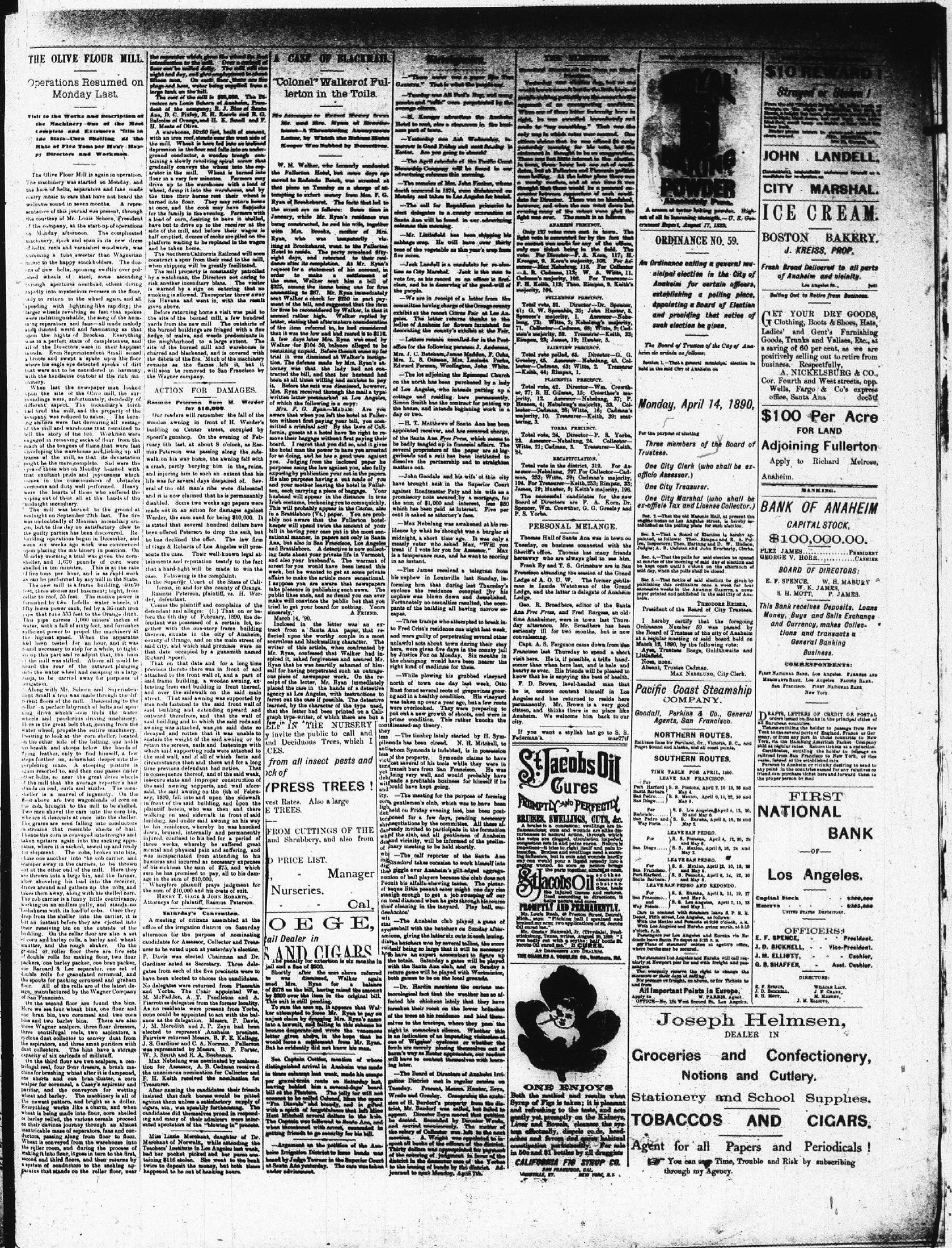
Searchable text
THE OLIVE FLOUR MILL.
Operations Resumed on Monday Last.
Visit to the Works and Description of the Machinery—One of the Most complete and Extensive Titles in the State—Corn Shelling at the State of Five Tempers Month—Happy Directors and Workmen.
The Olive Flour Mill is again in operation. The machinery was started on Monday, and the hum of belts, separators and fans made merry music to ears that have not heard the welcome sound in seven months. A representative of this journal was present, through the courtesy of Mr. Louis Schorn, President of the company, at the start-up of operations on Monday afternoon. The complicated machinery, spick and span in its new dress of belts, reels and varnished woodwork, was numming a tune sweeter than Wagnerian music to the happy stockholders. The dozens of new belts, spinning swiftly over polished wheels of steel, some ascending through apertures overhead, others diving rapidly into myterious recesses in the floor, only to return to the wheel again, and all speeding with lightning-like rapidity; the larger wheels revolving so fast that spokes were indistinguishable, the song of the humming separator and fans—all made melody and discord weird and fascinating as that upon the hights of Brocken. Everything was in a perfect state of completeness, and all of the Directors were in their happiest moods. Even Superintendent Small seized a broom and swept a space upon the floor where his eagle eye detected specks of dirt that were not to be considered in harmony with the handsome contour of the rich machinery.
When last the newspaper man looked upon the site of the Olive mill, the surroundings were, unfortunately, decidedly of different aspect. The incendiary's torch had fired the mill, and the property of the company was reduced to ashes. The burning smithers were fast devouring all vegetation of the mill and warehouse that remained to tell the story of the fire. Workmen were engaged in removing sacks of flour from the reach of the tongues of flame that were fast developing the warehouse and kicking up all traces of the mill, so that its devastation might be the more complete. Sad were the two magnificent which gave life to what has been introduced to the mill. Over a second of flour can be milled daily. The mill will now night and day, and give employment to about fifteen men. On each floor, there are five plages and here, water being supplied from a large tank on the hill.
The cost of the mill is $65,000. The Directors are Louis Sahara of Anchorage, President of the company; R. J. Miles of Stats Ana, D. C. Fixley, R. H. Reavis and R. G. Balcolin of Orange, and H. K. Small and F. H. Mantea of Otiva.
A warehouse, 50x60 feet, built of cement with an iron roof, stands near the west side of the mill. Wheat is here fed into an inclined depression in the floor and falls into an underground conductor, a wooden trough containing a slowly revolving spiral screw that gradually conveys the wheat into the separator in the mill. Wheat is turned into flour in a very few minutes. Farmers may drive up to the warehouse with a load of wheat, damp it into the warehouse, and by the time their horses rest their wheat is turned into flour. They may return home at once, and the cook may have fajitas for the family in the evening. Farmers with a load of corn, desiring to have it shelled, have to drive up to the receiver at the side of the mill, and before their wagon is half emptied, dozens of sacks are piled on the platform waiting to be replaced in the wagon and be taken home.
The Southern California Railroad will soon construct a spur from their road to the mill, when shipping will be greatly facilitated.
The mill property is constantly patrolled by a watchman, the Directors not caring to risk another incendiary blaze. The vinter is warned by a sign on entering that no smoking is allowed. The reporter throw away his Havana and went in, with the results given above.
Before returning home a visit was paid to the site of the burned mill, a few hundred yards from the new mill. The outskirts of the burned buildings are fringed with a fine hedge of malva, and weeds predominate in the neighborhood to a large extent. The site of the burned mill and warehouse is charred and blackened, and is covered with the debris of the fire. Much of the machinery remains as the flames left it, but it will soon be removed to San Francisco by the Wagner company.
ACTION FOR DAMAGES.
Rasmus Peterson Smee H. Werder for $100,000.
Our readers will remember the fall of the wooden awning in front of H. Werder's building on Center street, occupied by Spoerl's gunshop. On the evening of February 6th last, at about 8 o'clock, as Rasmus Peterson was passing along the sidewalk on his way home, the awning fell with a magnitude which gives life to what has been introduced to the mill.
A case of Black Colonel Walker in the Town
Mr Attenpagen on Murray McMurray-McLennan-A Threathening-A Lemore-by Whittam-McKenner-Warner-Walker-Matthew by Lester-Heath-McKenner-Warner-Walker-Matthew by Lester-Heath-McKenner-Warner-Walker-Matthew by Lester-Heath-McKenner-Warner-Walker-Matthew by Lester-Heath-McKenner-Warner-Walker-Matthew by Lester-Heath-McKenner-Warner-Walker-Matthew by Lester-Heath-McKenner-Warner-Walker-Matthew by Lester-Heath-McKenner-Warner-Walker-Matthew by Lester-Heath-McKenner-Warner-Walker-Matthew by Lester-Heath-McKenner-Warner-Walker-Matthew by Lester-Heath-McKenner-Warner-Walker-Matthew by Lester-Heath-McKenner-Warner-Walker-Matthew by Lester-Heath-McKenner-Warner-Walker-Matthew by Lester-Heath-McKenner-Warner-Walker-Matthew by Lester-Heath-McKenner-Warner-Walker-Matthew by Lester-Heath-McKenner-Warner-Walker-Matthew by Lester-Heath-McKenner-Warner-Walker-Matthew by Lester-Heath-McKenner-Warner-Walker-Matthew by Lester-Heath-McKenner-Warner-Walker-Matthew by Lester-Heath-McKenner-Warner-Walker-Matthew by Lester-Heath-McKenner-Warner-Walker-Matthew by Lester-Heath-McKenner-Warner-Walker-Matthew by Lester-Heath-McKenner-Warner-Walker-Matthew by Lester-Heath-McKenner-Warner-Walker-Matthew by Lester-Heath-McKenner-Warner-Walker-Matthew by Lester-Heath-McKenner-Warner-Walker-Matthew by Lester-Heath-McKenner-Warner-Walker-Matthew by Lester-Heath-McKenner-Warner-Walker-Matthew by Lester-Heath-McKenner-Warner-Walker-Matthew by Lester-Heath-McKenner-Warner-Walker-Matthew by Lester-Heath-McKenner-Warner.Walker.Matthew.Walker.Matthew.Walker.Matthew.Walker.Matthew.Walker.Matthew.Walker.Matthew.Walker.Matthew.Walker.Matthew.Walker.Matthew.Walker.Matthew.Walker.Matthew.Walker.Matthew.Walker.Matthew.Walker.Matthew.Walker.Matthew.Walker.Matthew.Walker.Matthew.Walker.Matthew.Walker.Matthew.Walker.Matthew.Walker.Matthew.Walker.Matthew.Walker.Matthew.Walker.Matthew.Walker.Matthew.Walker.Matthew.Walker.Matthew.Walker.Matthew.Walker.Matthew.Walker.Matthew.Walker.Matthew.Walker.Matthew.Walker.Matthew.Walker.MATTWALKWALKWALKWALKWALKWALKWALKWALKWALKWALKWALKWALKWALKWALKWALKWALKWALKWALKWALKWALKWALKWALKWALKWALKWALKWALKWALKWALKWALKWALKWALKWALKWALKWALKWALKWALKWALKWALKWALKWALKWALKWALKWALKWALKWALKWALKWALKWALKWALKWALKWALKWALKWALKWALKWALKWALKWALKWALKWALKWALKE
When last the newspaper man looked upon the site of the Olive mill, the surroundings were, unfortunately, decidedly of different aspect. The incendiary's torch had tired the mill, and the property of the company was reduced to ashes. The burning smithers were fast devouring all vegetation of the mill and warehouse that remained to tell the story of the fire. Workmen were engaged in removing sacks of flour from the reach of the tongues of flames that were fast developing the warehouse and licking up all traces of the mill, so that its devastation might be the more complete. Sad were the eyes of those who on Monday beamed with that exultant pride and joyousness which comes in the consciousness of obstacles overcome and duty well performed. Heavy were the hearts of those who suffered the wiping out of their all at the hands of the midnight incendary.
The mill was burned to the ground at midnight on September 29th last. The fire was undoubtedly of Mexican incendiary origin, but to this day no satisfactory clew to the guilty parties has been discovered. Re-building operations began in December, and some six weeks ago work was commenced upon placing the machinery in position. On Monday morning a trial was given the corn sheller, and 1,670 pounds of corn were shelled in ten minutes. This is at the rate of five tons per hour, and is as rapid work as can be performed by any mill in the State.
The new mill is a frame building, 40x50 feet, three stories and basement; high, from cellar to roof, 55 feet. The motive power is furnished by two Lefelfe water wheels, of fifty horse power each, fed by a 36-inch iron taps that runs 553 feet to the Orange ditch. This pipe carries 1,000 miners' inches of water, with a fall of sixty feet, and furnishes sufficient power to propel the machinery at the highest speed. When the apparatus had been tested for an hour, and it was found necessary to stop for a while, tighten up this part and re adjust that, the hum at the mill was stilled. Above all could be heard the roar of the cataract plunging into the water wheel and escaping in a large cupa, to be carried away for purposes of irrigation.
Along with Mr. Schorn and Superintendent Small a trip was made through the different floors of the mill. Descending to the pillar—a perfect labyrinth of belts and spinning drive wheels—one finds the water wheels and ponderous driving machinery. There is the great bolt that, coming from the water wheel, propels the entire machinery. Desiring to look at the corn sheller, located on the other side of the beltling, one holds his breath and stoops below the bands of flying leather, only to find himself, a few steps further on, somewhat deeper into the perplexing maze. A stooping posture is again resorted to, and then one passes under other belts, so near the great drive wheels of the mill that the average reporter's hair stands on end, curls and sizzles. The corn sheller is a marvel of ingenuity. On the floor above are two wagonloads of corn on the cob, brought to the mill to be shelled. Two men shovel the ears into the corn bin, whence it descends at once into the sheller. The grains are seen falling into conductors in streams that resemble sheets of hail. Thence the corn is conveyed into troughs and taken upstairs again into the sacking apparatus, where it is sacked, sewed up and ready for shipment. The cobs, broken into bits, chase one another into the cob carrier, and scamper away in the carriers, to be thrown out at the other end of the mill. Here they are thrown into a large bin, and the farmer after shovelling his load into the receiver.
ACTION FOR DAMAGES.
Rasmus Peterson Snee H. Werder for $10,000.
Our readers will remember the fall of the wooden awning in front of H. Werder's building on Center street, occupied by Spoerl's gunshot. On the evening of February 6th last, at about 8 o'clock, as Rasmus Peterson was passing along the sidewalk on his way home, the awning fell with a crash, partly burying him in the ruins, and injuring him to such an extent that his life was for several days despaired of. Several of the old man's ribs were dislocated and it is now claimed that he is permanently disabled. Some two weeks ago papers were made out in an action for damages against Werder, the sum sued for being $10,000. It is stated that several hundred dollars have been offered Peterson to drop the suit, but he has declined the offer. The law firm of Gage & Robarts of Los Angeles will prosecute the case. Their well-known legal attainments and reputation testify to the fact that a hard-fight will be made to win the case. Following is the complaint:
In the Superior Court of the State of California, in and for the county of Orange.
Rasmus Peterson, plaintiff, vs. H. Werder, defendant.
Comes the plaintiff and complains of the defendant and alleges: (1.) That on or before the 6th day of February, 1890, the defendant was possessed of a certain lot, together with the one-story frame building thereon, situated in the city of Anahiem, county of Orange, and on the main street of said city, and which said premises were on that date occupied by a gunsmith named Richard Spoerl.
That on that date and for a long time previous thereto there was in front of and attached to the front wall of, and a part of said frame building, a wooden awning, extending from said building in front thereof, and over the sidewalk on the said main street.
That said awning was supported by iron rods fastened to said front wall of said building and extending upward and outward therefrom, and that the wall of said building and to which said rods and awning was attached, was on said date so decayed and rotten that it was unable to sustain the weight of the said awning or to retain the screws, nails and fastening with which said supporting rods were attached to the said wall, and of all of which facts and circumstances then and there and for a long time previous defendants had notice.
Thus in consequence thereof, and of said weak, insureuro state and improper construction of the said awning supports, and wall aforesaid, the said awning on the 6th of February, 1890, fell into and upon the sidewalk in front of said building, and upon the plaintiff herein, who was then and there walking on said sidewalk in front of said building, and under said awning on his way to his residence, whereby he was knocked down, brushed internally and permanently injured, confined to his bed for a period of three weeks, whereby he suffered great mental and physical pain and suffering, and was incapacitated from attending to his business and incurred as necessary expenses of his sickness the sum of $75, and which sum he has promised to pay, all to his damage in the sum of $10,000.
A
March 14,'90.
Inclosed in the letter was tract from a Santa Ana paper flicted upon the worthy couple's cournilous and blackmailing character writer of this article when conan Mr. Ryan, confessed that Walk spired it, asked forgiveness and as Ryan that he was heartily ashamed self for having perpetrated such an one piece of newspaper work. Coipts of the letter, Mr. Ryan placed in case in the hands of agency at Los Angeles, with instert out othe case if possible. The learned, by the character of thie that she letter had been printed graph type-writer, of which there few ELF IN THE NURSERY may invite the public to call undeciduous Trees, which CES.
from all insect pests stock of PRESS TREE
vest Rates. Also a large E TREES.
FROM CUTTINGS OF AND SHRUBBERY, AND also D PRICE LIST.
MANA
the average reporter's hair stands on end, curly and sizzles. The corn-seller is a marvel of ingenuity. On the floor above are two wagonloads of corn on the cob, brought to the mill to be shelled. Two men shovel the ears into the corn bin, whence it descends at once into the sheller. The grains are seen falling into conductors in streams that resemble sheets of hail. Thence the corn is conveyed into troughs and taken upstairs again into the sacking apparatus, where it is sacked, sewed up and ready for shipment. The cobs, broken into bits, chase one another into the cob carrier, and scamper away in the carriers, to be thrown out at the other end of the mill. Here they are thrown into a large bin, and the farmer, after showling his load into the receiver, drives around and gathers up the cobs and takes them away, along with his shelled corn. The cob carrier is a funny little contrivance, working on an endless pully, and stands no foolishness with its load of cobs. Once they drop from the sheller into the carrier, it is but an instant before they are ejected into their receiving bin on the outside of the building. On the cellar floor are also a set of corn and barley rolls, a barley and wheat smutter, and the rough shaker. On the ground or roller floor there are five sets of double rolls for making flour, two flour packers, one barley packer, one bran packer, one Barnard & Lee separator, one set of double rolls for granulated cornmeal, and the spouts for packing cornmeal and graham flour. All of the rolls are of the latest design, manufactured by the Wagner Company of San Francisco.
On the second floor are found the bins. Here we see four wheat bins, one flour and one bran bin, two cornmeal and two corn bins and two barley bins. There are also three Wagner scalpers, three flour dressers, three contrifugal reels, two aspirators, a cyclone dust collector to convey dust from the aspirators, and three amt purifiers with dust collectors. The bins have a storage capacity of six carloads of millstaff.
On the third flour are two scalpers, a contrifugal real, four flour dressers, a brush machine for brushing wheat after it is dampened, one shorts and one bran duster, a corn scalper for cornmeal, a Casey's aspirator and panifier, and the conveyors for wetting wheat and barley. The machinery is all of the newest pattern, and bright as a dollar. Everything works like a charm, and when wheat is being made into flour, corn shelled or barley rolled, the various cereals proceed on their davions journey through an almost inextricable mass of separators, fans and conductors, passing along from floor to floor. Wheat is conveyed from the warehouse into the roller room, and during the process of making it into flour, it goes in turn to the first, second and third floors, and their returns by a system of conductors to the sacking apparatus that stands on the roller floor, near the said awning supports, and wall afore said, the said awning on the 6th of February, 1890, fell into and upon the sidwalk in front of the said building, and upon the plaintiff herein, who was then and there walking on said sidewalk in front of said building, and under said awning on his way to his residence, whereby he was knocked down, bruised internally and permanently injured, confined to his bed for a period of three weeks, whereby he suffered great mental and physical pain and suffering, and was incapacitated from attending to his business and incurred as necessary expenses of his sickness the sum of $75, and which sum he has promised to pay, all to his damage in the sum of $10,000.
Whoresfore plaintiff prays judgment for the sum of $10,000 and his costs of suit.
HENRY T. GAGE & JOHN ROBARTS,
Attorneys for plaintiff, Raamus Peterson.
Saturday's Convention.
A meeting of citizens assembled at the office of the irrigation district on Saturday afternoon for the purpose of nominating candidates for Assessor, Collector and Treasurer to be voted upon at yesterday's election.
P. Davis was elected Chairman and Dr. Gardiner acted as Secretary. Three delegates from each of the five precincts were to have been elected to choose the candidates.
No delegates were returned from Plaasatin and Yorba. The Chair appointed Wm. M. McFadden, A. T. Pendleton and A. Pierrotti as delegates from the former locality.
As no residents were present from Yorba none could be appointed to act with the balance as the delegation. Means: P. Davis, J. M. Meredith and J. P. Zeyn had been elected to represent Anahaim president. Fairview returned Means; B. F. E. Kellogg, J. S. Gardiner and C. A. Norman. Fullerton was represented by Means; B. F. Porter, W. J. Smith and R. A. Beaubanan.
Max Nebelung was nominated by acclamation for Assessor, A. B. Oddman received the unanimous nomination for Collector and F. H. Keith received the nomination for Treasurer.
After naming the candidates their friends insisted that dark horses would be pitted against them unless a satisfactory supply of ingers etc., was specially forthcoming. The candidates did themselves proud in responding and many of their admirers were interested spectators of the "blowing in" process.
Miss Lizzie Merohant, daughter of Dr. Merohant of Norwalk, while attending the Teachers' Institute in Los Angeles last week, had her pocket picked and her parma containing $116 stolen. She went to the bank twice to deposit the money, but both times happened to be out of hanking hours.
Argument on the petition about him Irrigation District to hear heard by Judge Turner in the Supreme Court at Santa Ana yesterday. The case under adjudgment...
CASE OF BLACKHAIL
Colonel" Walker of Fullerton in the Toils.
W. M. Walker, who formerly commanded the Fullerton Hotel, but some days ago moved to Redondo Beach, was arrested at a place on Tuesday on a charge of stealing to extort money from Mrs. P. G. Mann of Brookhartt. The facts that led to arrest are as follows: Some time in January, while Mr. Ryan's residence was being constructed, he and his wife, together with Mrs. Brooks, mother of Mrs. Mann, who was temporarily visiting at Brookhartt, went to the Fullerton hotel to reside. The party remained fifty-four days, and returned to their residence after its completion. At Mr. Ryan's request for a statement of his account, in order to make a settlement of the matter, Walker sent him a bill of 55 among the items being one for first payment to $87. Mr. Ryan immediately asked Walker a check for $250 in part payment of the bill, and suggested that the item be reconsidered by Walker, in that it must rather high. Walker replied by stating that alternates consideration of the items referred to, he had considered it was too low and had raised it to $116. New days later Mrs. Ryan was made by Walker for $104.50, balancing alleged to be remaining unpaid. Before the threat came up for it was dismissed at Walker's insistence. The defense made by Mrs. Ryan's attorney was that the lady had not contended the bill, and that her husband had all times willing and anxious to pay before the suit was dismissed, however, Ryan received through the mail a typewritten letter postmarked at Los Angeles, which the following is a copy:
Mr. P. G. Ryan—Madam: Are you sure that when you left the hotel at Fullerton without first paying your bill, you contacted a criminal act? By the laws of California, guests as a hotel have no right to receive their baggage without first paying their rent. I regret that you did so, and it gives hotel man the power to have you arrested doing, and he has a good ones against Judging from the inclosed paper he
MIDDLEFIELD
"There minor was a year Miss Garners." That is what the people say.
Tuesday was All Hall's Day, and many people and "Bullfrog" were perplexed by the orange album.
K. Kungar advertises the Ambulance Hotel to rush, also a shortroom in the business part of town.
Yesterday was Ash Wednesday, tomorrow is Good Friday and next Sunday in Easter.
The April midnight of the Pacific Coast Stemship Company will be found in our advertising column this morning.
The remains of Mrs. John Fischer, whom death occurred in 1874, were dismixed on Monday and taken to Los Angeles for burial.
The call for Republican primaries to elect delegates to a county convention at Santa Ana will be found in our advertising column this morning.
Mr. Littlefield has been shipping his embargo crop. He will have over thirty tons of the vegetable as this year's crop from five acres.
Jack Landell is a candidate for re-election as City Marshal. Jack is the man to vote for, as his record as an officer is first-class, and he is deserving of the good-will of the people.
We are in receipt of a letter from the committee having charge of the Orange county exhibit at the recent Citrus Fair at Los Angeles. The letter returns thanks to the ladies of Anahaim for flowers furnished for decorating the county's exhibit at the Fair.
Letters remain uncalled-for in the Post-office for the following persons: J. Anderson, Mrs. J. C. Batchman, James Madison, P. Oehle, Mrs. L. S. Ostmann, Mrs. Lucinda Parks, Edward Forman, Woollington, John Whits.
The lot adjoining the Episcopal Church on the north has been purchased by a lady of Los Angeles, who intends putting up a cottage and residing here permanently. Simon Smith has the contract for putting up the house, and intends beginning work in a day or two.
H. T. Matthews of Santa Ana has been appointed receiver, and has assumed charge of the Santa Anna Free Press, which seems to be badly tangled up in financial affairs. The several proprietors of the paper are at larger heads and a suit has been instituted to dissolve the partnership and to straighten them.
THE HISTORY
Annual meeting all the towns on Monday.
Tuesday can barely sleep but no one would hear anything until little hours after its lunch; but one cannot immediately end up in eight hours but one out of eight days; but at Ballard and Plumbers' public works building. At the latter place there was a very wide window, and at one time it was thought that would be a personal encounter between supporters of each candidate for Director. There was no blindfolded hurry, and when she went down last evening many of the others were glad the light was over.
ANARIE PRECINCT.
Only 127 votes were cast in town. The light vote is accounted for by the fact that no contest was made for any of the offices; only one bid being in the field. The voter: Director—P. A. Kann, 117; H. Kungar, 9; Kara's majority, 108. For Annumer—Max Nebalang, 118. For Callester—A. R. Cudman, 113; W. A. Witts, 111; Codman's majority, 102. For Treasurer—P. H. Keith, 113; Then Rimpaun, 9; Keith's majority, 104.
FULLERTON PRECINCT.
Total votes: 81. Director—Dr. Spencer, 41; G. W. Spenable, 35; John Hunter, 5; Spencer's majority, 1. Annumer—Nebalang, 73; Witts, 2; Nebalang's majority, 71. Callester—Codman, 68; Witts, 9; Codman's majority, 59. Treasurer—Keith, 33; Rimpaun, 22; Jamens, 19; Hunter, 5.
FAIRVIEW PRECINCT.
Total votes polled: 45. Director—G., G. Grovey, 45; Annumer—Nebalang, 45. Collector—Codman, 48; Witts, 2. Treasurer—Keith, 44; Rimpaun, 5.
PLACKPTIA PRECINCT.
Total votes: 42. Director—Wm. Crowther, 27; R. H. Gilman, 15; Crowther's majority, 12; Annumer—Nebalang, 37; P. Hannan, 4; Nebalang's majority, 33. Collector—Codman, 26; Witts, 16; Codman's majority, 10. Treasurer—Keith, 39; scattering, 3.
YORRA PRECINCT.
Total votes: 24. Director—P. S. Yorba, 22; Annumer—Nebalung, 24. Collector—Witts, 21; Codman, 3. Treasurer—Keith,
RECAPITULATION.
Total votes in the district: 319.
A crown or all of all in criminal impunity.
Section L — The hold in the mud.
The Bureau himself do ordinance.
Section L — The hold in the mud.
The Bureau himself do ordinance.
Section L — The hold in the mud.
The Bureau himself do ordinance.
Section L — The hold in the mud.
The Bureau himself do ordinance.
Section L — The hold in the mud.
The Bureau himself do ordinance.
Section L — The hold in the mud.
The Bureau himself do ordinance.
Section L — The hold in the mud.
The Bureau himself do ordinance.
Section L — The hold in the mud.
The Bureau himself do ordinance.
Section L — The hold in the mud.
The Bureau himself do ordinance.
Section L — The hold in the mud.
The Bureau himself do ordinance.
Section L — The hold in the mud.
The Bureau himself do ordinance.
Section L — The hold in the mud.
The Bureau himself do ordinance.
Section L — The hold in the mud.
The Bureau himself do ordinance.
Section L — The hold in the mud.
The Bureau himself do ordinance.
Section L — The hold in the mud.
The Bureau himself do ordinance.
Section L — The hold in the mud.
The Bureau himself do ordinance.
Section L — The hold in the mud.
The Bureau himself do ordinance.
Section L — The hold in the mud.
The Bureau himself do ordinance.
Section L — The hold in the mud.
The Bureau himself do ordinance.
Section L — The hold in the mud.
The Bureau himself do ordinance.
Section L — The hold in the mud.
The Bureau himself do ordinance.
Section L — The hold in the mud.
The Bureau himself do ordinance.
Section L — The hold in the mud.
The Bureau himself do ordinance.
Section L — The hold in the mud.
The Bureau himself do ordinance.
Section L — The hold in the mud.
The Bureau himself do ordinance.
Section L — The hold in the mud.
The Bureau himself do ordinance.
Section L — The hold in the mud.
The Bureau himself do ordinance.
Section L — The hold in the mud.
The Bureau himself do ordinance.
Section L — The hold in the mud.
The Bureau himself do ordinance.
Section L — The hold in the mud.
The Bureau himself do ordinance.
Section L — The hold in the mud.
The Bureau himself do ordinance.
Section L — The hold in the mud.
The Bureau himself do ordinance.
Section L — The hold in the mud.
The Bureau himself do ordinance.
Section L — The hold in the mud.
The Bureau himself do ordinance.
Section L — The hold in the mud.
The Bureau himself do ordinance.
Section L — The hold in the mud.
The Bureau himself do ordinance.
Section L — The hold in the mud.
The Bureau himself do ordinance.
Section L — The hold in the mud.
The Bureau himself do ordinance.
Section L — The hold in the mud..
The Bureau himself do ordinance...
The Bureau himself do ordinance...
The Bureau himself do ordiance...
The Bureau himself do ordiance...
The Bureau himself do ordiance...
The Bureau himself do ordiance...
The Bureau himself do ordiance...
The Bureau himself do ordiance...
The Bureau himself do ordiance...
The Bureau himself do ordiance...
The Bureau himself do ordiance...
The Bureau himself do ordiance...
The Bureau himself doordiance...
The Bureau himself doordiance...
The Bureau himselfdoordiance...
The Bureauhimdoordiance...
The Bauhimdoordiance...
The Bauhimdoordiance...
The Bauhimdoordiance...
The Bauhimdoordiance...
The Bauhimdoordiance...
The Bauhimdoordiance...
The Bauhimdoordiance...
The Bauhimdoordiance...
The Bauhimdoordiance...
The Bauhimdoordiance...
The Bauhimdoordiance...
The Bauhimdoordiance...
The Bauhimdoordiance...
The Bauhimdoordiance...
The lot adjoining the Episcopal Church on the north has been purchased by a lady of Los Angeles, who intends putting up a cottage and residing here permanently. Simona Smith has the contract for putting up the house, and intends beginning work in a day or two.
H. T. Matthews of Santa Ana has been appointed receiver, and has assumed charge of the Santa Ana Free Press, which seems to be badly tangled up in financial affairs. The several proprietors of the paper are at largerheads and a suit has been instituted to dissolve the partnership and to straighten matters out.
John Goodale and his wife of this city have brought ask in the Superior Court against Roadmaster Paty and his wife on a promissory note secured by a mortgage, for the sum of $1,000 and interest, less $50 which has been paid as interest. Five per cent is asked as attorney's fee.
Max Nebelang was awakened at his residence by what he thought was a burglar at midnight, a short time ago. It was only a mealy voter who asked Max, "Will you treat if I vote for you for Amessor." Max is a temperance man, and he went to snoring in an instant.
Plex James received a telegram from his nephew in Louisville last Sunday, informing him that during last Thursday's cyclone the residence occupied by his nephew was blown down and demolished. Fortunately no casualties resulted, the companies of the building all having narrow escapees.
Three tramps who attempted to break into Fred Crist's residence one night last week, and were guilty of perpetrating several other unlawful acts about town during their stay here, were given five days in the county jail by Justice Fox on Monday. Six months in the chaining would have been nearer the right kind of medicine for them.
While plowing his grubbed vineyard north of town one day last week, Otto Rnst found several roots of grapevines growing and in a healthy condition. His vineyard was taken up over a year ago, but a few roots were overlooked. They were preparing to put out a new growth of shoots, and were in prime condition. This rather knocks the contiseased sap theory.
The tinshop lately started by H. Sympileads has been closed. N. H. Mitchell, to whom Symponis is indicted, is in possession less victorious than him. Symponis claims to have lost several of his tools while they were in transit here from San Francisco. He was doing very well, and would probably have made a profitable business for himself if he could have kept going.
The meeting for the purpose of forming some gentlemen's club, which was to have been held on Friday evening last, has been postponed for a few days, pending necessary negotiations by the committee. All these already invited to participate in the formation whof the club, and all gentlemen of Anaheim deserved vicinity, will be informed of the preliminary meeting to be held shortly.
The call reporter of the Santa Ana dig Standard takes occasion to work himself into that giggle over Anaheim's gilt-edged aggregation of ball players because the club does not
St. Jacobs Oil Cures
PROMPTLY AND PERFECTLY
PUZZLES, SWELLINGS, CUTS, &c.
A bruise is a contusion; swelling are inflammation; cuts and wounds are allied disturbances to natural action, through which the veins are clogged, circulation impeded, congestion sets in and pain ensues. Nature is impatient; it tries to right itself and pain insists. Bruises and swellings need a soothing influence, but in cuts and wounds hardly any wound could pour a liquid remedy into a getting wound. So soon as nature brings the parts together, almost once, soothes away
PRESS TREES!
Rates. Also a large
CREES.
OM CUTTINGS OF THE
Shrubbery, and also from
PRICE LIST.
Manager
Jurseries.
Cal.
DEGE,
Dealer in
AND CIGARS
penalty for extortion is six months in
and a fine of $500.
shortly after the case above referred
was dismissed, Walker again
Mrs. Ryan for a balance
on the bill, having raised the amount
$100 over the item in the original bill.
mit is still pending.
from the case up, it appears that Waltempted to force Mr. Ryan to pay an
claim by dragging Mrs. Ryan's name
in lawuit, and failing in this scheme he
despends and wrote the venomous
given abay, in the hope that he
forms a settlement from Mr. Ryan.
The evidently did not know his man.
Captain Cottier, mention of whose
regulated arrival in Anaheim was made
some colony last week, made his summe
gravel-train routes on Saturday last,
holding him a several-day' board
at the Plumbers. The jelly bar will not
be called Colandel, then the agents
Davisah' and brandy, and is gifted
a spirit of forgetfulness that left Mine
Mitchell several dollars in the hale.
Captain was followed to Santa Ana,
and threatened with arrest, summoned in
friends to go security for his bill.
Argument on the position of the Anirrigation District to home hands was
by Judge Twewer in the Superior Court
San Ana yesterday. The case was taken
ad vitamens.
The meeting for the purpose of forming comgentlemen's club, which was to have been held on Friday evening last, has been posttorponed for a few days, pending necessary negotiations by the committee. All these already invited to participate in the formation whif the club, and all gentlemen of Anaheim design vicinity, will be informed of the preliminary meeting to be held shortly.
The call reporter of the Santa Ana
Standard takes occasion to work himself into
the giggle over Anaheim's gilt-edged aggrenation of ball players because the club does not Peouit his alfalfa-shawing tastes. The picturof beque little peanut enter might one day rise stanigh enough to get a job sweeping off our on local diamond when he gets through his course their cleaning in the tanyard. Play ball, ma-deehachos!
The Anaheim club played a game of eyeball with the butchers on Sunday afteramioce, giving the lather six outs in each innings. Dishe butchers won by several tallies, the more raielf being so large that it will be necessary both have an expert accountant to figure up the totals. Saturday a game will be played with the Santa Ana club, and on Sunday a return game will be played with Westminster, both games to be on the local grounds.
Dr. Hardin mentions the curious meteorological fact that the weather has no effected his chickens lately that they have foraken their roost on the lower branches of the trees at his residence and bind them-ves to the treeops, where they pass the night in commendable silence. Whether thin is an indication of an impending violation of one of Wiggins' cyclones or whether the fowls are merely ploning themselves out of harm's way an Karner approach, our readers will have to content themselves with learning later.
The Board of Directors of Anaheim Irrigation District met in regular session on Tuesday. Present, Mannen, Hunter, Zeyra,
Wrede and Graceley. Conquering the exsision of H. Barderf's property from the district, Mr. Barderf was called, but failed to appear. Director Zeyra moved that position be denied. Shunned by Director Wrede and carried unanimously. The master of the salary of Calhoun was left to the next meaning.
A Wright was appointed to inspect all banks of the district. Thirty dollars was appropriated for payment of the enquiry of judgment in favor of the district in the summer one of the Yerkes to the innings of hands by the district. Ad-journed to next Monday, April 7th.
ONE ENJOYS
Both the method and results when Syrup of Figs is taken; it is pleasant and refreshing to the taste, and acts gently yet promptly on the Kidneys, Liver and Boneh, cleanses the system officially, dispels coils, headaches and favors and gives habitual constipation permanently. For sale in 50n and $1 bottles by all druggists
CALIFORNIA FIG SYROP CO.
SAN FRANCISCO, CA.
LAMBERTVILLE, ST.
NEW YORK, N.Y.
ORDINANCE NO. 59.
An Ordinance calling a general municipal election in the City of Anaheim for certain officers, establishing a polling place, appointing a Board of Election and providing that notice of such election be given.
The Board of Trustees of the City of Anaheim do ordain as follows:
Section 1. That a general municipal election be held in the mid City of Anaheim on
Monday, April 14, 1890,
For the purpose of electing
Three members of the Board of Trustees.
$10 REWARD
Straped or Stitched /
JOHN LANDELL,
CITY MARSHAL.
ICE CREAM.
BOSTON BAKERY.
J. KREI88, PROP.
Fresh Bread Delivered to all parts of Anaheim and vicinity.
Selling Out to Retire from Business.
GET YOUR DRY GOODS,
Clothing, Boots & Shoes, Hats,
Ladies' and Gent's Furnishing Goods, Trunks and Valises, Etc., at a saving of 60 per cent, as we are positively selling out to retire from business. Respectfully,
A. NICKELSBURG & CO.,
Cor. Fourth and West streets, opp.
Wells, Fargo & Co.'s express office, Santa Ana dec5tf
$100 Per Acre
FOR LAND
Adjoining Fullerton
Apply to Richard Melrose,
Monday, April 14, 1890,
For the purpose of electing
Three members of the Board of Trustees.
One City Clerk (who shall be ex-officio Assessor.)
One City Treasurer.
One City Marshal (who shall be ex-officio Tax and License Collector.)
Sec. 2. That the old Mason's Hall, at present the engine-house on Los Angeles street, is hereby established as the polling place for such election.
Sec. 3. That a Board of Election is hereby appointed, as follows: Theo. Rimpai and E. A. Fullen, Inspectors; Theo. Hartung and D. W. Hudson, Judges; A. B. Oddman and John Everharty, Clerks.
Sec. 4. That the polls for mid election be opened at sunrise of the morning of said day of election and be kept open until 5 o'clock on the afternoon of said day, when the polls shall be closed.
Sec. 5. That notice of mid election be given by publishing this ordinance once a week for four successive weeks in the Anaheim Gazette, a newspaper printed and published in the said City of Anaheim.
THEODORE REISER,
President of the Board of City Trustees.
I hereby certify that the foregoing Ordinance Number 59 was passed by the Board of Trustees of the city of Anaheim at a regular meeting of said board held on March 12, 1890, by the following vote:
Ayes, Trustees Boege, Goldthwaite and Littlefield.
Noes, none.
Absent, Trustee Cadman.
Max Nebeluno, City Clerk.
Pacific Coast Steamship COMPANY.
Goodall, Perkins & Co., General Agents, San Francisco.
NORTHERN ROUTES.
Embrace lines for Portland, Or., Victoria, B.C., and Puget Sound and Alaska, and all coast points.
SOUTHERN ROUTES.
TIME TABLE FOR APRIL, 1890.
LEAVE SAN FRANCISCO.
For Port Harford
Santa Barbara
San Pedro...
San Diego...
For Radondo...
San Pedro and Way Porta...
LEAVE SAN PEDRO.
For San Diego...
LEAVE SAN PEDRO.
For San Francisco.
Port Harford...
Santa Barbara...
$100 Per Acre FOR LAND
Adjoining Fullerton
Apply to Richard Melrose,
Anaheim.
BANKING.
BANK OF ANAHEIM
CAPITAL STOCK,
$100,000.00.
PLEZ JAMES...President GEORGE V. HORR...CASNIER
BOARD OF DIRECTORS:
E. F. SPENCE, W. H. MABURY
W. K. JAMES,
S. H. MOTT, P. JAMES.
This Bank receives Deposits, Loans Money, Buys and Sells Exchange and Currency, makes Collections and transacts a General Banking Business.
CORRESPONDENTS:
First National Bank, Los Angeles. Farmers and Merchants Bank, Los Angeles. Pacific Bank.
San Francisco. First National Bank New York.
DRAPTS, LETTERS OF CREDIT OR POSTAL orders issued on Banks in the principal cities of all European countries.
Tickets entailing the holder to passage from New York to the several ports of England. France or Germany, or from any port in those countries to New York, via the Hamburg American Packet Company sold at regular rates. Return tickets as a reduction.
Certificates entailing the holder to passage on railroad from San Francisco to New York, or vice versa, issued at the established rate.
Persons in Anaheim or vicinity desiring to send to any point in the countries named for any relatives or friend can purchase ticket here and forward them to the proper person by mail.
FIRST NATIONAL BANK
OF
Los Angeles.
FIRST NATIONAL BANK OF Los Angeles.
Capital Stock $200,000
Reserve $203,000
OFFICERS:
E. F. SPENCE, President.
J. D. BICKNELL, Vice-President.
J. M. ELLIOTT, Cashier.
Q. B. SHAFFER, Assistant Cashier.
DIRECTORS:
E. F. SPENCE, William Lacty.
J. D. BICKNELL, J. P. Clark,
S. H. Mott, H. MAHWY,
J. M. ELLIOTT,
Joseph Helmsen,
DEALER IN
Groceries and Confectionery,
Notions and Cutlery.
Stationery and School Supplies.
TOBACCOS AND CIGARS.
Agent for all Papers and Periodicals!
You can save Time, Trouble and Risk by subscribing through my Agency.