anaheim-gazette 1888-11-01
Scanned page
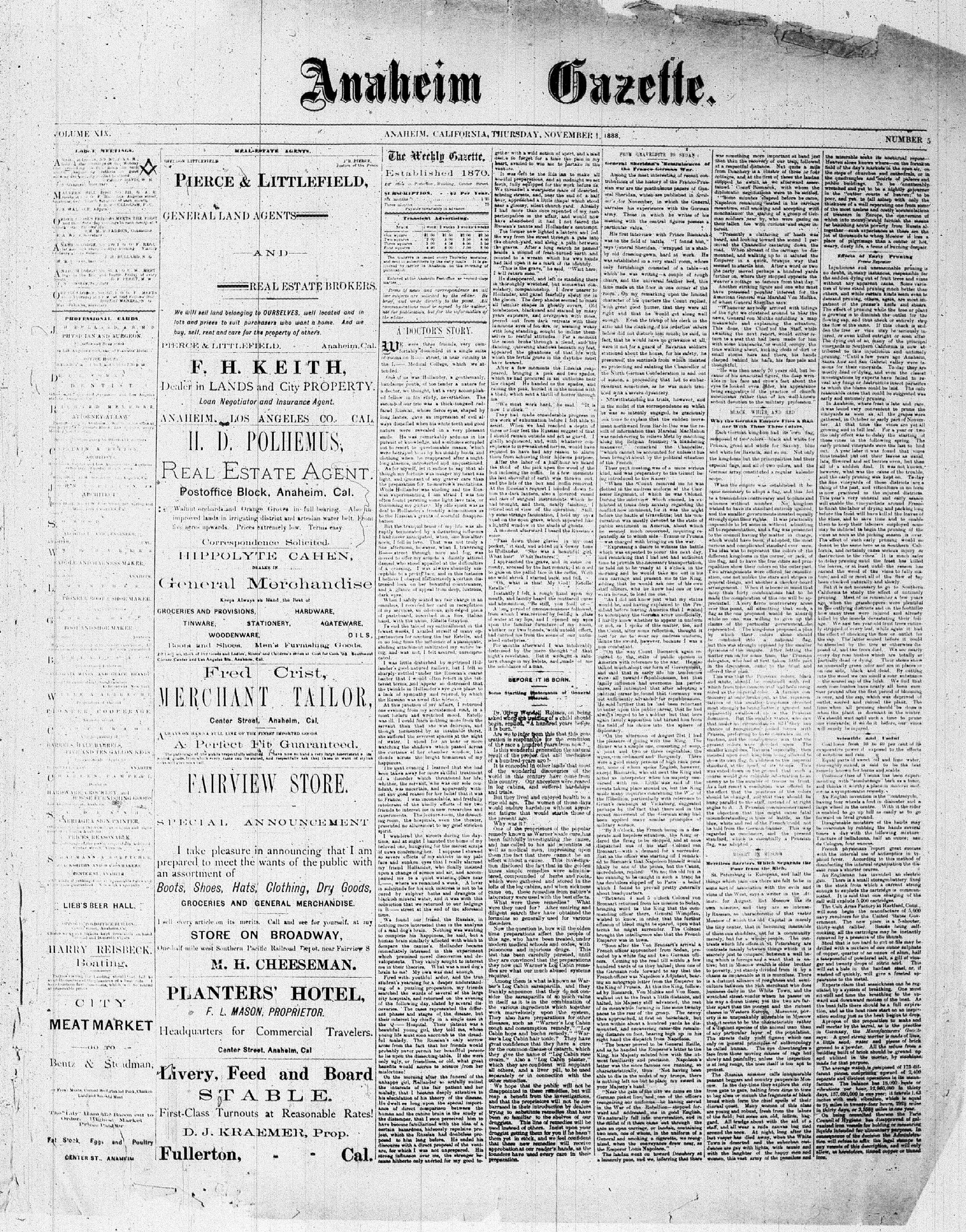
Searchable text
VOLUME XIX.
LODGE MEETINGS.
A. HARDY ALLOWED TO BELIEVE THAT THE MONDAY MEETING WAS NOT GOOD.
MALKEN HILL POPPIN NO. 13, G. A. K.
OVERDOES FERRENS MEETS THE PIERST AND THE ATTENDANTS IN EACH MONTH.
A. NARD LODGE, NO. 10, O. F. REGU.
ANNAH M. LODGE, NO. 10, O. F. REGU.
ANAH M. LODGE, NO. 10, O. F. REGU.
OVERDOES FERRENS MEETS THE PIERST AND THE ATTENDANTS IN EACH MONTH.
PROFESSIONAL CARDS.
J. H. REILAND, A. B. M. D.
PHYSICIAN AND SURGEON.
D. R. TOWAN
DENTIST
R. HEARD MEYLOR
ATTORNEY AT LAW
REAL ESTATE AGENTS.
HELDSON LITTLEFIELD
PIERCE & LITTLEFIELD
GENERAL LAND AGENTS
AND
REAL ESTATE BROKE
We will sell land belonging to OURSELVES, well located and lots and prices to suit purchasers who want a home. And we buy, sell, rent and care for the property of others.
PIERCE & LITTLEFIELD.
Anaheim.
F. H. KEITH,
Dealer in LANDS and City PROPERTY
Loan Negotiator and Insurance Agent.
ANAHEIM, LOS ANGELES CO.
H. D. POLHEMUS,
F. H. KEITH,
Dealer in LANDS and City PROPERTIES
Loan Negotiator and Insurance Agent.
ANAHEIM, LOS ANGELES CO.
H. D. POLHEMUS,
REAL ESTATE AGENT
Postoffice Block, Anaheim, Cal.
Walnut orchards and Orange Groves in full boaring. Also improved lands in irrigating district and artesian water belt. Five acres upwards. Prices extremely low. Terms easy.
Correspondence Solicited.
HIPPOLYTE CAHEN,
DEALER IN
General Merchandise
Keeps Always on Hand the Best of
GROCERIES AND PROVISIONS, HARDWARE,
TINWARE, STATIONERY, AGATEWARE
WOODENWARE,
Boots and Shoes. Men's Furnishing Goods.
Fred Crist,
MERCHANT TAILOR
Center Street, Anaheim, Cal.
Always on hand a full link of the finest imported goods.
A Perfect Fit Guaranteed.
FAIRVIEW STORE.
SPECIAL ANNOUNCEMENT
I take pleasure in announcing that I am prepared to meet the wants of the public w
FAIRVIEW STORE.
SPECIAL ANNOUNCEMENT
I take pleasure in announcing that I have prepared to meet the wants of the public with an assortment of
Boots, Shoes, Hats, Clothing, Dry Goods,
GROCERIES AND GENERAL MERCHANDISE.
I sell every article on its merits. Call and see for yourself at
STORE ON BROADWAY,
One-half mile west Southern Pacific Railroad Depot, near Fairview
M. H. CHEESEMAN.
PLANTERS' HOTEL
F. L. MASON, PROPRIETOR.
Headquarters for Commercial Travele
Center Street, Anaheim, Cal
Livery, Feed and Boar
STABLE.
First-Class Turnouts at Reasonable Rates
D. J. KRAEMER, Prop.
Fullerton, - - Ca
ANAHEIM, CALIFORNIA, THURSDAY, NOVEMBER 1, 1888.
AGENTS.
STLEFIELD,
ESTATE BROKERS.
LVES, well located and in who want a home. And wearty of others.
Anaheim, Cal.
THE WEEKLY GAZETTE.
Established 1870.
SUBSCRIPTION. 52 Per Year.
Three months.
Payable invariably in advance.
Transient Advertising.
The newspapers is issued every Thursday morning, and sent to subscribers by the early mail. It is delivered by carrier in Anaheim on the morning of publication.
Entered at the Anaheim Post Office as second-class matter.
Items of news and correspondence on all live subjects are solicited by the editor. He brief, and write directly to the point. All communications must be signed by the author, not for publication, but for the information of the editor.
A DOCTORS STORY.
We were three friends, very comfortably domiciled in a single suite of rooms on B——street, in near vicinity to the L——Medical College, which we attended.
One of us was Hollander, a gentlemanly, handsome youth, of too tender a nature for a doctor, we thought, but a very accomplished fellow in his study, nevertheless. The seconds of our trio was a thick-tongued red-faced Russian, whose fierce eyes, shaped by long lashes, gave an impression of evil always dispelled when his white teeth and good nature were revealed in a very pleasant smile. He was remarkably arduous in his pursuit of knowledge, and a timeless scrupulous not to resort to questionable means, which were latrayed to us by his muddy boots and clothing when he reappeared after a night.
getter with a wild motion of sport, and a mad desire to forget for a time the pain in my heart, availed to win me to partake in the venture.
It was felt to the Rdian to make all wonderful preparations, and at midnight we set forth, fully equipped for the work before us. We threaded a warpsome maze of deserted, aching streets, and, near the end of a half hour, approached a little chapel which stood near a gloomy, silent church yard. Already I had more than once repented of my rash participation in the affair, and would now have abandoned it had I not feared the Russian's taunts and Hollander's contempt.
The former new lighted a lantern and led the way from the street through a gate into the church-yard, and along a path between the graves. After a long search he passed behind a mound of fresh-turned earth and pointed to a wreath which his own hands had laid upon it as a mark of its identity.
"This is the grave," he said. "Wait here; I will return soon."
He disappeared, and left us standing there in thoroughly wrretched, but somewhat consolatory, companionship. I drew nearer to Hollander, and gazed fearfully about me in the glom. The deep shadows seemed to mask all familiar shapes in ghostly covers. Old totabotones, blackened and stained by many years' exposure, and overgrown with moss, peered out from dark retreats with their luminous eyes of fox fire, or seeming weary with long standing, sought to incline themselves to restful attitudes. For a moment the moon broke through a cloud, and the dancing, quivering shadows beneath my feet, appeared the phantoms of that life with which the fertile grove in the daytide must have termined.
After a few moments the Russians reappeared, bringing a pick and two spades, which he had procured in an outhouse near the chapel. He handed us the spades, and raising the pick, buried it in the mount with a thud, which sent a thrill of horror through me.
"We must work hard," he said. "It is now 1 o'clock."
They had made considerable progress in the work of exhumation before I felt able to assist. When we had reached a depth of three or four feet the Russians suggest that I should remain outside and act as guard. I glially acquiesced, and, with whatever consequence to my weakened nerves, would have rejoiced to have had any reason to alarm them from achieving their hideous purpose.
FROM GRAVELDETTE TO SENIOR SHERIDAN'S HERMINE THE FRANCE-German WORKER
Among the most interesting of tribulations of the history of the French war are the posthumous papersorial Sheridan, which are published here for November, in which they narrate his experiences with the army. Those in which he meets with the central figure particular value.
His first interview with Prince was on the field of battle. "I feel says General Sheridan," wrapped by old dressing-gown, hard at work was established in a very small room only furnishings consisted of a chair which he was writing—a couple chairs, and the universal feather-time made on the door in one corner. On my remarking upon the character of his quarters the Court with great good humor that they right and that he would get enough. Even the tramp of his old attic and the clanking of his order below did not disturb him much; fact, that he would have no grievance were it not for a guard of Bavaria stationed about the house, for his prassumed; the sentinels from which en protecting and saluting the Château North German Confederation is of season. A proceeding that led reassessment sometimes, as he was misled with a severe dysentery.
Notwithstanding his trials, how in the midst of the correspondence he was so intently engaged, he took time to explain that the sound meant northward from Bar-le-Duc due to suit of information that Marshal Marmalade endeavoring to relieve Metz by allying the Belgian frontier; "a bounty mansever," remarked the Clos de la Pointe which cannot be accounted for unseen brought about by the political agitation.
On the afternoon of August 21st the pleasure of dining with the Kunin dinner was a simple one, consisting of a joint and two or three vegetarian wines, vin ordinarie and Burgundy, were a good many persons of high rank, none of whom spoke English, except Bismarck, who sat next to Kunin knew whether to appear or not, so I spoke of this matter, the Count, after some reflection, the Count, after some reflection, the Count, after some reflection, the Count, after some reflection, the Count, after some reflection, the Count, after some reflection, the Count, after some reflection, the Count, after some reflection, the Count, after some reflection, the Count, after some reflection, the Count, after some reflection, the Count, after some reflection, the Count, after some reflection, the Count, after some reflection, the Count, after some reflection,
the Count, after some reflection, the Count, after some reflection, the Count, after some reflection, the Count, after some reflection, the Count, after some reflection, the Count, after some reflection, the Count, after some reflection, the Count, after some reflection, the Count, after some reflection, the Count, after some reflection, the Count, after some reflection, the Count, after some reflection,
the Count, after some reflection, the Count, after some reflection, the Count, after some reflection, the Count, after some reflection, the Count, after some reflection, the Count, after some reflection, the Count, after some reflection, the Count, after some reflection,
the Count, after some reflection, the Count, after some reflection,
the Count, after some reflection,
the Count,
the Count,
the Count,
the Count,
the Count,
the Count,
the Count,
the Count,
the Count,
the Count,
the Count,
the Count,
the Count,
the Count,
the Count,
the Count,
the Count,
the Count,
the Count,
the Count,
the Count,
the Count,
the Count,
the Count,
the Count,
the Count,
the Count,
the Count,
the Count,
the Count,
the Count,
the Count,
the County,
The next evening I learned that she had been taken away for more skillful treatment of a disorder which threatened her life; whither the servant who was our sole conductor was uncertain and apparently without any good reason for her belief that it was to France. I was inconsolable and frightfully intolerant of the kindly efforts of my two friends to interest me in new researches and experiments. The lecture room, the dissecting room, the hospitals, even the theater, presented no allurement to my grief stricken spirit.
I wandered the streets during the daytime, and at night I haunted the home of my beloved one, hungering for the mercet scrape of news concerning her. I suppose I showed an severe effects of my anxiety in my pale face and sunken eyes that I really alarmed my friend Hollander who finally insisted
One of us was Hollander, a gentlemanly handsome youth of too tender a nature for a doctor; we thought but a very accomplished fellow in his study nevertheless. The second of our trio was a thick-tongued red-faced Russian whose fierce eyes, shaped by long lashes, gave an impression of evil always dispelled when his white teeth and good nature were revealed in a very pleasant smile. He was remarkably aridious in his pursuit of knowledge,and a sometimes scruple not to resist to questionable means,'which were惩ed to us by his muddy boots and clothing when he reappeared after a mighty absence,intented and unquestioned.
As for myself, let it suffice to say that although my fortune was messier my heart was light,and ignorant of any graver care than the preparation for tomorrow's recitations. While Hollander was studying and the Russian experimenting I am afraid I was too often found persisting some light leave tales,或 thumming my guitar. My idle spirit was as deaf to Hollander's friendly admixtures as to the Russian's gratitude of scornful disappointment.
But the tranquil tenor of my life was abruptly terminated by a disturbing influence which never anticipated, when one fine afternoon I fell in love. That was not truly a fine afternoon; however when I traversing H—street through nurc and fog,moved to offer my arm to a daintily attired damselfish who stood appalled at the difficulties of a crossing. I was always absurdly susceptible to a pertinent face,and in this instance I believe I obeyed instinctively a certain distressed look on her beautiful countenance,and a glance of appeal from deep,hustrous,dark eyes.
When I safely seated my fair charge in an omnibus I received her card in recognition of my services,a colorous,gift-edged piece of pasteboard inscribed in a fine Italian hand with the name:Katie Brailey.
To end the tale of my enthrallment in the fewest words I availed myself many opportunities for meeting the fair Katelle,and in no long time the influence of a passionate abiding attachment mitigated my entire being,and was not.I felt assured.unreciprocated.
I was little disturbed by my friend Hollander's good nature rallery,但 I felt so sharply nettled under the Russian's coarse baitter that I would often retort in the bitterest terms,and appear so distressed that the twinkle in Hollander's eye gave place to a look of sympathy and reproof,bY which the Russian was awed into silence.
At this junction of jury affairs I returned one evening from my accustomed visit,在a most torrent and wrinkled mood. Katelle was ill.I could learn nothing more from the servant than that she was deprived,and though tormented by an insatiable thirst,she suffered the severest apasms at the sight of water.I stood for an hour or more watching the shadows which passed across the curtains of her chamber window.like clouds across the bright firmament of my happiness.
The next evening I learned that she had been taken away for more skillful treatment of a disorder which threatened her life; whither the servant who was our sole conductor was uncertain and apparently without any good reason for her belief that it was to France. I was inconsolable and frightfully intolerant of the kindly efforts of my two friends to interest me in new researches and experiments.The lecture room,the dissecting room,the hospitals,even the theater,presented no allurement to my grief stricken spirit.
I wandered the streets during the daytime,and at night I haunted the home of my beloved one,hungering for the mercet scrape of news concerning her. I suppose I showed an severe effects of my anxiety in my pale face and sunken eyes that I really alarmed my friend Hollander who finally insisted
One of us was Hollander,a gentlemanly handsome youth of too tender a nature for a doctor;we thought but a very accomplished fellow in his study nevertheless.The second of our trio was a thick-tongued red-faced Russian whose fierce eyes,shaped by long lashes,gave an impression of evil always dispelled when his white teeth and good nature were revealed in a very pleasant smile.He was remarkably aridious in his pursuit of knowledge,and a sometimes scruple not to resist to questionable means,'which were惩ed to us by his muddy boots and clothing when he reappeared after a mighty long absence,intented and unquestioned.
As for myself,Let us suffice to say that although my fortune was messier my heart was light,and ignorant of any graver care than the preparation for tomorrow's recitations.While Hollander was studying and the Russian experimenting I am afraid I was too often found persisting some light leave tales,或 thumming my guitar.My idle spirit was as deaf to Hollander's friendly admixtures as to the Russian's gratitude of scornful disappointment.
But the tranquil tenor of my life was abruptly terminated by a disturbing influence which never anticipated when one fine afternoon.I fell in love.That was not truly a fine afternoon; however when I traversing H—street through nurc and fog,moved to offer my arm to a daintily attired damselfish who stood appalled at the difficulties of a crossing.I was always absurdly susceptible to a pertinent face,and in this instance I believe I obeyed instinctively a certain distressed look on her beautiful countenance,and a glance of appeal from deep,hustrous,dark eyes.
When I safely seated my fair charge in an omnibus I received her card in recognition of my services,a colorous,gift-edged piece of pasteboard inscribed in a fine Italian hand with the name:Katie Brailey.
To end the tale of my enthrallment in the fewest words I availed nothing more from the servant than that she was deprived,and though tormented by an insatiable thirst,she suffered the severest apasms at the sight of water.I stood for an hour or more watching the shadows which passed across the curtains of her chamber window.like clouds across the bright firmament of my happiness.
The next evening I learned that she had been taken away for more skillful treatment of a disorder which threatened her life; whither the servant who was our sole conductor was uncertain and apparently without any good reason for her belief that it was to France. I was inconsolable and frightfully intolerant of the kindly efforts of my two friends to interest me in new researchs and experiments.The lecture room,the dissecting room,the hospitals,even the theater,presented no allurement to my grief stricken spirit.
I wandered the streets during the daytime,and at night I haunted the home of my beloved one,hungering for the mercet scrape of news concerning her. I suppose I showed an severe effects of my anxiety in my pale face and sunken eyes that I really alarmed my friend Hollander who finally insisted
One of us was Hollander,a gentlemanly handsome youth of too tender a nature for a doctor;we thought but a very accomplished fellow in his study nevertheless.The second of our trio was a thick-tongued red-faced Russian whose fierce eyes,shaped by long lashes,gave an impression of evil always dispelled when his white teeth and good nature were revealed in a very pleasant smile.He was remarkably aridious in his pursuit of knowledge,and a sometimes scruple not to resist to questionable means,'which were惩ed to us by his muddy boots and clothing when he reappeared after a mighty long absence,intented and unquestioned.
As for myself,Let us suffice to say that although my fortune was messier my heart was light,and ignorant of any graver care than the preparation for tomorrow's recitations.While Hollander was studying and the Russian experimenting I am afraid I was too often found persisting some light leave tales,或 thumming my guitar.My idle spirit was as deaf to Hollander's graceful appearance like a hidden window in the shade of ghosts.
A moment afterward I heard the Russian's voice.
"Pass down those gloves in my coat pocket," it said,and added in a lower tone to Hollander."She was a beautiful girl.What hair What features!
I approached the grave,and in some curiosity,aroused by the fast remark.I at owed to gaze on the palid face in the coffin.With one wild shriek I started back,and fell.
"Oh what is that! My God! Eatelle! Eatelle!"
Instantly I felt,a rough hand upon my mouth,and faithfully held the muttered cape and salutation."Be still,you fool or—A long period of uncrowdedness followed,从 which I was revived by feeling a glass of water at my hips,and I opened my eyes upon the familiar furniture of my room,their two friends,together with untold effort,had carried me from the scene of our unfinished enterprise.
For months afterward I was intolerably distressed by the mere thought-of that night's revelation.Bit it wrought-a saliary change in my habit,sand made me feel blunt about me.the semblance.of a man.
BEFORE IT IS BORN.
Dr. Oliver Wendell Holmes.on being asked when are treading of a child should begin,r replied,"A hundred years before it is born."
Are we to infer from this that this generation is responsible for the condition of this race-a hundred years from now?
Is this wonderful generation natural result of proper diet and medicines of a hundred-year ago?
Is conceded in other lands that most of the wonderful discoveries of the world in this century have come from this country.Our ancestors were rearred in log cabina,and suffered hardships and trials.
But they lived and enjoyed health to a ripe old age.The women of those days would endure hardships without apparent fatigue that would startle those of the present age.
Why was it?
One of the proprietors of the popular remedy known as Warner’s safe cure,has been faithful investigating the cause,and has called to his aid scientists as well as medical men,introducing upon them fact that there cannot be an effect without a cause.This investigation disclosed the fact that in golden timesimple remedies were admini-
By 3 o'clock,the French being operate and hopeless situation,the Knight dared to fire be stopped,and dispatched one of his staff.-Color Bronsart—a demand for a staff-Just as the officer was starting off.I led to Bismarck which Napoleon himself likely be one of the prizes,but then withstanding his trials,howeverinmotionandprotectionandsalutingtheChairtheNorthGermanConfederationintheseason,a proceedingthat ledtoassessmentofanissue,a proceedingthat ledtoassessmentofanissue,a proceedingthat ledtoassessmentofanissue,a proceedingthat ledtoassessmentofanissue,a proceedingthat ledtoassessmentofanissue,a proceedingthat ledtoassessmentofanissue,a proceedingthat ledtoassessmentofanissue,a proceedingthat ledtoassessmentofanissue,a proceedingthat ledtoassessmentofanissue,a proceedingthat ledtoassessmentofanissue,a proceedingthat ledtoassessmentofanissue,a proceedingthat ledtoassessmentofanissue,a proceedingthat ledtoassessmentofanissue,a proceedingthat ledtoassessmentofanissue,a proceedingthat ledtoassessmentofanissue,a proceedingthat ledtoassessmentofanissue,a proceedingthat ledtoassessmentofanissue,a proceedingthat ledtoassessmentofanissue,a proceedingthat ledtoassessmentofanissue,a proceedingthat ledtoassessmentofanissue,a proceedingthat ledtoassessmentofanissue,a proceedingthat ledtoassessmentofanissue,a proceedingthat ledtoassessmentofanissue,a proceedingthat ledtoassessmentofanissue,a proceedingthat ledtoassessmentofanissue,a proceedingthat ledtoassessmentofanissue,a proceedingthat ledtoassessmentofanissue,a proceedingthat ledtoassessmentofanissue,a proceedingthat ledtoassessmentofanissue,a proceedingthat ledtoassessmentofanissue,a proceedingthat ledtoassessmentofanissue,a proceedingthat ledtoassessmentofanissue,a proceedingthat ledtoassessmentofanissue,a proceedingthat ledtoassessmentofanissue,a proceedingthat ledtoassessmentofanissue,a proceedingthat ledtoassessmentofanissue,a proceedingthat ledtoassessmentofanissue,a proceedingthat ledtoassessmentofanissue,A proceedingthat ledtoassessmentofanissue,A proceedingthat ledtoassessmentofanissue,A proceedingthat ledtoassessmentofanissue,A proceedingthat ledtoassessmentofanissue,A proceedingthat ledtoassessmentofanissue,A proceedingthat ledtoassessmentofanissue,A proceedingthat ledtoassessmentofanissue,A proceedingthat ledtoassessmentofanissue,A proceeding that ledtoassessmentofanissue,A proceeding that ledtoassessmentofanissue,A proceeding that ledtoassessmentofanissue,A proceeding that ledtoassessmentofanissue,A proceeding that ledtoassessmentofanissue,A proceeds that leadsto assessments that leadsto assessments that leadsto assessments that leadsto assessments that leadsto assessments that leadsto assessments that leadsto assessments that leadsto assessments that leadsto assessments that leadsto assessments that leadsto assessments that leadsto assessments that leadsto assessments that leadsto assessments that leadsto assessments that leadsto assessments that leadsto assessments that leadsto assessments that leadsto assessments that leadsto assessments that leadsto assessments that leadsto assessments that leadsto assessments that leadsto assessments that leadsto assessments that leadsto assessments that leadsto assessments that leadsto assessments that leadsto assessments that leadsto assessments that leadsto assessments that leadsto assessments that leadsto assessments that leads to assessments that leads to assessments that leads to assessments that leads to assessments that leads to assessments that leads to assessments that leads to assessments that leads to assessments that leads to assessments that leads to assessments that leads to assessments that leads to assessments that leads to assessments that leads to assessments that leads to assessments that leads to assessments that leads to assessments that leads to assessments that leads to assessments that leads to assessments that leads to assessments that leads to assessments that leads to assessments that leads to assessments that leads to assessments that leads to assessments that leads to assessments that leads to assessments that leads to assessments that leads to assessments that leads to assessments that leads to assessments that leads to assessments that leads
ON BROADWAY, NEAR FAIRVIEW BEAUTIFUL MERCHANDISE.
HOTEL, PRIETOR. MEMORIAL TRAVELERS. ALM, CAL.
AND BOARD LE. REASONABLE RATES! ER, PROP.
ON the morning after the funeral of the unhappy girl, Hallander so artfully united the interests of the fair patient and her malady, that I became deeply attentive to his solicitation of his theory of the disease. He dwelt as long upon the special importance of direct comparison between the human and the canine brain in the study of the disemper, that I soon perceived him to have become familiarized with the idea of a certain hazardous, hideously repulsive project, which the Russian had doubtless proposed to him long before. He ended his discourse with a direct proposal of the venture, for which I was not unprepared. His strong influence ever me, the stranger because hitherto only exerted for my good to world in this century have come from this country. Our ancestors were roamed in log cabins, and suffered hardships and trials.
But they lived and enjoyed health to a ripe old age. The women of those days would endure hardships without apparent fatigue that would startle those of the present age.
Why was it?
One of the proprietors of the popular remedy known as Warner’s safe cure, has been faithfully investigating the cause, and has called to his aid scientists as well as medical men, impressing upon them the fact that there cannot be an effect without a cause. This investigation disclosed the fact that in the golden times simple remedies were administered, compounded of herbs and roots, which were gathered and stored in the lofts of the log cabins, and when sickness came on, these remedies from nature’s laboratory were used with the best effects.
What were these remedies? What were they used for? After untiring and diligent search they have obtained the formulas so generally used for various disorders.
Now the question is, how will the oldest time preparations affect the people of this age, who have been treated, under modern medical schools and codes, with poisonous and injurious drugs. This test has been carefully pursued, until they are convinced that the preparations they now call Warner’s Log Cabin remedies are what our much abused systems required.
Among them is what is known as Warner’s Log Cabin saraparilla, and they frankly announce that they do not consider the saraparilla of so much value in itself as it is in the combination of various ingredients which together work marvelously upon the system. They also have preparations for other diseases, such as “Warner’s Log Cabin cough and consumption remedy,” “Log Cabin hope and buoch remedy,” “Warner’s Log Cabin hair tonic.” They have great confidence that they have a cure for the common disease of catarrh, which they give the name of “Log Cabin rose cream.” Also a “Log Cabin plaster,” which they are confident will supplant all others, and a liver pill, to be used separately or in connection with the other remedies.
We hope that the public will not be disappointed in these remedies, but will reap a benefit from the investigations, and that the proprietors will not be embarrassed in their introduction by dealers trying to substitute remedies that have been so familiar to the shelves of our druggists. This line of remedies will be used instead of others. Insist upon your druggist getting them for you if he hasn’t them yet in stock, and we feel confident that these new remedies will receive approbation at our reader’s hands, as the founders have used every care in their preparation.
By 3 o’clock, the French being in perate and hopeless situation, the King dared the firing to be stopped, and dispatched one of his staff. Colon Brassart—with a demand for a suit—just as the officer was starting off Olivier to Bismarck that Napoleon himself likely be one of the prizes, but the incredulous replied: “Oh no; the old toounning to be caught in such a state with doubles slipped off to Paris—which I found to prevail pretty gale about headquarters.”
Between 4 and 5 o’clock Colon Brassart returned from his mission to bring word to the King that the manding officer there, General Wilkinson wished to know, in order that ejection of blood might be spared, upwards he might surrender.
The brought intelligence also that the Emperor was in town.
Soon after the Von Brassart’s a French officer approached from Sedda coded by a white flag and two Germers. Coming up the road till within about a hundred yards of us they halted; then the Germans rode forward to say to French officer was Napoleon’s Adjutant an autograph letter from the Emperor of King, his Majesty saluted him with most familiarity and precision. Latter was the since famous one run characteristically, thus: “Not having able to die in the midst of my troops is nothing left me but to place my own Majesty’s hand.”
Near the gate of the city we came German packet line, and one of them recognizing our uniforms—he having in the War of the Rebellion—stepward and addressed me in good weather fell into conversation; the midst of it there came out throw gate an open carriage, or landau, two men, one of whom, in the unfinished General and smoking a cigarette, wined when the convoy drew near the Emperor Louis Napoleon.”
The laudan went on Howard Dempsey a lasurely pace, and we inferring tha
FROM GRAVELDITE TO SEDAY:
General Sheridan's Memoirs of the Franco-German War.
Among the most interesting of recent contributions of the history of the Franco-Prussian war are the posthumous papers of General Sheridan, which are published in *Scribner's* for November, in which the General, narrates his experiences with the German army. Those in which he writes of his meeting with the central figures possess a particular value.
His first interview with Prince Bismarak was on the field of battle. "I found him," says General Sheridan, "wrapped in a shabby old dressing-gown, hard at work. He was established in a very small room, whose only furnishings consisted of a table—at which he was writing—a couple of rough chairs, and the universal feather bed, this time made on the door in one corner of the room. On my remarking upon the limited character of his quarters the Count replied, with great good hummer, that they were all right and that he would get along well enough. Even the trump of his clerk in the tite and the clanking of his orderlies' sabers below did not disturb him much; he said, in fact, that he would have no grievance at all, are it not for a guard of Bavarian soldiers stationed about the house, for his safety, he assumed, the sentinels from which insisted on protecting and saluting the Chancellor of the North German Confederation in and out season, a proceeding that led to embarrassment sometimes, as he was much troubled with a severe dysentery.
Notwithstanding his trials, however, and the midst of the correspondence on which was so intently engaged, he graciously took time to explain that the sudden movement northward from Bar-le-Duc was the result of information that Marshal MacMahon was endeavoring to relieve Metz by marching the Belgian frontier; "a blanding anewer," remarked the Chancellor, which cannot be accounted for unless it has brought about by the political situation was something more important at hand just then than the recovery of our trap, followed at a respectful distance. Not quite a mile from Donchery is a cluster of three or four cottages, and at the first of these the landad stopped, to await, as we afterward asserted. Count Bismarck, with whom the diplomatic negotiations were to be settled.
"Some minutes slapped before he came, Napoleon remaining seated in his carriage meantime, still smoking and accepting with nonchalance the staring of a group of German soldiers near by, who were gazing on their fallen foe with curious—and eager interest.
"Presently a clattering of hoofs was heard, and looking toward the sound I perceived the Chancellor canting down the road. When abreast of the carriage he dismounted, and walking up to it saluted the Emperor in a quick, brusque way that seemed to startle him. After a word or two the party moved perhaps a hundred yards further on, where they stopped opposes the weaver's cottage so famous from that day.
Another striking figure and one who must have possessed peculiar interest for the American General was Marshal Von Molkke, of whom General Shagdian says:
"Whenever anybody arrived with tidings of the fight we clashed around to hear the news, General von Molkke unfolding a map meanwhile and explaining the situation. This done, the Chief of the Staff, while awaiting the next report, would either return to a seat that had been made for him with knapsacks, or would occupy the tiny walking about, kicking elds of dirt or small stones here, there his hands clasped behind his back, his face pale and thoughtful.
"He was then nearly 70 years old, but because of his amaculated figure, the deep wrinkles in his face and groove's feet about the eyes he looked even earlier, his appearance being suggestive of this practice of church asceticism rather than of his well-known ardent devotion to the military profession."
BLACK WHITE AND RED
Why the German Empire Filed a Manner With These Three Colors.
Each German kingdom had its own flag, composed of two colors—black and white for Prussia, green and white for Saxony, blue and white for bavaria, and so on. Not only the kingdoms but the principalities had their minarets its ancestral reps—Hawaii alone knows where—on the forman field of the day's markets in the open air, on the steps of churches and cathedrals, or in the quadrangles and courts of palaces and public buildings. To be unutterably wretched and yet to be a nightly gooner in the "notter courts of heaven," to be poor, and yet to (all alike) with only the thickness of a wall separating one from some of the most useless and costly accumulations of treasure in Europe, the conversion of which into money would furnish the means for banishing acute poverty from Ruins altogether—such experiences as these are the lot of thousands to when Moscow is less a place of pilgrimage than a center of hot, weary, dusty life, a focus of burning despair.
Effects of Early Pruning
Injudicious and unsuccessable pruning is no doubt, in many instances, responsible for the sudden dying out of fruit trees and vines without any apparent cause. Some varieties of trees stand pruning much better than others, and while certain kinds seem even to demand pruning, others again are most impatient of the pruner's knife and shears.
The effect of pruning while the tree or plant is growing is to diminish the outlet for the flowing sap, and thus check or entirely stop the flow of the same. If this check is sudden the tree or vine may be seriously injured, or even killed outright or soon after. The dying out of so many of the principal vineyards in Southern California is now attributed to this injudicious and untimely pruning. Until a few years ago Anaheim, Santa Ana and San Gabriel valley were famous for their vineyards. To-day they are mostly dead or dying, and even the closest investigations by experts have failed to reveal any fungi or destructive insect parasites to which the blame could be laid. The only reasonable cause that could be suggested was early and untimely pruning.
In Anaheim, where frost is late and rare, it was found very convenient to prune the vineyards as soon as all the grapes were gathered in October or early part of November. At that time the vines are yet all growing and in full leaf. For a year or two the only effect was to delay the starting of those vines in the following spring. The early pruned vineyards were the last to bind out. A year later it was found that vines thus treated put out their leaves as usual.
protecting and saluting the Chancellor of the North German Confederation in and out of season, a proceeding that led to embarkment sometimes, as he was much troubled with a severe dysentery.
Notwithstanding his trials, however, and the midst of the correspondence on which was so intently engaged, he graciously took time to explain that the sudden movement northward from Bar-le-Duc was the result of information that Marshal MacMahon endeavoring to relieve Metz by marching the Belgian front; "a blundering messover," remarked the Chancellor, which cannot be accounted for unless it has been brought about by the political situation the French.
Their next meeting was of a more serious nature, and was preparatory to the General being introduced to the Kaiser.
When the Count received me he was settled in the undress uniform of the Chancellor Regiment, of which he was Chancellor, during the interview which ensued, he exhibited at times deep anxiety regarding the conflict now imminent, for it was the night before the battle of GraveBotte; but his conversation was mostly devoted to the state of public sentiment in America, about which seemed much concerned, inquiring relatively as to which side — Frances or Prussia — was charged with bringing on the war.
Expressing a desire to witness the battle which was expected to occur the next day, I remarking that I had not had sufficient one to provide the necessary transportation, told me to be ready at 4 o'clock in the morning and he would take me out in his carriage and present me to the King, saying that he would ask one of his own officers, who he knew had one or two tractors, to lend me one.
As I did not know just what my status could be, and having explained to the President before leaving America that I wished accompany the German army unofficially, nearly knew whether to appear in uniform not, so I spoke of this matter, too, and Count, after some reflection, thought it for me to wear my undress uniform, as the sword, however, because I was a combatant.
On the way Count Bismarck again resigned to the state of public opinion in America with reference to the war. He also took much about our form of Government, said that in early life his tendencies were all toward Republicanism, but that纵然 influence had overcome his perceptions, and intimated that after adopting a career he found that Germany was sufficiently advanced for republicanism, and further that he had been reluctant upon this public career, that he had longed to be a soldier but that here in family disposition had turned him from mind of his choice into the sphere of commerce.
On the afternoon of August 21st I had pleasure of dining with the King. The latter was a simple one, consisting of soup, meat and two or three vegetables; the meat, vin ordinarie and Burgundy. There is a good many persons of high rank presume of whom spoke English, however, apt Bismarck, who sat next the King and as interpreter when his majesty counselled with me. Little was said of the taking place around us, but the King dearly many inquiries concerning the War of Elisabeth, particularly with reference to an campaign at Vickersburg, suggested maps by the fact that there and in the movement of the German army had an applied many similar principles of military science.
By 3 o'clock the French being in a desate and hopeless situation, the King or the firing to be stopped, and at once matched one of his staff — Colonel von Smart — with a demand for a surrender as the officer was starting off I remarked Bismarck that Napoleon himself would be one of the prizes, but the Count, without standing a demand for a surrender as the officer was starting off I remarked Bismarck that Napoleon himself would be one of the prizes, but the Count, without standing a demand for a surrender as the officer was starting off I remarked Bismarck that Napoleon himself would be one of the prizes, but the Count, without standing a demand for a surrender as the officer was starting off I remarked Bismarck that Napoleon himself would be one of the prizes, but the Count, without standing a demand for a surrender as the officer was starting off I remarked Bismarck that Napoleon himself would be one of the prizes, but the Count, without standing a demand for a surrender as the officer was starting off I remarked Bismarck that Napoleon himself would be one of the prizes, but the Count, without standing a demand for a surrender as the officer was starting off I remarked Bismarck that Napoleon himself would be one of the prizes, but the Count, without standing a demand for a surrender as the officer was starting off I remarked Bismarck that Napoleon himself would be one of the prizes, but the Count, without standing a demand for a surrender as the officer was starting off I remarked Bismarck that Napoleon himself would be one of the prizes, but the Count, without standing a demand for a surrender as the officer was starting off I remarked Bismarck that Napoleon himself would be one of the prizes, but the Count, without standing a demand for a surrender as the officer was starting off I remarked Bismarck that Napoleon himself would be one of the prizes, but the Count, without standing a demand for a surrender as the officer was starting off I remarked Bismarck that Napoleon himself would be one of the prizes, but the Count, without standing a demand for a surrender as the officer was starting off I remarked Bismarck that Napoleon himself would be one of the prizes, but the Count, without standing a demand for a surrender as the officer was starting off I remarked Bismarck that Napoleon himself would be one of the prizes, but the Count, without standing a demand for a surrender as the officer was starting off I remarked Bismarck that Napoleon himself would be one of the prizes, but the Count, without standing a demand for a surrender as the officer was starting off I remarked Bismarck that Napoleon himself would be one of the prizes, but the Count, without standing a demand for a surrender as the officer was starting off I remarked Bismarck that Napoleon himself would be one of the prizes, but the Count, without standing a demand for a surrender as the officer was starting off I remarked Bismarck that Napoleon himself would be one of the prizes, butthe Count, without standing a demand for a surrender as the officer was starting off I remarked Bismarck that Napoleon himself would be one of the prizes, butthe Count, without standing a demand for a surrender as the officer was starting off I remarked Bismarck that Napoleon himself would be one of the prizes, butthe Count, without standing a demand for a surrender as the officer was starting off I remarked Bismarck that Napoleon himself would be one of the prizes, butthe Count, without standing a demand for a surrender as the officer was starting off I remarked Bismarck that Napoleon himself would be one of the prizes,$butthe Count, without standing a demand for a surrender as the officer was starting off I remarked Bismarck that Napoleon himself would be one of the prizes,$butthe Count, without standing a demand for a surrender as the officer was starting off I remarked Bismarck that Napoleon himself would be one of the prizes,$butthe Count, without standing a demand for a surrender as the officer was starting off I remarked Bismarck that Napoleon himself would be one of
By 3 o'clock the French being in a desert and hopeless situation, the King or the firing to be stopped, and at once matched one of his staff. Colonel von Smart with a demand for a surrender, as the officer was starting off I remarked to Napoleon himself would be one of the prizes, but the Count, relapsed. On no; the old toy is running to be caught in such a trap; he doubtless slipped off to Paris—a belief which I found to prevail pretty generally at headquarters.
Between 4 and 5 o'clock Colonel von Smart returned from his mission to Sedan, ginger word to the King that the comrades officer there, General Wimpffen, had known, in order that the further motion of blood might be spared, upon what he might surrender. The Colonel might the intelligence also that the Frenchperor was in town.
Soon after the Von Bronsart's arrival a much officer approached from Sedan, preyed by a white flag and two German officers. Coming up the road till within a few hundred yards of its halted, then one of Germans rode forward to say that the much officer was Napoleon's Adjutant, bearer an autograph letter from the Emperor to King of Prussia. At this the King followed Bismarck, Von Molka and Von Roon, kicked out to the front a little distance, and his Majesty still advanced, the rest meanwhile forming in line some twenty as to the rear of the group. The envoy approached, at first on horseback, but within about a hundred yards he disminted, and uncovering came—the remainder on foot, bearing high up in his hand the dispatch from Napoleon.
The bearer proved to be General Raille, as he handed the Emperor's letter to the king, his Majesty satute him with the utmost familiarity and precision. Napoleon's war was since famous one running so factorially, thus: "Not having been to die in the midst of my troops, there nothing left me but to place my award in our Majesty's hand."
Near the gate of the city we came on the man penetrate line—and one of the officers ignoring our uniforms—he having served the War of the Rebellion—stepped forward and addressed me in good English, naturally fell into conversation, and in amidst it there came out through the man open carriage, or landan, containing men, one of whom, in the uniform of a general and smoking a cigarette, we recogel, when the convoyance drew near, as Emperor Louis Napoleon."
The Russian summer calls innumerable peasant baggars and country panners to Moscow. In the day-time they explore the city from gate to gate, halting time to time to bag alms or munch the fragments of black bread which the chief spoils of their diurnal quest. Many women of this class are young and robust, fresh from the labors of the Said; but some are old, infirm, haggard. All trudge about with the aid of a staff, and all wear a rude canvas bag tied around the neck. At night, long after the last vaper has died away, when the White Town is deserted and the suburban residences are gay with lights, with music and with the laughter of the happy men and women, this vast army of the penniless and
Professor Guer of Vienna has been experimenting with "endurance" bark as a tonic, and thinks it worthy a place in material medicine as a symptomatic remedy.
An English invention is the "centrecycle," having four wheels a foot in diameter and a wheel in the centre. With it the rider is enabled to go up hill as easily as to go forward on level ground.
Disagreeable moisture of the hands may be overroome by rubbing the hands several times a day with the following mixture: Tincture of belladonna, half an ounce; can de Cologne, four ounces.
French physicians report great success with the internal use of antiseptics in typhoid fever. According to this method of disinfecting the internal organization the disease runs a shorter course.
An Englisman has invented an electric gun. There is a small storage battery fixed in the stock from which a current strong enough to explode the cartridge is communicated. It is said that one charging of the cell will explode 5,900 cartridges.
The Colt Arms Factory at Hartford, Conn., will soon begin the manufacture of 5,000 navy revolvers for the United States Government. The new piece is a 5-shooter, thirty-eight caliber. Beside being self-cocking, all the cartridges may be instantly removed by a pressure of the thumb.
Steel that is too hard to cut or file may be drilled with a mixture of one ounce sulphate of copper, quarter of an ounce of alum, half a teaspoonful of powdered salt, a gill of vinegar and twenty drops of nitric acid. This will sit a bale in the hardest steel, or if waabed off quickly, will give a freeted appearance to the metal.
Experts claim that seasickness can be regulated by a system of breathing. One must sit still and time the breathing to the upward and downward motion of the boat. As the boat falls there should be a full expiration, and as the boat rises start on an inspiration ending just as the beat begins to drop.
A proposal of the proposition to make and sell mortar by the barrel, as is practiced in Germany, the Manufacturer's Gazette says: A good strong mortar is made of lime, a little sand, water and pieces of brick ground to a powder. All the refuse from a building built of brick should be ground up and utilized in the mortar, by machines made for that purpose.
The average watch in pemposed of 175 different pieces, comprising upward of 2,400 separate and distinct operations in its manufacture. The balance has 18,000 heats or vibrations per hour, 12,960,000 in thirty days, 157,680,000 in one year; it travels 1.43 inches with each vibration, which is equal to 9 miles in twenty-four hours, 2924 miles in thirty days, or 3,556 miles in one year.
On being consulted theromo the Paris Council of Hygiene has disapproved of galvanized iron vanals for holding or measuring liquids intended for alimentary purposes. In consequence of the decision the Administration will refuse to affix the legal stamp to any venoms of this description, and will only allow as handtofors tinned copper or tinned iron.