anaheim-gazette 1888-08-16
Scanned page
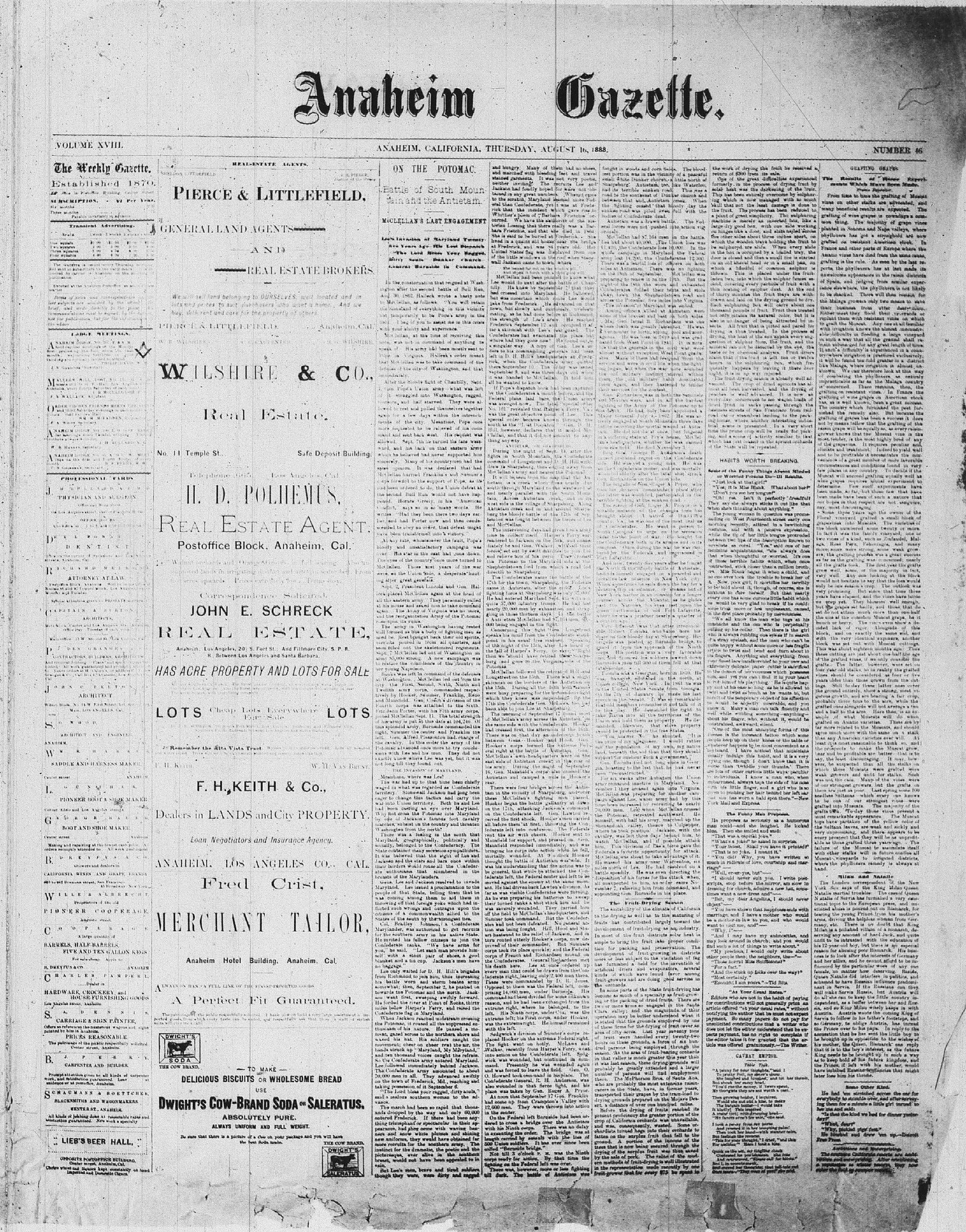
Searchable text
VOLUME XVIII.
The Weekly Gazette.
Established 1870.
Transient Advertising.
Lodge Meetings
PIERCE & LITTLEFIELD
GENERAL LAND AGENTS
AND
REAL ESTATE BROKEN
We will sell land belonging to ourselves, well located and in lots and prices to suit purchasers who want a home. And we buy, sell rent and care for the property of others.
WILSHIRE & CO
Real Estate.
No. 11 Temple St... Safe Deposit Build
WILSHIRE & CO.
Real Estate.
No. 11 Temple St... Safe Deposit Build
H. D. POLHEMUS.
Real Estate Agent
Postoffice Block, Anaheim, Cal.
Correspondence Solvented.
JOHN E. SCHRECK
Real Estate
Anaheim, Los Angeles, 205 S. Fort St., And Fillmore City, S. P. R.
R. Between Los Angeles and Santa Barbara.
HAS ACRE PROPERTY AND LOTS FOR SALE
LOTS Cheap Lots Everywhere For Sale
Remember the Alta Vista Tract.
F. H. KEITH & Co.,
Dealers in LANDS and City PROPERTY
Loan Negotiators and Insurance Agency.
ANAHEIM, LOS ANGELES CO.. CA
L. UNDER PIONKER BOOT & SHOE MAKER
Center Adale and Los Angeles streets.
G. GEORGE BAYER BOOT AND SHOE MAKER
Center street Anaheim
B. DREYFUS ACE Growers and dealers in CALIFORNIA WINES AND GRAPE BRANDY 863 to 942 Branman street San Francisco Broadway New York.
W. WILLE & ALBRECHT Proprietors of the old PIONKER COOPERAGE Auguste street.
C. COOPERAGE A large quantity of BARRELS, HALF-BARRELS, FIVE AND TEN GALLON KEGS For sale cheap Apply to R. DREYFUS & CO. Anaheim
C. CHARLES PAMPER L... Dealer in HARDWARE, CROCKERY, and HOUSE FURNISHING GOODS Los Angeles street Anaheim.
S. A. DENNIS CARRIAGE & SIGN PAINTER Offers as references the numerous wagons and signs painted by him in Anaheim. PRICES REASONABLE The patronage of the public respectfully solicited Center street, Anaheim.
B. J. PERRY CARPENTER AND BUILDER Prompt attention given to all kinds of carpenter work, and satisfaction guaranteed. Low at audience or at postoffice, Anaheim.
S. CHAUMANN & BOETTCHEK BLACKSMITHS AND WAGONMAKERS CENTER ST, Anaheim All kinds of jabbing done at reasonable rates and satisfaction guaranteed. New work a specialty.
LIEB'S BEER HALL,
OPPOSITE POSTOFFICE BUILDING.
Omerer street Anaheim, Cal.
Choose wines and liquors kept constantly on hand Imported and Domestic Cigars.
F. H., KEITH & Co., Dealers in LANDS and City PROPERTY Loan Negotiators and Insurance Agency.
ANAHEIM, LOS ANGELES CO.. CA Fred Crist,
MERCHANT TAILOR
Anaheim Hotel Building, Anaheim, Cal.
ALWAYS ON HANDA FULL LINE OF THE FINEST IMPORTED GOODS A Perfect Fit Guaranteed.
DWIGHT'S SODA THE COW BRAND.
TO MAKE DELICIOUS BISCUITS OR WHOLESOME BREAD USE DWIGHT'S COW-BRAND SODA OR SALERATUS ABSOLUTELY PURE. ALWAYS UNiform AND FULL WEIGHT.
Be sure that there is a picture of a Cow on your package and you will have the best soda made. THE COW BRAND
ANAHEIM, CALIFORNIA, THURSDAY, AUGUST 16, 1888.
ON THE POTOMAC.
Battle of South Mountain and the Antietam.
McCLELLAN'S LAST ENGAGEMENT
Lee's invasion of Maryland Twenty-five Years Age—The Lost Dispatch
"The Lord Brom Your Magnet,
Dirty Seals" Dunker Church
General Burmaide in Command.
In the consternation that reigned at Washington after the second battle of Bull Run, April 30, 1862, Halleck wrote a hazy note to McClellan, as follows: "You will retain the command of everything in this vicinity not temporarily to be Pope's army in the field. I beg of you to assist me in this cruise with your ability and experience."
McClellan, at the time of receiving this note, was not in command of anything to speak of. His army had been mostly sent to Pope in Virginia. Hallibuck's order meant that McClellan was to take command of the defense of the city-of-Washington, and that immediately.
After the bloody fight of Chantilly, Sept. 7, Pope's Union army—what was left of it—struggled into Washington, ragged, boisterous, and half starved. They were allowed to rest and pulled themselves together again for a few days within the intrenchments of the city. Meantime, Pope once more requested to be relieved of his command and sent back west. His request was allowed. Sept. 7th he turned his face westward, and his back on that eastern army which he believed had never supported him and hungry. Many of them had no shoes and marched with bleeding feet and travel stained garments. It was not very poetic, neither inviting. The recruits Lee and Jackson had fondly hoped for were not obtained in any great numbers. Whatever came to the scratches, Maryland seemed more Federal than Confederate yet it was at Frederick that the incident which gave rise to Whittier's poem of "Barbara Fristoeh" occurred. We have the authority of the historian Lossing that there really was a Barbara Fristoeh, and that she died in 1864. She is said to be buried at Frederick. She lived in a quaint old house near the bridge at Frederick, and was 54 years old. Her United States flag was displayed from one of the little windows in the roof when Stonewall Jackson came to town where.
McClellan had been put into know what Lee would do next after the battle of Chantilly. He knew by September 2 that they had crushed Maryland. He followed, but was uncertain which route Lee would take from Frederick. He advanced on that town, but slowly and cautiously, overwriting as he had done before at Richmond, the strength of Lee's army. He reached Frederick September 12 and occupied it after a skirmish with Lee's rear guard. The Confederates had evacuated the place where had they gone now? He found out on a singular way. A copy of Lee's orders to his commanding generals had been left in D-H Hill's headquarters at Frederick, when the Confederate army quitted there September 10. The letter was sent September 9 and was three days old when it was handed to McClellan. It told him all he wanted to know.
If Pope's dispatch book had been captured by the Confederates a month before, and the Federal plans land bared, the Union army was avenged now. The fatal Special Order No. 1011 revealed that Rapper's Perry Vacc was the greatest objective point of Lee. This special order became known through the south as the "Lost Dispatch." Gen D-H Hill, however, declares that it missed McClellan, and that it did not amount to anything anyway.
ANTIETAM, on another day.
During the night of Sept. 14 after the lights on South Mountain, the Confederate General July 4, 1862. He severely engaged at South Mountain before moving the mortal wound to a win. He did not die at once, but in a suffering state at Fry's house. An injured person whether he was from here or elsewhere he was taken home.
Henry George B. Anderson was proclaimed regent on the Conde
After the bloody fight of Chantilly, Sept. 1, Pope's Union army what was left of it struggled into Washington, ragged, insane, and half starved. They were allowed to rest and pulled themselves together again for a few days within the intrenchments of the city. Meantime, Pope once more requested to be relieved of his command and sent back home. His request was allowed. Sept. 7th he turned his face westward, and his back on that eastern army which he believed had never supported him sincerely. Many of his countrymen had the same opinion. It was declared that had Metellian hurried Franklin's and Summer's corps forward to the support of Pope, as he had been ordered to do, the Union defeat at the second Bull Run would not have happened. Horace Greely, in his "American Conflict," says so in no many words. He writes "Had they been there two days earlier, and had Porter now and then condescended to obey an order, that defeat might have been transformed into a victory."
At any rate, wholesover the fault, Pope's bloody and unsatisfactory campaign was over. His star in the seat had gone down. The eyes of the country once more turned to Metellian. These first years of the war were, on the Union side, a desperate hunting after great general.
Sept. 2, President Lincoln and Gen. Halick placed Metellian again at the head of all the western army. They personally called at his house and asked him to take command again. The Army of Virginia was no more, and the reorganization Army of the Potomac rose upon its ruins.
The army in Washington having rested still formed as fine a body of fighting men as need be. Rest brought back their old spirits, recruited from all quarters, and soon filled out the skilleted regiments. Sept. 7 Metellian led out of Washington an army 80,000 strong. A new campaign was to restore the confidence of the country in her young Napoleon.
Banks was left in command of the defenses at Washington. Metellian led out from the city, First, Second, Sixth, Ninth and Twelfth army corps, commanded respectively by Hooker, Summer, Franklin, Reno and Manistee. Gen. Coach's division of the Fourth corps was attached to the Sixth-Fitz John Porter, with his Fifth army corps, named Metellian Sept. 11. That total strength of his army is pat at this date at 104,246. Of this splendid army, Bariside commanded the right, Summer the center and Franklin the left. Gen. Alfred Pleasanton had charge of the cavalry. In this order the army of the Potomac advanced once more to try conclusions with Lee and his men. They did not exactly know where Lee was yet, but it was not long till they found out.
THE INVASION OF MARYLAND.
Meantime, where was Lee?
The war had up to that time been chisily waged in what was regarded as Confederate territory. Stonewall Jackson had long been eager to change this tactics and carry the war into Union territory. Both he and Lee had been casting an eye over Maryland. Why not cross the Potomac into Maryland by one of Jackson's famous foot cavalry marches, subsist on the country and threaten Washington from the north?
There was a feeling in the south that Maryland, geographically, politically and socially, belonged to the Confederacy. The State contained many secession sympathizers. It was believed that the sight of Lee and Jackson and the stars and bars once within their borders would rouse all the Confederate.
After the bloody fight of Chantilly, Sept. 1, Pope's Union army what was left of it struggled into Washington, ragged, insane, and half starved. They were allowed to rest and pulled themselves together again for a few days within the intrenchments of the city. Meantime, Pope once more requested to be relieved of his command and sent back home. His request was allowed. Sept. 7th he turned his face westward, and his back on that eastern army which he believed had never supported him sincerely. Many of his countrymen had the same opinion. It was declared that had Metellian hurried Franklin's and Summer's corps forward to the support of Pope, as he had been ordered to do, the Union defeat at the second Bull Run would not have happened. Horace Greely, in his "American Conflict," says so in no many words. He writes "Had they been there two days earlier, and had Porter now and then condescended to obey an order, that defeat might have been transformed into a victory."
At any rate, wholesover the fault, Pope's bloody and unsatisfactory campaign was over. His star in the seat had gone down. The eyes of the country once more turned to Metellian. These first years of the war were, on the Union side, a desperate hunting after great general.
Sept. 2, President Lincoln and Gen. Halick placed Metellian again at the head of all the western army. They personally called at his house and asked him to take command again. The Army of Virginia was no more, and the reorganization Army of the Potomac rose upon its ruins.
The army in Washington having rested still formed as fine a body of fighting men as need be. Rest brought back their old spirits, recruited from all quarters, and soon filled out the skilleted regiments. Sept. 7 Metellian led out of Washington an army 80,000 strong. A new campaign was to restore the confidence of the country in her young Napoleon.
Banks was left in command of the defenses at Washington. Metellian led out from the city, First, Second, Sixth, Ninth and Twelfth army corps, commanded respectively by Hooker, Summer, Franklin, Reno and Manistete. Gen. Coach's division of the Fourth corps was attached to the Sixth-Fitz John Porter, with his Fifth army corps, named Metellian Sept. 11. That total strength of his army is pat at this date at 104,246. Of this splendid army, Bariside commanded the right, Summer the center and Franklin the left. Gen. Alfred Pleasanton had charge of the cavalry. In this order the army of the Potomac advanced once more to try conclusions with Lee and his men. They did not exactly know where Lee was yet, but it was not long till they found out.
THE INVASION OF MARYLAND.
Meantime, where was Lee?
The war had up to that time been chisily waged in what was regarded as Confederate territory. Stonewall Jackson had long been eager to change this tactics and carry the war into Union territory. Both he and Lee had been casting an eye over Maryland. Why not cross the Potomac into Maryland by one of Jackson's famous foot cavalry marches; subsist on the country and threaten Washington from the north?
There was a feeling in the south that Maryland, geographically, politically and socially, belonged to the Confederacy. The State contained many secession sympathizers. It was believed that the sight of Lee and Jackson and the stars and bars once within their borders would rouse all the Confederate.
After the bloody fight of Chantilly, Sept. 1, Pope's Union army what was left of it struggled into Washington, ragged, insane, and半星射向了它的防御军中。联邦军的计划和行动表明了它的防御能力。
During the night of Sept. 14 after theights on South Mountain,the Confederate command of Longestland and D.H.Hill with drew to Sharpburg, thus ending away from Metellian's army and nearing the Palmau.
It will be seen from the map that the Antietam is a creek where flows nearly due south through Maryland to westward at and nearly parallel with the South Mountain.At Antietam Creek,and on its west side is the village of Sharpburg.Along Antietam Creek and in around Sharpburg the bloody battle of the 15th of September was fought between the forces of Lee and Metellian.
The intervening days had given Lewis army time to collect itself.Harry Ferry surrendered to Jackson on the 16th,and immediately he and Gen.Walker,with all their forces set out by swift marches to join Lee and relieve him of his peril.Phraser raised The Potomac to the Maryland sack at the Shapharstown fort from which a road led directly to Sharpburg.
The Confederates name the battle of the 17th for town,Sharpburg,the Federals name it Antietam,after the siege.Hew entered Maryland Sept. 16 with a quintile 37,000 infantry troops.Hew had lost nearly 20,000 men by exhaustion and straining in those thirteen days.In the battle Antietam McJellan had 52,000 being engaged in the fight.
Concerning this nightteen,长街 street speaks his mind from the Confederate standpoint in his usual free manner.Speaking of the night of 15th,after Lee heard of the fall of Harper's Ferry,他 skyy"Right then we would have retired from Sapphireburg,and gone to,the Virginia,side ofthe Potomac.
McJellan followed the retreat of Hill and Longstreet on the 15th.During allthe 16th both names were busy preparing forthe transitionalightwhich they knewwas impendingBythe 17ththe Confederate Gen.McJellantohadbeen abletojoinLeeatSharpburg.
The morning of September 17 found mostof Metellian's army acrossthe Antietamin onthe same side withthe Confederate.Hooker had crossedfirst,the afternoonofthe 16thThere was on that day an indisputable junctionbetween Gena…Hookerand Host.Gen.Hooker's corps formedthe extreme FederalrightatthebattleofAntietam.Gen.Metellianaownheadquarterswereonethe eastsideofAntietamcreekintherearofhisarm.DuringthemightofSeptember16,Gen.Manusfield'scorpsalsocrossedtheAntietamandcampedainHooker'srear.
There were four bridges acrossthe Antietamin inthe vicinityof Sharpburg,andover these McJellansfightingmenpassed.Hooker beganthe battlegallantattawnonthe17th,attackingJackson'scommandontheConfederateleft.Gen.Lawtonreceivedthefirstshock.Hookeraimcarriedallbefore thematfirst,tallowingtheConfederateleftintoconfusion.TheFederalsrenttheairwithcheers.Hooker senttoManusfieldforsupport,andpress.onGen.Manusfieldrespondimmediately,andwas bringinghiscorpusintoactionwhenhe fell,mortally.wounded.At9tocheckHooker thoughtthebattleofAntietamwaswin.IwashisunderstandingthattheactionwouldtoCullwherehiketposition.JacksonwavcailedlethreedaysbeneathwatchMcJellan,andifpossiblehimThisdivisionOfDearaforgeneralHammondhasarmedhisarmnearWentworthmilesnorthofLee.Hadresolvedit.NevertwentyfiveyearsafterlivinginMarylandNovemberItheyarrusedagainintoMetellianwaspreparingagainpastwhenhebecameinboundattheUnionterritory.Onthe7thofJanuaryhemadeinboundattheSouthernareabutthenhepopulatedmyownmysland.beneaththesoilthanthatheypowerforemostheronselowthesoulthanthatheypowerforemostheronselowthesoulthanthatheypowerforemostheronselowthesoulthanthatheypowerforemostheronselowthesoulthanthatheypowerforemostheronselowthesoulthanthatheypowerforemostheronselowthesoulthanthatheypowerforemostheronselowthesoulthanthatheypowerforemostheronselowthesoulthanthatheypowerforemostheronselowthesoulthanthatheypowerforemostheronselowthesoulthanthatheypowerforemostheronselowthesoulthanthatheypowerforemostheronselowthesoulthanthatheypowerforemostheronselowthesoulthanthatheypowerforemostheronselowthesoulthanthatheypowerforemostheronselowthesoulthanthatheypowerforemostheronselowthesoulthanthatheypowerforemostheronselowthesoulthanthatheypowerforemostheronselowthesoulthanthatheypowerforemostheronselowthesoulthanthatheypowerforemostheronselowthesoulthanthatheypowerforemostheronselowthesoulthanthatheypowerforemostheronselowthesoulthanthatheypowerforemostheronselowthesoulthanthatheypowerforemostheronselowthesoulthanthatheypowerforemostheronselowthesoulthanthatheypowerforemostheronselowthesoulthanthatheypowerforemostheronselowthesoulthanthatheypowerforemostheronselowthesoulthanthatheypowerforemostheronselowthesoulthanthatheypowerforemostheronselowthesoulthanthatheypowerforemostheronselowthesoulthanthatheypowerforemostheronselowthesoulthanthatheypowerforemostheronselowthesoulthanthatheypowerforemostheronselowthesoulthanthatheypowerforemostheronselowthesoulthanthatheypowerforemostheronselowthesoulthanthatheypowerforemostherronselowthesoulthanthatheypowerforemorethernselowthesoulthanosthernselowthernselowsthernselowsthernselowsthernselowsthernselowsthernselowsthernselowsthernselowsthernselowsthernselowsthernselowsthernselowsthernselowsthernselowsthernselowsthernselowsthernselowsthernselowsthernselowsthernselowsthernselowsthernselowsthernselowsthernselowsthernselowsthernselowschernessellowthernssellowthernssellowthernssellowthernssellowthernssellowthernssellowthernssellowthernssellowthernssellowthernssellowthernssellowthernssellowthernssellowthernssellowthernssellowthernssellowthernssellowthernssellowthernssellowthernssellowthernssellowthernis sellowthernis sellowTHERNSSELLOWTHERNSSELLOWTHERNSSELLOWTHERNSSELLOWTHERNSSELLOWTHERNSSELLOWTHERNSSELLOWTHERNSSELLOWTHERNSSELLOWTHERNSSELLOWTHERNSSELLOWTHERNSSELLOWTHERNSSELLOWTHERNSSELLOWTHERNSSELLOWTHERNSSELLOWTHERNSSELLOWTHERNSSELLOWTHERNSSELLOWTHERNSSELLOWTHERNSSELLOWTHERNSSELLOWTHERNSSELLOWTHERNSSELLOWTHERNSSELLOWTHERNSSELLOWTHERNSSELLOWTHERNSSELLOWTHERNSSELLOWTHERNSSELLOWTHERNSSELLOWTHERNSSELLOWTHERNSSELLOWTHERNSSELLOWTHERNSSELLOWTHERNSSELLOWTHERNSSELLOWTHERNSSELLOWTHERNSSELLOWTHERNSSELLOWTHERNSSELLOWTHERNSSELLOWTHERNSSELLOWTHERNSSELLOWTHERNSSELLOWTHERNSSELLOWTHERNSSELLOWTHERNSSELLOWTHERNSSELLOWTERNSSELLOWTERNSSELLOWTERNSSELLOWTERNSSELLOWTERNSSELLOWTERNSSELLOWTERNSSELLOWTERNSSELLOWTERNSSELLOWTERNSSELLOWTERNSSELLOWTERNSSELLOWTERNSSELLowTERNSSELLowTERNSSElLowTERNSSElLowTERNSSElLowTERNSSElLowTERNSSElLowTERNSSElLowTERNSSElLowTERNSSElLowTERNSSElLowTERNSSElLowTERNSSElLowTERNSSElLowTERNSSElLowTERNSSElLowTERNSSElLowTERNSSElLowTERNSSElLowTERNSSElLowTERNssElLowTERNssElLowTERNssElLowTERNssElLowTERNssElLowTERNssElLowTERNssElLowTERNssElLowTERNssElLowTERNssElLowTERNssElLowTERNssElLowTERNssElLowTERNssElLowTERNssElLowTERNssElLowTERNssElLowTERNssElLowTERNssElLowTERNssElLowTerNTERNNssElLowTerNNssElLowTerNNssElLowTerNNssElLowTerNNssElLowTerNNssElLowTerNNssElLowTerNNssElLowTerNNssEl LowTerNNss El LowTerNNss El LowTerNNss El LowTerNNss El LowTerNNss El LowTerNNss El LowTerNNss El LowTerNNss El LowTerNNss El LowTerNNss El LowTerNNss El LowTerNNss El LowTerNNss El LowTerNNss El LowTerNNss El LowTerNNss El LowTerNNss El LowTerNNss El LowTerNNss El LowTerNNss El LowTerNNss El Low TerNTERNNss El LowTerNNss El LowTerNNss El LowTerNNss El LowTerNNss El LowTerNNss El LowTerNNss El LowTerNNss El LowTerNNss El LowTerNNss El LowTerNNss El LowTerNNss El LowTerNNss El LowTerNNss El LowTerNNss El LowTerNNss El LowTerNNss El LowTerNNss El LowTerNNss El LowTerNTERNNess ELlowTerNNess ELlowTerNNess ELlowTerNNess ELlowTerNNess ELlowTerNNess ELlowTerNNess ELlowTerNNess ELlowTerNNess ELlowTerNNess ELlowTerNNess ELlowTerNNess ELlowTerNNess ELlowTerNNess ELlowTerNNess ELlowTerNNess ELlowTerNNess ELlowTerNNess ELlowTerNNess ELlowTerNNess ELlow TerNTERNNess ELlowTerNNess ELlowTerNMess ELlowTerNMess ELlowTerNMess ELlow TerNMess ELlow TerNMess ELlow TerNMess ELlow TerNMess ELlow TerNMess ELlow TerNMess ELlow TerNMess ELlow TerNMess ELlow TerNMess ELlow TerNMess ELlow TerNMess ELlow TerNMess ELlow TerNMess ELlow TerNMess ELlow TerNMess EL low TerNMess EL low TerNMess EL low TerNMess EL low TerNMess EL low TerNMess EL low TerNMess EL low TerNMess EL low TerNMess EL low TerNMess EL low TerNMess EL low TerNMess EL low TerNMess EL low TerNMess EL low TerNMess EL low TerNMess EL low TerNMess EL low TerNMess EL low TerNMess EL low TerNMess EL low Ter NMess EL low Ter NMess EL low Ter NMess EL low Ter NMess EL low Ter NMESS EL low Ter NMESS EL low Ter NMESS EL low Ter NMESS EL low Ter NMESS EL low Ter NMESS EL low Ter NMESS EL low Ter NMESS EL low Ter NMESS EL low Ter NMESS EL low Ter NMESS EL low ter NMESS EL low ter NMESS EL low ter NMESS EL low ter NMESS EL low ter NMESS EL low ter NMESS EL low ter NMESS EL low ter NMESS EL low ter NMESS EL low ter NMESS EL low ter NMESS EMISS EMISS EMISS EMISS EMISS EMISS EMISS EMISS EMISS EMISS EMISS EMISS EMISS EMISS EMISS EMISS EMISS EMISS EMISS EMISS EMISS EMISS EMISS EMISS EMISS EMISS EMISS EMISS EMISS EMISS EMISS EMISS EMISS EMISS EMISS EMISS EMISS EMISS EMISS EMISS EMISS EMISS EMISS EMISS EMISS EMISS EMISS EMISS EMISS EMISSEMISS EMISS EMISS EMISS EMISS EMISS EMISS EMISS EMISS EMISS EMISS EMISS EMISS EMISS EMISS EMISS EMISS EMiss EMiss Emiss Emiss Emiss Emiss Emiss Emiss Emiss Emiss Emiss Emiss Emiss Emiss Emiss Emiss Emiss Emiss Emiss Emiss Emiss Emiss Emiss Emiss Emiss Emiss Emiss Emiss Emiss Emiss Emiss Emiss Emiss Emiss Emiss Emiss Emiss Emiss Emiss Emiss Emiss Emiss Emiss Emiss Emiss Emiss Emiss Emiss EmissEmissEmissEmissEmissEmissEmissEmissEmissEmissEmissEmissEmissEmissEmissEmissEmissEmissEmissEmissEmissEmissEmissEmissEmissEmissEmissEmissEmissEmissEmissEmissEmissEmissEmissEmissEmissEm issEm issEm issEm issEm issEm issEm issEm issEm issEm issEm issEm issEm issEmp issEmp issEmp issEmp issEmp issEmp issEmp issEmp issEmp issEmp issEmp issEmp issEmp issEmp issEmp issEmp issEmp issEmp issEmp issEmp issEmp issEmp issEmp issEmp issEmp issEmp issEmp issEmp iss Emp iss Emp iss Emp iss Emp iss Emp iss Emp iss Emp iss Emp iss Emp iss Emp iss Emp iss Emp iss Emp iss Emp iss Emp iss Emp iss Emp iss Emp iss Emp iss Emp iss Emp iss Emp Iss Emp Iss Emp Iss Emp Iss Emp Iss Emp Iss Emp Iss Emp Iss Emp Iss Emp Iss Emp Iss Emp Iss Emp Iss Emp Iss Emp Iss Emp Iss Emp Iss Emp Iss Emp Iss Emp Iss Emp Iss Emp Iss Emp Iss Emp Iss Emp Iss Emp Iss Emp Iss Emp Iss Emp Iss Emp IssempIssempIssempIssempIssempIssempIssempIssempIssempIssempIssempIssempIssempIssempIssempIssempIssempIssempIssempIssempIssempIssempIssempIssempIssempIssempIssempIssempIssempIssempIssempIssempIssempIssempIssempIssempIssempIssempIssempIssempIss empIss empIss empIss empIss empIss empIss empIss empIss empIss empIss empIss empIss empIss empIss empIss empIss empIss empIss empIss empIss empIss empIss empIss empIss empIss empIss empIss empIss empIss empIss empIss empIss empIss empIss emp ISS emp ISS emp ISS emp ISS emp ISS emp ISS emp ISS emp ISS emp ISS emp ISS emp ISS emp ISS emp ISS emp ISS emp ISS emp ISS emp ISS emp ISS emp ISS emp ISS emp ISS emp ISS emp ISS emp ISS emp ISS emp ISS emp ISS emp ISS emp ISS emp ISS emp ISS emp ISS emps emps emps emps emps emps emps emps emps emps emps emps emps emps emps emps emps emps emps emps emps emps emps emps emps emps emps emps emps emps emps emps emps emps emps emps emps emps emps emps emps emps emps emps emps emps emps emps empsempsempsempsempsempsempsempsempsempsempsempsempsemptsemptsemptsemptsemptsemptsemptsemptsemptsemptsemptsemptsemptsemptsemptsemptsemptsemptsemptsemptsemptsemptsemptsemptsemptsemptsemptsemptsemptsemptsemptsemptsemptsemptsemptsemptsemptsempts
EMISSIONS
EMISSIONS
EMISSIONS
EMISSIONS
EMISSIONS
EMISSIONS
EMISSIONS
EMISSIONS
EMISSIONS
EMISSIONS
EMISSIONS
EMISSIONS
EMISSIONS
EMISSIONS
EMISSIONS
EMISSIONS
EMISSIONS
EMISSIONS
EMISSIONS
EMISSIONS
EMISSIONS
EMISSIONS
EMISSIONS
EMISSIONS
EMISSIONS
EMISSIONS
EMISSIONS
EMISSIONS
EMISSIONS
EMISSIONS
EMISSIONS
EMISSIONS
EMISSIONS
EMISSIONS
EMISSIONS
EMISSIONS
EMISSIONS
EMISSIONS
EMISSIONS
EMISSIONS
EMISSIONS
EMISSIONS
EMISSIONS
EMISSIONS
EMISSIONS
EMISSIONS
EMISSIONS
EMISSIONS
EMISSIONS
EMISSIONS
EMISSIONS
EMISSIONS
EMISSIONS
EMISSIONS
EMISSIONS
EMISSIONS
EMISSIONS
EMISITIONS
EMISITIONS
EMISITIONS
EMISITIONS
EMISITIONS
EMISITIONS
EMISITIONS
EMISITIONS
EMISITIONS
EMISITIONS
EMISITIONS
EMISITIONS
EMISITIONS
EMISITIONS
EMISITIONS
EMISITIONS
EMISITIONS
EMISITIONS
EMISITIONS
EMISITIONS
EMISITIONS
EMISITIONS
EMISITIONS
EMISITIONS
EMIsITIONS
EMIsITIONS
EMIsITIONS
EMIsITIONS
EMIsITIONS
EMIsITIONS
EMIsITIONS
EMIsITIONS
EMIsITIONS
EMIsITIONS
EMIsITIONS
EMIsITIONS
EMIsITIONS
EMIsITIONS
EMIsITIONS
EMIsITIONS
EMPLICATIONSMESSMESSMESSMESSMESSMESSMESSMESSMESSMESSMESSMESSMESSMESSMESSMESSMESSMESSMESSMESSMESSMESSMESSMESSMESSMESSMESSMESSMESSMESSMESSMESSMESSMESSMESSMESSMESSMESSMESSMESSMESSMESSMESSMESSMESSMESSMES SMESSMESSMESSMESSMESSMESSMESSMESSMESSMESSMESSMESSMESSMESSMESSMESSMESSMESSMes SMes SMes SMes SMes SMes SMes SMes SMes SMes SMes SMes SMes SMes SMes SM
The war had up to that time been chiefly waged in what was regarded as Confederate territory. Stonewall Jackson had long been eager to change this tactic and carry the war into Union territory. Both he and Lee had been casting an eye over Maryland. Why not cross the Potomac into Maryland by one of Jackson's famous foot cavalry marches, subsist on the country and threaten Washington from the north?
There was a feeling in the south that Maryland, geographically, politically and socially, belonged to the Confederacy. The State contained many secession sympathizers. It was believed that the sight of Lee and Jackson and the stars and bars once within their borders would rouse all the Confederate enthusiasm that slumbered in the breasts of the Marylanders.
Gana. Lee and Jackson resolved to invade Maryland. Lee issued a proclamation to the people of that State, telling them that he was coming among them to aid them in throwing off that foreign yoke which had inflicted such wrongs and outrages upon the citizens of a commonwealth allied to the States of the south by the strongest ties.
Col. Bradley Johnson, a Confederate Marylander, was authorized to get recruits for the southern army in his native State. He invited his fellow citizens to join the Confederate ranks. "We have arms for you," he said. "Let each man provide himself with a stout pair of shoes, a good blanket and a tin cup. Jackson's men have no baggage."
Lee only waited for D. H. Hill's brigades from Richmond to join him, thus increasing his battle worn and storm beaten army somewhat; then, September 2, he pushed on towards the Potomac and the north. Jackson went first, sweeping swiftly forward. He forced the river at Point of Rocks, thirty miles below Harper's Ferry, and raised the Confederate flag in Maryland.
When Jackson reached midstream crossing the Potomac, it roared all the suppressed enthusiasm of his nature. He paused a moment, gazed across to the northern shores and waved his hat. His soldiers caught the movement; cheer on cheer rent the air, the bands struck up "Maryland, My Maryland," and ten thousand voices caught the refrain. So the Confederate army entered Maryland. Lee followed immediately behind Jackson. The Confederate army amounted to about 70,000 men in all. They advanced swiftly on the town of Frederick, Md., reaching and taking possession of it September 6.
"The Lord bless your ragged, dirty souls," said a zealous southern woman to the advance.
The march had been so rapid that thousands dropped by the way and only 60,000 entered Frederick. If there had been anything triumphant or spectacular in their appearance, had they come with waving banners and snow white plumes and shining new uniforms, they would have obtained far more recruits for the southern army. The instinct for the dramatic, the poetic and the picturesque, ever alive in the southern breast, would not have been appealed to in vain.
But Lee's men brave and tired mobilized though they were, were dirty and rugged.
The war had up to that time been chiefly waged in what was regarded as Confederate territory. Stonewall Jackson had long been eager to change this tactic and carry the war into Union territory. Both he and Lee had been casting an eye over Maryland. Why not cross the Potomac into Maryland by one of Jackson's famous foot cavalry marches, subsist on the country and threaten Washington from the north?
There was a feeling in the south that Maryland, geographically, politically and socially, belonged to the Confederacy. The State contained many secession sympathizers. It was believed that the sight of Lee and Jackson and the stars and bars once within their borders would rouse all the Confederate enthusiasm that slumbered in the breasts of the Marylanders.
Gana. Lee and Jackson resolved to invade Maryland. Lee issued a proclamation to the people of that State, telling them that he was coming among them to aid them in throwing off that foreign yoke which had inflicted such wrongs and outrages upon the citizens of a commonwealth allied to the States of the south by the strongest ties.
Col. Bradley Johnson, a Confederate Marylander, was authorized to get recruits for the southern army in his native State. He invited his fellow citizens to join the Confederate ranks. "We have arms for you," he said. "Let each man provide himself with a stout pair of shoes, a good blanket and a tin cup. Jackson's men have no baggage."
Lee only waited for D. H. Hill's brigades from Richmond to join him, thus increasing his battle worn and storm beaten army somewhat; then, September 2, he pushed on towards the Potomac and the north. Jackson went first, sweeping swiftly forward. He forced the river at Point of Rocks, thirty miles below Harper's Ferry, and raised the Confederate flag in Maryland.
When Jackson reached midstream crossing the Potomac, it roared all the suppressed enthusiasm of his nature. He paused a moment, gazed across to the northern shores and waved his hat. His soldiers caught the movement; cheer on cheer rent the air, the bands struck up "Maryland, My Maryland," and ten thousand voices caught the refrain. So the Confederate army entered Maryland. Lee followed immediately behind Jackson. The Confederate army amounted to about 70,000 men in all. They advanced swiftly on the town of Frederick, Md., reaching and taking possession of it September 6.
"The Lord bless your ragged, dirty souls," said a zealous southern woman to the advance.
The march had been so rapid that thousands dropped by the way and only 60,000 entered Frederick. If there had been any thing triumphant or spectacular in their appearance, had they come with waving banners and snow white plumes and shining new uniforms, they would have obtained far more recruits for the southern army. The instinct for the dramatic, the poetic and the picturesque, ever alive in the southern breast, would not have been appealed to in vain.
But Lee's men brave and tired mobilized though they were, were dirty and rugged.
On the Federal left Burnside had been ordered to cross a bridge over the Antietam with his Ninth corps. There was no delay in exassembling the order. The bridge was at length carried with ammunition with the loss of 500 Unisex soldiers. It has ever since been called "Burnside bridge."
Not till 3 o'clock p.m. was the Ninth corps ready for action. By that time the fighting on the Federal left was over.
There was four bridges across the Antietam in the vicinity of Sharpburg, and over these McCullah's fighting men passed. Hooker began the battle gallantry at dawn on the 17th, attacking Jackson's command on the Confederate left. Gen Lawton received the first shock. Hooker carried all before them at first, throwing the Confederate left into confusion. The Federals rent air with cheers. Hooker sent to ManSField for support, and pressed on. Gen ManSField responded immediately, and was bringing his corps into action when he fell mortally wounded. At 9 o'clock Hooker thought the battle of Antietam was won. It was his understanding that the action was to be moved against the enemy at the same moment. He had driven back Lawton division. As far as was visible Confederates were turning. As he was preparing his batteries to sweep their turned ranks a shot stack him and he was severely wounded. They carried him off the field to McCullah's headquarters, and Summer took command. But the Confederates had not been defeated. No general action was being fought. Hill Hood and Stuart hastened to the relief of Jackson, and in turn routed utterly Hooker's corps now deprived of their commander. But Summer corps took its place quickly, and the Federal corps of Franch and Richardson moved on the Confederates. General Richardson met his death here. Lee at once ordered up every man that could be drawn from that confederate right, leaving only 2,400 men there. These were commanded by D. R. Jones. Opposed to them was the Federal left, comprising 14,000 men, under Burnside. His command had been divided for some unknown reason, and he had been exchanged from the extreme right, where he belonged, to the left. His Ninth corps, under Cox, was the extreme left; his First corps, under Hooker, was the extreme right. He himself remained with the left.
Sedgegill's division of Sumner's corps replaced Hooker on the extreme Federal right. The fight went on hotly. McLaws and Walker recently from Harper's Ferry went into action on the Confederate left. Sedgegill was wounded, but continued in command. Presently he was wounded again and was forced to leave the field. Gen O. O. Howard took command in his place. The Confederate General, R. H. Anderson, was also wounded in that fierce fight, and his place was taken by Gen Reger A. Pryor.
At noon that September 17 Gen Franklin had come up from Crampston's Valley with 12,000 men. They were thrown into action in the center.
OntheFederalleftBurnsidehadbeendorderedtocrossabridgeovertheAntietamwithhisNinthcorpsTherewasnodelayinexassemblingtheorder.Thebridgewatatlengthcarriedwithamunitionwiththelossof500Unisex SoldiersIthaseversincebeencalled"Burnsidebridge."
Not till 3 o'clock p.m.wastheNinthcorpsreadyforaction.BythattimethefightingontheFederalleftwasover.
Therewashowevermoreorlessfightingtilldark.ThehabitofAntietamwas
For six weeks after Antietam they army remained inactive in Maryland; November I they辊ased into Maryland; was preparing for another page against Lose; whose army had time been increased by recruiting ten 70,000 men; Leek when McCullahsPotemac; retreated southward himself with half his army; matched Shemandoah valley; thence to Californiastherehe took position:Jackson.wavallowsthearmytotherockson.wavallowedeverymanthatcouldbe drawnfromtheconfederateleft,theFederalcenterandlefttobew movedagainsttheenemyatthecentre.McCullahsheadquarters,andSummertookcommand.ButtheConfederateshadnotbeendefeated.Nogeneralactionwasbeingfought.ontheconfederateleft,theFederalcorpstoitsplacequickly,andtheFederalcorpsofFranchandRichardsonmovedontheConfederates.GeneralRichardsonmethisdeathhere.Lewatonceorderedupeverymanthatcouldbe drawnfromtheconfederateleft,theFederalcenterandlefttobew movedagainsttheenemyatthecentre.McCullahsheadquarters,andSummertookcommand.ButtheConfederateshadnotbeendefeated.Nogeneralactionwasbeingfought.ontheconfederateleft,theFederalcorpstoitsplacequickly,andtheFederalcorpsofFranchandRichardsonmovedontheConfederates.GeneralRichardsonmethisdeathhere.Lewatonceorderedupeverymanthatcouldbe drawnfromtheconfederateleft,theFederalcenterandlefttobew movedagainsttheenemyatthecentre.McCullahsheadquarters,andSummertookcommand.ButtheConfederateshadnotbeendefeated.Nogeneralactionwasbeingfought.ontheconfederateleft,theFederalcorpstoitsplacequickly,andtheFederalcorpsofFranchandRichardsonmovedontheConfederates.GeneralRichardsonmethisdeathhere.Lewatonceorderedupeverymanthatcouldbe drawnfromtheconfederateleft,theFederalcenterandlefttobew movedagainsttheenemyatthecentre.McCullahsheadquarters,andSummertookcommand.ButtheConfederateshadnotbeendefeated.NogeneralactionwasbeingfittedbythearmyfromcommissionappointingGen.Burnsideinhisplace.
In some parts of the State fruit-dry became as much of a specialty as fruiting or packing of dried fruits. Two or more arms so engaged in this area or those within it are probably the most extensive careers in the State; have, in former transported their grapes by the train-drying grounds prepared on The Mojave; a distance over one hundred miles.
Before the drying of fruits reach present proficiency—the greater portion crop of California orchards was unraveled and was consequently washed.So charidata turned hogs into their orchard flatten on surplus fruit that fall ground.A portion of the income trees that is now being secured through drying of surplus fruit was thinned by sale of pork.The value of them methods of fruit-drying is well illustrated in this representation made recently by fruit-growers than for every 675 he mays
NUMBER 46
GRAFTING GRAPES
The Results of Monroe Experiments Which Have Been Made.
From time to time the grafting of Mossat vines on other stalks are advocated, and many beneficial results are expected. The grafting of wine grapes is nowadays a common thing. The majority of grape vines planted in Sonoma and Napa valleys, where phylloxera has got a stronghold and now grafted on resistant American stock. In France and other parts of Europe where the Amato vines have died from the same cannage, grafting is the rule. As seen by the last reports, the phylloxera has at last made its unwelcome appearance in the rain districts of Spain, and judging from similar experience elsewhere, the phylloxera is not likely to be checked. There will thus remain for the Malaga growers only two means to save their business from utter destruction: either must they flood their vineyards or replant them with resistant vines on which to graft the Mossat. Any one at all familiar with irrigation knows the almost unconscionable difficulty in flooding a large vineyard in such a way that all the ground shall remain submerged for any great length of time. If such a difficulty is experienced in a country where irrigation is practiced exclusively, it will be found ten fold greater in a district like Malaga, where irrigation is almost unknown. We can therefore look at this way of combating the phylloxera as entirely impracticable as far as the Malaga country is concerned. There remains, then, the grafting on resistant vines. In France the grafting of wine grapes on American stock has as well known been a great success. The country which furnished the pest furnished the remedy also. But because the grafting of grapes has been a success it does not by means follow that the grafting of the raisin grape will be equally so; as every raisin-grower knows that the Muscat vine is the most tender, is the most highly bred of any of the grapevine. It requires peculiar soil, climate and treatment. Indeed to yield wall and to be profitable it presents the con-
HABITS WORTH BREAKING.
Some of the Funny Things Absent Minded or Warried Persons Do—Ill Results.
"Just look at that girl!"
"You! It is Mine Blank. What about her?"
"Don't you see her tongue?"
"Oh! you! Isn't it perfectly dreafull? They say she always sticks it out like that when she thinks about anything."
The young woman in question was promoting on West Fourteenth street early one morning recently, attired in a bewitching costume, and with a pensive expression, while the tip of her little tongue protruded between two lips of description known to novelists as coral. "Yes," said one of her feminine acquaintances, "who always does that when thoughtful or worried." It's one of these terrible habits which, when once contracted, stick closer than a million broths.
Miss Blank began it when a child, and no one ever took the trouble to break her of it. Now, poor girl, it reaffirms her terrility to be told about it, though, of course, she is anxious to cure herself. But then nearly every one has some curious habit which he would be very glad to break if he could; some trick more or less implausant, caused in the first place probably by nervousness.
"We all know the man who tugs at his mustache and the one who is perpetually pulling up his collar. Then there is the girl who is always rubbing one eye as if in search of a stray eyelash, and the man who can't be quite happy without some more or less fragile article to twist and bend and turn about in fingers. Anything and everything from your finest lace handkerchief to your new and extremely delicate paper cutter is sacrificed to the demon of nervousness which possess him, and yet you can't find it in your heart to touch him of his playing. He is quite happy and at his ease so long as he is allowed to twist and twist as much as he wants to, but secret of the temporary object of his affection would be subjectly miserable, and you know it. Many a man can talk finely and well while winding something—about his finger, who, without it, would be constrained, awkward, silent.
One of the most annoying forms of this disease is the incestuous tattoo which some people keep up on their knees or the table or whatever harms to be most convenient as a keyboard. I have noticed that musicians usually indulge this habit, and it is a very trying one, though I don't know that it is worse than 'twiddle your thumbs.' There are lots of other curious little ways: peculiar to individuals. I know a man who, when embarrassed, always tapes the side of his nose with his little finger, and a girl who is so grown to push her hair behind her left ear not she has worn a bald spot there."—New York Mail and Express.
The Funny Man Proposes.
He proposes as seriously as a humorous man could—and she laughed. He looked blue. Then she smiled and said:
"That was a capital joke."
"What's a joke?" he asked in surprise.
"Your latest. Shall you have it printed?"
"That is no joke. I meant it."
"You did! Why, you have written so much in ridicule of love, courtship and marriage—"
We can therefore look at this way of combating the phylloxera as entirely impracticable as far as the Malaga country is concerned. There remains, then, the grafting on resistant vines. In France the grafting of wine grapes on American stock has, as is well known, been a great success. The country which furnished the pest furnished the remedy also. But because the grafting of grapes has been a success it does not by means follow that the grafting of the raisin grapes will be equally so, as every raisin-grower knows that the Muscat vine is the most tender, is the most highly bred of any of the grapevines. It requires peculiar soil, climate and treatment. Indeed to yield wall and to be profitable it necessitates the convenience of a great number of more favorable circumstances and conditions found in very places in any country. To decide if the Muscat will succeed grafting equally well as wine grapes requires actual experiment to determine. Few such experiments have been made so far, but those law that have been made have been of such a nature that our hopes in that respect are not sanguine, nay, most discouraging.
Some three years ago the owner of the Floral vineyard grafted a small block of grapevines into Muscata. The varieties of the block numbered some twenty or more. In fact it was the family vineyard, one or two vines of a kind, such as Zufaudel, Malaga, Rosa Pern, Fehersguel, and many more were strong, some weak growers; the grafting process was a great success as far as the grafting was concerned; nearly all the grafts took. The first year the grafts grew well, some or the majority in fact, very well. Any one looking at the block would not hesitate to say that the loss would only be one season's crop. The outlook was very promising. But since time three years have elapsed, and the vines have no霜 no crop yet. They blossom well enough, but the grapes set badly, and those that do not attain much more than one half the size of the common Muscat grapes, be it bunch or berry. The vines even show a decided lack of vigor. Alongside of this block, and on exactly the same soil, and with the very identical exposure, another block was set out with Muscat cuttings. This was about eighteen months ago. Thus these cutting are just about one half of the grafted vines; if we only consider the grafts. The latter, however, were set on four year old stalks, so in reality the grafted vines should be considered as four or five years older than those grown from the cuttings. Still to stay these latter ones cover the ground entirely, show a strong, most vigorous growth, and are bearing a fair drop; probably three tons to the acre; while the grafted ones alongside will not average a ten and a half to the acre. Here then is an example of what Muscata will do when grafted on Asiatic varieties. These are by far more related to the Muscata, and should agree much more with the same on a stalk than any American varieties ever saw. At least it most reasonable to think so, and the prospects to make the Muscat grow, bear and be profitable are better; that is to say, the heat discouraging. It may now ever be suspected that all the stalks on which these Muscata were grafted were weak growers and unit for stalks. Such was not the case. Many of the vines were of our strongest growers, but the grafts on them are just as poor. Last spring some 100 sapless Suitasans —which every one knows to be one of our strongest vines—were grafted into Muscata. The majority of the grafts took. To-day those vines present a most remarkable appearance. The Muscat tops have partaken of the yellow color of the Sulfana leaves, are weak and sickly and very unpromising, and there appears to be every prospect that they will be as unprofitable as those grafted three years ago. The failure of the Muscat to assimilate itself with other stalks will in future confine all Muscat vineyards to irrigated districts, where the phylloxera remedy is always at hand.
The Fruit-Drying Season
The suitability of the climate of California for drying as well as to the maturing of fruits has contributed largely toward the development of fruit-drying as an industry. Most of the fruit districts solar heat is used to bring the fruit into proper condition for packing and preservation. The equipment of fruit growing in districts or less subject to the visitation of fog furnished a hold for the invention of social driers and evaporators, several of which have found favor among growers and are doing good service in orchards.
Some parts of the State fruit-drying have been as much of a specialty as fruit-growing for the packing of dried fruits. There are more arms so engaged in the Santa Valley; and the magnitude of their operation may be better understood when it is stated that the grounds employed by one of these firms for the drying of fruit cover an area of fifty acres. Last year seventy tons of fruit were handled every twenty-two on these grounds, a force of six hundred persons being employed through the season. As the area of fruit-bearing orchards that valley is much greater this year than last season, these drying grounds will probably be greatly extended and a larger number of persons will find employment there. The McPherson Bros. of Santa Ana are probably the most extensive rainseries in the State, have, in former years, reported their grapes by the train-load to dry ground prepared on the Mojave Desert at a distance of over one hundred miles. Refers the drying of fruits reached its best proficiency the greater portion of the California orchards was unavailable, was consequently, wasted. Some orchards turned heaps into their orchards to run on the surplus fruit that fell to the land. A portion of the income of that is now being assured through the sale of pork. The value of the modern methods of fruit-drying is well illustrated in representation made recently by one grower than for every 975 he spent in individualia. I know a man who, when embarrassed, always taps the side of his nose with his little finger, and a girl who is so down to pushing her hair behind her left ear she has worn a bald spot there."—New York Mail and Express.
The Funny Man Proposes
He proposes as seriously as a humorous man could—and she laughs. He looked blue. Then she smiled and said:
"That was a capital joke."
"What's a joke?" he asked in surprise.
"Your latest. Shall you have it printed?"
"That is no joke. I meant it."
"You did! Why, you have written so much in ridicule of love, courtship and marriage!"
"Well, er-er-yea, but..."
"I should never suit you. I write postscripts, stop before the mirror, am slow in dressing for church, admire a new hat, sometimes want a new dress and..."
"But, my dear Angelina, I should never object!"
"You have shown that happiness ends with marriage, and I have a mother who would be a mother-in-law to you, and who would want to visit me, and..."
"Why I..."
"And I may have my animities, and may look around in church; and you would find such a lot of things to write about."
"My precious I would only write about other people then; the neighbors, the..."
"These horrid Miss Snifflesons!"
"For a fact."
"And the stink up folks over the way!"
"Most certainly."
"Enough! I am yours."—Tid Bits.
As Your Usual Habits.
Editors who are not in the habit of paying for contributions will not generally print an article offered "at your usual rates," without notification the author that he must not expect payment. So many papers do not pay for unsolicited contributions that a writer who does not let the editor understand that he expects payment, has no trouble if the editor takes it for granted that the article was offered gratuitously.—The Writer.
CAVEAT EMPTOR
Table Talk.
"A penny for your thoughts," said I.
To pretty Poll, my sister's clown.
She laughed and blushed, and bit her thumb.
But familiarity with it took my mind.
You'd run the money if fewer spent.
My thoughts they are not worth a cent.
Then growing bolder, I acquired.
We had sold him in tears.
The basin batter—I would take it kindly. This inspired.
A real first; with a running hand—
My favors aren't for sale, quite mid.
I took a penny from my pants.
And pressed it in her tempting palm!
Then took her hand—with manner calm.
But familiarity with it took my mind.
This for your thought," I urged," and this For nothing." Here I took a kiss.
Quick as the salt, my tingling check.
Confused in perilament.
Rose And murmured," Kisses all for blown."
But I, in acorns moored,
Still curled her thunder, that tall-tale and Queen name."
The Fruit-Drying Season
The suitability of the climate of California for drying as well as to the maturing of fruits has contributed largely toward the development of fruit-drying as an industry. Most of the fruit districts solar heat is used to bring the fruit into proper condition for packaging and preservation. The equipment of fruit growing in districts or less subject to the visitation of fog furnished a hold for the invention of social driers and evaporators, several of which have found favor among growers and are doing good service in orchards.
Some parts of the State fruit-drying has been as much of a specialty as fruit-growing for the packing of dried fruits. There are more arms so engaged in the Santa Valley; and the magnitude of their operation may be better understood when it is stated that the grounds employed by one of these firms for the drying of fruit cover an area of fifty acres. Last year seventy tons of fruit were handled every twenty-two on these grounds, a force of six hundred persons being employed through the season. As the area of fruit-bearing orchards that valley is much greater this year than last season, these drying grounds will probably be greatly extended and a larger number of persons will find employment there. The McPherson Bros. of Santa Ana are probably the most extensive rainseries in the State, have, in former years, reported their grapes by the train-load to dry ground prepared on the Mojave Desert at a distance of over one hundred miles. Refers the drying of fruits reached its best proficiency she greater portion of the California orchards was unavailable, was consequently, wasted. Some orchards turned heaps into their orchards to run on the surplus fruit that fell to the land. A portion of the income of that is now being assured through the age of sale of pork. The value of the modern methods of fruit-drying is well illustrated in representation made recently by one grower than for every $75 he spent in individualia. I know a man who, when embarrassed, always taps the side of his nose with his little finger, and a girl who is so down to pushing her hair behind her left ear she has worn a bald spot there."—New York Mail and Express.
The Funny Man Proposes
He proposes as seriously as a humorous man could—and she laughs. He looked blue. Then she smiled and said:
"That was a capital joke."
"What's a joke?" he asked in surprise.
"Your latest. Shall you have it printed?"
"That is no joke. I meant it."
"You did! Why, you have written so much in ridicule of love, courtship and marriage!"
"Well, er-er-yea, but..."
"I should never suit you. I write postscripts, stop before the mirror, am slow in dressing for church, admire a new hat, sometimes want a new dress and..."
"But my dear Angelina, I should never object!"
"You have shown that happiness ends with marriage, and I have a mother who would be a mother-in-law to you, and who would want to visit me, and..."
"Why I..."
"And I may have my animities, and may look around in church; and you would find such a lot of things to write about."
"My precious I would only write about other people then; the neighbors, the..."
"These horrid Miss Snifflesons!"
"For a fact."
"And the stuck up folks over the way!"
"Most certainly."
"Enough! I am yours."—Tid Bits.
As Your Usual Habits.
Editors who are not in the habit of paying for contributions will-not generally print an article offered "at your usual rates," without notification the author that he must not expect payment. So many papers do not pay for unsolicited contributions that a writer who does not let the editor understand that he expects payment, has no trouble if it charges for granting that the article was offered gratuitously.—The Writer.
CAVEAT EMPOTR
Table Talk.
"A penny for your thoughts," said I.
To pretty Poll, my sister's clown.
She laughed and blushed, and bit her thumb.
But familiarity with it took my mind.
You'd run the money if fewer spent.
My thoughts they are not worth a cent.
Then growing bolder, I acquired.
We had sold him in tears.
The basin batter—I would take it kindly. This inspired.
A real first; with a running head—
My favors aren't for sale, quite mid.
I took a penny from my pants.
And pressed it in her tempting palm!
Then took her hand—with manner calm.
But familiarity with it took my mind.
This for your thought," I urged," and this For nothing." Here I took a kiss.
Quick as the salt, my tingling check.
Confused in perilament.
Rose And murmured," Kisses all for blown."
But I, in acorns moored,
Still curled her thunder, that tall-tale and Queen name."
The Fruit-Drying Season
The suitability of the climate of California for drying as well as to the maturing of fruits has contributed largely toward the development of fruit-drying as an industry. Most of the fruit districts solar heat is used to bring the fruit into proper condition for packaging and preservation. The equipment of fruit growing in districts or less subject to the visitation of fog furnished a hold for the invention of social driers and evaporators, several of which have found favor among growers and are doing good service in orchards.
Some parts of the State fruit-drying has been as much of a specialty as fruit-growing for the packing of dried fruits. There are more arms so engaged in the Santa Valley; and the magnitude of their operation may be better understood when it is stated that the grounds employed by one of these firms for the drying of fruit cover an area of fifty acres.
Last year seventy tons of fruit were handled every twenty-two on these grounds, a force of six hundred persons being employed through the season. As the area of fruit-bearing orchards that valley is much greater this year than last season, these drying grounds will probably be greatly extended and a larger number of persons will find employment there. The McPherson Bros. of Santa Ana are probably the most extensive rainseries in the State, have, in former years, reported their grapes by the train-load to dry ground prepared on the Mojave Desert at a distance over one hundred miles. Refers the drying of fruits reached its best proficiency she greater portion of the California orchards was unavailable, was consequently, wasted. Some orchards turned heaps into their orchards to run on the surplus fruit that fell to the land. A portion of the income of that is now being assured through the age of sale of pork. The value of the modern methods of fruit-drying is well illustrated in representation made recently by one grower than for every $75 he spent in individualia. I know a man who, when embarrassed, always taps the side of his nose with his little finger, and a girl who is so down to pushing her hair behind her left ear she has worn a bald spot there."—New York Mail and Express.
The Funny Man Proposes
He proposes as seriously as a humorous man could—and she laughs. He looked blue. Then she smiled and said:
"That was a capital joke."
"What's a joke?" he asked in surprise.
"Your latest. Shall you have it printed?"
"That is no joke. I meant it."
"You did! Why, you have written so much in ridicule of love, courtship and marriage!"
"Well, er-er-yea, but..."
"I should never suit you. I write postscripts, stop before the mirror, am slow in dressing for church, admire a new hat, sometimes want a new dress and..."
"But my dear Angelina, I should never object."
The Fruit-Drying Season
The suitability of the climate of California for drying as well as to the maturing of fruits has contributed largely toward the development of fruit-drying as an industry. Most of the fruit districts solar heat is used to bring the fruit into proper condition for packaging and preservation. The equipment of fruit growing in districts or less subject to the visitation of fog furnished a hold for the invention of social driers and evaporators, several of which have found favor among growers and are doing good service in orchards.
Some parts of the State fruit-drying has been as much of a specialty as fruit-growing for the packing of dried fruits. There are more arms so engaged in the Santa Valley; and the magnitude of their operation may be better understood when it is stated that the grounds employed by one of these firms for the drying of fruit cover an area of fifty acres.
Last year seventy tons of fruit were handled every twenty-two on these grounds, a force of six hundred persons being employed through the season. As the area of fruit-bearing orchards that valley is much greater this year than last season, these drying grounds will probably be greatly extended and a larger number of persons will find employment there. The McPherson Bros. of Santa Ana are probably the most extensive rainseries in the State, have, in former years, reported their grapes by the train-load to dry ground prepared on the Mojave Desert at a distance over one hundred miles. Refers the drying of fruits reached its best proficiency she greater portion of the California orchards was unavailable, was consequently, wasted. Some orchards turned heaps into their orchards to run on the surplus fruit that fell to the land. A portion of the income of that is now being assured through the age of sale of pork. The value of the modern methods of fruit-drying is well illustrated in representation made recently by one grower than for every $75 he spent in individualia. I know a man who, when embarrassed, always taps the side of his nose with his little finger, and a girl who is so down to pushing her hair behind her left ear she has worn a bald spot there."—New York Mail and Express.
The Funny Man Proposes
He proposes as seriously as a humorous man could—and she laughs. He looked blue. Then she smiled and said:
"That was a capital joke."
"What's a joke?" he asked in surprise.
"Your latest. Shall you have it printed?"
"That is no joke. I meant it."
"You did! Why, you have written so much in ridicule of love, courtship and marriage!"
"Well, er-er-yea, but..."
"I should never suit you. I write postscripts, stop before the mirror, am slow in dressing for church, admire a new hat, sometimes want a new dress and..."
"But my dear Angelina, I should never object."
The Fruit-Drying Season
The suitability of the climate of California for drying as well as tothe maturingof fruits has contributed largely towardthe developmentof fruitingdrugsasanutrienttofarmingfortheminatureandnutritiontofarmingfortheminatureandnutritiontofarmingfortheminatureandnutritiontofarmingfortheminatureandnutritiontofarmingfortheminatureandnutritiontofarmingfortheminatureandnutritiontofarmingfortheminatureandnutritiontofarmingfortheminatureandnutritiontofarmingfortheminatureandnutritiontofarmingfortheminatureandnutritiontofarmingfortheminatureandnutritiontofarmingfortheminatureandnutritiontofarmingfortheminatureandnutritiontofarmingfortheminatureandnutritiontofarmingfortheminatureandnutritiontofarmingfortheminatureandnutritiontofarmingfortheminatureandnutritiontofarmingfortheminatureandnutritiontofarmingfortheminatureandnutritiontofarmingfortheminatureandnutritiontofarmingfortheminatureandnutritiontofarmingfortheminatureandnutritiontofarmingfortheminatureandnutritiontofarmingfortheminatureandnutritiontofarmingfortheminatureandnutritiontofarmingfortheminatureandnutritiontofarmingfortheminatureandnutritiontofarmingfortheminatureandnutritiontofarmingfortheminatureandnutritiontofarmingfortheminatureandnutritiontofarmingfortheminatureandnutritiontofarmingfortheminatureandnutritiontofarmingfortheminatureandnutritiontofarmingfortheminatureandnutritiontofarmingfortheminatureandnutritiontofarmingfortheminatureandnutritiontofarmingfortheminatureandnutritiontofarmingfortheminatureandnutritiontofarmingfortheminatureandnutritiontofarmingfortheminatureandnutritiontofarmingfortheminatureandnutritiontofarmingfortheminatureandnutritiontofarmingfortheminatureandnutritiontofarmingfortheminatureandnutritiontofarmingfortheminatureandnutritiontofarmingfortheminatureandnutritiontofarmingfortheminatureandnutritiontofarmingfortheminatureandnutritiontofarmingfortheminature和nutritiontofarmingfortheminature和nutritiontofarmingfortheminature和nutritiontofarmingfortheminature和nutrition.tofarmingfortheminature和nutrition.tofarmingfortheminature和nutrition.tofarming.fortheminature和nutrition.tofarming.fortheminature和nutrition.tofarming.for.theminature和nutrition.tofarming.for.theminature和nutrition.tofarming.for.theminature和nutrition.tofarming.for.theminature和nutrition.tofarming.for.theminature和nutrition.tofarming.for.theminature和nutrition.tofarming.for.theminature和nutrition.tofarming.for.theminature和 Nutration.ToFruit-Drying Season
The suitability of the climate of California for drying as well as tomaturingof fruits has contributed largely towardthe developmentof fruitingdrugsasanutrienttofarmingforthematuringof fruits has contributed largely towardthe developmentof fruitingdrugsasanutrienttof farmmingfordrugsasanutrienttof farmmingfordrugsasanutrienttof farmmingfordrugsasanutrienttof farmmingfordrugsasanutrienttof farmmingfordrugsasanutrienttof farmmingfordrugsasanutrienttof farmmingfordrugsasanutrienttof farmmingfordrugsasanutrienttof farmmingfordrugsasanutrientTOFruit-Drying Season
The suitability of the climateof California for dryING as well as tomaturingof fruits has contributed largely towardthe developmentof fruitingdrugsasanutrienttof farmmingfordrugsasanutrient TOFruit-Drying Season
The suitabilityofthcclimateofCaliforniafortrydingaswellastomatingoffruitingdrugsasanutrienttocalmatingoffruitingdrugsasanutrienttocalmatingoffruitingdrugsasanutrienttocalmatingoffruitingdrugsasanutrienttocalmatingoffruitingdrugsasanutrienttocalmatingoffruitingdrugsasanutrienttocalmatingoffruitingdrugsasanutrienttocalmatingoffruitingdrugsasanutinentocalmatingoffruitingdrugsasanutinentocalmatingoffruitingdrugsasanutinentocalmatingoffruitingdrugsasanutinentocalmatingoffruitingdrugsasanutinentocalmatingoffruitingdrugsasanutinentocalmatingoffruitingdrugsasanutinentocalmatingoffruitingdrugsasanutienttocalmatingoffruitingdrugsasanutienttocalmatingoffruitingdrugsasanutienttocalmatingoffruitingdrugsasanutienttocalmatingoffruitingdrugsasanutienttocalmatingoffruitingdrugsasanutienttocalmatingoffruitingdrugsasanutienttocalmatingoffruitingdrugsasananutienttocalmatingoffruilingdruguessananutienttocalmagingoffrublingsessananutienttocalmagingoffrublingsessananutienttocalmagingoffrublingsessananutienttocalmagingoffrublingsessananutienttocalmagingoffrublingsessananutienttocalmagingoffrublingsessananutienttocalmagingoffrublingsessananutienttocalmagingoffrublingsessananutienttocalmagingoffrublingsessananutienttocalmagingoffrublingsessananutienttocalmagingoffrublingsessananutienttocalmagingoffrublingsessananutienttocalmagingoffrublingsessananutienttocalmagingoffrublingsessananutienttocalmagingoffrublingsessananutienttocalmagingoffrublingsessananutienttocalmagingoffrublingsessananutienttocalmagingoffrublingsessananutienttocalmagingoffrublingsessananutienttocalmagingoffrublingsessananutienttocalmagingoffrublingsessananutienttocalmagingoffrublingsessananutienttocalmagingoffrublingsessananutienttocalmagingoffrublingsessananutienttocalmagingoffrublingsessananutienttocalmagingoffrublingsessananutienttocalmagingoffrublingsessananutienttocalmagingoffrublingsessananutienttocalmagingoffrublingsessananutienttocalmagingoffrublingsessananutienttocalmagingoffrublingsessananutienttocalmagingoffrublingsessananutienttocalmagingoffrublingsessananutienttocalmagingoffrublingsessananUTreatment
The suitabilityofthcclimateofCaliforniafortrydingaswellasmaturingoffruitingdruguessananUTreatment
The suitabilityofthcclimateofCaliforniafortrydingaswellasmaturingoffruitingdruguessananUTreatment
The suitabilityofthcclimateofCaliforniafortrydingaswellasmaturingoffruitingdruguessananUTreatment
The suitabilityofthcclimateofCaliforniafortrydingaswellasmaturingoffruitingdruguessananUTreatment
The suitabilityOfthcclimateOfCaliforniaFortrydingAsWellAsMaturingOfFrUyingDrugSolution
The suitabilityOfthcclimateOfCaliforniaFortrydingAsWellAsMaturingOfFrUyingDrugSolution
The suitabilityOfthcclimateOfCaliforniaFortrydingAsWellAsMaturingOfFrUyingDrugSolution
The suitabilityOfthcclimateOfCaliforniaFortrydingAsWellAsMaturingOfFrUyingDrugSolution
The suitabilityOfthcclimateOfCaliforniaFortrydingAsWellAsMaturingOfFrUyingDrugSolution
The suitabilityOfthcclimateOfCaliforniaFortrydingAsWellAsMaturingOfFrUyingDrugSolution
The suitabilityOfthcclimateOfCaliforniaFortrydingAsWellAsMaturingOfFrUyingDrugSolution
The suitabilityOfthcclimateOfCaliforniaFortrydingAsWellAsMaturingOfFrUyingDrugSolution
The suitabilityOfthcclimateOfCaliforniaFortrydingAsWellAsMaturingOfFrUyingDrugSolution
The suitabilityOfthcclimateOfCaliforniaFortrydingAsWellAsMaturingOfFrUyingDrugSolution
The suitabilityOfthcclimateOfCaliforniaFortrydingAsWellAsMaturingOfFrUyingDrugSolution
The suitabilityOFthcclimateOfCaliforniaFortrydingAsWellAsMaturingOFFrUyingDrugSolution
The suitabilityOFthcclimateOfCaliforniaFortrydingAsWellAsMaturingOFFrUyingDrugSolution
The suitabilityOFthcclimateOfCaliforniaFortrydingAsWellAsMaturingOFFrUyingDrugSolution
The suitabilityOFthcclimateOfCaliforniaFortrydingAsWellAsMaturingOFFrUyingDrugSolution
The suitabilityOFthcclimateOfCaliforniaFortrydingAsWellAsMaturingOFFrUyingDrugSolution
The suitabilityOFthcclimateOfCaliforniaFortrydingAsWellAsMaturingOFFrUyingDrugSolution
The suitabilityOFthcclimateOfCaliforniaFortrydyINGASWELLASMATURINGOFFRUYINGDrugSolution
The suitabilityOFthcclimateOfCaliforniaFortrydyINGASWELLASMATURINGOFFRUYINGDrugSolution
The suitabilityOFthcclimateOfCaliforniaFortrydyINGASWELLASMATURINGOFFRUYINGDrugSolution
The suitabilityOFthcclimateOfCaliforniaFortrydyINGASWELLASMATURINGOFFRUYINGDrugSolution
The suitabilityOFthcclimateOfCaliforniaFortrydyINGASWELLASMATURINGOFFRUYINGDrugSolution
The suitabilityOFthcclimateOfCaliforniaFortrydyINGASWELLASMATURINGOFFRUYINGDrugSolution
The suitabilityOFthcclimateOfCaliforniaFortrydyINGASWELLASMATURINGOFFRUYINGDrugSolution
The suitabilityOFthcclimateOfCaliforniaFortrydyINGASWELLASMATURINGOFFRUYINGDrugSolution
The suitabilityOFthcclimateOfCaliforniaFortrydyINGASWELLASMATURINGOFFRUYINGDrugSolution
The suitabilityOFthcclimateOfCaliforniaFortrydyINGASWELLASMATURINGOFFRUYINGDrugSolution
The suitabilityOFthcclimateOfCaliforniaFortrydyINGASWELLASMATURINGOFFRUYINGDrugSolution
The suitabilityOFthcclimateOfCaliforniaFortrydyINGASWELLASMATURINGOFFRUYINGDrugSolution
The suitabilityOFthcclimateOfCaliforniaFortrydyINGASWELL