anaheim-gazette 1888-07-05
Scanned page
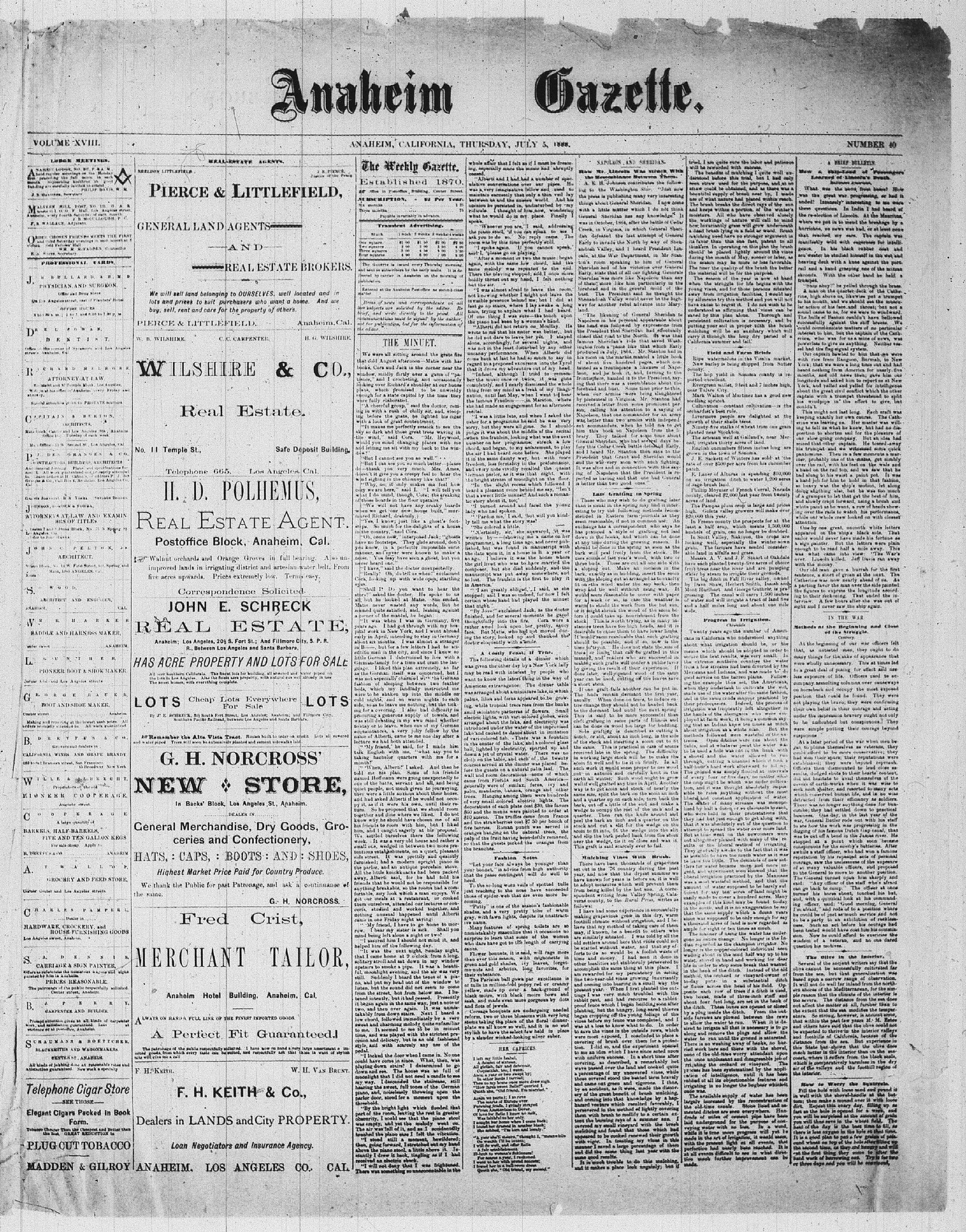
Searchable text
VOLUME XVIII.
LOBE MEETINGS.
AHAHEE LODGE, NO. 27, F.R.A.M.
hold records meetings on the Monday
and present the full moon in each month.
Noon beginning breakfast in good
handling are cordially invited to attend.
PHILIP DAVIS, W. M.
J. R. DAUSSEN, Secretary
MALTLEEN, HILL PONT, NO. 131, O. A. B.
house 01, O. O. F. Hall, Los Angeles street,
Anaheim, every fourth Saturday of each month.
J. R. MCCULLOUGH, P. C.
P. WALLACE, Adjutant.
ORDER CHOSEN FRIENDS MEET THE FIRST
AND CIRD SATURDAY EARNS IN EACH MONTH AT 8
O'clock. Old Fellow Hall
WW. M. McFADDEN, Counselor
R. A. WORSE, Secretary
PROFESSIONAL CARDS.
J. K. BELLARD, A.B., M.D.
PHYSICIAN AND SUROKON.
Office and Drug Store
Quiet Los Angeles street, east of Planters' Hotel
OFFICE HOURS
8:00 No. 11 to 7 and 6:30 to 7:00 p.m.
DR. E. L. POWAY,
DENTIST.
Office at the corner of Sycamore and Los Angeles
street Anaheim, Cal.
RICHARD MELROSE,
ATTOKNEY AT LAW.
Roman and M Temple Block, Los Angeles.
William's office in Anaheim every Friday and
saturday.
Special attention given to PROTECT matters.
CAPITAIN A BURTON,
ARCHITECTS.
Metal stock, Center and Los Angeles St., Anaheim
Office D., Tuesday of each week.
P. J. DES GRANGES & CO.
REAL ESTATE AGENTS.
SHELDON LITTLEFIELD.
J. R. PIERCE,
Junior of the Press.
PIERCE & LITTLEFIELD,
GENERAL LAND AGENTS—AND—REAL ESTATE BROKERS.
We will sell land belonging to OURSELVES, well located and in
lots and prices to suit purchasers who want a home. And we
buy, sell, rent and care for the property of others.
PIERCE & LITTLEFIELD.
Anaheim, Cal.
W. B. WILSHIRE.
C.C. CARPENTER.
H.G. WILSHIRE.
WILSHIRE & CO., Real Estate.
No. 11 Temple St., Safe Deposit Building.
RICHARD MELROSE ATTORNEY AT LAW
CAPITAIN A BURTON ARCHITECTS
METAL BLOCK, CENTER AND LOS ANGELES ST., Anaheim Office D. Tuesday of each week
MAIN OFFICE 12 W. SECOND ST., Los Angeles, Cal.
P.J. DE ORANGE & CO.
CONTRACTORS BUILDERS ARCHITECTS
Animal Labelling, Plants and specifications for all work guaranteed and promptly attended by owners at H. Calle, address P.J. De Orange & Co., Call Box 7, Anaheim, Los Angeles Co.
GARTH JOHNSON R. & YORK WEDNESDAY BOOKS
JOHNSON, BORDER & TORRA,
ATTORNEYS AT LAW AND EXAMINER OF TITLES
Lennard Tand Jones Block, No. 15 N Spring St., Los Angeles, Cal.
Marry to Joan Hanna
JOHN C. FELTON, JR. ARCHITECT.
William Block, No. 11 W First Street, Lot Spring and Main, Los Angeles, Cal.
S. WOOD.
ARCHITECT AND ENGINEER,
ANAHEIM.
W. R. HARKER BADDLE AND HARNESS MAKER.
Center street Anaheim.
L. GUNTHER.
PIONEER BOOT & SHOE MAKER.
Corner Alley and Los Angeles streets.
GEORGE HAKER BOOT AND SHOE MAKER.
Center street Anaheim.
B. DREYFUS & CO.
Growers and dealers in CALIFORNIA WINES AND GRAPE BRANDY
U.S. to 2 Brannan street San Francisco 15 Broadway New York
WILLE & LRECHT.
Proprietors of the old KIONERR COOPERAGE.
Auguste street.
COOPERAGE
A large quantity of BARRELS, HALF-BARRELS, FIVE AND TEN GALLON KEGS For sale cheap Apply to R. DREYFUS & CO.
WILSHIRE & CO., Real Estate.
No. 11 Temple St., Safe Deposit Building.
Telephone 665. Los Angeles, Cal.
II. D. POLHEMUS,
REAL ESTATE AGENT.
Postoffice Block, Anaheim, Cal.
Walnut orchards and Orange Groves in full bearing. Also unimproved lands in irrigating district and artesian water belt. From five acres upwards. Prices extremely low. Terms easy.
Correspondence Solicited.
JOHN E. SCHRECK REAL ESTATE,
Anaheim; Los Angeles, 201 S. Fort St.; And Fillmore City, S. P. R.
R., Between Los Angeles and Santa Barbara.
HAS ACRE PROPERTY AND LOTS FOR SALE
All over Southern California. The finest lots for building, all sewered and water piped on the lots in Los Angeles. Also the finest area property, with natural gas well already in use. The next homes, with everything complete.
LOTS Cheap Lots Everywhere LOTS
By J.E. SCHRECK, 801 South Fort Street, Los Angeles; Anaheim; and Fillmore City, Southern Pacific Railroad, between Los Angeles and Santa Barbara.
Remember the Alta Vista Tract. Houses built to order on credit. Lots all sewered and water piped. Trees will soon be extensively planted and sement sidewalks laid.
G. H. NORCROSS'
NEW STORE,
In Backs' Block, Los Angeles St., Anaheim.
DEALER IN:
General Merchandise, Dry Goods, Groceries and Confectionery,
HATS, : CAPS, : BOOTS: AND: SHOES,
Highest Market Price Paid for Country Produce
NEW STORE,
In Backs' Block, Los Angeles St., Anaheim.
DEALER IN
General Merchandise, Dry Goods, Groceries and Confectionery,
HATS, CAPS, BOOTS AND SHOES,
Highest Market Price Paid for Country Produce.
We thank the Public for past Patronage, and ask a continuance of the same.
G. H. NORCROSS.
Fred Crist,
MERCHANT TAILOR,
Anaheim Hotel Building, Anaheim, Cal.
ALWAYS ON HAND A FULL LINK OF THE FINEST IMPORTED GOODS.
A Perfect Fit Guaranteed.
The patronage of the public respectfully solicited. I have now on hand a very large assortment of imported goods, from which every taste can be suited, and respectfully ask that these in want of stylish suits will give me a call.
F. H. Keith.
W. H. Van Breunt.
F. H. KEITH & Co.,
Dealers in LANDS and City PROPERTY.
Loan Negotiators and Insurance Agency.
ANAHEIM, LOS ANGELES CO., CAL.
ANAHEIM, CALIFORNIA, THURSDAY, JULY 5, 1885.
THE MINUET.
We were all sitting around the grate fire that cold August afternoon—Matie with her books, Cora and Jack in the corner near the window, mildly fiery over a game of "patience," and I crocheting, and occasionally looking over Richard's shoulder at our house plans, which promised to be unwieldy enough for a state capitol by the time they were fully elaborated.
"A cheerful group," said the doctor, coming in with a rush of chilly air, and stooping before the grate, he lighted his cigar with a look of great contentment.
"It makes me perfectly sensack to see the sky so dark and those great trees waving in the wind," said Cora. "Mr. Heywood, would you mind changing places with me and letting me sit with my back to the windows."
But I cannot see you so well."
Life Deposit Building
MUS,
AGENT.
heim, Cal.
full bearing. Also unscientian water belt. From
Terms easy.
ECK
ATE,
more City, S. P. R.
wbara.
TS FOR SALE
ere LOTS
OSS'
ORE,
anaheim.
Goods, Gronery,
ND: SH0ES,
A cheerful group," said the doctor, coming in with a rush of chilly air, and stooping before the grate, he lighted his cigar with a look of great contentment.
"It makes me perfectly seasick to see the sky so dark and those great trees waving in the wind," said Cora. "Mr. Heywood, would you mind changing places with me and letting me sit with my back to the window."
"But I cannot see you so well." "But I can see you so much better—please do—thank you very much. Mrs. Ames, doesn't it give you a creepy feel to hear the wind sighing in the chimney like that?" "Why, no; it only makes me feel how close we are here," said I. "I will tell you what I do mind, though, Cora; the breaking of those boards in the floor upstairs."
"We will not have any creaky boards when we get our new house built, murmured Richard, dreamily."
"Yes, I know; just like a ghost's footstep. So much for the delights of a house in the country," said Cora.
"Oh, come now," interposed Jack; "ghosts have no footsteps. They glide around, don't you know, in a perfectly impossible eerie manner, and never were known to make a noise. You may have seen a ghost, but you never heard one."
"I have," said the doctor unexpectedly.
"Really? Oh, do tell us when!" exclaimed Cora, looking up with wide open, startling eyes.
"Shall I Do you want to hear the story?" asked the doctor. He spoke to us all, but he looked at Matte. She smiled. Matte never wasted any words, but he seemed quite satisfied, and leaning against a partner of the mantel, he began:
"It was when I was in Germany, five years ago. I had got through with my hospital work in New York, and I went abroad early in April, intending to stay in Germany about six months. I was almost a stranger in B—, but for a few letters I had to scientific men in the city, and since I knew so little German I determined to live with a German family for a time and cram the language. I liked this plan extremely, so far as the German itself was concerned, but I was not especially charmed with" the German fashion of sleeping between two feather beds, which my landlord instructed me were to be shaken up into the middle on cold nights, and on warm nights to each side, so as to leave me nothing, but the ticking for a covering. I also had difficulty in procuring a generous supply of towels, and was still debating in my own mind whether to stay or to leave, when one of my German acquaintances, a very polly fellow by the name of Alberti, came to me one day after a lecture we had both attended.
"My friend," he said, for I made him talk English with me, "what say you to taking bachelor quarters with me for a month."
"When, Alberti?" asked. And then he told me his plan. Some of his friends named Hoffmann were going unexpectedly to one of the baths, servant and all, and being quiet people, not much given to journeying, they were a little anxious about their house. And had asked Alberti if he would not occupy it, as if it were his own, until their return. So he proposed that we should room together and dine where we liked. I do not know why he should have chosen me of all his friends to room with him, but I liked him, and I caught eagerly at his proposal. We settled ourselves there the following week. It was a very old house and rather a small one, wedged in between two more pretentious establishments, on a quiet, pleasant side street. It was prettily and quaintly furnished; had a modern upright piano in the parlor, and an antique porcelain stove.
"A cheerful group," said the doctor, coming in with a rush of chilly air, and stoop-ing before the grate, he lighted his cigar with a look of great contentment.
"It makes me perfectly saxic to see the sky so dark and those great trees waving in the wind," said Cora. "Mr. Heywood, would you mind changing places with me and letting me sit with my back to the windows."
"But I cannot see you so well." "But I can see you so much better—please do—thank you very much. Mrs. Ames, doesn't it give you a creepy feel to hear the wind sighing in the chimney like that?" "Why, no; it only makes me feel how close we are here," said I. "I will tell you what I do mind, though, Cora; the breaking of those boards in the floor upstairs."
"We will not have any creaky boards when we get our new house built, murmured Richard, dreamily."
"Yes, I know; just like a ghost's foot-stripe. So much for the delights of a house in the country," said Cora.
"Oh, come now," interposed Jack; "ghosts have no footsteps. They glide around, don't you know, in a perfectly impossible eerie manner, and never were known to make a noise. You may have seen a ghost, but you never heard one."
"I have," said the doctor unexpectedly.
"Really? Oh, do tell us when!" exclaimed Cora, looking up with wide open, startling eyes.
"Shall I Do you want to hear the store?" asked the doctor. He spoke to us all, but he looked at Matte. She smiled. Matte never wasted any words, but he seemed quite satisfied, and leaning against a partner of the mantel, he began:
"It was when I was in Germany, five years ago. I had got through with my hospital work in New York, and I went abroad early in April, intending to stay in Germany about six months. I was almost a stranger in B—, but for a few letters I had to scientific men in the city, and since I knew so little German I determined to live with a German family for a time and cram the language." Liked this plan extremely, so far as the German itself was concerned, but I was not especially charmed with" the German fashion of sleeping between two feather beds, which my landlord instructed me were to be shaken up into the middle on cold nights, and on warm nights to each side, so as to leave me nothing, but the ticking for a covering. I also had difficulty in procuring a generous supply of towels, and was still debating in my own mind whether to stay or to leave, when one of my German acquaintances, a very polly fellow by the name of Alberti, came to me one day after a lecture we had both attended.
"My friend," he said, for I made him talk English with me,"what say you to taking bachelor quarters with me for a month."
"When, Alberti?" asked. And then he told me his plan. Some of his friends named Hoffmann were going unexpectedly to one of the baths, servant and all, and being quiet people, not much given to journeying, they were a little anxious about their house. And had asked Alberti if he would not occupy it, as if it were his own, until their return. So he proposed that we should room together and dine where we liked. I do not know why he should have chosen me of all his friends to room with him, but I liked him, and I caught eagerly at his proposal. We settled ourselves there the following week. It was a very old house and rather a small one, wedged in between two more pretentious establishments, on a quiet, pleasant side street. It was prettily and quaintly furnished; had a modern upright piano in the parlor, and an antique porcelain stove.
"A Costly Furnish: If True."
The following details of a dinner which was given other day by a New York lady may be read with interest by people who want to know the latest fishing in the way of American extravagance. The dinner table was arranged about aminature lake in which palms, lilies and ferns appeared to be growing; while tropical trees rose from the banks and miniature partitions of flowers. Small electric lights, with vari-colored globes, were arranged about the lake; and electricity was introduced under the water of the improvised lake caused by dancing about in imitation of vari-colored fish. There was a fountain in the center of the lake; and a colored glass ball; lighted by electricity; spotted up and down a jet of crystal water. There was no cloth on the table; and each of the twenty courses served at the dinner was placed before the guests on a natural palm leaf. The wall and room decorations—some of which came from Florida and South America—generally were of similac, ferns and palm; manlariin banana; orange and other trees. Hanging among them were bundles of very small colored electric lights. The decorations of each plate cost $30; the favors $50 and the menus were painted to order at $10 apiece. The truffles came from France and the strawberries coat $7 50 per bunch of five berries. Roman panch was served in oranges hanging on the natural trees; the pulp of the fruit having been deftly removed; so that the guests picked the oranges from the branches.
Fashion Notes.
"Let your face always be younger than your nose," is advice from high authority
Late Gratifying in Spring
Those who may wish to do graffiting later than is usual in the spring may find it interesting to try the following methods recommended in Eastern farm journals as they seem reasonable; if not in common use. An exchange has a correspondent who says he has practiced a style of graffiting not laid down in the books, and which can be done at any time during the growing season. It should be done in the spring as soon as the bark will peal freely from the stock. He uses scions of last year’s wool; with two or three buds. These are cut all one side with a sloping cut. Make an inclusion in the bark exactly as in building; insert the soon with the sloping cut so arranged as to exactity fit on the wood under the sap mark; then wrap and tie well without using wax. It would seem reasonable to cover with paper for a week or so; in case the weather is warm or it might shrink the wood of the soon before it could take up nourishment from the stock. This is worth trying; as in many instances trees have too high heads; and it is desirable to cause them to have lower limbs. It would seem reasonable that such graffiting should be possible; if so now is the time of try.
He does not state the size of trees or limbs that can be graffited in this manner; and readers who are successful in making such graffits will confer by giving the result of their experience.
If done later, well ripened wood of the same year can be used; cutting off the leaves save a short stem.
If one graft fails another can be put in. The buds remain dermant first year usually. When done on trees; to induce entire change they should not be headed back to the dormant until next spring This is said to be more successful than cleft graffiting in some parts of Illinois and can be done on wool too large for building.
Side graffiting is described as cutting a notch or slit about an inch long; in the side of stock and inserting a soon cut into fit same work well enough to grow well if graffited any time in April. Another way is to get soon and stock of nearly the same size; split the bark on the coon an inch and a quarter up on each side; turn back the bark; cut off a half of the end and make a wedge to occupy the rest of the inch and a quarter. Then run the knife around and peel bark an inch and a quarter on the stock and cut a slit for wedge on the coon; then fit the wedge into its slit and slip the bark pealed back from the shoot over the wedge; it tie it on close and wax it.
This graft is said scarceely ever to fail.
Mutching Vines With Brush.
There have been thousands of grapevines set out in 76 countries during past
Hoffmann were going unexpectedly to one of the baths, servant and all, and being quiet people, not much given to journeying, they were a little anxious about their house, and had asked Alberti if he would not occupy it, as if it were his own, until their return. So he proposed that we should room together and dine where we liked. I do not know why he should have chosen me of all his friends to room with him, but I liked him, and I caught eagerly at his proposal. We settled ourselves there the following week. It was a very old house and rather a small one, wedged in between two more pretentious establishments, on a quiet, pleasant side street. It was prettily and quantitatively furnished; had a modern upright piano in the parlor, and an antique porcelain stove. All the little knickknacks had been packed away, Alberti said, for he had told his friend that he would not be responsible for anything breakable, so the rooms had a comfortable, airy look which a man enjoys. We got our meals at a restaurant, or cooked them ourselves, attended our lectures or concerts, studied and worked together, and nothing unusual happened until Alberti came in one Friday night saying:
"My friend, I have to go home to morrow. I hear my sister is sick. Shall you mind being left alone a night or two?
I assured him I should not mind it, and helped him off the following day.
"It was the next night, Sunday night, that I came home at 9 o'clock from a long, solitary stroll and sat down in my window upstairs to smoke a pipe. It was a beautiful, moonlight evening, and the air was very still. Suddenly I heard the tones of a piano, and put my head out of the window to listen, but the sound did not seem to come from the street, but from below me. I hastened intently, but it had ceased. Presently it began again in the same way, just a note or two, and then over again. It was unmistakably from down stairs. Next I heard a low chord, followed immediately by a very sweet and charming melody quite unfamiliar to me. It seemed to me to be in minute time, and was played with the strictest precision and delicacy, but in an old fashioned style, and with scarcely any use of the pedal.
"I locked the door when I came in. No one could have come in since. What, then, was playing down stairs? I determined to go down and see. The house was so full of moonlight that I did not need a candle to see my way. I desecrated the staircase, still hearing the sweet, full tones of the German piano, and noiselessly throwing open the parlor door, stood for a moment upon the threshold.
"By the bright light which flooded that part of the room, leaving the rest in greater obscurity, I could see that the piano stool was empty, and yet the melody went on. The air was fall of it, and as I incidentally touched the piano case I felt the vibration.
"I stood still a moment, bewildered; then, going forward, I stretched out my hand above the piano stool, a little above it. Instantly I drew it back, tipling as if I had received an electric shock.
"I will not deny that I was frightened. There was something so unaccountable in the wall and room decorations—some of which came from Florida and South America—generally were of similax, ferns, ivy and palm, manilin, banana, orange and other trees. Hanging among them were hundreds of very small colored electric lights. The decorations of each plate coat $30, the favors $10 and the menus were painted to order at $10 apiece. The truffles came from France and the strawberries coat $75 per bunch of five berries. Roman panch was served in oranges hanging on the natural trees, the pulp of the fruit having been deftly removed, so that the guests picked the oranges from the branches."
Fashion Notes
"Let your face always be younger than your bonnet," is advice from high authority that the passe contingent will do well to beet.
To the so-long worn veils of spotted tulle just reaching to the nose have succeeded those of spider-web that are even more becoming.
"Patty" is one of the season's fashionable shades, and a very pretty tone of warm gray, with fawn lights, despite its unattractive name.
Many features of spring toilets are so unmistakably masculine that it occasions no surprise to learn that some of the women who dare have got to life length of carrying canes.
Flower bonnets, it is said, will rage more than ever this season, with mignonette in green and gold shades, ivy leaves, forget-me-nots and arbutus, long favorites, for their substance.
The Parisian ball gown par excellence is of tallie in million-fold poppy red or creamy yellow, made up over a back-ground of black moiré with black moiré bows and saffl., and made even more gorgeous by dots and flots of jewels.
Coromache bouquets are undergoing needed reform, two or three blossoms with very long stems taking the place of the floral dinnerplate we all know so well, and it is no end stylish to have the select few held in place by a slender wicked-looking silver saber.
HER CAPRICES
I left my little lavalier.
A danger of skitters.
All glitish, fair and dishonour.
Coppertish, too, I wear.
Anno a year or two swept by;
In either hands I carried;
Then to my house we were drawn nigh.
With four hands Ballet" queried I.
Quoth she,"Old friend," fam married."
Again we parte 1; I to rove.
The mantra of Marmite.
Pronunciation: From Amsterdam to Dover.
Of love for Belle I knew no neck,
Was faithful to her only.
I sought her home when I came back;
I found her drummed in number black;
She mobbed,"I'm born and benny."
"A year after it murmured," thought I,"manaw hike On wealth I'll be intent;
I will do well, and offer Balle
A fair establishment.
Ill-luck to swear's fashions!
For example I paid I invaded;
I want to hear with ground measure;
I found her in a ball-woman drum.
Quoth she,"Old friend," my second."
NUMBER 40
LINCOLN AND SHERIDAN.
Lincoln Was struck With Combustion Between Them.
Johnson contributes the followWashington Star. "Just now publishing many very interesting at General Sheridan. I now come to matter which I do not think Sheridan has any knowledge."
Itober, 1864, after the battle of ChelVirginia, in which General Sherident the last attempt of General
rule the North by way of Shenley, and I heard President LanWar Department, in Mr Stanspeaking to him of general
of his victories over General
that of all our fighting Generals
as more like Napoleon than any
more like him particularly in the
and in the general mold of the
President said he thought the
Valley would never be the highther rebel advance into Maryening of General Sheridan to
his personal appearance about
a followed by expressions from
that Sheridan had effectually
road to the North. It was that
Sheridan's ride that saved Washpae like that which Early July, 1864., Mr. Stanton hall in the marble, mantel a little book five hundred pages, which contortispease a likeness of Napetook it, and, turning to the handed it to the President, sayre was a resemblance about the bust. Some time prior to this,
marmies were being slaughtered in Virginia, Mr. Stanton had better from some prominent perhitter from some prominent perhis attention to a saying of
that one commander for an army than two armies with independent leaders, when he told me to get book on Napoleon from the litly talked for some time about Sheridan, who had several days before Creek battle defeated Early.
Mr. Stanton then says to the next Grant and Sheridan would trust, I am quite sure the labor and patience will be rewarded with success.
The benefits of mulching I quite well understood before this trial, but I had only no straw used for the purpose, and so no straw could be obtained, and as there was a beautiful supply of brush near by, I made use of what nature had placed within reach.
The brush breaks the direct rays of the sun and keeps within a portion of the winter's moisture. All who have observed closely the workings of nature will call to mind how invariably grass will grow underneath a dead brush lying in a field or wood. Brush matching need have no stronger argument in its favor than this one fast, patent to all thinkers. In operating on this plan the brush should be placed lightly around the vines during the month of May, sooner or later, as the season may be more or less favorable. The inner quality of the brush the better the material will be for the purpose.
The season of the year is now at hand when the struggle for life begins with the young vines, and for those persons situated away from irrigation facilities, I would say by all means try this method and you will not have cause to regret it. I do not wish to be understood as affirming that vines can be saved by this plan alone. Thorough and persistent cultivation is necessary, and by putting your soil in proper tilth the brush mulching will be an auxiliary which will carry it through the long dry period of a California summer and fall.
FIELD AND FARM HISTORY
Ripe watermelons in the Visalia market.
New barley is being shipped from Sutter county.
The hop yield in Sonoma county is reported excellent.
Evergreen millet, 9 feet and 7 inches high, near Tulare City.
Mark Walton of Martinez has a good new seeding apricot.
Cultivation - constant cultivation - is the orchardist's best rule.
Livermore people are delighted at the growth of their shade trees.
Ninety-five stalks of wheat from one grain planted near Stockton.
The artesian well at Gailand's, near Merced, irrigates thirty acres of land.
English cucumbers fifteen inches long are grown in the town of Sonoma.
A BRIEF PULLETIN
How a ship-Load of Penumbra Learned of Lincoln's Beech.
What was the news from home? How was the great war progressing, or had it ended? Intensely interesting to me were these questions. In India I had heard of the re-election of Lincoln. At the Mauritius, where we put in to mend the breakage by a hurricane, no news was had, or at least none that reached my ears. The captain was manifestly wild with ignorance. In his black rubber coat and son wester he studied himself in wet and bearing deck with a knee against the portrail and a hand grasping one of the mizzen shroads. With the other hand he held a trumpet.
"Ship ahoy!" he yelled through the brace.
A man on the quarter-deck of the Cathrina, high above us, likewise put a trumpet to his mouth, and we should see the muscular action of his face and throat; but not a sound came to us, for we were to windward. The balla of Bashan couldn't have bellowed successfully against the stiff breezes. We could communicate matters of no particular interest to him, but the captain of the Cathrina, who was for us a mine of news, was powerless to give us anything. Neither vessel had the flag-signal system.
Our captain bawled to him that we were with rice from Rangoon, Burmah, to New York; that we were a long time out and had heard nothing from America for nearly five months, and old news then; gave him our longitude and asked him to report us at New York, and yelled and yelled for intelligence about the great civil conflict which the other captain with a trumpet threatened to split his windpipe in'the effort to give, but couldn't.
This might not last long. Each craft was keeping exactly her own course. The Cathrina was leaving us. Her master was willing to tell us what he knew, but had no disposition to shorten sail for the pleasure of our slow going company. But an idea had seized that other captain. He tossed away his trumpet—and we witnessed some quick pantomime. Then in a few moments a mariner probably got a wake.
Gratting in Spring
A may wish to do grafting later in the spring may find it intertaking methods recommended farm-journals as they able, if not in common use: An correspondent who says he a style of grafting not land books, and which can be done during the growing season. It one in the spring as soon as the al fresco from the stock. He last year a wool, with two or three are cut all one side with it. Make an incursion in the as in budding, insert the soon cutting cut so arranged as to exactly under the sap bark, then well without using wax. It reasonable to cover with paper or so, in case the weather is hard work from the hot sun, drink the wood of the soom be take up nourishment from the is worth trying, as in many im- have too high heads, and it is ease them to have lower limbs. A reasonable that such grafting feasible, and if so, now is the He does not state the size of that can be grafted in this readers who are successful in grafts will confer a public favor result of their experience. If well ripened wood of the same used, cutting off the leaves take up nourishment from the is worth trying, as in many im- have too high heads, and it is ease them to have lower limbs. A reasonable that such grafting feasible, and if so, now is the He does not state the size of that can be grafted in this readers who are successful in grafts will confer a public favor result of their experience. If well ripened wood of the same used, cutting off the leaves take up nourishment from the is worth trying, as in many im- have too high heads, and it is ease them to have lower limbs. A reasonable that such grafting feasible, and if so, now is the He does not state the size of that can be grafted in this readers who are successful in grafts will confer a public favor result of their experience. If well ripened wood of the same used, cutting off the leaves take up nourishment from the is worth trying, as in many im- have too high heads, and it is ease them to have lower limbs. A reasonable that such grafting feasible, and if so, now is the He does not state the size of that can be grafted in this readers who are successful in grafts will confer a public favor result of their experience. If well ripened wood of the same used, cutting off the leaves take up nourishment from the is worth trying, as in many im- have too high heads, and it is ease them to have lower limbs. A reasonable that such grafting feasible, and if so, now is the He does not state the size of that can be grafted in this readers who are successful in grafts will confer a public favor result of their experience. If well ripened wood of the same used, cutting off the leaves take up nourishment from the is worth trying, as in many im- have too high heads, and it is ease them to have lower limbs. A reasonable that such grafting feasible, and if so, now is the He does not state the size of that can be grafted in this readers who are successful in grafts will confer a public favor result of their experience. If well ripened wood of the same used, cutting off the leaves take up nourishment from the is worth trying, as in many im- have too high heads, and it is ease them to have lower limbs. A reasonable that such grafting feasible, and if so, now is the He does not state the size of that can be grafted in this readers who are successful in grafts will confer a public favor result of their experience. If well ripened wood of the same used, cutting off the leaves take up nourishment from the is worth trying, as in many im- have too high heads, and it is ease them to have lower limbs. A reasonable that such grafting feasible, and if so, now is the He does not state the size of that can be grafted in this readers who are successful in grafts will confer a public favor result of their experience. If well ripened wood of the same used, cutting off the leaves take up nourishment from the is worth trying, as in many im- have too high heads, and it is ease them to have lower limbs. A reasonable that such grafting feasible, and if so, now is the He does not state the size of that can be grafted in this readers who are successful in grafts will confer a public favor result of their experience. If well ripened wood of the same used, cutting off the leaves take up nourishment from the is worth trying, as in many im- have too high heads, and it is ease them to have lower limbs. A reasonable that such grafting feasible, and if so, now is the He does not state the size of that can be grafted in this readers who are successful in grafts will confer a public favor result of their experience. If well ripened wood of the same used, cutting off the leaves take up nourishment from the is worth trying, as in many im- have too high heads, and it is ease them to have lower limbs. A reasonable that such grafting feasible, and if so, now is the He does not state the size of that can be grafted in this readers who are successful in grafts will confer a public favor result of their experience. If well ripened wood of the same used, cutting off the leaves take up nourishment from the is worth trying, as in many im- have too high heads, and it is ease them to have lower limbs. A reasonable that such grafting feasible, and if so, now is the He does not state the size of that can be grafted in this readers who are successful in grafts will confer a public favor result of their experience. If well ripened wood of the same used, cutting off the leaves take up nourishment from the is worth trying, as in many im- have too high heads, and it is ease them to have lower limbs. A reasonable that such grafting feasible, and if so, now is the He does not state the size of that can be grafted in this readers who are successful in grafts will confer a public favor result of their experience. If well ripened wood of the same used, cutting off the leaves take up nourishment from the is worth trying, as in many im- have too high heads, and it is ease them to have lower limbs. A reasonable that such grafting feasible, and if so, now is the He does not state the size of that can be grafted in this readers who are successful in grafts will confer a public favor result of their experience. If well ripened wood of the same used, cutting off the leaves take up nourishment from the is worth trying, as in many im- have too high heads, and it is ease them to have lower limbs. A reasonable that such grafting feasible, and if so, now is the He does not state the size of that can be grafted in this readers who are successful in grafts will confer a public favor result of their experience. If well ripened wood of the same used, cutting off the leaves take up nourishment from the is worth trying, as in many im- have too high heads, and it is ease them to have lower limbs. A reasonable that such grafting feasible, and if so, now is the He does not state the size of that can be grafted in this readers who are successful in grafts will confer a public favor result of their experience. If well ripened wood of the same used, cutting off the leaves take up nourishment from the is worth trying, as in many im- have too high heads, and it is ease them to have lower limbs. A reasonable that such graFTING feasible, and if so, now is the HE was long time out and had heard nothing from America for nearly five months,and old news then; gave him our longitude and asked him to report us at New York,and yelled and yelled for intelligence aboutthe great civil conflict which other captain with a trumpet threatened to split his windpipe"in"the effort to give,but couldn't.
This might not last long.Each craft was keeping exactly her own course.The Catherine was leaving us.Her master was willing to tell us what he knew,但 had no disposition to shorten sail forthe pleasureof our slow going company.But an idea had seized that other captain.Her tossed away his trumpet-and we witnessed some quick pantomime.Thenin a few momentsa marinerprobably one ofthe makes,nigibly overthe rail.with his feet onthe wailsanda hand onthe rail ton,and we sawthat he had slungto his waist ona paint pot.It wasa hard job for him to holdinthat fashion,she heavy wasthe ship's motion,telong doing anything else,但be was too muchofa grammus to let getthe bestofhim,and slowly crept forward,用a brushandwhite paintas he went,a rowofheads showingoverthe rails to watchhis performance.,whilerour whole craw looked onwith closest attention.
One-by-one great,uncouth white letters appeared onthe ship's black side.The sailor would never have made his fortuneas a sign painter.Butthe letters were plain enoughto be read half a mile away Thiswaswhat came into view."TheWar'sover.Lincoln killed.Jeff Davis ran awaywiththe money.
Our old man gave a hurrah forthe first sentence,a short of groanatthe next.TheCatherinewasnownearlyaheadofus.Asapartingfavorthemanoverthesidepaintedthefigurestoexpressthelongitudeaccordingtothe reckoning.That endedtheinterview.Afew hoursafter shewoutof sightandInever sawtheshipagain.
IN THE WAR
Methods atthe Beginning and Closeofthe Struggle.
Century.
Atthe beginningofour war officers feltthat,as untestedmen,they oughttodomany thingsforthe sakeofappearancethatwerewhollyunnecessaryThisattimesledtoa great dealofpositingfor effectanduselessexposureoflife.Officersusedtocompanyassaultcolumnoverscauseonhorsebackoccupymostexposedpositionthatcouldbefound Theywerenotplayingthebrave;theywereconfirmingtheownbeliefinthercourageandactingundertheimpressionbraveryoughtnotonlytobeundoubtedbutconspicuousTheyweresimpleputtingtheircouragebeyond suspicious.
Atalaterperiodofthewarwhenmen begantoplumethemselvesasveterans,theycouldafortobetmoreconservative;theyhadwon theirspurs;their reputationswereestablished;theywere beyondreproach.Officersthendismountedtoleadcloseassistance,dodgedshotstoheirheart'scontent,dothestaitateavail-themselvesofthecoversofearworkswhenitwaswiseto seeksuch shelter,andresortedtomanyactswhichconservedhumanlife,andinno wise detractedfrom their efficiencyas soldiers.
Therewasno longeranythingdoneforbombber;theyhadsettleddowntopracticalbusiness.Onday,thelastyearofthewar,GeneralButlerrodeoutwithhisstafftosseehowthoseworkprogressinginthediggingofhismountyGapcanal,thewascutoffa bendintheJamesriver.Hestoppedatapointwhichsoonbecameconspicuousfortheenemy'sbatteries.Afterawhilea staff officer,howhad wonafamous reputationbyhisrepeatedactsofpersonalcourage,sawtheunsenessoftheexposureofso manyvaluableofficers,andproposed
been thousands of grapevines in 76 country during the past year that the dryest summer we ever saw before us, it is well known which will prevent them killed by the hot sun. A correction from Valley Spring, Calabria, to the Rural Press, writes as some experience in successfully growing in this dry, warm climate without irrigation, and I be method of taking care of them when benefit to others who situated. I was told by all the ground here that vine could not without water, and that my effort would be a foolish waste of money. I had seen it done in grass and stubbornly persevered to the same thing at this place. I for my persistence in seeing old vines growing luxuriantly into bearing in a small way the time when first planted the cuttlefish much troubled with the land had recourse to a rabbit which I began building soon after the hungry, long eared thieves of the young foliage of the my fence was completed, and I know what to do. In order lines in the outside rows, which exposed, I concluded to place a brush over them for a protector, and the experiment opened which I have since acted upon success. In a short time after described, a remarkably hot cover the land and cooked quite of my uncovered vines, while stood the heated term bravely green and vigorous. I thus, as it were, made the discernment benefit of brush mulching, into that knowledge by a hapless which resulted favorably. I the method of lightly covering brush to mollify to a certain exerting rays of a summer sun. I small vineyard with the brush found that those which had been cooled renewed their growth. In treating my vines in this and a large percentage of them name thing last year with the results trouble to do this malching, a place look ungainly; but if
The growth of water has been largely increased by the recomposition of the old-time canals. Stone limed and cemented ditches are seen everywhere. Hundreds of miles of cement pipe have been laid underground for the purpose of conveying water with no loss. In a word, while it is true more progress will yet be made in the art of irrigation, it would seem, with the present light at all events, that perfection had nearly been reached. It is at all events difficult to see in what direction much further improvement can be made.
The demands of new settlers for water became more and more urgent, and experiment soon showed that the liberal irrigation practiced by the Mexicans was a most wasteful method, and that the amount of water supposed to be barely sufficient for say ten acres of land might be easily made to cover a hundred acres. Many examples of this kind may be found to-day in the south, and it is no exaggeration to say that the same supply which a dozen years since was supposed to be only enough for say a thousand acres of land is now regarded as ample for eight or ten times as much.
The manner of using the water has undergone an entire change. No longer is the Indian regarded as the champion irrigator. No longer is the copper-colored individual seen waaling about in the mud half way up to his waist, above in hand and working for dear life in order to stop some break that washed in the bank of the ditch. Instead of the old method, the orchard or vineyard-owner of to-day puts in a substantial ditch or flume across the head of his field. Opposite each row of trees if a ditch is used, two boxes, made of three-inch snuff and about four feet long, are set in the bank of the ditch. These boxes are opened or closed by a plug inside the ditch. From the outside farrows are plowed between the rews to allow the water to run. When it is desired to irrigate all that is necessary is to go along and remove the plugs and allow the water to run until the ground is saturated. There is no washing away of banks, no hurried work here and there with the shovel, none of the old-time worry attendant upon the once unpleasant and disagreeable job of irrigating the orchard or vineyard. The process has been systematized by the application of intelligence, until it has been robbed of all its objectionable features and irrigating is no longer the bugbear which bit once was.
The available supply of water has been largely increased by the recomposition of the old-time canals. Stone limed and cemented ditches are seen everywhere. Hundreds of miles of cement pipe have been laid underground for the purpose of conveying water with no loss. In a word, while it is true more progress will yet be made in the art of irrigation, it would seem, with the present light at all events, that perfection had merely been reached. It is at all events difficult to see in what direction much further improvement can be made.
Fill the hole with loose sand and pennail is in well with the shovel-handle at the bottom; then make a mound over it with loose dirt. Repeat this every day, filling up as fast as the hole is opened for a week, and you will be surprised at the amount of grain you will thus save in the wheat field. The heat of the day is in the best time to ill, as there is less oxygen in the hole at that time. It is a good plan to put a few grains of pulp on top of the hole after filling up the amount time, on they cool hungry and will at the first thing they come to after the hand work of burrowing out. Try for two or three days and you will be convinced,