anaheim-gazette 1883-04-28
Scanned page
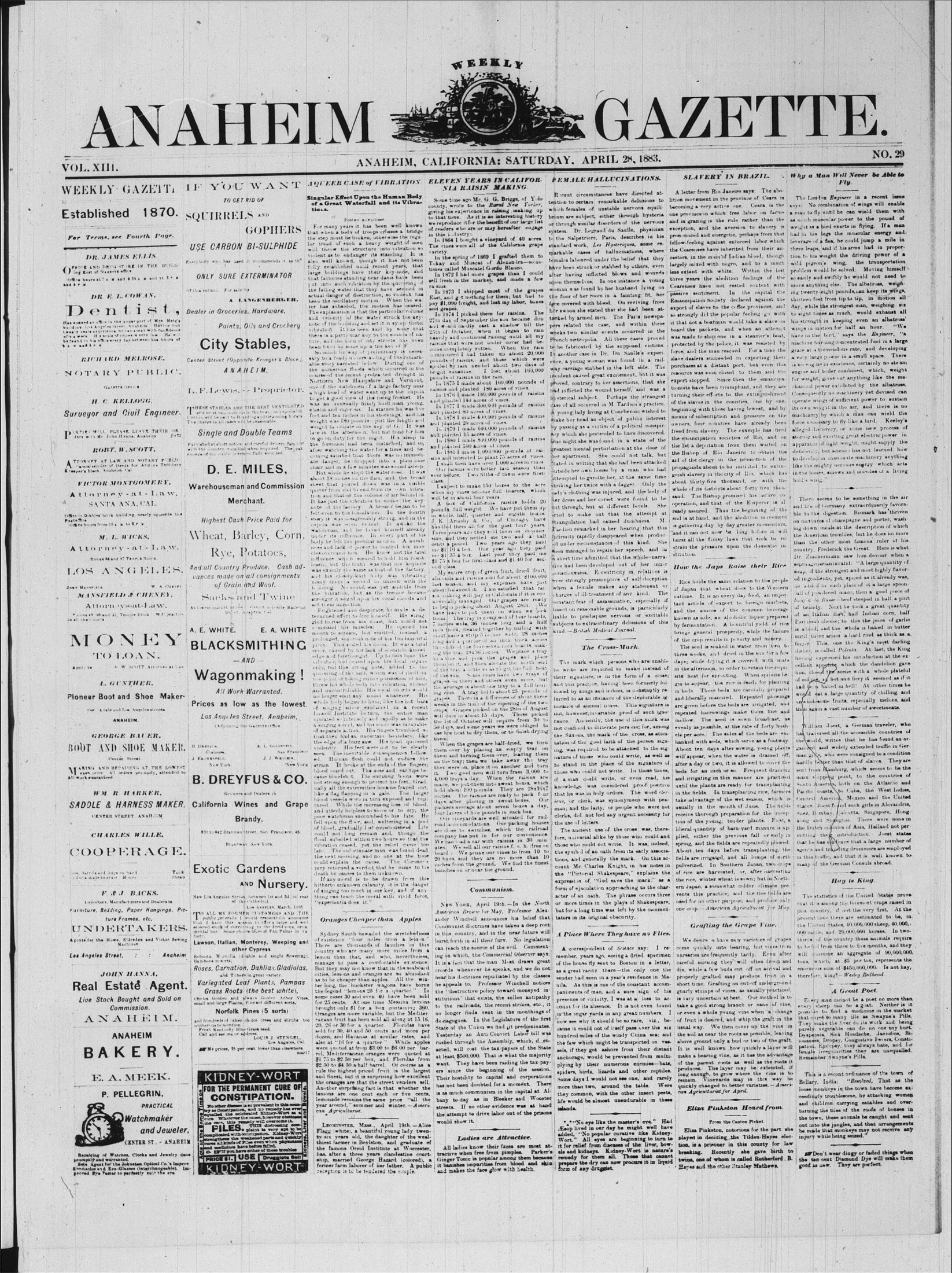
Searchable text
ANAHEIM
VOL. XIII.
WEEKLY GAZETT.
Established 1870.
For Terms, see Fourth Page.
DR. JAMES ELLIS
OFFICE AND DRUG STORE IN THE BUILDING East of Anaheim office
Office hours at 7 a.m. and 9:30 a.m. and at 10 a.m.
DR E. L. COWAN,
Dentist,
Has opened an office in the upper part of Mrs Metz's building Los Angeles street Anaheim Having had twenty years experience human sleek with confidence of a work He is sale of prices very low He will be found in his office every day between the hours of
RICHARD MELROSE,
NOTARY PUBLIC.
Gazette Office
H. C. KELLOGG,
Surveyor and Civil Engineer.
PARTICLE WILL, PLEASE LEAVE THEIR ORDER WITH Mr John Hanna Anaheim jly22
ROBT. W. SCOTT.
ATTORNEY AT LAW AND NOTARY PUBLIC Commissioner of Drews for Arizona Territory Kreoger's Block Anaheim Cal.
IF YOU WANT TO GET RID OF SQUIRRELS AND GOPHERS USE CARBON BI-SULPHIDE
Everybody who has used it recommends it as the ONLY SURE EXTERMINATOR
Of this vermin For sale by A LANGENBERGER.
Dealer in Groceries, Hardware,
Paints, Oils and Crockery.
City Stables,
Center Street (Opposite Krroger's Block)
ANAHEIM.
L. F. Lewis, Proprietor.
THESE STABLES ARE THE BEST VENTILATED and most comfortable in the town especially it situation will be paid to Boarding and Grumbling hours The charge in all cases will be reasonable.
Single and Double Teams
Furnished at short notice and careful drivers familiar with the country supplied when required The patronage of the public is respectfully solicited.
D. E. MILES,
NOTARY OFFICE
H. C. KELLOGG,
Surveyor and Civil Engineer.
PORTTLE WILL, PLEASE LEAVE THEIR ORDER WITH MR. JOHN HANNA, Anaheim.
ROBT. W. SCOTT.
ATTORNEY AT LAW AND NOTARY PUBLIC COMMISSIONER OF DEEDS FOR ARIZZA TERRITORY KREUGE'S BLOCK, Anaheim, Cal.
VICTOR MONTGOMERY.
Attorney-at-Law, SANTA ANA, CAL.
OFFICE IN DIABLES' BRICK BUILDING, NEARLY OPPOSITE THE POST office.
OFFICE HOURS FROM 10 AM TO 3 PM.
M. L. WICKS.
Attorney-at-Law.
ROWS 46 and 87 TRAFFIC BLOCK.
LOS ANGELES.
JOHN MANSFIELD.
W. A. CHURSEY
MANSFIELD & CHENEY.
Attorneys-at-Law.
POINS 49, 50 and 51, Temple Block Will practice in all the Courts.
MONEY TO LOAN.
Apply to R. W. SCOTT Attorneys at Law.
L. GUNTHER.
Pioneer Boot and Shoe Maker.
CENTER STREET
MAKING AND REPAIRING AT THE LOWEST EACH PRICE. All orders promptly attended to. All work guaranteed.
WM. R. HARKER.
SADDLE & HARNESS MAKER.
CENTER STREET ANAHEIM
CHARLES WILLE.
COOPERAGE.
Tank cheap
F. & J. BACKS.
L. F. Lewis, Proprietor.
THESE STABLES ARE THE BEST VENTILATED AND most comfortable in the barn, especially it cation will be paid to Boarding and Grooming horses. The charge in all cases will be reasonable.
Single and Double Teams
Furnished at short notice and careful drivers familiar with the country, supplied when required. The cost of the public is respectfully admitted.
D. E. MILES,
Warehouseman and Commission Merchant.
Highest Cash Price Paid for Wheat, Barley, Corn, Rye, Potatoes,
And all Country Produce. Cash advances made on all consignments of Grain and Wool.
Sacks and Twine
At lowest market prices. Grocer uponsite Handling Dept., Anaheim, Cal.
A. E. WHITE.
E. A. WHITE
BLACKSMITHING — AND —
Wagonmaking!
All Work Warranted.
Prices as low as the lowest.
Los Angeles Street, Anaheim.
Adjoining the Gazette Office
R. DARGERS.
ANAHEIM.
San Francisco
J. FROWKEVER.
NEW YORK
J. WATLMANN.
New York
B. DREYFUS & CO.
Growers and Dealers in California Wines and Grape Brandy.
630 to 642 Brannan Street, San Francisco; 45 Broadway New York
Exotic Gardens
AND Nursery.
New Los Angeles Street, between 1st and 3rd in rear course of the secrecy one of the watchmen a high head of war to get a good view was an unusual elastic and vigorous feet and ten inches weight was 180 pounds weight to vigilate late in the afternoon to go on duty for the foremoon man after watching the coming satisfied tate danger, he chair and in a few But while he about 18 inches of sheet that poured quiver from end then and that of it It has just the factor felt even to the story it was insured cupola was ever watchman, and under its influence body he felt the need and lack of cles overcame him influence which loosely but the trit was exactly the w and his closely many times a bouncing No so the vibration, he stronger it seized set them inmotion Frightened and terminated effort to gled to rise from command his mouth to scream prolonged, simmer pitch This seal error caused by edge and foreth vibration had only, but this as quivering of the point of take threw his whole and uncontrolled no longer emit a whole body began of singing alive Lowell Institute vibrated so intense a singing sound of separate action that they had arched the edge of a bus violently His seen The inevitable Human strain It broke blood oozed out came bloodish it not strong enough usually all the ext like a flag flapping blood vessels were tured While it and utterly helped poor watchman fell upon the floor of blood, graduation could not long flood subsided vibration ceased late The unfortunate next morning could explain that jury returned a death by causes If any moral hitherto unknown of singing too much thing can teach
SADDLE & HARNESS MAKER.
CENTER STREET ANAHEIM
CHARLES WILLE,
COOPERAGE.
F. P. J. BACKS.
Importers, Manufacturers and Dealers in
Furniture, Bedding, Paper Hangings, Picture Frames, etc,
UNDERTAKERS.
Agents for the Howe, Eldredge and Victor Sewing Machines.
Los Angeles Street, Anaheim
JOHN HANNA,
Real Estate Agent.
Live Stock Bought and Sold on Commission.
ANAHEIM.
ANAHEIM
BAKERY.
E. A. MEEK.
P. PELLEGRIN,
PRACTICAL
Watchmaker
and Jeweler,
CENTER ST., - ANAHEIM
Repairing of Watches, Clocks and Jewelry done promptly and warranted.
Sets Agent for the Johnston Optical Co.'s Improved Snitacles and Eye-Glasses (interchangeable).
Improved Eye Tester to perfectly suit the eye.
California Wines and Grape Brandy.
630 to 642 Brannan street, San Francisco, 45 Broadway, New York
Exotic Gardens AND Nursery.
New Los Angeles Street, between 1st and 3d, in rear of the Cathedral.
Los Angeles, March, 1883
TO ALL MY FORMER CUSTOMERS AND THE public generally I would respectfully announce that I have this season to offer a large and well selected stock of everything in the deciduous ornamental line. Some choice trees of Fan Palms in varieties.
Lawson, Italian, Monterey, Weeping and other Cypress
Robusta, Magnolia (double and single flowering), flamibones in sorts.
Roses, Carnation, Dahlias, Gladiolas, and Tubers in great variety.
Variegated Leaf Plants, Pampas Grass Roots (the best white),
Choice Golden and always Golden Arbor Vitesa, small and large Plants, Pine sof different sorts.
Norfolk Pines (5 sorts)
and hundreds of other choice trees and shrubs too numerous to mention.
Fresh Kentucky Blue Grass seed.
Call and see me or address.
LOUIS J. STENGEL,
Los Angeles, Cal.
My prices, 25 per cent lower than elsewhere mar17
KIDNEY-WORT
FOR THE PERMANENT CURE OF CONSTIPATION.
No other disease is so prevalent in this country as Constipation, and no remedy has ever equalled the celebrated Kidney-Wort as a cure. Whatever the cause, however obstinate the case, this remedy will overcome it.
PILES. THIS distressing complaint is very apt to be complicated with constipation. Kidney-Wort strengthens the weakened parts and quickly cures all kinds of Piles even when physicians and medicines have before failed.
KEEP IF YOU HAVE EITHER OF THESE TROUBLES
PRICE $1. USE Druggists Sell
KIDNEY-WORT
WEEKLY
EIM GA
ANAHEIM, CALIFORNIA: SATURDAY, APRIL 28, 1883.
AQUEER CASE OF VIBRATION.
Singular Effect Upon the Human Body of a Great Waterfall and its Vibrations.
Poston Advertiser
For many years it has been well known that when a body of troops crosses a bridge the step must be broken, otherwise the regular tread of such a heavy weight of men will throw the structure into vibration so violent as to endanger its standing. It is also well known, though it has not been fully established until recent years, that large buildings have their key note, and that factories standing near dams have been put into such vibration by the quivering of the falling water that they have seemed in actual danger of destruction, so violent has been the oscillatory motion. When the water has subsided, the motion has ceased. The explanation is that the particular volume and velocity of the water struck the keynote of the building and set it in symphetic vibration. It has been said by some that there is a particular key to the sounds of nature, and the name of city streets has even been fixed by some upon the key of F.
So much by way of preliminary is necessary to a ready understanding of the remarkable story narrated below. During one of the numerous floods which occurred in the course of the recent protracted drought in Northern New Hampshire and Vermont, one of the watchmen of a large factory near a high head of water went up to the cupola to get a good view of the rising freshet. He was an unusually firmly built man, young, elastic and vigorous. In stature he was five feet and ten inches in his stockings, and his weight was 180 pounds—just the length and weight to vibrate in the key of G. It was late in the afternoon, but not time for him to go on duty for the night. His sleep in the foremoon had been disturbed, and so after watching the water for a time and becoming satisfied that there was no immediate danger, he dropped into a plain pine chair and in a few minutes was sound asleep.
But while he slept the water rose. It was
ELEVEN YEARS IN CALIFORNIA RAISIN MAKING.
Some time ago Mr. G. G. Briggs, of Yolo county, wrote to the Rural New Yorker, giving his experience in raising making up to that time. As it is an interesting history we reproduce it for the benefit of our large list of readers who are or may hereafter engage in this industry.
In 1864 I bought a vineyard of 40 acres. The vines were all of the California grape variety.
In the spring of 1869 I grafted them to Tokay and Muscat of Alexandria—some times called Muscatel Gordo Blanco.
In 1872 I had more grapes than I could sell fresh in the market, and made a few raisins.
In 1873 I shipped most of the grapes East, and got nothing for them; but had to pay $1,000 freight, and lost my labor, boxes and grapes.
In 1874 I picked them for raisins. The 27th day of September the sun became dim and would hardly cast a shadow till the 25th of October, when it began to rain heavily and continued raining until all my raisins that were not under cover had become completely rotten. When the rain commenced I had taken up about 20,000 pounds of raisins, and those which were spoiled by rain needed about two days of bright sunshine. I lost about 160,000 pounds of raisins in the rain.
In 1875 I made about 160,000 pounds of raisins and planted 180 acres of vines.
In 1876 I made 180,000 pounds of raisins and planted 140 acres of vines.
In 1877 I made 300,000 pounds of raisins and planted 80 acres of vines.
In 1878 I made 400,000 pounds of raisins and planted 20 acres of vines.
In 1879 I made 640,000 pounds of raisins and planted 15 acres of vines.
In 1880 I made 800,000 pounds of raisins and planted 500 acres of vines.
In 1881 I made 1,000,000 pounds of raisins and intended to plant 75 acres of vines.
I shall then have over 1,000 acres in vines. Our raisins were better last season than before. Two little of them were first.
Recent circumstances have directed attention to certain remarkable delusions to which females of unstable nervous equilibrium are subject, either through hysteria or through similar disorders of the nervous system. Dr. Legrand du Saulle, physician to the Salpetriere, Paris, describes in his standard work, Les Hystériques, some remarkable cases of hallucinations, where females laboured under the belief that they have been struck or stabbed by others, even after having inflicted blows and wounds upon themselves. In one instance a young woman was found by her husband lying on the floor of her room in a fainting fit, her face covered with blood. On reviving from her swoon she stated that she had been attacked by armed men. The Paris newspapers related the case, and within three weeks two similar events occurred in the French metropolis. All these cases proved to be fabricated by the supposed victims. In another case in Dr. Du Saulle's experience, a young woman was found in a railway carriage stabbed in the left side. The incident caused great excitement, but it was proved, contrary to her assertions, that she had inflicted the wound herself, and was a hysterical subject. Perhaps the strangest case of all occurred in M Tardieu's practice at young lady living at Courbevoie wished to make her head an object of public interest by passing as a victim of a political conspiracy which she pretended to have discovered. One night she was found in a state of the greatest mental perturbation at the door of her apartment. She could not talk, but stated in writing that she had been attacked outside her own house by a man who had
Northern New Hamshire and Vermont, one of the watchmen if a large factory near a high head of water went up to the cupola to get a good view of the rising freshet. He was an unusually firmly built man, young, elastic and vigorous. In stature he was five feet and ten inches in his stockings, and this weight was 180 pounds—just the length and weight to vibrate in the key of G. It was late in the afternoon, but not time for him to go on duty for the night. His sleep in the foremorning had been disturbed, and so after watching the water for a time and becoming satisfied that there was no immediate danger, he dropped into a plain pine chair and in a few minutes was sound asleep.
But while he slept the water rose. It was about 18 inches on the dam, and the broad sheet that poured down was in a visible quiver from end to end from its own vibration and that of the volume of air behind it. It has just the vibration to strike the keynote of the factory. A tremor began to be felt even to the foundation. In the fourth story it was disagreeably strong, and in the cupola was even violent. It awoke the watchman, and he found himself already under its influence. In every part of his body he felt the peculiar motion. A numbness and lack of power to control his muscles overcame him. He knew not the total influence which seemed to hold him resistlessly, but the truth was that his keynote was exactly the same as that of the factory, and his closely knit body was vibrating many times a second in unison with the bracing. No sound was yet audible from the vibration, but as the tremor became stronger it seized upon his vocal chords and set them imminent.
Frightened and desperate, he made a determined effort to free himself. He struggled to rise from his chair, but could not command his muscles. He opened his mouth to scream, but emitted instead, a prolonged, simorous note of his fundamental pinn. This sealed his doom. It was a fatal error, caused by his lack of scientific knowledge and forethought. Up to this time the vibration had ceased upon his local organs only, but this strong note, added to the quivering of the mill, which was of itself on the point of taking entire possession of him, threw his whole body into vibration, violent and uncontrollable. His vocal chords would no longer emit any sound whatever. His whole body began to hart; like the hot bars of singing silver exploded in a recent Lowell Institute lecture, the entire man vibrated intensely and rapidly as to make a singing sound, and his voice was incapable of separate action. His fingers trembled so that they had an uncertain boundary, like the edge of a buzz saw. His head quivered violently. His feet were not to be clearly seen. The inevitable consequences followed. Human flesh could not endure the strain. It broke at the ends of the fingers; blood oozed out. The nose and ear tips became bloodshot. The encrustations both were not strong enough to protect his feet. Gradually all the extremities became frayed out, like a flag flapping in a gale. The larger blood vessels were in turn exposed and raptured. While the increasing loss of blood, and utterly helpless to move or to cry, the poor watchman succumbed to his fate. He fell upon the floor, and, weltering in a pool of blood, gradually lost consciousness. Life could not long remain and, though the flood subsided within two hours so that the vibration ceased, yet the relief came too late. The fortunate man was found dead next morning, and no one at the time could explain the cause. The coroner's jury returned a verdict that he came to his death by causes to them unknown.
If any moral is to be drawn from this hitherto unknown calamity, it is the danger of singing too much in one key, and if anything can teach the moral with vivid force,
Communism.
In 1875 I made about 160,000 pounds of raisins and planted 180 acres of vines.
In 1876 I made 150,000 pounds of raisins and planted 140 acres of vines.
In 1877 I made 300,000 pounds of raisins and planted 80 acres of vines.
In 1878 I made 400,000 pounds of raisins and planted 20 acres of vines.
In 1879 I made 640,000 pounds of raisins and planted 15 acres of vines.
In 1880 I made 800,000 pounds of raisins and planted 500 acres of vines.
In 1881 I made 1,000,000 pounds of raisins and intended to plant 75 acres of vines.
I shall then have over 1,000 acres in vines.
Our raisins were better last season than ever before. Two fifths of them were first class.
I expect to make 150 boxes to the acre when my nieces become full bearers, which will be in about four years.
A box of California raisins holds 20 pounds full weight. We have put them up in whole half quarter and eighth boxes. J.K. Arnsby & Co., of Chicago, have handled them all for the past four years. Three years ago they sold them on commission, and they netted me two and a half cents a pound. Two years ago they paid me $110 a box. One year ago they paid me $135 a box. Last year they paid me $175 a box for first class and $140 for second class.
My entire crop of green fruit, dried fruit, almonds and raisins sold for about $100,000 last season, and my expenses have just about balanced it. I am satisfied that raisin making will pay in California if it is economically managed. Our grapes are ready to begin picking about August 28th. We have trays to put them on when we pick them.
The tray is composed of four boards, 7 inches wide, 36 inches long and a half inch thick, cledged together by mailing with about nails a strip 3 inches wide, 28 inches long and a quarter of an inch time across the ends of the four seven inch boards, making the tray 28x36 inches. We place a tray to a vine and pick the grapes and place them on it, and then elevate the north end of the tray a little so as to get the full heat of the sun. Some vines have two trays of grape on them and others even more, but the average is about one tray to a full bearing vine.
A tray holds about 25 pounds of grapes. There is a difference of about three weeks in the time of ripening of the two crops. Grapes picked on the 28th of August will come in about 15 days. Those picked the list of October will require from 30 to 50 days, and some years we were obliged to use heat to dry them, or to finish drying them.
When the grapes are half-dried, we turn them over by placing an empty tray on them and turning them over, leaving them on the tray; then we take away the tray they were on, place it another and turn it. Two good men will turn from 3,000 to 4,000 trays a day. When the raisins are made, we put-them into sweat boxes, which hold about 100 pounds. They are 28x36x7 inches. The raisins are ready to pack four days after placing in sweat-boxes. Our packers average about seven boxes a day, four layers of five pounds in each box.
Our vineyards are well situated for railroad accommodations. Our packing houses are close to switches, which the railroad company has put in for our convenience. We can load a car with raisins in 30 minutes. We sell all our raisins f.o.b. (free on board). We prune our vines from 10 to 20 buds, and they are no more than 10 inches from the ground. We find the finest bunches on or near the ground.
Incident caused great excitement, but it was proved contrary to her assertions, that she had inflicted the wound herself, and was a historical subject. Perhaps the strangest case of all occurred in M Tarlieu's practice; a young lady living at Courbevoie wished to make her head an object of public interest by passing as a victim of a political conspiracy which she pretended to have discovered. One night she was found in a state of the greatest mental perturbation at the door of her apartment. She could not talk but stated in writing that she had been attacked outside her own house by a man who had attempted to garotte her; at the same time striking her twice with a dagger. Only the lady's clothing was injured, and the body of her dress and her corset were found to be out through, but at different levels. She tried to make out that the attempt at strangulation had caused dumbness. M Tarlieu remarked in her hearing that this infirmity rapidly disappeared when produced under circumstances of this kind. She soon managed to regain her speech, and in a short time admitted that the whole narrative had been developed out of her inner consciousness. Eccentricity in relatives is ever strongly presumptive of self-deception when a female makes any statement or charges of ill-treatment of any kind. The constant fear of assassination, especially if based on reasonable grounds, is particularly liable to predispose nervous or excitable subjects to extraordinary delusions of this kind.
British Medical Journal.
The Cross-Mark.
The mark which persons who are unable to write are required to make instead of their signature, is in form of a cross; and this practice, having been formerly followed by kings and nobles, is constantly referred to as an instance of the deplorable ignorance of ancient times. This signature is not however invariable proof of such ignorance. Anciently, the use of this mark was not confined to literate persons; for among the Saxons, the mark of the cross, as attestation of the good faith of the person signing was required to be attached to the signature of those who could write, as well as to stand in the place of the signature of those who could not write. In those times if a man could write, or even read, his knowledge was considered proof positive that he was in holy orders. The word clerics or clerk was synonymous with penman; and the laity, or people who were not clerks did not feel any urgent necessity for the use of letters.
The ancient use of the cross was therefore universal alike by those who could and those who could not write. It was indeed, the symbol of an oath from its early associations, and generally the mark. On this account Mr Charles Knight, in his notes in the "Pictorial Shakespeare," explains the expression of "God save the mark." as a form of ejaculation approaching to the character of an oath. The phrase occurs three
blood vessels were in turn exposed and trapped.
While the increasing loss of blood,
and utterly helpless to move or to cry,
the poor watchman succumbed to his fate.
He fell upon the floor, and, weltering in a pool of blood, gradually lost consciousness.
Life could not long remain and, though the flood subsided within two hours so that the vibration ceased, yet the relief came too late.
The unfortunate man was found dead the next morning, and no one at the time could explain the cause.
The coroner's jury returned a verdict that he came to his death by causes to them unknown.
If any moral is to be drawn from this hitherto unknown calamity, it is the danger of singing too much in one key, and if anything can teach the moral with vivid force, "experientia does it."
Oranges Cheaper than Apples.
Sydney Smith bewailed the wretchedness of existence "four miles from a leinon."
There are thousands of families in this country who are many more miles from a lemon than that, and who, nevertheless, manage to pass a comfortable existence.
But they may not know that in the seaboard cities, lemons and oranges are so abundant as to be cheaper than apples. All the winter long, the huckster wagons have borne the legend "lemons 25 for a quarter." In some cases 30 and even 40 have been sold for 25 cents. At one time Messina lemons brought only $1 for a box containing 360. Oranges are more variable, but the Mediterranean fruit has been sold all along at 15.16, 20, 26 or 30 for a quarter. Floridas have sold for 30, 40 and 50 cents and more per dozen, and Havanas at similar rates, and also at "16 for a quarter." While apples were quoted at from $3.00 to $6.00 per barrel, Mediterranean oranges were quoted at $1.75 to $2.50 per box, and Floridas from $2.50 to $4.50 a half barrel. Of course as a rule the highest priced fruit is the largest and finest, but it is surprising how excellent the oranges are that the street vendors sell.
Another surprising fact is that whether the lemons are one cent each or five cents, lemonade remains the same price "all the year around," summer and winter. —American Agriculturist.
LEOMINSTER, Mass., April 19th. — Alice Flagg white), a beautiful young lady twenty six years old, the daughter of the wealthiest farmer in Boylston, and graduate of the famous Oreid Institute at Worcester, has, after a three years clandestine courtship, married George Hazard (colored), a former farm laborer of her father. A public reception is to be tendered the couple.
Communism.
New York, April 19th. — In the North American Review for May, Professor Alexander Winchell announces his belief that Communist doctrines have taken a deep root in this country, and in the near future will burst forth in all their fury. No legislation can reach the source of the evil. Commenting on which, the Commercial Observer says: It is a fact that the man Most draws great crowds whenever he speaks, and we do not hear his doctrines repudiated by the classes he appeals to. Professor Winchell noticees the "destructive policy toward moneyed institutions" that exists, the sullen antipathy to the railroads, the recent strikes, etc., it no longer finds vent in the mouthings of deanagogues. In the Legislature of the first State of the Union we find it predominates. Yesterday an Anti-Convict Labor bill was rushed through the Assembly, which, if enacted, will cost the tax-payers of the State at least $500,000. That is what the majority want. They have been raiding the tax-payers since the beginning of the session. Their hostility to capital and corporations has not been doubted for a moment. There is as much communism in the capital at Albany to-day as in Bleeker and Wooster streets. If no other evidence was at hand the attempt to drive labor out of the prisons would show it.
Ladies are Attractive.
All ladies know their faces are most attractive when free from pimples. Parker's Ginger Tonic is popular among them because it banishes unpurities from blood and skin and makes the face glow with health.
I remember, years ago, seeing a dried specimen of the house fly sent to Boston in a letter, as a great rarity there—the only one the sender had seen in a year's residence in Manila. As this is one of the constant accompaniments of man, and a sure sign of his presence or vicinity, I was at a loss to account for its absence. It is not even found in the sugar yards in any great numbers. I now see why it should be so rare, viz., because it could not of itself pass over the six hundred miles of the windy China sea; and the few which might be transported on vessels, if they got ashore from their distant anchorage, would be prevented from multiplying by their numerous enemies—bats, spiders, birds, lizards and other reptiles. Some days I would not see one, and rarely more than two, around the table. Were they common, with the other insect pests, life would be almost unendurable in these islands.
"No eye like the master's eye." Had Esop lived in our day he might well have added, "No popular curative like Kidney-Wort." All eyes are beginning to turn to it for relief from diseases of the liver, bowels and kidneys. Kidney-Wort is nature's remedy for them all. Those that cannot prepare the dry can now procure it in liquid form of any druggist.
GAZETTE.
APRIL 28, 1883.
ALLUCINATIONS.
attances have directed at remarkable delusions to unstable nervous equilibriums either through hysteria disorders of the nervous system and du Saulle, physician Paris, describes in his *Les Hystériques*, some re-occultations, where under the belief that they were stabbed by others, even infected blows and wounds.
In one instance a young boy by her husband lying on him in a fainting fit, her blood. On reviving from bed that she had been at men. The Paris newspaper case, and within three years occurred in the city. All these cases proved by the supposed victims.
Dr. Du Saulle's expert man was found in a railbed in the left side. The great excitement, but it was no her assertions, that she wound herself, and was a Perhaps the strangest ill in M. Tardieu's practice. Being at Courbevoie wished to object of public interest victim of a political conspirioned to have discovered. It found in a state of the perturbation at the door of She could not talk, but that she had been attacked house by a man who had
SLAVERY IN BRAZIL.
A letter from Rio Janeiro says: The abolition movement in the province of Ceara is becoming a very active one. Ceara is the one province in which free labor on farms and in grazing is the rule rather than the exception, and the aversion to slavery is pronounced and energetic, perhaps from that fellow-feeling against entorced labor which the Cearouses have inherited from their ancestors, in the main of Indian blood, though largely mixed with negro, and to a much less extent with white. Within the last three years the abolition feelings of the Cearenses have not rested content with passive sentiment. In the capital the Emancipation Society declared against the export of slaves to the coffee provinces, and so strongly did the popular feeling go with it that not a boatman would take a slave on board the packets, and when an attempt was made to ship one in a steamer's boat, protected by the police, it was resisted by force, and the man rescued. For a time the slave dealers succeeded in exporting their purchases at a distant port, but even this resource was soon closed to them and the export stopped. Since then the emancipationists have been triumphant, and they are turning their efforts to the extinguishment of the slaves in the counties, one by one, beginning with those having fewest, and by means of subscription and pressure on the owners, four counties have already been freed from slavery. The example has fired the emancipation societies of Rio, and on the 1st a deputation from them waited on the Bishop of Rio Janeiro to obtain the aid of the clergy in the promotion of the propaganda about to be initiated to extinguish slavery in the city of Rio, which has
Why a Man Well Never Be Able to Fly.
The London Engineer in a recent issue says: No combination of wings will enable a man to fly until he can wield them with as much muscular power to the pound of weight as a bird exerts in flying. If a man had in his legs the muscular energy and leverage of a flea, he could jump a mile in three leaps, and if his arms had in proportion to his weight the driving power of a wild pigeon's wing, the transportation problem would be solved. Moving himself so easily and swiftly he would not need to move anything else. The albatross, weighing twenty-eight pounds, can keep its wings thirteen feet from tip to tip, in motion all day, while the strongest man, weighing six to eight times as much, would exhaust all his strength in keeping even an albatross' wings in motion for half an hour. "We have in the bird," says the Engineer, "a machine burning concentrated fuel in a large grace at a tremendous rate, and developing a very large power in a small space. There is no engine in existence, certainly no steam engine and boiler combined, which, weight for weight, gives out anything like the mechanical power exhibited by the albatross. Consequently no machinery yet devised can operate wings of sufficient power to sustain its own weight in the air, and there is no machinery by which a man can wield the force necessary to fly like a bird. Keeley's alleged discovery, or some new process of storing and exerting great electric power in apparatuses of light weight, might supply the deficiency; but science has not learned how to develop in manatee machinery anything like the mighty nervous energy which acts in the bones, sinews and muscles of a living
Cross-Mark.
Which persons who are unable to make instead of rice in the form of a cross, having been formerly followed nobles, is constantly resistance of the deplorable ignent times. This signature is harrtable proof of such ignorance, the use of this mark was misiterate persons; for, among mark of the cross, as attested faith of the person signified to be attached to the sig who could write, as well as place of the signature of not write. In those times, he write, or even read, his considered proof positive orders. The word cler was synonymous with penalty, or people who were not feel any urgent necessity for it. Use of the cross was, there like by those who could and not write. It was, indeed, oath from its early association the mark. On this acces Knight, in his notes in Shakespeare," explains the God save the mark;" as a notion approaching to the charm. The phrase occurs three resources will be used to stop export stopped. Since then the emancipationists have been triumphant, and they are turning their efforts to the extinguishment of the slaves in the counties, one by one, beginning with those having fewest, and by means of subscription and pressure on the owners, four counties have already been freed from slavery. The example has fired the emancipation societies of Rio, and on the 1st a deputation from them waited on the Bishop of Rio Janeiro to obtain the aid of the clergy in the promotion of the propaganda about to be initiated to extinguish slavery in the city of Rio, which has about thirty five thousand, or with the whole of its districts about forty five thousand. The Bishop promised his active cooperation, and that of the Emperor is already assured. Thus the beginning of the end is at hand, and the abolition movement is gathering day by day greater momentum; and it can not now be long before it will burst all the flimsy laws that seek to restrain the pressure upon the domestic institution.
How the Japs Raise their Rice
Rice holds the same relation to the people of Japan that wheat does to the Western nations. It is an every-day food, an important article of export to foreign markets, and the source of the common beverage known as sake, an alcoholic liquor prepared by fermentation. A beautiful yield of rice brings general prosperity, while the failure of the crop results in poverty and misery.
The seed is soaked in water from two to three weeks, and dried in the sun for a few days; while drying it is covered with mats in the afternoon, in order to retain the requisite heat for sprouting. When sprouts begin to appear, the rice is ready for planting in beds. These beds are carefully prepared and liberally manured. Repeated plowings are given before the beds are irrigated, and repeated harrowings make them fine and mellow. The seed is sown broadcast, as evenly as possible, at the rate of forty bushels per acre. The sides of the beds are embanked with sods, which serve as a footway. About ten days after sowing, young plants will appear, when the water is drained off, after a day or two, it is allowed to cover the beds for an inch or so. Frequent draining and irrigating in this manner are practised until the plants are ready for transplanting in the fields. In transplanting rice farmers take advantage of the wet season, which is usually in the month of June. The fields receive thorough preparation for the reception of the young; tender plants. First, a liberal quantity of barn-yard manure is applied, either the previous fall or early in spring, and the fields are repeatedly plowed. About ten days before transplanting, the fields are irrigated, and all lumps of earth pulverized. In Southern Japan, two crops of rice are harvested, or, after harvesting the rice, winter wheat is sown; but in Northern Japan, a somewhat colder climate prevents this practice, and the rice fields are export stopped. Since then the emancipationists have been triumphant, and they are turning their efforts to the extinguishment of the slaves in the counties, one by one, beginning with those having fewest, and by means of subscription and pressure on the owners, four counties have already been freed from slavery. The example has fired the emancipation societies of Rio, and on the 1st a deputation from them waited on the Bishop of Rio Janeiro to obtain the aid of the clergy in the promotion of the propaganda about to be initiated to extinguish slavery in the city of Rio, which has about thirty-five thousand, or with the whole of its districts about forty-five thousand. The Bishop promised his active cooperation, and that of the Emperor is already assured. Thus the beginning of the end is at hand, and the abolition movement is gathering day by day greater momentum; and it can not now be long before it will burst all the flimsy laws that seek to restrain the pressure upon the domestic institution.
How the Japs Raise their Rice
Rice holds the same relation to the people of Japan that wheat does to the Western nations. It is an everyday food, an important article of export to foreign markets, and the source of the common beverage known as sake, an alcoholic liquor prepared by fermentation. A beautiful yield of rice brings general prosperity, while the failure of the crop results in poverty and misery.
The seed is soaked in water from two to three weeks, and dried in the sun for a few days; while drying it is covered with mats in the afternoon, in order to retain the requisite heat for sprouting. When sprouts begin to appear, the rice is ready for planting in beds. These beds are carefully prepared and liberally manured. Repeated plowings are given before the beds are irrigated, and repeated harrowings make them fine and mellow. The seed is sown broadcast, as evenly as possible, at the rate of forty bushels per acre. The sides of the beds are embanked with sods, which serve as a footway. About ten days after sowing, young plants will appear, when the water is drained off after a day or two, it is allowed to cover the beds for an inch or so. Frequent draining and irrigating in this manner are practised until the plants are ready for transplanting in the fields. In transplanting rice farmers take advantage of the wet season, which is usually in the month of June. The fields receive thorough preparation for the reception of the young; tender plants. First, a liberal quantity of barn-yard manure is applied, either the previous fall or early in spring, and the fields are repeatedly plowed. About ten days before transplanting, the fields are irrigated, and all lumps of earth pulverized. In Southern Japan, two crops of rice are harvested, or after harvesting the rice, winter wheat is sown; but in Northern Japan, a somewhat colder climate prevents this practice, and the rice fields are export stopped. Since then the emancipationists have been triumphant, and they are turning their efforts to the extinguishment of the slaves in the counties, one by one, beginning with those having fewest, and by means of subscription and pressure on the owners, four counties have already been freed from slavery. The example has fired the emancipation societies of Rio, and on the 1st a deputation from them waited on the Bishop of Rio Janeiro to obtain the aid of the clergy in the promotion of the propaganda about to be initiated to extinguish slavery in the city of Rio, which has about thirty-five thousand, or with the whole of its districts about forty-five thousand. The Bishop promised his active cooperation, and that of the Emperor is already assured. Thus the beginning of the end is at hand, and the abolition movement is gathering day by day greater momentum; and it can not now be long before it will burst all the flimsy laws that seek to restrain the pressure uponthe domestic institution.
How the Japs Raise their Rice
Rice holds the same relation to the people of Japan that wheat does tothe Western nations. It is an everyday food, an important article of export to foreign markets,andthe sourceofthecommonbeverageknownassake,thealcoholicliquorpreparedbyfermentation.Abewell yieldofricebringsgeneralprospersitywhilethefailureofthecropresultsinpovertyandmisery.
The seedissoakedinwaterfromtwotreesweeks,anddriedinthesunforafewdays;whiledryingitiscoveredwithmatsintherapoonintheafternoon.inordertoretaintherequisiteheatforsprouting.Wherespirtoolsbegintoappear,thericeisreadyforplantinginbeds.Thesebedsarecarettypreparedandliberallymanured.Repeatedplowingsaregivenbeforethebedsareirrigated,andrepeatedharrowingsmakethetineandmellow.Theseedissoakedinwaterfromtwotreesweeks,anddriedinthesunforafewdays;whiledryingitiscoveredwithmatsintherapoonintheafternoon.inordertoretaintherequisiteheatforsprouting.Wherespirtoolsbegintoappear,thericeisreadyforplantinginbeds.Thesebedsarecarettypreparedandliberallymanured.Repeatedplowingsaregivenbeforethebedsareirrigated,andrepeatedharrowingsmakethetineandmellow.Theseedissoakedinwaterfromtwotreesweeks,anddriedinthesunforafewdays;whiledryingitiscoveredwithmatsintherapoonintheafternoon.inordertoretaintherequisiteheatforsprouting.Wherespirtoolsbegintoappear,thericeisreadyforplantinginbeds.Thesebedsarecarettypreparedandliberallymanured.Repeatedplowingsaregivenbeforethebedsareirrigated,andrepeatedharrowingsmakethetineandmellow.Theseedissoakedinwaterfromtwotreesweeks,anddriedinthesunforafewdays;whiledryingitiscoveredwithmatsintherapoonintheafternoon.inordertoretaintherequisiteheatforsprouting.Wherespirtoolsbegintoappear,thericeisreadyforplantinginbeds.Thesebedsarecarettypreparedandliberallymanured.Repeatedplowingsaregivenbeforethebedsareirrigated,andrepeatedharrowingsmakethetineandmellow.Theseedissoakedinwaterfromtwotreesweeks,anddriedinthesunforafewdays;whiledryingitiscoveredwithmatsintherapoonintheafternoon.inordertoretaintherequisiteheatforsprouting.Wherespirtoolsbegintoappear,thericeisreadyforplantinginbeds.Thesebedsarecarettypreparedandliberallymanured.Repeatedplowingsaregivenbeforethebedsareirrigated,andrepeatedharrowingsmakethetineandmellow.Theseedissoakedinwaterfromtwotreesweeks,anddriedinthesunforafewdays;whiledryingitiscoveredwithmatsintherapoonintheafternoon.inordertoretaintherequisiteheatforsprouting.Wherespirtoolsbegintoappear,thericeisreadyforplantinginbeds.Thesebedsarecarettypreparedandliberallymanured.Repeatedplowingsaregivenbeforethebedsareirrigated,andrepeatedharrowingsmakethetineandmellow.Theseedissoakedinwaterfromtwotreesweeks,anddriedinthesunforafewdays;whiledryingitiscoveredwithmatsintherapoonintheafternoon.inordertoretaintherequisiteheatforsprouting.Wherespirtoolsbegintoappear,thericeisreadyforplantinginbeds.Thesebedsarecarettypreparedandliberallymanured.Repeatedplowingsaregivenbeforethebedsareirrigated,andrepeatedharrowingsmakethetineandmellow.Theseedissoakedinwaterfromtwotreesweeks,anddriedinthesunforafewdays;whiledryingitiscoveredwithmatsintherapoonintheafternoon.inordertoretaintherequisiteheatforsprouting.Wherespirtoolsbegintoappear,thericeisreadyforplantinginbeds.Thesebedsarecarettypreparedandliberallymanured.Repeatedplowingsaregivenbeforethebedsareirrigated,andrepeatedharrowingsmakethetineandmellow.Theseedissoakedinwaterfromtwotreesweeks,anddriedinthesunforafewdays;whiledryingitiscoveredwithmatsintherapoonintheafternoon.inordertoretaintherequisiteheatforsprouting.Wherespirtoolsbegintoappear,thericeisreadyforplantinginbeds.Thesebedsarecarettypreparedandliberallymanured.Repeatedplowingsaregivenbeforethebedsareirrigated,andrepeatedharrowingsmakethetineandmellow.Theseedissoakedinwaterfromtwotreesweeks,anddriedinthesunforafewdays;whiledryingitiscoveredwithmatsintherapoonintheafternoon.inordertoretaintherequisiteheatforsprouting.Wherespirtoolsbegintoappear,thericeisreadyforplantinginbeds.Thesebedsarecarettypreparedandliberallymanured.Repeatedplowingsaregivenbeforethebedsareirrigated,andrepeatedharrowingsmakethetineandmellow.Theseedissoakedinwaterfromtwotreesweeks,anddriedinthesunforafewdays;whiledryingitiscoveredwithmatsintherapoonintheafternoon.inordertoretaintherequisiteheatforsprouting.Wherespirtoolsbegintoappear,thericeisreadyforplantinginbeds.Thesebedsarecarettypreparedandliberallymanured.Repeatedplowingsaregivenbeforethebedsareirrigated,andrepeatedharrowingsmakethetineandmellow.Theseedissoakedinwaterfromtwotreesweeks,anddriedinthesunforafewdays;whiledryingitiscoveredwithmatsintherapoonintheafternoon.inordertoretaintherequisiteheatforsprouting.Wherespirtoolsbegintoappear,thericeisreadyforplantinginbeds.Thesebedsarecarettypreparedandliberallymanured.Repeatedplowingsaregivenbeforethebedsareirrigated,andrepeatedharrowingsmakethetineandmellow.Theseedissoakedinwaterfromtwotreesweeks,anddriedinthesunforafewdays;whiledryingitiscoveredwithmatsintherapoonintheafternoon.inordertoretaintherequisiteheatforsprouting.Wherespirtoolsbegintoappear,thericeisreadyforplantinginbeds.Thesebedsarecarettypreparedandliberallymanured.Repeatedplowingsaregivenbeforethebedsareirrigated,andrepeatedharrowingsmakethetineandmellow.Theseedissoakedinwaterfromtwotreesweeks,anddriedinthesunforafewdays;whiledryingitiscoveredwithmatsintherapoonintheafternoon.inordertoretaintherequisiteheatforsprouting.Wherespirtoolsbegintoappear,thericeisreadyforplantinginbeds.Thesebedsarecarettypreparedandliberallymanured.Repeatedplowingsaregivenbeforethebedsareirrigated,andrepeatedharrowingsmakethetineandmellow.Theseedissoakedinwaterfromtwotreesweeks,anddriedinthesunforafewdays;whiledryingitiscoveredwithmatsintherapoonintheafternoon.inordertoretaintherequisiteheatforsprouting.Wherespirtoolsbegintoappear,thericeisreadyforplantinginbeds.Thesebedsarecarettypreparedandliberallymanured.Repeatedplowingsaregivenbeforethebedsareirrigated,andrepeatedharrowingsmakethetineandmellow.Theseedissoakedinwaterfromtwotreesweeks,anddriedinthesunforafewdays;whiledryingitiscoveredwithmatsintherapoonintheafternoon.inordertoretaintherequisiteheatForsprouting.Wherespirtoolsbegintoappear,thericeisreadyforplantinginbeds.Thesebedsarecarettypreparedandliberallymanured.Repeatedplowingsaregivenbeforethebedsareirrigated,andrepeatedharrowingsmakethetineandmellow.Theseedissoakedinwaterfromtwotreesweeks,anddriedinthesunforafewdays;whiledryingitiscoveredwithmatsintherapoonintheafternoon.inordertoretaintherequisiteheatForsprouting.Wherespirtoolsbegintoappear,thericeisreadyforplantinginbeds.Thesebedsarecarettypreparedandliberallymanured.RepeATEDPLOWING IS CALLED "GOD SAVE THE MARK" AS A BONDARY FOR PRESENTATION OF THIS MARK IN THE WORLD.
This cross-mark was there-like by those who could and not write. It was indeed,a tooth from its early association-the mark.On this accless Knight,missing some fruits,easely melons,and then again a vast number of sweetmeats.
Hay Is King.
The statistics of this United States prove
Here They have no Flies.
ment of Science say: I reago, seeing a dried specimen
resent to Boston in a letter,
there—the only one the
in a year's residence in Maman one of the constant accompan, and a sure sign of his
unity, I was at a loss to acsence. It is not even found
rods in any great numbers. I
should be so rare, viz., benot of itself pass over the six
of the windy China sea; and
might be transported on vesters ashore from their distant
could be prevented from multier numerous enemies—bats,
lizards and other reptiles.
Could not see one, and rarely
around the table. Were
with the other insect pests,
most unendurable in these
like the master's eye." Had
your day he might well have
popular curative like Kidneyeyes are beginning to turn to
the diseases of the liver, bowa Kidney-Wort is nature's
lem all. Those that cannot
can now procure it in liquid
drugst.
Grafting the Grape Vine.
We desire a have new varieties of grapes come quickly into bearing, but vines from nurseries are frequently tardy. Even after careful nursing they will often droop and die, while a few buds cut off on arrival and properly grafted may produce fruit in a short time. Grafting on cut-off underground gnarly stumps of vines, as usually practiced, is very uncertain at best. Our method is to take a good strong branch or cane of vine, or even a whole young vine when a change of fruit is desired, and whip the graft in the usual way. We then cover up the vine in the soil as near the roots as possible, leaving above ground only a bud or two of the graft. It is well known how quickly a layer will make a bearing vine, as it has the advantage of the parent roots as well as the roots it produces. The layer may be extended, if long enough, to grow where the vine is to remain. Vineyards may in this way be quickly changed to better varieties. — American Agriculturist for April.
Eliza Pinkston Heard from.
From the Canton Picket.
Eliza Pinkston, notorious for the part she played in deciding the Tilden-Hayes election, is a prisoner in this county for law breaking. Recently she gave birth to twins, one of whom is called Rutherford B. Hayes and the other Stanley Mathews.
Hay is King.
The statistics of the United States prove that it is among the foremost crops raised in this country, if not the very first. At the present time there are estimated to be, in the United States, 40,000,000 sheep, 40,000,000 cattle, and 20,000,000 horses. In two-thirds of the country these animals require to be fed from three to five months, and they will consume an aggregate of 90,000,000 tons, which at $5 per ton, represents the enormous sum of $450,000,000. Is not hay, therefore, king? — Wesley Redhead.
A Great Poet.
Every man cannot be a poet no more than every sheep can be a goat. Neither is it possible to find a medicine in the market that cures so many illis as Swayne's Pills. They make the liver do its work and being purely vegetable can do no one any hurt. Dyspejia, Sick Headache, Jaundice, Buionness, Dropay, Congestive Fevers, Constipation, Epilepsy, they always hate, and for female irregularities they are unequalled. Remember Swayne's Pills.
This is a recent ordinance of the town of Bellary, India: "Resolved That as the loose monkeys in the town have become exceedingly troublesome, by attacking women and children carrying eatables and overturning the tiles of the roofs of houses in the town, these animals be caught and sent out into the jungles, and that arrangements be made that monkeys may not receive any injury while being seized."
Don't wear dingy or faded things when the ten-cent Diamond Dye will make them good as new. They are perfect.