anaheim-gazette 1882-11-25
Scanned page
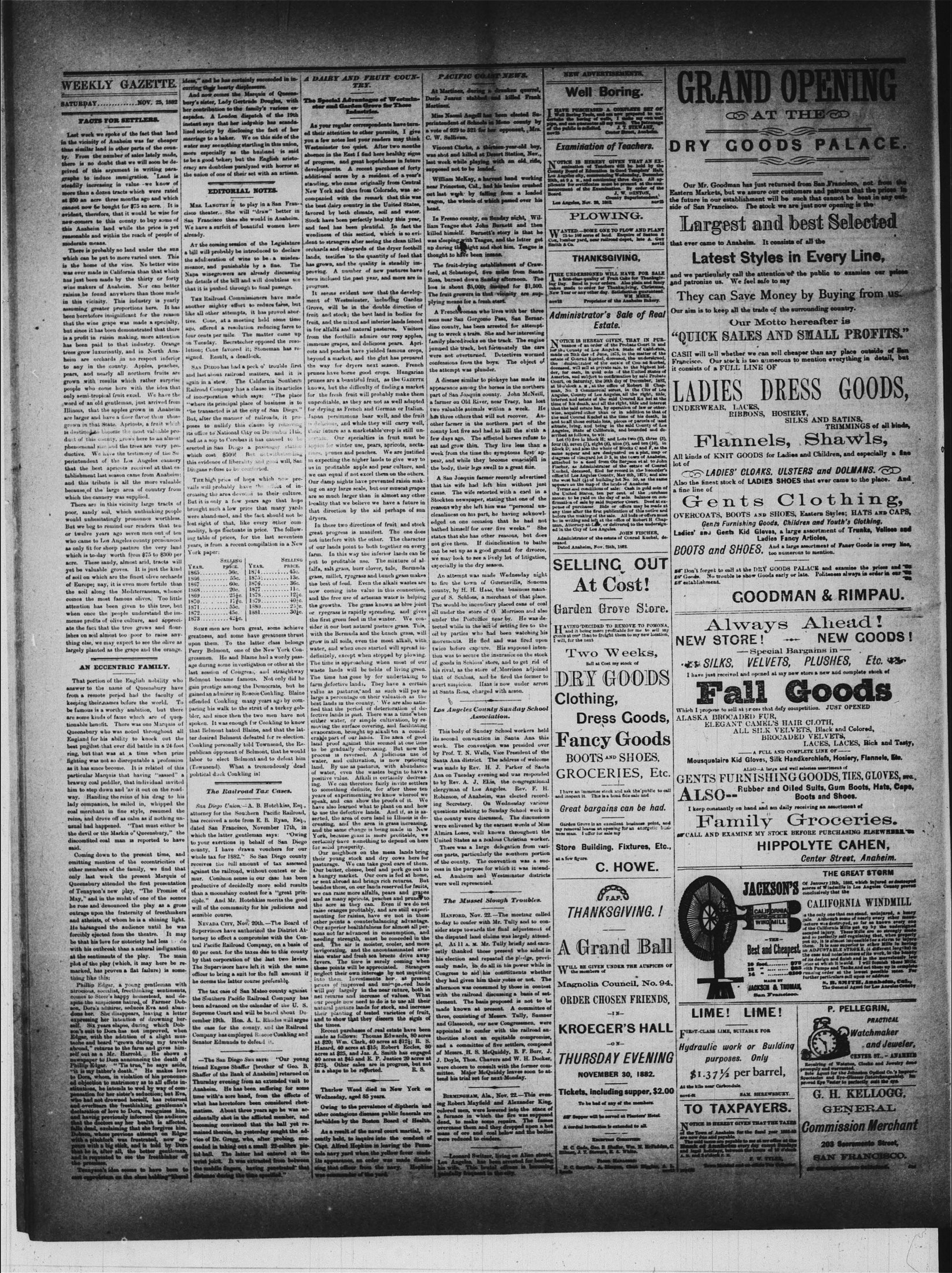
Searchable text
WEEKLY GAZETTE.
SATURDAY...NOV. 25, 1852
FACTS FOR SETTLERS.
Last week we spoke of the fact that land in the vicinity of Anaheim was far cheaper than similar land in other parts of the county. From the number of sales lately made, there is no doubt that we will soon be deprived of this argument in writing paragraphs to induce immigration. Land is steadily increasing in value—we know of more than a dozen tracts which were rated at $50 an acre three months ago and which cannot now be bought for $75 an acre. It is evident, therefore, that it would be wise for new-comers to this county to buy some of this Anaheim land while the price is yet reasonable and within the reach of people of moderate means.
There is probably no land under the sun which can be put to more varied uses. This is the home of the vine. No better wine was ever made in California than that which has just been made by the thirty or forty wine makers of Anaheim. Nor can better raisins be found anywhere than those made in this vicinity. This industry is yearly assuming greater proportions here. It has been heretofore insignificant for the reason that the wine grape was made a specialty, but since it has been demonstrated that there is a profit in raisin making, more attention has been paid to that industry. Orange trees grow luxuriantly, and in North Anaheim are orchards in no respect inferior to any in the county. Apples, peaches, pears, and nearly all northern fruits are grown with results which rather surprise people who come here with the idea that only semi-tropical fruit excel. We have the word of an old gentleman, just arrived from Illinois, that the apples grown in Anaheim are larger and have a finer flavor than those grown in that State. Apricots, a fruit which is destined to become the most valuable product of this county, grows here to an almost phenomenal size and the trees are very productive. We have the testimony of the Superintendent of the Los Angeles cannery that the best apricots received at that establishment last season came from Anaheim.
ideas," and he has certainly succeeded in incurring their hearty displeasure.
And now comes the Marquis of Queensbury's sister, Lady Gertrude Douglas, with her contribution to the family's various escapades. A London dispatch of the 19th instant says that her idgship has scandalized society by disclosing the fact of her marriage to a baker. We on this side of the water may see nothing startling in this union, more especially as the husband is said to be a good baker; but the English aristocracy are doubtless paralyzed with horror at the union of one of their set with an artisan.
EDITORIAL NOTES.
Mrs. Langtry is to play in a San Francisco theater. She will "draw" better in San Francisco than she would in Anaheim. We have a surfeit of beautiful women here already.
At the coming session of the Legislature a bill will probably be introduced to declare the adulteration of wine to be a misdemeanor, and punishable by a fine. The Napa winegrowers are already discussing the details of the bill and will doubtless see that it is pushed through to final passage.
The Railroad Commissioners have made another mighty effort to reduce fares, but like all other attempts, it has proved abortive. Cone, at a meeting held some time ago, offered a resolution reducing fares to four cents per mile. The matter came up on Tuesday. Beerstecher opposed the resolution; Cone favored it; Stoneman has resigned. Result, a deadlock.
San Diego has had a peck o' trouble first and last about railroad matters, and it again in a stew. The California Southern Railroad Company has a clause in its articles of incorporation which says: "The place where its principal place of business is to 'be transacted is at the city of San Diego.' But, after the manner of railroads, it proposes to nullify this clause by removing its office to National City on December 11th, and as a sop to Corebus it has caused to be erected in San Diego a passenger station which cost $500! But notwithstanding this evidence of liberality and good will, San Diegans refuse to be comforted.
A DAIRY AND INDUSTRIAL ADVERTISING
As your regular co-editor they attention you a few notes less Westminster too quiet absence in the East of progress, and great developments. A number additional acres being standing, who came New York and then companied with them the best dairy countrys favored by both Stock have been peeled and feed has been weediness of this district to strangers all orchards and vibey lands, testifies to has grown, and the proving. A number been inclosed the progress.
It seems evidentment of Westminster Grove, will be in fruit and stock; the fruit, and the mixed in for alfalfa and nuts from the foothills immense grapes, acorns and peaches beyond a market; at the way for dry prunes have borne prunes are a beauty knows, but the difficulty for the fresh fruiting unprofitable, as thou for drying as French Japan persimmons is delicious, and wives their future as a mern certain. Our special apples for winter rimes, peunces and in expecting the harshest us in profitable areas we can equal if not
pears, and nearly all northern fruits are grown with results which rather surprise people who come here with the idea that only semi-tropical fruit excel. We have the word of an old gentleman, just arrived from Illinois, that the apples grown in Anaheim are larger and have a finer flavor than those grown in that State. Apricots, a fruit which is destined to become the most valuable product of this county, grows here to an almost phenomenal size and the trees are very productive. We have the testimony of the Superintendent of the Los Angeles cannery that the best apricots received at that establishment last season came from Anaheim; and this tribute is all the more valuable because of the large area of country from which the cannery was supplied.
There are in this vicinity large tracts of poor, sandy soil, which unthinking people would unhesitatingly pronounce worthless. But we beg to remind our readers that ten or twelve years ago seven men out of ten who came to Los Angeles county pronounced as only fit for sheep pasture the very land which is to-day worth from $75 to $300 per acre. These sandy, almost arid, tracts will yet be valuable groves. It is just the kind of soil on which are the finest olive orchards of Europe; nay, it is even more fertile than the soil along the Mediterranean, whence comes the most famous olives. Too little attention has been given to this tree, but when once the people understand the immense profits of olive culture, and appreciate the fact that the tree grows and flourishes on soil almost too poor to raise anything else, we may expect to see the olive as largely planted as the grape and the orange.
AN ECCENTRIC FAMILY.
That portion of the English nobility who answer to the name of Queensbury have from a remote period had the faculty of keeping their names before the world. To be famous is a worthy ambition, but there are some kinds of fame which are of questionable benefit. There was one Marquis of Queensbury who was noted throughout all England for his ability to knock out the best pugilist that ever did battle in a 24-foot ring, but that was at a time when prize fighting was not so disreputable a profession as it has since become. It is related of this particular Marquis that having "sassed" a brawny coal peddler, that individual invited him to step down and 'av it out on the roadway. Handling the reins of his drag to his lady companion, he sailed in, whipped the coal merchant in fine style, resumed the reins, and drove off as calm as if nothing unusual had happened. "That must either be the devil or the Markia o' Queensbury," the discomfited coal man is reported to have said.
Coming down to the present time, and omitting mention of the eccentricities of other members of the family, we find that only last week the present Marquis of Queenabury attended the first presentation of Tennyson's new play, "The Promise of May," and in the midst of one of the scenes
SELLING YEAR. PRICE. SELLING YEAR. PRICE.
1865. 50c. 1874. 45c.
1866. 55c. 1875. 13c.
1867. 60c. 1876. 36c.
1868. 20c. 1877. 11c.
1869. 25lc. 1878. 12lc.
1870. 17lc. 1879. 40lc.
1871. 55c. 1880. 25lc.
1872. 45c. 1881. 30lc.
1873. 42lc.
Some men are born great, some achieve greatness, and some have greatness thrust upon them. To the latter class belongs Perry Belmont, one of the New York Congressmen. He and Blaine had a wordy passage during some investigation or other at the last session of Congress, and straightway Belmont became famous. Not only did he gain prestige among the Democrats, but he gained an admirer in Roscoe Conkling. Blaine offended Conkling many years ago by comparing his walk to the strut of a turkey gobler, and since then the two men have not spoken. It was enough for Conkling to know that Belmont hated Blaine, and that the latter desired Belmont defeated for re-election. Conkling personally told Townsend, the Republican opponent of Belmont, that he would labor to elect Belmont and to defeat him (Townsend). What a tremendously dead political duck Conkling is!
The Railroad Tax Cases.
San Diego Union:—A. B. Hotchkiss, Esq., attorney for the Southern Pacific Railroad, has received a note from E. B. Ryan, Esq., dated San Francisco, November 17th, in which the latter gentleman says: "Owing to your exertions in behalf of San Diego county, I have drawn vouchers for our whole tax for 1882." So San Diego county receives the full amount of tax assessed against the railroad, without contest or demur. Common sense in our case has been productive of decidedly more solid results than a moonshiny contest for a "great principle."
Our neighbors their young stock pasturage. We Our butter, cheese a hungry market or sent abroad besides these, on we can raise more and as many mills...
Coming down to the present time, and omitting mention of the eccentricities of other members of the family, we find that only last week the present Marquis of Queensbury attended the first presentation of Tennyson's new play, "The Promise of May," and in the midst of one of the scenes he rose and denounced the play as a gross outrage upon the fraternity of freethinkers and atheists, of whom he is a shining light. He barangued the audience until he was forcibly ejected from the theatre. It may be that his love for notoriety had less to do with his outbreak than a natural indignation at the sentiments of the play. The main plot of the play (which, it may here be remarked, has proven a flat failure) is something like this:
Phillip Edgar, a young gentleman with astrocious, socialist, freethinking sentiments, comes to Steer's happy homestead, and despite the anapolic hatred of Farmer Dobson, Dora's admirer, seduces Eva and abandons her. She disappears, leaving a letter expressing her intention of drowning herself. Six years elapse, during which Dobson's suit to Dora has not improved, when Edgar, with the addition of a slight mustache and beard "grown during my travels abroad," returns to the farm and gives himself out as a Mr. Harrold. He shows a newspaper to Dora announcing the death of Phillip Edgar. "'Tis true," he says aside, "it is my father's death." He makes love to Dora, whom, in violation of his pronounced objection to matrimony as to all effete institutions, he intends to wed by way of compensation for her sister's seduction; but Eva, who had not drowned herself, has returned and overhears the freethinking gentleman's declaration of love to Dora, recognises him, and having previously informed the audience that the doctors say her health is affected, falls dead, exclaiming that she forgives him. Dobson, whose previous attempt on Edgar with a pitchfork was frustrated, now appears with a big stick, and is told by Dora that he is, after all, the better gentleman, and is requested to see the freethinker off the premises.
Tennyson's idea seems to have been to cast apprehension on the slave holding "Alfred"
San Diego Union:—A. B. Hotchkiss, Esq., attorney for the Southern Pacific Railroad, has received a note from E. B. Ryan, Esq., dated San Francisco, November 17th, in which the latter gentleman says: "Owing to your exertions in behalf of San Diego county, I have drawn vouchers for our whole tax for 1882." So San Diego county receives the full amount of tax assessed against the railroad, without contest or demur. Common sense in our case has been productive of decidedly more solid results than a moonshiny contest for a "great principle." And Mr. Hotchkiss merits the good will of the community for his judicious and sensible course.
Nevada City, Nov. 20th.—The Board of Supervisors have authorized the District Attorney to effect a compromise with the Central Pacific Railroad Company, on a basis of 60 per cent. for the taxes due to this county by that corporation of the last two levies. The Supervisors have left it with the same officer to bring a suit for the full amount if he deems the latter course preferable.
The tax case of San Mateo county against the Southern Pacific Railroad Company has been advanced on the calendar of the U.S. Supreme Court and will be heard about December 19th. Hon. A. L. Rhodes will argue the case for the county, and the Railroad Company has employed Rosene Conkling and Senator Edmunds to defend it.
—The San Diego Sun says: "Our young friend Engene Shaffer [brother of Geo. B. Shaffer of the Bank of Anaheim] returned on Thursday evening from an extended visit to Anaheim. He has been suffering for some time with a sore hand, from the effects of what has heretofore been considered rheumatism. About three years ago he was accidentally shot in the afflicted member, and becoming convinced that the ball yet remained therein, he yesterday sought the advice of Dr. Gregg, who, after probing succeeded in taking out a small $2 calibre pistol ball. The latter had entered at the wrist joint. It was extracted from between the middle fingers, having penetrated that distance during the time specified."
Thurlow Wednesday, age
Owing to the other contagious forbidden by the Capt. Alfred Hollins navy yard its appearance, singing that officious was commended...
A DAIRY AND FRUIT COUNTRY.
The Special Advantages of Westminster and Garden Grove for Those Industries.
As your regular correspondents have turned their attention to other pursuits, I give you a few notes less your readers may think. Westminster too quiet. After two months absence in the East I find here healthy signs of progress, and great hopefulness in future developments. A recent purchase of forty additional acres by a resident of a year's standing, who came originally from Central New York and then from Colorado, was accompanied with the remark that this was the best dairy country in the United States, favored by both climate, soil and water. Stock have been perfectly healthy this year, and feed has been plentiful. In fact the weediness of this section, which is so evident to strangers after seeing the clean tilled orchards and viheyards of the dryer foothill lands, testifies to the quantity of feed that has grown, and the quality is steadily improving. A number of new pastures have been inclosed the past year, and more are in progrus.
It seems evident now that the development of Westminster, including Garden Grove, will be in the double direction of fruit and stock; the best land in bodies for fruit, and the mixed and interior lands fenced in for alfalfa and natural pastures. Visitors from the foothills admire our rosy apples, immense grapes, and delicious pears. Apricots and peaches have yielded famous crops, beyond a market, and the glut has prepared the way for dryers next season. French prunes have borne good crops. Hungarian prunes are a beautiful fruit, as the Gazette knows, but the difficulty of finding a market for the fresh fruit will probably make them unprofitable, as they are not as well adapted for drying as French and German or Italian. Japan persimmons bear well, and the fruit is delicious, and while they will carry well, their future as a marketable crop is still uncertain.
Our specialties in fruit must be apples for winter use, pears, apricots, nectarines, peanuts and peaches. We are justified in expecting the higher lands to give way to us in profitable apple and pear culture, and we can equal if not excels them on the others.
PACIFIC COAST NEWS.
At Martinez, during a drunken quarrel, Durio Juarez stabbed and killed Frank Martinez.
Miss Naomi Angell has been elected Superintendent of Schools in Mono county by a vote of 929 to 521 for her opponent, Mrs. C. W. Sullivan.
Vincent Clarke, a thirteen-year-old boy, was shot and killed at Desert Station, Nev., last week while playing with an old rifle, supposed not to be loaded.
William McKay, a harvest hand working near Princeton, Cal., had his brains crushed out last week by falling from a loaded wagon, the wheels of which passed over his head.
In Fresno county, on Sunday night, William Teague shot John Burnett and then killed himself. Burnett's story is that he was sleeping with Teague, and the latter got up during the night and shot him. Teague is thought to have been insane.
The fruit-drying establishment of Crawford, at Sebastopol, five miles from Santa Rosa, burned down Sunday afternoon. The loss is about $5,000; insured for $1,500. The fruit growers in that vicinity are supplying means for a fresh start.
A French woman who lives with her three sons near San Gorgonio Pazs, San Bernardino county, has been arrested for attempting to wreck a train. She and her interesting family placed rocks on the track. The engine jumped the track, but fortunately the cars were not overturned. Detectives wormed confessions from the boys. The object of the attempt was plunder.
A disease similar to pinkeye has made its appearance among the horses in the northern part of San Joaquin county. John McNeill, a farmer on Old River, near Tracy, has lost two valuable animals within a week. He has three others that will not recover. Another farmer in the northern part of the county lost five and had to kill the sixth a few days ago. The afflicted horses refuse to eat and grow thin. They live less than a week from the time the symptoms first appear, and while they become emaciated in the body, their legs swell to a great size.
NEW ADVERTISEMENTS.
Well Boring.
I HAVE PURCHASED A COMPLETE SET OF Well Boring Techs, and am now prepared to undertake the boring of wells. I make my own well pipes, and can guarantee all my work. The patronage of the public is solicited.
J.T. STEWART,
Center Street, Anaheim.
Examination of Teachers.
NOTICE IS HEREBY GIVEN THAT AN EXamination of Teachers will be held by the County Board of Education in Good Temple's Hall, Los Angeles city, commencing Wednesday, December 20th, at 9 A.M., and continuing three days. All applicants for certificates must be present at the commencement of the Examination. By order of the Board.
J.W. HINTON,
County Superintendent.
PLOWING.
WANTED—SOME ONE TO PLOW AND PLANT 75 to 100 acres of land. Enquire of Saxton & Co., Lumber yard, near railroad depot, late A. Guy Smith & Co.
THANKSGIVING,
THE UNDERSIGNED WILL HAVE FOR SALE a first-class quality of Fruit Cake for Thanksgiving Day. Send in your orders. Also plain and fancy cakes made to order for Thanksgiving, Christmas New Year or any other day. Satisfaction guaranteed.
WM MEKK,
Proprietor of the Anaheim Bakery.
Administrator's Sale of Real Estate.
NOTICE IS HEREBY GIVEN THAT IN PURSUANCE of an order of the Probate Court in and for the County of Los Angeles State of California, made on Saturday, the 30th day of December, 1882, at 10 o'clock A.M., at the office of Robert H Chapman, No. 3 Commercial street, in the City of Los Angeles County of Los Angeles, all the right title interest and estate of the said Conrad Kuchel at the time of his death, and all the right title interest that the said estate has, by operation of law or otherwise, acquired other than or in addition to that of the said Conrad Kuchel at the time of his death, in and to all those certain lots, pieces or parcels of land situate living, and being in the said County of Los Angeles State of California, bounded and described as follows: to wit:
Lot (5) five in Block H; and Lots two (2), three (3), four (4), seven (7), eight (8), nine (9), ten (10), in Block D; and also the whole of Blocks C and F, as the same appear and are designated on a plat, map or diagram of vineyard lot D 3, in the town of Anaheim attached to a deed from Ole Bergson et al to John Fischer, as Administrator of the estate of Conrad Kuchel deceased, filed for record in the Recorder's County Monthly Record.
prunes are a beautiful fruit, as the GAZETTE knows, but the difficulty of finding a market for the fresh fruit will probably make them unprofitable, as they are not as well adapted for drying in French and German or Italian. Japan persimmons bear well, and the fruit is delicious, and while they will carry well, their future as a marketable crop is still uncertain. Our specialties in fruit must be applied for winter use, pears, apricots, nectarines, prunes and peaches. We are justified in expecting the higher lands to give way to us in profitable apple and pear culture, and we can equal if not excel them on the others.
Our damp nights have prevented raisin making on any large scale, but our muscat grapes are so much larger than in almost any other locality that we believe we have a future in that direction by the aid perhaps of sun dryers.
In these two directions of fruit and stock great progress is manifest. The one does not interfere with the other. The character of our lands point to both together on every farm. In this way the inferior lands can be put to profitable use. The mixture of alfalfa, salt grass, burr clover, tule, Bermuda grass, millet, ryegrass and bunch grass makes the best of feed. Even the alkali wastes are now coming into value in this connection, and the free use of artesian water is helping the growths. The grass known as blue joint or ryegrass is rapidly spreading, and gives the first green feed in the winter. We consider it our best natural pasture grass. This, with the Bermuda and the bunch grass, will grow in all soils, even the most alkali, with water, and when once started will spread indefinitely, except when stopped by plowing. The time is approaching when most of our waste lands will be fields of living green. The time has gone by for undertaking to farm defective lands. They have a certain value as pastures, and as such will pay as large a percentage on their valuation as the best lands in the county. We are also satisfied that the period of deterioration of defective lands is past. There was a time when either water, or simple cultivation, by removing the surface covering, and facilitating evaporation, brought up alkali on a considerable part of our lands. The area of good land proof against this seemed at one time to be gradually decreasing. But now the process is reversed. A judicious use of water, and cultivation, is now restoring land. By use as pastures, with abundance of water, even the wastes begin to have a positive value. Alkali is certainly decreasing. We can therefore fairly invite settlers to something definite, for after these ten years of experimenting we know where we speak, and can show the proofs of it. We have also learned what to plant on and how to use the defective lands. And if, as is asserted, the area of corn land in Illinois is decreasing, and the area in grass increasing, and the same change is being made in New York, because grass is more profitable, we certainly have something to depend on here for solid prosperity.
Our neighbors on the mesa lands bring their young stock and dry cows here for pasturage. We can take good care of them. Our batter, cheese, beef and pork go out to a hungry market. Our corn is fed at home, or sent abroad and brings rich returns. But besides these, on our lands reserved for fruits, we can raise more alfalfa, pears and grapes and as many apricots, peaches and prunes to
A disease similar to pinkeye has made its appearance among the horses in the northern part of San Joaquin county. John McNeill, a farmer on Old River, near Tracy, has lost two valuable animals within a week. He has three others that will not recover. Another farmer in the northern part of the county lost five and had to kill the sixth a few days ago. The afflicted horses refuse to eat and grow thin. They live less than a week from the time the symptoms first appear, and while they become emaciated in the body, their legs swell to a great size.
A San Joaquin farmer recently advertised that his wife had left him without just cause. The wife retorted with a card in a Stockton newspaper, stating that one of the reasons why she left him was "personal uncleanliness on his part, he having acknowledged on one occasion that he had not bathed himself for over five weeks." She states that she has other reasons, but does not give them. If disinclination to bathe can be set up as a good ground for divorce, we may look to see a lively lot of litigation, especially in the dry season.
An attempt was made Wednesday night to fire the town of Guernevilla, Sonoma county, by H. H. Haas, the business manager of S. Schlossa, a merchant of that place. The would-be incendiary placed cans of coal oil under the store of O. Morrison and also under the Postoffice near by. He was detected while in the act of setting fire to the oil by parties who had been watching his movements. He fled and was fired upon twice before capture. His supposed intention was to secure the insurance on the stock of goods in Schlossa store, and to get rid of his rival, as the store of Morrison adjoined that of Senlossa, and he fired the former to avert suspicion. Haas is now under arrest at Santa Rosa, charged with arson.
Los Angeles County Sunday School Association.
This body of Sunday School workers held its second convention in Santa Ana this week. The convention was presided over by Prof. T. N. Wells, Vice President of the Santa Ana district. The address of welcome was made by Rev. H. J. Parker of Santa Ana on Tuesday evening and was responded to by Rev. A. J. Ellis, the congregational clergyman of Los Angeles. Rev. F. H. Robinson of Anaheim, was elected recording Secretary. On Wednesday various questions relating to Sunday School work in the county were discussed. The discussions were enlivened by the earnest words of Miss Almira Loosee, well known throughout the United States as a zealous Christian worker.
There was a large delegation from various parts, particularly the southern portion of the county. The convention was a success in the purpose for which it was intended. Anaheim and Westminster districts were well represented.
America, and subject to confirmation by sale Probate Court, on Saturday, the 30th day of December, 1853, at 10 o'clock A.M., at the office of Robert H Chapman, No. 3 Commercial street, in the City of Los Angeles, County of Los Angeles, all the right title, interest and estate of the said Conrad Kuehl at the time of his death, and all the right title and interest that the said estate has; by operation law or otherwise, acquired other than or in addition to that of the said Conrad Kuehl at the time of his death, in and to all those certain lots; pieces or parcels of and situate; living, and being in the said County of Los Angeles, State of California, and bounded and described as follows; to wit:
Lot (5) five in Block H; and Lots two (2), three (3), four (4), seven (7), eight (9), and ten (10), in Block D; and also the whole of Blocks C and P, as the same appear and are designated on a plat, map or diagram of vineyard lot D 3, in the town of Anahiem; attached to a deed from Ole Bergem et al to John Fischer; as Administrator of the estate Conrad Kuehl; deceased; died for record in the Recorder's office of Los Angeles County; May 5th, 1853; and also the west half (4) of building lot No. 175; and also the same appears on the map of lands of Anahiem.
Terms and conditions of sale: Cash in gold coin of the United States; ten per cent. of purchase money; be paid on the day of sale; balance on commission for sale by said Superior Court. Doed at expiration of purchaser. Bids or offers may be made at any time after first publication of this notice and before making of the sale. All bids or offers must be in writing and left at the office of Robert H Chapman; Attorney-at-Law; or delivered to the undersigned in the City of Los Angeles.
JOHN FISCHER,
Administrator of the estate Conrad Kuehl, deceased.
Dated Anaheim, Feb.: 25th, 1852.
SELLING OUT
At Cost!
Garden Grove Store.
HAVING DECIDED TO REMOVE TO POMONA,
and it being more profitable for me to sell my groves at cost than to freight them to my new location.
I will, for the next
Two Weeks,
Sell at Cost my stock of
DRY GOODS
Clothing,
Dress Goods,
Fancy Goods
BOOTS AND SHOES,
GROCERIES, Etc.
I have an immense stock and ask public to call and inspect it. This is a bonafide sale and
Great bargains can be had.
Garden Grove is an excellent business point, and my removal leaves an opening for an energetic business man.
I offer for sale my
Store Building, Fixtures, Etc.,
at a low figure.
C. HOWE.
Great bargains can be had.
Garden Grove is an excellent business point, and my removal leaves an opening for an energetic business man. I offer for sale my
Store Building, Fixtures, Etc., at a low figure.
C. HOWE.
The Mussel Slough Troubles.
HANFORD, Nov. 22.—The meeting called to-day to confer with Mr. Tully and to consider steps towards the final adjustment of the disputed land claims was largely attended. At 11 A.M. Mr. Tully briefly and earnestly thanked those present who aided in his election and repeated the pledge, previously made, to do all in his power while in Congress to aid his constituents whether they had given him their votes or not. The afternoon was consumed by those in contest with the railroad discussing a basis of settlement. The basis proposed is not to be made known at present. A committee of three, consisting of Messrs. Tully, Sumner and Glasscock, our new Congressmen, were appointed to confer with the railroad authorities about an equitable compromise, and a committee of five settlers, composed of Messrs. H. S. McQuiddy, B. F. Burr, J. J. Doyle, Thos. Chavers and W. H. Docker, were chosen to consult with the former committee. Major McQuiddy leaves soon to attend his trial set for next Monday.
BIRMINGHAM, Ala., Nov. 22.—This evening Robert Mayfield and Alexander King, colored men, were lowered into the stacks of a furnace in which the fire was supposed dead, to make some repairs. The fires overcame them and they dropped upon a hot mass of ore and coal below and the bodies were reduced to cinders.
Leonard Switzer, living on Aliso street, Los Angeles, has been arrested for heating his wife. This brutal affection in becoming painfully frequent in the city.
GRAND OPENING
AT THE
DRY GOODS PALACE.
Our Mr. Goodman has just returned from San Francisco, not from the Eastern Markets, but we assure our customers and patrons that the prices in the future in our establishment will be such that cannot be beat in any outside of San Francisco. The stock we are just now opening is the Largest and best Selected that ever came to Anaheim. It consists of all the Latest Styles in Every Line, and we particularly call the attention of the public to examine our prices and patronize us. We feel safe to say They can Save Money by Buying from us. Our aim is to keep all the trade of the surrounding country.
Our Motto hereafter is "QUICK SALES AND SMALL PROFITS."
CASH will tell whether we can sell cheaper than any place outside of San Francisco. Our stock is too numerous to mention everything in detail, but it consists of a FULL LINE OF
LADIES DRESS GOODS,
UNDERWEAR, LACES,
RIBBONS, HOSIERY,
SILKS AND SATINS,
TRIMMINGS of all kinds,
Flannels, Shawls,
All kinds of KNIT GOODS for Ladies and Children, and especially a fine lot of
LADIES DRESS GOODS,
UNDERWEAR, LACES,
RIBBONS, HOSIERY,
SILKS AND SATINS,
TRIMMINGS of all kinds,
Flannels, Shawls,
All kinds of KNIT GOODS for Ladies and Children, and especially a fine lot of
LADIES' CLOAKS, ULSTERS and DOLMANS.
Also the finest stock of LADIES SHOES that ever came to the place. And a fine line of
Gents Clothing,
OVERCOATS, BOOTS AND SHOES, Eastern Styles; HATS AND CAPS,
Gents Furnishing Goods, Children and Youth's Clothing,
Ladies' and Gents Kid Gloves, a large assortment of Trunks, Valises and Ladies Fancy Articles,
BOOTS and SHOES.
And a large assortment of Fancy Goods in every line, too numerous to mention.
Don't forget to call at the DRY GOODS PALACE and examine the prices and Goods. No trouble to show Goods early or late. Politeness always in order in our establishment.
GOODMAN & RIMPAU.
Always Ahead!
NEW STORE! — NEW GOODS!
Special Bargains in—
SILKS, VELVETS, PLUSHES, Etc.
I have just received and opened at my new store a new and complete stock of
Fall Goods
Which I propose to sell at prices that defy competition. JUST OPENED
ALASKA BROCADED FUR,
ELEGANT CAMEL'S HAIR CLOTH,
ALL SILK VELVETS, Black and Colored,
BROCADED VELVETS,
LACES, LACES, Rich and Tasty,
A FULL AND COMPLETE LINE OF—
Mousquaiaire Kid Gloves, Silk Handkerchiefs, Hosiery, Flannels, Etc.
ALSO—a large and well selected assortment of
GENTS FURNISHING GOODS, TIES, GLOVES, etc.
Rubber and Oiled Suits, Gum Boots, Hats, Caps,
Boots and Shoes.
I keep constantly on hand and am daily receiving an assortment of
Family Groceries.
CALL AND EXAMINE MY STOCK BEFORE PURCHASING ELSEWHERE
HIPPOLYTE CAHEN,
Center Street, Anaheim.
THE GREAT STORM
Of January 12th, 1832, which injured or destroyed scores of Windmills in Los Angeles County proved conclusively that the
I keep constantly on hand and am daily receiving an assortment of
Family Groceries.
CALL AND EXAMINE MY STOCK BEFORE PURCHASING ELSEWHERE.
HIPPOLYTE CAHEN,
Center Street, Anaheim.
THE GREAT STORM
Of January 12th, 1882, which injured or destroyed scores of Windmill in Los Angeles County present conclusively that the
CALIFORNIA WINDMILL
is the only one that can stand, uninjured, a heavy gale. Although some of nearly every other manufacture was destroyed, so far as known, one of the California Mills put up by the underigned escaped injury. These Mills are so strongly made and so perfectly self-regulating that, when properly put up, it is almost impossible to a storm to injure them. It is also superior to other Mills in having ADJUSTABLE STROKE (a different length) in the case and no clearness of its work, in the beauty of its design and finish and in the marvellous low order at which it is cold. I will furnish these Mills with Pumps and Tanks and set them up in complete running order at the lowest possible rate. For further particulars call upon or address
N. H. SMISTER, Anahedee, Calif.
The General Agent for Los Angeles County
LIME! LIME!
FIRST-CLASS LIME, SUITABLE FOR
Hydraulic work or Building purposes. Only
$1.37½ per barrel,
At the kiln near Carbondale.
nov4-st.
SAM SHREWSBURY.
TO TAXPAYERS.
NOTICE IS HEREBY GIVEN THAT THE TAXES
of the Town of Anaheim for the fiscal year 1882-83
are now due and payable.
The said taxes are payable to me at my office at the Municipal of Anaheim every day except Sundays and legal holidays, between the hours of 10 o'clock A.M. and 5 o'clock P.M.
E. W. TILER,
San Francisco and an office The Collector.
P. PELLEGRIN,
PRACTICAL
Watchmaker
and Jeweler,
CENTER ST., - ANAHEIM
Receiving of Watson, Clocks and Jewelry does promptly and warranted.
Sole Agent for the Johnston Optical Co.'s Improvement and Eye-Glasses (interchangeable). Im proved Eye Tester to perfectly edit the eye.
G. H. KELLOGG,
GENERAL
Commission Merchant
203 Sacramento Street,
SAN FRANCISCO.
ar Guadalupe Street Salida.