anaheim-gazette 1882-11-25
Scanned page
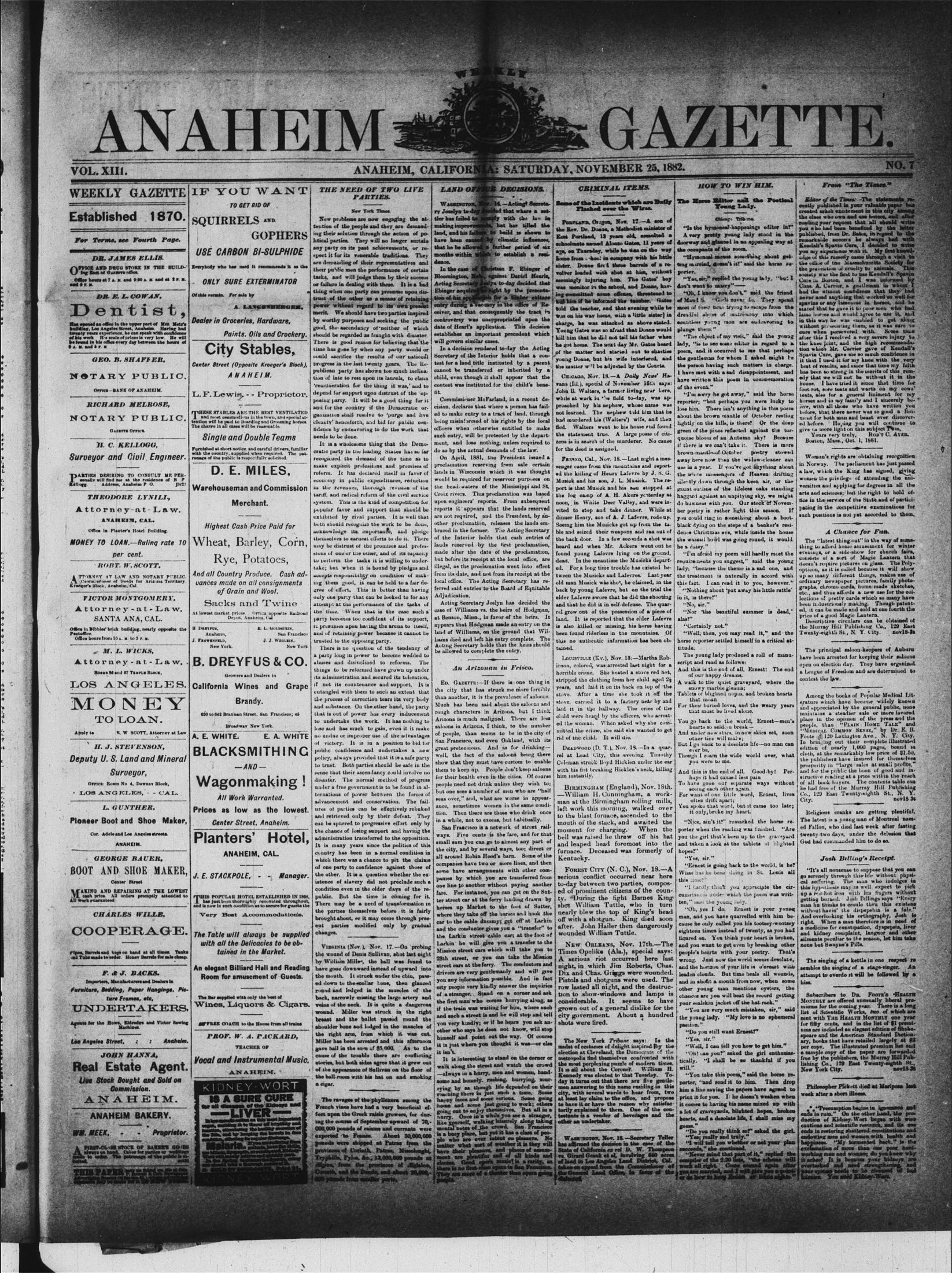
Searchable text
ANAHEIM
VOL. XIII.
WEEKLY GAZETTE
Established 1870.
For Terms, see Fourth Page.
DR. JAMES ELLIS.
OFFICE AND DRUG STORE IN THE BUILDING East of Anaheim office.
Office hours at 7 A.M. and 9:30 A.M. and at 2 P.M. and 5 P.M.
DR. E. L. COWAN,
Dentist,
Has opened an office in the upper part of Mrs. Meta's building, Los Angeles Street, Anaheim. Having had twenty years experience, he can speak with confidence of his work. It's scale of prices is very low. He will be found in his office every day between the hours of 9 A.M. and 5 P.M.
GEO. B. SHAFFER,
NOTARY PUBLIC.
OFFICE—BANK OF ANAHEIM.
RICHARD MELROSE,
NOTARY PUBLIC.
GAZETTE OFFICE.
H. C. KELOGG,
Surveyor and Civil Engineer.
IF YOU WANT
TO GET RID OF
SQUIRRELS AND
GOPHERS
USE CARBON BI-SULPHIDE
Everybody who has used it recommends it as the ONLY SURE EXTERMINATOR
Of this vermin. For sale by
A. LANGENBERGER.
Dealer in Groceries, Hardware,
Paints, Oils and Crockery.
City Stables,
Center Street (Opposite Kroeger's Block),
ANAHEIM.
L.F. Lewis--Proprietor.
THESE STABLES ARE THE BEST VENTILATED
and most commodious in the town, and special attention will be paid to Boarding and Grooming horses.
The charve in all cases will be reasonable.
Single and Double Teams
Furnished at short notice, and careful drivers, familiar with the country, supplied when required. The patronage of the public is respectfully solicited.
D. E. MILES.
NOTARY PUBLIC.
OFFICE—BANK OF ANAHEIM.
RICHARD MELROSE,
NOTARY PUBLIC.
GAZETTE OFFICER.
H. C. KELOGG,
Surveyor and Civil Engineer.
PARTIES DESIRING TO CONSULT ME PERSONALLY WILL FIND ME AT THE RESIDENCE OF B. F. KELOGG.
Address: Anaheim P.O. Jiv2
THEODORE LYNILI,
Attorney-at-Law.
ANAHEIM, CAL.
Office in Planter's Hotel Building.
MONEY TO LOAN.—Ruling rate 10 per cent.
ROBT. W. SCOTT.
ATTORNEY AT LAW AND NOTARY PUBLIC.
Commissioner of Deeds for Arizona Territory Kreeger's Block, Anaheim, Cal.
VICTOR MONTGOMERY,
Attorney-at-Law.
SANTA ANA, CAL.
Office in Dibbles' brick building, nearly opposite the Postoffice.
Office hours from 10 A.M. to 3 P.M.
M. L. WICKS,
Attorney-at-Law.
Rooms 86 and 87 Temple Block.
LOS ANGELES.
MONEY TO LOAN.
Apply to R. W. SCOTT, Attorney at Law.
H. J. STEVENSON,
Deputy U. S. Land and Mineral Surveyor,
Office: Room No 4, Downey Block,
LOS ANGELES, - - CAL.
L. GUNTHER.
Ploneer Boot and Shoe Maker,
Cor. Adele and Los Angeles streets.
ANAHEIM.
GEORGE BAUER,
BOOT AND SHOE MAKER,
Center Street
MAKING AND REPAIRING AT THE LOWEST cash price. All orders promptly attended to.
ANAHEIM.
L. F. Lewis, - Proprietor.
THESE STABLES ARE THE BEST VENTILATED and most commodious in the town, and special attention will be paid to Boarding and Grooming horses. The charve in all cases will be reasonable.
Single and Double Teams
Furnished at short notice, and careful drivers, familiar with the country, supplied when required. The patronage of the public is respectfully solicited.
D. E. MILES,
Warehouseman and Commission Merchant.
Highest Cash Price Paid for Wheat, Barley, Corn, Rye, Potatoes,
And all Country Produce. Cash advances made on all consignments of Grain and Wool.
Sacks and Twine
At lowest market prices. Office opposite Railroad Depot, Anaheim, Cal.
B DARFUS.
E. L. GOLDBREIN,
Anaheim,
San Francisco
J. FROWENFIELD,
New York.
New York
B. DREYFUS & CO.
Growers and Dealers in California Wines and Grape Brandy.
650 to 642 Brannan Street, San Francisco; 45 Broadway New York.
A. E. WHITE.
E. A. WHITE
BLACKSMITHING — AND —
Wagonmaking!
All Work Warranted.
Prices as low as the lowest.
Center Street, Anaheim.
Planters' Hotel,
ANAHEIM, CAL.
J. E. STACKPOLE, - Manager.
THIS POPULAR HOTEL ESTABLISHED IN 1868,
It is a wholesale cratic party in the recognized city make explicit pledge reform. It has economy in public tariff, and radical system. This is popular favor exhibited by both should acknowledge themselves to each may be distrusted slots of one or two to perform the take; but when accepts responsibility them good, free of effort, only one party attempts at the time. Whole party becomes it presumes upon and of retaining trusted to the opposes no undue or impulse of victory. It public confidence policy always pushes to trust. Both sense that their disaster. The under a free governmentations of power advancement arises of parties and retrieved can be spurred the chance of local administration it is many yeas country has been which there was of one party to the other. It is instance of slave condition even public. But t
L. GUNTHER.
Ploneer Boot and Shoe Maker,
Cor. Adele and Los Angeles streets.
ANAHEIM.
GEORGE BAUER,
BOOT AND SHOE MAKER,
Center Street
Making and Repairing at the Lowest Cash price. All orders promptly attended to. All work guaranteed.
CHARLES WILLE,
COOPERAGE.
Pipes, Barrels and keys on hand at all times. Tanks and Tubs made to order. Honey Barrels for sale cheap.
F. & J. BACKS.
Importers, Manufacturers and Dealers in Furniture, Bedding, Paper Hangings, Picture Frames, etc.
UNDERTAKERS.
Agents for the Howe, Eldredge and Victor Sewing Machines.
Los Angeles Street: Anaheim.
JOHN HANNA,
Real Estate Agent.
Live Stock Bought and Sold on Commission.
ANAHEIM.
ANAHEIM BAKERY.
WM. MEEK, Proprietor.
A FIRST-CLASS STOCK OF BAKERY GOODS always on hand. Calves for parties or weddings made to order. The paleness of the public is not tested.
THIS PAPER may be sold at the rate shown above.
All Work Warranted.
Prices as low as the lowest.
Center Street, Anaheim.
Planters' Hotel,
ANAHEIM, CAL.
J. E. STACKPOLE, Manager.
THIS POPULAR HOTEL ESTABLISHED IN 1865, has just been thoroughly renovated throughout, and is now in such condition as to secure for guests the Very Best Accommodations.
The Table will always be supplied with all the Delicacies to be obtained in the Market.
An elegant Billiard Hall and Reading Room for amusement of Guests.
The Bar supplied with only the best of Wines, Liquors & Cigars.
FREE COACH to the House from all trains
PROF. W. A. PACKARD,
TEACHER OF Vocal and Instrumental Music,
ANAHEIM.
KIDNEY-WORT
IS A SURE CURE
for all diseases of the Kidneys and LIVER
It has greatly edified on this most important organ, building it to throw off intollerity and habituation, eliminating the healthy extension of the Milk, and by hugging the bowels in five conditions, affording its regular discharge.
Malaria. Every amount given from milk, bacon, eggs, potatoes, on condition of Kidney-Wort will still cure the disease every minute into a thorough cure of it.
KIDNEY-WORT
THE NEED OF TWO LIVE PARTIES.
New York Times
New problems are now engaging the attention of the people and they are demanding their solution through the action of political parties. They will no longer sustain any party on its past achievements, or respect it for its venerable traditions. They are depanding of their representatives and their public men the performance of certain tasks, and will judge them by their success or failure in dealing with these. It is a bad thing when one party can presume upon distrust of the other as a means of retaining power without regard to its own present merit. We should have two parties inspired by worthy purposes and seeking the public good, the ascendancy of 'neither of which should be regarded as fraught with disaster. There is good reason for believing that the time has gone by when any party would or could sacrifice the results of our national progress in the last twenty years. The Republican party has shown too much inclination of late to rest upon its laurels, to claim 'remuneration for the thing it was,' and to depend for support upon distrust of the opposing party. It will be a good thing for it and for the country if the Democratic organization shall resolve to 'purge and live cleanly' henceforth, and bid for public confidence by endeavoring to do the work that needs to be done.
It is a wholesome thing that the Democratic party in the leading States has so far recognized the demand of the time as to make explicit professions and promises of reform. It has declared itself in favor of
LAND OFFICE DECISIONS.
Washington, Nov. 14.—Acting Secretary Joselyn to-day decided that where a settler has failed to comply with the law in making improvements, but has tillied the land, and his failure to build is shown to have been caused by climatic influences, that he be allowed a further period of six months within which to establish a residence.
In the case of Christian F. Ebinger of Bloomington, Neb., against Daniel Hearle, Acting Secretary Joselyn to-day decided that Ebinger acquired no right by the presentation of his application for a timber culture entry during a vacancy in the office of Receiver, and that consequently the tract in controversy was unappropriated upon the date of Hearl's application. This decision establishes an important precedent which will govern similar cases.
In a decision rendered to-day the Acting Secretary of the Interior holds that a contest for a land title instituted by a parent cannot be transferred or inherited by a child, even though it shall appear that the contest was instituted for the child's benefit.
Commissioner McFarland, in a recent decision, declares that where a person has failed to make entry to a tract of land, through being misinformed of his rights by the local officers when otherwise entitled to make such entry, will be protected by the department, and lose nothing, unless required to do so by the actual demands of the law.
On April, 1881, the President issued a proclamation reserving from sale certain lands in Wisconsin which it was thought
CRIMINAL ITEMS.
Some of the Incidents which are Daily Flashed over the Wires.
Portland, Oregon, Nov. 17.—A son of the Rev. Dr. Doane, a Methodist minister of East Portland, 13 years old, assaulted a schoolmate named Alonzo Gates, 11 years of age, on Thursday, while he was on the way home from school in company with his little sister. Doane first three barrels of a revolver loaded with shot at him, without seemingly injuring him. The Gates' boy was monitor in the school, and Doane, having committed some offense, threatened to kill him if he informed the teacher. Gates told the teacher, and that evening while he was on his way home, with a little sister] in charge, he was attacked as above stated. Young Gates was so afraid that Doane would kill him that he did not tell his father when he got home. The next day Mr. Gates heard of the matter and started out to chastise young Doane, but his wife interfered, and the matter will be adjusted by the Courts.
Chicago, Nov. 18.—A Daily News' Havana (Ill.), special of November 16th says: John B. Walters, a farmer living near here, while at work in the field to-day, was approached by his nephew, whose name was not learned. The nephew told him that he had murdered his ('Walters') wife, and then fled. Walters went to his home rud found the statement true. A large posse of citizens is in search of the murderer. No cause for the deed is assigned.
Pressno, Cal., Nov. 18.—Last night a messenger came from the mountains and reported the killing of Henry Lafevre by J. S. G.
tion of late to rest upon its laurels, to claim 'remuneration for the thing it was,' and to depend for support upon distrust of the opposing party. It will be a good thing for it and for the country if the Democratic organization shall resolve to 'purge and live cleanly' henceforth, and bid for public confidence by endeavoring to do the work that needs to be done.
It is a wholesome thing that the Democratic party in the leading States has so far recognized the demand of the time as to make explicit professions and promises of reform. It has declared itself in favor of economy in public expenditures, reduction in the revenues, thorough revision of the tariff, and radical reform of the civil service system. This is the kind of competition for popular favor and support that should be exhibited by rival parties. It is well that both should recognize the work to be done, acknowledge its importance, and pledge themselves to earnest efforts to do it. There may be distrust of the promises and professions of one or the other, and of its capacity to perform the tasks it is willing to undertake; but when it is bound by pledges and accepts responsibility on condition of making them good, it can be held to a fair degree of effort. This is better than having only one party that can be looked to for any attempt at the performance of the tasks of the time. When that is the case such a party becomes too confident of its support, it prepares upon having the arena to itself, and of retaining power because it cannot be trusted to the opposing party.
There is no question of the tendency of a party long in power to become wedded to abuses and disinclined to reforms. The things to be reformed have grown up under its administration and secured its toleration, if not its countenance and support. It is entangled with them to such an extent that the process of correction tears its very body and substance. On the other hand, the party that is out of power has every inducement to undertake the work. It has nothing to lose and has much to gain, even if it make no undue or improper use of the advantages of victory. It is in a position to bid for public confidence and undertakes a new policy, always provided that it is a safe party to trust. Both parties should be safe in the sense that their ascendancy could involve no disaster. The normal method of progress under a free government is to be found in alternations of power between the forces of advancement and conservation. The failures of parties can be effectively rebuked and retrieved only by their defeat. They can be spurred to progressive effort only by the chance of losing support and having the administration transferred to the opposition. It is many years since the politics of this country has been in a normal condition in which there was a chance to pit the claims of one party to confidence against those of the other. It is a question whether the existence of slavery did not preclude such a condition even in the older days of the republic. But the time is coming for it.
Chicago, Nov. 18.—A Daily News' Havana (Ill.), special of November 16th says: John B. Walters, a farmer living near here, while at work in the field today, was approached by his nephew, whose name was not learned. The nephew told him that he had murdered his (Walters') wife, and then fled. Walters went to his home rud found the statement true. A large posse of citizens is in search of the murderer. No cause for the deed is assigned.
Fresno, Cal., Nov. 18.—Last night a messenger came from the mountains and reported the killing of Henry Lafevre by J. S. G. Musick and his son, J. L. Musick. The report is that Musick and his son stopped at the log camp of A. H. Akers yesterday at noon, in White Deer Valley, and were invited to stop and take dinner. While at dinner Henry, son of A. J. Lafevre, rode up. Seeing him the Musicks got up from the table and seized their weapons and ran out of the back door. In a few seconds a shot was heard and when Mr. Ackers went out he found young Lafevre lying on the ground, dead. In the meantime the Musicks departed. For a long time trouble has existed between the Musicks and Lafevres. Last year old man Musick was shot, he claimed, in the back by young Lafevre, but on the trial the elder Lafevre swore that he did the shooting and that he did it in self-defense. The quarrel grew out of the possession of a piece of land. It is reported that the elder Lafevre is also killed or missing, his horse having been found riderless in the mountains. Of this no authentic information has been obtained.
Louisville (Kv.), Nov. 18:—Martha Robinson, colored, was arrested last night for a horrible crime. She heated a stove red hot, stripped the clothing from her child aged 23 years, and laid it on its back on top of the stove. After a time she took it off the stove, carried it to a factory near by and laid it in the hallway. The cries of the child were heard by the officers, who arrested the woman. When asked why she committed the crime, she said she wanted to get rid of the child. It will die.
Deadwood (D. T.), Nov. 18:—In a quarrel at Lead City, this evening Timothy Coleman struck Boyd Hicklen under the ear with his fist breaking Hicklen's neck, killing him instantly.
Birmingham (England), Nov. 18th.—William H. Cunningham, a workman at the Birmingham rolling mills, left work this morning, walked over to the blast furnace, ascended to the mouth of the stack, and awaited the moment for charging. When the bell was raised he threw off his hat and leaped head foremost into the furnace. Deceased was formerly of Kentucky.
Forest City (N.C.), Nov. 18:—A serious conflict occurred near here to-day between two parties, composed of prominent citizens of the county. During the fight Barnes King
advancement and conservation. The failures of parties can be effectively rebuked and retrieved only by their defeat. They can be spurred to progressive effort only by the chance of losing support and having the administration transferred to the opposition. It is many years since the politics of this country has been in a normal condition in which there was a chance to pit the claims of one party to confidence against those of the other. It is a question whether the existence of slavery did not preclude such a condition even in the older days of the republic. But the time is coming for it. There may be a need of transformation in the parties themselves before it is fairly brought about, or it may come through present parties modified only by gradual changes.
VIRGINIA (Nov.). Nov. 17.—On probing the wound of Denis Sullivan, shot last night by William Miller, the ball was found to have gone downward instead of upward into the mouth. It struck under the chin, passed down to the scollar bone, then glanced round and lodged in the muscles of the back, narrowly missing the large artery and veins of the neck. It is quite a dangerous wound. Miller was struck in the right breast and the bullet passed round the shoulder bone and lodged in the muscles of the right arm, from which it was cut. Miller has been arrested and this afternoon gave bail in the sum of $5,000. As to the cause of the trouble there are conflicting stories, but both sides agree that it grew out of the appearance of Sullivan on the floor of the ball-room with his hat on and smoking a cigar.
The ravages of the phylloxera among the French vines have had a very beneficial effect upon the Greek raisin growers, for during the course of September upward of 70,000,000 pounds of raisins and currants were exported to France. About 30,000,000 pounds were shipped at Patras from the provinces of Corinth, Patras, Missolonghi, Tryphilla, Pylha, &c., 12,000,000 pounds at Algina, from the provinces of Hegalen, Corinth, and the Dande, and about 20,000,000 pounds from smaller ports.
San Francisco is a network of street railways. Five cents is the fare, and for that small sum you can go to almost any part of the city, and by several ways, too; direct or all around Robin Hood's barn. Some of the companies have two or more lines, and then some have arrangements with other companies by which you are transferred from one line to another without paying another fare. For instance, you can get on the Sutter street car at the ferry landing drawn by horses up Market to the foot of Sutter, where they take off the horses and hook the car to the cable dummy; get off at Larkin and the conductor gives you a "transfer" to the Larkin street cable car; at the foot of Larkin he will give you a transfer to the Mission street cars which will take you to 28th street, or you can take the Mission street cars at the ferry. The conductors and drivers are very gentlemanly and will give you any information possible. And in fact city people very kindly answer the inquiries of a stranger. Stand on a corner and ask the first man who comes hurrying along, as if the train was waiting for him, where such a street is and he will stop and tell you very kindly; or if he hears you ask another who says he does not know, will stop himself and point out the way. Of course it is just where you thought it was—or else it isn't.
It is interesting to stand on the corner or walk along the street and watch the crowd —always in a hurry, men and women, handsome and homely. rushing, hurrying, sourrying by as though life depended on their reaching there in just such a time. Some happy faces and some serious. Some going home and some just going to work; others going out to enjoy themselves. But all in a hurry. Once in a while you see a stranger, like yourself, walking leisurely along taking mental notes of the crowd. San Francisco is a busy place, but yet it has a class of people who are ever intent on pleasure. No matter what sort of weather it is they will have their pleasure, and places of amusement are plentiful and of all kinds and classes. Good open music is a rarity, as there is no first-class opera in San Francisco. They are more of a theater than opera going people.
Man at the Birmingham rolling mills, left work this morning, walked over to the blast furnace, ascended to the mouth of the stack, and awaited the moment for charging. When the bell was raised he threw off his hat and leaped head foremost into the furnace. Deceased was formerly of Kentucky.
FOREST CITY (N.C.), Nov. 18.—A serious conflict occurred near here to-day between two parties, composed of prominent citizens of the county. During the fight Barnes King shot William Tuttle, who in turn nearly blew the top of King's head off with a shotgun. King died soon after. John Hailer then dangerously wounded William Tuttle.
NEW ORLEANS, Nov. 17th.—The Times Opelike (Ala.), special says: A serious riot occurred here last night, in which Jim Roberts, Chas. Dix and Chas. Griggs were wounded. Pistols and shotguns were used. The row lasted all night, and the destruction to show-windows and lamps is considerable. It seems to have grown out of a general dislike for the city government. About a hundred shots were fired.
The New York Tribune says: In the midst of ecstacies of delight inspired by the election at Cleveland, the Democrat of the metropolis find themselves confronted with the most perplexing puzzle of modern times. It is all about the Coroner. William H. Kennedy was elected to that Tuesday. Today it turns out that there are five gentlemen answering to this name residing in this city, with several wards to hear from, two at least lay claim to the office, and propose to have it or have the reason why satisfactorily explained to them. One of the contestants is a vendor of beverages and the other an undertaker.
WASHINGTON, Nov. 18.—Secretary Teller has affirmed the decision in the case of the State of California ex ref D. W. Thompson va Girard Grank et al involving 640 acres of land in Los Angeles Land District, Cal., taken on appeal from the Commissioner of the General Land Office, in favor of the decision.
GAZETTE.
NO. 7
MINAL ITEMS.
Residents which are Daily News over the Wires.
Oregon, Nov. 17.—A son of Doane, a Methodist minister of 13 years old, assaulted a man Alozo Gates, 11 years of age, while he was on the way in company with his little friend three barrels of a reewith shot at him, withoutiring him. The Gates' boy the school, and Doane, have some offense, threatened toformed the teacher. Gates or, and that evening while he home, with a little sister] in attacked as above stated. so afraid that Doane would did not tell his father when the next day Mr. Gates heard and started out to chastise but his wife interfered, and be adjusted by the Courta.
Nov. 18.—A Daily News' Headline of November 16th says: "a farmer living near here, on the field to-day, was apis nephew, whose name was the nephew told him that he is (Walters') wife, and then went to his home sud found true. A large posse of citi- of the murderer. No cause assigned."
Nov. 18.—Last night a mesmum the mountains and report of Henry Lafevre by J. S. G.
HOW TO WIN HIM.
The Horse Editor and the Poetical Young Lady.
Chicago Tribune.
"Is the hymenal-happenings editor in?"
A very pretty young lady stood in the doorway and glanced in an appealing way at the occupants of the room.
"Hymenal means something about getting married, doesn't it?" said the horse reporter.
"Yes, sir," replied the young lady, "but I don't want to marry."
Oh, I know you don't," said the friend of Maud S. "Girl never do. They spend most of their time trying to escape from the dreavful abyss of matrimony into which countless young men are endeavoring to plunge them."
"The object of my visit," said the young lady, "is to see some editor in regard to a poem, and it occurred to me that perhaps the gentleman for whom I asked might be the person having such matters in charge. I have met with a sad disappointment, and have written this poem in commemoration of the event."
"I'm sorry he got away," said the horse reporter; "but perhaps you were lucky to lose him. There isn't anything in this poem about the brown mantle of October resting lightly on the hills; is there? Or the deep green of the pines reflected against the torquoise bloom of an Autumn sky? Because if there is we can't take it. There is more brown-mantle-of-October poetry stowed away here now than the widow-cleaner can use in a year. If you've got anything about the white messengers of Heaven drifting"
From "The Times."
Editor of the Times:—The statements recently published in your valuable paper has created much excitement in this city among the class who own and use horses, and after reading your request that all should write you who had been benefited by the letter published, from Dr. Batax, in regard to the remarkable success he always had with Kendall's Spavin Cure, I decided to write you my experience with it. My first knowledge of this remedy came through a visit to the office of the Massachusetts Society for the prevention of cruelty to animals. This society was the first to use Kendall's Spavin Cure in Boston, and I was informed by Chas A. Carrier, a gentleman in whom I had the utmost confidence that they had never used anything that worked so well for spavins or any lameness in horses, and he stated that he gave it to poor men who had lame horses and would agree to use it, and in this way he was enabled to get along without presenting them, so it was sure to cure when persevered with. Some time after this I received a very severe injury to the knee joint, and the high recommendation which Mr. Carrier gave of Kendall's Spavin Cure, gave me so much confidence in it that I used it for my knee with the very best of results, and since that time my faith has been so strong in the merits of this remedy that we will not be without it in the house. I have tried it since that time for foot-rot, sore teats and warts on my cows' teats, also for a general liniment for my horses and in my family and I sincerely believe, with all those who have written you before, that there never was so good a filament for both man and beast ever discovered before. Hoping you will continue to give us more light on this subject Tom.
Yours very truly, Roa't C. Ayer.
Boston, Mass., Oct. 1, 1881.
Woman's rights are obtaining recognition in Norway. The parliament has just passed a law, which the King has signed, giving
Nov. 18.—A Daily News' Headline of November 16th says: "a farmer living near here, in the field to-day, was apiece nephew, whose name was the nephew told him that he (Walters) wife, and then went to his home rud found true. A large posse of citizens of the murderer. No cause assigned."
Nov. 18.—Last night a mess on the mountains and report of Henry Lafevre by J. S. G. Johnson, J. L. Musick. The reckless and his son stopped at A. H. Akers yesterday at Deer Valley, and were in and take dinner. While at son of A. J. Lafevre, rode up. Musicks got up from the taunt their weapons and ran out of In a few seconds a shot was on Mr. Ackers went out he Lafevre lying on the ground, beastime the Musicks depart-time trouble has existed becks and Lafevres. Last year was shot, he claimed, in the Lafevre, but on the trial the wore that he did the shooting it in self-defense. The quarrel the possession of a piece reported that the elder Lafevre or missing, his horse having arrested in the mountains. Ofotic information has been obtained.
Kv.), Nov. 18:—Martha Robb was arrested last night for a She heated a stove red hot, nothing from her child aged 23 and it on its back on top of the time she took it off the hit to a factory near by and hallway. The cries of the old by the officers, who arrest-When asked why she comme, she said she wanted to get It will die.
D. T.), Nov. 18:—In a quarantity, this evening. Timothy Boyd Hicklen under the ear seaking Hicklen's neck, killing
AM (England), Nov. 18th. M. Cunningham, a work-wirmingham rolling mills, is morning, walked over furnace, ascended to the stack, and awaited the charging. When the head he threw off his hat ahead foremost into the deceased was formerly of
TY (N. C.), Nov. 18.—A dict occurred near here when two parties, composent citizens of the coun-county fight Barnes King
"I'm sorry he got away," said the horse reporter; "but perhaps you were lucky to lose him. There isn't anything in this poem about the brown mantle of October resting lightly on the hills, is there? Or the deep green of the pines reflected against the torquise bloom of an Autumn sky! Because if there is we can't take it. There is brown-mantle-of-October poetry stowed away here now than the wilow-cleaner can use in a year. If you've got anything about the white messengers of Heaven drifting silently down through the keen air, or the gaunt outline of the lifeless oaks standing haggard against an unpitying sky, we might do business with you. Our stock of November poetry is rather light this season. If you could ring in something about a boot-black dying on the steps of a banker's residence Christmas eve, while inside the house the wassail bowl was going round, it would be a daisy."
"I'm afraid my poem will hardly meet the requirements you suggest," said the young lady, "because the theme is a sad one, and the treatment is naturally in accord with this fact. I can read it to you, however."
"Nothing about 'put away his little rattle' in it, is there?"
"No, sir."
"Nor 'the beautiful summer is dead,' alas?"
"Certainly not."
"Well, then, you may read it," and the horse reporter settled himself in a critical attitude.
The young lady produced a roll of manuscript and read as follows:
And this is the end of all, Ernest! The end of our happy dreams.
A walk to the quiet graveyard, where the snowy marble gleams;
Tablets of blighted hopes, and broken hearts that mean
For their buried loves, and the weary years that must be lived alone.
You go back to the world, Ernest—men's hearts so seldom break—and under new stars, in new skies set, soon other ties will make;
But I go back to a desolate life—no man can ever be.
Though I roam the wide world over, what you were to me.
And this is the end of all. Good-by! Perhaps it had caused less pain.
To have gone our separate ways without seeing each other again.
For want of one little word, Ernest, lives often drift apart;
You spoke that word, but it came too late; it only broke my heart.
"Nice, ain't it?" remarked the horse reporter when the reading was finished. "Are you the girl that's been up to the graveyard and taken a look at the tablets of blighted hopes?"
"Yes, sir."
"Ernest is going back to the world, is he? What has he been doing in St. Louis all this time?"
"I hardly think you appreciate the circumstances under which the poem was written that we will not be without it in the house. I have tried it since that time for foot-rot, sore teats and warts on my coats' tests, also for a general limiment for my horses and in my family and I sincerely believe, with all those who have written you before, that there never was so good a limiment for both man and beast ever discovered before. Hoping you will continue to give us more light on this subject Tom.
Yours very truly, Roat C. Ayer.
Boston, Mass., Oct. 1, 1881.
Woman's rights are obtaining recognition in Norway. The parliament has just passed a law, which the King has signed, giving women the privilege of attending the universities and applying for degrees in all the arts and sciences; but the right to hold office in the service of the State and of participating in the competitive examinations for such positions is not yet accorded to them.
A Chance for Fun.
The "latest thing out" in the way of something to afford home amusement for winter evenings, or a side-show for church fairs, consists of a sort of Magic Lantern that doesn't require pictures on glass. The Poly-option, as it is called because it will show up so many different things, makes use of ordinary newspaper pictures, family photographs, chroma cards, home-made sketches, etc., and thus affords a new use for the collections of pretty cards which so many have been industriously making. Though patented, it can be made and sold at one fourth the price of a good Magic Lantern.
Descriptive circulations can be obtained of the Murray Hill Publishing Co., 129 East Twenty-eighth St., N.Y.C., nov18-3s
The principal saloon-keepers of Auburn have been arrested for keeping their saloons open on election day. They have organized a League of Freedom and are determined to contest the law.
Among the books of Popular Medical Literature which have become widely known and appreciated by the general public, none maintains a steadier sale or more favored place in the opinion of the press and the people, than "PLAIN HOME TALK" and "MEDICAL COMMON SENSE," by Dr. E.B.Foote of 120 Lexington Ave., N.Y.C. In bringing out their complete illustrated edition of nearly 1,000 pages, bound in cloth, at the remarkably low price of $1.50,the publishers have insured for themselves prosperity in "large sales at small profits," and for the public the boon of good and instructive reading at a price within the reach of all book-buyers. The contents table can be had free of the Murray Hill Publishing Co., 129 East Twenty-eighth St., N.Y.C., nov18-3s
Religious cranks are getting plentiful. The latest is a young man of Montreal named Fallon, who died last week after fasting twenty-two days, under the delusion that God had commanded him to do so.
Josh Billing's Receipt.
"It's all nonsense to suppose that you can go serenely through this life without physical suffering. The man who indulges in this hypothesis may as well expect to pick up a red-hot iron with his fingers without getting burned. Josh Billing says "Every
Firmingham rolling mills,
is morning, walked over
urnace, ascended to the
stack, and awaited the
charging. When the
head foremost into the
ceased was formerly of
City (N.C.), Nov. 18.—A
dict occurred near here
when two parties, composent citizens of the countle of the fight Barnes King
in Tuttle, who in turn
the top of King's head
shotgun. King died soon
Hailer then dangerously
William Tuttle.
Leans, Nov. 17th.—The
like (Ala.), special says:
riot occurred here last
which Jim Roberts, Chas.
Grings were wounded.
shotguns were used. The
night, and the destrucwindows and lamps is
It seems to have
a general dislike for the
ment. About a hundred
reared.
York Tribune says: In the
ties of delight inspired by the
raveland, the Democrats of the
themselves confronted with
existing puzzle of modern times.
the Coroner. William H.
selected to that Tuesday. Tothat there are five gentleto this name residing in this
mural wards to hear from, two
him to the office, and propose
have the reason why satisfacto them. One of the couender of beverages and the
staker.
Nov. 18.—Secretary Teller
the decision in the case of the
minor cz rel D. W. Thompson
ek et al, involving 640 acres
Angles Land District, Cal.
from the Commissioner of
and Office, in favor of the
often drift apart;
You spoke that word, but it came too late;
it only, broke my heart.
"Nice, ain't it?" remarked the horse reporter when the reading was finished. "Are you the girl that's been up to the graveyard and taken a look at the tablets of blighted hopes!"
"Yes, sir."
"Ernest is going back to the world, is he? What has he been doing in St. Louis all this time?"
"I hardly think you appreciate the circucumstances under which the poem was writen," said the young lady.
"Oh, yes I do. Ernest is your young man, and you have quarrelled with him because he only called you his tootsey-wootsey eighteen times instead of twenty, as you had figured on. You think your heart is broken, and you want to get even by breaking other people's hearts with your poetry. That's wrong. Just now the world seems desolate, and the horizon of your life is o'ercast with leaden clouds. But time heals all wounds, and in about a month from now, when some other young man mentions oysters, the chances are you will beat the record getting your sealskin jacket off the hat-rack."
"You are very much mistaken, sir," said the young lady. "My love is no ephemeral passion."
"Do you still want Ernest?"
"Yes, sir."
"Well, I can tell you how to get him."
"Oh! can you?" asked the girl enthusiastically. "I shall be so thankful if you will."
"You take this poem," said the horse reporter, "and send it to him. Then drop him a line saying the papers have agreed to print it for you. If he doesn't weaken when it comes to having his name mixed up with a lot of craveyards, blighted hopes, broken hearts, and a desolate life, I shall miss my goose."
"Do you really think so?" asked the girl.
"Yes, really and truly."
"I will tell you whether or not your plan succeeds," she continued.
"Never mind that part of it," replied the compiler of the 2:20 lists, "the scheme will work all right. Come around again after you are married, and I will give you a pointer on how to keep Exist or limits nights."