anaheim-gazette 1882-09-16
Scanned page
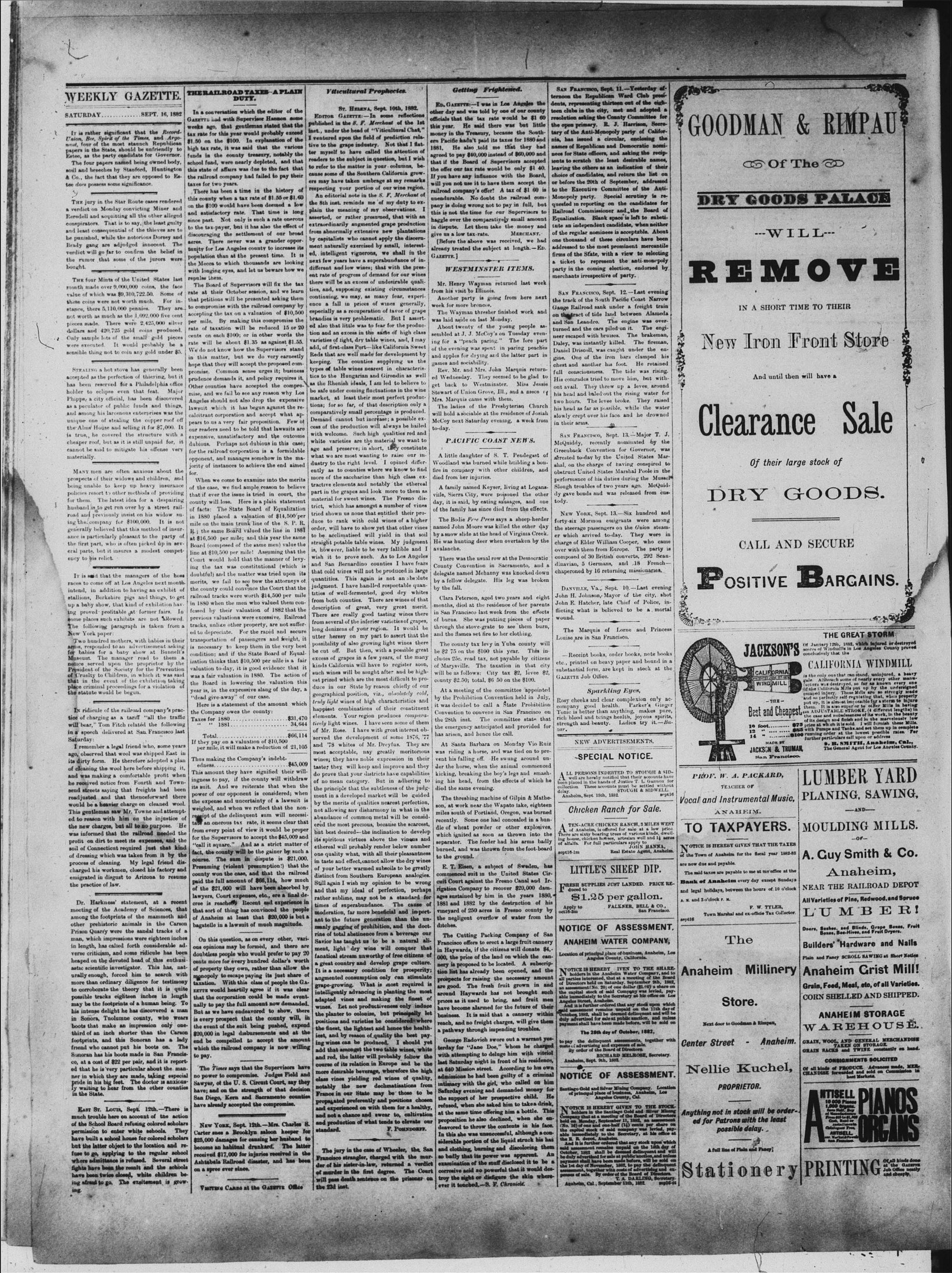
Searchable text
WEEKLY GAZETTE.
SATURDAY. SEPT. 16, 1882
It is rather significant that the Record-Union, Bee, Spirit of the Times, and Argonaut, four of the most stannch Republican papers in the State, should be unfriendly to Eatee, as the party candidate for Governor.
The four papers named being owned body, soul and breeches by Stanford, Huntington & Co., the fact that they are opposed to Eatee does possess some significance.
The jury in the Star Route cases rendered a verdict on Monday convicting Miner and Reredell and acquitting all the other alleged conspirators. That is to say, the least guilty and least consequential of the thieves are to be punished, while the notorious Dorsey and Brady gang are adjudged innocent. The verdict will go far to confirm the belief in the rumor that some of the jurors were bought.
The four Mints of the United States last month made over 9,000,000 coins, the face value of which was $9,310,722.50. Some of these coins were not worth much. For instance, there 5,110,000 pennies. They are not worth as much as the 1,092,000 five cent pieces made. There were 2,425,000 silver dollars and 420,725 gold coins produced. Only sample lots of the small gold pieces were executed. It would probably be a sensible thing not to coin any gold under $5.
Stealing a hot stove has generally been accepted as the perfection of thieving, but it has been reserved for a Philadelphia office holder to eclipse even that feat. Major Phipps, a city official, has been discovered as a peculator of public funds and things, and among his larcenous enterprises was the unique one of stealing the copper roof off the Alms House and selling it for $7,000. It is true, he covered the structure with a cheaper roof, but as it is still unpaid for, it cannot be said to mitigate his offense very materially.
Many men are often anxious about the
THERAILROAD TAXES - APLAIN DUTY.
In a conversation which the editor of the Gazette had with Supervisor Hannon some weeks ago, that gentleman stated that the tax rate for this year would probably exceed $1.50 on the $100. In explanation of the high tax rate, it was said that the various funds in the county treasury, notably the school fund, were nearly depleted, and that this state of affairs was due to the fact that the railroad company had failed to pay their taxes for two years.
There has been a time in the history of this county when a tax rate of $1.55 or $1.60 on the $100 would have been deemed a low and satisfactory rate. That time is long since past. Not only is such a rate onerous to the tax-payer, but it has also the effect of discouraging the settlement of our broad acres. There never was a grander opportunity for Los Angeles county to increase its population than at the present time. It is the Mecca to which thousands are looking with longing eyes, and let us beware how we repulse them.
The Board of Supervisors will fix the tax rate at their October session, and we learn that petitions will be presented asking them to compromise with the railroad company by accepting the tax on a valuation of $10,500 per mile. By making this compromise the rate of taxation will be reduced 15 or 20 cents on each $100; or in other words the rate will be about $1.35 as against $1.55. We do not know how the Supervisors stand in this matter, but we do very earnestly hope that they will accept the proposed compromise. Common sense urges it; business prudence demands it, and policy requires it. Other counties have accepted the compromise, and we fail to see any reason why Los Angeles should not also drop the expensive lawsuit which it has begun against the recalcitrant corporation and accept what appears to us a very fair proposition. Few of our readers need to be told that lawsuits are expensive, unsatisfactory and the outcome dubious. Perhaps not dubious in this case; for the railroad corporation is a formidable opponent, and manages somehow in the majority of instances to achieve the end aimed for.
St. Hugh Editor Gazette published in the St. Inst., under the head I ventured upon tive to the grape mer myself to hail readers to the sub- to refer to the ma- cause some of the ers may have taken respecting your p-
An editorial note on the 8th inst. reminds plain the meaning asserted, or rather extraordinarily away from abnormally en- by capitalists whi ment naturally ex- ed, intelligent vi- next few years ha- different and low ent rate of progres- there will be an en ties, and supposite continuing, we mu nce a fall in p especially as a reco brandics is very p ed also that little tion and an excess varieties of light, c add, of first-class Reds that are well keeping. The co types of table wintics to the Hung- as the Rhenish id- be safe under com market, at least tions; for so far, comparatively sm- Demand cannot occess of the produc with welcome. S white varieties a age and preserv what we are most dustry to the right ently as to count
Many men are often anxious about the prospects of their widows and children, and being unable to keep up heavy insurance policies resort to other methods of providing for them. The latest idea for a despairing husband is to get run over by a street railroad and previously insist on his widow suing the company for $100,000. It is not generally believed that this method of insurance is particularly pleasant to the party of the first part, who is often picked up in several parts, but it insures a modest competency to his relict.
It is said that the managers of the boss races to come off at Los Angeles next month intend, in addition to having an exhibit of stallions, Borkshire pigs and things, to get up a baby show, that kind of exhibition having proved prolific at former fairs. In some places such exhibits are not allowed. The following paragraph is taken from a New York paper:
Two hundred mothers, with babies in their arms, responded to an advertisement asking for babies for a baby show at Bunnell's Museum. The manager read to them a notice served upon the proprietor by the President of the Society for the Prevention of Cruelty to Children, in which it was said that in the event of the exhibition taking place criminal proceedings for a violation of the statute would be begun.
In ridicule of the railroad company's practice of charging as a tariff "all the traffic will bear," Tom Fitch related the following in a speech delivered at San Francisco last Saturday:
I remember a legal friend who, some years ago, observed that wool was shipped East in its dirty form. He therefore adopted a plan of cleaning the wool here before shipping it, and was making a comfortable profit when he received notice from Fourth and Townsend streets saying that freights had been readjusted and that thenceforward there would be a heavier charge on cleaned wool. This gentleman saw Mr. Towne and attempted to reason with him on the injustice of the new charges, but all to no purpose. He was informed that the railroad needed the profit on dirt to meet its expenses, and the soil of Connecticut required just that kind of dressing which was taken from it by the process of cleaning. My legal friend discharged his workmen, closed his factory and emigrated in disgust to Arizona to resume the practice of law.
Prudence demands it, and policy requires it. Other counties have accepted the compromise, and we fail to see any reason why Los Angeles should not also drop the expensive lawsuit which it has begun against the recalcitrant corporation and accept what appears to us a very fair proposition. Few of our readers need to be told that lawsuits are expensive, unsatisfactory and the outcome dubious. Perhaps not dubious in this case; for the railroad corporation is a formidable opponent, and manages somehow in the majority of instances to achieve the end aimed for.
When we come to examine into the merits of the case, we find ample reason to believe that if ever the issue is tried in court, the county will lose. Here is a plain statement of facts: The State Board of Equalization in 1880 placed a valuation of $14,500 per mile on the main trunk line of the S. P. R.; the same Board valued the line in 1881 at $16,500 per mile; and this year the same Board (composed of the same men) value the line at $10,500 per mile! Assuming that the Court would hold that the manner of levying the tax was constitutional (which is doubtful) and the matter was tried upon its merits, we fail to see how the attorneys of the county could convince the Court that the railroad tracks were worth $14,500 per mile in 1880 when the men who valued them confessed by their valuation of 1882 that the previous valuations were excessive. Railroad tracks, unlike other property, are not suffered to depreciate. For the rapid and secure transportation of passengers and weight, it is necessary to keep them in the very best condition; and if the State Board of Equalization thinks that $10,500 per mile is a fair valuation to-day, it is good evidence that it was a fair valuation in 1880. The action of the Board in lowering the valuation this year is, in the expressive slang of the day, a "dead give-away" of our case.
Here is a statement of the amount which the Company owes the county:
Taxes for 1880...$31,470
" " 1881...34,644
Total...$66,114
If they pay on a valuation of $10,500 per mile, it will make a reduction of 21,105
Thus making the Company's indebtedness...$45,009
This amount they have signified their willingness to pay, if the county will withdraw its suit. And we reiterate that when the power of our opponent is considered; when the expense and uncertainty of a lawsuit is weighed, and when we reflect that the non-receipt of the delinquent sum will necessitate an onerous tax rate, it seems clear that from every point of view it would be proper for the Supervisors to accept the $45,009 and "call it square." And as a strict matter of fact, the county will be the gainer by such a course. The sum in dispute is $21,000. Presuming (violent presumption!) that the county won the case, and that the railroad paid the full amount of $66,114, how much of the $21,000 will have been absorbed by lawyers, Court expenses, etc., ere a final deprudence demands it, and policy requires it. Other counties have accepted the compromise, and we fail to see any reason why Los Angeles should not also drop the expensive lawsuit which it has begun against the recalcitrant corporation and accept what appears to us a very fair proposition. Few of our readers need to be told that lawsuits are expensive, unsatisfactory and the outcome dubious. Perhaps not dubious in this case; for the railroad corporation is a formidable opponent, and manages somehow in the majority of instances to achieve the end aimed for.
When we come to examine into the merits of the case, we find ample reason to believe that if ever the issue is tried in court, the county will lose. Here is a plain statement of facts: The State Board of Equalization in 1880 placed a valuation of $14,500 per mile on the main trunk line of the S. P. R.; the same Board valued the line in 1881 at $16,500 per mile; and this year the same Board (composed of the same men) value the line at $10,500 per mile! Assuming that the Court would hold that the manner of levying the tax was constitutional (which is doubtful) and the matter was tried upon its merits, we fail to see how the attorneys of the county could convince the Court that the railroad tracks were worth $14,500 per mile in 1880 when the men who valued them confessed by their valuation of 1882 that the previous valuations were excessive. Railroad tracks, unlike other property, are not suffered to depreciate. For the rapid and secure transportation of passengers and weight, it is necessary to keep them in the very best condition; and if the State Board of Equalization thinks that $10,500 per mile is a fair valuation to-day, it is good evidence that it was a fair valuation in 1880. The action of the Board in lowering the valuation this year is, in the expressive slang of the day, a "dead give-away" of our case.
Here is a statement of the amount which the Company owes the county:
Taxes for 1880...$31,470
" " 1881...34,644
Total...$66,114
If they pay on a valuation of $10,500 per mile, it will make a reduction of 21,105
Thus making the Company's indebtedness...$45,009
This amount they have signified their willingness to pay, if the county will withdraw its suit. And we reiterate that when the power of our opponent is considered; when the expense and uncertainty of a lawsuit is weighed, and when we reflect that the non-receipt of the delinquent sum will necessitate an onerous tax rate, it seems clear that from every point of view it would be proper for the Supervisors to accept the $45,009 and "call it square." And as a strict matter of fact, the county will be the gainer by such a course. The sum in dispute is $21,000. Presuming (violent presumption!) that the county wonthe case,andthattherailroadpaidthefullamountof$66,114,howmuchofthe$21,000willhavebeenabsorbedbylawyers,Courtexpenses,eetc.,ereafinaldeprudencedemandsit,andpolicyrequiresit.Othercountieshavecertainedthecompromise,andwefailtoseeanyreasonwhyLosAngelesshouldnotalsodroptheexpensivelawsuitsareexpensive Unsatisfactoryandtheoutcomedubious.Personalitiestoachievetheendaimedfor.
When we come to examine into the merits ofthecase,thefindamplereasontobelievethatifevertheissueistriedincourt,thecountwilllose.Hereisplainstatementoffacts:TheStateBoardOfEqualizationin1880placedavaluationof$14,500permileonthemaintrunklineoftheS.P.R.R.;thesameBoardvaluedthelinein1881at$16,500permile;andthisyearthesameBoard(composedofthesamemen)valuethelineat$10,500permile!AssumingthattheCourtwouldholdthatthe manneroflevyingthetaxwasconstitutional(whichisdoubtful)和themattercouldconvincetheCourtthattherailroadtrackswereworth$14,500permileonthemaintrunklineoftheS.P.R.R.;thesameBoardvaluedthelinein1881at$16,500permile;andthisyearthesameBoard(composedofthesamemen)valuethelineat$10,500permile!AssumingthattheCourtwouldholdthatthe manneroflevyingthetaxwasconstitutional(whichisdoubtful)和themattercouldconvincetheCourtthattherailroadtrackswereworth$14,500permileonthemaintrunklineoftheS.P.R.R.;thesameBoardvaluedthelinein1881at$16,500permile;andthisyearthesameBoard(composedofthesamemen)valuethelineat$10,5
Dr. Harkness' statement, at a recent meeting of the Academy of Sciences, that among the footprints of the mammoth and other prehistoric animals in the Carson Prison Quarry were the sandal tracks of a man, which impressions were eighteen inches in length, has called forth considerable adverse criticism, and some ridicule has been heaped on the devoted head of this enthusiastic scientific investigator. This has naturally enough, forced him to search with more than ordinary diligence for testimony to corroborate the theory that it is quite possible tracks eighteen inches in length may be the footprints of a human being. To his intense delight he has discovered a man in Sonora, Tuolumne county, who wears boots that make an impression only one-third of an inch shorter than the Carson footprints, and this Sonoran has a lady friend who cannot put his boots on. The Sonoran has his boots made in San Francisco, at a cost of $22 per pair, and it is reported that he is very particular about the manner in which they are made, taking especial pride in his big feet. The doctor is anxiously waiting to hear from the other counties in the State.
EAST ST. LOUIS, Sept. 12th.—There is much trouble here on account of the action of the School Board refusing colored scholars permission to enter white schools. They have built a school house for colored scholars but the latter object to the location and refuse to go, applying to the regular school where admittance is refused. Several street fights have been the result and the schools have been twice closed, white children being afraid to go. The excitement is growing.
On this question, as on every other, various opinions may be formed, and there are doubtless people who would prefer to pay 20 cents more for every hundred dollar's worth of property they own, rather than allow the monopoly to escape paying its just share of taxation. With this class of people the Gazette would heartily agree if it was clear that the corporation could be made eventually to pay the full amount now demanded. But as we have endeavored to show, there is every prospect that the county will, in the event of the suit being pushed, expend $20,000 in legal disbursements and at the end be compelled to accept the amount which the railroad company is now willing to pay.
The Times says that the Supervisors have no power to compromise. Judges Field and Sawyer, of the U. S. Circuit Court, say they have; and on the strength of that decision San Diego, Kern and Sacramento counties have already accepted the compromise.
NEW YORK, Sept. 12th.—Mrs. Charles S. Carter sues a Brooklyn saloon keeper for $25,000 damages for causing her husband to become an habitual drunkard. The latter received $17,000 for injuries received in the Ashtabala Railroad disaster, and has been on a spree ever since.
VISITING CARDS AT THE GAZETTE OFFICE
by the merits of not allowing any abundance of coerced the most pity but best desired its spiritous virtue ethereal will present one quality what in taste and effect of your better view distinct from Soil Still again I wish and that my id rather sublime, times of superb moderation, farant to the futur manly gagging rine of total absurd Savior has taught ment, light dri fanatical stream a great country It is a necessary augmented cons grape-growing intelligently ad adapted vines wines. Let not the planter to o positions and view the finest, the highest, and by res ing wines can add that among and red, the last course of its reli more desirable class vines yield notably the France in our propagated pres and experiences and not a change and production standard.
The jury in the Francisco stranger of his sister of murder in this will pass death the 23d inst.
Viticultural Prophecies.
St. Helena, Sept. 10th, 1882.
Editor Gazette:—In some reflections published in the S. F. Merchant of the last inst., under the head of "Viticultural Chat," I ventured upon the field of prediction relative to the grape industry. Not that I flatter myself to have called the attention of readers to the subject in question, but I wish to refer to the matter in your columns, because some of the Southern California growers may have taken umbrage at my remarks respecting your portion of our wine region.
An editorial note in the S. F. Merchant of the 8th inst. reminds me of my duty to explain the meaning of my observations. I asserted, or rather presumed, that with an extraordinarily augmented grape production from abnormally extensive new plantations by capitalists who cannot apply the discernment naturally exercised by small, interested, intelligent vignerons, we shall in the next few years have a superabundance of indifferent and low wines; that with the present rate of progress of demand for our wines there will be an excess of undesirable qualities, and supposing existing circumstances continuing, we may, as many fear, experience a fall in prices of wines generally, especially as a recuperation of favor of grape brandies is very problematic. But I asserted also that little was to fear for the production and an excess in the same of high class varieties of light, dry table wines, and, I may add, of first-class Port—like California Sweet Reds that are well made for development by keeping. The counties supplying us the types of table wines nearest in characteristics to the Hungarian and Girondin as well as the Rhenish ideals, I am led to believe to be safe under coming fluctuations in the wine market, at least their most perfect productions; for so far, of that description only a comparatively small percentage is produced. Demand cannot but increase; a possible excess of the production will always be hailed with welcome. Such high qualities red and white varieties are the material we want to age and preserve; in short, they constitute what we are most wanting to raise our industry to the right level. I opined differently as to counties where we know to find
Getting Frightened.
Ed. Gazette:—I was in Los Angeles the other day and was told by one of our county officials that the tax rate would be $1 60 this year. He said there was but little money in the Treasury, because the Southern Pacific hadn't paid its taxes for 1880 and 1881. He also told me that they had agreed to pay $40,000 instead of $60,000 and that if the Board of Supervisors accepted the offer our tax rate would be only $1 40. If you have any influence with the Board, will you not use it to have them accept the railroad company's offer? A tax of $1 60 is unendurable. No doubt the railroad company is doing wrong not to pay in full, but this is not the time for our Supervisors to haggle over the comparatively small amount in dispute. Let them take the money and give us a low tax-rate.
[Before the above was received, we had already treated the subject at length.—Ed. Gazette.]
WESTMINSTER ITEMS.
Mr. Henry Wayman returned last week from his visit to Illinois.
Another party is going from here next week for more broncos.
The Wayman thresher finished work and was laid aside on last Monday.
About twenty of the young people assembled at J. J. McCoy's on Tuesday evening for a "peach paring." The fore part of the evening was spent in paring peaches and apples for drying and the latter part in games and sociability.
Rev. Mr. and Mrs. John Marquis returned Wednesday. They seemed to be glad to get back to Westminster. Miss Jessie Stewart of Union Grove, Ill., and a niece of Mrs. Marquis came with them.
The ladies of the Presbyterian Church will hold a sociable at the residence of Josiah McCoy next Saturday evening, a week from to-day.
PACIFIC COAST NEWS.
A little daughter of S. T. Pendegast of Woodland was burned while building a bonfire in company with other children, and
SAN FRANCISCO, Sept. 11.—Yesterday afternoon the Republican Ward Club presidents, representing thirteen out of the eighteen clubs in the city, met and adopted a resolution asking the County Committee for the open primary. R. J. Harrison, Secretary of the Anti-Monopoly party of California, has issued a circular, enclosing the names of Republican and Democratic nominees for State officers, and asking the recipients to scratch the least desirable names, leaving the others as an indication of their choice of candidates, and return the list on or before the 20th September, addressed to the Executive Committee of the Anti-Monopoly party. Special scrutiny is requested in reporting on the candidates for Railroad Commissioner and, the Board of Equalization. Blank space is left to substitute an independent candidate, when neither of the regular nominees is acceptable. About one thousand of these circulars have been addressed to the most prominent mercantile firms of the State, with a view to selecting a ticket to represent the anti-monopoly party in the coming election, endorsed by merchants irrespective of party.
SAN FRANCISCO, Sept. 12.—Last evening the track of the South Pacific Coast Narrow Gauge Railroad sank under a freight train on the tract of tide land between Alameda and San Leandro. The engine was overturned and the cars piled on it. The engineer escaped with bruises. The brakeman, Daley, was instantly killed. The fireman, Daniel Driscoll, was caught under the engine. One of the iron bars clamped his chest and another his foot. He retained full consciousness. The tide was rising. His comrades tried to move him, but without avail. They threw up a levee around his head and baled out the rising water for two hours. The levee broke. They raised his head as far as possible, while the water slowly crept over his face and he drowned in their arms.
SAN FRANCISCO, Sept. 13.—Major T. J. McQuiddy, recently nominated by the Greenback Convention for Governor, was arrested to-day by the United States Marshal, on the charge of having conspired to obstruct United States Marshal Poole in the
tics to the Hungarian and Girondin as well as the Rhenish ideals, I am led to believe to be safe under coming fluctuations in the wine market, at least their most perfect productions; for so far, of that description only a comparatively small percentage is produced. Demand cannot but increase; a possible excess of the production will always be hailed with welcome. Such high qualities red and white varieties are the material we want to age and preserve; in short, they constitute what we are most wanting to raise our industry to the right level. I opined differently as to counties where we know to find more of the saccharine than high class extractive elements and notably the ethereal part in the grapes and look more to them as material for sweet wines. The Fresno district, which has amongst a number of vines tried shown us none that entitled their produce to rank with cold wines of a higher order, will have to show yet that other vines to be acclimatised will yield in that soil straight potable table wines. My judgment is, however, liable to be very fallible and I wish it to prove such. As to Los Angeles and San Bernardino counties I have fears that cold vines will not be produced in large quantities. This again is not an absolute judgment. I have handled respectable quantities of well-fermented, good dry whites from both counties. There are wines of that description of great, very great merit. There are really good tasting wines there from several of the inferior varieties of grapes, long denizens of your region. It would be utter heresy on my part to assert that the possibility of also growing light wines there be cut off. But then, with a possible great excess of grapes in a few years, of the many kinds California will have to register soon, such wines will be sought after and be highest prized which are the most difficult to produce in our State by reason chiefly of our geographical position, viz., absolutely cold, truly light wines of high characteristics and happiest combinations of their constituent elements. Your region produces comparatively light wines. I have seen some of them of Mr. Rose. I have with great interest observed the development of some 1876, 77 and 78 whites of Mr. Dreyfus. They are most acceptable, nay greatly meritorious wines; they have noble expression in their taste; they will keep and improve and they do prove that your districts have capabilities of no mean category. But in adhering to the principle that the subtleness of the judgment in a developed market will be guided by the merits of qualities nearest perfection, not allowing any disharmony in what in the abundance of common metal will be considered the most precious, because the scarceest, but best desired—the inclination to develop its spiritous virtues above the vinous and ethereal will probably render below number one quality what, with all their pleasantness in taste and effect, cannot allow the dry wines of your better warmed subsoils to be greatly distinct from Southern European analogies. Still again I wish my opinion to be wrong and that my ideal of perfection, perhaps rather sublime, may not be a standard for ed Wednesday. They seemed to be glad to get back to Westminster. Miss Jessie Stewart of Union Grove, Ill., and a niece of Mrs. Marquis came with them.
The ladies of the Presbyterian Church will hold a sociable at the residence of Josiah McCoy next Saturday evening, a week from to-day.
PACIFIC COAST NEWS.
A little daughter of S. T. Pendegast of Woodland was burned while building a bonfire in company with other children, and died from her injuries.
A family named Keyser, living at Logansville, Sierra City, were poisoned the other day, it is said, by eating sausages, and one of the family has since died from the effects.
The Bodie Free Press says a sheep-herder named John Moore was killed the other day by a snow slide at the head of Virginia Creek. He was hunting deer when overtaken by the avalanche.
There was the usual row at the Democratic County Convention in Sacramento, and a delegate named Mehanny was knocked down by a fellow delegate. His leg was broken by the fall.
Clara Peterson, aged two years and eight months, died at the residence of her parents in San Francisco last week from the effects of burns. She was putting pieces of paper through the stove-grate to see them burn, and the flames set fire to her clothing.
The county tax levy in Yuba county will be $2 75 on the $100 this year. This includes 25c, road tax, not payable by citizens of Marysville. The taxation in that city will be as follows: City tax $2, levee $2, county $2.50; total, $6 50 on the $100.
At a meeting of the committee appointed by the Prohibition Convention held in July, it was decided to call a State Prohibition Convention to convene in San Francisco on the 28th inst. The committee state that the emergency anticipated and provided for has arisen, and hence the call.
At Santa Barbara on Monday Vio Ruiz was riding a horse, and was tied on to prevent his falling off. He swung around under the horse, when the animal commenced kicking, breaking the boy's legs and smashing his head, from the effects of which he died the same evening.
The threshing machine of Gilpin & Matheson, at work near the Wapato lake, eighteen miles south of Portland, Oregon, was burned recently. Some one had concealed in a bundle of wheat powder or other explosives, which ignited as soon as thrown into the separator. The feeder had his arms badly burned, and was thrown from the foot-board to the ground.
E. T. Eisen, a subject of Sweden, has commenced suit in the United States Circuit Court against the Fresno Canal and Irrigation Company to recover $20,000 damages sustained by him in the years 1880,
His comrades tried to move him, but without avail. They threw up a levee around his head and baled out the rising water for two hours. The levee broke. They raised his head as far as possible, while the water slowly crept over his face and he drowned in their arms.
SAN FRANCISCO, Sept. 13.-Major T. J. McQuiddy, recently nominated by the Greenback Convention for Governor, was arrested to-day by the United States Marshal, on the charge of having conspired to obstruct United States Marshal Poole in the performance of his duties during the Mussel Slough troubles of two years ago. McQuiddy gave bonds and was released from custody.
NEW YORK, Sept. 13.-Six hundred and forty-six Mormon emigrants among the steerage passengers on the Guion steamer which arrived to-day. They were in charge of Elder William Cooper, who came over with them from Europe. The party is composed of 30 British converts, 292 Scandinavian, 5 Germans, and 18 French-chaperoned by 16 returning missionaries.
DANVILLE, Va., Sept. 10.-Last evening John H. Johnson, Mayor of the city, shot John E. Hatcher, late Chief of Police, inflicting what is believed to be a mortal wound.
The Marquis of Lorne and Princess Louise are in San Francisco.
-Receipt books, order books, note books etc., printed on heavy paper and bound in a substantial form, are kept in stock at the Gazette Job Office.
Sparkling Eyes,
Rosy cheeks and clear complexion only accompany good health. Parker's Ginger Tonic is better than anything makes pure rich blood and brings health, joyous spirits strength and beauty. Ladies try it.-Bazar.
NEW ADVERTISEMENTS.
SPECIAL NOTICE.
ALL PERSONS INDEBTED TO STOUGH & SIDWELL are hereby notified that their accounts have been placed in the hands of Justice T. L Gannon for collection. These accounts must be settled without delay. STOUGH & SIDWELL.
Anahelm, Sept 15th, 1882
Chicken Ranch for Sale.
ATEN-ACRE CHICKEN RANCH, 3 MILES WEST OF Anahiem, is offered for sale at a low price. There are sixty bearing trees of various kinds, dwelling house, chicken houses, artesian well and 14 acres of alfalfa. For full particulars apply to JOHN HANNA.
Real Estate Agent, Anahiem
LITTLE'S SHEEP DIP.
FRESH SUPPLIES JUST LANDED. PRICE REduced to $1.25 per gallon.
The jury in the case of Wheeler, the San Francisco strangler, charged with the murder of his sister-in-law, returned a verdict of murder in the first degree. The Court will pass death sentence on the prisoner on the 23d inst.
The threshing machine of Gilpin & Sikherson, at work near the Wapato lake, eighteen miles south of Portland, Oregon, was burned recently. Some one had concealed in a bundle of wheat powder or other explosives, which ignited as soon as thrown into the separator. The feeder had his arms badly burned, and was thrown from the foot-board to the ground.
E. T. Eisen, a subject of Sweden, has commenced suit in the United States Circuit Court against the Fresno Canal and Irrigation Company to recover $20,000 damages sustained by him in the years 1880, 1881 and 1882 by the destruction of his vineyard of 250 acres in Fresno county by the negligent overflow of water from the ditches.
The Cutting Packing Company of San Francisco offers to erect a large fruit cannery in Haywards, if the citizens will donate $4,000, the price of the land on which the cannery is proposed to be located. A subscription list has already been opened, and the prospects for raising the necessary amount are good. The fresh fruit grown in and around Haywards has not brought such prices as it used to bring, and fruit men have become alarmed for the future of their business. It is said that a cannery within reach, and no freight charges, will give them a pathway through impending troubles.
George Radovich swore out a warrant yesterday for "Jane Doe," whom he charged with attempting to deluge him with vitriol last Saturday night in front of his residence, at 640 Mission street. According to his own admissions he had been guilty of a criminal intimacy with the girl, who called on him Saturday evening and demanded money for the support of her prospective child. He refused, when she asked him to take a drink, at the same time offering him a bottle. This proposition he also declined, when she endeavored to throw the contents in his face. In this she was unsuccessful, although a considerable portion of the liquid struck his hat and clothing, burning and discoloring them so badly that its power was apparent. An examination of the stuff disclosed it to be a corrosive acid so powerful that it would destroy the sight or disfigure the skin wherever it touched.
T. A. DARLING, Secretary,
Anaheim, Cal., September 11th, 1882
NOTICE OF ASSESSMENT
ANAHEIM WATER COMPANY,
Location of principal place of business, Anaheim, Los Angeles County, California.
NOTICE IS HEREBY IVEN TO THE SHAREHOLDERS in the Anaheim Water Company, and to all parties interested, that at a meeting of the Board of Directors held on Saturday, September 9th, 1883 an assessment (No. 16) of one dollar ($1.00) a share of the capital stock of said Company was levied, payable immediately to the Secretary at his office on Los Angeles Street, Anaheim.
And it is further ordered that any stock upon which sale assessment remains unpaid on the 14th day of October, 1882 shall be deemed delinquent and will be duly advertised for sale at public auction, and unless payment shall have been made before, will be sold on the 1st day of November, 1882, to pay the delinquent assessment, together with costs of advertising and expenses of sale. By order of the Board of Directors.
T. A. DARLING, Secretary,
Anaheim, Cal., September 11th, 1882
GOODMAN & RIMPAU
Of The
DRY GOODS PALACE
---WILL---
REMOVE
IN A SHORT TIME TO THEIR
New Iron Front Store
And until then will have a
Clearance Sale
Of their large stock of
Clearance Sale
Of their large stock of
DRY GOODS.
CALL AND SECURE
POSITIVE BARGAINS.
THE GREAT STORM
Of January 12th, 1882, which injured or destroyed scores of Windmills in Los Angeles County proved conclusively that the
CALIFORNIA WINDMILL
is the only ones that can stand, uninjured, a heavy gale. Although some of nearly every other manufacture was destroyed, so far as known one of the California Mills put up by the undersigned escaped injury. These Mills are so strongly made and so perfectly self-regulating that, when properly put up, it is almost impossible for a storm to injure them. It is also superior or to other Mills in having an ADJUSTABLE STROKE (4 different lengths) in the case and noiselessness of its work, in the beauty of its design and finish and in the marvelously low price at which it is sold. I will furnish these Mills with Pumpes and Tanks, and set them up in complete running order at the lowest possible rates. For further particulars call upon or address
S. H. SMITH, Anaheim, Cal., The General Agent for Los Angeles County.
PROF. W. A. PACKARD,
TEACHER OF Vocal and Instrumental Music,
ANAHEIM.
TO TAXPAYERS.
NOTICE IS HEREBY GIVEN THAT THE TAXES of the Town of Anaheim for the fiscal year 1882-83 are now due and payable.
The said taxes are payable to me at my office at the Bank of Anaheim every day except Sundays and legal holidays, between the hours of 10 o'clock
LUMBER YARD
PLANING, SAWING,
AND
MOULDING MILLS.
OF
A. Guy Smith & Co.
Anaheim,
NEAR THE RAILROAD DEPOT
TO TAXPAYERS.
NOTICE IS HEREBY GIVEN THAT THE TAXES of the Town of Anaheim for the fiscal year 1882-83 are now due and payable.
The said taxes are payable to me at my office at the Bank of Anaheim every day except Sundays and legal holidays, between the hours of 10 o'clock A.M. and 3 o'clock P.M.
F. W. TYLER,
Town Marshal and ex-officio Tax Collector.
sept16
The Anaheim Millinery Store.
Next door to Goodman & Rimpau,
Center Street - Anaheim.
Nellie Kuchel,
PROPRIETOR.
Anything not in stock will be ordered for Patrons with the least possible delay.
A full line of Plain and Fancy]
Stationery
AND
MOULDING MILLS.
OF
A. Guy Smith & Co.
Anaheim,
NEAR THE RAILROAD DEPOT
All Varieties of Pine, Redwood, and Spruce LUMBER!
Doers, Sashes, and Blinds, Grape Boxes, Fruit Boxes, Bee-Hives, and Fruit Dryers.
Builders’ Hardware and Nails
Plain and Fancy SCROLL SAWING at Short Notices
Anaheim Grist Mill!
Grain, Feed, Meal, etc., of all Varieties.
CORN SHELLED AND SHIPPED.
ANAHEIM STORAGE WAREHOUSE.
GRAIN, WOOL, AND GENERAL MERCHANDISE TAKEN ON STORAGE.
GRAIN BACKS and TWINE constantly on hand.
CONSIGNMENTS SOLICITED
Of all kinds of PRODUCE. Advances made, MERCHANDISE forwarded and sold on Commission in best Markets.
ANTISELL
10,000 Pines
1,000 Organs.
Save Half-Bay, Buy of Manufacturers From $25 to $41,000 Cash. Bank or installment Charged Free.
ANTISELL.
Marks & Powderan Printing.
PRINTING
Of all kinds done at the GASMER Job Office neatly and cheaply.