anaheim-gazette 1882-09-16
Scanned page
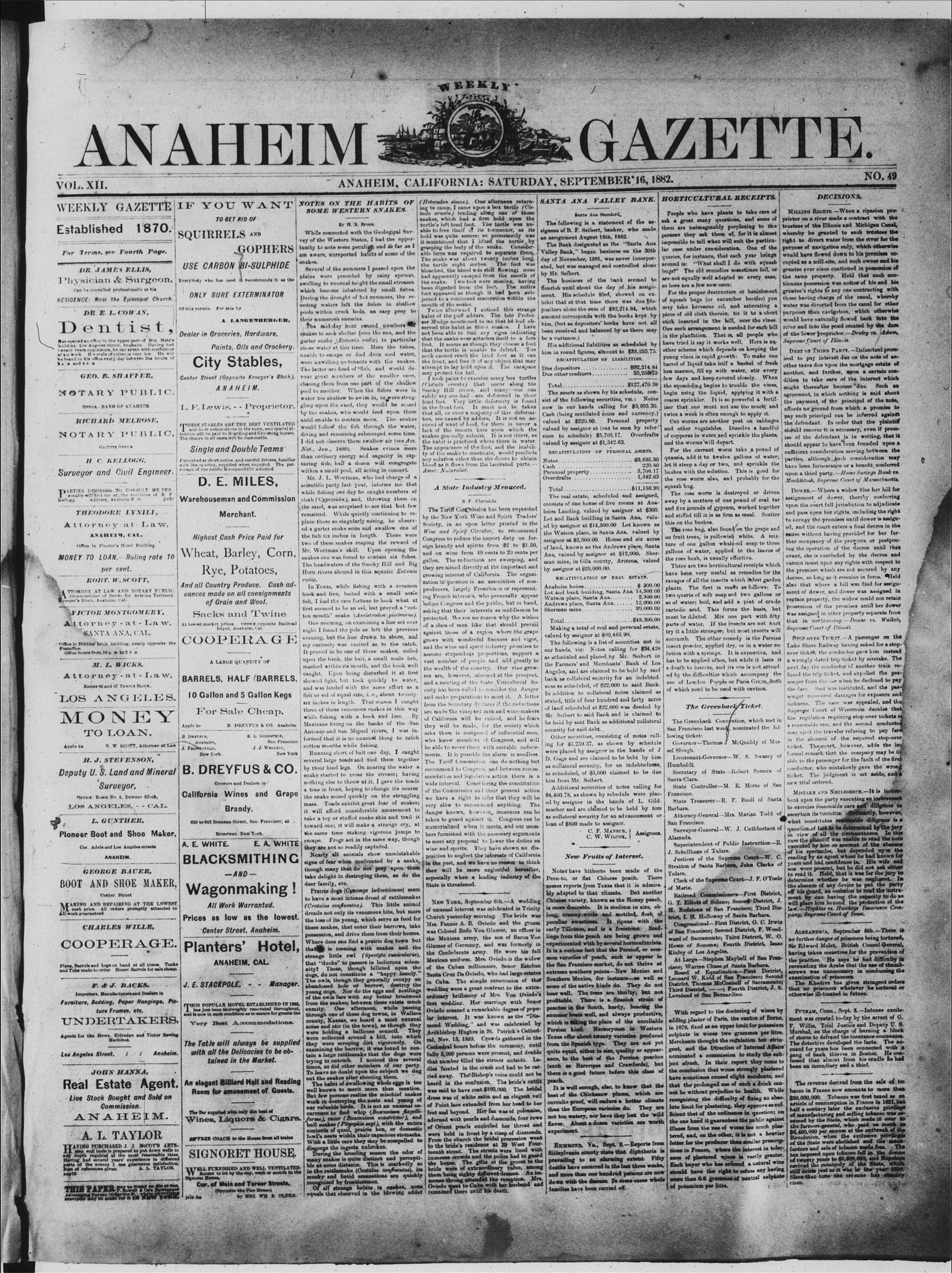
Searchable text
ANAHEIM
VOL. XII.
WEEKLY GAZETTE
Established 1870.
For Terms, see Fourth Page.
DR. JAMES ELLIS,
Physician & Surgeon,
Can be consulted professionally at his
RESIDENCE: Near the Episcopal Church.
DR. E. L. COWAN,
Dentist,
Has opened an office in the upper part of Mrs. Metra's building, Los Angeles Street, Anaheim. Having had twenty years experience, he can speak with confidence of his work. If a scale of prices is very low, He will be found in his office every day between the hours of Balm and SPM.
GEO. B. SHAFFER,
NOTARY PUBLIC.
OFFICE—BANK OF ANAHEIM.
RICHARD MELROSE,
NOTARY PUBLIC.
GAZETTER OFFICE.
H. C. KELLDGG,
Surveuor and Civil Engineer.
IF YOU WANT
TO GET RID OF
SQUIRRELS AND
GOPHERS
USE CARBON BI-SULPHIDE
Everybody who has used it recommends it as the ONLY SURE EXTERMINATOR
Of this vermin. For sale by A LANGENBERGER,
Dealer in Groceries, Hardware,
Paints, Oils and Crochery.
City Stables,
Center Street (Opposite Kroeger's Block),
ANAHEIM.
L. F. Lewis, -- Proprietor.
THESE STABLES ARE THE BEST VENTILATED and most commodious in the town, and special attention will be paid to Boarding and Grooming horses. The charge in all cases will be reasonable.
Single and Double Teams
Furnished at short notice, and careful drivers, familiar with the country, supplied when required. The patronage of the public is respectfully solicited.
NOTES ON THE SOME WESTERN
By H. T.
While connected with vey of the Western Society to note some pains am aware, unreported snakes.
Several of the summer plains were preceded swelling to unusual hues which become incubate During the drought oceding waters left pools within creek but their numerous enemies The mid-day heat snakes to seek shelter garter snake (Entabar chose water at this time unable to escape or were unwilling co-ten The latter are fond of your great numbers chasing them from one pool to another. When water too shallow to gling upon the sand, by the snakes, who were until unable to contact would follow the first diving and remaining I did not observe the Nat., Jan., 1880).
than ordinary energy turing fish; half a within a small pool,
GEO. B. SHAFFER,
NOTARY PUBLIC.
OFFICE—BANR OF ANAHEIM
RICHARD MELROSE,
NOTARY PUBLIC.
GATES OFFICE
H. C. KELLOGG,
Surveyor and Civil Engineer.
PARTIES DESIRING TO CONSULT ME PERSONALLY WILL FIND ME AT THE RESIDENCE OF B. F. Kellogg
Address: Anaheim P.O. Jv22
THEODORE LYNILL,
Attorney at Law.
ANAHEIM, CAL.
Office in Planter's Hotel Building.
MONEY TO LOAN.—Ruling rate 10 per cent.
ROBT. W. SCOTT.
ATTORNEY AT LAW AND NOTARY PUBLIC.
Commissioner of Deeds for Arizona Territory Grozer's Block, Anaheim, Cal.
VICTOR MONTGOMERY,
Attorney-at-Law,
SANTA ANA, CAL.
Office in Dibbles' brick building, nearly opposite the Postoffice.
Office hours from 10 A.M. to 3 P.M.
M. L. WICKS,
Attorney-at-Law,
Rooms 80 and 87 Temple Block.
LOS ANGELES.
MONEY TO LOAN.
Apply to R. W. SCOTT, Attorney at Law.
H. J. STEVENSON,
Deputy U. S. Land and Mineral Surveyor.
Office: Room No 4, Downey Block,
LOS ANGELES, -- CAL.
L. GUNTHER,
Ploneer Boot and Shoe Maker,
Cor. Adele and Los Angeles streets.
ANAHEIM.
GEORGE BAUER,
BOOT AND SHOE MAKER,
Center Street
Center Street (Opposite Kroeger's Block),
ANAHEIM.
L. F. Lewis, - Proprietor.
THESE STABLES ARE THE BEST VENTILATED and most commodious in the town, and special attention will be paid to Boarding and Grooming horses.
The charve in all cases will be reasonable.
Single and Double Teams
Furnished at short notice, and careful drivers, familiar with the country, supplied when required. The patronage of the public is respectfully solicited.
D. E. MILES,
Warehouseman and Commission Merchant.
Highest Cash Price Paid for Wheat, Barley, Corn, Rye, Potatoes, And all Country Produce. Cash advances made on all consignments of Grain and Wool.
Sacks and Twine
At lowest market prices. Office opposite Railroad Depot, Anaheim, Cal.
COOPERAGE
A LARGE QUANTITY OF
BARRELS, HALF BARRELS,
10 Gallon and 5 Gallon Kegs
For Sale Cheap.
Apply to B. DREYFUS & CO. Anaheim
B. DREYFUS,
Anaheim,
San Francisco
J. FROWENFEED,
New York,
New York
B. DREYFUS & CO.
Growers and Dealers in California Wines and Grape Brandy.
630 to 642 Brannan Street, San Francisco; 45 Broadway New York.
A. E. WHITE.
E. A. WHITE
BLACKSMITHING
AND
Wagonmaking!
Your great numbers chasing them from one pool to another. Water too shallow to gling upon the sand, by the snakes, who were until unable to contact would follow the fish diving and remaining I did not observe the Nat., Jan., 1880).
Than ordinary energy turing fish; half a within a small pool.
Mr. J. L. Wortman scientific party last year while fishing one day club (Ceprinide), and the sand was surprising remained. While quail place those so singulared a garter snake seized the fish six inches into two of these snakes Mr. Wortman's skill snakes one was found The headwaters of the Horn rivers abound radix.
In Texas, while fishing with Mexicans living on Antonio and San Marino formed that it is no cotton mouths while Running short of several large toads by their hind legs snake started to creep nothing else to throw a toss in front, hope the snake seized quail mass. Toads exhibit it will afford constance take a toy or stuff toward one; it will she same time make escape. Frogs act they are not so read Nearly all animals signs of fear when though many that take delight in destiny deer family, etc.
Prairie dogs (Cynomys) to have a most intolerable
L. GUNTHER.
Ploneer Boot and Shoe Maker,
Cor. Adele and Los Angeles streets.
ANAHEIM.
GEORGE BAUER,
BOOT AND SHOE MAKER,
Center Street
MAKING AND REPAIRING AT THE LOWEST
cash price. All orders promptly attended to
All work guaranteed.
CHARLES WILLE,
COOPERAGE.
Pipes, Barrels and kegs on hand at all times. Tanks
and Tubs made to order. Honev Barrels for sale cheap.
F. & J. BACKS.
Importers, Manufacturers and Dealers in
Furniture, Bedding, Paper Hangings, Picture Frames, etc,
UNDERTAKERS.
Agents for the Howe, Eldredge and Victor Sewing Machines.
Los Angeles Street, Anaheim.
JOHN HANNA,
Real Estate Agent.
Live Stock Bought and Sold on Commission.
ANAHEIM.
A. L. TAYLOR
HAVING PURCHASED J. J. McCOY'S ARTESTIAN wall tools is prepared to put down wells to any depth required at the most reasonable rates.
Having had several years' experience in different parts of the county I can guarantee satisfaction.
Best of references given.
THIS PAPER may be found on file at Gas.
P. Rowell & Co. Newspaper Advertising Bureau (10 Squirce St.) where advertising contracts may be made for it IN NEW YORK.
Brandy.
630 to 642 Brannan Street, San Francisco; 45 Broadway New York.
A. E. WHITE.
E. A. WHITE
BLACKSMITHING
AND
Wagonmaking!
All Work Warranted.
Prices as low as the lowest.
Center Street, Anaheim.
Planters’ Hotel,
ANAHEIM, CAL.
J. E. STACKPOLE, - - Manager.
THIS POPULAR HOTEL ESTABLISHED IN 1868,
has just been thoroughly renovated throughout,
and is now in such condition as to secure for guests the Very Best Accommodations.
The Tatle will always be supplied with all the Delicacies to be obtained in the Market.
An elegant Billiard Hall and Reading Room for amusement of Guests.
The Bar supplied with only the best of Wines, Liquors & Cigars.
FREE COACH to the House from all trains
SIGNORET HOUSE.
WELL FURNISHED AND WELL VENTILATED.
Rooms to let by the day, week or month in the Signoret House,
Cor. of Main and Turner Streets,
(Opposite the Pico House)
by Mrs. Wm. R. OLDEN.
NOTES ON THE HABITS OF SOME WESTERN SNAKES.
By H. A. Brons.
While connected with the Geological Survey of the Western States, I had the opportunity to note some peculiar and as far as I am aware, unreported habits of some of the snakes.
Several of the summers I passed upon the plains were preceded by rainy springs, swelling to unusual height the small streams, which become inhabited by small fishes. During the drought of hot summers, the receding waters left the fishes in shallow pools within creek beds, an easy prey to their numerous enemies.
The mid-day heat caused numbers of snakes to seek shelter from the sun, and the garter snake (Entoria radix) in particular chose water at this time. Here the fishes, unable to escape or find deep cool water, were unwilling co-tenants with the snakes. The latter are fond of fish, and would devour great numbers of the smaller ones, chasing them from one part of the shallow pool to another. When the fishes were in water too shallow to swim in, or were struggling upon the sand, they would be seized by the snakes, who would feed upon them until unable to contain more. The snakes would follow the fish through the water, diving and remaining submerged some time. I did not observe them swallow air (see Am. Nat., Jan., 1880). Snakes evince more than ordinary energy and sagacity in capturing fish; half a dozen will congregate within a small pool, all acting in concert.
(Heterodon simus). One afternoon returning to camp, I came upon a box turtle (Cistulo ornata) trailing along one of these snakes, which had a firm hold upon the turtle's left hind foot. The turtle was unable to free itself of its tormentor, as its hold was quite secure; so persistently was it maintained that I lifted the turtle by grasping the body of the snake. Considerable force was required to separate them. The snake was about twenty inches long, the turtle eight inches. The foot was bleached, the blood was still flowing; none had apparently escaped from the mouth of the snake. Two toes were missing, having been digested from the foot. The entire foot appeared as though it had been subjected to a continued maceration within the month of the snake.
Twice afterward I noticed this strange habit of the puff adders. The late Professor Mudge mentioned to me that he had observed this habit in these snakes. I have not been able to find any signs indicating that the snake ever attaches itself to a fore foot. It seems as though they choose a foot that the turtle is unable to defend. The neck cannot reach the hind foot as it can the front, and free it of any object that may attempt to lay hold upon it. The carapace may protect the tail.
I took pains to examine many box turtles (Cistulo ornata) that occur along the Smoky Hill rivers, and many—one can safely say one-half—are deformed in their hind feet. Very little deformity is found in the front feet. It must not be taken that all, or even a majority of this deformities, are caused by adders. It is not on account of want of food, for there is never a lack of the insects here upon which the snakes generally subsist. It is not thirst, as the habit is practiced where there is water. The appearance of the foot, and the inability of the snake to masticate, would preclude any solution other than the desire to obtain blood as it flows from the lacerated parts.
SANTA ANA VALLEY BANK.
Santa Ana Standard.
The following is a statement of the assignees of B. F. Seibert, banker, who made an assignment August 16th, 1882.
The Bank designated as the "Santa Ana Valley Bank," began business on the 30th day of November, 1881, was never incorporated, but was managed and controlled alone by Mr. Seibert.
The business of the bank seemed to flourish until about the day of his assignment. His schedule filed, showed on exhibit that at that time there was due depositors alone the sum of $92,214.84, which amount corresponds with the books kept by him, (but as depositors' books have not all been received and balanced by us there may be a variance.) His additional liabilities as scheduled by him in round figures, amount to $35,255.75.
RECAPITULATION OF LIABILITIES.
Due depositors... $92,214.84
Due other creditors... 35,255.75
Total... $127,470.59
The assets as shown by his schedule, consist of the following securities, viz.: Notes now in our hands calling for $3,695.30. Cash (being mutilated coins and currency.) valued at $220.80. Personal property valued by assignor at (can be seen by reference to schedule) $5,708.17. Overdrafts valued by assignor at $1,542.63.
RECAPITULATION OF PERSONAL ASSETS.
Notes... $3,695.30
Cash... 220.80
Personal property... 5,708.17
your great numbers of the smaller ones,
chasing them from one part of the shallow pool to another. When the fishes were in water too shallow to swim in, or were struggling upon the sand, they would be seized by the snakes, who would feed upon them until unable to contain more. The snakes would follow the fish through the water, diving and remaining submerged some time. I did not observe them swallow air (see Am. Nat., Jan., 1880). Snakes evince more than ordinary energy and sagacity in capturing fish; half a dozen will congregate within a small pool, all acting in concert.
Mr. J. L. Wortman, who had charge of a scientific party last year, informs me that while fishing one day he caught numbers of club (Ceprinidae), and throwing them on the sand, was surprised to see that but few remained. While quietly continuing to replace those so singularly missing, he observed a garter snake seize and swallow one of the fish six inches in length. There were two of these snakes reaping the reward of Mr. Wortman's skill. Upon opening the snakes one was found to contain six fishes. The headwaters of the Smoky Hill and Big Horn rivers abound in this aquatic Entonia radix.
In Texas, while fishing with a common hook and line, baited with a small scale fish, I had the rare fortune to hook what at first seemed to be an eel, but proved a "cotton mouth" snake (Ancistrodon piscivorus).
One morning, on examining a line set over night I found the pole as left the previous evening, but the line drawn to shore, and my curiosity was excited as to the catch. It proved to be one of these snakes, coiled upon the bank, the bait, a small scale fish, mashed within its mouth, and the hook well caught. Upon being disturbed it at first showed fight, but took quickly to water, and was landed with the same effort as a fish or eel of equal size, i.e., about twenty-six inches in length. That season I caught three of these venomous snakes in this way while fishing with a hook and line. By Mexicans living on the banks of the San Antonio and San Miguel rivers, I was informed that it is no unusual thing to catch cotton mouths while fishing.
Running short of bait one day, I caught several large toads and tied them together by their hind legs. On nearing the water a snake started to cross the stream; having nothing else to throw at it, I gave the toads a toss in front, hoping to change its course the snake seized quickly on the struggling mass. Toads exhibit great fear of snakes; it will afford considerable amusement to take a toy or stuffed snake skin and trail it toward one; it will make a strange cry, at she same time making vigorous jumps to escape. Frogs act in the same way, though they are not so readily captured.
Nearly all animals show unmistakable signs of fear when confronted by a snake, though many that do not prey upon them take delight in destroying them, as do the deer family, etc.
Prairie dogs (Cynomys ludovicianus) seem to have a most intense dread of rattlesnakes
A State Industry Menaced.
S.F. Chronicle.
The Tariff Commission has been requested by the New York Wine and Spirit Traders' Society, in an open letter printed in the Wine and Spirit Circular, to recommend Congress to reduce the import duty on foreign brandy and spirits from $2 to $1.50, and on wine from 40 cents to 20 cents per gallon. The reductions are sweeping, and they are aimed directly at the important and growing interest of California. The organization in question is an association of non-producers, largely Frenchmen or representing French interests, who personally appear before Congress and the public, hat in hand, asking that their interests as middlemen be protected. We see no reason why the wishes of a class of men like that should prevail against those of a region where the grape grows with wonderful fineness and vigor, and the wine and spirit industry promises to assume stupendous proportions, support a vast number of people and add greatly to the wealth of the country. Our vine growers are, however, alarmed at the prospect, and a meeting of the State Viticultural Society has been called to consider the danger and make preparations to meet it. A letter from the Secretary declares if the reductions are made the vineyard man and wine-makers of California will be ruined, and he fears they will be made, for the society which asks them is composed of influential men, who know members of Congress, and will be able to move them with suitable inducements. It is possible the alarm is needless. The Tariff Commission can do nothing but recommend to Congress, and between recommendation and legislative action there is a wide interval. Considering the constitution of the Commission and their present action we have a right to infer that they will be very slow to recommend anything. The danger known, however, measures can be taken to guard against it. Congress can be memorialized when it meets, and our members furnished with the necessary arguments to meet any proposal to lower the duties on wine and spirits. They have shown no disposition to neglect the interests of California in the past, and we have no reason to think they will be more neglectful hereafter, especially when a leading industry of the State is threatened.
Total... $127,470.59
The assets as shown by his schedule, consist of the following securities, viz.: Notes now in our hands calling for $3,695.30. Cash (being mutilated coins and currency.) valued at $220.80. Personal property valued by assignor at (can be seen by reference to schedule) $5,708.17. Overdrafts valued by assignor at $1,542.63.
RECAPITULATION OF PERSONAL ASSETS.
Notes... $3,695.30
Cash... $220.80
Personal property... $5,708.17
Overdrafts... $1,542.63
Total... $11,166.90
The real estate, scheduled and assigned, consists of one house of five rooms at Anaheim Landing; valued by assignor at $300. Lot and Bank building in Santa Ana; valued by assignor at $14,500.00 Lot known as the Watson place, in Santa Ana; valued by assignor at $2,500.00 House and six acres of land, known as the Andrews place, Santa Ana; valued by assignor at $12,000. Sherman mine, in Gila county, Arizona; valued by assignor at $20,000.00.
RECAPITULATION OF REAL ESTATE.
Anaheim house... $2 800.00
Lot and bank building, Santa Ana 14,500.00 Watson place, Santa Ana 2,500.00 Andrews place, Santa Ana 12,000.00 Sherman mine 20,000.00
Total... $49,300.00
Making a total of real and personal estate, valued by assignor at $60,466.90.
The following is a list of securities not in our hands, viz: Notes calling for $34,438 as scheduled and placed by Mr. Seibert in the Farmers' and Merchants' Bank of Los Angeles, and are claimed to be held by said bank as collateral security for an indebtedness as scheduled, of $22,000 to said Bank. In addition to collateral notes claimed as stated, title of four hundred and forty acres of land scheduled at $22,000 was deeded by Mr. Seibert to said Bank and is claimed to be held by said Bank as additional collateral security for said debt.
Other securities, consisting of notes calling for $5,239.37, as shown by schedule were placed by assignor in the hands of J.D. Gage and are claimed to be held by him as collateral security for an indebtedness as scheduled, of $5,000 claimed to be due him from Mr. Seibert.
Additional securities of notes calling for $4,400.78, as shown by schedule were placed by assignor in the hands of L.Gildmacher and are claimed to be held by him as collateral security for an advancement or loan of $800 made to assignor.
C.F.Mansur,
C.W.Wilcox,
New Fruits of Interest.
Notes have hitherto been made of the Peen-to-, or flat Chinese peach. There comes reports from Texas that it is admirably adapted to that climate. But another Chinese peach is known as Honey peach!
Nearly all animals show unmistakable signs of fear when confronted by a snake, though many that do not prey upon them take delight in destroying them, as do the deer family, etc.
Prairie dogs (Cynomys ludovicianus) seem to have a most intense dread of rattlesnakes (Crotalus confluentus). This little animal dreads not only its venomous bite, but more the loss of its young, which serve as food for these snakes, that enter their burrows, take possession, and drive them from their homes. Where does one find a prairie dog town but that is teeming with snakes and the strange little owl (Speotyto cunicularia), that "ducks" to passers in ludicrous solemnity? These, though billeted upon the dogs, do not constitute a "happy family." The owls, though they generally occupy an abandoned hole or burrow, destroy the young dogs. Nor do the eggs and nestlings of the owls fare with any better treatment from the snakes; between these exists much enmity. One afternoon, while passing through one of these dog towns, in Wallace county, Kansas, we heard a most unusual noise and stir (in the town), as though they were holding a bellicose council. They were collected around a hill, into which they were scraping dirt vigorously. On examining the burrow, it was found to contain a large rattlesnake that the dogs were trying to entomb. I noticed this several times, as did other members of our party. To leave no doubt upon the subject we dug out the snakes after shooting them.
The habit of swallowing whole eggs is too well known to merit more than mention. But few persons realize the mischief snakes work in destroying the nests and young of our valuable birds. It is not an unusual occurrence to find whip (Bascanium magelliforme), racer (Bascanium constrictor), and bull snakes (Pitgophis soyi), with the entire contents of quail, prairie hen, or domestic fowl's nests within their capacious stomachs. With a little care they may be compelled to disgorge the ingesta unbroken.
During the breeding season the odor of many snakes is quite distinct and perceptible at some distance. This is markedly so in the rattlesnake (Crotalus confluentus), its musky and foxtid emanations are quickly recognized by frontiersmen.
Of all strange habits in snakes, none equals that observed in the blowing adder we have a right to infer that they will be very slow to recommend anything. The danger known, however, measures can be taken to guard against it. Congress can be memorialized when it meets, and our members furnished with the necessary arguments to meet any proposal to lower the duties on wine and spirits. They have shown no disposition to neglect the interests of California in the past, and we have no reason to think they will be more neglectful hereafter, especially when a leading industry of the State is threatened.
New York, September 6th.—A wedding of unusual interest was celebrated in Trinity Church yesterday morning. The bride was Mrs. Fannie A. B. Oviedo and the groom was Colonel Bodo Von Glumer, an officer in the Mexican army, the son of Baron Von Glumer of Germany, and was formerly in the Confederate army. He wore his full Mexican uniform. Mrs. Oviedo is the widow of the Cuban millionaire, Senor Esteban Santa Cruz De Oviedo, who had large estates in Cuba. The simple ceremonies of this wedding were a great contrast to the extraordinary brilliance of Mrs. Von Oviedo's first wedding. Her marriage with Senor Oviedo created a remarkable degree of popular interest. It was known as the "Diamond Wedding," and was celebrated by Archbishop Hughes in St. Patrick's Cathedral, Nov. 13, 1859. Crowds gathered in the Cathedral hours before the ceremony, until fully 3,000 persons were present, and double that number filled the streets outside. Ladies fainted in the crush and had to be carried away. The Bishop's voice could not be heard in the confusion. The bride's outfit was said to have cost $100,000. The bridal dress was of white satin and an elegant veil of Point lace extended from her head to her feet and beyond. Her fan was of polonaise, adorned with pearls and diamonds, four rows of Orient pearls encircled her throat and were held in front by a clasp of diamonds. From the church the bridal procession went to the bride's residence at 39 West Fourteenth street. The streets were lined with immense crowds and the police had to guard the house. The gifts of the groom to the bride were of extraordinary value, among them being eighty different dresses. An immense throng attended the reception. Mrs. Oviedo went to Cuba with her husband and remained there until his death.
Notes have hitherto been made of the Peen-to, or flat Chinese peach. There comes reports from Texas that it is admirably adapted to that climate. But another Chinese variety, known as the Honey peach, is more desirable. It is medium in size, oblong, creamy-white and mottled, flesh of peculiar sweetness. It ripens with the early Tillotson, and is a freestone. Seedlings from this peach are being grown and experimented with by several horticulturists. It is a curious fact that the Persian, or common varieties of peach, such as appear in the San Francisco market, do not thrive at extreme southern points—New Mexico and Southern Mexico, for instance—as well as some of the native kinds do. They do not bear well. The trees are thrifty, but not profitable. There is a Spanish strain of peaches in the South, hardy, bearing the summer heats well, and always productive, which is taking place of the unreliable Persian kind. Nurseymen in Western Texas offer about twenty varieties produced from the Spanish type. They are not yet quite equal, either in size, quality or appearance, to the best of the Persian peaches (such as Rareripes and Crawfords), but there is a good future before this class of peach.
It is well enough, also, to know that the best of the Chickasaw plums, which are curculio proof, will endure a hotter climate than the European varieties do. They are not too watery, nor have they lost the wild flavor. About a dozen varieties are worth experiment.
Richmond, Va., Sept. 9.—Reports from Sittsylvania county state that diptheria is prevailing to an alarming extent. Fifty deaths have occurred in the last three weeks, and more than one hundred persons are now down with the disease. In some cases whole families have been carried off.
GAZETTE.
NO. 49
VALLEY BANK.
A statement of the ass-
tant, banker, who made
16th, 1882.
and as the "Santa Ana
business on the 30th
1881, was never incorpor-
ed and controlled alone
the bank seemed to
the day of his assign-
filed, showed on ex-
there was due file-
of $92,214.84, which
with the books kept by
books have not all
aligned by us there may
abilities as scheduled by
amount to $35,255.75.
OF LIABILITIES.
$92,214.84
35,255.75
by his schedule, consecurities, viz.: Notes calling for $3,695.30.
coins and currency.)
Personal property (can be seen by referr-
$5,708.17. Overdrafts
$1,542.63.
OF PERSONAL ASSETS.
$3,695.30
220.80
5,708.17
HORTICULTURAL RECEIPTS.
People who have plants to take care of ask a great many questions, and some of them are unimaginably perplexing to the persons they ask them of, for it is almost impossible to tell what will suit the particular case under consideration. One of the queries, for instance, that each year brings around is: "What shall I do with squash bugs?" The old remedies sometimes fail, or are not equally well adapted to every case, so here are a few new ones:
For the proper destruction or banishment of squash bugs (or cucumber beetles) you may take kerosene oil, and saturating a piece of old cloth therein, tie it to a short stick inserted in the hill, near the vines. One such arrangement is needed for each hill in the plantation. That is, all people who have tried it say it works well. Here is another scheme which depends on keeping the young vines in rapid growth: To make one barrel of liquid take half a bushel of fresh hen manure, fill up with water, stir every few days and keep covered closely. When the squashing begins to trouble the vines, begin using the liquid, applying it with a coarse sprinkler. It is so powerful a fertilizer that one must not use too much; and twice a week is often enough to apply it.
Cut worms are another pest on cabbages and other vegetables. Dissolve a handful of copperas in water and sprinkle the plants, and the worms will depart.
For the currant worm take a pound of quassia, add it to twelve gallons of water; let it steep a day or two, and sprinkle the bushes with the solution. This is good for
DECISIONS.
MILLING RIGHTS.—When a riparian proprietor on a river made a contract with the trustees of the Illinois and Michigan Canal, whereby he granted to such trustees the right to divert water from the river for the purpose of navigation only, which otherwise would have flowed down to his premises occupied as a mill-site, and such owner and his grantee ever since continued in possession of the same property. Held that such continuous possession was notice of his and his grantee's rights to any one contracting with those having charge of the canal, whereby water was diverted from the canal for other purposes than navigation, which otherwise would have naturally flowed back into the river and into the pond created by the dam of the lower proprietor.—Druley vs. Adam,
Supreme Court of Illinois.
DEBT OF THIRD PARTY.—Defendant promised to pay interest due on the note of another taxes due upon the mortgage estate of another, and further, upon a certain condition to take care of the interest which might thereafter become due. Such an agreement, in which nothing is said about the payment of the principal of the note, affords no ground from which a promise to pay such principal can be inferred against the defendant. In order that the plaintiff should recover it is necessary, even if promise of the defendant is in writing, that it should appear to have been founded upon a sufficient consideration moving between the parties, although such consideration may have been forbearance or a benefit conferred upon a third party.—Home Savings Bank vs.
OF PERSONAL ASSETS.
$127,470.59
on by his schedule, consecurities, viz.: Notes
calling for $3,695.30,
and coins and currency.)
Personal property
(can be seen by refer-
$3,695.30
220.80
5,708.17
1,542.63
$11,166.90
scheduled and assigned,
of five rooms at Anadied by assignor at $300.
long in Santa Ana, valued by 1,500.00 Lot known as
Santa Ana, valued by
House and six acres
The Andrews place, Santa
signor at $12,000. Shercounty, Arizona, valued
$200.00.
OF REAL ESTATE.
$200.00
long, Santa Ana 14,500.00
Ana. 2,500.00
Ana. 12,000.00
20,000.00
$49,300.00
real and personal estate,
at $60,466.90.
list of securities not in
notes calling for $34,438
secured by Mr. Seibert in
Merchants' Bank of Loscalm to be held by said
security for an indebtedness,
of $22,000 to said Bank.
material notes claimed as
hundred and forty acres
$22,000 was deeded by
Bank and is claimed to
be additional collateral.
consisting of notes callas shown by schedule
signor in the hands of J.
claimed to be held by him
by an indebtedness,
of 1,000 claimed to be due
tortes of notes calling for
by schedule were placthe hands of L. Gildclaimed to be held by him
by an advancement or
no assignor.
F. MANSUR,
W. WILCOX,
Assigneca.
MISTAKE AND NEGLIGENCE.-It is incumbent upon the party executing an instrument to exercise reasonable care and diligence to ascertain its contents. Ordinarily, however,
what constitutes reasonable diligence is a question of fast to be determined by the jury in view of all the circumstances. In this case the plaintiff was unable to read the note executed by him on account of the absence of his spectacles, but depended upon the reading by an agent whom he had known for years and had confidence in. His wife and son were present, but he did not ask either to read it. Held, that it was for the jury to determine whether he was negligent. In the absence of any device to put the party off his guard, an omission to read the instrument by one having the capacity to do so
Hands of L. Gildenmerton to be held by him for an advancement or assignor.
F. Mansur, W. Wilcox, Assignees.
Measures of Interest.
Merito been made of the Chinese peach. There is Texas that it is admirable climate. But another known as the Honey peach. It is medium in size, obliquely mottled, flesh of it. It ripens with the sun is a freestone. Seedlings are being grown and by several horticulturists, such as that the Persian, or com-peach, such as appear in market, do not thrive at points—New Mexico and for instance—as well as kinds do. They do not trees are thrifty, but not is a Spanish strain of vitth, hardy, bearing the fruit and always productive, place of the unreliable nurserymen in Western twenty varieties produced large. They are not yet in size, quality or appearance of the Persian peaches (and Crawfords), but mature before this class of plants, also, to know that the maw plums, which are endure a hotter climate than varieties do. They are never have they lost the wild frozen varieties are worth mentioning.
Sept. 9. Reports from any state that diphtheria is alarming extent. Fifty cases in the last three weeks, the hundred persons are now deceased. In some cases whole corpses carried off.
State Treasurer—R. F. Buell of Santa Barbara.
Attorney-General—Mrs. Marian Todd of San Francisco.
Surveyor-General—W. J. Cuthbertson of Alameda.
Superintendent of Public Instruction—E. J. Schellhous of Tulare.
Justices of the Supreme Court—W. C. Stratton of Santa Barbara, John Clarke of Tulare.
Clerk of the Supreme Court—J. F. O'Toole of Marin.
Railroad Commissioners—First District, G. T. Elliott of Solano; Second District, J. H. Redstone of San Francisco; Third District, I. H. Holloway of Santa Barbara.
Congressional—First District, G. C. Irwin of San Francisco; Second District, F. Woodward of Sacramento; Third District, W. O. Howe of Sonoma; Fourth District, Isaac Kinley of Los Angeles.
At Large—Stephen Maybell of San Francisco; Warren Chase of Santa Barbara.
Board of Equalization—First District, Leonard W. Kidd of San Francisco; Second District, Thomas McConnell of Sacramento; Third District, — —; Fourth District, J. S. Loveland of San Bernardino.
With regard to the doctoring of wines by adding plaster of Paris, the canton of Berne, in 1879, fixed as an upper limit for potassium sulphate in wines two grammes per litre. Merchants thought the regulation too stringent, and the Direction of Internal Affairs nominated a commission to study the subject afresh. In their report they come to the conclusion that wines strongly plastered have sometimes caused slight accidents, and that the prolonged use of such a drink cannot be without prejudice to health. While recognizing the difficulty of fixing an absolute limit for plastering, they approve as sufficient that of the ordinance in question; on the one hand it guarantees the public against illness from the use of wines too much plastered, and, on the other, it is not a heavier fetter for the producer than similar prescriptions in France, where the interest in tolerance of plastered wines is vastly greater. Each buyer who has ordered a natural wine should have the right to refuse any having more than 0.6 grammes of neutral sulphate of potassium per litre.
ALEXANDRA, September 8th.-There is no further danger of prisoners being tortured, Sir Elward Malet, British Consul-General, having taken measures for the prevention of the practice. He says he had difficulty in persuading the Arabs that the use of thumb-screws was unnecessary in conducting the examination of prisoners.
The Khedive has given stringent orders that no prisoners whatever be tortured or otherwise ill-treated in future.
PUTNAM, Conn., Sept. 8.-Intense excitement was created to-day by the arrest of G. F. Willis, Trial Justice and Deputy U. S. Marshal, on the charge of burning a block of stores to defraud the insurance companies. The detective developed the facts. The accused for years has been connected with a gang of bank thieves in Boston. He confessed that almost from his cradle he had been an incendiary and a thief.
The revenue derived from the sale of tobacco in France now amounts to more than $50,000,000. Tobacco was first taxed as an article of consumption in France in 1621, but half a century later the exclusive privilege of manufacturing and selling tobacco was assumed by the State, which made it over to the farmer-general, who paid as much as $6,400,000 per annum at the outbreak of the Revolution, when the exclusive privileges of the State were abolished and the manufacture and sale of tobacco made free. The tax imposed upon tobacco fell in the course of twenty years to $2,600,000, and Napoleon revived the monopoly of the State, which still exists just as it was in the year 1910. Since that time the revenue has steadily riten.