anaheim-gazette 1882-09-09
Scanned page
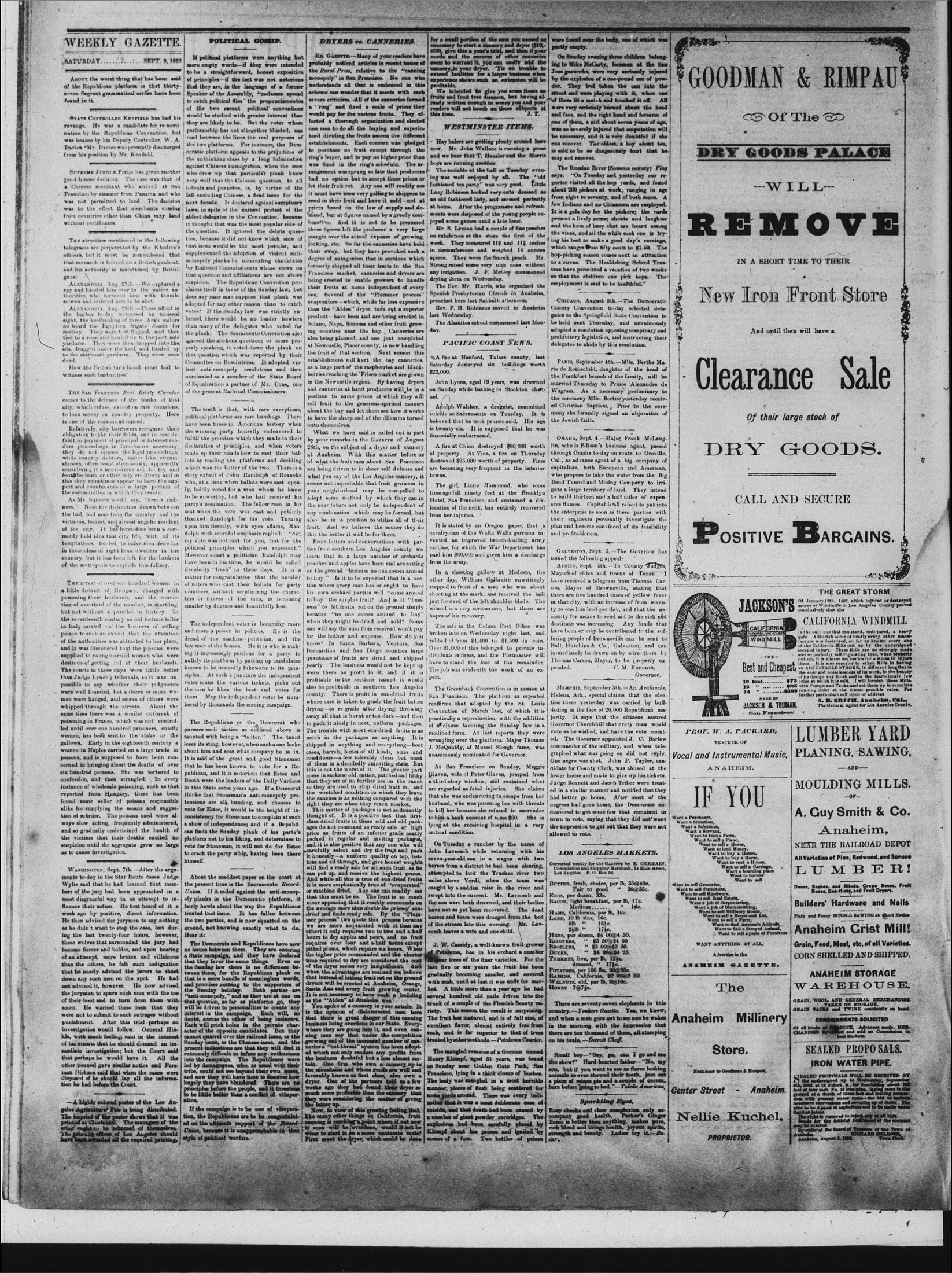
Searchable text
WEEKLY GAZETTE.
SATURDAY... SEPT. 9, 1882
About the worst thing that has been said of the Republican platform is that thirty-seven flagrant grammatical errors have been found in it.
STATE CONTROLLEER KENFIELD has had his revenge. He was a candidate for re-nomination by the Republican Convention, but was beaten by his Deputy Controller, W. A. Davies. Mr. Davies was promptly discharged from his position by Mr. Kenfield.
SUPREME JUSTICE FIELD has given another pro-Chinese decision. The case was that of a Chinese merchant who arrived at San Francisco by steamer from Panama and who was not permitted to land. The decision was to the effect that merchants coming from countries other than China may land without certificates.
The atrocities mentioned in the following telegrams are perpetrated by the Khedive's officers, but it must be remembered that monarch is housed on a British gunboat, and his authority is maintained by British guns:
ALEXANDRIA, Aug. 27th. — We captured a spy and handed him over to the native authorities, who tortured him with thumb-screws and ordered him to be shot.
ALEXANDRIA, Aug. 29th. — Those afloat in the harbor to-day witnessed an unusual sight, the keelbauling of three Arab sailors on board the Egyptian frigate Souda for mutiny. They were first flogged, and then tied to a rope and hauled up to the port side yardarm. They were then dropped into the sea, dragged under the keel, and hauled up to the starboard yardarm. They were soon dead.
How the British tar's blood must boil to witness such barbarities!
The San Francisco Real Estate Circular comes to the defense of the banks of that city, which refuse, except on rare occasions, to loan money on country property. Here is one of the reasons advanced:
Relatively, city borrowers recognize their obligation to pay their debts, and in case default in payment of principal or interest renders proceedings in foreclosure necessary, they do not oppose the legal proceedings, while country debtors, under like circumstances, often resist strenuously, apparently considering it a meritorious act to try and beat the bank or other creditors and in
POLITICAL GOSSIP.
If political platforms were anything but mere empty words—if they were intended to be a straightforward, honest exposition of principles—if the fact was not notorious that they are, in the language of a former Speaker of the Assembly, "molasses spread to catch political flies" the pronunciamentos of the two recent political conventions would be studied with greater interest than they are likely to be. But the voter whom partisanship has not altogether blinded, can read between the lines the real purposes of the two platforms. For instance, the Democratic platform appeals to the prejudices of the unthinking class by a long fulmination against Chinese immigration, when the men who drew up that particular plank knew very well that the Chinese question, to all intents and purposes, is, by virtue of the bill excluding Chinese, a dead issue for the next decade. It declared against sumptuary laws, in spite of the earnest protest of the ablest delegates in the Convention, because it thought that was the most popular side of the question. It ignored the debris question, because it did not know which side of that issue would be the most popular, and supplemented the adoption of violent anti-monopoly planks by nominating candidates for Railroad Commissioners whose views on that question and affiliations are not above suspicion. The Republican Convention proclaims itself in favor of the Sunday law, but does any sane man suppose that plank was adopted for any other reason than to catch votes? If the Sunday law was strictly enforced, there would be no louder howlers than many of the delegates who voted for the plank. The Sacramento Convention also ignored the slickens question; or more properly speaking, it voted down the plank on that question which was reported by their Committee on Resolutions. It adopted violent anti-monopoly resolutions and then nominated as a member of the State Board of Equalization a partner of Mr. Cone, one of the present Railroad Commissioners.
The truth is that, with rare exceptions, political platforms are rare humbugs. There have been times in American history when the winning party honestly endeavored to fulfill the promises which they made in their declaration of principles, and when voters made up their minds how to cast their ballots by reading the platforms and deciding which was the better of the two. There is a story extant of John Randolph of Roanoke.
ED. GAZETTE: — probably noticed by the Rural Press monopoly" in Sandy understands all this scheme can wonder severe criticism. And a "ring" and fix would pay for them affected a thorough one man to do all tend dividing their establishments. It to purchase no ring's buyer, and was fixed in the arrangement was spared had no option but let their fruit rot. It must have been sent in their fruits prices based on mand, but at figure bination. And if these figures left margin over the ad picking, etc. So far their sway, but the degree of antagonism formerly shipped at Francisco market being erected to cover their fruits at home one. Several of these evaporators—which than the "Alden" product—have been Solano, Napa, Sonoma counties near also being planned at Newcastle, Place—the fruit of that so establishment will as a large part of their berries reaching thru in the Newcastle ranch and canneries at his position to name sell fruit to them about the bay and to have the sharp edge onto themselves.
What we have by your remarks in 26th, on the subject at Anaheim. What of what the fruit ranch are being driven to
The San Francisco Real Estate Circular comes to the defense of the banks of that city, which refuse, except on rare occasions, to loan money on country property. Here is one of the reasons advanced:
Relatively, city borrowers recognize their obligation to pay their debts, and in case default in payment of principal or interest renders proceedings in foreclosure necessary, they do not oppose the legal proceedings, while country debtors, under like circumstances, often resist strenuously, apparently considering it a moritorious act to try and beat the bank or other city creditors; and in this they sometimes appear to have the support and countenance of a large portion of the communities in which they reside.
As Mr. Squiers would say, "here's richness." Note the distinction drawn between the bad, bad man from the country and the virtuous, honest and almost angelic resident of the city. It has heretofore been a commonly held idea that city life, with all its temptations, tended to make men more lax in their ideas of right than dwellers in the country, but it has been left for the bankers of the metropolis to explode this lallacy.
The arrest of over one hundred women in a little district of Hungary, charged with poisoning their husbands, and the conviction of one-third of the number, is startling, but not without a parallel in history. In the seventeenth century an old fortune teller in Italy carried on the business of selling poison to such an extent that the attention of the authorities was attracted to her place, and it was discovered that the poisons were supplied to young married women who were desirous of getting rid of their husbands. The courts in those days were little better than Judge Lynch's tribunals, so it was impossible to say whether their judgments were well founded, but a dozen or more women were hanged, and scores of others were whipped through the streets. About the same time there was a similar outbreak of poisoning in France, which was not controlled until over one hundred prisoners, chiefly women, has been sent to the stake or the gallows. Early in the eighteenth century a woman in Naples carried on a large trade in poisons, and is supposed to have been concerned in bringing about the deaths of over six hundred persons. She was tortured to confession, and then strangled. In every instance of wholesale poisoning, such as that reported from Hungary, there has been found some seller of poisons responsible alike for supplying the means and suggestion of murder. The poisons used were always slow acting, frequently administered, and so gradually undermined the health of the victims that their deaths excited no suspicion until the aggregate grew so large as to cause investigation.
WASHINGTON, Sept. 7th.—After the arguments to-day in the Star Route cases Judge Wylie said that he had learned that members of the jury had been approached in a most disgraceful way in an attempt to nominated as a member of the State Board of Equalization a partner of Mr. Cone, one of the present Railroad Commissioners.
The truth is that, with rare exceptions, political platforms are rare humbugs. There have been times in American history when the winning party honestly endeavored to fulfill the promises which they made in their declaration of principles, and when voters made up their minds how to cast their ballots by reading the platforms and deciding which was the better of the two. There is a story extant of John Randolph of Roanoke who, at a time when ballots were cast openly, boldly voted for a man whom he knew to be unworthy, but who had received his party's nomination. The fellow rose in his seat when the vote was cast and publicly thanked Randolph for his vote. Turning upon him fiercely, with eyes aflame, Randolph with scornful emphasis replied: "Sir, my vote was not cast for you, but for the political principles which you represent." However smart a politician Randolph may have been in his time, he would be called decidedly "fresh" in these days. It is a matter for congratulation that the number of voters who cast their ballots for party nominees, without scrutinizing the characters or fitness of the men, is becoming smaller by degrees and beautifully less.
The independent voter is becoming more and more a power in politics. He is the dread of the machine-politician, and the bete noir of the bosses. He it is who is making it increasingly perilous for a party to nullify its platform by putting up candidates known to be inwardly lukewarm to its principles. At such a juncture the independent voter scans the various tickets, picks out the men he likes the best and votes for them. May the independent voter be numbered by thousands the coming campaign.
The Republican or the Democrat who pursues such tactics as outlined above is taunted with being a "bolter." The taunt loses its sting, however, when such a one looks about him and sees what company he is in. It is said of the great and good Stoneman that he has been known to vote for a Republican, and it is notorious that Estee and Booth were the leaders of the Dolly Vardens in this State some years ago. If a Democrat thinks that Stoneman's anti-monopoly pretensions are all humbug, and chooses to vote for Estee, it would be the height of inconsistency for Stoneman to complain at such a show of independence; and if a Republican finds the Sunday plank of his party's platform not to his liking, aud determines to vote for Stoneman, it will not do for Estee to crack the party whip, having been there himself.
About the maddest paper on the coast at the present time is the Sacramento Record-Union. If it railed against the anti-monopoly planks in the Democratic platform, it berries reaching thru in the Newcastle ranch position to name sell fruit to the bay and have the sharp edge onto themselves.
What we have by your remarks in 26th, on the subject at Anaheim. What of what the fruit man are being driven to what you say of this seems not improbable your neighborhood adopt some method near future not any combination also be in a posse fruit. And we be this the better it will.
From letters and ties from southern learn that in a peaches and apples on the ground "be buy." Is it to mention where every man his own orchard put buy" the surplusness" to let fruits because "no one when they might be one will say she suset for the bother and know? In Santa Bernardino and S quantities of fruits yearly. The business were there no profitable in the state also be profitable in county. There is where care is taken drying—to re-grade away all that is bui to pack it nicely in The trouble with much in the pack shipped in anything cases, barrels, box conditions—a few tails of them in a decide this is not the worst come in sacks so old that they are of no use so they are used to the wretched course ranches is as no sight they are when
This matter of pity thought of. It is a class dried fruits in ages do not commute price as fruits off packed in regular and it is also possibly carefully select and it honestly—a unit tom and all through will find a ready sale can put up, and re-And while all this it is more emphatic or machine dried that this must be s
WASHINGTON, Sept. 7th. After the arguments to-day in the Star Route cases Judge Wylie said that he had learned that members of the jury had been approached in a most disgraceful way in an attempt to influence their action. He first heard of it a week ago by positive, direct information. He then advised the jurymen to say nothing as he didn't want to stop the case, but during the last twenty-four hours, however, these wolves that surrounded the jury had become fiercer and bolder, and upon hearing of an attempt, more brazen and villainous than the others, he felt such indignation that he nearly advised the jurors to shoot down any such men on the spot. He had not advised it, however. He now advised the jurymen to spurn such men with the toe of their boot and to turn from them with scorn. He warned these men that they were not to submit to such outrages without punishment. After this trial perhaps an investigation would follow. General Hinkle, with much feeling, said in the interest of his clients that he should demand an immediate investigation; but the Court said that perhaps he would have it. All the other counsel gave similar notice and Foreman Dickson said that when the cases were disposed of he should lay all the information he had before the Court.
A highly colored poster of the Los Angeles Agricultural Fair is being distributed. The imprint of the poster shows that it was printed at Chicago. The managers of the affair ought to be ashamed of themselves. The printing offices of Los Angeles should have been awarded all the required printing.
About the maddest paper on the coast at the present time is the Sacramento Record-Union. If it railed against the anti-monopoly planks in the Democratic platform, it fairly howls about the way the Republicans treated that issue. It has fallen between the two parties, and is now squatted on the ground, not knowing exactly what to do. Hear it:
The Democrats and Republicans have now no issues between them. They are entering a State campaign, and they have declared that they favor the same things. Even on the Sunday law there is no difference between them, for the Republican plank on that is a mere bundle of meaningless words, and promises nothing to the supporters of the Sunday holiday. Both parties are "anti-monopoly," and as they are at one on that question, so far as platforms go, they will be driven to personalities to create any interest in the campaign. Each will, no doubt, accuse the other of being insincere. Each will prick holes in the private character of the opposite candidates. But they cannot quarrel over the railroad issue, or the Sunday issue, or the Chinese issue, and the present indications are that they will find it extremely difficult to infuse any enthusiasm into the campaign. The Republicans were led by demagogues, who, as usual with their tribe, could not see beyond their own noses, and now they will have time to discover how hugely they have blundered. There are no principles before the people, and it threatens to be little better than a conflict of vituperation.
If the campaign is to be one of vituperation, the Republicans are to be congratulated on the ultimate support of the Record-Union, because it is unapproachable in that style of political warfare.
DRYERS vs. CANNERIES.
Ed. Gazette:—Many of your readers have probably noticed articles in recent issues of the Rural Press, relative to the "canning monopoly" in San Francisco. No one who understands all that is embraced in this scheme can wonder that it meets with such severe criticism. All of the canneries formed a "ring" and fixed a scale of prices they would pay for the various fruits. They effected a thorough organization and elected one man to do all the buying and superintend dividing the fruits among the different establishments. Each concern was pledged to purchase no fruit except through the ring's buyer, and to pay no higher price than fixed in the ring's schedule. The arrangement was sprung so late that producers had no option but to accept these prices or let their fruit rot. Any one will readily see it must have been very galling to shippers to send in their fruit and have it sold—not at prices based on the law of supply and demand, but at figures named by a greedy combination. And it is not to be presumed these figures left the producer a very large margin over the actual expense of growing, picking, etc. So far the canneries have held their sway, but they have provoked such a degree of antagonism that in sections which formerly shipped all their fruits to the San Francisco market, canneries and dryers are being erected to enable growers to handle their fruits at home independent of every one. Several of the "Plummer process" evaporators—which, while far less expensive than the "Alden" dryer, turn out a superior product—have been and are being erected in Solano, Napa, Sonoma and other fruit growing counties near the bay. Canneries are also being planned, and one just completed at Newcastle, Placer county, is now handling the fruit of that section. Next season this establishment will hurt the bay canneries, as a large part of the raspberries and blackberries reaching the 'Frisco market are grown in the Newcastle region. By having dryers and canneries at hand producers will be in a position to name prices at which they will sell fruit to the generous-spirited canners about the bay and let them see how it works to have the sharp end of the dilemma turned onto themselves.
What we have said is called out in part by your remarks in the Gazette of August 26th, on the subject of a dryer and cannery at Anaheim. With this matter before us of what the fruit men about San Francisco are being driven to in sheer self defense and profitability, can you find any other information relevant to this article?
WESTMINSTER ITEMS:
Hay balers are getting plenty around here now. Mr. John Wallace is running a press and we hear that T. Hensler and the Morris boys are running another.
The sociable at the hall on Tuesday evening was well enjoyed by all. The "old fashioned tea party" was very good. Little Lucy Robinson looked very cute dressed as an old fashioned lady, and seemed perfectly at home. After the programme and refreshments were disposed of the young people enjoyed some games until a late hour.
Mr. S. Lyman had a couple of fine peaches on exhibition at the store the first of the week. They measured 113 and 115 inches in circumference and weighed 14 ounces apiece. They were the Smock peach. Mr. Strong raised some very nice ones without any irrigation. J. J. McGoy commenced drying them on Wednesday.
The Rev. Mr. Harris, who organized the Spanish Presbyterian Church in Anaheim, preached last Sabbath afternoon.
Rev. F. H. Robinson moved to Anaheim last Wednesday.
The Alamitos school commenced last Monday.
PACIFIC COAST NEWS.
A fire at Hanford, Tulare county, last Saturday destroyed six buildings worth $23,000.
John Lyons, aged 19 years, was drowned on Sunday while bathing in Stockton channel.
Adolph Walther, a druggist, committed suicide at Sacramento on Tuesday. It is believed that he took prussic acid. His age is twenty-six. It is supposed that he was financially embarrassed.
A fire at Chico destroyed $80,000 worth of property. At Vina, a fire on Thursday destroyed $25,000 worth of property. Fires are becoming very frequent in the interior town.
were found near the body, one of which was partly empty.
On Sunday evening three children belonging to Mike McCarty, foreman at the San Jose gasworks, were very seriously injured by the explosion of a one-pound can of powder. They had taken the can into the street and were playing with it, when one of them lit a match and touched it off. All were very seriously burned about the head and face, and the right hand and forearm of one of them, a girl about seven years of age, was so severely injured that amputation will be necessary, and it is very doubtful if she can recover. The oldest; a boy about ten, is said to be so dangerously hurt that he may not recover.
The Russian River (Sonoma county) Flag says: "On Tuesday and yesterday our reporter visited all the hop yards, and found about 200 pickers at work, ranging in age from eight to seventy, and of both sexes. A few Indians and no Chinamen are employed. It is a gala day for the pickers; the yards present a lively scene; shows and laughter and the hum of busy chat are heard among the vines, and all while each one is trying his best to make a good day's earnings, which ranges from fifty cents to $1.50. The hop-picking season comes next in attraction to a circus. The Healdsburg School Trustees have permitted a vacation of two weeks so that the children can pick hops. The employment is said to be healthful."
Chicago, August 5th.-The Democratic County Convention to-day selected delegates to the Springfield State Convention to be held next Thursday, and unanimously adopted a resolution opposing sumptuary and prohibitory legislation, and instructing their delegates to abide by this resolution.
Paris, September 4th.-Mlle. Berthe Marie de Rothschild, daughter of the head of the Frankfort branch of the family, will be married Thursday to Prince Alexandre de Wagram. As a necessary preliminary to the ceremony Mlle. Berthe yesterday received Christian baptism. Prior to the ceremony she formally signed an abjuration of the Jewish faith.
Omaha, Sept. 4.-Major Frank McLauglin, who is Edison's business agent, passed through Omaha to-day en route to Oroville, Cal., as advance agent of a big company of capitalists, both European and American, who propose to take the water from the Big
Berries reaching the Frisco market are grown in the Newcastle region. By having dryers and canners at hand producers will be in a position to name prices at which they will sell fruit to the generous-spirited canners about the bay and let them see how it works to have the sharp end of the dilemma turned onto themselves.
What we have said is called out in part by your remarks in the Gazette of August 26th, on the subject of a dryer and cannery at Anaheim. With this matter before us of what the fruit men about San Francisco are being driven to in sheer self defense and what you say of the Los Angeles cannery, it seems not improbable that fruit growers in your neighborhood may be compelled to adopt some method by which they can in the near future not only be independent of any combination which may be formed, but also be in a position to utilize all of their fruit. And we believe the sooner they do this the better it will be for them.
From letters and conversations with parties from southern Los Angeles county we learn that in a large number of orchards peaches and apples have been and are rotting on the ground "because no one comes around to buy." Is it to be expected that in a section where every man has or ought to have his own orchard parties will "come around to buy" the surplus fruit? And is it "business" to let fruits rot on the ground simply because "no one comes around to buy" when they might be dried and sold? Some one will say the sum thus received won't pay for the bother and expense. How do you know? In Santa Barbara, Ventura, San Bernardino and San Diego counties large quantities of fruits are dried and shipped yearly. The business would not be kept up were there no profit in it, and if it is profitable in the sections named it would also be profitable in southern Los Angeles county. There is profit in sun-dried fruits where care is taken to grade the fruit before drying—to re-grade after drying, throwing away all that is burnt or too dark—and then to pack it nicely in neat, uniform packages. The trouble with most sun-dried fruits is as much in the packages as anything. It is shipped in anything and everything—boot cases, barrels, boxes of all kinds, sizes and conditions—a few tolerably clean but most of them in a decidedly uninviting state. But this is not the worst of it. The greater part come in sacks so old, rotten, patched and filthy that they are of no further use on the ranch so they are used to ship dried fruit in, and the wretched condition in which they leave the ranches is as nothing compared with the sight they are when they reach market.
This matter of packages is not sufficiently thought of. It is a positive fact that first-class dried fruits in these old and old packages do not command as ready sale or high price as fruits of an inferior grade neatly packed in regular and inviting packages, and it is also positive that any one who will carefully select and dry the fruit and pack it honestly—a uniform quality on top, bottom and all through, and give honest weights will find a ready sale for all such fruit as he can put up, and receive the highest prices. And while all this is true of sun-dried fruits it is more emphatically true of "evaporated" or machine dried. Any one can readily see that this must be so. The fruit is so much
John Lyons, aged 19 years, was drowned on Sunday while bathing in Stockton channel.
Adolph Walther, a druggist, committed suicide at Sacramento on Tuesday. It is believed that he took prussic acid. His age is twenty-six. It is supposed that he was financially ombarrassed.
A fire at Chico destroyed $80,000 worth of property. At Vina, a fire on Thursday destroyed $25,000 worth of property. Fires are becoming very frequent in the interior towns.
The girl, Lizzie Hammond, who some time ago fell ninety feet at the Brooklyn Hotel, San Francisco, and sustained a dislocation of the neck, has entirely recovered from her injuries.
It is stated by an Oregon paper, that a cavalryman of the Walla Walla garrison invented an improved breech-loading army carbine, for which the War Department has paid him $60,000 and given him a discharge from the army.
In a shooting gallery at Modesto, the other day, William Grabraith unwittingly stepped in front of a man who was about shooting at the mark, and received the ball just forward of the left shoulder-blade. The wound is a very serious one, but there are hopes of his recovery.
The safe in the Colusa Post Office was broken into on Wednesday night last, and robbed of from $1,400 to $1,500 in coin. Over $1,000 of this belonged to private individuals or firms, and the Postmaster will have to stand the loss of the remainder. The job was evidently the work of an expert.
The Greenback Convention is in session at San Francisco. The platform as reported reaffirms that adopted by the St. Louis Convention of March last, of which it is practically a reproduction, with the addition of a clause favoring the Sunday law in a modified form. At last reports they were wrangling over the platform. Major Thomas J. McQuiddy, of Mussel Slough fame, was unanimously nominated for Governor.
At San Francisco on Sunday, Maggie Glaven, wife of Peter Glaven, jumped from a third-story window, and sustained what are regarded as fatal injuries. She claims that she was endeavoring to escape from her husband, who was pursuing her with threats to kill her because she refused to surrender to him a bank account of some $60. She is lying at the receiving hospital in a very critical condition.
On Tuesday a rancher by the name of John Lavcomb while returning with his seven-year-old son in a wagon with two horses from a district he had been clearing, attempted to ford the Truckee river two miles above Verdi, when the team was caught by a sudden raise in the river and swept into the current. Mr. Lavcomb and the Frankfort branch of the family, will be married Thursday to Prince Alexandre de Wagram. As a necessary preliminary to the ceremony Mlle Berthe yesterday received Christian baptism. Prior to the ceremony she formally signed an abjuration of the Jewish faith.
Omaha, Sept. 4. Major Frank McLaughlin, who is Edison's business agent, passed through Omaha to-day en route to Oroville. Cal., as advance agent of a big company of capitalists, both European and American, who propose to take the water from the Big Bend Tunnel and Mining Company to irrigate a large territory of land. They intend to build thirteen and a half miles of expensive flumes. Capital is all raised to put into the enterprise as soon as these parties with their engineers personally investigate the plan and become convinced of its feasibility and profitability.
Galveston, Sept. 5. The Governor has issued the following appeal:
Austin, Sept. 4th. To County Judges, Mayors of cities and towns of Texas: I have received a telegram from Thomas Carson, Mayor of Brownsville, stating that there are five hundred cases of yellow fever in that city, with an increase of from seventy to one hundred per day, and that the necessity for means to send aid to the sick and destitute was increasing. Any funds that have been or may be contributed to the suffering people of Brownsville can be sent to Ball, Hutchins & Co., Galveston, and can immediately be drawn on by wire-there by Thomas Carson, Mayor, to be properly expended.
C. M. Roberts,
Governor.
Memphis, September 5th. An Avalanche, Helena, Ark., special claims that the election there yesterday was carried by bulldozing in the face of 20,000 Republican majority. It says that the citizens assured Governor Churchhill that every man would vote as he wished, and have the vote counted. The Governor appointed J. C. Barlow commander of the military, and when telegraphed what was going on did not reply. One negro was shot. John P. Taylor, candidate for County Clerk, was abused at the lower house and made to give up his tickets. Judge Bennett and Jacob Triber were treated in a similar manner and notified that they had better go home. After most of the negroes had gone home, the Democrats endeavored to get some few that remained in town to vote, saying that they did not want the impression to get out that they were not allowed to vote.
LOS ANGELES MARKETS.
Corrected weekly for the Gazette by E. Germain Commission and Shipping Merchant, 24 Main street Los Angeles. P.O. Box 58.
Butter, fresh, choice, per lb., 35@40c.
Fair to good "30@35c.
Eggs, per dozen, 33c.
This matter of packages is not sufficiently thought of. It is a positive fact that first-class dried fruits in these old and old packages do not command as ready sale or high price as fruits of an inferior grade neatly packed in regular and inviting packages, and it is also positive that any one who will carefully select and dry the fruit and pack it honestly—a uniform quality on top, bottom and all through, and give honest weights will find a ready sale for all such fruit as he can put up, and receive the highest prices. And while all this is true of sun-dried fruits it is more emphatically true of "evaporated" or machine dried. Any one can readily see that this must be so. The fruit is so much nicer appearing that it readily commands on the average more than double the price of sun-dried and finds ready sale. By the "Plummer process" (we quote this process because we are more acquainted with it than any other) it only requires two to two and a-half hours to dry apples and pears, and no fruit requires over four and a-half hours except pitted plums, which require six hours. When the higher price commanded and the shorter time required to dry are considered the cost of the dryer seems very insignificant. And when the advantages are realized we believe that instead of letting fruit rot on the ground dryers will be erected at Anaheim, Orange, Santa Ana and every fruit growing center. It is not necessary to have such a building as the "Alden" at Anaheim was.
You spoke of a cannery in your article. It is the opinion of disinterested men here that there is great danger of this canning business being overdone in our State. Everywhere they are going into it, and even canning men say that under the competition growing out of the increased number of canneries a "cut-throat" system has been adopted which not only renders any profits from the business doubtful but a loss almost certain. One firm who own a cannery up in the mountains and whose goods are well and favorably known as first class, also own a dryer. One of the partners told us a few weeks ago they had found their dryer so much more profitable than the cannery that they were considering the matter of giving the latter up.
Now, in view of this growing feeling that, like many other things in California, fruit canning is reaching a point where if not now it soon will be overdone, would it not be wise to start in on a more moderate scale? First erect the dryer, which could be done husband, who was pursuing her with threats to kill her because she refused to surrender to him a bank account of some $60. She is lying at the receiving hospital in a very critical condition.
On Tuesday a rancher by the name of John Lavcomb while returning with his seven-year-old son in a wagon with two horses from a district he had been clearing, attempted to ford the Truckee river two miles above Verdi, when the team was caught by a sudden raise in the river and swept into the current. Mr. Lavcomb and the son were both drowned, and their bodies have not as yet been recovered. The dead horses and team were dragged from the bed of the stream late this evening. Mr. Lavcomb leaves a wife and one child.
J. W. Cassidy, a well-known fruit-grower of Petaluma, has in his orchard a number of year trees of the finer varieties. For the last five or six years the fruit has been gradually becoming smaller, and covered with scab, until at last it was unfit for market. A little more than a year ago he had several hundred old nails driven into the trunk of a couple of the Flemish Beauty variety. This season the result is surprising. The fruit has matured, and is of full size, of excellent flavor, almost entirely free from scab, and is far superior to that of trees treated by other methods. —Petaluma Courier.
The mangled remains of a German named Henry Klompf, aged 51 years, was found on Sunday near Golden Gate Park, San Francisco, lying in a thick clump of bushes. The body was mangled in a most horrible manner, pieces of flesh being scattered for some yards around. There was every indication that it was a most deliberate case of suicide, and that death had been caused by a number of giant powder cartridges. The explosives had been carefully placed by Klompf about his person and ignited by means of a fuse. Two bottles of poison
LOS ANGELES MARKETS.
Corrected weekly for the Gazette by E. GERMAIN. Commission and Shipping Merchant, 24 Main street, Los Angeles. P.O. Box 58.
Butter, fresh, choice, per lb, 35@40c.
Fair to good " 30@35c.
Eggs, per dozen, 33c.
Bacon, light breakfast, per lb, 17c.
Medium " 16c.
Hams, California, per lb, 16c.
Lard, 10 lb tins, 16c.
5lb " 16½c.
2½lb " 17½c.
Hens, per dozen, $4 00@4 50.
Roosters " $3 50@$4 00
Broilers " $3 00@$3 50.
Ducks " $4 00@$4 25.
Turkeys live, per lb, 12½c.
dressed " 17½c.
Potatoes per 100 lbs, 90@95c.
Raisins, California, $2 00@2 50.
Walnuts old, per lb, 9@10c.
Honey 7@7½c.
There are seventy-seven elephants in this country. —Yonkers Gazette. Yes, we know; and when a man goes out to see one he wakes in the morning with the impression that there are ten thousand of them, all stamping on his brain. —Detroit Chaff.
Small boy—"Say, pa, can I go and see the show!" Hard-hearted father—"No, my son, but if you want to see as fierce looking animals as ever showed their teeth, just eat a piece of mince pie and a couple of cucumbers before going to bed." —Toledo American.
Sparkling Eyes,
Rosy cheeks and clear complexion only accompany good health. Parker's Ginger Tonic is better than anything makes pure, rich blood and brings health, joyous spirits, strength and beauty. Ladies try it. —Bazar.
GOODMAN & RIMPAU
Of The
DRY GOODS PALACE
---WILL---
REMOVE
IN A SHORT TIME TO THEIR
New Iron Front Store
And until then will have a
Clearance Sale
Of their large stock of
DRY GOODS.
Clearance Sale
Of their large stock of
DRY GOODS.
CALL AND SECURE
POSITIVE BARGAINS.
THE GREAT STORM
Of January 12th, 1882, which injured or destroyed scores of Windmills in Los Angeles County proved conclusively that the
CALIFORNIA WINDMILL
is the only one that can stand, uninjured, a heavy gale. Although some of nearly every other manufacturer was destroyed, so far as known every one of the California Mills put up by the undersigned escaped injury. These Mills are so strongly made and so perfectly self-regulating that, when properly put up, it is almost impossible for a storm to injure them. It is also superior to other Mills in having an ADJUSTABLE STROKE (4 different lengths) in the case and no lessness of its work, in the beauty of its design and finish and in the marvelously low price at which it is sold. I will furnish these Mills with Pumps and Tanks, and set them up in complete running order at the lowest possible rates. For further particulars call upon or address S. B. SMITH, Anaheim, Cal., The General Agent for Los Angeles County.
PROF. W. A. PACKARD,
TEACHER OF
Vocal and Instrumental Music,
ANAHEIM.
IF YOU
Want a Purchaser,
Want a Situation,
Want a Salesman,
Want a Servant,
Want to rent a Farm,
Want to sell a Piano,
Want to sell a Horse,
Want to lend Money,
Want to buy a House,
Want to buy a House,
Want to rent a Carriage,
Want a boarding place,
Want to borrow
Want to sell
LUMBER YARD PLANING, SAWING,
AND
MOULDING MILLS.
OF
A. Guy Smith & Co.
Anaheim,
NEAR THE RAILROAD DEPOT
All Varieties of Pine, Redwood,and Spruce LUMBER!
Doors, Sashes, and Blinds, Grape Boxes, Fruit Boxes, Bees-Hives, and Fruit Dryers.
IF 100
Want a Purchaser,
Want a Situation,
Want a Salesman,
Want a Servant,
Want to rent a Farm,
Want to sell a Piano,
Want to lead Money,
Want to buy a House,
Want to buy a Horse,
Want to rent a House,
Want to sell a Carriage,
Want a boarding place,
Want to borrow
Want to sell
Want to sell Groceries,
Want to sell Furniture,
Want to sell Hardware,
Want to sell Real Estate,
Want a job of Carpentering,
Want a job of Blacksmithing,
Want to sell Millinery Goods,
Want to sell a House and Lot,
Want to sell a Farm,
Want to find Anyone's Address,
Want to find a Strayed Animal,
Want to sell a piece of Furniture
WANT ANYTHING AT ALL.
Advertise in the
ANAHEIM GAZETTE.
The
Anaheim Millinery
Store.
Next-door to Goodman & Rimpae,
Center Street - Anaheim.
Nellie Kuchel,
PROPRIETOR.
A. Guy Smith & Co.
Anaheim,
NEAR THE RAILROAD DEPOT
All Varieties of Pine, Redwood, and Spruce
LUMBER!
Doors, Sashes, and Blinds, Grape Boxes, Fruit
Boxes, Bee-Hives, and Fruit Dryers.
Builders' Hardware and Nails
Plain and Fancy SCROLL SAWING at Short Notice
Anaheim Crist Mill!
Grain, Feed, Meal, etc., of all Varieties.
CORN SHELLED AND SHIPPED.
ANAHEIM STORAGE
WAREHOUSE.
GRAIN, WOOL, AND GENERAL MERCHANDISE
TAKEN ON STORAGE.
GRAIN SACKS and TWINE constantly on hand.
CONSIGNMENTS SOLICITED
Of all kinds of PRODUCE. Advances made, MEBCHANDISE forwarded and sold on Commission in best Markets.
SEALED PROPOSALS.
IRON WATER PIPE.
SEALED PROPOSALS WILL BE RECEIVED BY
the undersigned up to Wednesday, September
6th, 1892, at 12 o'clock, n., for furnishing about 700
feet of four inch No. 16 iron pipe, laying name in the
ground at a depth of three feet and making contion with present water main—the bldd to include
necessary excavations and covering up of some. The
pipe to be dipped in asphaltum and to be made water
tight as joints.
The right is reserved to reject any or all bids.
Bonds for the faithful fulfillment of the contract
may be exacted.
By order of the Board of Trustees of the Town of
Anaheim.
RICHARD MELLOOK,
Anaheim, August 2, 1892.
Town Clark.