anaheim-gazette 1882-09-09
Scanned page
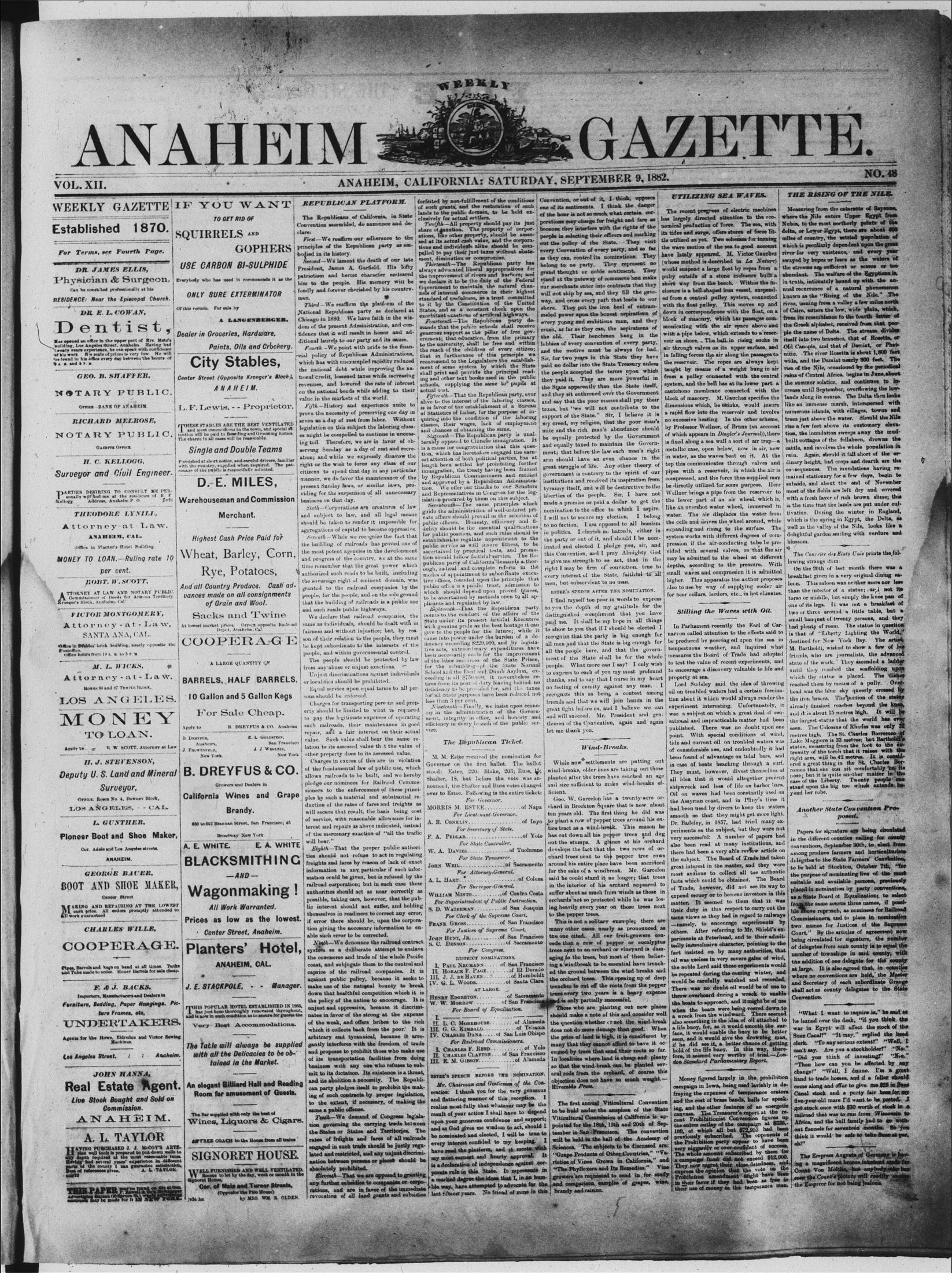
Searchable text
ANAHEIM
VOL. XII.
WEEKLY GAZETTE
Established 1870.
For Terms, see Fourth Page.
DR. JAMES ELLIS,
Physician & Surgeon,
Can be consulted professionally at his
RESIDENCE: Near the Episcopal Church.
DR. E. L. COWAN,
Dentist,
Has opened an office in the upper part of Mrs. Metz's building, Los Angeles Street, Anaheim. Having had twenty years experience, he can speak with confidence of his work. His scale of prices is very low. He will be found in his office every day between the hours of D.A.M. and 6 P.M.
GEO. B. SHAFFER,
NOTARY PUBLIC.
OFFICE—BANK OF ANAHEIM.
RICHARD MELROSE,
NOTARY PUBLIC.
GAKEETTE OFFICE.
H. C. KELOGG,
Surveyor and Civil Engineer.
IF YOU WANT
TO GET RID OF
SQUIRRELS AND
GOPHERS
USE CARBON BI-SULPHIDE
Everybody who has used it recommends it as the ONLY SURE EXTERMINATOR
Of this vermin. For sale by
A. LANGENBERGER,
Dealer in Groceries, Hardware,
Paints, Oils and Crockery.
City Stables,
Center Street (Opposite Kroeger's Block),
ANAHEIM.
L.F. Lewis. - Proprietor,
THESE STABLES ARE THE BEST VENTILATED
and most commodious in the town, and special attention will be paid to Boarding and Grooming horses.
The charme in all cases will be reasonable.
Single and Double Teams
Formished at short notice, and careful drivers, familiar with the country, supplied when required. The patronage of the public is respectfully solicited.
REPUBLICAN
The Republicans owe Convention assembled, clare:
First—We reaffirm our principles of the Republic bodied in its history.
Second—We lament President, James A. Madison, patriotism and heroism him to the people fondly and forever cherish men.
Third—We reaffirm National Republican Chicago in 1880. We dom of the present Advocacy that it will restitution laurels to our nation.
Fourth—We point to special policy of Republican which has with unexactness the national debt with national credit, lessened revenues, and lowered on the national bonds value in the markets.
Fifth—History and prove the necessity of seven as a day of rest legislation on this subject might be compelled to toll. Therefore, serving Sunday as a station; and while we right or the wish to citizens to spend thirteen cents per gallon.
GEO. B. SHAFFER,
NOTARY PUBLIC.
OFFICE—BANK OF ANAHEIM.
RICHARD MELROSE,
NOTARY PUBLIC.
GAKETTE OFFICE.
H. C. KELLOGG,
Surveyor and Civil Engineer.
PARTIES DESIRING TO CONSULT ME PERSONALLY WILL FIND ME AT THE RESIDENCE OF B. F. Kellogg.
Address, Anaheim P.O. Jly22
THEODORE LYNILL,
Attorney at Law.
ANAHEIM, CAL.
Office in Planter's Hotel Building.
MONEY TO LOAN.—Ruling rate 10 per cent.
ROBT. W. SCOTT.
ATTORNEY AT LAW AND NOTARY PUBLIC.
Commissioner of Deeds for Arizona Territory.
Kroeger's Block, Anaheim, Cal.
VICTOR MONTGOMERY,
Attorney-at-Law.
SANTA ANA, CAL.
Office in Dubbles' brick building, nearly opposite the Postoffice.
Office hours from 10 A.M. to 3 P.M.
M. L. WICKS,
Attorney-at-Law.
HOUSES 85 and 87 TEMPLE BLOCK.
LOS ANGELES.
MONEY TO LOAN.
Apply to R. W. SCOTT, Attorney at Law
H. J. STEVENSON,
Deputy U. S. Land and Mineral Surveyor.
OFFICE: Room No 4, Downey Block,
LOS ANGELES, -- CAL.
L. GUNTHER,
Ploneer Boot and Shoe Maker,
Cor. Adelaide and Los Angeles streets.
ANAHEIM.
GEORGE BAUER,
BOOT AND SHOE MAKER,
Center Street
Center Street (Opposite Kroeger's Block),
ANAHEIM.
L. F. Lewis.-- Proprietor.
THESE STABLES ARE THE BEST VENTILATED and most commodities in the town, and special attention will be paid to Boarding and Grimming horses. The charve in all cases will be reasonable.
Single and Double Teams
Furnished at short notice, and careful drivers, familiar with the country, supplied when required. The patronage of the public is respectfully solicited.
D. E. MILES,
Warehouseman and Commission Merchant.
Highest Cash Price Paid for
Wheat, Barley, Corn, Rye, Potatoes,
And all Country Produce. Cash advances made on all consignments of Grain and Wool.
Sacks and Twine
At lowest market prices. Office opposite Railroad Depot, Anaheim, Cal.
COOPERAGE
A LARGE QUANTITY OF
BARRELS, HALF BARRELS,
10 Gallon and 5 Gallon Kegs
For Sale Cheap.
Apply to B. DREYFUS & CO. Anaheim
B. DREYFUS,
Anaheim,
San Francisco
J. FROWENFIELD,
New York
B. DREYFUS & CO.
Growers and Dealers in California Wines and Grape Brandy.
630 to 642 Brannan Street, San Francisco; 45 Broadway New York.
A. E. WHITE.
E. A. WHITE
BLACKSMITHING
—and
Wagonmaking!
National credit, lessened revenues, and lowered value in the markets of Fifth—History and prove the necessity of seven as a day of rest legislation on this subject might be compelled toil. Therefore, serving Sunday as station; and while we right or the wish to citizens to spend that manner, we do favor present Sunday laws, viding for the suspension business on that day.
Sixth—Corporation and subject to law should be taken to aggregations of capital.
Seventh—While we the building of railroad the most potent agent and progress of the time remember that authorized such roads the sovereign right granted to the rail people, for the people that the building of railroad and such roads publish.
We declare that same as individuals, fairness and without son of their relation be kept subordinated people, and within g.
The people should from any abuse or unjust discrimination or localities should beEqual service upon sons should be enforced.
Charges for transports should be limited to pay the legitimate such railroads, the repair, and a fair value. Such value limitation to its assesses other property does.
Charges in excess of the fundamental allows railroads to pledge our nominee-sioners to the entities by such a material duction of the rates will secure that reservation and repairs a of the mercenary e will bear."
Eighth—That ties should not refreights and fares information in anmation could be given railroad corporation authorities should possible taking care
L. GUNTHER,
Ploneer Boot and Shoe Maker,
Cor. Adele and Los Angeles streets.
ANAHEIM.
GEORGE BAUER,
BOOT AND SHOE MAKER,
Center Street
Making and repairing at the lowest cash price. All orders promptly attended to all work guaranteed.
CHARLES WILLE,
COOPERAGE.
Pipes, Barrels and kegs on hand at all times. Tanks and Tubs made to order. Honey Barrels for sale cheap.
F. & J. BACKS.
Importers, Manufacturers and Dealers in Furniture, Bedding, Paper Hangings, Picture Frames, etc.
UNDERTAKERS.
Agents for the Howe, Eldredge and Victor Sewing Machines.
Los Angeles Street, Anaheim.
JOHN HANNA,
Real Estate Agent.
Live Stock Bought and Sold on Commission.
ANAHEIM.
A. L. TAYLOR
Having purchased J. J. McCOY'S ARTEtian well tools is prepared to put down walls to any depth required at the most reasonable rates. Having had several years' experience in different parts of the county I can guarantee satisfaction. Best of references given.
A. L. TAYLOR.
THIS PAPER may be found on file at them.
Advertising Bureau (9) Spruce St., which advertising contracts may be made for it in New York.
CURRICULUM OF BRANDY.
630 to 642 Brannan Street, San Francisco; 45 Broadway New York.
A. E. WHITE.
E. A. WHITE
BLACKSMITHING
—AND—
Wagonmaking!
All Work Warranted.
Prices as low as the lowest.
Center Street, Anaheim.
Planters’ Hotel,
ANAHEIM, CAL.
J. E. STACKPOLE, Manager.
This popular hotel established in 1868, has just been thoroughly renovated throughout, and is now in such condition as to secure for guests the Very Best Accommodations.
The Table will always be supplied with all the Delicacies to be obtained in the Market.
An elegant Billiard Hall and Reading Room for amusement of Guests.
The Bar supplied with only the best of Wines, Liquors & Cigars.
FREE COACH to the House from all trains
SIGNORET HOUSE.
Well furnished and well ventilated. Rooms to let by the day, week or month in the Signoret House,
Cor. of Main and Turner Streets,
(Opposite the Pico House)
by Mrs. Wm. R. OLDEN.
REPUBLICAN PLATFORM.
The Republicans of California, in State Convention assembled, do announce and declare:
First—We reaffirm our adherence to the principles of the Republican party as embodied in its history.
Second—We lament the death of our late President, James A. Garfield. His lofty patriotism and heroic character endeared him to the people. His memory will be fondly and forever cherished by his countrymen.
Third—We reaffirm the platform of the National Republican party as declared at Chicago in 1880. We have faith in the wisdom of the present Administration, and confidence that it will result in honor and additional laurels to our party and its cause.
Fourth—We point with pride to the financial policy of Republican Administrations, which has with unexampled rapidity reduced the national debt while improving the national credit, lessened taxes while increasing revenues, and lowered the rate of interest on the national bonds while adding to their value in the markets of the world.
Fifth—History and experience unite to prove the necessity of preserving one day in seven as a day of rest from labor. Without legislation on this subject the laboring classes might be compelled to continue in unceasing toil. Therefore, we are in favor of observing Sunday as a day of rest and recreation; and while we expressly disavow the right or the wish to force any class of our citizens to spend that day in any particular forfeited by non-fulfillment of the conditions of such grants, and the restoration of such lands to the public domain, to be held exclusively for actual settlers.
Twelfth—All property should pay its just share of taxation. The property of corporations, like other property, should be assessed at its actual cash value, and the corporations and individuals alike should be compelled to pay their just taxes without abatement, diminution or compromise.
Thirteenth—The Republican party has always advocated liberal appropriations for the improvement of rivers and harbors; and we declare it to be the duty of the Federal Government to maintain the natural channels of internal commerce in their highest standard of usefulness, as a trust committed to it by the Constitution of the United States, and as a constant check upon the exorbitant exactions of artificial highways.
Fourteenth—The Republican party demands that the public schools shall receive generous support as the pillar of free government; that education, from the primary to the university, shall be free and within the reach of the children of every citizen; that in furtherance of this principle we recommend to the Legislature the establishment of some system by which the State shall print and provide the principal reading and other text books used in the public schools, supplying the same to pupils at actual cost.
Fifteenth—That the Republican party, ever alive to the interest of the laboring classes, is in favor of the establishment of a Bureau of Statistics of Labor, for the purpose of inquiry into the condition of the laboring classes, their wages, lack of employment and chances of obtaining the same.
Sixteenth—The Republican party is unalterably opposed to Chinese immigration. It is a cause for congratulation that this question, which has heretofore engaged the earnest attention of both political parties, has at length been settled by prohibiting further immigration, the treaty having been framed
Convention, or out of it, I think, opposes one of its sentiments. I think the danger of the hour is not so much what certain corporations may charge for freight and fare as because they interfere with the rights of the people in selecting their officers and marking out the policy of the State. They visit every Convention of every party, and so far as they can, control its nominations. They belong to no party. They represent no grand thought or noble sentiment. They stand at the gateway of commerce and make our merchants enter into contracts that they will not ship by sea, and they fill the gateway, and cross every path that leads to our shore. They put the iron beel of untrammeled power upon the honest aspirations of every young and ambitious man, and they crush, as far as they can, the aspirations of the old. Their henchmen hang in the lobbies of every convention of every party, and the motive must be always for bad. Sir, for two years in this State they have paid no dollar into the State Treasury unless the people accepted the terms upon which they paid it. They are more powerful in the State apparently than the State itself, and they sit enthroned over the Government and say that the poor masses shall pay their taxes, but "we will not contribute to the support of the State." Sir, I believe it is my creed, my religion, that the poor man's mite and the rich man's abundance should be equally protected by the Government and equally taxed to maintain the Government; that before the law each man's right arm should have an even chance in the great struggle of life. Any other theory of government is contrary to the spirit of our
Fifth—History and experience unite to prove the necessity of preserving one day in seven as a day of rest from labor. Without legislation on this subject the laboring classes might be compelled to continue in unceasing toil. Therefore, we are in favor of observing Sunday as a day of rest and recreation; and while we expressly disavow the right or the wish to force any class of our citizens to spend that day in any particular manner, we do favor the maintenance of the present Sunday laws, or similar laws, providing for the suspension of all unnecessary business on that day.
Sixth—Corporations are creatures of law and subject to law, and all legal means should be taken to render it impossible for aggregations of capital to become oppressive.
Seventh—While we recognize the fact that the building of railroads has proved one of the most potent agencies in the development and progress of the country, we at the same time remember that the great power which authorized such roads to be built, including the sovereign right of eminent domain, was granted to the railroad companies by the people, for the people, and on the sole ground that the building of railroads is a public use and such roads public highways.
We declare that railroad companies, the same as individuals, should be dealt with in fairness and without injustice; but, by reason of their relation to the people, they must be kept subordinate to the interests of the people, and within governmental control.
The people should be protected by law from any abuse or unjust exactions.
Unjust discriminations against individuals or localities should be prohibited.
Equal service upon equal terms to all persons should be enforced.
Charges for transporting persons and property should be limited to what is required to pay the legitimate expenses of operating such railroads, their maintenance in good repair, and a fair interest on their actual value. Such value shall bear the same relation to its assessed value that the value of other property does to its assessed value.
Charges in excess of this are in violation of the fundamental law of public use, which allows railroads to be built, and we hereby pledge our nominees for Railroad Commissioners to the enforcement of these principles by such a material and substantial reduction of the rates of fares and treights as will secure that result, the basis being cost of service, with reasonable allowance for interest and repairs as above indicated, instead of the mercenary exaction of "all the traffic will bear."
Eighth—That the proper public authorities should not refuse to act in regulating freights and fares by reason of lack of exact information in any particular if such information could be given, but is refused by the railroad corporation; but in such case these authorities should act as near correctly as possible taking care however that the public prime and other text books used in the public schools, supplying the same to pupils at actual cost.
Fifteenth—That the Republican party, ever alive to the interest of the laboring classes, is in favor of the establishment of a Bureau of Statistics of Labor, for the purpose of inquiry into the condition of the laboring classes, their wages, lack of employment and chances of obtaining the same.
Sixteenth—The Republican party is unalterably opposed to Chinese immigration. It is a cause for congratulation that this question, which has heretofore engaged the earnest attention of both political parties, has at length been settled by prohibiting further immigration, the treaty having been framed by Republican Commissioners and ratified and approved by a Republican Administration. We offer our thanks to our Senators and Representatives in Congress for the legislation procured by them on this subject.
Seventeenth—The same principles which guide the administration of well-ordered private affairs should prevail in the selection of public officers. Honesty, efficiency and fidelity should be the essential qualifications for public position, and such rules should be established to regulate appointment to the public service as will insure fitness, to be ascertained by practical tests, and promotion should follow faithful service. The Republican party of California demands a thorough, radical and complete reform in the modes of appointment to subordinate executive offices, founded upon the principle that public office is a public trust, admission to which should depend upon proved fitness, to be ascertained by methods open to all applicants and regulated by law.
Eighteenth—That the Republican party points to the conduct of the affairs of the State under its present faithful Executive with genuine pride as the best hostage it can give to the people for the future; while it came into power under the burden of a deficiency exceeding $220,000, and by legislative acts, extraordinary expenditures have been necessarily made for the improvement of the labor resources of the State Prison, for the rebuilding of the State Normal School and the Deaf and Dumb Asylum, exceeding in all $750,000; it nevertheless retires from its post of duty leaving behind no deficiency to be provided for, and the taxes for all State purposes have been reduced not less than 3 per cent.
Nineteenth—Finally, we insist upon economy in the administration of the Government, integrity in office, and honesty and efficiency in every branch of the public service.
The Republican Ticket.
M. M. Estee received the nomination for Governor on the first ballot. The ballot stood: Estee, 220; Blake, 203; Russ, 15; Shafter, 18, but before the vote was announced, the Shafter and Russ votes changed over to Estee. Following is the entire ticket:
For Governor.
MORRIS M. ESTEE...of Napa
For Lieutenant-Governor.
A. R. CONKLIN...of Inyo
For Secretary of State.
F. A. PEDLAR...of Yolo
For State Controller.
W. A. DAVIES...of Tuohimne
For State Treasurer.
JOHN WEIL...of Sacramento
For Attorney-General.
A. L. HART...of Colusa
For Surveyor-General.
WILLIAM MINTO...of Contra Costa
Wind-Breaks.
While now settlements are putting out wind-breaks, older ones are taking out those planted after the trees have reached an age and size sufficient to make wind-breaks efficient.
Geo. W. Garcelon has a twenty-acre orchard in Brockton Square that is now about ten years old. The first thing he did was to plant a row of pepper trees around his entire tract as a wind-break. This season he has cut down all his pepper trees and dug out the stumps. A glance at his orchard develops the fact that the two rows of orchard trees next to the pepper tree rows around his entire place have been sacrificed for the sake of a windbreak. Mr. Garcelon said he could stand it no longer; that trees in the interior of his orchard appeared to suffer about as much from winds as those in orchards not protected when he was lost.
Eighth—That the proper public authorities should not refuse to act in regulating freights and fares by reason of lack of exact information in any particular if such information could be given, but is refused by the railroad corporation; but in such case these authorities should act as near correctly as possible, taking care, however, that the public interest should not suffer, and holding themselves in readiness to correct any error, if error there should be, upon the corporation giving the necessary information to enable such error to be corrected.
Ninth—We denounce the railroad contract system as a deliberate attempt to enslave the commerce and trade of the whole Pacific coast, and subjugate them to the control and caprice of the railroad companies. It is against public policy, because it seeks to make use of the national bounty to break down that healthful competition which it is the policy of the nation to encourage. It is unjust and oppressive, because it discriminates in favor of the strong at the expense of the weak, and offers bribes to the rich which it collects back from the poor. It is arbitrary and tyrannical, because it arrogantly interferes with the freedom of trade and proposes to prohibit those who make use of its transportation facilities from doing business with any one who refuses to submit to its dictation. Its existence is a threat, and its abolition a necessity. The Republican party pledges itself to prohibit the making of such contracts by proper legislation, to the extent, if necessary, of making the same a public offense.
Tenth—We demand of Congress legislation governing the carrying trade between the States or States and Territories. The rates of freights and fares of all railroads engaged in such trade should be justly regulated and restricted, and any unjust discrimination between persons or places should be absolutely prohibited.
Eleventh—That we are opposed to granting any further subsidies to companies or corporations, and are in favor of the immediate revocation of all land grants and subsidies
For Governor.
MORRIS M. ESTEE...of Napa
For Lieutenant-Governor.
A. R. CONKLIN...of Inyo
For Secretary of State.
F. A. PEDLAR...of Yolo
For State Controller.
W. A. DAVIES...of Tuohumne
For State Treasurer.
JOHN WEIL...of Sacramento
For Attorney-General.
A. L. HART...of Colusa
For Surveyor-General.
WILLIAM MINTO...of Contra Costa
For Superintendent of Public Instruction.
S. D. WATERMAN...of San Joaquin
For Clerk of the Supreme Court.
FRANK GROSS...of San Francisco
For Justices of Supreme Court.
JOHN HUNT, JR...of San Francisco
S. C. DENSON...of Sacramento
For Congress.
DISTRICT NOMINATIONS.
I. PAUL NEUMANN...of San Francisco
II. HORACE F. PAGE...of El Dorado
III. J. J. DE HAVEN...of Humboldt
IV. G. L. WOODS...of Santa Clara AT LARGE.
HENRY EDGERTON...of Sacramento
W. W. MORROW...of San Francisco
For Board of Equalization.
I.
II. L. C. MOREHOUSE...of Alameda
III. G. G. KIMBALD...of Tehama
IV. CHARLES DANA...of San Luis Obispo
For Railroad Commissioners.
I. CHARLES F. REED...of Yolo
II. CHARLES CLAYTON...of San Francisco
III. E. M. GIBSON...of Alameda
ESTEE'S SPEECH BEFORE THE NOMINATION.
Mr. Chairman and Gentlemen of the Convention: I thank you for the very generous and flattering manner of this reception. I realize most fully that whatever may be the result of your action I shall have to depend upon your generous confidence and support; and as God gives me wisdom to act, should I be nominated and elected, I will be true to every interest confided to my keeping. I have read the platform, and it meets with my most earnest and hearty approval. It is a declaration of independence against corporate rule in this State. It represents in a marked degree the idea that I, in an humble way, have attempted to advocate for the last fifteen years. No friend of mine in this Geo. W. Garcelon has a twenty-acre orchard in Brockton Square that is now about ten years old. The first thing he did was to plant a row of pepper trees around his entire tract as a wind-break. This season he has cut down all his pepper trees and dug out the stumps. A glance at his orchard develops the fact that the two rows of orchard trees next to the pepper tree rows around his entire place have been sacrificed for the sake of a windbreak. Mr. Garcelon said he could stand it no longer; that trees in the interior of his orchard appeared to suffer about as much from winds as those in orchards not so protected while he was losing heavily every year on those trees next to the pepper trees.
This is not a solitary example; there are many other cases nearly as pronounced as the one cited. All our fruit-growers concede that a row of pepper or eucalyptus trees next to an orchard or vineyard is damaging to the trees, but most of them believing a windbreak to be essential have trenched the ground between the wind breaks and the orchard trees. This opening up of deep trenches to cut off the roots from the pepper trees every two years is a heavy expense and is only partially successful.
Those who are planting out new places should make a note of this and consider well the question whether or not the wind-break does not do more damage than good. When the price of land is high, it is considered by many that they cannot afford to have it occupied by trees that send their roots so far. In localities where land is cheap and plenty so that the wind-break can be planted several rods from the orchard, of course this objection does not have so much weight—Riverside Press.
The first annual Viticultural Convention to be held under the auspices of the State Viticultural Commission of California is appointed for the 18th, 19th and 20th of September in San Francisco. The convention will be held in the hall of the Academy of Sciences. The subjects to be discussed are: "Grape Products of Other Countries," "Varieties of Vines Grown in California," and "The Phylloxera and Its Remedies." Vine growers are requested to send in for study and comparison examples of grapes, wine, brandy and raisins.
GAZETTE.
MEMBER 9, 1882.
NO. 48
UTILIZING SEA WAVES.
The recent progress of electric machines has largely directed attention to the economical production of force. The sea, with its tides and surge, offers stores of force little utilized as yet. Two schemes for turning the wave motion of the sea to good account have lately appeared. M. Victor Gauchez (whose method is described in La Nature) would suspend a large float by ropes from a pully outside of a stone inclosure built a short way from the beech. Within the enclosure is a bell-shaped iron vessel, suspended from a central pulley system, connected with the float pulley. This moves up and down in correspondence with the float, on a block of masonry, which has passages communicating with the air space above and with a pipe below, which extends to a reservoir on shore. The bell in rising sucks in air through valves on its upper surface, and in falling forces the air along the passages to the reservoir. The ropes are always kept taught by means of a weight hung in air from a pulley connected with the central system, and the bell has at its lower part a cautchono membrane connected with the block of masonry. M. Gauchez specifies the dimensions which, he thinks, would insure a rapid flow into the reservoir and involve no excessive heating. In the other scheme, by Professor Wellner, of Brunn (an account of which appears in Dingler's Journal), there is fixed along a sea wall a sort of air trap—a metallic case, open below, now in air, now in water, as the waves beat on it. At the top this communicates through valves and pipes with a reservoir, in which the air is
THE RISING OF THE NILE.
Measuring from the cataracts of Sayenne, where the Nile enters Upper Egypt from Nubia, to the most northerly points of the delta, or Lower Egypt, there are about 600 miles of country, the settled population of which is peculiarly dependent upon the great river for very existence, and every year awayed by hopes or fears as the waters of the streams are sufficient or scarce or too abundant. The welfare of the Egyptians is in truth, intimately bound up with the annual recurrence of a natural phenomenon known as the "Rising of the Nile." The river, issuing from a valley a few miles north of Cairo, enters the low, wide plain, which, from its resemblance to the fourth letter of the Greek alphabet, received from that people the name of Delta. The stream divides itself into two branches, that of Rosetta, or Old Canopic, and that of Damiat, or Phatnitic. The river Rosetta is about 1,800 feet wide, and the Damiat nearly 300 feet. The rise of the Nile, occasioned by the periodical rains of Central Africa, begins in June, about the summer solstice, and continues to increase until September, overflowing the lowlands along its course. The Delta then looks like an immense marsh, interspersed with numerous islands, with villages, towns and trees just above the water. Should the Nile rise a few feet above its customary elevation, the inundation sweeps away the mud-built cottages of the fellabeen, drowns the cattle, and involves the whole population in rain. Again, should it fall short of the ordinary height, bad crops and dearth are the consequences. The inundations having re-
poor in words to express my gratitude for the embodiment that you have made my hope in all things if I should be elected I partly is big enough for the State is big enough for me, and that the governorship shall be for the whole we can say? I only wish of you my most profound that I nurse in my heart cry against any man. I being a contest among will join hands in the wars, and I believe we can Mr. President and generation, again and again.
Stilling the Waves with Oil.
In Parliament recently the Earl of Carnervon called attention to the effects said to be produced by pouring oil upon the sea in tempestuous weather, and inquired what measures the Board of Trade had adopted to test the value of recent experiments, and to encourage a discovery valuable to life and property at sea.
Lord Sudeley said the idea of throwing oil on troubled waters had a certain fascination about it which would always render the experiment interesting. Unfortunately, it was a subject on which a great deal of sensational and impracticable matter had been published. There was no doubt upon one point. With special conditions of wind, tide and current oil on troubled waters was of considerable use, and undoubtedly it had been found of advantage on tidal bars, and in case of boats beaching through a surf. They must, however, divest themselves of all idea that it would altogether prevent shipwreck and loss of life on harbor bars. Oil on waves had been constantly used on the Assyrian coast, and in Pliny's time it had been used by divers to keep the waters smooth so that they might get more light. Dr. Badeley, in 1857, had tried many experiments on the subject, but they were not very successful: A number of papers had also been read at many institutions, and there had been a very able review article on the subject. The Board of Trade had taken great interest in the matter, and they were most anxious to collect all the authentic facts which could be obtained. The Board of Trade, however, did not see its way to expend money or to become investors in this rains of Central Africa, begins in June, about the summer solstice, and continues to increase until September, overflowing the lowlands along its course. The Delta then looks like an immense marsh, interspersed with numerous islands, with villages, towns and trees just above the water. Should the Nile rise a few feet above its customary elevation, the inundation sweeps away the mud-built cottages of the fallabeen, drowns the cattle, and involves the whole population in rain. Again, should it fall short of the ordinary height, bad crops and dearth are the consequences. The inundations having remained stationary for a few days, begin to subside, and about the end of November most of the fields are left dry and covered with a fresh layer of rich brown slime; this is the time that the lands are put under cultivation. During the winter in England, which is the spring in Egypt, the Delta, as well as the valley of the Nile, looks like a delightful garden smiling with verdure and blossom.
The Courrier des Etats Unis prints the following strange item:
On the 20th of last month there was a breakfast given in a very original dining saillon. This saloon was neither more nor less than the interior of a statue; arl not its torso or middle, but simply the knee pan of one of its legs. It was not a breakfast of two or three around a little table, but a small banquet of twenty persons, and they had plenty of room. The statue in question is that of "Liberty Lighting the World," destined for New York Bay. The artist, M. Bartholdi, wished to show a few of his friends, who are journalists, the advanced state of the work. They ascended a ladder until they reached the scaffolding upon which the statue is placed. The dishes reached them by means of a pully. Overhead was the blue sky queerly crossed by the iron braces. The portion of the statue already finished reaches beyond the knees, and it is about 15 metres high. It will be the largest statue that the world has ever seen. The Colossus of Rhodes was only 32 metres high. The St. Charles Borromeo of Lake Maggiore is 33 metres; but Bartholdi's statue, measuring from the foot to the extremity of the torch that it raises with the right arm, will be 42 metres. It is considered a great thing in the St. Charles Borromeo that one can sit comfortably on its nose; but it is quite another matter in the case of the Liberty. Twenty people can stand upon the big toe which extends beyond her robe.
Another State Convention Proposed.
Papers for signature are being circulated in the different counties calling for county conventions, September 30th, to elect from among produce farmers and horticulturists delegates to the State Farmers' Convention, to be held at Stockton, October 7th, "for the purpose of nominating five of the most suitable and available persons, previously placed in nomination by party conventions, as a State Board of Equalization; to select
Another State Convention Proposed.
Papers for signature are being circulated in the different counties calling for county conventions, September 30th, to elect from among produce farmers and horticulturists delegates to the State Farmers' Convention, to be held at Stockton, October 7th, "for the purpose of nominating five of the most suitable and available persons, previously placed in nomination by party conventions, as a State Board of Equalization; to select from the same source three names, if possible above reproach, as nominees for Railroad Commissioners, and to place in nomination two names for Justices of the Supreme Court." By the articles of agreement now being circulated for signature, the number of delegates from each county is to equal the number of townships in said county, with the addition of one delegate for the county at large. It is also agreed that, in counties where no conventions are held, the Master and Secretary of each subordinate Grange shall act as county delegates to the State Convention.
"What I want to inquire is," he said as he leaned over the desk, "if you think the war in Egypt will affect the stock of the Suez Canal?" "It may," replied the head clerk. "To any serious extent?" "Well, I can't say. Are you a stockholder!" "No."
"Did you think of investing?" "N.e."
"Then how can you be affected by any change?" "Well, I dunno. I'm a great hand to trade houses, and if a seller should come along and offer to give me $25 in Suez Canal stock and a party fair home for my five-year-old mare I'd want to be posted. I got stuck once with $30 worth of stock in a railroad that was to run from Wisconsin to Africa, and the hull family had to go without flannels for seventeen months. So you think it would be safe to take Suez at par, eh?"
The Empress Augusta of Germany is having a magnificent brass inkstand made for Count Von Moltke, but anybody who has seen the Count's picture will readily admire the Emperor for not being jealous.