anaheim-gazette 1882-08-05
Scanned page
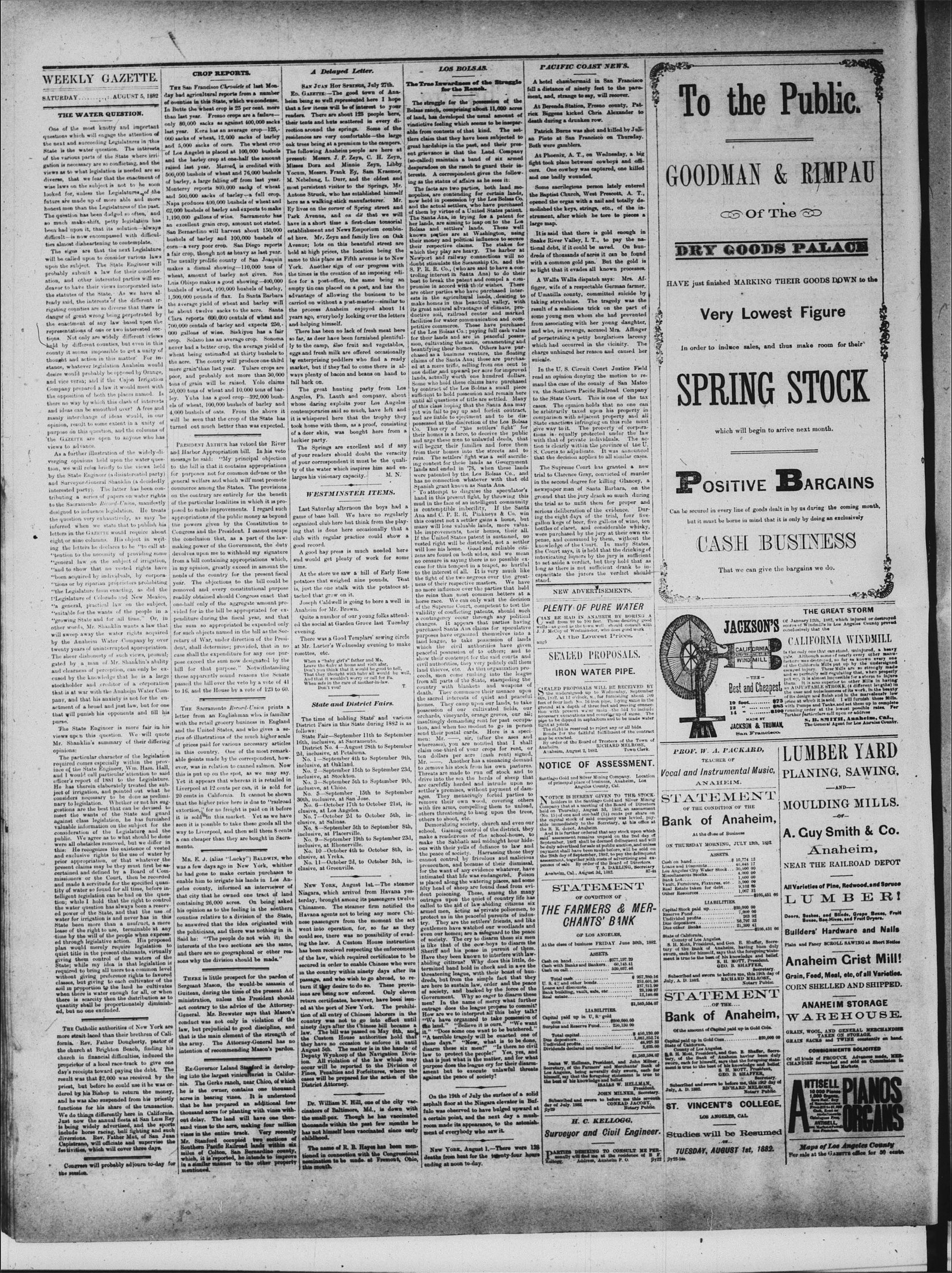
Searchable text
WEEKLY GAZETTE.
SATURDAY... AUGUST 5, 1882
THE WATER QUESTION.
One of the most knotty and important questions which will engage the attention of the next and succeeding Legislatures in this State is the water question. The interests of the various parts of the State where irrigation is necessary are so conflicting, and the views as to what legislation is needed are so diverse, that we fear that the enactment of wise laws on the subject is not to be soon looked for, unless the Legislatures of the future are made up of more able and more honest men than the Legislatures of the past. The question has been dodged so often, and so much make-shift, petty legislation has been had upon it, that its solution—always difficult—is now encompassed with difficulties almost disheartening to contemplate.
The signs are that the next Legislature will be called upon to consider various laws upon the subject. The State Engineer will probably submit a law for their consideration, and other interested parties will endeavor to have their views incorporated into the statutes of the State. As we have already said, the interests of the different irrigating counties are so diverse that there is danger of great wrong being perpetrated by the enactment of any law based upon the representations of one or two interested sections. Not only are widely different views held by different counties, but even in this county it seems impossible to get a unity of thought and action in this matter. For instance, whatever legislation Anaheim would desire would probably be opposed by Orange, and vice versa; and if the Cajon Irrigation Company prepared a law it would meet with the opposition of both the places named. Is there no way by which this clash of interests and ideas can be smoothed over? A free and manly interchange of ideas would, in our opinion, result to some extent in a unity of purpose on this question, and the columns of 'the Gazette' are open to anyone who has views to advance.
As a further illustration of the widely diverging opinions held upon the water question, we will refer briefly to the views held by the State Engineer (almost interested party)
CROP REPORTS.
The San Francisco Chronicle of last Monday had agricultural reports from a number of counties in this State, which we condense. In Butte the wheat crop is 25 per cent. more than last year. Fresno crops are a failure—only 80,000 sacks as against 400,000 sacks last year. Kera has an average crop—125,-000 sacks of wheat, 12,000 sacks of barley and 5,000 sacks of corn. The wheat crop of Los Angeles is placed at 100,000 bushels and the barley crop at one-half the amount raised last year. Merced is credited with 500,000 bushels of wheat and 76,000 bushels of barley, a large falling off from last year. Monterey reports 800,000 sacks of wheat and 500,000 sacks of barley—a full crop. Napa produces 400,000 bushels of wheat and 62,000 bushels of barley and expects to make 1,190,000 gallons of wine. Sacramento has an excellent grain crop, amount not stated. San Bernardino will harvest about 150,000 bushels of barley and 100,000 bushels of corn—a very poor crop. San Diego reports a fair crop, though not as heavy as last year. The usually prolific county of San Joaquin makes a dismal showing—110,000 tons of wheat, amount of barley not given. San Luis Obispo makes a good showing—400,000 bushels of wheat, 190,000 bushels of barley, 1,500,000 pounds of flax. In Santa Barbara the average yield of wheat and barley will be about twelve sacks to the acre. Santa Clara reports 600,000 centals of wheat and 700,000 centals of barley and expects 250,-000 gallons of wine. Siskiyou has a fair crop. Solano has an average crop. Sonoma never had a better crop, the average yield of wheat being estimated at thirty bushels to the acre. The county will produce one-third more grain than last year. Tulare crops are poor, and probably not more than 30,000 tons of grain will be raised. Yolo claims 50,000 tons of wheat and 10,000 tons of barley. Yuba has a good crop—392,000 bushels of wheat, 190,000 bushels of barley and 4,000 bushels of oats. From the above it will be seen that the crop of the State has turned out much better than was expected.
PRESIDENT ARTHUR has vetoed the River and Harbor Appropriation bill. In his veto message he said: "My principal objection to the bill is that it contains appropriations for purposes not for common defense or the A Delayed Issue.
SAN JUAN HOT SPRING.
Ed. GAZETTE:—The good-heim being so well represented that a few items will be of readers. There are about eight their tents and huts scattered around the spring residences are very comfort oak trees being at a premium. The following Anaheim presents: Messrs. J. P. Zezey Misses Dora and Minnie Yocum, Messrs. Frank Eyre M. Nebelung, L. Durr, and most persistent visitor to Antone Struck, who has entered here as a walking-stick man. Ey lives on the corner of Park Avenue, and on have in a short time a fine establishment and News Ed here. Mr. Zeyn and france Avenue; lots on this bench at high prices; the same to this place as Fifth York. Another sign of the times is the creation of office for a post-office; the empty tin can placed on an advantage of allowing them carried on without a post—the process Anaheim years ago; everybody looks and helping himself.
There has been no lack so far, as deer have been lily to the camp; also fruiting eggs and fresh milk are on lay enterprising peddlers market; but if they fail to ways plenty of bacon and fall back on.
The great hunting Angeles, Ph. Lauth and whose daring exploits y contemporaries said so much it is whispered here that took home with them, assiduous of a deer skin, was boo-luckier party.
The Springs are excuseof your readers should knowof your correspondent it ty of the water which in
As a further illustration of the widely diverging opinions held upon the water question, we will refer briefly to the views held by the State Engineer (a disinterested party) and Surveyor-General Shanklin (a decidedly interested party). The latter has been contributing a series of papers on water rights to the Sacramento Record-Union, manifestly designed to induce legislation. He treats the question very exhaustively, as may be inferred when we state that to publish his letters in the Gazette would require about eight or nine columns. His object in writing the letters he declares to be "to call attention to the necessity of providing some general law on the subject of irrigation," and to show that no vested rights have been acquired by individuals, corporations or by riparian proprietors prohibiting the Legislature from enacting, as did the Legislature of Colorado and New Mexico, a general, practical law on the subject, suitable for the wants of the people in a "growing State and for all time." Or, in other words, Mr. Shanklin wants a law that will sweep away the water rights acquired by the Anaheim Water Company by over twenty years of uninterrupted appropriation. The sheer dishonesty of such views, promulgated by a man of Mr. Shanklin's ability and clearness of perception, can only be excused by the knowledge that he is a large stockholder and creditor of a corporation that is at war with the Anaheim Water Company, and that his anxiety is not for the enactment of a broad and just law, but for one that will punish his opponents and till his purse.
The State Engineer is more fair in his views upon this question. We will quote Mr. Shanklin's summary of their differing opinions:
The particular character of the legislation required comes especially within the province of the State Engineer, Wm. Haim Hall, and I would call particular attention to said officer's report of 1881 to the Legislature. He has therein elaborately treated the subject of irrigation, and pointed out what he considers necessary to be done as preliminary to legislation. Whether or not his suggestions are the best that can be devised to meet the wants of the State and guard against class legislation, he has furnished valuable information on the subject for the consideration of the Legislature and the public. We agree as to what should be done were all obstacles removed, but we differ in this: He recognizes the existence of vested and exclusive rights to the use of water by prior appropriation, or that whatever the present claims may be they must first be certaind and defined by a Board of Commissioners or the Court, then be recorded and made a servitude for the specified quantity of water so found for all time, before intelligent legislation can be had on the questions would probably be discussed by Orange and vice versa; and if the Cajon Irrigation Company prepared a law it would meet with the opposition of both the places named. Is there no way by which this clash of interests and ideas can be smoothed over? A free and manly interchange of ideas would, in our opinion, result to some extent in a unity of purpose on this question, and the columns of 'the GAZETTE' are open to anyone who has views to advance.
As a further illustration of the widely-diverging opinions held upon the water question, we will refer briefly to the views held by the State Engineer (a disinterested party) and Surveyor-General Shanklin (a decidedly interested party). The latter has been contributing a series of papers on water rights to the Sacramento Record-Union, manifestly designed to induce legislation. He treats the question very exhaustively, as may be inferred when we state that to publish his letters in the Gazette would require about eight or nine columns. His object in writing the letters he declares to be "to call attention to the necessity of providing some general law on the subject of irrigation," and to show that no vested rights have been acquired by individuals, corporations or by riparian proprietors prohibiting the Legislature from enacting, as did the 'Legislature of Colorado and New Mexico,' a general, practical law on the subject, suitable for the wants of the people in a "growing State and for all time." Or, in other words, Mr. Shanklin wants a law that will sweep away the water rights acquired by the Anaheim Water Company by over twenty years of uninterrupted appropriation. The sheer dishonesty of such views, promulgated by a man of Mr. Shanklin's ability and clearness of perception, can only be excused by the knowledge that he is a large stockholder and creditor of a corporation that is at war with the Anaheim Water Company, and that his anxiety is not for the enactment of a broad and just law, but for one that will punish his opponents and till his purse.
The State Engineer is more fair in his views upon this question. We will quote Mr. Shanklin's summary of their differing opinions:
The particular character of the legislation required comes especially within the province of the State Engineer, Wm. Haim Hall, and I would call particular attention to said officer's report of 1881 to the Legislature. He has therein elaborately treated the subject of irrigation, and pointed out what he considers necessary to be done as preliminary to legislation. Whether or not his suggestions are the best that can be devised to meet the wants of the State and guard against class legislation, he has furnished valuable information on the subject for the consideration of the Legislature and the public. We agree as to what should be done were all obstacles removed, but we differ in this: He recognizes the existence of vested and exclusive rights to the use of water by prior appropriation, or that whatever the present claims may be they must first be certaind and defined by a Board of Commissioners or the Court, then be recorded and made a servitude for the specified quantity of water so found for all time, before intelligent legislation can be had on the questions would probably be discussed by Orange and vice versa; and if the Cajon Irrigation Company prepared a law it would meet with the opposition of both the places named. Is there no way by which this clash of interests and ideas can be smoothed over? A free and manly interchange of ideas would, in our opinion, result to some extent in a unity of purpose on this question, and the columns of 'the GAZETTE' are open to anyone who has views to advance.
As a further illustration of the widely-diverging opinions held upon the water question, we will refer briefly to the views held by the State Engineer (a disinterested party) and Surveyor-General Shanklin (a decidedly interested party). The latter has been contributing a series of papers on water rights to the Sacramento Record-Union, manifestly designed to induce legislation. He treats the question very exhaustively, as may be inferred when we state that to publish his letters in the Gazette would require about eight or nine columns. His object in writing the letters he declares to be "to call attention to the necessity of providing some general law on the subject of irrigation," and to show that no vested rights have been acquired by individuals, corporations or by riparian proprietors prohibiting the Legislature from enacting, as did the 'Legislature of Colorado and New Mexico,' a general, practical law on the subject, suitable for the wants of the people in a "growing State and for all time." Or, in other words, Mr. Shanklin wants a law that will sweep away the water rights acquired by the Anaheim Water Company by over twenty years of uninterrupted appropriation. The sheer dishonesty of such views, promulgated by a man of Mr. Shanklin's ability and clearness of perception, can only be excused by the knowledge that he is a large stockholder and creditor of a corporation that is at war with the Anaheim Water Company, and that his anxiety is not for the enactment of a broad and just law, but for one that will punish his opponents and till his purse.
The State Engineer is more fair in his views upon this question. We will quote Mr. Shanklin's summary of their differing opinions:
The particular character of the legislation required comes especially within the province of the State Engineer, Wm. Haim Hall, and I would call particular attention to said officer's report of 1881 to the Legislature. He has therein elaborately treated the subject of irrigation, and pointed out what he considers necessary to be done as preliminary to legislation. Whether or not his suggestions are the best that can be devised to meet the wants of the State and guard against class legislation, he has furnished valuable information on the subject for the consideration of the Legislature and the public. We agree as to what should be done were all obstacles removed, but we differ in this: He recognizes the existence of vested and exclusive rights to use of water by prior appropriation, or that whatever the present claims may be they must first be certaind and defined by a Board of Commissioners or the Court, then be recorded and made a servitude for the specified quantity of water so found for all time, before intelligent legislation can be had on the questions would probably be discussed by Orange and vice versa; and if the Cajon Irrigation Company prepared a law it would meet with the opposition of both the places named. Is there no way by which this clash of interests and ideas can be smoothed over? A good hay press is used plenty time.
At the store we saw potatoes that weighed nails; just one stalk was tached that grew on it.
Joseph Caldwell is gone Anaheim for Mr. Brown Quite a number oufedthe social at Garden evening.
There was a Good Tent at Mr. Larter's Wednesdays rosettes, etc.
When a "baby girl's" faile Leave baby at home Don't you think that it That they thought with And that it wouldn't woe When safe inthe care oof Don't you!
The Sacramento Record-Union prints a letter from an Englishman who is familiar with the retail grocery business in England andthe United States,and who gives a seriesof illustrationsofthe much higher scaleof prices paidfor various necessary articlesin this country. One ofthe most remarkable points madebythe correspondent,howeverwas in relation tocanned salmon.Nowthisis put up onthe spot.aswe may say.Yet it appearsthat whereasit is retailedin Liverpoolat12 cents percan,tis soldfor20 centsin California.Icannotbe shownthatthehigherpricehereisdueto"railroad extortion,"forno freightispaidontibetitissoldinthismarket.Yetaswehave seenitpossibletakethesegoodsallthewayToLiverpool,andthen sellthem8centsa cancheaperthantheyare boughtinSacramento.
MR.E.J.(alias "Lucky") BALDWIN,who wasafewdaysagoinNewYork whitherhehadgonetomakecertainpurchasestocenablehimtoirrigatehislandsinLosAngelescounty,farnamedaninterviewerofthatcitythatheownedone tractoflandwaysplentyofbaconandtailbackon.
The great hunting at Angeles,Ph.Lauthandwhose daring exploitsycontemporaries said so maltitofwaterwhichintolargeshisvisionarycapacity.
WESTMINSTER
Last Saturday afternoon gameofbaseball.Wereorganizedclub herebutingthatisdoneherewithclubwithregularpracticalgoodrecord.Agoodhaypressisusedplentytime.
Atthestorewe sawpotatoesthatweighednailsjusttheonestalkwattachedthatgrewonit.
JosephCaldwellisgoeanaheimforMr.BrownQuiteanumberoftoufedthesocialatGardenevening.
TherewasaGoodTentatMr.Larter'sWednesdaysrosettes,etc.
Whena"baby girl's"faileLeavebabyathomeDon'tyouthinkthatitThattheythoughtwithAndthatitwouldnotwoeWhensafeinthecareoofDon'tyou!
The Catholic authorities of New York are more strait-laced than their brethren of California. Rev. Father Dougherty, pastor of the church at Brighton Beach, finding his church in financial difficulties, induced the proprietor of a local race-track to give one day's receipts toward paying the debt. The result was that $2,000 was received by the priest, but before he could use it he was ordered by his Bishop to return the money, and he was also suspended from his priestly functions for his share of the transaction.
We do things differently here in California. Just now the annual fiesta at San Luis Rey is being widely advertised, and the sports include horse racing, bull fighting and such diversions. Rev. Father Mut, of San Juan Capistrano, will officiate and supervise the festivities, which will cover three days.
Congress will probably adjourn to-day for the session.
Mr. E. J. (alias "Lucky") Baldwin, who was a few days ago in New York, whither he had gone to make certain purchases to enable him to irrigate his lands in Los Angeles county, informed an interviewer of that city that he owned one tract of land containing 26,000 acres. On being asked his opinion as to the feeling in the southern counties relative to a division of the State, he answered that the idea originated with the politicians, and there was nothing in it. Said he: "The people do not wish it; the interests of the two sections are the same, and there are no geographical or other reasons why the division should be made."
There is little prospect for the pardon of Sergeant Mason, the would-be assassin of Guiteau, during the time of the present Administration, unless the President should act contrary to the advice of the Attorney-General. Mr. Brewster says that Mason's conduct was not only in violation of the law, but prejudicial to good discipline, and that is the main element of the strength of the army. The Attorney-General has no intention of recommending Mason's pardon.
Ex-Governor Leland Stanford is developing into the largest viniculturist in California. The Gerke ranch, near Chico, of which he is the owner, contains one thousand acres in bearing vines. It is understood that he has prepared an additional four thousand acres for planting with vines without delay. The land will have one thousand vines to the acre, making four million vines in the entire track. Very recently Mr. Stanford occupied two sections of Southern Pacific Railroad lands within six miles of Colton, San Bernardino county, which it is reported, he intends to improve in a similar manner to the other property mentioned.
A Delayed Letter.
SAN JUAN HOT SPRINGS, July 27th.
Ed. GAZETTE:—The good town of Anaheim being so well represented here I hope that a few items will be of interest to your readers. There are about 125 people here, their tents and huts scattered in every direction around the springs. Some of the residences are very comfortable—the large oak trees being at a premium to the campers. The following Anaheim people are here at present: Messrs. J. P. Zeyn, C. H. Zeyn, Misses Dora and Minnie Zeyn, Libby Yocum, Messrs. Frank Ey, Sam Kraemer, M. Nebelung, L. Durr, and the oldest and most persistent visitor to the Springs, Mr. Antone Struck, who has established himself here as a walking-stick manufacturer. Mr. Ey lives on the corner of Spring street and Park Avenue, and on dit that we will have in a short time a first-class tonsorial establishment and News Emporium combined here. Mr. Zeyn and family live on Oak Avenue; lots on this beautiful street are held at high prices, the location being the same to this place as Fifth avenue is to New York. Another sign of our progress with the times is the creation of an imposing edifice for a post-office, the same being an empty tin can placed on a post, and has the advantage of allowing the business to be carried on without a post-master—similar to the process Anaheim enjoyed about 14 years ago, everybody looking over the letters and helping himself.
There has been no lack of fresh meat here so far, as deer have been furnished plentifully to the camp, also fruit and vegetables, eggs and fresh milk are offered occasionally by enterprising peddlers who find a ready market, but if they fail to come there is always plenty of bacon and beans on hand to fall back on.
The great hunting party from Los Angeles, Ph. Lauth and company, about whose daring exploits your Los Angeles contemporaries said so much, have left and it is whispered here that the trophy they took home with them, as a proof, consisting of a deer skin, was bought here from a luckier party.
The Springs are excellent and if any of your readers should doubt the veracity of your correspondent it must be the quality of the water which inspires him and en-
LOS BOLSAS.
The True Inwardness of the Struggle for the Ranch.
The struggle for the possession of the Bolsas ranch, comprising about 11,000 acres of land, has developed the usual amount of vindictive feeling which seems to be inseparable from contests of that kind. The settlers claim that they have been subjected to great hardships in the past, and their present grievance is that the Land Company (so-called) maintain a band of six armed desperadoes on the ranch to guard their interests. A correspondent gives the following as the status of affairs as he sees it:
The facts are two parties, both land monopolies, are contending for certain lands, now held in possession by the Los Bolsas Co., and the actual settlers, who have purchased of them by virtue of a United States patent. The Santa Ana, in trying for a patent for her lands, are aiming to leap on to the Los Bolsas and settlers' lands. These well known parties are at Washington, using their money and political influence to secure their respective claims. The stakes for which they play are heavy. The harbor at Newport and railway connections will no doubt stimulate the Steamship Co. and the S. P. R. R. Co., (who are said to have a controlling interest in Santa Ana) to do their best to break the patent and compel a compromise in accord with their wishes. There are other parties who have purchased interests in the agricultural lands, desiring to make homes in this beautiful valley, with its great natural advantages of climate, productive soil, railroad center and marked facilities for water communication and competitive commerce. These have purchased of the Los Bolsas Co.; paying full cash value for their lands and are in peaceful possession, cultivating the same, ornamenting and beautifying their homes. Others have purchased as a business venture, the floating claims of the Santa Ana; these are purchased at a mere trifle, selling from one cent to one dollar and upward per acre for improved lands, actually worth one hundred dollars. Some who hold these claims have purchased by contract of the Los Bolsas a small piece sufficient to hold possession and remain here until all questions of title are settled. Many of this class hoping that the Santa Ana may yet win fail to pay up and forfeit contract, and are liable to ejectment and to be disposessed at the discretion of the Los Bolsas Co. This cry of "the settlers' fight" for their homes is a farce, to deceive the public and urge these men to unlawful deeds, that will beggar their families and force them from their homes into the streets and to ruin. The settlers' fight was a self-sacrificing contest for these lands as Government lands and ended in '78, when these lands were patented by the Los Bolsas Co., and
PACIFIC COAST NEWS.
A hotel chambermaid in San Francisco fell a distance of ninety feet to the pavement, and strange to say, will recover.
At Berenda Station, Presno county, Patrick Biggens kicked Chris Alexander to death during a drunken row.
Patrick Burns was shot and killed by Julian Pinto at San Francisco on Thursday. Both were gamblers.
At Phoenix, A. T., on Wednesday, a big fight took place between cowboys and officers. One cowboy was captured, one killed and one badly wounded.
Some sacrilegious person lately entered the Baptist Church, West Prescott, A. T., opened the organ with a nail and totally demolished the keys, strings, etc., of the instrument, after which he tore to pieces a large map.
It is said that there is gold enough in Snake River Valley, I. T., to pay the national debt, if it could be saved. On hundreds of thousands of acres it can be found with a common gold pan. But the gold is so light that it evades all known processes.
A Walla Walla dispatch says: Mrs. Affinger, wife of a respectable German farmer, of Umatilla county, committed suicide by taking strychnine. The tragedy was the result of a malicious trick on the part of some young men whom she had prevented from associating with her young daughter, and who, in revenge, accused Mrs. Affinger of perpetrating a petty burglarious larceny which had occurred in the vicinity. The charge unhinged her reason and caused her suicale.
In the U. S. Circuit Court Justice Field read an opinion denying the motion to remand the case of the county of San Mateo vs. the Southern Pacific Railroad Company to the State Court. This is one of the tax cases. The opinion holds that no one can be arbitrarily taxed upon his property in comparison with adjacent property and all State enactions infringing on this rule must give way to it. The property of corporations is equally protected under the law with that of private individuals. The action is clearly within the province of the U. S. Courts to adjudicate. It was announced that the decision applies to all similar cases.
The Supreme Court has granted a new trial to Clarence Gray, convicted of murder
WESTMINSTER ITEMS.
Last Saturday afternoon the boys had a game of base ball. We have no regularly organized club here but think from the playing that is done here occasionally that a club with regular practice could show a good record.
A good hay press is much needed here and would get plenty of work for some time.
At the store we saw a hill of Early Rose potatoes that weighed nine pounds. That is, just the one stalk with the potatoes attached that grew on it.
Joseph Caldwell is going to bore a well in Anaheim for Mr. Brown.
Quite a number of our young folks attended the social at Garden Grove last Tuesday evening.
There was a Good Templars' sewing circle at Mr. Larter's Wednesday evening to make rosettes, etc.
When a "baby girl" father and Ma. Leave the baby at home and visit afar, Don't you think that it would be good to tell, That they thought with baby all would be well, And that it wouldn't worry or call for Pa. When safe in the care of mother-in-law.
State and District Fairs.
The time of holding State and various District Fairs in this State during 1882 is as follows:
State Fair—September 11th to September 16th, inclusive, at Sacramento.
District No. 4—August 28th to September 2d, inclusive, at Petaluma.
No. 1—September 4th to September 9th, inclusive, at Oakland.
No. 2—September 15th to September 23d, inclusive, at Stockton.
No. 3—September 5th to September 9th, inclusive, at Chico.
No. 5—September 15th to September 30th, inclusive, at San Jose.
No. 6—October 17th to October 21st, inclusive, at Los Angeles.
No. 7—October 2d to October 5th, inclusive, at Salinas.
No. 8—September 5th to September 8th, inclusive, at Placerville.
No. 9—September 19th to September 23d, inclusive, at Rhonerville.
No. 10—October 4th to October 8th, inclusive, at Yreka.
No. 11—October 2d, to October 5th, inclusive, at Greenville.
New York, August 1st. The steamer Niagara, which arrived from Havana yesterday brought among its passengers twelve lands, actually worth one hundred dollars. Some who hold these claims have purchased by contract of the Los Bolsas a small piece sufficient to hold possession and remain here until all questions of title are settled. Many of this class hoping that the Santa Ana may yet win fail to pay up and forfeit contract, and are liable to ejectment and to be disposessed at the discretion of the Los Bolsas Co. This cry of "the settlers' fight" for their homes is a farce, to deceive the public and urge these men to unlawful deeds, that will beggar their families and force them from their homes into the streets and to ruin. The settlers' fight was a self-sacrificion contest for these lands as Government lands and ended in 78, when these lands were patented by the Los Bolsas Co., and has no connection whatever with that old Spanish grant known as Santa Ana.
To attempt to disguise the speculator's hand in this present fight, by throwing this mud in the face of an intelligent community is contemptible imbecility. If the Santa Ana and C. P. R. R. Pinkneys & Co. win this contest not a settler gains a home, but many will lose valuable lands, more valuable improvements, their homes, their all. If the United States patent is sustained, no vested right will be disturbed, not a settler will lose his home. Good and reliable citizens are found on both sides, and we mean no censure in saying there is no possible excuse for this tempest in a teapot, so hurtful to the interest of all. It is very much like the fight of the two negroes over the greatness of their respective masters. We have no more influence over the parties that hold the reins than most common betters at a horse race. We can only wait the decision of the Supreme Court, competent to test the validity of conflicting patents, should such a contingency occur through any political changes. It appears that parties having purchased Santa Ana claims for speculative purposes have organized themselves into a land league, to take possession of lands which the civil authorities have given peaceful possession of to others; and to show their contempt for the said courts and civil authorities, they very politely call them land thieves, etc. As this organization proceeds, men come rushing into the league from all parts of the State, stampeding the country with blankets and weapons of death. They commence their menace upon the sacred interests of quiet and peaceful homes. They camp upon our lands, to take possession of our cultivated fields, our orchards, vineyards, orange groves, our all; insultingly demanding rent for past occupation, and when too modest to go in person send their postal cards. Here is a specimen: Mr. — , sir, (after the ases and whereas), you are notified that I shall claim one-third of your crops for rent, or ten dollars per acre (cash rent) signed. Mr. — , Another has a menacing demand to remove his stock from his own pastures. Threats are made to run off stock and to drive into the sea the herds of sheep that are carefully herded and intrude upon no settler's premises, without payment of damages. They menacingly forbid parties to remove their own wood, covering others with fire arms, compelling them to unload others threatening to hang upon the trees, others to shoot, etc.
Demoralizing society, church and even our school. Gaining control of the district, they make a rendezvous of the school-house, to make the Sabbath and midnight hour hideous with their yells of defiance to law and the peace of society. Harrassing those they cannot control by frivolous and malicious prosecution, and because of their dismissal, for the want of any evidence whatever, have intimated that life was endangered. Poison is placed along the watering places, and some fifty head of sheep are found dead from evident poisoning. These, among the many outrages upon the quiet of country life have read an opinion denying the motion to remand the case of the county of San Mateo vs. the Southern Pacific Railroad Company to the State Court. This is one of the tax cases. The opinion holds that no one can be arbitrarily taxed upon his property in comparison with adjacent property and all State enactions infringing on this rule must give way to it. The property of corporations is equally protected under the law with that of private individuals. The action is clearly within the province of the U.S. Courts to adjudicate. It was announced that the decision applies to all similar cases.
The Supreme Court has granted a new trial to Clarence Gray, convicted of murder in the second degree for killing Glancey, a newspaper man of Santa Barbara, on the ground that the jury drank so much during the trial as to unfit them for proper and serious deliberation of the evidence. During the eight days of the trial, four five-gallon kegs of beer, five gallons of wine, ten bottles of claret, and considerable whisky were purchased by the jury at their own expense, and consumed by them, without the knowledge of the Court. In many States, the Court says it is held that the drinking of intoxicating liquors by the jury is sufficient to set aside a verdict, but they hold that as long as there is not sufficient drank to incapacitate the jurors the verdict should stand.
NEW ADVERTISEMENTS.
PLENTY OF PURE WATER
CAN BE HAD IN ANAMEIM BY BORING A well from 50 to 100 feet. Those desiring good wells-as good as the town well should consult with J.J.MeCoy of Westminster who does good work At the Lowest Prices.
SEALED PROPOSALS.
IRON WATER PIPE.
SEALED PROPOSALS WILL BE RECEIVED BY THE UNDERGROUND UP TO WEDNESDAY, SEPTEMBER 6TH, AT 12 o'clock, M., for furnishing about 100 feet of iron pipe; laying same in the ground at a depth of three feet and making connection with present water main—the bid to include necessary excavations and coverage up of same. The pipe to be dipped in asphaltum and to be made water tight at joints
The right is reserved to reject any or all bids.
Bonds for the faithful fulfillment of the contract may be exacted.
By order of the Board of Trustees of the Town of Anameim
RICHARD MELROSE,
Anameim August 2, 1882
Town Clerk.
NOTICE OF ASSESSMENT.
Santiago Gold and Silver Mining Company. Location of principal place of business Anameim, Los Angeles County, Cal.
NOTICE IS HEREBY GIVEN TO THE STOCKHOLDERS in the Santiago Gold and Silver Mining Company that at a meeting of the Board of Directors held on Thursday, August 3d, 1882, an assessment (No.15) of one and one-half (1½) cents per share on the capital stock of said company was levied; payable immediately to the Secretary; at his office at the R.R.detox.Anameim.
And it is further ordered that any stock upon which said assessment remains unpaid on the 2nd day of September, 1882 shall be deemed delinquent and will be duly advertised for sale at public auction,and unless payment shall have been made before,the will be sold on the 20th day of September,1882,tothe delinquent assessment,togetherwith costsofadvertisingandexpensesofsale.By orderoftheBoardofDirectors.T.A.DARLING.SecretaryAnameim.Cal.,August3d,1882
STATEMENT OF CONDITION OF
NEW YORK, August 1st.—The steamer Niagara, which arrived from Havana yesterday, brought among its passengers twelve Chinamen. The steamer firm notified the Havana agents not to bring any more Chinese passengers from the moment the act went into operation, for, so far as they could see, there was no possibility of evading the law. A Custom House instruction has been received respecting the enforcement of the law, which required certificates to be secured in order to enable Chinese who were in the country within ninety days after its passage, and who wish to go abroad, to return if they desire to do so. These provisions are being now enforced. Only eleven return certificates, however, have been issued at the port of New York. The prohibition of all entry of Chinese laborers in the country was not to go into effect until ninety days after the Chinese bill became a law. The bill was passed on May 6th, and the Custom House authorities hold that they have no occasion to enforce it until August 5th. The matter is in the hands of Deputy Wynkoop of the Navigation Division. All violation of the law which may occur will be reported to the Division of Fines, Penalties and Forfeitures, where the cases will be prepared for the action of the District Attorney.
Dr. William N. Hill, one of the city vaccinators of Baltimore, Md., is down with the small-pox. Though he has vaccinated thousands within the past few months he has not himself been vaccinated since early childhood.
The name of R. B. Hayes has been mentioned in connection with the Congressional nomination to be made at Fremont, Ohio, this month.
On the 19th of July the surface of a solid asphalt floor at the Niagara elevator in Buffalo was observed to have bulged upward at a certain point, and the next day a mushroom made its appearance, to the astonishment of everybody who saw it.
New York, August 1,—There were 138 deaths from heat for the twenty-four hours ending at noon to-day.
Demoralizing society, church and even our school. Gaining control of the district, they make a rendezvous of the school-house, to make the Sabbath and midnight hour hideous with their yells of defiance to law and the peace of society. Harrassing those they cannot control by frivolous and malicious prosecution, and because of their dismissal, for the want of any evidence whatever, have intimated that life was endangered. Poison is placed along the watering places, and some fifty head of sheep are found dead from evident poisoning. These, among the many outrages upon the quiet of country life has called to the aid of law-abiding citizens six armed men, acting as private policemen, to protect us in the peaceful pursuits of industry. They are the settlers' friends, and like gentlemen have watched our woodlands and even our homes; are a safeguard to the peace of society. The cry to disarm these six men is like that of the cow-boys to disarm the Sheriff and his posse in pursuit of them. Have they been known to interfere with law-abiding citizens? Why does this little, determined band hold in check and in awe the threatening league, with their boast of hundreds, but from the simple fact that they are here to sustain law, order and the peace of society, and backed by the force of the Government. Why so eager to disarm these men? In the name of mercy what further outrage does the league propose to commit?
How are we to interpret all this baby talk? "We have organized to take possession of the land." "Believe it is ours." "We want it." "Does some one want to be butchered."
"A terrible tragedy will be enacted one of these days." "Now, what is to be done, disarm these six men?" "Is there no civil law to protect the people!" Yes, yes, and that is just what is the matter, and for what purpose does the league cry for their disarmament but to execute unlawful threats against the peace of society?
STATEMENT OF CONDITION OF THE FARMERS & MERCHANTS' BANK
OF LOS ANGELES,
At the close of business Friday June 20th, 1882.
ASSETS.
Cash on hand... $377,197.29
Cash with Banks and Bankers... 60,145.41
Cash on call... 520,037.46
Total cash... $957,380.16
U.S. 8% and other bonds... 253,601.36
Loans and discounts... 337,211.90
Bank building, vault, safe, etc... 28,199.97
Real estate... 12,140.68
LIABILITIES.
Capital paid up in U.S. gold coin... $200,000.00
Surplus and Reserve Fund... 250,120.00
Total capital... $450,120.00
Due depositors... 1,081,853.74
Undivided profits... 48,925.33
Dividends declared and uncalled for... 2,025.00
Isaiah W. Hallman, President, and John Milner,
Secretary, of the Farmers' and Merchants' Bank of Los Angeles, being severally duly sworn, each for himself, say that the foregoing statement is true to the best of his knowledge and belief.
ISAIAS W. HELLMAN,
President.
JOHN MILNER, Secretary.
Subscribed and sworn to before me this seventh day of July 1882.
CONRAD JACOBY,
Notary Public.
H. C. KELLOGG,
Surveyor and Civil Engineer.
PARTIES DESIRED TO CONSULT ME PERSONALLY will find me at the residence of B.F.Kelogg.
Address: Anaheim P.O.
To the Public.
GOODMAN & RIMPAU
Of The
DRY GOODS PALACE
HAVE just finished MARKING THEIR GOODS DOWN to the
Very Lowest Figure
In order to induce sales, and thus make room for their
SPRING STOCK
which will begin to arrive next month.
SPRING STOCK
which will begin to arrive next month.
POSITIVE BARGAINS
Can be secured in every line of goods dealt in by us during the coming month,
but it must be borne in mind that it is only by doing an exclusively
CASH BUSINESS
That we can give the bargains we do.
THE GREAT STORM
Of January 12th, 1882, which injured or destroyed scores of Windmills in Los Angeles County proved conclusively that the
CALIFORNIA WINDMILL
Is the only one that can stand, uninjured, a heavy scale. Although some of nearly every other manufacture was destroyed, so far as known every one of the California Mills put up by the underigned escaped injury. These Mills are so strongly made and so perfectly self-regulating that, when properly put up, it is almost impossible for a stern to injure them. It is also superior to other Mills in having an ADJUSTABLE STROKE, (4 different lengths) in the ease and noiselessness of its work, in the beauty of its design and finish and in the marvelously low prices at which it is sold. I will furnish these Mills with Pumps and Tanks, and set them up in complete running order at the lowest possible rates. For further particulars call upon or address
N. B. SMITH, Anaheim, Cal.
The General Agent for Los Angeles County.
PROF. W. A. PACKARD,
TEACHER OF
Vocal and Instrumental Music,
ANAHEIM.
STATEMENT
OF THE CONDITION OF THE
Bank of Anaheim,
At the close of Business
ON THURSDAY MORNING, JULY 13th, 1882.
ASSETS.
Cash on hand... $ 10,774 13
Loans and Discounts... 46,448 17
Los Angeles City Water Stock... 30,000 00
Miscellaneous Stocks... 4,000 00
Bank Lot... 1,000 00
Vault, Furniture, Fixtures, etc... 3,000 00
Real Estate taken for debt... 9,152 66
Other Resources... 1,067 51
LUMBER YARD
PLANING, SAWING,
AND
MOULDING MILLS.
OF
A. Guy Smith & Co.
Anaheim,
NEAR THE RAILROAD DEPOT
All Varieties of Pine, Redwood,and Spruce
OF THE CONDITION OF THE
Bank of Anaheim,
At the close of Business
ON THURSDAY MORNING, JULY 13th, 1882
ASSETS.
Cash on hand..... $ 10,774 13
Loans and Discounts..... 46,448 17
Los Angeles City Water Stock... 30,000 00
Miscellaneous Stocks..... 4,000 00
Bank Lot..... 1,000 00
Vault, Furniture, Fixtures, etc. ..... 3,000 00
Real Estate taken for debt..... 9,152 66
Other Resources..... 1,067 31
LIABILITIES.
Capital Stock paid up..... $20,000 00
Reserve Fund..... 7,000 00
Undivided profits..... 263 92
Due depositors..... 56,797 33
Due other Banks..... 21,300 41
State of California.
County of Los Angeles.
S. H. Mott, President, and Geo. B. Shaffer, Secretary of the Bank of Anaheim, having been duly sworn, each for himself, says that the foregoing statement is true to the best of his knowledge and belief.
S. H. MOTT, President.
GEO. B. SHAFFER,
Secretary.
Subscribed and sworn to before me, this 19th day of July, A. D. 1882.
RICHARD MELROSE,
Notary Public.
STATEMENT
OF THE...
Bank of Anaheim,
Of the amount of Capital paid up in Gold Coin.
Capital paid up in Gold Coins..... $20,000 00
State of California,
County of Los Angeles.
S. H. Mott, President, and Geo. B. Shaffer, Secretary of the Bank of Anaheim having been duly sworn, each for himself, says that the foregoing statement is true to the best of his knowledge and belief.
S. H. MOTT, President,
GEO. B. SHAFFER,
Secretary.
Subscribed and sworn to before me, this 19th day of July, A. D. 1882.
RICHARD MELROSE,
Notary Public.
ST. VINCENT'S COLLEGE,
LOS ANGELES, CAL.
Studies will be Resumed
TUESDAY, AUGUST 1st, 1882.
By 22:1m
MOULDING MILLS.
A. Guy Smith & Co.
Anaheim,
NEAR THE RAILROAD DEPOT
All Varieties of Pine, Redwood,and Spruce LUMBER!
Deors,Bashee,and Blinds,Grape Boxes,Fruit Boxes,Bee-Hives,and Fruit Dryers.
Builders' Hardware and Nails
Plain and Fancy SCROLL SAWING at Short Notles
Anaheim Grist Mill!
Grain,Feed Meal,etc.of all Varieties.
CORN SHELLED AND SHIPPED.
ANAHEIM STORAGE WAREHOUSE.
GRAIN,WOOL AND GENERAL MERCHANDISE TAKEN ON STORAGE.
GRAIN NACKS and TWINE constantly on hand.
CONSIGNMENTS SOLICITED
Of all kinds of PRODUCE. Advances made,MERCHANDISE forwarded and sold on Commission in best Markets.
ANTISELL.
10,000 Pines
1,000 Organs
Share Half.Bay.of Manufacturers From $25 to $4,999
Cooks,Bread,Nutrition,Chelogs.From ANTISELL,
and Market AT Potential San Francisco.
Maps of Los Angeles County
For sale at the GAZETTE office for 50 cents.