anaheim-gazette 1882-08-05
Scanned page
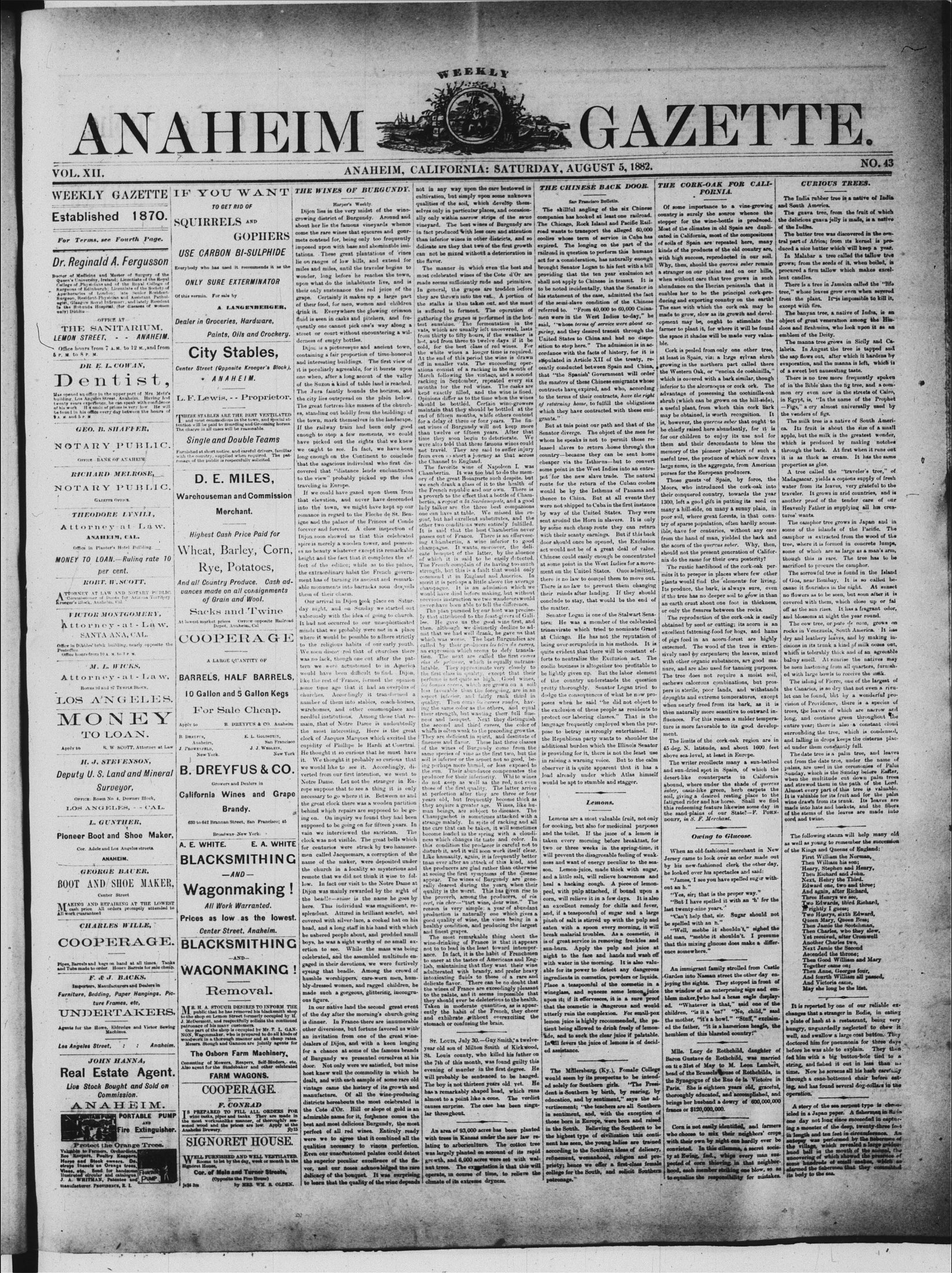
Searchable text
ANAHEIM
VOL. XII.
WEEKLY GAZETTE
Established 1870.
For Terms, see Fourth Page.
Dr. Reginald A. Fergusson
Doctor of Medicine and Master of Surgery of the Queen's University, Ireland; Licentiate of the Royal College of Physicians and of the Royal College of Surgeons of Edinburgh; Licentate of the Society of Apothecaries of London; Late Senior Resident Nurse, Resident Physician and Assistant Pathologist, Glasgow Royal Infirmary, and lately Resident in the Rotunda Hospital (for diseases of women only) Dublin.
OFFICE AT
THE SANITARIUM.
LEMON STREET. - - ANAHEIM.
Office hours from 7 A.M. to 12 M., and from 5 P.M. to 8 P.M.
DR. E. L. COWAN,
Dentist,
Has opened an office in the upper part of Mrs. Metz's building, Los Angeles Street, Anaheim. Having had twenty years experience, he can speak with confidence of his work. If a sale of prices is very low He will be found in his office every day between the hours of 8 A.M. and 5 P.M.
GEO. B. SHAFFER,
NOTARY PUBLIC.
Office: BANK OF ANAHEIM
RICHARD MELROSE.
IF YOU WANT
TO GET RID OF
SQUIRRELS AND
GOPHERS
USE CARBON BI-SULPHIDE
Everybody who has used it recommends it as the ONLY SURE EXTERMINATOR
Of this vermin. For sale by
A LANGENBERGER,
Dealer in Groceries, Hardware,
Paints, Oils and Crockery.
City Stables,
Center Street (Opposite Kroeger’s Block),
ANAHEIM.
L.F. Lewis. - Proprietor.
THE WINES OF
Harper's
Dijon lies in the very growing district of Burton about her lie the famous come the rare wines that mets contend for, being imposed upon with basements. These great lie on ranges of low hills miles and miles, until the wonder, long before upon what do the inhabitants their only sustenance grape. Certainly it makes of their food, for men, drink it. Everywhere fluid is seen in casks and frequently one cannot pick street or court without derness of empty bottles.
Dijon is a picturesque containing a fair proposition and interesting building it is peculiarly agreeable one when, after a long of the Suzon a kind of The Jura faintly hounds the city lies outspread. The great fortress-like es, standing out boldly the town, mark themselfs. If the railway train enough to stop a few have picked out the we ought to see. In long enough on the C that the sagacious ind covered that "distanc
Dentist,
Has opened an office in the upper part of Mrs. Metta's building, Los Angeles Street, Anaheim. Having had twenty years experience, he can speak with confidence of his work. It is safe of prices very low. He will be found in his office every day between the hours of 8 A.M. and 5 P.M.
GEO. B. SHAFFER,
NOTARY PUBLIC.
OFFICE: BANK OF ANAHEIM.
RICHARD MELROSE,
NOTARY PUBLIC.
GAZETTE OFFICE.
THEODORE LYNILL,
Attorney at Law.
ANAHEIM, CAL.
Office in Planter's Hotel Building.
MONEY TO LOAN.—Ruling rate 10 per cent.
ROBT. W. SCOTT.
ATTORNEY AT LAW AND NOTARY PUBLIC.
Commissioner of Deeds for Arizona Territory Kroeger's Block, Anaheim, Cal.
VICTOR MONTGOMERY,
Attorney-at-Law,
SANTA ANA, CAL.
Office in Dubbles' brick building, nearly opposite the Postoffice.
Office hours from 10 A.M. to 3 P.M.
M. L. WICKS,
Attorney-at-Law,
Rooms 60 and 70 Temple Block.
LOS ANGELES.
MONEY TO LOAN.
Apply to R. W SCOTT, Attorney at Law
H. J. STEVENSON,
Deputy U. S. Land and Mineral Surveyor,
OFFICE: Room No 4, Downey Block,
LOS ANGELES, -- CAL.
L. GUNTHER,
Ploneer Boot and Shoe Maker,
Cor. Adele and Los Angeles streets.
ANAHEIM.
GEORGE BAUER,
BOOT AND SHOE MAKER,
Center Street
ANAHEIM.
L.F. Lewis.- Proprietor.
THESE STABLES ARE THE BEST VENTILATED and most commodious in the town, and special attention will be paid to Boarding and Grooming horses. The charm in all cases will be reasonable.
Single and Double Teams
Furnished at short notice, and careful drivers, familiar with the country, supplied when required. The patronage of the public is respectfully solicited.
D. E. MILES,
Warehouseman and Commission Merchant.
Highest Cash Price Paid for
Wheat, Barley, Corn, Rye, Potatoes,
And all Country Produce. Cash advances made on all consignments of Grain and Wool.
Sacks and Twine
At lowest market prices. Office opposite Railroad Depot, Anaheim, Cal.
COOPERAGE
A LARGE QUANTITY OF
BARRELS, HALF BARRELS,
10 Gallon and 5 Gallon Kegs For Sale Cheap.
Apply to B. DREYFUS & CO. Anaheim
B. DREYFUS,
Anaheim,
San Francisco
J. PROWENFIELD,
New York.
B. DREYFUS & CO.
Growers and Dealers in California Wines and Grape Brandy.
630 to 642 Brannan Street, San Francisco; 45 Broadway New York.
A. E. WHITE.
E. A. WHITE
BLACKSMITHING
AND
Wagonmaking!
If we could have gamed that elevation, and into the town, we might romance in regard to the ignee and the palace of forever and forever. Dijon soon showed us spire is merely a wooded no beauty whatever height and the fact that of the edifice; we the extraordinary habitation has of turning it able monuments into them of their charm.
Our arrival in Dijon day night, and on valorously with the ides it had not occurred to mind that we probably where it would be posed to the religious habit We soon discover red t was no lack, though o tern we were accustomed would have been d like the rest of France some time ago that churches. According number of them into warehouses, and other needful institutions main, that of Notre Dame. Let no rope suppose that to necessary to go where the great clock there behind which repairs ing on. On inquiry we supposed to be going vain we interviewed clock was not visible for centuries were men called Jacquem name of the maker the church in a local remote that we did not low. In fact our visit Dijon was mainly re the headle—wise i
L. GUNTHER,
Pioneer Boot and Shoe Maker,
Cor. Adele and Los Angeles streets.
ANAHEIM.
GEORGE BAUER,
BOOT AND SHOE MAKER,
Center Street
MAKING AND REPAIRING AT THE LOWEST
cash price. All orders promptly attended to.
All work guaranteed.
CHARLES WILLE,
COOPERAGE.
Pipes, Barrels and kegs on hand at all times. Tanks
and Tube made to order. Honey Barrels for sale cheap.
F. & J. BACKS.
Importers, Manufacturers and Dealers in
Furniture, Bedding, Paper Hangings, Picture
Frames, etc,
UNDERTAKERS,
Agents for the Howe, Eldredge and Victor Sewing
Machines.
Los Angeles Street, : : Anaheim.
JOHN HANNA,
Real Estate Agent.
Live Stock Bought and Sold on
Commission.
ANAHEIM.
PORTABLE PUMP
AND
Fire Extinguisher.
Protect the Orange Trees.
Valuable to Farmers, Orchardists,
Bee Keepers, Poultry Keepers,
Horses and Stock owners. Do
stroys insects on Orange trees,
Vines, etc. Send for handsome
Illustrated circular and catalogue.
J. A. WHITMAN, Patentee and
manufacturer. Providence, R. L.
Brandy.
630 to 642 Brannan Street, San Francisco; 45
Broadway-New York.
A. E. WHITE.
E. A. WHITE
BLACKSMITHING
—AND—
Wagonmaking!
All Work Warranted.
Prices as low as the lowest.
Center Street, Anaheim.
BLACKSMITHING
—AND—
WAGONMAKING!
Removal.
MR. H. A. STOUGH DESIRES TO INFORM THE
public that he has removed his blacksmith shop
to the shop on Lemon Street formerly occupied by H.
J. McDermott, and respectfully solicits the continued
patronage of his many customers.
One part of the shop is occupied by Mr. T. L. GANNON, Wagonmaker, who is prepared to do all kinds of
woodwork in a thorough manner and at cheap rates.
Messrs. Stough and Gannon are jointly agents for
The Osborn Farm Machinery.
Consisting of Mowers, Reapers, Self-Binders, etc.
Also agent for the Studebaker and other celebrated
FARM WAGONS.
COOPERAGE.
F. CONRAD
IS PREPARED TO FILL ALL ORDERS FOR
wine casks, pipes and tanks. They are made in
the most workmanlike manner, of thoroughly seasoned wood and the prices are low. Apply at the Anaheim Brewery.
SIGNORET HOUSE.
WELL FURNISHED AND WELL VENTILATED.
Rooms to let by the day, week or month in the Signoret House,
Cor. of Main and Turner Streets,
(Opposite the Pion House)
by MRS. WM. R. OLDEN.
THE WINES OF BURGUNDY.
Harper's Weekly.
Dijon lies in the very midst of the wine-growing district of Burgundy. Around and about her lie the famous vineyards whence come the rare wines that epicures and gourmets contend for, being only too frequently imposed upon with base and abominable imitations. These great plantations of vines lie on ranges of low hills, and extend for miles and miles, until the traveler begins to wonder, long before he reaches the town, upon what do the inhabitants live, and is their only sustenance the red juice of the grape. Certainly it makes up a large part of their food, for men, women and children drink it. Everywhere the glowing crimson fluid is seen in casks and pitchers, and frequently one cannot pick one's way along a street or court without encountering a wilderness of empty bottles.
Dijon is a picturesque and ancient town, containing a fair proportion of time-honored and interesting buildings. The first view of it is peculiarly agreeable, for it bursts upon one when, after a long ascent of the valley of the Suzon a kind of table land is reached. The Jura faintly bounds the horizon, and the city lies outpatched on the plain below. The great fortress-like masses of the churches, standing out boldly from the buildings of the town, mark themselves in the landscape. If the railway train had been only good enough to stop a few moments, we could have picked out the sights that we knew we ought to see. In fact, we have been long enough on the Continent to conclude that the sagacious individual who first discovered that "distance lends enchantment not in any way upon the care bestowed in cultivation, but simply upon some unknown qualities of the soil, which develop themselves only in particular places, and occasionally only within narrow strips of the same vineyard. The best wines of Burgundy are in fact produced with less care and attention than inferior wines in other districts, and so delicate are they that two of the first growth can not be mixed without a deterioration in the flavor.
The manner in which even the best and most celebrated wines of the Cote d'Or are made seems sufficiently rude and primitive. In general, the grapes are trodden before they are thrown into the vat. A portion of the stalks is then taken out, and the must is suffered to ferment. The operation of gathering the grapes is performed in the hottest sunshine. The fermentation in the vats, which are usually left uncovered, lasts from thirty to fifty hours, if the weather is hot, and from three to twelve days if it be cold, for the best class of red wines. For the white wines a longer time is required. At the end of this period the wine is drawn off in smaller vats. The succeeding operations consist of a racking in the month of March following the vintage, and a second racking in September, repeated every six months for the red wines. The casks are kept exactly filled, and the wine is fined. Opinions differ as to the time when the wines should be bottled. Certain wine-growers maintain that they should be bottled at the end of fifteen months, while others contend for a delay of three or four years. The finest wines of Burgundy will not keep more than twelve or fifteen years. After that time they soon begin to deteriorate. We were also told that these famous wines could not travel. They are said to suffer injury from even so short a journey as that across the Channel to England.
The favorite wine of Napoleon I. was Chamberlin. It was too bad to do the memorial.
THE CHINESE BACK DOOR.
San Francisco Bulletin.
The skillful angling of the six Chinese companies has hooked at least one railroad. The Chicago, Rock Island and Pacific Railroad wants to transport the alleged 60,000 coolies whose term of service in Cuba has expired. The longing on the part of the railroad in question to perform this humane act for a consideration, has naturally enough brought Senator Logan to his feet with a bill providing that the ten year exclusion act shall not apply to Chinese in transit. It is to be noted incidentally, that the Senator in his statement of the case, admitted the fact of the semi-slave condition of the Chinese referred to. "From 40,000 to 60,000 China men were in the West Indies to-day," he said, "whose terms of service were about expiring, and they desired transit through the United States to China and had no disposition to stop here." The admission is in accordance with the facts of history, for it is stipulated in Article XII of the treaty, recently conducted between Spain and China, that "the Spanish Government will order the masters of these Chinese emigrants whose contracts have expired, and who, according to the terms of their contracts, have the right of returning home, to fulfill the obligations which they have contracted with these emigrants."
But at this point our path and that of the Senator diverge. The object of the men for whom he speaks is not to permit these released slaves to return home through this country—because they can be sent home cheaper via the Isthmus—but to convert some point in the West Indies into an entre
one when, after a long ascent of the valley of the Suzon a kind of table land is reached.
The Jura faintly bounds the horizon, and the city lies outpread on the plain below.
The great fortress-like masses of the churches, standing out bodily from the buildings of the town, mark themselves in the landscape.
If the railway train had been only good enough to stop a few moments, we could have picked out the sights that we knew we ought to see. In fact, we have been long enough on the Continent to conclude that the sagacious individual who first discovered that "distance lends enchantment to the view" probably picked up the idea traveling in Europe.
If we could have gazed upon them from that elevation, and never have descended into the town, we might have kept up our romance in regard to the Fleche de St. Benigne and the palace of the Princes of Conde forever and forever. A close inspection of Dijon soon showed us that this celebrated spire is merely a wooden tower, and possesses no beauty whatever except its remarkable height and the fact that it completes the effect of the edifice; while at the palace, the extraordinary habit the French government has of turning its ancient and remarkable monuments into barracks soon despoils them of their charm.
Our arrival in Dijon took place on Saturday night, and on Sunday we started out valorously with the idea of going to church. It had not occurred to our unsophisticated minds that we probably were not in a place where it would be possible to adhere strictly to the religious habits of our early youth. We soon discovered that of churches there was no lack, though one cut after the pattern we were accustomed to in America would have been difficult to find. Dijon, like the rest of France, formed the opinion some time ago that it had an overplus of churches. Accordingly it transformed a number of them into stables, coach-houses, warehouses, and other commonplace and needful institutions. Among those that remain, that of Notre Dame is undoubtedly the most interesting. Here is the great clock of Jacques Marques which excited the cupidity of Phillipe le Hardi at Courtrai. He thought it so curious that he must have it. We thought it probably so curious that we would like to see it. Accordingly, diverted from our first intention, we went to Notre Dame. Let not the stranger in Europe suppose that to see a thing it is only necessary to go where it is. Between us and the great clock there was a wooden partition behind which repairs are supposed to be going on. On inquiry we found they had been supposed to be going on for fifteen years. In vain we interviewed the sacristan. The clock was not visible. The great bells which for centuries were struck by two hammermen called Jacquemars, a corruption of the name of the maker, were deposited under the church in a locality so mysterious and remote that we did not think it wise to follow. In fact our visit to the Notre Dame at Dijon was mainly rewarded by the sight of the beadle-aisse is the name he goes by March following the vintage, and a second racking in September, repeated every six months for the red wines. The casks are kept exactly filled, and the wine is fined. Opinions differ as to the time when the wines should be bottled. Certain wine-growers maintain that they should be bottled at the end of fifteen months, while others contend for a delay of three or four years. The finest wines of Burgundy will not keep more than twelve or fifteen years. After that time they soon begin to deteriorate. We were also told that these famous wines could not travel. They are said to suffer injury from even so short a journey as that across the Channel to England.
The favorite wine of Napoleon I. was Chambertin. It was too bad to do the memory of the great Bonaparte such despite, but we each drank a glass of it to the health of the French republic and our own. There is a proverb to the effect that a bottle of Chambertin, a rogout à la Sardanopile, and a good lady talker are the three best companions one can have at table. We missed the rogout, but had excellent substitutes, and the other two conditions were entirely fulfilled. It is said that the best Chambertin never passes out of France. There is an effervescing Chambertin, a wine inferior to good champagne. It wants, moreover, the delicate bouquet of the latter, by the absence of which it is said to be easily detected. The French complain of its having too much strength, but this is a fault that would only commend it in England and America. In spirit it is perhaps a little above the average champagne. It is an admission which we would have died before making, but without previous instruction we two wandering would never have been able to tell the difference.
The plan pursued by our host was precisely that attributed to the least-giver of Galilee. He gave us the good wine first, and then, although we distinctly decline to admit that we had well drank, he gave us that which was worse. The best Burgundies are called by their producers les têtes du cuerces, an expression which seems to defy translation. The next are called the first cuerces des pêrères, which is equally untranslatable. They approximate very closely to the first class in quality, except that their perfume is not quite so high. Good wines, les cuerces carrées, which are grown on a soil less favorable than the foregoing, are in an aspect inferior, and fairly rank third in quality. Then come les cuerces rondees, having the same color as the others, and equal their strength, but wanting their full finesse and bouquet. Next they distinguish the second and third cuerces, the color of which is often weak to the preceding growths. They are deficient in spirit, and destitute of fineness and flavor. These last three classes of the wines of Burgundy come from the same species of vine as the first two, but the soil is inferior or the aspect not so good, being perhaps more humid, or less exposed to the sun. Their abundance compensates the producer for their inferiority. White wines do not keep as well as the red, not even those of the first quality.
Lemons.
Lemons are a most valuable fruit, not only for cooking, but also for medicinal purposes and the toilet. If the juice of a lemon is taken every morning before breakfast, for two or three weeks in the spring-time, it will prevent the disagreeable feeling of weakness and want of energy peculiar to the season. Lemon-juice, made thick with sugar, and a little salt, will relieve hoarseness and heal a hacking cough. A piece of lemon-peel, with pulp attached, if bound upon a corn will relieve it in a few days. It is also
the great clock there was a wooden partition behind which repairs are supposed to be going on. On inquiry we found they had been supposed to be going on for fifteen years. In vain we interviewed the sacristan. The clock was not visible. The great bells which for centuries were struck by two hammermen called Jacquemars, a corruption of the name of the maker, were deposited under the church in a locality so mysterious and remote that we did not think it wise to follow. In fact our visit to the Notre Dame at Dijon was mainly rewarded by the sight of the beadle—swise is the name he goes by here. This individual was magnificent, resplendent. Attired in brilliant scarlet, and covered with silver-lace, a cooked hat on his head, and a long staff in his hand with which he ushered people about, and prodded small boys, he was a sight worthy of no small exertion to see. While the mass was being celebrated, and the assembled multitude engaged in their devotions, we were furtively eyeing that beadle. Among the crowd of humble worshippers, care-worn men, humbly-dressed women, and ragged children, he made such a gorgeous, glittering, incongruous figure.
In our native land the second great event of the day after the morning's church-going is dinner. In France there are innumerable other diversions, but fortune favored us with an invitation from one of the great wine-dealers of Dijon, and with a keen longing for a chance at some of the famous brands of Burgundy we presented ourselves at his door. Not only were we satisfied, but mine host knew well the commodity in which he dealt, and with each sample of some rare old vintage came the history of its growth and manufacture. Of all the wine-producing districts hereabouts the most celebrated is the Cote d'Or. Hill or slope of gold is an admirable name for it, for hence comes the best and most delicious Burgundy, the most perfect of all red wines. Entirely ready were we to agree that it combined all the qualities necessary to vinous perfection. Even our unacustomed palates could detect the superior peculiar excellence of the flavor, and our noses acknowledged the rare delicacy of the bouquet. It was surprising to learn that the quality of the wine depends
St. Louis, July 30.—Guy Smith,"a twelve-year old son of Milton Smith of Kirkwood, St. Louis county, who killed his father on the 7th of this month, was found guilty this evening of murder in the first degree. He will probably be sentenced to be hanged. The boy is not thirteen years old yet. He has a remarkably shaped head, which runs almost to a point like a cone. The verdict causes surprise. The case has been singular throughout.
An area of 93,000 acres has been planted with trees in Kansas under the new law relating to arboriculture. The cotton tree was largely planted on account of its rapid growth, and 6,000 acres were set with walnut trees. The expectation is that this will operate, in course of time, to relieve the climate of its extreme dryness.
Lemons.
Lemons are a most valuable fruit, not only for cooking, but also for medicinal purposes and the toilet. If the juice of a lemon is taken every morning before breakfast, for two or three weeks in the spring-time, it will prevent the disagreeable feeling of weakness and want of energy peculiar to the season. Lemon-juice, made thick with sugar, and a little salt, will relieve hoarseness and heal a hacking cough. A piece of lemon peel, with pulp attached, if bound upon a corn, will relieve it in a few days. It is also an excellent remedy for chills and fever, and, if a teaspoonful of sugar and a large pinch of salt is stirred up with the pulp and eaten with a spoon every morning, it will break malarial troubles. As a cosmetic, it is of great service in removing freckles and sun-burn. Apply the pulp and juice at night to the face and hands and wash off with water in the morning. It is also valuable for its power to detect any dangerous ingredients in cosmetics, powders or liquids. Place a teaspoonful of the cosmetic in a wineglass, and squeeze some lemon juice upon it; if it effervesces, it is a sure proof that the cosmetic is dangerous and would utterly ruin the complexion. For small-pox lemon juice is highly recommended, the patient being allowed to drink freely of lemonade, and to suck the clear juice if palatable. In all fevers the juice of lemons is of decided assistance.
The Milleraburg, (Ky.), Female College would seem by its prospectus to be intended solely for Southern girls."The President is Southern by birth, by rearing, by education, and by sentiment," says the advertisement; "the teachers are all Southern in sentiment, and, with the exception of those born in Europe, were born and raised in the South. Believing the Southern to be the highest type of civilization this continent has seen, the young ladies are trained according to the Southern ideas of delicacy, refinement, womanhood, religion and propriety; hence we offer a first-class female college for the South, and solicit Southern patronage."
GAZETTE.
AUGUST 5, 1882.
BACK DOOR.
To Bulletin.
Of the six Chinese that least one railroad. Island and Pacific Railway at the alleged 60,000 mile service in Cuba has been on the part of the superform this humane has naturally enough to his feet with a bill ten year exclusion act these in transit. It is easy, that the Senator in case, admitted the fact mention of the Chinese 60,000 to 60,000 China Indies to-day," he service were about excland transit through the India and had no dispersion. The admission is in acts of history, for it is III of the treaty, re-ween Spain and China, government will order Chinese emigrants whose land, and who, according contracts, have the right fulfill the obligations contracted with these emigrants.
The CORK-OAK FOR CALIFORNIA.
Of some importance to a vine-growing country is surely the source whence the stopper for the wine-bottle is produced. Most of the climates in old Spain are duplicated in California, most of the compositions of soils of Spain are repeated here, many kinds of the products of the old country are, with high success, reproduced in our soil. Why, then, should the quercus suber remain a stranger on our plains and on our hills, when without care that tree grows in such abundance on the Iberian peninsula that it enables her to be the principal cork-producing and exporting country on the earth? The ease with which the cork oak may be made to grow, slow as its growth and development may be, ought to stimulate the farmer to plant it, for where it will be found the space it shades will be made very valuable.
Cork is peeled from only one other tree, at least in Spain, viz: a large sylvan shrub growing in the northern part called there the Western Oak, or "encina de coehinilla," which is covered with a bark similar, though inferior to the alcornoque or cork ork. The advantage of possessing the cochinilla-oak shrub (which can be grown on the hill-side), a useful plant, from which thin cork bark may be obtained, is worth recognition. It is, however, the quercus suber that ought to be chiefly raised here abundantly, for it is for our children to enjoy its use and for them and their descendants to bless the memory of the pioneer planters of such a useful tree, the produce of which now draws large sums, in the aggregate, from American purses for the European producers.
CURIOUS TREES.
The India rubber tree is a native of India and South America.
The guava tree, from the fruit of which the delicious guava jelly is made, is a native of the Indies.
The butter tree was discovered in the central part of Africa; from its kernel is produced a nice butter which will keep a year.
In Malabar a tree called the tallow tree grows; from the seeds of it, when boiled, is procured a firm tallow which makes excellent candles.
There is a tree in Jamaica called the "life tree," whose leaves grow even when severed from the plant. It is impossible to kill it, except with fire.
The hanyan tree, a native of India, is an object of great veneration among the Hindoos and Brahmins, who look upon it as an emblem of the Deity.
The manna tree grows in Sicily and Calabria. In August the tree is tapped and the sap flows out, after which it hardens by evaporation, and the manna is left, which is of a sweet but nauseating taste.
There is no tree more frequently spoken of in the Bible than the fig tree, and a common cry even now in the streets of Cairo, in Egypt, is, "In the name of the Prophet — Figs," a cry almost universally used by the vendors of figs.
The milk tree is a native of South America. Its fruit is about the size of a small apple, but the milk is the greatest wonder, which is produced by making notches through the bark. At first when it runs out it is as thick as cream. It has the same properties as glue.
A tree called the "traveler's tree," of
The path and that of the object of the men for to permit these return home through this may be sent home but to convert Indies into an entreave trade. The natural of the Cuban coolers thmus of Panama and out at all events theyuba in the first instance and States. They were in slavers. It is only notice they can return things. But if this back opened, the Exclusion great deal of value. Enough be concentrated West Indies for a move-states. Once admitted, pallet them to move out. Prevent them changing clothing. If they should would be the end of the Stalwart Sena- member of the celebrated tried to nominate Grant not the reputation of in his methods. It is here will be constant effec Exclusion act. Together too profitable to But the labor element understands the question Senator Logan tried tozes of what he now pro- "the did not object to the people as residents to classes." That is the employed when the pur- strongly entertained. If wants to shoulder the which the Illinois Senator there is not the least use voice. But to the calm apparent that it has a which Atlas himself stable and stagger.
valuable fruit, not only for medicinal purposes the juice of a lemon is long before breakfast, for in the spring-time, it greceable feeling of weak energy peculiar to the sea-made thick with sugar, relieve hoarseness and cough. A piece of lemon-cured, if bound upon a few dawns. It is also which is covered with a bark similar, though inferior to the alcornoque or cork ork. The advantage of possessing the cochinilla-oak shrub (which can be grown on the hill-side), a useful plant, from which thin cork bark may be obtained, is worth recognition. It is, however, the quercus suber that ought to be chiefly raised here abundantly, for it is for our children to enjoy its use and for them and their descendants to bless the memory of the pioneer planters of such a useful tree, the produce of which now draws large sums, in the aggregate, from American purses for the European producers.
Those guests of Spain, by force, the Moors, who introduced the cork-oak into their conquered country, towards the year 1300, left a good gift in putting its seed on many a hill-side, on many a sunny plain, in poor soil, where great forests, in that country of sparse population, often hardly accessible, have for centuries, without any care from the hand of man, yielded the bark and the acorn of the quercus suber. Why, then, should not the present generation of California do the same for their own posterity?
The rustic hardihood of the cork-oak permits it to prosper in places where few other plants would find the elements for living. Its produce, the bark, is always sure, even if the tree has no deeper soil to grow in than an earth crust about one foot in thickness, or only the fissures between the rocks.
The reproduction of the cork-oak is easily obtained by seed or cutting; its acorn is an excellent fattening food for hogs, and hams of pigs feed in an acorn-forest are highly esteemed. The wood of the tree is extensively used by carpenters; the leaves, mixed with other organic substances, are good manure, and are also used for tanning purposes.
The tree does not require a moist soil, eschews calcerous combinations, but propers in sterile, poor lands, and withstands droughts and extreme temperatures, except when nearly freed from its bark, as it is then naturally more sensitive to outward influences. For this reason a milder temperature is more favorable to its good development.
The limits of the cork-oak region are in 45 deg. N. latitude, and about 1600 feet above sea-level, at least in Europe.
The writer recollects many a sun-bathed and sun-dried spot in Spain, of which the desert-like counterparts in California abound, where under the shade of quercus suber, oasis-like green, herb carpets the soil, giving a desired resting place to the fatigued rider and his horse. Shall we find this redeeming feature likewise some day in the sand-plains of our State?—F. POHN-DORFF, in S. F. Merchant.
Owing to Glucose.
When an old-fashioned merchant in New Jersey came to look over an order made out by his new-fashioned clerk, the other day, he looked over his spectacles and said:
"James, I see you have spelled sugar without an h."
"Yes, sir; that is the proper way."
There is no tree more frequently spoken of in the Bible than the fig tree, and a common cry even now in the streets of Cairo, in Egypt, is, "In the name of the Prophet — Figs," a cry almost universally used by the vendors of figs.
The milk tree is a native of South America. Its fruit is about the size of a small apple, but the milk is the greatest wonder, which is produced by making notches through the bark. At first when it runs out it is as thick as cream. It has the same properties as glue.
A tree called the "traveler's tree," of Madagascar, yields a copious supply of fresh water from its leaves, very grateful to the traveler. It grows in arid countries, and is another proof of the tender care of our Heavenly Father in supplying all his creatures' wants.
The camphor tree grows in Japan and in some of the islands of the Pacific. The camphor is extracted from the wood of the tree, where it is formed in concrete lumps, some of which are as large as a man's arm, though this is rare. The tree has to be sacrificed to procure the camphor.
The sorrowful tree is found in the Island of Goa, near Bombay. It is so called because it flourishes in the night. At sunset no flowers as to be seen, but soon after it is covered with them, which close up or fall off as the sun rises. It has a fragrant odor, and blossoms at night the year round.
The cow tree, or pato de vaca, grows on rocks in Venezuela, South America. It has dry and leathery leaves, and by making incisions in its trunk a kind of milk oozes out, which is tolerably thick and of an agreeable balmy smell. At sunrise the natives may be seen hastening from all quarters, furnished with large bowls to receive the milk.
The island of Sicily, is so dry that not even a rivulet can be found, but by a wonderful provision of Providence, there is a species of trees, the leaves of which are narrow and long, and continue green throughout the entire year; there is also a constant cloud surrounding the tree, which is condensed, and falling in drops keeps the cisterns placed under them constantly full.
The date tree is a palm tree, and leaves cut from the date tree, under the name of palms are used in the ceremonies of Palm Sunday, which is the Sunday before Easter, when the multitude cut down palm trees and strewed them in the path of the Lord. Almost every part of this tree is valuable. It is valuable for its fruit and for the palm wine drawn from its trunk. Its leaves are made into hats and baskets, and the fibers of the stems of the leaves are made into cord and twine.
The following stanza will help many old as well as young to remember the succession of the Kings and Queens of England:
First William the Norman,
Then William his son,
Henry Stephen and Henry,
Then Richard and John,
Next Henry the Third,
Edward one, two and three;
And again, after Richard,
Three Henrys we see.
Owing to Glucose.
When an old-fashioned merchant in New Jersey came to look over an order made out by his new-fashioned clerk the other day, he looked over his spectacles and said:
"James, I see you have spelled sugar without an h."
"Yes, sir; that is the proper way."
"But I have spelled it with an 'h' for the last twenty-nine years."
"Can't help that, sir. Sugar should not be spelled with an 'h.'"
"Well, mebbe it shouldn't," sighed the old man, "mebbe it shouldn't. I presume that this mixing glucose does make a difference somewhere."
An immigrant family strolled from Castle Garden into Nassan street the other day enjoying the sights. They stopped in front of the window of an enterprising sign and emblem maker, who had a brass eagle displayed. "Whatever is that," said one of the children, "is it a 'en'? "No, child," said the mother, "it's a howl." "Stuff," exclaimed the father, "it is a hamerican heagle, the hemblem of this blarsted country!"
Mlle. Lucy de Rothchild, daughter of Baron Gustave de Rothchild, was married on the 31st of May to M. Leon Lambert, head of the Brussels House of Rothchilds, in the Synagogue of the Rue de la Victoire in Paris. She is eighteen years old, graceful, thoroughly educated, and accomplished, and brings her husband a dowry of 600,000,000 francs or $120,000,000.
Corn is not easily identified, and farmers who choose to mix their neighbors' crops with their own by night can hardly ever be convicted. In this dilemma, a secret society at Ewing, Ind., whips every man suspected of corn thieving in that neighborhood, each member striking one blow, so as to equalize the responsibility for mistakes.
The following stanza will help many old as well as young to remember the succession of the Kings and Queens of England:
First William the Norman,
Then William his son;
Henry, Stephen and Henry,
Then Richard and John.
Next, Henry the Third.
Edward one, two and three;
And again, after Richard,
Three Henrys we see,
Two Edwards, third Richard,
Brightly I guess;
Two Honrys, sixth Edward,
Queen Mary, Queen Bess;
Then Jamie the Scotchman,
Then Charles, who they slew,
Yet received, after Cromwell
Another Charles two.
Next Jamie the Second
Ascended the throne;
Then Good William and Mary
Together came on;
Then Anne, Georges four,
And fourth William all passed,
And Victoria came,
May she long be the last.
It is reported by one of our reliable exchanges that a stranger in Bodie, in eating a plate of hash at a restaurant, being very hungry, unguardedly neglected to chew it well, and swallow a large coat button. They doctored him for pneumonia for three days before he was able to explain. They then fed him with a big button-hole tied to a string, and fished it out in less than ten time. Now he screens all his hash carefully through a cane-bottomed chair before eating, and has found several dog-collar in the operation.
A story of the sea serpent type is chronicled in a Japan paper. A fisherman in Japan one day not long since succeeded in capturing a monster of the deep, twenty-three feet in length and ten feet in circumference. An antopay was performed by the fishermen of the village which revealed a large gold-buried ball in the mouth of the animal, the uncovering of which showed the presence of some hundreds of small snakes, which as alarmed the fishermen that they committed its body to the sea.