anaheim-gazette 1882-03-11
Scanned page
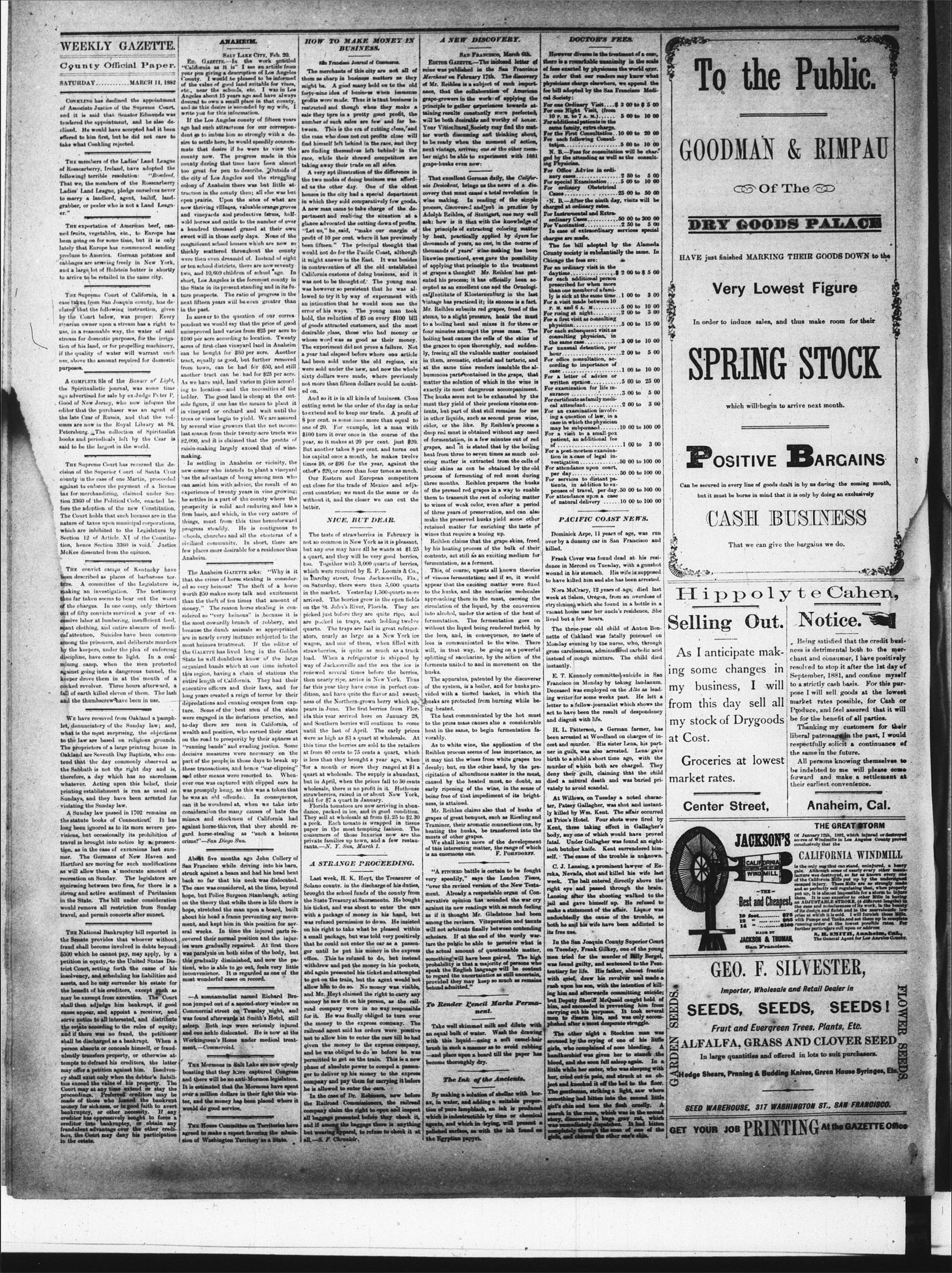
Searchable text
WEEKLY GAZETTE.
County Official Paper.
SATURDAY...MARCH 11, 1882
Corkling has declined the appointment of Associate Justice of the Supreme Court, and it is said that Senator Edmunds was tendered the appointment, and he also declined. He would have accepted had it been offered to him first, but he did not care to take what Conkling rejected.
The members of the Ladies' Land League of Rosscarberry, Ireland, have adopted the following terrible resolution: "Resolved That we, the members of the Rosscarberry Ladies' Land League, pledge ourselves never to marry a landlord, agent, bailiff, land-grabber, or peeler who is not a Land Leaguer."
The exportation of American beef, canned fruits, vegetables, etc., to Europe has been going on for some time, but it is only lately that Europe has commenced sending produce to America. German potatoes and cabbages are arriving freely in New York, and a large lot of Holstein butter is shortly to arrive to be retailed in the same city.
The Supreme Court of California, in a case taken from San Joaquin county, has declared that the following instruction, given by the Court below, was proper: Every riparian owner upon a stream has a right to use, in a reasonable way, the water of said stream for domestic purposes, for the irrigation of his land, or for propelling machinery, if the quality of water will warrant such use, above the amount required for domestic purposes.
A complete file of the Banner of Light, the Spiritualistic journal, was some time ago advertised for sale by ex-Judge Peter P. Good of New Jersey, who now informs the editor that the purchaser was an agent of the late Czar of Russia, and that the volumes are now in the Royal Library at St. Petersburg. The collection of Spiritualist books and periodicals left by the Czar is said to be the largest in the world.
The Supreme Court has reversed the decision of the Superior Court of Santa Cruz.
ANAHEIM.
SALT LAKE CITY, Feb. 20.
Ed. Gazette—In the work entitled "California as it is" I see an article from your pen giving a description of Los Angeles County. I would be pleased to be informed of the values of good land suitable for vines, etc., near the schools, etc. I was in Los Angeles about 15 years ago and have always desired to own a small place in that county, and as this desire is seconded by my wife, I write you for this information.
If the Los Angeles county of fifteen years ago had such attractions for our correspondent as to imbue him so strongly with a desire to settle here, he would speedily consume that desire if he were to view the county now. The progress made in this county during that time have been almost too great for pen to describe. Outside of the city of Los Angeles and the struggling colony of Anaheim there was but little attraction in the county then; all else was but open prairie. Upon the sites of what are now thriving villages, valuable orange groves and vineyards and productive farms, half-wild horses and cattle to the number of over a hundred thousand grazed at their own sweet will in those early days. None of the magnificent school houses which are now so thickly scattered throughout the county were then even dreamed of. Instead of eight or ten school districts, there are now seventy-two, and 10,600 children of school age. In short, Los Angeles is the foremost county in the State in its present standing and in its future prospects. The ratio of progress in the next fifteen years will be even greater than in the past.
In answer to the question of our correspondent we would say that the price of good unimproved land varies from $25 per acre to $100 per acre according to location. Twenty acres of first-class vineyard land in Anaheim can be bought for $80 per acre. Another tract, equally as good, but further removed from town, can be had for $50, and still another tract can be had for $25 per acre. As we have said, land varies in price according to location—and the necessities of the holder. The good land is cheap at the outside figure, if one has the means to plant it in vineyard or orchard and wait until the trees or vines begin to yield. We are assured by several wine growers that the net income last season from their twenty-acre tracts was $2,000, and it is claimed that the profits of raisin-making largely exceed that of wine-making.
In settling in Anaheim or vicinity, the new-comer who intends to plant a vineyard
HOW TO MAKE BUSINESS
The merchants of them as sharp in business might be. A good man forty-nine idea of business were made. They restricted and thought they tern. This is the end of the man who does not find himself left behind are finding themselves race, while their shaking away their trust.
A very apt illustration the two modes of doing us the other day houses in the city hall in which they sold cotton. A new man came to department and realizing glance advocated them "Let us," he said, "profit of 10 per cent." Been fifteen." The would not do for them it might answer in that contravention of California customs if was not to be thought was however so persisted lowed to try it by was an intimation that his error of his ways hold, the reduction of goods attracted cus-desirable class, those whose word was as The experiment did not a year had elapsed before had been sold under were sold under the sixty dollars were not more than fifteen ed on.
And so it is in all cutting must be the one to extend and to keep 8 per cent. is some one of 20. For example $100 turn it over once year, so it makes at But another takes 8 times $8, or $96 for other's $20, or more
A complete file of the Banner of Light, the Spiritualistic journal, was some time ago advertised for sale by ex-Judge Peter P. Good of New Jersey, who now informs the editor that the purchaser was an agent of the late Czar of Russia, and that the volumes are now in the Royal Library at St. Petersburg. The collection of Spiritualist books and periodicals left by the Czar is said to be the largest in the world.
The Supreme Court has reversed the decision of the Superior Court of Santa Cruz county in the case of one Martin, proceeded against to enforce the payment of a license tax for merchandizing, claimed under Section 3360 of the Political Code, enacted before the adoption of the new Constitution. The Court holds that such licenses are in the nature of taxes upon municipal corporations, which are inhibited to the Legislature by Section 12 of Article XI of the Constitution, hence Section 3360 is void. Justice McKee dissented from the opinion.
The convict camps of Kentucky have been described as places of barbarous torture. A committee of the Legislature is making an investigation. The testimony thus far taken seems to bear out the worst of the charges. In one camp, only thirteen out of fifty convicts survived a year of excessive labor at lumbering, insufficient food, scant clothing, and entire absence of medical attention. Suicides have been common among the prisoners, and deliberate murders by the keepers, under the plea of enforcing discipline, have come to light. In a coal-mining camp, when the men protested against going into a dangerous tunnel, the keeper drove them in at the mouth of a cocked revolver. Three hours afterward, a fall of earth killed eleven of them. The lash and the thumb screw have been in use.
We have received from Oakland a pamphlet, denunciatory of the Sunday law; and, what is the most surprising, the objections to the law are based on religious grounds. The proprietors of a large printing house in Oakland are Seventh Day Baptists, who contend that the day commonly observed as the Sabbath is not the right day and is, therefore, a day which has no sacredness whatever. Acting upon this belief, their printing establishment is run as usual on Sundays, and they have been arrested for violating the Sunday law.
A Sunday law passed in 1702 remains on the statute books of Connecticut. It has long been ignored as to its more severe provisions, but occasionally its prohibition of travel is brought into notice by a prosecution, as in the case of excursions last summer. The Germans of New Haven and Hartford are moving for such modifications as will allow them a moderate amount of recreation on Sunday. The legislators are squirming between two fires, for there is a strong and active sentiment of Puritanism in the State. The bill under consideration
In settling in Anaheim or vicinity, the new comer who intends to plant a vineyard has the advantage of being among men who can assist him with advice, the result of an experience of twenty years in vine growing; he settles in a part of the county where the prosperity is solid and enduring and has a firm basis, and which, in the very nature of things, must from this time henceforward progress steadily. He is contiguous to schools, churches and all the etceteras of a civilized community. In short, there are few places more desirable for a residence than Anaheim.
The Anaheim Gazette asks: "Why is it that the crime of horse stealing is considered so very heinous? The theft of a horse worth $50 makes more talk and excitement than the theft of ten times that amount of money." The reason horse stealing is considered so "very heinous" is because it is the most cowardly branch of robbery, and because the dumb animals so appropriated are in nearly every instance subjected to the most heinous treatment. If the editor of the Gazette has lived long in the Golden State he will doubtless know of the large organized bands which at one time infested this region, having a chain of stations the entire length of California. They had their executive officers and their laws, and for long years created a reign of terror by their depredations and cunning escapes from capture. Some of the best men of the state were engaged in the nefarious practice, and to-day there are men in California, of wealth and position, who earned their start on the road to prosperity by their aptness at "running bands" and evading justice. Some decisive measures were necessary on the part of the people in those days to break up these transactions, and hence "car-clipping" and other means were resorted to. Whenever one was captured with clipped ears he was promptly hung, as this was a token that he was an old offender. In consequence, can it be wondered at, when we take into consideration the many causes of hate the miners and stockmen of California had against horse-thieves, that they should regard horse-stealing as "such a heinous crime?"—San Diego Sun.
About five months ago John Collery of San Francisco while driving into his barn, struck against a beam and had his head bent back so far that his neck was dislocated. The case was considered, at the time, beyond hope, but Police Surgeon Stambaugh, acting another tract can be had for $25 per acre. As we have said, land varies in price according to location—and the necessities of the holder. The good land is cheap at the outside figure, if one has the means to plant it in vineyard or orchard and wait until the trees or vines begin to yield. We are assured by several wine growers that the net income last season from their twenty-acre tracts was $2,000, and it is claimed that the profits of raisin-making largely exceed that of wine-making.
In settling in Anaheim or vicinity, the new comer who intends to plant a vineyard has the advantage of being among men who can assist him with advice, the result of an experience of twenty years in vine growing; he settles in a part of the county where the prosperity is solid and enduring and has a firm basis, and which, in the very nature of things, must from this time henceforward progress steadily. He is contiguous to schools, churches and all the etceteras of a civilized community. In short, there are few places more desirable for a residence than Anaheim.
The taste of straw not so common in New York but any one may have a quart, and they will too. Together with which were received in Barclay street, fenced on Saturday, there winthe market. Yes arrived. The berries on the St. John's Rivert picked just before they are packed in trays quarts. The trays are atrats, nearly as lawagon, and one of strawberries, is quite load. When a reflex way of Jacksonville renewed several times then nearly ripe, arrfar this year they had dition, and have quite ness of the Northern pears in June. The ida this year arrived and Southern berries until the last of A were as high as $3 a this time the berries at from 40 cents to 75 is less than they brook for a month or more quart at wholesale. But in April, when wholesale, there is no strawberries, raised sold for $7 a quart i Florida tomatoes dance, packed in ice They sell at wholesale a peck. Each tomato paper in the most consumers of those private families up prants.-N.Y.Sun.,
A Sunday law passed in 1702 remains on the statute books of Connecticut. It has long been ignored as to its more severe provisions, but occasionally its prohibition of travel is brought into notice by a prosecution, as in the case of excursions last summer. The Germans of New Haven and Hartford are moving for such modifications as will allow them a moderate amount of recreation on Sunday. The legislators are squirming between two fires, for there is a strong and active sentiment of Puritanism in the State. The bill under consideration would remove all restriction from Sunday travel, and permit concerts after sunset.
The National Bankruptcy bill reported in the Senate provides that whoever without fraud shall become involved in debts beyond $500 which he cannot pay, may apply, by a petition in equity, to the United States District Court, setting forth the cause of his insolvency, and scheduling his liabilities and assets, and he may surrender his estate for the benefit of his creditors, except such as may be exempt from execution. The Court shall then adjudge him bankrupt, if good cause appear, and appoint a receiver, and serve notice to all interested, and distribute the estate according to the rules of equity; and if there was no fraud, the petitioner shall be discharged as a bankrupt. When a person absents or conceals himself, or fraudulently transfers property, or otherwise attempts to defraud his creditors, the latter may offer a petition against him. Insolvency shall exist only when the debtor's liabilities exceed the value of his property. The Court may at any time extend or stay the proceedings. Preferred creditors may be made of those who loaned the bankrupt money for sickness, or in good faith to avert bankruptcy, or other necessity. If any creditor has oppressively sought to force a creditor into bankruptcy, or obtain any fraudulent advantage over the other creditors, the Court may deny his participation in the estate.
About five months ago John Collery of San Francisco while driving into his barn, struck against a beam and had his head bent back so far that his neck was dislocated. The case was considered, at the time, beyond hope, but Police Surgeon Stambaugh, acting on the theory that while there is life there is hope, stretched the man upon a board, built about his head a frame preventing any movement, and kept him in this position for several weeks. In time the injured parts recovered their normal position and the injuries were gradually repaired. At first there was paralysis on both sides of the body, but this gradually diminished, and now the patient, who is able to go out, feels very little inconvenience. It is regarded as one of the most wonderful cases on record.
A somnambulist named Richard Brenon jumped out of a second-story window on Commercial street on Tuesday night, and was found afterwards at Smith's Hotel, still asleep. Both legs were seriously injured and one ankle dislocated. He is now at the Workingmen's Home under medical treatment.
The Mormons in Salt Lake are now openly boasting that they have captured Congress and there will be no anti-Mormon legislation. It is estimated that the Mormons have spent over a million dollars in their fight this winter, and the money has been placed where it would do good service.
The House Committee on Territories have agreed to make a report favoring the admission of Washington Territory as a State.
HOW TO MAKE MONEY IN BUSINESS.
San Francisco Journal of Commerce.
The merchants of this city are not all of them as sharp in business matters as they might be. A good many hold on to the old forty-nine idea of business when immense profits were made. Thus it is that business is restricted and though when they make a sale they turn in a pretty good profit, the number of such sales are few and far between. This is the era of cutting close," and the man who does not cut profits close will find himself left behind in the race, and they are finding themselves left behind in the race, while their shrewd competitors are taking away their trade on all sides.
A very apt illustration of the difference in the two modes of doing business was afforded us the other day. One of the oldest houses in the city had a special department in which they sold comparatively few goods. A new man came to take charge of the department and realizing the situation at a glance advocated the cutting down of profits. "Let us," he said, "make our margin of profit of 10 per cent. where it has previously been fifteen." The principal thought that would not do for the Pacific Coast, although it might answer in the East. It was besides in contravention of all the old established California customs of doing business, and it was not to be thought of. The young man was however so persistent that he was allowed to try it by way of experiment with an intimation that he would soon see the error of his ways. The young man took hold, the reduction of $5 on every $100 bill of goods attracted customers, and the most desirable class, those who had money or whose word was as good as their money. The experiment did not prove a failure. Not a year had elapsed before where one article had been sold under the old regime, six were sold under the new, and now the whole sixty dollars were made, where previously not more than fifteen dollars could be counted on.
And so it is in all kinds of business. Close cutting must be the order of the day in order to extend and to keep our trade. A profit of 8 per cent. is sometimes more than equal to one of 20. For example, let a man with $100 turn it over once in the course of the year, so it makes at 20 per cent. just $20. But another takes 8 per cent. and turns out his capital once a month, he makes twelve times $8, or $96 for the year, against the other's $20, or more than four times as much.
A NEW DISCOVERY.
San Francisco, March 6th.
Editor Gazette.—The inclosed letter of mine was published in the San Francisco Merchant on February 17th. The discovery of Mr. Reihlen is a subject of such importance, that the collaboration of American grape-growers in the work of applying the principle to gather experiences towards attaining results constantly more perfected, will be both desirable and worthy of honor. Your Viticultural Society may find the matter worth discussing and thinking about, to be ready when the moment of action, next vintage, arrives; one or the other member might be able to experiment with 1881 grape-husks even now:
That excellent German daily, the California Demokrat, brings us the news of a discovery that must cause a total revolution in wine making. In reading of the simple process, discovered and put in practice by Adolph Reihlen, of Stuttgart, one may well ask: how is it that with the knowledge of the principle of extracting coloring matter by heat, practically applied by dyers for thousands of years, no one, in the course of thousands of years' wine-making has been likewise practiced, ever gave the possibility of applying that principle to the treatment of grapes a thought? Mr. Reihlen has patented his process; it has officially been accepted as an excellent one and the Oenological Institute of Klosternenburg in the last vintage has practiced it; its success is a fact. Mr. Reihlen submits red grapes, freed of the stems, to a slight pressure, heats the must to a boiling heat and mixes it for three or four minutes amongst the press mass. The boiling heat causes the cells of the skins of the grapes to open thoroughly, and suddenly, freeing all the valuable matter contained in them, aromatic, etherial and tartaric, and at the same time renders insoluble the albuminous parts contained in the grape, that matter the solution of which in the wine is exactly its most dangerous accompaniment. The husks seem not to be exhausted by the must they yield of their precious vinous contents, but part of that still remains for use in other liquids, such as second press wine, cider, or like. By Reihlen's process a deep red must is obtained without any need of fermentation, in a few minutes out of red grapes, and it is stated that by the boiling heat from three to seven times as much coloring matter is extracted from the cells of their skins as can be obtained by the old formations of wine and must during
DOCTOR'S FEES.
However diverse in the treatment of a case, there is a remarkable unanimity in the scale of fees exacted by physicians the world over. In order that our readers may know what physicians charge elsewhere, we append the fee bill adopted by the San Francisco Medical Society:
For one Ordinary Visit...$ 3 00 to $ 5 00
For one Night Visit, (from 10 P.M. to 7 A.M.)...5 00 to 10 00
For additional patients in the same family, extra charge.
For the First Consultation...10 00 to 20 00
For each following Consultation...5 00 to 10 00
N.B.-Fees for consultitation will be charged by the attending as well as the consulting Physician.
For Office Advice in ordinary cases...2 50 to 5 00
For special Examination...5 00 to 10 00
For ordinary Obstetrical Cases...25 00 to 50 00
-N.B.-After the ninth day, visits will be charged at ordinary rates.
For Instrumental and Extraordinary Cases...50 00 to 300 00
For Vaccination...2 50 to 5 00
In case of extraordinary services special charges are made.
The fee bill adopted by the Alameda County society is substantially the same. In Chicago the fees are:
For an ordinary visit in the daytime...$ 2 00 to $ 5 00
For each additional person prescribed for when more than one member of a family is sick at the same time...1 00 to 3 00
For a visit made between 10 P.M. and 6 A.M..5 00 to 10 00
For rising at night...2 00 to 3 00
For a first visit as consulting physician...5 00 to 15 00
For each subsequent visit as consulting physician, in the same case...3 00 to 10 00
For unusual detention, per hour...2 00 to 5 00
For office consultation, according to importance of case...1 00 to 10 00
For a letter of advice or written opinion...5 00 to 25 00
For examination for life insurance...3 00 to 5 00
For certificate as family medical attendant...2 00 to 3 00
For an examination involving a question of law, in a case in which the physician may be subpoenaed...10 00 to 100 00
For a visit to a small-pox patient, an additional fee of...1 00 to 3 00
For a post-mortem examination in a case of legal investigation...50 00 to 100 00
For attendance upon court, per day...50 00 to 100 00
NICE, BUT DEAR.
The taste of strawberries in February is not so common in New York as it is pleasant, but any one may have all he wants at $1.25 a quart, and they will be very good berries, too. Together with 3,000 quarts of berries, which were received by E. P. Loomis & Co., in Barclay street, from Jacksonville, Fla., on Saturday, there were then 5,000 quarts in the market. Yesterday 1,500 quarts more arrived. The berries grow in the open fields on the St. John's River, Florida. They are picked just before they are quite ripe, and are packed in trays, each holding twelve quarts. The trays are laid in great refrigerators, nearly as large as a New York ice wagon, and one of them, when filled with strawberries, is quite as much as a truck load. When a refrigerator is shipped by way of Jacksonville and the sea the ice is renewed several times before the berries, then nearly ripe, arrive in New York. Thus far this year they have come in perfect condition, and have quite the flavor and sweetness of the Northern-grown berry which appears in June. The first berries from Florida this year arrived here on January 28, and Southern berries will continue to come until the last of April. The early prices were as high as $3 a quart at wholesale. At this time the berries are sold to the retailers at from 40 cents to 75 cents a quart, which is less than they brought a year ago, when for a month or more they ranged at $1 a quart at wholesale. The supply is abundant, but in April, when the prices fall to 30 cents wholesale, there is no profit in it. Hothouse strawberries, raised in or about New York, sold for $7 a quart in January.
Florida tomatoes are now arriving in abundance, packed in ice, and in good condition. They sell at wholesale at from $1.25 to $2.30 a peck. Each tomato is wrapped in tissue paper in the most tempting fashion. The consumers of those Luxuries now are the private families up town, and a few restaurants.—N. Y. Sun, March 1.
A STRANGE PROCEEDING.
Last week, H. K. Hoyt, the Treasurer of Solano county, in the discharge of his duties, brought the school funds of the county from the State Treasury Department. He bought sixty dollars were made, where previously not more than fifteen dollars could be counted on.
And so it is in all kinds of business. Close cutting must be the order of the day in order to extend and to keep our trade. A profit of 8 per cent is sometimes more than equal to one of 20. For example, let a man with $100 turn it over once in the course of the year, so it makes at 20 per cent. just $20. But another takes 8 per cent and turns out his capital once a month, he makes twelve times $8, or $96 for the year, against the other’s $20, or more than four times as much.
Our Eastern and European competitors cut close for the trade of Mexico and adjacent countries; we must do the same or do without it, and the closer we can cut the better.
Reihlen claims that the grape-skins, freed by his heating process of the bulk of their contents, act still as an exciting medium for fermentation, as a ferment.
This, of course, upsets all known theories of vinous fermentation; and if so, it would appear that the exciting matter were fixed to the husks, and the saccharine molecules approaching them in the must, causing the circulation of the liquid, by the conversion into alcohol, under the action of the heat of fermentation. The fermentation goes without the liquid being rendered turbid by the lees, and, in consequence, no taste of lees is communicated to the wine. There will, in that way, be going on a powerful splitting of saccharine, by the action of the ferments united to and in movement on the husks.
The apparatus, patented by the discoverer of the system, is a boiler, and for husks provided with a tinted basket, in which the husks are protected from burning while being heated.
The heat communicated by the hot must to the press mass causes also a considerable heat in the same, to begin fermentation favorably.
As to white wine, the application of the Reihlen process seems of less importance, as it may tint the wines from white grapes too deeply; but, on the other hand, by the precipitation of albuminous matter in the must, caused by the heated must, no doubt, an early ripening of the wine, in the sense of being free of that impediment of its brightness, is attained.
Mr. Reihlen claims also that of husks of grapes of great bouquet, such as Riesling and Traminer, their aromatic connections can, by heating the husks, be transferred into the musts of other grapes.
We shall learn more of the development of this interesting matter, the range of which is an enormous one.
F. Pohnendorff
"A pitched battle is certain to be fought very speedily," says the London Times, "over the revised version of the New Testament. Already a respectable organ of Connaught parts contained in the grape, that matter the solution of which in the wine is exactly its most dangerous accompaniment. The husks seem not to be exhausted by the must they yield of their precious vinous contents, but part of that still remains for use in other liquids, such as second press wine, cider, or like. By Reihlen's process a deep red must is obtained without any need of fermentation, in a few minutes out of red grapes, and it is stated that by the boiling heat from three to seven times as much coloring matter is extracted from the cells of their skins as can be obtained by the old process of fermenting of red must during three months. Reihlen prepares the husks of the pressed red grapes in a way to enable them to transmit the rest of coloring matter to wines of weak color, even after a period of three years of preservation, and can also make the preserved husks yield some other retained matter for enriching the taste of wines that require a toning up.
Reihlen claims that the grape-skins, freed by his heating process of the bulk of their contents, act still as an exciting medium for fermentation, as a ferment.
This, of course, upsets all known theories of vinous fermentation; and if so, it would appear that the exciting matter were fixed to the husks, and the saccharine molecules approaching them in the must, causing the circulation of the liquid, by the conversion into alcohol, under the action of the heat of fermentation. The fermentation goes without the liquid being rendered turbid by the lees, and, in consequence, no taste of lees is communicated to the wine. There will, in that way, be going on a powerful splitting of saccharine, by the action of the ferments united to and in movement on the husks.
The apparatus, patented by the discoverer of the system, is a boiler, and for husks provided with a tinted basket, in which the husks are protected from burning while being heated.
The heat communicated by the hot must to the press mass causes also a considerable heat in the same, to begin fermentation favorably.
As to white wine, the application of the Reihlen process seems of less importance, as it may tint the wines from white grapes too deeply; but, on the other hand, by the precipitation of albuminous matter in the must,caused by the heated must,no doubt,an early ripening ofthe wine,inthe senseofbeingfreeofthatimpedimentofitsbrightness,isattained.
Mr.Reihlenclaimsalsothatofhusksofgrapesofgreatbouquet,suchasRieslingandTraminer,theiraromaticconnectionscan,beyatingthehusks,thebe transferredintothemustsofothergrapes.
Weshalllearnmoreofthedevelopmentofthisinterestingmatter,therangeofwhichisanenormousone.F.Pohnendorff
"C.I.FITCHEDBATTLEIScertaintobefoughtveryspeedily,"saystheLondonTimes,"overtherevisedversionoftheNewTestament.AlreadyarespectableorganOfConnaughtpartscontainedinthegrape,matterthesolutionofwhichinthewineisexactlyitsmostdangerousaccompaniment.Thehusksseemnottobechaustedbythemusttheyyieldofthepreciousvinouscontentsbutpartofthatstillremainsforuseinotherliquidssuchsecondpresswine,cider.orlike.ByReihlen'sprocessade Deepredmustisobtainwithoutanyneedoffermentation.inafewminutesoutredgrapes,anditistatedthatbytheboilingheatfromthreetoseventimesasmuchcoloringmatterisextractedfromthecellsoftheskinsascanbeobtainedbytheoldprocessoffermentingofredmustduringthreemonths.Reihlenpreparesthehusksofthepressedredgrapesinawaytowebehanthemtransmittherestofcoloringmattertowinesofweakcolor,evenafteraproductofthreeyearsofpreservation,andcanalsomakethepreservedhusksyieldsomeotherretainedmatterforyerichengethetasteofwinesthatrequireatoningup."
DominickArpe,11yearsofage,wasrunoverbya dummycarinSanFranciscoandkilled.
FrankCover was found dead at his residence inMercedon on Tuesday,withagunshotwoundinhis stomach.His wifeissupposedtohavekilledhimandshehasbeenarrested.
NoraMcCrary,12yearsofage,diedlastweekatSalemOregon,从anoverdoseofstrychninewhichshefoundinabottleinavacanthousenearheruncle'sresidence.Shelivedbutafewhours.
Thethree-yearoldchildofAntonBonnetteofOaklandwasfatallypoisonedonMondayeveningbythenursewho,toughgrosscarelessnessadministeredcarbolic acidinsteadofcoughmixture.Thechild diednaturaldeathandwasburiedprivatelytoavoidscandal.
AtWillows.onTuesdaya notedcharacter,PatseyGallagher.wasshotandinstantlykilledbyWm.Kent.TheaffairoccurredatPrice'sHotel.FourshotswerefiredbyKentthree takingeffectinGallagher'sbodyanyoneonewhichwouldhaveprovedfatal.UnderGallagherwasfoundaneight-inchbutcherknife.Kentsurrenderedhimself.Thecauseofthetroubleisunknown.
C.J.Lansing,aprominentlawyerOfEureka,Nevada shotandkillhiswifelastweek.Theballentereddirectlyabovetherighteyeandpassedthroughthebrain.Lansingaftertheshootingwalkedtothe
A STRANGE PROCEEDING.
Last week, H. K. Hoyt, the Treasurer of Solano county, in the discharge of his duties, brought the school funds of the county from the State Treasury at Sacramento. He bought his ticket, and was about to enter the cars with a package of money in his hand, but was refused permission to do so. He insisted on his right to take what he pleased within a small package, but was told very positively that he could not enter the car as a passenger until he put his money in the express office. This he refused to do, but instead withdrew and put the money in his pockets, and again presented his ticket and attempted to get on the train, but the agent would not allow him to do so. No money was visible, and Mr. Hoyt claimed the right to carry any money he saw fit on his person, as the railroad company were in no way responsible for it. He was finally obliged to turn over the money to the express company. The railroad agent said his orders were positive not to allow him to enter the cars till he had given the money to the express company, and he was obliged to do so before he was permitted to get on the train. This is a new phase of absolute power to compel a passenger to deliver up his money to the express company and pay them for carrying it before he is allowed to enter the cars.
In the case of Dr. Robinson, now before the Railroad Commissioners, the railroad company claim the right to open and inspect all baggage presented before they check it, and if among the baggage there is anything but wearing apparel, to refuse to check it at all.—S. F. Chronicle.
"A FITCHED battle is certain to be fought very speedily," says the London Times, "over the revised version of the New Testament. Already a respectable organ of Conservative opinion has sounded the war cry against its new readings with as much feeling as if it thought Mr. Gladstone had been among the revisers. Vituperation and tannets will not arbitrate finally between contending scholars. If at the end of the wordy warfare the public be able to perceive what is the actual amount of questionable matter, something will have been gained. The high probability is that a majority of persons who speak the English language will be content to regard the uncertainties as still uncertain, provided they may keep so much as remains behind admitted."
To Render Pencil Marks Permanent.
Take well skimmed milk and dilute with an equal bulk of water. Wash the drawing with this liquid—using a soft camel-hair brush in such a manner as to avoid rubbing—and place upon a board till the paper has become thoroughly dry.
The Ink of the Ancents.
By making a solution of shellac with borax, in water, and adding a suitable proportion of pure lampblack, an ink is produced which is indestructible by time or chemical agents, and which in drying will present a polished surface, as with the ink found on the Egyptian papyrus.
At Willow, on Tuesday a hotel character, Patsey Gallagher, was shot and instantly killed by Wm. Kent. The affair occurred at Price's Hotel. Four shots were fired by Kent, three taking effect in Gallagher's body, any one of which would have proved fatal. Under Gallagher was found an eight-inch butcher knife. Kent surrendered himself. The cause of the trouble is unknown.
C. J. Lansing, a prominent lawyer of Eureka, Nevada, shot and killed his wife last week. The ball entered directly above the right eye and passed through the brain. Lansing after the shooting walked to the jail and gave himself up. He refused to make a statement of the affair. Liquor was undoubtedly the cause of the trouble, as both he and his wife have been addicted to its free use.
In the San Joaquin County Superior Court on Tuesday, Frank Gilkey, one of the young men tried for the murder of Billy Bergel, was found guilty, and sentenced to the Penentiary for life. His father, almost frantic with grief, drew his revolver and made a rush upon his son, with the intention of killing him and afterwards committing suicide; but Deputy Sheriff McQuaid caught hold of him, and succeeded in preventing him from carrying out his purposes. It took several men to disarm him, and was only accomplished after a most desperate struggle.
The other night a Stockton man was aroused by the crying of one of his little girls, who complained of nose bleeding. A handkerchief was given her to stanch the blood, and she soon fell asleep again. In a little while her sister, who was sleeping with her, cried out in pain, and struck at an object and knocked it off the bed to the floor. The gentleman, striking a light, saw where something had bitten into the second little girl's chin and torn the flesh cruelly. A search in the room, which was in the second story, discovered a huge gray rat, which was immediately dispatched. It had bitten completely through the nose of one of the girls, and chewed the other one's chin.
To the Public.
GOODMAN & RIMPAU
Of The
DRY GOODS PALACE
HAVE just finished MARKING THEIR GOODS DOWN to the
Very Lowest Figure
In order to induce sales, and thus make room for their
SPRING STOCK
which will begin to arrive next month.
POSITIVE BARGAINS
which will begin to arrive next month.
POSITIVE BARGAINS
Can be secured in every line of goods dealt in by us during the coming month,
but it must be borne in mind that it is only by doing an exclusively
CASH BUSINESS
That we can give the bargains we do.
Hippolyte Cahen,
Selling Out. Notice.
As I anticipate making some changes in my business, I will from this day sell all my stock of Drygoods at Cost.
Groceries at lowest market rates.
Center Street,
Anaheim, Cal.
Being satisfied that the credit business is detrimental both to the merchant and consumer, I have positively resolved to stop it after the 1st day of September, 1881, and confine myself to a strictly cash basis. For this purpose I will sell goods at the lowest market rates possible, for Cash or Produce, and feel assured that it will be for the benefit of all parties.
Thanking my customers for their liberal patronage in the past, I would respectfully solicit a continuance of the same in the future.
All persons knowing themselves to be indebted to me will please come forward and make a settlement at their earliest convenience.
THE GREAT STORM
Of January 12th, 1882, which injured or destroyed scores of Windmills in Los Angeles County proved conclusively that the
CALIFORNIA WINDMILL
is the only one that can stand, uninjured, a heavy gale. Although some of nearly every other manufacture was destroyed, so far as known every one of the California Mills put up by the undersigned escaped injury. These Mills are so strongly made and so perfectly self-regulating that, when properly put up, it is almost impossible for a storm to injure them. It is also superior to other Mills in having
Center Street, Anaheim, Cal.
THE GREAT STORM
Of January 12th, 1882, which injured or destroyed scores of Windmills in Los Angeles County proved conclusively that the
CALIFORNIA WINDMILL
Is the only one that can stand, uninjured, a heavy gale. Although some of nearly every other manufacture was destroyed, so far as known, one of the California Mills put up by the undersigned escaped injury. These Mills are so strongly made and so perfectly self-regulating that, when properly put up, it is almost impossible for a storm to injure them. It is also superior to other Mills in having an ADJUSTABLE STROKE (4 different lengths) in the ease and noiselessness of its work, in the beauty of its design and finish and in the marvelously low price at which it is sold. I will furnish these Mills with Pumpes and Tanks, and set them up in complete running order at the lowest possible rates. For further particulars call upon or address
K. H. SMITH, Anaheim, Cal.
The General Agent for Los Angeles County.
GEO. F. SILVESTER,
Importer, Wholesale and Retail Dealer in
SEEDS, SEEDS, SEEDS!
Fruit and Evergreen Trees, Plants, Etc.
ALFALFA, GRASS AND CLOVER SEED
In large quantities and offered in lots to suit purchasers.
Hedge Shears, Prnning & Budding Knives, Green House Syringes, Etc.
SEED WAREHOUSE, 317 WASHINGTON ST., SAN FRANCISCO.
GET YOUR JOB PRINTING At the GAZETTE Office