anaheim-gazette 1882-03-11
Scanned page
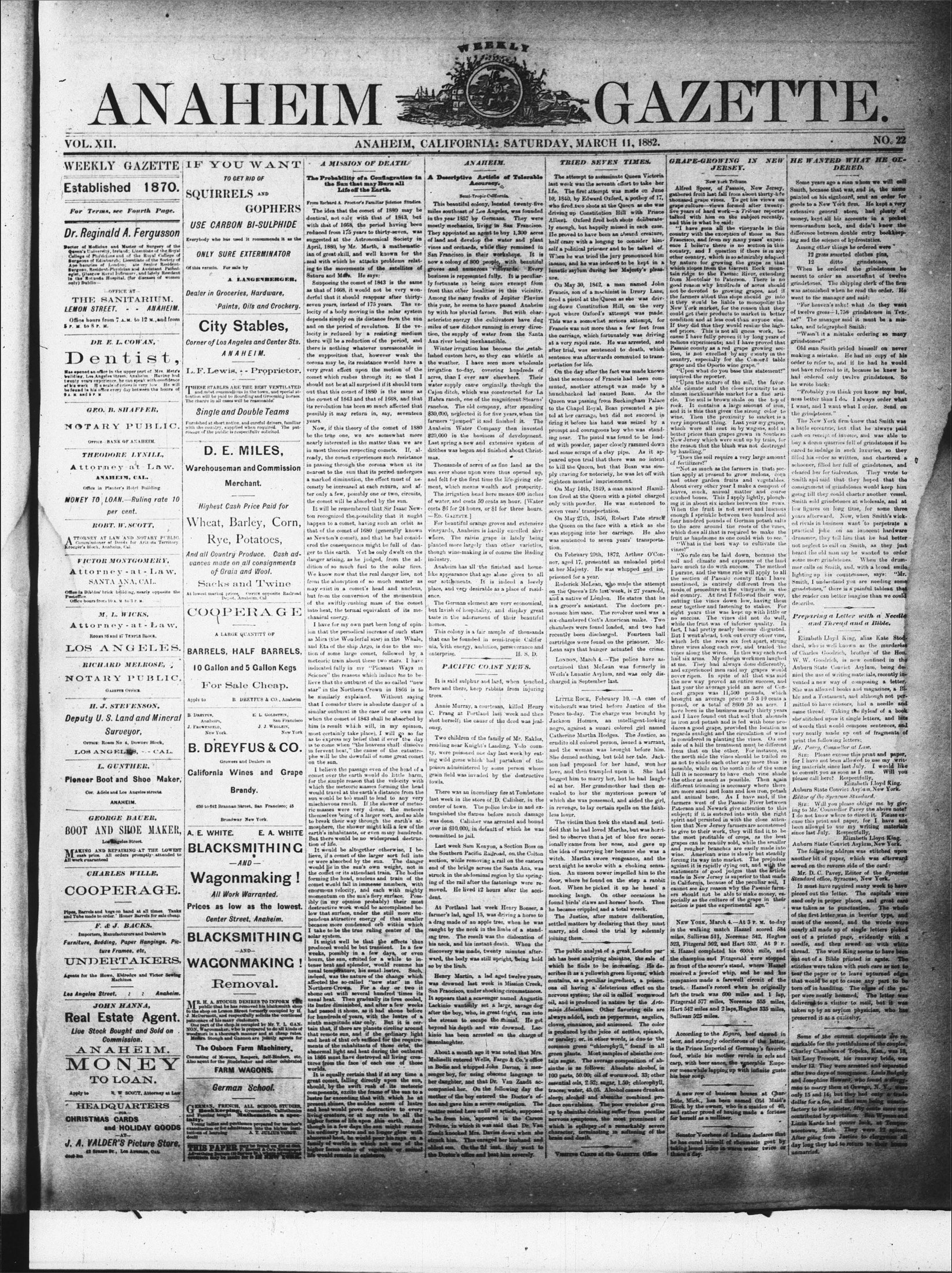
Searchable text
ANAHEIM
VOL. XII.
WEEKLY GAZETTE
Established 1870.
For Terms, see Fourth Page.
Dr. Reginald A. Fergusson
Doctor of Medicine and Master of Surgery of the Queen's University, Ireland; Licentiate of the Royal College of Physicians and of the Royal College of Surgeons of Edinburgh; Licentiate of the Society of Ape hearies of London; ate Senior Resident-Surgeon, Resident-Physician and Assistant Pathologist, Glasgow Royal Infirmary, and lately Resident in the Rotunda Hospital. (for diseases of women only) Dublin—
OFFICE AT
THE SANITARIUM.
LEMON STREET. - - ANAHEIM.
Office hours from 7 a.m. to 12 m., and from 5 p.m. to 8 p.m.
DR. E. L. COWAN,
Dentist,
Has opened an office in the upper part of Mrs. Metr's building, Los Angeles Street, Anaheim. Having had twenty years experience, he can speak with confidence of his work. If a scale of prices is very low, He will be found in his office every day between the hours of 9 a.m. and 6 p.m.
GEO. B. SHAFFER,
NOTARY PUBLIC.
OFFICE - BANK OF ANAHEIM.
THEODORE LYNILL,
Attorney at Law.
IF YOU WANT
TO GET RID OF
SQUIRRELS AND
GOPHERS
USE CARBON BI-SULPHIDE
Everybody who has used it recommends it as the ONLY SURE EXTERMINATOR
Of this vermin. For sale by
A. LANGENBERGER,
Dealer in Groceries, Hardware,
Paints, Oils and Crockery.
City Stables,
Corner of Los Angeles and Center Sts.
ANAHEIM.
L.F. Lewis. - Proprietor.
THESE STABLES ARE THE BEST VENTILATED and most commodious in the town, and special attention will be paid to Boarding and Drooming horses. The charge in all cases will be reasonable.
Single and Double Teams
Furnished at short notice, and careful drivers, familiar with the country, supplied when required. The patronage of the public is respectfully solicited.
D. E. MILES,
Warehouseman and Commission
A MISSION
The Probability of the Sun the Life of
From Richard A. Procter
The idea that the dentical, not only with that of 1668, reduced from 175 yrs suggested at the April, 1880, by Mr. Jian of great skill, a zeal with which he being to the movement Saturn and Mars.
Supposing the course as that of 1668, it would derful that it should seven years, instead locity of a body may depends simply on and on the period of locity is reduced there will be a reduction there is nothing with the supposition that corona may be, its very great effect comet which rushes should not be at all out that this comet the comet of 1843 as its revolution has possibly it may reyears.
Now, if this theory be the true one, we nearly interested in in most theories ready, the comet e in passing through nearest to the sun
GEO. B. SHAFFER,
NOTARY PUBLIC.
OFFICE - BANK OF ANAHEIM.
THEODORE LYNILL,
Attorney at Law.
ANAHEIM, CAL.
Office in Planter's Hotel Building.
MONEY TO LOAN.—Ruling rate 10 per cent.
ROBT. W. SCOTT.
ATTORNEY AT LAW AND NOTARY PUBLIC.
Commissioner of Deeds for Arizona Territory Kroeger's Block, Anaheim, Cal.
VICTOR MONTGOMERY,
Attorney-at-Law,
SANTA ANA, CAL.
Office in Dibbles' brick building, nearly opposite the Postoffice.
Office hours from 10 A.M. to 3 P.M.
M. L. WICKS,
Attorney-at-Law,
Rooms 86 and 87 Temple Block.
LOS ANGELES.
RICHARD MELROSE,
NOTARY PUBLIC.
GAZETTE OFFICE.
H. J. STEVENSON,
Deputy U. S. Land and Mineral Surveyor,
OFFICE: Room No 4, Downey Block,
LOS ANGELES, -- CAL.
L. GUNTHER.
Pioneer Boot and Shoe Maker;
Cor. Adele and Los Angeles streets.
ANAHEIM.
GEORGE BAUER,
BOOT AND SHOE MAKER,
Los Angeles Street.
MAKING AND REPAIRING AT THE LOWEST cash price. All orders promptly attended to All work guaranteed.
CHARLES WILLE,
COOPERAGE.
THREE STABLES ARE THE BEST VENTILATED and most commodious in the town, and special attention will be paid to Boarding and Grooming horses. The charge in all cases will be reasonable.
Single and Double Teams
Funded at short notice, and careful drivers, familiar with the country, supplied when required. The patronage of the public is respectfully solicited.
D. E. MILES,
Warehouseman and Commission Merchant.
Highest Cash Price Paid for Wheat, Barley, Corn, Rye, Potatoes,
And all Country Produce. Cash advances made on all consignments of Grain and Wool.
Sacks and Twine
At lowest market prices. Offer opposite Railroad Depot, Anaheim, Cal.
COOPERAGE
A LARGE QUANTITY OF
BARRELS, HALF BARRELS,
10 Gallon and 5 Gallon Kegs
For Sale Cheap.
Apply to B. DREYFUS & CO., Anaheim
B. DREYFUS,
Anaheim,
San Francisco
J. FROWENFIELD,
New York,
J. WEGLEIN,
New York
B. DREYFUS & CO.
Growers and Dealers in California Wines and Grape Brandy.
630 to 642 Brannan Street, San Francisco; 45 Broadway New York.
A. E. WHITE.
E. A. WHITE
BLACKSMITHING
AND
Wagonmaking!
All Work Warranted.
Now, if this theorem be the true one, we nearly interested in most theories readily, the comet eclipse in passing through nearest to the sun a marked diminution occurs be increased ter only a few, posing the comet will be a
It will be remembered that happen to a comet, that of the comet or as Newton's comet ered the consequence to this earth danger arising, as a definition of so much from the absorption may exist in a cone but from the convexity of the swiftly-rush into heat, the term chanical energy.
I have for my opinion that the period as Mira (the Wound) and Eta of the shipion of some large meteoric train abo indicated fully in Science" the reason lie that the outburst star" in the North be similarly explain that I consider the similar outburst in when the comet of him (a result which most certainly take as to express my b is to come when "in fervent heat," t phe will be the do on the sun.
I believe the pass comet over the earth for the simple reason which the meteoric would travel at the sun would be too mischievous results were w themselves being to break their way mosphere, the shoe earth's inhabitant But there would be tion of life.
It would be alt lieve, if a comet of or were absorbed it would lie in the s the comet or its ast forming the head, comet would fall in enormous velocity momentum on th
ANAHEIM.
GEORGE BAUER,
BOOT AND SHOE MAKER,
Los Angeles Street.
MAKING AND REPAIRING AT THE LOWEST
cash price. All orders promptly attended to
All work guaranteed.
CHARLES WILLE,
COOPERAGE.
Pipes, Barrels and keys on hand at all times. Tanks
and Tubs made to order." Honey Barrels for sale cheap.
F. & J. BACKS.
Importers, Manufacturers and Dealers in
Furniture, Bedding, Paper Hangings, Picture Frames, etc,
UNDERTAKERS,
Agents for the Howe, Eldredge and Victor Sewing Machines.
Los Angeles Street, : : Anaheim.
JOHN HANNA,
Real Estate Agent.
Live Stock Bought and Sold on Commission.
ANAHEIM.
MONEY TO LOAN.
Apply to R. W. SOOTT, Attorney at Law
HEADQUARTERS
FOR CHRISTMAS CARDS
AND HOLIDAY GOODS
ATJ. A. VALDER'8 Picture Store,
42 Brunswick Dr., Los Angeles, CA.
630 to 642 Brannan Street, San Francisco; 45 Broadway New York.
A. E. WHITE.
E. A. WHITE
BLACKSMITHING
— AND —
Wagonmaking!
All Work Warranted.
Prices as low as the lowest.
Center Street, Anaheim.
BLACKSMITHING
— AND —
WAGONMAKING!
Removal.
MR. H. A. STOUGH DESIRES TO INFORM THE
public that he has removed his blacksmith shop
to the shop on Lemon Street formerly occupied by H.
J. Melbermott, and respectfully solicits the continued
patronage of his many customers.
One part of the shop is occupied by Mr. T. L. GANNON, Wagonmaker, who is prepared to do all kinds of
woodwork in a thorough manner and at cheap rates.
Melera Stough and Gannon are jointly agents for
The Osborn Farm Machinery,
Connecting of Mowers, Reapers, Self-Binders, etc.
Also agent for the Studebaker and other celebrated
FARM WAGONS.
German School.
GERMAN, FRENCH, ALL SCHOOL STUDIES,
Honkkeeping, Gyrmation, Callisthenics
and Fencing taught Mathematics a speciality.
Young ladies and gentlemen prepared for teacher's
examination or for admittance into the higher institutions of learning.
A. T. JULIUS VOIGT.
THIS PAPER may be found on file at Glenn
Advertising Bureau (19 Spruce St.), where advertising
contracts may be made for it in NEW YORK.
ANAHEIM, CALIFORNIA: SATURDAY, MARCH 11, 1882.
A MISSION OF DEATH.
The Probability of a Conflagration in the Sun that may Burn all Life off the Earth.
From Richard A. Proctor's Familiar Science Studies.
The idea that the comet of 1880 may be dentical, not only with that of 1843, but with that of 1668, the period having been reduced from 175 years to thirty-seven, was suggested at the Astronomical Society in April, 1880, by Mr. Marth, a mathematician of great skill, and well known for the zeal with which he attacks problems relating to the movements of the satellites of Saturn and Mars. He says:
Supposing the comet of 1843 is the same as that of 1668, it would not be very wonderful that it should reappear after thirty-seven years, instead of 175 years. The velocity of a body moving in the solar system depends simply on its distance from the sun and on the period of revolution. If the velocity is reduced by a resisting medium there will be a reduction of the period, and there is nothing whatever unreasonable in the supposition that, however weak the corona may be, its resistance would have a very great effect upon the motion of the comet which rushes through it; so that I should not be at all surprised if it should turn out that this comet of 1880 is the same as the comet of 1843 and that of 1668, and that its revolution has been so much affected that possibly it may return in, say, seventeen years.
Now, if this theory of the comet of 1880 be the true one, we are somewhat more nearly interested in the matter than we are in most theories respecting comets. If, already, the comet experiences such resistance in passing through the corona when at its nearest to the sun that its period undergoes
ANAHEIM.
A Descriptive Article of Tolerable Accuracy.
Semi-Tropic California.
This beautiful colony, located twenty-five miles southeast of Los Angeles, was founded in the year 1857 by Germans. They were mostly mechanics, living in San Francisco. They appointed an agent to buy 1,300 acres of land and develop the water and plant vines and orchards, while they remained in San Francisco in their workshops. It is now a colony of 800 people, with beautiful groves and numerous vineyards. Every business is represented fully. It is peculiarly fortunate in being more exempt from frost than other localities in this vicinity. Among the many freaks of Jupiter Plavins this year, he seems to have passed Anaheim by with his pluvial favors. But with characteristic energy the cultivators have dug miles of new ditches running in every direction, the supply of water from the Santa Ana river being inexhaustible.
Winter irrigation has become the established custom here, so they can whistle at the weather. I have seen more wholesale irrigation to-day, covering hundreds of acres, than I ever saw elsewhere. Their water supply came originally through the Cajon ditch, which was constructed for La Habra ranch, one of the magnificent Stearns' ranchos. The old company, after spending $30,000, neglected it for five years, when the farmers "jumped" it and finished it. The Anaheim Water Company then invested $20,000 in the business of development. Last spring a new and extensive system of ditches was begun and finished about Christmas.
Thousands of acres of fine land as the sun ever shone upon were thus opened up,
TRIED SEVEN TIMES.
The attempt to assassinate Queen Victoria last week was the seventh effort to take her life. The first attempt was made on June 10, 1840, by Edward Oxford, a potboy of 17, who fired two shots at the Queen as she was driving up Constitution Hill with Prince Albert. Oxford fired both shots deliberately enough, but happily missed in each case. He proved to have been an absurd creature, half crazy with a longing to consider himself a political prisoner and to be talked of. When he was tried the jury pronounced him insane, and he was ordered to be kept in a lunatic asylum during her Majesty's pleasure.
On May 30, 1842, a man named John Francis, son of a machinist in Drury Lane, fired a pistol at the Queen as she was driving down Constitution Hill, on the very spot where Oxford's attempt was made. This was a somewhat serious attempt, for Francis was not more than a few feet from the carriage, which fortunately was driving at a very rapid rate. He was arrested, and after trial, was sentenced to death, which sentence was afterwards commuted to transportation for life.
On the day after the fact was made known that the sentence of Francis had been commuted another attempt was made by a hunchbacked lad named Bean. As the Queen was passing from Buckingham Palace to the Chapel Royal, Bean presented a pistol at her carriage, but did not succeed in firing it before his hand was seized by a prompt and courageous boy who was standing near. The pistol was found to be loaded with powder, paper closely rammed down and some scraps of a clay pipe. As it appeared upon trial that there was no intent to kill the Queen, but that Bean was simply craving for notoriety, he was let off with
comet which rushes through it; so that I should not be at all surprised if it should turn out that this comet of 1880 is the same as the comet of 1843 and that of 1688, and that its revolution has been so much affected that possibly it may return in, say, seventeen years.
Now, if this theory of the comet of 1880 be the true one, we are somewhat more nearly interested in the matter than we are in most theories respecting comets. If, already, the comet experiences such resistance in passing through the corona when at its nearest to the sun that its period undergoes a marked diminution, the effect must of necessity be increased at each return, and after only a few, possibly one or two, circuits, the comet will be absorbed by the sun.
It will be remembered that Sir Isaac Newton recognized the possibility that it might happen to a comet, having such an orbit as that of the comet of 1680 (generally known as Newton's comet), and that he had considered the consequences might be full of danger to this earth. Yet he only dwelt on the danger arising, as he judged, from the addition of so much fuel to the solar fires. We know now that the real danger lies, not from the absorption of so much matter as may exist in a comet's head and nucleus, but from the conversion of the momentum of the swiftly-rushing mass of the comet into heat, the terminal equivalent of its mechanical energy.
I have for my own part been long of opinion that the periolistic increase of such stars as Mira (the Wonderful star) in the Whale, and Eta of the ship Argo, is due to the motion of some large comet, followed by a meteoric train about these two stars. I have indicated fully in my "Pleasant Ways in Science" the reasons which induce me to believe that the outburst of the so-called "new star" in the Northern Crown in 1866 is to be similarly explained. Without saying that I consider there is absolute danger of a similar outburst in the case of our own sun when the comet of 1843 shall be absorbed by him (a result which will, in my opinion, most certainly take place). I will go so far as to express my belief that if ever the day is to come when "the heavens shall dissolve in fervent heat," the cause of the catastrophe will be the downfall of some great comet on the sun.
I believe the passage even of the head of a comet over the earth would do little harm, for the simple reason that the velocity with which the meteoric masses forming the head would travel at the earth's distance from the sun would be too small to lead to any very mischievous result. If the shower of meteoric masses were very dense, the meteors themselves being of a larger sort, and so able to break their way through the earth's atmosphere, the shower might kill a few of the earth's inhabitants, or even many hundreds. But there would be no widespread destruction of life.
It would be altogether otherwise, I believe, if a comet of the larger sort fell into or were absorbed by the sun. The danger would lie in the sun's own weight, not in the comet or its attendant train. The bodies forming the head, nucleus and train of the comet would fall in immense numbers, with enormous velocity, and each with mighty momentum on the sun's fiery surface. Possessing which rushes through it; so that I should not be at all surprised if it should turn out that this comet of 1880 is the same as the comet of 1843 and that of 1688, and that its revolution has been so much affected that possibly it may return in, say, seventeen years.
Now, if this theory of the comet of 1880 be the true one, we are somewhat more nearly interested in the matter than we are in most theories respecting comets. If, already, the comet experiences such resistance in passing through the corona when at its nearest to the sun that its period undergoes a marked diminution, the effect must of necessity be increased at each return, and after only a few, possibly one or two, circuits, the comet will be absorbed by the sun.
It will be remembered that Sir Isaac Newton recognized the possibility that it might happen to a comet, having such an orbit as that of the comet of 1680 (generally known as Newton's comet), and that he had considered the consequences might be full of danger to this earth. Yet he only dwelt on the danger arising, as he judged, from the addition of so much fuel to the solar fires. We know now that the real danger lies, not from the absorption of so much matter as may exist in a comet's head and nucleus, but from the conversion of the momentum of the swiftly-rushing mass of the comet into heat, the terminal equivalent of its mechanical energy.
I have for my own part been long of opinion that the periolistic increase of such stars as Mira (the Wonderful star) in the Whale, and Eta of the ship Argo, is due to the motion of some large comet, followed by a meteoric train about these two stars. I have indicated fully in my "Pleasant Ways in Science" the reasons which induce me to believe that the outburst of the so-called "new star" in the Northern Crown in 1866 is to be similarly explained. Without saying that I consider there is absolute danger of a similar outburst in the case of our own sun when the comet of 1843 shall be absorbed by him (a result which will, in my opinion, most certainly take place). I will go so far as to express my belief that if ever the day is to come when "the heavens shall dissolve in fervent heat," the cause of the catastrophe will be the downfall of some great comet on the sun.
I believe the passage even of the head of a comet over the earth would do little harm, for the simple reason that the velocity with which the meteoric masses forming the head would travel at the earth's distance from the sun would be too small to lead to any very mischievous result. If the shower of meteoric masses were very dense, the meteors themselves being of a larger sort, and so able to break their way through the earth's atmosphere, the shower might kill a few of the earth's inhabitants, or even many hundreds. But there would be no widespread destruction of life.
It would be altogether otherwise, I believe, if a comet of the larger sort fell into or were absorbed by the sun. The danger would lie in the sun's own weight, not in the comet or its attendant train. The bodies forming the head, nucleus and train of the comet would fall in immense numbers, with enormous velocity, and each with mighty momentum on the sun's fiery surface. Possessing which rushes through it; so that I should not be at all surprised if it should turn out that this comet of 1880 is the same as the comet of 1843 and that of 1688, and that its revolution has been so much affected that possibly it may return in, say, seventeen years.
Now, if this theory of the comet of 1880 be the true one, we are somewhat more nearly interested in the matter than we are in most theories respecting comets. If, already, the comet experiences such resistance in passing through the corona when at its nearest to the sun that its period undergoes a marked diminution, the effect must of necessity be increased at each return, and after only a few, possibly one or two, circuits, the comet will be absorbed by the sun.
It will be remembered that Sir Isaac Newton recognized the possibility that it might happen to a comet, having such an orbit as that of the comet of 1680 (generally known as Newton's comet), and that he had considered the consequences might be full of danger to this earth. Yet he only dwelt on the danger arising, as he judged, from the addition of so much fuel to the solar fires. We know now that the real danger lies, not from the absorption of so much matter as may exist in a comet's head and nucleus, but from the conversion of the momentum of the swiftly-rushing mass of the comet into heat, the terminal equivalent of its mechanical energy.
I have for my own part been long of opinion that the periolistic increase of such stars as Mira (the Wonderful star) in the Whale, and Eta of the ship Argo, is due to the motion of some large comet, followed by a meteoric train about these two stars. I have indicated fully in my "Pleasant Ways in Science" which唤 induced me to believe that outburst ofthe so-called "new star"intheNorthernCrownin1866istobesimilarlyexplained.WithoutsayingthatIconsiderthereisabsolutedangerofafsimilaroutburstinthecaseofourownsunwhenatnearesttothesunthatitsperiodundergoesamarkeddiminuation,theeffectmustofnecessitybeincreasedateachreturn,andafteronlya fewpossiblyoneortwocircuits,thecometwillbeabsorbedbythesun.
ItwillberememberthatSirIsaacNewtonrecognizedthepossibilitythatitmighthappentoacomet,havingsuchanorbitasthatofthecometof1680(generallyknownasNewton'scomet),andthathewaspassingfromBuckinghamPalacetotheChapelRoyal,Benpresentedapistathercarriage,bbutdidnot succeedinfiringitbeforehishandwassizedbyapromptandcourageousboywhowasstandingnear.Thepistolwouldbefoundwithadloadwithpowder,papercloselyrammeddownandsomescrapsofaclippipe.Asitappearedupontrialthatthere wasnointenttokilltheQueen,但thatBeanwas simplycravingfornotoriety,他wasletoffwitheighteenmonths'imprisonment.
OnMay14th,1849,a man namedHamiltonfiredattheQueenwithapistolchargedonlywithpowder.Hewassentencedtosevenyears'transportation.
OnMay27th,1850,RobertPatestrueTheQueenonthefacewitha stickasshewassteppingintohercarriage.Hewalsowassentencedtosevenyears'transportation.
OnFebruary29th,1872,ArthurO'Connor,aged17,presentedanunloaded pistolatherMajesty.Hewwaswhippedandimprisonedforayear.
RoderickMcLean,whomadetheattemptontheQueen'slifelastweek,is27yearsold,anda nativeofLondon.Hewstatesthatheisa grocerer'sassistant.Thedoctorspronouncehimsane,therevolverusedwasa six-chamberedCoitt'SAmericanmake.Twochamberswerefoundloaded,andtwohadrecentlybeendischarged.Fourteenballcartridgeswerefoundontheprisoner.McLean saysthat hungeractuatedthecrime.
LONDON,March4.-ThepolicehaveascertainedthatMcLeanwasformerlyinWeils'LunaticAsylum,andwasonlydischargedinSeptemberlast.
LITTLEROCK,February10.-AcaseofwitchcraftwastriedbeforeJusticeofthePeaceto-day.Thechargew broughtbyJacksonHotmes,intelligent-lookingnegro,gainstha smartcolored girlnamedCatherineMarthaHodges.TheJustice,aneruditeoldcoloredperson,issuedawarrant,andthewomanwasbroughtbeforehim.Shedemnednothing,但toldher tale.Jacksonhadproposedforherhand,wonherlove,andthentrampledupitit.Shehadbeggedhimtomarryher,但hehadlaughedin她.Hergrandmotherhadthenrevealedtoherthemysteriouspowers'ofwhichshewaspossessed,andaidedthegirl.inrevenge,tolaycertainspellsonthefaithlesslover.
Thevictimthen tookthestandandtestifiedthathehad lovedMartha,但washorriiedtoobservethatajetofbluefireoccasionally camefrom her nose,andgaveuptheideaofmarryingherbecauseshewasawitch.Marthasworevengeance,andthenextnightheawokewithachokingsensation.AnunseenpowerimpelledhimtothedoorwherehefoundonthestepaclabritailfootWhenhe pickedituphe heardamocking laugh.Onother occasionshe
It would be altogether otherwise, I believe, if a comet of the larger sort fell into or were absorbed by the sun. The danger would lie in the sun's own weight, not in the comet or its attendant train. The bodies forming the head, nucleus and train of the comet would fall in immense numbers, with enormous velocity, and each with mighty momentum on the sun's fiery surface. Possibly (in my opinion probably) their most destructive work would be accomplished below that surface, under the still more stupidous attractive energy of that smaller because more condensed orb within which I take to be the true ruling center of the solar system.
It might well be that the effects thus produced would be but transient. In a few weeks, possibly in a few days, or even hours, the sun, excited for a while to intense heat and splendor, would resume his usual temperature, his usual lustre. Sach, indeed, was the nature of the change which affected the so-called "new star" in the Northern Crown. For a day or two it shone out with several hundred times its usual heat. Then gradually its fires cooled, its lustre diminished, and after a few weeks had passed it shone, as it had shone before for hundreds of years, with the lustre of a ninth magnitude star only. But it is certain that, if there are planets circling around that remote sun, and if the ordinary light and heat of that orb sufficed for the requirements of the inhabitants of those orbs, the abnormal light and heat during the outburst in 1865 must have destroyed all living creatures from the face of each one of those worlds.
It is equally certain that if at any time a great comet, falling directly upon the sun, should, by the swift rush of its meteoric components, excite the frame of the sun to a lustre far exceeding that with which he at present shines, the sudden access of lustre and heat would prove destructive to every living creature, or at any rate to all the higher forms of life upon this earth. And though in a few days the sun might resume his ordinary lustre and no longer glow with abnormal heat, he would pour his rays on a family of worlds in which not one of the higher forms either of vegetable or animal life would remain in existence.
Last week Sam Kenyon, a Section Boss on the Southern Pacific Railroad, on the Colton section, while removing a rail on the eastern end of the bridge across the Santa Ana, was struck in the abdominal region by the springing of the rail after the fastenings were removed. He lived 12 hours after the accident.
At Portland last week Henry Bonser, a farmer's lad, aged 15, was driving a horse to a drag made of an apple tree, when he was caught by the neck in the limbs of a standing tree. The result was the dislocation of his neck, and his instant death. When the discovery was made, twenty minutes afterward, the body was still upright, being held so by the limb.
Henry Martin, a lad aged twelve years, was drowned last week in Mission Creek, San Francisco, under shocking circumstances. It appears that a scavenger named Augustin Lackinio wantonly set a large savage dog after the boy, who, in great fright, ran into the stream to escape the animal. He got beyond his depth and was drowned. Lackinio has been arrested on the charge of manslaughter.
About a month ago it was noted that Mrs. Mulinelli entered Wells, Fargo & Co.'s office in Bodie and whipped John Davies, a messenger boy, for using obscene language to her daughter, and that Dr. Van Zandt accompanied her. On the following day the mother of the boy entered the Doctor's office and gave him a severe castigation. The matter rested here until an article, supposed to be from him, appeared in the Carson Tribune, in which it was said that Dr. Van Zandt knocked Mrs. Davies down when she struck him. This enraged her husband and oldest son. On the 2d inst., they went to the Doctor's office and beat him severely.
The public analyst of a great London parish has been analyzing absinthe, the sale of which he finds to be increasing. He describes it as a yellowish green liquor, which contains, as a peculiar ingredient, a poisonous oil having a deleterious effect on the nervous system; the oil is called wormwood oil, and is produced in nature by the Artemisia Absinthium. Other flavoring oils are always added, such as peppermint, angelica, cloves, cinnamon, and aniseseed. The color is produced by the juice of nettles, spinach, or parsley; or, in other words, is due to the common green "chlorophyll," found in all green plants. Most samples of absinthe contain sugar. The average composition of absinthe is as follows: Absolute alcohol, in 100 parts, 50.00; oil of wormwood. 33; other essential oils, 2.52; sugar, 1.50; chlorophyll, traces; water, 45.05. Alcohol causes drunken sleep; alcohol and absinthe combined produce convulsions. The poor wretches given up to absinthe drinking suffer from peculiar nervous symptoms, the most prominent of which is epilepsy of a remarkably severe character, terminating in softening of the brain and death.
GAZETTE.
MARCH 11, 1882. NO. 22
SEVEN TIMES.
Assassinate Queen Victoria seventh effort to take her attempt was made on June 4rd Oxford, a potboy of 17, at the Queen as she was stationed both shots deliberately missed in each case. She been an absurd creature, longing to consider him owner and to be talked of. The jury pronounced him ordered to be kept in a spring her Majesty's plea.
12, a man named John Machinist in Drury Lane, the Queen as she was driving Hill, on the very old's attempt was made. That serious attempt, for more than a few feet from fortunately was driving He was arrested, and sentenced to death, which awards commuted to trans-
for the fact was made known of Francis had been committed was made by a named Bean. As the from Buckingham Palace, Bean presented a pis but did not succeed in hand was seized by a gorgeous boy who was stand-tol was found to be load-paper closely rammed down a clay pipe. As it ap-that there was no intent that Bean was simi-oriety, he was let off with
GRAPE-GROWING IN NEW JERSEY.
New York Tribune.
Alfred Speer, of Passaic, New Jersey, gathered fruit last fall from about thirty-hee thousand grape vines. To get his views on grape culture—views formed after twenty-five years of hard work—a Tribute reporter talked with him on the subject recently, and this is what he said:
"I have seen all the vineyards in this country with the exception of those in San Francisco, and from my many years' experience I believe there is no section in this country, and I question if there is in any other country, which is so admirably adapted by nature for growing the grape as that which slopes from the Garrett Rock mountain ridge to the Passaic River, extending from Montclair to Paterson. There is no good reason why hundreds of acres should not be devoted to growing grapes, and if the farmers about this slope should go into it they would be liable to monopolize the New York market, for the reason that they could get their products to market in better condition and at less cost than anyone else. If they did this they would realize the highest prices. This is not all guess work, because I have fully proven it by long years of tedious experiments; and I have proved that Passaic county as a red grape growing section, is not excelled by any county in the country, especially for the Concord table grape and the Oporto wine grape."
"Upon what do you base this statement?" inquired the reporter.
"Upon the nature of the soil, the favorable climate and the close proximity to an almost inexhaustible market for a fine article. The soil is brown shale on the top of rock. It contains a large amount of iron, and it is this that gives the strong color to wine. Then the proximity to market is a very important thing. Last year my grapes, which were all sent in by wagons, sold at better prices than grapes grown in Southern New Jersey which were sent up by train, for the reason that the blush was not destroyed by handling."
"Does the soil require a very large amount of fertilizers?"
"Not as much as the farmers in that section apply at present to grow melons, corn
HE WANTED WHAT HE ORDERED.
Some years ago a man whom we will call Smith, because that was, and is, the name painted on his signboard, sent an order for goods to a New York firm. He kept a very extensive general store, had plenty of money, kept all his accounts in a pocket memorandum book, and didn't know the difference between double entry bookkeeping and the science of hydrostatics.
Among other things he ordered were
12 gross assorted clothes pins,
12 ditto grindstones,
When he ordered the grindstones he meant to order an assortment of twelve grindstones. The shipping clerk of the firm was astonished when he read the order. He went to the manager and said:
"For heaven's sake! what do they want of twelve gross—1,738 grindstones in Texas?" The manager said it must be a mistake, and telegraphed Smith:
"Wasn't it a mistake ordering so many grindstones?
Old man Smith prided himself on never making a mistake. He had no copy of his order to refer to, and if he had he would not have referred to it, because he knew he had ordered only twelve grindstones. So he wrote back:
"Probably you think you know my business better than I do. I always order what I want, and I want what I order. Send on the grindstones."
The New York firm knew that Smith was a little eccentric, but that he always paid cash on receipt of invoice, and was able to buy a dozen quarries full of grindstones if he cared to indulge in such luxuries, so they filled his order as written, and chartered a schooner, filled her full of grindstones, and cleared her for Galveston. They wrote to
Of Francis had been committempt was made by a named Bean. As the from Buckingham Palace, Bean presented a pistol but did not succeed in hand was seized by a vigorous boy who was stand-tol was found to be load-paper closely rammed down a clay pipe. As it appethat there was no intent about that Bean was simi-iority, he was let off with imprisonment.
1849, a man named Hamil-leen with a pistol charged He was sentenced to importation.
1850, Robert Pate struck face with a stick as she her carriage. He also seven years' transporta-
1872, Arthur O'Conant an unloaded pistol He was whipped and im-
man, who made the attempt last week, is 27 yearsold, London. He states that heistant. The doctors pro-
The revolver used was a It's American make. Two land loaded, and two had charged. Fourteen ball sound on the prisoner. Me-
ger actuated the crime.
February 10.—A case of need before Justice of the case charge was brought by an intelligent-looking smart colored girl named Hodges. The Justice, an old person, issued a warrant, was brought before him, but told her tale. Jack-for her hand, won herample upon it. She haderry her, but he had laugh-grandmother had then ree-mysterious powers 'of assessed, and aided the girl, certain spells on the faith-
took the stand and testi-ved Martha, but was horri- at a jet of blue fire occas-her nose, and gave up being her because she was a wore vengeance, and the vice with a choking sensa-power impelled him to the land on the step a rabbit kicked it up he heard a On other occasions he inquired the reporter.
"Upon the nature of the soil, the favorable climate and the close proximity to an almost inexhaustible market for a fine article. The soil is brown shale on the top of rock. It contains a large amount of iron, and it is this that gives the strong color to wine. Then the proximity to market is a very important thing. Last year my grapes, which were all sent in by wagons, sold at better prices than grapes grown in Southern New Jersey which were sent up by train, for the reason that the blush was not destroyed by handling."
"Does the soil require a very large amount of fertilizers?"
"Not as much as the farmers in that section apply at present to grow melons, corn and other garden fruits and vegetables. About every other year I make a compost of leaves, muck, animal matter and coarse crushed bones. This I apply lightly, ploughing it in about six inches between the rows. When the fruit is not sweet and luscious enough I sprinkle between two hundred and four hundred pounds of German potash salts to the acre around the roots of the vines, which does all that is required to make the fruit as haudsome as one could wish to see."
"What is the best way to cultivate the vines?"
"No rule can be laid down, because the soil and climate and exposure of the land have much to do with success. The method I pursue, and the same rule will apply to all the section of Passaic county that I have mentioned, is entirely different from the mode of procedure in the vineyards in the old country. At first I followed their way, cutting the vines down low, having them near together and fastening to stakes. For eight years this was kept up with little or no success. The vines did not do well, while the fruit was of inferior quality. In fact, I had pretty nearly become disgusted. But I went ahead, took out every other vine, which left the rows six feet apart, strung three wires along each row, and trailed the vines along the wires. In this way each root had six arms. My foreign workmen laughed at me. They had always done differently, and experienced men said my grapes would never ripen. In spite of all that was said the new way proved an entire success, and last year the average yield an acre of Concord grapes was 11,500 pounds, which brought an average price of 5310 cents a pound, or a total of $699 50 an acre. I have been in the business nearly thirty years and I have found out that soil that abounds in iron and potash and is fed with bone produces a good grape, provided the location as regards sunlight and the circulation of wind is considered in planting the vines. On one side of a hill the treatment must be different from that on the other. For instance, on the north side the vines should be trailed so as not to shade each other any more than is possible, while on the south side of the same hill it is necessary to have each vine shade the other as much as possible. Then again different trimming is necessary where there are more sand and loam and less iron, potash and animal bone. As I have said, if the farmers west of the Passaic River between Paterson and Newark give attention to this subject; if it is entered into with the right spirit and persisted in with the close attention that New Jersey farmers are accustomed to give to their work, they will find it to be the most profitable of crops, as the best grapes can be readily sold, while the smaller and rougher branches are easily made into wine. American wine is slowly but steadily forcing its way into market. The prejudice against it is rapidly dying out, and with the statements of good judges that the article made in New Jersey is superior to that made in California, because of the peculiar soil, I cannot see any reason why the Passaic farmers should not be able to make money, especially as culture of the grane in their
had ordered only twelve grindstones. So he wrote back:
"Probably you think you know my busi-ness better than I do. I always order what I want, and I want what I order. Send on the grindstones."
The New York firm knew that Smith was a little eccentric, but that he always paid cash on receipt of invoice, and was able to buy a dozen quarries full of grindstones if he cared to indulge in such luxuries, so they filled his order as written, and chartered a schooner, filled her full of grindstones, and cleared her for Galveston. They wrote to Smith and said that they hoped that the consignment of grindstones would keep him going till they could charter another vessel. Smith sold grindstones at wholesale, and at low figures on long time, for some three years afterward. Now, when Smith's wicked rivals in business want 'to perpetrate a practical joke on an innocent hardware drummer, they tell him that he had better not neglect to call on Smith, as they just heard the old man say he wanted to order some more grindstones. When the drummer calls on Smith, and with a broad smile lighting up his countenance, says: "Mr. Smith, I understand you are needing some grindstones," there is a painful tableau that the reader can better imagine than we could describe.
Preparing a Letter with a Needle and Thread and a Bible.
Elizabeth Lloyd King, alias Kate Stoddard, who is well known as the murderess of Charles Goodrich, brother of the Hon. W.W. Goodrich, is now confined in the Auburn State Convict Asylum, being denied use of writing materials, recently invented a new way of composing a letter. She was allowed books and magazines, a Bible and a Testament, and although not permitted to have scissors, had a needle and same thread. Taking the flyleaf of a book she stitched upon it single letters, and bits of words that would compose sentences, and very neatly made up out of fragments of print following letters:
Mr. Parcy, Counsellor at Law.
SIR: Please excuse this print and paper; for I have not been allowed to use my writing materials since last July. I would like to consult you as soon as I can. Will you please call here? Respectfully,
Elizabeth Lloyd King.
Auburn State Convict Asylum, New York.
Editor of the Syracuse Standard.
SIR: Will you please oblige me by giving to Mr. Counsellor Pavey the above note? I do not know where to direct it. Please excuse this print and paper; for I have not been allowed to use my writing materials since last July. Respectfully,
Elizabeth Lloyd King.
Auburn State Convict Asylum, New York.
The following address was stitched upon another bit of paper, which was afterward sewed on the reverse side of the card:
Mr. D.C. Pavey, Editor of the Syracuse Standard office, Syracuse, New York.
It must have required many weeks to have pieced out the letter. The capitals were
took the stand and testified Martha, but was horrified at a jet of blue fire occasioned by her nose, and gave up drinking her because she was a worm vengeance, and the sake with a choking sensation impelled him to the stand on the step a rabbit knocked it up he heard a call on other occasions he and horses' hoofs. Then he and a total wreck.
After mature deliberation, declaring that they must end the trial by solemnly resting of a great London parishioner absinthe, the sale of it be increasing. He devised green liqueur, which also included ingredient, a poisonous deleterious effect on the oil is called wormwood in nature by the Artefact. Other flavoring oils are known as peppermint, angelica, and anise seed. The color juice of nettles, spinach, another words, is due to the chlorophyll," found in all most samples of absinthe concoction composition of absinth: Absolute alcohol, in mill of wormwood. 33; other sugar, 1.50; chlorophyll, 15. Alcohol causes drunkenness abinthe combined proportion. The poor wretches given drinking suffer from peculiar health, the most prominent of which is remarkably severe resulting in softening of the skin at the Gaertner Office.
New York, March 4. At 3 p.m. to-day in the walking match Hazael scored 584 miles, Sullivan 511, Noremae 542, Hughes 523, Fitzgerald 562, and Hart 532. At 9 p.m. Hazael completed his 600th mile, and the champion and Fitzgerald were stopped in front of the scorer's stand, where Hazael received a jeweled whip, and he and his companion made a farewell circuit of the track. Hazael's record when he originally left the track was 600 miles and 1 lap, Fitzgerald 577 miles, Noremae 555 miles, Hart 542 miles and 2 laps, Hughes 535 miles, Sullivan 525 miles.
According to the Kigaro, beef stewed in beer, and strongly odoriferous of the latter, is the Prince Imperial of Germany's favorite food, while his mother revels in eels and carp, with beer sause, the venerable Emperor meanwhile lapping up with infinite gusto his beer soup.
A new row of business houses at Charlotte, Mich., has been named Old Maid's Block by the owner, who is a maiden of 40, and rather proud of having made a fortune for herself as a milliner.
Senator Voorhees of Indiana declares that he has cured himself of rheumatic gout by taking lemon juices in warm water twice or thrice a day.
SIR: Will you please oblige me by giving to Mr. Counsellor Pavey the above note? I do not know where to direct it. Please excuse this print and paper, for I have not been allowed to use my writing materials since last July. Respectfully,
Elizabeth Lloyd King.
Auburn State Convict Asylum, New York.
The following address was stitched upon another bit of paper, which was afterward sewed on the reverse side of the card:
Mr. D. C. Pavey, Editor of the Syracuse Standard office, Syracuse, New York.
It must have required many weeks to have pieced out the letter. The capitals were used only in proper places, and great care was taken as to punctuation. The whole of the first letter was in brevier type, and most of the second, and the words were nearly all made up of single letters picked out of a printed page, evidently with a needle, and then sewed on with white thread. The word King seems to have been cut out of a Bible printed in agate. The stitches were taken with such care as not to tear the paper or to leave upturned edges that would be apt to cause any part to be torn off in handling. The edges of the paper were neatly hemmed. The letter was delivered to a visitor to mail, but it was taken up by an asylum physician, who has preserved it as a curiosity.
Some of the current clippings are remarkable for the youthfulness of the couples. Charley Chambers of Topeka, Kan., was 18, but Lucy Prescott, his runaway bride, was under 12. They were arrested and separated after two days of noncemoon. Louis Badgely and Josephine Howard, who found a dermatoman to marry them at Qawago, N.Y., were only 15 and 14; but they had only a trade dollar for a fee, and that sum being misfashioned to the minister, fifty cents more was contributed by spectators. Ben Wyman and Lizzie Karde had poorer luck at Temperance town, Mich. They were 12 apices. After going from Justice to clergyman all day long they had to return to their house unmarried.