anaheim-gazette 1882-01-28
Scanned page
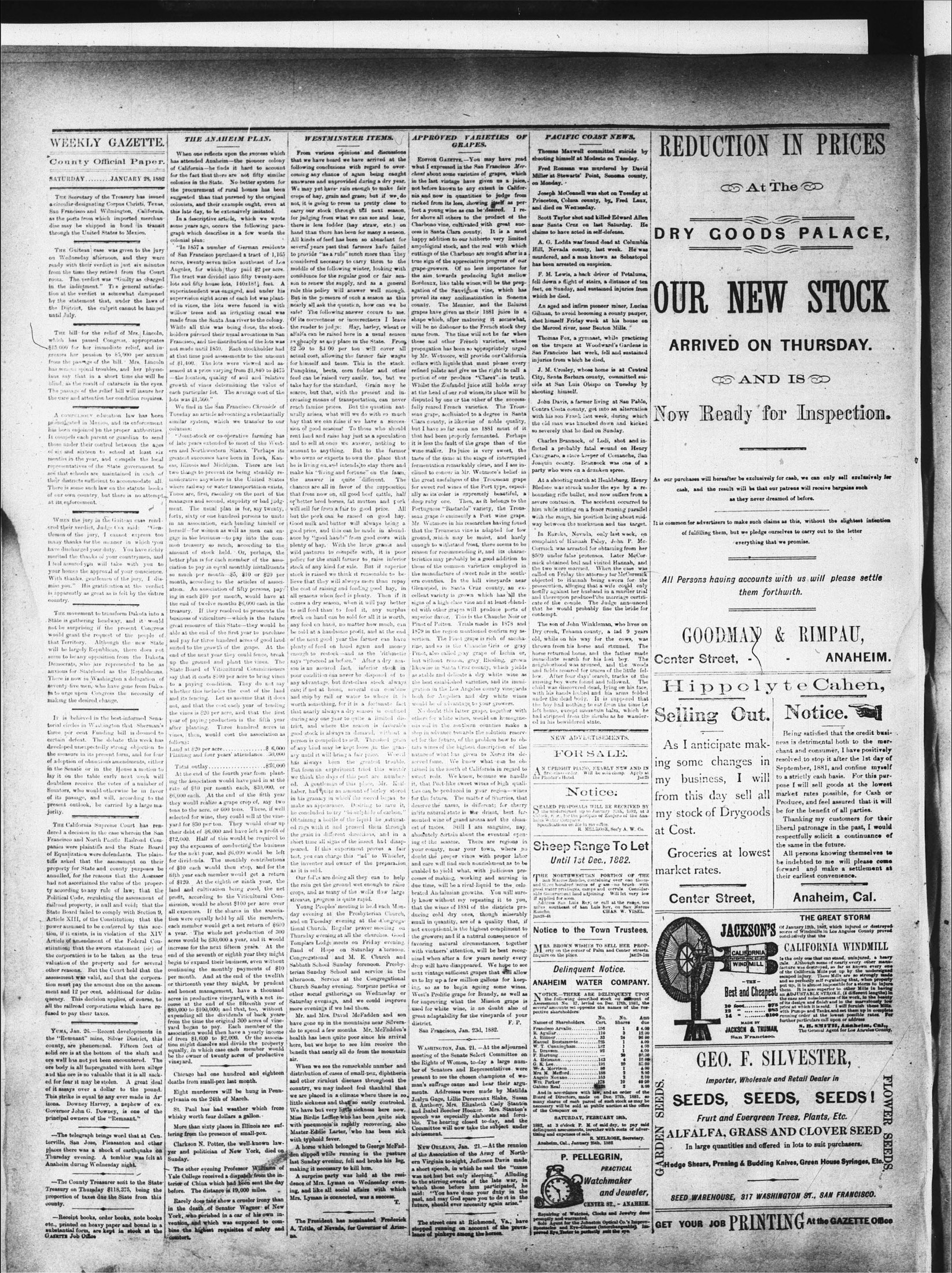
Searchable text
WEEKLY GAZETTE.
County Official Paper.
SATURDAY... JANUARY 28, 1882
The Secretary of the Treasury has issued a circular designating Corpus Christi, Texas, San Francisco and Wilmington, California, as the ports from which imported merchandise may be shipped in bond in transit through the United States to Mexico.
The Guiteau case was given to the jury on Wednesday afternoon, and they were ready with their verdict in just six minutes from the time they retired from the Court room. The verdict was "Guilty as charged in the indictment." The general satisfaction at the verdict is somewhat dampened by the statement that, under the laws of the District, the culprit cannot be hanged until July.
The bill for the relief of Mrs. Lincoln, which has passed Congress, appropriates $15,000 for her immediate relief, and increases her pension to $5,000 per annum from the passage of the bill. Mrs. Lincoln has serious spinal troubles, and her physicians say that in a short time she will be blind, as the result of cataracts in the eyes. The passage of the relief bill will insure her care and attention her condition requires.
A compulsory education law has been promulgated in Mexico, and its enforcement has been enjoined on the proper authorities. It compels each parent or guardian to send those under their control between the ages of six and sixteen to school at least six months in the year, and compels the local representatives of the State government to see that schools are maintained in each of
THE ANAHEIM PLAN.
When one reflects upon the success which has attended Anaheim—the pioneer colony of California—he finds it hard to account for the fact that there are not fifty similar colonies in the State. No better system for the procurement of rural homes has been suggested than that pursued by the original colonists, and their example ought, even at this late day, to be extensively imitated.
In a descriptive article, which we wrote some years ago, occurs the following paragraph which describes in a few words the colonial plan:
"In 1857 a number of German residents of San Francisco purchased a tract of 1,165 acres, twenty-seven miles southeast of Los Angeles, for which they paid $2 per acre. The tract was divided into fifty twenty-acre lots and fifty house lots, 140x181 feet. A superintendent was engaged, and under his supervision eight acres of each lot was planted in vines, the lots were fenced in with willow trees and an irrigating canal was made from the Santa Ana river to the colony. While all this was being done, the stockholders pursued their usual avocations in San Francisco, and the distribution of the lots was not made until 1859. Each stockholder had at that time paid assessments to the amount of $1,400. The lots were viewed and assessed at a price varying from $1,840 to $475—the location, quality of soil and relative growth of vines determining the value of each particular lot. The average cost of the lots was $1,300."
We find in the San Francisco Chronicle of Tuesday an article advocating a substantially similar system, which we transfer to our columns:
"Joint-stock or co-operative farming has of late years extended to most of the Western and Northwestern States. Perhaps its greatest successes have been in Iowa, Kansas, Illinois and Michigan. There are but two things to prevent its being steadily re-established means of transportation reach famine prices. But naturally arises, what will we hay that we can raise if we version of good seasons? To rent land and raise hay jointly and to sell at once we are amount to anything. But who owns or expects to own he is living on and intends make his 'living and fertile.'"
WESTMINSTER.
From various opinions that we have heard we have following conclusions with coming any chance of age unawares and unprovided. We may yet have rain crops of hay, grain and goat not, it is going to press us carry our stock throughout for judging from what we there is less fodder (ha). hand than there has been. All kinds of feed has been several years past that far to provide "as a rule" must considered necessary to cover middle of the following w confidence for the regular son to renew the supply. Rule this policy will answer. But in the pressure of such nearly all ask the question safe? The following answer Of its correctness or incurs reader to judge: Has alfalfa can be raised here as cheaply as any place near $2.50 to $1.00 per ton actual cost, allowing the farmer himself and team. Pumpkins, beets, corn feed can be raised very easily take hay for the standard scarce, but that, with this creasing means of transport reach famine prices. But naturally arises, what will we hay that we can raise if we version of good seasons? To rent land and raise hay jointly and to sell at once we are amount to anything. But who owns or expects to own he is living on and intends make his 'living and fertile.'
A compulsory education law has been promulgated in Mexico, and its enforcement has been enjoined on the proper authorities. It compels each parent or guardian to send those under their control between the ages of six and sixteen to school at least six months in the year, and compels the local representatives of the State government to see that schools are maintained in each of their districts sufficient to accommodate all. There is some such law on the statute books of our own country, but there is no attempt at its enforcement.
When the jury in the Guiteau case rendered their verdict, Judge Cox said: "Gentlemen of the jury, I cannot express too many thanks for the manner in which you have discharged your duty. You have richly merited the thanks of your countrymen, and I feel assured you will take with you to your homes the approval of your conscience. With thanks, gentlemen of the jury, I dismiss you." His gratification at the verdict is apparently as great as is felt by the entire country.
The movement to transform Dakota into a State is gathering headway, and it would not be surprising if the present Congress would grant the request of the people of that Territory. Although the new State will be largely Republican, there does not seem to be any opposition from the Dakota Democrats, who are represented to be as anxious for Statehood as the Republicans. There is now in Washington a delegation of seventy-five men, who have gone from Dakota to urge upon Congress the necessity of making the desired change.
It is believed in the best-informed Senatorial circles in Washington that Sherman's three per cent Funding bill is doomed to certain defeat. The debate this week has developed unexpectedly strong objection to the measure in its present form, and for fear of adoption of obnoxious amendments, either in the Senate or in the House a motion to lay it on the table early next week will doubtless receive the votes of a number of Senators, who would otherwise be in favor of its passage, and will, according to the present outlook, be carried by a large majority.
The California Supreme Court has rendered a decision in the case wherein the San Francisco and North Pacific Railroad Companies were plaintiffs and the State Board of Equalization were defendants. The plaintiffs asked that the assessment on their property for State and county purposes be annulled, for the reasons that the Assessor had not ascertained the value of the property according to any rule of law; that the Political Code, regulating the assessment of
—the location, quality of soil and relative growth of vines determining the value of each particular lot. The average cost of the lots was $1,500."
We find in the San Francisco Chronicle of Tuesday an article advocating a substantially similar system, which we transfer to our columns:
"Joint-stock or co-operative farming has late years extended to most of the Western and Northwestern States. Perhaps its greatest successes have been in Iowa, Kansas, Illinois and Michigan. There are but two things to prevent its being steadily remunerative anywhere in the United States where railway or water transportation exists. These are, first, rascality on the part of the managers and second, stupidity or bad judgment. The usual plan is for, say twenty, forty sixty or one hundred persons to unite in an association, each binding himself or herself—for women as well as men can engage in the business—to pay into the common treasury so much, according to the amount of stock held. Or, perhaps, the better plan is for each member of the association to pay in equal monthly installments so much per month—$5, $10 or $20 per month, according to the articles of association. An association of fifty persons, paying in each $10 per month, would have at the end of twelve months $6,000 cash in the treasury. If they resolved to prosecute the business of viticulture—which is the future great resource of this State—they would be able at the end of the first year to purchase and pay for three hundred acres of good land suited to the growth of the grape. At the end of the next year they could fence, break up the ground and plant the vines. The State Board of Viticultural Commissioners say that it costs $100 per acre to bring vines to a paying condition. They do not say whether this includes the cost of the land and its fencing. Let us assume that it does not, and that the cost each year of tending the vines is $20 per acre, and that the first year of paying production is the fifth year after planting. Three hundred acres in vines, then, would cost the association as follows:
Land at $20 per acre... $6,000 Planting and four years' attendance...30,000
Total outlay...$35,000
At the end of the fourth year from planting the association would have paid in at the rate of $10 per month each, $30,000, or $6,000 each. At the end of the fifth year they would realize a grape crop of, say two tons to the acre, or 600 tons. These, if well selected for wine, they could sell at the vineyard for $30 per ton. They would clear up their debt of $6,000 and have left a profit of $12,000. Half of this would be required to pay the expenses of conducting the business for the next year, and $6,000 would be left for dividends. The monthly contributions of $10 each would then stop, and for the fifth year each member would get a return of $120. At the eighth or ninth year, the land and cultivation being good, the net profit, according to the Viticultural Confeed can be raised very easily by taking hay for the standard scarce, but that, with this creasing means of transport reach famine prices.
But urally arises what will wilt bay that we can raise if we version of good seasons? To rent land and raise hay jay and to sell at once we are amount to anything. But who owns or expects to owe is living on,and intend make his "living and ford" answer is quite chances are all in favor that from now on, all good or better bred horses,fat will sell for from a fair toy but the pork can be raised Good milk and butter with good price,and this can beance by "good hands"from plenty of hay.With these wild pastures to compete policy for the small farm stock of any kind for sale stock is raised we think that they will always cost of raising and feed all seasons when feed is present a dry season,they will sell feed than to feed stock on hand can be sold any feed on hand,nobase sold at a handsome price of the next good year thistle plenty of feed on hand enough to restock—and says "proceed as before." son is an assured fact,poor condition can never any advantage,but first-can if not at home,sex and ship by rail or water worth something;for it is that nearly always a dry during any one year to open trict,and where she good stock is always in person is compelled to sell of any kind may be kept any until it will bring a fruit always been But from an experiment we think the days of this ed.A gentleman of this haber,had quite an amount in his granary in which he make an appearance.Do he concluded to try "bis Obtaining a bottle of these rags with it and press the grain in different directions short time all signs of peaed.If this experiment test,you can charge this inventor and owner as it is sold.
Our folls are doing allthe rain get the ground w crops,and as many ofthe straws progress is omitted
The California Supreme Court has rendered a decision in the case wherein the San Francisco and North Pacific Railroad Companies were plaintiffs and the State Board of Equalization were defendants. The plaintiffs asked that the assessment on their property for State and county purposes be annulled, for the reasons that the Assessor had not ascertained the value of the property according to any rule of law; that the Political Code, regulating the assessment of railroad property, is null and void; that the State Board failed to comply with Section 9, Article XIII, of the Constitution; that the power assumed to be conferred by this section, if it exists, is in violation of the XIV Article of amendment of the Federal Constitution; that the sworn statement (sic) of the corporation is to be taken as the true valuation of the property and for several other reasons. But the Court held that the assessment was valid, and that the corporation must pay the amount due on the assessment and 12 per cent, additional for delinquency. This decision applies, of course, to all the railroad corporations which have refused to pay their taxes.
YUMA, Jan. 26.—Recent developments in the “Remnant” mine, Silver District, this county, are phenomenal. Fifteen feet of solid ore is at the bottom of the shaft and ore well has not yet been encountered. The ore body is all impregnated with horn silver and the ore is so valuable that it is all sacked for fear it may be stolen. A great deal of it assays over a dollar to the pound. This strike is equal to any ever made in Arizona. Downey Harvey, a nephew of ex-Governor John G. Downey, is one of the principal owners of the “Remnant.”
—The telegraph brings word that at Centerville, San Jose, Pleasanton and other places there was a shock of earthquake on Thursday evening. A temblor was felt at Anaheim during Wednesday night.
—The County Treasurer sent to the State Treasury on Thursday $118,375, being the proportion of taxes due the State from this county.
—Receipt books, order books, note books etc., printed on heavy paper and bound in a substantial form, are kept in stock at the Gazette Job Office they would realize a grape crop of, say two tons to the acre, or 600 tons. These, if well selected for wine, they could sell at the vineyard for $30 per ton. They would clear up their debt of $6,000 and have left a profit of $12,000. Half of this would be required to pay the expenses of conducting the business for the next year, and $6,000 would be left for dividends. The monthly contributions of $10 each would then stop, and for the fifth year each member would get a return of $120. At the eighth or ninth year, the land and cultivation being good, the net profit, according to the Viticultural Commission, would be about $100 per acre over all expenses. If the shares in the association were equally held by all members, each member would get a net return of $600 a year. The whole net production of 300 acres would be $30,000 a year, and it would increase for the next fifteen years. At the end of the seventh or eighth year they might begin to expand their business, even without continuing the monthly payments of $10 per month. And at the end of the twelfth or thirteenth year they might, by prudent and honest management, have a thousand acres in productive vineyard, with a net income at the end of the fifteenth year of $80,000 to $100,000; and that, too, without expending all the dividends of back years from the time the original 300 acres of vineyard began to pay. Each member of the association would then have a yearly income of from $1,600 to $2,000. Or the association might dissolve and divide the property equally, in which case each member would be the owner of twenty acres of productive vineyard.
Chicago had one hundred and eighteen deaths from small-pox last month.
Eight murderers will be hung in Pennsylvania on the 24th of March.
St. Paul has had weather which froze whisky worth four dollars a gallon.
More than sixty places in Illinois are suffering from the presence of small-pox.
Clarkson N. Potter, the well-known lawyer and politician of New York, died on Sunday.
The other evening Professor Williams of Yale College received a dispatch from the interior of China which had been sent the day before. The distance is 19,000 miles.
Rarely does fate show a crueler irony than in the death of Senator Wagner of New York, who perished in a car of his own invention, and which was supposed to combine the highest requisites of safety and comfort.
Our foliars are doing all they can get the ground w crops, and as many of them streams progress is quite young Peoples' meeting day evening at the Prairie and on Tuesday evening national Church. Regular Thursday evening at all three Templars Lodge meets on Band of Hope on Sabbath School Sunday terian Sunday School and afternoon. Service at Church Sunday evening. other social gatherings Saturday evenings, and more evenings if we had Mr. and Mrs. David M have gone up in the mount do to spend a few months health has been quite poor here, but we hope to see benefit that nearly all do air.
When we see the remain distribution of cases of enfield and other virulent disease country, we may indeed we are placed in a climate little sickness and that we have but very little Miss Birdie Leffler who with pneumonia is rapid Master Eddie Larter, wife with typhoid fever.
A horse which belonged den slipped while running last Sunday evening, fell making it necessary to kill A surprise party was dence of Mrs. Lyman on ing, and like all social Mrs. Lyman is connected
The President has no A. Tritle, of Nevada, for na-
WESTMINSTER ITEMS.
From various opinions and discussions that we have heard we have arrived at the following conclusions with regard to overcoming any chance of again being caught unawares and unprovided during a dry year. We may yet have rain enough to make fair crops of hay, grain and grass; but if we do not, it is going to press us pretty close to carry our stock through the next season, for judging from what we can see and hear, there is less fodder (hay straw, etc.) on hand than there has been for many a season. All kinds of feed has been so abundant for several years past that farmers have failed to provide "as a rule" much more than they considered necessary to carry them to the middle of the following winter, looking with confidence for the regular good or fair season to renew the supply, and as a general rule this policy will answer well enough. But in the pressure of such a season as this nearly all ask the question, how can we be safe? The following answer occurs to me. Of its correctness or incorrectness I leave the reader to judge: Hay, barley, wheat or alfalfa can be raised here in a usual season as cheaply as any place in the State. From $2.50 to $4.00 per ton will cover all actual cost, allowing the farmer fair wages for himself and team. This in the stack. Pumpkins, beets, corn fodder and other feed can be raised very easily, too, but we take hay for the standard. Grain may be scarce, but that, with the present and increasing means of transportation, can never reach farm prices. But the question naturally arises, what will we do with so much hay that we can raise if we have a succession of good seasons? To those who should rent land and raise hay just as a speculation and to sell at once we answer, nothing to amount to anything. But to the farmer who owns or expects to own the place that he is living on, and intends to skate there and make his "living and fortune" on the farm,
APPROVED VARIETIES OF GRAPES.
EDITOR GAZETTE.—You may have read what I expressed in the San Francisco Merchant about some varieties of grapes, which in the last vintage have given us a juice, not before known to any extent in California and now in quantities to judge from racked from its lees, showing itself as perfect a young wine as can be desired. I refer above all others to the product of the Charbono vine, cultivated with great success in Santa Clara county. It is a most happy addition to our hitherto very limited ampelological stock, and the zeal with which cuttings of the Charbono are sought after is a true sign of the appreciative progress of our grape-growers. Of no less importance for the aim towards producing light mellow Bordeaux, like table wines, will be the propagation of the Sauvignon vine, which has proved its easy acclimatization in Sonoma county. The Mennier, and the Baluzat grapes have given us their 1881 juice in a shape which, after maturing it somewhat, will be no dishonor to the French stock they came from. The time will not be far when these and other French varieties, whose propagation has been so appropriately urged by Mr. Wetmore, will provide our California cellars with liquids that must please every refined palate and give us the right to call a portion of our produce "Clares" in truth. Whilst the Zinfandel juice still holds away at the head of our red wines, its place will be disputed by one or the other of the successfully reared French varieties. The Trousseau grape, acclimated to a degree in Santa Clara county, is likewise of noble quality, but I have so far seen no 1881 must of it that had been properly fermented. Perhaps it is less the fault of the grape than of the wine-maker. Its juice is very sweet, the taste of the same at the stage of interrupted fermentation remarkably clean, and I am inclined to concur in Mr. Wetmore's belief in
PACIFIC COAST NEWS.
Thomas Maxwell committed suicide by shooting himself at Modesto on Tuesday.
Fred Roussan was murdered by David Miller at Stewart's Point, Sonoma county, on Monday.
Joseph McConnell was shot on Tuesday at Princeton, Colusa county, by Fred Laux, and died on Wednesday.
Scott Taylor shot and killed Edward Allen near Santa Cruz on last Saturday. He claims to have acted in self-defense.
A. G. Lodda was found dead at Columbia Hill, Nevada county, last week. He was murdered, and a man known as Sebastopol has been arrested on suspicion.
F. M. Lewis, a hack driver of Petaluma, fell down a flight of stairs, a distance of ten feet, on Sunday, and sustained injuries from which he died.
An aged and infirm pioneer miner, Lucian Gilman, to avoid becoming a county pauper, shot himself Friday week at his house on the Merced river, near Beuton Mills.
Thomas Fox, a gymnast, while practicing on the trapeze at Woodward's Gardens in San Francisco last week, fell and sustained injuries from which he died.
J. M. Croaley, whose home is at Central City, Santa Barbara county, committed suicide at San Luis Obispo on Tuesday by shooting himself.
John Davis, a farmer living at San Pablo, Contra Costa county, got into an altercation with his son Frank last week, during which the old man was knocked down and kicked so severely that he died on Sunday.
Charles Brannock, of Lodi, shot and inflicted a probably fatal wound on Henry Cavagnaro, a store-keeper of Comanche, San Joaquin county. Brannock was one of a party who were on a drunken spree.
feed can be raised very easily, too, but we take hay for the standard. Grain may be scarce, but that, with the present and increasing means of transportation, can never reach famine prices. But the question naturally arises, what will we do with so much hay that we can raise if we have a succession of good seasons? To those who should rent land and raise hay just as a speculation and to sell at once we answer, nothing to amount to anything. But to the farmer who owns or expects to own the place that he is living on, and intends to stay there and make his "living and fortune" on the farm, the answer is quite different. The chances are all in favor of the supposition that from now on, all good beef cattle, half or better bred horses, fat mutton and pork will sell for from a fair to good price. All but the pork can be raised on good hay. Good milk and butter will always bring a good price, and this can be made in abundance by "good hands" from good cows with plenty of hay. With the large grants and wild pastures to compete with, it is poor policy for the small farmer to raise inferior stock of any kind for sale. But if superior stock is raised we think it reasonable to believe that they will always more than repay the cost of raising and feeding good hay, in all seasons when feed is plenty. Then if it comes a dry season, when it will pay better to sell feed than to feed it, any surplus stock on hand can be sold for all it is worth, any feed on hand, no matter how much, can be sold at a handsome profit, and at the end of the next good year the farmer can have plenty of feed on hand again and money enough to restock—and as the rithmetic says "proceed as before." After a dry season is an assured fact, inferior stock in poor condition can never be disposed of to any advantage, but first-class stock always can; if not at home, several can combine and snip by rail or water to where it is worth something, for it is a fortunate fact that nearly always a dry season is confined during any one year to quite a limited district, and where the season is favorable good stock is always in demand, without a person is compelled to sell. Threshed grain of any kind may be kept loose in the granary until it will bring a fair price. Weil has always been the greatest trouble. But from an experiment tried this winter we think the days of this pest are numbered. A gentleman of this place, Mr. Keifhaber, had quite an amount of barley stored in his granary in which the weevil began to make an appearance. Desiring to save it, he concluded to try "bi-sulphide of carbon." Obtaining a bottle of the liquid he saturated rags with it and pressed them through the grain in different directions, and in a short time all signs of the insect had disappeared. If this experiment proves a fair test, you can charge this "ad" to Wheeler, the inventor and owner of the preparation as it is sold.
Our folks are doing all they can to help the rain get the ground wet enough to raise crops, and as many of the wells flow large progress is quite rapid.
Whilst the Zinfandel juice still holds sway at the head of our red wines, its place will be disputed by one or the other of the successfully reared French varieties. The Trouseau grape, acclimated to a degree in Santa Clara county, is likewise of noble quality, but I have so far seen no 1881 must of it that had been properly fermented. Perhaps it is less the fault of the grape than of the wine-maker. Its juice is very sweet, the taste of the same at the stage of interrupted fermentation remarkably clean, and I am inclined to concur in Mr. Wetmore's belief in the great usefulness of the Trouseau grape for sweet red wines of the Port type, especially as its color is supremely beautiful, a deep ruby one. Then, as it belongs to the Portuguese "Bastardo" variety, the Trouseau grape is eminently a Port wine grape. Mr. Wetmore in his researches having found that the Trouseau vine is adapted for low ground, which may be moist, and hardly enough to withstand frost, there seems to be reason for recommending it, and its characteristics may probably be a good addition to those of the common varieties employed in the manufacture of sweet reds in the southern counties. In the bill vineyards near Glencwood, in Santa Cruz county, an excellent variety is grown which has all the signs of a high class vine and at least extended with other grapes will produce ports of superior flavor. This is the Chanche Noir or Pinot of Poiton. Trials made in 1878 and 1879 in the region mentioned confirm my assertion. The Pinot grape is rich of saccharine, and so is the Chanche Gris or gray Pinot, also called gray grape of Lachia or, but without reason, gray Hiesling, grown likewise in Santa Cruz county, which yields as stable and delicate a dry white wine as the best established varieties, and its immigration in the Los Angeles county vineyards both for Angelaea and dry white wines would be of advantage to your growers.
No doubt this latter grape, together with others for white wines, would on homogeneous soil in the southern counties make a step in advance towards the solution reserved for the future, of the problem how to obtain wines of the highest description of the nature of what has given to Xerez its deserved fame. We know what can be obtained in the south of California in regard to sweet reds. We know, because we handle it, that Port-like sweet wines of high qualities can be produced in your region—wines for the future. The matter of Sherries, that deserve the name, is different; for sherry in its natural state is the driest, best fermented wine of grand aroma and the clearest of tastes. Still I am sanguine, nay, absolutely certain about the eventual opening of the sesame. There are regions in your county, near your town, where no doubt the proper vines with proper labor and care will find such nourishment as to be enabled to yield what, with judicious processes of making, working and nursing in due time, will be a rival-liquid to the celebrated Andalusian growths. You will surely benefit from our nitrate content.
City, Santa Barbara county, committed suicide at San Luis Obispo on Tuesday by shooting himself.
John Davis, a farmer living at San Pablo, Contra Costa county, got into an altercation with his son Frank last week, during which the old man was knocked down and kicked so severely that he died on Sunday.
Charles Brannock, of Lodi, shot and inflicted a probably fatal wound on Henry Cavagnaro, a store keeper of Comanche, San Joaquin county. Brannock was one of a party who were on a drunken spree.
At a shooting match at Healdsburg, Henry Bledsoe was struck under the eye by a rebounding rifle bullet, and now suffers from a severe contusion. The accident occurred to him while sitting on a fence running parallel with the range, his position being about mid-way between the marksmen and the target.
In Eureka, Nevada, only last week, on complaint of Hannah Poley, John P. McCormuck was arrested for obtaining from her $500 under false protesions. Later McCormuck obtained bail and visited Hannah, and the two were married. When the case was called on Friday the attorney for McCormuck objected to Hannah being sworn for; the prosecution, alleging that a wife could only testify against her husband in a murder trial and thereupon produced the marriage certificate of the couple. The Judge announced that he would probably fine the bride for contempt.
The son of John Winkleman, who lives on Dry creek, Tehama county, a lad 9 years old, while on his way for the cows, was thrown from his horse and stunned. The horse returned home,and the father made immediate search for his lost boy.The neighborhood was aroused,and the woods and fields secured for traces of the little fellow.After four days' search,tracks of the missing boy were found and followed.The child was discovered dead,Lying on his face.with his hands locked and his arms folded under the dead body.It is supposed thatthe boy had nothing to eat from the time he left home.except mountain balmswhich he had stripped from the shrubs as he wandered in his bowdered state.
NEW ADVERTISING.
FOR SALE.
AN UPRIGHT PIANO,NEARLY NEW AND IN FIRST CLASS ORDER.Will be sold cheap.Apply at The Planter's Hotel.
Notice:
SEALED PROPOSALS WILL BE RECEIVED BY THE UNDERSIGNED UP TO January 20th,1852,at 3 o'clock,p.m.,for the position of Zanjero of the Anaheim Water Company.Specifications on file in my office.R.MELROSE,Sec'y A.W.Co.
Sheep Range To Let Until 1st Dec.,1882.
THE NORTHWESTERN PORTION OF THE San Marcos Ranch,countering over one thousand hundred acres of grass-no brush-with good water privileges,camps and corrals.Considerable Government land adjoining.Will let very low if applied for soon.
In his granary in which the devil began to make an appearance, Desiring to save it, he concluded to try "bi-sulphide of carbon." Obtaining a bottle of the liquid he saturated rags with it and pressed them through the grain in different directions, and in a short time all signs of the insect had disappeared. If this experiment proves a fair test, you can charge this "ad" to Wheeler, the inventor and owner of the preparation as it is sold.
Our folks are doing all they can to help the rain get the ground wet enough to raise crops, and as many of the wells flow large streams, progress is quite rapid.
Young Peoples' meeting is held each Monday evening at the Presbyterian Church, and on Tuesday evening at the Congregational Church. Regular prayer meeting on Thursday evening at all the churches. Good Templars Lodge meets on Friday evening. Band of Hope on Saturday afternoon. Congregational and M. E. Church and Sabbath School Sunday forenoon. Presbyterian Sunday School and service in the afternoon. Service at the Congregational Church Sunday evening. Surprise parties or other social gatherings on Wednesday or Saturday evenings, and we could improve more evenings if we had them.
Mr. and Mrs. David McFadden and son have gone up in the mountains near Silverado to spend a few months. Mr. McFadden's health has been quite poor since his arrival here, but we hope to see him receive the benefit that nearly all do from the mountain air.
When we see the remarkable number and distribution of cases of small-pox, diphtheria and other virulent diseases throughout the country, we may indeed feel thankful that we are placed in a climate where there is so little sickness and that so easily controlled. We have but very little sickness here now. Miss Birdie Leffler who has been quite sick with pneumonia is rapidly recovering, also Master Eddie Larter, who has been sick with typhoid fever.
A horse which belonged to George McFadden slipped while running in the pasture last Sunday evening, fell and broke his leg, making it necessary to kill him.
A surprise party was held at the residence of Mrs. Lyman on Wednesday evening, and like all social affairs with which Mrs. Lyman is connected, was a success.
T.
The President has nominated Frederick A. Tritle, of Nevada, for Governor of Arizona.
WASHINGTON, Jan. 21. — At the adjourned meeting of the Senate Select Committee on the Rights of Women, to-day a large number of Senators and Representatives were present to see the chosen champions of woman's suffrage cause and hear their arguments. Addresses were made by Matilda Joslyn Gage, Lillie Devereaux Blake, Susan B. Anthony, Mrs. Elizabeth Cady Stanton and Isabel Beecher Hooker. Mrs. Stanton's speech was especially elaborate and forebice. The hearing closed to-day, and the Committee will now take the subject under advisement.
NEW ORLEANS, Jan. 21. — At the reunion of the Association of the Army of Northern Virginia to-night, Jefferson Davis made a short speech, in which he said the "cause was not lost but only sleeping." Alluding to the stirring events of the late war, in which those before him participated, he said: "You have done your duty in the past, and may God spare you to do it in the future, should ever necessity again arise."
The street cars at Richmond, Va., have stopped running on account of the prevalence of pinkeye among the horses.
Sheep Range To Let Until 1st Dec., 1882.
THE NORTHWESTERN PORTION OF THE San Marcos Ranch, containing over one thousand hundred acres of grass—no brush with great water privileges, camps and corrals. Considerable Government land adjoining. Will let very low if applied for soon.
Address San Luis Rey; or call at the range, ten miles southeast of san Luis Rey, on San Marcos Ranch.
CHAS. W. VISEL.
Notice to the Town Trustees.
MRS. BROWN WISHES TO SELL HER PROPERTY on the corner of Palm and Center streets. Inquire on the plces.
Delinquent Notice.
ANAHEIM WATER COMPANY.
NOTICE—THERE ARE DELINQUENT UPON the following described stock on account of Assessment No. 17, levied on Dec. 17th, 1881, the several amounts set opposite the names of the respective shareholders:
Names of Shareholders. No. Cert. Shares due
Francisco Arvallo. 156 $4.00
K. Aguilar. 110 $12.00
A. Eittner. 33 $90.00
Manuel Bustamente. 225 $4.00
W.T. Cunningham. 182 $4.00
L. Dravsen. 92 $4.00
F.Hartung. 20 $80.00
A. Helmann. 143 $16.00
G.K.Lee. 191 $80.00
W.A.Morrison. 80 $4.00
Mrs.M.Mefford. 188 $8.00
Angelo Novano. 163 $2.00
Wm.Parker. 178 $40.00
Gabino Real. 28 $8.00
And in accordance with law, and an order of the Board of Directors, made on Dec. 17th, 1881, so many shares of each parcel of such stock as may be necessary will be sold at public auction at the office of the Company on
SATURDAY, FEBRUARY 18th,
1882, at 3 o'clock P.M.of said day, to pay said delinquent assessments, together with costs of advertising and expenses of sale.
R.MELROSE, Secretary.
Anaheim, Cal., January 25th, 1882
P. PELLEGRIN,
PRACTICAL
Watchmaker
and Jeweler,
CENTER ST., - ANAHEIM.
Repairing of Watches, Clocks and Jewelry done promptly and warranted.
Sole Agent for the Johnston Optical Co.'s Improv-Spectacles and Eye-Glasses (interchangeable). Improved Eye-Tester to perfectly suit the eye.
REDUCTION IN PRICES
At The
DRY GOODS PALACE,
OUR NEW STOCK
ARRIVED ON THURSDAY.
AND IS
Now Ready for Inspection.
AND IS
Now Ready for Inspection.
As our purchases will hereafter be exclusively for cash, we can only sell exclusively for cash, and the result will be that our patrons will receive bargains such as they never dreamed of before.
It is common for advertisers to make such claims as this, without the slightest intention of fulfilling them, but we pledge ourselves to carry out to the letter everything that we promise.
All Persons having accounts with us will please settle them forthwith.
GOODMAN & RIMPAU,
Center Street, - - ANAHEIM.
Hippolyte Cahen,
Selling Out. Notice.
As I anticipate making some changes in my business, I will from this day sell all my stock of Drygoods at Cost.
Groceries at lowest market rates.
Being satisfied that the credit business is detrimental both to the merchant and consumer, I have positively resolved to stop it after the 1st day of September, 1881, and confine myself to a strictly cash basis. For this purpose I will sell goods at the lowest market rates possible, for Cash or Produce, and feel assured that it will be for the benefit of all parties.
Thanking my customers for their liberal patronage in the past, I would respectfully solicit a continuance of the same in the future.
All persons knowing themselves to be indebted to me will please come forward and make a settlement at their earliest convenience.
Anaheim, Cal.
FROM this day sell in my stock of Drygoods at Cost.
Groceries at lowest market rates.
Center Street,
Anaheim, Cal.
THE GREAT STORM
Of January 12th, 1882, which injured or destroyed scores of Windmills in Los Angeles County proved conclusively that the CALIFORNIA WINDMILL is the only one that can stand, uninjured, a heavy sale. Although some of nearly every other manufacture was destroyed, so far as known every one of the California Mills put up by the undersigned escaped injury. These Mills are so strongly made and so perfectly self-regulating that, when properly put up, it is almost impossible for a storm to injure them. It is also superior to other Mills in having an ADJUSTABLE STROKE (4 different lengths) in the ease and noiselessness of its work, in the beauty of its design and finish and in the marvelously low price at which it is sold. I will furnish these Mills with Pumps and Tanks, and set them up in complete running order at the lowest possible rates. For further particulars call upon or address
S. H. SMITH, Anaheim, Cal.
The General Agent for Los Angeles County.
GEO. F. SILVESTER,
Importer, Wholesale and Retail Dealer in SEEDS, SEEDS, SEEDS!
Fruit and Evergreen Trees, Plants, Etc.
ALFALFA, GRASS AND CLOVER SEED
In large quantities and offered in lots to suit purchasers.
Hedge Shears, Pruning & Budding Knives, Green House Syringes, Etc.
SEED WAREHOUSE, 817 WASHINGTON ST., SAN FRANCISCO.
GET YOUR JOB PRINTING At the GAZETTE Office