anaheim-gazette 1882-01-28
Scanned page
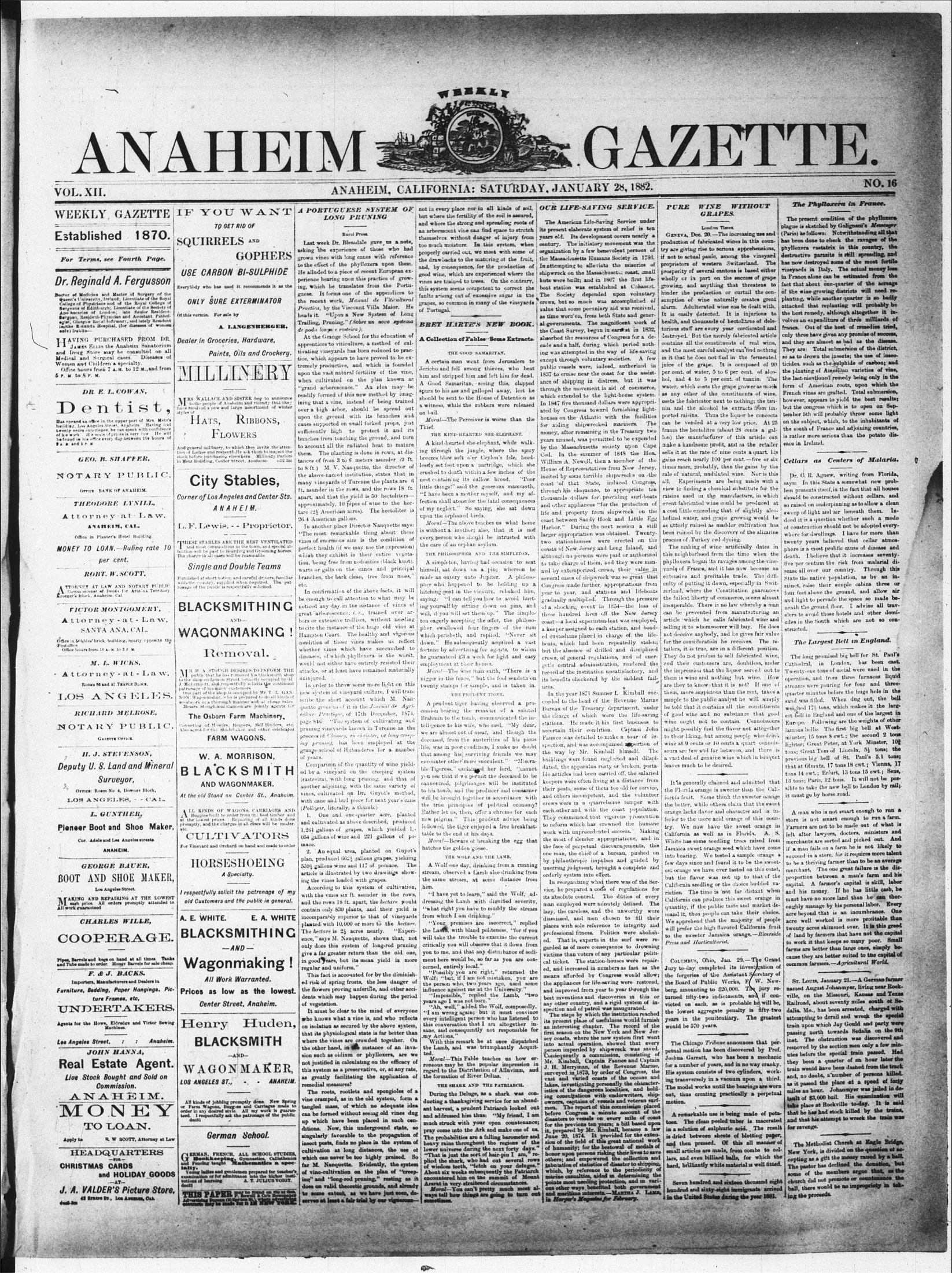
Searchable text
ANAHEIM
VOL. XII.
WEEKLY GAZETTE
Established 1870.
For Terms, see Fourth Page.
Dr. Reginald A. Fergusson
Doctor of Medicine and Master of Surgery of the Queen's University, Ireland; Licentiate of the Royal College of Physicians and of the Royal College of Surgeons of Edinburgh; Licentiate of the Society of Apothecaries of London; late Senior Resident-Surgeon, Resident-Physician and Assistant Pathologist, Glasgow Royal Infirmary; and lately Resident in the Rotunda Hospital (for diseases of women only) Dublin—
HAVING PURCHASED FROM DR. JAMES ELLIS the Anaheim Sanatorium and Drug Store may be consulted on all Medical and Surgical cases. Diseases of Women and Children a specialty.
Office hours from 7 A.M. to 12 M., and from 5 P.M. to 8 P.M.
DR. E. L. COWAN,
Dentist,
Has opened an office in the upper part of Mrs. Metz's building, Los Angeles Street, Anaheim. Having had twenty years experience, he can speak with confidence of his work. His scale of prices is very low. He will be found in his office every day between the hours of 9 A.M. and 6 P.M.
GEO. B. SHAFFER,
NOTARY PUBLIC
DR. E. L. COWAN,
Dentist,
Has opened an office in the upper part of Mrs. Metz's building, Los Angeles Street, Anaheim. Having had twenty years experience, he can speak with confidence of his work. His scale of prices is very low. He will be found in his office every day between the hours of 9 AM and 5 PM.
GEO. B. SHAFFER,
NOTARY PUBLIC.
OFFICE: BANK OF ANAHEIM.
THEODORE LYNILL,
Attorney-at-Law,
ANAHEIM, CAL.
Office in Planter's Hotel Building.
MONEY TO LOAN.—Ruling rate 10 per cent.
ROBT. W. SCOTT,
ATTORNEY AT LAW AND NOTARY PUBLIC.
Commissioner of Deeds for Arizona Territory Grocer's Block, Anaheim, Cal.
VICTOR MONTGOMERY,
Attorney-at-Law,
SANTA ANA, CAL.
Office in Dibbles' brick building, nearly opposite the Postoffice.
Office hours from 10 A.M. to 3 P.M.
M. L. WICKS,
Attorney-at-Law,
Rooms 86 and 87 Temple Block.
LOS ANGELES.
RICHARD MELROSE,
NOTARY PUBLIC.
Gazette Office.
H. J. STEVENSON,
Deputy U. S. Land and Mineral Surveyor,
OFFICE: Room No 4, Downey Block,
LOS ANGELES, - - CAL.
L. GUNTHER,
Pioneer Boot and Shoe Maker,
Cor. Adele and Los Angeles streets.
ANAHEIM.
GEORGE BAUER,
BOOT AND SHOE MAKER,
Los Angeles Street.
MRS. WALLACE AND SISTER beg to announce to the people of Anaheim and vicinity that they have received a new and large assortment of winter styles of HATS, RIBBONS, FLOWERS
And general millinery, to which they invite the attention of Ladies and respectfully ask them to inspect the stock before purchasing elsewhere. Millinery Parlors in Metz Building, Center Street, Anaheim n12 3m
City Stables,
Corner of Los Angeles and Center Sts.
ANAHEIM.
L.F. Lewis -- Proprietor.
THESE STABLES ARE THE BEST VENTILATED and most commodious in the town, and special attention will be paid to Boarding and Grooming horses. The charge in all cases will be reasonable.
Single and Double Teams
Furnished at short notice, and careful drivers, familiar with the country, supplied when required. The patronage of the public is respectfully solicited.
BLACKSMITHING
AND
WAGONMAKING!
Removal.
MR. H.A. STOUGH DESIRES TO INFORM THE public that he has removed his blacksmith shop to the shop on Lemon Street formerly occupied by H.J. Mehernott, and respectfully solicits the continued patronage of his many customers.
One part of the shop is occupied by Mr.T.L.GANON, Wagonmaker, who is prepared to do all kinds of woodwork in a thorough manner and at cheap rates. Messrs. Stough and Gannon are jointly agents for The Osborn Farm Machinery.
Consisting of Mowers, Reapers, Self Binders, etc. Also agent for the Studebaker and other celebrated FARM WAGONS.
W.A. MORRISON,
BLACKSMITH AND WAGONMAKER.
At the old Stand on Center St., Anaheim.
ALL KINDS OF WAGONS, CARRIAGES AND Buggies built to order from the best timber and at the lowest prices. Repairing of all kinds done promptly, and the charges in all cases will be moderate.
CULTIVATORS
For Vineyard and Orchard on hand and made to order
HORSESHOEING
A Specialty.
I respectfully solicit the patronage of my
Comparison of the ed by a vineyard on (rastreira), with long another adjoining, wives cultivated on with cane and bud pips (Pollepur), literally, a
1. One and one and cultivated as about 1,261 gallons of grape 054 gallons of wine amace.
2. An equal area plan, produced 662½ gallons wine article is illustrated b ing the vines loaded According to this with the vines six ft.
L. GUNTHER,
Pioneer Boot and Shoe Maker,
Cor. Adele and Los Angeles streets.
ANAHEIM.
GEORGE BAUER,
BOOT AND SHOE MAKER,
Los Angeles Street.
Making and repairing at the lowest cash price. All orders promptly attended to. All work guaranteed.
CHARLES WILLE,
COOPERAGE.
Pipes, Barrels and kegs on hand at all times. Tanks and Tube made to order. Honey Barrels for sale cheap.
F. & J. BACKS.
Importers, Manufacturers and Dealers in Furniture, Bedding, Paper Hangings, Picture Frames, etc,
UNDERTAKERS,
Agents for the Howe, Eldredge and Victor Sewing Machines.
Los Angeles Street, Anaheim.
JOHN HANNA,
Real Estate Agent.
Live Stock Bought and Sold on Commission.
ANAHEIM.
MONEY TO LOAN.
Apply to R. W SCOTT, Attorney at Law
HEADQUARTERS
FOR CHRISTMAS CARDS and HOLIDAY GOODS
AT
J. A. VALDER'S Picture Store,
42 Eratine St., Los Angeles, Cal.
ALL KINDS OF WAGONS, CARRIAGES AND Buggies built to order from the best timber and at the lowest prices. Repairing of all kinds done promptly, and the charges in all cases will be moderate.
CULTIVATORS
For Vineyard and Orchard on hand and made to order
HORSESHOEING
A Specialty.
I respectfully solicit the patronage of my old Customers and the public in general.
A. E. WHITE.
E. A. WHITE
BLACKSMITHING
AND
Wagonmaking!
All Work Warranted.
Prices as low as the lowest.
Center Street, Anaheim.
Henry Huden,
BLACKSMITH
AND
WAGONMAKER,
LOS ANGELES ST., - - ANAHEIM.
All kinds of jobbing promptly done. New Spring or Farm Wagons, Bugges and Carriages made to order in any desired style. All my work is guaranteed. I respectfully ask the patronage of the public.
German School.
GERMAN, FRENCH, ALL SCHOOL STUDIES, Bookkeeping, Gymnastics, Callisthenics and Fencing taught Mathematics a specialty.
Young ladies and gentlemen prepared for teacher's examination or for admittance into the higher institutions of learning.
A. T. JULIUS VOIGT.
THIS PAPER may be found on file at Gen. P. Bowell & Co.'s Newspaper Advertising Bureau (10 Spruce St.) where advertising contracts may be made for it in NEW YORK.
1. One and one-half gallons wine and cultivated as about 1,261 gallons of grape juice; 054 gallons of wine and mace.
2. An equal area plan produced 662½ gallons of wine and article is illustrated by using the vines loaded according to this with the vines six ft. tall and the rows 18 ft. tall contain only 830 plants in comparably superior planted with 10,000 acres. The hectare is 2½ acres; says M. Nanquet only does this system give a far greater return in good years, but it is regular and uniform.
This fact is accounted for risk of spring frost the flowers proving unfit which may harm vegetation.
It must be clear to who knows what a vine on isolation as secure that its physiological where the vines are the other hand, in vision such as oidium not justified in calculation this system as a press as greatly facilitated remedial measures?
The roots, rootlets, vine cramped, as in tangled mass, of which can never be far M. Nanquette of vine-cultivation or "long-rod does on valid theory to some extent, as serves at least a fair
ANAHEIM, CALIFORNIA: SATURDAY, JANUARY 28, 1882.
A PORTUGUESE SYSTEM OF LONG PRUNING
Rural Press.
Last week Dr. Blenadale gave us a note, asking the experience of those who had grown vines with long canes with reference to the effect of the phylloxera upon them. He alluded to a piece of recent European experience bearing upon this practice of growing, which he translates from the Portuguese. It forms one of the appendices to the recent work, Manual de Viticultural Practica, by the Viscount Villa Maior. He heads it. "Upon a New System of Long Trailing, Pruning." (Sobre un novo sistema de peda longa roteira);
At the Grange School for the education of apprentices to viticulture, a method of cultivating vineyards has been reduced to practice, which appears to have proved to be extremely productive, and which is founded upon the vast natural fertility of the vine, when cultivated on the plan known as "grand arborescence." An idea may be readily formed of this new method by imagining that a vine, instead of being trained over a high arbor, should be spread out upon the ground with its branches and canes supported on small forked props, just sufficiently high to protect it and its bunches from touching the ground, and turn to account all the radiated heat to mature them. The planting is done in rows, at distances of from 3 to 6 meters asunder (9 ft. to 8 ft.) M. V. Nanquette, the director of the above named institution states that in not in every place nor in all kinds of soil, but where the fertility of the soil is assured, and where the strong and spreading roots of an arborescent vine can find space to stretch themselves without danger of injury from too much moisture. In this system, when properly carried out, we meet with some of the drawbacks to the maturing of the fruit, and, by consequence, for the production of good wine, which are experienced where the vines are trained to trees. On the contrary, this system seems competent to correct the faults arising out of excessive sugar in the grapes, so common in many of the vineyards of Portugal.
BRET HARTE'S NEW BOOK.
A Collection of Fables - Some Extracts.
THE GOOD SAMARITAN.
A certain man went from Jerusalem to Jericho and fell among thieves, who beat him and stripped him and left him for dead. A Good Samaritan, seeing this, clapped spurs to his ass and galloped away, lest he should be sent to the House of Detention as a witness, while the robbers were released on hail.
Moral—The Perceiver is worse than the Thief.
THE KIND-HEARTED SHE-ELEPHANT.
A kind-hearted she-elephant, while walking through the jungle, where the spicy breezes blow soft o'er Ceylon's fsle, headlessly set foot upon a partridge, which she crushed to death within a few inches of the
OUR LIFE-SAVING SERVICE.
The American Life-Saving Service under its present elaborate system of relief is ten years old. Its development covers nearly a century. The initiatory movement was the organization by a few benevolent persons of the Massachusetts Humane Society in 1786. In attempting to alleviate the miseries of shipwreck on the Massachusetts coast, small huts were built; and in 1807 the first life-boat station was established at Cohasset. The Society depended upon voluntary crews, but so much was accomplished of value that some pecuniary aid was received, as time wore on, from both State and general governments. The magnificent work of the Coast Survey, begun in earnest in 1832, absorbed the resources of Congress for a decade and a half, during which period nothing was attempted in the way of life-saving except through voluntary societies. A few public vessels were, indeed, authorized in 1837 to cruise near the coast for the assistance of shipping in distress, but it was through the movement in aid of commerce, which extended to the light-house system. In 1847 five thousand dollars were appropriated by Congress toward furnishing light-houses on the Atlantic with the facilities for aiding shipwrecked mariners. The money, after remaining in the Treasury two years unused, was permitted to be expended by the Massachusetts society upon Cape Cod. In the summer of 1848 the Hon. William A. Newell, then a member of the House of Representatives from New Jersey, made sells gains time-saving.
upon the vast mercantile territory in which cultivated on the plan known as "grand arborescence." An idea may be readily formed of this new method by imagining that a vine, instead of being trained over a high arbor, should be spread out upon the ground with its branches and canes supported on small forked props, just sufficiently high to protect it and its bunches from touching the ground, and turn to account all the radiated heat to mature them. The planting is done in rows, at distances of from 3 to 6 meters asunder (9 ft. to 8 ft.) M. V. Nanquette, the director of the above-named institution, states that in many vineyards of Turenne the plants are 6 ft. asunder in the rows, and the rows 18 ft. apart, and that the yield is 50 hectoliters—approximately, 10 pipes of wine to the hectare (2½ American acres). The hectoliter is 26.4 American gallons.
In another place Director Nanquette says: "The most remarkable thing about these vines of enormous size is the condition of perfect health (if we may use the expression) which they exhibit in their entire vegetation, being free from nodosities (black knot), warts or galls on the canes and principal branches, the bark clean, tree from moss," etc.
In confirmation of the above facts, it will be enough to call attention to what may be noticed any day in the instance of vines of great arborescence; i.e., trained over arbors or extensive trellises, without needing to cite the instance of the huge old vine at Hampton Court. The healthy and vigorous condition of these vines makes us reflect whether vines which have succumbed to diseases, of which phylloxera is the worst, would not either have entirely resisted their attacks, or at least have remained materially uninjured.
In order to throw some more light on this new system of vineyard culture, I will transcribe the short account which M. Nanquette gives us of it in the Journal de Agriculture Practique, of 17th December, 1874, page 846. "The system of cultivating and pruning vineyards known in Turenne as the process of Chisney, en chistre, or long creeping pruning, has been employed at the grange-school of Hubanderes for a number of years.
Comparison of the quantity of wine yielded by a vineyard on the creeping system (rastreira), with long pruning, and that of another adjoining, with the same variety of vines, cultivated on Dr. Guyot's method, with cane and bud piece for next year's cane (Pollegar, literally, a thumb.)
1. One and one-quarter acre, planted and cultivated as above described, produced 1,261 gallons of grapes, which yielded 1.054 gallons of wine and 221 gallons of pomace.
2. An equal area, planted on Guyot's plan, produced 662½ gallons grapes, yielding 559½ gallons wine and 117 of pomace. The article is illustrated by two drawings showing the vines loaded with grapes.
According to this system of cultivation, with the vines six ft. asunder in the rows,
upon cultivated on the plan known as "grand arborescence." An idea may be readily formed of this new method by imagining that a vine, instead of being trained over a high arbor, should be spread out upon the ground with its branches and canes supported on small forked props, just sufficiently high to protect it and its bunches from touching the ground, and turn to account all the radiated heat to mature them. The planting is done in rows, at distances of from 3 to 6 meters asunder (9 ft. to 8 ft.) M. V. Nanquette, the director of the above-named institution, states that in many vineyards of Turenne the plants are 6 ft. asunder in the rows, and the rows 18 ft. apart, and that the yield is 50 hectoliters—approximately, 10 pipes of wine to the hectare (2½ American acres). The hectoliter is 26.4 American gallons.
In another place Director Nanquette says: "The most remarkable thing about these vines of enormous size is the condition of perfect health (if we may use the expression) which they exhibit in their entire vegetation, being free from nodosites (black knot), warts or galls on the canes and principal branches, the bark clean, tree from moss," etc.
In confirmation of the above facts, it will be enough to call attention to what may be noticed any day in the instance of vines of great arborescence; i.e., trained over arbors or extensive trellises, without needing to cite the instance of the huge old vine at Hampton Court. The healthy and vigorous condition of these vines makes us reflect whether vines which have succumbed to diseases, of which phylloxera is the worst, would not either have entirely resisted their attacks, or at least have remained materially uninjured.
In order to throw some more light on this new system of vineyard culture, I will transcribe the short account which M. Nanquette gives us of it in the Journal de Agriculture Practique, of 17th December, 1874, page 846. "The system of cultivating and pruning vineyards known in Turenne as the process of Chisney, en chistre, or long creeping pruning, has been employed at the grange-school of Hubanderes for a number of years.
Comparison of the quantity of wine yielded by a vineyard on the creeping system (rastreira), with long pruning, and that of another adjoining, with the same variety of vines, cultivated on Dr. Guyot's method, with cane and bud piece for next year's cane (Pollegar, literally, a thumb.)
1. One and one-quarter acre, planted and cultivated as above described, produced 1,261 gallons of grapes, which yielded 1.054 gallons of wine and 221 gallons of pomace.
2. An equal area, planted on Guyot's plan, produced 662½ gallons grapes, yielding 559½ gallons wine and 117 of pomace. The article is illustrated by two drawings showing the vines loaded with grapes.
According to this system of cultivation, with the vines six ft. asunder in the rows,
upon cultivated on the plan known as "grand arborescence." An idea may be readily formed of this new method by imagining that a vine, instead of being trained over a high arbor, should be spread out upon the ground with its branches and canes supported on small forkedprops, just sufficiently high to protect it and its bunches from touching the ground, and turn to account all the radiated heat to mature them. The planting is done in rows, at distances of from 3 to 6 meters asunder (9 ft. to 8 ft.) M. V. Nanquette, the director of the above-named institution, states that in many vineyards of Turenne the plants are 6 ft. asunder in the rows, and the rows 18 ft. apart, and that the yield is 50 hectoliters—approximately, 10 pipes of wine to the hectare (2½ American acres). The hectoliter is 26.4 American gallons.
In another place Director Nanquette says: "The most remarkable thing about these vines of enormous size is the condition of perfect health (if we may use the expression) which they exhibit in their entire vegetation, being free from nodosites (black knot), warts or galls on the canes and principal branches, the bark clean, tree from moss," etc.
In confirmation of the above facts, it will be enough to call attention to what may be noticed any day in the instance of vines of great arborescence; i.e., trained over arbors or extensive trellises, without needing to cite the instance of the huge old vine at Hampton Court. The healthy and vigorous condition of these vines makes us reflect whether vines which have succumbed to diseases, of which phylloxera is the worst, would not either have entirely resisted their attacks, or at least have remained materially uninjured.
In order to throw some more light on this new system of vineyard culture, I will transcribe the short account which M. Nanquette gives us of it in the Journal de Agriculture Practique, of 17th December,1874,page 846.“The system of cultivating and pruning vineyards known in Turenne as the process of Chisney,en chistre,or long creeping pruning,has been employed at the grange-school of Hubanderes for a number of years.
Comparison of the quantity of wine yielded by a vineyard on the creeping system (rastreira),with long pruning,and that of another adjoining,with the same variety of vines,cultivated on Dr. Guyot's method,with cane and bud piece for next year's cane(Pollegar,literally,a thumb.)
1. One and one-quarter acre,planted and cultivated as above described,produced 1,261 gallons of grapes,which yielded 1.054 gallons of wine和221 gallonsof pomace.
2.An equal area,planted on Guyot's plan,produced 662½ gallons grapes,yielding 559½ gallons wine和117ofponace.The article is illustrated by two drawings showingthevine loadedwithgrapes.
Accordingtothissystemofcultivationwiththevine sixft.asunderintherows,
upon cultivated ontheplanknownas"grandarborescence."Anideamaybe readilyformedofthisnewmethodbyimaginingthatavinefromtouchingtheground,andturntocounthemovementinaidofcommercewhichextendedtothelight-housesystem.In1847five thousanddollarswereappropriatedbyCongresstowardfurnishinglighthousesontheAtlanticwiththefacilitiesforaidingshipwreckedmariners.ThemoneyafterremainingintheTreasurytwoyearsunusedwaspermittedtobeexpendedbytheMassachusettssocietyuponCapEco.Inthesummerof1848theHon.WilliamA.Newell,theamemberoftheHouseOfRepresentativesfromNewJerseyincitedbysometerribleshipwreckson-thecoastofthatState,introducedCongressthroughhiseloquence,tocompatriate ten thousandsdollarsforprovidingsurf-boatsandotherappliances"fortheprotectionoflifeandpropertyfromshipwreckonthecoastbetweenSandyHookandLittleEggHarbor."Duringthenextsessiona stilllargerappropriationwasobtained.Twentytwostationhouseswere erectedonthecoastsOfNewJerseyandLongIsland,andalthoughno personswouldorauthorizedtotakechargeofthem,andtheyweremannedbyextemporizedcrews,thevalueinseveralcasesofshipwreckswouldgreatthatCongressmadefurtherappropriationsfromyeartoyear,andstationsandlifeboatsgraduallymultipliedThroughthepressureofa shockingeventin1854—thelossofthreehundredlivesofftheNewJerseycoast—alocalsuperintendentwasemployed,akeeperassignedtoeachstation,andbondedcustodiansplacedinchargeofthelifeboatswhichhadbeenrepeatedlystolenbuttheabsenceofdrilledanddisciplinedcrewsofgeneralregulations,andenergeticcentraladministration,rendererdotherecordofinstitutionunsatisfactory,anditsbenefitscheckeredbythesaddestfailures.
Intheyear1871SumnerI.Kimball succeededtoheadoftheRevenueMarineBureauoftheTreasurydepartment underthechargeofwhichwerethelife-savingstations.Hewmadeithisfirstbusinesstoascertainthecondition.CaptainJohnFauncewasedetailedtomakea tourofinspection,andwasaccompaniedportionofthewaybyMr.Kimballhimself.Thebuildingswerefoundneglectedanddilapidated,theapparatusrustorybroken portablearticleshadbeencarriedoff,thesalariedkeeperswere often livingatatdistancefromthepests,someofthetomothooleafservice,andothers incompetent,andthevolunteercrewswereinquaworthheratherandwiththecoastpopulation Theycommencedthatvigorousprosecutionto reformwhichhas crownedthehumaneworkwithprecedentedsuccess.Makingthemostofslenderappropriations,andinthefaceofperpetualdiscouragements,theone man,the chiefofa bureau,pushedonbyphilanthropicimpulsesandguidedbyunerringjudgment,broughtacompleteandorderlysysteminto effect.
Inreorganizingwhatthere wasofTheService,hhepreparedacodeofregulationsforitsabsolutecontrol.Thedutiesofevery
1. One and one-quarter acre, planted and cultivated as above described, produced 1,261 gallons of grapes, which yielded 1,054 gallons of wine and 221 gallons of pomace.
2. An equal area, planted on Guyot's plan, produced 662½ gallons grapey, yielding 559½ gallons wine and 117 of pomace. The article is illustrated by two drawings showing the vines loaded with grapes.
According to this system of cultivation, with the vines six ft. asunder in the rows, and the rows 18 ft. apart, the hectare would contain only 830 plants, and their yield is incomparably superior to that of vineyards planted with 10,000 or more to the hectare. The hectare is 2½ acres nearly. "Experience," says M. Nanquette, shows that, not only does this system of long-rod pruning give a far greater return than the old one, in good years, but its mean yield is more regular and uniform."
This fact is accounted for by the diminished risk of spring frosts, the less danger of the flowers proving unfertile, and other accidents which may happen during the period of vegetation.
It must be clear to the mind of everyone who knows what a vine is, and who reflects on isolation as secured by the above system, that its physiological state is far better than where the vines are crowded together. On the other hand, in the instance of an invasion such as odium or phylloxera, are we not justified in calculating on the efficacy of this system as a preservative, or, at any rate, as greatly facilitating the application of remedial measures!
The roots, rootlets and spongioles of a vine cramped, as in the old system, form a tangled mass, of which no adequate idea can be formed without seeing old vines dug up which have been placed in such conditions. Now, this underground state, so singularly favorable to the propagation of insect pests, finds no place in the system of cultivation at long distances, the use of which can never be too highly praised. So far M. Nanquette. Evidently, the system of vine-cultivation on the plan of "creeping" and "long-rod pruning," resting as it does on valid theoretic grounds, and already to some extent, as we have just seen, deserves at least a fair trial by our vigorous—will be brought together in accordance with the true principles of political economy? Rather let us, then, offer a chromo for each new pilgrim." This prudent advice being followed, the tiger enjoyed a free breakfast-table to the end of his days.
Moral—Beware of breaking the egg that hatches the golden goose.
THE WOLF AND THE LAMB.
A Wolf one day, drinking from a running stream, observed a Lamb also drinking from the same stream, at some distance from him.
"I have yet to learn," said the Wolf, addressing the Lamb with dignified severity, "what right you have to muddy the stream from which I am drinking."
"Your premises are incorrect," replied the Lamb, with bland politeness, "for if you will take the trouble to examine the current critically you will observe that it flows from you to me, and that any disturbance of sediment here would be, so far as you are concerned, entirely local."
"Possibly you are right," returned the Wolf; "but, if I am not mistaken, you are the person who, two years ago, used some influence against me at the University."
"IImpossible," replied the Lamb, "two years ago I was not born."
"Ah, well," added the Wolf, composedly, "I am wrong again; but it must convince every intelligent person who has listened to this conversation that I am altogether insane, and consequently not responsible for my Actions."
With this remark be at once dispatched the Lamb, and was triumphantly Acquitted.
Moral—This Fable teaches us how erroneous may be the popular impression in regard to the Distribution of Alluvium, and the formation of River Deltas.
THE SHARK AND THE PATRIARCH.
During the Deluge, as a shark was conducting a thanksgiving service for an abundant harvest, a prudent Patriarch looked out and addressed him thus: "My friend, I am much struck with your open countenance; pray come into the Ark and make one of us. The probabilities are a falling barometer and heavy rains throughout the regions of the lower universe during the next forty days." "That is just the sort of hair-pin I am," replied the shark, who had cut several rows of wisdom teeth, "fetch on your deluges." About six weeks subsequently the Patriarch encountered him on the summit of Mount Ararat in very straitened circumstances.
Moral—You can't pretty much most always tell how things are going to turn out sometimes.
crews were in a quarrelsome temper with each other and with the coast population. They commenced that vigorous prosecution to reform which has crowned the humane work with unprecedented success. Making the most of slender appropriations, and in the face of perpetual discouragements, this one man, the chief of a bureau, pushed on by philanthropic impulses and guided by unerring judgment, brought a complete and orderly system into effect.
In reorganizing what there was of the Service, he prepared a code of regulations for its absolute control. The duties of every man employed were minutely defined. The lazy, the careless, and the unworthy were dismissed, and men chosen to fill their places with sole reference to integrity and professional fitness. Politics were abolished. That is, experts in the surf were regarded as of more consequence to drowning victims than voters of any particular political ticket. The station-houses were repaired, and increased in numbers as fast as the means afforded by Congress would allow; the appliances for life-saving were restored, and improved from year to year through the best inventions and discoveries in this or any other country, and a rigid system of inspection and of patrol was inaugurated.
The steps by which the institution reached its present plane of usefulness would furnish an interesting chapter. The record of the first season on the New York and New Jersey coasts, where the new system first went into actual operation, showed that every person imperiled by shipwreck was saved. Consequently a commission, consisting of Mr. Kimball, Captain Fanncee and Captain J. H. Merryman, of the Revenue Marine surveyed in 1873, by order of Congress, the vast and varied coasts of the oceans and lakes, investigating personally the characteristics of the dangerous localities, and holding consultations with underwriters, shipowners, captains of vessels and veteran surfers. The report of this commission placed before Congress a minute account of the disasters to vessels on every mile of coast for the previous ten years; a bill based upon it, prepared by Mr. Kimball became a law June 20, 1874. It provided for the extension of the field of this great national work of humanity; for the bestowal of medals of honor upon persons risking their lives to save others; and empowered the collection and tabulation of statistics of disaster to shipping, which, by reference to the periodicity of marine casualties, aided in determining the points most needing protection, and in various other ways benefited both government and maritime interests.—Martha J. Lamm,
in Harper's Magazine for February.
GAZETTE.
February 28, 1882.
SAVING SERVICE.
The saving service under the system of relief is tenement covers nearly a quarter movement was the benevolent persons of the manane Society in 1786. Variate the miseries of Massachusetts coast, small than 1807 the first life-established at Cohasset. Indeed upon voluntary aid was accomplished of secondary aid was received, both State and general magnificent work of men in earnest in 1832, of Congress for a design which period nothwithin the way of life-saving military societies. A few indeed, authorized in the coast for the assisting distress, but it was not in aid of commerce, the light-house system. The dollars were appropriated furnishing light-ice with the facilities skipped mariners. The king in the Treasury two committed to be expended on society upon Cape Cod of 1848 the Hon. when a member of the lives from New Jersey, who adjoined countries, is rather more serious than the potato disease in Ireland.
PURE WINE WITHOUT GRAPES.
London Times.
GENEVA, Dec. 20. — The increasing use and production of fabricated wines in this country are giving rise to serious apprehensions, if not to actual panic, among the vineyard proprietors of western Switzerland. The prosperity of several cantons is based either wholly or in part on the success of grape growing, and anything that threatens to hinder the production or curtail the consumption of wine naturally creates great alarm. Adulterated wine can be dealt with. It is easily detected. It is injurious to health, and thousands of hectolitres of deleterious stuff are every year confiscated and destroyed. But the merely fabricated article contains all the constituents of real wine, and the most careful analyst can find nothing in it that he does not find in the fermented juice of the grape. It is composed of 90 per cent. of water, 5 to 6 per cent. of alcohol, and 4 to 5 per cent. of tannin. The water, which costs the grape grower as much as any other of the constituents of wine, costs the fabricator next to nothing; the tannin and the alcohol he extracts from imported raisins. Thus the liquor he concocts can be vended at a very low price. At 25 francs the hectolitre (about 28 cents a gallon) the manufacturer of this article can make a handsome profit, and as the retailer sells it at the rate of nine cents a quart, his gains reach nearly 100 per cent. — five or six times more, probably, than the gains by the sale of natural, undiluted wine. Nor is this
The Phylloxera in France.
The present condition of the phylloxera plague is sketched by Galignani’s Messenger (Paris) as follows: Notwithstanding all that has been done to check the ravages of the phylloxera vaatatrix in this country, the destructive parasite is still spreading, and has now destroyed some of the most fertile vineyards in Italy. The actual money loss in France alone can be estimated from the fact that about one-quarter of the acreage of the wine-growing districts will need replanting, while another quarter is so badly attacked that replanting will probably be the best remedy, although altogether it involves an expenditure of three milliards of francs. Out of the host of remedies tried, only three have given any promise of success, and they are almost as bad as the disease. They are: Total submersion of the district, so as to drown the insects; the use of insecticides such as the sulphide of carbon; and the planting of American varieties of vine, the last mentioned remedy being only in the form of American roots, upon which the French vines are grafted. Total submersion, however, appears to yield the best results; but the congress which is to open on September 5th will probably throw some light on the subject, which, to the inhabitants of the south of France and adjoining countries, is rather more serious than the potato disease in Ireland.
Cellars as Centers of Malaria.
It is generally claimed and admitted that the Florida orange is sweeter than the California fruit. Some think the sweeter orange the better, while others claim that the sweet orange lacks flavor and character and is inferior to the more acid orange of this country. We now have the sweet orange in California as well as in Florida. A. S. White has some seedling trees raised from Jamaica sweet orange seed which have come into bearing. We tested a sample orange a few days since and found it to be the sweetest orange we have ever tasted on this coast, but the flavor was not up to that of the California seedling or the choice budded varieties. The time is not far distant when California can produce this sweet orange in the last mentioned remedy being only in the form of American roots, upon which the French vines are grafted. Total submersion, however, appears to yield the best results; but the congress which is to open on September 5th will probably throw some light on the subject, which, to the inhabitants of the south of France and adjoining countries, is rather more serious than the potato disease in Ireland.
Cellars as Centers of Malaria.
Dr. C. R. Agnew, writing from Florida, says: In this State a somewhat new problem presents itself, in the fact that all houses should be constructed without cellars, and so raised on underpinning as to allow a clean sweep of light and air beneath them. Indeed it is a question whether such a mode of construction should not be adopted everywhere for dwellings. I have for more than twenty years believed that cellar atmosphere is a most prolific cause of disease and death. I believe that it increases seventy-five per centum the risk from malarial disease all over our country. Through this State the native population, as by an instinct, raise their simple cabins three or four feet above the ground, and allow air and light to pervade the space so made beneath the ground floor. I advise all travelers to avoid those hotels and other domiciles in the South which are not so constructed.
The Largest Bell in England.
The long promised big bell for St. Paul's Cathedral, in London, has been cast. Twenty-one tons of metal were used in the operation, and from three furnaces liquid streams were pouring for four and three-quarter minutes before the huge hole in the sand was filled. When dug out, the bell weighed 17 tons, which makes it the largest bell in England and one of the largest in Europe. Following are the weights of other famous bells: The first big bell at Westminster, 15 tons 8 cwt.; the second 2 tons lighter; Great Peter, at York Minster, 10 tons; Great Tom of Lincoln, 5½ tons; the previous big bell of St. Paul's 5.1 tons; that at Olmutz, 17 tons 18 cwt.; Vienna, 17 tons 14 cwt.; Erfurt, 13 tons 15 cwt.; Sens, 13 tons; Paris, 12 tons. It will not be possible to take the new bell to London by rail; it must go by horse road.
A man who is not smart enough to run a store is not smart enough to run a farm. Farmers are not to be made out of what is left after lawyers, doctors, ministers and merchants are sorted and picked out. And if a man fails on a farm he is not likely to succeed in a store, for it requires more talent to be a thriving farmer than to be an average merchant. The one great failure is the disproportion between a man's farm and his capital. A farmer's capital is skill, labor and his money. If he has little cash, he must have no more land than he can thor-
carrelsome temper with the coast population. That vigorous prosecution crowned the humane treatment success. Making appropriations, and in discouragements, this of a bureau, pushed on impulses and guided by brought a complete and effect.
that there was of the Serious mode of regulations for the duties of every minute defined. The land the unworthy were chosen to fill their preference to integrity and Politics were abolished in the surf were re- consequence to drowning of any particular politi- nation-houses were repair-numbers as fast as the Congress would allow; life-saving were restored, year to year through the discoveries in this or and a rigid system of indictment was inaugurated.
with the institution reached usefulness would furnish better. The record of the New York and New Jer- nee new system first went on, showed that every shipwreck was saved. Commission, consisting of Brian Faunce and Captain of the Revenue Marine, new order of Congress, the coasts of the oceans and personally the character- nous localities, and hold- with underwriters, shipwrecks and veteran sur- lice this commission placed immediate account of the ton every mile of coast years; a bill based upon Kimball, became a law provided for the extent this great national work be bestowal of medals of crisking their lives to save covered the collection and losses of disaster to shipping, due to the periodicity ofiding in determining the protection, and in vari- fited both government acts.—Martha J. Lams, time for February.
Columbus, Ohio, Jan. 29. — The Grand Jury to-day completed its investigation of the forgeries of the Assistant Secretary of the Board of Public Works, F.W. Newberg, amounting to $20,000. The jury returned fifty-two indictments, and if convicted on each, as is probable he will be, the lowest aggregate penalty is fifty-two years in the penitentiary. The greatest would be 570 years.
The Chicago Tribune announces that perpetual motion has been discovered by Prof. Joshua Garratt, who has been a mechanic for a number of years, and in no way cranky. His system consists of two cylinders, working transversely in a vacuum upon a third. The model works until the bearings are worn out, thus creating practically a perpetual motion.
A remarkable use is being made of potatoes. The clean peeled tuber is macerated in a solution of sulphuric acid. The result is dried between sheets of blotting paper, and then pressed. Of this all manner of small articles are male, from combs to collars, and even billiard balls, for which the hard, brilliantly white material is well fitted.
Seven hundred and sixteen thousand eight hundred and sixty-eight immigrants arrived in the United States during the year 1881.
A man who is not smart enough to run a store is not smart enough to run a farm. Farmers are not to be made out of what is left after lawyers, doctors, ministers and merchants are sorted and picked out. And if a man fails on a farm he is not likely to succeed in a store, for it requires more talent to be a thriving farmer than to be an average merchant. The one great failure is the disproportion between a man's farm and his capital. A farmer's capital is skill, labor and his money. If he has little cash, he must have no more land than he can thoroughly manage by his personal labor. Every acre beyond that is an incumbrance. One acre well worked is more profitable than twenty acres skimmed over. It is this greed of land by farmers that have not the capital to work it that keeps so many poor. Small farms are better than large ones, simply because they are better suited to the capital of common farmers. — Agricultural World.
St. Louis, January 21. — A German farmer named August Johanmyer, living near Rockville, on the Missouri, Kansas and Texas Railroad, about seventy miles south of Sedalia. Mo., has been arrested, charged with attempting to derail and wreck the special train upon which Jay Gould and party were passing north towards Sedalia on the 9th inst. The obstruction was discovered and removed by the section men only a few minutes before the special train passed. Had they been a quarter of an hour later the train would have been dashed from the track and, no doubt, a number of persons killed. As it passed the place at a speed of forty miles an hour. Johanmyer was jailed in default of $3,000 bail. His examination will take place at Rockville to-day. It is said that he has had stock killed by the trains, and that his attempt to wreck the train was for revenge.
The Methodist Church at Eagle Bridge, New York, is divided on the question of accepting as a gift the money raised by a ball. The pastor has declined the donation, but some of the members argue that, as the church did not promote or countenance the ball, there would be no impropriety in taking the proceeds.