anaheim-gazette 1881-11-26
Scanned page
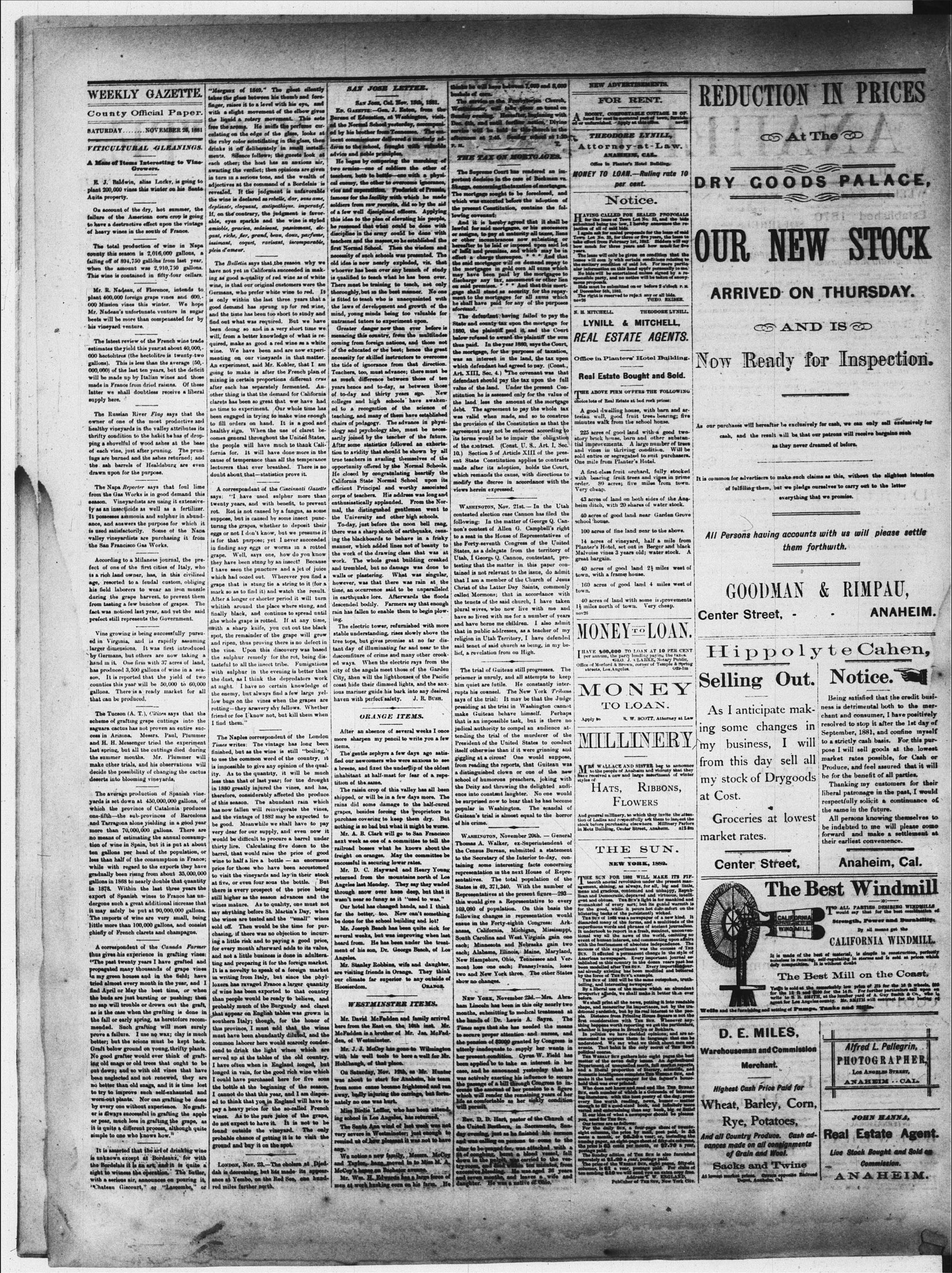
Searchable text
WEEKLY GAZETTE.
County Official Paper.
SATURDAY...NOVEMBER 26, 1851
VITICULTURAL GLEANINGS.
A Mass of Items Interesting to Vine-Growers.
E. J. Baldwin, alias Lucky, is going to plant 200,000 vines this winter on his Santa Anita property.
On account of the dry, hot summer, the failure of the American corn crop is going to have a destructive effect upon the vintage of heavy wines in the south of France.
The total production of wine in Napa county this season is 2,016,000 gallons, a falling off of 894,750 gallons from last year, when the amount was 2,910,750 gallons. This wine is contained in fifty-four cellars.
Mr. R. Nadeau, of Florence, intends to plant 400,000 foreign grape vines and 600,-000 Mission vines this winter. We hope Mr. Nadeau's unfortunate venture in sugar beets will be more than compensated for by his vineyard venture.
The latest review of the French wine trade estimates the yield this year at about 40,000,-000 hectolitres (the hectolitre is twenty-two gallons). This is less than the average (50,-000,000) of the last ten years, but the deficit will be made up by Italian wines and those made in France from dried raisins. Of these latter we shall doubtless receive a liberal supply here.
The Russian River Flag says that the owner of one of the most productive and healthy vineyards in the valley attributes its thrifty condition to the habit he has of dropping a shovelful of wood ashes at the base of each vine, just after pruning. The prunings are burned and the ashes returned; and the ash barrels of Healdsburg are even drawn upon for the purpose.
"Marginx of 1849." The guest silently takes the glass between his thumb and forefinger, raises it to a level with his eye, and with a slight movement of the elbow gives the liquid a rotary movement. This sets free the aroma. He smiffs the perfume circulating on the edge of the glass, looks at the ruby color scintillating in the glass, then drinks it off deliberately in small installations. Silence follows; the guests look at each other; the host has an anxious air, awaiting the verdict; then opinions are given in turn in a serious tone, and the wealth of adjectives at the command of a Bordelais is revealed. It the judgment is unfavorable the wine is declared as rebelle, dar, sans ame, depliante, cloquant, antipathique, imperatef. If, on the contrary, the judgment is favorable, eyes sparkle and the wine is styled amioble, graciea, sedaisant, passiomant, elegant, riche, fier, grand, beau, douz, parfumé, insimant, coquet, ravisant, incompatible, plein d'ameur.
The Bulletin says that the reason why we have not yet in California succeeded in making as good a quality of red wine as of white wine, is that our original customers were the Germans, who prefer white wine to red. It is only within the last three years that a good demand has sprung up for red wine, and the time has been too short to study and find out what was required. But we have been doing so and in a very short time we will, from a better knowledge of what is required, make as good a red wine as a white wine. We have been and are now experimenting on our vineyards in that matter. An experiment, said Mr. Kohler, that I am going to make is after the French plan of mixing in certain proportions different crues after each has separately fermented. Another thing is that the demand for California clarets has been so great that we have had no time to experiment. Our whole time has been engaged in trying to make wine enough to fill orders on hand. It is a good and healthy sign. When the use of claret becomes general throughout the United States, the people will have much to thank California for. It will have done more in the cause of temperance than all the temperance lecturers that ever breathed. There is no doubt about that—statistics prove it.
Er. Gail Barnes of old the Noir ed by his incinent comdrives to the advice anne He begins two seminal teachers cal enemy vice and many famous for soldiers framed this idea he reason discipline teachers are first Norman necessity menacing coming fright of the educ necessity tide of Teachers as much years hemmed of to-day colleges ed to a teaching chairs ofology and sarily join After some true teach opportunities He closes
The Russian River Flag says that the owner of one of the most productive and healthy vineyards in the valley attributes its thrifty condition to the habit he has of dropping a shovelful of wood ashes at the base of each vine, just after pruning. The prunings are burned and the ashes returned; and the ash barrels of Healdsburg are even drawn upon for the purpose.
The Napa Reporter says that foul lime from the Gas Works is in good demand this season. Vineyardists are using it extensively as an insecticide as well as a fertilizer. It possesses ammonia and sulphur in abundance, and answers the purpose for which it is used satisfactorily. Some of the Napa valley vineyardists are purchasing it from the San Francisco Gas Works.
According to a Milanese journal, the prefect of one of the first cities of Italy, who is a rich land owner, has, in this civilized age, resorted to a feudal custom, obliging his field laborers to wear an iron muzzle during the grape harvest, to prevent them from tasting a few bunches of grapes. The fact was noticed last year, and yet the said prefect still represents the Government.
Vine growing is being successfully pursued in Virginia, and is rapidly assuming larger dimensions. It was first introduced by Germans, but others are now taking a hand in it. One firm with 37 acres of land, has produced 3,500 gallons of wine in a season. It is reported that the yield of two counties this year will be 50,000 to 60,000 gallons. There is a ready market for all that can be produced.
The Tucson (A. T.), Citizen says that the scheme of grafting grape cuttings into the saguara cactus has not proven an entire success in Arizona. Messrs. Paul, Plummer and H. H. Messenger tried the experiment last spring, but all the cuttings died during the summer months. Mr. Plummer will make other trials, and his observations will decide the possibility of changing the cactus deserts into blooming vineyards.
The average production of Spanish vineyards is set down at 450,000,000 gallons, of which the province of Catalonia produces one-fifth—the sub-provinces of Barcelona and Tarragona alone yielding in a good year more than 70,000,000 gallons. There are no means of estimating the annual consumption of wine in Spain, but it is put at about ten gallons per head of the population, or less than half of the consumption in France; while with regard to the exports they have gradually been rising from about 35,000,000 gallons in 1868 to nearly double that quantity in 1878. Within the last three years the export of Spanish wines to France has unmixing in certain proportions different cruz after each has separately fermented. Another thing is that the demand for California clarets has been so great that we have had no time to experiment. Our whole time has been engaged in trying to make wine enough to fill orders on hand. It is a good and healthy sign. When the use of claret becomes general throughout the United States, the people will have much to thank California for. It will have done more in the cause of temperance than all the temperance lecturers that ever breathed. There is no doubt about that—statistics prove it.
A correspondent of the Cincinnati Gazette says: "I have used sulphur more than twenty years, and with benefit, to prevent rot. Rot is not caused by a fungus, as some suppose, but is caused by some insect puncturing the grapes, whether to deposit their eggs or not I don't know, but we presume it is for that purpose; yet I never succeeded in finding any eggs or worms in a rotted grape. Well, says one, how do you know they have been stung by an insect? Because I have seen the puncture and a jet of juice which had oozed out. Wherever you find a grape that is stung tie a string to it (for a mark so as to find it) and watch the result. After a longer or shorter period it will turn whitish around the place where stung, and finally black, and continue to spread until she whole grape is rotted. If at any time, with a sharp knife, you cut out the black spot, the remainder of the grape will grow and ripen, thus proving there is no defect in the vine. Upon this discovery was based the sulphur remedy for the rot, being distasteful to all the insect tribe. Fumigations with sulphur in the evening is better than the dust, as I think the depredators work at night. I have no certain knowledge of the enemy, but always find a few large yellow bugs on the vines when the grapes are rotting—they are very shy fellows. Whether friend or foe I know not, but kill them when I find them."
The Naples correspondent of the London Times writes: The vintage has long been finished, but as the wine is still "boiling," to use the common word of the country, it is impossible to give any opinion of the quality. As to the quantity, it will be much less than that of last year; for the drought in 1880 greatly injured the vines, and has therefore considerably affected the produce of this season. The abundant rain which has now fallen will reinvigorate the vines, and the vintage of 1882 may be expected to be good. Meanwhile we shall have to pay very dear for our supply, and even now it would be difficult to procure a barrel under thirty lire. Calculating five dozen to the barrel, that would raise the price of good wine to half a litre—a enormous price for those who have been accustomed to visit the vineyards and lay in their stock at five, or even four sous the bottle. But there is every prospect of the price being still higher as the season advances and the
After more sh items.
The'g fired our breeze inhabita titon of
The ra shipped rains di grapes purchase nothing
Mr.A next we railroad freight successful
Mr.H returned Angeles through waven
yards is set down at 450,000,000 gallons, of which the province of Catalonia produces one-fifth—the sub-provinces of Barcelona and Tarragona alone yielding in a good year more than 70,000,000 gallons. There are no means of estimating the annual consumption of wine in Spain, but it is put at about ten gallons per head of the population, or less than half of the consumption in France; while with regard to the exports they have gradually been rising from about 35,000,000 gallons in 1868 to nearly double that quantity in 1878. Within the last three years the export of Spanish wines to France has undergone such a great additional increase that it may safely be put at 90,000,000 gallons. The imports of wine are very small, being little more than 100,000 gallons, and consist chiefly of French clarets and champagne.
A correspondent of the Canada Farmer thus gives his experience in grafting vines: "The past twenty years I have grafted and propagated many thousands of grape vines in my green houses and in the field; have tried almost every month in the year, and I find April or May the best time, or when the buds are just bursting or pushing; then no sap will trouble or drown out the graft, as is the case when the grafting is done in the fall or early spring, as heretofore recommended. Such grafting will most surely prove a failure. I use no wax; clay is much better; but the scions must be kept back. Graft below ground on young, thrifty plants. No good grafter would ever think of grafting old snags or old trees that ought to be cut down; and so with old vines that have been neglected and not renewed, they are no better than old snags, and it is time lost to try to improve such self-exhausted and worn-out plants. Nor can grafting be done by every one without experience. No grafter is always successful in grafting the apple or pear, much less in grafting the grape, as it is quite a different process, although quite simple to one who knows how."
It is asserted that the art of drinking wine is unknown except at Bordeaux, for with the Bordelais it is an art, and it is quite a sight to witness the operation. The Butler, with a serious air, announces on pouring it, "Chateau Giscourt," or "Lascombe," or of this season. The abundant rain which has now fallen will reinvigorate the vines, and the vintage of 1882 may be expected to be good. Meanwhile we shall have to pay very dear for our supply, and even now it would be difficult to procure a barrel under thirty lire. Calculating five dozen to the barrel, that would raise the price of good wine to half a litre a bottle — an enormous price for those who have been accustomed to visit the vineyards and lay in their stock at five, or even four sous the bottle. But there is every prospect of the price being still higher as the season advances and the wines mature. As to quality, one must not say anything before St. Martin's Day, when the wines are tested and the "small" wines sold off. Then would be the time for purchasing, if there was no objection to incurring a little risk and to paying a good price, for every month afterward adds to its value, and not a little business is done in adulterating and preparing it for the foreign market. It is a novelty to speak of a foreign market in writing from Italy, but since the phylloxera has ravaged France a larger quantity of wine has been exported to that country than people would be ready to believe, and probably much of the Burgundy and claret that appear on English tables was grown in southern Italy; though, for the honor of this province, I must add that the wines must have been abundantly diluted, and the common laborer here would scarcely condescend to drink the light wines which are served up at the tables of the old country. I have often when in England longed, but longed in vain, for the good rich wine which I could have purchased here for five sous the bottle at the beginning of the season. I cannot do that this year, and I am disposed to think that you in England will have to pay a heavy price for the so-called French wines. As to the pure juice of the grape, do not expect to have it. It is not to be found outside the vineyard. The only probable chance of getting it is to visit the ground and buy it on the spot.
London, Nov. 23—The cholera at Djeddah is decreasing; but has made its appearance at Yembo, on the Red Sea, one hundred miles further north.
the guest silently with his eye, and of the elbow gives impression. This sets the perfume curtain glass, looks at in the glass, then in small installments guests look at an anxious air, opinions are given and the wealth of of a Bordelais is unfavorable. The dar, sans ame, chique, imperatef, judgment is favoring the wine is styled passionant, elegant, douz, parfume, unt, incomparable.
The reason why we succeeded in making wine as of white customers were the wine to red. It three years that a cup for red wine, short to study and did. But we have every short time we judge of what is reed wine as a white and are now experienced in that matter. Kohler, that I am the French plan of tons different crucifermented. An island for California that we have had our whole time has make wine enough. It is a good and use of claret because the United States, much to thank Cali done more in the all the temperance shed. There is no prove it.
SAN JOSE LETTTE.
San Joan, Cal. Nov. 15th, 1831.
Ed. GAZETTE—Gen. J. Eaton, from the Bureau of Education, at Washington, visited the Normal School yesterday, accompanied by his brother from Tennessee. The eminent commissioner delivered a masterly address to the school, brought with valuable advice and noble principles.
He began by comparing the marching of two armies—one of soldiers the other of teachers, both to battle—one with a physical enemy, the other to overcome ignorance, vices and superstition. Frederick Prunia, famous for the facility with which he made soldiers from raw reworms, did so by the aid of a few well disciplined officers. Applying this idea to the plan of elevating his people, he reasoned that what could be done with discipline in the army could be done with teachers and the masses, so he established the first Normal School. Then the wisdom and necessity of such schools was presented. The old idea is now nearly exploded, viz. that whoever has been over any branch of study is qualified to teach what he has been over. There must be training to teach, not only thoroughly, but in the best manner. No one is fitted to teach who is unacquainted with the laws of development and growth of the mind, young minds being too valuable for untrained tutors to experiment upon.
Greater danger now than ever before is menacing this country, from the multitudes coming from foreign nations, and those not of the educated or the best; hence the great necessity for skilled instructors to overcome the tide of ignorance from that direction. Teachers, too, must advance; there must be as much difference between those of ten years hence and to-day, as between those of to-day and thirty years ago. New colleges and high schools have awakened to a recognition of the science of teaching, and many of them have established chairs of pedagogy. The advance in physiology and psychology also, must be necessarily joined by the teacher of the future. After some statistics followed an exhortation to avidity that should be shown by all true teachers in availing themselves of the opportunity offered by the Normal Schools. He closed by congratulating heartily the thinker he will have between 7,000 and 8,000 husbands of corn.
The service on the Pennsylvania Church, Westminster, will take place on Sunday evening. Henshall, beginning with Dec. 6th, and until further notice, Divine service will be held in this church in the afternoon at 2:45. Sunday school at 1:20 p.m.
THE TAX ON MORTGAGES.
The Supreme Court has rendered an important decision in the case of Beckman v. Skagge, concerning the taxation of mortgages. The mortgage sought to be foreclosed, and which was executed before the adoption of the present Constitution, contains the following covenant:
And it is hereby agreed that it shall be lawful for said mortgages, or his successors or assigns, to pay at maturity all taxes, liens or other incumbrances now subsisting or hereafter to be laid or imposed upon said lot of land and premises, and which may be in effect a charge thereupon.* * * And that the said mortgage will on demand repay to the mortgages in gold coin all sums which may have been paid by the mortgages to discharge any tax, assessment or other lien on said premises.* * * And that this mortgage shall stand as security for the repayment to the mortgages for all sums which he shall have paid for any of the purposes aforeseen.
The defendant having failed to pay the State and county tax upon the mortgage for 1880, the plaintiff paid it, and the Court below refused to award the plaintiff the sum thus paid. In the year 1880, says the Court, the mortgage, for the purposes of taxation, was an interest in the land, the tax upon which defendant had agreed to pay. (Const., Art. XIII, Sec. 4.)* * The covenant was that defendant should pay the tax upon the full value of the land. Under the present Constitution he is assessed only for the value of the land less the amount of the mortgage debt. The agreement to pay the whole tax was valid when made, and so to construe the provision of the Constitution as that the agreement may not be enforced according to its terms would be to impair the obligation of the contract. (Const. U. S., Art. I, Sec. 10.) Section 5 of Article XIII of the present State Constitution applies to contracts made after its adoption, holds the Court, which remands the cause with directions to
as much difference between those of ten years hence and to-day, as between those of to-day and thirty years ago. New colleges and high schools have awakened to a recognition of the science of teaching, and many of them have established chairs of pedagogy. The advance in physiology and psychology also, must be necessarily joined by the teacher of the future. After some statistics followed an exhortation to avidity that should be shown by all true teachers in availing themselves of the opportunity offered by the Normal Schools. He closed by congratulating heartily the California State Normal School upon its efficient Principal and worthy associated corps of teachers. His address was long and enthusiastically applauded. From the Normal, the distinguished gentlemen went to the University and other high schools.
To-day, just before the noon bell rang, there was a sharp shock of earthquake, causing the blackboards to behave in a frisky manner, which added lines not of beauty to the work of the drawing class that was at work. The whole great building creaked and trembled, but no damage was done to walls or plastering. What was singular, however, was that there was rain at the time, an occurrence said to be unparalleled in earthquake lore. Afterwards the floods descended bodily. Farmers say that enough rain has fallen to enable them to begin plowing.
The electric tower, refurnished with more stable understanding, rises slowly above the tree tops, but gives promise at no far distant day of illuminating far and near to the discomfiture of crime and many other crooked ways. When the electric rays from the city of the angels meet those of the Garden City, then will the lighthouses of the Pacific coast hide their dimmed lights, and the anxious mariner guide his bark into any desired haven with perfect safety. J. R. Bush.
ORANGE ITEMS.
After an absence of several weeks I once more sharpen my pencil to write you a few items.
The gentle zephyrs a few days ago satisfied our newcomers who were anxious to see a breeze, and fixed the underlip of the oldest inhabitant at half-mast for fear of a repetition of the same.
The raisin crop of this valley has all been shipped, or will be in a few days more. The rains did some damage to the half-cured grapes, besides forcing the proprietors to purchase covering to keep them dry. But nothing is so bad but what it might be worse.
Mr. A. B. Clark will go to San Francisco next week as one of a committee to tell the railroad bosses what he knows about the freight on oranges. May the committee be successful in securing lower rates.
Mr. D. C. Hayward and Henry Young returned from the mountains north of Los Angeles last Monday. They say they waded through snow over knee deep, but that it won't near as funny as it "used to was."
WASHINGTON, Nov. 21st. — In the Utah contested election case Cannon has filed the following: In the matter of George Q. Cannon's contest in Allen G. Campbell's right to a seat in the House of Representatives of the Forty-seventh Congress of the United States, as a delegate from the territory of Utah, I George Q. Cannon, contestant, protesting that the matter in this paper contained is not relevant to the issue, do admit that I am a member of the Church of Jesus Christ of the Latter Day Saints, commonly called Mormons; that in accordance with the tenets of the said church, I have taken plural wives, who now live with me and have so lived with me for a number of years and have borne me children. I also admit that in public addresses, as a teacher of my religion in Utah Territory, I have defended said tenet of said church as being, in my belief, a revelation from on High.
The trial of Guiteau still progresses. The prisoner is unruly, and all attempts to keep him quiet are futile. He constantly interrupts his counsel. The New York Tribune says of the trial: It may be that the Judge presiding at the trial in Washington cannot make Guiteau behave himself. Perhaps that is an impossible task, but is there no judicial authority to compel an audience attending the trial of the murderer of the President of the United States to conduct itself otherwise than if it were grinning and giggling at a circus? One would suppose, from reading the reports, that Guiteau was a distinguished clown or one of the new school of humorous preachers, joking with the Deity and throwing the delighted audience into constant laughter. No one would be surprised now to hear that he had become popular in Washington. The scandal of Guiteau's trial is almost equal to the horror of his crime.
WASHINGTON, November 20th. — General Thomas A. Walker, ex-Superintendent of the Census Bureau, submitted a statement to the Secretary of the Interior to-day, containing some interesting facts concerning representation in the next House of Representatives. The total population of the States is 49,371,340. With the number of Representatives at the present figure—293—real estate bought and sold choice lots of Real Estate at bed rock prices:
A good dwelling house, with barn a teesian well, good fruit trees bearing minutes walk from the school house.
225 acres of good land with a good story brick house, barn and other suit improvements. A large number ores and vines in thriving condition. Sold entire or segregated to suit pure One mile from Planter's Hotel.
A first-class fruit orchard, fully sided with bearing fruit trees and vines in order. 80 acres; five miles from Very cheap.
43 acres of land on both sides of the heim ditch, with 20 shares of water st
40 acres of good land near Garden school house.
100 acres of fine land near to the al
14 acres of vineyard, half a mile Planter's Hotel, set out in Berger and Malvoise vines 3 years old; water stock great bargain.
40 acres of good land 2½ miles town, with a frame house.
160 acres of good land 4 miles town.
40 acres of land with some improv 1½ miles north of town. Very cheap nov26
MONEY TO LOAN
I HAVE $60,000 TO LOAN AT 10 PER annum, the party lending paying THE GEO. J. CLARKE Notary Office of Morford & Brown, corner of Temple streets, Los Angeles.
MONEY TO LOAN.
Apply to R.W.SCOTT, Attorney
MILLINER
MRS WALLACE AND SISTER beg to join the people of Anaheim and vicinity have received a new and large assortment styles of HATS, RIBBON FLOWERS
And general millinery, so which they invite tion of Ladies and respectfully ask them to stock before purchasing elsewhere. Millinery in Metz Building, Center Street, Anaheim.
THE SUN
NEW YORK, 1883.
THE SUN FOR 1882 WILL MAKE Tenth annual revolution under the presi- ment agreement, shining, as always, for all, big a mean and gradual, contented and unhappy lian- d and Democratic; depraved and virtuous
WESTMINSTER ITEMS.
Mr. David McFadden and family arrived here from the East on the 16th inst. Mr. McFadden is a brother of Mr. Jan. McFadden, of Westminster.
Mr. J. J. McCoy has gone to Wilmington with his well tools to here a well for Mr. Hohlbaugh, of that place.
On Saturday, Nov. 12th, as Mr. Hunter was about to start for Anahaim, his team from some cause became frightened and ran away, badly injuring the carriage, but fortunately no one was hurt.
Miss Birdie Leffler, who has been attending school in Los Angeles, has returned.
The Santa Ana wind of last week was not very severe in Westminster; just enough to remind us of how pleasant it was not to have any.
We notice a new family, Means, McCoy and Taylor, have moved in to Miss M. A. McCoy's home on Bochejor avenue.
Mr. Wm. H. Edwards has a large force of men at work hushing corn on his farm. He be surprised now to hear that he had become popular in Washington. The scandal of Guiteau's trial is almost equal to the horror of his crime.
WASHINGTON, November 20th. — General Thomas A. Walker, ex-Superintendent of the Census Bureau, submitted a statement to the Secretary of the Interior to-day, containing some interesting facts concerning representation in the next House of Representatives. The total population of the States is 49,371,340. With the number of Representatives at the present figure—293—this would give a Representative to every 169,080 of population. On this basis the following changes in representation would ensue in the Forty-eighth Congress: Arkansas, California, Michigan, Mississippi, South Carolina and West Virginia gain one each; Minnesota and Nebraska gain two each; Alabama, Illinois, Maine, Maryland, New Hampshire, Ohio, Tennessee and Vermont lose one each; Pennsylvania loses two and New York three. The other States show no changes.
NEW YORK, November 23d. — Mrs. Abraham Lincoln has been in this city nearly two months, submitting to medical treatment at the hands of Dr. Lewis A. Sayre. The Times says that she has needed the means to secure proper attention and nurses, and the pension of $3000 granted by Congress is utterly inadequate to supply her wants in her present condition. Cyrus W. Field has been applied to take an interest in her case, and he announced yesterday that he was actively exerting his influence to secure the pamage of a bill through Congress to increase the amount of her pension to a figure which will render the remaining years of her life as comfortable as her sickly condition will permit.
Rev. D. D. Hart, pastor of the Church of the United Southern, in Sacramento, Sunday evening, just as he finished his sermon and was calling on persons to come to the altar to be prayed for, was attached with a fit of coughing, burst a blood vessel, fell down in the pulpit, was carried to the ventry room, and died within ten minutes, from excessive bleeding. He was aged 36 years and seven months, and leaves a wife and daughter. He was a native of Ohio.
THE SUN FOR 1882 WILL MAKE THE Tenth annual revolution under the presidency, shining, as always, for all, big and mean and gracious, contented and unhappy lian and Democratic, depraved and virtuous gent and obtuse. The Sun's light is for man womankind of every sort; but its genial light for the good, while it pours hot disciple blistering backs of the persistently wicked.
The Sun of 1882 was a newspaper of a new discarded many of the forms, and a multitude superfluous words and phrases of ancient joke It undertook to report in a fresh, succinct tone all the news of the world, one event of human interest, and commenting upon with the fearlessness of absolute independence success of this experiment was the success Sue. It effected a permanent change in the American newspapers. Every important job established in this country in the dozen years been modelled after The Sun. Every important already existing has been modified and by the force of The Sun's example.
The Sun of 1882 will be the same outspoken telling, and interesting newspaper.
By a liberal use of the means which an prosperity affords, we shall make it better before we shall print all the news, putting it into shape, and measuring its importance, not by distal yardstick, but by its real interest to pla. Distance from Printing House Square first consideration with The Sun. When thing happens worth reporting we get the picture whether it happens in Brooklyn or Bokhara.
In politics we have decided opinions; and customed to express them in language understood. We say what we think about events. That habit is the only secret of political course.
The WEEKLY Sun gathers into eight pages master of the seven daily issues An Age Department of unequalled merit. Full month and a liberal proportion of literary, citizen domestic intelligence complete The Weekly Sun makes it best newspaper for the fargest hold that was ever printed.
Who does not know and read and like The Sun, each number of which is a Golcanda oil literature, with the best诗诗 of the every line worth reading, news, humor enough to fill a good-sized book, and infinity waned and entertaining than any book. If our idea of what a newspaper should bring you, send for The Sun.
Our terms are as follows:
For the daily Sun, a four-page sheet of eight columns, the price by mail, post payment a month, or $6-5 a year; or in Sunday paper, an eight-page sheet of fifty-three cents per month, or $7-7 a postage paid.
The Sunday edition of The Sun is also separately as $1-20 a year, postage paid.
The price of the WEEKLY Sun, eight pages columns, is $1 a year; postage paid.
Ten sending $10 we will send you an extra address Y.W.English Publisher of The Sun.New
REDUCTION IN PRICES
At The
DRY GOODS PALACE,
OUR NEW STOCK
ARRIVED ON THURSDAY.
AND IS
Now Ready for Inspection.
As our purchases will hereafter be exclusively for cash, we can only sell exclusively for cash, and the result will be that our patrons will receive bargains such as they never dreamed of before.
As our purchases will hereafter be exclusively for cash, we can only sell exclusively for cash, and the result will be that our patrons will receive bargains such as they never dreamed of before.
It is common for advertisers to make such claims as this, without the slightest intention of fulfilling them, but we pledge ourselves to carry out to the letter everything that we promise.
All Persons having accounts with us will please settle them forthwith.
GOODMAN & RIMPAU,
Center Street, - - ANAHEIM.
Hippolyte Cahen,
Selling Out. Notice.
As I anticipate making some changes in my business, I will from this day sell all my stock of Drygoods at Cost.
Groceries at lowest market rates.
Center Street,
Anaheim, Cal.
Being satisfied that the credit business is detrimental both to the merchant and consumer, I have positively resolved to stop it after the 1st day of September, 1881, and confine myself to a strictly cash basis. For this purpose I will sell goods at the lowest market rates possible, for Cash or Produce, and feel assured that it will be for the benefit of all parties.
Thanking my customers for their liberal patronage in the past, I would respectfully solicit a continuance of the same in the future.
All persons knowing themselves to be indebted to me will please come forward and make a settlement at their earliest convenience.
The Best Windmill
FLOWERS
MILLINERY, to which they invite the attendants and respectfully ask them to inspect the more purchasing elsewhere. Millinery Parlors Building, Center Street, Anaheim. n128m
THE SUN.
NEW YORK, 1882.
SUN FOR 1882 WILL MAKE IT FIFTH annual revolution under the present man-shining, as always, for all, big and little, gracious, contented and unhappy, Republican, depraved and virtuous, intelligent and obtuse. The Sun's light is for mankind and good, while it pours hot diode-mort on the backs of the persistent) wicked.
Of 1883 was a newspaper of a new kind. It had many of the forms, and a multitude of the various words and phrases of ancient journalism. Book to report in a fresh, succinct, unconvenient way all the news of the world, omitting no human interest, and commenting upon affairs fearlessness of absolute independence. The effect of this experiment was the success of The Best Windmill.
To all parties desiring windmills would say that for the best combination of strength, power and durability, by all means get the CALIFORNIA WINDMILL.
It is made of the best of material, is simple in construction, perfectly noiseless in running, self-regulating in storms and is sold at prices which daily competition. It is without doubt.
The Best Mill on the Coast,
Yet it is sold at the remarkably low price of 75 for the 12 ft wheels, 900 for the 14 ft. For further particulars call upon us write to B. B. SMITH, at the lumber yard of A. Guy Smith & Co., who is agent for Los Angeles county. Mr. SMITH will contract for the boring of Wells and the furnishing and setting of Pampa, Tampa and Miles.
Groceries at lowest market rates.
Center Street,
Anaheim, Cal.
The Best Windmill
TO ALL PARTIES DESIRED WINDMILLS would say that for the best combination of strength, power and durability, by all means get the CALIFORNIA WINDMILL.
It is made of the best of material, is simple in construction, perfectly noiseless in running, self-regulating in storms and is sold at prices which daily competition. It is without doubt.
The Best Mill on the Coast,
Yet it is sold at the remarkably low price of 75 for the 12 ft wheels, 900 for the 14 ft. For further particulars call upon us write to B. B. SMITH, at the lumber yard of A. Guy Smith & Co., who is agent for Los Angeles county. Mr. SMITH will contract for the boring of Wells and the furnishing and setting of Pampa, Tampa and Miles.
D. E. MILES,
Warehouseman and Commission Merchant.
Highest Cash Price Paid for Wheat, Barley, Corn, Rye, Potatoes,
And all Country Produce. Cash advances made on all consignments of Grain and Wool.
Sacks and Twine
At lowest market prices. Green opposite Railroad Depot, Anaheim, Cal.
Alfred L. Pallegrin,
PHOTOGRAPHER,
LOS ANGELES STREET,
ANAHEIM...CAL.
JOHN HANNA,
Real Estate Agent.
Live Stock Bought and Sold on Commission.
ANAHEIM.