anaheim-gazette 1881-11-26
Scanned page
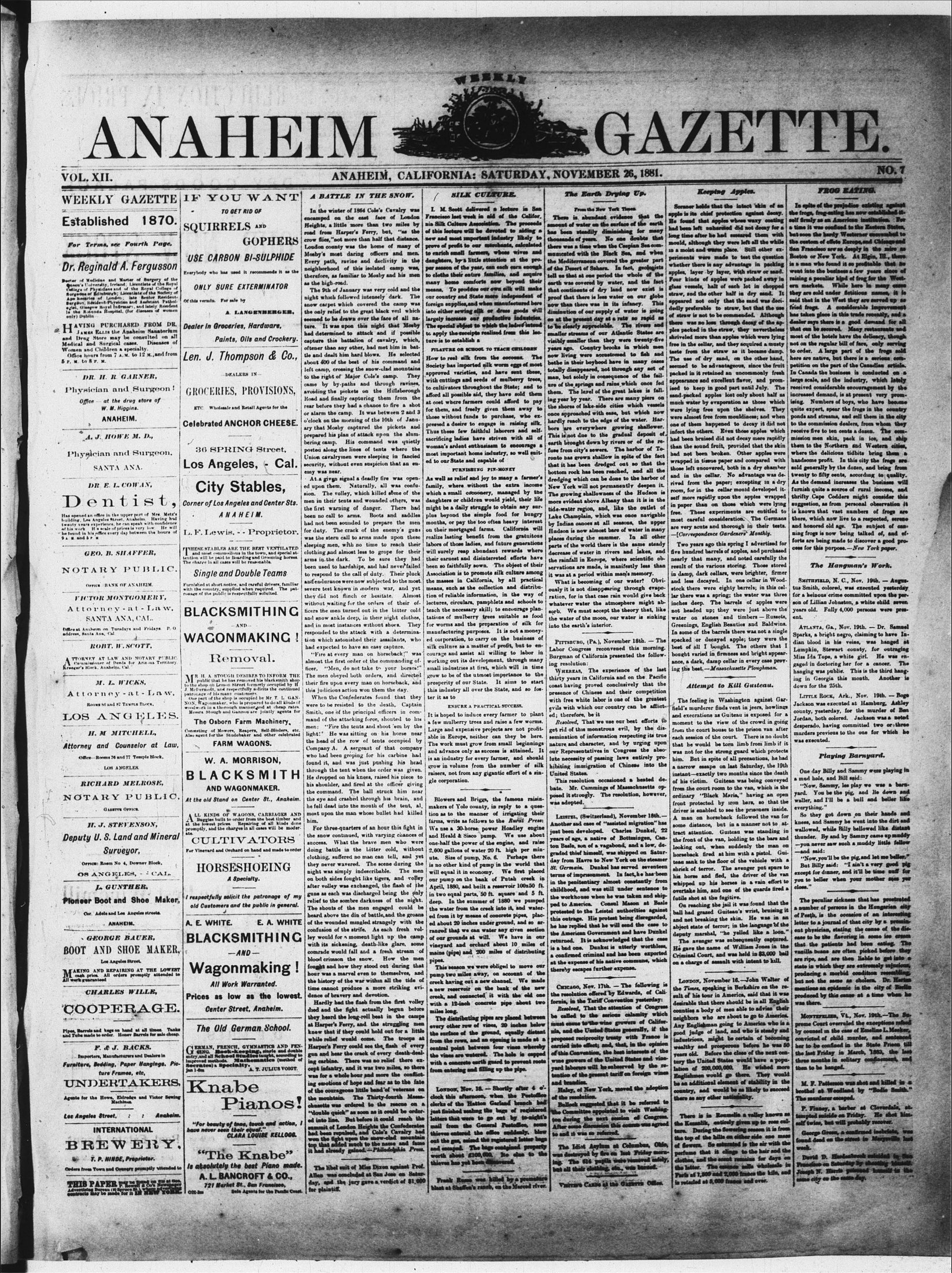
Searchable text
ANAHEIM
VOL. XII.
WEEKLY GAZETTE
Established 1870.
For Terms, see Fourth Page.
Dr. Reginald A. Fergusson
Doctor of Medicine and Master of Surgery of the Queen's University, Ireland; Licentiate of the Royal College of Physicians and of the Royal College of Surgeons of Edinburgh; Licentiate of the Society of Ape herders of London; late Senior Resident-Burgdon, Resident-Physician and Assistant Pathologist, Glasgow Royal Infirmary, and later Resident in the Rotunda Hospital (for diseases of women only) Dublin.
HAVING PURCHASED FROM DR. JAMES ELLIS the Anaheim Sanatorium and Drug Store may be consulted on all Medical and Surgical cases. Diseases of Women and Children a specialty.
Office hours from 7 A.M. to 12 M., and from 5 P.M. to 8 P.M.
DR. H. R. GARNER,
Physician and Surgeon!
Office at the drug store of W. M. Higgins.
ANAHEIM.
A. J. HOWE M. D.,
Physician and Surgeon.
SANTA ANA.
IF YOU WANT
TO GET RID OF
SQUIRRELS AND
GOPHERS
USE CARBON BI-SULPHIDE
Everybody who has used it recommends it as the ONLY SURE EXTERMINATOR
Of this vermin. For sale by
A. LANGENBERGER,
Dealer in Groceries, Hardware,
Paints, Oils and Crockery.
Len. J. Thompson & Co.,
DEALERS IN
GROCERIES, PROVISIONS,
ETC Wholesale and Retail Agents for the Celebrated ANCHOR CHEESE.
36 SPRING Street,
Los Angeles, - Cal.
A BATTLE
In the winter of 1870 encamped on the Heights, a little more road from Harper's crow flies," not more London county was Mosby's most dark Every path, ravine neighborhood of the therefore, as families as the high-road.
The 9th of January night which followed snow carpet which the only relief to the seemed to be drawn nature. It was upon had determined to capture this battalion oftener than any other and dealt him about 400 of the best left camp, crossing to the right of Maj came by by-paths avoiding the picket Road and finally care rear before they had or alarm the camp.
o'clock on the morning ary that Mosby cap prepared his plan of bering camp. His posted along the line Union cavalrymen security, without evemy was near.
DR. H. R. GARNER,
Physician and Surgeon!
Office at the drug store of
W. M. Higgins.
ANAHEIM.
A. J. HOWE M. D.,
Physician and Surgeon,
SANTA ANA.
DR. E. L. COWAN,
Dentist,
Has opened an office in the upper part of Mrs. Metr's building, Los Angeles Street, Anaheim. Having had twenty years experience, he can speak with confidence of his work. His scale of prices is very low. He will be found in his office every day between the hours of 9 AM and 5 PM.
GEO. B. SHAFFER,
NOTARY PUBLIC.
Office BANK OF ANAHEIM.
VICTOR MONTGOMERY,
Attorney-at-Law,
SANTA ANA, CAL.
Office at Anaheim on Tuesdays and Fridays. P.O. address, Santa Ana, Cal.
ROBT. W. SCOTT.
ATTORNEY AT LAW AND NOTARY PUBLIC.
Commissioner of Deeds for Arizona Territory.
Kreeger's Block, Anaheim, Cal.
M. L. WICKS,
Attorney-at-Law,
Rooms 86 and 87 Temple Block,
LOS ANGELES.
H. M MITCHELL,
Attorney and Counselor at Law,
Office—Rooms 76 and 77 Temple Block,
LOS ANGELES.
RICHARD MELROSE,
NOTARY PUBLIC.
Gazette Office.
H. J. STEVENSON,
Deputy U. S. Land and Mineral Surveyor,
Office: Room No 4, Downey Block,
OS ANGELES, - CAL.
L. GUNTHER,
DEALERS IN
GROCERIES, PROVISIONS,
ETC. Wholesale and Retail Agents for the
Celebrated ANCHOR CHEESE.
36 SPRING Street,
Los Angeles, - Cal.
City Stables,
Corner of Los Angeles and Center Sts.
ANAHEIM.
L. F. Lewis.- Proprietor.
THESE STABLES ARE THE BEST VENTILATED and most commensious in the town, and special attention will be paid to Boarding and Grooming horses. The charge in all cases will be reasonable.
Single and Double Teams
Furnished at short notice, and careful drivers, familiar with the country, supplied when required. The patronage of the public is respectfully solicited.
BLACKSMITHING
AND
WAGONMAKING!
Removal.
MR. H. A STOUGH DESIRES TO INFORM THE public that he has removed his blacksmith shop to the shop on Lemon Street formerly occupied by H. J. McLernott, and respectfully solicits the continued patronage of his many customers.
One part of the shop is occupied by Mr. T. L. GANNON, Wagoonmaker, who is prepared to do all kinds of woodwork in a thorough manner and at cheap rates. Messrs. Stough and Gannos are jointly agents for The Osborn Farm Machinery.
Consisting of Mowers, Reapers, Self-Binders, etc. Also agent for the Studebaker and other celebrated FARM WAGONS.
W. A. MORRISON,
BLACKSMITH AND WAGONMAKER.
At the old Stand on Center St., Anaheim.
ALL KINDS OF WAGONS, CARRIAGES AND Buggies built to order from the best timber and at the lowest prices. Repairing of all kinds done promptly, and the charges in all cases will be moderate.
CULTIVATORS
For Vineyard and Orchard on hand and made to order
HORSESHOEING
A Specialty.
I respectfully solicit the patronage of my
At a given signal ed upon them. Nai-sion. The volley, w men in their tents a first warning o been no call to arms had not been sounded for duty. The crack was the stern call to sleeping men, with clothing and almost arms in the dark. been used to hardship to respond to the c and endurance were severe test known i they did not flinch without waiting for ficers the men turn and snow ankle dee d and in most instance responded to the attition which astonish had expected to ha- "Fire at every m almost the first ordi ficer." "Men, do ne The men obeyed b their fire upon ever this judicious action When the Confee were to be resisted Smith, one of the p mand of the attack men: "Fire the te light!" He was siti head of the ro Company A. A se who had been groped found it, and was through the tent w He dropped on his shoulder, and f the command. Th e eye and crashes he fell dead into th most upon the man him.
For three-quarter the snow continued success. What th doing battle in th clothing, suffered n they never wavered night was simply on both sides fought after volley was ex guns as each was d
H. J. STEVENSON,
Deputy U. S. Land and Mineral Surveyor,
Office: Room No 4, Downey Block,
OS ANGELES, - CAL.
L. GUNTHER.
Pioneer Boot and Shoe Maker,
Cor. Adele and Los Angeles streets.
ANAHEIM.
GEORGE BAUER,
BOOT AND SHOE MAKER,
Los Angeles Street.
MAKING AND REPAIRING AT THE LOWEST
cash price. All orders promptly attended to
All work guaranteed.
CHARLES WILLE,
COOPERAGE.
Pipes, Barrels and kegs on hand at all times. Tanks
and Tubes made to order. Honev Barrels for sale cheap.
F. & J. BACKS.
Imperter, Manufacturers and Dealers in
Furniture, Bedding, Paper Hangings, Picture Frames, etc,
UNDERTAKERS,
Agents for the Howe, Eldredge and Victor Sewing Machines.
Los Angeles Street, : Anaheim.
INTERNATIONAL
BREWERY.
T. P. MINDE, Proprietor.
Orders from Town and Country promptly attended to
THIS PAPER may be found on file at GlenAdvertising Bureau (10 Square St.), where advertising
contracts may be made for it in New York.
At the old Stand on Center St., Anaheim.
ALL KINDS OF WAGONS, CARRIAGES AND
Burgles built to order from the best timber and
at the lowest prices. Repairing of all kinds done
promptly, and the charges in all cases will be moderate.
CULTIVATORS
For Vineyard and Orchard on hand and made to order
HORSESHOEING
A Specialty.
I respectfully solicit the patronage of my
old Customers and the public in general.
A. E. WHITE.
E. A. WHITE
BLACKSMITHING
—AND—
Wagonmaking!
All Work Warranted.
Prices as low as the lowest.
Center Street, Anaheim.
The Old German School.
GERMAN, FRENCH, GYMNASTICS AND FENCING.
Book-keeping, single and double entry, and all School Studies taught, according to improved methods.
Mathematics (method of Secrates) a Specialty.
Jan 1-8m
A. T. JULIUS VOIGT.
Knabe
Pianos!
"For beauty of tone, touch and action, I have never seen their equal."
CLARA LOUISE KELLOGG.
"The Knabe"
Is absolutely the best Piano made.
A. L. BANCROFT & CO.,
721 Market St., San Francisco,
Sole Agents for the Pacific Coast.
The libel suit of Allen was concluded day, and the jury for plaintiff.
ANAHEIM, CALIFORNIA: SATURDAY, NOVEMBER 26, 1881.
A BATTLE IN THE SNOW.
In the winter of 1864 Cole's Cavalry was encamped on the east face of London Heights, a little more than two miles by road from Harper's Ferry, but, "as the crow flies," not more than half that distance. London county was the home of many of Mosby's most daring officers and men. Every path, ravine and declivity in the neighborhood of this isolated camp was, therefore, as familiar to Mosby and his men as the high-road.
The 9th of January was very cold and the night which followed intensely dark. The snow carpet which covered the camp was the only relief to the great black veil which seemed to be drawn over the face of all nature. It was upon this night that Mosby had determined to attack and if possible capture this battalion of cavalry, which, oftener than any other, had met him in battle and dealt him hard blows. He selected about 400 of the best of his command and left camp, crossing the snow-clad mountains to the right of Major Cole's camp. They came by by-paths and through ravines, avoiding the pickets on the Hillsborough Road and finally capturing them from the rear before they had a chance to fire a shot or alarm the camp. It was between 2 and 3 o'clock on the morning of the 10th of January that Mosby captured the pickets and prepared his plan of attack upon the slumbering camp. His command was quietly posted along the lines of tents where the Union cavalrymen were sleeping in fancied security, without even suspicion that an enemy was near.
SILK CULTURE.
L. M. Scott delivered a lecture in San Francisco last week in aid of the Californiia Silk Culture Association. The proceeds of this lecture will be devoted to aiding a new and most important industry likely to prove of profit to our merchants, calculated to enrich small farmers, whose wives and daughters, by a little attention at the proper season of the year, can each earn enough to clothe their entire families, and acquire many home comforts now beyond their means. To produce our own silk will make our country and State more independent of foreign supplies, and when manufactured here into either sewing silk or dress goods will largely increase our productive industries. The special object to which the ladies intend to apply the receipts realized from this lecture is to establish a Pilature or School to teach children.
How to reel silk from the cocosens. The Society has imported silk worm eggs of most approved varieties, and have sent these, with cuttings and seeds of mulberry trees, to cultivators throughout the State; and to afford all possible aid, they have sold them at cost where farmers could afford to pay for them, and freely given them away to those without funds to purchase, who expressed a desire to engage in raising silk. Thus these few faithful laborers and self-sacrificing ladies have striven with all of woman's ardent enthusiasm to encourage a most important home industry, so well suited to our State and capable of furnishing pin-money.
The Earth Drying Up.
From the New York Times.
There is abundant evidence that the amount of water on the surface of the earth has been steadily diminishing for many thousands of years. No one doubts that there was a time when the Caspian Sea communicated with the Black Sea, and when the Mediterranean covered the greater part of the Desert of Sahara. In fact, geologists tell us that at one period the whole of the earth was covered by water, and the fact that continents of dry land now exist is proof that there is less water on our globe now than there was in its infancy. This diminution of our supply of water is going on at the present day at a rate so rapid as to be clearly appreciable. The rivers and smaller streams of our Atlantic States are visibly smaller than they were twenty-five years ago. Country brooks in which men now living were accustomed to fish and bathe in their boyhood have in many cases totally disappeared, not through any act of man, but solely in consequence of the failure of the springs and rains which once fed them. The level of the great lakes is falling year by year. There are many piers on the shores of lake-side cities which vessels once approached with ease, but which now hardly reach to the edge of the water. Harbors are everywhere growing shallower. This is not due to the gradual deposit of earth brought down by rivers or of the refuse from city's sewers. The harbor of Toronto has grown shallow in spite of the fact that it has been dredged out so that the bottom rock has been reached, and all the
to the right of Major Cole's camp. They came by by-paths and through ravines, avoiding the pickets on the Hillsborough Road and finally capturing them from the rear before they had a chance to fire a shot or alarm the camp. It was between 2 and 3 o'clock on the morning of the 10th of January that Mosby captured the pickets and prepared his plan of attack upon the slumbering camp. His command was quietly posted along the lines of tents where the Union cavalrymen were sleeping in fancied security, without even suspicion that an enemy was near.
At a given signal a deadly fire was opened upon them. Naturally, all was confusion. The volley, which killed some of the men in their tents and wounded others, was the first warning of danger. There had been no call to arms. Boots and saddles had not been sounded to prepare the men for duty. The crack of the enemy's guns was the stern call to arms made upon these sleeping men, with no time to reach their clothing and almost less to grope for their arms in the dark. To be sure they had been used to hardships, and had never failed to respond to the call of duty. Their pluck and endurance were now subjected to the most severe test known in modern war, and yet they did not flinch or besitate. Almost without waiting for the orders of their officers the men turned out in the bitter cold and snow ankle deep, in their night clothes, and in most instances without shoes. They responded to the attack with a determination which astonished their assailants, who had expected to have an easy capture.
"Fire at every man on horseback!" was almost the first order of the commanding officer. "Men, do not take to your horses!" The men obeyed both orders, and directed their fire upon every man on horseback, and this judicious action won them the day.
When the Confederates found that they were to be resisted to the death, Captain Smith, one of the principal officers in command of the attacking force, shouted to his men: "Fire the tents and shoot 'em by the light!" He was sitting on his horse near the head of the row of tent occupied by Company A. A sergeant of that company who had been groping for his carbine had found it, and was just pushing his head through the tent when the order was given. He dropped on his knees, raised his piece to his shoulder, and fired at the officer giving the command. The ball struck him near the eye and crashed through his brain, and he fell dead into the mouth of the tent, almost upon the man whose bullet had killed him.
For three-quarters of an hour this fight in the snow continued, with varying chances of success. What the brave men who were doing battle in the bitter cold, without clothing, suffered no man can tell, and yet they never wavered. The scene during the night was simply indescribable. The men on both sides fought like tigers, and volley after volley was exchanged, the flash of the guns as each was discharged being the only way to right the situation.
Approved valuation is based on writings and seeds of mulberry trees, to cultivators throughout the State; and to afford all possible aid, they have sold them at cost where farmers could afford to pay for them, and freely given them away to those without funds to purchase, who expressed a desire to engage in raising silk. Thus these few faithful laborers and self-sacrificing ladies have striven with all of woman's ardent enthusiasm to encourage a most important home industry, so well suited to our State and capable of furnishing pin-money.
As well as relief and joy to many a farmer's family, where without the extra income which a small cocoonery, managed by the daughters or children would yield, their life might be a daily struggle to obtain any surplus beyond the simple food for hungry mouths, or pay the too often heavy interest on their mortgaged farms. California will realize lasting benefit from the gratuitous labors of those ladies, and future generations will surely reap abundant rewards where their earnest and disinterested efforts have been so faithfully sown. The object of their Association is to promote silk culture among the masses in California, by all practical means, such as the collection and distribution of reliable information, in the way of lectures, circulaars, pamphlets and schools to teach the necessary skill; to encourage plantations of mulberry trees suitable as food for worms and the preparation of silk for manufacturing purposes. It is not a moneyed corporation, to carry on the business of silk culture as a matter of profit, but to encourage and assist all willing to labor in working out its development, through many small industries at first, which will in time grow to be of the utmost importance to the prosperity of our State. It aims to start this industry all over the State, and so foster it as to
ENSURE A PRACTICAL SUCCESS.
It is hoped to induce every farmer to plant a few mulberry trees and raise a few worms. Large and expensive projects are not profitable in Europe, neither can they be here. The work must grow from small beginnings and advance only as success is attained. It is an industry for every farmer, and should grow in volume from the number of silk raisers, not from any gigantic effort of a single corporation.
Blowers and Briggs, the famous raisin-makers of Yolo county, in reply to a question as to the manner of irrigating their farms, write as follows to the Rural Press: We use a 30-horse power Hoadley engine and Heald & Sisco pump. We use about one-half the power of the engine, and raise 2,600 gallons of water 20 ft. high per minute. Size of pump, No. 6. Perhaps there is no other kind of pump in the world that will equal it in economy. We first placed our pump on the bank of Putah creek in April, 1880, and built a reservoir 100x50 ft. in two equal parts, 50 ft. square and 5 ft.
man, but solely in consequence of the failure of the springs and rains which once fed them. The level of the great lakes is falling year by year. There are many piers on the shores of lake-side cities which vessels once approached with ease, but which now hardly reach to the edge of the water. Harbors are everywhere growing shallower. This is not due to the gradual deposit of earth brought down by rivers or of the refuse from city's sewers. The harbor of Toronto has grown shallow in spite of the fact that it has been dredged out so that the bottom rock has been reached, and all the dredging which can be done to the harbor of New York will not permanently deepen it. The growing shallowness of the Hudson is more evident above Albany than it is in the tide-water region, and, like the outlet of Lake Champlain, which was once navigable by Indian canoes at all seasons, the upper Hudson is now almost bare of water in many places during the summer. In all other parts of the world there is the same steady decrease of water in rivers and lakes, and the rainfall in Europe, where scientific observations are made, is manifestly less than it was at a period within man's memory.
What is becoming of our water? Obviously it is not disappearing through evaporation, for in that case rain would give back whatever water the atmosphere might absorb. We must accept the theory that, like water of the moon, our water is sinking into the earth's interior.
PITTSBURG, (Pa.), November 18th. — The Labor Congress reconvened this morning. Burgman of California presented this following resolution:
Whereas, The experience of the last thirty years in California and on the Pacific coast having proved conclusively that the presence of Chinese and their competition with free white labor is one of the greatest evils with which our country can be afflicted; therefore, be it
Resolved That we use our best efforts to get rid of this monstrous evil, by the dissemination of information respecting its true nature and character, and by urging upon our Representatives in Congress the absolute necessity of passing laws entirely prohibiting immigration of Chinese into the United States.
This resolution occasioned a heated debate. Mr. Cummings of Massachusetts opposed it strongly. The resolution, however, was adopted.
LEISTEL, (Switzerland), November 18th. — Another sad case of "assisted migration" has just been developed. Charles Dunkel, 22 years of age, a native of Bottmingen, Canton Basle, son of a vagabond, and a low-degraded thief himself, was shipped on Saturday from Havre to New York on the steamer St. Germain. Dunkel has served seventeen terms of imprisonment. In fact, he has been in the penitentiary almost constantly from childhood, and was still under sentence to the workhouse when he was taken and ship-
For three-quarters of an hour this fight in the snow continued, with varying chances of success. What the brave men who were doing battle in the bitter cold, without clothing, suffered no man can tell, and yet they never wavered. The scene during the night was simply indescribable. The men on both sides fought like tigers, and volley after volley was exchanged, the flash of the guns as each was discharged being the only relief to the sombre darkness of the night. The shouts of the men engaged could be heard above the din of battle, and the groans of the wounded mingled strangely with the confusion of the strife. As each fresh volley would for a moment light up the camp with its sickening, death-like glare, some comrade would fall and a fresh stream of blood crimson the snow. How the men fought and how they stood out during that hour was a marvel even to themselves, and the history of the war within all the tide of time cannot produce a more striking evidence of bravery and devotion.
Hardly had the flash from the first volley died and the fight actually begun before they heard the long-roll beat in the camps at Harper's Ferry, and the struggling men knew that if they could hold out for a little while relief would come. The troops at Harper's Ferry could see the flash of every gun and hear the crack of every death-dealing carbine. There was no relief there except infantry, and it was two miles, so there was for a whole hour and more the conflicting emotions of hope and fear as to the fate of the courageous little band of veterans on the mountain. The Thirty-fourth Massachusetts was ordered to the rescue on a "double quick" as soon as it could be ordered into line. But before it could reach the summit of London Heights the Confederates had been repulsed, and Cole's Cavalry had won the fight upon the snow-clad mountain top that added much to the name and fame it had already gained—Philadelphia Press.
The libel unit of Miss Dixon against Prof. Allen was concluded at San Jose on Saturday, and the jury gave a verdict of $1,000 for plaintiff.
Blowers and Briggs, the famous rainstorm makers of Yolo county, in reply to a question as to the manner of irrigating their farms, write as follows to the Rural Press: We use a 30-horse power Hoadley engine and Heald & Sisco pump. We use about one-half the power of the engine, and raise 2,600 gallons of water 20 ft. high per minute. Size of pump, No. 6. Perhaps there is no other kind of pump in the world that will equal it in economy. We first placed our pump on the bank of Putah creek in April, 1880, and built a reservoir 100x50 ft. in two equal parts, 50 ft. square and 5 ft. deep. In the summer of 1880 we pumped the water from the creek into it, and watered from it by means of concrete pipes, placed about 20 inches under ground, and so arranged that we can water any given section of our grounds at will. We have in our vineyard and orchard about 10 miles of mains (pipe) and 200 miles of distributing pipes.
This season we were obliged to move our pump two miles away, on account of the creek having cut a new channel. We made a new reservoir on the bank of the new creek, and connected it with the old one with a 12-inch concrete pipe about two miles long.
The distributing pipes are placed between every other row of vines, 20 inches below the surface of the ground, equally distant from the rows, and an opening is made at a central point between four vines whereby the vines are watered. The hole is capped with a concrete earth guard to prevent roots from entering and filling up the pipe.
London, Nov. 18. — Shortly after 4 o'clock this afternoon, when the Postoffice clerks of the Hatton Garland branch had just finished sealing the bags of registered letters that were to go out by to-night's mail from the General Postoffice, some thieves entered the office suddenly, blow out the gas, issued the registered letter bags and escaped. The bags contained property worth about £100,000. No else to the thieves has yet been discovered.
Frank Russo was killed by a premature blast at Shaffen's ranch, on the Marced river.
Leistel, (Switzerland), November 18th. — Another sad case of "assisted migration" has just been developed. Charles Dunkel, 22 years of age, a native of Bottmingen, Canton Basle, son of a vagabond, and a low, degraded thief himself, was shipped on Saturday from Havre to New York on the steamer St. Germain. Dunkel has served seventeen terms of imprisonment. In fact, he has been in the penitentiary almost constantly from childhood, and was still under sentence to the workhouse when he was taken and shipped to America. Consul Mason at Basle protested to the Leistel authorities against this outrage. His protest being disregarded, he has replied that he will send the case to the American Government and have Dunkel returned. It is acknowledged that the case is a bad one. Dunkel is utterly worthless, a confirmed criminal and has been exported at the expense of his native commune, which thereby escapes further expense.
Chicago, Nov. 17th. — The following is the resolution offered by Edwards, of California, in the Tariff Convention yesterday:
Resolved That the attention of Congress be called to the serious calamity which must ensue to the wine growers of California, and the United States generally, if the proposed reciprocity treaty with France is carried into effect; and that, in the opinion of this Convention, the best interests of the wine growers of the United States and vineyard laborers will be subserved by the retention of the present tariff on foreign wines and brandies.
Haley, of New York, moved the adoption of this resolution.
Bullock suggested that it be referred to the Committee appointed to visit Washington during the next session of Congress. After some discussion this course was agreed to and it was so referred.
The Idiot Asylum at Columbus, Ohio was destroyed by fire on last Friday morning. The 614 pupils were removed safely but all their clothing still was burned.
Virginia Canals at the Gazette Office.
GAZETTE.
OCTOBER 26, 1881.
DRYING UP.
New York Times.
Evident evidence that the surface of the earth is diminishing for many years. No one doubts that when the Caspian Sea comes to Black Sea, and when covered the greater part thaws. In fact, geologists period the whole of the dry water, and the fact dry land now exist in less water on our globe is in its infancy. This supply of water is going away at a rate so rapid as receivable. The rivers and our Atlantic States are then they were twenty-five dry brooks in which men accustomed to fish and good have in many cases not through any act of consequence of the fail-land rains which once fed of the great lakes is fall-There are many piers on inside cities which vessels with ease, but which now edge of the water. Harder growing shallower. On the gradual deposit of rain by rivers or of the rewaters. The harbor of To-mallow in spite of the fact fredged out so that the been reached, and all the keeping apples.
Soraner holds that the intact skin of an apple is its chief protection against decay. He found that apples whose waxy coating had been left unharried did not decay for a long time after he had ensured them with mould, although they were left all the while in a moist and warm place. Still other experiments were made to test the question whether there is any advantage in packing apples, layer by layer, with straw or sand. Four kinds of apples were packed away in glass vessels, halt of each lot in chopped straw, and the other half in dry sand. It appeared not only that the sand was decidedly preferable to straw, but that the use of straw is not to be commended. Although there was no loss through decay of the apples packed in the straw, they nevertheless shriveled more than apples which were lying free in the cellar, and they acquired a musty taste from the straw as it became damp. The use of dry sand, on the other hand, seemed to be advantageous, since the fruit packed in it retained an uncommonly fresh appearance and excellent flavor, and promised to keep in good part until July. The sand-packed apples lost only about half as much water by evaporation as those which were lying free upon the shelves. They were almost free from mouldiness; and when one of them happened to decay it did not infect the others. Even those apples which had been bruised did not decay more rapidly than the sound fruit, provided that the skin had not been broken. Other apples were wrapped in tissue paper and compared with those left uncovered, both in a dry chamber in the cellar. No advantage was de-
FROG EATING.
In spite of the prejudice existing against frogs, frog-eating has now established itself firmly as an American institution. For a time it was confined to the Eastern States, but soon the hardy Western succumbed to the custom of effete Europe, and Chicago and San Francisco are as deeply in the mire as Boston or New York. At Elgin, Ill., there is a man who found it so profitable that he went into the business a few years since of raising a peculiar kind of frog for the Western markets. While here in many cases they are sold under fictitious names, it is said that in the West they are served up as fried frogs. A considerable improvement has taken place in this trade recently, and a dealer says there is a good demand for all that can be secured. Many restaurants and most of the hotels have the delicacy, though not on the regular bill of fare, only serving to order. A large part of the frogs sold here are native, but there is a serious competition on the part of the Canadian article. In Canada the business is conducted on a large scale, and the industry, which lately received considerable encouragement by the increased demand, is at present very promising. Numbers of boys, who have become quite expert, spear the frogs in the country ponds and streams, and sell them in the city to the commission dealers, from whom they receive five to ten cents a dozen. The commission men skin, pack in ice, and ship them to the Northern and Western cities, where the delicious tidbits bring them a handsome profit. In this city the frogs are sold generally by the dozen, and bring from twenty to fifty cents according to quality.
The consequence of the failand rains which once fed
the great lakes is fallThere are many piers on
inside cities which vessels
with ease, but which now
are edge of the water. Hardhere growing shallower,
the gradual deposit of
by rivers or of the rewaters. The harbor of Tonallow in spite of the fact
hurdled out so that the
been reached, and all the
can be done to the harbor of
permanently deepen it.
Downness of the Hudson is
the Albany than it is in the
and, like the outlet of
which was once navigable
at all seasons, the upper
most bare of water in many
summer. In all other
there is the same steady
in rivers and lakes, and
ope, where scientific obience is manifestly less than
within man's memory.
ing of our water? Obviappearing through evapocase rain would give back
the atmosphere might abcept the theory that, like
moon, our water is sinking
interior.
November 18th. — The
reconvened this morning.
Burnia presented the followexperience of the last
California and on the Pacific
had conclusively that the
house and their competition
abor is one of the greatest
our country can be afflicted.
we use our best efforts to
mistrous evil, by the disinformation respecting its true
water, and by urging upon
ones in Congress the absassing laws entirely protection of Chinese into the
occasioned a heated denings of Massachusetts opThe resolution, however,
November 18th. — Of "assisted migration" has
red. Charles Dunkel, 22
tive of Bottminingen, Cana vagabond, and a low, deself, was shipped on Saturday
to New York on the steamer
inkel has served seventeen
ment. In fact, he has been
almost constantly from
still under sentence to
when he was taken and ship-
packed in is retained an uncommon free appearance and excellent flavor, and promised to keep in good part until July. The sand-packed apples lost only about half as much water by evaporation as those which were lying free upon the shelves. They were almost free from mouldiness; and when one of them happened to decay it did not infect the others. Even those apples which had been bruised did not decay more rapidly than the sound fruit, provided that the skin had not been broken. Other apples were wrapped in tissue paper and compared with those left uncovered, both in a dry chamber and in the cellar. No advantage was derived from the paper; excepting in a dry room, for in the cellar mount developed itself more rapidly upon the apples wrapped in paper than on those which were lying free. These experiments are entitled to most careful consideration. The Germans are very acute and thorough in their tests.
[Correspondence Gardeners' Monthly]
Two years ago this spring I advertised for five hundred barrels of apples, and purchased nearly that many, and noted carefully the result of the various storing. Those stored in damp, dark cellars, were brighter, firmer and less decayed. In one cellar in Woodstock there were eighty barrels; in this cellar there was a spring; the water was three inches deep. The barrels of apples were not headed up; they were just above the water on stones and timbers—Russets, Greenings, English Beauties and Baldwins. In some of the barrels there was not a single specked or decayed apple; they were the best of all I bought. The others that I bought varied in firmness and bright appearance, a dark, damp cellar in every case proving the best.
Massachusetts Ploughman.
Attempt to Kill Guiteau.
The feeling in Washington against Garfield's murderer finds vent in jeers, howlings and executions as Guiteau is exposed for a moment to the view of the crowd in going from the court house to the prison van after each session of the court. There is no doubt that he would be torn limb from limb if it was not for the strong guard which protects him. But in spite of all precautions, he had a narrow escape on last Saturday, the 19th instant—exactly two months since the death of his victim. Guiteau was being conveyed from the court room to the van, which is the ordinary "Black Maria," having an open front protected by iron bars, so that the driver is enabled to see the prisoners inside. A man on horseback followed the van for some distance, but in a manner not to attract attention. Guiteau was standing in the front of the van, holding to the bars and looking out, when suddenly the man on horseback fired at him with a pistol. Guiteau sank to the floor of the vehicle with a shriek of terror. The avenger put spurs to his horse and fled, the driver of the van whipped up his horses in a vain effort to overtake him, and one of the guards fired a futile shot at the fugitive.
In Canada it is conducted on a large scale, and the industry, which lately received considerable encouragement by the increased demand, is at present very promising. Numbers of boys, who have become quite expert, spear the frogs in the country ponds and streams, and sell them in the city to the commission dealers, from whom they receive five to ten cents a dozen. The commission men skin, pack in ice, and ship them to the Northern and Western cities, where the delicious tidbits bring them a handsome profit. In this city the frogs are sold generally by the dozen, and bring from twenty to fifty cents, according to quality. As the demand increases the business will furnish quite a source of rural income, and thrifty Cape Codders might consider this suggestion, as from personal observation it is known that vast numbers of frogs are there, which now live to a respected, serene and honored old age. The subject of canning frogs is now being talked of, and efforts are being made to discover a good process for this purpose.
New York paper.
The Hangman's Work.
Smithfield, N.C., Nov. 19th. — Augustus Smith, colored, was executed yesterday for a heinous crime committed upon the person of Lillian Johnaton, a white child seven years old. Fully 4,000 persons were present.
Atlanta, Ga., Nov. 19th. — Dr. Samuel Sparks, a bright negro, claiming to have Indian blood in his veins, was hanged at Lumpkin, Stewart county, for outraging Miss Ida Tope, a white girl. He was engaged in doctoring her for a cancer. The hanging was public. This is the third hanging in Georgia this month. Another is down for the 25th.
Little Rock, Ark., Nov. 19th. — Boge Jackson was executed at Hamburg, Askley county, yesterday; for the murder of Ben Jordan, both colored. Jackson was a noted desperado, having committed two or three murders previous to the one for which he was executed.
Playing Barnyard.
One day Billy and Sammy were playing in a mud hole, and Bill said:
"Now, Sammy, les play we was a barnyard. You be the pig, and lie down and waller, and I'll be a bull and beller like everything."
So they got down on their hands and knees, and Sammy he went into the dirt and wallowed, while Billy bellowed like distant thunder. By and by Sammy came up muddy—you never saw such a muddy little fellow—and said:
"Now,你'll be the pig,and let me beller."
But Billy said: "I sinn't a very good pig except for dinner,and it'll be time sniff for you to beller when your mother sees you close."
November 18th. — of "assisted migration" has been issued. Charles Dunkel, 22 active of Bottmingen, Canada, vagabond, and a low, defensible, was shipped on Saturday to New York on the steamer Dunkel has served seventeen months. In fact, he has been almost constantly from his still under sentence to when he was taken and shipwrecked. Consul Mason at Basle Leistel authorities against the protest being disregarded, that he will send the case to government and have Dunkel acknowledged that the case Dunkel is utterly worthless, penal and has been exported to this native commune, which further expense.
17th. — The following is referred by Edwards, of Calif.-Convention yesterday: the attention of Congress to serious calamity which the wine growers of California generally, if the city trusty with France is; and, that, in the opinion of the best interests of the United States and vinailed he subserved by the recent tariff on foreign wines.
York, moved the adoption that it be referred to appointed to visit Washington next session of Congress. Session this course was agreed referred.
Bylum at Columbus, Ohio, fire on last Friday morning; piles were removed safely, killing one, was burned.
There is in Roumelia a valley known as the Kenzalik, entirely given up to rose culture. During the flowering season it is from the top of the hills on either side one mass of flowers. So saturated is the air with the perfume that it clings to the hair and the clothes, and the scent remains for days on the latter. The essence calls wholesale in Paris at 1,500 and 2,000 francs the kilo, and is retailed at 5,000 francs and over.
London, November 16. — John Walter of the Times, speaking in Berkshire on the result of his tour in America, said that it was desirable that there should be in all English counties a body of men able to advise their neighbors who are about to go to America. Any Englishman going to America who is a good judge of land, and who is steady and industrious, might be certain of becoming wealthy and prosperous before he was 50 years old. Before the close of the next century the United States would have a population of 200,000,000. He wished more Englishmen would go there. They would be an additional element of stability in the country, and would be as likely to succeed there as any other nationality.
There is in Roumelia a valley known as the Kenzalik, entirely given up to rose culture. During the flowering season it is from the top of the hills on either side one mass of flowers. So saturated is the air with the perfume that it clings to the hair and the clothes, and the scent remains for days on the latter. The essence calls wholesale in Paris at 1,500 and 2,000 francs the kilo, and is retailed at 5,000 francs and over.
So they got down on their hands and knees, and Sammy he went into the dirt and wallowed, while Billy bellowed like distant thunder. By and by Sammy came up muddy—you never saw such a muddy little fellow—and said:
"Now, you'll be the pig,and let me beller."
But Billy said: "Iain't a very good pig except for dinner, and it'll be time stuff for you to beller when your mother sees you close."
The peculiar sickness that has prostrated a number of persons in the Hungarian city of Peeth, is the occasion of an interesting letter to a journal of that city by a prominent physician, stating the cause of the disease to be the flavoring in some ice cream that the patients had been eating. The vanilla beans are often picked before they are ripe, and are then liable to get into a state in which they are extremely injurious, producing a morbid condition resembling but not the same as cholera. Dr. Hastan mentions an epidemic in the city of Berlin produced by this cause at a time when he was there.
Montefeklierer, Vt., Nov. 19th. — The Supreme Court overruled the exceptions raised by counsel in the case of Emeline L. Moeker, convicted of child murder, and sentenced her to be confined in the State Prison till the last Friday in March, 1883, the last three months in solitary confinement, and then to be hanged.
M. F. Patterson was shot and killed in a brothel at Woodland by "Bodie Smith." The murderer escaped.
F. Finney, a barber at Cloverdale, attempted suicide on Friday. He shot himself twice, but will probably recover.
George Green, a confirmed inmate, was found dead on the street in Maryville last week.
David D. Henderson suicided by Sun Prudence on Saturday by shooting himself. Joseph N. Harris poisoned himself in the same city on the same day.