anaheim-gazette 1881-05-07
Scanned page
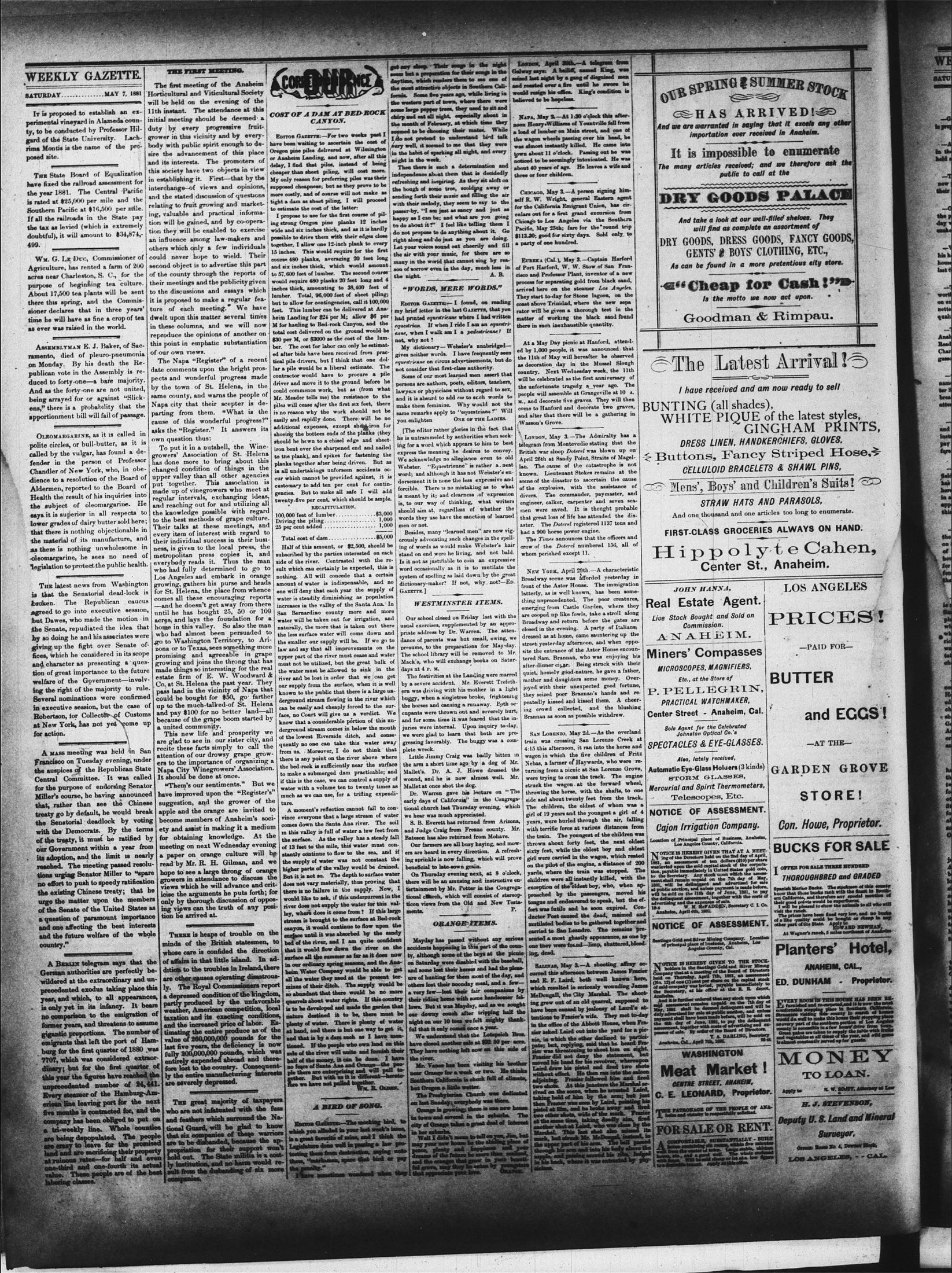
Searchable text
WEEKLY GAZETTE.
SATURDAY...MAY 7, 1881
It is proposed to establish an experimental vineyard in Alameda county, to be conducted by Professor Hilgard of the State University. Lachrima Montis is the name of the proposed site.
The State Board of Equalization have fixed the railroad assessment for the year 1881. The Central Pacific is rated at $25,000 per mile and the Southern Pacific at $16,500 per mile. If all the railroads in the State pay the tax as levied (which is extremely doubtful), it will amount to $34,874,-499.
Wm. G. Le Duc, Commissioner of Agriculture, has rented a farm of 200 acres near Charleston, S. C., for the purpose of beginning tea culture. About 17,500 tea plants will be sent there this spring, and the Commissioner declares that in three years' time he will have as fine a crop of tea as ever was raised in the world.
Assemblyman E. J. Baker, of Sacramento, died of pleuro-pneumonia on Monday. By his death the Republican vote in the Assembly is reduced to forty-one—a bare majority. And as the forty-one are not united, being arrayed for or against "Slickens," there is a probability that the apportionment bill will fail of passage.
Oleomargarine, as it is called in polite circles, or bull-butter, as it is called by the vulgar, has found a defender in the person of Professor Chandler of New York, who, in obe-
OLEOMARGARINE, as it is called in polite circles, or bull-butter, as it is called by the vulgar, has found a defender in the person of Professor Chandler of New York, who, in obedience to a resolution of the Board of Aldermen, reported to the Board of Health the result of his inquiries into the subject of oleomargarine. He says it is superior in all respects to lower grades of dairy butter sold here; that there is nothing objectionable in the material of its manufacture, and as there is nothing unwholesome in oleomargarine, he sees no need of legislation to protect the public health.
The latest news from Washington is that the Senatorial deadlock is broken. The Republican caucus agreed to go into executive session, but Dawes, who made the motion in the Senate, repudiated the idea that by so doing he and his associates were giving up the fight over Senate offices, which he considered in its scope and character as presenting a question of great importance to the future welfare of the Government—involving the right of the majority to rule. Several nominations were confirmed in executive session, but the case of Robertson, for Collector of Customs at New York, has not yet come up for action.
A mass meeting was held in San Francisco on Tuesday evening, under the auspices of the Republican State Central Committee. It was called for the purpose of endorsing Senator Miller's course, he having announced that, rather than see the Chinese treaty go by default, he would break the Senatorial deadlock by voting with the Democrats. By the terms of the treaty, it must be ratified by our Government within a year from its adoption, and the limit is nearly reached. The meeting passed resolutions urging Senator Miller to "spare no effort to push to speedy ratification the existing Chinese treaty; that he publican vote in the Assembly deduced to forty-one—a bare majority. And as the forty-one are not united, being arrayed for or against "Slickens," there is a probability that the apportionment bill will fail of passage.
To put it in a nutshell, the Winegrowers' Association of St. Helena has done more to bring about this changed condition of things in the upper valley than all other agencies put together. This association is made up of vinegrowers who meet at regular intervals, exchanging ideas, and reaching out for and utilizing all the knowledge possible with regard to the best methods of grape culture. Their talks at these meetings, and every item of interest with regard to their individual success in their business, is given to the local press, the metropolitan press copies it, and everybody reads it. Thus the man who had fully determined to go to Los Angeles and embark in orange growing, gathers his purse and heads for St. Helena, the place from whence comes all these encouraging reports—and he doesn't get away from there until he has bought 25, 50 or 100 acres, and lays the foundation for a home in this valley. So also the man who had almost been persuaded to go to Washington Territory, to Arizona or Texas, sees something more promising and agreeable in grape growing and joins the throng that has made things so interesting for the real estate firm of E. W. Woodward & Co., at St. Helena the past year. They pass land in the vicinity of Napa that could be bought for $50, go farther up to the much-talked-of St. Helena and pay $100 for no better land—all because of the grape boom started by a united community.
This new life and prosperity we are glad to see in our sister city, and recite these facts simply to call the attention of our drowsy grape growers to the importance of organizing a Napa City Winegrowers' Association. It should be done at once.
"Them's our sentiments." But we have improved upon the "Register's" suggestion, and the grower of the apple and the orange are invited to become members of Anaheim's society and assist in making it a medium for obtaining knowledge. At the meeting on next Wednesday evening a paper on orange culture will be read by Mr. R. H. Gilman, and we hope to see a large throng of orange growers in attendance to discuss the views which he will advance and criticise the arguments he puts forth; for pects and wonderful progress made by the town of St. Helena, in the same county, and warns the people of Napa city that their scepter is departing from them. "What is the cause of this wonderful progress?" asks the "Register." It answers its own question thus:
To put it in a nutshell, the Winegrowers' Association of St. Helena has done more to bring about this changed condition of things in the upper valley than all other agencies put together. This association is made up of vinegrowers who meet at regular intervals, exchanging ideas, and reaching out for and utilizing all the knowledge possible with regard to the best methods of grape culture. Their talks at these meetings, and every item of interest with regard to their individual success in their business, is given to the local press, the metropolitan press copies it, and everybody reads it. Thus the man who had fully determined to go to Los Angeles and embark in orange growing, gathers his purse and heads for St. Helena, the place from whence comes all these encouraging reports—and he doesn't get away from there until he has bought 25, 50 or 100 acres, and lays the foundation for a home in this valley. So also the man who had almost been persuaded to go to Washington Territory, to Arizona or Texas, sees something more promising and agreeable in grape growing and joins the throng that has made things so interesting for the real estate firm of E. W. Woodward & Co., at St. Helena the past year. They pass land in the vicinity of Napa that could be bought for $50, go farther up to the much-talked-of St. Helena and pay $100 for no better land—all because of the grape boom started by a united community.
This new life and prosperity we are glad to see in our sister city, and recite these facts simply to call the attention of our drowsy grape growers to the importance of organizing a Napa City Winegrowers' Association. It should be done at once.
"Them's our sentiments." But we have improved upon the "Register's" suggestion, and the grower of the apple and the orange are invited to become members of Anaheim's society and assist in making it a medium for obtaining knowledge. At the meeting on next Wednesday evening a paper on orange culture will be read by Mr. R. H. Gilman, and we hope to see a large throng of orange growers in attendance to discuss the views which he will advance and criticise the arguments he puts forth; for pects and wonderful progress made by the town of St. Helena, in the same county, and warns the people of Napa city that their scepter is departing from them. "What is the cause of this wonderful progress?" asks the "Register." It answers its own question thus:
To put it in a nutshell, the Winegrowers' Association of St. Helena has done more to bring about this changed condition of things in the upper valley than all other agencies put together. This association is made up of vinegrowers who meet at regular intervals, exchanging ideas, and reaching out for and utilizing all the knowledge possible with regard to the best methods of grape culture. Their talks at these meetings, and every item of interest with regard to their individual success in their business, is given to the local press, the metropolitan press copies it, and everybody reads it. Thus the man who had fully determined to go to Los Angeles and embark in orange growing, gathers his purse and heads for St. Helena, the place from whence comes all these encouraging reports—and he doesn't get away from there until he has bought 25, 50 or 100 acres, and lays the foundation for a home in this valley. So also the man who had almost been persuaded to go to Washington Territory, to Arizona or Texas, sees something more promising and agreeable in grape growing and joins the throng that has made things so interesting for the real estate firm of E. W. Woodward & Co., at St. Helena the past year. They pass land in the vicinity of Napa that could be bought for $50, go farther up to the much-talked-of St. Helena and pay $100 for no better land—all because of the grape boom started by a united community.
This new life and prosperity we are glad to see in our sister city, and recite these facts simply to call the attention of our drowsy grape growers to the importance of organizing a Napa City Winegrowers' Association. It should be done at once.
"Them's our sentiments." But we have improved upon the "Register's" suggestion, and the grower of the apple and the orange are invited to become members of Anaheim's society and assist in making it a medium for obtaining knowledge. At the meeting on next Wednesday evening a paper on orange culture will be read by Mr. R. H. Gilman, and we hope to see a large throng of orange growers in attendance to discuss the views which he will advance and criticise the arguments he puts forth; for pects and wonderful progress made by the town of St. Helena, in the same county, and warns the people of Napa city that their scepter is departing from them. "What is the cause of this wonderful progress?" asks the "Register." It answers its own question thus:
To put it in a nutshell, the Winegrowers' Association of St. Helena has done more to bring about this changed condition of things in the upper valley than all other agencies put together. This association is made up of vinegrowers who meet at regular intervals, exchanging ideas, and reaching out for and utilizing all the knowledge possible with regard to the best methods of grape culture. Their talks at these meetings, and every item of interest with regard to their individual success in their business, is given to the local press, the metropolitan press copies it, and everybody reads it. Thus the man who had fully determined to go to Los Angeles and embark in orange growing, gathers his purse and heads for St. Helena, the place from whence comes all these encouraging reports—and he doesn't get away from there until he has bought 25, 50 or 100 acres, and lays the foundation for a home in this valley. So also the man who had almost been persuaded to go to Washington Territory, to Arizona or Texas, sees something more promising and agreeable in grape growing and joins the throng that has made things so interesting for the real estate firm of E. W. Woodward & Co., at St. Helena the past year. They pass land in the vicinity of Napa that could be bought for $50, go farther up to the much-talked-of St. Helena and pay $100 for no better land—all because of the grape boom started by a united community.
This new life and prosperity we are glad to see in our sister city, and recite these facts simply to call the attention of our drowsy grape growers to the importance of organizing a Napa City Winegrowers' Association. It should be done at once.
"A moment's reflection can vince everyone that a large comes downthe Santa Ana in this valley is fullof waterthe surface.Asthe valley yof 13 feettothe mile,thewantstonlycontinuetoflowtothe supplyofwaterwasnore higherpartsofthevalleywButitisnotso.Thedepth does not varymaterially,thethereisnofailureintheswouldlikeotask.itifthisun
that, rather than see the Chinese treaty go by default, he would break the Senatorial deadlock by voting with the Democrats. By the terms of the treaty, it must be ratified by our Government within a year from its adoption, and the limit is nearly reached. The meeting passed resolutions urging Senator Miller to "spare no effort to push to speedy ratification the existing Chinese treaty; that he urge the matter upon the members of the Senate of the United States as a question of paramount importance and one affecting the best interests and the future welfare of the whole country."
A Berlin telegram says that the German authorities are perfectly bewildered at the extraordinary and unprecedented exodus taking place this year, and which, to all appearances, is only yet in its infancy. It bears no comparison to the emigration of former years, and threatens to assume gigantic proportions. The number of emigrants that left the port of Hamburg for the first quarter of 1880 was 7707, which was considered extraordinary; but for the first quarter of this year the figures have reached the unprecedented number of 24,441. Every steamer of the Hamburg-American line leaving port for the next five months is contracted for, and the company has been obliged to put on a tri-weekly line. Whole counties are being depopulated. The people are crazy to leave for the promised land and are sacrificing their property at ruinous rates—for half and even one-third and one-fourth its actual value. These people are of the best laboring classes.
There is heaps of trouble on the minds of the British statesmen, to whose care is confided the direction of affairs in that little island. In addition to the troubles in Ireland, there are other causes operating disastrously. The Royal Commissioners report a depressed condition of the kingdom, partly produced by the unfavorable weather, American competition, local taxation and its exacting conditions, and the increased price of labor. Estimating the entire produce as of the value of 260,000,000 pounds for the last five years, the deficiency is now fully 200,000,000 pounds, which was entirely expended abroad and therefore lost to the country. Consequently the entire manufacturing interests are severely depressed.
The great majority of taxpayers who are not infatuated with the fuss and feathers which surround the National Guard, will be glad to know that six companies of these warriors are to be disbanded, because the appropriation for their support won't hold out. The State militia is a costly institution, and no harm would result from the disbanding of six more companies.
A moment's reflection can convince everyone that a large comes down the Santa Ana in this valley is full of water on the surface. As the valley of 13 feet to the mile, this will stantly continue to flow to the supply of water was no higher parts of the valley was. But it is not so. The depth does not vary materially, there is no failure in the river does not supply the water, where does it come from stream is brought to the sun canyon, it would continue surface until it was absorbed bed of the river, and I am that it would flow down the surface all the summer as far in our ordinary spring season heim Water Company would all the water they need at minus of their ditch. There so abundant that there were quarrels about water rights is to be developed and made nature destined it to be plenty of water. There is at hand, and there is but and that is by a dam such tioned. If the people who ride of the river will unite half of the money, it can no fears of Santa Ana and ple there are enterprising gether. But with us it is fore we have not pulled to
POST OF A DAM AT BED-BOCK CANYON.
EDITOR GAZETTE:—For two weeks past I have been waiting to ascertain the cost of Oregon pine piles delivered at Wilmington Anaheim Landing, and now, after all this day, I find that piles, instead of being paper than sheet piling, will cost more. Only reason for preferring piles was their proposed cheapness; but as they prove to be costly, and of course will not make as much as a dam as sheet piling, I will proceed to estimate the cost of the latter:
I propose to use for the first course of pilstrong Oregon pine planks 12 inches wide and six inches thick, and as it is hardly possible to drive them with their edges close together, I allow one 12-inch plank to every inch. This would require for the first series 480 planks, averaging 20 feet long and six inches thick, which would amount to 57,600 feet of lumber. The second course would require 480 planks 20 feet long and 4 inches thick, amounting to 38,400 feet of lumber. Total, 96,000 feet of sheet piling; it to allow for contingencies, call it 100,000 feet. This lumber can be delivered at Anaheim Landing for $24 per M; allow $6 per hauling to Bed-rock Canyon, and the total cost delivered on the ground would be 10 per M, or $3000 as the cost of the lumber. The cost for labor can only be estimated after bids have been received from practical pile drivers, but I think that one dollar a pile would be a liberal estimate. The contractor would have to procure a pile river and move it to the ground before he could commence work, but as (from what Mr. Meader tells me) the resistance to the pile will cease after the first six feet, there no reason why the work should not be easily and rapidly done. There will be no additional expenses, except shear iron for boeing the bottom ends of the planks (they would be hown to a chisel edge and sheet-on bent over the sharpened end and nailed in the plank), and spikes for fastening the banks together after being driven. But as all undertakings unforeseen accidents occur any sleep. Their songs in the night seem but a preparation for their songs in the daytime, which renders them to me one of the most attractive objects in Southern California. Some five years ago, while living in the western part of town, where there were some large pepper trees, they used to sit and chirp and eat all night, especially about in the month of February, at which time they seemed to be choosing their mates. While I do not pretend to understand bird talk very well, it seemed to me that they were in the habit of sparking all night, and every night in the week.
Then there is such a determination and independence about them that is decidedly refreshing and inspiring. As they sit aloft on the bough of some tree, scolding away or sending forth their music and filling the air with their melody, they seem to say to the passer-by, "I am just as saney and just as happy as I can be; and what are you going to do about it?" I feel like telling them I do not propose to do anything about it. Go right along and do just as you are doing. Let your voices sound out cheerily and fill the air with your music, for there are so many in the world that cannot sing by reason of sorrow even in the day, much less in the night.
A.B.
"WORDS, MERE WORDS."
EDITOR GAZETTE:—I found, on reading my brief letter in the last Gazetteer, that you had printed equestrienne where I had written equestrian. If when I ride I am an equestrienne, when I walk am I a pedestrienne! If not, why not?
My dictionary—Webster's unabridged—gives neither words. I have frequently seen equestrienne on circus advertisements, but do not consider that first-class authority.
Some of our most learned men assert that persons are authors, poets, editors, teachers, lawyer or physicians without regard to sex, and it is absurd to add easil to such words to make them feminine. Why would not the same remarks apply to "equestrians?" Will you enlighten One of the Ladies.
[The editor rather glories in the fact that he is untrammeled by authorities when seeking for a word which appears to him to best express the meaning he desires to convey. We acknowledge no allegiance even to old Webster. "Equestrienne" is rather a neat word, and although it has not Webster's enlightened]
London, April 30th.—A telegram from Galway says: A bailiff, named King, was seized last night by a gang of disguised men and roasted over a fire until he swore he would resign his office. King's condition is believed to be hopeless.
NAPA, May 2.—At 1:30 o'clock this afternoon Henry Williams of Yountville fell from a load of lumber on Main street, and one of the wagon wheels passing over his head, he was almost instantly killed. He came into town about 11 o'clock. Passing out he was noticed to be seemingly intoxicated. He was about 40 years of age. He leaves a wife and three or four children.
CHICAGO, May 3.—A person signing himself R.W. Wright, general Eastern agent for the California Emigrant Union, has circulars out for a first grand excursion from Chicago to Los Angeles via the Southern Pacific, May 25th; fare for the round trip $113.30; good for sixty days. Sold only to a party of one hundred.
EUREKA (Cal.), May 3.—Captain Harford of Port Harford, W.W. Stow of San Francisco and Professor Plant, inventor of a new process for separating gold from black sand, arrived here on the steamer Los Angeles. They start to-day for Stone lagoon, on the coast above Trinidad, where the new separator will be given a thorough test in the matter of working the black sand found there in such inexhaustible quantity.
At a May Day picnic at Hanford, attended by 1,000 people, it was announced that the 11th of May will hereafter be observed as decoration day in the Mussel Slough country. Next Wednesday week, the 11th will be celebrated as the first anniversary of the unfortunate tragedy a year ago. The people will assemble at Grangeville at 10 A.M., and decorate five graves. They will then come to Hanford and decorate two graves, and after that there will be a gathering in Wasson's Grove.
London, May 3.—The Admiralty has a telegram from Montevedio stating that the British war sloop Doterel was blown up on April 26th at Sandy Point, Straits of Magellan. The cause of the catastrophe is not known. Lieutenant Stokes remains at the
contractor would have to procure a pier river and move it to the ground before he could commence work, but as (from what Mr. Meader tells me) the resistance to the idea will cease after the first six feet, there no reason why the work should not be easily and rapidly done. There will be no additional expenses, except shear iron for boeing the bottom ends of the planks (they would be hwn to a chisel edge and sheet-on bent over the sharpened end and nailed in the plank), and spikes for fastening the tanks together after being driven. But as all undertakings unforeseen accidents occur which cannot be provided against, it is customary to add ten per cent for continencies. But to make all safe I will add twenty-five per cent, which should be ample.
Total cost of dam $5,000
Half of this amount, or $2,500, should be subscribed by the parties interested on each side of the river. Contrasted with the result which can certainly be expected, this is nothing. All will concede that a certain amount of water is indispensable, and no one will deny that each year the supply of water is steadily diminishing as population increases in the valley of the Santa Ana. In San Bernardino county more and more water will be taken out for irrigation, and naturally, the more that is taken out there the less surface water will come down and the smaller our supply will be. If we go to law and say that all improvements on the upper part of the river must cease and water must not be utilized, but the great bulk of the water must be allowed to sink in the river and be lost in order that we can get our supply from the surface, when it is well known to the public that there is a large underground stream flowing in the river which can be easily and cheaply forced to the surface, no Court will give us a verdict. We know that a considerable portion of this underground stream comes in below the mouth of the lowest Riverside ditch, and consequently no one can take this water away from us. Moreover, I do not think that there is any point on the river above where the bed-rock is sufficiently near the surface to make a submerged dam practicable; and if this is the case, we can control a supply of water with a volume ten to twenty times as much as we can use, for a trifling expenditure.
A moment's reflection cannot fail to convince everyone that a large stream of water comes down the Santa Ana river. The soil in this valley is full of water a few feet from the surface. As the valley has a steady fall of 13 feet to the mile, this water must constantly continue to flow to the sea, and if the supply of water was not constant the higher parts of the valley would be drained. But it is not so. The depth to surface water does not vary materially, thus proving that there is no failure in the supply. Now, I would like to ask, if this undercurrent in the Some of our most learned men assert that persons are authors, poets, editors, teachers, lawyers or physicians without regard to sex, and it is aburd to add reas to such words to make them feminine. Why would not the same remarks apply to "equestrians?" Will you enlighten One OF THE LADIES.
[The editor rather glories in the fact that he is untrammeled by authorities when seeking for a word which appears to him to best express the meaning he desires to convey. We acknowledge no allegiance even to old Webster. "Equestrienne" is rather a neat word; and although it has not Webster's endorsement it is none the less expressive and forcible. There is no mistaking as to what is meant by it; and clearness of expression is, to our way of thinking, what writers should aim at, regardless of whether the words they use have the sanction of learned men or not.
Besides, many "learned men" are now vigorously advocating such changes in the spelling of words as would make Webster's hair stand on end were he living, and not bald. Is it not as justifiable to coin an expressive word occasionally as it is to mutilate the system of spelling as laid down by the great dictionary-maker? If not, why not?—Ed. Gazette-]
WESTMINSTER ITEMS.
Our school closed on Friday last with the usual exercises, supplemented by an appropriate address by Dr. Warren. The attendance of parents was but small, owing, we presume, to the preparations for May-day. The school library will be removed to Mr. Mack's, who will exchange books on Saturdays at 4 P.M.
The festivities at the Landing were marred by a severe accident. Mr. Everett Trefethen was driving with his mother in a light buggy, when a singletree broke, frightening the horses and causing a runaway. Ephth occupants were thrown out and severely hurt, and for some time it was feared that the injuries were internal. Upon inquiry to-day, we were glad to learn that both are progressing favorably. The buggy was a complete wreck.
Little Jimmy Craig was badly bitten in the arm a short time ago by a dog of Mr. Mallet's. Dr. A. J. Howe dressed the wound, and he is now almost well. Mr. Mallet at once shot the dog.
Dr. Warren gave his lecture on "The early days of California" in the Congregational church last Thursday evening, which we hear was much appreciated.
S. B. Everett has returned from Arizona, and Judge Craig from Fresno county. Mr. Bateson has also returned from Mohave.
Our farmers are all busy haying, and mowers are heard in every direction. A refreshing sprinkle is now falling, which will prove beneficial to late-sown grain.
On Thursday evening next, at 8 o'clock, there will be an amusing and instructive entertainment by Mr. Potter in the Congregational church, which will consist of stereopictures will be celebrated as the first anniversary of the unfortunate tragedy a year ago. The people will assemble at Grangeville at 10 A.M., and decorate five graves. They will then come to Hanford and decorate two graves, and after that there will be a gathering in Wasson's Grove.
LONDON, May 3.—The Admiralty has a telegram from Montevedio stating that the British war sloop Doterel was blown up on April 26th at Sandy Point, Straits of Magellan. The cause of the catastrophe is not known. Lieutenant Stokes remains at the scene of the disaster to ascertain the cause of the explosion, with the assistance of divers. The commander, paymaster, and engineer, calker, carpenter and seven seamen were saved. It is thought probable that great loss of life has attended the disaster. The Doterel registered 1137 tons and had a 900 horse power engine.
The Times announces that the officers and crew of the Doterel numbered 156, all of whom perished except 11.
NEW YORK, April 29th.—A characteristic Broadway scene was afforded yesterday in front of the Astor House. The immigration latterly, as is well known, has been something unprecedented. The poor creatures, emerging from Castle Garden, where they are cooped up like fowls, take a stroll along Broadway and return before the gates are closed in the evening. A party of Italians dressed as at home, came sauntering up the street yesterday afternoon, and when opposite the entrance of the Astor House encountered Sam. Brannan, who was enjoying his after-dinner cigar. Being struck with their quiet, homely good-nature, he gave a father, mother and daughters some money. Overjoyed with their unexpected good fortune, they seized poor Brannan's hands and repeatedly kissed and kissed them. A cheering crowd collected, and the blushing Brannan as soon as possible withdrew.
SAN LORENZO, May 2d.—As the overland train was crossing San Lorenzo Creek at 4:15 this afternoon, it ran into the horse and wagon in which the five children of Fritz Nebas, a farmer of Haywards, who were returning from a picnic at San Lorenzo Grove, were trying to cross the track. The engine struck the wagon at the forward wheel, throwing the horse, with the shafts, to one side and about twenty feet from the track. The children, the oldest of whom was a girl of 19 years and the youngest a girl of 4 years, were hurled through the air, falling with terrific force at various distances from the train. The youngest of the children was thrown about forty feet, the next oldest sixty feet, while the oldest boy and oldest girl were carried in the wagon, which rested on the pilot of the engine, a distance of 200 yards, where the train was stopped. The children were all instantly killed, with the exception of the oldest boy, who when approached by the passengers moved his foot...
A moment's reflection cannot fail to convince everyone that a large stream of water comes down the Santa Ana river. The soil in this valley is full of water a few feet from the surface. As the valley has a steady fall of 13 feet to the mile, this water must constantly continue to flow to the sea, and if the supply of water was not constant the higher parts of the valley would be drained. But it is not so. The depth to surface water does not vary materially, thus proving that there is no failure in the supply. Now, I would like to ask, if this underscurrent in the river does not supply the water for this valley, where does it come from? If this large stream is brought to the surface at Bed-rock canyon, it would continue to flow upon the surface until it was absorbed by the sandy bed of the river, and I am quite confident that it would flow down the river on the surface all the summer as far as it does now in our ordinary spring seasons, and the Anaheim Water Company would be able to get all the water they need at the present terminus of their ditch. The supply would be so abundant that there would be no more quarrels about water rights. If this country is to be developed and made the garden that nature destined it to be, there must be plenty of water. There is plenty of water at hand, and there is but one way to get it, and that is by a dam such as I have mentioned. If the people who own land on this side of the river will unite and furnish their half of the money, it can be done. I have no fears of Santa Ana and Orange—the people there are enterprising and will pull together. But with us it is different—heretofore we have not pulled together.
Wm. R. Olden.
A BIRD OF SONG.
Edron Galerra:—The mocking bird, to which you alluded in your last week's issue, is a great favorite of mine, and I think the Legislature done well in passing a law protesting them from destruction, saying unto them, "marshman, spare that bird or pay the penalty."
I have sometimes wondered when they early days of California" in the Congregational church last Thursday evening, which we hear was much appreciated.
S. B. Everett has returned from Arizona, and Judge Craig from Fresno county. Mr. Bateson has also returned from Mohave.
Our farmers are all busy haying, and mowers are heard in every direction. A refreshing sprinkle is now falling, which will prove beneficial to late-sown grain.
On Thursday evening next, at 8 o'clock, there will be an amusing and instructive entertainment by Mr. Potter in the Congregational church, which will consist of stereopticon views from the Old and New Testaments.
ORANGE ITEMS.
Mayday has passed without any serious accidents happening in this part of the county, although some of the boys at the picnic on Saturday were disabled with the baseball, and some lost their horses and had the pleasure of hunting for them most of the day, and others lost their noonday meal, and a few—a very few—lost their fair companions by their riding home with some handsome fellows. But it was Mayday, and as we sought our downy couch after tripping half the night on our 10 tees we felt mighty thankful that it only comes once a year.
We understand that the Lotspeich Bros. have closed another sale at $32.50 per acre. They have nothing left now on this side of the river.
Mr. Vance has been visiting his brother near Orange for a week or two. He thinks Southern California is chock full of climate, but Oregon a little wetter.
The Presbyterian Church was dedicated on last Sunday; everybody was there.
Orange is growing; there is one new house in town and several in the suburbs. The city of Orange takes a great deal of interest in her suburbs.
Well I didn't mean to tall on you, Jim, but may your new house be the abiding place of peace, plenty and happiness and your dreams of the future be more than realised, and the orange that grows in your beautiful grove, may they be eaten by youngsters that appreciate your love.
SALINAS, May 3.—A shooting affray occurred this afternoon between James Frazier and E. F. Laird, both well known here, which resulted in seriously wounding James McDougall, the City Marshal. The shooting grew out of an old quarrel, supposed to have been caused by jealousy of Laird's attention to Frazier's wife. They met to-day in the office of the Abbott House, when Frazier asked Laird out into the yard for a picnic, in which the other declined to participate; but, replying, said that he heard Frazier was threatening to shoot him on sight. Frazier did not deny the statement, but moved his hand for his revolver, whereupon Laird drew his pistol and fired two shots without effect. He then ran into the saloon adjoining. Frazier followed him and fired two shots. At this juncture the Marshal arrived on the scene, when he arrested Laird, taking hold of him by the arm; but just then Fraser was seen by Laird, pointing his pistol at him, and he broke away and fired two other shots, wide of the mark. Frazier at the same time, taking deadly aim, fired another shot at Laird, who was close by the Marshal. This last shot also missed its mark, but struck Mr. McDougall instead, in the upper part of his arm. The ball passed through his arm and into his body above the nipple, and passing around his ribs, lodged in his back, where it was entrained by physicians.
OUR SPRING & SUMMER STOCK
HAS ARRIVED!
And we are warranted in saying that it excels any other importation ever received in Anaheim.
It is impossible to enumerate
The many articles received; and we therefore ask the public to call at the
DRY GOODS PALACE
And take a look at our well-filled shelves. They will find as complete an assortment of
DRY GOODS, DRESS GOODS, FANCY GOODS,
GENTS' & BOYS' CLOTHING, ETC.,
As can be found in a more pretentious city store.
"Cheap for Cash!"
Is the motto we now act upon.
Goodman & Rimpau.
The Latest Arrival!
I have received and am now ready to sell
BUNTING (all shades),
WHITE PIQUE of the latest styles,
GINGHAM PRINTS,
DRESS LINEN, HANDKERCHIEFS, GLOVES,
Buttons, Fancy Striped Hose,
CELLULOID BRACELETS & SHAWL PINS,
I have received and am now ready to sell
BUNTING (all shades),
WHITE PIQUE of the latest styles,
GINGHAM PRINTS,
DRESS LINEN, HANDKERCHIEFS, GLOVES,
Buttons, Fancy Striped Hose,
CELLULOID BRACELETS & SHAWL PINS,
Mens', Boys' and Children's Suits!
STRAW HATS AND PARASOLS,
And one thousand and one articles too long to enumerate.
FIRST-CLASS GROCERIES ALWAYS ON HAND.
Hippolyte Cahen,
Center St., Anaheim.
JOHN HANNA,
Real Estate Agent.
Live Stock Bought and Sold on
Commission.
ANAHEIM.
Miners' Compasses
MICROSCOPES, MAGNIFIERS,
Etc., at the Store of
P. PELLEGRIN,
PRACTICAL WATCHMAKER,
Center Street - Anaheim, Cal.
Sole Agent for the Celebrated
Johnston Optical Co.'s
SPECTACLES & EYE-GLASSES.
Also, lately received,
Automatic Eye-Glass Holuers (3 kinds)
STORM GLASSES,
Mercurial and Spirit Thermometers,
Telescopes, Etc.
NOTICE OF ASSESSMENT.
Cajon Irrigation Company.
Location of Principal place of Business, Anaheim,
Los Angeles County, California.
NOTICE IS HEREBY GIVEN THAT AT A MEETING of the Directors held on the 2nd day of April, 1881, an assessment of ten dollars ($10) per share was levied upon the sold capital stock of the corporation, payable immediately in United States gold coin, to the Secretary. Any stock upon which the assessment shall remain unpaid on the 7th day of May, 1881, will be delinquent and advertised for sale at public auction, and unless payment is made before will be sold on the 11th day of June, 1881, to pay the delinquent assessment, together with the costs of
LOS ANGELES
PRICES!
—PAID FOR—
BUTTER
and EGGS!
—AT THE—
GARDEN GROVE
STORE!
Con. Howe, Proprietor.
BUCKS FOR SALE
I OFFER FOR SALE THREE HUNDRED
THOROUGHBRED and GRADED
Spanish Merino Buck. The stockmen of this county know that these buckes rank with the finest in Southern California, and therefore any special mention of
NOTICE OF ASSESSMENT.
Cajon Irrigation Company.
Location of Principal place of Business, Anaheim,
Los Angeles County, California.
NOTICE IS HEREBY GIVEN THAT AT A MEETING of the Directors held on the 2nd day of April, 1881, an assessment of ten dollars ($10) per share was levied upon the sold capital stock of the corporation, payable immediately in United States gold coin, to the Secretary. Any stock upon which the assessment shall remain unpaid on the 7th day of May, 1881, will be delinquent and advertised for sale at public auction, and unless payment is made before, will be sold on the 11th day of June, 1881, to pay the delinquent assessment, together with the costs of advertising and the expenses of sale.
W. M. McFADDEN, Secretary C. I. Co., Anaheim, April 4th, 1881.
NOTICE OF ASSESSMENT.
Santiago Gold and Silver Mining Company. Location of principal place of business, Anaheim, Los Angeles County, Cal.
NOTICE IS HEREBY GIVEN TO THE STOCK-holders in the Santiago Gold and Silver Mining Company that at a meeting of the Board of Directors held on Thursday, April 7th, 1881, an assessment (No. 12) of one (1) cent per share on the capital stock of said company was levied, payable immediately to the Secretary, at his office at the R. R. depot, Anaheim.
And it is further ordered that any stock upon which mid assessment remains unpaid on the 7th day of May, 1881 shall be deemed delinquent and will be duly advertised for sale at public auction, and unless payment shall have been made before, will be sold on the 6th day of June, 1881, to pay the delinquent assessment, together with costs of advertising and expenses of sale. By order of the Board of Directors.
T. A. DARLING, Secretary Anaheim, Cal., April 7th, 1881.
WASHINGTON
Meat Market!
CENTRE STREET, ANAHEIM,
C. E. LEONARD, Proprietor.
THE PATRONAGE OF THE PEOPLE OF ANAHEIM and visually is respectfully solicited.
FOR SALE OR RENT.
A COMFORTABLE, SUBSTANTIALLY - BUILT house containing six rooms, within five minutes from the center of town. Large stable, chickens house, etc., and a good well. The whole endowed with furnishings. Will be sold change or lot at a low figure two desirable tenants. Apply at this office.
Con. Howe, Proprietor.
BUCKS FOR SALE
OFFER FOR SALE THREE HUNDRED
THOROUGHBRED and GRADED
Spanish Merino Bucks. The stockmen of this county know that these bucks rank with the finest in Southern California, and therefore any special mention of their good points would be superfluous.
I will be pleased to show the animals to all who will visit the ranch.
The prices have been fixed very low, and no bucks of a like quality could be bought as cheap in any other part of the State. Apply to EDWARD NEWHAN,
At Wagner's ranch, 5 miles northeast of Anaheim.
Planters' Hotel,
ANAHEIM, CAL.
ED. DUNHAM - Proprietor.
EVERY ROOM IN THIS HOUSE HAS BEEN RE-FURNISHED AND RE-CARPeted, and it is now the most comfortable stopping place in Southern California. Strangers visiting this county in search of homes would do well to make this house their stopping place as every part of the southern portion of Los Angeles county is assembled in a few hours' drive from town.
Great pains are taken to supply the table with fruits and vegetables at all times of the year, and old games is almost constantly served up for guests.
MONEY TO LOAN.
Apply to H. W. SONTT, Attorney at Law
H. J. STEVENSON,
Deputy U. 8. Land and Mineral Surveyor,
Ornament No. 4, Downer Mills,
LOS ANGELES, -- CAL.