anaheim-gazette 1880-11-06
Scanned page
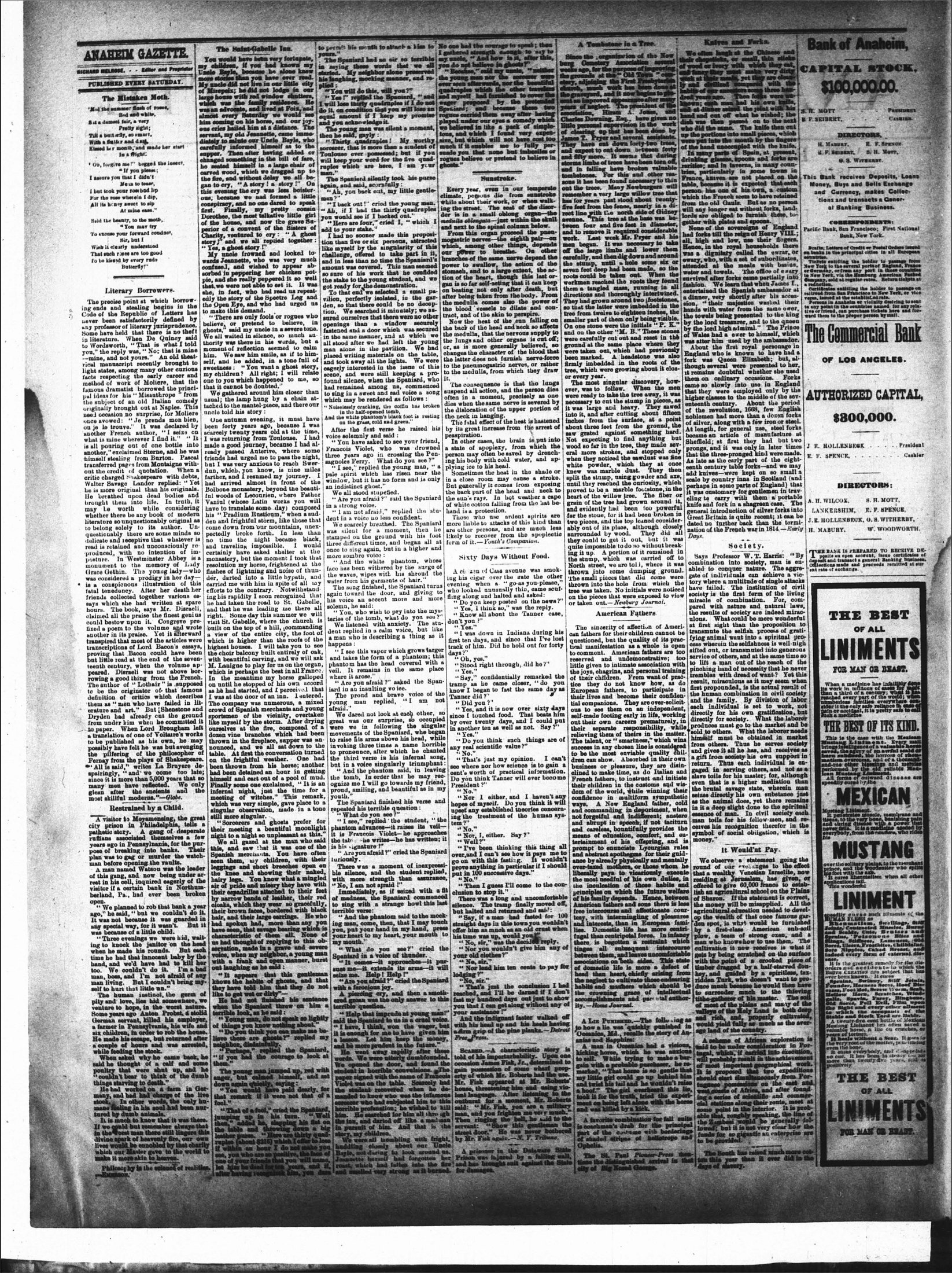
Searchable text
ANAHEIM GAZETTE.
RICHARD MELROSE. - Editor and Proprietor
PUBLISHED EVERY SATURDAY.
The Mistaken Moth.
'Mid the summer flush of roses,
Bed and white,
Sat a damsel fair, a very
Pretty sight;
Till a butt or so smart,
With a fitter and day,
Kissed her month, and made her start
In a flight:
"Oh, forgive me!" bagged the insect,
"If you please;
I assure you that I didn't
Mein to tease,
I but took your rose bad lip
For the rose wherein I dip,
All its honey sweet to sip
At mine ease."
Said the beauty, to the moth,
"You may try
To excuse your forward conduct,
Sir, but I
Wish it clearly understood
That such roses are too good
To be kissed by every rude
Butterfly!"
Literary Borrowers.
The precise point at which borrowing ends and stealing begins in the Code of the Republic of Letters has never been satisfactorily defined by any professor of literary jurisprudence. Some have held that there is no theft in literature. When De Quincy said to Wordsworth, "That is what I told you," the reply was, "No; that is mine—mine, and not yours." An old theatrical manuscript recently brought to light states, among many other curious facts respecting the early career and method of work of Moliere, that the famous dramatist borrowed the principal ideas for his "Misanthrope" from the subject of an old Italian comedy originally brought out at Naples. This need occasion no surprise, for Moliere once avowed: "Je prends mon bien, on je le trouve." It was declared by another French author, "I seize on what is mine wherever I find it." "It is all pouring out of one bottle into another," exclaimed Sterne, and he was himself stealing from Burton. Pascal transferred pages from Montaigne without the credit of quotation. When a
Restrained by a Child.
A visitor to Meyamensing, the great city prison in Philadelphia, tells a pathetic story. A gang of desperate ruffians associated themselves a few years ago in Pennsylvania, for the purpose of breaking into banks. Their plan was to gag or murder the watchman before opening the vaults.
A man named Watson was the leader of this gang, and now being under arrest in his cell, inquired eagerly of the visitor if a certain bank in Northumberland, Pa., had ever been broken facts respecting the early career and method of work of Moliere, that the famous dramatist borrowed the principal ideas for his "Misanthrope" from the subject of an old Italian comedy originally brought out at Naples. This need occasion no surprise, for Moliere once avowed: "Je prends mon bien, on je le trouve." It was declared by another French author, "I seize on what is mine wherever I find it." "It is all pouring out of one bottle into another," exclaimed Sterne, and he was himself stealing from Burton. Pascal transferred pages from Montaigne without the credit of quotation. When a critic charged Shakespeare with debts, Walter Savage Landor replied: "Yet he is more original than his originals. He breathed upon dead bodies and brought them into life. In truth, it may be worth while considering whether there be any book of modern literature so questionably original as to belong solely to its author. Unquestionably there are some minds so delicate and receptive that whatever is read is retained and unconsciously reproduced, with no intention of posture. In Westminster Abbey is a monument to the memory of Lady Grace Gethin. The young lady—who was considered a prodigy in her day—is a conspicuous illustration of this fatal tenedency. After her death her friends collected together various essays which she had written at spare hours. The book, says Mr. Disraeli, claimed all the praise the finest genius could bestow upon it. Congreve prefixed a poem to the volume and wrote another in its praise. Yet it afterward transpired that most of the articles were transcriptions of Lord Bacon's essays, proving that Bacon could have been but little read at the end of the seventeenth century, when the volume appeared. Disraeli was not above borrowing a good thing from the French. The author of "Lothair" is supposed to be the originator of that famous definition of critics which describes them as "men who have failed in literature and art." But Shenstone and Dryden had already cut the ground from under him when he committed it to paper. When Lord Brougham left a translation of one of Voltaire's works to be published as his own, he may possibly have felt he was but avenging the pilfering of the philosopher of Fermay from the plays of Shakespeare. "All is said," writes La Bruyere despairingly, "and we come too late; since it is more than 5,000 years that so many men have reflected. We only glean after the ancients and the most skillful moderns."—Globe.
Restrained by a Child.
A visitor to Meyamensing, the great city prison in Philadelphia, tells a pathetic story. A gang of desperate ruffians associated themselves a few years ago in Pennsylvania, for the purpose of breaking into banks. Their plan was to gag or murder the watchman before opening the vaults.
A man named Watson was the leader of this gang, and now being under arrest in his cell, inquired eagerly of the visitor if a certain bank in Northumberland, Pa., had ever been broken facts respecting the early career and method of work of Moliere, that the famous dramatist borrowed the principal ideas for his "Misanthrope" from the subject of an old Italian comedy originally brought out at Naples. This need occasion no surprise, for Moliere once avowed: "Je prends mon bien, on je le trouve." It was declared by another French author, "I seize on what is mine wherever I find it." "It is all pouring out of one bottle into another," exclaimed Sterne, and he was himself stealing from Burton. Pascal transferred pages from Montaigne without the credit of quotation. When a critic charged Shakespeare with debts, Walter Savage Landor replied: "Yet he is more original than his originals. He breathed upon dead bodies and brought them into life. In truth, it may be worth while considering whether there be any book of modern literature so questionably original as to belong solely to its author. Unquestionably there are some minds so delicate and receptive that whatever is read is retained and unconsciously reproduced, with no intention of imposture. In Westminster Abbey is a monument to the memory of Lady Grace Gethin. The young lady—who was considered a prodigy in her day—is a conspicuous illustration of this fatal tenedency. After her death her friends collected together various essays which she had written at spare hours. The book, says Mr. Disraeli, claimed all the praise the finest genius could bestow upon it. Congreve prefixed a poem to the volume and wrote another in its praise. Yet it afterward transpired that most of the articles were transcriptions of Lord Bacon's essays, proving that Bacon could have been but little read at the end of the seventeenth century, when the volume appeared. Disraeli was not above borrowing a good thing from the French. The author of "Lothair" is supposed to be the originator of that famous definition of critics which describes them as "men who have failed in literature and art." But Shenstone and Dryden had already cut the ground from under him when he committed it to paper. When Lord Brougham left a translation of one of Voltaire's works to be published as his own, he may possibly have felt he was but avenging the pilfering of the philosopher of Fermay from the plays of Shakespeare. "All is said," writes La Bruyere despairingly, "and we come too late; since it is more than 5,000 years that so many men have reflected. We only glean after the ancients and the most skillful moderns."—Globe.
Restrained by a Child.
A visitor to Meyamensing, the great city prison in Philadelphia, tells a pathetic story. A gang of desperate ruffians associated themselves a few years ago in Pennsylvania, for the purpose of breaking into banks. Their plan was to gag or murder the watchman before opening the vaults.
A man named Watson was the leader of this gang, and now being under arrest in his cell, inquired eagerly of the visitor if a certain bank in Northumberland, Pa., had ever been broken facts respecting the early career and method of work of Moliere, that the famous dramatist borrowed the principal ideas for his "Misanthrope" from the subject of an old Italian comedy originally brought out at Naples. This need occasion no surprise, for Moliere once avowed: "Je prends mon bien, on je le trouve." It was declared by another French author, "I seize on what is mine wherever I find it." "It is all pouring out of one bottle into another," exclaimed Sterne, and he was himself stealing from Burton. Pascal transferred pages from Montaigne without the credit of quotation. When a critic charged Shakespeare with debts, Walter Savage Landor replied: "Yet he is more original than his originals. He breathed upon dead bodies and brought them into life. In truth, it may be worth while considering whether there be any book of modern literature so questionably original as to belong solely to its author. Unquestionably there are some minds so delicate and receptive that whatever is read is retained and unconsciously reproduced, with no intention of imposture. In Westminster Abbey is a monument to the memory of Lady Grace Gethin. The young lady—who was considered a prodigy in her day—is a conspicuous illustration of this fatal tenedency. After her death her friends collected together various essays which she had written at spare hours. The book, says Mr. Disraeli, claimed all the praise the finest genius could bestow upon it. Congreve prefixed a poem to the volume and wrote another in its praise. Yet it afterward transpired that most of the articles were transcriptions of Lord Bacon's essays, proving that Bacon could have been but little read at the end of the seventeenth century, when the volume appeared. Disraeli was not above borrowing a good thing from the French. The author of "Lothair" is supposed to be the originator of that famous definition of critics which describes them as "men who have failed in literature and art." But Shenstone and Dryden had already cut the ground from under him when he committed it to paper. When Lord Brougham left a translation of one of Voltaire's works to be published as his own, he may possibly have felt he was but avenging the pilfering of the philosopher of Fermay from the plays of Shakespeare. "All is said," writes La Bruyere despairingly, "and we come too late; since it is more than 5,000 years that so many men have reflected. We only glean after the ancients and the most skillful moderns."—Globe.
Restrained by a Child.
A visitor to Meyamensing, the great city prison in Philadelphia, tells a pathetic story. A gang of desperate ruffians associated themselves a few years ago in Pennsylvania, for the purpose of breaking into banks. Their plan was to gag or murder the watchman before opening the vaults.
A man named Watson was the leader of this gang, and now being under arrest in his cell, inquired eagerly of the visitor if a certain bank in Northumberland, Pa., had ever been broken facts respecting the early career and method of work of Moliere, that the famous dramatist borrowed the principal ideas for his "Misanthrope" from the subject of an old Italian comedy originally brought out at Naples. This need occasion no surprise, for Moliere once avowed: "Je prends mon bien, on je le trouve." It was declared by another French author, "I seize on what is mine wherever I find it." "It is all pouring out of one bottle into another," exclaimed Sterne, and he was himself stealing from Burton. Pascal transferred pages from Montaigne without the credit of quotation. When a critic charged Shakespeare with debts, Walter Savage Landor replied: "Yet he is more original than his originals. He breathed upon dead bodies and brought them into life. In truth, it may be worth while considering whether there be any book of modern literature so questionably original as to belong solely to its author. Unquestionably there are some minds so delicate and receptive that whatever is read is retained and unconsciously reproduced, with no intention of imposture. In Westminster Abbey is a monument to the memory of Lady Grace Gethin. The young lady—who was considered a prodigy in her day—is a conspicuous illustration of this fatal tenedency. After her death her friends collected together various essays which she had written at spare hours. The book, says Mr. Disraeli, claimed all the praise the finest genius could bestow upon it. Congreve prefixed a poem to the volume and wrote another in its praise. Yet it afterward transpired that most of the articles were transcriptions of Lord Bacon's essays, proving that Bacon could have been but little read at the end of the seventeenth century, when the volume appeared. Disraeli was not above borrowing a good thing from the French. The author of "Lothair" is supposed to be the originator of that famous definition of critics which describes them as "men who have failed in getting himself and cart out of a pool of mud. Finally some one exclaimed, "It is an infernal night, just the time for a meeting of witches." This remark, which was very simple, gave place to a singular observation made in a tone still more singular.
“Sorcerers and ghosts prefer for their meeting a beautiful moonlight night to a night so unpleasant as this.”
We all gazed at the man who said this, and saw that it was one of the Spanish merchants. You have often seen them, my children, with their leggings and short breeches open on the knee and showing their naked, hairy legs. You know what a mingled air of pride and misery they have with their espadrilles attached to their feet by narrow bands of leather, their red children? All right! I will release one such voice solitary.
“I seephantom it is Frieze table is his sign.”
“Thereble silent window,b an indistinct We all say face has been wile water from The son again to wipe his voice solemn,h He you,t teries o f The young n afraid.”
“We day great war were we movement raise lh invoking pronounce thru youth.”
“The Sp repeated What I seephantom it is Frieze table is his sign.”
“There ble silent window,b an indistinct We all say face has been wile water from The son again to wipe his voice solemn,h He you,t teries o f The young n afraid.”
“There ble silent window,b an indistinct We all say face has been wile water from The son again to wipe his voice solemn,h He you,t teries o f The young n afraid.”
“There ble silent window,b an indistinct We all say face has been wile water from The son again to wipe his voice solemn,h He you,t teries o f The young n afraid.”
“There ble silent window,b an indistinct We all say face has been wile water from The son again to wipe his voice solemn,h He you,t teries o f The young n afraid.”
“There ble silent window,b an indistinct We all say face has been wile water from The son again to wipe his voice solemn,h He you,t teries o f The young n afraid.”
“There ble silent window,b an indistinct We all say face has been wile water from The son again to wipe his voice solemn,h He you,t teries o f The young n afraid.”
“There ble silent window,b an indistinct We all say face has been wile water from The son again to wipe his voice solemn,h He you,t teries o f The young n afraid.”
“There ble silent window,b an indistinct We all say face has been wile water from The son again to wipe his voice solemn,h He you,t teries o f The young n afraid.”
“There ble silent window,b an indistinct We all say face has been wile water from The son again to wipe his voice solemn,h He you,t teries o f The young n afraid.”
“There ble silent window,b an indistinct We all say face has been wile water from The son again to wipe his voice solemn,h He you,t teries o f The young n afraid.”
“There ble silent window,b an indistinct We all say face has been wile water from The son again to wipe his voice solemn,h He you,t teries o f The young n afraid.”
“There ble silent window,b an indistinct We all say face has been wile water from The son again to wipe his voice solemn,h He you,t teries o f The young n afraid.”
“There ble silent window,b an indistinct We all say face has been wile water from The son again to wipe his voice solemn,h He you,t teries o f The young n afraid.”
“There ble silent window,b an indistinct We all say face has been wile water from The son again to wipe his voice solemn,h He you,t teries o f The young n afraid.”
“There ble silent window,b an indistinct We all say face has been wile water from The son again to wipe his voice solemn,h He you,t teries o f The young n afraid.”
“There ble silent window,b an indistinct We all say face has been wile water from The son again to wipe his voice solemn,h He you,t teries o f The young n afraid.”
“There ble silent window,b an indistinct We all say face has been wile water from The son again to wipe his voice solemn,h He you,t teries o f The young n afraid.”
“There ble silent window,b an indistinct We all say face has been wile water from The son again to wipe his voice solemn,h He you,t teries o f The young n afraid.”
“There ble silent window,b an indistinct We all say face has been wile water from The son again to wipe his voice solemn,h He you,t teries o f The young n afraid.”
“There ble silent window,b an indistinct We all say face has been wile water from The son again to wipe his voice solemn,h He you,t teries o f The young n afraid.”
“There ble silent window,b an indistinct We all say face has been wile water from The son again to wipe his voice solemn,h He you,t teries o f The young n afraid.”
“There ble silent window,b an indistinct We all say face has been wile water from THE son again to wipe his voice solemn,h He you,t terIES o f THE young n afraid.”
“There ble silent window,b an indistinct We all say face has been wile water从THE son again to wipe his voice solemn,h HE你,tTERIES o f THE young n害怕”
“There ble silent window,b an indistinct WE ALL SAY FACE HAS BEEN WILLED IN THE TIME OF THE DAY TO BE READ IN THE CITY OF THE CITY OF THE CITY OF THE CITY OF THE CITY OF THE CITY OF THE CITY OF THE CITY OF THE CITY OF THE CITY OF THE CITY OF THE CITY OF THE CITY OF THE CITY OF THE CITY OF THE CITY OF THE CITY OF THE CITY OF THE CITY OF THE CITY OF THE CITY OF THE CITY OF THE CITY OF THE CITY OF THE CITY OF THE CITY OF THE CITY OF THE CITY OF THE CITY OF THE CITY OF THE CITY OF THE CITY OF THE CITY OF THE CITY OF THE CITY OF THE CITY OF THE CITY OF THE CITY OF THE CITY OF THE CITY OF THE CITY OF THE CITY OF THE CITY OF THE CITY OF THE CITY OF THE CITY OF THE CITY OF THE CITY OF THE CITY OF THE CITY OF THE CITY OF THE CITY OF THE CITY OF THE CITY OF THE CITY OF THE CITY OF THE CITY OF THE CITY OF THE CITY OF THE CITY OF THE CITY OFTHE CITYOFTHECITYOFTHEC CityOfTheC CityOfTheC CityOfTheC CityOfTheC CityOfTheC CityOfTheC CityOfTheC CityOfTheC CityOfTheC CityOfTheC CityOfTheC CityOfTheC CityOfTheC CityOfTheC CityOfTheC CityOfTheC CityOfTheC CityOfTheC CityOfTheC CityOfTheC CityOfTheC CityOfTheC CityOfTheC CityOfTheC CityOfTheC CityOfTheC CityOfTheC CityOfTheC CityOfTheC CityOfTheC CityOfTheC CityOfTheC CityOfTheC CityOfTheC CityOfTheC CityOfTheC CityOfTheC CityOfTheC CityOfTheC CityOfTheC CityOfTheC CityOfTheC CityOfTheC CityOfTheC CityOfTheC CityOfTheC CityOfTheC cityofthec cityofthec cityofthec cityofthec cityofthec cityofthec cityofthec cityofthec cityofthec cityofthec cityofthec cityofthec cityofthec cityofthec cityofthec cityofthec cityofthec cityofthec cityofthec cityofthec cityofthec cityofthec cityofthec cityofthec cityofthec cityofthec cityofthec cityofthec cityofthec cityofthec cityofthec cityofthec cityofthec cityofthec cityofthec cityofthec cityofthec cityofthec cityofthec cityofthec cityofthec cityofthec cityofthec cityofthec cityofthec cityofthec cityofthec cityofthec cityofthec cityOFTHECcityOFTHECcityOFTHECcityOFTHECcityOFTHECcityOFTHECcityOFTHECcityOFTHECcityOFTHECcityOFTHECcityOFTHECcityOFTHECcityOFTHECcityOFTHECcityOFTHECcityOFTHECcityOFTHECcityOFTHECcityOFTHECcityOFTHECcityOFTHECcityOFTHECcityOFTHECcityOFTHECcityOFTHECcityOFTHECcityOFTHECcityOFTHECcityOFTHEC城市OFTHEC城市OFTHEC城市OFTHEC城市OFTHEC城市OFTHEC城市OFTHEC城市OFTHEC城市OFTHEC城市OFTHEC城市OFTHEC城市OFTHEC城市OFTHEC城市OFTHEC城市OFTHEC城市OFTHEC城市OFTHEC城市OFTHEC城市OFTHEC城市OFTHEC城市OFTHEC城市OFTHEC城市OFTHEC城市OFTHEC城市OFTHEC城市OFTHREE城市_OFTHREE城市_OFTHREE城市_OFTHREE城市_OFTHREE城市_OFTHREE城市_OFTHREE城市_OFTHREE城市_OFTHREE城市_OFTHREE城市_OFTHREE城市_OFTHREE城市_OFTHREE城市_OFTHREE城市_OFTHREE城市_OFTHREE城市_OFTHREE城市_OFTHREE城市_OFTHREE城市_OFTHREE城市_OFTHREE城市_OFTHREE城市_OFTHREE城市_OFTHREE城市_OFTHREE城市_OFTHREE市城_OFTHREE市城_OFTHREE市城_OFTHREE市城_OFTHREE市城_OFTHREE市城_OFTHREE市城_OFTHREE市城_OFTHREE市城_OFTHREE市城_OFTHREE市城_OFTHrees市城_OFThrees市城_OFThrees市城_OFThrees市城_OFThrees市城_OFThrees市城_OFThrees市城_OFThrees市城_OFThrees市城_OFThrees市城_OFThrees市城_OFThrees市城_OFThrees市城_OFThrees市城_OFThrees市城_OFThrees市城_OFThrees市城_OFThrees市城_OFThrees市城_OFThrees市城 Of Threes 市城 Of Threes 市城 Of Threes 市城 Of Threes 市城 Of Threes 市城 Of Threes 市城 Of Threes 市城 Of Threes 市城 Of Threes 市城 Of Threes 市城 Of Threes 市城 Of Threes 市城 Of Threes 市城 Of Threes 市城 Of Threes 市城 Of Threes 市城 Of Threes 市城 Of Threes 市城 Of Threes 市城 Of Threes 市城 Of THREE市城 Of THREE市城 Of THREE市城 Of THREE市城 Of THREE市城 Of THREE市城 Of THREE市城 Of THREE市城 Of THREE市城 Of THREE市城 Of THREE市城 Of THREE市城 Of THREE市城 Of THREE市城 Of THREE市城 Of THREE市城 Of THREE市城 Of THREE市城 Of THREE市城 Of THREE市墙 Of THREE市墙 Of THREE市墙 Of THREE市墙 Of THERE市墙 Of THERE市墙 Of THERE市墙 Of THERE市墙 Of THERE市墙 Of THERE市墙 Of THERE市墙 Of THERE市墙 Of THERE市墙 Of THERE市墙 Of THERE市墙 Of THERE市墙 Of THERE市墙 Of THERE市墙 Of THERE市墙 Of THERE市墙 Of THERE市墙 Off THERE市墙 Off THHERE市墙 Off THHERE市墙 Off THHERE市墙 Off THHERE市墙 Off THHERE市墙 Off THHERE市墙 Off THHERE市墙 Off THHERE市墙 Off THHERE市墙 Off THHERE市墙 Off THHERE市墙 Off_THHERE市墙 Off_THHERE市墙 Off_THHERE市墙 Off_THHERE市墙 Off_THHERE市墙 Off_THHERE市墙 Off_THHERE市墙 Off_THHERE市墙 Off_THHERE市墙 Off_THHERE市墙 Off_THHERE市墙 Off_THHERE市墙 Off_THHERE市民墙 Off_THHERE市民墙 Off_THHERE市民墙 Off_THHERE市民墙 Off_THHERE市民墙 Off_THHERE市民墙 Off_THHERE市民墙 Off_THHERE市民墙 Off_THHERE市民墙 Off_THHERE市民墙 Off_THHERE市民墙 Off_THHERE市民墙 Off_THHERE市民墙 Off_THHERE市民墙 Off_THHERE市民墙 Off_THHERE市民墙 OFF_THERE市民墙壁 OFF_THERE市民墙壁 OFF_THERE市民墙壁 OFF_THERE市民墙壁 OFF_THERE市民墙壁 OFF_THERE市民墙壁 OFF_THERE市民墙壁 OFF_THERE市民墙壁 OFF_THERE市民墙壁 OFF_THERE市民墙壁 OFF_THERE市民墙壁 OFF_THERE市民墙壁 OFF_THERE市民墙壁 OFF_THERE市民墙壁 OFF_THERE市民墙壁 OFF_THERE市民墙壁 OFF_THERE市民墙壁 OFF_THERE市民墙壁 OFF_THERE市民墙壁 OFF_THERE市民墙壁 OFF_ThERE市民墙壁 OFF_Thereum市民墙壁 OFF_Thereum市民墙壁 OFF_Thereum市民墙壁 OFF_Thereum市民墙壁OFF_Thereum市民墙壁OFF_Thereum市民墙壁OFF_Thereum市民墙壁OFF_Thereum市民墙壁OFF_Thereum市民墙壁OFF_Thereum市民墙壁OFF_Thereum市民墙壁OFF_Thereum市民墙壁OFF_Thereum市民墙壁OFF_Thereum市民墙壁OFF_Thereum市民墙壁OFF_Thereum市民墙壁OFF_Thereum市民墙壁OFF_Thereum市民墙壁OFF_Thereum市民墙壁OFF_Thereum市民墙壁OFF_Thereum市民墙壁OFF_Thereum市民墙壁OFF_Thereum市民墙壁OFF_Thereum市民墙壁OFF_Thereum市民壁Off_thereum市民壁Off_thereum市民壁Off_thereum市民壁Off_thereum市民壁Off_thereum市民壁Off_thereum市民壁Off_thereum市民壁Off_thereum市民壁Off_thereum市民壁Off_thereum市民壁Off_thereum市民壁Off_thereum市民壁Off_thereum市民壁Off_thereum市民壁Off_thereum市民壁Off_thereum市民壁Off_thereum市民壁OFF_thereum市民壁OFF_thereum市民壁OFF_Thereum市民壁OFF_Th爨市委官员壁Off_th爗市委官员壁Off_th爗市委官员壁Off_th爗市委官员壁Off_th爗市委官员壁Off_th爗市委官员壁Off_th爗市委官员壁Off_th爗市委官员壁Off_th爗市委官员壁Off_th爗市委官员壁Off_th爗市委官员壁Off_th爗市委官员壁Off_th爗市委官员壁Off_th爗市委官员壁Off_th爗市委官员壁OFF_th爗市委官员壁OFF_Th爗市委官员壁OFF_Th爗市委官员壁OFF_Th爗市委官员壁OFF_Th爗市委官员壁OFF_Th爗市委官员壁OFF_Th爗市委官员壁OFF_Th爗市委官员壁OFF_Th爗市委官员壁OFF_Th爗市委官员壁OFF_Th爗
Restrained by a Child.
A visitor to Moyamensing, the great city prison in Philadelphia, tells a pathetic story. A gang of desperate ruffians associated themselves a few years ago in Pennsylvania, for the purpose of breaking into banks. Their plan was to gag or murder the watchman before opening the vaults.
A man named Watson was the leader of this gang, and now being under arrest in his cell, inquired eagerly of the visitor if a certain bank in Northumberland, Pa., had ever been broken open.
"We planned to rob that bank a year ago," he said, "but we couldn't do it. It was not because it was guarded in any special way, for it wasn't. But it was because of a little child."
Three evenings we were hid, waiting to knock the janitor on the head when he made his rounds. But each time he had that innocent baby by the hand, and we'd have had to kill her too. We couldn't do it. I'm a bad man, boss, and I'm not afraid of any man living. But I couldn't bring myself to hurt that little un."
The human instinct, the germ of pity and love, lies hid somewhere, we venture to hope, in the worst nature. Some years ago Anton Probst, a stolid German servant, killed his employer, a farmer in Pennsylvania, his wife and six children, in order to rob the house. He made his escape, but returned after a couple of hours and was arrested, while feeding the stock.
When asked why he came back, he said he thought of a calf and some poultry that were shut up, and he "couldn't bear to think of the dumb things starving to death."
He had worked on a farm in Germany, and had had charge of the live stock. In other words, the only humane feeling in his soul had been nurtured by dumb animals.
It is much to know that it was there. If we could but remember always that in the worst man there still lingers this divine spark of heavenly fire, our own lives would be unnobled by that charity which our Master gave to the world to make it more skin to heaven.
Philosophy is the science of realities.—Exmouth.
to permit his month to attach a kim to yours."
The Spaniard had an air so terrible in saying these words that we all started. My neighbor alone preserved his laughing, mocking manner, and replied:
"You will do this, will you?"
"Yes!" replied the Spaniard, "and I will lose thirty quadruples if I do not do it, on condition that you will lose an equal amount if I keep my promise and you acknowledge it.
The young man was silent a moment, then he said, gaily:
"Thirty quadruples! My worthy sorcerer, that is more than a student of Toulouse ever possessed; but if you will keep your word for the five quadruples which are here, I am your man."
The Spaniard silently took his purse again, and said, scornfully:
"Ah, you back out, my little gentleman?"
"I back out!" cried the young man.
"Ah, if I had the thirty quadruples you would see if I backed out."
"Here are four," cried I, "which I add to your stake."
I had no sooner made this proposition than five or six persons, attracted like myself by the singularity of this challenge, offered to take part in it, and in less than no time the Spaniard's amount was covered. This man seemed so sure of his work that he confided the stake to the young student, and we got ready for the demonstration.
To that end we selected a small pavilion, perfectly isolated, in the garden, so that there could be no deception. We searched it minutely; we assured ourselves that there were no other openings than a window securely fastened and a door which was secured in the same manner, and at which we all stood after we had left the young man alone in the pavilion. We had placed writing materials on the table, and took away all the lights. We were eagerly interested in the issue of this scene, and were still keeping a profound silence, when the Spaniard, who had remained among us, commenced to sing in a sweet and sad voice a song which may be rendered as follows:
"Noiselessly cracking, the coffin has broken in the half-opened tomb.
And the white phantom's black foot is resting on the grass, cold and green."
After the first verse he raised his voice selemnly and said:
"You have asked to see your friend, Francois Violet, who was drowned three years ago in crossing the Pensagnoles Ferry. What do you see?"
"I see," replied the young man, "a pale spirit which has risen near the No one had the courage to speak; then I gathered strength enough to say to my uncle, "And how is it, after this, you do not believe in ghosts?"
"Because," said my uncle, "notither the young man nor the sorcerer were ever seen afterwards, nor the beautiful quadruples which the other travelers and myself had furnished to cover the wager proposed by the pretended Spaniard; and because these two rogues carried them away after having played under our eyes a comedy which we believed in like a pack of simpletons, and which I found very expensive, but which will not have cost too much if it enables me to fully persuade you that none but imbeciles or rogues believe or pretend to believe in ghosts."
Sunstroke.
Every year, even in our temperate climate, peasons die from sunstroke while about their work, or when walking the street. The seat of the disorder is in a small oblong organ—the medulla oblongata—just within the skull and next to the spinal column below.
From this organ proceed the pneumogastric nerves—the eighth pair—on which, among other things, depends our power to breathe. On other branches of the same nerve depend the power to swallow, the action of the stomach, and to a large extent, the action of the heart, though this last organ is so far self-acting that it can keep on beating not only after death, but after being taken from the body. From the medulla comes also the power of the blood vessels to dilate and contract, and of the skin to perspire.
Now the heat of the sun falling on the back of the head and neck so affects the medulla, that the nervous supply to the lungs and other organs is cut off; or, as is more generally believed, so changes the character of the blood that the latter does not furnish nerve-force to the pneumogastric nerves, or rather to the medulla, from which they draw it.
The consequence is that those lungs suspend all action, and the person dies often in a moment, precisely as one dies when the same nerve is severed by the dislocation of the upper portion of the neck in hanging.
The fatal effect of the heat is hastened by its great increase from the arrest of pessipation.
In other cases, the brain is put into a state of apoplexy, from which the person may often be saved by drenching his body with cold water, and applying ice to his head.
Sometimes the heat in the shade or A Tombstone in a Tree.
Since the organization of the Newburg Cemetery Association several weeks ago, for the purpose of improving the grounds at the "Old Town" cemetery, adjoining the First Presbyterian church, much work has been done at the graveyard, and it now begins to play an improved appearance after many years of neglect. The president of this association, Hiram A. Jones, and Charles Downing, Esq., have given me little personal supervision in the work of clearing up that has been done by James T. Pryer and several assistants. They have cut down forty-two trees and expect to cut down between forty-fifty more. It seems that during storms limbs of trees have been torn off and in falling have broken valuable tombstones. For this and other reasons it has been found necessary to shut off the trees. Many Newburgers will remember a very large willow tree that has for years past stood about twenty-five feet from the fence, nearly in a direct line with the north side of Gidna avenue. This tree at the base was between four and five feet in diameter and to remove it required considerable work. Last week Mr. Pryer and his men began. It was necessary to take off the large limbs and lower them carefully, and then dig down and around the stump, until a hole some six feet deep had been made, so that roots could be taken out. When they workedmen reached the roots they found them a tangled mass, running in all directions and thoroughly intertwined. They had grown around two footstones so that the latter were imbedded in the tree from twelve to eighteen inches, thus smaller part of them only being visible. On one stone were the initials "P. K." and on the other "M. B." These stones were carefully cut out and reset in the ground at the same place where they were taken out, which had previously been marked. A headstone was firmly imbedded in the roots of the tree, which were growing about it closer every year.
The most singular discovery, however, was to follow. When the mans were ready to take the tree away, it was necessary to cut the stump in pieces; it was large and heavy. They saw into it, and after cutting about fifteen inches from the surface, at a point about three feet from the ground, saw grated against something hard.
Not expecting to find anything but wood so far in the tree, they made several strokes, and stopped once when they noticed the sawdust was fine white powder, which they at once knew was marble dust. They threw
It must have because I was at the time, house. I had because I had all where some pass the night, reach Swer, is nine miles by journey. I front of the and the beauti-where Father works you will may) composed when a sud-like those that maintains, unex-In less than became black, I would waiter at the sent I took that shutted at the noise of thun-ebypath, and spite of all my Notwithstand-cognized that St. Gabelle, me there all summer we will the church is commandingity, the foot of the roofs of the take you to see entirely of oak, and we will ask us on the organ, but in all France, chorse galloped his own accord superceived that ann. I entered,orous, a mixed animals and young unity, overtaken After drying composed of which had been supper was an sat down to the perservation turned her. One had herse; another tour in getting a pool of mud, named, "It is an the time for a This remark, gave place to a made in a toneests prefer for illful moonlight pleasant as this," he man who said was one of the You have often seen, with their reeches open en-g their naked, what a mingled they have with and to their feet neither, their red Immediately, as if seized with a fit of madness, the Spaniard commenced scene, and were still keeping a profound silence, when the Spaniard, who had remained among us, commenced to sing in a sweet and sad voice a song which may be rendered as follows:
"Noiselessly cracking, the coffin has broken in the half-opened tomb,
And the white phantom's black foot is resting on the grass, cold and green."
After the first verse he raised his voice solemnly and said:
"You have asked to see your friend, Francois Violet, who was drowned three years ago in crossing the Pen-sagnoles Ferry. What do you see?"
"I see," replied the young man, "a pale spirit which has risen near the window, but it has no form and is only an indistinct ghost."
We all stood stupied.
"Are you afraid?" said the Spaniard in a strong voice.
"I am not afraid," replied the student in a voice no less confident.
We scarcely breathed. The Spaniard was silent for a moment, then he stamped on the ground with his foot three different times, and began all at once to sing again, but in a higher and more sombre voice:
"And the white phantom, whose face has been withered by the surge of the waves, wipes with his shroud the water from his garments of hair."
The song finished, the Spaniard turns again toward the door, and giving to his voice an accent more and more solemn, he said:
"You, who wish to pry into the mysteries of the tomb, what do you see?"
We listened with anxiety. The student replied in a calm voice, but like a man who is describing a thing as it happens:
"I see this vapor which grows larger and takes the form of a phantom; this phantom has the head covered with a veil. It remains in the same place where it arose."
"Are you afraid?" asked the Spaniard in an insulting voice.
The proud and brave voice of the young man replied, "I am not afraid."
We dared not look at each other, so great was our surprise, so occupied were we in following the singular movements of the Spaniard, who began to raise his arms above his head, while invoking three times a name horrible to pronounce, after which he chanted the third verse in his infernal song, but in a voice singularly triumphant:
"And the phantom said, in leaving the tomb. In order that he may recognize me I will go towards my friend, proud, smiling, and beautiful as in my youth."
The Spaniard finished his verse and repeated his terrible question:
"What do you see?"
"I see," replied the student, "the phantom advances—it raises its veil—it is Fraucois Violet—he approaches the tabohe writes—he has written; it is his signature!"
"Are you afraid?" cried the Spaniard furiously.
There was a moment of inexpressible silence, and the student replied, with more strength than assurance,
"No, I am not afraid!"
Immediately, as if seized with a fit of madness, the Spaniard commenced scene, and were still keeping a profound silence, when the Spaniard, who had remained among us, commenced to sing in a sweet and sad voice a song which may be rendered as follows:
"Noiselessly cracking, the coffin has broken in the half-opened tomb,
And the white phantom's black foot is resting on the grass, cold and green."
After the first verse he raised his voice solemnly and said:
"You have asked to see your friend, Francois Violet, who was drowned three years ago in crossing the Pen-sagnoles Ferry. What do you see?"
"I see," replied the young man, "a pale spirit which has risen near the window, but it has no form and is only an indistinct ghost."
We all stood stupied.
"Are you afraid?" said the Spaniard in a strong voice.
"I am not afraid," replied the student in a voice no less confident.
We scarcely breathed. The Spaniard was silent for a moment, then he stamped on the ground with his foot three different times, and began all at once to sing again, but in a higher and more sombre voice:
"And the white phantom, whose face has been withered by the surge of the waves, wipes with his shroud the water from his garments of hair."
The song finished, the Spaniard turns again toward the door, and giving to his voice an accent more and more solemn, he said:
"You, who wish to pry into the mysteries of the tomb, what do you see?"
We listened with anxiety. The student replied in a calm voice, but like a man who is describing a thing as it happens:
"I see this vapor which grows larger and takes the form of a phantom; this phantom has the head covered with a veil. It remains in the same place where it arose."
"Are you afraid?" asked the Spaniard in an insulting voice.
The proud and brave voice of the young man replied, "I am not afraid."
We dared not look at each other, so great was our surprise, so occupied were we in following the singular movements of the Spaniard, who began to raise his arms above his head, while invoking three times a name horrible to pronounce, after which he chanted the third verse in his infernal song,
but in a voice singularly triumphant:
"And the phantom said, in leaving the tomb. In order that he may recognize me I will go towards my friend, proud, smiling, and beautiful as in my youth."
The Spaniard finished his verse and repeated his terrible question:
"What do you see?"
"I see," replied the student, "the phantom advances—it raises its veil—it is Fraucois Violet—he approaches the tabohe writes—he has written; it is his signature!"
"Are you afraid?" cried the Spaniard furiously.
There was a moment of inexpressible silence, and the student replied, with more strength than assurance,
"No, I am not afraid!"
Immediately, as if seized with a fit of madness, the Spaniard commenced scene, and were still keeping a profound silence when the Spaniard who had remained among us, commenced to sing in a sweet and sad voice a song which may be rendered as follows:
"Noiselessly cracking, the coffin has broken in the half-opened toomb,
And the white phantom's black foot is resting on the grass, cold and green."
The consequence is that the lungs suspend all action, and the person dies often in a moment, precisely as one dies when the same nerve is severed by the dislocation of upper portion of the neck in hanging.
The fatal effect of the heat is hastened by its great increase from the arrest of peaspiration.
In other cases,the brain is put into a state of apoplexy,从 which the person may often be saved by drenching his body with cold water,and applying ice to his head.
Sometimes the heat in the shade or in a close room may cause a stroke. But generally it comes from exposing back part of the head and neck to the sun's rays. In hot weather a cape of white cotton falling from the hat behand is a protection.
Those who use ardent spirits are more liable to attacks of this kind than are other persons,and are much less likely to recover from the apoplectic form of it.—Youth's Companion.
Sixty Days Without Food.
A citizen of Cass avenue was smoking his cigar over the gate other evening when a "go-as you-please," who looked unusually thin,came scuffling along and halted and asked:
"Do you keep posted on the news?"
"Yes.I think so," was the reply.
"Know all about the Tanner case,dont you?"
"Yes."
"I was down in Indiana during his first ten days,and since that I've lost track of him.Did he hold out for forty days?"
"Oh,yes."
"Stood right through,did he?"
"Yes."
"Say," confidentially remarked the tramp as he came closer,"do you know I began to fast the same day as Tanner did?"
"Did you?"
"Yes,and it is now over sixty days since I touched food. That beats him by over twenty days,and I could put in another ten as well as not.Say?"
"Yes."
"Do you think such things are of any real scientific value?"
"No."
"That's just my opinion. I can't see where nor how science is to gain a cent's worth of practical information. Do you think Tanner will ever become President?"
"No."
"Nor I either,and I haven't any hopes of myself. Do you think it will upset any established theories concerning treatment of the human system?"
"No."
"Nor.I,either.Say?"
"Well?"
"I've been thinking this thing all over,and I can't see how it pays me to go on with this fastig. It wouldn't prove anything in particular if I should put in 100 successive days."
"No."
"The Then I guess I'll come to the conclusion to stop it."
There was a long and uncomfortable way. A New England father,and commanding in deportment,and not forgetful and indifferent;and able and careless,bountifully provides means of education,comfort,and terrain of his offspring,and prompt to enunciate Lyourgian,and abstract apothegms for their grace by already physically and mentally over-taxed mothers,或 those who liberally pays to vicariously exertthe most useful of his own dutiesin principle on which futurewillsof his family depends.Hence best
The Spaniard finished his verse and repeated his terrible question:
"What do you see?"
"I see," replied the student, "the phantom advances—it raises its veil—it is Francois Violet—the he approaches the table—the writes—he has written; it is his signature!"
"Are you afraid?" cried the Spaniard furiously.
There was a moment of inexpressible silence, and the student replied, with more strength than assurance,
"No, I am not afraid!"
Immediately, as if seized with a fit of madness, the Spaniard commenced to sing with a strange howl this last terrible verse:
"And the phantom said to the mocking man, come, then, that I may touch you, put your hand in my hand, press your heart to my heart, your mouth to my mouth."
"What do you see?" cried the Spaniard in a voice of thunder.
"It comes—it approaches—it pursues me—it extends its arms—it will seize me. Help! Help!"
"Are you afraid?" cried the Spaniard with a ferocious joy.
A piercing cry, and then a smothered groan was the only answer to this terrible question.
"Help that imprudent young man!" said the Spaniard to us in a cruel voice.
"I have, I think, won the wager, but it is enough for me to have given him a lesson. Let him keep the money, and be more prudent in the future."
He went away rapidly after these words. We were utterly dumbfounded. We opened the door, and found the student in horrible convulsions. The paper signed with the name of Francois Violet was on the table. Scarcely had the student recovered when he demanded to know who was the infamous sorcerer who had subjected him to this horrible profanation; he wished to kill him. He searched for him all through the fan, and darted off like a madman in pursuit of him. And that is the story, my children.
We were all trembling with fright, huddling closely about our Uncle Bayle, not during to look around us. Jasminette herself had forgotten her rost, which had fallen into the fire and smallled very strong as it burned.
Nor I enter, and I hope of myself. Do you think it will upset any established theories concerning the treatment of the human system?
"No."
Nor, I either. Say?
Well?
I've been thinking this thing all over, and I can't see how it pays me to go on with this fasting. It wouldn't prove anything in particular if I should put in 100 successive days."
No.
Then I guess I'll come to the conclusion to stop it."
There was a long and uncomfortable silence. The tramp finally moved off, but halted and returned and said:
"Say, if a man had fasted for 100 straight days in this town you wouldn't offer him as much as an old crust when his time was up, would you?"
No, sir," was the decided reply.
Nor you wouldn't give him any of your old clothes?
No, sir."
Nor land him ten cents to pay for lodging?
No, sir."
That's just the conclusion I had reached, and I'll be darned if I don't fast my hundred days out just to show you that I can get along without any of your assistance!
And the indignant faster walked off with his head up and his heals having a firm grip of the pine planks. — Detroit Free Press.
Scared.—A characteristic story is told of his imperturbability. Upon one occasion James Fisk, Jr., determined to gain possession of some wharf property of which Mr. Roberts had the use. Mr. Fisk appeared at Mr. Roberts' house, threatening him and using violent language. After listening to the outburst for a moment, Mr. Roberts said: "Mr. Fisk, you are a military man, and you frighten me very much." Then ringing the bell, he said to the servant: "Show this gentleman the street door." He was never bothered by Mr. Fisk again. — N. Y. Tribune.
A prisoner in the Delaware State Prison was injured by a falling wall, and has brought suit against the State for damage.
A New England father and commanding in deportment, we not forgetful and indifferent; and abrupt in speech, if not tactful and careless, bountifully provides means of education, comfort, and tertainment of his offspring, and prompt to enunciate Lyourgian and abstract apothegms for their grace by already physically and mentally over-taxed mothers, or those whose liberally pays to vicariously exert the most needful of his own duties in the incubation of those habits principles on which the future war of his family depends. Hence, both American fathers and sons there free intercourse and affectionate tease, with intermingling of pleas and interests, than in European lies. Domestic life has more or fewer tripetal force. In there is begotten a restraint wittings all subsequent intersections them, and leaves uncomfort associations on both sides. This of domestic life is more a defeat than heart, chiefly arising the neglect to cultivate those endangered habits and manners which show the crowning grace of intellect accomplishments and parental arity. — Home Journal.
A Lie Punished.—The follow-up to how a lie was quickly punish Oceanica, Md., recalls the story anias and Sapphire:
A man in Oceanica had a vicious horse, which he was able to sell. While trying to make gain with a probable purchaser, marked, "That horse is no gentel my little girl could go up behind and twist his tail and he wouldn’t a hoof." The girl overheard the look for it for the truth, tried the meat on being left alone with them and was killed by a kick.
A favorite combination for fall is coachman’s drab for the part of the course with bord of shaded strips of hellotropia Ophalia.
The St. Paul Pioneer-Press tains the distinguished arrival in city of Big Nead Georgia.
Bank of Anaheim,
CAPITAL STOCK,
$100,000.00.
S. H. MOTT
PRESIDENT
E. F. SEIBERT
CASHIER
DIRECTORS:
H. MABURY, E. F. SPENCE.
H. F. SEIBERT, S. H. MOTT,
O. S. WITHERBY.
This Bank receives Deposits, Loans Money, Buys and Sells Exchange and Currency, makes Collections and transacts a General Banking Business.
CORESPONDENTS:
Pacific Bank, San Francisco; First National Bank, New York.
Drafts, Letters of Credit or Postal Orders issued on banks in the principal cities in all European countries.
Tickets entitling the holder to passage from New York to the several ports of England, France or Germany, or from any port in these countries to New York, via the Hamburg American Pushed Company, sold at regular rates. Return tickets at a reduction.
Certificates entitling the holder to passage on railroad from San Francisco to New York, or vice versa, issued at the established rate.
Persons in Anaheim or violently desiring to sent to any point in the countries named for any relative or friend, can purchase tickets here and forward them to the proper person by mail.
The Commercial Bank
OF LOS ANGELES.
AUTHORIZED CAPITAL,
$800,000.
J. E. HOLLENBECK
President
E. F. SPENCE, Cashier
A portion of it remained in the tree, which was carried off to meet, we are toll, where it was into some dumping ground. Pieces that did come were to the hole from which the broken. No initials were noticed except that were exposed to view out.
American Fathers
Uncerity of affection of Americans for their children cannot be said, but the quality of its practicability as a whole is open to and undemonstrative; too often to intimate association with shagrins, and personal training children. From want of practice do not know how, as do fathers, to participate in and become their confidenceions. They are over-solicitude them on an independent, the footing early in life, working own careers prematurely, in separate responsibility, while them of theirs in the matter.
It or "smartness," which wins any chosen line is considered the most enviable quality childish show. Absorbed in their own or pleasure, they are disinformable time, as do Italian and French, to instruct and initiate children in the customs and wishes of the world, while winning their place in multiform sympathetic New England father, cold demanding in deportment, when待ful and indifferent; anathemarupt in speech, if not taciturn withoutless, bountifully provides the self education, comfort, and enlightenment of his offspring, and is to enunciate Lycurgian rules direct apothegms for their guidance already physically and mentally used mothers, or those whom he pays to vicariously execute needful of his own duties, in education of those habits and ones on which the future welfare family depends. Hence, between them on ordinary occasions. Forks came so slowly into use in England that they were employed only by the higher classes to the middle of the seventeenth century. About the period of the revolution, 1668, few English noblemen had more than a dozen forks of silver, along with a few iron or steel. At length, for general use, steel forks became an article of manufacture at Sheffield; at first they had but two prongs, and it was only in later times that the three-pronged kind were made. As late as the early part of the eighteenth century table forks—and we may add knives—were kept on so small a scale by country inns in Scotland (and perhaps in some parts of England) that it was customary for gentlemen in traveling to carry with them a portable knife and fork in a shagreen case. The general introduction of silver forks into Great Britain is quite recent; it can be dated no further back than the termination of the French war in 1814—Early Days.
Society.
Says Professor W. T. Harris: "By combination into society, man is enabled to conquer nature. The aggregate of individuals can achieve a victory where a multitude of single attacks have failed. The institution of civil society is the first form of the living miracle of combination. For, compared with nature and natural laws, the results of society are indeed miraculous. What could be more wonderful at first sight than the proposition to transmute the selfish process of gratifying animal want into a spiritual process wherein the selfishness is well-nigh sifted out, or transmuted into generous service of others, and at the same time so to lift a man out of the reach of the pinching hand of necessity that he never trembles with dread of want? Yet this result, miraculous as it may seem when first propounded, is the actual result of the human combination in civil society and the family. By division of labor each individual is set to work, not directly for his own gratification, but directly for society. What the laborer produces must go to the market and be sold to others. What the laborer needs himself must be obtained in market from others. Thus he serves society and gives it all he has, and receives as a gift from society his own support in return. Thus each individual is engaged in serving others, and not as a slave toils for his master; for, although even that is a higher mediation than the brutal savage state, wherein man seizes directly his own substance just as the animal does, yet there remains in it a deep slight done to the spiritual essence of man. In civil society each man toils for his fellow-men, and receives his recognition therefor in the symbol of social obligation, which is money."
It Wouldn't Pay.
We observe a statement going the round of our exchanges to the effect that a wealthy Venetian Israelite, now residing at Jerusalem, has given, or offered to give 60,000 francs to establish an agricultural school on the Plains of Sharon. If the statement is correct,
AUTHORIZED CAPITAL,
$800,000.
J E HOLLENBECK President
E F SPENCE Cashier
DIRECTORS:
A H WILCOX S H MOTT,
LANKERSHIM E F SPENCE,
J E HOLLENBECK O S WITHERBY,
H MABURY W WOODWORTH.
THE BANK IS PREPARED TO RECEIVE DEPOSITS ON OPEN ACCOUNT, ISSUE CERTIFICATES OF DEPOSIT AND TRANSACT A GENERAL BANKING BUSINESS. Collections made and proceeds remitted at current rate of exchange.
THE BEST OF ALL
LINIMENTS
FOR MAN OR BEAST.
When a medicine has infallibly done its work in millions of cases for most than a third of a century; what is has reached every part of the world; when numberless families everywhere consider it the only safe reliance in case of pain or accident; it is pretty safe to call such a medicine
THE BEST OF ITS KIND.
This is the case with the Mexican Mustang Liniment. Every mail brings intelligence of a valuable horse saved, the agony of an awful soul or burns solidum, the horrors of themmism overcome, and of a thousand-and-one other blessings and mercies performed by the old reliable Mexican Mustang Liniment.
All forms of outward disease are speedily cured by the MEXICAN Mustang Liniment.
It penetrates muscles, membrane and tissue, to the very bone, banishing pain and thuring disease with a power that never fails. It is a medicine needed by everybody from the rancher who rides his MUSTANG over the solitary plains, to the merchant prince, and the woodmaster who spits his foot with the axe.
It curses linemanism when all other applications fail.
This wonderful LINIMENT
A New England father, cold demanding in deportment, when fruitful and indifferent; austere in speech, if not taciturn less, bountifully provides the of education, comfort, and enlightenment of his offspring, and is to enunciate Lycurgian rules extract apothegms for their guidance already physically and mentally needed mothers, or those whom he pays to vicariously execute is needful of his own duties, in preparation of those habits and habits on which the future welfare family depends. Hence, between fathers and sons there is less course and affectionate courting intermingling of pleasures than in European fami- domestic life has more centripetal force. In infancy it begotten a restraint which all subsequent intercourse them, and leaves uncomfortable on both sides. This state of life is more a defect of man heart, chiefly arising from select to cultivate those endearing and mafters which should be owning grace of intellectual enrichments and parental authority.
PUNISHED.—The following as a lie was quickly punished in cases, Md., recalls the story of Annel Sapphire:
Man in Oceanica had a vicious horse, which he was anxious to try trying to make a bar with a probable purchaser, he re- "That horse is no gentle that she girl could go up behind him at his tail and he wouldn't raise." The girl overheard this lie, for the truth, kried the experi- being left alone with the horse is killed by a kick.
Favorite combination for fall suits human's drab for the principal of the costume with borderings del strips of hellstrops and wa.
St. Paul Pioneer-Press man- the distinguished arrival in that Big Neal George.
We observe a statement going the round of our exchanges to the effect that a wealthy Venetian Israelite, now residing at Jerusalem, has given, or offered to give 60,000 francs to establish an agricultural school on the Plains of Sharon. If the statement is correct, the money will be misapplied. All the agricultural education needed to develop the wealth of that once famous garden spot, is what would be furnished by a first-class American sub-soil plow, a team of strong oxen, and a man who knows how to use them. The cultivation it now receives is what it gets by being scratched on the surface with the point of a crooked piece of timber dragged by a half-starved donkey, and guided by a spiritless, tax-ridden Turk, who doesn't want to produce much because he would then have to surrender much to the thirsting tithe-gatherer of his master. The soil of most of the plains and many of the valleys of the Holy Land is both deep and rich, and properly cultivated, would yield fully as much as the average land of the country.
A scheme of African exploration is said to be under consideration in Portugal, which, if carried into execution, will probably result in the achievement of most important geographical work. It is proposed that two expeditions should start simultaneously from Portuguese possessions on the east and west coasts of Africa, and after founding a series of scientific and commercial stations along their route, meet at some point in the interior. It is probable that, roughly speaking, the line of the Zambesi would be generally followed; but it is not very clear how the funds for so gigantic an enterprise are to be provided.
The South has raised much more cotton this year than it ever did in the days of slavery.
MUSTANG
over the solitary plains, to the merchant prince, and the woodenter who splits his foot with the ash.
It cures lichenism when all other applications fail.
This wonderful
LINIMENT
spreadily eases such aliments of the HUMAN FLESH as
Rhumatisms, Swellings, Stiff Joints, Contracted Muscles, Burns and Scalds, Cuts, Bruises and Sprains, Poisonous Bites and Stings, Stiffness, Lameness, Old Sorces, Ulcers, Frontbites, Chliblains, Sore Nipples, Caked Breast, and indeed every form of external disease.
It is the greatest remedy for the disorders and accidents to which the Burra Creation are subject that has ever been known. It eures
Sprains, Swimmy, Stiff Joints,
Founder, Marneas Horse, Moof Disease,
Foot Not, Sore Worm, Seah,
Hollow Horn, Scratchae, Wind-gallis, Spavin, Faray, Minghome,
Old Sorces, Poll Evil, Film upon the Night and every other aliment to which the occupants of the Stable and Stock Yard are liable.
A twenty-five cent bottle of Mexican Mustang Liniment has often saved a valuable horse, a life on crutches, or years of torture.
It hauls without a Seur. It goes to the very root of the matter, penetrating even the home.
It eures everybody, and Campoids no one. It has been in steady use for more than twenty-five years, and is positively
THE BEST OF ALL
LINIMENTS
FOR MAN OR BEAM.