anaheim-gazette 1880-09-25
Scanned page
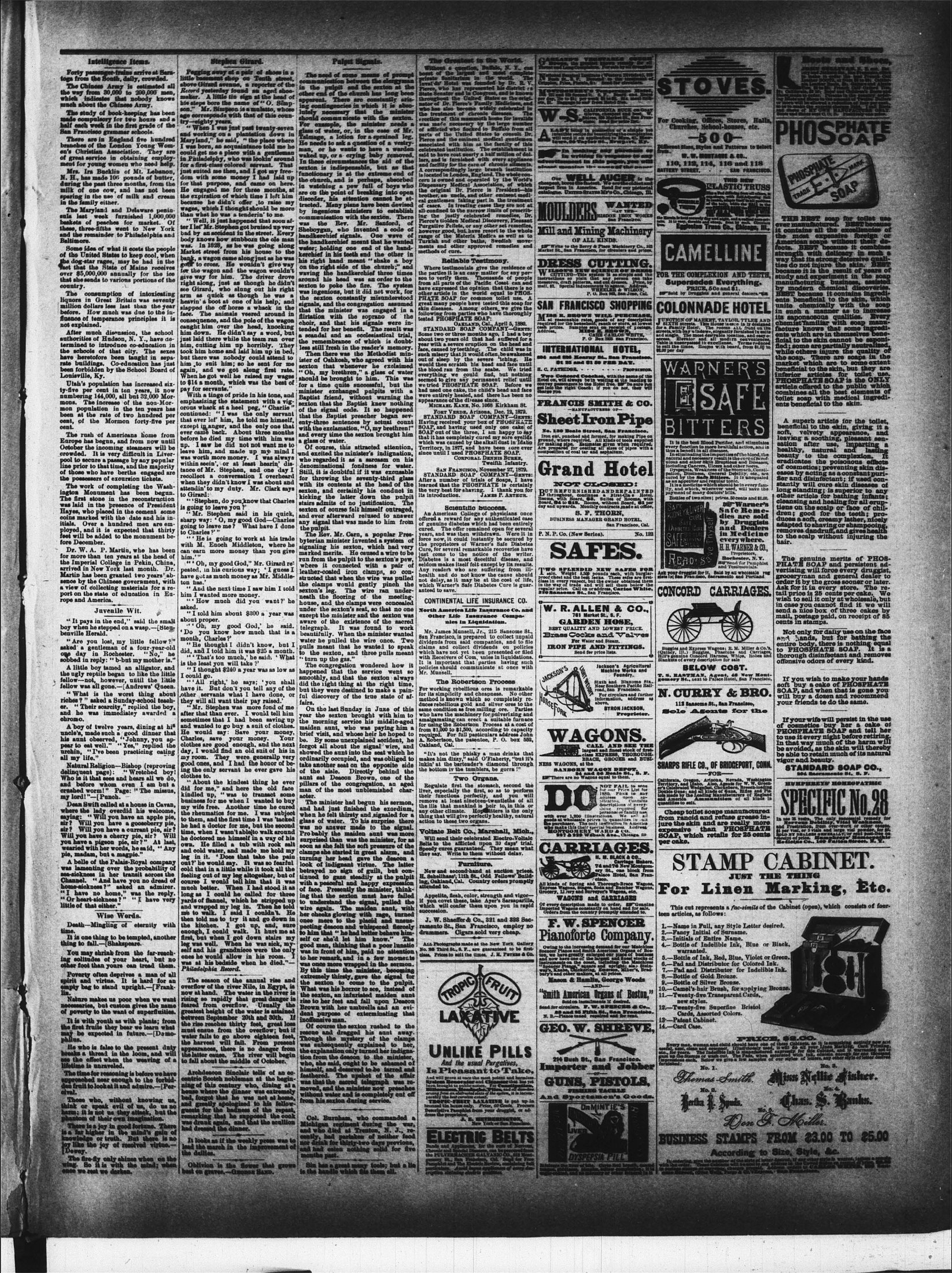
Searchable text
Intelligence Items.
Forty passenger-train arrive at Harstoga from the South, daily, crowded.
The Chinese Army is estimated all the way from 30,000 to 200,000 men, which indicates that nobody knows much about the Chinese Army.
The study of book-keeping has been made compulsory for two hours and a half each week in the first grade of the San Francisco grammar schools.
There are in England five hundred branches of the London Young Women's Christian Association. They are of great service in obtaining employment for young women who need help.
Mrs. Ira Bucklin of Mt. Lebanon, N. H., has made 106 pounds of butter, during the past three months, from the milk of one cow, and has not been sparing in the use of milk and cream in the family either.
The Maryland and Delaware peninsula last week furnished 1,000,000 baskets of peaches for market. Of these, three-fifths went to New York and the remainder to Philadelphia and Baltimore.
Some idea of what it costs the people of the United States to keep cool, when the dog-star rages, may be had in the fact that the State of Maine receives over $5,000,000 annually for the ice that she sends to various portions of the country.
The consumption of intoxicating liquors in Great Britain was seventy million dollars less than the year before. How much was due to the influence of temperance principles it is not explained.
After much discussion, the school authorities of Hudson, N. Y., have determined to introduce co-education in the schools of that city. The sexes have heretofore been taught in separate buildings. Co-education has just been forbidden by the School Board of Louisville, Ky.
Utah's population has increased sixty-five per cent in ten years, it now numbering 144,000, all but 32,000 Mormons. The increase of the non-Mormon population in the ten years has been at the rate of two hundred per cent, of the Mormon forty-five per cent.
The rush of Americans home from Europe has begun, and from now until October the incoming steamers will be crowded. It is very difficult in Liverpool to secure a passage by any popular line prior to that time, and the majority of those who have berths engaged are
Stephen Girard.
Pegging away at a pair of shoes in a little basement shop on Tenth street, above Girard avenue, a reporter of the Record yesterday found an aged shoe-maker. A little tin sign at the head of his steps bore the name of "O. Simpson." Mr. Simpson is a mulatto, whose age corresponds with that of this country—eighty years.
"When I was just past twenty-seven and working on a plantation down in Maryland," he said, "the place where I was born, an acquaintance told me he could get me a place with a gentleman in Philadelphia, who was lookin' around for a first-class colored servant. That just suited me then, and I got my freedom with some money I had laid up for that purpose, and came on here. He engaged me for three months, at the expiration of which time I left him because he didn't offer to raise my wages, which I thought should be more than what he was a tenderin' to me.
"Well, it just happened that soon after I left Mr. Stephen got bruised up very bad by an accident in the street. Every body knows how stubborn the ole man was. In 1828, as he was going along Market street from his house to the bank, a wagon came along just as he was gold to cross. He wouldn't give way for the wagon and the wagon wouldn't give way for him. The driver drove right along, just as though he didn't see Girard, who slung out his right arm as quick as though he was a heavin' a boot at one of his help, and slapped the off-horse a whack in the face. The animals veered around in consequence, and the pole of the wagon caught him over the head, knocking him down. He didn't say a word, but just laid there while the team ran over him, cutting him up horribly. They took him home and laid him up in bed, but there was nobody could attend to him to suit him; so he sent for me again, and we got along first rate. When he got well he raised my wages to $14 a month, which was the best of pay for servants."
With a tinge of pride in his tone, and emphasizing the statement with a vigorous whack at a heel peg, "Charlie" continued: "I was the only servant that ever lef' him, he told me himself, except in anger, and the only one that ever came back. About three months before he died my time with him was up. I saw he did not want me to leave him, and made up my mind I was worth more money. I was always within seein', or at least hearin' distance of Mr. Stephen, and one day I pulpit.
The need of some communication between in the pulpit and other end of the chaparral appears. There is lingering contingencies in lately necessary to should communicate. For example, the glass of water, or, if Talmage, a lotion He needs to ask a qur'an man, or he wants waked up, or a cry In these circumstances sexton is indispensable functionary is at the church, and is in watching a pew are on the point of disorder, his attentive tracted. Many plants by ingenious minima communication with was the Rev. Sheboygan, who is handkerchief signaing the handkerchief my water; holding one kerchief in his teethed his right hand me on the right side oweing the handkead around his head to poke them was ingenuous, but not the sexton constant signals, and the comma that the minister flirtation with their choir, and that they tended for her benene a scandal and an remembrance less still fresh in thence.
Then there was tister of Oshkosh, who sexton that when "Oh, my brethren should be brought for a time quite s minister exchange Baptist friend, who sexton that the Baptist code that the Baptist parley-three sentence with the exclamation and every time they were a glass of water.
Of course, this s and excited the minima who regarded it as denominational for Still, it is doubtful
Utah's population has increased sixty-five per cent in ten years, it now numbering 144,000, all but 32,000 Mormons. The increase of the non-Mormon population in the ten years has been at the rate of two hundred per cent, of the Mormon forty-five per cent.
The rush of Americans home from Europe has begun, and from now until October the incoming steamers will be crowded. It is very difficult in Liverpool to secure a passage by any popular line prior to that time, and the majority of those who have berths engaged are the possessors of excursion tickets.
The work of completing the Washington Monument has been begun. The first stone in the reconstruction was laid in the presence of President Hayes, who placed in the cement some coins marked with the date and his initials. Over a hundred men are employed, and it is expected that thirty feet will be added to the monument before December.
Dr. W. A. P. Martin, who has been for more than ten years at the head of the Imperial College in Pekin, China, arrived in New York last month. Dr. Martin has been granted two years' absence by the Chinese government, with a view of collecting materials for a report on the state of education in Europe and America.
Juvenile Wit.
"It pays in the end," said the small boy when he stepped on a wasp.—[Steu benville Herald.
"Are you lost, my little fellow?" asked a gentleman of a four-year-old one day in Rochester. "No," he sobbed in reply: "b-but my mother is."
A little boy tamed an alligator, and the ugly reptile began to like the little fellow—not, however, until the little fellow was all gone.—[Andrews' Queen.
What is the worst thing about riches?" asked a Sunday-school teacher. "Their scarcity," replied the boy, and he was immediately awarded a chromo.
A boy of twelve years, dining at his uncle's, made such a good dinner that his aunt observed, "Johnny, you appear to eat well." "Yes," replied theurchin, "I've been practicing eating all my life."
Natural Religion—Bishop (reproving delinquent page): "Wretched boy! Who is it that sees and hears all we do, and before whom even I am but a crushed worm!" Page: "The missus, my lord!"—[Punch.
Dean Swift called at a house in Cavan, where the lady overdid his welcome, saying: "Will you have an apple pie, sir? Will you have a gooseberry pie, sir? Will you have a currant pie, sir? Will you have a cherry pie, sir? Will you have a pigeon pie, sir?" At last, wearied with her words, he said, "Any pie, madam, but a magpie."
A belle of the Palais-Royal company was lamenting over the probability of sea-sickness in her transit across the Channel. "And have you no dread of home-sickness?" asked an admirer. "I have no home," was the reply.
Or heart-sickness?"
When he got well he raised my wages to $14 a month, which was the best of pay for servants."
With a tinge of pride in his tone, and emphasizing the statement with a vigorous whack at a heel peg, "Charlie" continued: "I was the only servant that ever left him, he told me himself, except in anger, and the only one that ever came back. About three months before he died my time with him was up. I saw he did not want me to leave him, and made up my mind I was worth more money. I was always within seein', or at least hearin' distance of Mr. Stephen, and one day I recollect a conversation I overheard when they didn't know I was about and attendin' to my duty. Mr. Clark says to Girard:
"Stephen, do you know that Charles is going to leave you?"
Mr. Stephen said in his quick, sharp way: "O, my good God—Charles going to leave me? What have I done to Charles?"
"He is going to work at his trade with M. Enoch Middleton, where he can earn more money than you give him.""
"Oh, my good God," Mr. Girard repeated, in his curious way; "I guess I have got as much money as Mr. Middleton has."
"And the next time I saw him I told him I wanted more money.
"How much did you want?' he asked.
"I told him about $300 a year was about proper."
"Oh, my good God,' he said. 'Do you know how much that is a month, Charles?'
"He thought I didn't know, but I did, and I told him it was $25 a month."
"That's too much,' he said. 'What is the least you will take?"
"I thought $240 a year was as low as I could go."
"All right,' he says; 'you shall have it. But don't you tell any of the other servants what I have done, or they will all want their pay raised.'"
Mr. Stephen was more fond of me after that than ever. I would tell him sometimes that I had been saving up and wanted to go buy a suit of clothes. He would say: Save your money, Charles, save your money. Your clothes are good enough, and the next day, I would find an old suit of his in my room. They were generally very good ones, and I had the honor of being the only servant he ever gave his clothes to.
About the kindest thing he ever did for me," and here the old face kindled up, "was to transact some business for me when I wanted to buy my wife free. Another time he cured the rheumatics for me. I was subject to them, and the first time I was tacked he had a doctor for me, but the second time, when I wasn't able to walk around he doctored me himself in a way of his own. He filled a tub with rock salt and cold water, and made me hold my leg in it. 'Does that take the pain out?' he would say. It was so fearful cold that in a little while it took all the feeling out of my leg altogether, but of course I would tell him that it was much better. When I had stood it as long as I could he called for three When he got well he raised my wages to $14 a month, which was the best of pay for servants."
With a tinge of pride in his tone, and emphasizing the statement with a vigorous whack at a heel peg, "Charlie" continued: "I was the only servant that ever left him, he told me himself, except in anger, and the only one that ever came back. About three months before he died my time with him was up. I saw he did not want me to leave him, and made up my mind I was worth more money. I was always within seein', or at least hearin' distance of Mr. Stephen, and one day I recollect a conversation I overheard when they didn't know I was about and attendin' to my duty. Mr. Clark says to Girard:
"Stephen, do you know that Charles is going to leave you?"
Mr. Stephen said in his quick, sharp way: "O, my good God—Charles going to leave me? What have I done to Charles?"
"He is going to work at his trade with M. Enoch Middleton, where he can earn more money than you give him.""
"Oh, my good God," Mr. Girard repeated, in his curious way; "I guess I have got as much money as Mr. Middleton has."
"And the next time I saw him I told him I wanted more money.
"How much did you want?' he asked.
"I told him about $300 a year was about proper."
"Oh, my good God,' he said. 'Do you know how much that is a month, Charles?"
"He thought I didn't know, but I did, and I told him it was $25 a month."
"That's too much,' he said. 'What is the least you will take?'"
"I thought $240 a year was as low as I could go."
"All right,' he says; 'you shall have it. But don't you tell any of the other servants what I have done, or they will all want their pay raised.'"
Mr. Stephen was more fond of me after that than ever. I would tell him sometimes that I had been saving up and wanted to go buy a suit of clothes. He would say: Save your money, Charles, save your money. Your clothes are good enough, and the next day, I would find an old suit of his in my room. They were generally very good ones, and I had the honor of being the only servant he ever gave his clothes to.
About the kindest thing he ever did for me," and here the old face kindled up, "was to transact some business for me when I wanted to buy my wife free. Another time he cured the rheumatics for me. I was subject to them, and the first time I was tacked he had a doctor for me, but the second time, when I wasn't able to walk around he doctored me himself in a way of his own. He filled a tub with rock salt and cold water, and made me hold my leg in it. 'Does that take the pain out?' he would say. It was so fearful cold that in a little while it took all the feeling out of my leg altogether, but of course I would tell him that it was much better. When I had stood it as long as I could he called for three When he got well he raised my wages to $14 a month, which was the best of pay for servants."
With a tinge of pride in his tone, and emphasizing the statement with a vigorous whack at a heel peg, "Charlie" continued: "I was the only servant that ever left him, he told me himself, except in anger, and the only one that ever came back. About three months before he died my time with him was up. I saw he did not want me to leave him, and made up my mind I was worth more money. I was always within seein', or at least hearin' distance of Mr. Stephen, and one day I recollect a conversation I overheard when they didn't know I was about and attendin' to my duty. Mr. Clark says to Girard:
"Stephen, do you know that Charles is going to leave you?"
Mr. Stephen said in his quick, sharp way: "O, my good God—Charles going to leave me? What have I done to Charles?"
"He is going to work at his trade with M. Enoch Middleton, where he can earn more money than you give him.""
"Oh, my good God," Mr. Girard repeated, in his curious way; "I guess I have got as much money as Mr. Middleton has."
"And the next time I saw him I told him I wanted more money.
"How much did you want?' he asked.
"I told him about $300 a year was about proper."
"Oh,my good God,' he said. 'Do you know how much that is a month,Charles?"
"He thought I didn't know,but I did,and I told him it was $25 a month."
"That's too much,' he said. 'What is the least you will take?'"
"I thought $240 a year was as low as I could go."
"All right,' he says; 'you shall have it. But don't you tell any of the other servants what I have done,or they will all want their pay raised.'"
Mr. Stephen was more fond of me after that than ever. I would tell him sometimes that I had been saving up and wanted to go buy a suit of clothes. He would say: Save your money,Charles,save your money. Your clothes are good enough,and the next day,I would find an old suit of his in my room. They were generally very good ones,and I had the honor of being the only servant he ever gave his clothes to.
About the kindest thing he ever did for me," and here the old face kindled up,"was to transact some business for me when I wanted to buy my wife free. Another time he cured the rheumatics for me.I was subject to them,and the first time I was tacked he had a doctor for me,但the second time when I wasn't able to walk around他 doctored me himself in a way of his own.He filled a tub with rock salt和cold水,and made我hold我的腿in turning her headlook of indignantbetrayed no signtinned no gaze stethwith a peacefulandof face.Presentingthatthesexttion
Dean Swift called at a house in Cavan, where the lady overdid his welcome, saying: "Will you have an apple pie, sir? Will you have a gooseberry pie, sir? Will you have a cherry pie, sir? Will you have a pigeon pie, sir?" At last, wearied with her words, he said, "Any pie, madam, but a magpie."
A belle of the Palais-Royal company was lamenting over the probability of sea-sickness in her transit across the Channel. "And have you no dread of home-sickness?" asked an admirer. "I have no home," was the reply. "Or heart-sickness?" "I have very little of that either."
Wise Words.
Death—Mingling of eternity with time.
It is one thing to be tempted, another thing to fall.—[Shakespeare.
You may shrink from the far-reaching solitudes of your heart, but no other foot than yours can tread them.
Poverty often deprives a man of all spirit and virtue. It is hard for an empty bag to stand upright.—[Franklin.
Nature makes us poor when we want necessaries, but custom gives the name of poverty to the want of superfluities.
It is with youth as with plants; from the first fruits they bear we learn what may be expected in future.—[Dempophilus.
He who is false to the present duty breaks a thread in the loom, and will use the effect when the weaving of a lifetime is unraveled.
The time for reasoning is before we have approached near enough to the forbidden fruit to look at it and admire.—[Percival.
Those who, without knowing us, think or speak evil of us, do us no harm; it is not us they attack, but the phantom of their own imagination.
There is a joy in good fortune. There is a far higher in the mind's gain of knowledge or truth. But there is no joy like the joy of resolved virtue.—[Deway.
The fire-fly only shines when on the wing. So it is with the mind; when once we rest we darken.
The season of the annual rise and overflow of the river Nile, in Egypt, is now at hand. The water in the river is rising so rapidly that great danger is feared from overflow. Usually the greatest height of the water is attained between September 20th and 30th. If the rise reaches thirty feet, great loss must ensue from the overflow; but if water fails to go above eighteen feet, the harvest will fail. From present appearances, there is no danger from the latter cause. The river will begin to fall about the middle of October.
Archdeacon Sinclair tells of an eccentric Scotch nobleman at the beginning of this century who, dining at a house where the dinner was extremely bad, forgot that he was not at home, and greatly apologized to his fellow-guests for the badness of the repast, remarking that he supposed the cook was drunk again, and that the scullion had dressed the dinner.
It looks as if the weekly press was to lead the march in the improvement of the delights.
Oblivion is the flower that grows best on graves.—Guinan Sand.
The minister had and had just finished when he felt thirsty glass of water. He was no answer most probably the main surprised than was soon as she felt the clamps she started turning her head look of indignant betrayed no sign tinned to gaze stuwith a peaceful and of face. Presently ing that the sexton to understand the wire again. The her cheeks glowing once mere to the peoting descon and to him that "he has self or she'd let good man, thinking was in front of him to her remark, and was once more wrap By this time the extremely thirsty, the sexton to co-What was his horrice the sexton, an infuriate rise to her feet and Brown with her unident purpose of inoffensive man.
Of course the sex rescue and dragger Though the mystery was subsequently the explanation only tion from the descon who, she said, ough himself, and deserve feathered. The u was that the scourge moved, and the min without water and from his sexton dur
Col. Burnham, Michigan regiment and who died at cantly, had partial nor drink for thirty and had eaten not months past.
Sin has a great m is the handle which
Pulpit Signals.
The need of some means of prompt communication between the clergyman in the pulpit and the sexton at the other end of the church has long been apparent. There are constantly arising contingencies in which it is absolutely necessary that the minister should communicate with the sexton. For example, the minister needs a glass of water, or, in the case of Mr. Talmage, a lotion for a sprained leg. He needs to ask a question of a vestryman, or he wants to have a warden waked up, or a crying baby removed. In these circumstances the aid of the sexton is indispensable, but as that functionary is at the extreme end of the church, and is perhaps absorbed in watching a pew full of boys who are on the point of breaking into open disorder, his attention cannot be attracted. Many plans have been devised by ingenious ministers to establish communication with the sexton. There was the Rev. Mr. Sanford, of Sheboygan, who invented a code of handkerchief signals. One wave of the handkerchief meant that he wanted water; holding one end of the handkerchief in his teeth and the other in his right hand meant "shake a boy on the right side of the church;" and waving the handkerchief three times around his head was an order to the sexton to poke the fire. The system was ingenious, but it did not work, for the sexton constantly misunderstood signals, and the congregation assumed that the minister was engaged in a flirtation with the soprano of the choir, and that his signals were intended for her benefit. The result was a scandal and an ecclesiastical trial, the remembrance of which is doubtless still fresh in the reader's memory.
Then there was the Methodist minister of Oshkosh, who agreed with his sexton that whenever he exclaimed "Oh, my brethren!" a glass of water should be brought to him. This was for a time quite successful, but the minister exchanged pulpits with a Baptist friend, without warning the sexton that the Baptist knew nothing of the signal code. It so happened that the Baptist preacher began seventy-three sentences by actual count with the exclamation, "O, my brethren!" and every time the sexton brought him a glass of water.
Of course, this attracted attention, and excited the minister's indignation, who regarded it as a sarcasm on his denominational fondness for water. Still, it is doubtful if it was excusable
The Greatest in the World.
Without a question, Buffalo, N.Y., can boost of the largest and most complete private sanitarium in the world. The invalid Hotel was founded by Dr. R.V. Pierce, who has represented his district as State Senator and in Congress, and is known throughout the United States as the originator of Dr. Pierce's Family Medicine, and who has also become widely celebrated in the treatment of chronic diseases. The erection of this mammoth home for invalids was made necessary by the large number of afflicted who flocked to Buffalo from all parts of the United States to consult Dr. Pierce and the eminent medical gentlemen associated with him as the faculty of this celebrated institution. The establishment is said to have cost nearly a half million of dollars, and is furnished with every appliance and facility for the care of chronic alimenta. A correspondingly large branch institution is located in London, England. The whole concern is owned and operated by the World's Dispensary Medical Association, of which the original Dr. Pierce is President—his brother, an uncle, and other eminent medical gentlemen taking part in the treatment of cases. In treating cases they are not at all confined to the narrow limits of prescribing the justly celebrated remedies, Dr. Pierce's Golden Medical Discovery, Pleasant Purgative Pellets, or any other set remedies, however good, but have resort to the whole range of the Materia Medica as well as to Turkish and other baths, Swedish movements and other approved remedies and methods of cure.
Reliable Testimony.
Where testimonialists give the residence of the parties it is an easy matter for any person to verify them. Thousands of people from all parts of the Pacific Coast can and have expressed the opinion that there is no other article in the world equal to PHOSPHATE SOAP for common toilet use. A great many people have tested this soap for skin diseases. Among others we give the following from parties who have thoroughly tested PHOSPHATE SOAP:
OAKLAND, Cal., April 5, 1880.
STANDARD SOAP COMPANY—GENTS:
Some two or three months ago, I had a boy about two years old that had suffered for a year with a severe eruption on the head and face, caused by teething. The child was in such misery that it would often be awakened out of sleep by the severe 'tching.' He would then scratch his head and face until the blood ran from the scabe. We tried everything we could find, but nothing seemed to give any permanent relief until we tried PHOSPHATE SOAP. Before we had used one cake, the child's head and face were entirely healed, and there has been no appearance of the disease since.
MICHAEL KANE, No. 1068 Kirkham St.
FORT VERDE, Arizona, Dec. 19, 1879.
STANDARD SOAP COMPANY—GENTS:
Having received your box of PHOSPHATE SOAP, and having used only one cake of SOAP out of the three, I am happy to say that it has completely cured my sore eyelids which was caused by the alkali dust in Idaho Territory, in 1877, and have been sore ever since until I used PHOSPHATE SOAP.
CORPORAL DENNIS BURKE,
Twelfth Infantry.
SAN FRANCISCO, November 27, 1879.
CALIFORNIA BUCK ON GOAV GLOVE, CHAMPAGNE AND BUSH W.W. SHIRES, 30 MARKET ST., SAN FRANCISCO.
A LADY being in possession of a simple but insitable recipe for beautifying the completion will send it on application to Mrs. C.H. Tewkes, 60 TAYLER ST., NEWPORT, NY.
In making any purchase or in writing in response to any advertisement in this paper you will allow us to name the name of the power.
WELL AUGER is the cheapest brooklyn street. We are the oldest and largest firm in America. Send for our pictorial catalogue. UNITED STATES MY'S CO., CHICAGO.
MOULDERS WANTED AT THE HISDIN IBON WORKS SAN FRANCISCO.
Mill and Mining Machinery OF ALL KINDS.
Write to the Berry & Place Machinery Co., 322 Market St., San Francisco, for circulators and prices.
DRESS CUTTING.
WILSONS NEW SCIENCE OF DRESS CUTTING—This system is so simple and the instructions so plain that any person can take measures, draft patterns, etc., dresses. Price: by small $3. Special inducements to agents. Address: WHEELER & WILLOW.
P.O. Box 944, San Jose, Cal.
SAN FRANCISCO SHOPPING
MISS E. BROWN WILL PURCHASE at reasonable rates; goods of any description required for the household; ranch or store; at lowest cash prices. Samples sent on receipt of postage. Address: MISS E. BROWN.
P.O. Box 944, San Jose, Cal.
INTERNATIONAL HOTEL,
824 AND 828 Kearny St., San Francisco.
H.C. PATHIDGE.
PROPRIETOR.
Two Concord Coaches, with the name of the Hotel on, will always be in waiting at the landing to convey passengers to the Hotel free. Be sure you get into the right Coach: if you do not they will charge you.
FRANCIS SMITH & CO.
Sheet IronPipe
No. 130 Beale Street, San Francisco.
Iron eat, punched and formed; for making Pipe on ground, where required. All kinds of tools supplied for making pipe. Estimates given when required. Are prepared for coating all sizes of pipes with a composition of coal tar and asphaltum.
Grand Hotel
should be brought to him. This was for a time quite successful, but the minister exchanged pulpits with a Baptist friend, without warning the sexton that the Baptist knew nothing of the signal code. It so happened that the Baptist preacher began seventy-three sentences by actual count with the exclamation, "O, my brethren!" and every time the sexton brought him a glass of water.
Of course, this attracted attention, and excited the minister's indignation, who regarded it as a sacramam on his denominational fondness for water. Still, it is doubtful if it was excusable for throwing the seventy-third glass with its contents at the head of the sexton, and certainly his conduct in kicking the latter down the pulpit stairs admits of no justification. The sexton of course felt himself outraged, and ever afterward refused to answer any signal that was made to him from the pulpit.
The Rev. Mr. Carn, a popular Presbyterian minister invented a system of signaling his sexton, which had very marked merits. He caused a wire to be run from the pulpit to the sexton's pew, where it connected with a pair of leather-coated iron clamps, so constructed that when the wire was pulled the clamps would gently pinch the sexton's leg. The wire ran underneath the flooring of the meeting-house, and the clamps were concealed under the sexton's seat, so that no one except the minister and the sexton was aware of the existence of the sacred telegraph. It was found to work beautifully. When the minister wanted water he pulled the wire once. Two pulls meant that he wanted to speak to the sexton, and three pulls meant "turn up the gas."
The congregation wondered how it happened that the service went so smoothly, and that the sexton always did the right thing at the right time, but they were destined to make a painful discovery of the true state of affairs.
On the last Sunday in June of this year the sexton brought with him to the morning service his middle-aged maiden aunt, who was paying him a brief visit, and whose he hoped to be. By some unexplained accident, he forgot all about the signal wire, and showed the aunt into the seat which he ordinarily occupied, and was obliged to take another seat on the opposite side of the aisle. Directly behind the aunt sat Deacon Brown, one of the pillars of the congregation, an aged man of the most unblemished character.
The minister had begun his sermon, and had just finished the exordium, when he felt thirsty and signaled for a glass of water. To his surprise there was no answer made to the signal. Probably the maiden aunt was more surprised than was the minister, for as soon as she felt the soft pressure of the clamps she started in great alarm, and turning her head gave the deacon a look of indignant virtue. The latter betrayed no sign of guilt, but continued to gaze steadily at the pulpit with a peaceful and happy expression of face. Presently the minister, thinking that the sexton must have failed everything we could find, but nothing seemed to give any permanent relief until we tried PHOSPHATE SOAP. Before we had used one cake, the child's head and face were entirely healed, and there has been no appearance of the disease since.
MICHAEL KANE, No. 1068 Kirkham St.
FORT VENDRE, Arizona, Dec. 12, 1879.
STANDARD SOAP COMPANY—GENTS: Having received your box of PHOSPHATE SOAP, and having used only one cake of SOAP out of the three, I am happy to say that it has completely curved my sore eyelids which was caused by the alkali dust in Idaho Territory, in 1877, and have been core ever since until I used PHOSPHATE SOAP.
CORPORAL DENNIS BURKE,
Twelfth Infantry.
SAN FRANCISCO, November 27, 1879.
STANDARD SOAP COMPANY—GENTS: After a number of trials of Soaps, I have learned that the PHOSPHATE is certainly the very best for shaving. I thank you for its introduction.
JAMES P. ARTHUR.
Scientific success.
An American College of physicians once offered a reward for any authenticated case of genuine diabetes which had been entirely cured. The offer remained open for several years, and was then withdrawn. Were it in force now, it could instantly be secured by the proprietors of Warner’s Safe Diabetes Cure, for several remarkable recoveries have just come to the notice of the writer. Diabetes is a most deceitful disease, and seldom makes itself felt except by its results. Any readers who are suffering from illhealth and do not know the cause should not delay, as it may be at the cost of life, which Warner’s Safe Diabetes Cure is guaranteed to save.
CONTINENTAL LIFE INSURANCE CO.
North America Life Insurance Co. and Other Life Insurance Companies in Liquidation.
Mr. James Munsell, Jr., 215 Sansome St., San Francisco, is prepared to collect unpaid dividends from said companies, and to file claims and collect dividends on policies which have not yet been presented or filed with Receivers of Com., unies in liquidations. It is important that parties having such policies should communicate at once with Mr. Munsell.
The Robertson Process
For working rebellious ores is remarkable for its simplicity and cheapness. No other method is known which so completely reduces rebellious gold and silver ores to the same condition as free milling ore. Parties who have the machinery for pulverizing and amalgamating can erect a suitable furnace for using the Robertson Process at a cost of from $1,000 to $1,500, according to capacity required. For full particulars address John A. Robertson, the patentee, P. O. box 552, Oakland, Cal.
"It's not the phisky a man drinks that makes him dizzy," said O'Flaherty, "but it's lukin' at the barbender's diamond through the bottom ivy the gorra!"
Two Organs.
Regulate first the stomach, second the liver, especially the first, so as to perform their functions perfectly, and you will remove at least nineteen-twentieths of all the lilts that mankind is heir to, in this or any other climate. Hop litters is the only thing that will give perfectly healthy natural action to these two organs.
Voltage Belt Co., Marshall, Mich.
Will send their celebrated Electro-Voltale Belt to the affliction upon 30 days’ trial. Speedy cures guaranteed. They mean what they say. Write to them without delay.
Furniture.
New and second-hand at auction prices. H. Shellhasee, 11th St., Odd Fellows’ Building, Oakland, Cal. Country orders promptly attended to.
Appetite, flesh, color, strength and vigor—
Two Centercard Coaches, with the name of the Hotel on, will always be in waiting at the landing to convey passengers to the Hotel free. Be sure you get into right Coach; if you do not, they will charge you.
FRANCIS SMITH & CO.
Sheet Iron Pipe
No. 130 Beale Street, San Francisco.
Iron cut, punched and formed, for making Pipe on ground, where required. All kinds of tools supplied for making pipe. Estimates given when required. Are prepared for coating all sizes of pipes with a composition of coal tar and saphaltum.
Grand Hotel
NOT CLOSED:
BUTREFURNISHED AND REPAINTED throughout, continues a First-Clai Hotel. Rooms with Board, SS. Series of Booms with Board, S4 to S18. Rooms without Board; 54 per day and upwards. Monthly contracts made at office.
S.F. THORN,
BUSINESS MANAGER GRAND HOTEL.
San Francisco, Cal.
P.N.P.C.(New Series).
No. 182
SAFES.
TWO SPLENDID NEW SAFES FOR sale. Weight 3,500 pounds each, with burglar-proof chest and the best locks. These safes are first installed in every wing but only on all windows in the way of trade and will sell them below the regular price. Call on or address; Charles White; 320 Sansome St., San Francisco.
W.R. ALLEN & CO.
GARDEN HOSE,
BEST QUALITY AND LOWEST PRICE.
Brass Cocks and Valves
For Water and Steam.
IRON PIPE AND FITTINGS.
Send for price lists.
Jackson’s Agricultural Machine Works and Foundry.
Sixth and Bluxome Rts., Near Southern Pacific Railroad, San Francisco.
For circulare and further information address as above.
BYRON JACKSON,
Proprietor.
WAGONS.
CALL AND SEE THE LARGEST and finest stock of first-class EXPRESS, THOROUGH-BRAACE, GROCER AND BUSI-NESS WAGONS at the
SANBORN WAGON DEPOT.
24 and 26 Beale St., S.F.
There are no Wagons to them.
NOT FAIL TO SENSE FOR our Price List for our own use upon admittition. Contains descriptions of everything required for personal family use.Wagons are available at wholesale prices in quantities to suit purchaser.The only institution in America who makes this their special business.Address: MONTGOMERY WARD & CO.
527 & 329 Websh Ave., Chicago II
CARRIAGES.
H.M.BLACK & CO.
Carriage Makers.
74 and 76 New Montgomery St., one block from Palace Hotel, San Francisco.
All kinds of Spring and Thorough-Brace Wagons Express Wagons; Stage; Boda and Butcher Wagons; Grocery; Livery and Surveyor’s Wagons; etc.
WAGONS AND CARRIAGES.
The minister had begun his sermon, and had just finished the exordium, when he felt thirsty and signaled for a glass of water. To his surprise there was no answer made to the signal. Probably the maiden aunt was more surprised than was the minister, for as soon as she felt the soft pressure of the clamps she started in great alarm, and turning her head gave the deacon a look of indignant virtue. The latter betrayed no sign of guilt, but continued to gaze steadily at the pulpit with a peaceful and happy expression of face. Presently the minister, thinking that the sexton must have failed to understand the signal, pulled the wire again. The maiden aunt, with her cheeks glowing with rage, turned once more to the placid and unsuspecting deacon and whispered fiercely to him that "he had better behave himself or she'd let him know." The good man, thinking that a poor lunatic was in front of him, paid no attention to her remark, and in a few moments was once more wrapped in the sermon. By this time the minister, becoming extremely thirsty, gave the signal for the sexton to come to the pulpit. What was his horror to see, instead of the sexton, an infuriated maiden aunt rise to her feet and fall upon Deacon Brown with her umbrella and an evident purpose of exterminating that inoffensive man.
Of course the sexton rushed to the rescue and dragged his aunt away. Though the mystery of the clamps was subsequently explained to her, the explanation only turned her indignation from the deacon to the minister, who, she said, ought to be ashamed of himself, and deserved to be tarred and feathered. The upshot of the affair was that the sacred telegraph was removed, and the minister now prosecutes without water and is completely cut off from his sexton during service.
Col. Burnham, who commanded a Michigan regiment during the war, and who died at Trenton, N. J., recently, had partaken of neither food nor drink for thirty-two days previous, and had eaten nothing solid for five months past.
Sin has a great many tools; but a lie is the handle which fixes them all.
Voltaic Belt Co., Marshall, Mich.
Will send their celebrated Electro-Voltale Belts to the afflicted upon 30 days' trial. Speedy cures guaranteed. They mean what they say. Write to them without delay.
Furniture.
New and second-hand at auction prices.
H. Schellhaas', 11th St., Odd Fellows' Building, Oakland, Cal. Country orders promptly attended to.
Appetite, flesh, color, strength and vigor—if you covet these, take Ayer's Sarasaparilla, which will confer them upon you in rapid succession.
J. W. Shaffer & Co., 321 and 328 Sacramento St., San Francisco, employ no drummers. Cigars sold very cheap.
All photographs made at the New York Gallery No. 26 Third St., S.F., are guaranteed to be first-class. Prices to suit the times. J. H. Furthers & Co.
TROPIC FRUIT LAXATIVE UNLIKE PILLS And the usual Purgatives Is Pleasant to Take,
And will prove at once the most potent and harmless Syngenean Destroyer and Capturee does not leave brought to public notice. For Constitutionists, Biltmore House, Philadelphia, Phila., and all disorders arising from an obstruction state of the system, it is incompatible with the best routine extent.
TROPIC-FRUIT LAXATIVE is put up in bronzed tin boxes only. Price: 60 cents. Procure Descriptive Pamphlets from your druggist, or address the proprietor.
J. E. NEATHERINGTON,
New York or San Francisco.
ELECTRIC BELTS
Bands and Appliances; for the cure of Nervous Chronic and Special Diseases; can be prepared from the PULVERMACHER GALVANIC CO., 618 Montgomery St., San Francisco, Cal. Suppl for Free Pamphlets and The Electric Review, containing full particulars. Avoid large appliance of every description claiming electric qualities.
Dr MINTIE'S LIVER DYSPEPSIA PILL
In follows the liver of bile. Curves first bends curved maze; then turns if it sugar coated; and no mercury or other liquids is in
STOVES.
For Cooking, Offices, Stores, Halls,
Churches, School-houses, etc.
-500Different sizes, styles and patterns to select from.
W. W. MORTAGUE & CO..
110, 112, 114, 116 and 118
BATTERY STREET,
SAN FRANCISCO.
CAMELLINE
FOR THE COMPLEXION AND TEETH,
Supersedes Everything.
PRICE, 50c and $1.
Sold by Druggists and general dealers.
COLONNADE HOTEL
JUNCTION OF MARKET, TAYLOR, TYLER AND SIXTH STREET.
The house is one inly designed for a family Hotel. The rooms all front on the streets, with bay windows, elegantly furnished in suits and single. The most desirable location, and easy access. Elevator and all modern conveniences. Table is unsurpassed in excellence. Terms reduced to suit the times. Rooms with board, from $1.00 to $3.00 per day.
WARNER'S
SAFE BITTERS
It is the best Blood Purifier, and stimulates every function to more healthful action, and is thus a benefit in all diseases.
In eliminating the impurities of the blood, the natural and necessary result is the cure of scrofulous and other skin eruptions and Diseases, including Cancer, Ulcers and other Sores.
Dyspepsia, Weakness of the Stomach, Constipation, Dizziness, General Debility, etc., are
PHOSPHATE SOAP
THE BEST soap for toilet use ever manufactured. BEST because it contains all the excellencies of the most expensive foreign or American soaps without their defects. BEST because it combines strength with delicacy in such a way that its strong deterrive qualities do not injure the skin. BEST because it is the result of years of study and experiment in the soap manufacturing business, assisted by modern chemical discoveries. BEST because it contains ingredients beneficial to the skin, which unite chemically with the soap in such a manner as to increase its saponaceous qualities. Every chemist familiar with soap manufacture knows that some ingredients which are in themselves beneficial to the skin cannot be saponified; some are partially neutralized, while others injure the quality of the soap. There are soaps in the market which are to some extent beneficial to the skin, but they are inferior articles for toilet use.
PHOSPHATE SOAP is the ONLY article offered to the public which combines all the best elements of toilet soap with medical ingredients beneficial to the skin.
A superb article for the toilet, beneficial to the skin, giving it a soft, velvety appearance, and leaving a soothing, pleasant sensation after use, imparting a healthy, natural and lasting beauty to the complexion. It eradicates the poisonous effects of cosmetics; preventing skin diseases; acting as a constant purifier.
SAFE BITTERS
It is the best Blood Purifier, and stimulates every function to more beautiful action, and is thus a benefit in all diseases.
In eliminating the impurities of the blood, the natural and necessary result is the cure of Scrofulous and other Skin Eruptions and Diseases, including Carcinoma, Lichen and other sores.
Dysphagia, Weakness of the Torment Constipation, Dizziness, General Debility, etc., are cured by the Safe Bitter. It is unequaled as an appetizer and regular tonic.
It is a medicine which should be in every family, and which when used, will save the payment of many doctors' bills.
Bottles of two sizes; prices. 50 cents and $1.00.
Warner’s Safe Remedies are sold by Druggists and Dealers in Medicine everywhere.
H. H. WARNER & CO., Proprietors,
Rochester, N.Y.
Broad for Pamphlet and Testimonials.
Ask your druggist for it. Sold by all wholesale rugs in San Francisco, Sacramento and Portland.
CONCORD CARRIAGES.
Buggies and Express Wagons: E. M. Miller & Co.'s (Quincy, Ill.) Buggies, Phactons and Carriages, Bill's genuine Concord Harness, Whips, Robes and Blankets of every description for sale.
BELOW COST.
T. S. EARTHAN, Agent, 48 New Montgomery St., next to Palace Hotel, San Francisco,
N. CURRY & BRO.
112 Sansome St., San Francisco,
Sole Agents for the SHARPS RIFLE CO., OF BRIDGEPORT, CONN.
FOR California, Oregon, Arizona, Nevada, Washington Territory, and Idaho, Also, Agents for W. W. Greuer's Celebrated Wedgefest, Chokeberre, Breech-loading Double Guns; and all kinds of Guns, Rifles and Fittels made by the Leading Manufacturers of England and America Ammunition of all kinds in quantities to sell.
Cheap toilet soaps manufactured from rancid and refuse grease injure the skin and are really more expensive than PHOSPHATE SOAP, which retails for 25 cents per cake.
STAMP CABINET.
JUST THE THING
For Linen Marking, Etc.
STAMP CABINET.
JUST THE THING
For Linen Marking, Etc.
This cut represents a fac-simile of the Cabinet (open), which consists of fourteen articles, as follows:
1. Name in Full, any Style Letter desired.
2. Fancy Initial of Surname.
3. Initials of Entire Name.
4. Bottle of Indelible Ink, Blue or Black, warranted.
5. Bottle of Ink, Red, Blue, Violet or Green.
6. Pad and Distributor for Colored Ink.
7. Pad and Distributor for Indelible Ink.
8. Bottle of Gold Bronze.
9. Bottle of Silver Bronze.
10. Camel's-hair Brush, for applying Bronze.
11. Twenty-five Transparent Cards, new styles.
12. Twenty-five Superfine Bristol Cards, Assorted Colors.
13. Patent Cabinet.
14. Card Case.
PRICE, $2.00.
Every man, woman and child should have one of these Cabinets, so it is something entirely new and useful; next, clean an envelope. If justly used, it will do all your Linen Marking, Card Printing, etc.; for years. The Indelible Ink is manufactured expressly for this Cabinet, and is warranted not to gum up the stamps or wash out. The Pads, when saturated with ink, contain enough for one thousand imprints each. Below we give a few samples of our styles of letters, any other style of letter desired furnished:
No. 1. Thomas Smith. Miss Nellie Fisher.
No. 2. Bertha R. Spuds. Chas. S. Banks.
No. 3. Don F. Miller.
BUSINESS STAMPS FROM $3.00 TO $5.00
According to Size, Style, &c.
It ordering gives the number of the size of letter desired, if any other style is wanted, informs a man with his order. These stamps will be sent to any address in the United States on request of price in position change or delivery charge paid. Address orders to CARLOS WHITE; NO NAME-ONE HENCH, Glen Waltz; Large & Co.'s Engraver; San Francisco.