anaheim-gazette 1880-09-25
Scanned page
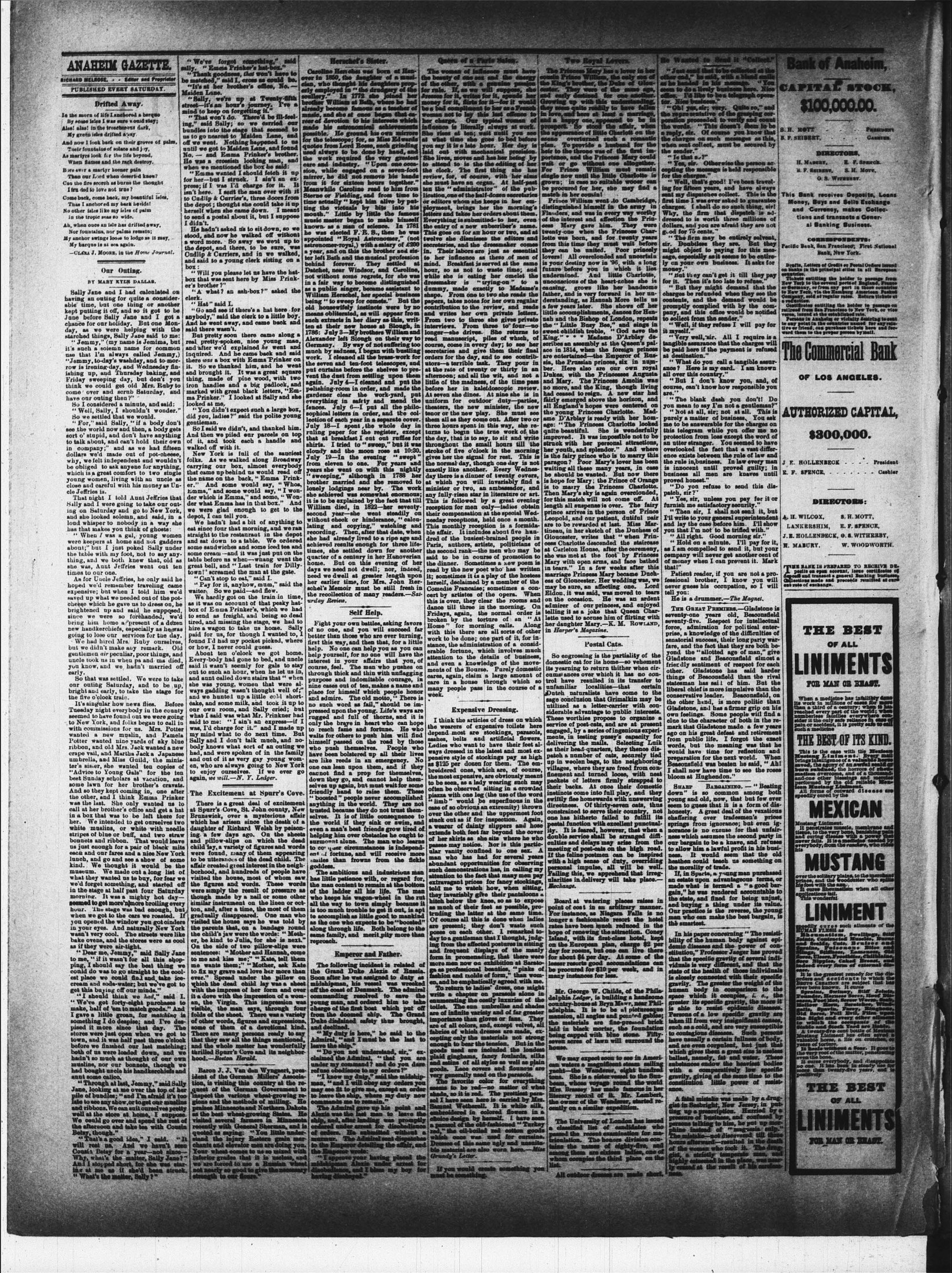
Searchable text
ANAHEIM GAZETTE.
RICHARD MELROSE. - Editor and Proprietor
PUBLISHED EVERY SATURDAY.
Drifted Away.
In the morn of life I anchored a barque
By some isles I was sure would stay;
Alas! alas! in the treacherous dark,
My green isles drifted away.
And now I look back on their groves of palm,
Their fountains of solace and joy,
As martyrs look for the life beyond,
When flames and the raak destroy.
Bore ever a martyr keener pain
Than our Lord when deserted know?
Can the fire scorch as burns the thought
I frusted to love not true?
Come back, come back, my beautiful isles,
Thus I anchored my bark beside!
No other isles like my isles of palm
in the tropic seas so wide.
Ah, when once an isle has drifted away,
Nor fountains, nor palms remain;
My anchor swings loose to lodge as it may,
My barque is at sea again.
— CLERA J. MOORE, in the Home Journal.
Our Outing.
BY MARY KYLE DALLAS.
Sally Jane and I had calculated on having an outing for quite a considerable time, but one thing or another kept putting it off, and so it got to be June before Sally Jane and I got a chance for our holiday. But one Monday, as we were helping with the starched things, Sally Jane said to me:
"Jemmy," (my name is Jemima, but it's such a solemn name for common use that I'm always called Jemmy.)
"Jemmy, to-day's washday, and to-morrow is irening-day, and Wednesday finishing up, and Thursday baking, and Friday sweeping day, but don't you think we could get old Mrs. Ruby to come over and scrub Saturday, and have our outing then?"
So I considered a minute, and said:
"Well, Sally, I shouldn't wonder."
So we settled that we would.
"For," said Sally, "if a body don't see the world now and then, a body gets sort o' stupid, and don't have anything to talk about, and can't hold their own in company;" and as we had fifteen dollars we'd made out of pot-cheese, why, we felt independent and wouldn't be obliged to ask anyene for anything, which is a great comfort to two single
"We've forgot something," said sally. "Emma Prinker's hat-box."
Thank goodness, that won't have to be matched," said I, crosses could be.
"It's at her brother's office, No. — Maiden Lane.
"Sally, we're up at Twenty-fifth street—it's an hour's journey. I've a mind to keep on forgetting it."
"That won't do. There'd be ill-feeling," said Sally; so we carried our bundles into the stage that seemed to us to go nearest to Maiden Lane, and off we went. Nothing happened to us until we got to Maiden Lane, and found No. — and Emma Prinker's brother. He was a crossish looking man, and when we mentioned the box he said:
"Emma wanted I should fetch it up for her—but I struck. Iain't an express; if I was I'd charge for it. It isn't here. I sent the man over with it to Cudlip & Currier's, three doors from the depot; thought she could take it up herself when she came down. I meant to send a postal about it, but I suppose I didn't.
He hadn't asked us to sit down, so we stood, and now he walked off without a word more. So away we went up to the depot, and there, to be sure, was Cudlip & Curriers, and in we walked, and said to a young clerk sitting on a box:
"Will you please let us have the hat-box that was sent here by Miss Prinker's brother?"
"A what? an ash-box?" asked the clerk.
"Hat" said I.
"Go and see if there's a hat here for anybody," said the clerk to a little boy. And he went away, and came back and said there wasn't.
But pretty soon there came along a real pretty-spoken, nice young man, and after we'd explained he went and inquired. And he came back and said there was a box with Emma Prinker on it. So we thanked him, and he went and brought it. It was a great square thing, made of pine wood, with two iron handles and a big padlock, and marked with great black letters, "Emma Prinker." I looked at Sally and she looked at me.
"You didn't expect such a large box, did you, ladies?" said the polite young gentleman.
So I said we didn't, and thanked him. And then we piled our parcels on top of it, and took each a handle and walked off with it.
New York is full of the sauciest folks. As we walked along Broadway carrying our box, almost everybody that came up behind us would read off
Herachet.
Caroline Harcock over in 1850, the clan, who thought early employed in "scullery." In 1872 brother William already become first musician, and she at reefer of devotion made his astronaut possible. He grew for the telescope; quotes from Lord Meanwhile Caroline Sterne or Fielding time actually "kept the victual month." Little music master began known as a man he was elected II appointed "Roya astrenomer-royal," a year, and on this ter left Bath and the behind forever.
Datchet, near Woolton without some in a fair way to it as a public singer William Herschel being "to sweep old housewifely means obliterated such extracts in Helen at their new 1786: July 3—Mr Alexander left St Germany. By much by sadness work. I cleaned the seven and ten put contains before vent the dust frost again. July 4—polishing-room in gardener clear everything in fencees. July 6—sophical letters in lection of each ye July 18—I spent ruling paper for that at breakfast shirts. I tried cloudy and the July 19—In tha from eleven to years she went
Friday sweeping day, but don't you think we could get old Mrs. Ruby to come over and scrub Saturday, and have our outing then?
So I considered a minute, and said:
"Well, Sally, I shouldn't wonder."
So we settled that we would.
"For," said Sally, "if a body don't see the world now and then, a body gets sort of stupid, and don't have anything to talk about, and can't hold their own in company;" and as we had fifteen dollars we'd made out of pot-cheese, why, we felt independent and wouldn't be obliged to ask anyone for anything, which is a great comfort to two single young women, living with an uncle as close and careful with his money as Uncle Jeffries is.
That night I told Aunt Jeffries that Sally and I were going to take our outing on Saturday and go to New York, and she looked solemn, and said, in a loud whisper to nobody in a way she has that makes you think of ghosts:
"When I was a gal, young women were keepers at home and not gadders about;" but I just poked Sally under the table with my foot, not to say anything, and we both knew that, old as she was, Aunt Jeffries went out ten times to our one.
As for Uncle Jeffries, he only said he hoped we'd remember traveling came expensive; but when I told him we'd saved up what we needed out of the pot-cheese which he gave us to dress on, he brightened up and said he supposed, since we were so forehanded, we'd bring him home a present of a dozen new handkerchiefs, especially as he was going to lose our services for the day.
We had hired Mrs. Ruby ourselves, but we didn't make any remark. Old gentlemen air peculiar, poor things, and uncle took us in when pa and ma died, you know, and we hadn't married off early.
So that was settled. We were to take our outing Saturday, and to be up, bright and early, to take the stage for the five o'clock train.
It's singular how news flies. Before Tuesday night everybody in the county seemed to have found out we were going to New York, and folks began to call in with commissions for us. Mrs. Potter wanted a new muslin, and Pamela Potter wanted nine yards of sky blue ribbon, and old Mrs. Jack wanted a new crape vail, and Martha Jack a Japanese umbrella, and Miss Guild, the minister's sister, she wanted ten copies of "Advice to Young Gals" for the ten best Sunday scholars at vacation, and some lawn for her brother's cravats. And so they kept coming in, one after the other, and I think Emma Prinker was the last. She only wanted us to call at her brother's office and get a hat in a box that was to be left there for her. We intended to get ourselves two white muslins, or white with needle stripes of blue or buff, and two straw bonnets and ribbon. That would leave us just enough for a pair of black mits eason and our fares and a nice New York lunch, and go and see a show of some kind. We thought it would be the museum. We made out a long list of what they wanted us to buy, for fear we we'd forget something, and started off in the stage at half past four Saturday morning. It was a mighty hot day—
New York is full of the sauciest folks. As we walked along Broadway carrying our box, almost everybody that came up behind us would read off the name on the back, "Emma Prinker." And some would say, "Whoa, Emma," and some would say, "I wonder which is Emma," and some, "Wonder what Emma has in that box." And we were glad enough to get to the depot, I can tell you.
We hadn't had a bit of anything to eat since four that morning, and we ran straight to the restaurant in the depot and sat down to a table. We ordered some sandwiches and some iced tea and some cream—and it was just put on the table before us when—whang went the great bell, and "Last train for Dilly-town!" screamed the man at the gate.
"Can't stop to eat," said I.
"Pay for it, anyhow, mum," said the waiter. So we paid—and flew.
We hardly got on the train in time, as it was on account of that peky hatbox of Emma Prinker's, which we had to send as freight, and being so dead tired, and missing the stage, we had to hire a wagon to take us home. Sally paid for us, for though I wanted to, I found I'd had my pocket picked, where or how I never could guess.
About ten o'clock we got home. Every-body had gone to bed, and uncle said it wasn't seemly for gals to stay out to such an hour, when he let us in, and aunt called down stairs that "when she was young, women that were always gadding wasn't thought well of;" and we hunted up a little cold shortcake, and some milk, and took it up to our own room, and Sally cried; but what I said was what Mr. Prinkner had said to me: "Iain's an express—if I was I'd charge for it." And I made up my mind what to do next time. But Sally and I don't talk much, and nobody knows what sort of an outing we had, and were spoken of in the family and out of it as very gay young women, who are always going to New York to enjoy ourselves. If we ever go again, we will.—N. Y. Ledger.
The Excitement at Spurr's Cove.
There is a great deal of excitement at Spurr's Cove. St. John county, New Brunswick, over a mysterious affair which has arisen since the death of a daughter of Richard Welsh by poisoning a few days ago. On the sheets and pillow-slips on which the dead child lay,a variety of figures and words were found,many of them appearing to be utterances of the dead child. The affair created great interest in the neighborhood,and hundreds of people have visited the house,most of whom saw the figures and words. These words were simply the result of pressure as though made by a nail or some other thing,made of pine wood,two iron handles and a big padlock,and marked with great black letters," Emma Prinker." I looked at Sally and she looked at me,
"You didn't expect such a large box,did you ladies?" said the polite young gentleman.
So I said we didn't,and thanked him. And then we piled our parcels on top of it,and took each a handle and walked off with it.
New York is full of the sauciest folks. As we walked along Broadway carrying our box, almost everybody that came up behind us would read off the name on the back," Emma Prinker." And some would say," Whoa, Emma,"and some would say," I wonder which is Emma,"and some," Wonder what Emma has in that box." And we were glad enough to get to the depot,i can tell you.
We hadn't had a bit of anything to eat since four that morning,and we ran straight to the restaurant in the depot and sat down to a table. We ordered some sandwiches and some iced tea and some cream—and it was just put on the table before us when—whang went the great bell,and "Last train for Dilly-town!" screamed the man at the gate.
"Can't stop to eat," said I.
"Pay for it, anyhow,mum," said the waiter. So we paid—and flew.
We hardly got on the train in time,
as it was on account of that peky hatbox of Emma Prinker's,the which we had to send as freight,and being so dead tired,and missing the stage,the had to hire a wagon to take us home.Sally paid for us,for though I wanted to,i found I'd had my pocket picked,where or how.I never could guess.
About ten o'clock we got home.Every-body had gone to bed,and uncle said it wasn't seemly for gals to stay out to such an hour,when he let us in,and aunt called down stairs that "when she was young,women that were always gadding wasn't thought well of;"and we hunted up a little cold shortcake,and some milk,and took it up to our own room,and Sally cried;but what I said was what Mr. Prinkner had said to me: "Iain's an express—if I was I'd charge for it."And I made up my mind what to do next time.But Sally and I don't talk much,and nobody knows what sort of an outing we had,and were spoken of in the family and out of it as very gay young women,who are always going to New York to enjoy ourselves.If we ever go again,\never go again,friendly hand."
The Excitement at Spurr's Cove.
There is a great deal of excitement at Spurr's Cove. St. John county,新 brunswick,over a mysterious affair which has arisen since the death of a daughter of Richard Welsh by poisoning a few days ago.On the sheets and pillow-slips on which the dead child lay,a variety of figures和words were found,manyof them appearingto be utterancesofthedeadchild.Theaffirerecreatedgreatinterestinthenearborhood,andhundredsofpeoplehavisitedthehouse,mostofwhom sawthefiguresandwordsThesewordsweresimplytheresultofpressureasideffectedeverythinginthesecthoseyearsshewentonlysweeping,"altbrothermarriedlonelylodgingssheachettquarterofaccenthome。但ondaysweneednowneednewdwellafterher earliertime,shelle'sMemoirtherecollectionurdayReview。
Fight your ownof no one,andbetterthan thosefirstthisway,andhelp.Noonecanhelpyourself,forginterinyouncourse feel.THroughthickandpurposeandinminecasesoutofplaceforhimseandadmire.ThenosuchwordpassedupontheruggedandfullyonlythebraverywaitsforsomephysicallettersinlectionofeachyearJuly18-Ithenthreefromeleventoyearsshewentonlysweeping,"altbrothermarriedlonelylodgingssheachettquarterofaccenthome。但ondaysweneednowneednewdwellafterher earliertime,shelle'sMemoirtherecollectionurdayReview。
was the last. She only wanted us to call at her brother's office and get a hat in a box that was to be left there for her. We intended to get ourselves two white muslins, or white with needle stripes of blue or buff, and two straw bonnets and ribbon. That would leave us just enough for a pair of black mits each and our fares and a nice New York lunch, and go and see a show of some kind. We thought it would be the museum. We made out a long list of what they wanted us to buy, for fear we we'd forget something, and started off in the stage at half past four Saturday morning. It was a mighty hot day—seemed to get more'nmore broiling every hour. The stage was bad enough, but when we got to the cars we roasted. If you opened the window you got oinders in your eyes. And naturally New York wasn't very cool. The streets were like bake ovens, and the stores were as cool as if they were air-tight.
"Dear me, Jemmy," said Sally Jane to me, "if it wasn't for all this shopping, I should say the best thing we could do was to go straight to the coolest place we could find and take ice cream and soda-water; but we've got to get this buying off our minds."
"I should think we had," said I. "We've got forty-eight purchases to make, half of 'em to match goods." And I gave a little groan, for matching is something I do despise; and I've despaired it more since that day. The stores were just open when we got to town, and it was half past three o'clock before we finished our last matching; both of us were loaded down, and we hadn't so much as thought of our own musline, nor our bonnets, though we had bought uncle his handkerchiefs and anunt some calico.
"Through at last, Jemmy," said Sally Jane, looking at me over the top of her pile of bundles; "and I'm afraid it's too late to see any show, or to get our muslins and ribbons. We can suit ourselves pretty well at the store at home, I suppose. We could go over and spend the rest of the afternoon and take tea with Cousin Betay, though."
"It that's a good idea," I said. "It will rest no. And we haven't seen Cousin Betay for a year—not since Why, what's the matter, Sally Jane?" And I stopped short, for she was starling at me as if she'd been struck.
"What's the matter, Sally?"
There is a great deal of excitement at Spurr's Cove, St. John county, New Brunswick, over a mysterious affair which has arisen since the death of a daughter of Richard Welsh by poisoning a few days ago. On the sheets and pillow-slips on which the dead child lay, a variety of figures and words were found, many of them appearing to be utterances of the dead child. The affair created great interest in the neighborhood, and hundreds of people have visited the house, most of whom saw the figures and words. These words were simply the result of pressure as though made by a nail or some other similar instrument on the linen or cotton, and after a time, the most of them gradually disappeared. One man who visited the house says he was told by the parents that, on a bandage round the child's jaw were the words: "Mother, be kind to Julia, for she is next." On the side of two pillow-slips were sentences: "Mother and Hannah come to me and kiss me;" "Kate, tell them me wants them;" "Mother, ask Kate to fix my grave and love her more than ever." Spread under the pillow on which the dead child lay was a sheet with the impress of her form and over it a dove with the impression of a woman, the Virgin. This impression was visible, the man says, through four folds of the sheet. There was a variety of other words, figures and expressions, some of them of a devotional kind. There are many persons ready to say that they saw all the things mentioned, and the whole matter has wonderfully thrilled Spurr's Cove and its neighborhood.
Baron J. J. Van dan Wyngnert, president of the German Millers' Association, is visiting this country at the request of the German Government to inspect the various wheat-growing regions and the methods of milling. He praises Minnesota and Northern Dakota as the best wheat-growing States. He visited several farmers in Minnesota recently with General Sherman, and is quoted as saying: "You little understand the injury Eastern grain merchants and elevator men are doing you. Your wheat comes to us so mixed with inferior grades that it is useless, and we are forced to use a Russian wheat not nearly so good to give the necessary strength to our flour."
The ambition has little patience for the man contented of the ladder who keeps his wife all the way to the coast of North America to conquer circus entitlement fortune, smiles than frightened goddess.
The ambition has little patience for the man contented of the ladder who keeps his wife all the way to the coast of North America to conquer circus entitlement fortune, smiles than frightened goddess.
The following is Grand Duchess Soon after he was midshipman, off the coast of North America to command young man, and charge of the first from the doom Duke disbanded and declined.
My duty is Admiral, "and I leave the ship."
Do you not claim the Admiral under my command refuse obedience?
I know my man, "and I may see fit to go to leave the ship commands me.
The Admiral Alexia was the ship, and after ordered under orders. He moved to the Emperor's Emperor.
I approve my midshipman disobedience, having dismayed...
Herschel's Sister.
Caroline Herschel was born at Hanover in 1850, the daughter of a musician, who thought his daughters properly employed in "the drudgery of the scollary." In 1772 she joined her brother William at Bath, where he had already become famous as a teacher of music, and she at once began that career of devotion to his interests which made his astronomical achievements possible. He ground his own mirrors for the telescope; for, as Miss Edwards quotes from Lord Bosse, such grinding used always to be done by hand, and the work required the very greatest care and industry. "Upon one occasion, while engaged on a seven-foot mirror, he did not remove his hands from it for sixteen hours together." Meanwhile Caroline read to him from Sterne or Fielding, and from time to time actually "kept him alive by putting the victuals by hits into his mouth." Little by little the famous music master began to make himself known as a man of science. In 1781 he was elected F. R. S., then he was appointed "Royal Astronomer," (not astronomer-royal), with a salary of £200 a year, and on this the brother and sister left Bath and the musical profession behind forever. They settled at Datchet, near Windsor, and Caroline, not without some regrets, for she was in a fair way to become distinguished as a public singer, became assistant to William Herschel, her special business being "to sweep for comets." But the old housewife instincts were by no means obliterated, as will appear from such extracts in her diary as this, written at their new house at Slough, in 1786: July 3—My brothers William and Alexander left Slough on their way to Germany. By way of not suffering too much by sadness, I began with bustling work. I cleaned all the brass-work for the seven and ten-foot telescopes, and put curtains before the shelves to prevent the dust from settling upon them again. July 4—I cleaned and put the pelishing room in order, and made the gardener clear the work-yard, put everything in safety and mend the fences. July 6—I put all the philosophical letters in order, and the collection of each year in a separate cover. July 18—I spent the whole day in ruling paper for the register, except that at breakfast I cut out ruffles for shirts. I tried to "sweep," but it was cloudy and the moon rose at 10:30. July 19—In the evening "swept" from eleven to one. For years and years she went on with this nightly routine.
Queen of a Paris Salon.
The woman of influence must have the beauty of one sex and the energy of the other, with a genuine passion for rule. If, as we will suppose, she dresses for it, writes for it, spends her money for it, flirts for it—for it would be a bad compliment to her as a French woman not to lay this last offence to her charge. Our typical woman of influence is literally always at work. She rises at ten; wait until you see what time she goes to bed before you say it is a late hour. Her day is laid out with mechanical precision. She lives, moves and has being by to attend to is the the editing of her clock. The first thing she has review, for, of course, with her aims she must have an organ. At half-past ten the "administrator" of the publication, one of the half-dozen secretaries or editors whom she keeps in her employment, brings her the morning's letters and takes her orders about them. Everything is submitted—to her, even the entry of a new subscriber's name. This goes on for an hour or two, and at twelve she dismisses the editors and secretaries, and the dressmaker comes in. Their labors are just as essential to her influence as these of men of mind. Breakfast is served at the same hour, so as not to waste time; and while she is eating her omelet the dressmaker is "trying-on" to a dummy, made exactly to Madame's shape. From one to two she reads the papers, takes notes for her own regular contribution to the review, and reads and writes her own private letters. From two to three she gives private interviews. From three to four—no longer—she drives. She returns to read manuscript, piles of which, of course, come in every day; to see her secretaries and give them their final orders for the day, and to see contributors—a terrible task. They pour in at the rate of twenty or thirty in an afternoon; and all the wit, and not a little of the madness, of the time pass before her in kaleidoscopic review. At seven she dines. At nine she is in uniform for outdoor duty—parties, theaterers, the new minister, the new tenor or the new play. She must see them all as they come out. After two or three hours spent in this way, she returns to begin the true work of the day, that is to say, to sit and write throughout the small hours till the stroke of five o'clock in the morning gives her the signal for rest. This is the normal day, though one day is not exactly like another. Every Wednesday there is a chance for her cousin Prince William has a lover in her cousin Prince William, the only son of the King's brother, the Duke of Gloucester. They were of the same age, and early destined for one another. Growing up with this understanding, they seem quite readily to have fallen in love, and here at least a marriage, and a happy one, appeared to be in prospect. So stood the affair, when the appearance of little Charloff on the scene overturned such a romantic plan. To provide a husband for the heir to the throne was of the first importance, and the Princess Mary could wait or go without one altogether. For Prince William must remain single now until the little Charlotte is grown; in case no suitable wooer can be procured for her, she may find a match in her cousin!
Prince William went to Cambridge, distinguished himself in the army in Flanders, and was in every way worthy of the interest and affection the Princess Mary gave him. They were twenty-one when the Princess Charlotte was born, and for twenty years from this time they must wait before they can be united. Poor princely lovers! All overlouded and uncertain is your destiny now in '96, with a long future before you in which it lies undermined. And little Charlotte, unconscious of the heart-zches she is causing, grows like her handsome father, and is very forward in her understanding, as Hannah More tells us a few years later. She shows off her little accomplishments, dances for Hannah and the Bishop of London, repeats the "Little Busy Bee," and sings in sweet childish treble. "God save the King." * * Madame D'Arblay describes an assembly at the Queen's palace in 1814, when the foreign princes are entertained—the Emperor of Russia, the Prussian princes, six in number. Here also are our own royal Dukes, with the Princesses Augusta and Mary. The Princess Amelia was no more, and the King, though living had ceased to reign. A new star had fairly emerged above the horizon, and all England's hopes were centered on the young Princess Charlotte. Madame D'Arblay is ready with her homage: "The Princess Charlotte looked quite beautiful. She is wonderfully improved. It was impossible not to be struck with her personal attractions, her youth, and splendor." And where is the fairy prince who is to marry this paragon? Poor Mary's lover has been waiting all these many years, in case he should be wanted. But now there
vent the dust from settling upon them again. July 4—I cleaned and put the palishing-room in order, and made the gardener clear the work-yard, put everything in safety and mend the fences. July 6—I put all the philosophical letters in order, and the collection of each year in a separate cover. July 18—I spent the whole day in ruling paper for the register, except that at breakfast I out out ruffles for shirts. I tried to "sweep," but it was cloudy and the moon rose at 10:30. July 19—In the evening "swept" from eleven to one. For years and years she went on with this nightly "sweeping," although in 1788 her brother married and she removed to lonely lodgings near by. The work she achieved was somewhat enormous; it is to be explained by the fact that till William died, in 1822—her seventy-second year—she went steadily on without check or hindrance, "calonating and copying," watching and recording. Then, after that date, when she had already lived to a ripe age and achieved results enough for three lifetimes, she settled down for another quarter of a century in her Hanoverian home. But on this evening of her days we need not dwell; nor, indeed, need we dwell at greater length upon her earlier time, for Mrs. John Hershel's Memoir must be still fresh in the recollection of many readers.—Saturday Review.
Self Help.
Fight your own battles, asking favors of no one, and you will succeed far better than those who are ever turning, first this way, and then that, for a little help. No one can help you as you can help yourself, for no one will have the interest in your affairs that you, of course, feel. The man who pushes on through thick and thin with unflagging purpose and indomitable courage, in nine cases out of ten, makes a name and place for himself which people honor and admire. The old motto, "There is no such word as fail," should be impressed upon the young. Life's ways are rugged and full of thorns, and it is only the brave in heart who can hope to reach fame and fortune. He who waits for others to push him will find himself passed on the road by those who push themselves. People who have been bolstered up all their lives are like reeds in an emergency. No one can lean upon them, and if they cannot find a prop for themselves, down they go, and cannot help themselves up again, but must wait for some friendly hand to raise them. These "boosted" people never accomplished anything in the world. They are not trusted because they do not trust themselves. It is of little consequence to the world if they sink or swim, and even a man's best friends grow tired of helping him over obstacles he ought to surmount alone. The man who learns to coerce circumstances is independent of fortune, and will receive more smiles than frowns from the sickle goddess.
The ambitious and industrious man has little patience with, or regard for, the man content to remain at the bottom of the ladder all his life. The man who keeps his wagon-wheel in the rut afternoon; and all the wit, and not a little of the madness, of the time pass before her in kaledoscopic review. At seven she dines. At nine she is in uniform for outdoor duty—parties, theaters, the new minister, the new tenor or the new play. She must see them all as they come out. After two or three hours spent in this way, she returns to begin the true work of the day, that is to say, to sit and write throughout the small hours till the stroke of five o'clock in the morning gives her the signal for rest. This is the normal day, though one day is not exactly like another. Every Wednesday there is a dinner of twenty cavers, at which you will invariably find a minister or two, an ambassador, and any fully-risen star in literature or art. This is followed by a great evening reception for men only—ladies obtain their compensation at the special Wednesday receptions, held once a month. This monthly reception is a formidable affair. It includes about five hundred of the busiest-brained people in Paris, authors, artists, politicians of the second rank—the men who may be said to be in course of promotion to the dinner. Sometimes a new poem is read by the new poet who has written it; sometimes it is a play of the hostess herself, declaimed by a member of the Comedie Francaise; sometimes a concert by artistes of the opera. When this is over, they clear the rooms and dance till three in the morning. On Fridays, again, the normal order is broken by the torture of an "At Home" for morning calls. Along with this there are all sorts of other work to be done; one part of it, for instance, the administration of a considerable fortune, which involves much attention to the details of business, and even a knowledge of the movements of the Bourse. Purely domestic cares, again, claim a large amount of care in a house through which so many people pass in the course of a week.
Expensive Dressing.
I think the articles of dress on which the wearers of expensive toiletis here depend most are stockings, parasols, belts and artificial flowers. Ladies who want to have their feet always dressed in the latest and most expensive style of stockings pay as high as $125 per dozen for them. The embroidered ones, which are, of course, the most expensive, are obviously meant to be seen, as a lady wearing such may often be observed sitting in a crowded piazza with one leg (the use of the word "limb") would be superfluous in the case of so obvious an extremity) thrown over the other and the uppermost foot struck out as if for inspection. Again, a wearer of dainty slippers and hose extends both feet far beyond the cover of her skirts as she sits where he who passes may notice. Nor is this particular vanity confined to one sex. A man who has had for several years abundant opportunities for observing such demonstrations has, in calling my attention to the fact that many men pay extravagant prices for fancy stockings, told me to watch how, when sitting, they invariably give their pantaloons a afternoon; and all the wit, and not a little of the madness, of the time pass before her in kaledoscopic review. At seven she dines. At nine she is in uniform for outdoor duty—parties, theaters, the new minister or the new play. She must see them all as they come out. After two or three hours spent in this way, she returns to begin the true work of the day, that is to say, to sit and write throughout the small hours till the stroke of five o'clock in the morning gives her the signal for rest. This is the normal day, though one day is not exactly like another. Every Wednesday there is a dinner of twenty cavers, at which you will invariably find a minister or two, an ambassador, and any fully-risen star in literature or art. This is followed by a great evening reception for men only—ladies obtain their compensation at the special Wednesday receptions, held once a month. This monthly reception is a formidable affair. It includes about five hundred of the busiest-brained people in Paris, authors, artists, politicians of the second rank—the men who may be said to be in course of promotion to the dinner. Sometimes a new poem is read by the new poet who has written it; sometimes it is a play of the hostess herself, declaimed by a member of the Comedie Francaise; sometimes a concert by artistes of the opera. When this is over, they clear the rooms and dance till three in the morning. On Fridays again, the normal order is broken by the torture of an "At Home" for morning calls. Along with this there are all sorts of other work to be done; one part of it, for instance, the administration of a considerable fortune, which involves much attention to the details of business, and even a knowledge of the movements of the Bourse. Purely domestic cares, again, claim a large amount of care in a house through which so many people pass in the course of a week.
Postal Cats.
So engrossing is the partiality of the domestic cat for its home—so vehement its yearning to return thither when circumstances over which it has no control have resulted in its transfer to unfamiliar localities—that certain Dutch naturalists have come to the sage conclusion that Grimalkin may be utilized as a letter-carrier with considerable advantage to public interests. These worthies propose to organize a service of post-cats,and are at present engaged by a series of ingenious experimentsin testing pussey's capacity for delivering the mails. Selecting Luikas as their head-quarters,they thence dispatch a number of cats,securely tied up in woolen bags,tothe neighboring villageswhere they are freed from confinementand turned loosewith nest packetsof letters firmly strapped to their backs.At once their domestic instincts come into full play,and they swiftly flee homewards with unswerving directness.Of thirty-seven cats,b thus constrained to serve their countrynot one has hitherto failed to fulfill its postal function with excellent punctuality.it is feared,however,that when a double service shall be arranged difficulties and delays may arise fromthe meetingof post-cats onthehighroad.Infleeingpostmencanbe inspiredwitha high senseofduty,overridingpersonalimpulse,allwillbe well.Fallingthis,we apprehendthatirregularitiesindeliverywilltakeplace.-Machange.
The ambitious and industrious man has little patience with, or regard for, the man content to remain at the bottom of the ladder all his life. The man who keeps his wagon-wheel in the rut all the way to town simply because it is too much trouble to get it out, is apt to accomplish as little good to mankind as the one who expects to be "boosted" along through life. Both belong to the same family, and merit pity more than reproach.
Emperor and Father.
The following incident is related of the Grand Duke Alexis of Russia. Soon after he was assigned to duty as midshipman, his vessel was wrecked off the coast of Denmark. The admiral commanding resolved to save the young man, and ordered him to take charge of the first boat which put off from the doomed ship. The Grand Duke disdained safety thus brought, and declined.
"My duty is here," he said to the Admiral, "and I must be the last to leave the ship."
"Do you not understand, sir," exclaimed the Admiral, "that you are under my command? and do you dare refuse obedience to my orders?"
"I know my duty," said the midshipman, "and I will obey any orders you may see fit to give me, except an order to leave the ship, where my duty now commands me to remain."
The Admiral gave up his point and Alexis was the last man to leave the ship, and, after landing was promptly ordered under arrest for disobedience of orders. He submitted without a murmur. The Admiral sent dispatches to the Emperor detailing the affair, and the Emperor wrote:
"I approve your having placed the midshipman Alexis under arrest for disobedience, and I bless my boy for having dismayed."
If you would create something you must be something.
Board at watering places raises in point of cost in an arbitrary manner. For instance, as Niagara Falls is no longer a fashionable resort the hotel rates have been much reduced in the hope of renewing the attraction. Coney Island, with its first-class hotel, kept on the European plan, charge $2 per day for rooms, but one can live there for about $4 per day. At some of the lesser resorts good accommodations can be procured for $10 per week, and in many instances for less.
Mr. George W. Childs, of the Philadelphia Ledger, is building a handsome country-house at Bryn Mawr, near Philadelphia. It is to be a picturesque mansion, all angles and pointed gables; the materials are fine-pressed brick laid in black mortar, the foundation being capped with blue stone. Fifty-seven acres of lawn will surround the house.
We may expect soon to see in American waters a magnificent steam sailing yacht—the Wanderer, eight hundred tons. She is a sister vessel to the Sunbeam, whose voyage round the world Mrs. Brassey has made famous in her literary record of it. Mr. Lambert, the owner of the Wanderer, started recently on a similar expedition.
The University of London has issued a classified list of candidates who passed the recent examination for matriculation. The honors division contains the names of eighty-five, and among them are sixteen ladies, one of whom occupies the third place on the list.
All outdoor dresses are made short.
He Wanted to Send it "Collect."
"Just send that to be collected at the other end," he said, with a blond smile as he handed in his message. "You seem to do a lively business here. Nice office. I'd like to be a telegraph operator. Nice business."
"Oh! yes, sir; very. Quite so," and the representative of the grasping corporation proceeded to verify and count the words. "This doesn't seem to be a reply, sir. Of course you know that the charges on such messages as this, when sent collect, must be secured by the sender."
"Is that a?"
"Yes, sir. Otherwise the person accepting the message is held responsible for the charges."
"Well, that's good! I've been traveling for fifteen years, and have always sent my dispatches collect. This is the first time I was ever asked to guarantee charges. I shall do no such thing, sir! Why, the firm that dispatch is addressed to is worth three millions of dollars, and you are afraid they are not good for 75 cents."
"The firm may be entirely solvent, air. Doubbless they are. But they might object to paying for this message, especially as it seems to be entirely on your own business. It asks for money."
"But they can't get it till they pay for it. Then it's too late to refuse."
"But they might demand that the charges be refunded when they see the contents, and the demand would be promptly complied with by the company, and this office would be notified to collect from the sender."
"Well, if they refuse I will pay for it myself."
"Very well, sir. All I require is a tangible assurance that the charges will be paid here if the payment is refused at destination."
"What do you call a tangible assurance? Here is my card. I am known all over this country."
"But I don't know you, and, of course, can't know how responsible you are."
"The blank dash you don't! Do you mean to say I'm not a gentleman?"
"Not at all, sir; not at all. This is purely a matter of business. You ask me to be answerable for the charges on this telegram while you offer me no protection from loss except the word of an utter stranger. You seemed to have overlooked the fact that a vast difference exists between the rule of law and the rule in business. In law every man is innocent until proved guilty; in business all men are knaves until Bank of Anaheim,
CAPITAL STOCK,
$100,000.00.
S. H. MOTT President
B. F. SEIBERT, Cashier
DIRECTORS:
H. MASURY, E. F. SPENCER,
M. F. SEIBERT, S. H. MOTT,
O. S. WITHERBY.
This Bank receives Deposits, Loans Money, Buys and Sells Exchange and Currency, makes Collections and transacts a General Banking Business.
CORRESPONDENTS:
Pacific Bank, San Francisco; First National Bank, New York.
Drafts, Letters of Credit or Postal Orders issued on banks in the principal cities in all European countries.
Tickets entitling the holder to passage from New York to the several ports of England, France or Germany, or from any port in those countries to New York, via the Hamburg American Passed Company, sold at regular rates. Return tickets at a reduction.
Certificates entitling the holder to passage on railroad from San Francisco to New York, or vice versa, issued at the established rate.
Persons in Anaheim or vicinity desiring to sent to any point in the countries named for any relative or friend, can purchase tickets here and forward them to the proper person by mail.
The Commercial Bank
OF LOS ANGELES.
AUTHORIZED CAPITAL,
$300,000.
J. E. HOLLENBECK President
E. F. SPENCE, Cashier
Princesses Augusta Princess Amelia was King, though living in King. A new star had moved the horizon, and was centered on Miss Charlotte. Mad-ready with her homestead Charlotte looked She is wonderfully impossible not to be personal attractions, tender." And where who is to marry this Mary's lover has been many years, in case it. But now there is the Prince of Orange Princess Charlotte. Again overclouded, not come off. At time is over. The fairy the person of Prince patient, dutiful pair at last. Miss Marsh of the Duchess of that "when Princessed the staircase after the ceremony, the foot by Princess arms, and face bathed New weeks after this Mary became Duch-Her wedding was, we affecting one. Lord He was an ardent princess, and enjoyed that Queen Charle see him of flirting with Y.-K. M. ROWLAND, Cine.
Total Cats.
Is the partiality of the cats home—so vehement turn thither when cir- which it has no con- in its transfer to utilities—that certain cats have come to the Grimalkin may be better-carrier with con- to public interests. propose to organize a cats, and are at present titles of ingenious experi- pussy's capacity forails. Selecting Luik letters, they thence dis- of cats, securely tied to the neighboring they are freed from con-ined loose, with neat is firmly strapped to once their domestic to full play, and they awards with unswerving thirty-seven cats, thus serve their country, not failed to fulfill its with excellent punctual- however, that when a shall be arranged diff- may arise from the cats on the high road. men can be inspired of duty, overriding all will be well. apprehend that irregularity will take place.
But I don't know you, and, of course, can't know how responsible you are."
The blank dash you don't! Do you mean to say I'm not a gentleman?"
Not at all, sir; not at all. This is purely a matter of business. You ask me to be answerable for the charges on this telegram while you offer me no protection from loss except the word of an utter stranger. You seemed to have overlooked the fact that a vast difference exists between the rule of law and the rule in business. In law every man is innocent until proved guilty; in business all men are knaves until proved honest."
Do you refuse to send this dispatch, sir?
Yes, sir, unless you pay for it or furnish me satisfactory security."
Then sir, I shall not send it, but I'll write to your general superintendent and lay the case before him. I'll show you that I'm not to be trifled with."
All right. Good morning sir."
Hold on a minute. I'll pay for it, as I am compelled to send it, but your company will never get another cent of money when I can prevent it. Mark that!
Patient reader, if you are not a professional brother, I know you will never guess his occupation, so I will tell you:
He is a drummer. — The Magnet.
The Great Premiers. — Gladstone is seventy-one years old, Beaconsfield seventy-five. Respect for intellectual force, admiration for political enterprise, a knowledge of the difficulties of senatorial success, their long party warfare, and the fact that they are both beyond the "allotted age of man," give Gladstone and Beaconsfield almost a friendly sentiment of respect for each other. Gladstone has said harder things of Beaconsfield than the rival statesman has sailed of him. But the liberal chief is more impulsive than the conservative leader. Beaconsfield, on the other hand, is more politic than Gladstone, and has a firmer grip on his own feelings. Some people will find a clue to the character of both in the remark that Gladstone made a few years ago on his great defeat and retirement from public life. I forgot the exact words, but the meaning was that he would have time for reflection and preparation for the next world. When Beaconsfield was beaten he said, "Ah! I shall now have time to see the roses bloom at Hughendon."
Sharp Bargaining. — "Beating down" is so common among both young and old, now, that but few ever seem to guess that it is a form of dishonesty. A great deal of the vexatious chaffering over tradesmen's prices springs from ignorance; but even ignorance is no excuse for that unfairness which assumes the second party in our bargain to be a knave, and refuses to allow him a lawful profit in his business. It would seem that the old heathen could teach us something on the morality of trade.
If, in Sparta, a young man purchased an estate upon advantageous terms, or made what is termed a "a good bargain," he was rendered accountable to the state, and fined for being unjust.
OF LOS ANGELES.
AUTHORIZED CAPITAL,
$300,000.
J E. HOLLENBECK President
E F. SPENCE Cashier
DIRECTORS:
A H. WILCOX, S H. MOTT,
LANKERSHIM, E F. SPENCE,
J E. HOLLENBECK, O S. WITHERBY,
H MABURY, W. WOODWORTH.
THE BANK IS PREPARED TO RECRIVE DEPOSITS ON OPEN ACCOUNT, ISSUE CERTIFICATES OF DEPOSITS AND TRANSACT A GENERAL BANKING BUSINESS. Collections made and proceeds remitted at cure rate of exchange.
THE BEST OF ALL
LINIMENTS
FOR MAN OR BEAST.
When a medicine has infilibly done its work in millions of cases for more than a third of a century; when it has reached every part of the world; when numberless families everywhere consider it the only safe reliance in case of pain or accident; it is pretty safe to call such a medicine.
THE BEST OF ITS KIND.
This is the case with the Mexican Mustang Limiment. Every mail brings intelligence of a valuable horse saved, the agony of an awful could go burn subdued, the horrors of sheam-tism overcome, and of a thousand-and-one blessings and mercies performed by the old reliable Mexican Mustang Limiment.
All forms of outward disease are speedily cured by the MEXICAN Mustang Limiment.
It penetrates muscle, membrane and tissue, to the very bone, banishing pain and curing disease with a power that never fails. It is a medicine needed by everybody from the remote, who rides his MUSTANG
over the solitary plains, to the merchant prince, and the woodcutter who splits his feet with the sage.
It causes Rheumatism when all other applications fail.
This wonderful
MEXICAN
Mustang Liniment.
It penetrates muscle, membrane and tissue, to the very bone, banishing pain and curing disease with a power that never falls. It is a medicine needed by everybody from the remote, who rides his MUSTANG over the solitary plains, to the merchant prince, and the woodcutter who splits his foes with the sage.
It curses Rheumatism when all other applications fail.
This wonderful LINIMENT speedily curves such alliments of the HUMAN FLESH as Rheumatism, Swollen Joints, Conjunctured Muscles, Nausea and Seals, Cuts, Bruises and Sprains, Poisonous Bites and Stings, Stiffness, Lameness, Old Sore, Ulcers, Prosthetics, Chhiblaine, More Nipples, Caked Breast, and indeed every form of exornal disease.
It is the greatest remedy for the disorders and accidents to which the Burn Creation are subject that has ever been known. It curses Spraines, Swollen Joints, Nauseas, Harness Surge, Heof Disseases, Foot Moist, Scarw Worm, Gush, Mallow Moist, Sarathee, Windgalls, Spavin, Purvy, Ringhose, Old Sore, Full Evil, Plum upon the sight and every other element to which the companions of the Stable and Stock Yard are liable.
A twenty-five cent bottle of Morion Mustang Liniment has often saved a valuable home, a life on crutches, or years of torture.
It heals without a Scar. It goes to the very root of the matter, penetrating even the bone.
It curses everybody, and disappears no one. It has been in steady use for more than twenty-five years, and is positively THE BEST OF ALL LINIMENTS FOR MAN OR HEART.