anaheim-gazette 1880-08-07
Scanned page
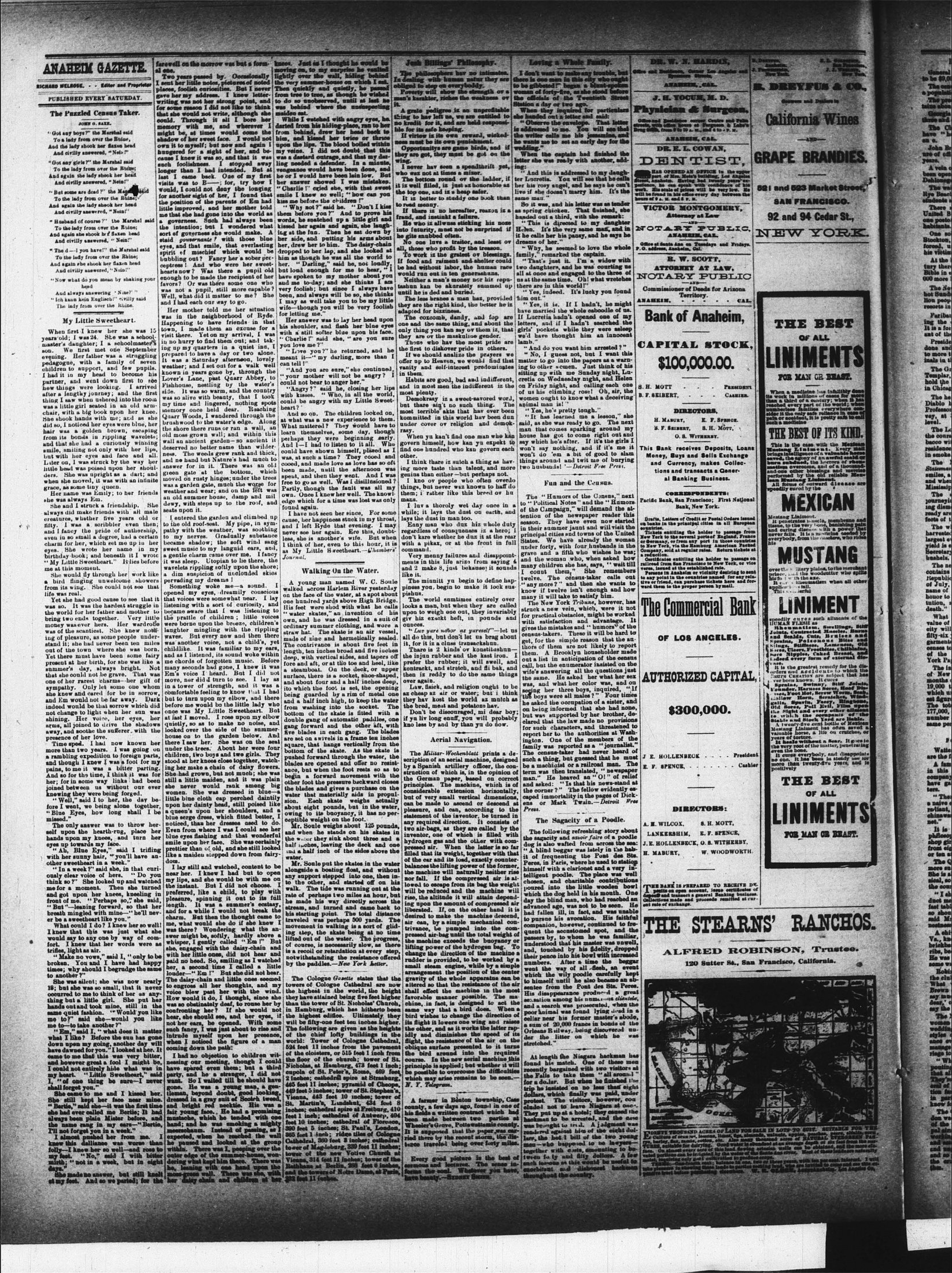
Searchable text
ANAHEIM GAZETTE.
RICHARD MELROSE. - Editor and Proprietor
PUBLISHED EVERY SATURDAY.
The Puzzled Census Taker.
JOHN G. BAXE.
"Got any boys?" the Marshal said
To a lady from over the Rhine;
And the lady shook her flaxen head
And civilly answered, "Nein!"
"Got any girls?" the Marshal said
To the lady from over the Rhine;
And again the lady shook her head
And civilly answered, "Nein!"
But some are dead? the Marshal said
To the lady from over the Rhine;
And again the lady shook her head
And civilly answered, "Nein!"
Husband of course? the Marshal said
To the lady from over the Rhine;
And again she shook her flaxen head
And civilly answered, "Nein!"
The d—I you have!" the Marshal said
To the lady from over the Rhine;
And again she shook her flaxen head
And civilly answered, "Nein!"
Now what do you mean by shaking your head
And always answering 'Nine?'
Ich kann kein Englisch! civilly said
The lady from over the Rhine.
My Little Sweetheart.
When first I knew her she was 15 years old; I was 24. She was a schoolmaster's daughter; I a schoolmaster's son. We first met one September evening. Her father was a struggling pedagogue, with a family of seven children to support, and few pupils. I had it in my head to become his partner, and went down first to see how things were looking. I arrived after a lengthy journey; and the first thing I saw when ushered into the room was a little girl seated in an old armchair, with a big book upon her knee. She shook hands with me; and as she did so, I noticed her eyes were blue, her hair was a golden brown, escaping from its bonds in rippling wavelets; and that she had a curiously winning smile, smiling not only with her lips, but with her eyes and face and all. Later on, I was struck by the way her little head was poised upon her shoulders. She was unright as a dark; and farewell on the mossrow was but a formal one.
Two years passed by. Occasionally I sent her little notes, pictures of noted places, foolish curiosities. But I never gave her my address. I knew letter-writing was not her strong point, and for some reason I did not like to think that she would not write, although she could. Through it all I bore her memory with me, and wherever I might be, at times would come the shadow of her sweet face. I would not own it to myself; but now and again I hungered for a sight of her, and because I knew it was so, and that it was such foolishness. I stopped away longer than I had intended. But at last I came back. One of my first visits was to B——; for, try how I would, I could not deny the longing for another sight of her. I found that the position of the parents of Em had little improved, and her mother told me that she had gone into the world as a governess. Such had always been the intention; but I wondered what sort of governess she would make. A staid gouernante! with those blue eyes, and that smile, that everlasting spirit of mischief which would be bubbling out? Fancy her a sober preceptress! And who were their sweet-hearts now? Was there a pupil old enough to be made the recipient of her favors? Or was there some one who was not a pupil, still more capable? Well, what did it matter to me? She and I had each our way to go.
Her mother told me her situation was in the neighborhood of Ryde. Happening to have friends in that town, I made them an excuse for a visit there. Yet on my arrival, I was in no hurry to find them out; and taking up my quarters in a quiet inn, I prepared to have a day or two alone. It was a Saturday afternoon, lovely weather; and I set out for a walk well known in years gone by, through the Lover's Lane, past Quarr Abbey, to Fishhouse, nestling by the water's side. It was so warm, and the country was so alive with beauty, that I took my time and lingered, nothing spots memory once held dear. Reaching Quarr Woods, I wandered through the brushwood to the water's edge. Along the shore there runs or ran a wall, an old moss grown wall; and within this wall an ancient garden—so ancient it deserved no better name than wilderness. The weeds grew rank and thick, and no hand but Nature's had much to answer for in it. There was an old green gate at the bottom, which knees. Just as I thought he moving on, to my surprise lightly over the wall, hid the very summer-house on wi Then quickly and quietly from tree to tree, as though to do so unobserved, until was behind where the unmaiden sat.
While I watched with angst darted from his hiding-place from behind, drew her here him, and kissed her twice upon the lips. The blood broke my veins. I did not doubt was a dastard outrage, and thieving needed a defender. In vengeance would have been he or I would have been late her answer showed I was "Charlie!" cried she, with smile I knew so well; "be kiss me before the children."
"Why not?" said he.
them before you?" And words he snatched up a kissed her again and again at the fun. Then he nailed her side, and putting his her, drew her to him. The dropped to her lap, and shied him as though he was all tilted her. "Darling," said he, but loud enough for me have spoken to my mother and me to-day; and she very foolish; but since I been, and always will be she may as well take you to wife—though you will be for letting me."
Her answer was to lay his shoulder, and flash him with a still softer blue nail "Charlie!" said she, "as you love me?
"Love you?" he returned meant it—"my darling," can tell!
"And you are sure," she "your mother will not be could not bear to anger her."
"Angry?" said he, cloak with kisses. "Who, in a could be angry with my heart?"
And so on. The children at what was a new experience What mattered? They learn themselves, some perhaps they were begin And I—I had to listen to could have shown himself was, at such a time? The cooled, and made love as he been made, until the
I had it in my head to become his partner, and went down first to see how things were looking. I arrived after a lengthy journey; and the first thing I saw when ushered into the room was a little girl seated in an old armchair, with a big book upon her knee. She shook hands with me; and as she did so, I noticed her eyes were blue, her hair was a golden brown, escaping from its bonds in rippling wavelets; and that she had a curiously winning smile, smiling not only with her lips, but with her eyes and face and all. Later on, I was struck by the way her little head was poised upon her shoulders. She was upright as a dart; and when she moved, it was with an infinite grace, as some tiny queen.
Her name was Emily; to her friends she was always Em.
She and I struck a friendship. She always did make friends with all male creatures, whether five years old or fifty. I was a scribbler even then; and I fancy the pride of authorship, even in so small a degree, had a certain charm for her, which set me up in her eyes. She wrote her name in my birthday-book; and beneath it I wrote "My Little Sweetheart." It lies before me at this moment.
She would fly through her work like a bird flinging unwelcome showers from its wing. She could not see that life was real.
Yet she had good cause to see that it was so. It was the hardest struggle in the world for her father and mother to bring two ends together. Very little money was ever hers. Her wardrobe was of the scantiest. She knew nothing of pleasure, as some people understand it; she had never been ten miles out of the town where she was born. Yet there must have been some fairy present at her birth, for she was like a summer's day, always bright. Not that she could not be grave. That was one of her rarest charms—her gift of sympathy. Only let some one whom she knew and cared for be in sorrow, and Em would not be far away. Dark indeed would be that sorrow which did not change to light when her sun was shining. Her voice, her eyes, her arms, all joined to drive the shadows away, and soothe the sufferer, with the presence of her love.
Time sped. I had now known her more than two years. I was going on a rambling expedition to foreign parts, and though I knew I was a fool for my pains, to me it was a bitter parting. And so for the time, I think it was for her; for in some way links had been joined between us without our ever knowing they were being forged.
"Well," said I to her, the day before I went, we being alone together, "Blue Eyes, how long shall I be missed."
The only answer was to throw herself upon the hearth-rug, place her hands upon my knees, and turn her eyes up towards my face.
"Ah, Blue Eyes," said I trifling with her sunny hair, "you'll have another sweetheart in a week."
"In a week?" said she, in that curiously clear voice of hers. "Do you think so?" She looked up and watched me for a moment. Then she turned and got upon her knees, kneeling in front of me.
Lover's Lane, past Quarr Abbey, to Fishhouse, nestling by the water's side. It was so warm, and the country was so alive with beauty, that I took my time and lingered, nothing spots memory once held dear. Reaching Quarr Woods, I wandered through the brushwood to the water's edge. Along the shore there runs or ran a wall, an old moss grown wall; and within this wall an ancient garden—so ancient it deserved no better name than wilderness. The weeds grew rank and thick, and no hand but Nature's had much to answer for in it. There was an old green gate at the bottom, which moved on rusty hinges; under the trees was a garden gate, much the worse for weather and wear; and on the left was an old summer house, damp and mildew, with steps up to the roof, and seats upon it.
I entered the garden and climbed up to the old roof-seat. My pipe, in sympathy with the weather, was soothing to my nerves. Gradually substance became shadow; the soft wind sang sweet music to my languid ears, and a gentle charm came over me. I fancy it was sleep. Utopian to lie there, the wavelets rippling softly upon the shore; a dim suspicion of unclouded skies pervading my dreams!
Something woke me—a sound. I opened my eyes, dreamily conscious that voices were somewhat near. I lay listening with a sort of curiosity, and became aware that I was listening to the prattle of children; little voices were borne upon the breeze, children's laughter mingling with the rippling waves. But every new and then there was another voice, not a child's, yet childlike. It was familiar to my ears, and as I listened, its sound woke within me chords of forgotten music. Before many seconds had gone, I knew it was Em's voice I heard. But I did not move, nor did I turn to see. I lay as in a tower of strength, and it was a comfortable feeling to know that I had but to turn upon my elbow, and there before me would be the little lady who once was My Little Sweetheart. But at fast I moved. I rose upon my elbow quietly, so as to make no noise, and looked over the side of the summer-house on to the garden below. And there I saw her. She was on the seat under the trees. About her were four children, two boys and two girls. They stood at her knees close together, watching her make a chain of daisy flowers. She had grown, but not much; she was still a little maiden, and it was plain she never would rank among big women. She was dressed in blue—a little blue cloth cap perched daintily upon her dainty head, still poised like a queen's upon her shoulders, and a blue serge dress, which fitted better. I noticed, than her dresses used to do. Even from where I was I could see her blue eyes flashing and that wonderful smile upon her face. She was certainly prettier than of old, and she still looked like a maiden stepped down from fairy-dom.
I lay still and watched, content to be near her. I knew I had but to open my lips, and she would be with me on the instant. But I did not choose. I preferred, like a child, to play with pleasure, spinning it out to its full knowledge in your yellow lane.
Lover's Lane, past Quarr Abbey, to Fishhouse, nestling by the water's side. It was so warm, and the country was so alive with beauty, that I took my time and lingered, nothing spots memory once held dear. Reaching Quarr Woods, I wandered through the brushwood to the water's edge. Along the shore there runs or ran a wall, an old moss grown wall; and within this wall an ancient garden—so ancient it deserved no better name than wilderness. The weeds grew rank and thick, and no hand but Nature's had much to answer for in it. There was an old green gate at the bottom, which moved on rusty hinges; under the trees was a garden gate, much the worse for weather and wear; and on the left was an old summer house, damp and mildew, with steps up to the roof, and seats upon it.
I entered the garden and climbed up to the old roof-seat. My pipe, in sympathy with the weather, was soothing to my nerves. Gradually substance became shadow; the soft wind sang sweet music to my languid ears, and a gentle charm came over me. I fancy it was sleep. Utopian to lie there, the wavelets rippling softly upon the shore; a dim suspicion of unclouded skies pervading my dreams!
Something woke me—a sound. I opened my eyes, dreamily conscious that voices were somewhat near. I lay listening with a sort of curiosity, and became aware that I was listening to the prattle of children; little voices were borne upon the breeze, children's laughter mingling with the rippling waves. But every new and then there was another voice, not a child's, yet childlike. It was familiar to my ears, and as I listened, its sound woke within me chords of forgotten music. Before many seconds had gone, I knew it was Em's voice I heard. But I did not move, nor did I turn to see. I lay as in a tower of strength, and it was a comfortable feeling to know that I had but to turn upon my elbow, and there before me would be the little lady who once was My Little Sweetheart. But at fast I moved. I rose upon my elbow quietly, so as to make no noise, and looked over the side of the summer-house on to the garden below.
And there I saw her. She was on the seat under the trees. About her were four children, two boys and two girls. They stood at her knees close together, watching her make a chain of daisy flowers. She had grown, but not much; she was still a little maiden, and it was plain she never would rank among big women. She was dressed in blue—a little blue cloth cap perched daintily upon her dainty head, still poised like a queen's upon her shoulders, and a blue serge dress, which fitted better. I noticed,than her dresses used to do.Even from where I was I could see her blue eyes flashing and that wonderful smile upon her face.She was certainly prettier than of old,and she still looked like a maiden stepped down from fairy-dom.
I lay still and watched,content to be near her.I knew I had but to open my lips,and she would be with me on the instant.But I did not choose.I preferred,like a child,to play with pleasure,spinning it out to its full surface,these are fouranda half inch broadanddeepwithvertical sidesforeandaftoratethetoodoublegangofautomaticgangforwardandthefivebladesineachgamagaresetonswivelsinafrissquarethathang verticallybottomoftheskate.Apushedforwardthroughbladesareopenedandcancebutwhenthefootbeginsafewordthefootthepressurebethleadsgatherpwaterthatmaterialysassion.Eachskateweabouteightpounds,buyowingtoitsbuoyancy,cceptibleweightonthefoorthMr.Soule weighsaboutandwhenhestandsonthewaterthey sinkabouthalfinchesleavingtheanda半 inchofthewater.Mr.Souleputtheskatallongsideaboatingfloatanysupportsteppedintotheother,andstartwalk.Thetidewasrunrateofperhapstwomilions
"Well," said I to her, the day before I went, we being alone together,
"Blue Eyes, how long shall I be missed."
The only answer was to throw herself upon the hearth-rug, place her hands upon my knees, and turn her eyes up towards my face.
"Ah, Blue Eyes," said I trifling with her sunny hair, "you'll have another sweetheart in a week."
"In a week?" said she, in that curiously clear voice of here. "Do you think so?" She looked up and watched me for a moment. Then she turned and got upon her knees, kneeling in front of me. "Perhaps so," she said, "But—leaning forward, so that her breath mingled with mine—'he'll never be a sweetheart like you."
What could I do? I knew her so well! I knew that this was just what she would say to any one by way of comfort. I knew that her words were as trifles, light as air.
"Make no vows," said I, "only to be broken. You and I have had happy times; why should I begrudge the same to another?"
She was silent; she was now nearly 18; but she was so small, that it never occurred to me to think of her as anything but a little girl. She put her hands out and took mine, still in the same quiet fashion. "Would you like me to?" said she—would you like me to—to take another?
"Em," said I, "what does it matter what I like? Before the sun has gone down upon my going, another day will have dawned for you." I looked at her. It came to me that this was very bitter, and however great a fool I might be, I could not entirely hide what was in my heart. "Little Sweetheart," said I, "of one thing be sure—I never shall forget you."
She came to me and I kissed her. She still kept her face near mine. "Bertie," said she—it was the first time she had ever called me Bertie; It had always been plain Mister before, and the name rang in my ears—"Bertie, I'll not forget you in a week."
I almost pushed her from me. I know this dalliance was worse than folly—I knew her so well—and rose to my feet. "No," said I with bitter mirth; "not in a week, but in eight days."
She made no answer, but still knelt at my feet. And so we parted; for the little blue cloth cap perched dauntily upon her dainty head, still poised like a queen's upon her shoulders, and a blue serge dress, which fitted better. I noticed, than her dresses used to do. Even from where I was I could see her blue eyes flashing and that wonderful smile upon her face. She was certainly prettier than old, and she still looked like a maiden stepped down from fairy-dom.
I lay still and watched, content to be near her. I knew I had but to open my lips, and she would be with me on the instant. But I did not choose. I preferred, like a child, to play with pleasure, spinning it out to its full length. It was a summer's ecstasy, and for a while I would not break the charm. But then the thought came to me, what would she do if she knew I was there? Wondering what the answer might be, softly, hardly above a whisper, I gently called "Em!" But she, engaged with the daisy-chain and with her little ones, did not hear and paid no heed. So, smiling as I watched her, a second time I called a little louder—"Em!" But she did not hear.
The daisy-chain and little ones seemed to engross all her thoughts, and my voice blew past her with the wind. How would it do, I thought, since she was so obstinately deaf, to rouse her by confronting her? If she would not hear, she should see, and her eyes, if not her ears, be opened. With some such fancy, I was just about to rise and intrude myself upon her presence, when I noticed the figure of a man coming down the path:
I had no objection to children witnessing our meeting, though I could have spared even them; but a third party, and he a stranger, I did not want. So I waited till he should have gone. He was a young man, a gentleman, beyond doubt, good looking, dressed in a gray suit of Scotch tweed, and bright red necktie. His was a fair young face.. He had a promising mustache, which he tended with one hand; and he was smoking a mighty meerschaum. Instead of passing, as I expected, when he reached the wall he paused and looked at the group within. There was I peeping over the outer edge of the summer-house, wondering what kept him there. There was he leaning with one hand upon the mess-green wall. There was she, with her daisy chain and children at her
Mr. Soule weighs about and when he stands on the water they sink about half inches, leaving the water and a half inch of the water.
Mr. Soule put the skate alongside a boating float any support stepped into the other, and start walking. The tide was run rate of perhaps two miles he made his way direct stream, and turned and his starting point. The traveled was perhaps five movement in walking is ing step, the skate being lifted out of the water. Of course, is necessarily a recoil or retardation notwithstanding the rest by the paddles.
The Cologne Gazette towers of Cologne Catholics highest in the world they have attained being than the tower of St. Nicola in Hamburg, which has the highest edifice. We will be fifty-one feet tall. The following are given of the chief lofty buoy world: Tower of Colony 524 feet 11 inches from of the cloisters, or 515 feet of the floor of the church Nicholas at Hamburg; cupola of St. Peter's; 2 inches; cathedral spire 465 feet 11 inches; pyramid 449 feet 5 inches; tower of Vienna, 443 feet 10 in St. Martin's, Landshut inches; cathedral spire 5 feet 1 inch; cathedral spire 10 inches; cathedral spire 380 feet 5 inches; St. Peregrine Cathedral, 360 feet 3 inches tower of Magleburg, 388 tower of the new Vienna, 314 feet 11 inches Hathana at Berlin, 288 and the towers of Notre Dame 232 feet 11 inches.
Just as I thought he would be moving on, to my surprise he vanished rightly over the wall, hiding behind the very summer-house on which I sat, then quickly and quietly, he passed from tree to tree, as though he wished to do so unobserved, until at last he was behind where the unsuspecting guarden sat.
While I watched with angry eyes, he started from his hiding-place, ran to her from behind, drew her head back to him, and kissed her twice or thrice upon the lips. The blood boiled within my veins. I did not doubt that this was a dastard outrage, and that my dazing needed a defender. In a minute, eneance would have been done, and we or I would have been lain low. But her answer showed I was mistaken. "Charlie!" cried she, with that sweet smile I knew so well; "how can you miss me before the children!"
"Why not?" said he. "Don't I kiss them before you?" And to prove his words, he snatched up a little girl and kissed her again and again, she laughing at the fun. Then he sat down by her side, and putting his arms about her, drew her to him. The daisy-chain dropped to her lap, and she looked at him as though he was all the world to her. "Darling," said he, not loudly, but loud enough for me to hear, "I have spoken to my mother about you and me to-day; and she thinks I am very foolish; but since I always have been, and always will be so, she thinks I may as well take you to be my little wife—though you will be very foolish for letting me."
Her answer was to lay her head upon his shoulder, and flash her blue eyes with a still softer blue upon his face. "Charlie!" said she, "are you sure you love me?"
"Love you?" he returned, and he meant it—"my darling, more than I can tell!"
"And you are sure," she continued, "your mother will not be angry? I could not bear to anger her."
"Angry?" said he, closing her lips with kisses. "Who, in all the world, could be angry with my Little Sweetheart?"
And so on. The children locked on, at what was a new experience to them. What mattered? They would have to learn themselves, some day, though perhaps they were beginning early. And I—I had to listen to it all. Who could have shown himself, pleased as I was, at such a time? They cooed and cooed, and made love as love has so oft been made, until the afternoon was over.
Josh Billings' Philosophy.
The philosophers have no intimates. In dealing with human nature they are obliged to step on everybody's potholes.
Poverty will show the strength of a man's karakter, richness the weakness of it.
A grate pedigree is an unprofitable thing to have left us, we are entitled to no kredit for it, and are held responsible for its safe keeping.
If virtue is its own reward, wickedness must be its own punishment.
Opportunities are game birds, and if they are got, they must be got on the wing.
I never have seen a spendthrift yet, who waz not at times a miser.
The bottom round ov the ladder, if it iz well filled, iz just az honorable az the top one, and iz a heap safer.
It iz better to studdy one book than to read menny.
If there iz no hereafter, reason iz a fraud, and instinkt a failure.
He who iz allwuss sticking his nose into futurity, must not be surprized if he gits anubbed often.
No one lavs a traitor, and least ov all, those who profit by the treason.
To work iz the greatest ov blessings. If food and raiment and shelter could be had without labor, the human race would run out in ten generashuns.
Neither a man's money nor hiz reputashun kan be akurately summed up until he is ded and buried.
The less branes a man haz, provided they are the right kind, the better he iz adapted for bizziness.
The coxcomb, dandy, and fop are one and the same thing, and about the only thing you kan say ov them iz, that they are ov the maskuline gender.
Thozs who hav the most pride are the first to discover pride in others.
If we should analyze the prayers we offer up to Heaven, we would find that vanity and self-interest predominates in them.
Habits are good, bad and indifferent, and in most men the indifferent iz the most plenty.
Demokrasy iz a sweet-savored word, but thare ain't no such thing. The most terrible akts that hav ever been committed in this world hav been dun under cover ov religion and demokrasy.
When yu kann't find one man who kan govern himself, how kan yu expekt to find one hundred who kan govern each other.
I think thare iz sutch a thing as having more taste than talent, and more genius than either—but perhaps not.
Loving a Whole Family.
I don't want to make any trouble, but there is one man in this city who ought to be gibbeted!" began a blunt-spoken woman of forty-five, as she stood before the officials of the Twentieth Street Station a day or two age.
When they inquired for particulars she handed out a letter and said:
"Observe the envelope. That latter is addressed to me. You will see that the writer calls me his jessamine,and he wants me to set an early day for the wedding."
When the captain had finished the letter she was ready with another, adding:
"And this is addressed to my daughter Lucretia. You will see that he calls her his rosy angel, and he says he can't live if she doesn't marry him. It's the same man."
So it was, and his letter was as tender as spring chicken. That flushed, she handed out a third, with the remark:
"This is directed to my daughter Helen. It’s the very same man,and in it he calls her his pansy,and he says he dreams of her."
Why, he seemed to love the whole family," remarked the captain.
"That's just it. I'm a widow with two daughters,and he was courting us all at once and engaged to the three of us at the same time. Oh! what wretches there are in this world!"
"Yes, indeed. It’s lucky you found him out."
"Yes, it is. If I hadn’t,he might have married the whole caboodle of us. If Lucretia hadn't opened one of my letters,and if I hadn’t searched the girls’ pockets while they were asleep we’d have thought him an innocent lamb."
"And do you want him arrested?"
"No, I guess not,但 I want this matter to go into the papers as a warning to other scenes.Just think of his sitting up with me Sunday night,Lucretia on Wednesday night,and Helen on Friday night,and calling each one of us his climbing rose! Oh,sir,the women ought to know what a deceiving animal man is!"
"Yes,他’s pretty tongh."
"It has learned me a lesson," she said, as she was ready to go. The next man that comes sparking around my house has got to come right out and say which he's after. If it's the girls I won't say nothing,and if it's me it won't do 'em a bit of good to slam things around and twit me of burying two husbands!" —Detroit Free Press.
"your mother will not be angry? I could not bear to anger her."
"Angry?" said he, closing her lips with kisses. "Who, in all the world, could be angry with my Little Sweetheart?"
And so on. The children looked on, at what was a new experience to them. What mattered? They would have to learn themselves, some day, though perhaps they were beginning early. And I—I had to listen to it all. Who could have shown himself, pleased as I was, at such a time? They cooed and coooed, and made love as love has so oft been made, until the afternoon was spent, and then they went. And I was free to go as well. Was I disillusioned? Partly, though the fault was all my own. Once I knew her well. The knowledge which for a time was lost was only found again.
I have not seen her since. For some cause, her happiness stuck in my throat, and I left Ryde that evening. I may never see her again. Ere this, doubtless, she is another's wife. But when I think of her, even to this hour, it is as My Little Sweetheart.—Chambers' Journal.
Walking On the Water.
A young man named W. C. Soule walked across Harlem River yesterday on the face of the water, at a spot about one hundred yards above High Bridge. His feet were shod with what he calls "water skates," an invention of his own, and he was dressed in a suit of ordinary summer clothing, and wore a straw hat. The skate is an air vessel, made of zinc and hermetically sealed. The contrivance is about five feet in length, ten inches broad and five inches deep, with vertical sides, and tapers off fore and aft, or at the toe and heel, like a steamboat. On the deck, or upper surface, there is a socket, shoe-shaped, and about four and a half inches deep, it which the foot is set, the opening being guarded by a rim of metal one and a half inch high, to keep the water from washing into the socket. The bottom of the skate is fitted with a double gang of automatic paddles, one gang forward and the other aft, with five blades in each gang. The blades are set on swivells in a frame ten inches square, that hangs vertically from the bottom of the skate. As the skate is pushed forward through the water, the blades are opened and offer no resistance, but when the foot rests so as to begin a forward movement with the other foot the pressure backward closes the blades and gives a purchase on the water that materially aids in propulsion. Each skate weighs actually about eight pounds, but in the water, owing to its buoyancy, it has no perceptible weight on the foot.
Mr. Soule weighs about 125 pounds, and when he stands on his skates in the water they sink about three and a half inches, leaving the deck and one and a half inch of the sides above the water.
Mr. Soule put the skates in the water alongside a boating float, and without any support stepped into one, then in to the other, and started off on his walk. The tide was running out at the rate of perhaps two miles an hour, but habitats are good, bad and indifferent, and in most men the indifferent iz the most plenty.
Demokrasy iz a sweet-savored word, but thare ain't no such thing. The most terrible akts that hav ever been committed in this world have been dun under cover ov religion and demokrasy.
When yu kan't find one man who can govern himself, how kan yu expekt to find one hundred who kan govern each other.
I think thare iz sutch a thing as having more taste than talent, and more genius than either—but perhaps not.
I kno ov people who often overdo things, but never was known to haff do them; i rather like this breed ov hu mans.
I luv a thoroly wet day once in a while; it lays the dust on earth, and lays the dust in man too.
Enny man who duz hiz whole duty regardless of consquenses iz a hero; i don't kare whether he duz it at the rear with a pikax, or at the front in full command.
Very menny failures and disappointments in this life arise from saying 4 and 2 make 8, just bekause! it sounds like it.
The minnitt yu begin to define happiness you, begin to make it look suspishus.
The world sumtimes entirely over looks a man, but when they are called upon to weigh one out, they invariably giv hiz exackt heft, in pounds and ounces.
"Luv yure nabor az yureself"—let us all do this, but don't let us brag about it, for it iz a cluss transackshun.
Thare is 2 kinds ov konstitashun—the injun rubber and the kast iron. I prefer the rubber; it will swell, and kontrackt, and stretch, and fli bak, and then iz reddy to do the same things over again.
Law, fisick, and religion ought to be az cheap az air or water; but i think they hav kost the world az mutch as the bred, meat and potatoze hav.
Don't be discouraged, mi dear boy; if yu liv long enuff, you will probably kno less by and by than yu do now.
Aerial Navigation.
The Militar-Woenblatt prints a description of an aerial machine, designed by a Spanish artillery officer, the construction of which is in the opinion of the German paper, based on correct principles. The machine, which is of considerable extension horizontally, but of very small vertical dimensions, can be made to ascend or descend at pleasure, and can according to the statement of the inventor, be turned in any required direction. It consists of two air-bags, as they are called by the inventor, one of which is filled with hydrogen gas and the other with compressed air. When the latter is so far filled that its weight, together with that of the car and its load, exactly counterbalances the lifting power of the former, the machine will naturally neither rise nor fall. If the compressed air is allowed to escape from its bag the weight will be reduced and the machine will rise, the altitude it will attain depend-
Fun and the Census.
The "Humors of the Census," next to "Political Notes" and the "Humors of the Campaign," will demand the attention of the newspaper reader this season. They have even now started in their summer jaunt and will visit the principal cities and towns of the United States. We have already the woman under forty, with four husbands in the grave and a fifth who wishes he was; and the woman who, when asked how many children she has says," wait till I count them." She remembers twelve. The census-taker calls out "any more?" and then she wants to know if twelve isn't enough and how many it will take to satisfy him.
The New York Tribune, however, has struck a new vein which, were it not for practical obstacles might be worked with satisfaction and advantage. It gives the mistakes and "humors" of the census-takers. These it will be hard to get, for the simple reason that the authors of them are not likely to report them. A Brooklyn householder made out a list in anticipation of the census call, but the enumerator insisted on the wife's answering all the questions just the same. He asked her what her sex was, and what her color was, and on seeing her three boys, inquired," If the boys were all males?" Four times he asked the occupation of a sister,and on being informed that she had none,但 was supported by her brother,the declared that the law made no provisions for such characters,and threatened to report her to the authorities at Washington.One of the members ofthe family was reported as a "journalist."
The census-taker had never heard of such a thing,but guessed that he must be a machinist or a railroad man.The term was then translated,"newspaper man."He heaved an "Ol"of reliefand asked: "Is that his news-stand atthe corner?"The fellow evidently escaped immortality in the pages of Dickens or Mark Twain.-Detroit Free Press.
The Sagacity of a Poodle.
The following refreshing story about the sagacity and savoir faire of a poodle dog is also wafted from across the sea:"A blind beggar was lately in the habit of frequenting the Pont des Sts.Peres,在Pariswhere he used to station himself with a clarionet and a very intelligent poodle.The place was well chosen,and charitable contributions poured into the little wooden bowlwhich the dog held in his mouth.One daythe blindmanwho had reached an
Each skate weighs actually about eight pounds, but in the water, owing to its buoyancy, it has no perceptible weight on the foot.
Mr. Sonle weighs about 125 pounds, and when he stands on his skates in the water they sink about three and a half inches, leaving the deck and one and a half inch of the sides above the water.
Mr. Sonle put the skates in the water alongside a boating float, and without any support stepped into one, then in to the other, and started off on his walk. The tide was running out at the rate of perhaps two miles an hour, but he made his way directly across the stream, and turned and came back to his starting point. The total distance traveled was perhaps 500 yards. The movement in walking is a sort of gliding step, the skate being at no time lifted out of the water. The progress, of course, is necessarily slow, as there is a recoil or retardation at every step, notwithstanding the resistance offered by the paddles.—New York letter.
The Cologne Gazette states that the towers of Cologne Cathedral are now the highest in the world, the height they have attained being five feet higher than the tower of St. Nicholas' Church, in Hamburg, which has hitherto been the highest edifice. Ultimately they will be fifty-one feet ten inches higher. The following are given as the heights of the chief lofty buildings in the world: Tower of Cologne Cathedral, 524 feet 11 inches from the pavement of the cloisters, or 515 feet 1 inch from the floor of the church; tower of St. Nicholas, at Hamburg, 473 feet 1 inch; cupola of St. Peter's, Rome, 469 feet 2 inches; cathedral spire at Strasburg, 465 feet 11 inches; pyramid of Cheops, 449 feet 5 inches; tower of St. Stephen's, Vienna, 443 feet 10 inches; tower of St. Martin's, Landshut, 434 feet 8 inches; cathedral spire at Freiburg, 410 feet 1 inch; cathedral of Antwerp, 404 feet 10 inches; cathedral of Florence, 390 feet 5 inches; St. Paul's, London, 365 feet 1 inch; ridge tiles of Cologne Cathedral, 360 feet 8 inches; cathedral tower of Magdeburg, 339 feet 11 inches; tower of the new Votive Church at Vienna, 314 feet 11 inches; tower of the Rathhaus at Berlin, 288 feet 8 inches, and the towers of Notre Dame at Paris, 232 feet 11 inches.
The following refreshing story about the sagacity and savoir faire of a poodle dog is also wafted from across the sea: "A blind beggar was lately in the habit of frequenting the Pont des Stes. Peres, in Paris, where he used to station himself with a clarionet and a very intelligent poodle. The place was well chosen, and charitable contributions poured into the little wooden bowl which the dog held in his mouth. One day the blind man, who had reached an advanced age, was not to be seen. He had fallen ill, in fact, and was unable to pursue his avocation. His faithful companion, however, continued to frequent the accustomed spot, and the passersby by, to whom he was familiar, understood that his master was unwell, and touched by his fidelity, dropped their pence into his bowl with increased numbers. After a time the beggar went the way of all flesh, an event which the wily poodle carefully kept to himself until he also became an absentee from the Pont des Stes. Peres. His disappearance produced a great sensation among his numerous clientele, and a search was prosecuted, when the poor animal was found lying dead in a cellar near his former master's abode, a sum of 20,000 francs in bonds of the Orleans Railway, being discovered under the litter on which he was stretched."
At length she Niagara hackman has found his match. One of these men recently bargained with two visitors at the Falls to take them "all around" for a dollar. But when he finished the trip he insisted on no less than eight dollars, which finally was paid under protest. The visitors, however, concluded not to leave Niagara at once. They put up at a hotel; they caused the hackman to be arrested, and the case was brought to trial. A judgment was rendered against him of the eight dollars, the hot I bill of the two young men—who happened to be lawyers—together with exists, amounting to between forty and fifty dollars. A few such lessons as this would be useful to morbitant and dishonest hackmen throughout the country.
DR. W. N. HARDIN,
Office and Bardon, Corner Los Angeles and Spanners Street,
ANAHEIM, CAL.
J. H. YOCUM, M. D.
Physician & Surgeon.
Office and Bardon, corner Centre and Palm streets, with office house at Pergama & Lake's Drug Store, from 8 to 10 A.M., and 4 to 5 P.M.
ANAHEIM, CAL.
DR. E. L. COWAN,
DENTIST,
HAS OPENED AN OFFICE in the upper part of Men. Heir's building, Los Angeles street, Anaheim. Having had twenty years' experience, he can speak with confidence of his work. His scale of prices will be very low. He will be found in his office every day between the hours of 9 A.M. and 5 P.M.
VICTOR MONTGOMERY,
Attorney at Law
AND
NOTARY PUBLIC,
ANAHEIM, CAL.
Office at Santa Ana on Tuesdays and Fridays.
P.O. address, Anaheim, Cal.
R. W. SCOTT,
ATTORNEY AT LAW,
NOTARY PUBLIC
AND
Commissioner of Deeds for Arizona Territory.
ANAHEIM, CAL.
Bank of Anaheim,
CAPITAL STOCK,
$100,000.00.
S. H. MOTT . . . President
B. F. SEIBERT , . . . Carrier
DIRECTORS.
H. MABURY, E. F. SPENCE.
B. F. SEIBERT, S. H. MOTT,
O. S. WITHERBY.
This Bank receives Deposits, Loans Money, Buys and Sells Exchange and Currency, makes Collections and transacts a Gener-
THE BEST OF ALL
LINIMENTS
FOR MAN OR BEAST.
When a medicine has infallibly done its work in millions of cases for more than a third of a century; when it has reached every part of the world; when numberless families everywhere consider it the only safe reliance in case of pain or accident, it is pretty safe to call such a medicine
THE BEST OF ITS KIND.
This is the case with the Mexican Mustang Liniment. Every mail brings intelligence of a valuable horse saved, the agony of an awful scald or burn subdued, the horrors of rheumatism overcome, and of a thousand-and-one other blessings and mercies
S. H. MOTT
PRESIDENT
B. F. SEIBERT,
CASHIER.
DIRECTORS:
H. MABURY,
E. F. SPENCE.
B. F. SEIBERT,
S. H. MOTT,
O. S. WITHERBY.
This Bank receives Deposits, Loans Money, Buys and Sells Exchange and Currency, makes Collections and transacts a General Banking Business.
CORRESPONDENTS:
Pacific Bank, San Francisco; First National Bank, New York.
Drafts, Letters of Credit or Postal Orders issued on banks in the principal cities in all European countries.
Tickets entitling the holder to passage from New York to the several ports of England, France or Germany, or from any port in those countries to New York, via the Hamburg American Packed Company, sold at regular rates. Return tickets at a reduction.
Certificates entitling the holder to passage on railroad from San Francisco to New York, or vice versa, issued at the established rate.
Persons in Anaheim or vicinity desiring to sent to any point in the countries named for any relative or friend, can purchase tickets here and forward them to the proper person by mail.
The Commercial Bank
OF LOS ANGELES.
AUTHORIZED CAPITAL,
$300,000.
J. E. HOLLENBECK
President
E. F. SPENCE,
Cashier
DIRECTORS:
A. H. WILCOX,
S. H. MOTT,
LANKERSHIM,
E. F. SPENCE,
J. E. HOLLENBECK, O. S. WITHERBY.
H. MABURY,
W. WOODWORTH.
THE BANK IS PREPARED TO RECEIVE DEPOSITS on open account, issue certificates of deposit and transact a general Banking business.
FOR MAN OR BEAST.
When a medicine has infiltrably done its work in millions of cases for more than a third of a century; when it has reached every part of the world; when numberless families everywhere consider it the only safe reliance in case of pain or accident, it is pretty safe to call such a medicine.
THE BEST OF ITS KIND.
This is the case with the Mexican Mustang Liniment. Every mail brings intelligence of a valuable horse saved, the agony of an awful scald or burn subdued, the horrors of rheumatism overcome, and of a thousand-and-one other blessings and miracles performed by the old reliable Mexican Mustang Liniment.
All forms of outward disease are speedily eured by the MEXICAN Mustang Liniment.
It penetrates muscle, membrane and tissue to the very bone, banishing pain and curing disease with a power that never fails. It is a medicine needed by everybody, from the rancher, who rides his MUSTANG over the military plains, to the merchant prince, and the woodcutter who splits his foot with the axe.
It can Rheumatism when all other applications fail.
LINIMENT
speedily eures such alliments of the HUMAN FLESH as Theumatism, Swellings, Stiff Joints, Contracted Muscles, Nerves and Scales, Cuts, Bruises and Nipines, Polemonous Bites and Nipines, Stiffness, Lameness, Old Burns, Ulcers, Frostbites, Chillsinse, Bore Nipples, Caked Breast, and Laden every form of external disease.
It is the greatest remedy for the disorders and accidents to which the Hurra Creation are subject that have ever been known. It cures Sprains, Swinnay, Stiff Joints, Knoter, Harness Noses, Roof Dizzies, Foot Mot, Screw Worm, Seahallow Horn, Serathesen, Windgalls, Spavin, Parey, Ringbone, Old Sores, Poll Evil, Wine Spots and Night and every other element to which the necessities of the Stable and Stock Yard are liable.
A twenty-five cent bottle of Mexican Mustang Liniment has often saved a valuable horse, a life on crutches, or years of torture.
It heals without a Scar. It goes to the very root of the matter, penetrating even the bone.
It cures everybody, and disappears no one. It has been in steady use for more than twenty-five years, and is positively THE BEST OF ALL LINIMENTS FOR MAN OR BEAST.
DIRECTORS:
A. H. WILCOX, S. H. MOTT,
LANKERSHIM, E. F. SPENCE,
J. E. HOLLENBECK, O. S. WITHERBY.
H. MABURY, W. WOODWORTH.
THE BANK IS PREPARED TO RECEIVE DEPOSITS ON OPEN ACCOUNT, ISSUE CERTIFICIES OF DEDUCTION AND TRANSACT A GENERAL BANKING BUSINESS. Collections made and proceeds remitted at current rate of exchange.
THE STEARNS' RANCHOS.
ALFRED ROBINSON, Trustee.
120 Sutter St., San Francisco, California.
EIGHTY THOUSAND ACRES OF LAND FOR SALE IN LOTS TO SUIT. SUITABLE FOR THE CULTURE OF CRANES, LEAVES, LIMBS, SKINS, ALMONDS, MULNUTS, APPLES, PATCHES, PEARS, ALMATA, CORK, RYE, BARLEY, FAX, MANIE, COTTON, etc. Also range thousand acres of NATURAL EVENGREEN PASTURE, suitable for dairying. Good water is abundant at an average depth of six feet from the surface. On almost every acre of this land diving artifice walks can be obtained, and the more elevated portions can be lightened by the water of the finite sun ripple. Most of these lands are naturally moist, requiring only gentle cultivation to produce crops.
TERMS: One-fourth cost; balance in cash, two or three years, with ten per cent interest. I will take pleasure in showing these lands to parties seeking land, who are invited to come and see this expensive trust before purchasing them. W. H. GLENN, Amphitheatre, Los Angeles Co.