anaheim-gazette 1880-08-07
Scanned page
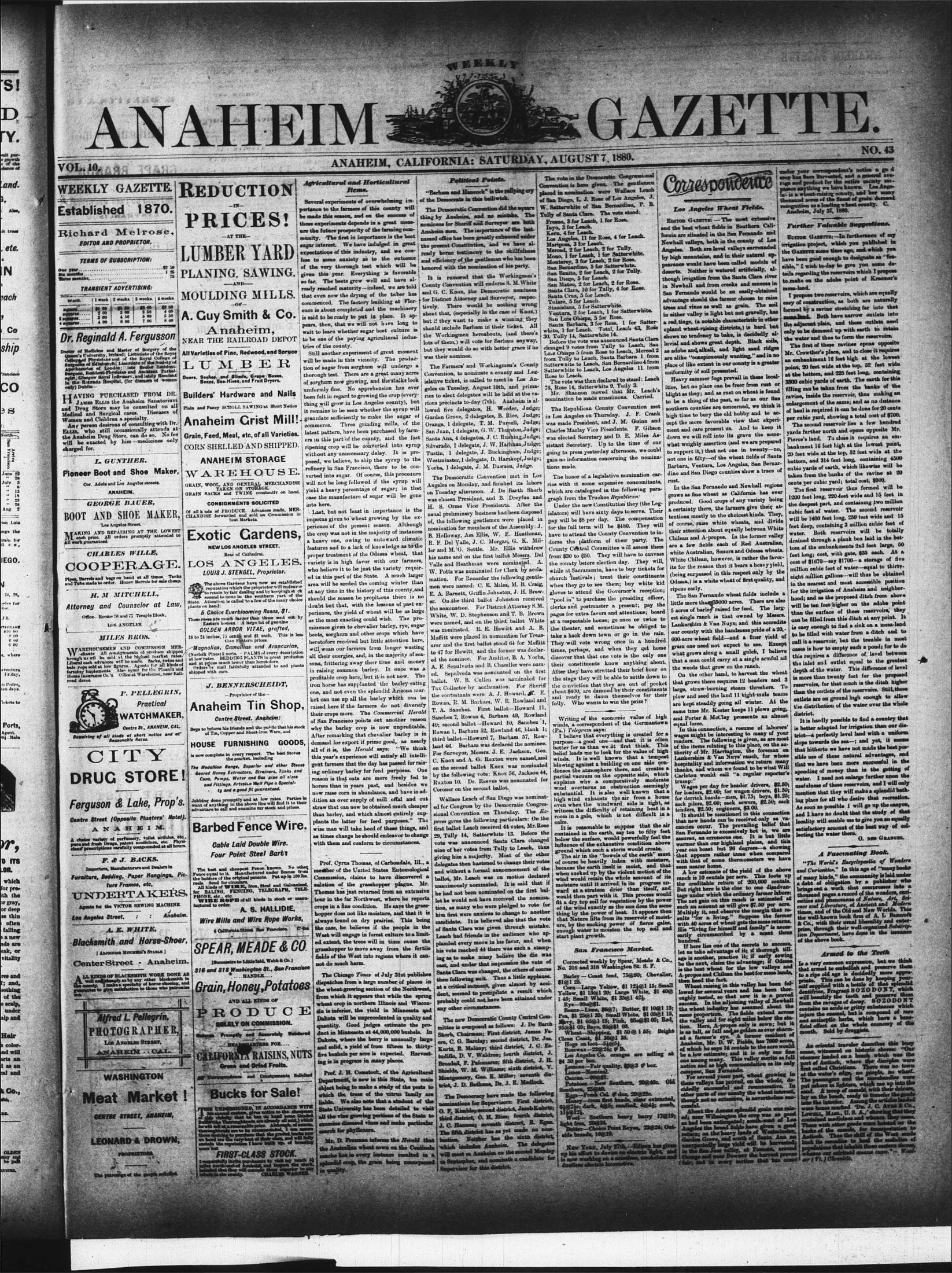
Searchable text
ANAHEIM
VOL. 10.
WEEKLY GAZETTE.
Established 1870.
Richard Melrose,
EDITOR AND PROPRIETOR.
TERMS OF SUBSCRIPTION:
One year... $2.50
Six months... $1.25
Three months... $75
TRANSIENT ADVERTISING:
SPACE
1 week
2 weeks
3 weeks
4 weeks
squares... $1.50
squares... $3.00
squares... $2.50
squares... $4.00
squares... $6.00
$2.50
$4.00
$5.00
$6.00
Dr. Reginald A. Fergusson
Doctor of Medicine and Master of Surgery of the Queen's University, Ireland; Licentiate of the Royal College of Physicians and of the Royal College of Surgeons of Edinburgh; Licentiate of the Society of Apothecaries of London; late Senior Resident Burger, Resident-Physician and Assistant Pathologist, Glasgow Royal Infirmary, and lately Resident in the Rotunda Hospital, (for diseases of women only) Dublin.
HAVING PURCHASED FROM DR. JAMES ELLIS the Anaheim Sanatorium and Drug Store may be consulted on all Medical and Surgical cases. Diseases of Women and Children a specialty.
Any person desirous of consulting with Dr. Ellis, who still occasionally attends at the Anaheim Drug Store, can do so. No fee will be exacted by him—medicines only charged for.
L. GUNTHER.
Pioneer Boot and Shoe Maker,
REDUCTION IN PRICES!
AT THE LUMBER YARD PLANING, SAWING, AND MOULDING MILLS.
OF A. Guy Smith & Co.
Anaheim,
NEAR THE RAILROAD DEPOT
All Varieties of Pine, Redwood, and Spruce
LUMBER
Doors, Sashes, and Blinds, Grape Boxes,
Boxes, Bee-Hives, and Fruit Dryers.
Builders' Hardware and Nails
Plain and Fancy SCROLL SAWING at Short Notice
Anaheim Crist Mill!
Grain, Feed, Meal, etc., of all Varieties.
CORN SHELLED AND SHIPPED.
ANAHEIM STORAGE WAREHOUSE.
Agricultural and Ite.
Several experiments have portended to the farmer, be made this season, and these experiments depend upon the future prosperity of the farm. The first in sugar interest. We have expectations of this in less to some auxiliary of the very thorough given this year. Even so far. The beets grow ready reached maturity that even now the dry commenced. The failure is about complete is said to be ready to pears, then, that we wait to learn whether to be one of the pay tries of the county.
Still another experiment will be made in thisition of sugar from so thorough test. There of sorghum now grows uniformly fine. No been felt in regard to thing will grow in L it remains to be seen granulate sufficiently commerce. Three latest pattern, have ers in this part of the ripening crop will b without any unnecess posed, we believe, the refinery in San Francisco.
HAVING PURCHASED FROM DR. JAMES ELLIS the Anaheim Sanatorium and Drug Store may be consulted on all Medical and Surgical cases. Diseases of Women and Children a speciality. Any person desirous of consulting with Dr. Ellis who still occasionally attends at the Anaheim Drug Store, can do so. No fee will be exacted by him—medicines only charged for.
L. GUNTHER.
Pioneer Boot and Shoe Maker,
Cor. Adele and Los Angeles streets.
ANAHEIM.
GEORGE BAUER,
BOOT AND SHOE MAKER,
Los Angeles Street.
MAKING AND REPAIRING AT THE LOWEST cash prices. All orders promptly attended to All work guaranteed.
CHARLES WILLE,
COOPERAGE.
Pipes, Barrels and kegs on hand at all times. Tanks and Tubs made to order. Honey Barrels for sale cheap.
H. M MITCHELL,
Attorney and Counselor at Law,
Office - Rooms 76 and 77 Temple Block.
LOS ANGELES.
MILES BROS.
WAREHOUSEMEN AND COMMISSION MERchants. All conglomerations of produce shipped through us will be sold at the highest market rates. Liberal cash advances will be made. Sacks, twine and bale rope sold at low figures. Agents for all kinds of farming implements. Also agent for the Plamix and Home Insurance Co.'s Office at Warehouse, near Railroad denot.
P. PELLEGRIN,
Practical WATCHMAKER,
Centre St., ANAHEIM, CAL.
Repairing of all kinds at short notice and at Reasonable Rates.
CITY DRUG STORE!
Ferguson & Lake, Prop's.
Centre Street (Opposite Planters' Hotel).
ANAHEIM.
A choice variety of perfumery, toilet articles, etc., pure and fresh drugs, patent medicines, etc. Physician prescriptions carefully compounded at all hours.
F. & J. BACKS.
Importers, Manufacturers and Dealers in Furniture, Bedding, Paper Hangings, Picture Frames, etc., UNDERTAKERS,
Builders’ Hardware and Nails
Plain and Fancy SCROLL SAWING at Short Notice
Anaheim Crist Mill!
Grain, Feed, Meal, etc., of all Varieties.
CORN SHELLED AND SHIPPED.
ANAHEIM STORAGE
WAREHOUSE.
GRAIN, WOOL, AND GENERAL, MERCHANTABILITY TAKEN ON STORAGE.
GRAIN SACKS and TWINE constantly on hand.
CONSIGNMENTS SOLICITED
Of all kids of PRODUCE. Advances made, MERCHANTABILITY forwarded and sold on Commission in best Markets.
Exotic Gardens,
NEW LOS ANGELES STREET,
Rear of Cathedral.
LOS ANGELES.
LOUIS J. STENGEL, Proprietor.
The above Gardens have now an established reputation which the proprietor will endeavor to retain by fair dealing and by keeping stakes second to none in the southern part of the State. Attention is called to a few of the many choice plants on hand:
5 Choice Everblooming Rosas, $1.
These roses are much larger than those sent out by Eastern houses. A large lot of genuine GOLDEN ARBOR VITAE, grafted, 18 to 24 inches, 75 cents and $1 each. This is less than Pattern prices.
Magnolias, Camellias and Arancarias,
(Nortolk Pines) 5 sorts. PALMS of every description at low rates. BEDDING PLANTS in great profusion and at prices much lower than heretofore.
Orders by mail faithfully attended to and plants shipped with care.
J. BENNERSCHEIDT,
Proprietor of the Anaheim Tin Shop,
Centre Street. Anaheim:
Begs to inform his friends and the public that his stock of Tin, Copper and Sheet-Iron Ware, and HOUSE FURNISHING GOODS, is now complete in every respect. The best Stoves the market, including
The Medallion Range, Superior and other Stoves Geared Honey Extractors, Strainers, Tanks and Cans, Pumps, Water and Gas pipe all sizes and Fittings. Artesian Well Pipe a Specialty and a good fit guaranteed.
Jobbing done promptly and at low rates. Parties in want of anything in the above line will find it to their advantage to call and examine my stock and prices.
Barbed Fence Wire.
Cable Laid Double Wire.
Four Point Steel Barb
The best and cheapest Pence known. No other Fence equal to it. Manufactured under license from the holders of the original patents. Put up in 100 lbs. reels. Send for circulars.
All kinds of WIRE, Iron, Steel and Galvanized, for BALING, FENCING, TELEGRAPH, TELEPHONE, etc., etc.
Prof. Cyrus T
member of the U Commission, cla solution of the Thomas has just tour in the far
Ferguson & Lake, Prop's.
Centre Street (Opposite Planters' Hotel).
ANAHEIM.
A choice variety of perfumery, toilet articles, etc., pure and fresh Drugs, patent medicines, etc. Physician prescriptions carefully compounded at all hours.
F. & J. BACKS.
Importers, Manufacturers and Dealers in Furniture, Bedding, Paper Hangings, Picture Frames, etc,
UNDERTAKERS,
Agents for the VICTOR SEWING MACHINE.
Los Angeles Street.: Anaheim.
A. E. WHITE,
Blacksmith and Horse-Shoer,
[ ADJOINING MITCHELL'S STABLE ]
Center Street - Anaheim.
ALL KINDS OF BLACKSMITH WORK DONE AS well and simply as by any other blacksmith in the county. I make a specialty of horse-shoeing, and guarantee to give satisfaction to those who patronize me.
Alfred L. Pellegrin,
PHOTOGRAPHER,
LOS ANGELES STREET,
ANAHEIM..CAL.
WASHINGTON
Meat Market!
CENTRE STREET, ANAHEIM,
LEONARD & DROWN,
PROPRIETORS.
The patronage of the people solicited.
Barbed Fence Wire.
Cable Laid Double Wire.
Four Point Steel Barb?
The best and cheapest Fence known. No other Fence equal to it. Manufactured under license from the holders of the original patents. Put up in 100 lbs. reels. Send for circulars.
All kinds of WIRE, Iron, Steel and Galvanized, for BALING, FENCING, TELEGRAPH, TELEPHONE, etc., etc.
WIRE ROPE of all kinds in stock or manufactured to order.
A. S. HALLIDIE,
Wire Mills and Wire Rope Works,
6 California Street San Francisco.
SPEAR, MEADE & CO.
[Successors to Little Sold, Webb & Co.]
316 and 318 Washington St., San Francisco....HANDLE....
Grain, Honey, Potatoes
AND ALL KINDS OF PRODUCE SOLELY ON COMMISSION.
Bakers Pramply and Accurately Handered....HEADSHARTERS FOR....CALIFORNIA RAISINS, NUTS Green and Dried Fruits.
Correspondence and Consequences Solicited
Bucks for Sale!
THE UNDERSIGNED, IN ACCORDANCE WITH
My annual custom, gives notice to the shoresman of this vicinity that he has no hand some Graded Bread (the Thoroughbreds are already all sold) which he will sell at a reasonable price. Although, of course, thoroughbirds are to be recommended, I can assure them drinking to purchase that the graded hacks pork on hand are the very best of their class, and will fully satisfy the reputation I have built up, of branding more best.
FIRST-CLASS STOCK.
I respectfully invite purchaser to visit my ramshackle north-end of Anaheim, and inspect the stock, indicated that they will console their companion to any others in the county.
CHARLES WAGNER.
ANAHEIM, CALIFORNIA: SATURDAY, AUGUST 7, 1880.
Agricultural and Horticultural Items.
Several experiments of overwhelming importance to the farmers of this county will be made this season, and on the success of these experiments depends in a great measure the future prosperity of the farming community. The first in importance is the best sugar interest. We have indulged in great expectations of this industry, and we confess to some anxiety as to the outcome of the very thorough test which will be given this year. Everything is favorable so far. The beets grew well and have already reached maturity—indeed, we are told that even now the drying of the tuber has commenced. The factory building at Florence is about completed and the machinery is said to be ready to put in place. It appears, then, that we will not have long to wait to learn whether sugar beet culture is to be one of the paying agricultural industries of the county.
Still another experiment of great moment will be made in this vicinity. The production of sugar from sorghum will undergo a thorough test. There are a great many acres of sorghum now growing, and the stalks look uniformly fine. No apprehension has ever been felt in regard to growing the crop (everything will grow in Los Angeles county), but it remains to be seen whether the syrup will granulate sufficiently to make the sugar of commerce. Three grinding mills, of the latest pattern, have been purchased by farmers in this part of the county, and the fast ripening crop will be converted into syrup without any unnecessary delay. It is proposed, we believe, to ship the syrup to the refinery in San Francisco, there to be conducted into sugar. Of course, this procedure
Political Points.
"Barham and Hancock" is the rallying cry of the Democrats in this bailiwick.
The Democratic Convention did the square thing by Anaheim, and no mistake. The nominees for Sheriff and Surveyor are both Anaheim men. The importance of the last-named office has been greatly enhanced under the present Constitution, and we have already borne testimony to the skillfulness and efficiency of the gentleman who has been honored with the nomination of his party.
It is rumored that the Workingmen's County Convention will endorse S. M. White and G. C. Knox, the Democratic nominees for District Attorney and Surveyor, respectively. There would be nothing wrong about that, (especially in the case of Knox,) but if they want to make a winning they should include Barham in their ticket. All the Workingmen hereabouts, (and there's lots of them,) will vote for Barham anyway, but they would do so with better grace if he was their nominee.
The Farmers' and Workingmen's County Convention, to nominate a county and legislative ticket, is called to meet in Los Angeles on Tuesday, August 10th, and primaries to elect delegates will be held at the various precincts to-day (7th). Anaheim is allowed five delegates, H. Werder, Judge; Garden Grove, 2 delegates, B. Rice, Judge; Orange, 1 delegate, T. M. Purcell, Judge; San Juan, 1 delegate, G. W. Thurston, Judge; Santa Ana, 4 delegates, J. C. Rushing, Judge; Silverado, 1 delegate, J. W. Harman, Judge; Tustin, 1 delegate, J. Buckingham, Judge; Westminster, 1 delegate, D. Hartkopf, Judge; Yorba, 1 delegate, J. M. Dawson, Judge.
The vote in the Democratic Congressional Convention is here given. The gentlemen placed in nomination were Wallace Leach of San Diego, L. J. Rose of Los Angeles, J. W. Satterwhite of San Bernardino, P. B. Tully of Santa Clara. The vote stood:
Fresno, 3 for Leach, 1 for Rose.
Iyoyo, 3 for Leach.
Kern, 4 for Leach.
Los Angeles, 11 for Rose, 4 for Leach.
Mariposa, 3 for Leach.
Merced, 2 for Leach, 2 for Tully.
Mono, 1 for Leach, 1 for Satterwhite.
Monterey, 3 for Leach, 2 for Rose.
San Bernardino, 5 for Satterwhite.
San Benito, 2 for Leach, 2 for Tully.
San Diego, 5 for Leach.
San Matee, 2 for Leach, 2 for Rose.
Santa Clara, 10 for Tully, 4 for Rose.
Santa Cruz, 5 for Leach.
Tulare, 5 for Leach.
Stanislaus, 5 for Satterwhite.
Ventura, 2 for Leach, 1 for Satterwhite.
San Luis Obispo, 5 for Rose.
Santa Barbara, 3 for Rose, 1 for Satterwhite, 1 for Leach. Total: Leach 43, Rose 30, Tully 14, Satterwhite 14.
Before the vote was announced Santa Clara changed 9 votes from Tully to Leach, San Luis Obispo 5 from Rose to Leach, Merced 2 from Tully to Leach, Santa Barbara 1 from Satterwhite to Leach, San Bernardino 4 from Satterwhite to Leach, Los Angeles 11 from Rose to Leach.
The vote was then declared to stand: Leach 76, Rose 14, Satterwhite 9, Tully 3.
Mr. Shannon moved that Mr. Leach's nomination be made unanimous. Carried.
The Republican County Convention met in Los Angeles on Thursday. J. F. Crank was made President, and J. M. Guinn and Charles Maclay Vice Presidents. F. Gibson was elected Secretary and D. E. Miles Assistant Secretary. Up to the time of our going to press yesterday afternoon, we could gain no information concerning the nominations made.
thorough test. There are a great many acres of sorghum now growing, and the stalks look uniformly fine. No apprehension has ever been felt in regard to growing the crop (everything will grow in Los Angeles county), but it remains to be seen whether the syrup will granulate sufficiently to make the sugar of commerce. Three grinding mills, of the latest pattern, have been purchased by farmers in this part of the county, and the fast ripening crop will be converted into syrup without any unnecessary delay. It is proposed, we believe, to ship the syrup to the refinery in San Francisco, there to be converted into sugar. Of course, this procedure will not be long followed if the syrup will yield a heavy percentage of sugar; in that case the manufacture of sugar will be gone into here.
Last, but not least in importance is the impetus given to wheat growing by the experience of the present season. Although the crop was not in the majority of instances a heavy one, owing to untoward climatic features and to a lack of knowledge as to the proper treatment of the Odessa wheat, that variety is in high favor with our farmers, who believe it to be just the variety required in this part of the State. A much larger area will be seeded the coming winter than at any time in the history of this county, and should the season be propitious there is no doubt but that, with the lessons of past experience, the yield of wheat will be as large as the most exacting could wish. The prominence given to chevalier barley, rye, sugar beets, sorghum and other crops which have heretofore received but little attention here, will wean our farmers from longer wasting all their energies, and, in the majority of seasons, frittering away their time and money in raising common barley. It once was a profitable crop here, but it is not now. The iron horse has supplanted the barley eating one, and not even the splendid Arizona market can use up all the barley which can be raised here if the farmers do not diversify their crops more.
The Commercial Herald of San Francisco points out another reason why the barley crop is now unprofitable. After remarking that chevalier barley is in demand for export if prime good, as nearly all of it is, the Herald says: "We think this year's experience will satisfy all intelligent farmers that the day has passed for raising ordinary barley for feed purposes. One reason is that oats are more freely fed to horses than in years past, and besides we now raise corn in abundance, and have in addition an over supply of mill offal and cut straw that can now be obtained much cheaper than barley, and which almost entirely supplants the latter for feed purposes." The wise man will take heed of these things, and as times change he should endeavor to change with them and conform to circumstances.
Prof. Cyrus Thomas, of Carbondale, Ill., a member of the United States Entomological Commission, claims to have discovered a solution of the grasshopper plague. Mr. Thomas has just returned from an extensive tour in the Northwest where he reports Convention, to nominate a county agricultural ticket, is called to meet in Los Angeles on Tuesday, August 10th, and primaries to elect delegates will be held at the various precincts to-day (7th). Anaheim is allowed five delegates. H. Werder, Judge; Garden Grove, 2 delegates. B. Rice, Judge; Orange, 1 delegate. T. M. Purcell, Judge; San Juan, 1 delegate. G. W. Thurston, Judge; Santa Ana, 4 delegates; J. C. Rushing, Judge; Silverado, 1 delegate; J. W. Harthman, Judge; Tustin, 1 delegate. J. Buckingham, Judge; Westminster, 1 delegate. D. Hartkopf, Judge; Yorba, 1 delegate. J. M. Dawson, Judge.
The Democratic Convention met in Los Angeles on Monday, and finished its labors on Tuesday afternoon. J. De Barth Shorb was chosen President, and B. Dreyfus and H. S. Orme Vice Presidents. After the usual preliminary business had been disposed of, the following gentlemen were placed in nomination for members of the Assembly: J. B. Holloway, Asa Ellis, W. F. Heathman, R. F. Del Valle, J. C. Morgan, G. K. Miller and M.'G. Settle. Mr. Ellis withdrew his name and on the first ballot Messrs. Del Valley and Heathman were nominated. A.W. Potts was nominated for Clerk by acclimation. For Recorder the following gentlemen were named: C.E.Miles, M.B.Craig, E.A.Barnett, Griffin Johnston, J.H.Brewer. On the third ballot Johnston received the nomination. For District Attorney S.M. White, W.D.Stephenson and T.B.Brown were named, and on the third ballot White was nominated. R.E.Hewitt and A.B.Moffitt were placed in nomination for Treasurer and the first ballot stood 64 for Mofitt to 47 for Hewitt, and the former was declared the nominee. For Auditor, B.A.Yorba, A.E.Sepulveda and B.Candler were named. Sepulveda was nominated on the first ballot. W.B.Cullen was nominated for Tax Collector by acclamation. For Sheriff the contestants were A.J.Howard,M.E.Rowan,R.M.Barham.W.R.Rowland and T.A.Sanchez.First ballot—Howard 11,Sanchez 7,Rowan 4,Barham 49,Rowland 40; second ballot—Howard 10,Sanchez 1,Rowan 1,Barham 52,Rowland 46 blank 1; third ballot—Howard 7,Barham 57,Rowland 46.Barham was declared the nomineeFor Surveyor,Messrs.J.E.Jackson,C.Knox and A.G.Ruxton were named,and on the second ballot Knox was nominated by the following vote: Knox 56Jackson 44,Ruxton 10.Dr.Reeves was nominated for Coroner on the second ballot.
Wallace Leach of San Diego was nominated for Congress by the Democratic Congressional Convention on Thursday.The Express gives the following particulars:On the first ballot Leach received 44 votesMr.Rose 29,Tully 14,Satterwhite 13.Before the vote was announced Santa Clara changed nine of her votes from Tully to Leach,t thus giving him a majority.Most of the other delegates then hastened to change their votes and without a formal announcement of the ballotMr.leach was on motion declared unanimously nominated.it is said that if he had not been nominated on the first ballot would not have received the nomina
The air in the "bowels of the earth" must of course be heavily laden with moisture because the earth itself is moist,and that when snuck up by the violent motion of the wind would retain the whole amount of its moisture until it arrived in its progress unward at a stratum drier than itself,and would then part with it. This process would
write of the economic value of high winds,a correspondent of the Germantown(Pa.)Telegram says:
I believe that everything is created for a purpose—a good one—and that it is often better for us than we at first think. This belief leads me to look for the value of high winds.I is well known that a tempest blowing against a building on one side condenses the atmosphere there,and creates a partial vacuum on the opposite sidewhich explains why a comparatively moderate wind overturns an obstruction seemingly substantialIt is also well known that a high wind exhausts the air from a house even when the windward side is tight,switches the difficulty of retaining heat in room in a galewhich is not difficult in a calm.
It is reasonable to suppose that the air contained in the earth,say ten to fifty feet below the surface would powerfully feelthe influence of the exhaustive condition above ground such a storm would create.
The air in the "bowels of the earth"must of course be heavily laden with moisturebecause the earth itself is moist,and that when snuck up by the violent motion ofthe wind would retain the whole amount of its moisture until it arrived in its progress unward at a stratum drier than itself,and would then part with it. This process would
Prof. Cyrus Thomas, of Carbondale, Ill., a member of the United States Entomological Commission, claims to have discovered a solution of the grasshopper plague. Mr. Thomas has just returned from an extensive tour in the far Northwest, where he reports crops in a fine condition. He says the grasshopper does not like moisture, and that it is always found on dry prairies. This being the case, he believes if the people in the West will engage in forest culture to a limited extent, the trees will in time cause the grasshopper to move away from the fertile fields of the West into regions where it cannot do much harm.
The Chicago Times of July 31st publishes dispatches from a large number of places in the wheat-growing section of the Northwest, from which it appears that while the spring wheat crop in northern Illinois and Wisconsin is inferior, the yield in Minnesota and Dakota will be unprecedented in quality and quantity. Good judges estimate the product in Minnesota at 44,000,000 bushels. In Dakota, where the berry is unusually large and solid, a yield of from fifteen to thirty-five bushels per acre is expected. Harvesting is in progress in many places.
Prof. J. H. Comstock, of the Agricultural Department, is now in this State, his main object being to make a study of the pests to which the trees of the vitrus family are liable. We also note that a student of the State University has been detailed to visit all the vine growing portions of the State to examine diseased vines and make particular search for phylloxera.
Mr. D. Freeman informs the Herald that the Australian wheat sown on the Centinela rancho has in every instance resulted in a splendid crop, the grain being unsurpassed in quality.
Wallace Leach of San Diego was nominated for Congress by the Democratic Congressional Convention on Thursday. The Ecspress gives the following particulars: On the first ballot Leach received 44 votes, Mr. Rose 29, Tully 14, Satterwhite 13. Before the vote was announced Santa Clara changed nine of her votes from Tully to Leach, thus giving him a majority. Most of the other delegates then hastened to change their votes and without a formal announcement of the ballot, Mr. Leach was on motion declared unanimously nominated. It is said that if he had not been nominated on the first ballot he would not have received the nomination, as many who were pledged to vote for him first were anxious to change another candidate. It is believed also that the vote of Santa Clara was given through mistake. Leach had friends in the audience who applauded every move in his favor, and when his vote reached 44 there was such a stamping as to make many believe the die was cast, and under that impression the vote of Santa Clara was changed, the others of course then following suit. Thus a little applause at a critical moment, given almost by accident, seemed to precipitate a result which probably could not have been attained under any other circumstances.
The new Democratic County Central Committee is composed as follows: J. De Barth Shorb, Chairman; First district, James Feore, C. G. Barclay; second district, Dr. Jos Kurtz, R. Malony; third district, J. G. Estudillo, D. V. Waldron; fourth district, J. Broaded, F. Palomares; fifth district, J. H. Shields, W. M. Williams; sixth district, V. Montgomery, Geo. K. Miller; seventh district, J. D. Bethune, Dr. J. R. Medlock.
The Democracy have made the following nominations for Supervisors: First district, O. F. Kimble; second district, Jacob Kuhrts; third district, O. H. Bliss; fourth district, J. C. Hannon; seventh district, R. Egan. The fifth district has as yet made no nomination. Neither has the sixth district, which includes Anaheim. The delegates will meet in Anaheim on the second Monday in September, and nominate a candidate for Supervisor for this district.
San Francisco Market.
Corrected weekly by Spear, Meade & Co., No. 316 and 318 Washington St. S. F.
Barley — Coast feed, 75@80; Chevalier, $1@125.
Corn—Large Yellow, $112@115; Small Yellow, $115@120; Large White, $140@145; Small White, $135@142.
Rye—90@$1.
Beans—Lima, $6@7; Butter, $110@115;
Pea, $125@125; Small White, $105@115;
Mary, $105@115; Fink, $95@$105;
Red, $95@$105; Bayo, $95@$105;
Wheat—Shipping, $150@155;
Hogs on foot—$5@$5;
Booswax—22@24g @lb.
Los Angeles Co.oranges are selling at $450 per box.
Lemons—Fair quality,$2@3 @box.
Limes—Nominal.
Onions—90@$1.
Potatoes—New Southern, 20@40c.
Ole Southern, 25@40.
Eggs—Fresh Cal.$0dox, 20@22c.
Honey—from first hands, clear extracted 64@7he; dark, 4@5; candid, 4@4; cootable 11@12h.
Wool—Southern heavy burry 17@19 light free, 20@24.
Butter—Choice Point Reyes, 22@24; Outside brands, 16@19.
New York, July 27th.-Edison has given up his effort to devise an electric light and is now working on a nuclear smokeless and dustless electric motive.
GAZETTE.
NO. 43
Correspondence
Los Angeles Wheat Fields.
EDITOR GAZETTE: — The most extensive and the best wheat fields in Southern California are situated in the San Fernando and Newhall valleys, both in the county of Los Angeles. Both are level valleys surrounded by high mountains, and in their natural appearance would have been called models of deserts. Neither is watered artificially, although irrigation from the Santa Clara river in Newhall and from creeks and senseless in San Fernando would be an easily-obtained advantage should the farmer choose to raise trees and vines as well as grain. The soil in either valley is light but not gravelly, has a red tinge, (a notable characteristic in other upland wheat-raising districts.) is hard but shows no tendency to bake, is decidedly aluvial and shows great depth. Black soils, as adobe and alkali, and light sand ridges are alike "conspicuously wanting," and in no place of like extent in our county is a greater uniformity of soil presented.
Heavy summer fogs prevail in these localities, but no place can be freer from rust or blight as they; and as rust on wheat is found to be a thing of the past, so far as our fine southern counties are concerned, we think it high time to bury the old hobby and to accept the more favorable view that experiment and care present us. And to keep it down we will roll into its grave the somewhat weighty assertion (and we are prepared to support it), that not one in twenty—no, not one in fifty—of the wheat fields of Santa Barbara, Ventura, Los Angeles, San Bernardino and San Diego counties show a trace of under your correspondent's notice a good crop has been harvested, and a general average and product for the entire county suspense anything we have known. Los Angeles is a wheat-raising county, and her many thousand acres of the finest of grain demand recognition as a leading wheat county. C. Anaheim, July 31, 1880.
Further Valuable Suggestions.
EDITOR GAZETTE: — In furtherance of my irrigation project, which you published in the Gazette some time ago, and which you have been good enough to designate as "feasible," I wish to-day to give you some details regarding the reservoirs which I propose to make on the adobe point of Kraemer's mesa-land.
I propose two reservoirs, which are equally easy of construction, as both are naturally formed by a ravine stretching far into that mesa land. Both have narrow outlets into the adjacent plain, and these outlets need only to be dammed up with earth to retain the water and thus to form the reservoirs.
The first of these ravines opens opposite Mr. Crowther's place, and to close it requires an embankment 16 feet high at the lowest point, 20 feet wide at the top, 52 feet wide at the bottom, and 225 feet long, containing 3500 cubic yards of earth. The earth for this filling can be taken from the banks of the ravine, inside the reservoir, thus making an enlargement of the same; and as no distance of haul is required it can be done for 20 cents per cubic yard, showing a total cost of $700.
The second reservoir lies a few hundred yards further north and opens opposite Mr. Pierce's land. To close it requires an embankment 16 feet high at the lowest point, 20 feet wide at the top, 52 feet wide at the bottom, and 314 feet long, containing 4500 cubic yards of earth, which likewise will be taken from the banks of the ravine at 20
heavy summer fogs prevail in these localities, but no place can be freer from rust or blight as they; and as rust on wheat is found to be a thing of the past, so far as our fine southern counties are concerned, we think it high time to bury the old hobby and to accept the more favorable view that experiment and care present us. And to keep it down we will roll into its grave the somewhat weighty assertion (and we are prepared to support it,) that not one in twenty—no, not one in fifty—of the wheat fields of Santa Barbara, Ventura, Los Angeles, San Bernardino and San Diego counties show a trace of rust.
In the San Fernando and Newhall regions grows as fine wheat as California has ever produced. Good crops of any variety being a certain there, the farmers give their attention mostly to the choicest kinds. They, of course, raise white wheats, and divide their attention about equally between White Chilean and A-propos. In the former valley are a few fields each of Red Australian, white Australian, Sonora and Odessa wheata. White Chilean, however, is rather the favorite for the reason that it bears a heavy yield (being surpassed in this respect only by the Odessa,) is a white wheat of first quality, and ripens early.
The San Fernando wheat fields include a little more than 35000 acres. There are also 5 acres of barley raised for feed. The largest single ranch is that owned by Messrs. Lankershim & Van Nuys; and this accredits our county with the handsome pride of a 20,-000-acre wheat field—and a finer yield of grain one need not expect to see. Except what grows along a small gulch, I believe that a man could carry at a single armful all the weeds that grow on the ranch.
On the other hand, to harvest the wheat that grows there requires 12 headers and 3 large, straw-burning steam threshers. To plow and seed the land 11 eight-mule teams are kept steadily going all winter. At the same time Mr. Kester keeps 11 plows going, and Porter & McClay prosecute an almost equal force.
In this connection, a resume of laborers' wages might be interesting to many of your readers. The following is given, as are most of the items relating to this place, on the authority of Mr. Harrington, the foreman on Lankershim & Van Nuys' ranch, for whose hospitality and information we return many thanks, and whom we found to be what Will Carleton would call "a regular reporter's trump."
Wages per day for header drivers, $2.50; for loaders, $2.00; for wagon drivers, $1.50; for derrick hands—men, $1.75; boys, $1.25; sack pilers, $2.00; sack sewers, $2.50; sack tenders, $2.50; engineers, $3.00.
It should be mentioned in this connection that new hands can be received only as vacancies occur. The prevailing belief that San Fernando is excessively hot in, we are assured, an erroneous one. It is but little warmer than our highland plains, and this year can boast but 96 degrees—a showing that appears rather tame when compared with that of some thermometers we have seen near home.
A low estimate of the yield of the above ranch is 10 cents per acre. This foots up the creditable return of 200,000 centals. But right here is the clue to one disadvantage under which the ordinary farmer labors: much is estimated at
at the bottom, and 228 feet long.
at the bottom, and 350 cubic yards of earth. The earth for this filling can be taken from the banks of the ravine, inside the reservoir, thus making an enlargement of the same; and as no distance of haul is required it can be done for 20 cents per cubic yard, showing a total cost of $700.
The second reservoir lies a few hundred yards further north and opens opposite Mr. Pierce's land. To close it requires an embankment 16 feet high at the lowest point, 20 feet wide at the top, 52 feet wide at the bottom, and 314 feet long, containing 4500 cubic yards of earth, which likewise will be taken from the banks of the ravine at 20 cents per cubic yard; total cost, $900.
The first reservoir thus formed will be 1200 feet long, 220 feet wide and 15 feet in the deepest part, and containing two million cubic feet of water. The second reservoir will be 1400 feet long, 250 feet wide and 15 feet deep, containing 3 million cubic feet of water. Both reservoirs will be totally drained through a plank box laid in the bottom of the embankments 2x3 feet large, 50 feet long; cost, with gate, $35 each. At a cost of $1670—say $1700—a storage of five million cubic feet of water—equal to thirty-eight million gallons—will thus be obtained in the nearest and most accessible position for the irrigation of Anaheim and neighborhood; and as the proposed ditch from above will be ten feet higher on the adobe point than the surface of these reservoirs, they can be filled from this ditch at any point. It is easy enough to find a sink on a mega-land to be filled with water from a ditch and to call it a reservoir, but the trouble in most cases is how to empty such a pond; for to do this requires a difference of level between the inlet and outlet equal to the greatest depth of the water. This difference of level is more than twenty feet for the proposed reservoirs, for that much is the ditch higher than the outlets of the reservoirs. Still, these outlets are on ground high enough to allow the distribution of the water over the whole district.
It is hardly possible to find a country that is better adapted for irrigation than our district—a perfectly level land with a uniform slope towards the sea;—and yet, it seems that hitherto we have not made the best possible use of these natural advantages, and that we have been more successful in the spending of money than in the getting of water. I need not enlarge further upon the usefulness of these reservoirs, and I will only mention that they will make a splendid bathing place for all who desire that recreation. As soon as possible I will go up the canyon, and I have no doubt that the study of that locality will enable me to give you an equally satisfactory account of the best way of collecting the water there.
O. DES GRANGER.
A Fascinating Book.
"The World's Encyclopedia of Wonders and Curiosities." In this age of "many books of many kinds," the community is laid under a debt of obligation by a publisher who brings out a work that compresses into a thousand pages a record of the wonders, curiously charming and intriguing."
It should be mentioned in this connection that new hands can be received only as vacancies occur. The prevailing belief that San Fernando is excessively hot is, we are assured, an erroneous one. It is but little warmer than our highland plains, and this year can boast but 96 degrees—a showing that appears rather tame when compared with that of some thermometers we have seen nearer home.
A low estimate of the yield of the above ranch is 10 centals per acre. This foots up the creditable return of 200,000 centals. But right here is the clue to one disadvantage under which the ordinary farmer labors: The net gain on this ranch is estimated at such an amount as will give $7.50 per acre. Multiply it, and observe the margin that results "for a living." Suppose the farmer with 40 acres of wheat gets the same returns. His "living for himself and family" is necessarily circumscribed by a scant three hundred.
If here lies one of the secrets to success, let us take advantage of it; if thorough tillage is another, practice it; if early sowing be the next, claim the advantage; if Odessa is the best wheat for the low valleys and A-propos and Chilean the best for mega lands, then heed the fact.
Wheat raising in this valley has been followed for several years and has been thoroughly tested, so that now it is a proved success. In the adjoining valley of Newhall the wheat industry has assumed about the same proportion. The fields extend across the valley and for eight miles below the station. Here, A-propos only is sown; but it is as tall, as full and as golden as ever charmed a farmer's eye. A former resident of Anabeim, Mr. D. W. Fields, has 7000 acres, of which he says 14 centals to the acre would be a low estimate; and it is only one fine among many. This valley merits an fall notice and as high commandation as its only compere, San Fernando.
For several years past, wheat growing in these valleys has proved, on the whole, decidedly successful and remunerative. In other parts of our county the wheat interest, though not so extensive, is nevertheless successful.
About the Amnesia splendid grain was raised; near Wilmington the crop was as good as had been anticipated; south-west of Los Angeles the broad fields have given a good return; on the heavy lands of Westminster, Garden Grove, and south of Santa Ana an unexpected large yield will be harvested; in the San Jose valley, at Pomona, around Orange and near Downey the harvest proves fair; and in every section that has come
As soon as possible I will go up the canyon, and I have no doubt that the study of that locality will enable me to give you an equally satisfactory account of the best way of collecting the water there.
O. DES GRANGES.
A Fascinating Book.
"The World's Encyclopaedia of Wonders and Curiosities," In this age of "many books of many kinds," the community is laid under a debt of obligation by a publisher who brings out a work that compresses into a thousand pages a record of the wonders, curiosities and phenomena of Nature, Art, Science and Literature, of Ancient and Modern times, and of the Old and New Worlds. This well-known book firm of A. L. Bancroft & Co., with their usual liberality and enterprise, through their well-organized Subscription Department, have done in the issuance of the above book.
Armed to the Teeth
Is a very common expression, but we think that armed to embellish and preserve them to a ripe old age is decidedly more appropriate. This can be done by keeping yourself supplied with a bottle of that splendid dentifrice, Fragrant SOZODONT, which will beautify the teeth and preserve them from the ravages of decay. SOZODONT contains no acids or gritty substances which injure the enamel, but is composed of rare and antiseptic herbs, which have a beneficial effect on the whole economy of the mouth. Sold by druggists.
An oriental traveler describes this busy scene, witnessed on historic shores: "Our steamer handed on a beach which was the port of Antioch, where the disciples were first called Christians. There was no town at the water's edge, no people, no wharf. The passengers and the merchandise were put ashore in lighters, which ran up into the sand. A troop of cannels with their drivens lay on the beach, ready to transfer the goods into the interior. Among the articles landed were hoses marked 'Dr. J. C. Ayen & Co., Lowell, Mass., U.S.A.' showing that they contained medicines and whence they came. These with other goods were hoisted on the banks of the cannels, for transportation to Antioch. Thus the skill of the West snails back its renunciation to heal the malady of populations that inhabit those eastern shores, whence our spiritual manna came." — Windler (Vt.) Chronicle.