anaheim-gazette 1880-05-29
Scanned page
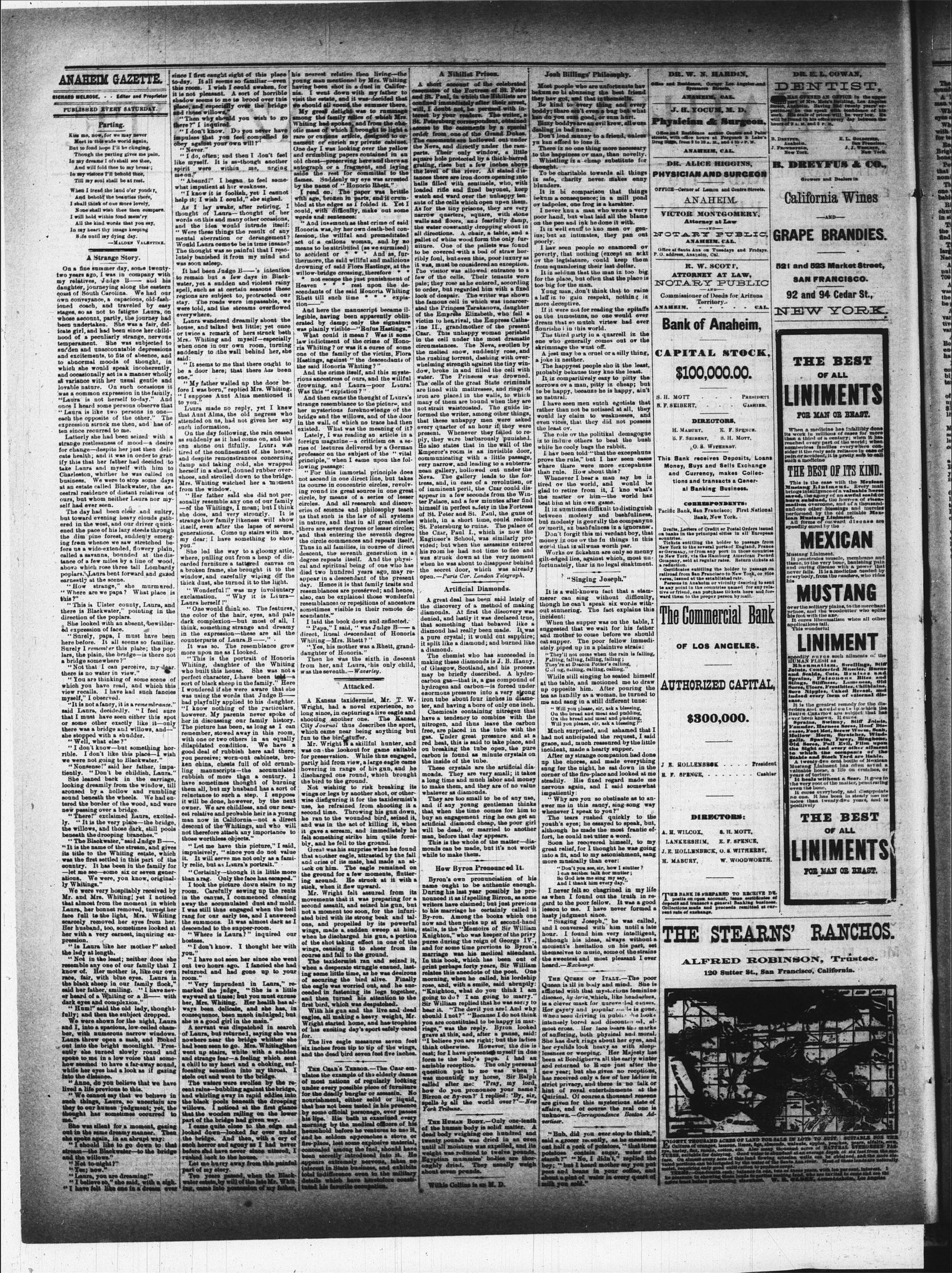
Searchable text
ANAHEIM GAZETTE.
RICHARD MELROSE. Editor and Proprietor
PUBLISHED EVERY SATURDAY.
Parting.
Kiss me, now, for we may never
Meet in this wide world again,
But to fond hope I'll be clinging.
Though the parting gives me pain.
In my dreams I oft shall see thee,
And will fold thee to my breast;
In my visions I'll behold thee,
Till my soul shall be at rest.
When I tread the land o'er yonder,
And behold the beauties there,
I shall think of one more lovely,
None shall wish thee then compare.
I will hold within fond mem'ry
All the kind words that you say,
In my heart thy image keeping
Safe until my dying day.
—MALDEN VALENTINE.
A Strange Story.
On a fine summer day, some twenty-two years ago, I was in company with my relatives, Judge B—and his daughter, journeying along the eastern coast of South Carolina. We had our own conveyance, a capacious, old-fashioned coach, and traveled by easy stages, so as not to fatigue Laura, on whose account, partly, the journey had been undertaken. She was a fair, delicate girl, and had been since her childhood of a peculiarly strange, nervous temperament. She was subjected to sudden and unaccountable depressions and excitements, to fits of absence, and to abnormal moods of thought, in which she would speak incoherently, and occasionally act in a manner wholly at variance with her usual gentle and lovable nature. On such occasions it was a common expression in the family, "Laura is not herself to-day." And once I heard some persons observe that "Laura is like two persons in one—each the opposite of the other." The expression struck me then, and has often since recurred to me.
Latterly she had been seized with a strange restlessness of mood—a desire for change—despite her just then delicate health; and it was in order to gratify this that her father had decided to take Laura and myself with him to Charleston whither he was called on since I first caught sight of this place to-day. It all seems so familiar—even this room. I wish I could awaken, for it is not pleasant. A sort of horrible shadow seems to me to brood over this place, and especially over the bridge and those willows."
"Then why should you wish to go there?" I inquired.
"I don't know. Do you never have impulses that you feel compelled to obey against your own will?"
"Never."
"I do, often; and then I don't feel like myself. It is as though another spirit were within me, urging me on."
"Absurd!" I began to feel somewhat impatient at her weakness.
"I know it is foolish, yet I cannot help it; I wish I could," she sighed.
As I lay awake, after retiring, I thought of Laura—thought of her words on this and many other occasions, and the idea would intrude itself:
"Were these things the result of any mental aberration or derangement? Would Laura come to be in time insane? The thought was so painful that I resolutely banished it from my mind and was soon asleep.
It had been Judge B——'s intention to remain but a few days in Black-water, yet a sudden and violent rainy spell, such as at certain seasons these regions are subject to, protracted our stay. The roads were impassable, we were told, and the streams overflowed everywhere.
Laura wandered dreamily about the house, and talked but little; yet once or twice a remark of hers struck both Mrs. Whiting and myself—especially when once in our own room, turning suddenly to the wall behind her, she said:
"It seems to me that there ought to be a door here; that there has been ene."
My father walled up the door before I was born," replied Mrs. Whiting.
"I suppose Aunt Alma mentioned it to you."
Laura made no reply, yet I knew that Aunt Alma, the old negress who attended on us, had not given her any such information.
On the day following, the rain ceased as suddenly as it had come on, and the sun shone out fitfully. Laura was tired of the confinement of the house, and despite remonstrances concerning damp and taking cold, she wrapped herself in a shawl, donned rubber over his nearest relative young man mentioned having been shot in his niece. I went down with visit the estate, and if we should all spend time My great delight among the family relation Whiting had spoken officie mass of which I rare or curious article nament or enrich me. One day I was looking and crumbling paper-old chest—preserving autograph or a fragile aside the rest for flames. Suddenly mute by the name of "Hope."
I read on. The page with age, broken in parts could, with difficulty words and sentences.
"And insinuach as Honoria was, by her fession, the willful act of a callous means to be attribited to accident or thermore, the said widow drowning of said Flo willow-bridge crossion not escape the jaws Heaven * * rescendants of the said Rhett till such timetion——"
And here the man legible, having been erated by damp; one was plainly visible—What could it make law indictment of theria Whiting? or was one of the family or Hastings, against "the said Honoria White?
And the crime its serious ancestress of our drowning. and La Was this "expiation."
And then came the strange resemblance her mysterious for bridge and the willow in the wall, of which existed. What was Lately, I was read foreign magazine—rries of lectures deli professor on the suprinciple," when I lowling passage: "For this immortal
and occasionally act in a manner wholly at variance with her usual gentle and lovable nature. On such occasions it was a common expression in the family, "Laura is not herself to-day." And once I heard some persons observe that "Laura is like two persons in one—each the opposite of the other." The expression struck me then, and has often since recurred to me.
Latterly she had been seized with a strange restlessness of mood—a desire for change—despite her just then delicate health; and it was in order to gratify this that her father had decided to take Laura and myself with him to Charleston, whither he was called on business. We were to stop some days at an estate called Blackwater, the ancestral residence of distant relatives of ours, but whom neither Laura nor myself had ever seen.
The day had been clear and sultry, but toward evening heavy clouds gathered in the west, and our driver quickened the pace of his lazy steeds through the dim pine forest, suddenly emerging from whence we saw stretched before us a wide-extended, flowery plain, called a savanna, bounded at the distance of a few miles by a line of wood, above which rose three tall Lombardy poplars. Laura bent forward and gazed earnestly at the scene.
"How strange," she murmured. "Where are we papa? What place is this?"
"This is Ulster county, Laura, and there is Blackwater," pointing in the direction of the poplars.
She looked with an absent, bewildered expression of face.
"Surely, papa, I must have been here before. It all seems so familiar. Surely I remember this place; the poplars, the plain, the bridge—is there not a bridge somewhere?"
"Not that I can perceive, my dear. there is no water in view."
"You are thinking of some scene of which you have read, and which this view recalls. I have had such fancies myself," I observed.
"It is not a fanoy, it is a remembrance," said Laura, decidedly. "I feel sure that I must have seen either this spot or some other exactly like it—only there was a bridge and willows, and—she stopped with a shudder."
"Well, what else?"
"I don't know—but something horrible. I don't like this place—I wish we were not going to Blackwater."
"Nonsense!" said her father, impatiently. "Don't be childish, Laura."
She leaned back in the carriage, looking dreamily from the window, till aroused by a hollow and rumbling sound beneath the wheels. We had entered the border of the wood, and were new passing over a bridge.
"There!" exclaimed Laura, excitedly. "It is the very place—the bridge, the willows, and those dark, still pools beneath the drooping branches."
"The Blackwater," said Judge B——. "It is the name of the stream, and gives its title to the Whiting estate, which was the first settled in this part of the country. It has been in the family for—let me see—some six or seven generations. We were, you know, originally Whitings."
We were very hospitably received by Mr. and Mrs. Whiting; yet I noticed
"My father walled up the door before I was born," replied Mrs. Whiting. "I suppose Aunt Alma mentioned it to you."
Laura made no reply, yet I knew that Aunt Alma, the old negress who attended on us, had not given her any such information.
On the day following, the rain ceased as suddenly as it had come on, and the sun shone out fitfully. Laura was tired of the confinement of the house, and despite remonstrances concerning damp and taking cold, she wrapped herself in a shawl, donned rubber overshoes, and strolled down to the bridge. Mrs. Whiting watched her a moment from the window.
"Her father said she did not personally resemble any one of our family—of the Whitings, I mean; but I think she does, and very strongly. It is strange how family likeness will show itself, even after the lapse of several generations. Come up stairs with me, my dear; I have something to show you."
She led the way to a gloomy attic, where, pulling out from a heap of discarded furniture a tattered canvas on a broken frame, she brought it to the window, and carefully wiping off the thick dust, she turned it to the light.
"Wonderful!" was my involuntary exclamation. "Why it is Laura herself!"
One would think so. The features, the color of the hair, eyes, and pale dark complexion—but most of all, I think, something strange and dreamy in the expression—these are all the counterparts of Laura B——.
It was so. The resemblance grew more upon me as I looked.
"This is the portrait of Honoria Whiting, daughter of the Whiting who built this house. She was not a perfect character, I have been told—a sort of black sheep in the family." Here I wondered if she were aware that she was using the words that Judge B——had playfully applied to his daughter.
"I know nothing of the particulars, however. My parents never spoke of her in discussing our family history. The picture has been, as long as I can remember, stowed away in this room, with one or two others in an equally dilapidated condition. We have a good deal of rubbish here and there, you perceive; worn-out cabinets, broken china, chests full of old crumbling manuscripts—the accumulated rubbish of more than a century. I have sometimes thought of burning them all, but my husband has a sort of reluctance to such a step. I suppose it will be done, however, by the next owner. We are childless, and our nearest relative and probable heir is a young man now in California—not a direct descent of the Whitings, and who will not therefore attach any importance to those worthless objects."
"Let me have this picture," I said, impulsively, "since you do not value it. It will serve me not only as a family relic, but as Laura's portrait."
Certainly—though it is little more than a rag. Only the face has escaped."
I took the picture down stairs to my room. Carefully sewing up the rents in the canvas, I commenced cleaning one."
And the entire ancestry of our drowning, and Laura Was this "expiation."
And then came the strange resemblance her mysterious forbride and the willow in the wall, of which existed. What was lately, I was read foreign magazine—rries of lectures deli professor on the suit principle," when I lowling passage:
"For this immortal not ascend in one day its course in conceiving round its great circle, by means of circles. And all rejoices of science and us that such is there in nature, and that there are seven degrees and that entering into the circle commence Thus in all families descent, the seventh degree repeats itself cal and spiritual be died two hundred appear in a descend day. Hence it is the resemblances are pure also can be explain resemblances or repeat sometimes visible scendants."
I laid the book down.
Papa," I said," direct, linear descent Whiting—Mrs. Rhue.
Yes, his mother daughter of Honor.
Then he was thereto from her, and Laura was the seventh.
Attn
A Kansas taxidy Wright, had a no long since, in captive shooting another City Journal thus which came near fun to the bird stuart.
Mr. Wright is awash on the lookout for preservation. partly hid from view hovering in range discharged one roar the bird to the grow.
Not wishing to wings or legs by as wise disfiguring it use, he refrained second time. Thru he ran to the womans and was in the acct it gave a scream felt something strangely and he fell to tears.
Great was his surp that another eagle,and cries of its mack on him.The ground for a feing around.He sticked when it flew Mr.Wright fel movements that it
"There!" exclaimed Laura, excitedly. "It is the very place—the bridge, the willows, and those dark, still pools beneath the drooping branches."
"The Blackwater," said Judge B——. "It is the name of the stream, and gives its title to the Whiting estate, which was the first settled in this part of the country. It has been in the family for—let me see—some six or seven generations. We were, you know, originally Whitings."
We were very hospitably received by Mr. and Mrs. Whiting; yet I noticed that almost from the moment in which Laura, her bonnet removed, turned her face full to the light, Mrs. Whiting scarcely removed her eyes from her. Her husband, too, sometimes looked at her with a very earnest, inquiring expression.
"Is Laura like her mother?" asked the lady at length.
"Not in the least; neither does she resemble any one of our family that I know of. Her mother is, like our own race, fair, with blue eyes. Laura is the black sheep in our family flock," said her father; smiling. "I have never heard of a Whiting or a B—— with dark eyes and complexion."
"Hum!" said the old lady thoughtfully; and then the subject dropped.
We were shown for the night, Laura and I, into a spacious, low-ceiled chamber, with numerous narrow windows. Laura threw open a sash, and looked out into the bright moonlight. Presently she turned slowly round and spoke to me in a low voice that somehow seemed to have a far-away sound, while her eyes had a look as if gazing into the distance.
Anne, do you believe that we have lived a life previous to this.
"We cannot say that we believe in such things, Laura, so uncertain are they to our human judgment; yet, the thought has sometimes occurred to me."
She was silent for a moment, gazing out in the same dreamy manner. Then she spoke again, in an abrupt way:
"I should like to go down to that stream—the Blackwater—to the bridge and the willows."
"Not to-night?"
"Yes; now."
"Laura, you are dreaming!"
"I believe so," she said, with a sigh.
"I have felt like one in a dream ever it will be done, however, by the next owner. We are childless, and our nearest relative and probable heir is a young man now in California—not a direct descent of the Whitings, and who will not therefore attach any importance to those worthless objects."
"Let me have this picture," I said, impulsively, "since you do not value it. It will serve me not only as a family relic, but as Laura's portrait."
"Certainly—though it is little more than a rag. Only the face has escaped." I took the picture down stairs to my room. Carefully sewing up the rents in the canvas, I commenced cleaning away the accumulated dust and mold. I was still thus engaged when the bell rang for our early tea, and I answered the summons. It was almost dark as I descended to the supper-room.
"Where is Laura?" inquired our hostess.
"I don't know. I thought her with you."
"I have not seen her since she went out two hours ago. I fancied she had returned and had gone up to your room."
"Very imprudent in Laura," remarked the judge. "She is a little wayward at times; but you must excuse her, Mrs. Whiting. Her health has always been delicate, and she has, in consequence, been much indulged; but she is a good girl in the main."
A servant was dispatched in search of Laura, but returned, saying she was nowhere near the bridge whither she had been seen to go. Mrs. Whiting then went up stairs, white with a sudden and strange fear—a feeling which sent a chill to my heart and a choking, suffocating sensation into my throat. I stole out and went to the bridge.
The waters were swollen by the recent rains—bubbling against the bridge, and whirling away in rapid eddies into the black pools beneath the drooping willows. I noticed at the first glance that the wooden railing on the lower part of the bridge had given way.
I came quite close to the edge and looked down—looked far over under the bridge. And then, with a cry of such horror and agony as I had never before and have never since uttered, I rushed back to the house.
Let me hurry away from this painful part of my story.
Ten years passed, when the Blackwater estate, by will of the late Mr. Whiting, came into possession of my father,
wise disfiguring it use, he refrained second time. Thrush he ran to the womb and was in the act it gave a scream, felt something strangely, and he fell to earth.
Great was his sure that another eagle and cries of its mate lack on him. The ground for a feeding around. He sticked, when it flew Mr. Wright fell movements that it second assault, and not a moment too soon stated bird with its wings, made a suce when he discharge of the shot taking wings, causing it course and fall to touch.
The taxidermist when a desperate seeing some little time of securing the eagle was worried because in fastening and then turning first bird, which was With his gun and eagles, all making Wright started hoisting of his exciting day for.
The live eagle six inches from tip and the dead bird tumbled his favorite
his nearest relative then living—the young man mentioned by Mrs. Whiting having been shot in a duel in California. I went down with my father to visit the estate, and it was decided that we should all send the summer there.
My great delight was to rummage among the family rolls of which Mrs. Whiting had spoken, and from the chaotic mass of which I brought to light a rare or curious article, designed to ornament or enrich my private cabinet.
One day I was looking over the yellow and crumbling papers contained in an old chest—preserving here and there an autograph or a fragment, and laying aside the rest for committal to the flames. Suddenly my eye was arrested by the name of "Honorio Rhett."
I read on. The paper was brittle with age, broken in parts, and it crumbled at the edges as I folded it. Yet I could, with difficulty, make out some words and sentences:
"And insensuch as that crime of said Honoria was, by her own death-bed confession, the willful and premeditated act of a callous woman, and by no means to be attributed (as we surmised) to accident or * * And as, furthermore, the said willful and malicious drowning of said Flora Hastings, at the willow-bridge crossing, therefore * *
* not escape the just punishment of Heaven * * rest upon the descendants of the said Honoria Whiting Rhett till such time * * expiation——"
And here the manuscript became illegible, having been apparently obliterated by damp; only the signature was plainly visible—"Bufus Hastings."
What could it mean? Was it some law indictment of the crime of Honoria Whiting? or was it a curse of some one of the family of the victim, Flora Hastings, against "the descendants of the said Honoria Whiting?"
And the crime itself, and this mysterious ancestress of ours, and the willful drowning. and Laura—poor Laura! Was this "expiation?"
And then came the thought of Laura's strange resemblance to the picture, and her mysterious foreknowledge of the bridge and the willows, and of the door in the wall, of which no trace had then existed. What was the meaning of it?
Lately, I was reading an article in a foreign magazine—a criticism on a series of lectures delivered by a German professor on the subject of the "vital principle," when I came upon the following passage:
"For this immortal principle does his nearest relative then living—the young man mentioned by Mrs. Whiting having been shot in a duel in California. I went down with my father to visit the estate, and it was decided that we should all spend the summer there.
My great delight was to rummage among the family rolls of which Mrs. Whiting had spoken, and from the chaotic mass of which I brought to light a rare or curious article, designed to ornament or enrich my private cabinst.
One day I was looking over the yellow and crumbling papers contained in an old chest—preserving here and there an autograph or a fragment, and laying aside the rest for committal to the flames. Suddenly my eye was arrested by the name of "Honorio Rhett."
I read on. The paper was brittle with age, broken in parts, and it crumbled at the edges as I folded it. Yet I could, with difficulty, make out some words and sentences:
"And insensuch as that crime of said Honoria was, by her own death-bed confession, the willful and premeditated act of a callous woman, and by no means to be attributed (as we surmised) to accident or * * And as, furthermore, the said willful and malicious drowning of said Flora Hastings, at the willow-bridge crossing, therefore * *
* not escape the just punishment of Heaven * * rest upon the descendants of the said Honoria Whiting Rhett till such time * * expiation——"
And here the manuscript became illegible, having been apparently obliterated by damp; only the signature was plainly visible—"Bufus Hastings."
What could it mean? Was it some law indictment of the crime of Honoria Whiting? or was it a curse of some one of the family of the victim, Flora Hastings, against "the descendants of the said Honoria Whiting?"
And the crime itself, and this mysterious ancestress of ours, and the willful drowning. and Laura—poor Laura! Was this "expiation?"
And then came the thought of Laura's strange resemblance to the picture, and her mysterious foreknowledge of the bridge and the willows, and of the door in the wall, of which no trace had then existed. What was the meaning of it?
Lately, I was reading an article in a foreign magazine—a criticism on a series of lectures delivered by a German professor on the subject of the "vital principle," when I came upon the following passage:
"For this immortal principle does his nearest relative then living—the young man mentioned by Mrs. Whiting having been shot in a duel in California. I went down with my father to visit the estate, and it was decided that we should all spend the summer there.
My great delight was to rummage among the family rolls of which Mrs. Whiting had spoken, and from the chaotic mass of which I brought to light a rare or curious article, designed to ornament or enrich my private cabinst.
One day I was looking over the yellow and crumbling papers contained in an old chest—preserving here and there an autograph or a fragment, and laying aside the rest for committal to the flames. Suddenly my eye was arrested by the name of "Honorio Rhett."
I read on. The paper was brittle with age, broken in parts, and it crumbled at the edges as I folded it. Yet I could, with difficulty, make out some words and sentences:
"And insensuch as that crime of said Honoria was, by her own death-bed confession, the willful and premeditated act of a callous woman, and by no means to be attributed (as we surmised) to accident or * * And as, furthermore, the said willful and malicious drowning of said Flora Hastings, at the willow-bridge crossing, therefore * *
* not escape the just punishment of Heaven * * rest upon the descendants of the said Honoria Whiting Rhett till such time * * expiation——"
And here the manuscript became illegible, having been apparently obliterated by damp; only the signature was plainly visible—"Bufus Hastings."
What could it mean? Was it some law indictment of the crime of Honoria Whiting? or was it a curse of some one of the family of the victim, Flora Hastings, against "the descendants of the said Honoria Whiting?"
And the crime itself, and this mysterious ancestress of ours, and the willful drowning. and Laura—poor Laura! Was this "expiation?"
And then came the thought of Laura's strange resemblance to the picture, and her mysterious foreknowledge of the bridge and the willows, and of the door in the wall, of which no trace had then existed. What was the meaning of it?
Lately, I was reading an article in a foreign magazine—a criticism on a series of lectures delivered by a German professor on the subject of the "vital principle," when I came upon the following passage:
"For this immortal principle does not ascend in one direct line, but takes its course in concentric circles, revolving round its great source in one great circle, by means of a series of lesser circles. And all research and discoveries of science and philosophy teach us that such is the law of all systems in nature, and that in all great circles there are seven degrees or lesser circles; and that entering the seventh degree the circle commences and repeats itself. Thus in all families, in course of direct descent, the seventh generation in a degree repeats itself. And the physical and spiritual being of one who has died two hundred years ago, may appear in a descendant of the present day. Hence it is that family traits and resemblances are preserved; and hence, also, can be explained those wonderful resemblances or repetitions of ancestors sometimes visible in their remote descendants."
I laid the book down and reflected.
"Papa," I said, "was Judge B—a direct, linear descendant of Honoria Whiting—Mrs. Rhett?"
"Yes, his mother was a Rhett, grand-daughter of Honoria."
Then he was the sixth in descent from her, and Laura, his only child, was the seventh. — Waverley.
Attacked.
A Kansas taxidermist, Mr. T. W. Wright, had a novel experience, no long since, in capturing a live eagle and shooting another one. The Kansas City Journal thus describes the sport, which came near being anything but fun to the bird-stuffer.
Mr. Wright is a skillful hunter, and was on the lookout for game suitable for preservation. While thus engaged, partly hid from view, a large eagle came hovering in range of his gun, and he discharged one round, which brought the bird to the ground.
Not wishing to risk breaking its wings or legs by another shot, or otherwise disfiguring it for the taxidermist's use, he refrained from shooting it a second time. Throwing his gun down, he ran to the wounded bird, seized it, and was in the act of killing it, when it gave a scream, and immediately he felt something strike him quite forcefully, and he fell to the ground.
Great was his surprise when he found that another eagle, attracted by the fall and cries of its mate, had made an attack on him. The eagle remained on the ground for a few moments, fluttering around. He struck at it with a stick, when it flew upward.
Mr. Wright felt assured from its movements that it was preparing for a water. The Princess was drowned. The cells of the great State criminals are lined with mattresses, and rings of iron are placed in the walls, to which many of them are bound when they are not strait waistcoated. The guide informed the writer, among other things, that these unhappy men were asked every quarter of an hour if they were present. Whenever they failed to reply, they were barbarously punished. He also states that in the wall of the Emperor's room is an invisible door, communicating with a little passage, very narrow, and leading to a subterranean gallery, hollowed out under the Neva. The gallery leads to the fortress, and, in case of a revolution, or of imminent peril, the Czar could disappear in a few seconds from the Winter Palace, and a few minutes after find himself in perfect safety in the Fortress of St. Peter and St. Paul, the guns of which, in a short time, could reduce St. Petersburg to ruins. The palace of the Czar, Paul I., which is now the Engineer's School, was similarly provided; but when the assassins entered his room he had not time to flee and was struck down at the very moment when he was about to disappear behind the secret door, which was already open. — Paris Cor. London Telegraph.
Artificial Diamonds.
A great deal has been said lately of the discovery of a method of making diamonds. At first the discovery was denied, and lastly it was declared true, that something that behaved like a diamond had really been made. It was a pure crystal; it would cut sapphire; it split like a diamond; and burned like a diamond.
The chemist who has succeeded in making these diamonds is J. B. Hanny of Glasgow, Scotland, and his process may be briefly described. A hydrocarbon gas—that is, a gas compound of hydrogen and carbon—is forced under enormous pressure into a very strong iron tube about four inches in diameter, and having a bore of only one inch.
Chemicals containing nitrogen that have a tendency to combine with the nitrogen, and thus leave the carbon free, are placed in the tube with the gas. Under great pressure and at a red heat, this is said to take place, and on breaking the tube open, the pure carbon is found as minute crystals on the inside of the tube.
These crystals are the artificial diamonds. They are very small; it takes a long time and much labor and money to make them, and they are of no value whatever as diamonds.
They are too small to be of any use, and if any young gentleman thinks that when the time comes for him to buy an engagement ring he can get an artificial diamond cheap, the poor girl will be dead, or married to another man, before that day appears.
This is the whole of the matter—diamonds can be made, but it's not worth while to make them.
How Byron Pronounced It.
Byron's own pronunciation of his name ought to be authentic enough. During his last year possibly he pronounced it as if spelling Birron, as some
It is comparatively easy to pitty the sorrows ov a man, pitty iz cheap; but to be happy, because he is happy, isn't so natural.
I have seen men sutch egists that rather than not be notised at all, they would lay claim to weaknesses, and even vices; that they did not possess the least ov.
The role ov the politikal demagogue iz to induce others to beat the bush white he cooly bags the rabbit.
I have been told—that the excepshuns prove the rule," but I have seen cases where there were more excepshuns than rule. How about this?
Whenever hear a man say he iz tired ov the world, and would be glad to retire from it, I kno what's the matter ov him—the world haz beat him at hiz own game.
It iz sumtimes diffikult to distinguish between modesty and bashfulness, but modesty iz generally the companyun ov merit; az bashfulness iz a ignorance.
Don't forgit this mi verdant boy, that money iz one ov the fu things in this world that iz allwus worth par.
Works ov fickshun are only so menny gilt-edged lies against which most unfortunately, thar iz no legal enaktment.
"Singing Joseph."
It is a well-known fact that a stammerer can sing without difficulty though he can't speak six words without stuttering. The fact explains this incident:
When the supper was on the table, I suggested that we wait for his father and mother to come before we should eat supper. The poor fellow immediately piped up in a plaintive strain:
"They'll not come when the rain is falling, Falling, falling falling; Falling,
They're at Descain Potter's calling,
Calling, calling calling,
While still singing he seated himself at the table,and motioned me to draw up opposite him.After pouring the tea as handily as a woman,他 turned to me and sang in a still different tune:
"Will you please,sir,s ask a blessing,
On the bread and meat and pudding,
On the bread and meat and pudding,
Will you please,sir,s ask a blessing?"
Much surprised,and ashamed that I had not anticipated the request.I said grace,and,much reassured bythe little incident,made a hearty supper.
After my strange companion had done up the chores,and made everything sung for the night,hie sat down in the corner ofthe fire-placeand looked at me steadily.His fixed regard made me nervons again,and I said somewhat impatient:
"Why are you so obstinate as to answer me in this sancy,sing-song way whenever I speak to you?"
The tears rushed quickly to the youth's eyes;he essayed to speak,but although he made the most frantic effort,the could not utter a word.
Soon he recovered himself,tom my great relief,for I thought he was going into a fit,and to my astonishment,sang more musically than ever:
"Don't you see,sir,how I stutter?
I can neither talk nor mutter;
So God lets me sing my say,
And I thank him every day."
I never felt so chagrined in my life as when I found out the truth in re-
wise disfiguring it for the taxidermist's use, he refrained from shooting it a second time. Throwing his gun down, he ran to the wounded bird, seized it, and was in the act of killing it, when it gave a scream, and immediately he felt something strike him quite forcefully, and he fell to the ground.
Great was his surprise when he found that another eagle, attracted by the fall and cries of its mate, had made an attack on him. The eagle remained on the ground for a few moments, fluttering around. He struck at it with a stick, when it flew upward.
Mr. Wright felt assured from its movements that it was preparing for a second assault, and seized his gun, but not a moment too soon, for the infuriated bird with its strong beak and talons, and propelled by its powerful wings, made a sudden sweep at him, when he discharged his gun, a portion of the shot taking effect in one of the wings, causing it to sheer from its course and fall to the ground.
The taxidermist ran and seized it, when a desperate struggle ensued, lasting some little time, as he was desirous of securing the bird alive. Finally the eagle was worried out, and he succeeded in fastening its legs together, and then turned his attention to the first bird, which was despatched.
With his gun and the live and dead eagles, all making a heavy weight, Mr. Wright started home, and has trophies of his exciting day's sport safely cared for.
The live eagle measures seven feet six inches from tip to tip of the wings, and the dead bird seven feet five inches.
THE CHAR'S TERROR.—The char emulates the example of the elderly dames of most nations of regularly looking under every possible piece of furniture for the deadly burglar or assassin. No nourishment, either solid or liquid, that has not been tasted in his presence by some official personage, ever passes his lips. His bath is examined every morning by the medical officers of his household before he ventures to use it, and he seldom approaches a stove or fire-place, least some explosive material, concealed among the fuel, should have been secretly introduced into it. He appears extremely nervous, takes no interest in State business, and exhibits total indifference even to the military details which have harefofore constituted his favorite occupation.
They are too small to be of any use, and if any young gentleman thinks that when the time comes for him to buy an engagement ring he can get an artificial diamond cheap, the poor girl will be dead, or married to another man, before that day appears.
This is the whole of the matter—diamonds can be made, but it's not worth while to make them.
How Byron Pronounced It.
Byron's own pronunciation of his name ought to be authentic enough. During his last year possibly he pronounced it as if spelling Birron, as some writers have claimed; but just previous to his marriage he certainly called it Byron. Among the books which one now and then picks up at second-hand stalls, is the "Memoirs of Sir William Knighton," who was keeper of the privy purse during the reign of George IV., and for some time previous to Byron's marriage was his medical attendant. In this book, which has been out of print perhaps forty years, Sir William relates this anecdote of the poet. One morning, when he called, his lordship rose, and, with a smile, said abruptly: "Knighton, what do you think I am going to do? I am going to marry." Sir William replied that he was sorry to hear it. "The devil you are! And why should I not?" "Because I do not think you are constituted to be happy in marriage," was the reply. Byron looked grave at this, and after a pause, said: "I believe you are right; but the ladies think otherwise. However, the die is cast; for I have presented myself in due form to the lady's papa. I had an amiable reception. The only personal question put to me was when I was mounting my horse, Sir Balph called after me: 'Pray, my lord, how do you pronounce your name?' Birron or Byron?' I replied: 'By, sir, spellls by all the world over?'—New York Tribune.
THE HUMAN BODY.—Only one-tenth of the human body is solid matter. A dead body weighing one hundred and twenty pounds was dried in an oven until all moisture was expelled, and its weight was reduced to twelve pounds. Egyptian mummies' bodies are thoroughly dried. They usually weigh about seven pounds.
Why are you so obstinate as to answer me in this sancy, sing-song way whenever I speak to you?
The tears rushed quickly to the youth's eyes; he essayed to speak, but although he made the most frantic effort, he could not utter a word.
Soon he recovered himself, to my great relief, for I thought he was going into a fit, and to my astonishment, sang more musically than ever:
"Don't you see, sir, how I stutter?
I can neither talk nor mutter;
So God lets me sing my say,
And I thank him every day."
I never felt so chagrined in my life as when I found out the truth in regard to the poor fellow. It was a good lesson to me. I have never formed a hasty judgment since.
"Singing Joseph," he was called, and I conversed with him until a late hour. I found him very intelligent, although his ideas always without a moment's hesitation on his part, set themselves to music, some of the strains the sweetest and most pleasant I ever heard.—Exchange.
THE QUEEN OF ITALY.—The poor Queen is ill in body and mind. She is afflicted with that mysterious feminine disease, hyteria, which like headaches, is a clever mask for unrevealed causes. Her gayety and popular smile is gone. When seen driving in public she looks intensely bored and discontented, almost cross. Her face bears the marks of suffering both physical and moral. She has dark rings about her eyes, and her eyelids look heavy as with sleeplessness or weeping. Her Majesty has been at Bordigherra all the early winter and returned to Rome just after the new year; but she gives no receptions, has received only a few of her ladies in strict privacy, and there is no talk or hint of royal entertainments at the Quirinal. Of course a thousand reasons are given for this mysterious state of affairs, and of course the real one is unknown.—Correspondence Boston Advertiser.
"Bub did you ever stop to think," said a grocer recently, as he measured out half a peck of potatoes," that these potatoes contain sugar, water and starch?" "No, I didn't," replied the boy; "but I heard mother say you put pess and beans in your coffee, and about a pink of water in every quart of milk you sold."
DR. W. N. HARDIN,
Office and Residence, Owner Los Angeles and Sycamore Streets.
ANAHEIM, CAL.
J. H. YOCUM, M. D.
Physician & Surgeon,
Office and Residence corner Centre and Palm streets, with office hours at Ferguson & Lake's Drug Store, from 9 to 19 A.M., and 4 to 5 P.M.
ANAHEIM, CAL.
DR. ALICE HIGGINS,
PHYSICIAN AND SURGEON
OFFICE—Corner of Lemon and Centre Streets.
ANAHEIM.
VICTOR MONTGOMERY,
Attorney at Law
AND
NOTARY PUBLIC,
ANAHEIM, CAL.
Office at Santa Ana on Tuesdays and Fridays.
P.O. address, Anahiem, Cal.
R. W. SCOTT,
ATTORNEY AT LAW,
NOTARY PUBLIC
AND
Commissioner of Deeds for Arizona Territory.
ANAHEIM, CAL.
Bank of Anaheim,
CAPITAL STOCK,
$100,000.00.
S. H. MOTT ... President
B. F. SEIBERT, ... Cashier.
DIRECTORS.
H. MABURY, E. F. SPENCE.
B. F. SEIBERT, S. H. MOTT.
O. S. WITHERBY.
This Bank receives Deposits, Loans Money, Buys and Sells Exchange and Currency, makes Collec-
DR. E. L. COWAN,
DENTIST,
HAS OPENED AN OFFICE in the upper part of Mrs. Meeks' building, Los Angeles Street, Anaheim. Having had twenty years experience he can speak with confidence of his work. His scale of prices will be very low. He will be found in his office every day between the hours of 9 A.M. and 5 P.M.
B. DREYFUS,
E. L. GOLDMER,
Anaheim.
San Francisco.
J. J. WAXLUN,
New York.
B. DREYFUS & CO.
Growers and Dealers in
California Wines
AND
GRAPE BRANDIES.
521 and 523 Market Street,
SAN FRANCISCO.
92 and 94 Cedar St., NEW YORK.
THE BEST OF ALL
LINIMENTS
FOR MAN OR BEAST.
When a medicine has infallibly done its work in millions of cases for more than a third of a century; when it has reached every part of the world; when numberless families everywhere consider it the only safe reliance in case of pain or accident, it is pretty safe to call such a medicine
THE BEST OF ITS KIND.
The Commercial Bank
OF LOS ANGELES.
AUTHORIZED CAPITAL,
$300,000.
J. E. HOLLENBECK President
H. F. SPENCE Cashier
DIRECTORS:
A. H. WILCOX, S. H. MOTT,
LANKERSHIM, E. F. SPENCE,
J. E. HOLLENBECK, O. S. WITHERBY,
H. MABURY, W. WOODWORTH.
THE BANK IS PREPARED TO RECEIVE DEPOSITS ON OPEN ACCOUNT, ISSUE CERTIFICATE OF
LINIMENTS
FOR MAN OR BEAST.
When a medicine has infallibly done its work in millions of cases for more than a third of a century, when it has reached every part of the world; when numberless families everywhere consider it the only safe reliance in case of pain or accident, it is pretty safe to call such a medicine.
THE BEST OF ITS KIND.
This is the case with the Mexican Mustang Liniment. Every mail brings intelligence of a valuable horse saved, the agony of an awful scald or burn subdued, the horrors of rheumatism overcome, and of a thousand-and-one other blessings and meries performed by the old reliable Mexican Mustang Liniment.
All forms of outward disease are speedily cured by the MEXICAN Mustang Liniment.
It penetrates muscle, membrane and tissue, to the very bone, banishing pain and curing disease with a power that never fails. It is a medicine needed by everybody, from the rancher, who rides his MUSTANG over the solitary plains, to the merchant prince, and the woodcutter who splits his foot with the axe.
It cures Rheumatism when all other applications fail.
This wonderful LINIMENT spadially encases such alliments of the HUMAN FLESH as Rheumatism, Swellings, Stiff Joints, Contracted Muscles, Burns and Scalds, Cuts, Bruises and Sprains, Poisonous Bites and Sings, Gistness, Luminesce, Old Sores, Ulcers, Prostheses, Chilblains, Sorris Nipples, Caked Breast, and indeed every form of external disease.
It is the greatest remedy for the disorders and accidents to which the Burmese Creation are subject that has ever been known. It cures Sprains, Swinny, Stiff Joints, Founder, Harness Sore, Hoof Diseases, Foot Mot, Screw Worm, Seah Mollow Horn, Seraches, Windgalls, Spavin, Varey, Ringhose, Old Sores, Pull Evil, Film upon the Sight and every other alliment to which the occupants of the Stable and Stock Yard are Habit.
A twenty-five cent both of Mexican Mustang Liniment has often saved a valuable horse, a life on crutches, or years of torture.
It heals without a Scar. It goes to the very root of the matter, penetrating even the bone.
It cures everybody, and disappoints no one. It has been in steady use for more than twenty-five years, and is positively THE BEST OF ALL LINIMENTS FOR MAN OR BEAST.
DIRECTORS:
A. H. WILCOX, S. H. MOTT,
LANKERSHIM, E. F. SPENCE,
J. E. HOLLENBECK, O. S. WITHERBY,
H. MABURY, W. WOODWORTH.
THE BANK IS PREPARED TO RECEIVE DEPOSITS ON OPEN ACCOUNT, ISSUE CERTIFICATES OF DEPOSITS AND TRANSACT A GENERAL BANKING BUSINESS. Collections made and proceeds remitted at current rate of exchange.
THE STEARNS' RANCHOS.
ALFRED ROBINSON, Trustee.
120 Sutter St., San Francisco, California.
EIGHTY THOUSAND ACRES OF LAND FOR SALE IN LOTS TO SUITABLE FOR THE CULTURE OF ORANGES, LEMONS, LIME, FAT, ALMONDS, WALNUTS, APPLES, PEACHES, YEARS, ALFalfa, corn, rye, barley, flax, rumle, cotton, etc. Also many thousand acres of NATURAL EVERGREEN PASTURES, suitable for dairying. Good water is abundant at an average depth of six feet from the surface. On almost every area of this land flowing artesian wells can be obtained, and the more elevated portions can be irrigated by the water of the Santa Ana River. Most of these lands are naturally moist, requiring only good cultivation to produce crops.
THEN: One-fourth cash; balance in one, two or three years, with ten percent interest. I am pleased in showing these lands to parties seeking land, who are invited to come and see the native forest before permitting clearance. W. H. OLDEN, Amorranahim, Los Angeles